GuitArchitect’s Guide to Modes Part 10 – Getting into Modal Arpeggios – Triads

Hello everyone!!

I’ll be delving into individual modes in more depth in the coming weeks and months ahead but as a preliminary step, I wanted to get into modal arpeggios a bit as they’ll be important components in future lessons.

.

Scales = Chords

.

Since chords and scales are made up of the building blocks (notes), they are essentially 2 sides of the same coin.

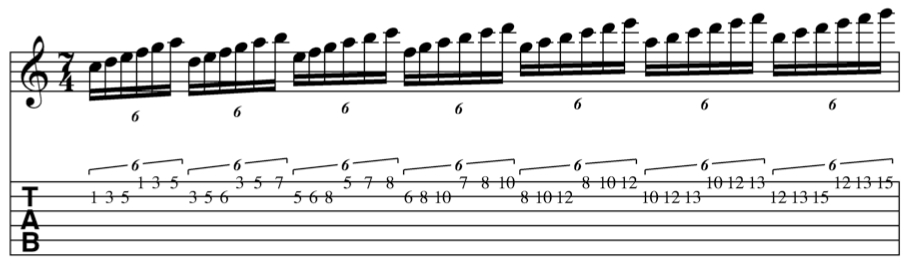
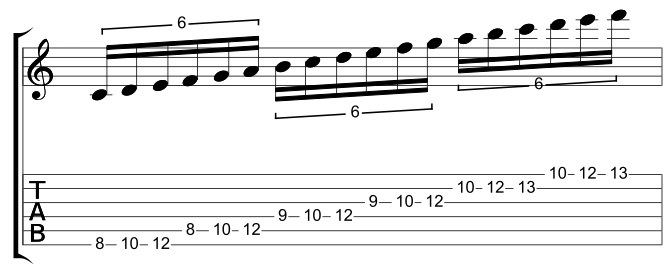
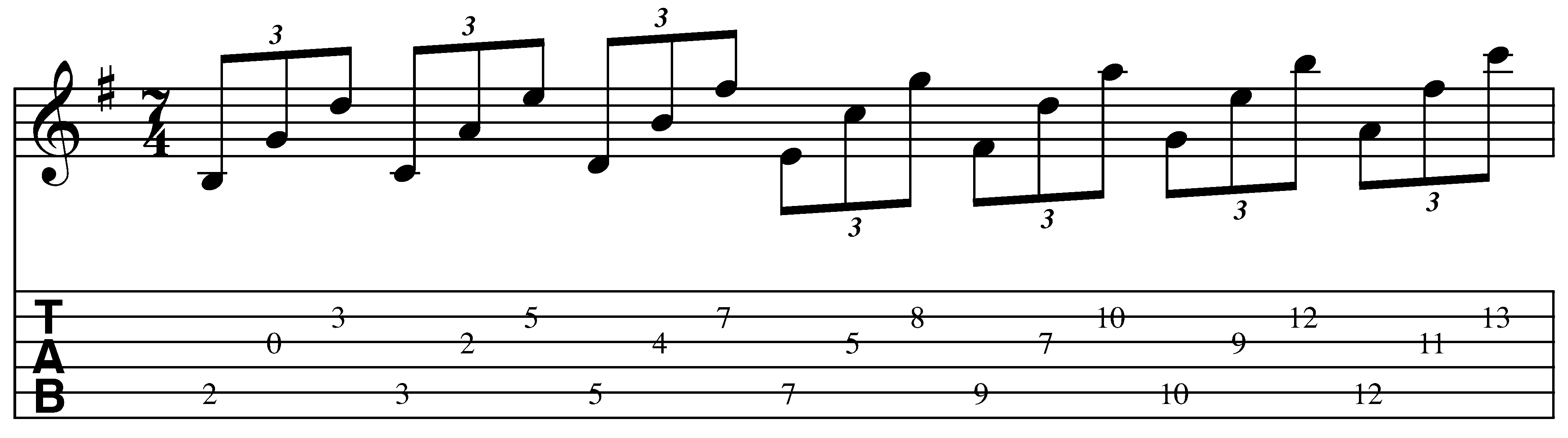
For example, let’s look at an ascending C major scale on the B and E strings:

.

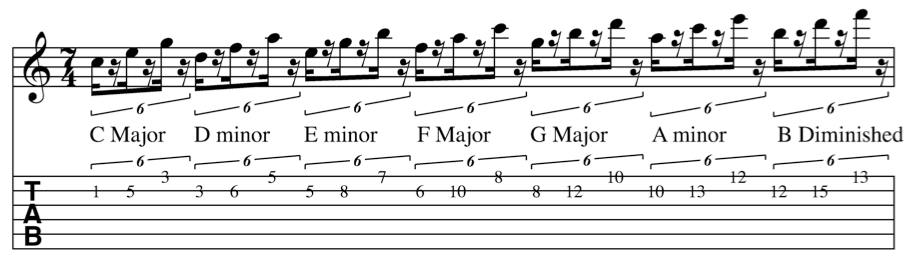
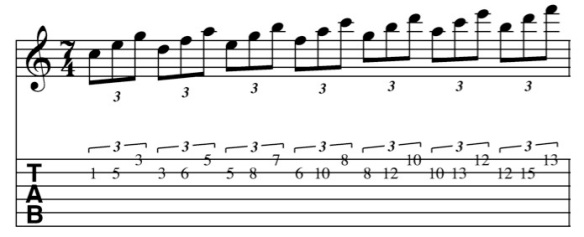
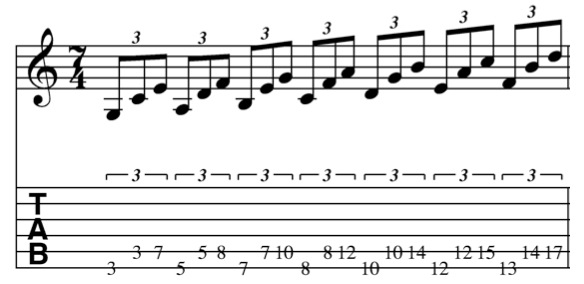
If we remove every other note of the first for notes we can see arpeggiated versions of the triads associated with those modes.

While 2-string arpeggios are often neglected by guitarists, they are certainly worth investigating for helping with visualization.

.

2-String Triadic Visualization

.

The major scale is made up of three types of triads:  major, minor and diminished. Played as unique notes, any triad has three typical voicings:

  • Root position with the root as the bass note: (i.e. Root, 3rd, 5th)
  • 1st inversion with the 3rd as the bass note: (i.e. 3rd, 5th, Root)
  • 2nd inversion with the 5th as the bass note: (i.e. 5th, Root, 3rd)

.

Here are some sample fingerings of each of the chord types played as 2-string arpeggios in each inversion:

.

.

.

.

.

.

.

2-string Major Scale Triads

.

Now I’ll apply each of these arpeggio shapes to the C major scale starting with the root position.

As a reminder here are the triads of the C major scale.

.

 .

Since the fingerings are on 2-strings, they’ll be the same on the E/A, D/G and B/e strings.

.

.

Here are the arpeggios in 1st inversion.  Again, since the fingerings are on 2-strings, they’ll be the same on the E/A and B/e strings as well.

.

C major scale triads in 1st inversion ascending by scale degree

.

And finally, here are the arpeggios in 2nd inversion.

.

.

Putting it together positionally

 .

At the top of the page, I showed how I extracted arpeggios from ascending 2 string patterns.  This same process can be applied positionally.  For example, here’s a 3-note per string C major scale played  in 8th position.

.

.

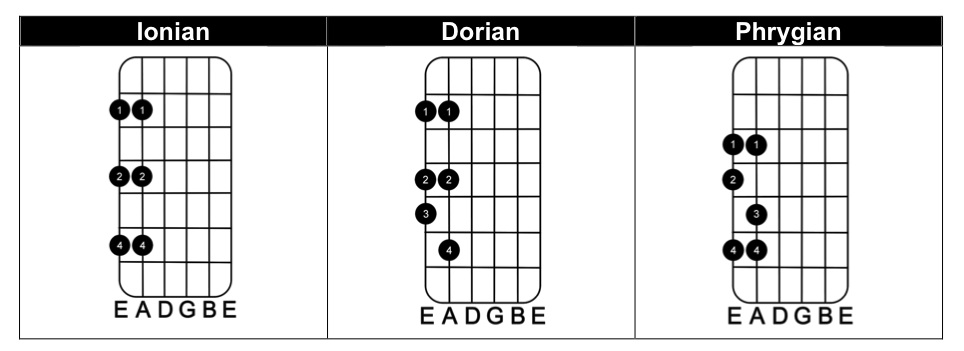
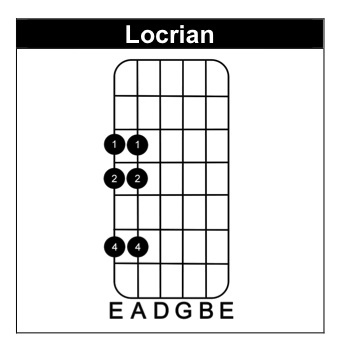
Now I’ll apply each of these arpeggio shapes to the C major scale starting with the root position. To create a modal arpeggio, simply remove every other note.  Doing so with this scale creates a C Ionian modal arpeggio.

.

.

Modal arpeggios are sonically cool because they convey the full sound of the mode but break it out of a scalar pattern.

Modal arpeggios are cool in this method, because if you can visualize a scale then making the arpeggio is relatively easy.

.

The trouble with Ionian

..

The “problem” with the Ionian mode in general is that the natural 4th is an avoid tone over major 7th chords with the same root.  (i.e. C Ionian played over C maj7).  For this reason, I generally avoid Ionian as a mode and instead focus on the major scale for visualization purposes.  

.

With that in mind, here ‘s another approach for using this arpeggio.

.

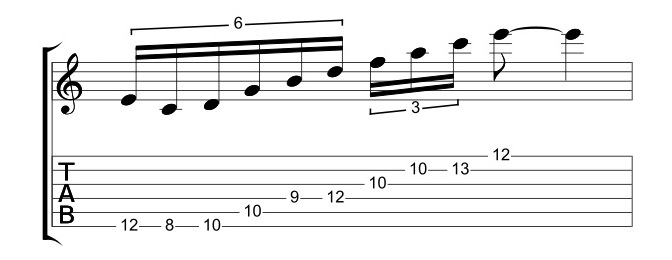
I really dig playing this particular arpeggio over D minor – to create a D Dorian type of sound. In the example below, I’ve used the C and the E pitches on the low E string to encircle the D (one note above and one below) to help emphasize the D minor 13 sound of the arpeggio and end it on the 9th.

.

.

The final visualization trick

.

If we look at the positional arpeggio again:

.

.

Take a close look at the positional modal arpeggio!  If you look at it as a group of 3-note shapes you’ll see that it’s actually made of of 3 triadic arpeggios: C Major, B diminished and A minor.  

.

C Ionian = C maj + B dim + A min

.

Going back to the 2-string scalar observation in part 3 of this post, as the pitches ascend, the related arpeggios descend.  This is true of any of the modal arpeggios – so it might be a cool way for you to visualize it! Try it with your own arpeggio forms!

 .

In the next post, I’ll go through 7th chord arpeggios.  In the meantime, try practicing the 2-string arpeggios over all of the chords of the C major scale:

  • C maj 7
  • D min 7
  • E min 7
  • F maj 7
  • G7
  • A min 7
  • B min7 b5

.

and then over whatever other tonal centers inspire youI hope this helps!  As always, thanks for reading!

.

-SC

.

PS  – if you like this post, you may also like:

.

Books:

.

Lessons

The Perils of Panaceas and Instant Gratification

Hello!

Thanks for coming to this page.

This post has been moved to Get-A-Grip.com.

You can read it here.

Thanks!

-SC

The GuitArchitect’s Guide To Modes Part 9 – Visualizing Melodic and Harmonic Minor

A while ago, I had posted that given an hour, I could get almost anyone at an intermediate level to visualize any of the Major, Melodic Minor or Harmonic Minor modes anywhere on the guitar.  In this overdue return to the serialization of the guide to modes book –  I guess this is my put up or shut up moment. ; )  Since this is print as a pixel based medium – I’m going to cover it in a lot more detail than I might normally in, say a 1/2 hour lesson.
.

As a precursor, all of the information here works off of the 2-string (3 note-per string) pattern visualization method that I’ve covered in parts 3a and 3b of this series, if any of the initial shapes (or connecting ideas) in this post seem confusing, just go back and review the following:

.

THE GUITARCHITECT’S GUIDE TO MODES PART 3B – Seeing The Six-String Major Scale

THE GUITARCHITECT’S GUIDE TO MODES PART 3A – Seeing The Six-String Major Scale

THE GUITARCHITECT’S GUIDE TO MODES PART 2 – Seeing The Two String Major Scale

THE GUITARCHITECT’S GUIDE TO MODES PART 1 – Seeing The Single String Major Scale

.

A Pedagogical note (taken from part 2)

Since the initial emphasis of this lesson series is on sonic visualization and making sense out of 2-string and positional fingerings, I’m only dealing with visualizing parent scales (Major, Melodic Minor or Harmonic Minor in this case)  as a whole here.

While modes are always associated with a chord or a chord progression, I’m limiting harmonic options only to C Major/Melodic Minor/Harmonic Minor  for now.

Extremely important elements in this process, such as harmony, modal interchange, arpeggios, individual modes and actual music making are the topics for other posts.  Having said that, it is important to state again, that modes (or any scale), in and of themselves, are not music but are only a tool in making music.   Anything I post here should always be filtered through your own aesthetic and utilized, adapted or even ignored accordingly (i.e. take what works for you).

With that in mind here’s a review of much of the information as it relates to C major.  For the Melodic and Harmonic minor shapes – just skip down to the next section.

.

Major Scale/Modal Visualization Review

  • The guitar fingerboard can be divided into 3 sets of two strings. Any 2-string fingering pattern that starts on the B string can be moved to the same starting pitch on the D or the low E string and keep the same fingering.
  • The major scale can be broken down into seven two-string modes that follow a specific order based on its scale degree from the parent scale (Ionian, Dorian, Phrygian, Lydian, Mixolydian, Aeolian, Locrian). The two-string patterns are modular and can be adapted to positional playing (see rules above).

.

The modular 2 string modal shapes I use look like this (The numbers represent fingers).

.

.

Here’s a C major scale played  on only the B and E strings:

.

Comparing the initial shapes to the ascending pattern, the positional patterns can be broken down into the seven 2-string modal fingerings that ascend in sequential order  (i.e. C Ionian, D Dorian, E Phrygian, F Lydian, G Mixolydian, A Aeolian and B Locrian).

.

Since the two-string patterns are modular they can also be adapted to positional playing.  So if we look at a C Major scale played in the 8th position and starting from C:

.

.

This 6-string fingering can be seen as containing three distinct patterns:

.

 Two-string sets of C Ionian

.

Here are the important things you need to know for visualizing this:

.

As the fingering pattern ascends across the strings,

the six note modal fingerings descend to the next modal pattern.  

.

Like wise, as the fingering pattern descends across the strings,

the six-note modal fingerings ascend to the next modal pattern.    

.

This is true of any 2-string pattern.

.

Adapting Major shapes to create Melodic and Harmonic Minor fingerings

.

I’ve talked before about the modal microscope and seeing things on the parent major level.  The advantage of this comes into play right here. First, let’s take another look at a C major scale played in the 8th position again:

.

.

Here’s the audio.

.

Note:

In all the audio examples, I’ve played the example first as sextuplets – then at a slower tempo (i.e. 16ths) – then as sextuplets again.

.

.

Each mode is associated with chords as well.  Here’s a chart of the triad and 7th chords  for C Major:

.

.

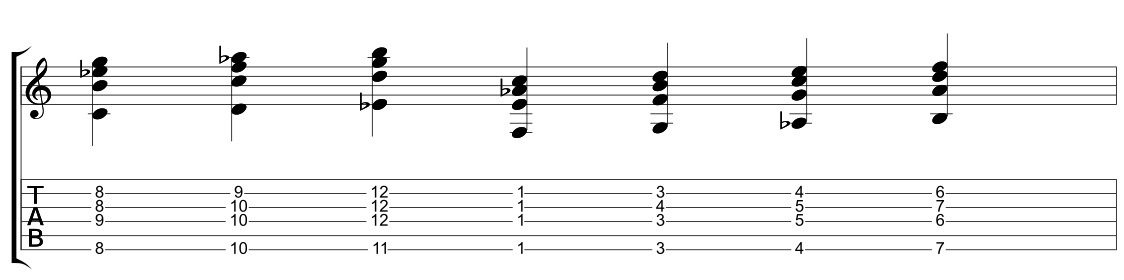
In all of the chord examples below, I’ve taken sample diatonic 7th chord shapes for the E, D, G and B strings with the roots on the low E string. These are certainly not the only way to play these chords, but if you’re not familiar with the voicings they’re not a bad place to start.  Also, while I’ve notated each chord as a 1/4 note, I’ve held each chord for 2 bar lengths (i.e. 8 beats) to be able to play the scale patterns against.

.

.

.

Also, distortion tends to wash out chords with larger voicings, so for all the examples in this exercise, I’ve used a clean setting courtesy of Scuffham Amps.

.

.

Melodic Minor

.

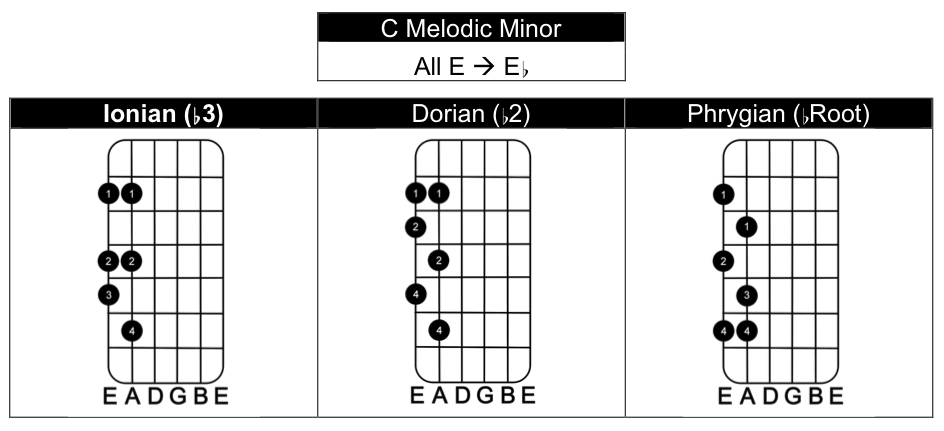
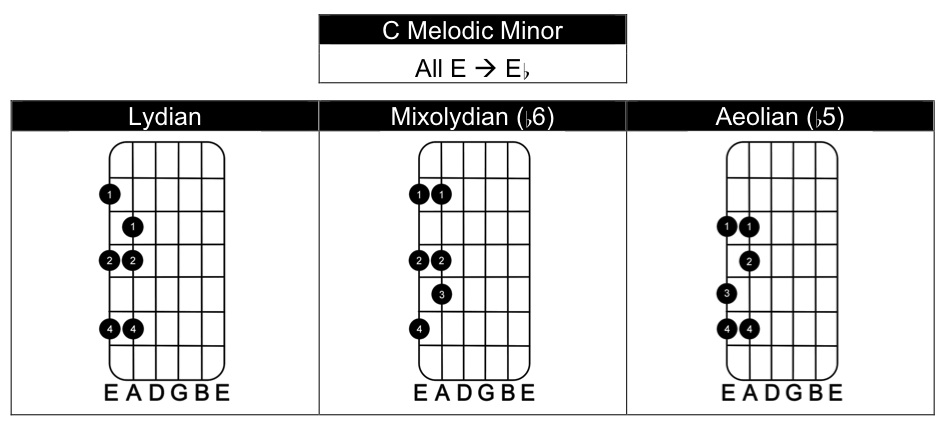
To visualize Melodic Minor Patterns – simply flat the 3rd of the Parent Major scale.

(i.e. to visualize C Melodic Minor just play C major but change every E  to Eb).

.

It’s important to note that all of the fingering conventions mentioned here are solely to assist with visualization. Melodic and Harmonic Minor really aren’t directly related to the Major scale sonically.  

.

.

.

Melodic Minor short cuts:

.

Using the Parent Major patterns above here’s a list of short cut’s to help you visualize the patterns.

.

.

Note: in the F Lydian shape – there’s no change from the major shape since there’s no Eb in the 2-string pattern.

.

.

.

Here’s the initial melodic pattern with the modified major fingerings written above the 2-string shapes:

.

.

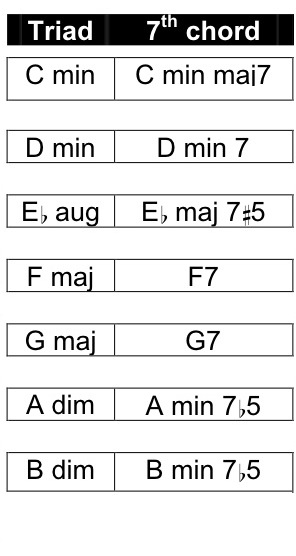
Here are the diatonic triads and 7th chords.

.

.

.

Try playing the initial C Melodic Minor shape over any of these chords..

.

.

.

Harmonic Minor

.

To visualize Harmonic Minor Patterns – simply flat the 3rd and the 6th of the Parent Major scale.

(i.e. to visualize C Harmonic Minor just play C major but change every E  to Eb and every A  to Ab).

.

.

.

Here are the pattern adaptations.  In a situation like this, it can get confusing to remember a formula like “Dorian b2, b5” so as an alternative you may just want to try remembering something like “Pattern 1” for Ionian b3, b6, “Pattern 2” for Dorian b2, b5, etc.

.

.
.
.
..
Here’s the same scale pattern – I left off Pattern 6 by mistake but the sequence is Ionian b3, b6 (Pattern 1 ), Locrian b4 (Pattern 7) and Ionian b5, bRoot (Pattern 6).  You can really see this if you compare it to the initial major patterns.
.
.
Here are the diatonic triads and 7th chords:
.
..
Try playing the initial C Harmonic Minor shape over any of these chords…
.
.
.

Performance Notes:

  • This whole process just a short cut for a visualization process to see C Major/Melodic Minor/Harmonic Minor on the fingerboard.  In parts 3a and 3b of this series, I’ve provided every C major positional fingering.  As a first step, you should consider adapting each of those fingerings to Melodic and Harmonic Minor.  After you get the shapes under your fingers, try moving them to other keys as well.
  • In addition to using a time keeping device of some kind (like a metronome, drum loop, etc) playing along to a chord or a bass note will help establish tonality and help associate each pattern with a sound).  I’ll get more into application in further lessons, but for now try playing the patterns over any of the bass notes or chords in the mp3s and once you get familiar with the chord shapes, try writing tunes or solos with the material.

.

Technical Notes:

  • While it’s natural to want to progress quickly, trying to play too quickly too soon results in excess hand tension which will increase the difficulty of what you’re trying to play.  Fluidity comes from focused, relaxed repetition.  
  • Fretting hand: When playing these patterns, practice using just the fingertip to fret the notes and use the minimum amount of tension needed for the note to sound cleanly.  Additionally, try to keep the fingers down on the strings when playing and remove them from the string only when necessary.
  • Picking Hand:  Try using the above picking pattern on the top two strings or alternate picking.
  • Practice the scale ascending and descending and really focus on clarity of notes, hand tension and timing.  Even many intermediate to advanced players can gain something by really focusing on making clean transitions between the fingering shapes.
  • Isolate problem areas and work out.  You’re not going to be able to play the sequence cleanly if any of the individual components aren’t 100%.  This isn’t a bad thing.  Things you develop over time are more likely to stay with you (and thus be accessible when you’re improvising).

.

Musical:

  • Making music from the patterns is a whole other skill set, but you need to know where to put your fingers on the strings while you  bend, slide and phrase your way into making music.  Having said that, since the visualization process doesn’t take that long,  as soon as you get the shapes down I’d recommend to start manipulating them to try to make them more musical to your ear.   See Part 2 of this series for more specifics or the making music out of scales post for some suggestions for how to do this.

.

Like I said before, I’ll be going deeper into using these scales (and using them in other harmonic contexts) in future posts.  With any lesson material, I recommend you just go through the lesson at your own pace and return as you need to.  Please feel free to post any questions you might have (or pm me at guitar.blueprint@gmail.com).

.

I hope this helps.   As always, thanks for reading!

.

-SC

.

P.S. If you like this post – you may also like:

.

Books:

The GuitArchitect’s Guide To Modes: Harmonic Combinatorics “Pre-Release” Now Available

THE GUITARCHITECT’S POSITIONAL EXPLORATION PRE-RELEASE NOW AVAILABLE

THE GUITARCHITECT’S GUIDE TO MODES: MELODIC PATTERNS BOOK “PRE-RELEASE” NOW AVAILABLE

.

LESSONS

.

Modes:

The Modal Microscope And A Sequenced Arpeggio Approach

Slash and Burn – Creating More Complex Sounds With Slash Chords

The GuitArchitect’s Guide to Modes Part 8 – Major Positional Modal Interchange and Complimenting Modes with Chords

THE GUITARCHITECT’S GUIDE TO MODES PART 7 – MINOR POSITIONAL MODAL INTERCHANGE AND COMPLIMENTING MODES WITH CHORDS

.

THE GUITARCHITECT’S GUIDE TO MODES PART 6 – THE CIRCLE OF 5THS AND MODAL INTERCHANGE

THE GUITARCHITECT’S GUIDE TO MODES PART 5 – MAKING THE MOST OF ONE PATTERN

The GuitArchitect’s Guide To Modes Part 4 – Modes and Chords

.

THE GUITARCHITECT’S GUIDE TO MODES PART 3B – SEEING THE SIX-STRING MAJOR SCALE

THE GUITARCHITECT’S GUIDE TO MODES PART 3A – SEEING THE SIX-STRING MAJOR SCALE

THE GUITARCHITECT’S GUIDE TO MODES PART 2 – SEEING THE TWO STRING MAJOR SCALE

.

The GuitArchitecture Guide To Modes Part 1 – Seeing The Single String Major Scale

Making Music Out Of Scales

.

Pentatonics:

Making Sense Of The Pentatonic Scale – Diagonal Forms – Part Two

MAKING SENSE OF THE PENTATONIC SCALE – DIAGONAL FORMS – PART ONE

Free Sweeping Pentatonic Minor Scale Lesson on Live4Guitar.com now online

.

2 STRING SHAPES OR MAKING SENSE OF THE PENTATONIC MINOR SCALE

THE BAKER’S DOZEN APPROACH TO PENTATONIC SCALES

GUITARCHITECTURE, SONIC VISUALIZATION AND A PENTATONIC APPROACH FOR THE HOLIDAYS

.

Chords/Triads/Superimposition/Arpeggios:

CREATING CHORDS AND LINES FROM ANY SCALE – A HARMONIC COMBINATORICS / SPREAD VOICINGS LESSON

AUGMENT YOUR KNOWLEDGE: SONIC SHAPES AND GETTING MORE FROM AUGMENTED CHORDS

Slash and Burn – Creating More Complex Sounds With Slash Chords

.

GETTING HIPNESS FROM A MAJOR TRIAD OR MORE CHORD RECYCLING PART 3

Getting Hipness From A Major Triad Or More Chord Recycling Part 2

GETTING HIPNESS FROM A MAJOR TRIAD OR MORE CHORD RECYCLING PART 1

.

Getting Through The Gig – Negotiating A Chord Chart Part 3

Getting Through The Gig – Negotiating A Chord Chart Part 2

GETTING THROUGH THE GIG – NEGOTIATING A CHORD CHART PART 1

.

RECYCLING CHORDS PART II: TRIAD TRANSFORMATION

RECYCLING CHORDS PART I OR WHERE’S THE ROOT?

.

FAVORED CURRY OR SPICING UP CHORD SCALES AND TRIADS PART 2

FAVORED CURRY OR SPICING UP CHORD SCALES AND TRIADS PART 1

.

RECYCLING SHAPES OR MODULAR ARPEGGIOS FOR FUN AND PROFIT

GLASS NOODLES – ADAPTING A PHILIP GLASS ARPEGGIO APPROACH TO GUITAR

.

Practicing:

MELVILLE, MADNESS AND PRACTICING – OR FINDING THE DEEPER LESSON PART 2

Some Useful Online Practice Tools

POSSESSION IS 9/10S OF THE LAW BUT PERCEPTION IS EVERYTHING OR PRACTICING PART VII

TESTING YOUR VOCABULARY OR PRACTICING PART VI

PRACTICE WHAT YOU PLAY OR PRACTICING PART V

.

DEFINITIONS AND DOCUMENTS OR PRACTICING PART IV

TENSION AND THE SODA CAN OR PRACTICING PART III

PROPER POSTURE IS REQUIRED FOR PROPER PERFORMANCE – PRACTICING PART II

PRACTICE MAKES BETTER AKA PRACTICING PART I

 .

Visualizing Video Game Licks Or An Intro To Symmetrical 12 Tone Guitar Patterns

Hello everyone!

Update:  My updated 12-tone pattern book is out!  I want to give you a precursor by showing you a cool approach to working 12-tone ideas into your playing.  This is a really long lesson because it’s tough to distill 200+ pages of material into a web post, but just take it in bite sized chunks and come back to it as you need to and I’m sure you’ll get something from it.

First, a little bit about the book!
12 Tone Cover small

The physical book and the e-book pdf are available on Lulu.com or on Amazon.com (or any of the international Amazon sites).
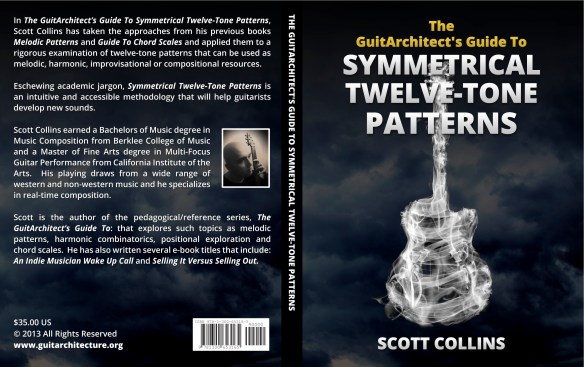
Symmetrical_12_Tone_Cover_Low Res

Symmetrical Twelve Tone Patterns is a 284 page book with a large reference component  and about 100 pages of extensive notated examples and instruction.

What makes this book different (apart from the cover) and what I’m most excited about offering is a bundle of files that will help readers maximize material in the book.  The bundle contains:

  • Guitar Pro files of all the examples in the book (in GP6 and GP5 format). For those of you unfamiliar with this musical notation, tablature platform and playback program, having Guitar Pro files means that the reader can hear the examples without having a  guitar handy and can work as a phrase trainer to help the reader get the examples to up to speed.

  • MIDI files of the musical examples.
  • PDFs of the musical examples.
  • MP3s of all the musical examples (again, exported from the same material).

Symmetrical Twelve-Tone Patterns presents 12-tone patterns in both improvisational and compositional contexts.  It shows how to create various intervallic lines and creates the outline of a tune and dissects how all the parts were created using this method.  If you’re looking for ways to explore new avenues in playing or in your writing this is the book for you!

.

Fire up the video game

When I heard the Praxis Transmutation (Mutatis Mutandis) record, I was blown away with Buckethead’s playing.  It also came at a time that I was getting into a lot of 12-tone music and trying to figure out how to adapt those things to guitar and his intervallic/atonal tapping ideas in particular seemed to go in a completely different direction that the 12-tone ideas I heard Jason Becker and Marty Friedman throw into their playing.

Public Service Announcement (i.e. a brief note about playing out):

Playing out just means playing note choices outside of a given tonality.  By its very nature, playing out requires an ability to play “in” because it requires a contextual contrast. So my suggestion is that you make sure you develop your ability to play in a tonality as well as outside of it.  (Also as a FYI – playing out is easy, but musicians are often judged by how musically they get back in).

.

Every once in a while, I get a hankerin’ for what I call “video game licks” (or symmetrical interval legato licks with a lot of gain and an unclear harmony).  Shawn Lane could veer into that territory when he wanted to but for me, Buckethead is pretty much the king of this approach.

In the lick below, I’ve worked all 12 tones into a two-handed idea that uses pick and fret hand tapping. I’ve kept it short so that you can focus on the coordination between both hands, but I’ve included a longer version of the lick after it.  As the lick uses all 12 tones, it doesn’t belong to any one key so try playing it over various chords or riffs of your choosing.

.

Technical Notes:

  • If you want to get this lick under your fingers, pay attention to the 3 T’s (hand tension, timing and tone) as you practice this.
  • Try to make sure that the motion from the fingers for striking the strings comes from the large knuckle of the hand (for more information on this see the glass noodles post).
  • The pattern is a variation on the tapping figure Greg Howe uses in kick it all over.  It’s written in groups of 6 to fit into one bar –  but just practice it slowly as triplets to get the initial speed and coordination down.
  • I never got into muti-finger tapping on phrases like this one (I just use the middle finger of the picking hand while I hold the pick with the index finger and thumb), but using the ring, middle and first finger on the picking hand for the upper register tapping you could probably work the phrase up to a tempo 30 bmp faster than this one.

.

.

Short lick faster

.

Short lick slower

.

Here’s an extended variation that moves the fingering pattern to the B and D strings.  While the pattern doesn’t keep all of the same intervals as the first example, it has enough continuity to sound like the same 12 tone idea. One recommendation I have is not to get into the dogmatic practice of having to use all twelve tones. If 10 notes work well, use ten notes. In any process like this, use the rules that work for you and discard the rest.

While not notated, this pattern uses all of the same fingerings and note attacks as the first example.

.

.

Longer lick faster

.

Longer lick slower

.

Here’s how I’m visualizing this and how you can generate a lot of ideas from this one approach.

.

The 12-tone pattern vs the 12 tone row

When I first got into 12 tone music and tried to think of a way to incorporate it into improvising, I grabbed some Webern and Berg tone rows (in an over-simplified description – a tone row is a restructured chromatic scale that is used for melodic and harmonic material) and tried improvising with them.

It was pretty dismal.

I found them really hard to improvise with because the row material was difficult to memorize and the number of notes made it difficult to use in an improvisation and then I thought about generating 12-tone patterns instead of working with rows.

.

Patterns can be useful in improvisation because:

  • they can be used to generate motifs, or themes
  • they can be manipulated in real-time and
  • they can establish recognizable elements of control in an improvisation.

The other advantage of a pattern is that its intervallic consistency adds an internal drive to melodic ideas.   The notes of the pattern move in and out of various tonalities, so it sounds “out” but not random (although you can modify it to be as random as you’d like.

In the 12 tone pattern book I wrote, I used a chromatic scale as a template for generating symmetrical patterns for improvisation. Intervallically uniform, the 12 notes of the chromatic scale are evenly divisible by the numbers: 1, 2, 3, 4, 6 and 12.  Since divisions of 1 and 12 do not divide the row into a more useable set, they can be ignored.  This leaves:

.

6 equal divisions:

(of a descending chromatic scale staring on C)

C B / Bb A /Ab G /Gb F / E Eb / D Db

Taking the first note of each division gives us:

 C, Bb, Ab, Gb/F#, E, D

aka: Whole tone scale (any note root)

.

A 12-tone pattern can be created by putting notes in between the notes of the whole tone scale.   Note that the intervals between all the 2-note divisions are symmetrical.

.

C B / Bb A /Ab G /Gb F / E Eb / D Db

C A / Bb G /Ab F /Gb Eb / E Db / D B

C G / Bb F /Ab Eb /Gb Db / E B / D A

C F / Bb Eb /Ab Db /Gb B / E A / D G

C Eb/ Bb Db /Ab B /Gb A / E G / D F

C Db/ Bb B /Ab A /Gb G / E F / D Eb

.

One advantage to symmetrical patterns is that they work off of divisions you probably already know.  If you can visualize a whole-tone scale, for example, filling in the other notes of the pattern becomes relatively easy.

.

4 equal divisions of the row:

C B Bb /A Ab G / Gb F E / Eb D Db

aka: C, Eb, Gb, A (Bbb)

aka: Diminished 7 chord (any note root)

.

3 equal divisions of the row:

C B Bb A /Ab G Gb F / E Eb D Db

aka: C E G#

aka:Augmented triad (any note root)

.

2 equal divisions of the row yields:

C B Bb A Ab G  / (Gb/F#) F E Eb D Db

aka: Tritone interval either note could be root

.

Using the divisions to create a 12-tone pattern

Here’s how I came up with the original example.  Using a diminished 7th chord as a starting point, the rest of the twelve tones could be filled in by playing three additional notes off each chord tone. Let’s say you have D diminished 7th chord (since any note in a diminished 7th chord can be a root it’s also a B, F and Ab diminished 7th chord).

.

B D F Ab

.

By adding 3 notes not already in use to each starting pitch you can create a 12-tone row. If you work out the same intervals on these notes you get a symmetrical twelve-tone pattern.

B  (Perfect 5th down) E, (minor 2nd down) D#

D (Perfect 5th down) G, (minor 2nd down) F#

F (Perfect 5th down) Bb, (minor 2nd down) A

Ab (Perfect 5th down) Db, (minor 2nd down) C

.

Adapting it to guitar

Where this gets cool part 1:

If we restructure the order of the first notes we get two tritones a minor 3rd apart.  Since the E and G strings are a minor 3rd apart this means that the fingering pattern will be the same on both sets of strings.

.

.

Where this gets cool part 2:

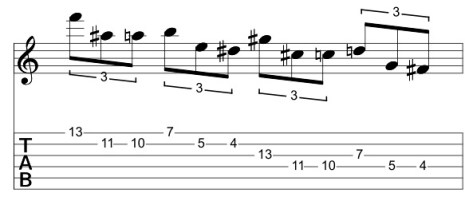
As I’ve mentioned before, using standard tuning the guitar can be visualized as three sets of strings tuned in 4ths.  So this means that the same fingering can be used to generate the same intervals on the G and D strings.

.
.

From here, you can see where the approach for the first lick came from.

.

.

Taking it further

.

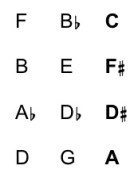
Another nice thing about patterns is that they’re easy to manipulate and draw other ideas from.  Let’s take a look at the first 12 notes:

.

You can change the last four notes to create new lines.

.
.

Here are these two ideas in notation and tab.

.

.

You could apply the same two-handed idea we’ve been looking at to any of these patterns or, better yet, apply your own!

.

Here are the last two patterns starting with F-Bb

.

.

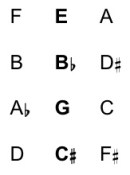
The next step is to change the middle notes of the pattern.

.
.

This creates 4 new patterns that start with F-E-A, F-E-Eb/D#, F-E-C and F-E-F#.

.

.

.

Here’s the same idea applied to F-C#/Db

.

.

.

.

And finally, patterns starting with F-G.

.

.

.

.

To sum up, that’s 16 very different licks all pulled from one approach and one initial pattern.  This is really the tip of the iceberg for this concept but as you can see, you really don’t need more than one approach to get the ideas flowing and use them on your own.

.

Note:

Sometimes you get an idea and think that you’re doing something unique. You get all excited about it until (if you’re me) you realize that Dave Creamer addressed many of these points back in the June 1989 issue of Guitar Player. Dave’s article inspired me to continue to research this book and try to present similar material my own way.

.

* (I should also mention in passing that (with the better part of a year’s worth of research) –  The GuitArchitect’s Guide to Symmetrical 12-Tone Patterns shows all possible symmetrical patterns for the 2, 3, 4 and 6 note divisions above.)

.

I hope this helps and thanks for reading!

-SC

.

12 Tone Cover small

The physical book and the e-book pdf are available on Lulu.com or on Amazon.com (or any of the international Amazon sites)

Symmetrical_12_Tone_Cover_Low Res

Symmetrical Twelve Tone Patterns is a 284 page book with a large reference component  and about 100 pages of extensive notated examples and instruction.

What makes this book different (apart from the cover) and what I’m most excited about offering is a bundle of files that will help readers maximize material in the book.  The bundle contains:

  • Guitar Pro files of all the examples in the book (in GP6 and GP5 format). For those of you unfamiliar with this musical notation, tablature platform and playback program, having Guitar Pro files means that the reader can hear the examples without having a  guitar handy and can work as a phrase trainer to help the reader get the examples to up to speed.

  • MIDI files of the musical examples.
  • PDFs of the musical examples.
  • MP3s of all the musical examples (again, exported from the same material).

Symmetrical Twelve-Tone Patterns presents 12-tone patterns in both improvisational and compositional contexts.  It shows how to create various intervallic lines and creates the outline of a tune and dissects how all the parts were created using this method.  If you’re looking for ways to explore new avenues in playing or in your writing this is the book for you!

I like physical books and the softbound version looks really good on my music stand – but I understand that some people like pdfs. The softbound copy GuitArchitect’s Guide To Symmetrical Twelve-Tone Patterns is $35 (though it’s currently selling for $31.50 on Amazon) and the e-book pdf is $15.   Both are available from The GuitArchitecture Product page on Lulu.


2012: How Not To Repeat The Mistakes Of The Past (Or Nothing Ever Got Done With An Excuse)

(This is a repost of something I wrote for the end of 2010.  The dates and information have been updated, and I suspect this will be one of the few yearly repost traditions I indulge in.)

.

I had hoped to get a few more things done before the end of the year, but decided instead to take the last week to wind down and center.  I find that this not only helps me take stock of what worked and didn’t work for me in 2011 but also helps me make sure I’m on track for what I want to get done in the new year.  As George Santayana said,

.

“Those who do not learn from history are doomed to repeat it.”

As 2011 draws to a close, I think back to many conversations I had with people at the end of 2009.  At that time, it seemed like everyone I talked to said the same thing, “2009 was such a bad year.  2010 has to be better.  It just has to.”

.

Now it seems I’m listening to the same sentiment with the same people about 2011 and the coming 2012.  And in some ways they have a valid point.  Listening to their circumstances, 2011 certainly offered some of these people a tough blow – but regardless of their circumstances, I believe that, unless they experience a windfall of good fortune, I will hear the same sentiments echoed at the end of 2012.  There’s a reason for this:

.

“If you always do what you’ve always done – you’ll always get what you always got” – anon

.

While I fully appreciate the merits of planning and goal setting – life will throw you any number of curveballs that may make a meticulously laid out plan get derailed.

.

A good plan has to be countered with an ability to improvise (as need be) to make sure that even if your mode of transportation is disabled, that you are still on the path to achieve your goals.

.

“Improvisation as a practice is the focus of an idea through an imposed restriction.  This restriction could either be self-imposed or be imposed upon the improviser through other means. Improvisation as it relates to common experience can be seen in the example of the car that stops running in the middle of a trip.  A person experienced in auto repair may attempt to pop the hood of the car to see if they can ascertain how to repair the vehicle.  Or they may try to flag down help.  Or they may try to use a cell phone to contact a garage.  The point being that within the context of a vehicle malfunction, different actions are improvised based on the improviser’s facility with both the situation at hand and the tools at their disposal….life is essentially an improvisation.  As individuals we come into each day not exactly knowing what will happen.  We know that there is an eventual end, but we don’t know when or how it will end.  But we continue to improvise, because it is in both the active improvisation (the present), the skill set and knowledge of that improvisation (the past) and in the philosophical/worldview/goals guiding our improvisational choices (the future) that we create meaning.”

.

If you approach life’s problems with the same mindset you’ve always had 

-and your new year’s resolution runs contrary to that mindset –

your resolutions are doomed.

.

I say this as a seasoned graduate of the school of hard knocks and as a person who found that while success felt a lot better – failure was a much more thorough teacher.

.

2011 had some great ups and downs for me and now there are a number of life and playing upgrades I’m going to put into practice in 2012 to address the things that didn’t work for me.  For those of you who are interested in making a real change the new year – here’s what worked for me going into 2011 that I plan on using this year as well:

.

Know the big picture.

If you have a goal – know why you have the goal.  As Victor Frankl once said, “He who has a why can endure almost any how.

.

Take stock of what you have done and identify what needs to change.

Have you done things that work towards that goal?  If so, what have you really done? What worked?  What didn’t work?  And what parameters can you put in place to make it work better?

What decisions did you make that set you back and how could you alter those decisions in the future?

Sometimes honesty is brutal but this isn’t about beating yourself up.  It’s about taking a realistic stock of what worked and what didn’t work for you in the year, reinforcing that things that work for you and discarding what didn’t work for you.

.

Revolution not resolution

People typically make resolutions because they recognize a need for change in their life.  For me – it really isn’t about making a momentary decision as a knee jerk reaction to something (which usually lasts as long as the time it took to make that decision).  The long-lasting changes in my life have come from making lifestyle changes, setting priorities and working within those changes.  It’s a revolt against what was done before instead of a compromise for a current mode of operation.

.

Positive habits

Making something a daily positive habit (like brushing your teeth) makes it easier to maintain over the long haul.

.

“Don’t make excuses – make it right” –  Al Little

People make excuses for things all the time.  No one cares about excuses because nothing ever got done with an excuse.  People (typically) only care about results.

.

There will undoubtably be moments that you relapse into older habits.  Instead of making excuses for why it happened – just acknowledge it and move past it. When you fall off the bike, it’s not about sitting down and nursing your scrapes.  It’s about getting back up on the bike again.  As it says in The Hagakure, “Seven times down – eight times up”

.

There is strength in numbers

Try to surround yourself with supportive people.

  • Not enabling people who will make changes more difficult for you.
  • Not negative or judgmental people who will scoff at your desire for change

.

Talk to the friends and family who will give honest and supportive feedback.  Here’s another important tip – don’t burn those people out with your goals.  The people around you have their own lives, so if every conversation becomes about you and your goals, you’re going to see less and less of those people!

.

In addition to (or in some cases in lieu of) that support, you may want to look into some free online accountability sites like Idonethis.com (post on this here) or Wunderlist.com which maintains a private calendar to help observe progress.

.

Be motivated to do more but be grateful for what you have

In a final 2011 observation, I’d like to thank everyone who took a moment to come here and read what I was doing.  GuitArchitecture had a 800 % increase in web traffic this year!  It’s going to get even bigger next year and it would all be impossible without the people reading.  So thank you all again and I hope that 2012 is your best year yet.

.

-SC

Creating Chords And Lines From Any Scale – A Harmonic Combinatorics / Spread Voicings Lesson

Hello everyone!

.

I wanted to post a lesson up that uses one of my approaches to harmonizing scales from my Harmonic Combinatorics book.  It’s a cool way to not only get away from stock voicings but also to generate new lines as well!

I’m using C Major as the tonal center for this lesson but the approach can (and probably should be) be adapted to any scale.

.

A couple of lessons ago, I talked about the modal microscope  – which was a term I used to discuss examining modes on multiple levels and the advantage of viewing modes as subsets of a parent scale.  Before I get into the harmonization approach I want to expand on this idea of the microscope analogy and apply it to harmony.

.

The Harmonic Microscope

If I harmonize a parent major scale in the key of C, I’ll end up with the following chords on each scale degree.

.

.

So if you’re playing in the key of C and want to get into more harmonic depth on an E minor chord, it’s time to reach into your chord bag and pull out your stock  minor 11 (b9, b13) voicing.  Oh, you don’t have one?  Don’t worry – most guitarists don’t.  Learning stock voicings and inversions for this specific chord form probably isn’t the best use of your time anyway.

Using the microscope analogy, this is really looking at the chord on a 2x setting.

.

Here’s the 1x setting for this example:

playing any combination of the notes from C Major over the root E creates some variant of an

E min / min7 / min7 (b9) / min 11 (b9, b13)  chord.

.

And here’s the bigger picture:

Once you are aware of the types of sounds that are created from various chord types, you can start thinking about chords and chord voicings on the macro (i.e. parent scale) level. This means that if I’m playing over a D minor chord and using notes from the C major scale, I don’t have to analyze each indidual chord because I know it’s all under some type of generic D minor 7/minor 9/minor 11 or minor 13 umbrella. 

Harmonic Combinatorics

Harmonic Combinatorics refers to a process of identifying “countable discrete structures” harmonically.  In other words, it examines unique combinations of notes on all of the possible string combinations for the purposes of develop harmonic and melodic possibilities.  One way to do this is through a method that I use to generate unique ideas through a process that some people refer to as spread voicings.

.

A Systematic Method For Harmonizing Any Scale Or Mode On The Guitar

It’s important to state at the outset that the method I’m employing is only one possible way to approach this exploration.  I’ve taken this approach to maximize the number of unique voicings, but you should feel free to take any of the rules that I’ve applied to this approach (like eliminating octaves) with a grain of salt.  The object is to gain new sounds – so change the patterns here in whatever ways necessary.

.

Here’s an approach that will give you more voicings and lines than you might have thought possible.

.

  • Step 1:  Write out a scale and write the scale degree under each note.

(Example:  C Major)

.
  • Step 2:  On a blank chord sheet – write out the scale degrees on each string up to the 5th fret.

.

(To clarify: The numbers on the left hand side of the diagram are the fret numbers ).

.

.

  • Step 3:  Starting with the lowest note on the lowest string, write out all the initial voicing of all possible 2, 3, 4, 5 or 6 note harmonies by scale degree on different string sets.

.

For example, if I was looking at the G, B and high E strings, some sample initial voicings would be

573, 574, 576, 513, 514, 516, 523, 524, 526, 534, 536

673, 674, 675, 613, 623

713, 723

173, 174, 175, 176, 123

.

You may have noticed that I skipped some voicings:

.

If you want to save some time and increase the number of unique chords try the following parameters:

.

  • No doubling of chord tones (Ex. 363).  (Again – if you like that sound – use it!  but the point of this process is to generate unique voicings with unique notes.)
  • At least one note in the voicing has to be the lowest on a string.  If you look at 614 on the G, B and high E strings you’ll see that it’s really the second voicing of 573 on the frets below it.  Having at least one note be the bottom note on any string will help ensure that you’re not just working out voicings that you may have already done.
  • The highest fret to be used in the first voicing is the 5th fret.  This last step is going to produce some voicings that aren’t playable on the lower frets, but might work in the upper registers.

.

  • Step 4:  Select a string set and move the voicing in scale-wise motion up the strings to the octave.

.

For the purposes of this lesson – I’m going to focus primarily on 3 string groups, but this idea is applicable on any 2-6 string set of strings.  (It’s worth mentioning that – Harmonic Combinatorics does all the work for this process for all string sets – (it’s also why it’s over 400 pages long!!)).

.

.

(Again, while this book follows this process through the key of C Major, this process can be applied to any tonal center.)

.

  •  I’ve written out an example based on the D, G and B string set (i.e. 432) and gone with an initial voicing of a F, G and D (or 452).

.

(Note:  The reason I start with numbers instead of notes is 1.  It’s a lot easier to see if I’ve missed a number in a sequence when working these things out and 2.  It eliminates the initial step of wondering what harmony I’m creating.  This is simply a process that I’ve used with good results.  If the numbering is weird for you, just use what works for you.)

.

.

.

  • This creates seven different voicings which could be played as a modal chord progression, used as the basis for a melodic idea or even isolated into individual chords.  If this process yields even one chord that you like it’s worthwhile.

.

  • The function of the voicings will depend on the root. If you want to dig deeper into this area, you can use other notes as a root (note Harmonic Combinatorics includes a chart which shows all chord tones based on scale degree).  I’ve posted  the sound of the chords being played against an A root below. A was picked as a root because it’s an open string, but you could just as easily tap any note from the C major scale to create various modal sounds:

.

  1. Playing C as the bass note will give you C Ionian sounds
  2. Playing D as the bass note will give you D Dorian sounds
  3. Playing E as the bass note will give you E Phrygian sounds
  4. Playing F as the bass note will give you F Lydian sounds
  5. Playing G as the bass note will give you G Mixolydian sounds
  6. Playing A as the bass note will give you A Aeolian sounds
  7. Playing B as the bass note will give you B Locrian sounds

.

Check out these chord sounds over A.  In addition to possible comping ideas, these can be arpeggiated for melodic ideas as well.

.

.

A few notes on working with voicings

.

Here are some additional points to consider when using this process:

.

  • Common sense is your friend.  If a chord seems difficult to play:

.

.

there is almost always an easier way to play it on another string set.

.

.
Since the voicings presented are in the key of C Major with no sharps or flats, the information (and approach) here is easily adaptable to other scales, modes etc…

.

  • If you find a voicing in C Major you like, just move it to whatever other key you’re playing in.
  • To create all of the C Melodic Minor (i.e. Jazz Minor) voicings – just change any E to Eb.
  • To create all of the C Harmonic Minor voicingsjust change any E to Eb and any A to Ab.

.

Now I’ll talk about making melodic lines from this material.

.

Melodic Variations

.

As I mentioned earlier, these voicings can be played as melodies simply by playing the notes one at a time.  In The GuitArchitect’s Positional Exploration and the GuitArchitect’s Guide to Modes: Melodic Patterns, I’ve outlined a series of methods for generating melodic variations. But since this approach is about combining things, it makes sense to at least look at some melodic possibilities with regards to note choice.  I’ve decided to take a three-note voicing as it offers enough possibilites to be interesting, but not too many to be over-whelming and have chosen this pattern simply because I like the first voicing.

.

.

It sounds a little deceptive if you play it as is.  This is because the first voicing is actually a G major chord in 1st inversion (i.e. with B in the bass).  Here it is with the root of each chord added to the low E string (Try working them out and playing them!!  There are come challenging chords there.)

.

.

but when you play it with the B as the lowest note it sounds like a B minor with the b3rd on the B string.

.

.

If you play it without harmonic backing, try changing any F natural to F # and it should sound more pleasing to you.

.

“Variety is the spice of life”

.

There are six unique melodic variations of any three-note chord or pattern.

.

.

These numbers represent note order.  Assigning 1 as the lowest note and 3 as the highest – here are the unique variations on the first three notes.

.

Applying this idea, one possibility for 123 looks like this:

.

.

.

Two things to consider:

.

1.  I’ve notated this as triplets for ease of reading, but the very first thing you should probably do (after getting the notes under your fingers is look for a more musical phrasing).

.

.

2. Again, if you play this without harmonic backing this may sound more “right” to you:

.

.

Alternating groups of 123 and 321 for each chord produces:

.

.

.

Combining the first 2 chords into a 6-note pattern allows even more flexibility.  Here, I’ve moved the number order around and made a more interesting line.

.

.

.

One part of this phrase has caught my ear:

.

.

When I add a low E root, I get a cool little Phrygian phrase (with a couple of notes snuck in on the high E string).

.

.

The GuitArchitect’s Positional Exploration and the GuitArchitect’s Guide to Modes: Melodic Patterns, has a systematic approach to exploring these types of variations.  Having said that, those of you who want to do the work, could just write down a collection of numbers and apply them to different ideas and see what happens.

.

The first important thing, however, is to experiment with different rhythms (including rests!), phrasings (like slides, hammer-on/pull offs) and make some music out this raw material.

.

The second important thing to consider is that with any approach like this you should:

  • take the things you like
  • use them in what you’re currently working on (songs, solos, etc)
  • make what you keep part of your sound and discard (or ignore) what you don’t use.

.

I cover some other approaches and break down the theory a little more in depth in Harmonic Combinatorics but I hope this lesson here helps and if you like this idea – you should check out the book (if you haven’t already)!

.

Thanks for reading!

.

-SC

.

If you like this post you may also like:

.

Books:

The Modal Microscope And A Sequenced Arpeggio Approach

Slash and Burn – Creating More Complex Sounds With Slash Chords

Making Music Out Of Scales

.

Chords/Triads/Superimposition/Arpeggios:

AUGMENT YOUR KNOWLEDGE: SONIC SHAPES AND GETTING MORE FROM AUGMENTED CHORDS

.

GETTING HIPNESS FROM A MAJOR TRIAD OR MORE CHORD RECYCLING PART 3

Getting Hipness From A Major Triad Or More Chord Recycling Part 2

GETTING HIPNESS FROM A MAJOR TRIAD OR MORE CHORD RECYCLING PART 1

.

Getting Through The Gig – Negotiating A Chord Chart Part 3

Getting Through The Gig – Negotiating A Chord Chart Part 2

GETTING THROUGH THE GIG – NEGOTIATING A CHORD CHART PART 1

.

RECYCLING CHORDS PART II: TRIAD TRANSFORMATION

RECYCLING CHORDS PART I OR WHERE’S THE ROOT?

.

FAVORED CURRY OR SPICING UP CHORD SCALES AND TRIADS PART 2

FAVORED CURRY OR SPICING UP CHORD SCALES AND TRIADS PART 1

.

RECYCLING SHAPES OR MODULAR ARPEGGIOS FOR FUN AND PROFIT

GLASS NOODLES – ADAPTING A PHILIP GLASS ARPEGGIO APPROACH TO GUITAR

.

Augment Your Knowledge: Sonic Shapes and Getting More From Augmented Chords

Hi everyone!

.

I wanted to post a lesson that uses some of the material from my Positional Exploration book in a way that I didn’t get to cover in the text itself.

Back in November when Guitar-Muse posted the second part of my interview with Rob Balducci, Rob brought up a process he called chord morphing.  When I saw it in the video, I slapped my head forehead loudly as I realized that while I mentioned that any of the melodic exercises in the Positional Exploration book could be played as a chord, I didn’t include chord tablature.

.

Anyway Rob had this cool idea of taking a 1-2-3-4 chromatic shape and playing it one note per fret on the bottom 4 strings which produces an Augmented chord like this:

Note:

Rob play this up on the 12-15th fret, but I’ve moved it to a low pitch of C for the purposes of explanation.

.

He then goes on to lower each note of the chord chromatically one at a time until he ends up with an augmented chord a 1/2 step away from where he started.    I’ve detailed a sample of this below with analysis, when playing it the key to remember is keeping your fingers down and only moving finger playing the individual note that changes.

.

.

Sonic Shapes

.

So, I thought that was a cool way to:
.

  1. warm up
  2. find some new voicings (1 shape yields 4 chords total) and
  3. see how different chord forms can be created by modifying existing voicings.

.

(You can check out my recycling chords post, for a pretty in-depth exploration of this idea with triads!)

.

And then I got to thinking about Sonic Shapes.  Back in the day, Howard Roberts used to write a column for Guitar Player magazine and he had a whole series of columns that centered around an idea of sonic shapes, which is moving a fingering to different string sets to create different sounds.  So here, I’ve taken the same 1-2-3-4 augmented shape and moved it to the 5th string:

.

.

And finally moving it to the top four strings:

.

.

Going Deeper

.

Then, because I couldn’t leave well enough alone, I started thinking about augmented chords in general.  They’re neat little things because they’re intervallically symmetrical and any note in the chord can be the root.

You can also use them to visualize all of your 3-note major and minor inversions.

.

Here’s the first trick using augmented chords that I copped from Pat Martino:

.

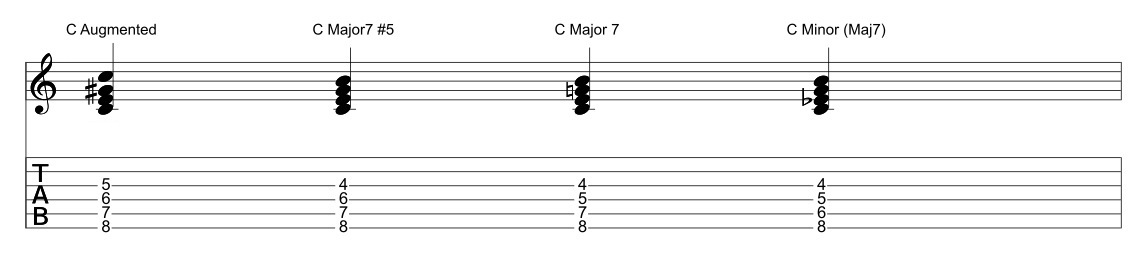
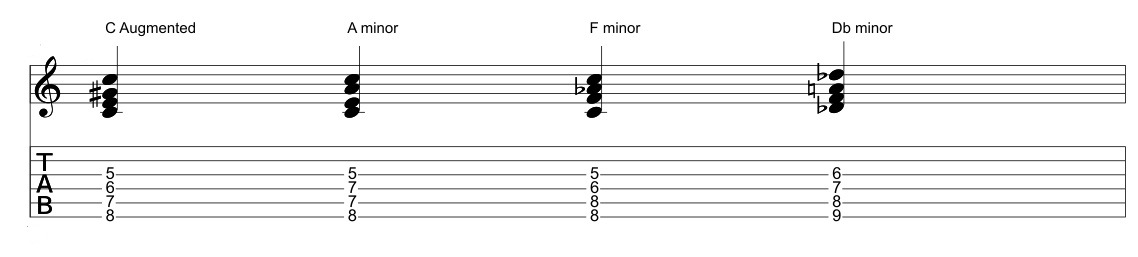
If you sharp any note of an augmented chord you create a minor chord with the sharped note acting as the root

.

In the following chords,  I’ve taken the original 4-note voicing I had (with doubled C) and sharped one note at a time which creates A minor, F minor and Db (or C#) minor.

.

.

Following through on this process, we can find voicings for every minor chord inversion.  First I’ll go through the inversions of the 3-note augmented chord across each group of 3 strings:

.

.

With the augmented inversions outlined, try converting each voicing to a minor chord:

  • Raising C a 1/2 step creates a C#/Db minor chord
  • Raising E a 1/2 step creates a F minor chord
  • Raising G# a 1/2 step creates a A minor chord

.

Since augmented chords are symmetrical –  the fingerings for inversions repeat every Major 3rd (i.e. 5 frets higher).

.

The next step is to move the entire pattern up 5 frets and repeat the process of converting the chords to minor.

.

.

Going up another 5 frets gives up the final inversion.

.

.

Once you get used to manipulating the augmented patterns to create all three minor chords, try taking one minor voicing (like A minor for example) and using the augmented visualization, try visualizing every inversion of A minor both across the fingerboard as well as on each string set.

.

Augmented visualization tip #2:

.

Here’s another cool trick from Mr. Martino:

.

if you flat any note in an augmented triad, the flatted note becomes the 5th of a major chord.

.

.

You can guess that the next step would be to apply this to all of the above inversions like you did with the minor.

.

To Review:

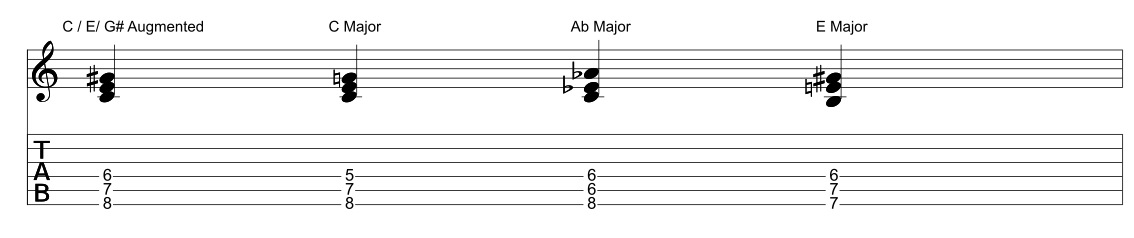
C / E/ G# (Ab) augmented can be transformed into:

  • A minor
  • F minor
  • C#/Db minor
  • C major
  • Ab major
  • E major

.

In a future post, I’ll talk about this as a melodic application, but in the meantime think about this:

If all of the above chords are related from C / E / G# augmented, then that augmented chord could be used as a bridge to cross bridge chords in very different key centers.

.

For Example:

A minor – C augmented – F minor.

A minor – C augmented – Db minor.

.

For those of you who have read my glass noodles post, you’ll see where this is going for a future lesson.

.

Enjoy the new voicings and thanks for reading!

.

SC

.

PS – If you like this idea, you might find my Positional Exploration book, Harmonic Combinatorics Book, Chord Scale Book or Melodic Patterns book really helpful in generating new melodic ideas or approaches.

For posts here, you may also like:

.

Chords/Triads/Superimposition/Arpeggios:

GETTING HIPNESS FROM A MAJOR TRIAD OR MORE CHORD RECYCLING PART 3

Getting Hipness From A Major Triad Or More Chord Recycling Part 2

GETTING HIPNESS FROM A MAJOR TRIAD OR MORE CHORD RECYCLING PART 1

.

Getting Through The Gig – Negotiating A Chord Chart Part 3

Getting Through The Gig – Negotiating A Chord Chart Part 2

GETTING THROUGH THE GIG – NEGOTIATING A CHORD CHART PART 1

.

RECYCLING CHORDS PART II: TRIAD TRANSFORMATION

RECYCLING CHORDS PART I OR WHERE’S THE ROOT?

.

FAVORED CURRY OR SPICING UP CHORD SCALES AND TRIADS PART 2

FAVORED CURRY OR SPICING UP CHORD SCALES AND TRIADS PART 1

.

RECYCLING SHAPES OR MODULAR ARPEGGIOS FOR FUN AND PROFIT

GLASS NOODLES – ADAPTING A PHILIP GLASS ARPEGGIO APPROACH TO GUITAR

.

Books

.

The Modal Microscope And A Sequenced Arpeggio Approach

Hello everyone!

.

I’ve been cleaning up a lot of the text for the GuitArchitecture book releases and wanted to post a lesson that uses some ideas and approaches from my Melodic Patterns book (available here).  But first, I need to talk about…

.

The Modal Microscope

.

When I explain using modes to students – I typically use the analogy of a microscope to discuss viewing modes conceptually on multiple levels.

.

Let’s say I want to solo over a D min7 chord.  So I’ll put that “under the microscope”.

.

On the 2x setting, I see that a number of minor modes will work over D min7.  In this case,  I’ll choose Dorian.

.

Going to the 4x setting on the microscope, I see that Dorian is made up of a series of interlocking 2-string patterns.

.

Note: 

If you’re unfamiliar with the 2-string approach I’m discussing I definitely recommend that you check out part 2, part 3a or part 3b of my guide to modes posts.

.

If I go to the 8x setting, I can break the 2-string patterns down into 1 string shapes and going to a higher resolution (16x) I can see those shapes as individual notes.  At the 16x setting – maybe I’m looking at the individual notes of D min7 (D, F, A and C) and thinking about accenting those notes in my playing.

.

If I now go out to the 1x setting – I see that D Dorian is just a subset of C major.  The thing is if you go playing a bunch of C major scales over D dorian and don’t resolve anything (or focus on the chord tones) – you’re missing a big piece of the puzzle.

.

It’s good to understand modes on multiple levels but if you see how all of the related modes interlock with each other, then (using the microscope analogy), you can deal with using modes with chords on the 1x or 2x level but use information from the higher levels in your playing.

.

Putting this to use:

.

I’ve posted a number of technical things here and decided to use a much lower gain approach than normal and slow things down a bit.  The same practice points as before (Tone, Tension and Timing) apply – but this exercise is all about how to find variations in small things.  (If you like the technical things don’t worry I’ve included some deceptively tricky variations as well!)

.

Let’s take a 2-string G Major shape.

.

.

.

The nice things about 2-string patterns like this is that the fingering repeats at each octave.  (So you only need to remember one fingering for a multi octave run).

.

.

.

One process I explore in my Melodic Patterns book is systematically breaking down patterns to get new sounds out of them.  In this case, I’m going to remove the 2nd and 4th note from the pattern which leaves me with this shape:

.

.

.

Looking closely at the notes reveals that I have a G, B, C and E which is a C maj7 arpeggio. By limiting it to a  2-string shape,  I can move it in octaves and the fingering stays the same.

.

Note:

The drums are the same pattern I’ve used on my other posts, so you can play against it for any other the things I post here (more info below).

.

.

.(I’ve added a C maj7 chord in front of this to give a sense of tonality.)

.

.

Going to a higher resolution

.

I know that G parent major also contains A Dorian – which works well over A minor chords.  So playing this shape over A minor the notes – now become: b7 (G), 9 (B), b3 (C) and 5th (E).  Which has a cool sound associated with it.  (I’ve subbed out A min7 for C maj 7 here for the opening chord).

.

.

.

Sequencing the ideas:

.

However cool any scale or arpeggio is, playing it in a linear up and down manner will only get you so far.  By playing groups of notes in short sequences, the arpeggio gains a little melodic drive.

.

In this first variation I’ll play groups of 3 (So I’m playing 3 ascending notes from each note of the arpeggio).  One way to immediately make this more interesting is to break the 3 note grouping out of the triplet rhythm.  Playing the same pattern in 16ths – displaces the first note of each pattern across different beats.

.

.

.

Here’s the same idea descending: (This is another case where the microscope idea comes into play.  The A note ending the phrase isn’t part of the 4 note arpeggio – but gives the descending line a sense of resolution.  Since I’m seeing and hearing the phrase as an A minor tonality – I’m resolving it to the tonic (A),  third (C) or 5th (E).

.

.

.

For a little variety –  I’ve taken the same idea but played it as sextuplets instead.  I’ve notated the first bar of it (as the notes are the same as the patterns above) – but I play it ascending and descending on the mp3 below.

.

.

.

5 alive

.

To get a little more mileage out of this arpeggio, I’m going to play the notes in groups of 5.  Here it is in a 1/16 note rhythm (I’ve left off the last 2 notes to keep it on one line).

.

.

.

Technical note:

Watch the position skip on the A/D and the B/ G strings!!

Here it is as septuplets (5 notes to the beat).

.

.

.

Changing the note order

.

You may have noticed that all of these arpeggios use a linear note order in the sequence.  So if G is the first note of the 1st pattern and B is the 2nd note – every pattern moves in straight ascending or descending order.

.

3 Note Pattern: G, B, C/B, C, E/C, E, G

in note order = 1,2, 3/2, 3, 4/ 3, 4, 1 etc.

.

But what if we varied up the note order?  In this example, I’m going to take play groups of 3 descending notes on each ascending note of the arpeggio. (So instead of playing note numbers 1,2 3  – I’m playing 3-2-1).

.

.

.

Here it is descending:

.

.

.

Displacing the rhythm by a 1/16 makes it cooler.

.

.

.

And again, descending:

.

.

Obligatory Plug

.

I’m only scratching the surface of what’s possible here.  The big takeway here is – if you really go deep on even something small – you can probably find interesting things that will work in your playing.

.

I would also be remiss in not mentioning that my melodic patterns book shows every possible unique combination of notes (and rests) in 1 – 6 note shapes and then shows how to combine them into longer sequences (up to 9 note patterns).  It is a deep resource that can open all manner of melodic and compositional doors (and makes a great gift as well!) ; )

.

Tones

.

I went with another tonal variation here and tried some of the lower gain settings on the Scuffham amp AU.  It’s a cool product and I should have a review up soon.  In the meantime – he’s a screenshot of the laptop set up I used to track this:

Click to see full size

.

I‘ve mentioned this in the laptop guitar posts – but the varispeed is a useful plug-in!  When I get bored with a metronome sound – I’ll throw a drum loop into the AU fileplayer and then use the varispeed to control the speed of the loop.

.

As always, I hope this helps!

.

-SC

.

If you like this post, you may also like:

.

Books:

LESSONS

.

Slash and Burn – Creating More Complex Sounds With Slash Chords

The GuitArchitect’s Guide to Modes Part 8 – Major Positional Modal Interchange and Complimenting Modes with Chords

THE GUITARCHITECT’S GUIDE TO MODES PART 7 – MINOR POSITIONAL MODAL INTERCHANGE AND COMPLIMENTING MODES WITH CHORDS

.

THE GUITARCHITECT’S GUIDE TO MODES PART 6 – THE CIRCLE OF 5THS AND MODAL INTERCHANGE

THE GUITARCHITECT’S GUIDE TO MODES PART 5 – MAKING THE MOST OF ONE PATTERN

The GuitArchitect’s Guide To Modes Part 4 – Modes and Chords

.

THE GUITARCHITECT’S GUIDE TO MODES PART 3B – SEEING THE SIX-STRING MAJOR SCALE

THE GUITARCHITECT’S GUIDE TO MODES PART 3A – SEEING THE SIX-STRING MAJOR SCALE

THE GUITARCHITECT’S GUIDE TO MODES PART 2 – SEEING THE TWO STRING MAJOR SCALE

.

The GuitArchitecture Guide To Modes Part 1 – Seeing The Single String Major Scale

Making Music Out Of Scales

.

Chords/Triads/Superimposition/Arpeggios:

GETTING HIPNESS FROM A MAJOR TRIAD OR MORE CHORD RECYCLING PART 3

Getting Hipness From A Major Triad Or More Chord Recycling Part 2

GETTING HIPNESS FROM A MAJOR TRIAD OR MORE CHORD RECYCLING PART 1

.

Getting Through The Gig – Negotiating A Chord Chart Part 3

Getting Through The Gig – Negotiating A Chord Chart Part 2

GETTING THROUGH THE GIG – NEGOTIATING A CHORD CHART PART 1

.

RECYCLING CHORDS PART II: TRIAD TRANSFORMATION

RECYCLING CHORDS PART I OR WHERE’S THE ROOT?

.

FAVORED CURRY OR SPICING UP CHORD SCALES AND TRIADS PART 2

FAVORED CURRY OR SPICING UP CHORD SCALES AND TRIADS PART 1

.

RECYCLING SHAPES OR MODULAR ARPEGGIOS FOR FUN AND PROFIT

GLASS NOODLES – ADAPTING A PHILIP GLASS ARPEGGIO APPROACH TO GUITAR

.

Practicing:

MELVILLE, MADNESS AND PRACTICING – OR FINDING THE DEEPER LESSON PART 2

Some Useful Online Practice Tools

POSSESSION IS 9/10S OF THE LAW BUT PERCEPTION IS EVERYTHING OR PRACTICING PART VII

TESTING YOUR VOCABULARY OR PRACTICING PART VI

PRACTICE WHAT YOU PLAY OR PRACTICING PART V

.

DEFINITIONS AND DOCUMENTS OR PRACTICING PART IV

TENSION AND THE SODA CAN OR PRACTICING PART III

PROPER POSTURE IS REQUIRED FOR PROPER PERFORMANCE – PRACTICING PART II

PRACTICE MAKES BETTER AKA PRACTICING PART I

.

Melville, Madness and Practicing – Or Finding The Deeper Lesson Part 2

Condensed Cliff Notes

.

Years ago, I found a back issue of National Lampoon that had a faux ad for Condensed Cliff Notes (“for people who didn’t have time to read the original”).  The joke was that major literary works were just boiled down into one sentence descriptions that couldn’t possibly encompass the scope of the book.  The Condensed Cliff Notes for Moby Dick was, “A whale bites off a man’s leg and he can’t forget about it.”

I don’t know how many of you have read Moby Dick.  I hated it when I had to read it in high school but really got to appreciate it when I was in college and read it again.  One of the central characters in the book was Captain Ahab, a man who not only couldn’t forget about the whale that bit his leg off – but was on monomaniacal mission of revenge that enveloped everyone around him in its wake.   At the end of the book, it’s also his undoing.

.

The Ahab effect and practicing

.

The nature of practicing music (seemingly endless repetition) makes it easy to fall into the Ahab role of obsessively trying to get a musical passage under your fingers.  I once had a lick I couldn’t get down.  It was challenging, but it certainly was something that was well with in my skill set.

.

But the more I worked at it  – the worse it got.

.

I’d work on this lick everyday for hours and get the metronome to a certain point.  When I came back to it, I’d have to knock the metronome back down 20 bpm – often 10 bpm lower than where I started the lick the day before!

You can imagine what this did for my sanity.

.

After a week of this – I started noticing a few things:

.

  • My goal line kept changing.  As I was working on the lick, I kept finding things wrong that I wanted to correct.  I was playing it clean, and then hear other technical issues when I switched to distortion. I was flubbing certain notes, and would go back to fix those.  I was rushing the parts where there were position changes.  I was over thinking it and the more energy I was putting into it the worse it got.  I was actually getting better at playing it, but because I kept adjusting the standard of what I was hearing I seemed further and further away from the goal.
  • I was in a rush.  I was putting all of this emphasis on this lick because I wanted to use it in a live context and  (finally)
  • I was hung up about the fact that I SHOULD be able to play it.

.

The operative terms here are, “hung up” and “should”.

.

Should is a faulty term. It implies value judgements that are hard, if not impossible to live up to and negates reality.   This might sound really  touchy-feely  to some people but this is the type of mindset that trips up musicians.  It’s why people get carpel tunnel (or Focal Dystonia)  – because they go all Ahab on something and assume that if they just work harder, that they’re going to get results quicker.

Everyone is different and this approach may work. for some people but it never worked for me.

.

Here’s what did work for me.

.

  • I got some distance and took a break.  I stopped playing for a couple fo days and came back to it fresh.
  • When did come back to it I had the lick down, but it taught me to try to approach all practicing more meditatively.  I noticed things that were wrong and worked on adjusting them rather than beating myself up about why I couldn’t do something.  When I did slip up and get angry or riled up – I made a note of that and tried smiling instead.

I found that I was really listening on a deeper level than I was before and using practicing to get to a deeper part of myself. I was really getting into the nuances of what I was playing and digging deeper into the pocket than I every had.  I noticed technical things that weren’t working and ultimately – I made a series of changes that had major technical ramifications for me in the long run.

.

All from one lick.

.

Anything has that potential to open the door to deeper expression.  But you won’t find it if all of your energy and attention is fixated on something.

.

In the next post, I’ll have some lesson material that uses approaches from my Melodic Patterns book, and we’ll get a glimpse into just how tricky playing 4 notes can be.

.

Thanks for reading!

-SC

.

If you like this post – you may also like:

The Ballad Of Cigar-Boy Or Threading Unlikely Connections Together Through Unison Tapping

The Story of Cigar Boy

has  moved!  You can find the all new and improved version here! (http://www.guitar-muse.com/unlikely-connections-unison-tapping-7805)