Podcast #4: Separating The Suck From Success

Hello Everyone!

Guit-A-Grip podcast #4 is in the bag!

.

Subscription Notes:

  • You can subscribe through iTunes here
  • You can use this link to subscribe with any other feed based service
  • or you can right-click here to download it.
  • or you can stream this episode below:

http://traffic.libsyn.com/guitagrip/Guit-A-Grip_Podcast_Episode_4.mp3

.

Tech Note:

A trip to Radio Shack netted me a score on a $6 boom stand and a replacement wind screen for my Shure so audio wise hopefully this is a step up from podcasts 1-3.  I’m still sussing levels out (like at the end of the podcast when the music drowns me out a little bit  while I’m hawking my wares so I guess I’ll take that as a lesson to make sure that I keep my energy level up from beginning to end!

Guit-A-Grip Episode #4 – Show Notes

When I recorded this podcast, I was sitting about 4 feet away from Mrs. Collins who was sound asleep but listening back to it, it sounds like a late night cough suppressant commercial!  I hope that no one mistakes my dry delivery on this as being lacksidasical about the subject matter.  It’s just that volume may have subdued my passion.

It’s easy to get sucked into the trappings of using someone else’s definition of success and not realize it. (Hence the title of the podcast). One thing alluded to in the podcast (but not stated out right) is that as an artist, you need to have as objective a view about your skill set as you can.  Telling yourself that you suck at something isn’t going to make you better at it.

At a certain point, everyone sucks at everything.

It’s called being a baby.

You have no skills as a baby.  You suck at walking, at talking, Hell even craping in a socially acceptable manner is a dismal failure.  However, you learn all of those skills – because they’re just skill sets and behaviors that you have to learn – and no one expects you to be awesome at anything out of the gate.

So you’re not a baby anymore, but adopting a mindset that everything is a skill that can be learned will probably help you grow much faster than adopting a mindset that says, “I suck at this.”  There’s a story in the podcast that touches on this idea as well.

Mindsets

This is the topic of a whole other podcast, but the important thing to note about mindsets is that they can be changed.

As humans, we have the capacity to be adaptive individuals.

The good news is that you don’t have to maintain a defeatist mindset.

The “bad news” is that you have to be self-aware enough to understand your mindset, and emotionally distant enough to analyze your reaction and make a conscious decision to react to situations differently.

That requires habitual behavior, awareness and discipline.

A topic for another time…but something to consider as this podcast rolls along.

I hope the thoughts on success help! If you like the podcast please let me know. If you really like it – leaving a rating on iTunes would be really appreciated.

More posts and podcasts are on their way. Thanks again!

-SC


The GuitArchitect’s Guide To Modes – Part 14 Not-peggios – Melodic Minor Version

Hey everyone,

As promised, here’s a follow-up lesson that takes the approach I explored in Part 13 and applies it to the Melodic Minor scale.

I’ll use C Melodic Minor in this case – but this idea will work on any root.

Chords

Before we get too far into the lick side of this let’s look at the chords to see what we can play this over.

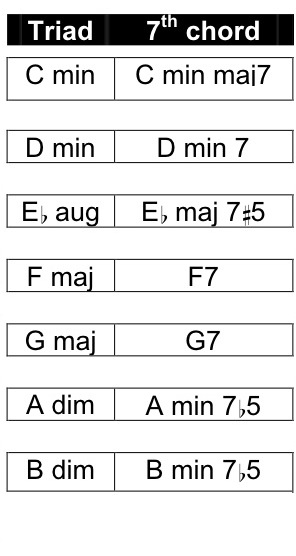
Here are the diatonic triads and 7th chords.


Try playing any of the following C Melodic Minor shapes over any of these chords..

Some Melodic Minor Notes:

  • Melodic Minor is an old scale.  Originally it was played as melodic minor when ascending but natural minor when descending.  Not a whole lot of people perform it that way in Jazz circles but mixing and matching the two can have some interesting sounds (i.e. it’s something you should consider experimenting with if this area interests you and you haven’t already).
  • Melodic Minor is a Dominant machine.  If you check out the harmonization above you’ll see that Melodic Minor has two 7th chords in it’s harmonization.  As Jazz standards use a LOT of dominant devices – this is a scale you’ll want to investigate if you have an even remote interest in Jazz.
  • Melodic Minor is a weird sound.  Yes it is.  The I chord is a minor (maj7) chord and that whole b3 mixed with the natural 6th and 7th makes for some interesting moments.  The only metal guy I knew who was really into that sound was David Chastain and he was doing instrumental stuff that didn’t really sound like anyone else. (Hint – this is worth exploring if you’re a rock or metal guy)
  • Hip trick alert:  since the ii chord is a minor chord -try playing C Melodic Minor lines over Bb Minor as well!

.

Now let’s talk about visualizing the scale.

“You take the good you take the bad – you flat the third and there you have…”

Melodic Minor

I’ve talked about my approach to Melodic Minor briefly in part 9 of this series – but as a brief review:

Major Scale/Modal Visualization Review

  • The guitar fingerboard can be divided into 3 sets of two strings. Any 2-string fingering pattern that starts on the B string can be moved to the same starting pitch on the D or the low E string and keep the same fingering.
  • The major scale can be broken down into seven two-string modes that follow a specific order based on its scale degree from the parent scale (Ionian, Dorian, Phrygian, Lydian, Mixolydian, Aeolian, Locrian). The two-string patterns are modular and can be adapted to positional playing.
  • Instead of thinking of individual modes when playing,  I tend to think of larger tonal systems (i.e. I think of C Major all over the fingerboard instead of D Dorian or A Aeolian.)
  • By thinking of the fingerboard in a larger scale – it makes it easier for me to navigate Melodic and Harmonic Minor as – solely from a fingering/sonic visualization standpoint – I just see it as variations of the Major scale patterns.

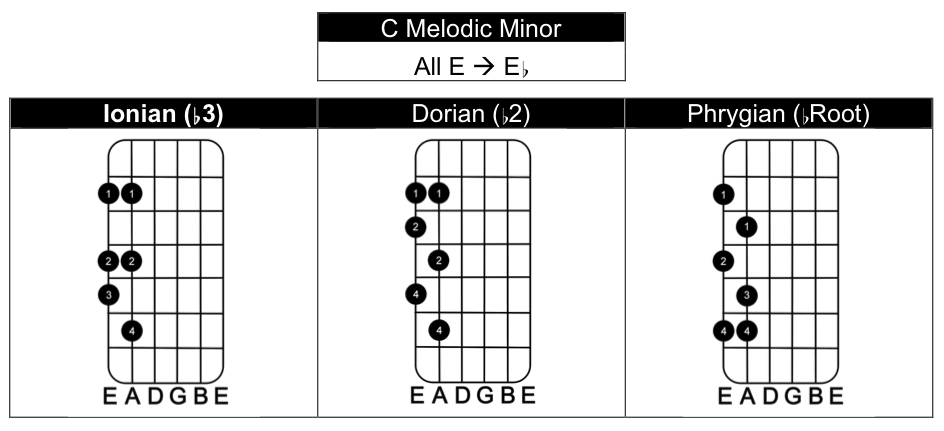
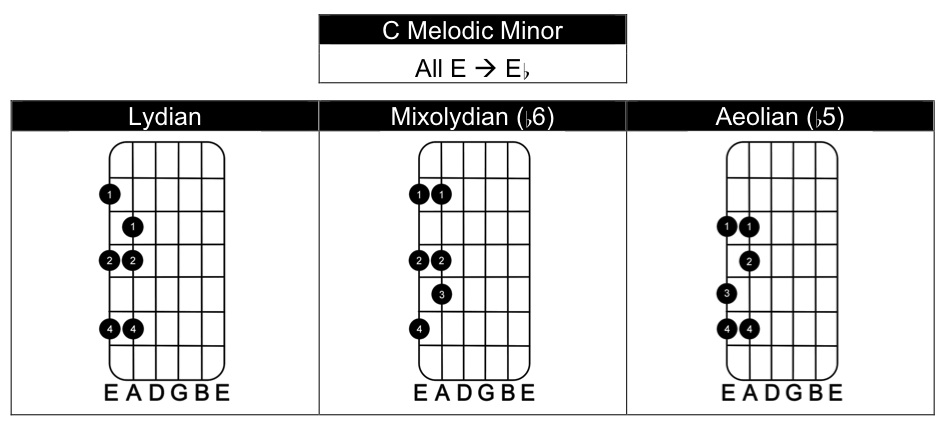
To visualize Melodic Minor patterns – simply flat the 3rd of the Parent Major scale. (i.e. to visualize C Melodic Minor just play C major but change every E  to Eb).

It’s important to note that all of the fingering conventions mentioned here are solely to assist with visualization as Melodic and Harmonic Minor really aren’t directly related to the Major scale sonically.

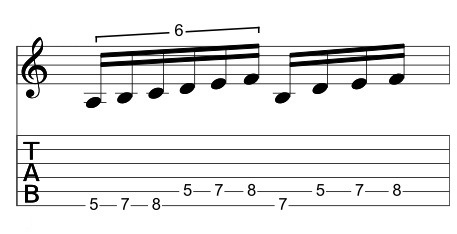
Here’s C Major

Here’s the audio.

Note:

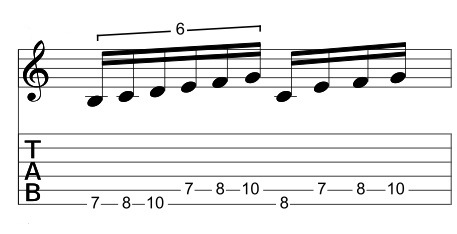
In all the audio examples, I’ve played the example first as sextuplets – then at a slower tempo (i.e. 16ths) – then as sextuplets again.

Here’s C Melodic Minor

(the only difference is that the E has been changed to Eb)

.

.

Melodic Minor short cuts:

Using the Parent Major patterns above here’s a list of short cut’s to help you visualize the patterns.

.

Note: in the F Lydian shape – there’s no change from the major shape since there’s no Eb in the 2-string pattern.

.

.

.

Not-Peggios

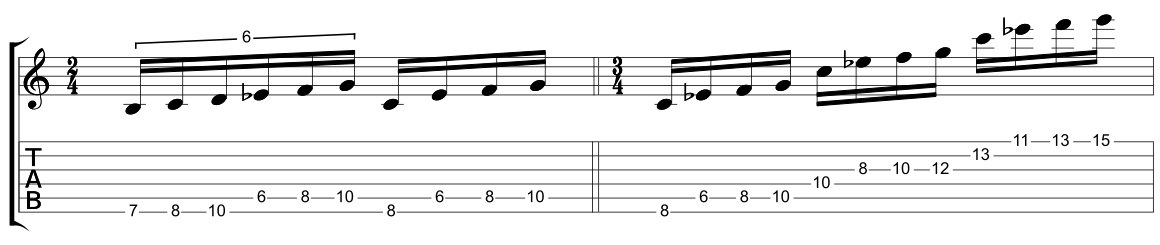
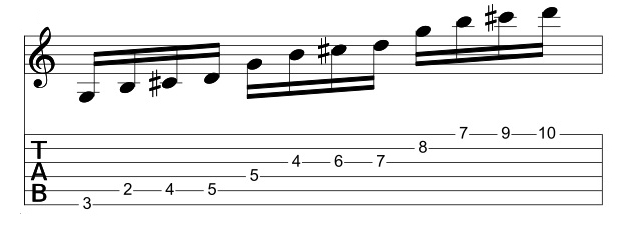
Now let’s take this not-peggio idea from the last lesson and apply it to C melodic minor starting from G.

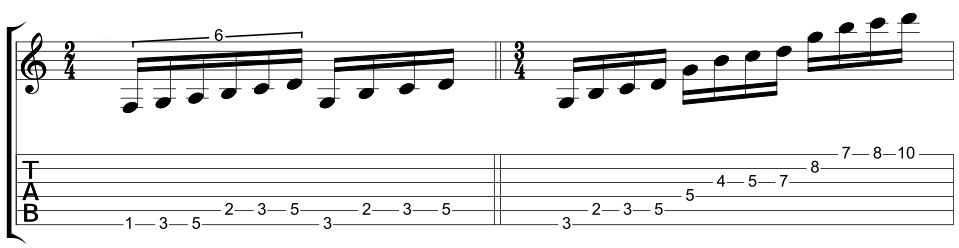
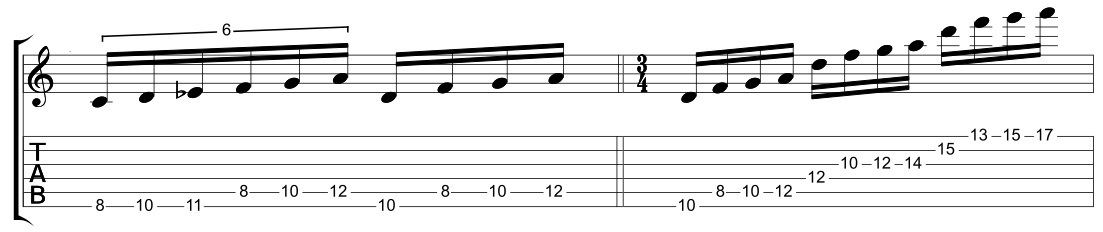
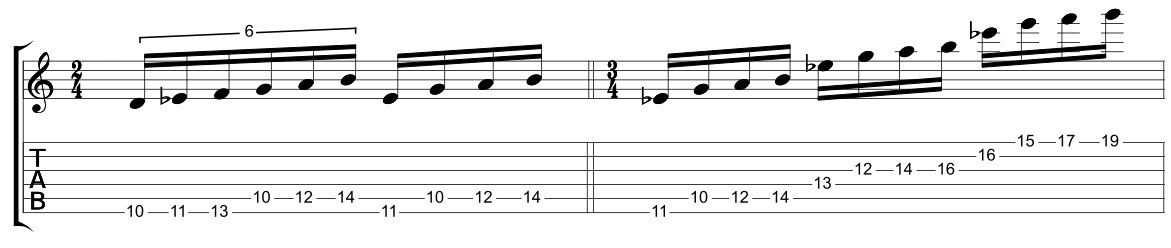
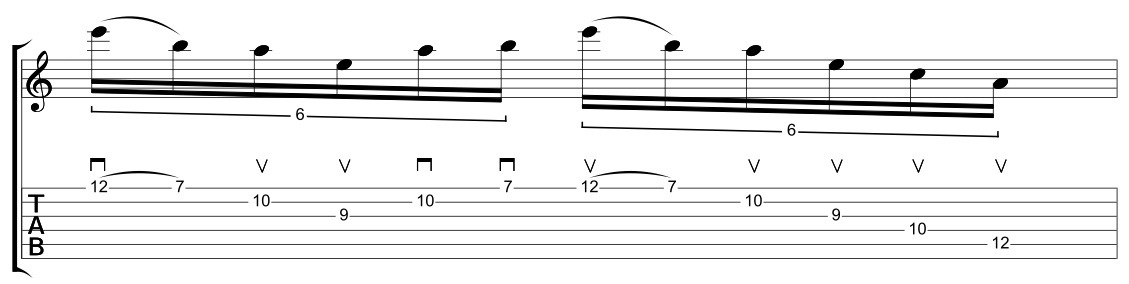
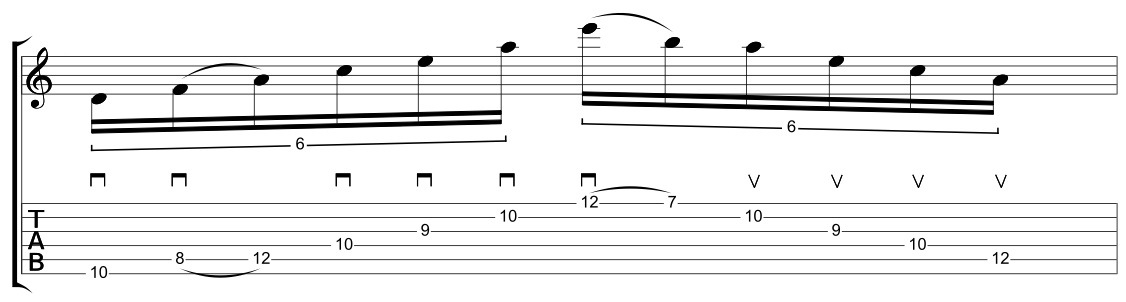
In each of the following I’ll show the 2-string pattern followed by the 4-note “notpeggio” extraction from that fingering and then show the multi octave form.

Note:  The extraction always starts from the second note of the 6-note pattern – so while the first example is extracted from the F Lydian fingering – it’s viewed as a G based pattern.

From G

G based pattern

Note: this G pattern is the same as the C major G shape.

From A

A based pattern

Note: this is a new shape from the Major patterns. The R-b3-4th-b5 shape may remind you of the A blues scale.

From B

B based pattern

Note: this is also a new shape from the Major patterns. The R-b3-b4th-b5 shape is something you may want to explore over diminished chords.

From C

C based pattern

Note: this C pattern shape is the same as the A minor form from C major.

From D

D based pattern

Note: this D pattern shape is also the same as the A minor form from C major.  This shape and the C minor shape above on their own really won’t give you much of the Melodic Minor flavor on their own – but alternating between the two of them will.  More on that in a future lesson.

From Eb

Eb based pattern

Note: this is a new shape from the Major patterns. The Eb Maj7 (#5) based pattern has been deconstructed into almost a whole-tone idea.  This is one of my favorite “outside” sounds in this scale.

From F

F based pattern

Finally,  this F pattern shape is the same as the F Lydian form from C major.

Here’s an audio sample of the 3/4 measures in ascending order from G

Next TIme?

In the next lesson I’ll look at applying this to Harmonic Minor and then I’ll look at working through these ideas positionally (Spoiler Alert – this is where this approach gets really cool!!).
As always, focus on the 3 T’s (Timing, Tone and hand Tension) when playing through these and make sure to have the timing locked in as you increase the metronome speed.  This approach is just a short cut to getting the patterns under your fingers.  By practicing them slowly and increasing the performance tempo gradually, you’re also getting the sound of them in your head – which is critical if they’re something you want to integrate in your playing!
As always, I hope this helps and thanks for reading!
– SC
PS – One plug here.  If you like this idea – I go MUCH deeper into similar concepts in my Guide to Chord Scales book – which covers every unique melodic combination from 3 notes to 12-note scales!!
Print editions of this book are available  on lulu.com or on Amazon (amazon.comamazon.co.uk, or amazon.fr).
.

The GuitArchitect’s Guide To Modes – Part 13 Not-peggios

Hello everyone!

It’s been a while since I’ve posted anything mode related. So I thought I’d make up for some lost time by posting this lesson.

Not-peggios?

Those of you who have been following the licks in this blog for a while have probably figured out that one of my favorite melodic approaches is to work in the area between scales and arpeggios.

For those of you who remember all the way back to part 11 of this series – this idea works on the same approach but with triads.

Step 1: Extracting the Not-peggio

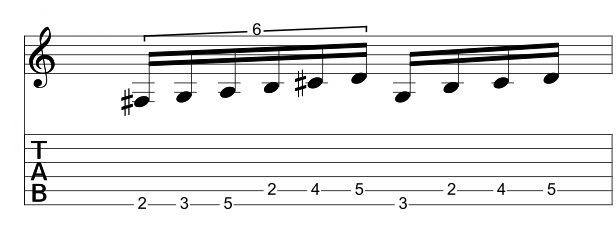
This idea uses the same 3-note-per-string / two string idea that’s behind all the visualization process here.  But to review:  Let’s start with a B Locrian scale pattern on the E and A strings:


C Ionian
From there:  I’m going to remove the 1st and 3rd notes of the pattern:


Not Peggio Extraction

Leaving a C major major triad with an added 4th which is something that intervallically lies somewhere between an arpeggio and a scale.  Technically it’s a close voiced arpeggio but the “not-peggio” tag has worked better for me when I explain to people so I’ll use it here as well.

Call it scrapple, grapple or anything else that will help you remember it – the naming convention is much less important than getting it under your fingers and in your ears so you can play it.

The good news is that applying this approach to a Major scale only produces four unique qualities of these melodic devices which I’ll talk about below.

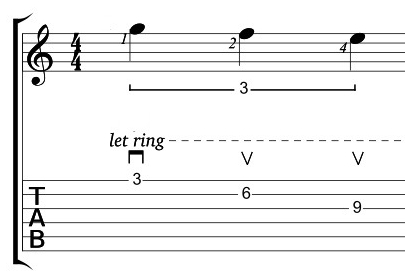
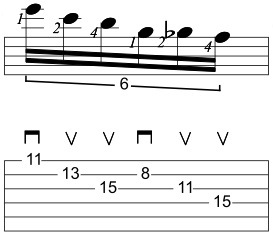
One brief technical note:  I recommend either one of following picking patterns for any of the 4-note shapes presented here:

Picking Examples

If you’re used to alternate picking, that will work as well but I find that the semi-swept approach of the first example gives me a more uniform sound for legato playing.  It’s counter-intuitive but check the A minor straight ascending mp3 below to see what I mean.

Major add 4

Major Add 4 shapes

This shape doesn’t really work that well over major chords because the 4th (aka 11) is an avoid tone over a major chord.

However they do work well over minor chords. Try playing the C Ionian shape over an A Minor but for the most part, I find the major add # 4 shape to be one I use much more often.

Major add #4

Major add # 4 shapes

.

I’ve talked about this before – but a kind of cool applied theory trick is that Lydian and Dorian are relative major/minor substitutions.  By that I mean that while C major is the relative major key of A natural minor related chords scales C Lydian and A Dorian both come from the same parent major scale (in this case G Major).  So licks generated from this source will do double duty over both major and minor chords.  A two-fer if you will (or won’t – I understand either way).

Let’s apply this idea to G Dorian.

Here’s the 4-note shape taken from F# Phrygian:

G add # 4 extraction

And here it is an a 3 octave form:

G add # 4 3 octave pattern

.

Here’s a more sequences lick type of approach:

G Lydian 3 Octave run

Here’s the audio – with a short descend of the patten ending on the G on the 8th fret of b string.

You can try this approach over E minor for an E Dorian type sound as well.

 Minor add 4

Minor add 4 shapes

Okay a couple of quick tips here.  Since you don’t get the natural 6 of Dorian or the b2 of Phrygian in these shapes – they’re not really going to give you much of the flavor of those modes.

In this case, I’ll use the A Aeolian shape over A minor and F Major chords.

A Minor:


A Aeolian part 1

In this audio example I play the 3 octave form and then play the multi-octvave sequenced idea.

A Aeolian over F lick

Used over F Major:

Now I’ll take the same sequenced idea and apply it over an F major lick.  Here’s an audio example.  I slid up to the G on the 15th fret of the high E string and then descended with some tremolo bar scoops along the way.

Normally, applying an A Aeolian idea over F major would give it a Lydian sound – but the lack of the B (#4) in the pattern makes it a little more open sounding to me.

Finally – here’s the Diminished form.

Diminished add 4

Diminished add 4 shapes

Looking at the notes here (B, D, F, E) – I see the upper notes of a G7 (add 13) chord: G [Root] – B [3rd] – D [5th] – F [b7] – E [13].  So this pattern is one I use in Dominant 7th situations.

Here’s the basic pattern:

B Locrian Multi Octave

And here’s the application over a G7 chord.  It uses the same pattern sequencing idea as the other examples ascending but bends into a couple of notes including the 3rd on the B string for the final note.

Next time?  Some Melodic and Harmonic Minor shapes to get under your fingers.

As always, I hope this helps!

-SC

PS – if you like the ideas in this approach – the following books will help you expand on this idea exponentially!

The GuitArchitect’s Guide To Chord Scales

The GuitArchitect’s Guide To Modes: Melodic Patterns

The GuitArchitect’s Guide To Modes: Harmonic Combinatorics

Notes From A Lecture

“What’s with all these words and where’s the shred stuff?”

I know I’ve been veering away form strictly guitar stuff lately on this blog.  (Don’t worry though, the pure guitar thing is never too far away. A number of new (strictly guitar related) posts have made their way to Guitar-Muse and there’s some new material that will be released either in Kindle or e-book format.)  A large part of the shift in content here is due to a move from focusing on working through the how (how do you play modes on guitar) and shifting the focus more to the why (i.e. my philosophy).  I’ve talked about this before but without a strong sense of why you do what you do, progressing and improving in the long term will fall apart as you face the numerous challenges and obstacles that you’ll be faced with on the long haul.

As someone who plays and teaches, I’m often asked, “How long does it take to learn to play guitar?” It’s a surprisingly easy question to answer.  It depends on what you want to do on the instrument.  If you want to learn to play a few chords to serenade someone on a tune you can get some basic chord forms and strum patterns down in as little as a few weeks.

If you want to really say something unique to you on the instrument, it will take years or decades of hard work and those before you who have already been on the path for decades will tell you that they’re still working on defining and articulating what they say on the instrument. This leads directly into my first point.

.

The heretic’s statement

While I love the guitar dearly, it’s just a tool of expression.

Guitar playing is only a reflection of who I am at the time I’m playing.  It’s a sonic documentary.  It’s a voice that I control with my fingers.

I need a pen to write ideas down on a piece of paper, but ultimately the ideas behind the writing are a lot more important than some scribbles on a page.

It’s a symbiotic relationship.  As I play guitar, I develop as a person as well.  As a person I take a number of influences that inspire me (like literature, film and other people’s music) and use those as spring boards for expression.

While I work at being a better guitarist, I’m also working at being a better person and vice-versa.

To me – it’s all guitar playing.

.

The How and Albert Ellis

For those of you unfamiliar with the man, Albert Ellis is not some brilliant up and coming underground shredder that will show you how to stuff 15 notes in a 5 note bag.  Mr. Ellis was a particularly brilliant psychologist who had taken some cues from Stoicism, and Levi-Strauss and created a new form of therapy known as REBT (Rational Emotive Behavior Therapy). I had first discovered Ellis’ work in college and while I found his books to be somewhat bizarre in their tone (the writing style seemed to be mired in the 1950’s with references to things like “Pollyannaish thinking”) his approach of using rational thought to break people out of emotional traps they had fallen into was particularly insightful to me and spoke to my own approach to removing emotions from problems and tackling them for what they are.

In the 1990’s I saw that an Adult Education division was going to bring Albert Ellis to speak at the lecture.  To say that Ellis was a brusque man is stating it mildly.  Throughout the lecture he swore like a sailor, called b-s on any number of things and took anonymous audience questions about problems they were having on stage and then talked through how to approach the problem.

When the lecture was over.  People were congregating around to talk to him and he yelled “Excuse me” and “Get out of my way” as he bolted out the door and went to his car.  I believe his logic was, he was paid to speak for two hours, people could ask him whatever they wanted during that time and he wasn’t going to hang out for another hour or two afterwards.  The audience hated this but I saw it as a man who practiced what he preached.  (If you read below, you’ll see that this wasn’t solely about the money – The Ellis Institutecontinues to offer the Friday Night public workshop that Ellis discusses below for the inflation adjusted price of $15 per person.  It’s about not getting entangled in things you don’t wish to).

I made a number of notes at the lecture and I’ve posted them below.  In terms of content, its a little rough and tumble and should act as little more than a “Cliff notes” version of his approach – but you might find it to be an interesting overview in how to remove emotions from problems and attack them in a systematic process.

If you find feelings of anger, depression or inadequacy acting as obstacles in your practicing, playing or goals, you might find Ellis’ approach helpful. I’ll include any new notes in brackets [ ].

Notes on an Albert Ellis lecture in Boston.  December 8, 1994.

Albert Ellis, Ph.D. is the head of the Institute for Rational-Emotive Therapy (RET). [Ellis used the terms RET and REBT in the lecture interchangeably] He conducts interviews every Friday night at the Institute for $5.

Ellis’ methodology is borne out of a philosophical tradition rather than a psychological one. Of primary influence to his methodology were the Greeks and their focus on the analytical.

You are a talented screwball.

.

The RET observations:

1.  All people want to be loved and accepted.

2. People meet conflicts with this goal.  The experience rejection/frustration /disappointment.

3.  People refuse to change

.

Three causes for Neurosis

1. EGO – I am the center fo the universe

2.  Anger / Rage

3. A perception that there has to be environmental control.

#2 and #3 –> refusal to accept (rationalize)

The two words that cure all neurosis?:  Tough shit.

Past events are not the causes for present conditions.

Humans are born with two tendencies

1.  Posessing goals, values, desires, etc and demanding what you want.  Ellis seems to view people generally as babies where immediate needs are the primary focus.  That egocentricity makes people very upsettable.

2.  People have a constructive self-actualizing tendency.  You are born to think.

The net effect of these two statements is that while you can disturb yourself, you can also undisturb yourself.

You balance the rational and the unrational. The Universe is ambivalent.

.

Three Insights of RET

1.  No one (or nothing) ever upset you.  You choose to upset yourself.

2.  When it [the depression/anxiety/problematic emotion] started is irrelevant.  It lasts because you believe it.  You can’t change people or situations – only perception.

3.  There is no magic. No one’s going to come down from the sky to save you. There is only work and practice.

.

How to change:

Cognitive thinking

1. Dispute the “musts”  “I must be this…I must do this.” Why must you? [Ellis refers to this in some of his writing as ‘musterbation”]

2. Along similar lines…”I can’t bear it (rejection, etc)” or  “I can’t stand it.” The implication is –   “I can’t stand it and be happy at all.”

3.  “When I fail, I am worthless” in reality – “I acted badly – but I screwed up and I am human.”

.

There are two solutions to a poor sense of self-worth

1.  I’m okay because I am alive. (I’m okay because I choose to be okay.)

2.  I’m neither good or bad as good implies perfection and bad implies damnable [The terms are all or nothings propositions for Ellis].  I am a human who behaves well and when I agree to reach/perform certain moral ethical deeds, I am behaving well but good deeds do not make me good.  (preferred method). I am not my acts/behaviours.

.

Self Esteem is an illness

When I am doing okay, I am okay – otherwise I’m a worm and even when I am okay – I worry about being a worm.

Low self-esteem: Because people don’t love me enough and because I act well I am okay.

High Self-Esteem I’m okay when I’m beautiful.

Self esteem is conditional.  The goal is unconditional self-acceptance.  Unconditional acceptance must be taught.

.

Coping methods

Referencing:  When you do something compulsively bad –  you write down all of the disadvantages of the act and review often.

Rational coping self-statement:  Effective view philosophy [Also written – also reviewed often]

“I don’t need – but I would like.”

There is nothing awful – only inconvenient. “Mind you getting slowly tortured to death is inconvenient but it is not a worse case scenario.  You could always be tortured more slowly.”  [What was implied by Ellis is that you can not be faced with the most awful thing or situation.]

Psycho-educational techniques:  Good books, video, etc prosleytize and teach so that you can learn.

Modeling:  find good role models

Role Playing: stop at anxious (or appropriate sensation) moments and analyze.  What am I thinking right now?

Positive thinking is okay but does have it’s limitations.  Its achilles heel is that it can reinforce the “must” syndrome.

If you’re afraid of something. Do it.  repeatedly.  Rewards afterwards and “punish” if you fall through. [Ellis used a couple of examples here but he said to a woman trying to lose weight, “Okay.  You want to loose weight.  And you eat cookies all the time so as one step of this, you’re going to stop eating cookies.  What do you hate to do in the world more than anything? ‘Call my mother-in-law.’ Okay then.  So from now on if you eat a cookie, you’ll have to call your mother-in-law and talk to her.  But you really have to do it!  It only works if you follow through.” In more extreme cases, Ellis recommends people burn money as a punishment.  “After someone burns their second $20 bill, they stop doing what they’re doing pretty quickly”]

You let other people affect you but not disturb you.

.

Grief vs depression.

Grief is okay.

Grief:  I’ve lost something and that is bad

Depression: Isn’t it too bad that I’ve lost something?

.

Problematic Solutions

When a situation is bad – do not leave when you are upset because you’ll take those emotions with you into every other situation.

1.  Analyze how upset you are

2.  Act rationally.

The approach seems to have several steps.

1.  Problem identification

2.  Statement and picturing of the worst thing that could happen.

3.  Identifying feelings with that scenario.

4.  Changing feelings/perceptions of the worse case scenario used rational coping self statements repeatedly and setting up small reward/punishment systems to work on those statements daily.

This last step implies a lot of time.  There is no quick panacea for your problems.

Dr. Ellis has a hard methodology.  It makes the individual fully responsible for his/her actions, works within a closed system and puts emphasis on the body’s cognitive powers. He is violently opposed to most forms of therapy which he feels puts too much emphasis on past actions and events and not enough on present responsibility.  While he isn’t opposed to all forms of psychotherapy, his motto certainly seems to be, let the buyer beware.

His lecture was filled with cursing.  It seems to be a part of his shtick, but one of the things that it did was keep the audience laughing – and laughter (along with responsibility, work and perception) seems to be a very important part of the RET methodology.

*Those are all the notes I had from the lecture.

I hope you found this interesting, insightful, or helpful in some way and, as always, thanks for reading.

-SC

Updates, Recycled Lessons And New Posts

Hey everyone!

By and large, I just have a few updates here.  

The site got a new layout!  It’s less THX-1138 and more product photo shoot, but it should at least be easier to read.  It’s affected some of the layout and links and I’m cleaning them up right now.  

A new “old” lesson

This will include adding links to the Guitar-Muse lesson series that I’ve been doing into the “lessons” section.

While new player profiles are in the increasingly infamous pipeline, I thought I’d post a video that I found as I was looking for a file on my hard drive.  

I shot this video back in early 2011 to go along with the Chord Recycling Lesson series I was posting at the time. After watching it back, I was flabbergasted with the sheer volume of “um”‘s in the lesson and planned on re-shooting the lesson with something novel like a script.

Then I got knee deep into other projects and so that never happened. ; )

I found this again and decided to post it as, while it doesn’t represent the most articulate lesson that I’ve ever given, I think it conveys the ideas well, and it shows a number of ways to get new chord and solo sounds from a shape that you already know!

The related lessons for this are:

Part 1

Part 2

Part 3

Chasing Tone Article

Speaking of Guitar-Muse, I just added a new article to the “Evolution of a Live Rig” series.  You can read the newest installment part 2 here, or part 1 here.

Eventually a lot of gear pieces old and new are going to be migrating to the Guitar-Muse site as I want to focus the GuitArchitecture site more on the performance, philosophical and psychological aspects of performance.

Kindle Books

Are in final stages of editing and should be out soon!

That’s it for now.  As always a number of new things are on the horizon and as always, thanks for reading!

Guitar-Muse Interview With Steve Vai And Gig, Post And Kindle Updates

Hey everyone!

.

Steve Vai Interview

My interview with Steve Vai is now up on Guitar-Muse.  You can read it here.  I’ve also posted a short lesson on rhythmic ear training that uses one of the new tracks as the basis for the lesson (copyright prohibits me from posting the actual notes – but it’s a good primer on how to figure out syncopated rhythms).  You can read that post here

.

Today’s Children of Mu Gig Is Rescheduled

The gig with Justin Wierbonski’s “Miles Davis Bitches-Brew era” group Children of Mu next Thursday is still happening but since today’s gig at the Shrine was double booked, it’s now been postponed until next Saturday evening.  

The rest of the band can’t make it so next Saturday’s show is going to be a drum guitar duo – but it’s going to be more free-form Jazz Sabbath (HA!)  and not at all “The Girl from Ipanema”!!

Forecast for next Saturday evening in Harlem –  high note density mixed with sporadic ambient textures with a chance of attendance.  Here are the dates for next week.

.

BAR4 

THURSDAY, JULY 12, 2012 – 9PM

.

THE SHRINE WORLD MUSIC VENUE 

Saturday, JULY 14, 2012 (time is evening TBA)

.

An Immodest Proposal Part II…

will be up on Monday and some people are likely to find it provocative.

In other post news, I do have some lessons to go up on the site over the next few weeks and I’ve been working on the Kindle book which I hope to have done by the end of the month.

Player profiles are on tap for Guitar-Muse in July and August and some cool interviewees in the pipeline in a “guitars of the underground series.”

.

Ah “Hot Town, summer in the city!”

Stay cool and thanks for reading.

-SC
Two Black and Bluegrass Licks To Get You Out Of A Session

Hey Everyone!

.

This lesson is a continuation of the same technical concept behind the sweep picking Pentatonic Minor/Blues scale lesson I posted earlier.  If you like this approach, you may like that lesson as well (links at the bottom of the page).

.

Today I have not one but TWO licks that go together like peanut butter and an ashtray.  Both of these are transitional licks leading back into key of G (The bluegrassiest of all keys) and while they probably won’t get you beat up (hence the black and bluegrass) or kicked out of a session – they might turn a head or two!

.

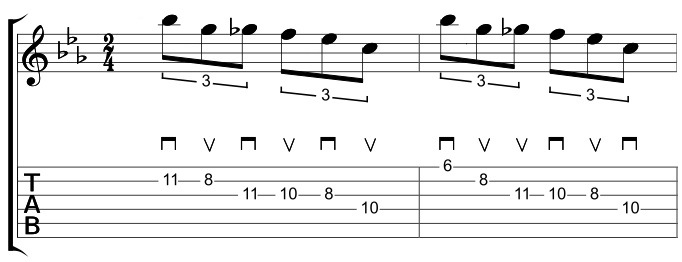
Here’s the first lick (in the video it’s played at 120 bpm – first as triplets then sextuplets):

.

(Note: fingerstyle players can play the 3-note groups as p-i-m)

.

[vimeo https://vimeo.com/44120906]

.

And here it is in notation and tab:

.

Lick #1

Now, let me explain a little about what going on here.  This is a transitional lick that resolves to G that uses different G-based chords starting from G, Bb and Db (aka G diminished).

.

The first chord is a G7 (add 13).  Originally, I was going to use a straight descending 1 note-per string scale version of G Mixolydian (i.e. G, F, E, D, C, B, A) but – while the first three notes sounded great:

.

The spread wasn’t an easy one to get in to or out of cleanly.  So I cheated it and used the D instead, grabbing the E on the B string keeping the D and adding a B on the D-string.

.

If you remove the E, you have a nice voicing for a G7 chord starting from the 3rd, but for melodic playing it’s easier to arpeggiate the chord as 3 note groups.

.

The next chord is a G min 7 starting from the b3rd.  It uses the same picking pattern as the first arpeggio:

.

Then the lick jumps from the D to Db to start the G min7b5 (add11) arpeggio.  That might sound exotic – but it’s just 4 notes from the G Blues scale (G, Bb, C, Db and F).

.

..

Finally, it ends up with a G major triad with an added b3rd (a useful bluegrass cliché.  For even more of a bluegrass sound, add the E on the 12th fret E string between the D and the G).

.

.
Technical Considerations 

.

1.  As with the sweep picking blues pentatonic lesson, keeping the notes staccato (i.e. taking the finger pressure off the string after each note is played) will help with articulation. 

.

2.  The biggest challenge with this lick will probably be taming the open D string when you switch from the 3-string D-G-B pattern back to the top three strings.  Use pick hand muting to mute the D string once you play the first note on the high E string – and try practicing the lick as 9-note groupings to work that transition.

.

.

or

.

Lick #2

.

Lick #2 is just silly – but it’s a fun idea and it’s a great way to work on the 3-string picking pattern.  

.

[vimeo https://vimeo.com/44120906]

.

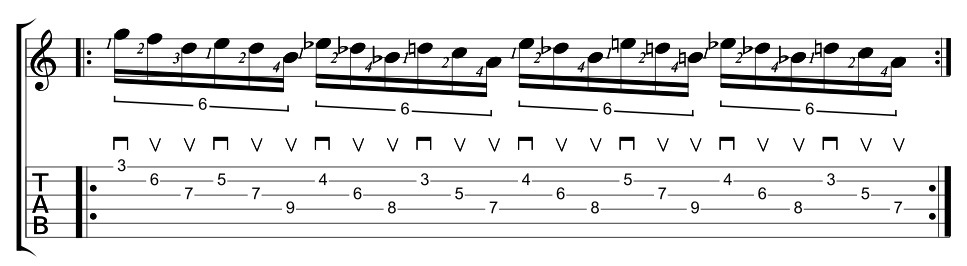
The lick is based on this idea:

.

.

This lick is just the first notes of lick #1 with a chromatically descending pattern based on the last three notes.  All I’ve done in lick #2 is chromatically ascend and then descend again like so:

.

Just use the same techniques that you used in getting the first lick down and pay attention to the 3 T’s (timing, (hand) tension and (quality of) tone and you’ll be fine.  (and remember – slow and steady wins the race here with regards to practice gains!)

.

This one-note per string scale idea is taken from the last section of my Melodic Patterns book so if this area interest you, you may want to check that book out.  You can find out more about it here.

.

As always, I hope this helps and thanks for reading!

-SC

.


If you like this approach, I have 2 books you may be interested in:


My Pentatonic Visualization Book


Minor Pent Front


is 100 + pages of licks and instruction and includes demonstrations and breakdowns of two-string fingerings, diagonal pentatonics, sweep picking pentatonics, pentatonic harmony and much more!  It’s available here.


My Melodic Patterns Book:


melodic-patterns


(available on Lulu or on Amazon) has a complete break down of all note-per-string scale variations which include the 2 above.  In the meantime, give this approach a try with other scales as well.  In the next sweep picking acoustic lesson – I’ll adapt this to a bluegrass lick that you might find cool.


Sweep Away Those Blues Or Some Useful Ways To Sweep Pick A Blues Scale

Right Lane?  Left Lane?  Shawn Lane.

I read an interview once with Shawn Lane where he talked about how he did very little taping and that the majority of really fast playing that he was doing was one-note per string fingerings.  It’s a cool idea, and here’s how I’ve adapted it to a C Blues/C Pentatonic Minor scale.

.

First, here’s the lick on acoustic.  FYI – I slide into the 1st note on the video 1st time through the lick.  (ps- it’s much easier to play cleanly on electric):

.

.

.

Note:  

I’m using C minor as a key signature here – but the key signature doesn’t show up in all the following notation.  In every example below, all notated B’s and E’s are Bb and Eb respectively as seen in the tab.

.

I explain each step of this in the video – but here’s the step by step process for how I came up with this:  

.

Let’s look at a standard C blues shape:

.

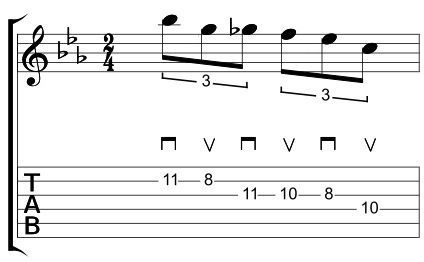
I’m going to use the descending portion of the lick starting from Bb.

.

.

Now I’m going to move the Bb from the B string back to the high E string.

.

Before                            and                      After

.

I’m using the 1st, 2nd and 4th fingers for the first three notes of the “After” section above.

.

Technical Note:

If you hold the notes down, you’ll loose definition on the individual notes because it’ll sound like you’re playing a chord.  So make each note staccato by lifting the finger off each note after playing it.  Try practicing just these 3 notes at first and work on getting the picking and the articulation down! Fingerstyle players can play the 3-string groupings as m-i-p (middle, index thumb).

.

Now I’ll move the F from the G string to the B string this gives us 2 three string shapes that can be swept pretty easily (fingering it is another issue entirely though!!)

.

Original Version                                    Bb moved to E string                      F moved to B string

.

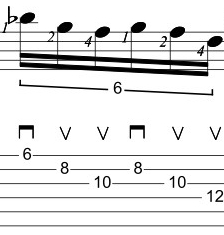
I’m playing the C on the D string with the 3rd finger so the pinky can grab the F#/Gb on the G string for the Paul Gilbert repeated note idea in the second sextuplet.

.
. 

.

The last sextuplet has a swept pentatonic idea that works in reverse from the initial lick.  Looking at that box blues shape again:

.

I’m starting from Bb on the D string and moving the Eb from the 8th fret of the G string to the 13th fret of the D string.  I’ve also taken the C from the 8th fret of the High E string and moved it to the 13th fret of the B string for a symmetrical shape.  Finally I’ve added the D to get a nice “9th” sound on the sweep. (Check the video for a full explanation).

.

“Shapes of things…”

.

Here’s something that isn’t covered in the video. This lick starts on the b7, but you can adapt the idea to any scale degree.  Moving down to the G, produces the following pattern.  It’s not really useful on the top 3 strings but the D, G, B shape is feasible.

.

C Blues from the 5th (G)

.

Here it is from the root (useful fingering #2):

.

C Blues from the root

.

Here it is from the b3rd.

.

C Blues from b3rd (Eb)

.

You can try it from the tritone as well.  The key thing is to find a shape that works for you, find a chord you like the sound of it over and monkey around with it until you get something you like out of it.

.

If you like this approach, I have 2 books you may be interested in

My Pentatonic Visualization Book

Minor Pent Front

is 100 + pages of licks and instruction and includes demonstrations and breakdowns of two-string fingerings, diagonal pentatonics, sweep picking pentatonics, pentatonic harmony and much more!  It’s available here.

My Melodic Patterns Book:

melodic-patterns

(available on Lulu or on Amazon) has a complete break down of all note-per-string scale variations which include the 2 above.  In the meantime, give this approach a try with other scales as well.  In the next sweep picking acoustic lesson – I’ll adapt this to a bluegrass lick that you might find cool.

.

As always, I hope this helps and thanks for reading!

-SC

.

If you like this post, you may also like:

TWO BLACK AND BLUEGRASS LICKS TO GET YOU OUT OF A SESSION (or sweep away those blues – Part 2)


.

Hot Rodding Your Minor Arpeggios – Or A Little Theory Goes A Long Ways

Hey everyone!

This post is tangentially related to the Modal Arpeggio posts that I put online so I’ve adapted the title (just like I’m going to be adapting the arpeggios in the post).

.

 “Minor minor on the wall….”

Let’s look at a 5-string A minor arpeggio:

.

.

Now there’s nothing wrong with this form.  But I find that a lot of people practice this arpeggio ascending and descending and then when it’s time to play over an A minor chord guess how they play it?

There was a time in the ’80’s where just cycling an A minor arpeggio over an A minor chord would cut it, but now it’s (yawn) boring.  So what can we do to make it more interesting?

.

Start with the Top Side

.

In a previous post, I talked about modifying triads to get more complex sounds.  In this lesson I’ll apply that to arpeggios.

The following is a map of alterations to show how chord tones can be modified to create other sounds.

.

.

So with any triad:

The root of the chord can be lowered to the 7 or raised to the 9

The third of the chord can be lowered to the 9 or raised to the 11

The fifth of the chord can be lowered to the 11 or raised to the 13

 .

In this manner, a triad can be altered into almost any other functional chord.

.
Let’s apply this to a minor arpeggio.

In the case of A minor I’m going to change the C on the high E string to B.  This creates an A minor (add 9) sound.


.

.

This is already a more interesting sound over an A minor chord to my ears.  But cycling the top notes of the arpeggio creates an interesting arpeggio sequence along the lines of something Tosin Abasi of Animals For Leaders might cycle (Try combining this lick with the one before it to see what I mean).

.

.

.

Going under the Hood

 .

This modification idea can be applied to any of the notes of the arpeggio, but for a moment let’s go in the opposite direction.  

In the previous post I talked about superimposing arpeggios.  Here I’ll take the same arpeggio form and drop the low note.  

Instead of stacking ascending thirds  like so:

A [up a 3rd]

C [up a 3rd]

E

I’m going to go a 3rd below A to F.  In this example I hammer on the 2nd note and then play the rest with sweep picking.

.

.

Over F, these notes become:

F (Root), A (Major 3rd), C (5th), E (Major 7th) and B (#11) or F Maj7 #11.

.

Using F# instead:

.

.

.

These notes then become:

F# (Root), A (Minor 3rd), C ( flat 5th), E (minor 7th) and B (11) or F Minor 7 b5 (add #11).

.

You could also make to low note G on the 10th fret for an A minor 9 sound (starting from the b7 – G) or make the low note an E which creates a A minor (add 9) arpeggio starting from the 5th.

.

For now, let’s stick with the F major 7 (add #11).  If we stack another 3rd below the F, we get D which creates a D minor 9 (add 13) sound. 

.

.


The natural 13 with the minor 9 is truly a Dorian modal arpeggio sound.  To play a simplified version –  just play the F major 7 (#11) arpeggio above over a d minor chord.

.

In the following example, I’ve added an open A string to the F major 7 (add #11) arpeggio.  Try playing this as a repeating figure which changing chords over the top of it.  It might give you a new song idea!

.

.

.

Hopefully this has given you some ideas and some new things to work on.  In the next lesson post, we get back into modes and get deeper into the individual modes.

.

Thanks for reading and I hope this helps!  

-SC
.

PS If you like this post you may also like:.

The Modal Microscope And A Sequenced Arpeggio Approach

Slash and Burn – Creating More Complex Sounds With Slash Chords

.

CREATING CHORDS AND LINES FROM ANY SCALE – A HARMONIC COMBINATORICS / SPREAD VOICINGS LESSON

AUGMENT YOUR KNOWLEDGE: SONIC SHAPES AND GETTING MORE FROM AUGMENTED CHORDS

Slash and Burn – Creating More Complex Sounds With Slash Chords

.

GETTING HIPNESS FROM A MAJOR TRIAD OR MORE CHORD RECYCLING PART 3

Getting Hipness From A Major Triad Or More Chord Recycling Part 2

GETTING HIPNESS FROM A MAJOR TRIAD OR MORE CHORD RECYCLING PART 1

.

RECYCLING CHORDS PART II: TRIAD TRANSFORMATION

RECYCLING CHORDS PART I OR WHERE’S THE ROOT?

RECYCLING SHAPES OR MODULAR ARPEGGIOS FOR FUN AND PROFIT

.

Some Useful Online Practice Tools

POSSESSION IS 9/10S OF THE LAW BUT PERCEPTION IS EVERYTHING OR PRACTICING PART VII

TESTING YOUR VOCABULARY OR PRACTICING PART VI

PRACTICE WHAT YOU PLAY OR PRACTICING PART V

.

DEFINITIONS AND DOCUMENTS OR PRACTICING PART IV

TENSION AND THE SODA CAN OR PRACTICING PART III

PROPER POSTURE IS REQUIRED FOR PROPER PERFORMANCE – PRACTICING PART II

PRACTICE MAKES BETTER AKA PRACTICING PART I

Update – New Guitar-Muse Soloing Article, New Tracks Et More!

Hi Everyone!

I just wrote an “instructional” post for Guitar-Muse about soloing that’s coming more from a self-pedagogical/ philosophical/ motivational standpoint but talks about the factors determining when a song needs a solo and how to develop your own voice when soloing.   It works off of some of the ideas I’ve written about here and you can read that here.

For those of you into the RedLnyx Trials games – you can hear me playing a solo on a track called “Come Alive ” on the new Trials Evolution game.  There’s a video for that here.  The solo starts at 1:26 or so and followed some directorial cues for what they wanted for the solo.  I’ll have a post about my video game recording experiences up next week.

I’ve mentioned Manrico Montero’s awesome Mandorla label before, but I’ve just sent a new soundscape track off to him for an Autumn-themed net release.  I have no idea how my field recording gone awry track will fit – the text for the track is:

“The ground grows cold

the sky holds it’s breath

in Autumn the bill comes due.”

so it may be ambient soundscapes – but it’s not new age by any means!  No word on release date for that yet.

.

More reviews on the way.  I have a new set of monitors that I dig for the price range and I’m working with a beta version of the new Scuffham Amp update for a forthcoming review (early verdict – it’s cool!) More online lessons are also on the way.  I’m trying to get rough hewn tracks out the door and working on tracks for a new project.

.

Finally, I’ve gotten a lot of really kind comments from people about the GuitArchitect’s… book series and I wanted to thank everyone for their support.  I’m happy that the books are out there and that people are getting something useful from them!

.

Thanks again!

-SC