Getting Through The Gig – Negotiating A Chord Chart Part 2

In the previous getting through the gig post, I talked about how to interpret chord symbols to determine what a song is asking for.  Today, I’m going to use upper structure triads (triads built on chord tones other than the root) to simplify the chart.  If you’re unfamiliar with the chord symbols below, you may want to start with Part 1 of this lesson.

This lesson will continue to use the  232 chart used in part 1.

.

(232 © Chris Lavender 2011 used with permission)

.

For now – let’s assume that you know how to play at least some major and minor triad shapes.  (If you didn’t take my advice to review the triadic inversions at the end of  the last post – you may want to do so now.)

.

Getting through the Charts part 1 – Unfamiliar and familiar


When sight-reading a chart, my goal isn’t neccessarilly to have a brilliant interpretation playing it the first time (although if I can make it better – great) . I just want to make sure that I’m playing the chords as written and then try to adapt it to the song.  So if I have stock voicings at my fingers for chords on the chart and they make sense, I’ll play those and then voice lead or tailor the approach from there.

Let’s assume for a moment that it’s a worse case scenario – you’re given this chart to play and all of these chords are alien to you.

.

Step 1:

Look for common chord types.

In this case, there are only a few different types of chords in the piece:

  • major9 #11
  • minor 11,
  • 9sus4,
  • major 9 and
  • minor 9.

If generic voicings can be developed they can just be moved to the roots of the chords that need to be played.

.

Step 2:

Convert to the key of C and figure out the chord formula.

The reason to convert to the key of C – is that the lack of sharps or flats in the key signature makes it easy to alter chord formulas as need be.

Here are the chords in question in the key of C:

C major9 #11:  C, E, G, B, D, F# (1, 3, 5, 7, 9, #11)

C minor 11:  C, Eb, G, Bb, D, F (1, b3, 5, b7, 9, 11)

C 9sus4: C, F, G, Bb, D,  (1, 4, 5, b7, 9)

C major 9: C, E, G, B, D (1, 3, 5, 7, 9)

C minor 9: C, Eb, G, Bb, D (1, b3, 5, b7, 9)

.

Step 3:

Focus on the upper notes (7, 9, 11, 13) of the voicing (and/or any alterations) and make a short cut:

Note:

This process assumes that there’s a bass player who will be playing the root.  You also loose the 3rd in the voicing, but you can always add the root, 3rd or any other chord tone  in later. The initial step is to just get through the chart, and then spruce it up as you gain familiarity.


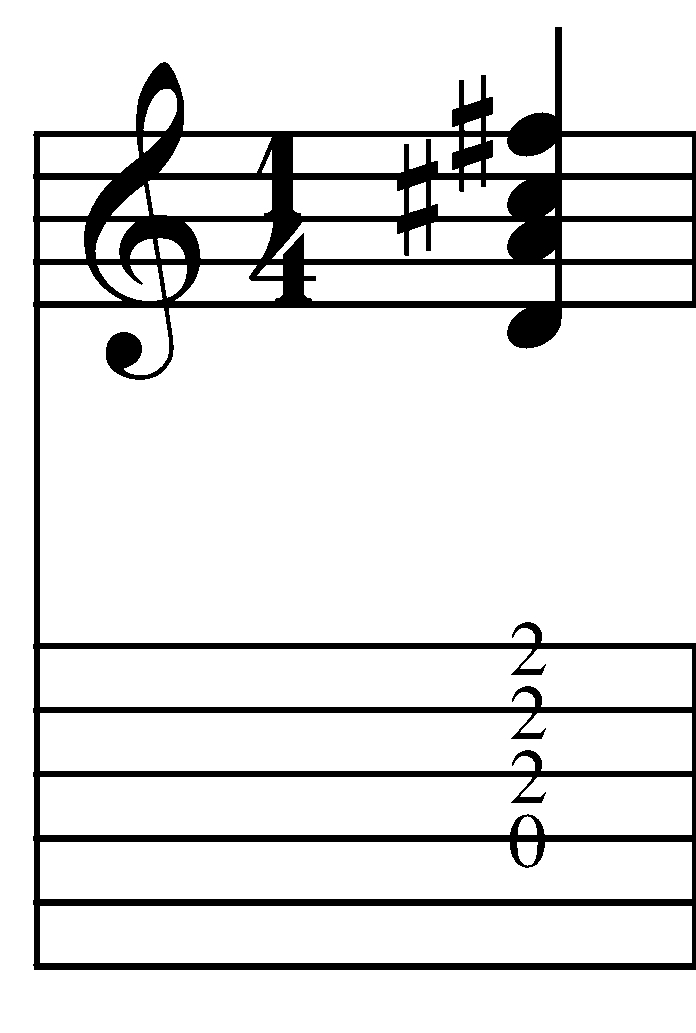
In the C major9 #11, the upper notes are the 7, 9 and #11 (B, D, F# ) this is a B minor triad with a C in the bass (also written B min/C).


The shortcut here is –

if you play a minor triad a ½ step down from the root

you’ll have the upper extension of the major 9 #11 chord.


Here are the transposed voicings


Gb major 9 #11 = F minor/Gb

A major 9 #11 = G# minor/A

F major 9 #11 = E minor/F

C major 9 #11 = B minor/E

D major 9 #11 = C# minor/D

Bb major 9 #11 = A minor/Bb

Here they are penciled into the chart:

Maj. 9 sharp 11 Shortcut

Note:

I’m going to into specific voicings in the third and final post – the idea here is to just to document how to figure out some basic chord substitutions.  While I haven’t written in the bass note (i.e. Gb major 9 #11 = F minor/Gb  – written on the chart as simply Fm), the bass note is still in the original chord voicing, so I can work it into the tonic as necessary.


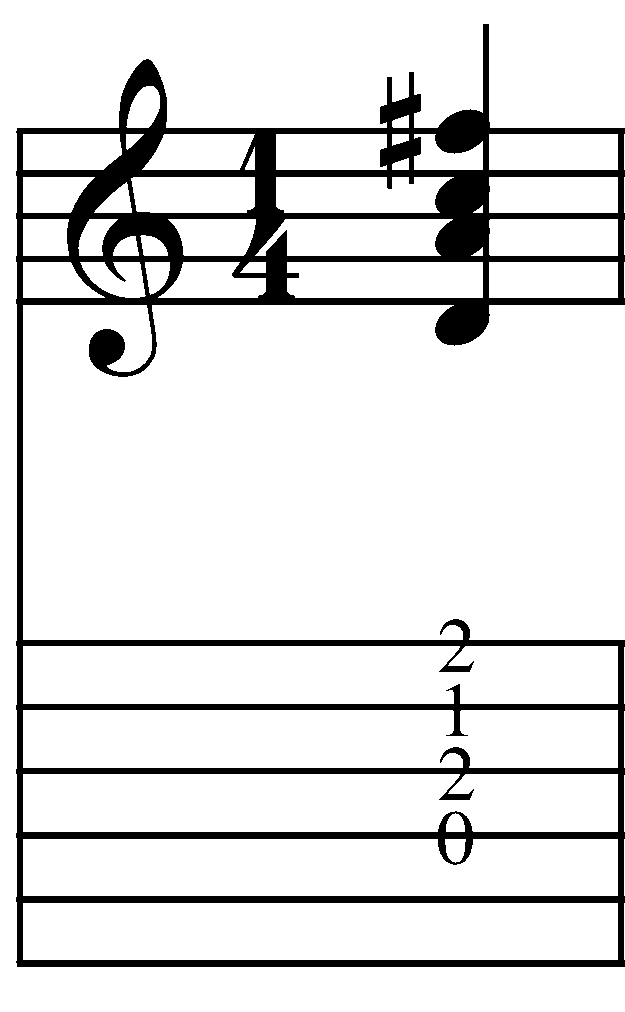
In the C minor 11, the upper notes are the b7, 9 and 11 (Bb, D, F) this is a Bb major triad with a C in the bass (also written B/C).

.

The shortcut here is –

if you play a major triad a step down from the root

you’ll have the upper extension of the minor 11 chord.


Here are the transposed voicings:


B minor 11 = A/B

C# minor 11 = B/C#

E minor 11 = D/E

Gb minor 11 = Fb(E)/Gb

and applied to the chart:
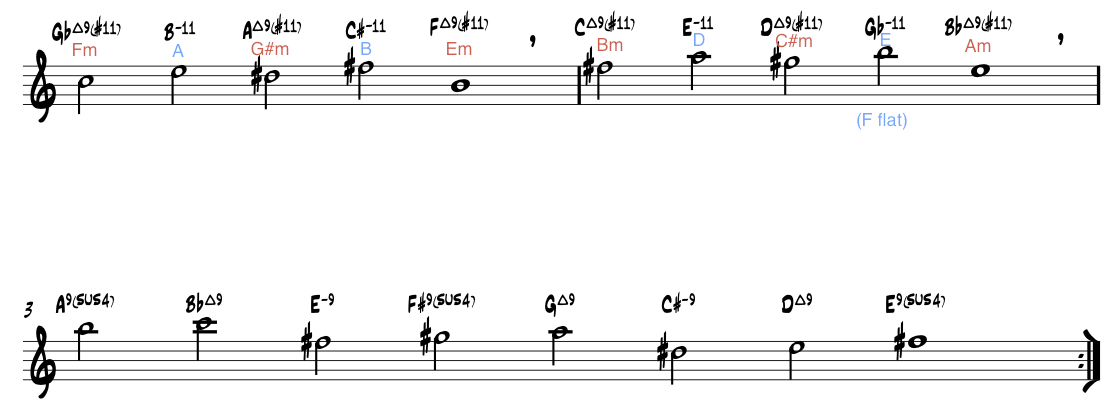
Minor 11 Triadic shortcuts


Next, let’s look at the 9 sus4 chord


C 9sus4: C, F, G, Bb, D,  (1, 4, 5, b7, 9)

Here the upper extensions are the b7, 9 and the added sus4 (Bb, D, F)

The real difference between the C9 Sus4 and the C minor 11 is the Eb.

.

The shortcut here is –

if you play a major triad a step down from the root

you’ll also have the primary tones of the 9sus4 chord.


Here are the transposed voicings:


A9 sus 4 = G/A

F#9 sus 4 = E/F#

E9 sus 4 = D/E

and applied to the chart:

9 sus 4 Triadic Shortcuts


For 11 and 13th chords, I tend to think in terms of  triads based on the 7th or the 9th.  Major and Minor 9th chords can be seen as triads starting from the 5th (but I usually see them as 7th chords from the 3rd – more on that in part 3 of these posts).


Major 9th shortcut –

if you play a major triad chord a 5th up from the root

you’ll have the upper extension of the major 9th chord.


Here are the transposed voicings:


C major 9: C, E, G, B, D (1, 3, 5, 7, 9) = G/C

Bb major 9 = F/Bb

G major 9 = D/G

D major 9 = A/D

and applied to the chart:

Major 9th Triad Shortcuts


Minor 9th shortcut –

if you play a minor triad a 5th up from the root

you’ll have the upper extension of the minor 9th chord.


Here are the transposed voicings:


C minor 9: C, Eb, G, Bb, D (1, b3, 5, b7, 9)  = G Minor

Emin9 = B min/E

C#min9 = G# min/ C#

And the big reveal or…


GET ON WITH IT ALREADY SCOTT – WHAT DOES ALL THIS MEAN?


Okay here’s the initial chart again:

.

and here’s the modified chart with triadic substitutions written in (click on the chart to see it full-sized).

.

Full Triadic Substitutions / Shortcuts

.

Which do you find easier to read chord-wise?


“Hey take a solo…”

As an additional bonus to this approach, these upper extension triads can also be approached as arpeggios that can be played over each chord for soloing or as a simpler tonal center for chord scales (just realize that not all chord scales that work for the upper extension triad will work for the initial chord – but experiment and use your ear to guide you for what works.)

In the final post of this series, I’ll show how I ended up voicing the tune.

Thanks for reading!

-SC

Getting Through The Gig – Negotiating A Chord Chart Part 1

In the previous surviving the gig post, I talked about some memorization skills that can help get through gigs that require learning a lot of tunes.  In this series of posts, I want to focus on how to get through gigs that may have unfamiliar chord changes.

In this post, I’m going to be discussing how to interpret chord symbols and then developing some short cuts for how to generate chord voicings on the bandstand as it were.  If you are already familiar with how to read chord voicings – you may want to skim this and just go to part 2.

There will be a lot of detail over these posts for how I’m doing what I’m doing, but once you get the concept under your belt.  It should be something you can do on the fly if need be.

As an example, I’ll be look at part of a chart Rough Hewn touch/stick/Warr guitarist Chris Lavender sent to me, called 232

(232 © Chris Lavender 2011 used with permission)

.

First Step – Know what notes the chord symbols are asking for.

It’s not that hard to figure out chords if you know what the symbols mean.  Here are some general shortcuts for chord types beyond triads.  There are only 3 basic categories that we’ll look at: Major, Minor and Dominant:

.

Major

(Sometimes designated by “major”, “maj” or a triangle)

Any type of major chord always has a major triad (Root, 3rd and 5th) plus a major 7th in the full chord voicing unless it states otherwise.  If a chart has any type of C Major chord variation (C Major 7, C Major 9 or C Major 13)  –  the voicing has a C, E, G and B.

Note:

When removing notes from any voicing the 5th is usually the first to go (unless it’s altered like #5, or b5).

The initial short cut is: any major type chord starts with (1,3, 7) or (C, E, B) in the key of C.


Minor

(Sometimes designated by “minor”, “min”. or “-” )

Any type of minor chord always has a minor triad (Root, b3rd and 5th) plus a b7th in the full chord voicing unless it states otherwise.  If a chart has any type of C Major chord variation (C minor 7, C minor 9, C minor 11 or C minor 13)  –  the voicing has a C, Eb, G and Bb.

Note:

When removing notes from any voicing the 5th is usually the first to go (unless it’s altered like #5, or b5).

The initial short cut is: any minor type chord starts with (1,b3, b7) or (C, bE, bB) in the key of C.


Dominant

(Sometimes designated by “dominant”, “dom”. or no designation

i.e. “C7”, “C9” or “C13” refers to a dominant chord unless otherwise stated)

Any type of dominant chord always has a major triad (Root, 3rd and 5th) plus a b7th in the full chord voicing unless it states otherwise.  If a chart has any type of C dominant chord variation (C 7, C 9, C 11 or C 13)  –  the voicing has a C, E, G and Bb.

Note:

When removing notes from any voicing the 5th is usually the first to go (unless it’s altered like #5, or b5).

The initial short cut is: any dominant type chord starts with (1,3, b7) or (C, E, Bb) in the key of C.


Beyond this, you just need to add in additional pitches based on what the voicing indicates.

Here’s a chart that relates all of the potential chord tones that you might see to a scale degree for quick reference.

Putting the chart to use:

The first chord in the 232 chart is a C major 9 #11.  As a reminder – any extended C major chord will have C, E, G, B in the full voicing.  Since it’s a C major 9, a 9th – which in the chart above is a D – will have to be added.    The #11 means an F# will get added to the voicing as well.  This brings the full voicing to (C, E, G, B, D, and F#).

Again, the only time you would probably play a full voicing is for a solo guitar or perhaps a duet performance.  In the next post, I’ll discuss how to extract what you need to get through the chart.

.

Second Step – Know some chords

When I went to Berklee, I was advised that I should learn at least 2 chord voicings for any chords that could be put on a chart in front of me.  These stock voicings are typically low E or A string rooted (as it helps with visualization) and are the default voicings that you would use if you were sight-reading a chart.  These typically include triads, Major /Minor / Dominant chord 7th, 9th, 11th and 13th chords.

While this is, generally, useful advice, I should state for the record that while I did the initial memorization required for school proficiencies – I quickly forgot the majority of voicings I wasn’t using all the time. Learning every inversion of every possible 7th, 9th, 11th and 13th chord on multiple string sets will take YEARS.  For some people, it’s the best method, but it never worked that well for me.

.

Once I understood how chords worked, I never bothered to memorize many specific voicings above a 9th chord because I found some shortcuts to get the sounds I needed.


Note:

This is not to say that you should be lazy.If you follow through on the suggestions that I have – you should plan on learning triads and 7th chords at a very deep level (i.e. you should have the goal of being able to play any triad or 7th chord in any inversion in any position).

(more on how to do that in a future post)


I hope this helps!  In the next post – I’ll simplify the 232 chart with some harmonic shortcuts.

While digesting this – I’d recommend you take some time to work on your chord inversions.  If you’re unfamiliar with them you may want to check out the D major inversions I’ve posted below, and adapt this process to minor triads (just flat the third – F# and make it F in the examples below), and 7th chords (major, dominant and minor).

.

(The following is adapted from another post (Recycling Chords Part II: Triad Transformation).

.

Thanks for reading!!


-SC

.

Note:  D major is used in the following examples instead of C major because the original post dealt with transforming triads.  Each note of a 1st position D major chord can be lowered to another note on the fingerboard, without using open strings.  In other words, each chord is a moveable voicing on the fingerboard. The following should be adapted to C major and other keys as necessary.

.

The first step to adapting voicings is to make sure you can visualize triads both horizontally and vertically across the fingerboard.

.

Horizontal (i.e. positional) Visualization

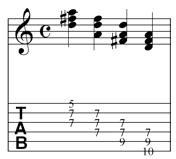
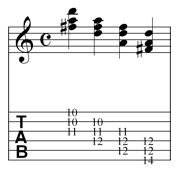
Here’s a series of  D major chord inversions in the 2nd position.

Helpful Tip

As you play through these voicings pay particular attention to which chord tone each finger is on (i.e. for the first D Major chord voicing – the first finger is on the 5th of the chord (A), the third finger is on the root (D) and the second finger is on the 3rd (F#). More on this later.

Here are the D major inversions in the 5th position

and in the 10th position.

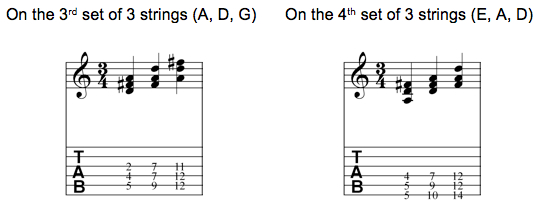
Vertical Visualization

.

Note:

the important thing with both the horizontal and vertical voicings is knowing where each chord tone is located in the voicing.

.

One way to practice this is to play through the chords and stop at random points and ask, “where is the root?” “where is the 3rd?”  “where is the 5th ?”  This has to be full internalized to be able to realize the goal of instant chord tone identification.


The Baker’s Dozen Approach To Pentatonic Scales

6 for the price of 5

While pentatonics are a great melodic and harmonic device, slipping some extra notes into the scale can add some additional spice to the  approach.  The most common way to do this is through the method used in the blues scale – which is a pentatonic minor scale with an added note (in the case of the blues scale – a tritone).

The impetus for posting on this was a post my friend Moby Pomerance put up regarding some elements of this very topic.  Originally I had devised an alternate (i.e. approximate) fingering for his idea – but ultimately I put a few twists and turns in it and came up with one lick that’s really three mini licks rolled into one.

First – The Scale

Here’s a “box” position D pentatonic minor scale as a starting point:

What I’m going to do is add in a 9th (e) for an additional flavor

If I put this in a 2 note per string pattern using the D on the D string 12th fret as a starting point, I get this fingering ascending and descending. (Use alternate picking with this lick.)

While there’s nothing wrong with fingering it this way, I like dividing it into 3 string groupings.  The 2-note-per-string approach with alternate picking is more aggressive – but the dividing the notes per string into grouping of 3-1-3 on the g-high e strings is a little more legato makes it easier for me to sequence sections.  So here is the same idea but moved to the 7th/8th position.

Pay careful attention to the picking pattern and the 4th finger.  The slide is indicated here to accent the pinky movement. While it’s picked in this example, it could also be played with only the first pick attack.

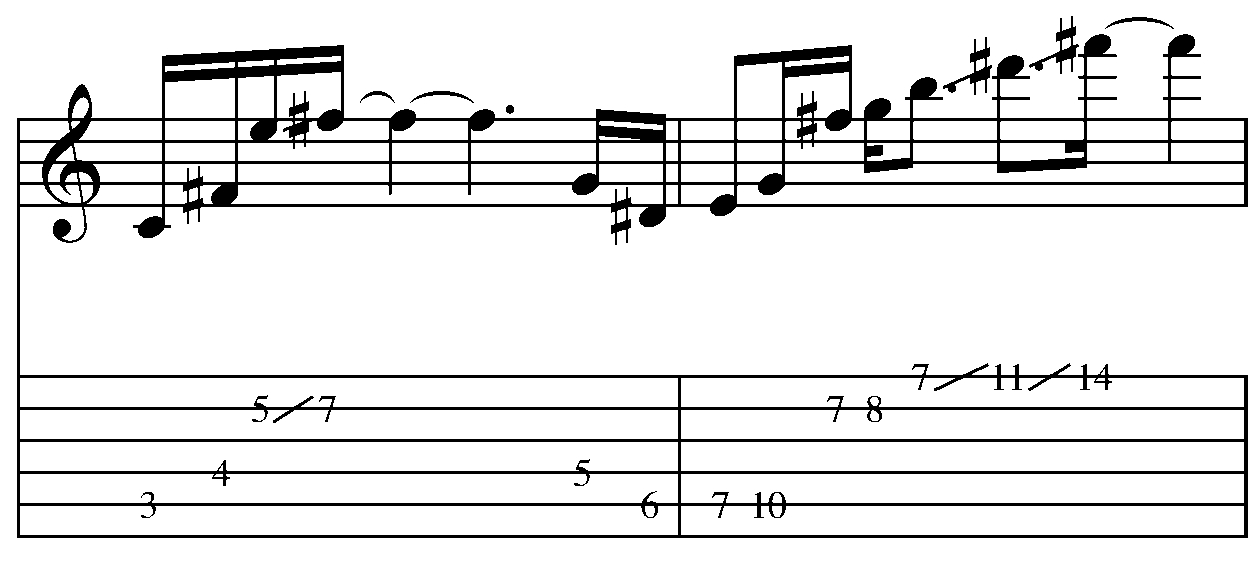
The lick

This idea is presented below in a larger lick that works over a d minor/d min7/d min9 chord.    Here’s an mp3 I recorded with the FNH Guitar  in AU Lab- first played slow (1/2 time) then faster (full speed – tempo is around 200).

** Note – the mp3 player on the site seems to be working better in Safari – but if you have trouble playing it – just refresh the page.


Notes:

  • The picking may seem idiosyncratic – but the approach is based on sweeping individual notes on multiple strings and alternate picking for notes on the same string.  You should find it consistent in that regard.
  • I see this as 3 licks.  Bar 1 is one approach.  The 1st two descending ideas in bar 2 as the second approach and the last 2 arpeggio ideas as the 3rd lick.
  • The note groupings are not all uniform.  Bar 2 has groups of 6 and 7 and splits a group of 5 up between bars 2 and three. .  Breaking out of rigid 4 note 1/16th note patterns adds an element of unpredictability .
  • There are a number of e-f slides to highlight the added note in this lick.  This is done with the idea of breaking the lick into segments rather than just using them in the lick as a whole.
  • Using patterns that have only 1 note on the B string – can make for some interesting chord ideas as well.  Here are some melodic fragments that can double as substitution chords over a d minor chord (with an mp3 here).

Lastly, examining the notes in this scale: D,E, F, G, A, C  as unique triads reveals the following:

D, F, A (d minor) + C, E, G (c major)

in other words – to get away from the full-scale approach – you could alternate D minor and C major arpeggios and get a very similar effect.  I’ll look at this more in a future lesson.

In the meantime, if this idea is interesting to you – you may also want to look at this GuitArchitecture lesson post, or look at the pdfs of the pentatonic posts in the online lesson (PDFs) tab on the top of the page.

I’m always looking for feedback.  If there’s anything in this lesson that helps, or that raises other questions – feel free to drop me a line at guitar.blueprint@gmail.com.

Thanks for reading!

-SC

.

Recycling Chords Part II: Triad Transformation

In the previous recycling chords lesson, I looked at ways to reinterpret chords. Another way to create different sounds is to take something as basic (and familiar) as a triad and alter tones to create more complex chords.

Note: this process isn’t designed to replace the need to learn multiple chord voicings but instead to supplement it.

.

Starting with the Flats

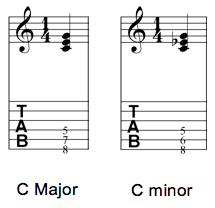
For example, take a C major triad (C, E, G) and flat the 3rd, and it becomes a C minor triad.

This idea also can be applied to the root of the chord.

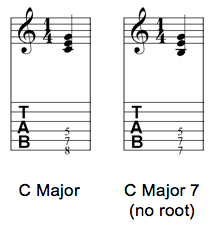
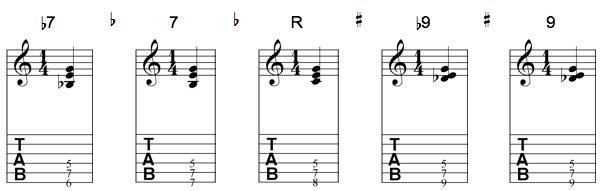
If the note C is flatted a ½ step (1 fret), the new note is B.  This creates a C major 7th chord with no root.

Likewise, if the note C is flatted a 1 step (2 frets), the new note is Bb. This creates a C7 chord with no root.

.

Moving to sharps

To add a 9th to the chord quality, raise the root  a ½ step for a flat 9 (b9) (or a step for a natural 9).

.

This is a good place to make a couple of notes:

.

First: the voicings presented here are used to demonstrate the process, but I like some of them better in other registers.  For example, here is the C add 9 voicing on the top 3 strings.

Second:  one reason to explore voicings without roots is that, in an ensemble setting, the bassist often holds down the root of the chord.  If you need the root –  it’s easy enough to just add it in.  Here is the same chord with a root:

The chord tone transformation chart


The following is a map of alterations to show how chord tones can be modified to create other sounds.

.

Taking the approach above, some general rules can be applied to a major triad.

.

The root of the chord can be lowered to the 7 or raised to the 9.


.

The third of the chord can be lowered to the 9 or raised to the 11.

.

The fifth of the chord can be lowered to the 11 or raised to the 13.

 .

In this manner, a triad can be altered into almost any other functional chord.


Here’s an exercise that utilizes a D major triad to illustrate this idea:

.

Note:  D major is used instead of C major because each note of a 1st position D major chord can be lowered to another note on the fingerboard, without using open strings.  In other words, each chord is a moveable voicing on the fingerboard.

.

The first step of this exercise is to make sure you can visualize triads both horizontally and vertically across the fingerboard.

 .

Horizontal (i.e. positional) visualization

Here’s a series of  D major chord inversions in the 2nd position.

Here are the D major inversions in the 5th position

and in the 10th position.

If these voicings are unknown to you, start by familiarizing yourself with them before continuing to the rest of the lesson.

.

Vertical visualization

Note: the important thing with both the horizontal and vertical voicings is knowing where each chord tone is located in the voicing.

One way to practice this is to play through the chords and stop at random points and ask, “where is the root?” “where is the 3rd?”  “where is the 5th ?”  This has to be full internalized to be able to intelligently transform the chords, with the goal being instant chord tone identification.


As with the horizontal voicings, if these voicings are unknown to you, start by familiarizing yourself with them before continuing to the rest of the lesson.

.

Triad Transformation Exercise

Now that the preliminary steps have been taken, let’s begin the process.

First, here are a few chord formulas we’ll need:

Major: Root, 3rd, 5th – D, F#, A

Major 7th: Root, 3rd, 5th and 7th –  D, F#, A, C#

Dominant 7th: Root, 3rd, 5th and  flat 7th –  D, F#, A, C

Minor: Root, flat 3rd, 5th –  D, F, A, C

Major 7 flat 5: Root, flat 3rd, flat 5th and flat 7th-  D, F, Ab, C

Now, let’s go through the exercise as individual steps to explain the process.

.

Step 1:  Take a Major chord (in this case D)

Step 2: Make it a D Major 7 chord

[by flatting the root a 1/2 step (1 fret)]

Step 3: Make the chord a D dominant 7 (D7) chord

[by flatting the root 1 step (2 frets)]

Step 4: Make the chord a d minor 7 chord

[by flatting the 3rd of the D7 a 1/2 step (1 fret)]

Step 5: Make the chord a d minor 7b5 chord

[by flatting the 5th of the Dminor7 a 1/2 step (1 fret)]

You get the idea.  Transform the chord into every possible voicing and repeat with every other inversion.

.

When less is more – A case for smaller voicings

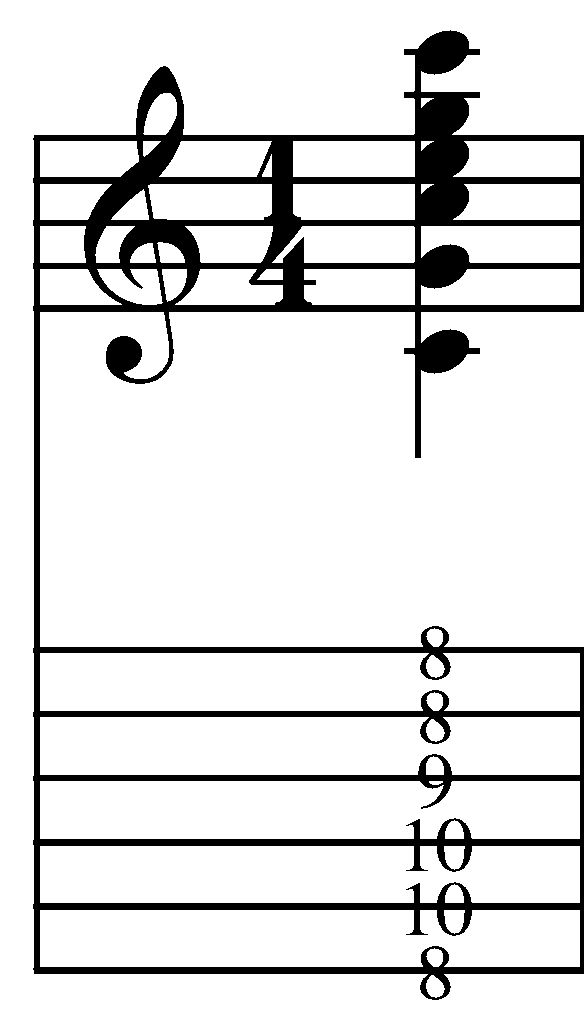
When I started out playing, if a song called for a C major chord, I’d play something like this:

While there’s nothing wrong with six note voicings, context is everything.  It took a while to realize that when playing in larger groups, smaller voicings sometimes helped propel the song and allowed for better voice leading.

For example: here’s the same C Major chord but with just 3 notes.

And here is the voicing in a I-iv-V7 (C-F-G7) progression with smooth voice leading.

If you’re playing solo guitar – this isn’t going to fill a lot of space sonically but it works well in an ensemble, and it’s easy to play.  A win-win.

I hope this helps!  In a future lesson I’ll go further into this concept and use it to create 9th, 11th and 13th chords.  In the meantime, you’re free to download and distribute any of the lessons here but I maintain the copyright on the material.

I’m always looking for feedback on what people find useful and what they don’t, so if you have any questions or comments, feel free to e-mail me at guitar.blueprint@gmail.com .

Favored Curry Or Spicing Up Chord Scales And Triads Part 2

In Part 1 of this lesson,  I went over how to create a chord scale for improvising over a specific chord (in this case C major)  chord.  As a brief recap – here is the chord scale I chose:

.

C major chord scale with a # 2, # 4, and a b6 scale degree.

.

To start this off – here’s a sample lick using this scale:

.

Here’s how the scale sounds played slowly  (1/4 note at 90)

Here’s the scale faster (1/4 note at 180).

.

The chords you say?

Since we’ve engineered this chord scale around a C major triad – we know that any licks we come up with will work over that chord – but to see what other chords can be used with this scale – we need to harmonize it.

Let’s look at the triadic (3 note) harmony first.

.

C major chord scale with a # 2, # 4, and b6 scale harmonized in 3rds (triads)

.

**Note the first 2 chords have been moved to the back three strings to facilitate playing:

.

Here are  the chord formulas that are generated:

  1. C, E, G – Root, 3rd and 5th – C Major
  2. D#, F#, Ab – Root, 3rd and double flat 5th – non functional harmony*
  3. E, G, B – Root, flat 3rd and 5th – E minor
  4. F#, Ab, C – Root, double flat 3rd, flat 5th – non functional harmony*
  5. G, B, D# – Root, 3rd, sharp 5th – G Augmented
  6. Ab, C, E – Root, 3rd, sharp 5th – Ab Augmented
  7. B, D#, F#, – Root, 3rd, 5th – B Major

(Note:  even though these don’t have a triadic function they can serve a function enharmonically – I’ll get to that in the 7th chord section).

To recap –  any licks that we generate from this scale will work over C major, E minor and B major.

 .

Adding the spice

Since we started this approach with C major – let’s look at a lick that spices up a C Major Triad.

.

Here’s an mp3 of the lick.  This is an example of something I might play as a backup accompaniment in the pre-chorus of a song.

To my ears even playing this over a straight C major tonality, the D#–>E really triggers an E minor tonality.  Try playing this over a C major –> E minor progression.

.

Moving to E minor – here’s an approach I use a lot in rhythm playing.

.

The first step is to take a set of three strings – in this case I’ll use the high E, B and G strings.

Starting with a sample chord voicing in the low register – ascend up the neck by moving each note in the voicing up by scale degree.  In this example:

.

I’ve started with an initial voicing (Ab, C and E) and moved it through scale-wise motion.

.

(Note:  I hear this as G# instead of Ab – you may want to see the section on enharmonics below).

.

Here is an mp3 of the voicings.  In the audio example, I play a low E between each chord to establish an overall tonality.

Having done this – I see some cool dyads ( 2 note voicings) on the B and G strings that I can use to spice up an E minor vamp.  This is an example of the type of comping I might do on the verse of a song if the song chart just said E minor).

.

Here is an mp3 of the lick.  Don’t be afraid to lay into the slides or add a little vibrato to make the notes sing a little more.

With a lot of these approaches – I’m not really conscious of what the specific functions of the notes are.  Once I know that the scale will work over a chord – it’s more about focusing on the sound of the notes and how they fit into the song.  On some tunes – these notes would clash with the melody and it wouldn’t work.

This process is about building a repertoire of sounds to have at your disposal.  Knowing the theory around it just allows you to adapt those sounds and approaches to make the fit where you want them to.

.

Space is the place

Here’s a lick that takes the above approach of breaking chords up into different string sets and applies it to a melody line.  Here I’ve focused on the A, D and B strings and added in the high E string at the end.

.

Here is an mp3 of the lick.  Note the slides, vibrato and slightly rubato phrasing at the end of the lick.  These are the little nuances that help make the difference between playing music and playing notes.

This next lick combines chord forms and melody by using artificial (i.e. “harp”) harmonics.  To produce these – a chord shape is held with the fretting hand while the picking hand picks and partially frets notes 12 frets higher resulting in a chime like timbre.  If you are unfamiliar with this technique – just google Lenny Breau (an absolute master of the approach) and you’ll get an idea.

For this specific lick:  I’m holding the D# with my second finger, the C with my 3rd and the Ab with my 4th so I can reach the F# with the fret hand 1st finger.

.

Here’s an mp3.

.

One of the secrets of this method is to strategically time the release of the fret hand notes.  The longer you can leave the notes held down, the more the pitches will bleed into one another – which produces the desired effect.  Before we go to the next lick I need to make a brief enharmonic diversion.

 .

An Enharmonic Diversion

An enharmonic is when a note is spelled differently but sounds the same (for example Ab and G#).  When playing this over an E drone – I hear the pitch on the first fret of the G string as a G# (i.e the third of the chord) instead of Ab.  It’s very difficult for me to hear that note functioning as a b4.

As a case in point, here’s another lick.  (This piece makes liberal use of vibrato bar scoops – listening to the mp3 of the lick for phrasing is recommended).

.

.

I’ve notated this lick with both a G# and a G natural as those are the intervals I hear in the approach.

With this interpretation it makes the scale harmonically vague as it would then have both a major AND a minor 3rd.  If we go back over the initial triadic chord and replace the Ab with G#, F# for Gb and D# for Eb we get a couple of different chord options.

  1. C, E, G#-  C Augmented
  2. E, G#, B –  E Major
  3. G#, B, D# – G# minor
  4. C, Eb , G –  C Minor
  5. G, B, Eb – Eb Augmented
  6. Ab, C, Eb – Ab Major

To recap –  in addition to C major, E minor and B major – these licks can also be used with care over E major, Ab major, C minor  and G# minor.

.

To finish this approach out for now – let’s look at 7th chords.

 .

C major chord scale with a # 2, # 4, and b6 scale harmonized in 3rds (7th chords)

**Note:  the stretch on the second chord should be approached with caution.  If it hurts – stop playing immediately!

.

Here are the chord formulas that are generated:

  1. C, E, G, B – Root, 3rd, 5th and 7th  – C Major 7
  2. D#, F#, Ab, C – Root, 3rd and double flat 5th, double flat 7 – Enharmonically – this spells – Ab, C, Eb, Gb, – or Ab7 – but doesn’t serve a function from the D# pitch.
  3. E, G, B, D# – Root, flat 3rd, 5th and 7th – E minor (Major 7)
  4. F#, Ab, C, E – Root, double flat 3rd, flat 5th – Enharmonically – this spells – Ab, C, Eb, Gb, – or Ab7 – but doesn’t serve a function from the F# pitch.
  5. G, B, D#, F# – Root, 3rd, sharp 5th, 7th – G Augmented 7
  6. Ab, C, E, G – Root, 3rd, sharp 5th – Ab Augmented 7
  7. B, D#, F#,A  – Root, 3rd, 5th, flat 7th  – B7

This gives us a couple of new tonalities to explore – namely, C Major 7th, E minor (major 7th), B7 and Ab7.

..

The final tally:

At a minimum, this chord scale will generate licks that can be used over the following chords:

C major, C Major 7th,

C minor, C minor (major 7th)

E major, E Major 7

E minor, E minor (major 7th),

Ab major, Ab7

G# minor

B major,  B7

.

Next steps:

You will probably not like the use of this scale with all of the chords listed but, as is the case with any musical approach, the key is always to use your ears as a guide to what works and what doesn’t.

I hope this helps! 

Happy Holidays and thanks for reading!

.

The material in the lesson is adapted from the material in The GuitArchitect’s Guide To Chord Scales book. More information about that book (including an overview and jpegs of sample pages) can be found here.

.

-SC

.

PS – If you like this post you may also like:

.

MAKING MUSIC OUT OF SCALES

CREATING CHORDS AND LINES FROM ANY SCALE – A HARMONIC COMBINATORICS / SPREAD VOICINGS LESSON

.

RECYCLING SHAPES OR MODULAR ARPEGGIOS FOR FUN AND PROFIT

GLASS NOODLES – ADAPTING A PHILIP GLASS ARPEGGIO APPROACH TO GUITAR

.

MELVILLE, MADNESS AND PRACTICING – OR FINDING THE DEEPER LESSON PART 2

SOME USEFUL ONLINE PRACTICE TOOLS

POSSESSION IS 9/10S OF THE LAW BUT PERCEPTION IS EVERYTHING OR PRACTICING PART VII

TESTING YOUR VOCABULARY OR PRACTICING PART VI

PRACTICE WHAT YOU PLAY OR PRACTICING PART V

.

DEFINITIONS AND DOCUMENTS OR PRACTICING PART IV

TENSION AND THE SODA CAN OR PRACTICING PART III

PROPER POSTURE IS REQUIRED FOR PROPER PERFORMANCE – PRACTICING PART II

PRACTICE MAKES BETTER AKA PRACTICING PART I

.

MELVILLE, MADNESS AND PRACTICING – OR FINDING THE DEEPER LESSON PART 2

FINDING THE DEEPER LESSON

INSPIRATION VS. INTIMIDATION

.

WARMING UP: FINGER EXERCISES, THE 3 T’S AND THE NECESSITY OF MISTAKES

“THE LIMITS OF MY LANGUAGE ARE THE LIMITS OF MY WORLD”

A BRIEF THOUGHT ABOUT MUSIC THEORY

.

BOOKS

LESSONS

.

Favored Curry Or Spicing Up Chord Scales And Triads Part 1

[This lesson uses material from The GuitArchitect’s Guide To Chord Scales which details all unique chord scales from 3-note cells to the 12-note chromatic set.  You can find out about that book (and the other GuitArchitecture books) here.]

When improvising over a C major chord, the first thought for many beginning improvisers is to use the C major scale as a melodic resource.  For example:  here are the notes of a C Major triad (C, E, G) broken up into a sample 2 string arpeggio:

.

C Major Arpeggio

.

One related chord scale for this scale is the C Major (Ionian) scale.  The reason for this is that all of the notes in the C major triad are found in the C major scale.

.

C Major Scale

.

While there is nothing wrong with this approach, in addition to being a fairly bland melodic color to utilize, it contains the 4th scale degree (F), which is often referred to as an avoid note because of its 1/2 step relationship to E.

.

Option B:  Modal Interchange

One solution to this is to use modal interchange to find alternate scales that work over a triad.  For example, C Major is a diatonic chord in the key of G.  Playing a G major scale starting and ending on C produces a C Lydian scale.

.

C Lydian  (Parent scale: G Major)


This scale works well with the triad.  In addition to containing the C major triad, it also has a raised fourth degree (aka #11), which adds a nice tension.

But this is merely scratching the surface of what can be found from this approach.

.

Option C:  Creating your own chord scale

.

Here ‘s a process for generating any chord scale based on a chord.

Step 1:  Start with a chord and write out the notes of the chord in ascending order.

.

Note: the smaller the chord, the more scale options you will have.

Let’s now look at the C major triad as a chord formula.  Since it’s made up of the notes C, E and G  any parent scale for C major chord should contain these notes (at least for now).

.

Step 2:  Between the notes of the chord, write in all possible notes for each additional scale degree.

For example, in the Ionian and Lydian chord scale examples above, the 2nd degree was D, but it could have just as easily been Db or D#.

Expanding on this idea, the 4th could either be F natural or F#, the 6th could either be Ab, A natural or A#, and the 7th could either be Bb, B natural or B#.

If we apply this idea to the all of the other scale degrees, we end up with a chromatic scale that looks like this in list form:

  • Scale Degree 1  – C
  • Scale Degree 2 – Db, D, D#
  • Scale Degree 3 – E
  • Scale Degree 4  – F, F#
  • Scale Degree 5  -G
  • Scale Degree 6 – Ab, A, A#
  • Scale Degree 7 – Bb, B

.

or this in music notation:

.

C Major triad with chromatic scale degrees

.

Note:  If you are planning on harmonizing the scale, deriving modal arpeggios or pentatonics, I recommend you keep each scale degree unique (i.e. that you use either Db or D or D#,  but not more than one type of D pitch).

Likewise, there are several enharmonic pitches (i.e. pitches that are spelled differently but sound the same) presented in the full chromatic.   While you could use A# and Bb in a chord scale since they are the same sounding pitch the result will be a 6 note scale.

.

Step 3:  Choose the scale degrees that sound the best to you.

Based on the above parameters, there are 32 unique chord scales for the C major triad.  Let’s look at one of them.

For this example, I’m going to choose a #2 for the second scale degree, a #4, a b6 and a natural 7 scale degree for a very chromatic chord scale. Here it is in list form:

  • Scale Degree 1  – C
  • Scale Degree 2 – D#
  • Scale Degree 3 – E
  • Scale Degree 4  – F#
  • Scale Degree 5  – G
  • Scale Degree 6 – Ab
  • Scale Degree 7 – B

and in music notation:

This scale has a # 2, # 4, and a b6 scale degree.

.

Next Steps

In the next lesson – we’ll examine how the scale is harmonized and generate some licks derived from this technique.

Thanks for reading!

-SC
.

The material in the lesson is adapted from the material in The GuitArchitect’s Guide To Chord Scales book. More information about that book (including an overview and jpegs of sample pages) can be found here.


PS – If you like this post you may also like:

.

MAKING MUSIC OUT OF SCALES

CREATING CHORDS AND LINES FROM ANY SCALE – A HARMONIC COMBINATORICS / SPREAD VOICINGS LESSON

FAVORED CURRY OR SPICING UP CHORD SCALES AND TRIADS PART 2

.

RECYCLING SHAPES OR MODULAR ARPEGGIOS FOR FUN AND PROFIT

GLASS NOODLES – ADAPTING A PHILIP GLASS ARPEGGIO APPROACH TO GUITAR

.

MELVILLE, MADNESS AND PRACTICING – OR FINDING THE DEEPER LESSON PART 2

SOME USEFUL ONLINE PRACTICE TOOLS

POSSESSION IS 9/10S OF THE LAW BUT PERCEPTION IS EVERYTHING OR PRACTICING PART VII

TESTING YOUR VOCABULARY OR PRACTICING PART VI

PRACTICE WHAT YOU PLAY OR PRACTICING PART V

.

DEFINITIONS AND DOCUMENTS OR PRACTICING PART IV

TENSION AND THE SODA CAN OR PRACTICING PART III

PROPER POSTURE IS REQUIRED FOR PROPER PERFORMANCE – PRACTICING PART II

PRACTICE MAKES BETTER AKA PRACTICING PART I

.

MELVILLE, MADNESS AND PRACTICING – OR FINDING THE DEEPER LESSON PART 2

FINDING THE DEEPER LESSON

INSPIRATION VS. INTIMIDATION

.

WARMING UP: FINGER EXERCISES, THE 3 T’S AND THE NECESSITY OF MISTAKES

“THE LIMITS OF MY LANGUAGE ARE THE LIMITS OF MY WORLD”

A BRIEF THOUGHT ABOUT MUSIC THEORY

.

BOOKS

LESSONS

.

I hope this helps!  You’re free to download and distribute any of the lessons here but I maintain the copyright on the material.

.

GuitArchitecture, Sonic Visualization And A Pentatonic Approach For The Holidays

Happy Holidays!

.

I know I’ve been posting a lot of gear related items lately – and  based on the statistics for site visits – this seems to be what people are primarily interested in – so this has driven the posting content recently.

While I’m happy to blog about gear (not incidentally, my 8 string Bare Knuckle Cold Sweat pickup came in last night and I squealed like Bobby Hill); I don’t want to get too far away from playing.  With that in mind I’m putting a concentrated effort to get more lesson/performance posts up to rebalance the site a bit.

I’ll have a new  chord-scale lesson up next week but in the meantime wanted to explain my performance/pedagogical approach to navigating the fingerboard with a fleet fingered pentatonic lick (yes, it’s reposted – but just like Thanksgiving leftovers – aren’t they still good on day two?).

.

GuitArchitecture?  Sonic Visualization?

.

I wanted to take a moment and talk a little about GuitArchitecture, sonic visualization and re-examine a chestnut from the lesson page as a little – three for the price of one post.

In broad strokes, the GuitArchitecture concept is that the nature of the guitar’s fretboard and tuning lends itself to visualizing fingering patterns.

While patterns performed mindlessly can be a bad thing, they allow people to realize ideas more readily.

Through these patterns, musical structures can be realized and worked into larger sonic arrangements.  More importantly, patterns can be associated with sounds and visualizing how to realize a sound by seeing its shape on the fretboard makes performing it easier.  Hence the term Sonic Visualization.

In my forthcoming books – I have a lot of information on this topic as it applies to scales.  When approaching scales – I see them as a series of modular two-string patterns that connect the entire fingerboard.

.

The GuitArchitecture Approach

. 

Here’s an applied example of sonic visualization:

Let’s say I’m playing a solo over an E minor chord.  As mentioned in a previous post – when soloing over a minor chord you can substitute a minor chord a 5th away (in this case B minor).

So if I’m thinking of using E pentatonic minor over the chord (E, G, A, B, D) I can also use B pentatonic minor (B, D, E, F#, A).

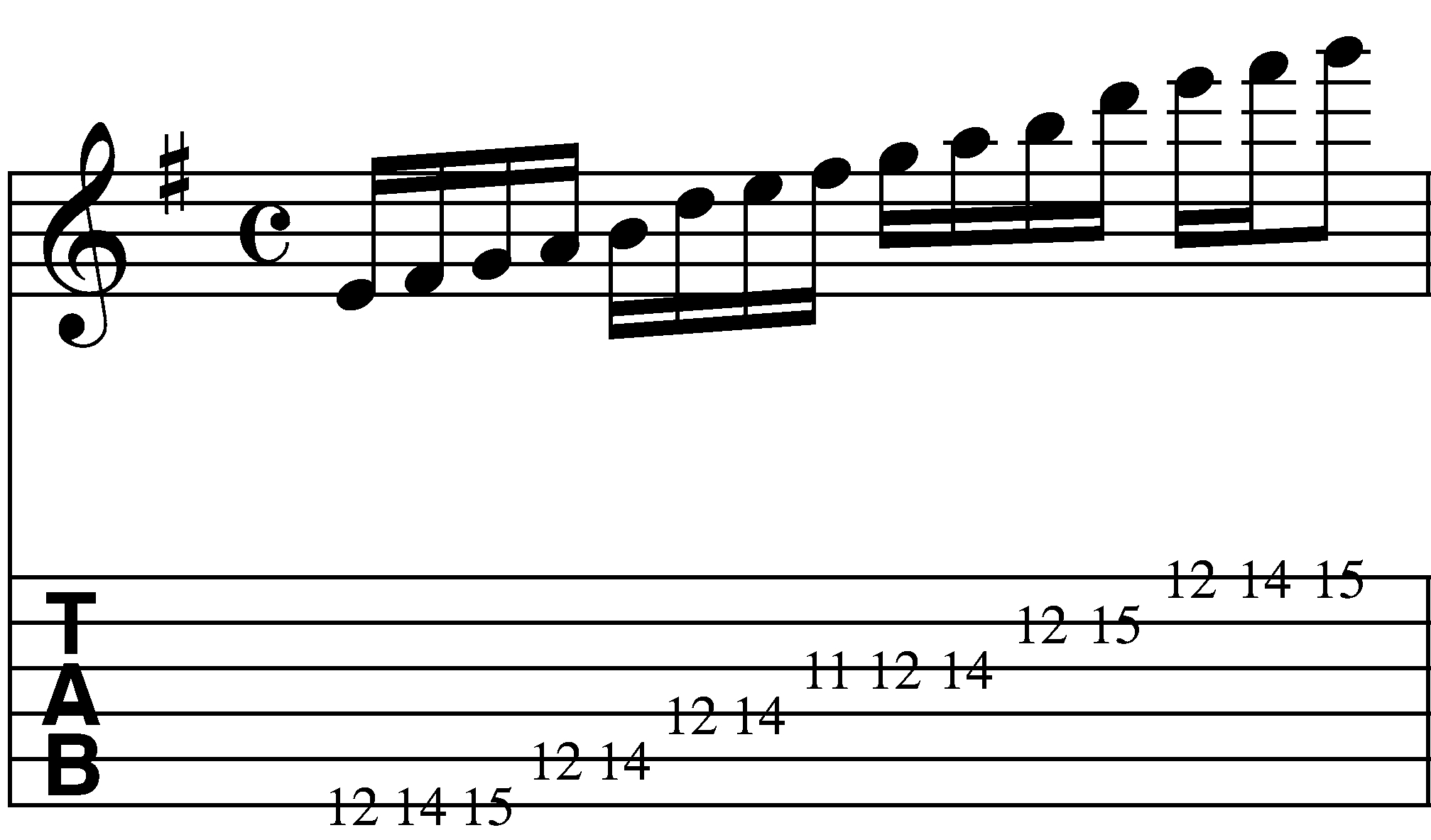
If you look carefully – you’ll see the only difference between the two is the F# and the G.   Both notes sound good against E minor, so if we combine them we get a six- note scale (E, F#, G, A, B, D).  Here is a sample fingering of the combined scales in the 12th position.

.

If that scale were fingered as a 2-string scale instead of a six- string box pattern – the same fingering pattern can be moved in octaves – thus eliminating the need for multiple fingerings. (This is the same approach I’m using on 8 string guitar btw).

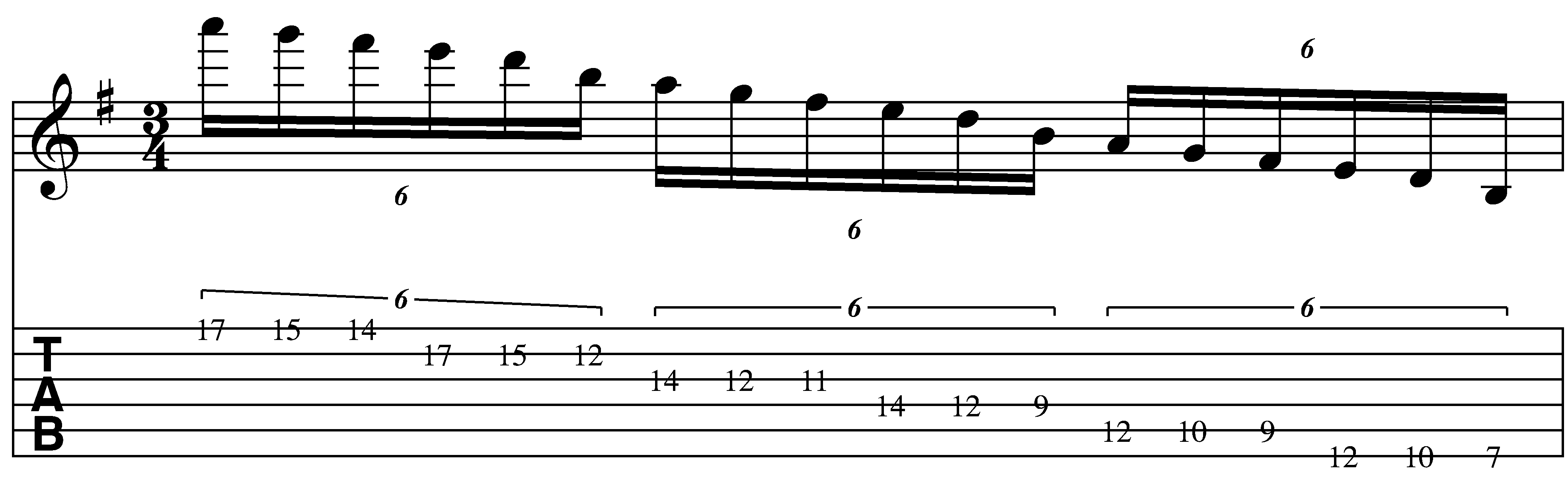
Here is an mp3 (note mp3s are a little glitchy in Safari – if it doesn’t play you may just have to reload the page) and notation/tab for the descending scale:

.

Sextuplet descending

.

.

* Fingering Note: I finger both patterns with the 1, 2 and 4 fret hand fingers on both string sets.

* Descending Picking Note: I play this with a modified sweep picking pattern

E string: up-down-up

B string: up-down-up

.

The picking pattern is the same for each string – but when I switch strings – it’s two up picks in a row.

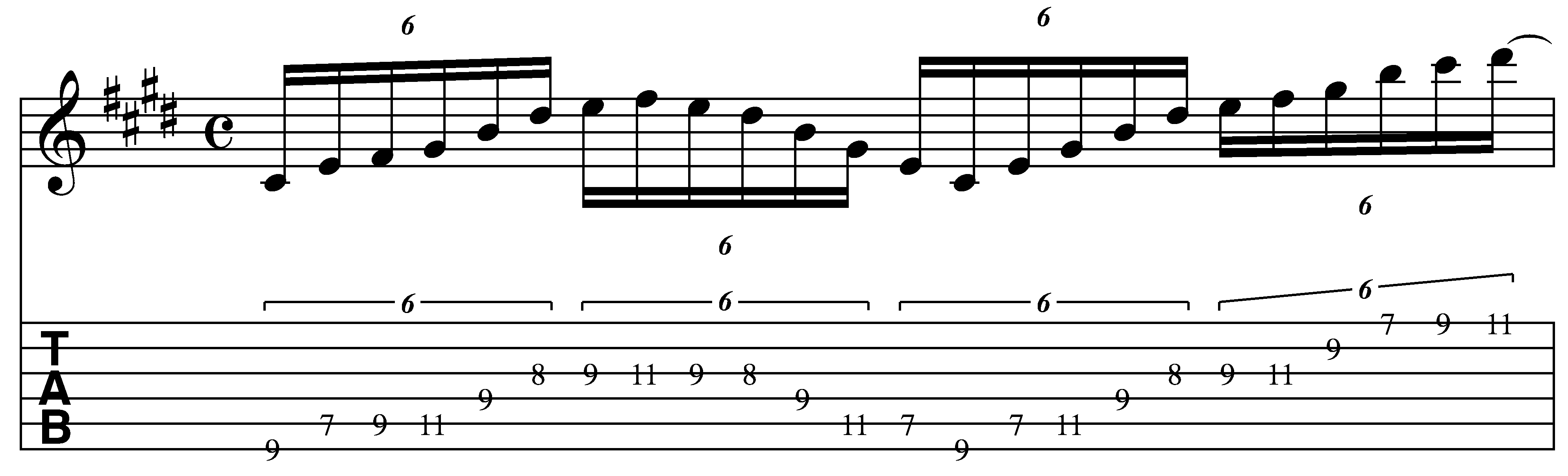
Here it is  ascending:

Sextuplet Ascending

.

* Ascending Picking Note: I also play this with a modified sweep picking pattern

.

E string: down-up-down

A string: down-up-down

.

The picking pattern is the same for each string – but when I switch strings – its two down picks in a row.

If you’re used to alternate picking  – you can use that approach as well but I try to apply the same picking pattern to all three-note per string patterns.

.

Practicing the pattern

.

In addition to focusing on the timing of the notes – it’s very important to practice slowly and only increase speed when both the timing (are all the notes being played with rhythmic equivalence?), tone (i.e. can you hear all of the notes clearly?) and hand tension (is your hand should be as relaxed as possible?) are all working together.

I’ve written a whole series of posts on practicing  (Post 1post 2post 3post 4post 5post 6 and post 7) that I’d recommend checking out if you haven’t already done so – but the simple principle here is to pay attention to what I call the 3 T’s in Performance: Timing, Tone Production and Tension.

This particular approach is challenging – particularly if you’re not used to the stretch.  Just remember to practice in small focused increments and try to increase steadily over time.

.

The Tones:

.

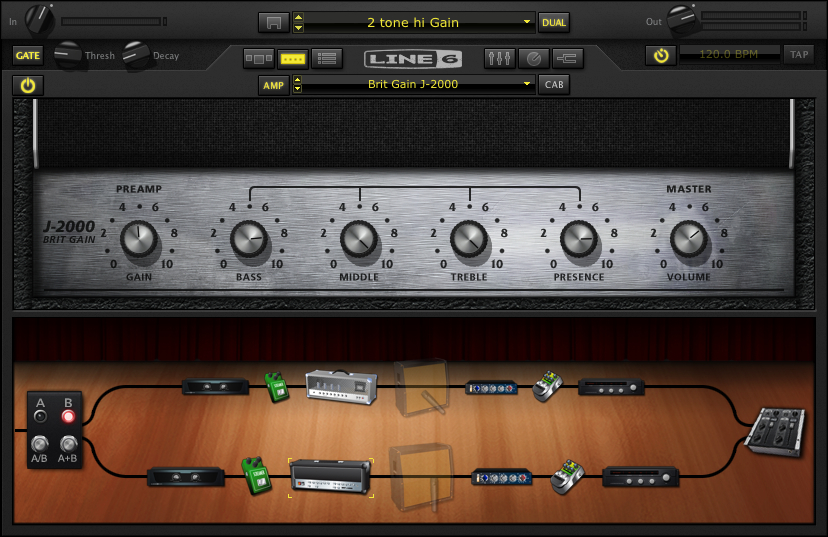
For those of you who are interested, tone on this recording was the same AU Lab/Apogee/FNH combination that I detailed here:

Here’s a screen shot of the Pod Farm setting (The tone can be downloaded from line 6 here):

.

That’s all for now

.

I hope this helps!  You’re free to download and distribute any of the lessons here but I maintain the copyright on the material.

I’m always looking for feedback on what people find useful and what they don’t so if you have any questions or comments, please feel free to e-mail me at guitar.blueprint@gmail.com

Building Blocks – or more examinations of a laptop guitar setup.

If you’ve ever seen the American dubbed version of Mad Max (the whole movie plays very differently with the original voices – I’m just so used to the original American release’s versions of Night Rider, Toecutter and the Goose –  that that’s the only one I can watch), there’s a moment where The Goose realizes that the person they’re about to arrest is an associate of ToeCutter, and the camera closes in on his face as he says,

“Well well well…”


I wanted to go a little more in depth with the laptop guitar rig I’ve been toying around with.  I’ve posted a couple of things about this but I realized that it may be more beneficial to examine each component and see how it fits in the puzzle.  I tend to focus these on distorted sounds as those to me are the most difficult to replicate.  Even Logic has some decent sounding clean amps built in – getting a useable dirty sound is still the challenge at least for me.

So what I did was improvise a little idea in a C# minor tonality and then played a series of versions of it through different versions of the laptop set up – to show the evolution of where I have things now.

There’s still a great deal more work to do in this area, but at least these are some starting points and may at least shed a light on the process I’m using.

As a starting point you may want to look at the gear page or my previous entries on this topic here or here.

The (salt) lick


To begin with, here’s an mp3 of the first thing I improvised:  C# min improv .

* Note:

occasionally mp3’s don’t load properly when I check them in Safari.  When I refesh the page they come up.  If you have this problem – it may work for you.  If you still can’t hear the mp3 just leave a comment and I’ll re-post it.

And here’s the notation

The first part of the lick is somewhere between a scale passage and an arpeggio which makes it a little interesting to me.  This approach is something I use a lot in my soloing to get away from the temptation to go on autopilot and just run scales up and down the whole time.

Visually, I’m initially thinking “G#min arpeggio”, and then dropping the lowest notes by alternating 3rds to extend the tonality.  This is an arpeggio trick I use all the time to get new sounds out of old shapes.  I’ll detail this process here:

Here’s a G# minor arpeggio:

When I look at the distance between the G# and the B – that’s a minor 3rd.  By alternating 3rds ( either major-minor or minor-major) I can extend the tonality.  A major 3rd down from G# would be E.

If I drop the lowest note to the “E” on the A string – I’d have an E maj 7 arpeggio. (E G#, B, D#).

If I drop the lowest note to the “C#” on the E string – I’d have a C# minor 9 arpeggio. (C#, E, G#, B, D#).

(If you wanted to go further you could continue the process to A, F#, etc.)

The next thing I do is to add the F# on the A and G string.

This makes G# min7 / E maj 9 / C# min 11 depending on the chord it’s being played over or how you’re visualizing it.

Now that I have the larger shape – I fill in some 3 note per string patterns on the G and high E strings.

There’s a slight 2 string variation on the A string that’s hammered instead of picked, but otherwise the picking pattern discussed on the swept pentatonic lesson is the same approach that’s used here.

This is very similar to the 3 note per string / 1 note per string pentatonic patterns that I’ve been exploring in the online lessons area of the blog (you can see a pdf here).

The process that I’m detailing is how I began to practice these things and then develop them into more complex ideas.  I tend to see sounds like this as one large pattern now ( note:  the GuitArchitecture process is all about sonic visualization – i.e. associating shapes with sounds so that sounds can be created and manipulated in real time) .  So when I improvise, I’m not really too conscious of exactly what’s happening theoretically – only sonically.

This ends in a pretty pedestrian B major (C# Phrygian) scale run.  In soloing I would typically try to develop it into something else – but for the purposes of a sound demo – it makes sense to have a short lick with a definitive ending.

The sounds

First I’ll play the lick with the sound used at the ending point of the process.  Here are some screen shots of the set up.

The FNH guitar on the neck pickup goes into the Apogee duet into AU LAB:

I run PSP Vintage Warmer

into Pod farm 2.01 Ilok version

I’m using the Marshall side of this rather than the Soldano – so I’ll show the signal chain there (it’s the same for both setups shown).

I’m going to start with the mixer and then go from there:

Since I’m only running a single line in- I’ve set both inputs to left.

There’s a little tonal secret hiding in plain sight here as well.  If you look carefully – you’ll see that the DI is set to about 18%.  This allows some of the dry guitar signal to come through as well.  This give the tone a little body and clarity that’s lacking from just the straight signal.

You might find that to completely not be the case – and again – this is just one person’s process detailed here.

Here’s the gate.  I tend to keep the levels low so it doesn’t kick in when I’m playing – but kills the noise when the volume is off.

The gain on the Marshall is set around 22%.  I tend to crank the mids a little to help make sure the sound cuts through in a live mix (note the use of the term “help”.  In reality – sound at any live gig is only as good as the sound person.  I just do what I can on my end to make sure I can hear myself on stage.).

Before the Marshall for the “lead” sound I’ve put in a tube screamer.  Here are the settings for that:

Here’s the lick with the tube screamer (same as above): with tube screamer

Here’s the lick without the tube screamer:  without tube screamer .

To give you a sense of how important the amp gain is to the overall sound – here’s a variation of the lick above with the amp gain set around half:

Here’s the lick with the tube screamer (same as above): TS_ON_50%_gain .

Here’s the lick without the tube screamer:  NO_TS_50%_gain .

I actually like this amount of saturation for lead lines – but the reason I’ve gone with the lower gain is that chords (outside or Root-5th diads) – tends to just crap out and turn to sonic mush with higher gain settings.  So to balance the 2 I’ve been working on lower tweaks.


WHY THE CABINET IS TRANSLUCENT.

Oh that’s easy.  It’s because I’m not using it.

Instead I’m using Impulse Responses from Recabinet in LA Convolver (See the links above for more info).

Here are the settings:

The IR’s are from the Recabinet Modern 2.02 Mac and PC-> 1960 4×12 cabinet settings.  You’ll notice that I don’t have anything fancy in terms of mikes set up on the cabinet,

Here is a major component of this process.  Recabinet comes with something like 2000 IRs.  I could spend weeks doing nothing but checking tonal variations on all the different cabs mikes.  Someday when I need to get really deep into this – I will.

In the meantime – to cut down on the number of parameters and just get to a tone – I went with the KISS (keep it simple stupid) approach.  I thought about what cabinet could be a constant for all my sounds clean and dirty – and the 4 x 12 came to me.  I’ve heard a DeVille through one and it sounded good so I decided to use that as the standard and tweak the amp around the cabinet.  Live, a 57 on the grill sounds good to me.  I tried 2 different variations of the same thing and went from there.

To contrast this:  here is the sound of just PodFarm – with the PodFarm cabinets but with the PSP and post preamp off.

Here’s the lick with the tube screamer (same as above): NO_IR_YES_TS .

Here’s the lick without the tube screamer:  NO_IR_NO_TS .

Some of you may prefer these sounds.  I happen to think that “initial” mp3 – has a bit more character than these.

Here’s the rest of the signal chain:

Here’s the pre-amp (post amp! – this is a very useful tweak!):

Here’s the delay:

Here’s the reverb:

So to quote the Goose, “Well well well…”

It’s still a work in progress.  I’d like to work on tweaking the preamp after the cab to carve the tone a bit more and experiment with using an outside delay later in the AULAB signal chain – but for now this is where it is.

I hope this helps!  If you have any questions or comments please fell free to leave them on the blog – or e-mail me at guitar.blueprint@gmail.com .

Thanks for dropping by.

-SC
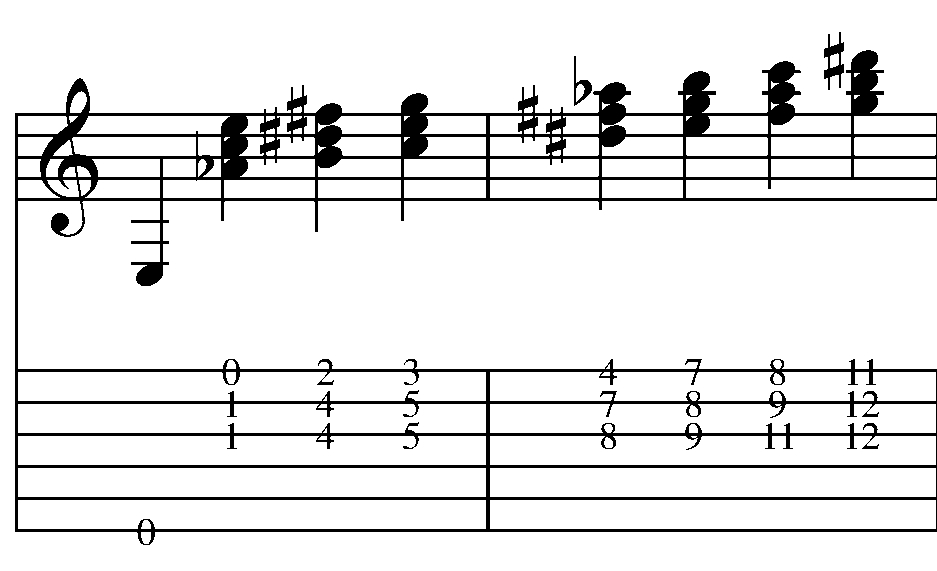
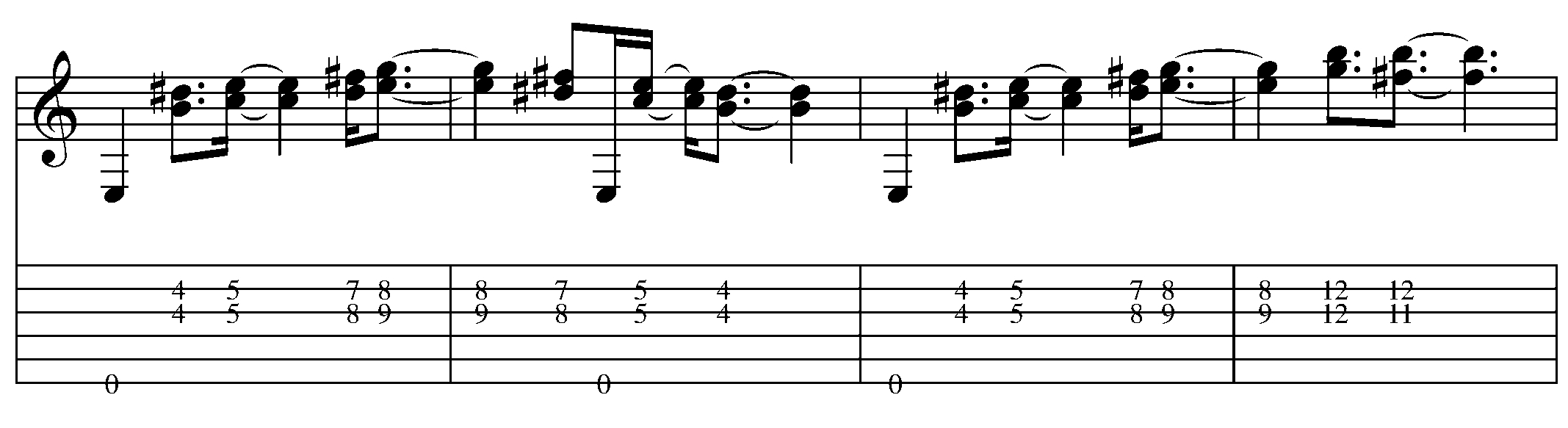
Glass Noodles – adapting a Philip Glass arpeggio approach to guitar

I tend to get a lot of playing ideas from sources other than guitar.  A primary source of influence is film and one of my all time favorites is Mishima. To me, Philip Glass’ score works brilliantly with the subject matter and helps create a powerful experience.

Here’s a lesson post on some cool approaches I borrowed (read: stole) from Glass that might provide you with some inspiration.

I’ll post the exercise first and then add some color commentary.

A link to an mp3 is here:  Glass Noodles122bpm

First thing’s first – the  triadic* chord progression (see note at the bottom) is  G Major, G# diminished, A Major, A# diminished, B Minor, G Major, B minor, B Diminshed, B Minor, G Major, B minor, B Diminshed. (Note: The second bar repeats – I just forgot to put the repeats in).

I’ll start with a technical issue and then go into the theoretical things to grab.

.

If you want it hypnotic –   you’ll have to lose the pick.

.

Part of the sound of this is the hypnotic repetition and a large part of that sound come from a uniform attack.  You can sweep pick all of these arpeggios as well – but for a more legato sound it’s best to approach all of these with fret hand tapping (i.e. all hammer ons and no picking).  From a technical standpoint the real challenges here are 1. keeping the attacks uniform (i.e. all of the note volumes are even) and 2. playing it in the pocket rhythmically.

.

Getting the maximum effect of something like this requires  sequencer like articulation and timing – and that alone makes this something worth studying.

.

As a starting point you’ll probably want to mute the stings to prevent open notes from ringing out (I just use my picking hand – some people use a hair tie or a piece of cloth.)

For uniform attacks – you’ll have to have very clean hammer-on technique with the fingertips hitting the strings instead of the pads of the fingers.   If there’s any slop there – it will come out in the arpeggios.  One other thing to note is that the notes should be lifted off and not pulled off.  If the only sound created is by the individual fingers hitting the strings – you will have a more uniform sound (which is totally the goal here).

.

Here’s a good way to visualize the fret hand finger motion you’re looking for.

.

Put the palms of your hands on a table.  Now without lifting the palms up, tap your fingertips one at a time on the table starting from the pinky and ending on the index.  You’ll notice that the fingers stay curved and that the large knuckle of each finger is responsible for the tapping.  This motion is what you’re looking for in this process.  You should also notice that you don’t need to hit the fingertips very hard against the table to get a crisp attack.

.

You should strive to get volume with the minimum amount of finger pressure.

The more relaxed you can keep your hand, the easier this will be.

.

You can add some compression to make help make the attacks more uniform as well.  I typically don’t use a lot of compression as I like to play very dynamically and find myself adjusting volume and tone a lot when I play – but a compressor plug in will make all of this easier to play.

This approach gets counter-intuitive at the G major arpeggio (the second arpeggio of bar 2).  For a technical stand point this is the trickiest part of the passage. (Note:  The numbers under the notes indicate fret hand fingerings.)
.

.

I am used to playing the G major arpeggio as a 5 string form – which usually uses the 3rd finger as a barre on the 12th fret, but barring the B and G on the 12 fret completely breaks up the sound and makes it impossible to get the tapped sound of the other notes.  To get around this – I use the index finger to fret the G  so each note gets a unique attack.

.

This is one of those deceptive exercises.  Playing it at 60% will not take very long – but the difference between 60% and 100% is HUGE.

.

Playing everything  with correct timing and really articulating every note will take a while.  Don’t get discouraged if it doesn’t happen right way.

.

The key here is to plan on spending a lot of time playing the arpeggios really slowly to make sure that the timing and volumes are 100% from the beginning.  You can read some of my posts on practicing to get a sense of the best way to start working on something like this.

Now some theory observations:

.

If you sharp the root of a major arpeggio – you get a diminished arpeggio.
.

This doesn’t sound like much – but look at the first 3 arpeggios.  By making the G a G#, you get a nice chromatic motion on the B string leading into the A Major Arpeggio.  You can also notice that the A# in the diminished arpeggio after the A major arpeggio leads right into the B Minor arpeggio.  This is a great way to sequence between 2 Major Arpeggios a step apart (Like G major and A major).

.

If you sharp the 5th of a minor arpeggio – you get the root of a major arpeggio.

.

Again a small thing – but by using this you get  a nice voice leading between the B minor/G major arpeggios in bar 2.  Also notice the chromatic motion on both the G and the high E string.   This continues the chromatic movement that occurred on the B string between the first 3 arpeggios.

.

If you flat the 5th of a minor arpeggio – you get the 5th of a Diminished arpeggio.

.

Check out the last arpeggio in bar 2!  By continuing the downward chromatic motion through the  G Major – B Minor – B Diminished – a sense of urgency is created and then the last point –

.

There’s mystery in keeping it unresolved.


.

In the Mishima soundtrack (you HAVE put the movie in your Netflix Queue yes?) there are a number of moments where at the end of the arpeggio flurries – it ends on an unresolved chord.   Here I’ve repeated the last arpeggio fully and then ended on the lower F on the last repeat.  If I was making a song out of these ideas – I would continue with the type of figures and ideas that have already been presented here and possibly resolving them.  But here in this context – ending on the F – just leaves a giant question mark and makes it interesting.  If you don’t believe me – watch the film!

.

*Note: If you move away from triads – there’s another analysis here:

.

The notes of G# diminished are can also be seen as the 3rd, 5th, and b7 of an E7 arpeggio.

Therefore: If you sharp the root of a major arpeggio – you also get the 3rd of a dominant 7th arpeggio (with no root).

.

This would make the chord progression   G Major, E7, A Major, F#7, B Minor, G Major, B minor, B Diminshed, B Minor, G Major, B minor, B Diminshed.

The bass motion would be what determines the actual chord progression.  I believe the bass motion followed the chromatic motion but the E7->A and F#7-Bm are pretty standard analysis for a chord progression like this.


More posts soon.  Please feel free to post any questions or comments you might have or e-mail me at guitar.blueprint@gmail.com.

-SC
A brief thought about music theory

One of the reoccurring  areas of concern that comes up in lessons is the issue of music theory.   This is both in terms of people who don’t want to be taught any kind of  theory, (as in, “No – don’t show me that!  It’ll mess up my playing!”) to people who have been exposed to terms that they have questions about. Usually both scenarios involve a lot of trepidation and discomfort (much of which is needlessly inflicted).

I would guess that the only people who have ever leapt for joy at the sight of a musical note on paper without hearing it are composers.  For most people, music is an expression solely existing in an aural form (i.e. it’s something we hear).

.

Theory is secondary to sound.

The history of music originates in organized sound.  Theory and jargon were developed over time as a way to replicate those organized sounds.  A term like “C major” is just musical jargon.  When “C Major” is said, it tells the informed person what kind of sound is going to be produced. This jargon then, is nothing more than a way for musicians to express ideas to each other without written music in a more efficient manner.
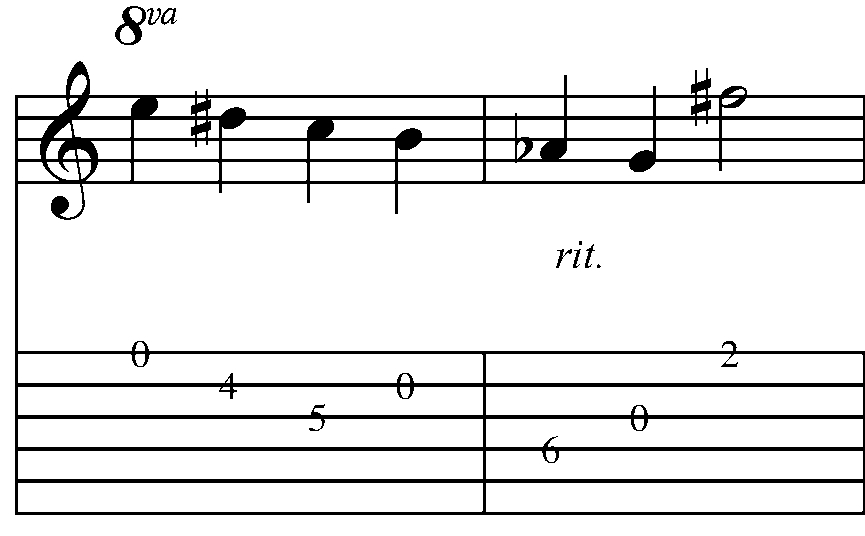
It’s much less important to be able to look at something and say, “that’s an altered dominant chord” than it is to hear an altered dominant chord in your head and be able to realize it on the guitar ( or to hear someone else playing it and know what to play against it).

.

In other words, theory and/or analysis should always be in the service of sound.

.

I think theory should have two functions – first to help us realize sounds that we want to reproduce and (to me the much more exciting option) to expose us to sounds we didn’t know were there.

.

The entire concept of GuitArchitecture (presenting applied theory as a set of approaches that can be used to help access both known and unknown sounds) is why a lot of the book material is less about licks and more about approaches.  

.

From a teaching perspective, it probably doesn’t matter if you can sound like me (unless that’s what you’re striving for), the important thing is developing your individual voice and being able to replicate sounds either intuitively and/or with theory is a major component of any player’s individual sound.

.

Theory, then,  is just a tool.  It really isn’t anything to get tripped up on.

.