Recycling Chords Part I or Where’s The Root?

I’d like to start this brief series off with an explanation of how I view the function of theory.

(For those of you who are interested, this is taken from, A brief thought on Music Theory.)

Theory is secondary to sound.

The history of music originates in organized sound.  Theory and jargon were developed over time as a way to replicate those organized sounds.  When a term like “C major” is used, it tells the informed person what kind of sound is going to be produced. This jargon then, is nothing more than a way for musicians to express ideas to each other without written music in a more efficient manner.

It’s much less important to be able to look at something and say, “that’s an altered dominant chord” than it is to hear an altered dominant chord in your head and be able to realize it on the guitar (or to hear someone else playing it and know what to play against it).”

This series of lessons are excerpts from the Guitarchitect’s Guide to Modes: Major Harmony book (due out in 2012).  While that book covers basic intervals and chord theory, this lesson will make the most sense if  you have some knowledge about chords, intervals and chord construction.  Having said that, even if you have a very limited knowledge of these areas you can still get something from this lesson by playing through the examples.

When I was at Berklee, one of the recommendations I got was to learn a minimum of two voicings for every chord type I came across (and more if possible).  While this is certainly a valid point – another way to approach learning new voicings is to reconceptualize what you already know. To see other ways of looking at things in this case, I’ll need to bring in a little music theory/analysis.

.

When is C, E and G something other than C Major?

In order to identify a chord, we first have to establish the root to determine the functions of the other notes in the chord.

For example, if we look at the notes C, E, and G with C in the bass we get a C Major chord.
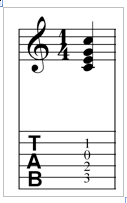
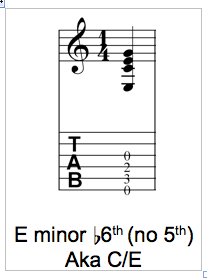
However if E is the root of the chord – it’s possible that the chord could be analyzed as an E minor with an added flat 6th and no 5th.

While you may hear this combination of notes as come kind of E minor chord, you are more likely to hear it as a C major triad with E in the bass.  The sound of a major triad is so entrenched in the average listener ’s head that it will be very difficult to hear this specific combination of notes as anything other than C major.

This is sometimes written as C/E.  This chordal notation is commonly called a slash chord and is written in the format of chord/bass note.
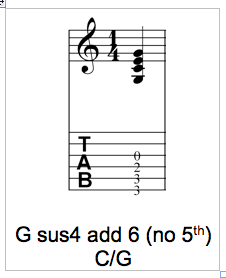
The same is true for the next example.  If G is the root of the chord – the chord could be analyzed as a G sus4 add 6 (no 5).  But more likely you will hear it as C/G.
Let’s add a note outside of the triad to the chord.  By putting an A in the bass, the chord spelling is now A-C-E-G (which is an A minor 7th chord).

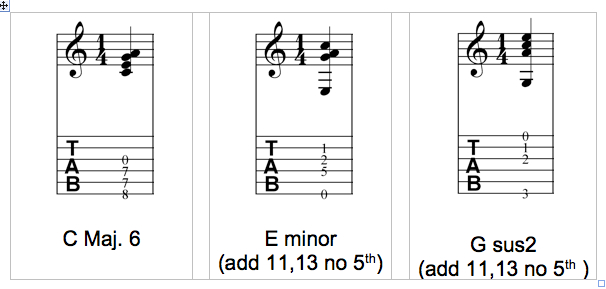
Just because you have 3 notes doesn’t mean that you’re limited to a specific chord type.  In other words the notes C, E, and G are sometimes more than a C Major chord.

Using the same process as above the collection of notes above could also be analyzed as:
.

Converting to C

Let’s now look at how a C Major triad can be analyzed over every other root.

A quick theory tip:  Whenever I see chord or a scale that I’m having trouble recognizing, I recommend modulating it to the key of C.  The reason for this is the lack of sharps or flats make any accidentals immediately identifiable.
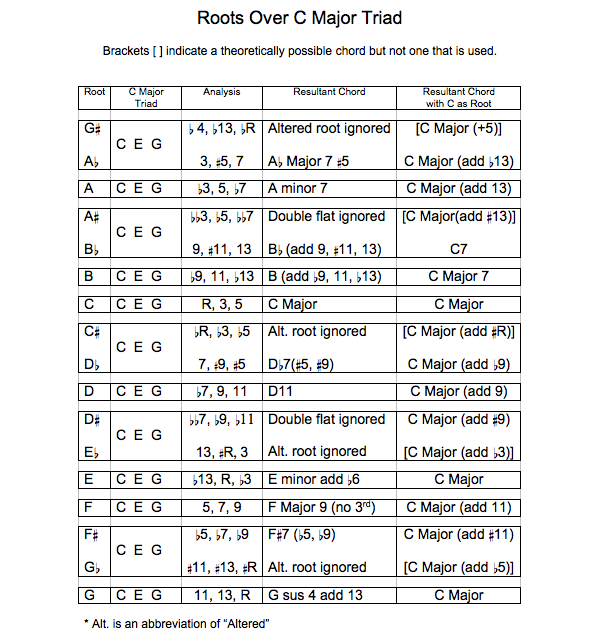
Here are a couple of points regarding this:

  1. There are several ways that these chords could be interpreted and that this is merely my analysis.
  2. The Analysis column is analysis in relation to the root.  For example, the C of a C major triad is a b4 over a G# root.
  3. The resultant chord column has an implied analysis.  For example the D11 derived from a C major triad over D is more accurately a D11 (no 3rd, no 5th add 9).
  4. Some of the voicings presented are theoretical voicings and not something you find on a chord chart.  For example: C7 is a much easier voicing to conceptualize than C Major (add #13) and I have yet to see a chord chart with C Major (add #13) on it.)  Ditto for altered roots.

.

Putting the Theory into Practice

Let’s say I’m playing a song that uses a major chord and I want to spice it up.

In looking at the above chart, I see that utilizing a C major triad over a Bb could be seen as a C7 chord with the 7 in the bass (C/ Bb ) or it could be seen as a Bb chord with every upper chord tension.

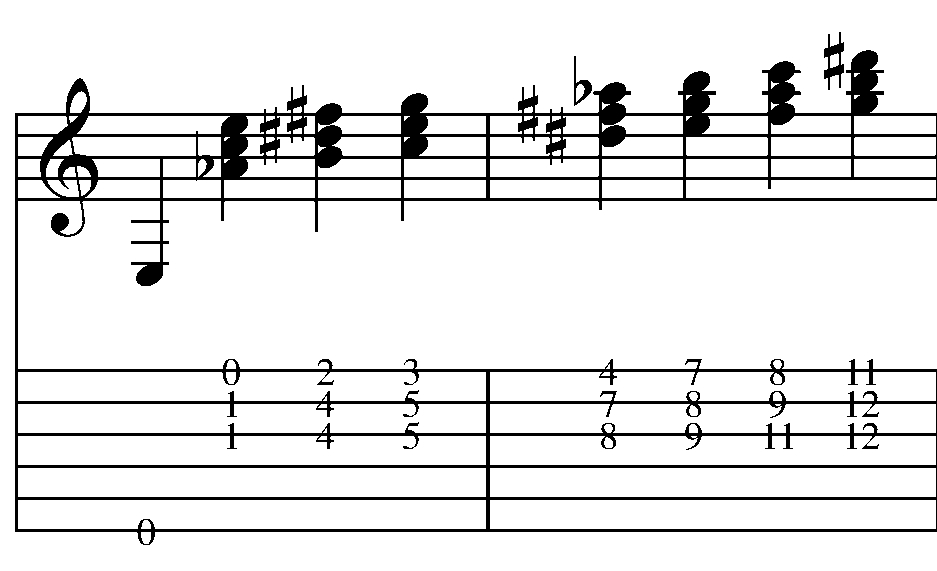
Here’s a voicing in open position.
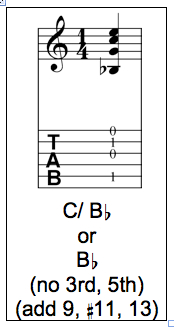
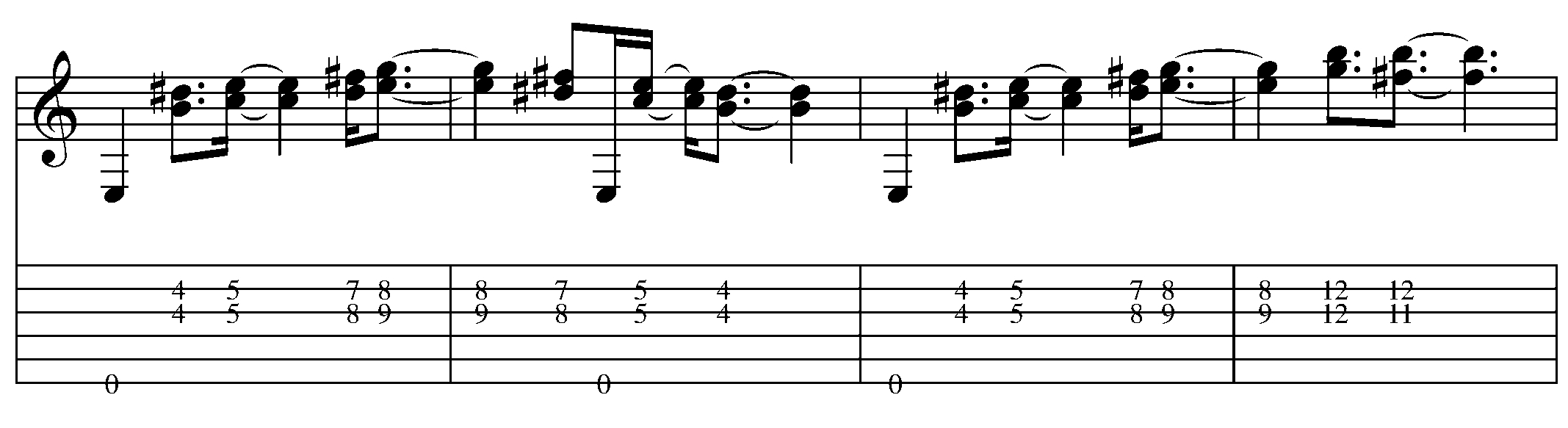
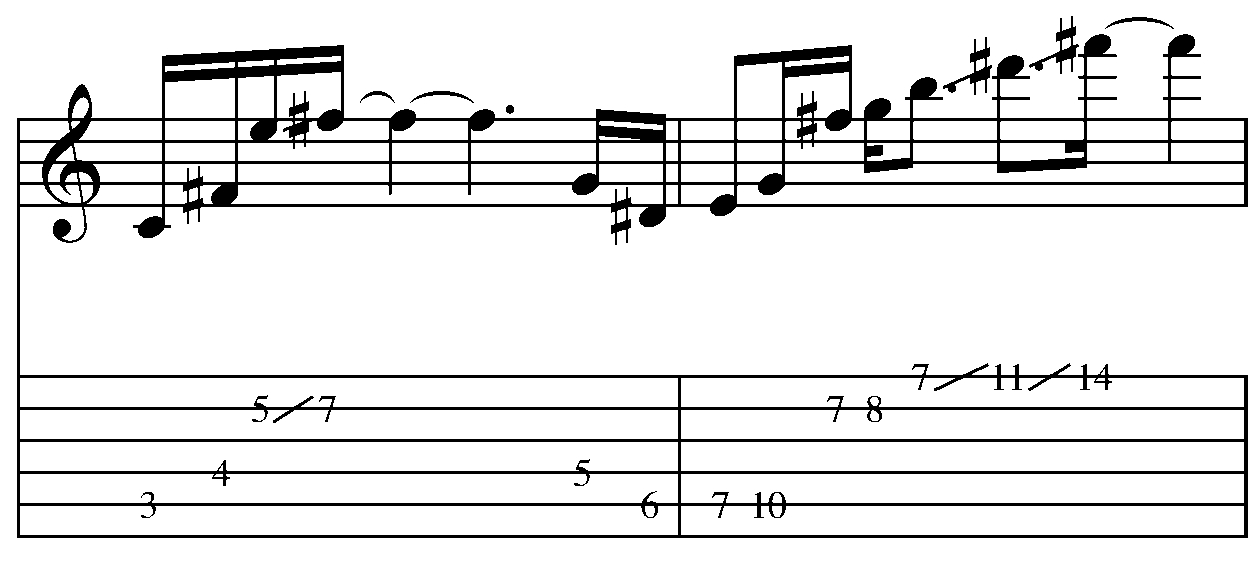
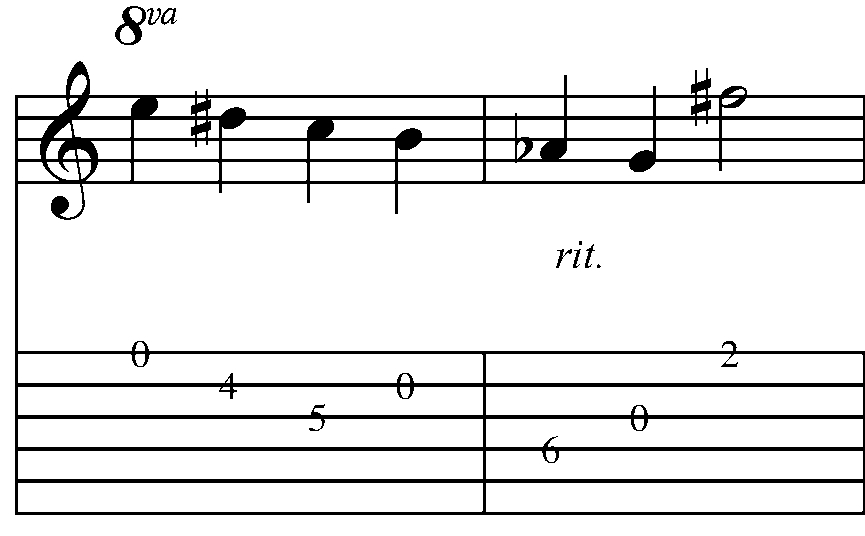
Now let’s make this a movable voicing.

Let’s begin with a 1st position C major chord

and a 1st position D major chord
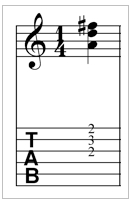
Keeping the root and the 3rd of the C major, we’ll use all the rest of the notes of D major:

and we get a really rich sounding substitution for a C major chord.

.

Next steps

This chord merely scratches the surface of this approach.

In addition to making some new chords from familiar voicings (i.e. Ab maj7#5 = C major /Ab), you also get some improvisational approaches as well (for example – as a starting point for soloing over a Ab maj7#5 you could play a C major arpeggio rather than learning a maj7#5 arpeggio).

For now, I would recommend exploring these sounds both as chords and as an arpeggio approach (i.e playing a C major arpeggio over each root) to see what sounds work for you and then adapt those to other keys.

Additionally, this process can be applied to any chord.  If you feel like exploring this approach – C minor might be a good place to start.

In part II of this series, I’ll discuss a process I call triadic transformation as another way to reconceptualize chords that you already know.

.

In the meantime, just remember that there isn’t anything here to get too hung up about.  Take the sounds and approaches that work for you and discard the rest.

I hope this helps!  You’re free to download and distribute any of the lessons here but I maintain the copyright on the material. I’m always looking for feedback, so if you have any questions or comments, please feel free to e-mail me at guitar.blueprint@gmail.com.

-SC
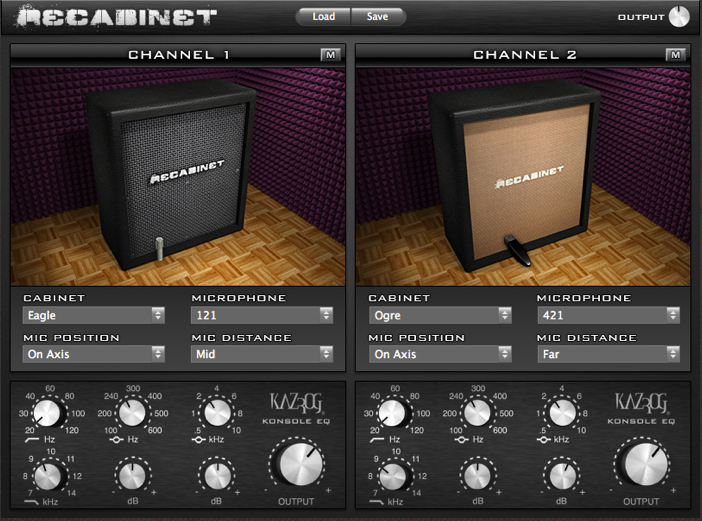
Recabinet 3 Announced – New IRs And A New AU/RTAS/VST Shell

For those of you who have been exploring the laptop/tech aspects of the site – Recabinet announced yesterday that the new 3.0 update will be sold on the  http://recabinet.com site on January 18th, 2011.

In addition to a number of 20 cabinets and 8 mics, you also get a new VST/AU RTAS Shell for hosting IRs in Mac or PC.

.

(Screen shot taken from Recabinet website)

Here’s what I find appealing from a first glance perspective:

  • Drop down menus for the cabinet and mic positions are big time savers
  • The eq functions are a good idea
  • Individual gain controls (in addition to the host gain) offers a lot of flexibility
  • A number of bundled presets – also a very good idea

.

Here’s a list of the cabs and mics

(taken from Recabinet website)

.

Cabinets:

  • 1960 – based on a Marshall 1960AV 4×12
  • Angora – based on a Line 6 Vetta 4×12
  • Blackface 4×10 – based on a Fender ’65 Super Reverb 4×10
  • Chordal – based on a Roland JC120
  • Damien – based on a Marshall 1936 2×12
  • Dazed – based on a Supro Thunderbolt
  • Eagle – based on an ENGL Pro 4×12
  • Excel – based on a Randall RS412XLT100 4×12
  • Genzie – based on a Genz Benz G-Flex ported 2×12
  • Green – based on an original 1970s Marshall 4×12
  • Igor – based on a Krank Krankenstein 4×12
  • Manatee – based on an Ampeg SVT 8×10
  • Motown – based on an Ampeg Portaflex B15N
  • Ogre – based on a Bogner Uberkab 4×12
  • Oversize – based on a Mesa Standard 4×12
  • Sterling – based on a Marshall Hand Wired 4×12 (late 1960s reissue)
  • Tangerine – based on an Orange 4×12
  • Top Boost – based on a Vox AC30
  • Tweed 1×12 – based on a Fender ’53 Deluxe 1×12
  • Zodiac 2×12 – based on a Selmer Zodiac Twin 30

Recorded with the same mics as before

Microphones:

  • 57 – based on a Shure SM57
  • 545 – based on a Shure Unidyne III 545
  • 121 – based on a Royer 121
  • 409 – based on a Sennheiser MD409
  • 421 – based on a Sennheiser MD421
  • i5 – based on an Audix i5
  • Reference – based on an Earthworks M30
  • U87 – based on a Neumann U87

Pricing

While the cost for new users is $130, users who purchased the Recabinet 2.0:

  • between November 1st, 2008 and October 22nd, 2009 are eligible for a FREE upgrade (only between January 18 and January 26, 2011)
  • on October 23rd, 2009 or later can upgrade to Recabinet 3 for $60

If I understand this correctly, this means that even if you were remiss in not getting Recabinet before – if you buy Recabinet 2.0 before January 18 for $15 – you can get the new plug in for $60.  But, since this is a presumption based on the information on the website and not and official policy of recabinet, you should contact them to see if this is the case before purchasing.

If this is the case – it’s a smart incentive to get people to use their impulse responses.

2011: How Not To Repeat The Mistakes Of The Past Or Nothing Ever Got Done With An Excuse

I had hoped to get a few more posts in before the end of the year, but decided instead to take the last week to wind down and center.  I find that this helps me not only take stock of what worked and didn’t work for me in 2010 but make sure that I’m on track for what I want to get done in the new year.  As George Santayana said,

.

“Those who do not learn from history are doomed to repeat it.”

As 2010 draws to a close, I think back to many conversations I had with people at the end of 2009.  At that time it seemed like everyone I talked to said the same thing, “2009 was such a bad year.  2010 has to be better.  It just has to.”  Now it seems I’m listening to the same sentiment with the same people about 2011.  And in some ways they have a valid point.  Listening to their circumstances, 2010 certainly offered some of these people a tough blow – but regardless of their circumstances, I believe that, unless they experience a windfall of good fortune, I will hear the same sentiments echoed in 2012.  There’s a reason for this:

.

“If you always do what you’ve always done – you’ll always get what you always got” – anon

.

While I fully appreciate the merits of planning and goal setting – life will throw you any number of curveballs that may make a meticulously laid out plan get derailed.

.

A good plan has to be countered with an ability to improvise as need be to make sure that even if your mode of transportation is disabled, that you are still on the path to achieve your goals.

“Improvisation as a practice is the focus of an idea through an imposed restriction.  This restriction could either be self imposed or be imposed upon the improviser through other means. Improvisation as it relates to common experience can be seen in the example of the car that stops running in the middle of a trip.  A person experienced in auto repair may attempt to pop the hood of the car to see if they can ascertain how to repair the vehicle.  Or they may try to flag down help.  Or they may try to use a cell phone to contact a garage.  The point being that within the context of a vehicle malfunction, different actions are improvised based on the improviser’s facility with both the situation at hand and the tools at their disposal….life is essentially an improvisation.  As individuals we come into each day not exactly knowing what will happen.  We know that there is an eventual end, but we don’t know when or how it will end.  But we continue to improvise, because it is in both the active improvisation (the present), the skill set and knowledge of that improvisation (the past) and in the philosophical/worldview/goals guiding our improvisational choices (the future) that we create meaning.”

.

If you approach life’s problems with the same mindset you’ve always had – and your new year’s resolution runs contrary to that mindset – your resolutions are doomed.

.

I say this as a seasoned graduate of the school of hard knocks.  As a person who found that while success felt a lot better – failure was a much more thorough teacher.

2010 had some great ups and downs for me and now there are a number of life and playing upgrades I’m going to put into practice in 2011 to address the things that didn’t work for me.  So for those of you who are interested in making a real change the new year – here’s what worked for me going into 2010:

.

Know the big picture.

If you have a goal – know why you have the goal.  As Victor Frankl once said, “He who has a why can endure almost any how.

.

Take stock of what you have done and identify what needs to change.

.

Have you done things that work towards that goal?  If so – what have you really done?

What worked?  What didn’t work?  and just as importantly why did or didn’t it work – and what parameters can you put in place to make it work better?

What decisions did you make that set you back?  How could you alter those decisions in the future?

Sometimes honesty is brutal – but this isn’t about beating yourself up.  It’s about taking a realistic stock of what worked and what didn’t work for you in the year and reinforcing that things that work for you.

.

Revolution not resolution

People typically make resolutions because they recognize a need for change in their life.  As I said before, if you approach life’s problems with the same mindset you’ve always had – and your new year’s resolution runs contrary to that mindset – your resolution is doomed.  So for me – it really isn’t about making a momentary decision – the long-lasting changes in my life have come from making lifestyle changes, setting priorities and working within those changes.  It’s a revolt against what was done before instead of a compromise in a current mode of operation.

.

Positive habits

Making something a daily positive habit (like brushing your teeth) makes it easier to maintain over the long haul.

.

“Don’t make excuses – make it right”

– Al Little

People make excuses for things all the time.  No one cares about excuses. They only care about results.  Nothing ever got done with an excuse. There will undoubtably be moments that you relapse into older habits.  Instead of making excuses for why it happened – just acknowledge it – and move past it. When you fall off the bike, it’s not about sitting down and nursing your scrapes.  It’s about getting back up on the bike again.

.

Be motivated to do more – Be grateful for what you have

In one last 2010 observation – I’d like to thank everyone who took a moment to come here and read what I was doing.  This month had almost twice the number of hits I had in November – and fifty times the number of hits I had this time last year.  It’s going to get even bigger next year.  So thank you all again.  I hope that 2011 is your best year yet.

.

-SC

Favored Curry Or Spicing Up Chord Scales And Triads Part 2

In Part 1 of this lesson,  I went over how to create a chord scale for improvising over a specific chord (in this case C major)  chord.  As a brief recap – here is the chord scale I chose:

.

C major chord scale with a # 2, # 4, and a b6 scale degree.

.

To start this off – here’s a sample lick using this scale:

.

Here’s how the scale sounds played slowly  (1/4 note at 90)

Here’s the scale faster (1/4 note at 180).

.

The chords you say?

Since we’ve engineered this chord scale around a C major triad – we know that any licks we come up with will work over that chord – but to see what other chords can be used with this scale – we need to harmonize it.

Let’s look at the triadic (3 note) harmony first.

.

C major chord scale with a # 2, # 4, and b6 scale harmonized in 3rds (triads)

.

**Note the first 2 chords have been moved to the back three strings to facilitate playing:

.

Here are  the chord formulas that are generated:

  1. C, E, G – Root, 3rd and 5th – C Major
  2. D#, F#, Ab – Root, 3rd and double flat 5th – non functional harmony*
  3. E, G, B – Root, flat 3rd and 5th – E minor
  4. F#, Ab, C – Root, double flat 3rd, flat 5th – non functional harmony*
  5. G, B, D# – Root, 3rd, sharp 5th – G Augmented
  6. Ab, C, E – Root, 3rd, sharp 5th – Ab Augmented
  7. B, D#, F#, – Root, 3rd, 5th – B Major

(Note:  even though these don’t have a triadic function they can serve a function enharmonically – I’ll get to that in the 7th chord section).

To recap –  any licks that we generate from this scale will work over C major, E minor and B major.

 .

Adding the spice

Since we started this approach with C major – let’s look at a lick that spices up a C Major Triad.

.

Here’s an mp3 of the lick.  This is an example of something I might play as a backup accompaniment in the pre-chorus of a song.

To my ears even playing this over a straight C major tonality, the D#–>E really triggers an E minor tonality.  Try playing this over a C major –> E minor progression.

.

Moving to E minor – here’s an approach I use a lot in rhythm playing.

.

The first step is to take a set of three strings – in this case I’ll use the high E, B and G strings.

Starting with a sample chord voicing in the low register – ascend up the neck by moving each note in the voicing up by scale degree.  In this example:

.

I’ve started with an initial voicing (Ab, C and E) and moved it through scale-wise motion.

.

(Note:  I hear this as G# instead of Ab – you may want to see the section on enharmonics below).

.

Here is an mp3 of the voicings.  In the audio example, I play a low E between each chord to establish an overall tonality.

Having done this – I see some cool dyads ( 2 note voicings) on the B and G strings that I can use to spice up an E minor vamp.  This is an example of the type of comping I might do on the verse of a song if the song chart just said E minor).

.

Here is an mp3 of the lick.  Don’t be afraid to lay into the slides or add a little vibrato to make the notes sing a little more.

With a lot of these approaches – I’m not really conscious of what the specific functions of the notes are.  Once I know that the scale will work over a chord – it’s more about focusing on the sound of the notes and how they fit into the song.  On some tunes – these notes would clash with the melody and it wouldn’t work.

This process is about building a repertoire of sounds to have at your disposal.  Knowing the theory around it just allows you to adapt those sounds and approaches to make the fit where you want them to.

.

Space is the place

Here’s a lick that takes the above approach of breaking chords up into different string sets and applies it to a melody line.  Here I’ve focused on the A, D and B strings and added in the high E string at the end.

.

Here is an mp3 of the lick.  Note the slides, vibrato and slightly rubato phrasing at the end of the lick.  These are the little nuances that help make the difference between playing music and playing notes.

This next lick combines chord forms and melody by using artificial (i.e. “harp”) harmonics.  To produce these – a chord shape is held with the fretting hand while the picking hand picks and partially frets notes 12 frets higher resulting in a chime like timbre.  If you are unfamiliar with this technique – just google Lenny Breau (an absolute master of the approach) and you’ll get an idea.

For this specific lick:  I’m holding the D# with my second finger, the C with my 3rd and the Ab with my 4th so I can reach the F# with the fret hand 1st finger.

.

Here’s an mp3.

.

One of the secrets of this method is to strategically time the release of the fret hand notes.  The longer you can leave the notes held down, the more the pitches will bleed into one another – which produces the desired effect.  Before we go to the next lick I need to make a brief enharmonic diversion.

 .

An Enharmonic Diversion

An enharmonic is when a note is spelled differently but sounds the same (for example Ab and G#).  When playing this over an E drone – I hear the pitch on the first fret of the G string as a G# (i.e the third of the chord) instead of Ab.  It’s very difficult for me to hear that note functioning as a b4.

As a case in point, here’s another lick.  (This piece makes liberal use of vibrato bar scoops – listening to the mp3 of the lick for phrasing is recommended).

.

.

I’ve notated this lick with both a G# and a G natural as those are the intervals I hear in the approach.

With this interpretation it makes the scale harmonically vague as it would then have both a major AND a minor 3rd.  If we go back over the initial triadic chord and replace the Ab with G#, F# for Gb and D# for Eb we get a couple of different chord options.

  1. C, E, G#-  C Augmented
  2. E, G#, B –  E Major
  3. G#, B, D# – G# minor
  4. C, Eb , G –  C Minor
  5. G, B, Eb – Eb Augmented
  6. Ab, C, Eb – Ab Major

To recap –  in addition to C major, E minor and B major – these licks can also be used with care over E major, Ab major, C minor  and G# minor.

.

To finish this approach out for now – let’s look at 7th chords.

 .

C major chord scale with a # 2, # 4, and b6 scale harmonized in 3rds (7th chords)

**Note:  the stretch on the second chord should be approached with caution.  If it hurts – stop playing immediately!

.

Here are the chord formulas that are generated:

  1. C, E, G, B – Root, 3rd, 5th and 7th  – C Major 7
  2. D#, F#, Ab, C – Root, 3rd and double flat 5th, double flat 7 – Enharmonically – this spells – Ab, C, Eb, Gb, – or Ab7 – but doesn’t serve a function from the D# pitch.
  3. E, G, B, D# – Root, flat 3rd, 5th and 7th – E minor (Major 7)
  4. F#, Ab, C, E – Root, double flat 3rd, flat 5th – Enharmonically – this spells – Ab, C, Eb, Gb, – or Ab7 – but doesn’t serve a function from the F# pitch.
  5. G, B, D#, F# – Root, 3rd, sharp 5th, 7th – G Augmented 7
  6. Ab, C, E, G – Root, 3rd, sharp 5th – Ab Augmented 7
  7. B, D#, F#,A  – Root, 3rd, 5th, flat 7th  – B7

This gives us a couple of new tonalities to explore – namely, C Major 7th, E minor (major 7th), B7 and Ab7.

..

The final tally:

At a minimum, this chord scale will generate licks that can be used over the following chords:

C major, C Major 7th,

C minor, C minor (major 7th)

E major, E Major 7

E minor, E minor (major 7th),

Ab major, Ab7

G# minor

B major,  B7

.

Next steps:

You will probably not like the use of this scale with all of the chords listed but, as is the case with any musical approach, the key is always to use your ears as a guide to what works and what doesn’t.

I hope this helps! 

Happy Holidays and thanks for reading!

.

The material in the lesson is adapted from the material in The GuitArchitect’s Guide To Chord Scales book. More information about that book (including an overview and jpegs of sample pages) can be found here.

.

-SC

.

PS – If you like this post you may also like:

.

MAKING MUSIC OUT OF SCALES

CREATING CHORDS AND LINES FROM ANY SCALE – A HARMONIC COMBINATORICS / SPREAD VOICINGS LESSON

.

RECYCLING SHAPES OR MODULAR ARPEGGIOS FOR FUN AND PROFIT

GLASS NOODLES – ADAPTING A PHILIP GLASS ARPEGGIO APPROACH TO GUITAR

.

MELVILLE, MADNESS AND PRACTICING – OR FINDING THE DEEPER LESSON PART 2

SOME USEFUL ONLINE PRACTICE TOOLS

POSSESSION IS 9/10S OF THE LAW BUT PERCEPTION IS EVERYTHING OR PRACTICING PART VII

TESTING YOUR VOCABULARY OR PRACTICING PART VI

PRACTICE WHAT YOU PLAY OR PRACTICING PART V

.

DEFINITIONS AND DOCUMENTS OR PRACTICING PART IV

TENSION AND THE SODA CAN OR PRACTICING PART III

PROPER POSTURE IS REQUIRED FOR PROPER PERFORMANCE – PRACTICING PART II

PRACTICE MAKES BETTER AKA PRACTICING PART I

.

MELVILLE, MADNESS AND PRACTICING – OR FINDING THE DEEPER LESSON PART 2

FINDING THE DEEPER LESSON

INSPIRATION VS. INTIMIDATION

.

WARMING UP: FINGER EXERCISES, THE 3 T’S AND THE NECESSITY OF MISTAKES

“THE LIMITS OF MY LANGUAGE ARE THE LIMITS OF MY WORLD”

A BRIEF THOUGHT ABOUT MUSIC THEORY

.

BOOKS

LESSONS

.

A Reminder – Stuart Adamson – Holidays – And Seasonal Affective Disorder

I’ve been thinking a lot about Stuart Adamson (guitarist and founder of Big Country) lately as I knew that the anniversary (not the term I’d like to use here – but the only one that comes to mind) of his death is in December (it turns out it was yesterday, December 16th.).

The first time I heard, “In a big country” and heard the way the the guitars were imitating bagpipes, I was blown away.  It never occurred to me that a guitar could imitate other instruments and in a lot of ways – the explorations I’ve made in adapting techniques and approaches from other cultures to guitar all stem from that initial door being opened for me.

It is incredibly awful to realize that the man who wrote these lyrics:

“…I’m not expecting to grow flowers in the desert,
But I can live and breathe and see the sun in wintertime..

And in a big country, dreams stay with you,
Like a lover’s voice, fires the mountainside..
Stay alive..”

would be found dead by his own hand in a hotel.

I don’t know anything about Stuart Adamson.  I don’t know anything about the pressures that drove him to such a desperate act so his particular situation isn’t something I feel comfortable discussing.

I will say that this season reminds me that I know some people with Seasonal Affective Disorder (S.A.D.) and the winter holidays are always particularly difficult (and sometimes very desperate) times for them.

.

Note:

The tags for this post are very limited and specific – so if you’ve come here from a google search – I implore you to read on.

.

All I can say is that every person on this planet has an effect on other people. You matter because everyone matters and no matter how physically or emotionally isolated you might perceive yourself to be – there are people who care about you.

If you or someone you know is prone to depression around the holidays – please seek out (or encourage them to seek out) professional help if  not doing so already.

Even if professional help is not available at the hour you might need it – if you are feeling desperate at a minimum try to reach out to other people.

And if other people need help, please make yourself available to them.  Sometimes a caring friend is just enough to get people past a dark moment long enough that they don’t do something rash.

.

In the U.S. The National Suicide Prevention Lifeline is 1-800-273-8255.

.

Again, I don’t know anything about Stuart Adamson.  But in listening to The Crossing, I can’t help but think the world is a smaller place without him.

X Code 3.2.5 / AU Lab 2.2 Now Available – Caveat Emptor

Here’s a pretty tech oriented post for those of you who have been using AU LAB for an audio unit host.

For those of you using AU Lab – the new X code 3.2.5 update is now available – which includes an update in AU Lab to version 2.2.

I did the update this weekend – and couldn’t get AU lab to work for the life of me.  If you’re using a newer mac – you might have better luck – but I was unable to get audio routing to the channel and the program would crash when trying to open a new document.

Based on the release notes I was able to see – the biggest update to the software was an automatic aggregate device configuration.  Which I don’t really get as setting up an aggregate device in Audio MIDI set up is well documented.

That may be the issue with the problems I had but in the meantime I had to go back and install the previous X code version over 3.2.5 to get a working version of AU Lab.

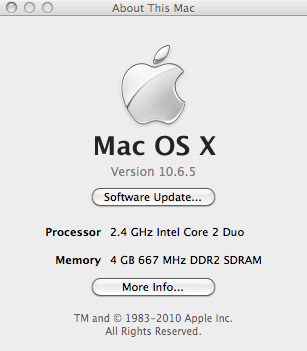
Like I said – You may have better luck if your system is more up to date.  Here’s what I’m running (note: I running 32 bit instead of 64 bit).

Special Note:

This suggestion only involves not using Software Update to install the new X code tools.  If you want to install the rest of the tools and skip AU lab – you’ll have to do it manually

  1. just follow the directions below
  2. choose X Code 3.2.5 instead of 3.2.2
  3. When down downloading choose Custom Install and install what you need

What to do if you DO need to re-install AU-Lab

Re-installing AU lab is not as straight forward as you might think.  There are probably multiple ways to  do it – but this is what worked for me.

While there are a series of paid subscriptions – you can sign up for the Apple Developer Program for free.  This will give to access to previous versions of X code tools (which has AU lab as a component).

Once you register and get to the login screen: Look for a screen called Downloads and Programmer Assets.

Then look for Developer tools.  If you scroll down you’ll see X code 3.2.2 Developer’s Tools – which has version 2.1 of AU Lab.

“Xcode 3.2.2 Developer Tools

Xcode 3.2.2 is an update release of developer tools for Mac OS X. This release provides bug fixes in gdb, Interface Builder, Instruments, llvm-gcc, Clang, Shark, and Xcode. It must be installed on Mac OS X 10.6.2 Snow Leopard and higher. Xcode defaults to upgrading an existing installation but may optionally be installed alongside existing Xcode installations. See accompanying release notes for installation instructions, known issues, security advisories.”

Download Name File Size Date Posted
About Xcode 3.2.2 (PDF) 131 KB 30 Mar 2010
Xcode 3.2.2 developer tools (Disk Image) 744.7 MB 30 Mar 2010

.

The download will take a while.  Just do the full install and it will replace the old files.

While not a very elegant solution it is a functional one.

I hope this helps!

-Scott

Favored Curry Or Spicing Up Chord Scales And Triads Part 1

[This lesson uses material from The GuitArchitect’s Guide To Chord Scales which details all unique chord scales from 3-note cells to the 12-note chromatic set.  You can find out about that book (and the other GuitArchitecture books) here.]

When improvising over a C major chord, the first thought for many beginning improvisers is to use the C major scale as a melodic resource.  For example:  here are the notes of a C Major triad (C, E, G) broken up into a sample 2 string arpeggio:

.

C Major Arpeggio

.

One related chord scale for this scale is the C Major (Ionian) scale.  The reason for this is that all of the notes in the C major triad are found in the C major scale.

.

C Major Scale

.

While there is nothing wrong with this approach, in addition to being a fairly bland melodic color to utilize, it contains the 4th scale degree (F), which is often referred to as an avoid note because of its 1/2 step relationship to E.

.

Option B:  Modal Interchange

One solution to this is to use modal interchange to find alternate scales that work over a triad.  For example, C Major is a diatonic chord in the key of G.  Playing a G major scale starting and ending on C produces a C Lydian scale.

.

C Lydian  (Parent scale: G Major)


This scale works well with the triad.  In addition to containing the C major triad, it also has a raised fourth degree (aka #11), which adds a nice tension.

But this is merely scratching the surface of what can be found from this approach.

.

Option C:  Creating your own chord scale

.

Here ‘s a process for generating any chord scale based on a chord.

Step 1:  Start with a chord and write out the notes of the chord in ascending order.

.

Note: the smaller the chord, the more scale options you will have.

Let’s now look at the C major triad as a chord formula.  Since it’s made up of the notes C, E and G  any parent scale for C major chord should contain these notes (at least for now).

.

Step 2:  Between the notes of the chord, write in all possible notes for each additional scale degree.

For example, in the Ionian and Lydian chord scale examples above, the 2nd degree was D, but it could have just as easily been Db or D#.

Expanding on this idea, the 4th could either be F natural or F#, the 6th could either be Ab, A natural or A#, and the 7th could either be Bb, B natural or B#.

If we apply this idea to the all of the other scale degrees, we end up with a chromatic scale that looks like this in list form:

  • Scale Degree 1  – C
  • Scale Degree 2 – Db, D, D#
  • Scale Degree 3 – E
  • Scale Degree 4  – F, F#
  • Scale Degree 5  -G
  • Scale Degree 6 – Ab, A, A#
  • Scale Degree 7 – Bb, B

.

or this in music notation:

.

C Major triad with chromatic scale degrees

.

Note:  If you are planning on harmonizing the scale, deriving modal arpeggios or pentatonics, I recommend you keep each scale degree unique (i.e. that you use either Db or D or D#,  but not more than one type of D pitch).

Likewise, there are several enharmonic pitches (i.e. pitches that are spelled differently but sound the same) presented in the full chromatic.   While you could use A# and Bb in a chord scale since they are the same sounding pitch the result will be a 6 note scale.

.

Step 3:  Choose the scale degrees that sound the best to you.

Based on the above parameters, there are 32 unique chord scales for the C major triad.  Let’s look at one of them.

For this example, I’m going to choose a #2 for the second scale degree, a #4, a b6 and a natural 7 scale degree for a very chromatic chord scale. Here it is in list form:

  • Scale Degree 1  – C
  • Scale Degree 2 – D#
  • Scale Degree 3 – E
  • Scale Degree 4  – F#
  • Scale Degree 5  – G
  • Scale Degree 6 – Ab
  • Scale Degree 7 – B

and in music notation:

This scale has a # 2, # 4, and a b6 scale degree.

.

Next Steps

In the next lesson – we’ll examine how the scale is harmonized and generate some licks derived from this technique.

Thanks for reading!

-SC

.

The material in the lesson is adapted from the material in The GuitArchitect’s Guide To Chord Scales book. More information about that book (including an overview and jpegs of sample pages) can be found here.


PS – If you like this post you may also like:

.

MAKING MUSIC OUT OF SCALES

CREATING CHORDS AND LINES FROM ANY SCALE – A HARMONIC COMBINATORICS / SPREAD VOICINGS LESSON

FAVORED CURRY OR SPICING UP CHORD SCALES AND TRIADS PART 2

.

RECYCLING SHAPES OR MODULAR ARPEGGIOS FOR FUN AND PROFIT

GLASS NOODLES – ADAPTING A PHILIP GLASS ARPEGGIO APPROACH TO GUITAR

.

MELVILLE, MADNESS AND PRACTICING – OR FINDING THE DEEPER LESSON PART 2

SOME USEFUL ONLINE PRACTICE TOOLS

POSSESSION IS 9/10S OF THE LAW BUT PERCEPTION IS EVERYTHING OR PRACTICING PART VII

TESTING YOUR VOCABULARY OR PRACTICING PART VI

PRACTICE WHAT YOU PLAY OR PRACTICING PART V

.

DEFINITIONS AND DOCUMENTS OR PRACTICING PART IV

TENSION AND THE SODA CAN OR PRACTICING PART III

PROPER POSTURE IS REQUIRED FOR PROPER PERFORMANCE – PRACTICING PART II

PRACTICE MAKES BETTER AKA PRACTICING PART I

.

MELVILLE, MADNESS AND PRACTICING – OR FINDING THE DEEPER LESSON PART 2

FINDING THE DEEPER LESSON

INSPIRATION VS. INTIMIDATION

.

WARMING UP: FINGER EXERCISES, THE 3 T’S AND THE NECESSITY OF MISTAKES

“THE LIMITS OF MY LANGUAGE ARE THE LIMITS OF MY WORLD”

A BRIEF THOUGHT ABOUT MUSIC THEORY

.

BOOKS

LESSONS

.

I hope this helps!  You’re free to download and distribute any of the lessons here but I maintain the copyright on the material.

.

Home For The Holidays – Gator Viper Gig Bag Review

Gator Viper Gig Bag

With the acquisition of my new Schecter 8 string, I realized that I would need to get a new gig bag to go with it.  After some searching –  I found the Gator Viper Gig bag. The bag lists at $149 and usually sells for $100 but Amazon had it listed for $37-$39 (as of this writing J&R music is selling it for $39.99 shipped via amazon).

I picked one up and just had Santa get me another one for Christmas.

Here’s the bag:

The Exterior

First and foremost – This is a rugged bag.  It’s almost more like a case than a gig bag.  I was surprised that it was heavier than I though it would be when I picked it up.  The zippers are larger than the ones used on other bags I have.  They’re luggage quality and seem durable.  The ad copy mentions that the bag is dual lined for protection and I believe that.  I would have no worries about this bag protecting the guitar in any kind of rain/snow/ condition.

If you look at the back of the bag:

you might notice that the two straps are padded for comfort.  There’s an optional sternum strap for stability as well.  The bag also features back cushions:

which help distribute the weight.  If you want to carry it by hand – the handle is reinforced.

The Interior

If you look at the headstock interior (quilted foam):

In addition to the heavy padding around the back and sides – you also get a neck rest.  The additional string guard on the head stock and the bridge:

is a nice touch as well.

The interior has what the company calls a “Universal ergo-fit design for most Strat- and LP-style guitars” – my non traditional shaped FNH Guitar fits in there fine.  The Schecter with a 26.5″ scale fits in the bag as well.

The bag has two compartments ( It’s hard to see in this photo – but there is a separate zippered section by the headstock which could easily hold picks, string, capos, etc.)

In addition to the front zippered section, the front pocket is spacious.  I can easily fit these full size headphones in the case with no issue.

For $30 more you can get a model with a separate laptop compartment.  I like the idea a lot – but it adds additional weight to the front of the bag.

The Sum Up

The short of it is – this is one of the best deals out there. Given that a garbage gig bag will probably set you back $20-$30 it’s impressive what you’re getting in this bag for a few dollars more.

Happy Holidays!

-SC

Rough Hewn Trio – Some Live Excerpts

The Rough Hewn Trio –  an instrumental trio consisting of Chris Lavender on Warr guitar, Craig Bunch on drums and myself on guitar are getting back into the rehearsal cycle and gearing up for some shows this spring.  To get a feel for what the shows will be like here are some live excerpts from some improvisations we did this fall.  The live sets – will include a combination of pre-composed and improvised material.

For those of you who are interested – this session is all drums and laptops.  I’m running Pod Farm and Sooperlooper and Chris is using Guitar Rig. (an amp was used to re-amp the guitar in 1C – which had some gnarly digital distortion tho…)

Note:

mp3 playback is sometimes a little glitchy in Safari.  If it doesn’t play in your web browser – you may just have to reload/refresh the playback page.

Enjoy!

-SC

Improv 2b

Improv 2a

Improv 1c

GuitArchitecture, Sonic Visualization And A Pentatonic Approach For The Holidays

Happy Holidays!

.

I know I’ve been posting a lot of gear related items lately – and  based on the statistics for site visits – this seems to be what people are primarily interested in – so this has driven the posting content recently.

While I’m happy to blog about gear (not incidentally, my 8 string Bare Knuckle Cold Sweat pickup came in last night and I squealed like Bobby Hill); I don’t want to get too far away from playing.  With that in mind I’m putting a concentrated effort to get more lesson/performance posts up to rebalance the site a bit.

I’ll have a new  chord-scale lesson up next week but in the meantime wanted to explain my performance/pedagogical approach to navigating the fingerboard with a fleet fingered pentatonic lick (yes, it’s reposted – but just like Thanksgiving leftovers – aren’t they still good on day two?).

.

GuitArchitecture?  Sonic Visualization?

.

I wanted to take a moment and talk a little about GuitArchitecture, sonic visualization and re-examine a chestnut from the lesson page as a little – three for the price of one post.

In broad strokes, the GuitArchitecture concept is that the nature of the guitar’s fretboard and tuning lends itself to visualizing fingering patterns.

While patterns performed mindlessly can be a bad thing, they allow people to realize ideas more readily.

Through these patterns, musical structures can be realized and worked into larger sonic arrangements.  More importantly, patterns can be associated with sounds and visualizing how to realize a sound by seeing its shape on the fretboard makes performing it easier.  Hence the term Sonic Visualization.

In my forthcoming books – I have a lot of information on this topic as it applies to scales.  When approaching scales – I see them as a series of modular two-string patterns that connect the entire fingerboard.

.

The GuitArchitecture Approach

. 

Here’s an applied example of sonic visualization:

Let’s say I’m playing a solo over an E minor chord.  As mentioned in a previous post – when soloing over a minor chord you can substitute a minor chord a 5th away (in this case B minor).

So if I’m thinking of using E pentatonic minor over the chord (E, G, A, B, D) I can also use B pentatonic minor (B, D, E, F#, A).

If you look carefully – you’ll see the only difference between the two is the F# and the G.   Both notes sound good against E minor, so if we combine them we get a six- note scale (E, F#, G, A, B, D).  Here is a sample fingering of the combined scales in the 12th position.

.

If that scale were fingered as a 2-string scale instead of a six- string box pattern – the same fingering pattern can be moved in octaves – thus eliminating the need for multiple fingerings. (This is the same approach I’m using on 8 string guitar btw).

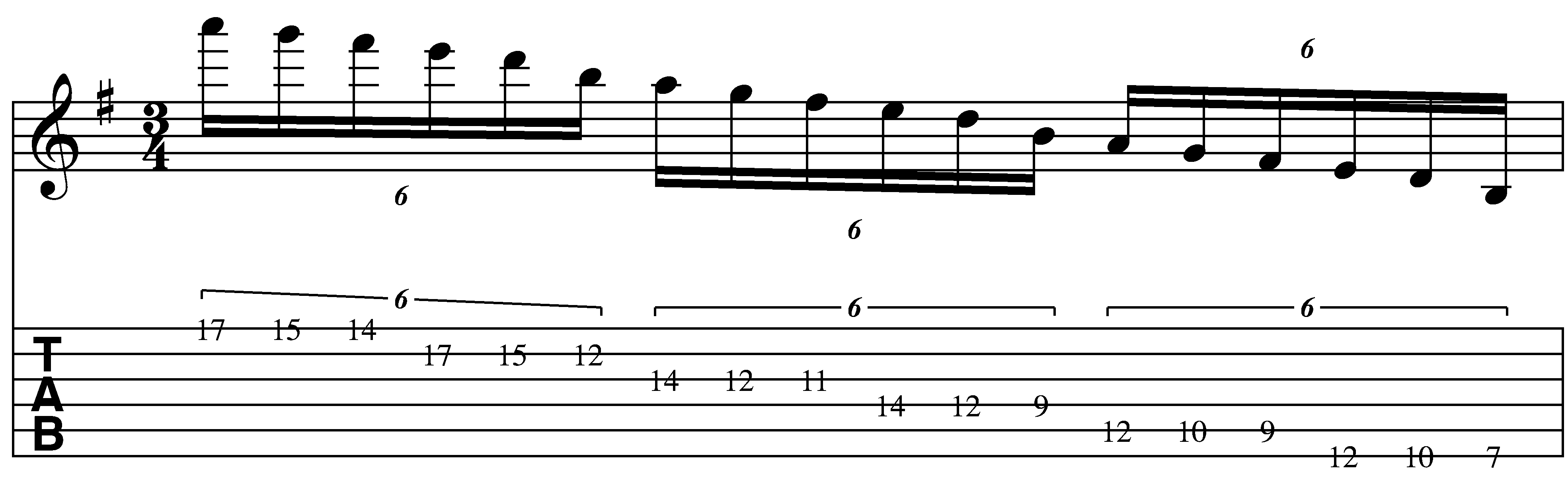
Here is an mp3 (note mp3s are a little glitchy in Safari – if it doesn’t play you may just have to reload the page) and notation/tab for the descending scale:

.

Sextuplet descending

.

.

* Fingering Note: I finger both patterns with the 1, 2 and 4 fret hand fingers on both string sets.

* Descending Picking Note: I play this with a modified sweep picking pattern

E string: up-down-up

B string: up-down-up

.

The picking pattern is the same for each string – but when I switch strings – it’s two up picks in a row.

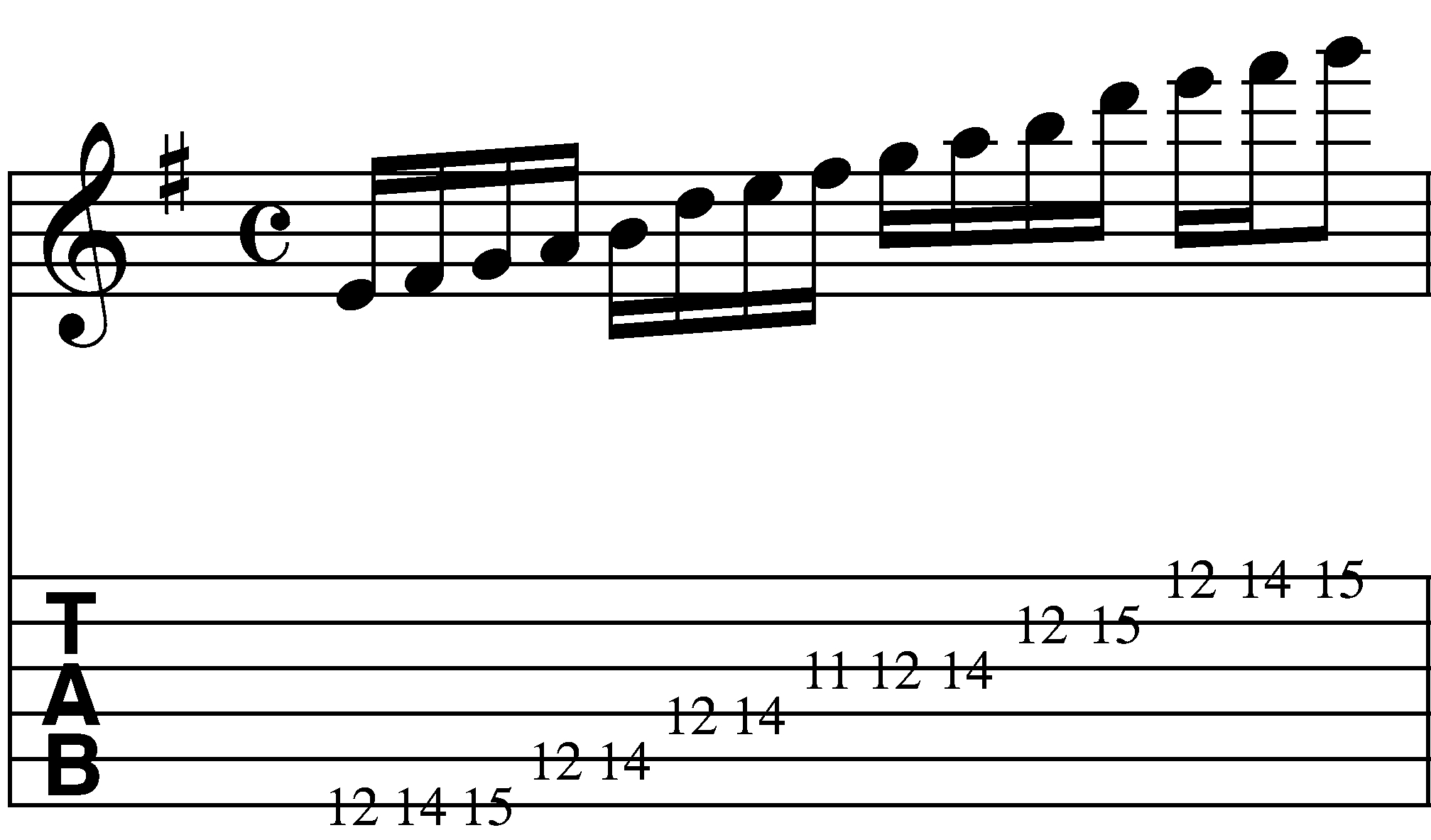
Here it is  ascending:

Sextuplet Ascending

.

* Ascending Picking Note: I also play this with a modified sweep picking pattern

.

E string: down-up-down

A string: down-up-down

.

The picking pattern is the same for each string – but when I switch strings – its two down picks in a row.

If you’re used to alternate picking  – you can use that approach as well but I try to apply the same picking pattern to all three-note per string patterns.

.

Practicing the pattern

.

In addition to focusing on the timing of the notes – it’s very important to practice slowly and only increase speed when both the timing (are all the notes being played with rhythmic equivalence?), tone (i.e. can you hear all of the notes clearly?) and hand tension (is your hand should be as relaxed as possible?) are all working together.

I’ve written a whole series of posts on practicing  (Post 1post 2post 3post 4post 5post 6 and post 7) that I’d recommend checking out if you haven’t already done so – but the simple principle here is to pay attention to what I call the 3 T’s in Performance: Timing, Tone Production and Tension.

This particular approach is challenging – particularly if you’re not used to the stretch.  Just remember to practice in small focused increments and try to increase steadily over time.

.

The Tones:

.

For those of you who are interested, tone on this recording was the same AU Lab/Apogee/FNH combination that I detailed here:

Here’s a screen shot of the Pod Farm setting (The tone can be downloaded from line 6 here):

.

That’s all for now

.

I hope this helps!  You’re free to download and distribute any of the lessons here but I maintain the copyright on the material.

I’m always looking for feedback on what people find useful and what they don’t so if you have any questions or comments, please feel free to e-mail me at guitar.blueprint@gmail.com