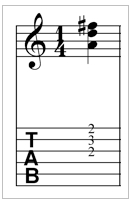
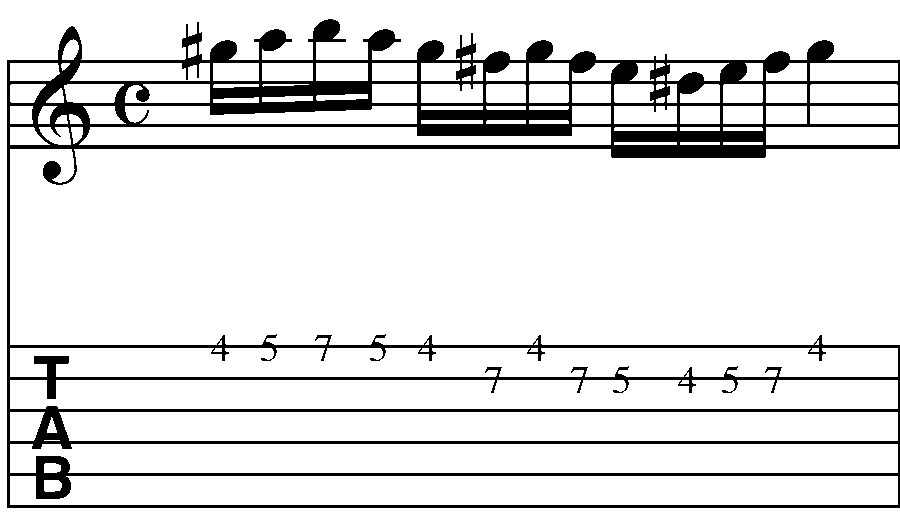
Making Music Out Of Scales

Hello everyone, and welcome to the largest GuitArchitecture lesson I’ve ever put up online!

.

In this lesson (an excerpt of some ideas from my forthcoming GuitArchitect’s Guide to Modes book), I’m going to talk about the difference between scales and music and show some concrete ways to adapt scales into unique phrases.

 .

When I first started playing guitar, I listened to a lot of metal and the players I was into were fond of working ascending and descending scales into their solos.   (I also listened to a lot of Al DiMeola on Friday Night in San Francisco as well).  So I initially focused a great deal on scales and got to the point where I could play them quickly (but not really cleanly).  The flash of this got me noticed by other players in my area, but I always felt like something was missing.

 .

At best, scales are only ½ of the equation

 .

Seeing where my fingers needed to go was important but phrasing is where the real music is happening.

.

Note:

There’s a lot of information below.  Just take your time and go at your own pace.  It’ll still be there later.

.

Here’s another way to think of it.  Scales are like basic vocabulary.  They’re your nouns and verbs and no matter how you speak (with arpeggios, intervals or chords), they all have a basis in scales.

Your phrases are your sentences.  Guys with great phrasing can play a scale and make sentence out of it.  But a scale is, in and of itself, largely just a tool in making music and not music itself.

First Steps: Music is a language.  

So approach it the way you approach your native language

.

The way we learn language is by listening to other people speak and then emulating their speech.  Initially it’s nonsensical.  Then some disjointed vocabulary emerges which eventually gives way to sentences.  There is typically a period of formal study where reading is taught, and students are required to write ideas down.  Eventually, we take on unique characteristics that make our voices distinct.  With daily exposure language, and our understanding of it is constantly evolving.

Learning music is the same thing.  It first requires active listening.  You need to find music that you’re passionate about and really work on learning it by ear.  Music theory is also important, because it can help you make shortcuts to understanding a sound (for example, “that Phrygian pattern” gives the informed listener an idea of what a sound is before he or she even hears it), but really getting into phrasing requires an aural understanding.   Initially, this will take a long time and you probably won’t have all of the technical skills that you’ll need to get it at 100% accuracy.  That’s fine.  Get what you can – but really pay attention to phrasing details like pitch (vibrato, slides, bends, etc) and rhythm.  If at all possible – try to sing along with what you’re trying to learn.   If you get to the point that you’re not enjoying it – move on and come back to it.  The more you actively enjoy what you’re doing, then more you will get out of it.

.

Step 2 involves listening out of your comfort zone.

.

Try checking out music from other (non-guitar playing) musicians and cultures as well.  A lot of my pointillist rhythm ideas were copped directly from Japanese Koto approaches.  I stole a lot of things from Arabic music (specifically Turkish folk and classical music, the Iranian Radif and various maqams), Hindustani music, and vocal music from around the world.  I copped gypsy violin and accordion licks and Klezmer clarinet lines.   Lately I’ve been super into the insanely wide vibrato and pitch bends in Vietnamese Dan Bau music.   The important thing is searching out for other sounds, getting inspired by them and taking something from them.

For me a lot of this has been the nonsense portion of trying to speak other musical languages.   Not everything I do translates in multiple musical situations.  It’s not always correct or accurate, and sometimes that’s even better because then it’s my own spin on it.

Really importantly  – not all of it sticks.  I spent a lot of time learning things that didn’t directly work its way into my playing.  That’s fine.  The important things are the things that will ultimately stick with you.  What it’s given me are some things that are distinctly mine now.  A distinct accent if you will, that immediately identifies a handful of things that I say as me.

 .

Next Steps:

 .

In addition to learning things by ear, having a few different approaches to using scales in your bag can help give you the flexibility to express some really musical things.  I’ve already posted on the area of limiting options, and with that in mind I think it’s more important to go deep with a few ideas, rather than just scatter-shot a number of approaches and deal with them all superficially.  So I’ll cover some of them here

 .

Starting point: The Scale

 .

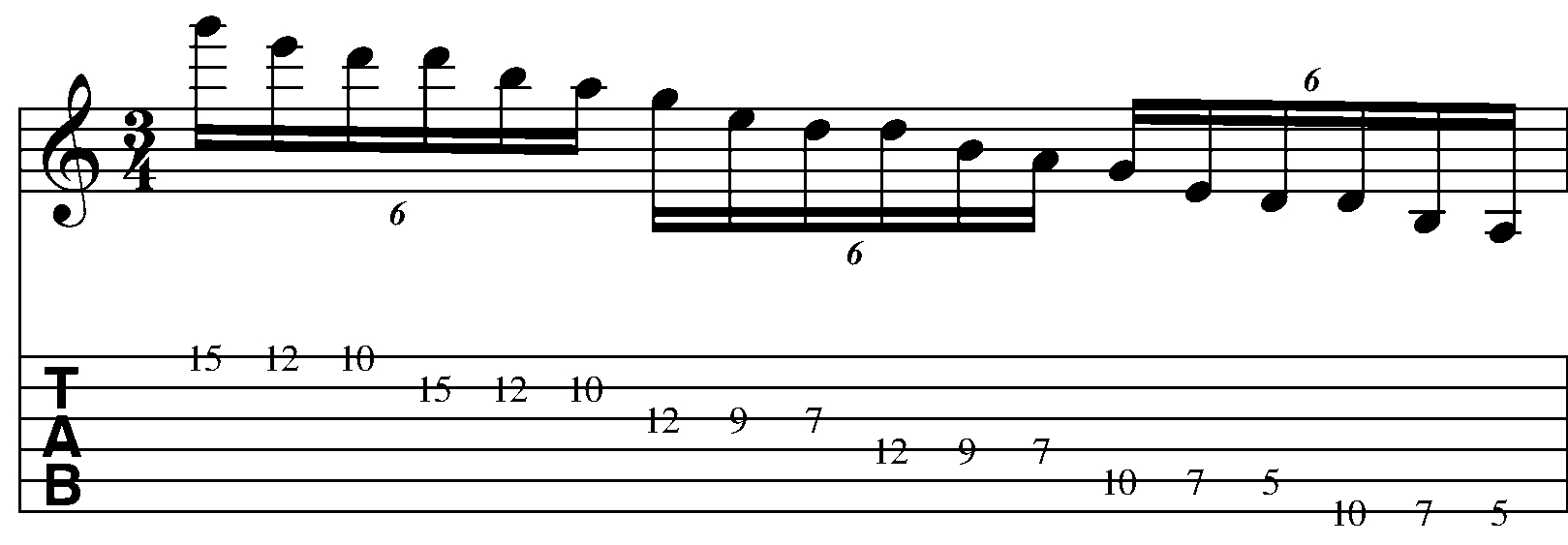
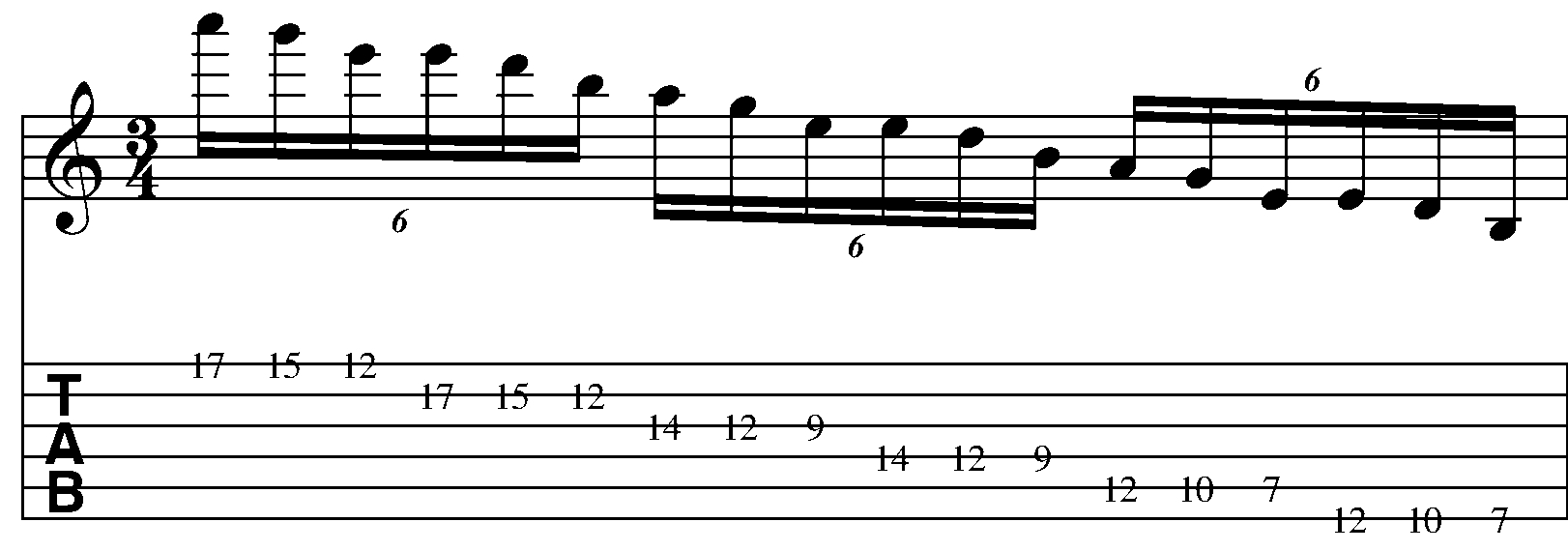
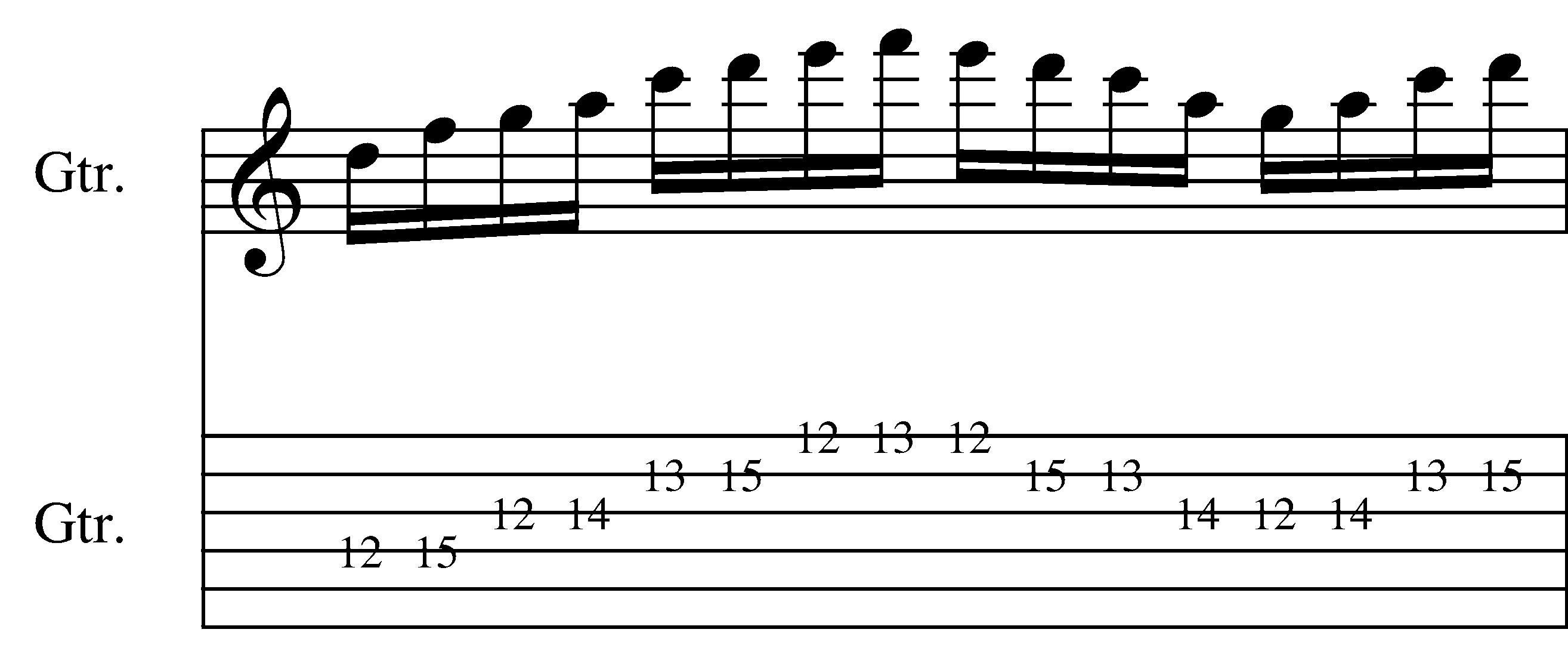
For an initial starting point, I’m going to look at a 3-note-per-string C Aeolian scale.  Try running this scale a few times with the fingering and picking patterns I’ve provided to make sure it’s under your fingers.

 .

.

 .

In the mp3 above, I’ve played the scale in 16th’s, a C minor 7 chord (to hear a harmonic context) and then as sextuplets.

.

Note:

In some textbooks you’ll see the b6 as an avoid tone against a minor 7 chord (i.e. the Ab as an avoid tone for C minor 7).  You can always just play a minor triad or a 5th for a similar effect.  I’ve included the minor 7th here because – aesthetically – it doesn’t bother me and I like the sound of a minor 7th better than the triad.

Picking this as I have above results in a smoother (almost legato) sound than I could get using alternate picking, even though I’m still picking every note.  For the initial fingering, I’m playing the first 2 notes of each grouping with my 1st and 2nd fingers to facilitate the slight positional shift on the B and E strings.

.

Note:  When practicing any musical idea, it helps to have a melodic and rhythmic context.  A time keeping device can certainly help, but I’ve included a short C note for a drone and a drum loop for your convenience below:

.

.

 .

Approach #1:  Skipping notes and using patterns

 .

The only time I use straight ascending/descending scales is if I have a target note that I’m specifically trying to get to.  In those cases, having some velocity to get there can build tension and make it exciting to hear.  Otherwise when you hear one note after another in straight ascending or descending scalar patters, it gets very predictable pretty quickly.

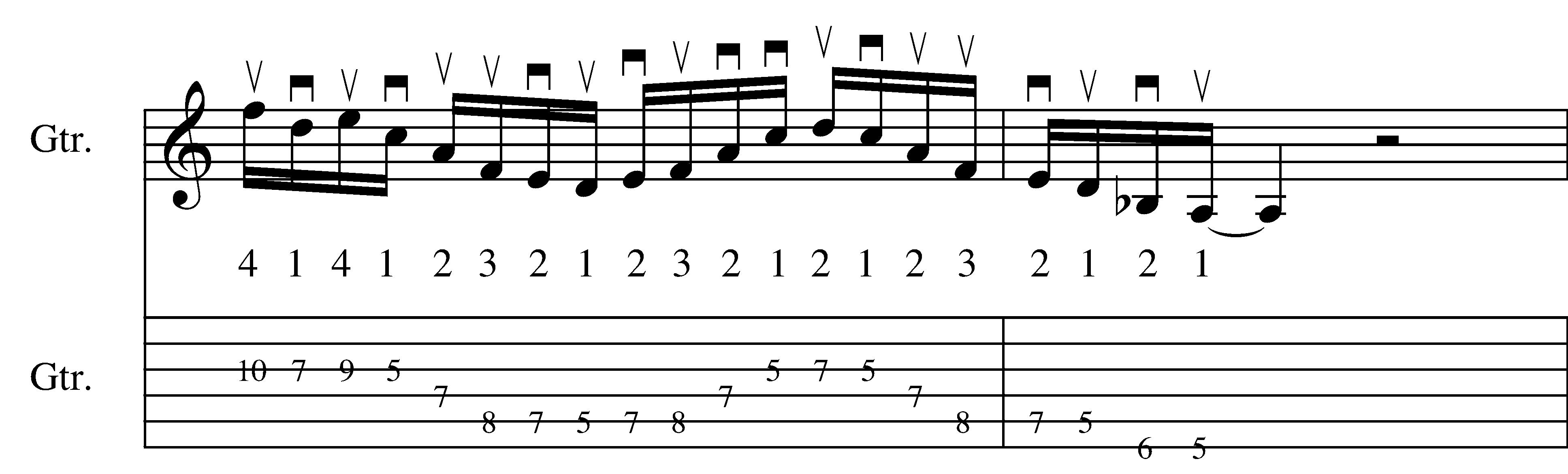
Here’s a sample phrase I improvised based on the scale above.  I’ve added some notes below.

 .

.

.

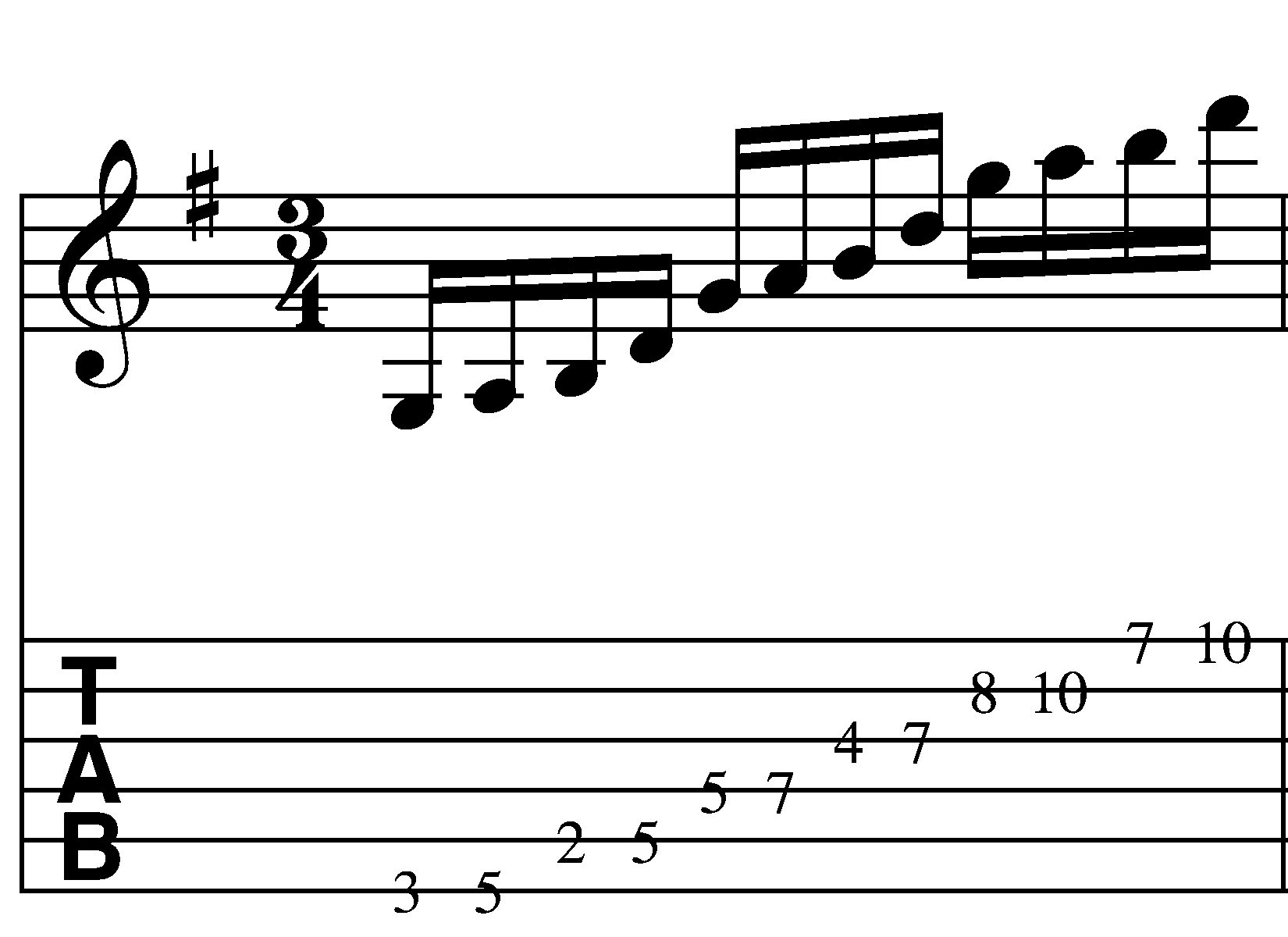
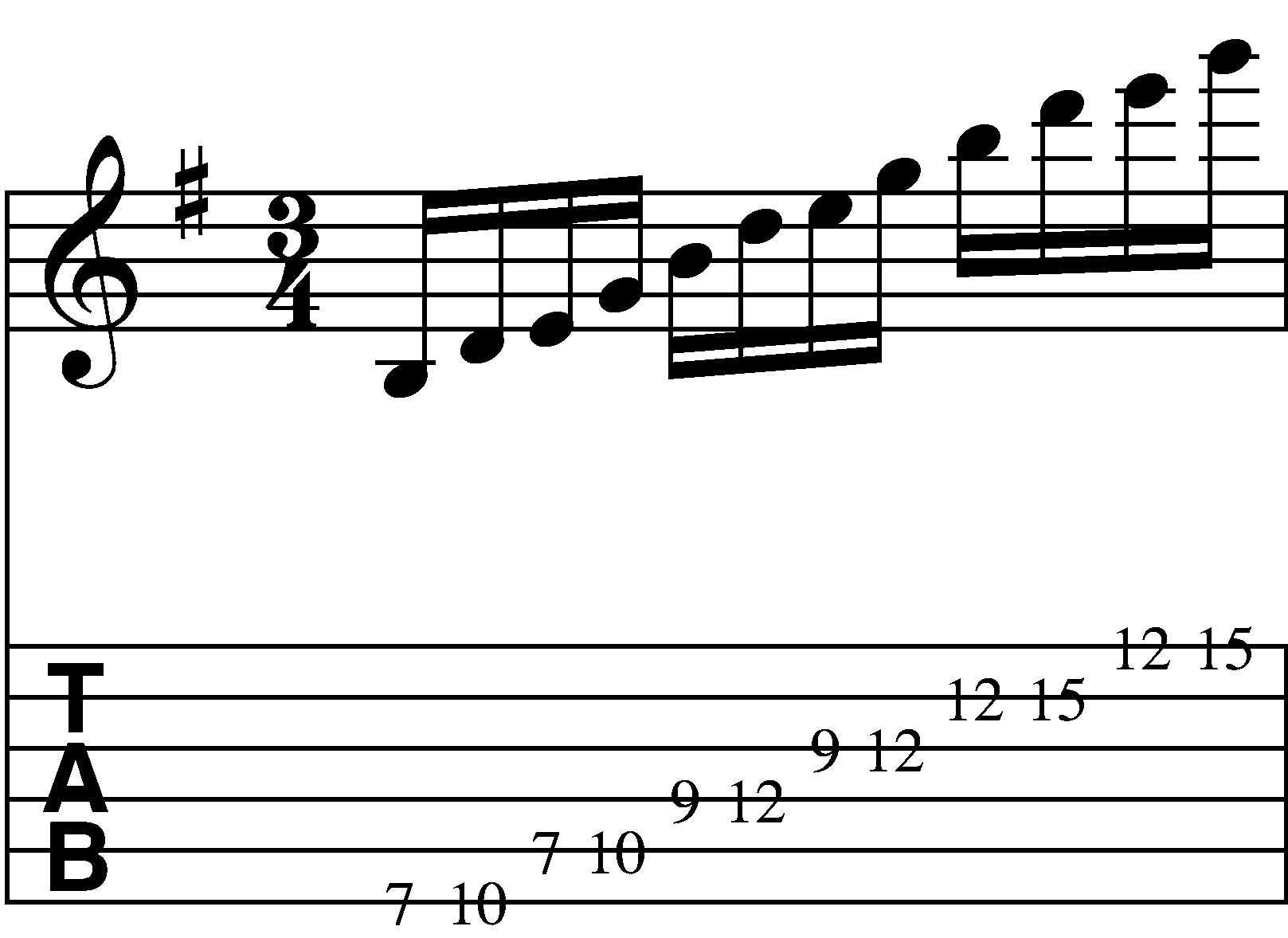
  1. On the first part of the phrase on the A and G strings, I’m only playing the notes C, D and Eb.  Adding a string skip and doubling the C at the octave creates more excitement in the phrase.  I’ve provided an optional notation indicating picking the octave C with the pick hand middle finger to give it a little snap – but you can certainly flatpick it as well.
  2. Starting on the Bb on the G string,  I’ve rhythmically copied the same phrase as on the A and G strings.  By playing it as a pattern, it creates some consistency in the phrase.  While the rhythm is sextuplets – the phrasing is alternating groups of 4 and 6.
  3. The last 6 notes break out of the pattern by just playing a straight ascending scale.

 ..

Here’s another track variation.  I’m picking every note on this one:

.

.

Approach #1a:  Skipping notes part 2 (Pentatonics)

Another way to work scalar ideas into a musical context is to reduce scales to pentatonics.  For example:  Here is my initial scale again:

.

And now I’m going to remove the F and the Bb from the scale.   This leaves a five-note pentatonic (C, D, Eb, G, Ab) – sometimes called Hirajoshi.

 .

.

.

The term, “Hirajoshi”,  actually refers to a Koto tuning.  In the Japanese scale system, this collection of intervals would be recognized as belonging to the In scale.  But since so many guitarists refer to this as Hirajoshi, I’ll use that nomenclature here.

Regardless of what you call it, sonically it’s a very cool scale.  The skips between the Eb/G and Ab/C really open the scale up sonically.

.

Here’s a variation on the lick above using this pentatonic idea in the second ½ of the phrase.

.

.

.

Technically, in addition to some of the challenges of the first lick, another tricky thing here is the skip from the C to the Eb on the G and B strings because the D, C, Bb pull off wants to go back up to D.  Sonically though it adds a really nice contour to the phrase.

 .

Approach #2:  Sequences

 .

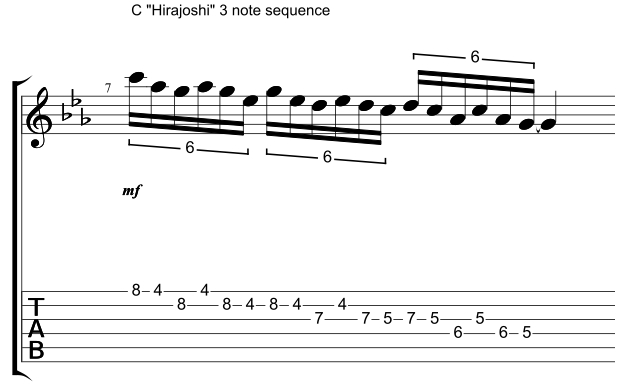
Sequences are a cool way to use scales in a way that generate melodic momentum but contain an internal logic.  Here’s an example of using the pentatonic in descending groups of 3s.

 .
.

.

This is a very Marty Friedman-esque idea.  A little goes a long ways with this type of approach, but these sequences are great devices to work into phrases as a way to get more mileage out of a scale.

. .

Approach #3:  Octave displacement

 .

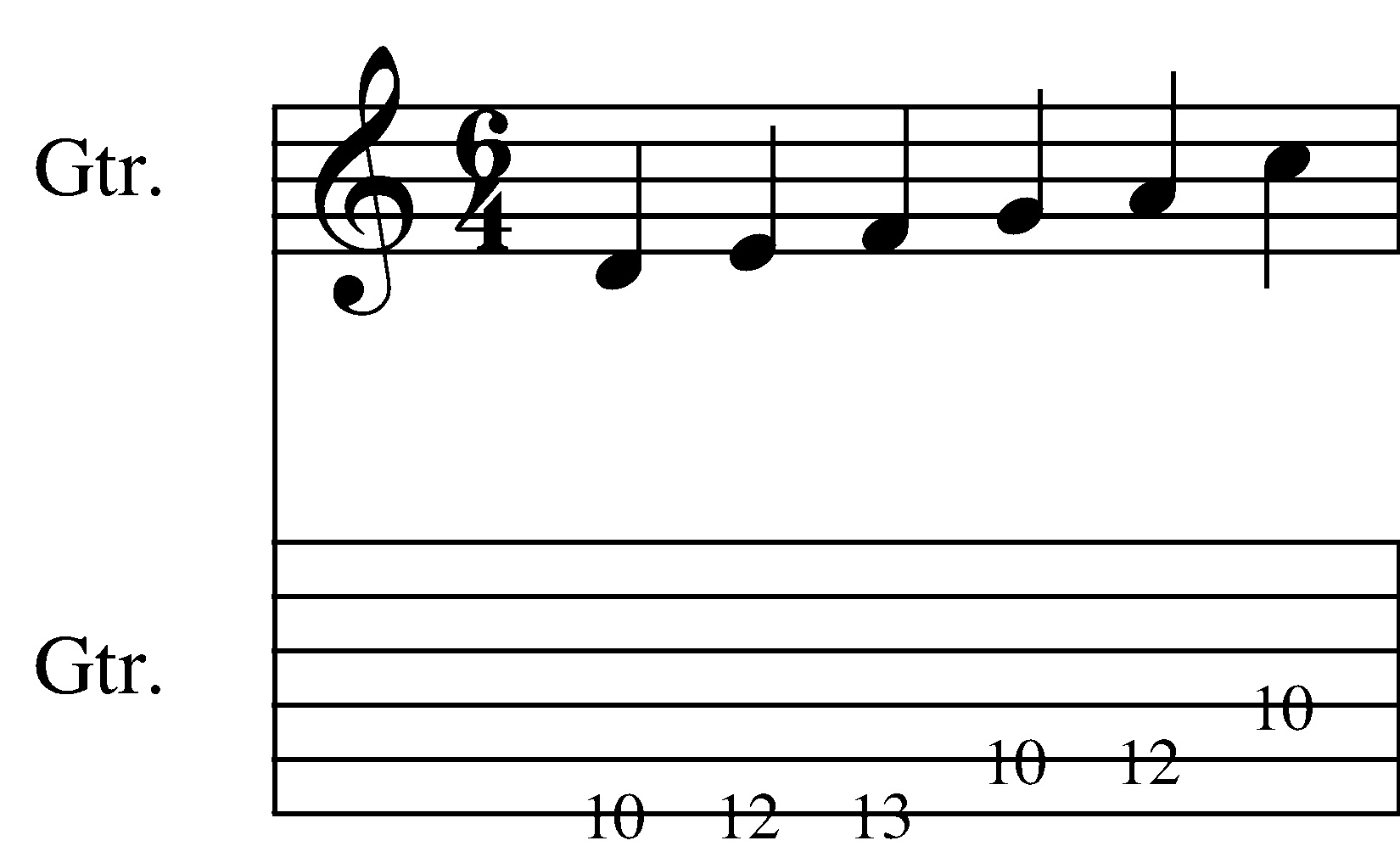
Playing notes in order can be boring, but as we saw with the octave C jump in the first lick, alternating scale notes in different registers can be much more interesting melodically.  Since the A and B string are a 9th apart, playing an ascending melody between the strings works well positionally.

The first step in this process involves being able to visualize the scale on each individual string:

 .

 .

Here’s a melodic idea that works off of this ascending/descending idea.  It works without a trem as well, but adding the trem gives it more of a slidish feel.  The important thing is to let it all ring together in a controlled way.  I’ve recorded this at full tempo and then in 1/2 time and I think it works a lot better at 1/2 speed .

 .

.

.

If you look at the notes in the phrases (C, D, Eb), (D, Eb, G), (Ab, Bb, Ab), (G, F, Eb).  They’re all based on short simple melodic ideas that sound more complex when broken up over octaves.

.

Approach #4:  Modal Arpeggios

 .

Previously, I removed two notes to create a pentatonic scale but if I play every other note of a mode, I can create an extended arpeggio called a modal arpeggio.

For example, here’s the scale again:

 .

Taking every other note:

 .

.

And putting it into a phase gives me this:

 .

.

.

Note#1:

It’s interesting because while the scale and tonality is rooted in C, sliding the last note of the arpeggio up to D gave it a whole other texture.

.

Note #2:

A lot of phrasing is really about minute details.  Here’s the same arpeggio but I sit on the first note just a little longer.  It makes the phrase more musical to me:

.

.

Here’s another arpeggio idea with a repeated phrase in the middle.

.

.

.

Playing arpeggios on smaller string sets allows me to sequence ideas more easily (Like the first 5 notes).  The jump to the Eb is probably the biggest surprise in the phrase.  Short but sweet.

This modal arpeggio approach can be applied to any mode or scale and offers a great way to add some additional textures into your soloing.

 .

Some Concluding Thoughts

 .

Normally, I would have broken this up into multiple posts, but I though it was important to get the aural learning component and the melodic variations on the same page.I didn’t even get into rhythmic variations, double stops, chromatics, chordal applications, superimpositions or any of the literally dozens of other approaches that can be used to extract music from scales.  It really all comes back to how much music you’ve absorbed because the most used tools in your melodic toolbelt are going to be your ears and your aesthetic and those are both guided by what you’ve been exposed to.

For those of you using GuitarPro, you can download the .gpx file of this lesson (with an extra arpeggio thrown in for good measure) here.

 .

The GuitArchitect’s Guide To Chord Scales

 .

Chord Scales Cover Front And Back

I’ve mentioned before, that (for me) the biggest advantage of investigating harmony and theory is to expose people to sounds that they didn’t know where there.  This is the entire purpose behind the  GuitArchitecture series.  One of the GuitArchitecture books in that series, The GuitArchitect’s Guide To Chord Scales utilizes and expands on this idea by exploring all unique scales from 3-12 notes!!!   The above material is expanded on substantially in that book so if you like this lessons you’ll really like the book.

More info on the book here.

Lulu Link

Amazon link

If you like this book you might want to check out the other books in this series here.

As always, thanks for reading!

.

-SC

Making Sense Of The Pentatonic Scale – Diagonal Forms – Part Two

Hello everyone!!

Here’s part 2 of the diagonal pentatonic lesson..Hopefully you’ve checked out the posts on two string patterns and part one of the diagonal forms post  and have gotten the shapes and  visualizations down and under your fingers.  (if not – just take a moment and check out the other two posts).

.

In this lesson, I’m going to continue the process of combining the two approaches into 5-note diagonal shapes.

.

 5 Note Diagonal Pentatonics

.

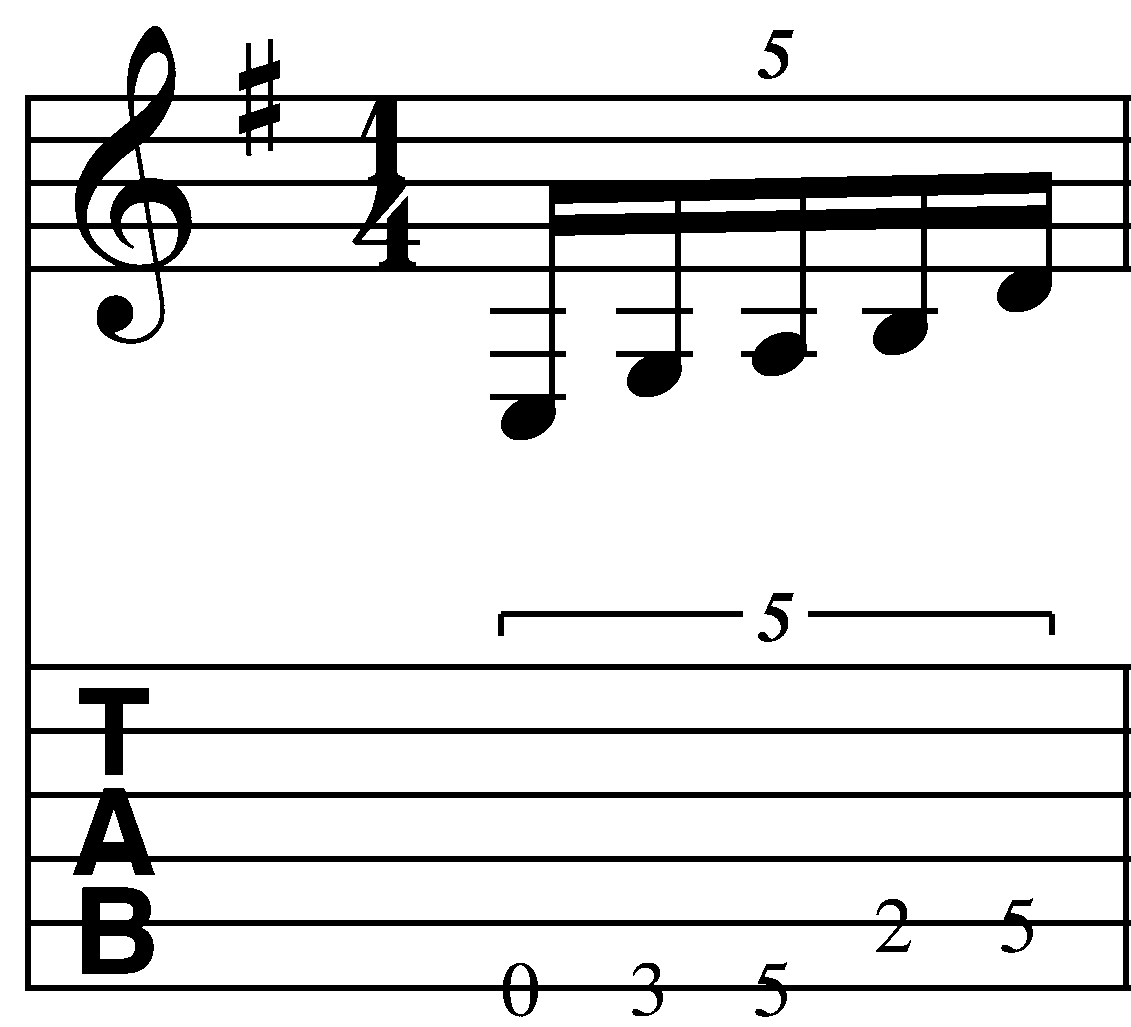
Perviously, I took a look at one 5 note pattern on two strings.  This can be done by either putting 2 notes on one string and 3 on another (1.e. a 2-3 pattern):


..
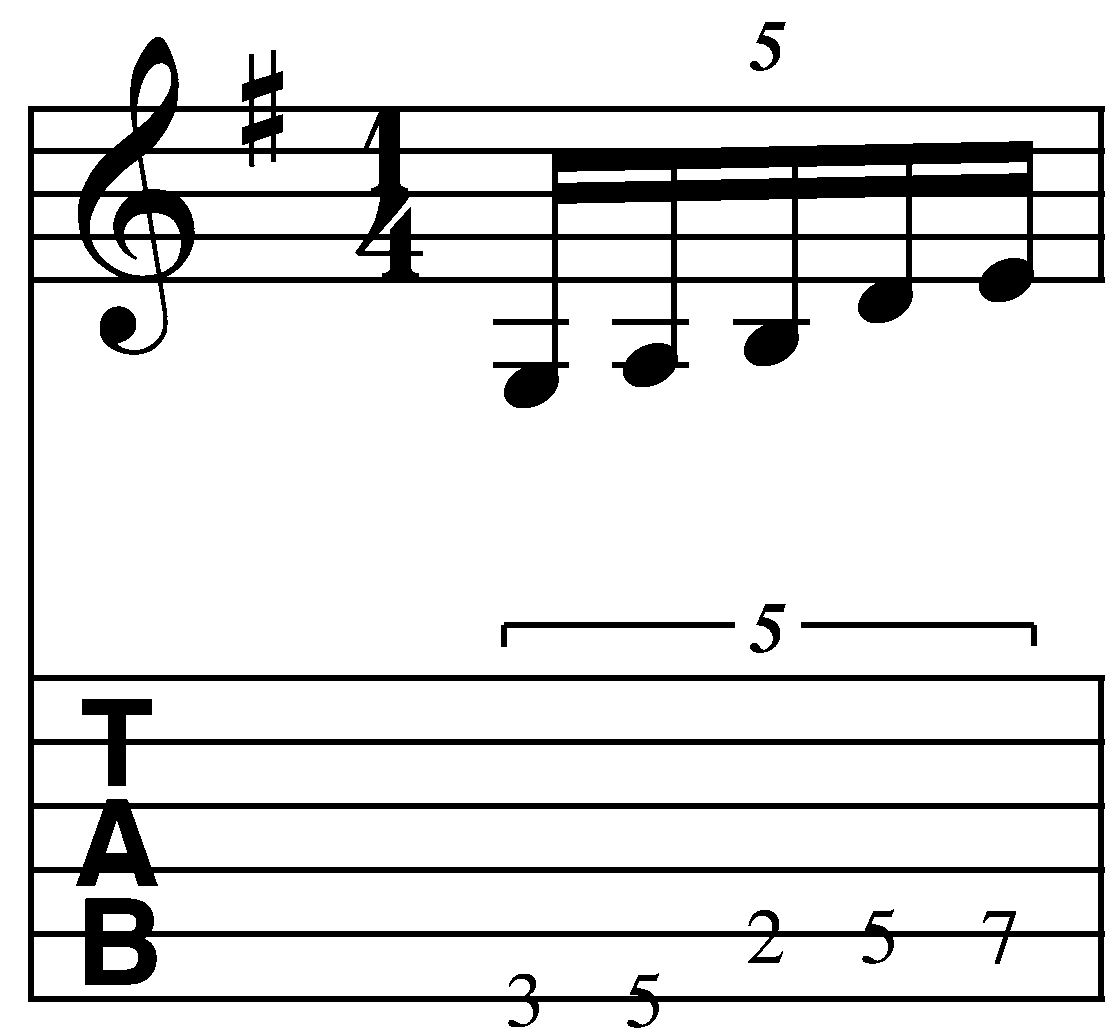
or by putting 3 notes on one string and 2 on another (1.e. a 3-2 pattern):

.

.

..
Note:

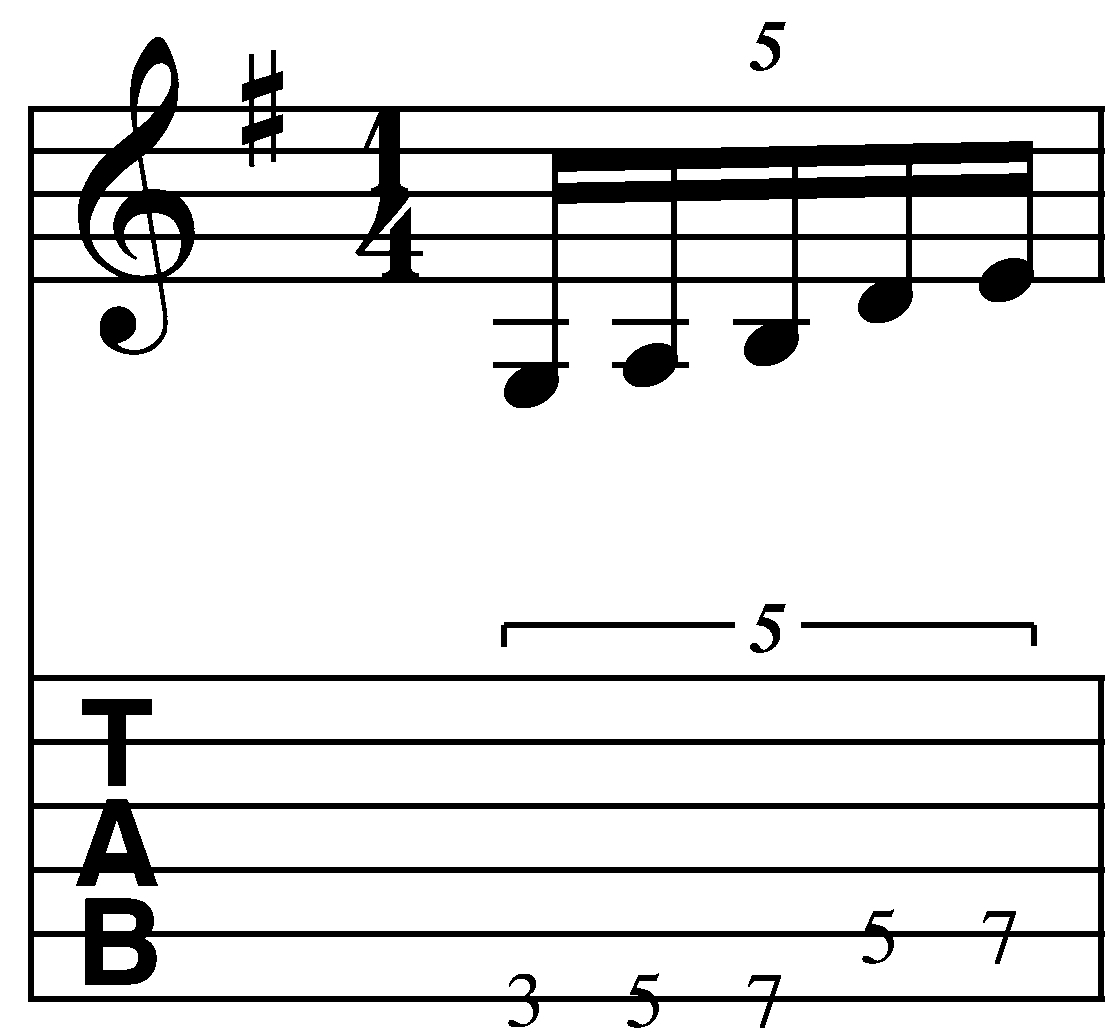
Those of you looking at the picking pattern closely may notice that I play the 3-2 pattern with a partial sweep instead of strict alternate picking.  While the 2-3 pattern can be swept as well, you’d have to start it on an upstroke:

.

.

From a picking perspective – I find the 3-2 typically works best when ascending and the 2-3 works best when descending – but from a fingering standpoint – sometimes the reverse of this will be true.  A little experimentation goes a long ways here.

.

Working with these forms:

I’ve documented every 2-3 and 3-2 combination here – but in general I don’t recommend spending a lot of time practicing forms that you’re not going to use.

.

Instead, try the following:

.

  • Take the shapes that you like (or shape if only one works for you)
  • Practice it with a time keeping device like a loop or a metronome
  • Practice it with consistent picking or legato (i.e. using hammer-ons and pull offs) played over a chord to supply a harmonic context.

.

You may want to start with an E minor or Em 7 and then try other chords like C Maj 7, G Maj 7,  F Maj 7, D min 7 or A min 7.

.

  • Practice the pattern in different rhythms

.

“Ceci n’est pas une pipe” or when is  5 – 4?

.

In the previous lesson, I talked a little about altering the rhythms of any sequences that you’re playing. Dividing the beat with a different number of notes than the notes in your phrases can add some rhythmic tension and goose the melodic line a little.  For example, here’s the initial 3-2 pattern from above moved in scale wise motion through each note of the E pentatonic minor scale.  I’m playing the phrase below as quintuplets (i.e. 5 notes to the beat). 

(If you have trouble counting the phrase try saying (“here’s a group of five”).  If you do it over and over again in a shopping mall someone will probably call security – so you may want to use your internal voice for this)

.

On a more serious note – I’ve notated the phrase as 5/4 to make the rhythmic division clear.  In the mp3 below – I’m playing the phrase over a 4/4 drum groove so there are 3 beats of space (5 beats + 3 beats = 8 beats or 2 bars of 4/4) before the descending line starts.  Here’s the ascending line:

.

.

and here’s the descending line:

.

.

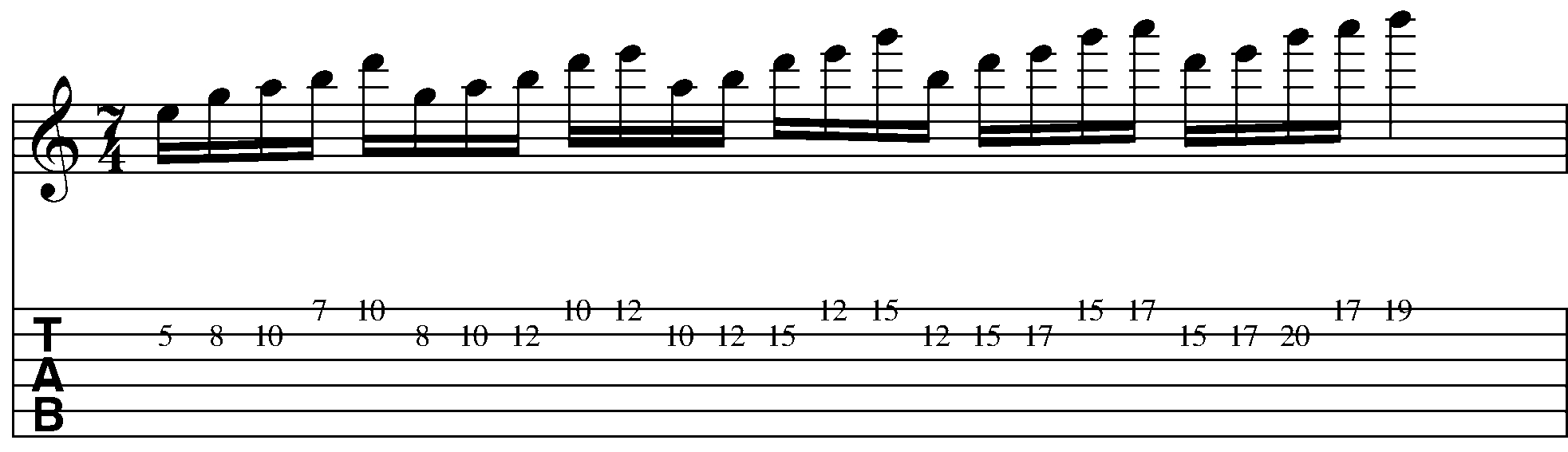
Now I’m going to take the same sequence but play it as 1/16th notes which does a very cool thing over the drum beat.  Where the previous phrase has the first note of each pattern start on a down beat, here the starting note keeps getting displaced.

.

Note :

I’ve notated the phrase as 7/4 to make the rhythmic division clear (just like the groups of 5).  In the mp3 below – I’m playing the phrase over the same  4/4 drum groove so there is 1 beats of space (creating a 2-bar phrase of 4/4) before the descending line starts.  Here’s the ascending line:

.

.

And the descending line….

.

.

and here they are back to back


.

The Shapes of things….


Now I’m going to go through each of the individual shapes and make some notes.  At the end of the shapes, I’ve included an mp3 of my preferred shapes in groups of 5 and then groups of 4.

.

Pattern 1

(Starting on the Root)

.

Here’s the 2-3 shape on the bottom 2 strings:

.

.

And played in octaves:

.

Note:

The stretch on the D and G strings isn’t very comfortable – so I’d most likely use this fingering only when descending.

.

.

Here it is in a 3-2 shape.  I’m playing the notes on the 3rd fret with the second finger, 2nd fret with the first finger and 5th fret with the pinky.

.

..

Here is the 3-2 shape in octaves.  The same fingering pattern applies just add the 1st finger for the “e”.

.


.

Pattern 2

(Starting on the b3)

.

Here’s the 2-3 shape.  It’s not very positional ascending – so again I use it primarily for descending ideas.

..

.

Here is the 2-3 shape in octaves:

.

Here’s the 3-2 shape.  The symmetrical fingering of the 2nd and 4th finger in this pattern is interesting to me.  I’m not a big finger exercise guy anymore, but if you’re looking for a fingering pattern to clean up your 2nd and 4th finger, smoothing out the octave runs on this shape will help with synchronization if you’re practicing it correctly. (You can check out the practice posts on my blog for some helpful practice tips – just look on the blueprint page).

.

.

Here’s the 3-2 shape in octaves:

.

.

Pattern 3

(Starting on the 4th)

.

Here it is in a 2-3 shape.  I actually prefer this pattern to the 3-2 shape as I find that by using my first and second fingers on the 5th and 7th frets, the pattern is more comfortable to me.

.

.

Here it is 2-3 in octaves.  I play this version primarily with alternate picking, but play two down strokes in a row to get from the G to the A to start every two string pattern on a down stroke.

.

.

Here’s the 3-2 shape.  If the 2nd pattern 3-2 shape is comfortable to you – you may like this one as well.

.

.

Here is the 3-2 shape in octaves:

.

Pattern 4

(Starting on the 5th)

.

Here’s the  2-3 shape.  I use fingers 1-3-4 for this one.

.

.

Here is the 2-3 shape in octaves.  I use the same picking pattern I described in pattern 3 for this pattern as well.

.

Here’s the 3-2 shape.  The focus here is the 3-4 finger shift.

.  

Here it is in octaves.

.

Pattern 5

(Starting on the b7 th)

.

Here’s the 2-3 shape.  This sits under the fingers very comfortably.

.

.

Here it is in octaves.  This is a great shape to repeat a few times before moving to the next octave.

.

.

Here’s the 3-2 shape.  This is a form I abandoned almost instantly – especially because the 2-3 form is so much easier.

.  

.

Here it is in octaves.  On the high B and E strings – this form can be useful when descending.  I use 3-1-4-2-1 for the fingering pattern. On the ascending 5s and 4s phrase, I played all the patterns in the 3-2 shapes to keep the picking consistent – so if you’re going to be playing the patterns on just  2-strings, you may want to familiarize your self with both divisions.

.

.

Finally here’s an mp3 of each group in order.  I recorded the patterns that I marked out as preferred patterns.  Typically I wouldn’t switch between phrases (and picking patterns) like this.   The same rhythmic idea as above (i.e. patterns notated for clarity but played over  2 bar 4/4 phrases).

.

.

Note:

These shapes are all adaptable to the blues scale as well by just adding an A#/Bb to the patterns.

.

“Ceci n’est pas une pipe” II or when is  five  six?

.

So here’s another way to manipulate the patterns into something more fluid.  Both pattern 3 and pattern 4 have symmetrical fingerings.  In pattern 3 for example, if I double the d between the 2 shapes I get a 6 note pattern with the same fingering.  This works best as a descending line to my ears:

.

.

.

Here’s the same idea with pattern 4 using a doubled E.

.

( 8/7/11 -Note:  the wrong graphic was posted here previously but this has now been fixed – SC)

.

.


By understanding patterns, it becomes possible to manipulate them and make them work for you.  The key is to take one idea or approach and put it through the paces and try to get something out of it that works for you.

.

I hope this helps!  In the meantime, if you like this approach, I have a book that includes this material you may be interested in

My Pentatonic Visualization Book

Minor Pent Front

is 100 + pages of licks and instruction and includes demonstrations and breakdowns of two-string fingerings, diagonal pentatonics, sweep picking pentatonics, pentatonic harmony and much more!  It’s available here.

.

Thanks for reading!

-SC

Making Sense Of The Pentatonic Scale – Diagonal Forms – Part One

Hello everyone!! After a lengthy delay – I’m posting this pentatonic lesson.  The amount of information over the next few posts will keep some of you busy for a while.

.

A general online lesson note:

.

The lessons I post here typically go into quite a bit of detail with the rationale that the reader (i.e. you) can take bite sized pieces of information and return to the material as needed.  If this more information than you will probably be able to process in a single setting, simply take one or two things that sound cool to you and apply them to what you’re currently playing (songs, solos, etc).

.

One idea applied well is worth more than a dozen ideas applied poorly.

.

In this lesson I’m going to combine 2-string pentatonic patterns into a diagonal approach.

.

Note: For those of you who want to adapt these ideas to the blues scale just add in the A#/Bb to the patterns listed below.

.

..

Diagonal Pentatonics

.

Playing two-string patterns in octaves moves the fretboard shape both horizontally and vertically (i.e. diagonally). Two-string diagonal playing can help with visualization as the same pattern is simply moved to the octave of the starting pitch.

.

To illustrate this – I’ll start with the following four-note shapes.  Use alternate picking for all of the following exercises.  With the exception of the first four notes which use open position, the rest of the patterns use the same fingering.

.

All of the following examples should be practiced with strict alternate picking or legato (i.e. using hammer-ons and pull offs) and (ideally) played over a chord to supply a harmonic context.

.

Some chords to try:

.

  • E minor or Em 7 chord 
  • C Major 7
  • G Major 7
  • F Major 7 
  • D minor 7 
  • A minor 7 or
  • whatever sounds good to you!

.

Here’s the 1st pattern moved in octaves.

.

.

Pattern # 2

.

.

Pattern # 3

.

.

Pattern # 4

.

.

Pattern # 5

.

.

Working with patterns

.

Note:

Pentatonic scales, or any kind of scale in general, are simply a tool in making music, but are not music in and of themselves.  The goal of this process is to use these shapes as a way to visualize sounds and then to be able to manipulate them in real-time.

.

Let’s generate a musical line using this approach. Here’s an idea in the style of Paul Gilbert.  I’m picking every note in the example – but you could use hammer-ons or pull offs for a more legato feel.  It’s played first with sextuplets and then slower at 16th notes to make the notes easier easier to hear.

.

.

.

The drums on this track are just a simple loop I pulled together for a song I was working on called Raga Jam.

.

.

While recorded at 105 bpm – the  mp3 can be downloaded and then slowed down or sped up to accommodate your tempo needs.  A number of applications will do this but if you’re looking for a recommendation –  I recommend Transcribe! by Seventh String Software.

.

There are several ideas here worth exploiting.

.

  • The initial pattern consisting of four notes, is played as sextuplets (groups of six).  Rhythmically, this adds a sense of tension that is absent in phrasing the group of four notes into a 1/16 note pattern.  This idea will be covered more in part two of this lesson.

.

In general, practice playing patterns in a variety of rhythms as you may find ideas you can use later.


  • The B on beat three breaks up the predictable note order a little.  It’s a small variation on the pattern that makes it sound a little less “patternish”.
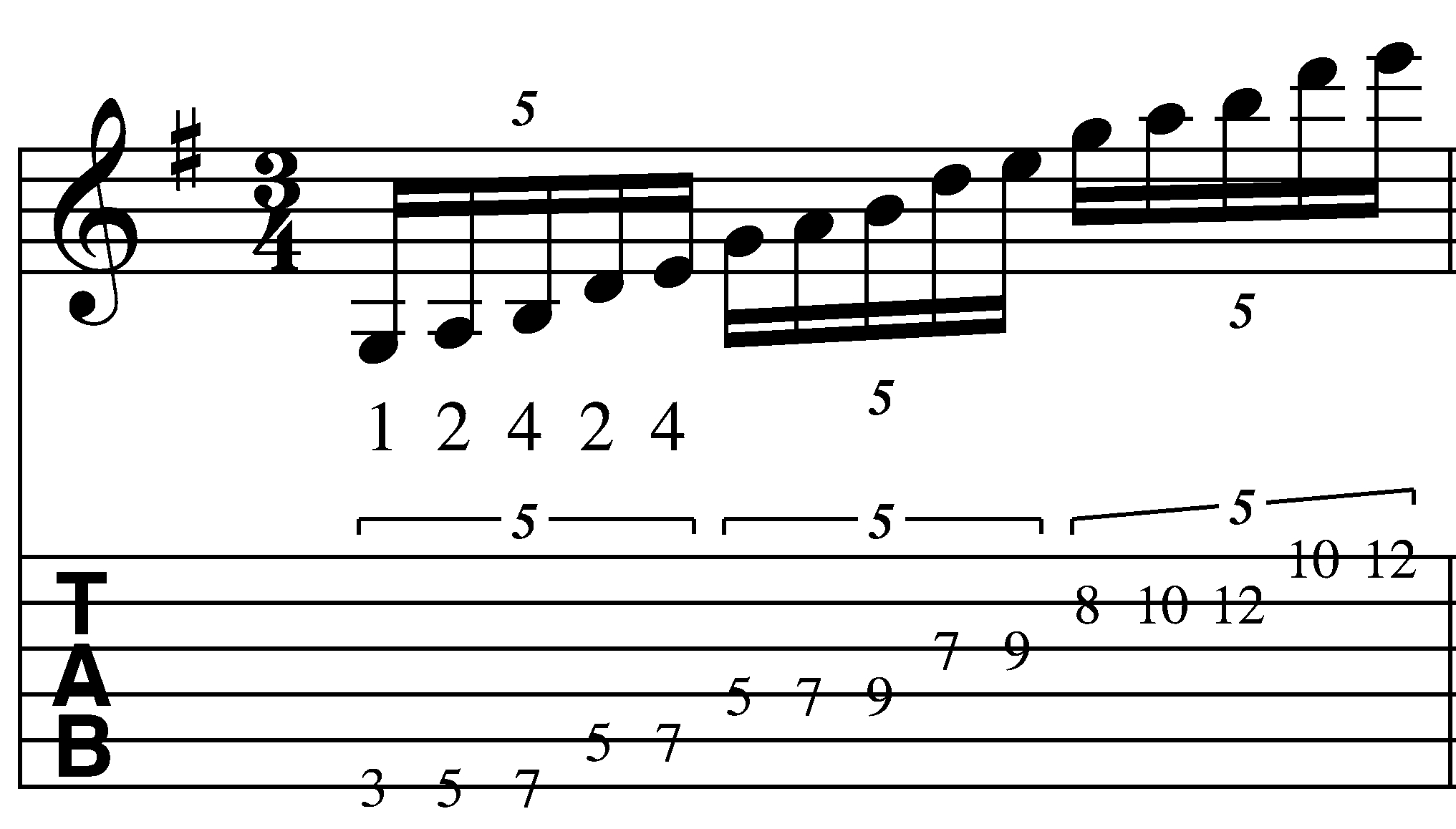
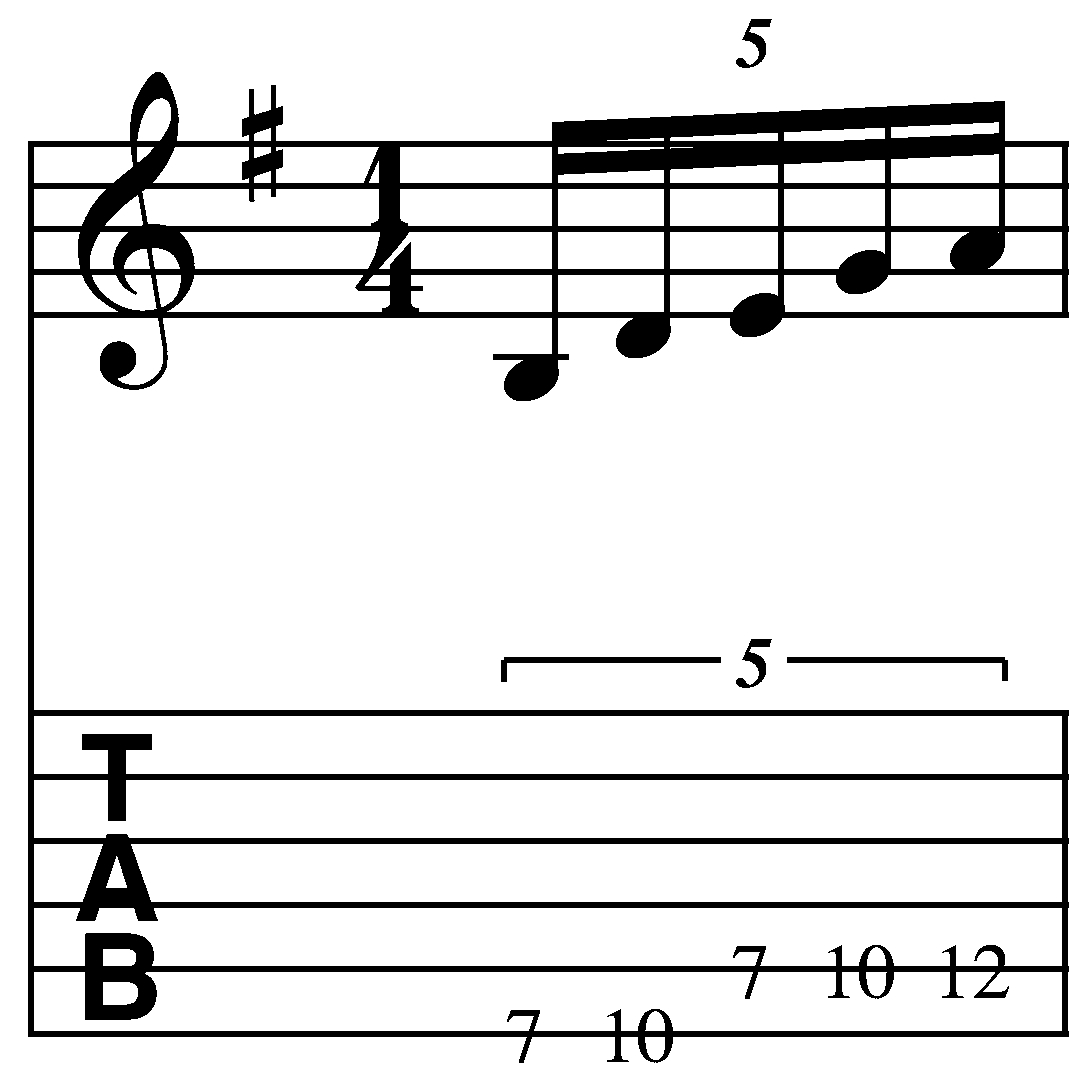
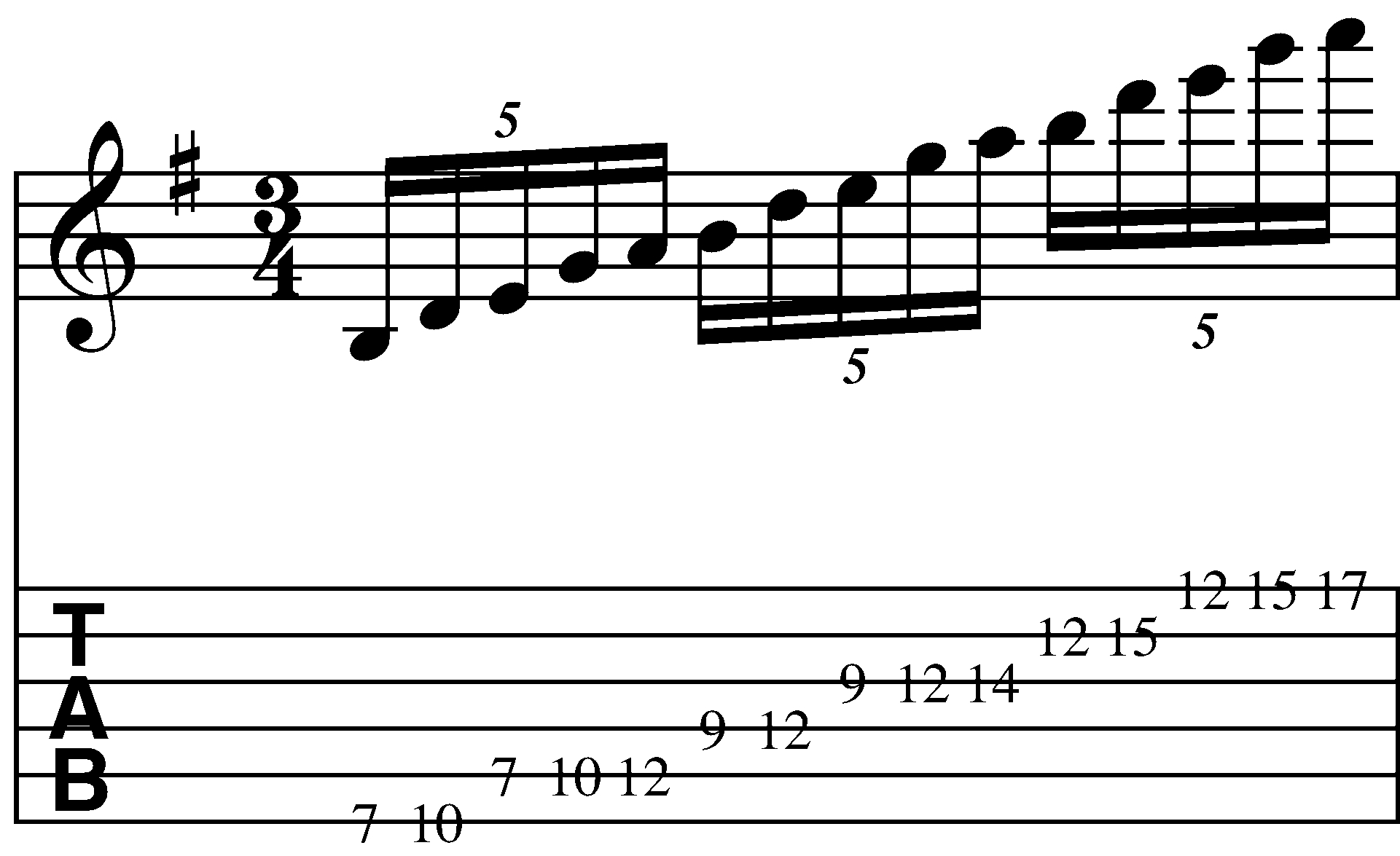
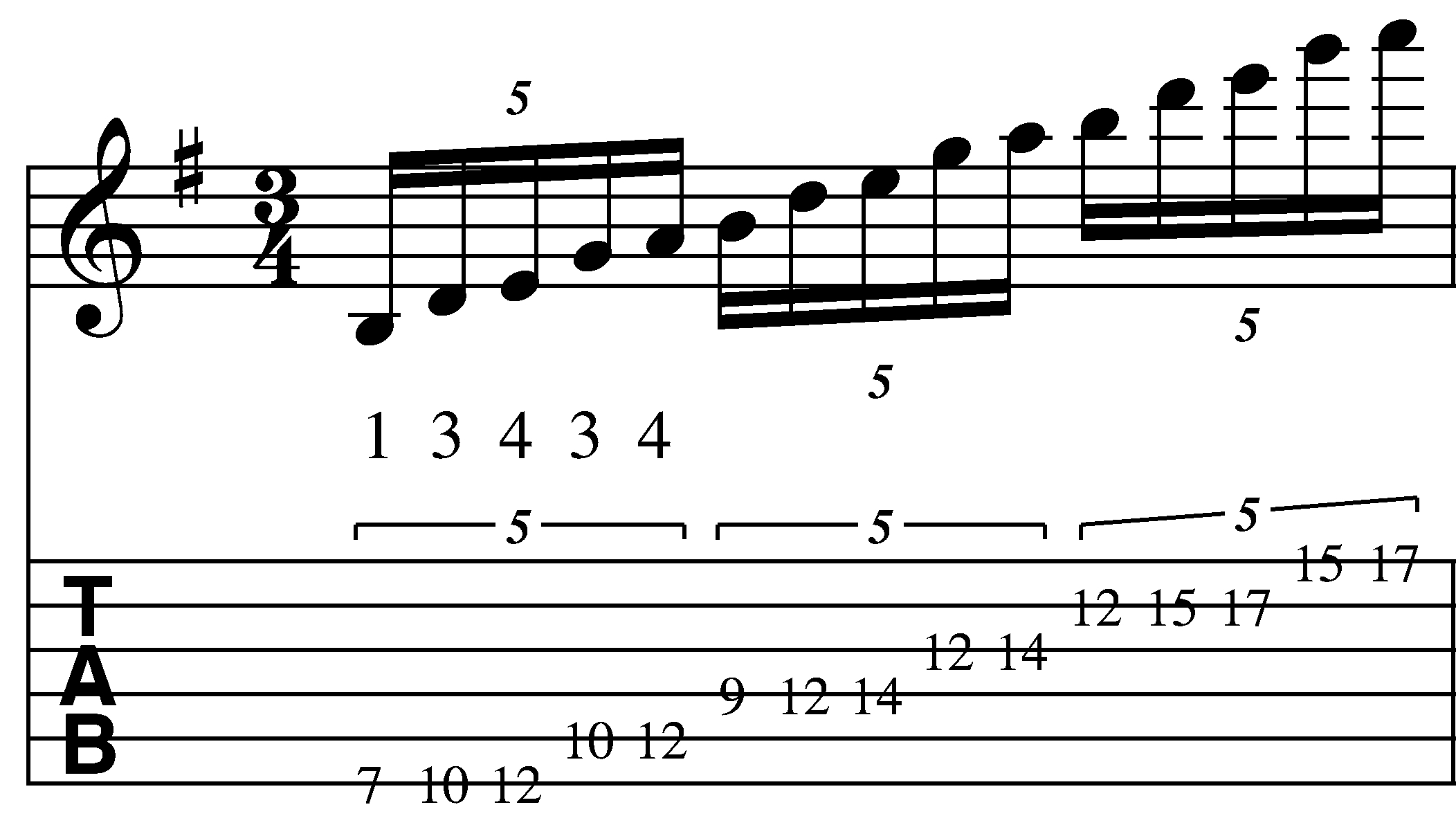
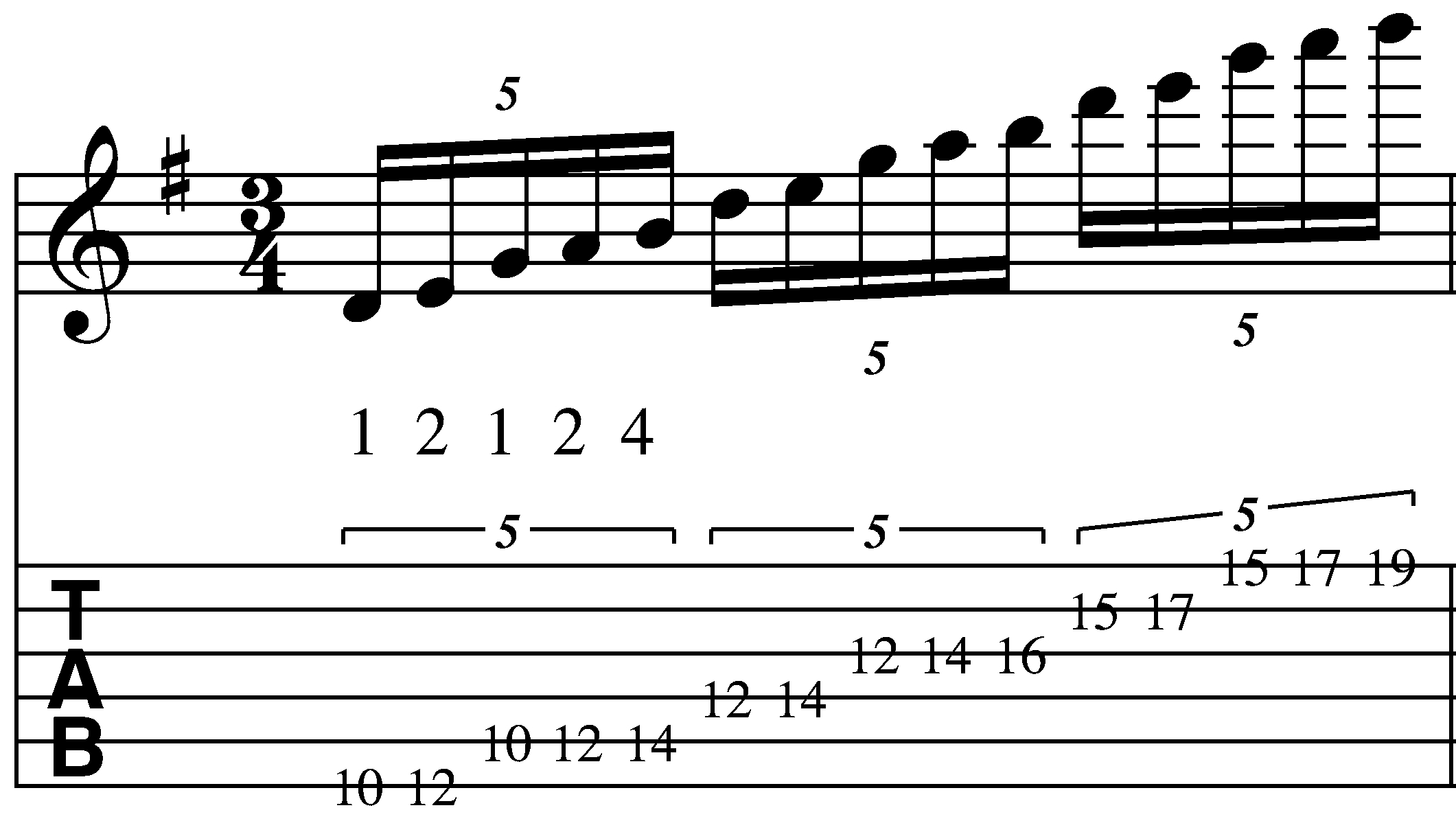
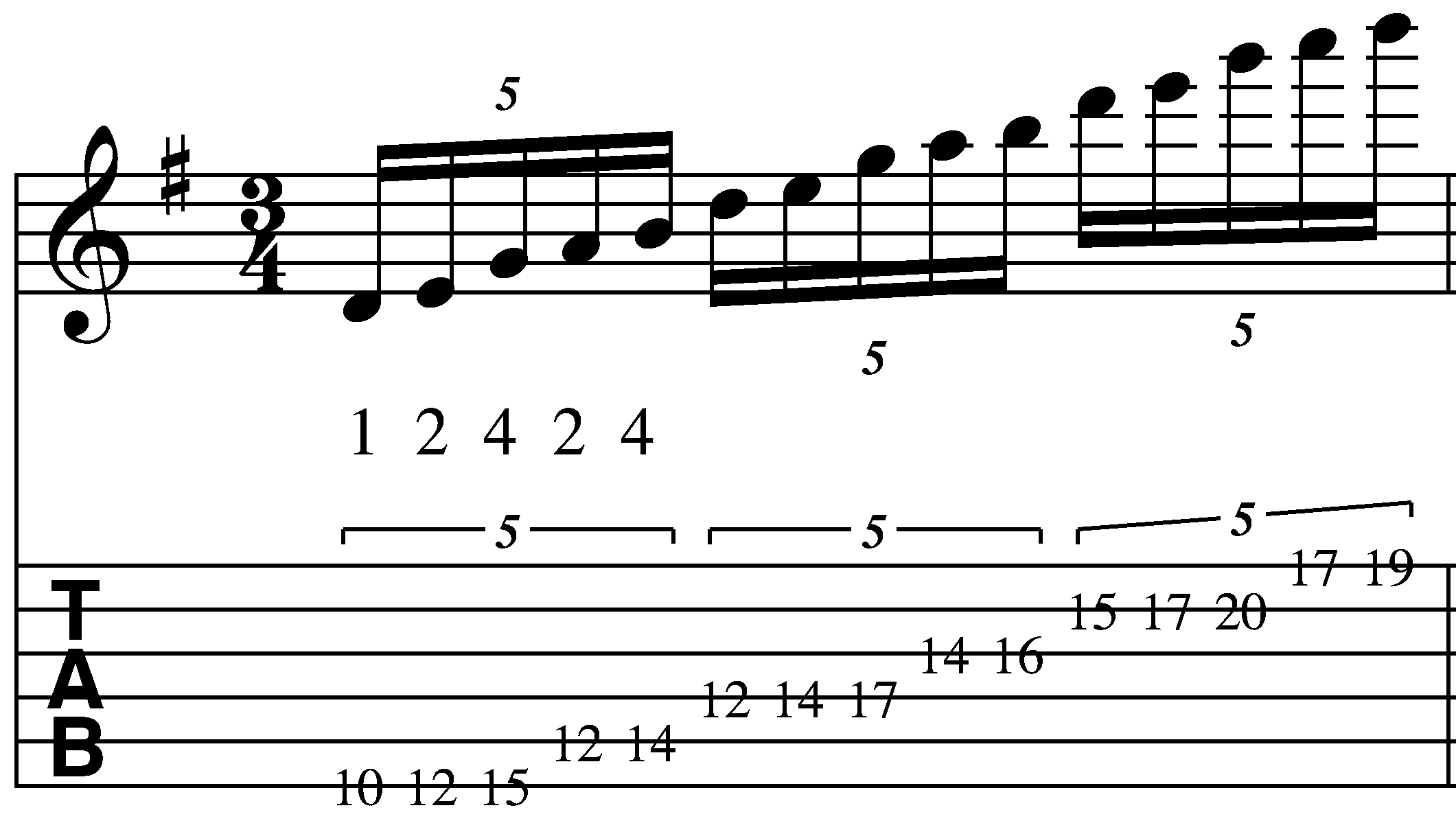
  • The last five notes of the sextuplet break the four note melodic pattern.  This idea will be explored more in part 2. But in the meantime, here’s an initial fingering to get you going.  I’ve notated it as a group of 5 – But rhythmically it’s part of the sextuplet pattern above.

.

.

The use of the open E and A strings changes the overall fingering shape on the bottom, middle and top two strings which may make the lick more challenging to play.  

.

If you are having difficulty playing something melodically, take a close look at the fingering you’re using and see if it’s the most efficient one.

.

In the example below, I’ve taken the same notes and broken them up into melodic shapes that use the G, A and B pitches on the same string.  You will probably find this much easier to play.

.

Here’s a fingering variation of the above idea (watch the skip from G to B on the D string!)

..

.

.

Going a little further:

.

Sometimes patterns can lead us to unexpected melodic places.  Here,  in this approximation of an improvisation for example,

.

.

.

  • I’ve taken the initial E, G, A and B pattern shape and instead of moving it up a 1/2 step, (to accommodate the B/G string 3rds tuning), I kept the fingering shape the same.  This produces a whole tone shape on the B string that adds a melodic surprise.
  • I’ve then continued the whole tone idea to the high E string  – bringing in a C and then resolving it to B (The 7th fret B is missing in the tab but is on the notation line). The whole steps in the F#, G# and A# passage and the C, D and E passage have the same intervals as the G, A, B of the pentatonic scale.  Even though the G# clashes with the G in E minor – the line has enough of a melodic drive that it can work (as long as you resolve the idea  – in this case to a chord tone).

.

By understanding patterns, it becomes possible to  manipulate them and make them work for you.  In the next lesson we’ll play full pentatonic patterns on 2 string sets and bring in a few other ideas that will spice up your approaches

.

Tones:

.

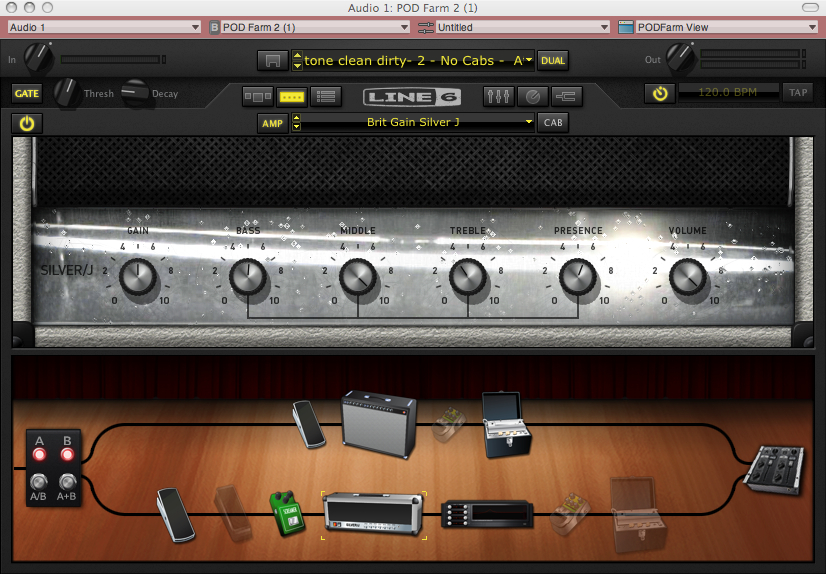
Finally, for  those of you interested in the technical side of what I’m doing here are some screen shots of my set up. First the AU Lab rig:

.

.

Something that may be of  interest to you – I set Audio MIDI Setup to 88.2k for the DUET  – but run the LA Convolver speaker cabs at 44.1.  That way the audio conversion rate for the guitar signal stays higher but I can use things that run at 44.1 (like the audio player on the Generator 1 strip).

.

.

I’ve mentioned the AUAUDIO File Player on my AU lab posts – but it’s a cool plug-in.  Using it, I can bring in all kinds of samples or tracks and run them live with the guitar signal and record them with the click of the record button.  (It’s how all of these tracks are recorded btw – live into AU Lab).

There are two dirty sounds (I didn’t like my first tones so I re-recorded everything.  When I couldn’t find the first 5 audio files while typing this – I just went with the initial recordings since I didn’t have access to my guitar.)

.

Here’s the dirty side of the main tone (Tube screamer is set at 9%, 53% and 9% – BTW)

.

.

and the clean side:

.

.

Tracks 1-4 are just my standard Marshall Who? settings

.

.

Part two will be up soon!! In the meantime,  if you like this approach, I have a book that includes this material you may be interested in that features this material and much more!

Minor Pent Front

is 100 + pages of licks and instruction and includes demonstrations and breakdowns of two-string fingerings, diagonal pentatonics, sweep picking pentatonics, pentatonic harmony and much more!  It’s available here.

.

Thanks for reading!

-SC

Getting hipness from a major triad or more chord recycling part 3

In part one of this post, I looked at generating different major chord variations based on flatting the root and the 5th.  In part 2, I sharped those pitches and then combined the two approaches to create additional chords and textures.  In this post, I’m going to look at applying these chord tones to  melodic (or lead) ideas.  But first…

.

The Relative Minor Explanation:

The second post of this series ended on a cliffhanger when I said that all of the A major upper extensions would work as substitutions for F# minor chords.   You can read the rest of this Relative Minor explanation if you want to understand why this works – otherwise you can just skip ahead to the next section for some melodic ideas.

Here’s the explanation for this.

In a major chord, the 4th is sometimes known as an avoid note.  In the key of C, this means that the note F is usually viewed as a note to avoid either melodically or harmonically.  If we look at a major scale:

C D E F G A B C

the only 1/2 steps in the scale are between E/F and B/C.

Chromatics are powerful things in music.  They tend to act as tonal anchors to where the tonal center is.  If you play a simple ascending C major scale and stop on the note B, most listeners will want you to resolve to C.   In the major scale the 1/2 step between the 3rd and 4th makes the ear think that F major is the tonal center.

(For those of you familiar with ear training, if you sing a c major scale from C to F – it sounds like you’re singing so la ti Do – instead of Do re me fa.)

One innovation that came about in jazz music was to substitute an #4 for a 4 over chords with a major quality.  This put the 1/2 step motion between the 4th and the 5th.  Since the 5th is a chord tone in a major triad, it has less of an effect of moving outside of the key.

Here’s how this is applied:

  • Any Major scale with a #4 is a Lydian mode.
  • The A Lydian mode is taken from the parent Major scale of E Major.
  • The Relative Minor chord of A Major is F# minor.
  • In the key of E Major, F# is the second scale degree and uses the Dorian mode.
  • Dorian is a popular mode for soloing over minor chords.

Here’s the shortcut:

You can change the chord scale with the chord if you want here – but if you’re playing a chord progression that goes between a major and the relative minor chord (and you’re using Lydian for the major chord) – you can keep using the same scale to create a Dorian sound over the minor chord

(and vice-versa).

A Quick Review

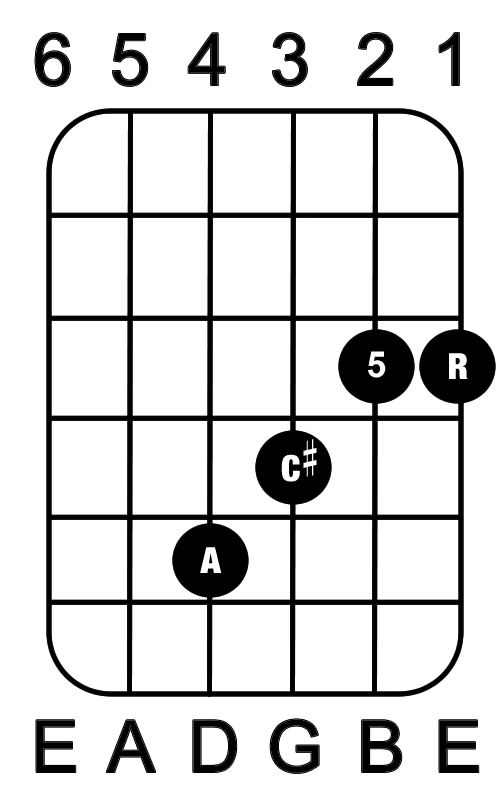
Here’s the Major chord shape I’ve been modifying over the first 2 lessons:


.

A Major

.

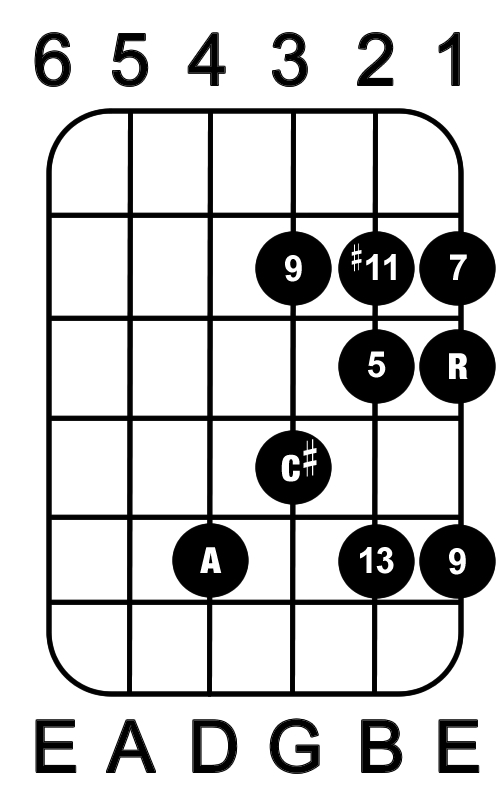
If the root and the 5th are strategically sharped or flatted, other chord tones (7, #11, 9 and 13 can be created).

.

A major with  additional chord tones on the B and E string

Since the b (9th) on the high E string is available, the 9th on the g string is something that can be incorporated as well.

.

A Lydian/F# Dorian Chord tones based on an A major chord shape

.

If I’m soloing over A major (or F# Minor)  – all of these notes are fair game. 

Try all the licks below over an A major type chord or F# minor type chord.

.

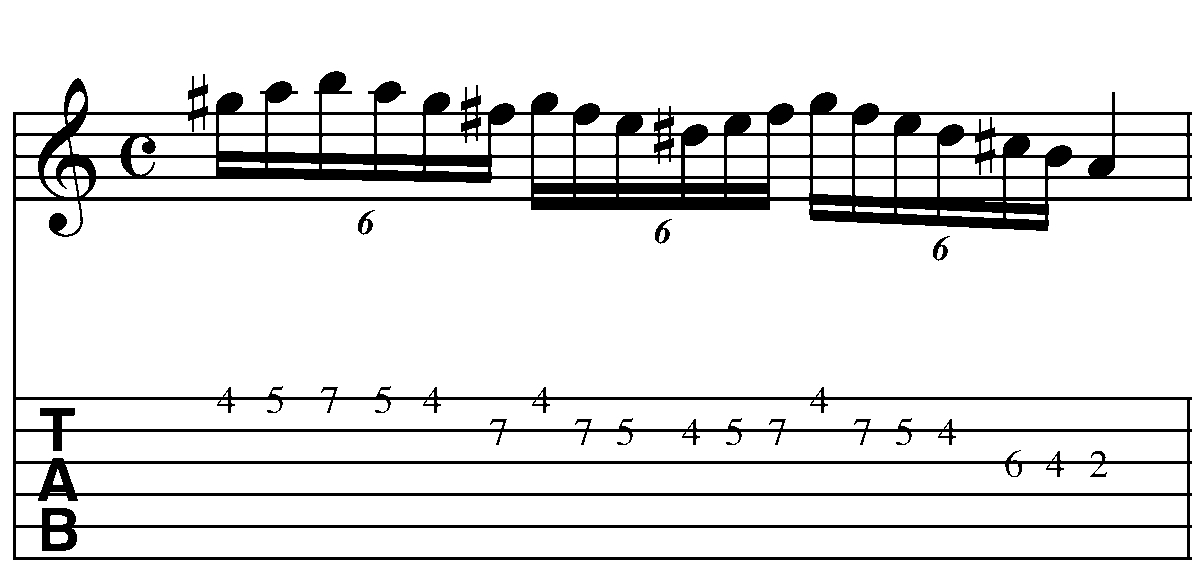
Lick 1 (Double Click any notation to see full size)

Lick 1


I try to stay with consistent note-per-string fingerings on strings when playing melodically, so here I’m going to take the same idea and just move the last note to the g string to create a 3 note per string pattern.

.

Lick 1: Three note-per-string shape

.

Here’s how it sounds at 1/2 speed.

Here’s how it sounds at tempo.

.

Lick 2:

Here, I’m taking the same notes and breaking them up intervallically into 4ths (except for the 5th in the last 2 notes which adds some variety in the cycle).  Licks like these are easy to visualize (and therefore easy to manipulate when improvising).

.

Here’s how it sounds at tempo. 

Note:

When I improvised this- I played it as transcribed – but when I recorded it – I played the last 2 notes as 1/8th notes instead – please take any of the ideas here and manipulate them as you see fit.

.

Here’s a similar (but shorter) idea with a scalar pattern at the end.

.

4ths lick 2

.

Here’s how it sounds at 1/2 speed.

Here’s how it sounds at tempo.

Lick 3:

Here’s an arpeggio idea that incorporates chromaticism.

.

arpeggio lick w. chromatics

.

Here’s how it sounds at 1/2 speed and then at tempo.

.

A couple of notes:

  • In the beginning I’m visualizing a C# min7 arpeggio (C#, E, G#, B) starting on the B.
  • The chromatic motion isn’t random – instead it specifically emphasizes the A and the C# in the A Major chord.
  • In the 3rds pattern that ends the lick – I’m skipping the middle note of the 3 note per string pattern in Lick 1.  I like using 3rds in patterns because it breaks up the monotony of just running scales up and down.


Going Further – Dominant Superimposition:

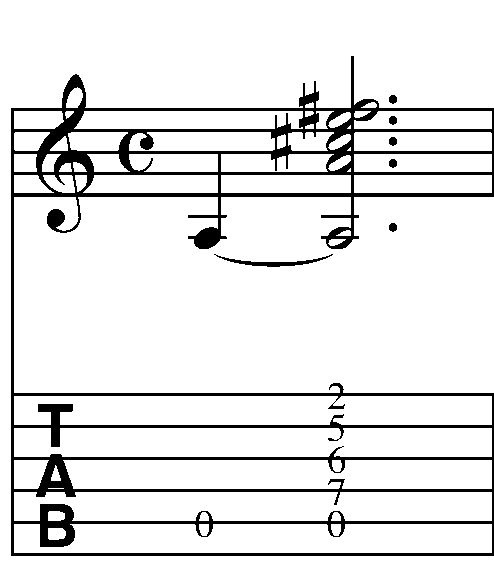
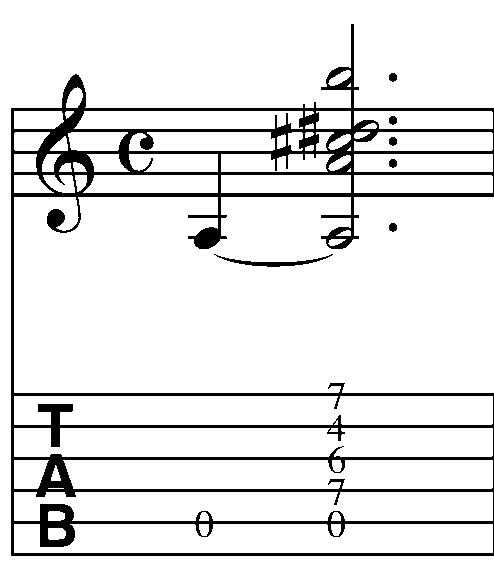
Now that some initial options have been explored – I’ll take a look at the upper notes of the voicing.  If I take the previous fretboard diagram and extend a note on the g string I’ll have something that looks like the diagram below:

Here’s a chord voicing I discussed in part 2 of this series (B7/A)

And here’s how it sounds.

Short cut 1:

Playing a dominant 7th chord on the second scale degree of a major chord will get you all of the upper extensions and the root)

(i.e. B7 over A major)

Short cut 2:

When soloing over a major chord – you can play a dominant arpeggio on the second scale degree (i.e. B7 over A major).

In the example below, I’m combining a B9 arpeggio and an A major arpeggio to create a melodic idea.  The A and C# on the D string are the linking material between the 2 arpeggios (they act as the 7 and 9 in the B9 chord, or as the root and 3rd of the A Major).

The important thing with any superimposition like this is to resolve it to a chord tone in the chord you’re soloing over (in this case A).

.

.

Here’s how it sounds at 1/2 speed.

Here’s how it sounds at tempo.

.


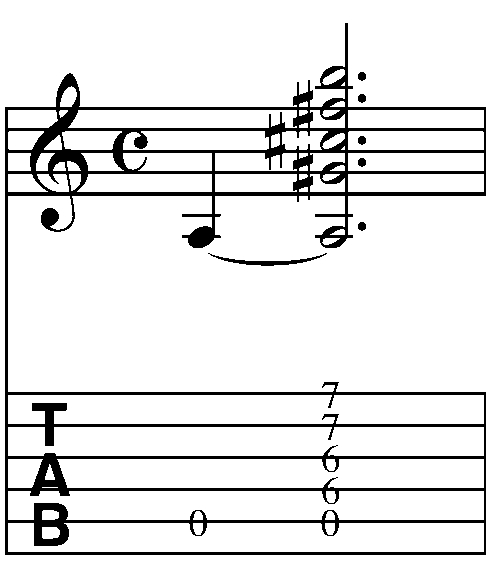
Going Further – Minor Superimposition:

Here’s another chord voicing I discussed in part 2 of this series (G# min7/A)

Short cut 1:

Playing a minor chord on the seventh scale degree of a major chord will get you upper extensions (7, 9, #11 and 13)  of the chord.

(i.e. G# min7 played over A major)

Short cut 2:

When soloing over a major chord – you can play a minor arpeggio on the second scale degree (i.e. G# min7/A).

In the example below, I’m combining a sextuplet idea from the earlier licks and a  G#min arpeggio to create a melodic idea. Again, an important thing with any superimposition like this is to resolve it to a chord tone in the chord you’re soloing over (in this case A).

I’m not a fan of the shift from E to D# in this fingering as it requires quickly barring to get the rest of the arpeggio.  As an alternate fingering, I  recommend this:

.

The “picking” is just a suggestion.  (For example: you could also pull off the D# to the B on the g string and then just continue the sweep picking motion.)

.

Here’s how it sounds at 1/2 speed.

Here’s how it sounds at tempo.

.

Wrapping it up:

This is really only the beginning of where these approaches can go.  Hopefully this will give you some ideas to explore both in comping and soloing.  If there’s enough interest, I’ll expand this approach to minor and dominant chords in future posts.

Final Tech Note:

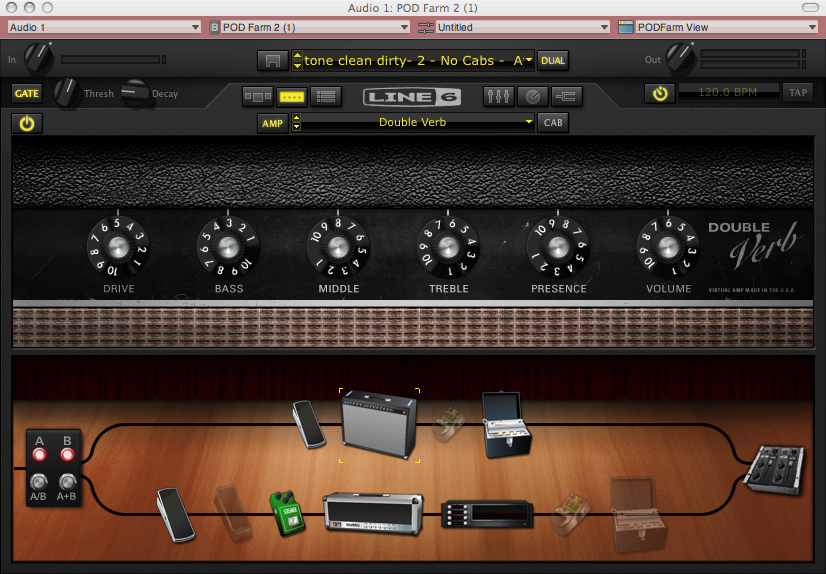
For those of you who are interested, these are the approximate settings I’m using in Pod farm for the distorted tone here:

Thanks for reading!

-SC

Getting Hipness From A Major Triad Or More Chord Recycling Part 2

In part one of this post, I looked at generating different major chord variations based on flatting the root and the 5th.  In this post, I’m looking at sharping those pitches and combining the two for additional textures (if you came here directly – you may want to review the A major variations in  part one before continuing).

.

Start with a map:

Adapting chord forms requires the ability to visualize chord tones around the shape you’re using.  As a starting point, here’s a fretboard diagram of an A major chord (with the A being on the 7th fret of the D string).  I’ve added some additional chordal extensions on the E and B strings (but this process could be applied to any string-set).

In the last lesson, I looked at creating sounds with the 6th (or 13 – see post 1 for the difference between the 2) on the E string.  This time, I’ll add the 6th (6th or 13th) on the B string by raising the E  up to F#.

.

A Major 6th no 5th

Here is the sound of the A Major 6th (no 5th) chord.

.

Comparing this to the A major 6th voicing in part 1:

.

A Major 6 - Watch the 1st finger stretch - if it hurts - stop Immediately!!

Here’s an mp3 of this chord.

.

The new voicing is certainly easier.  If I was really stuck on the close voicing of the E and the F# in the A major 6th, I could simply move the F# to the B string and move the E to the open string like this:

A maj 6 with open E string

.

Several Notes:

  • This voicing wasn’t included in the first lesson as I wanted to show the process of how to derive these chords.
  • The upside to this approach is it makes this specific voicing easier to play – but the downside is it’s not movable – which may or may not be problematic for you.
  • If a chord is really difficult to finger – there is always an easier way.  You may not get the specific notes or voicings you’re looking for – but there’s always an easier way.

Now I’ll extend the initial Major 6th sound by flatting the 7th.  This is done by lowering the A to G#.

.

A Maj 7 add 13 no 5th

Here’s how it sounds.

Again,  I’m a sucker for chords with seconds in the voicing (in this case the F# and G#).  It adds a little but of tension and elevates the chord a bit.

.

Adding in the 9th:

First let’s create an A major add 9 chord.

.

A add 9

Here’s how it sounds.

.

Note:

The reason this is an add 9 chord and not a major 9 chord is the lack of a 7th.

Since the chord is a major chord with a 9th added, it’s called an add 9.

.

Now I’ll add a sharp #11.  This is done by lowering the E to D#.

.

A maj 9 sharp 11 no 7th no 5th

Here’s how it sounds.

.

Another Note:


The further you extend the harmony and remove initial chord tones, the more vague the sound of the chord is as related to the tonic.

For example:  The chord above could be analyzed as an A major 9 # 11 with no 7th and no 5th. But the notes are A,  C#, D# and B.  If those tones are centered around B – you have a B, D#, A and C# or a B dominant 9 (no 5th)/A.

If you have to analyze a chord with more than 1 elimination (i.e. “no 7th no 5th”) there’s probably a simpler analysis of the chord.


Going Further:

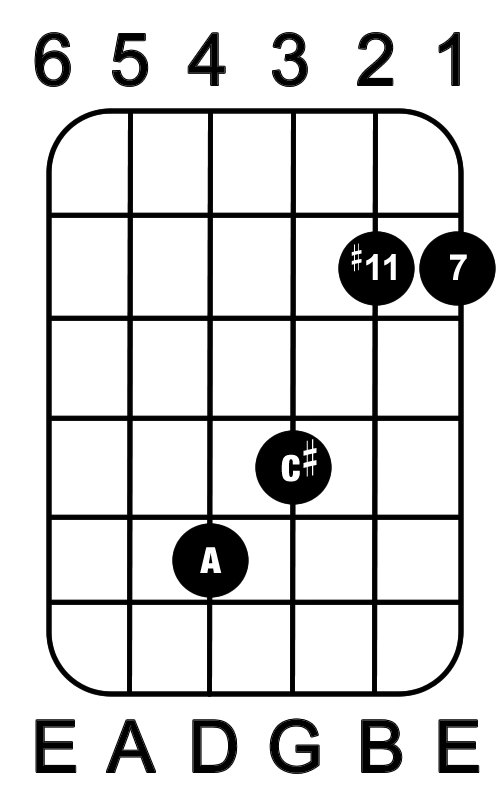
Now that some initial options have been explored – I’ll take a look at the upper notes of the voicing.  If I take the previous fretboard diagram and extend a note on the G string I’ll have something that looks like the diagram below (again the A listed below is on the 7th fret of the D string):

If I’m willing to be a little adventurous and replace the 3rd of the chord (C#) with the #11 (D#) , I’ll get a voicing with a root and then all upper tensions (9, #11 and 13).  Here it is notated:

.

B7/A

And here’s how it sounds.

.

While you could analyse this related to the key of A Major (A major 13, #11, no 3rd, no 5th, no 7th) you may have noticed that shape is the upper chord voicing for a VII position B 7 barre chord.

.

Short cut 1:

Playing a dominant 7th chord on the second scale degree of a major chord will get you all of the upper extensions and the root).

(i.e. B7 over A major)

But isn’t a stable sound on its own.  If you play this chord and then the standard A major, it will probably feel resolved to you when you play the A.  If you have a song with a number of bars of A major – switching between these two chords is a nice way to generate a little harmonic motion.

Now, I’ll take this idea a little further by lowering the A to a G#:

G# min 7/A

.

Here’s how it sounds.

.

This gives the chord a 7 (G#), 9 (B), #11 (D#) and 13 (F#) – or all of the upper chord tones.

Short cut 2:

Playing a minor 7th chord on the seventh scale degree of a major chord will get you all of the upper extensions of the chord.

(i.e. G# minor 7 over A major)

Like the B7/A, this isn’t a stable sound on its own.  If you play this chord and then the standard A major, it will probably feel resolved to you when you play the A.

.

Quartal for your thoughts?

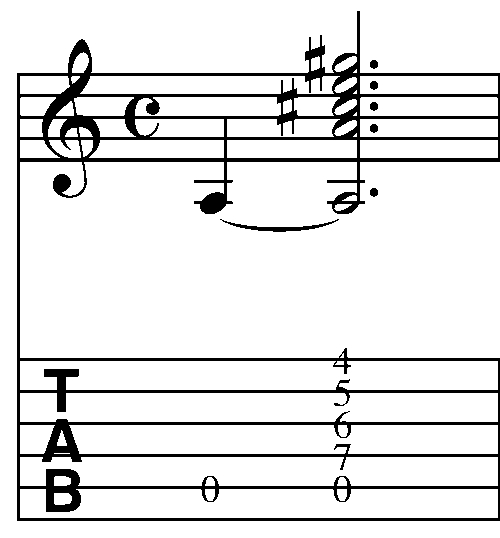
Here’s one last transformation for now.  Here I’m going to lower the D# to C# to create a quartal chord.

.

Quartal Chord

And here’s how it sounds:

.

A quartal chord is a chord that is built on 4ths (G#, C#, F#, B) as opposed to being built on 3rds like A Major (A, C#, E).  To me, quartal voicings have a nice “airy” or “floating” quality .  This is just one of many  possible quartal voicings built from A major.  Quartal voicings will be discussed more in-depth in a future post.

.

How to double the number of chords that have been covered.

So far, I’ve looked at a series of chords that either work as substitutions and/or extensions for major chords  I’m going to go into more depth about why this works in the next post but for right now – here’s a quick tip that gives a whole other dimension to using these chords.

.

Every chord presented here also works over the relative minor (i.e. F# minor chord).

.

Try taking this chord:

.

and after you play it add an F# by tapping a fret hand finger on the 2nd fret F# on the low E string for a very hip F# min 9 extension.

.

F# min 9 add 13 no 11

.

Hopefully this has given you some new chordal ideas!!  You may want to go back to the first post and apply this idea by playing through all of the voicings covered there and adding the F# as a root.

In addition to explaining this approach more in-depth, in part 3 of these posts I’m going to explore a number of ways to use these ideas in your soloing.

Thanks for reading!!  Please feel free to post any questions you might have.

-SC

Getting Hipness From A Major Triad Or More Chord Recycling Part 1

When I was at Berklee, one thing that took a while for me to really get my ear around was upper chord tones (7ths, 9ths, 11ths and 13ths).  Growing  up listening to a great deal of rock music – basic triads sounded “right” to me.   I learned a lot of esoteric chord voicings to try to expand on those forms – but my ear wasn’t ready for it and so I had no real motivation to develop it at the time.

As I mentioned in the getting through the gig and the recycling chords posts, simple triadic forms can be manipulated in a way that allows players to get more complex harmonic textures in real-time.  Additionally, these approaches can be adapted to lead playing as well.  This short series of posts are going to go deeper into adapting one specific chord voicing.  As a starting point I’ll use the major triad.

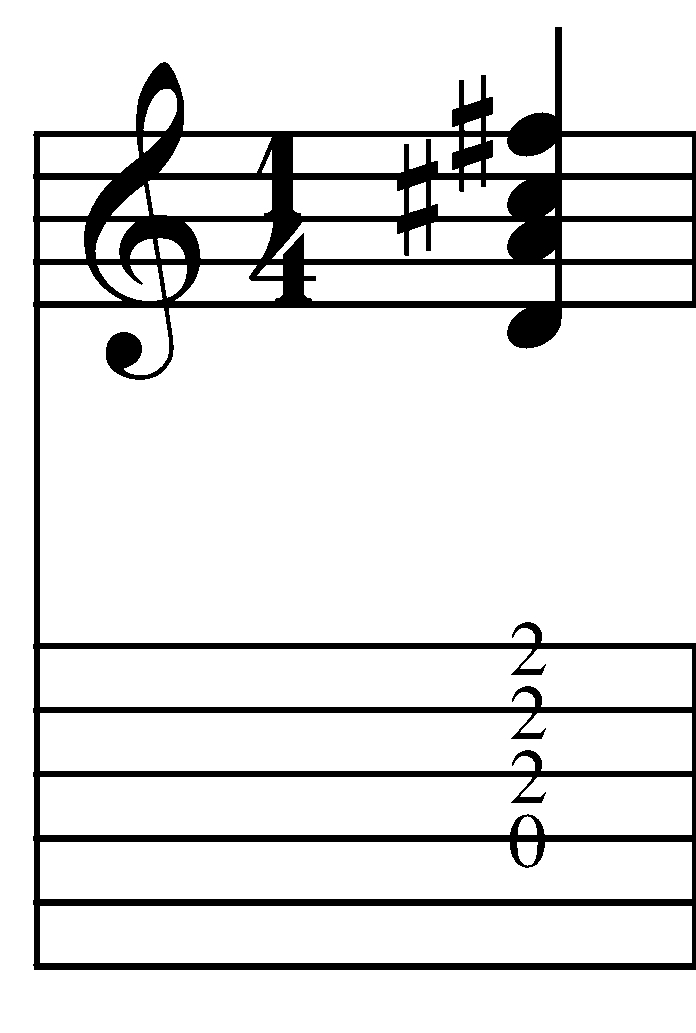
The following examples are based around a 5th position A major chord played on the D, G, B, and E strings.


The reason I’m using this specific voicing is to allow the open A string to ring while playing the chord to help reinforce the root.  Here’s the basic rhythm of the chordal examples:

While notated this way for simplicity, all the examples are played with a slight arpeggiation to help accent the different notes.

.

Here’s an mp3 of an A Major Triad.

 .

Rooting around for extra tones:

The first way to generate some additional substitutions for a simple major chord  is to lower the root chromatically.

While there is a root on both the D and the high E string, for now these examples will focus on manipulating the root on the high E string.

Lowering the root of a major triad a 1/2 step (1 fret) produces a Major 7th chord:

(This can be used in place of any A major triad)

A Major 7 Chord

 .

Here’s an mp3 of this A Major 7 chord.

.

Lowering the root of a major triad a step (2 frets) produces a Dominant 7th chord:

(This can sometimes be used in place of an A major triad

Example: When the A acts as a V chord in a chord progression (A -> D becomes A7–>D))

A7 Chord

.

Here’s an mp3 of this A 7 chord.

.

Note:

While dominant 7th chords contain a major triad in them – they are their own unique animal.  A future post will go into generating dominant chords – in depth – but this voicing is presented here as part of the process of generating chords by altering the root.

.

Lowering the root of a major triad a step  and a 1/2 (3 frets) produces a Major 6th chord:

(Typically this can be used in place of any A major triad)

A Major 6 - Watch the 1st finger stretch - if it hurts - stop Immediately!!

.

Here’s an mp3 of this A Major 6th chord.

.

Another Note:

There are certainly easier ways to generate this chord – but any chord form with  a 1/2 or whole step between notes on the B and E strings will require some limber hands.  Again, this voicing is not the only possible voicing of this chord but instead is just one possibility.

.

6th chord/13th chord Tip:

Frequently, I’m asked about the difference between a 6th chord and a 13th chord.  Since the note is the same for both the 6th and the 13th, the terms are sometimes used interchangably – but the difference is based around whether the chord has a 7th in it.  In the example above, the F# acts as a 6th, because no 7th is present in the chord.  If a seventh was in the chord, the F# would be viewed as a 13th.

.

The #4/#11:

One hip tone to use in a Major based chord is the #4 (or #11).  This is generated by flatting the 5th a 1/2 step (1 fret).

A Major add #4

.

Here’s an mp3 of this A Major add #4 chord.

I like voicings like this where the top voices (C#, D# and E in this case) are all close voiced (i.e. in the same octave). The technique of combining these close voiced ideas with open strings is a favorite approach of mine.

This idea can be expanded on by flatting the root as well.

This produces an A major 7 add #11 (no 5th) chord (A favorite substitution of mine for a major chord).

A Maj 7 # 11 no 5th

.

Here’s an mp3 of this chord.

.

Shortcut:

If you flat the top two notes of a major barre chord with the fifth and root on the B and high E string – you get a pretty hip major chord substitution.  This works in any key.

In part 2 of this series, I’ll look at sharping the 5th and the root to generate more chord voicings, combining both approaches and extrapolating lead ideas from these approaches as well.

Thanks for reading!!

-SC

Getting Through The Gig – Negotiating A Chord Chart Part 1

In the previous surviving the gig post, I talked about some memorization skills that can help get through gigs that require learning a lot of tunes.  In this series of posts, I want to focus on how to get through gigs that may have unfamiliar chord changes.

In this post, I’m going to be discussing how to interpret chord symbols and then developing some short cuts for how to generate chord voicings on the bandstand as it were.  If you are already familiar with how to read chord voicings – you may want to skim this and just go to part 2.

There will be a lot of detail over these posts for how I’m doing what I’m doing, but once you get the concept under your belt.  It should be something you can do on the fly if need be.

As an example, I’ll be look at part of a chart Rough Hewn touch/stick/Warr guitarist Chris Lavender sent to me, called 232

(232 © Chris Lavender 2011 used with permission)

.

First Step – Know what notes the chord symbols are asking for.

It’s not that hard to figure out chords if you know what the symbols mean.  Here are some general shortcuts for chord types beyond triads.  There are only 3 basic categories that we’ll look at: Major, Minor and Dominant:

.

Major

(Sometimes designated by “major”, “maj” or a triangle)

Any type of major chord always has a major triad (Root, 3rd and 5th) plus a major 7th in the full chord voicing unless it states otherwise.  If a chart has any type of C Major chord variation (C Major 7, C Major 9 or C Major 13)  –  the voicing has a C, E, G and B.

Note:

When removing notes from any voicing the 5th is usually the first to go (unless it’s altered like #5, or b5).

The initial short cut is: any major type chord starts with (1,3, 7) or (C, E, B) in the key of C.


Minor

(Sometimes designated by “minor”, “min”. or “-” )

Any type of minor chord always has a minor triad (Root, b3rd and 5th) plus a b7th in the full chord voicing unless it states otherwise.  If a chart has any type of C Major chord variation (C minor 7, C minor 9, C minor 11 or C minor 13)  –  the voicing has a C, Eb, G and Bb.

Note:

When removing notes from any voicing the 5th is usually the first to go (unless it’s altered like #5, or b5).

The initial short cut is: any minor type chord starts with (1,b3, b7) or (C, bE, bB) in the key of C.


Dominant

(Sometimes designated by “dominant”, “dom”. or no designation

i.e. “C7”, “C9” or “C13” refers to a dominant chord unless otherwise stated)

Any type of dominant chord always has a major triad (Root, 3rd and 5th) plus a b7th in the full chord voicing unless it states otherwise.  If a chart has any type of C dominant chord variation (C 7, C 9, C 11 or C 13)  –  the voicing has a C, E, G and Bb.

Note:

When removing notes from any voicing the 5th is usually the first to go (unless it’s altered like #5, or b5).

The initial short cut is: any dominant type chord starts with (1,3, b7) or (C, E, Bb) in the key of C.


Beyond this, you just need to add in additional pitches based on what the voicing indicates.

Here’s a chart that relates all of the potential chord tones that you might see to a scale degree for quick reference.

Putting the chart to use:

The first chord in the 232 chart is a C major 9 #11.  As a reminder – any extended C major chord will have C, E, G, B in the full voicing.  Since it’s a C major 9, a 9th – which in the chart above is a D – will have to be added.    The #11 means an F# will get added to the voicing as well.  This brings the full voicing to (C, E, G, B, D, and F#).

Again, the only time you would probably play a full voicing is for a solo guitar or perhaps a duet performance.  In the next post, I’ll discuss how to extract what you need to get through the chart.

.

Second Step – Know some chords

When I went to Berklee, I was advised that I should learn at least 2 chord voicings for any chords that could be put on a chart in front of me.  These stock voicings are typically low E or A string rooted (as it helps with visualization) and are the default voicings that you would use if you were sight-reading a chart.  These typically include triads, Major /Minor / Dominant chord 7th, 9th, 11th and 13th chords.

While this is, generally, useful advice, I should state for the record that while I did the initial memorization required for school proficiencies – I quickly forgot the majority of voicings I wasn’t using all the time. Learning every inversion of every possible 7th, 9th, 11th and 13th chord on multiple string sets will take YEARS.  For some people, it’s the best method, but it never worked that well for me.

.

Once I understood how chords worked, I never bothered to memorize many specific voicings above a 9th chord because I found some shortcuts to get the sounds I needed.


Note:

This is not to say that you should be lazy.If you follow through on the suggestions that I have – you should plan on learning triads and 7th chords at a very deep level (i.e. you should have the goal of being able to play any triad or 7th chord in any inversion in any position).

(more on how to do that in a future post)


I hope this helps!  In the next post – I’ll simplify the 232 chart with some harmonic shortcuts.

While digesting this – I’d recommend you take some time to work on your chord inversions.  If you’re unfamiliar with them you may want to check out the D major inversions I’ve posted below, and adapt this process to minor triads (just flat the third – F# and make it F in the examples below), and 7th chords (major, dominant and minor).

.

(The following is adapted from another post (Recycling Chords Part II: Triad Transformation).

.

Thanks for reading!!


-SC

.

Note:  D major is used in the following examples instead of C major because the original post dealt with transforming triads.  Each note of a 1st position D major chord can be lowered to another note on the fingerboard, without using open strings.  In other words, each chord is a moveable voicing on the fingerboard. The following should be adapted to C major and other keys as necessary.

.

The first step to adapting voicings is to make sure you can visualize triads both horizontally and vertically across the fingerboard.

.

Horizontal (i.e. positional) Visualization

Here’s a series of  D major chord inversions in the 2nd position.

Helpful Tip

As you play through these voicings pay particular attention to which chord tone each finger is on (i.e. for the first D Major chord voicing – the first finger is on the 5th of the chord (A), the third finger is on the root (D) and the second finger is on the 3rd (F#). More on this later.

Here are the D major inversions in the 5th position

and in the 10th position.

Vertical Visualization

.

Note:

the important thing with both the horizontal and vertical voicings is knowing where each chord tone is located in the voicing.

.

One way to practice this is to play through the chords and stop at random points and ask, “where is the root?” “where is the 3rd?”  “where is the 5th ?”  This has to be full internalized to be able to realize the goal of instant chord tone identification.


The Baker’s Dozen Approach To Pentatonic Scales

6 for the price of 5

While pentatonics are a great melodic and harmonic device, slipping some extra notes into the scale can add some additional spice to the  approach.  The most common way to do this is through the method used in the blues scale – which is a pentatonic minor scale with an added note (in the case of the blues scale – a tritone).

The impetus for posting on this was a post my friend Moby Pomerance put up regarding some elements of this very topic.  Originally I had devised an alternate (i.e. approximate) fingering for his idea – but ultimately I put a few twists and turns in it and came up with one lick that’s really three mini licks rolled into one.

First – The Scale

Here’s a “box” position D pentatonic minor scale as a starting point:

What I’m going to do is add in a 9th (e) for an additional flavor

If I put this in a 2 note per string pattern using the D on the D string 12th fret as a starting point, I get this fingering ascending and descending. (Use alternate picking with this lick.)

While there’s nothing wrong with fingering it this way, I like dividing it into 3 string groupings.  The 2-note-per-string approach with alternate picking is more aggressive – but the dividing the notes per string into grouping of 3-1-3 on the g-high e strings is a little more legato makes it easier for me to sequence sections.  So here is the same idea but moved to the 7th/8th position.

Pay careful attention to the picking pattern and the 4th finger.  The slide is indicated here to accent the pinky movement. While it’s picked in this example, it could also be played with only the first pick attack.

The lick

This idea is presented below in a larger lick that works over a d minor/d min7/d min9 chord.    Here’s an mp3 I recorded with the FNH Guitar  in AU Lab- first played slow (1/2 time) then faster (full speed – tempo is around 200).

** Note – the mp3 player on the site seems to be working better in Safari – but if you have trouble playing it – just refresh the page.


Notes:

  • The picking may seem idiosyncratic – but the approach is based on sweeping individual notes on multiple strings and alternate picking for notes on the same string.  You should find it consistent in that regard.
  • I see this as 3 licks.  Bar 1 is one approach.  The 1st two descending ideas in bar 2 as the second approach and the last 2 arpeggio ideas as the 3rd lick.
  • The note groupings are not all uniform.  Bar 2 has groups of 6 and 7 and splits a group of 5 up between bars 2 and three. .  Breaking out of rigid 4 note 1/16th note patterns adds an element of unpredictability .
  • There are a number of e-f slides to highlight the added note in this lick.  This is done with the idea of breaking the lick into segments rather than just using them in the lick as a whole.
  • Using patterns that have only 1 note on the B string – can make for some interesting chord ideas as well.  Here are some melodic fragments that can double as substitution chords over a d minor chord (with an mp3 here).

Lastly, examining the notes in this scale: D,E, F, G, A, C  as unique triads reveals the following:

D, F, A (d minor) + C, E, G (c major)

in other words – to get away from the full-scale approach – you could alternate D minor and C major arpeggios and get a very similar effect.  I’ll look at this more in a future lesson.

In the meantime, if this idea is interesting to you – you may also want to look at this GuitArchitecture lesson post, or look at the pdfs of the pentatonic posts in the online lesson (PDFs) tab on the top of the page.

I’m always looking for feedback.  If there’s anything in this lesson that helps, or that raises other questions – feel free to drop me a line at guitar.blueprint@gmail.com.

Thanks for reading!

-SC

.

Recycling Chords Part II: Triad Transformation

In the previous recycling chords lesson, I looked at ways to reinterpret chords. Another way to create different sounds is to take something as basic (and familiar) as a triad and alter tones to create more complex chords.

Note: this process isn’t designed to replace the need to learn multiple chord voicings but instead to supplement it.

.

Starting with the Flats

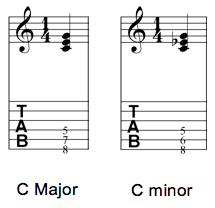
For example, take a C major triad (C, E, G) and flat the 3rd, and it becomes a C minor triad.
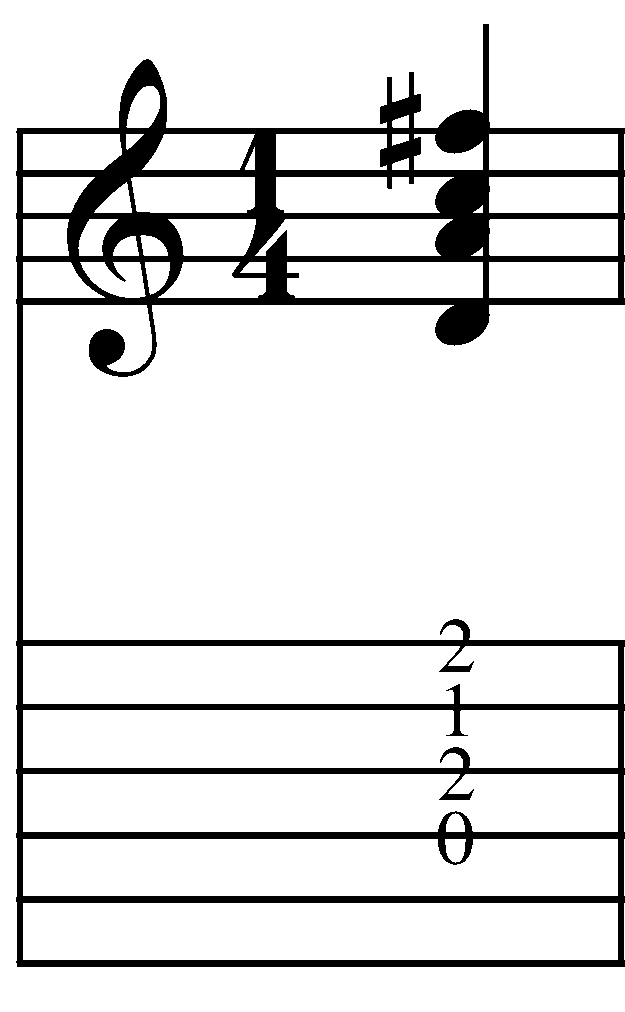
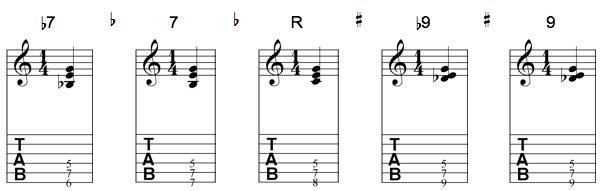
This idea also can be applied to the root of the chord.

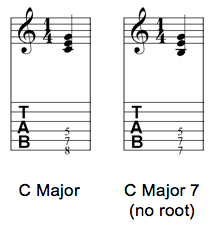
If the note C is flatted a ½ step (1 fret), the new note is B.  This creates a C major 7th chord with no root.

Likewise, if the note C is flatted a 1 step (2 frets), the new note is Bb. This creates a C7 chord with no root.

.

Moving to sharps

To add a 9th to the chord quality, raise the root  a ½ step for a flat 9 (b9) (or a step for a natural 9).

.

This is a good place to make a couple of notes:

.

First: the voicings presented here are used to demonstrate the process, but I like some of them better in other registers.  For example, here is the C add 9 voicing on the top 3 strings.

Second:  one reason to explore voicings without roots is that, in an ensemble setting, the bassist often holds down the root of the chord.  If you need the root –  it’s easy enough to just add it in.  Here is the same chord with a root:

The chord tone transformation chart


The following is a map of alterations to show how chord tones can be modified to create other sounds.

.

Taking the approach above, some general rules can be applied to a major triad.

.

The root of the chord can be lowered to the 7 or raised to the 9.


.

The third of the chord can be lowered to the 9 or raised to the 11.

.

The fifth of the chord can be lowered to the 11 or raised to the 13.

 .

In this manner, a triad can be altered into almost any other functional chord.


Here’s an exercise that utilizes a D major triad to illustrate this idea:

.

Note:  D major is used instead of C major because each note of a 1st position D major chord can be lowered to another note on the fingerboard, without using open strings.  In other words, each chord is a moveable voicing on the fingerboard.

.

The first step of this exercise is to make sure you can visualize triads both horizontally and vertically across the fingerboard.

 .

Horizontal (i.e. positional) visualization

Here’s a series of  D major chord inversions in the 2nd position.

Here are the D major inversions in the 5th position

and in the 10th position.

If these voicings are unknown to you, start by familiarizing yourself with them before continuing to the rest of the lesson.

.

Vertical visualization

Note: the important thing with both the horizontal and vertical voicings is knowing where each chord tone is located in the voicing.

One way to practice this is to play through the chords and stop at random points and ask, “where is the root?” “where is the 3rd?”  “where is the 5th ?”  This has to be full internalized to be able to intelligently transform the chords, with the goal being instant chord tone identification.


As with the horizontal voicings, if these voicings are unknown to you, start by familiarizing yourself with them before continuing to the rest of the lesson.

.

Triad Transformation Exercise

Now that the preliminary steps have been taken, let’s begin the process.

First, here are a few chord formulas we’ll need:

Major: Root, 3rd, 5th – D, F#, A

Major 7th: Root, 3rd, 5th and 7th –  D, F#, A, C#

Dominant 7th: Root, 3rd, 5th and  flat 7th –  D, F#, A, C

Minor: Root, flat 3rd, 5th –  D, F, A, C

Major 7 flat 5: Root, flat 3rd, flat 5th and flat 7th-  D, F, Ab, C

Now, let’s go through the exercise as individual steps to explain the process.

.

Step 1:  Take a Major chord (in this case D)

Step 2: Make it a D Major 7 chord

[by flatting the root a 1/2 step (1 fret)]

Step 3: Make the chord a D dominant 7 (D7) chord

[by flatting the root 1 step (2 frets)]

Step 4: Make the chord a d minor 7 chord

[by flatting the 3rd of the D7 a 1/2 step (1 fret)]

Step 5: Make the chord a d minor 7b5 chord

[by flatting the 5th of the Dminor7 a 1/2 step (1 fret)]

You get the idea.  Transform the chord into every possible voicing and repeat with every other inversion.

.

When less is more – A case for smaller voicings

When I started out playing, if a song called for a C major chord, I’d play something like this:

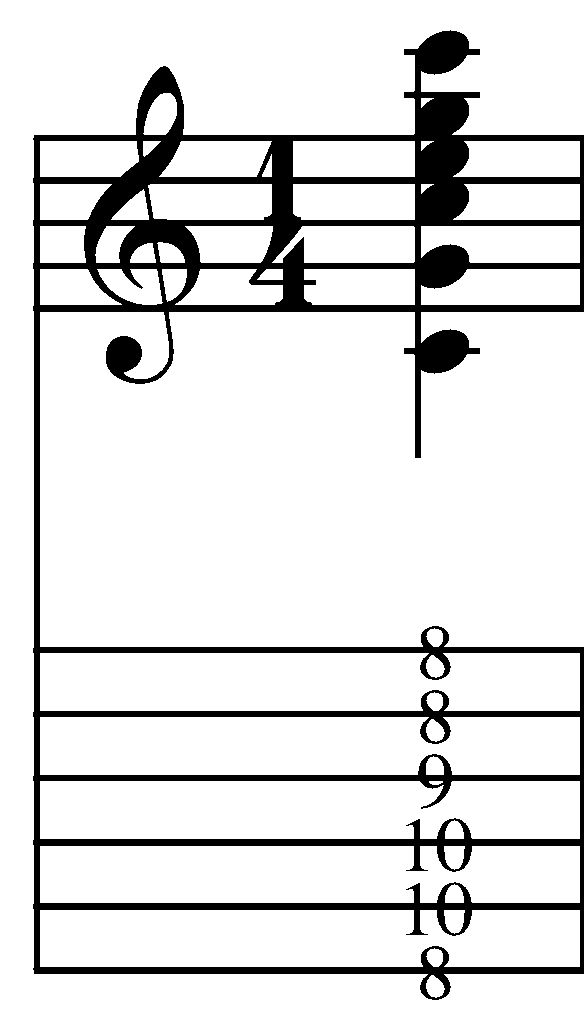
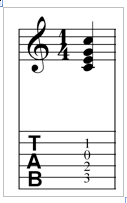
While there’s nothing wrong with six note voicings, context is everything.  It took a while to realize that when playing in larger groups, smaller voicings sometimes helped propel the song and allowed for better voice leading.

For example: here’s the same C Major chord but with just 3 notes.

And here is the voicing in a I-iv-V7 (C-F-G7) progression with smooth voice leading.

If you’re playing solo guitar – this isn’t going to fill a lot of space sonically but it works well in an ensemble, and it’s easy to play.  A win-win.

I hope this helps!  In a future lesson I’ll go further into this concept and use it to create 9th, 11th and 13th chords.  In the meantime, you’re free to download and distribute any of the lessons here but I maintain the copyright on the material.

I’m always looking for feedback on what people find useful and what they don’t, so if you have any questions or comments, feel free to e-mail me at guitar.blueprint@gmail.com .

Recycling Chords Part I or Where’s The Root?

I’d like to start this brief series off with an explanation of how I view the function of theory.

(For those of you who are interested, this is taken from, A brief thought on Music Theory.)

Theory is secondary to sound.

The history of music originates in organized sound.  Theory and jargon were developed over time as a way to replicate those organized sounds.  When a term like “C major” is used, it tells the informed person what kind of sound is going to be produced. This jargon then, is nothing more than a way for musicians to express ideas to each other without written music in a more efficient manner.

It’s much less important to be able to look at something and say, “that’s an altered dominant chord” than it is to hear an altered dominant chord in your head and be able to realize it on the guitar (or to hear someone else playing it and know what to play against it).”

This series of lessons are excerpts from the Guitarchitect’s Guide to Modes: Major Harmony book (due out in 2012).  While that book covers basic intervals and chord theory, this lesson will make the most sense if  you have some knowledge about chords, intervals and chord construction.  Having said that, even if you have a very limited knowledge of these areas you can still get something from this lesson by playing through the examples.

When I was at Berklee, one of the recommendations I got was to learn a minimum of two voicings for every chord type I came across (and more if possible).  While this is certainly a valid point – another way to approach learning new voicings is to reconceptualize what you already know. To see other ways of looking at things in this case, I’ll need to bring in a little music theory/analysis.

.

When is C, E and G something other than C Major?

In order to identify a chord, we first have to establish the root to determine the functions of the other notes in the chord.

For example, if we look at the notes C, E, and G with C in the bass we get a C Major chord.

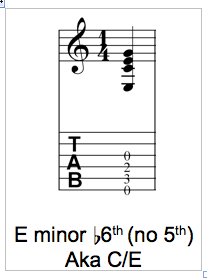
However if E is the root of the chord – it’s possible that the chord could be analyzed as an E minor with an added flat 6th and no 5th.

While you may hear this combination of notes as come kind of E minor chord, you are more likely to hear it as a C major triad with E in the bass.  The sound of a major triad is so entrenched in the average listener ’s head that it will be very difficult to hear this specific combination of notes as anything other than C major.

This is sometimes written as C/E.  This chordal notation is commonly called a slash chord and is written in the format of chord/bass note.

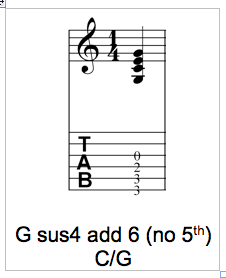
The same is true for the next example.  If G is the root of the chord – the chord could be analyzed as a G sus4 add 6 (no 5).  But more likely you will hear it as C/G.

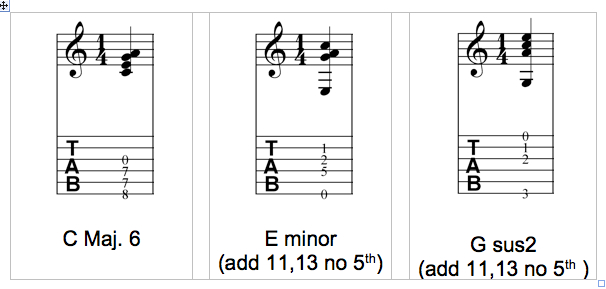
Let’s add a note outside of the triad to the chord.  By putting an A in the bass, the chord spelling is now A-C-E-G (which is an A minor 7th chord).

Just because you have 3 notes doesn’t mean that you’re limited to a specific chord type.  In other words the notes C, E, and G are sometimes more than a C Major chord.

Using the same process as above the collection of notes above could also be analyzed as:

.

Converting to C

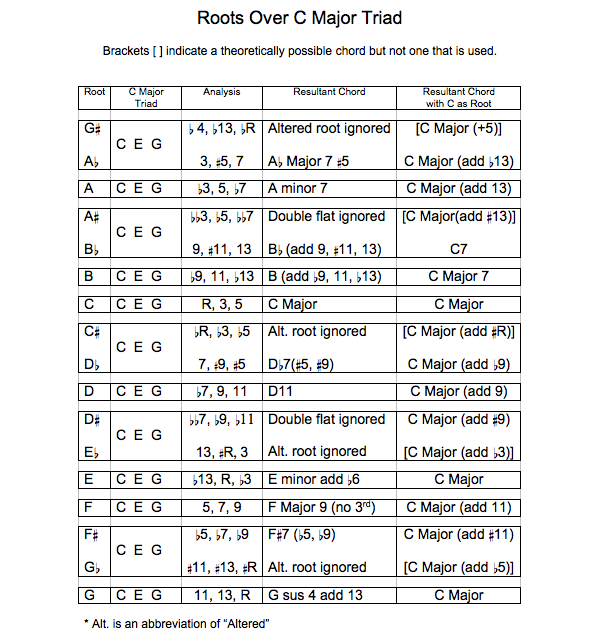
Let’s now look at how a C Major triad can be analyzed over every other root.

A quick theory tip:  Whenever I see chord or a scale that I’m having trouble recognizing, I recommend modulating it to the key of C.  The reason for this is the lack of sharps or flats make any accidentals immediately identifiable.

Here are a couple of points regarding this:

  1. There are several ways that these chords could be interpreted and that this is merely my analysis.
  2. The Analysis column is analysis in relation to the root.  For example, the C of a C major triad is a b4 over a G# root.
  3. The resultant chord column has an implied analysis.  For example the D11 derived from a C major triad over D is more accurately a D11 (no 3rd, no 5th add 9).
  4. Some of the voicings presented are theoretical voicings and not something you find on a chord chart.  For example: C7 is a much easier voicing to conceptualize than C Major (add #13) and I have yet to see a chord chart with C Major (add #13) on it.)  Ditto for altered roots.

.

Putting the Theory into Practice

Let’s say I’m playing a song that uses a major chord and I want to spice it up.

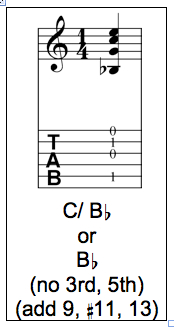
In looking at the above chart, I see that utilizing a C major triad over a Bb could be seen as a C7 chord with the 7 in the bass (C/ Bb ) or it could be seen as a Bb chord with every upper chord tension.

Here’s a voicing in open position.

Now let’s make this a movable voicing.

Let’s begin with a 1st position C major chord

and a 1st position D major chord

Keeping the root and the 3rd of the C major, we’ll use all the rest of the notes of D major:

and we get a really rich sounding substitution for a C major chord.

.

Next steps

This chord merely scratches the surface of this approach.

In addition to making some new chords from familiar voicings (i.e. Ab maj7#5 = C major /Ab), you also get some improvisational approaches as well (for example – as a starting point for soloing over a Ab maj7#5 you could play a C major arpeggio rather than learning a maj7#5 arpeggio).

For now, I would recommend exploring these sounds both as chords and as an arpeggio approach (i.e playing a C major arpeggio over each root) to see what sounds work for you and then adapt those to other keys.

Additionally, this process can be applied to any chord.  If you feel like exploring this approach – C minor might be a good place to start.

In part II of this series, I’ll discuss a process I call triadic transformation as another way to reconceptualize chords that you already know.

.

In the meantime, just remember that there isn’t anything here to get too hung up about.  Take the sounds and approaches that work for you and discard the rest.

I hope this helps!  You’re free to download and distribute any of the lessons here but I maintain the copyright on the material. I’m always looking for feedback, so if you have any questions or comments, please feel free to e-mail me at guitar.blueprint@gmail.com.

-SC