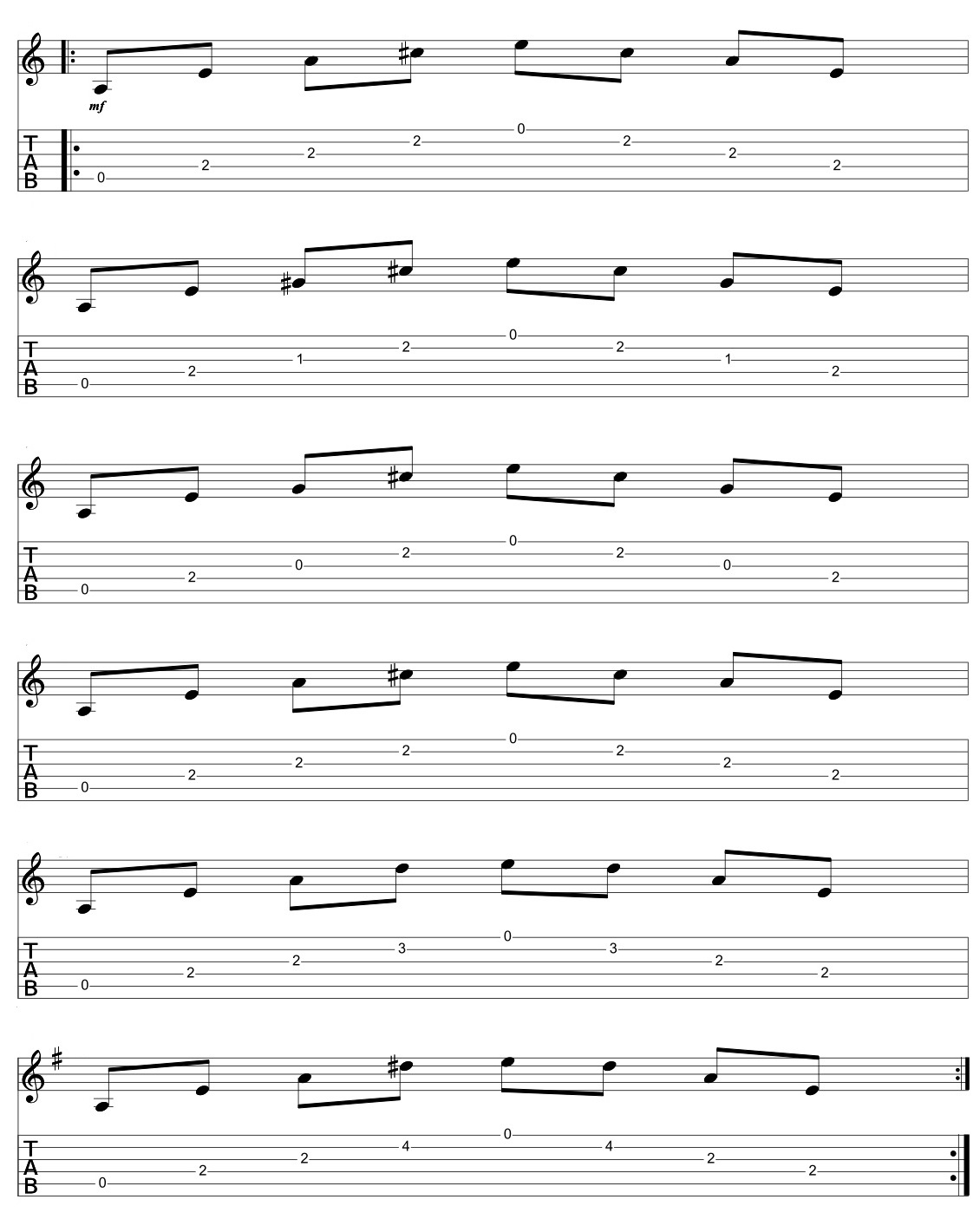
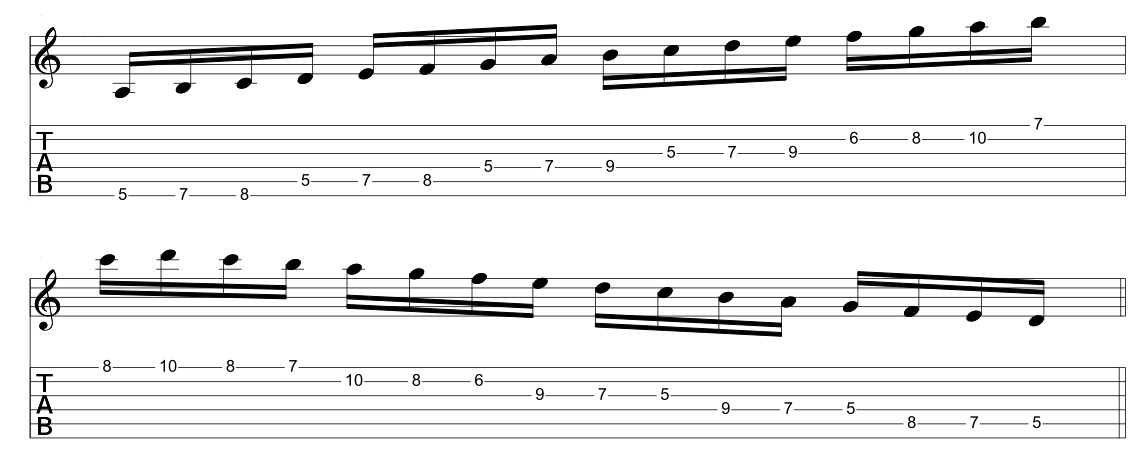
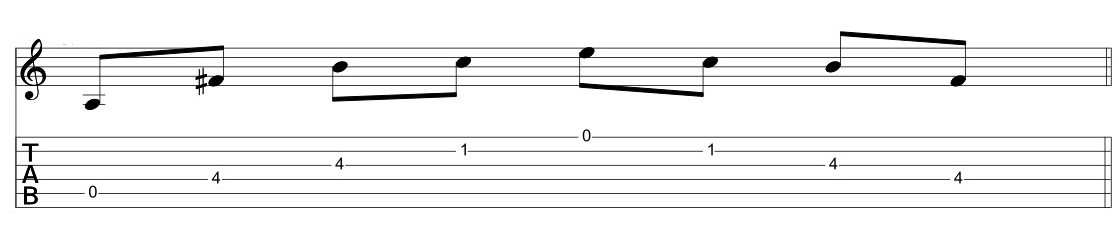
The GuitArchitect’s Guide To Modes: Harmonic Combinatorics “Pre-Release” Now Available

6/5/12

.

The official version of this book has been released as both a print and PDF version, so I’m leaving this page up  as a pointer for  historical purposes (and so that people who are interested in the book can get some more detailed information).   

.

All ordering information (including an overview of the book and jpegs of sample pages) can be found here.

.

Thanks!

-SC


Slash and Burn – Creating More Complex Sounds With Slash Chords

Hello all,

.

I wanted to take a break from the excerpts from the modes book I’ve been posting and post a lesson that’s based on material from my new Harmonic Combinatorics Book.  In that book, I have an entire section about using triads and 7th chords to create more complex sounds.

.

Here’s the two sentence synopsis:

  • Playing a minor chord (or arpeggio) a 1/2 step below a major triad implies a Lydian sound by giving you upper chord tensions (7, 9, #11) of that major chord. (i.e. B minor/C).
  • Playing a minor chord (or arpeggio) a step above a minor triad implies a Dorian sound by giving you the upper chord tensions (9, 11, 13) of the minor chord. (i.e. playing B minor over A minor).

.

Seeing (and making sense of ) the bigger picture:

.

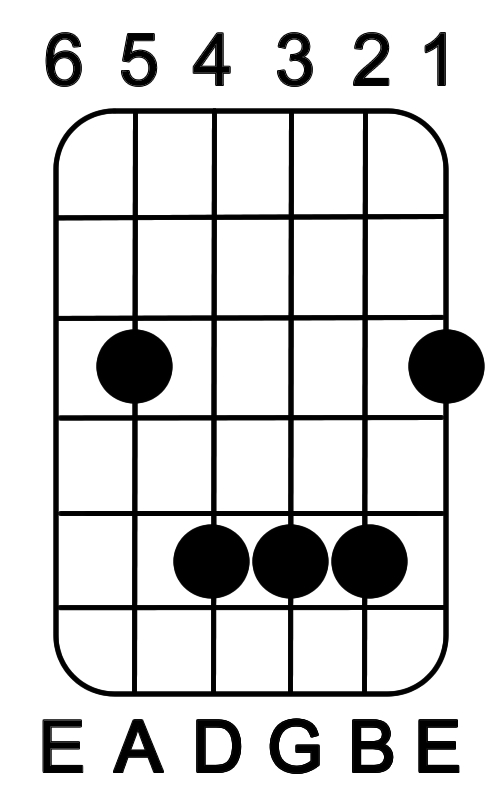
When beginning players see a 3rd position C major chord they see something like this:

.

.

But an experienced player sees something more like this:

.


.

One of the secrets to seeing more of the fretboard is to see chord tones relationally.  I’ll show you how to do that by applying some of the approaches from a previous Triad Transformation lesson:

.

Taking a C major chord:

.

C Major Triad

.

(here’s a reference chord):

.

.

Lowering the root a 1/2 step gives you a major 7 chord:

.

C Major 7

.

C Major 7:

.

.

Lowering the 3rd a 1/2 step gives you a 9th.  Since there’s no other 3rd in the chord – this becomes a slash chord of G Major over C (written G/C).  It has a lot of the sound of a major 9th chord – but because it’s missing the 3rd it really only implies the tonality.

.

G / C

.

G/C:

.

.

If you want this to sound like a Major 9th, we’ll need to add a 3rd in as well.

.

C Major 9

.

C Maj 9

.

.

Lowering the 5th a 1/2 step gives us the #4 (aka the # 11).  Here I’ve kept the 3rd to make it a Major 9 (#11) chord.

.

C Major 9 (#11)

.

C Maj 9 (#11)

.

.

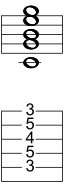
Notice that if we lower the root  a 1/2 step – we have a B minor triad:

.

B Minor

.

So, as a short cut,  playing a B minor over C we imply the sound of a C major  9 (#11) chord without having to memorize a separate voicing.

.

Melodic Application

This extends into lead playing as well.  Rather than just playing a C major arpeggio over a C chord, here I’ve replaced the bottom note of a B minor arpeggio with a C and resolved it to C:

.

B min / C  or C Lydian Lick

.

C Lydian lick (louder than the chord mp3s- FYI):

.

.

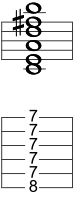
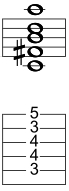
Here’s another chord voicing of B minor/C:

.

B minor / C

.

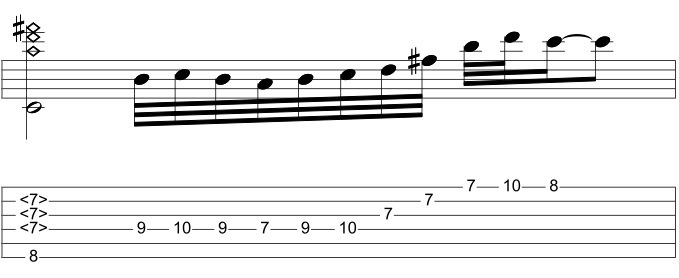
When I see voicings that use the middle notes of the 7th fret,  I generally try to think of ways to incorporate harmonics into it.  In this example, I’ve added harmonics in to fill out a B minor arpeggio with some encircling to resolve it to C. I forgot the fermata on the first chord – but you’ll figure it out when you hear the mp3.

.

B min / C aka C Lydian Lick 2

.

C Lydian Lick 2:

.

.

Now we’ll take this in a different direction:  playing B minor over A minor implies a cool A minor 13 sound.  I’ve added an A to lick #1, and a semi-chromatic run that skips the 3rd and makes it a more open sound.

.

B min / A min – A Dorian Lick

.

B min/A Dorian Lick:

.

.

I’ve resolved the lines to the root notes of the chords I’m playing over – but you may want to stay on a tension depending on the context.

.

With any approach like this – always use your ears as a guide for what sounds good and what doesn’t.

.

The Quiz:

Did you notice anything about the C major voicings?  Using a B minor triad doesn’t take it to the 13th.

.

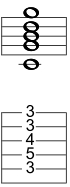
In any chord tone voicing, raising the 5th a step gives you the 6th (if no 7th is in the chord) or  (in this case) the 13th  So using our initial voicings, the easiest way to bring in the 13th is to raise the G on the high E string to A.

.

B min 7 / C Implying C maj 13 (#11)

.

.

Looking at at a little deeper,

if we fully spell out this chord:

  • C (root)
  • E (3rd)
  • G (5th)
  • B (7th)
  • D (9th)
  • F# (#11) and
  • A (13)

.

the top 3 notes form a D major chord.  As a modified rule for playing over a major chord:

.

  • Playing a minor chord (or arpeggio) a 1/2 step below a major triad implies a Lydian sound by giving you upper chord tensions (7, 9 and #11) of that major chord. (i.e. B minor/C).
  • Playing a major chord (or arpeggio) a step above a major triad also implies a Lydian sound by giving you the upper chord tensions (9, #11 and 13) of the minor chord. (i.e. playing D/C).

.

As with any material here, pay attention to the 3 T’s (Timing, (hand) Tension and Tone) and just go through the lesson at your own pace and return to it as you need to.

.

I hope this helps and as always, thanks for reading!

.

-SC

.

P.S. If you like this post – you may also like:

.

MAKING MUSIC OUT OF SCALES

SOME USEFUL ONLINE PRACTICE TOOLS

.

GETTING HIPNESS FROM A MAJOR TRIAD OR MORE CHORD RECYCLING PART 3

GETTING HIPNESS FROM A MAJOR TRIAD OR MORE CHORD RECYCLING PART 2

GETTING HIPNESS FROM A MAJOR TRIAD OR MORE CHORD RECYCLING PART 1

.

GETTING THROUGH THE GIG – NEGOTIATING A CHORD CHART PART 3

GETTING THROUGH THE GIG – NEGOTIATING A CHORD CHART PART 2

GETTING THROUGH THE GIG – NEGOTIATING A CHORD CHART PART 1

.

RECYCLING CHORDS PART II: TRIAD TRANSFORMATION

RECYCLING CHORDS PART I OR WHERE’S THE ROOT?

.

FAVORED CURRY OR SPICING UP CHORD SCALES AND TRIADS PART 2

FAVORED CURRY OR SPICING UP CHORD SCALES AND TRIADS PART 1

A BRIEF THOUGHT ABOUT MUSIC THEORY

.

The GuitArchitect’s Guide to Modes Part 8 – Major Positional Modal Interchange and Complimenting Modes with Chords

Welcome to the part eight of the GuitArcitecture Mode Visualization lesson series.

If you see anything unfamiliar here, you may want to check out:

.

.

In the last lesson, I took a look at adapting minor chords to modes and modal interchange.  In this lesson – I’m going to apply the same process to major chords.

.

Note:

I’ve outlined this process thoroughly in part 7, so if you have questions – just check the instructions there.

.

One Chord Modal Interchange Exercise – Major

.

 Of the parent major scale modes I’ve been covering – there are 3 that can be used over an A major chord:

.

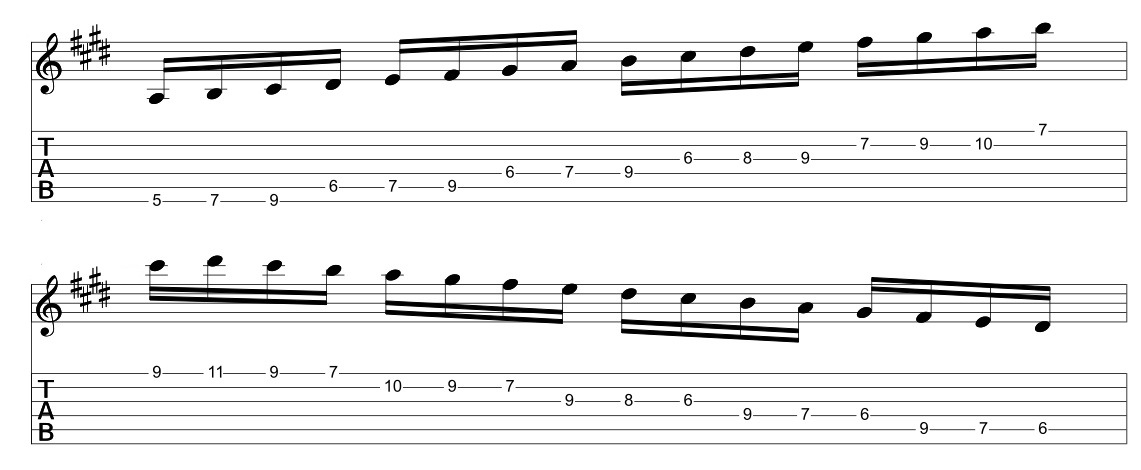
  • A Lydian (E major):

.

A Lydian – Click to enlarge

.

  • A Ionian (A Major):

.

A Ionian – Click to enlarge

.

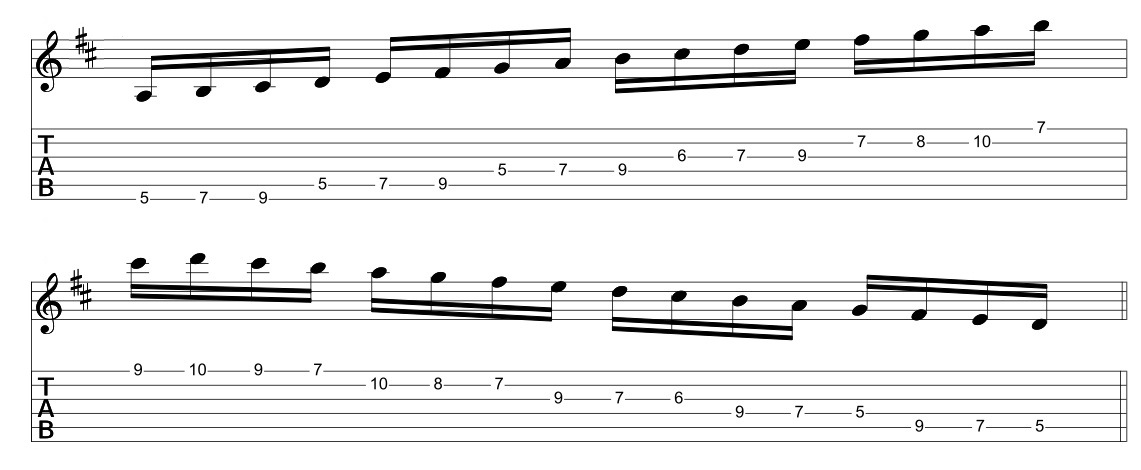
  • A Mixolydian (D major):

.

A Mixolydian – Click to enlarge

.

Here’s the major-based chord progression:

.

Repeat each bar 2-4 times ** Click to enlarge**

.

Here are the steps (repeated from Part 7):

  • Record or loop the pattern in time 
  • Playing over the loop practice switching modes each bar.  I’ve outlined the fingerings above (see earlier posts in the series if you want to see how I derived them) with a sample rhythm.  As an initial step – just practice ascending and descending the patterns in a scalar fashion.
  • As the level of familiarity with the modal interchanges increases, try removing the repeats and increasing the tempo (thus increasing the difficulty level).

.

Note:

Make sure you don’t start every bar with the low A root!

The goal of this is to be able to switch between modes “mid-stream”.   As a first step, when playing these ascending and descending make sure that wherever you are in the pattern ascending or descending that you transition into the next mode smoothly.  The initial goal here isn’t speed – it’s fluidity and being in control of switching between modes.

(See the melodic note below for some other tips once you get comfortable with the transition).

.

Now let’s examine each chord (and mode) individually:

.

  • First measure: A Major

..

A Major – Play A Lydian, A Ionian or A Mixolydian – Click to enlarge

.

The modes could be played over this chord are:

.

A Lydian (recommended), A Ionian (be careful of the 4th) and A Mixolydian

.

  • Measure 2: A Major 7

.

Lowering the root to G# creates an A major 7 chord – which works with either A Lydian or A Ionian.

.

A Major 7 – Play A Lydian or A Ionian – Click to enlarge

.

  • Measure 3:  Lowering the G# to G produces an A7 – stick with A Mixolydian for this one.

.

A7 – Play A Mixolydian – Click to enlarge

.

  • Measure 4:  I’m going to start the process of chromatically ascending certain pitches rather than descending.  So I’ll go back to A Major here.

.

  • Measure 5:  Raising the 3rd (C#) a 1/2 step to D produces an Asus4 chord.  The #4 in Lydian will clash with the natural 4th – so go with Ionian or Mixolydian for this one.

.

A sus4 – Play A Ionian or A Mixolydian – Click to enlarge

.

  • Measure 6: Raising the 4th another 1/2 step results in an A major (add #11) – a chord firmly in the domain of A Lydian.

.

A Major (add #11) – Play A Lydian – Click to enlarge

.

The chord progression then goes back to A major where any of the 3 modes could be used.

.

Notes:

.

  • Harmonic – If you’re playing with another musician try taking this one chord vamp idea and using your ear to change the chord when the soloist changes modes.  You can make other chordal alterations as well creating melodic movement in the voicing –  is a great approach to use both in comping on a single chord as well as creating melodic movement between 2 chords (more on that in another lesson).

.

  • Melodic – As the soloist in this approach – try to change modes then the rhythm player changes chords.  As soon as you get comfortable with the shapes – try making melodies and taking them through each modal change.  (See part 5  for an example of that process with one modal shape).

.

The nice thing about playing with human beings (rather than sequences) is that people can introduce random factors into playing.  A person can make all kinds of melodic or harmonic decisions that require the other person to change and adapt.  It develops a dialog and allows people to become more attune to playing with other people (and ultimately more musical).

.

The next lesson will cover a go a little deeper into modal chord progressions and offer some new challenges.  As before, just go through the lesson at your own pace and return to it as you need to.  Also please feel free to post any questions you might have (or pm me at guitar.blueprint@gmail.com).

.

I hope this helps and as always, thanks for reading!

.

-SC

.

P.S. If you like this post – you may also like:

.

THE GUITARCHITECT’S GUIDE TO MODES PART 7 – MINOR POSITIONAL MODAL INTERCHANGE AND COMPLIMENTING MODES WITH CHORDS

THE GUITARCHITECT’S GUIDE TO MODES PART 6 – THE CIRCLE OF 5THS AND MODAL INTERCHANGE

THE GUITARCHITECT’S GUIDE TO MODES PART 5 – MAKING THE MOST OF ONE PATTERN

THE GUITARCHITECT’S GUIDE TO MODES PART 4 – MODES AND CHORDS

.

Making Music Out Of Scales

A BRIEF THOUGHT ABOUT MUSIC THEORY

.

PRACTICE MAKES BETTER AKA PRACTICING PART I

PROPER POSTURE IS REQUIRED FOR PROPER PERFORMANCE – PRACTICING PART II

TENSION AND THE SODA CAN OR PRACTICING PART III

DEFINITIONS AND DOCUMENTS OR PRACTICING PART IV

PRACTICE WHAT YOU PLAY OR PRACTICING PART V

TESTING YOUR VOCABULARY OR PRACTICING PART VI

POSSESSION IS 9/10S OF THE LAW BUT PERCEPTION IS EVERYTHING OR PRACTICING PART VII

SOME USEFUL ONLINE PRACTICE TOOLS

.

GETTING HIPNESS FROM A MAJOR TRIAD OR MORE CHORD RECYCLING PART 3

Getting Hipness From A Major Triad Or More Chord Recycling Part 2

GETTING HIPNESS FROM A MAJOR TRIAD OR MORE CHORD RECYCLING PART 1

.

Getting Through The Gig – Negotiating A Chord Chart Part 3

Getting Through The Gig – Negotiating A Chord Chart Part 2

GETTING THROUGH THE GIG – NEGOTIATING A CHORD CHART PART 1

.

WARMING UP: FINGER EXERCISES, THE 3 T’S AND THE NECESSITY OF MISTAKES

.

The GuitArchitect’s Guide to Modes Part 7 – Minor Positional Modal Interchange and Complimenting Modes with Chords

Welcome to the seventh installment of the GuitArcitecture Mode Visualization lesson series.

If you see anything unfamiliar here, you may want to check out:

.

.

In the last lesson, I took a look at the modes and the circle of 5ths.  In this lesson, I’m going to:

.

  • show how to modify a minor chord to cover minor modal interchanges and
  • show how to switch modal patterns in position

.

Complimenting Modes with Chords

.

A lot of print has been used to describe how modes fit with chords but substantially less has been written about modifying chords to fit various modes. I’ve developed this approach as an introductory way to work on modal interchange it does three things:

  • Limits harmonic content to simplify the modal interchange process
  • show a way to modify chords to work with modes and
  • develops the skill set for changing modes in position.

.

(All useful skills to have – btw).  Since I’ve been dealing with C major – I’m going to look at A minor (the relative minor chord) first.

.

One Chord Modal Interchange Exercise – Minor

.

Before we get into the exercise, let’s make sure we’re clear about the modes we’ll be using.  Of the parent major scale modes I’ve covered – there are 3 that can be used over an A minor chord:

.

  • A Dorian (G major):

.

Click to enlarge

.

  • A Aeolian (C major):

.

Click to enlarge

.

  • A Phrygian (F major):

.

Click to enlarge

.

Here’s the accompaniment pattern:

..

Repeat each bar 2-4 times ** Click to enlarge**

.

Here are the steps:

  • Record or loop the pattern in time 
  • Playing over the loop practice switching modes each bar.  I’ve outlined the fingerings above (see earlier posts in the series if you want to see how I derived them) with a sample rhythm.  As an initial step – just practice ascending and descending the patterns in a scalar fashion.
  • As the level of familiarity with the modal interchanges increases, try removing the repeats and increasing the tempo (thus increasing the difficulty level).

.

Note:

Make sure you don’t start every bar with the low A root!

The goal of this is to be able to switch between modes “mid-stream”.   As a first step, when playing these ascending and descending make sure that wherever you are in the pattern ascending or descending that you transition into the next mode smoothly.  The initial goal here isn’t speed – it’s fluidity and being in control of switching between modes.

(See the melodic note below for some other tips once you get comfortable with the transition).

.

Now let’s examine each chord (and mode) individually:

.

  • First measure: arpeggiate a minor chord in 4/4 time (in this case A minor).

.

A minor – Play A Dorian, A Aeolian or A Phrygian – Click to enlarge

.

In order of increasing darkness, the modes could be played over that chord are:

.

A Dorian, A Aeolian and A Phrygian

.

  • Measure 2: adapt the chord to a specific mode using the mode’s characteristic note.

.

The first mode explored in this example will be A Phrygian.  Since Phrygian’s characteristic note is the b2, I’ll change the 2nd root (A) with the b2 (Bb) creating an A minor (add b9).

.

A minor add b9 – Play A Phrygian – Click to enlarge

.

  • Measure 3:  I’ll continue the chromatic motion on the G string changing the Bb to B natural. This produces an A minor (add 9).

.

A minor add 9 – Play A Dorian or A Aeolian – Click to enlarge

.

  • Measure 4:  Now the 5th of the chord (E) will move chromatically to F, emphasizing the b6 of the Aeolian mode creating an A minor (add 9, b6) chord.

.

A minor add 9 add b6 – Play A Aeolian – click to enlarge

.

  • Measure 5:  The 6th of the chord will now move chromatically to F#  emphasizing the natural 6 of the Dorian mode and creating an A minor (add 6, 9) chord.

.

A minor add 6, 9 – Play A Dorian – Click to enlarge

.

The chord progression then goes back to A minor where any of the 3 modes could be used.

.

Notes:

  • Harmonic – If you’re playing with another musician try taking this one chord vamp idea and using your ear to change the chord when the soloist changes modes.  You can make other chordal alterations as well creating melodic movement in the voicing –  is a great approach to use both in comping on a single chord as well as creating melodic movement between 2 chords (more on that in another lesson).

.

  • Melodic – As the soloist in this approach – try to change modes then the rhythm player changes chords.  As soon as you get comfortable with the shapes – try making melodies and taking them through each modal change.  (See part 5  for an example of that process with one modal shape).

.

The nice thing about playing with human beings (rather than sequences) is that people can introduce random factors into playing.  A person can make all kinds of melodic or harmonic decisions that require the other person to change and adapt.  It develops a dialog and allows people to become more attune to playing with other people (and ultimately more musical).

.

The next lesson will cover Major chord variations in this same style.  But if you want to get a head start the process is the same as what I just covered, the characteristic notes for the major modes are:

.

Lydian: #4

Major: Natural 7

Mixolydian: b7

.

As before, just go through the lesson at your own pace and return to it as you need to.  Also please feel free to post any questions you might have (or pm me at guitar.blueprint@gmail.com).

.

I hope this helps and as always, thanks for reading!

.

-SC

.

P.S. If you like this post – you may also like:

.

THE GUITARCHITECT’S GUIDE TO MODES PART 6 – THE CIRCLE OF 5THS AND MODAL INTERCHANGE

THE GUITARCHITECT’S GUIDE TO MODES PART 5 – MAKING THE MOST OF ONE PATTERN

THE GUITARCHITECT’S GUIDE TO MODES PART 4 – MODES AND CHORDS

.

THE GUITARCHITECT’S GUIDE TO MODES PART 3B – SEEING THE SIX-STRING MAJOR SCALE

THE GUITARCHITECT’S GUIDE TO MODES PART 3A – SEEING THE SIX-STRING MAJOR SCALE

THE GUITARCHITECT’S GUIDE TO MODES PART 2 – SEEING THE TWO STRING MAJOR SCALE

THE GUITARCHITECTURE GUIDE TO MODES PART 1 – SEEING THE SINGLE STRING MAJOR SCALE

.

Making Music Out Of Scales

A BRIEF THOUGHT ABOUT MUSIC THEORY

.

PRACTICE MAKES BETTER AKA PRACTICING PART I

PROPER POSTURE IS REQUIRED FOR PROPER PERFORMANCE – PRACTICING PART II

TENSION AND THE SODA CAN OR PRACTICING PART III

DEFINITIONS AND DOCUMENTS OR PRACTICING PART IV

PRACTICE WHAT YOU PLAY OR PRACTICING PART V

TESTING YOUR VOCABULARY OR PRACTICING PART VI

POSSESSION IS 9/10S OF THE LAW BUT PERCEPTION IS EVERYTHING OR PRACTICING PART VII

SOME USEFUL ONLINE PRACTICE TOOLS

.

GETTING HIPNESS FROM A MAJOR TRIAD OR MORE CHORD RECYCLING PART 3

Getting Hipness From A Major Triad Or More Chord Recycling Part 2

GETTING HIPNESS FROM A MAJOR TRIAD OR MORE CHORD RECYCLING PART 1

.

Getting Through The Gig – Negotiating A Chord Chart Part 3

Getting Through The Gig – Negotiating A Chord Chart Part 2

GETTING THROUGH THE GIG – NEGOTIATING A CHORD CHART PART 1

.

WARMING UP: FINGER EXERCISES, THE 3 T’S AND THE NECESSITY OF MISTAKES

.

The GuitArchitect’s Guide To Modes Part 6 – The Circle of 5ths and Modal Interchange

Welcome to the sixth installment of the GuitArcitecture Mode Visualization lesson series.

If you see anything unfamiliar here, you may want to check out:

.

.

In the last lesson, I took a look at using one fingering pattern to play all of the modes.  I wanted to get the sounds under your fingers a little bit and then start to explain a context for them a little more.

In this lesson, I’m going to go into modal interchange more in-depth.  To get deeper into modes, we need to talk about Relative Modes versus Parallel Modes, examine tonal centers and keys and talk about Modal Interchange.

..

Organizing the sounds of the different modes:

.

  • While the different modes of a parent major scale all contain the same notes, each mode has a unique sound.
  • For the purposes of this lesson, modes of the major scale will fall into one of two (overly general) categories (Major or Minor) based on their third scale degree.
  • The sounds of the modes are based on their scale formulaTheir scale formula is based on their relationship to their parallel major mode. 

.

For Example:

To determine the scale  formula of, say,  C Mixolydian, the notes of C Mixolydian would be compared to the notes of a C major scale.

  • Since C Mixolydian is spelled C, D, E, F, G, A, Bb, and
  • C Major is spelled C, D, E, F, G, A, B,
  • the scale formula of C Mixolydian is b7.

.

Relative versus Parallel Major 

C major is the relative major scale to A natural minor (A Aeolian) because both are part of the same parent major scale

.

C major is the parallel major scale of C natural minor (C Aeolian).

In this case they share a common root, but C natural minor has a different parent major scale than C major.

.

Here’s a table that shows the  parallel modes of C Major and their scale formula.

.

..

.

The Tonal Cycle of 5ths

.

Listing the modes in order of scale degree (Ionian, Dorian, etc.) is one way to work through the modes but a  more logical way to see the relationship of the modes is to place them in a tonal circle of 5ths.  So first let’s talk about the circle of 5ths versus the tonal circle.

.

The circle of 5ths:

The circle of fifths is a way to see all of the major and minor keys and key signatures in a logical order.  The Wikipedia page on it offers an excellent detailed explanation –  but seeing the actual circle will help clear things up.

.

Circle of 5ths taken from Wikipedia.com

.

From the pitch C :

  • moving in clockwise motion, the number of sharps in a key signature increase sequentially with each tonal center a 5th away. (C, G, D, A etc.)
  • moving in counterclockwise motion the number of flats in a key signature increase sequentially with each tonal center a 4th away. (C, F, Bb, Eb etc.)

..

This is a very handy and compact way to see tonal centers and relative major/minor scales – but adapting it to a tonal circle of 5ths will help clarify modes in a very unique way.

.

The Tonal Cycle of 5ths:

.

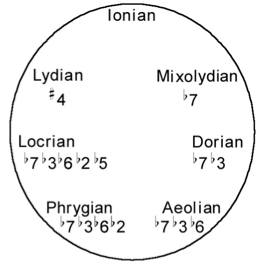
In a tonal circle of 5ths, the circle moves in diatonic 5ths (and thus stays in a particular key).  In the key of C it looks like this:

.
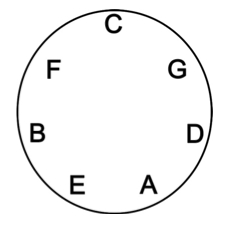
The next note in a circle of 5ths after B would be F#, but keeping it in a tonal cycle of 5ths the key of C major, the next note would be F natural.

Now that we have a tonal cycle of 5ths in C Major, let’s fill in the modes associated with each note of C Major.

.

.

Now let’s insert the scale formula of each mode:

.
.
Note:

the scale formula is listed as a series of cumulative alterations rather than sequential.

In general, the more flats in the modal scale formula, the darker the sound.

.

..

Modal Interchange

.

The key to using these to create modal sounds is what is called Modal Interchange.

.

As a simplified definition –  a mode associated with a specific chord will work over the same chord in any other key.  In other words, D Dorian could be played over any D minor 7 chord in any other key that has a D minor 7 chord in it.

.

Rather than thinking of modal ideas when I play,  an easier way (for me) to think about modal sounds is to think of parent scales since all the modes are derived from a parent scale (and it’s less to keep track of).

.

If I’m playing a song in the key of F major:

  • soloing over a Dm7 chord
  • and playing the notes from the C parent major scale over that chord
  • I’m playing in D Dorian.

If I use notes from the F major scale, I’m playing in D Aeolian.

If I use notes from the Bb major scale, I’m playing in D Phrygian.

.

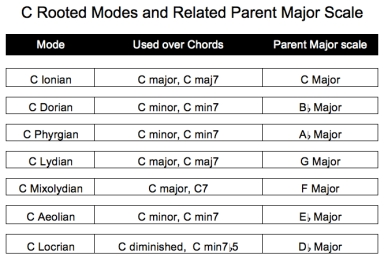
Since I’ve been dealing with C major – I’ll give a C parallel mode example:

.

If you want a C Lydian sound – you’re really talking about playing a G parent major scale over a C Major / C Major 7th) chord or a C major chord progression.  Here’s a shortcut:

.
.

Note (repeated from part 5):

This is a tricky area.  While I use a parent scale approach to visualize how I solo over chords, I am aware of the chord tones (and tensions) and tend to focus on those melodically.

Just running up and down a scale isn’t going to help you really nail changes in the long run, it’s just going to fill space that often doesn’t need filling sonically.

That being said, the first step in any playing process is knowing where to put your fingers – so working through scales is as good a place to start as any….

For beginning or intermediate players new to this – like I said before,  just worry about associating the modes, fingerings and sounds for now.

..

Next Steps

.

In the next part of this series I’m going to give some major and minor positional approaches and talk about a cool way to use modes to modify chords.  In the meantime you may want to familiarize yourself with the shapes in part 3b of the lesson series.

As before, just go through the lesson at your own pace and return to it as you need to and please feel free to post any questions you might have (or pm me at guitar.blueprint@gmail.com).

.
I hope this helps and as always, thanks for reading!

.

-SC

.

P.S. If you like this post – you may also like:

.

THE GUITARCHITECT’S GUIDE TO MODES PART 5 – MAKING THE MOST OF ONE PATTERN

The GuitArchitect’s Guide To Modes Part 4 – Modes and Chords

THE GUITARCHITECT’S POSITIONAL EXPLORATION PRE-RELEASE NOW AVAILABLE

THE GUITARCHITECT’S GUIDE TO MODES PART 3B – SEEING THE SIX-STRING MAJOR SCALE

THE GUITARCHITECT’S GUIDE TO MODES PART 3A – SEEING THE SIX-STRING MAJOR SCALE

THE GUITARCHITECT’S GUIDE TO MODES PART 2 – SEEING THE TWO STRING MAJOR SCALE

The GuitArchitecture Guide To Modes Part 1 – Seeing The Single String Major Scale

.

Making Music Out Of Scales

A BRIEF THOUGHT ABOUT MUSIC THEORY

.

PRACTICE MAKES BETTER AKA PRACTICING PART I

PROPER POSTURE IS REQUIRED FOR PROPER PERFORMANCE – PRACTICING PART II

TENSION AND THE SODA CAN OR PRACTICING PART III

DEFINITIONS AND DOCUMENTS OR PRACTICING PART IV

PRACTICE WHAT YOU PLAY OR PRACTICING PART V

TESTING YOUR VOCABULARY OR PRACTICING PART VI

POSSESSION IS 9/10S OF THE LAW BUT PERCEPTION IS EVERYTHING OR PRACTICING PART VII

SOME USEFUL ONLINE PRACTICE TOOLS

.

GETTING HIPNESS FROM A MAJOR TRIAD OR MORE CHORD RECYCLING PART 3

Getting Hipness From A Major Triad Or More Chord Recycling Part 2

GETTING HIPNESS FROM A MAJOR TRIAD OR MORE CHORD RECYCLING PART 1

.

Getting Through The Gig – Negotiating A Chord Chart Part 3

Getting Through The Gig – Negotiating A Chord Chart Part 2

GETTING THROUGH THE GIG – NEGOTIATING A CHORD CHART PART 1

.

WARMING UP: FINGER EXERCISES, THE 3 T’S AND THE NECESSITY OF MISTAKES