2013: How Not To Repeat The Mistakes Of The Past (Or Nothing Ever Got Done With An Excuse)

(This is a repost of something I wrote for the end of 2010.  The dates and information have been updated, and this has become one of the few yearly repost traditions I indulge in.)

.

I had hoped to get a few more things done before the end of the year, but decided instead to take the last week to wind down and center.  I find that this not only helps me take stock of what worked and didn’t work for me in 2012 but also helps me make sure I’m on track for what I want to get done in the new year.  As George Santayana said,

“Those who do not learn from history are doomed to repeat it.”

.

As 2012 draws to a close, I think back to many conversations I had with people at the end of 2009.  At that time, it seemed like everyone I talked to said the same thing, “2009 was such a bad year.  2010 has to be better.  It just has to.”

Now it seems I’m listening to the same sentiment with the same people about 2012 and the coming 2013.  And in some ways they have a valid point.  Listening to their circumstances, 2012 certainly offered some of these people a tough blow – but regardless of their circumstances, I believe that, unless they experience a windfall of good fortune, I will hear the same sentiments echoed at the end of 2013.  There’s a reason for this:

“If you always do what you’ve always done – you’ll always get what you always got” – anon

.

While I fully appreciate the merits of planning and goal setting – life will throw you any number of curveballs that may make a meticulously laid out plan get derailed.

.

A good plan has to be countered with an ability to improvise (as need be) to make sure that even if your mode of transportation is disabled, that you are still on the path to achieve your goals.

.

“Improvisation as a practice is the focus of an idea through an imposed restriction.  This restriction could either be self-imposed or be imposed upon the improviser through other means. Improvisation as it relates to common experience can be seen in the example of the car that stops running in the middle of a trip.  A person experienced in auto repair may attempt to pop the hood of the car to see if they can ascertain how to repair the vehicle.  Or they may try to flag down help.  Or they may try to use a cell phone to contact a garage.  The point being that within the context of a vehicle malfunction, different actions are improvised based on the improviser’s facility with both the situation at hand and the tools at their disposal….life is essentially an improvisation.  As individuals we come into each day not exactly knowing what will happen.  We know that there is an eventual end, but we don’t know when or how it will end.  But we continue to improvise, because it is in both the active improvisation (the present), the skill set and knowledge of that improvisation (the past) and in the philosophical/worldview/goals guiding our improvisational choices (the future) that we create meaning.”


If you approach life’s problems with the same mindset you’ve always had 

-and your new year’s resolutions run contrary to that mindset –

your resolutions are doomed.

.

I say this as a seasoned graduate of the school of hard knocks and as a person who found that while success felt a lot better – failure was a much more thorough teacher.

.

2012 had some great ups and downs for me and now there are a number of life and playing upgrades I’m going to put into practice in 2013 to address the things that didn’t work for me.  For those of you who are interested in making a real change the new year – here’s what worked for me going into 2012 that I plan on using this year as well:


Know the big picture.

If you have a goal – know why you have the goal.  As Victor Frankl once said, “He who has a why can endure almost any how.

.

Take stock of what you have done and identify what needs to change.

Have you done things that work towards that goal?  If so, what have you really done? What worked?  What didn’t work?  And what parameters can you put in place to make it work better?

What decisions did you make that set you back and how could you alter those decisions in the future?

Sometimes honesty is brutal but this isn’t about beating yourself up.  It’s about taking a realistic stock of what worked and what didn’t work for you in the year, reinforcing that things that work for you and discarding what didn’t work for you.

.

Revolution not resolution

People typically make resolutions because they recognize a need for change in their life.

Personally, change hasn’t been about making a momentary decision as a knee jerk reaction to something (which usually lasts as long as the time it took to make that decision).

The long-lasting changes in my life have come from making lifestyle changes, setting priorities and working within those changes.  Change, then, is not a temporary compromise to a current observation but is instead a revolt against habitual modes of thinking and operation. 

.

Positive habits

Making something a daily positive habit (like brushing your teeth) makes it easier to maintain over the long haul.

.

“Don’t make excuses – make it right” –  Al Little

People make excuses for things all the time.  No one cares about excuses because nothing ever got done with an excuse.  People (typically) only care about results.

There will undoubtably be moments that you relapse into older habits.  Instead of making excuses for why it happened – just acknowledge it and move past it. When you fall off the bike, it’s not about sitting down and nursing your scrapes.  It’s about getting back up on the bike again.  As it says in The Hagakure“Seven times down – eight times up”

.

There’s strength in numbers

Try to surround yourself with supportive people.

  • Not enabling people who will make changes more difficult for you.
  • Not negative or judgmental people who will scoff at your desire for change

.

Talk to the friends and family who will give honest and supportive feedback.  Here’s another important tip – don’t burn those people out with your goals.  The people around you have their own lives, so if every conversation becomes about you and your goals, you’re going to see less and less of those people!

.

In addition to (or in some cases in lieu of) that support, you may want to look into some free online accountability sites like Idonethis.com (post on this here) or Wunderlist.com which maintains a private calendar to help observe progress.

.

Be motivated to do more but be grateful for what you have

In a final 2012 observation, I’d like to thank everyone who took a moment to come here and read what I was doing.  So thank you all again and I hope that 2013 is your best year yet.

.

-SC
Analysis Of A Film Score

Recently, Gary Mairs, a filmmaker and faculty member at CalArts, asked me to create a score for a screening of Teinosuke Kinugasa’s landmark silent film, Kurutta Ippēji  (aka, Page of Madness” aka “A Page out of order”) in his Film History Class.

Accompanying silent films was a gig I had for several years at the school and enjoyed it so much that I started doing live scoring in other venues as well.  Gary’s class gave me the opportunity to create scores (with artists such as Carmina Escobar and the Rough Hewn Trio’s Craig Bunch and Chris Lavender) for many films including The Cabinet of Dr. CaligariBroken BlossomsThe Smiling Madame Beaudet, Faust and Phantom of The Opera.  

The experience with Carmina Escobar was so successful that when the opportunity arose to create a live score as part of the Cha’ak’ab Paaxil Festival in Mérida, Mexico ( and present a workshop on “Structured Improvisation in Film Accompaniment” at the Edificio de Artes Visuales – Escuela Superior de Artes de Yucatán) I took it immediately.

Of all the films I’ve accompanied though,  Page of Madness holds a special place in my heart.  The initial score that Carmina and I improvised for Gary’s class was a moment that resonated strongly with everyone in the room and I knew immediately that it was something that I wanted to add to my live repertoire.  When I moved to NY, I knew I wouldn’t be able to accompany Gary’s class live anymore but having the opportunity to do this was a way for me to create some kind of document of that time so I gladly took it on.

The process I used to improvise for film (and how I teach other people to do improvise in that manner) is too long to go into here so for now I’ll discuss some technical and non-technical aspects of how I approached the film.

The Film

Originally released in 1926, Page of Madness was assumed lost for decades until the director found in a rice tin in 1971.  He added a score (that I liked a great deal by the way) and cut about 1/3 of the original film and any known prints are based around the 1971 version.  In terms of the cuts effect on the story, I don’t know if the original cut’s pacing was more linear, but I suspect it wasn’t.

As the acting in early silent films was rooted in theatrical acting (with actors making large gesticulations and exaggerated characterizations to play to the people in the back of the room), many silent films haven’t aged particularly well. In that regard, one remarkable thing to me about this film is how well it has held up over time.  The entire action of the film takes place in and around a mental institution and the energy all the actors put into the characterizations works exceptionally well.

Avante-garde doesn’t even begin to describe this film which (like Murnau’s The last Laugh) uses no title cards and takes place solely in and on the grounds of an institution.  In addition to some jarring visual superimpositions, Page also features a story line that uses a series of flash backs and non-linear narratives that complicate the story. The end result is a film that is nostalgic on one hand and surprisingly contemporary on the other.

For those of you who are interested, I’ve uploaded about 30 minutes of the Quicktime film and the score to discuss what, why and how I did what I did.

Technical Notes:

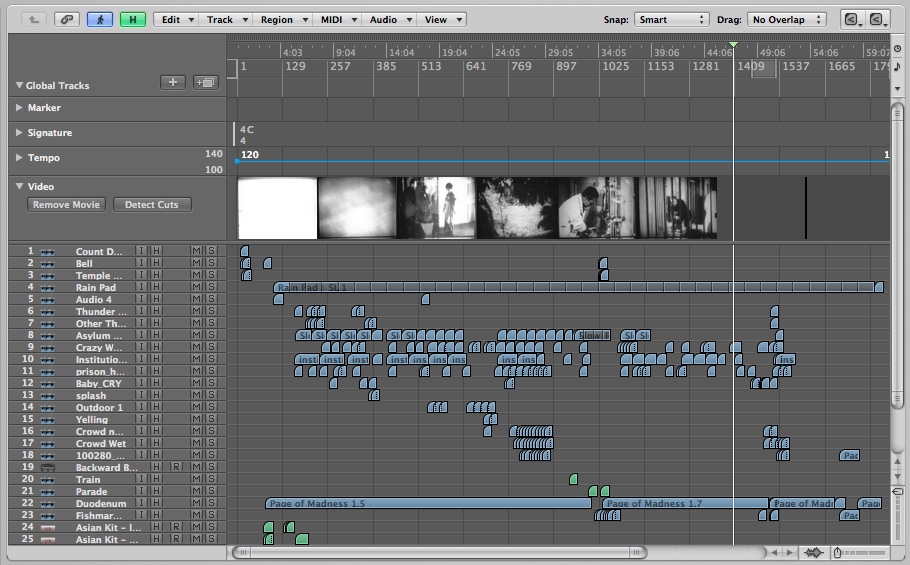
I used Logic for this project.  Here’s a screenshot of the session.

You might notice a distinct lack of midi in the score.  The majority of work I did was created with audio and samples rather than midi and I’ll try to explain differences in the video breakdown.

Here’s the film:


(If the link isn’t showing above in your browser – you can also see it here.)


Decisions, Decisions

Right off the bat, let me say I approached this completely differently than I would have approached scoring a traditional film.

If I got a gig creating cues for a video or a theatrical release, I would tailor the sounds and experience to audio locked into a film print.  As this score would be used to accompany a silent film in a film history class, my goal was to create a score that would simulate a live experience of someone accompanying the film but I also wanted to add foley and FX to create a depth of experience outside of merely adding music.

Working with Limitations

My original scoring idea was to accompany the film with a multitracked session of my recorded voice using extended techniques like overtone singing.  While I think it would have been really effective the lack of an isolated recording environment to record that cleanly nixed that idea ultimately.

After I had put a series of sound effects in, I remembered that I had a source recording of Carmina and I accompanying the same film at another venue and I realized that this might be the best way to tie in the loose live performance feel I was going for with the more orchestrated foley I employed.  The source audio of the live recording was fairly clean overall except for some places where the bass frequencies were distorting.  If you look at the track labelled “duodenum”, you’ll see some edits I made to either create space or deal with the frequency issue (I basically moved the offending audio to another track and processed it into something useable).

I used a Quicktime film in Logic to score to and exported the audio.  I sent Gary AIF, mp3 files and the Quicktime film so he could see how I imagined the synchronization, but I needed to leave the score open enough that even if the synch fell off that the score would still make sense.  Again, for a theatrical release I would have used Midi and SMPTE  to have everything synch perfectly but given that this is going to be an audio file that plays through the sound system while an actual film is screening through a film projector I decided to try to synch up a few things and leave the rest of it open.

Before I added any music, I spent a LOT of time on foley.  I pulled a number of samples from Free Sound dot org, and then spent countless hours cutting things up in Fission (A great 2-track editor from the makers of Audio Hijack Pro) and then further mutating them with endless plug ins in Logic.

Cue Notes:

Okay, here are some notes from the session from the video.

00:00 – 00:42 – Synch points and establishing tone

I synched up some audio of a man counting backwards from 1-10 in Japanese with the pre-roll to help Gary synch the audio for the class.  I decided to use a temple bell sound to help set the mood and synched that to the page turns.

00:46 – 02:09 –  Silence

I wasn’t sure if this would actually be a part of the screening.  In a traditional accompaniment, you’d typically hear some organist pull an old-time radio drama score over any type of credits or title cards.  To me, it’s emotionally not part of the actual film so I left it blank.  It also helps people focus on the story.

02:10 – 03:05 – Title sequence

The bell motive returned here.  I added in some Noh Drama type percussion but used a sparse rhythmic motive. In the background some reverse guitar loops begin.

Again, most of the initial work done was on foley and placement.  Once I added in the music track the score was largely a matter of balancing the mix and placement of what I had already done.  I took out about 25% of the foley work I’d done to make space for the score.

03:07 – 04:02 – Rain

I decided to treat rain almost as a character in this film.  I saw it (and still see it) as the truth and realization that the husband doesn’t want to face through the whole film.  It’s a psychological foreboding of what’s he’s been avoiding and ultimately acceptance of how things are. Multiple rain loops are employed in the beginning of the film but a single rain loop I created runs in the background of the whole film and continues past the last scene before it cuts to the last image when the sound fades to silence.  It’s a subtle detail but one that adds something to the environment.

04:03 – 05:06 – Dream state and Transition.

Detailing the nuances of the actual improvisation process we utilized is something that would be worthy of a much longer discussion but I feel that I should discuss at least one aspect of the structured improvisation Carmina and I utilized.  By structured improvisation, I mean that we worked out cues in the film of things that we were aiming for but what would happen before and after those points were an improvised path to reach an emotional moment at those cues and the actual cue itself might not be specific.  It might be something like, “When we get to the first fight – lets create a dense loop texture.” or it might be a specific melody or rhythmic device.  For this scene we wanted something dreamlike and other worldly so I went with a repeating figure while Carmina sang long tones over it.

Percussion was added to the loop to act as a foreshadowing of the dancing sequence to follow.

05:07 – 05:06 – Reality and Creating the Asylum

The gate door closing was part of a transition to bring the viewer back to our reality and show that this is how the inmate views the world.  There were a number of samples that all run during any of the asylum scenes to help set a claustrophobic tone of the institution. After the introduction, the outdoor scenes were the only time the asylum samples weren’t played.

Minor percussion and storm effects were added to Carmina’s loops to help build tension.

At 06:37, I stopped the percussion to highlight the fact that what this woman heard is outside the rhythm of the institution and is an internal force that she is compelled to interact with.  I think Carmina’s voices do a brilliant job of conveying that idea of multiple voices fighting for attention.

At 07:27 or so, exhaustion gives way to the sounds around the dancer and reality starts to envelop her again.  Carmina sang a variation of the earlier melody as a motif.  In the performance, I still had a loop I faded out on guitar and the low drum sound was created by me hitting a road case in the reverberation of the theater space.

At 08:01 or so – I began to add in a series of samples of heavily affected backwards speaking to represent the voices the wife hears.  I use this sound as the general sound of insanity in the asylum, so it comes to the foreground when the wife is on screen but stays back most of the time as another part of the environment.

08:15 – The Husband Enters.
All of the characters had a theme except for the husband.  I wanted to have the husband be a character that is adrift in this world around him.  I thought it would create a silence to contrast all of the other sounds against.

I tried to remain very aware of the spaces in the film.  Even though there aren’t any spaces of complete silence (until the end) I wanted to have sparse moments to contrast the rest of the film against.

11:49 – Flashback

We sidestep the asylum briefly to see how the wife got to where she is today.  Musically, I kept things open except for the mob scenes.  I began to build a loop texture on guitar.  The melodies and counterpoint are based around some Hirajoshi-inspired ideas.  I wanted to make sure that the percussion and melodic material I was providing has small hints of music inspired by traditional Japanese music while applying those ideas in a very western way.  The end result is something sonically that’s difficult to put your finger on.

19:31 – The build up

There are two fight sequences that Carmina and I knew that we wanted to make big sonically.  In the scenes leading up to this, I slowly began to make the loops more active and dense to show the tension underneath the surface of the Doctor’s routine walkthrough.  At 19:31 the textures start evolving in a different direction and slowly moving to the disturbance at 24:59 that leads to the full on freak out at 27:30 or so.  After that we bring it down and create another plateau to build from again later in the film.

Ending notes:

The process was really pretty simple.  It involved creating an environment and then removing absolutely everything that didn’t have to be there.  I should also mention that had Carmina and I tried to play really tight specific cues to the original film that flying in a full performance never would have worked.  The conversation that the two of us had during the film was something that would have been impossible to replicate completely and aesthetically, I really liked the idea of the music just being a part of a stream that flows along with the film.

Have a plan B

One last thing I should mention is that the process of actually creating the stereo file and synched video was no picnic.

For some reason, the Audio bounce in logic failed every time I tried it.  It would run for 7-8 hours and I’d have to force quit the file.

What I decided to do instead was use the aforementioned Audio Hijack Pro, to record the playback output of the logic file.  Once I had a stereo file.  I edited it in fusion to start at the 3 count lead in and imported the audio and video in iMovie and synched the hits there and output the Quicktime film.  I would have been REALLY stuck without Audio Hijack Pro, so I’m grateful that (3 days and 4 real time bounce attempts later) that I came up with that workaround.

All in, there’s about 40-50 hours of work in it.

There’s a few different things going on sonically in the second half, but this post explains a lot of the reasons behind what I did what I did, and perhaps that’s helpful, insightful or just interesting to some of you.

If people are interested, I’ll post the second half at some point and offer some more observations on what was done and why.

Until next time.  From the earlobe of Hurricane Sandy – stay dry (and thanks for reading)!

-SC

p.s. For the tech oriented amongst you.  Guitar sounds were FnH UltraSonic–> Digitech Space Station–>Apogee Duet–>macbook Pro->AuLab–>Pod farm–> Sooperlooper (Both controlled by a Line 6 Mark II pedal board) –>Atomic Reactor amp.

Notes From A Lecture

“What’s with all these words and where’s the shred stuff?”

I know I’ve been veering away form strictly guitar stuff lately on this blog.  (Don’t worry though, the pure guitar thing is never too far away. A number of new (strictly guitar related) posts have made their way to Guitar-Muse and there’s some new material that will be released either in Kindle or e-book format.)  A large part of the shift in content here is due to a move from focusing on working through the how (how do you play modes on guitar) and shifting the focus more to the why (i.e. my philosophy).  I’ve talked about this before but without a strong sense of why you do what you do, progressing and improving in the long term will fall apart as you face the numerous challenges and obstacles that you’ll be faced with on the long haul.

As someone who plays and teaches, I’m often asked, “How long does it take to learn to play guitar?” It’s a surprisingly easy question to answer.  It depends on what you want to do on the instrument.  If you want to learn to play a few chords to serenade someone on a tune you can get some basic chord forms and strum patterns down in as little as a few weeks.

If you want to really say something unique to you on the instrument, it will take years or decades of hard work and those before you who have already been on the path for decades will tell you that they’re still working on defining and articulating what they say on the instrument. This leads directly into my first point.

.

The heretic’s statement

While I love the guitar dearly, it’s just a tool of expression.

Guitar playing is only a reflection of who I am at the time I’m playing.  It’s a sonic documentary.  It’s a voice that I control with my fingers.

I need a pen to write ideas down on a piece of paper, but ultimately the ideas behind the writing are a lot more important than some scribbles on a page.

It’s a symbiotic relationship.  As I play guitar, I develop as a person as well.  As a person I take a number of influences that inspire me (like literature, film and other people’s music) and use those as spring boards for expression.

While I work at being a better guitarist, I’m also working at being a better person and vice-versa.

To me – it’s all guitar playing.

.

The How and Albert Ellis

For those of you unfamiliar with the man, Albert Ellis is not some brilliant up and coming underground shredder that will show you how to stuff 15 notes in a 5 note bag.  Mr. Ellis was a particularly brilliant psychologist who had taken some cues from Stoicism, and Levi-Strauss and created a new form of therapy known as REBT (Rational Emotive Behavior Therapy). I had first discovered Ellis’ work in college and while I found his books to be somewhat bizarre in their tone (the writing style seemed to be mired in the 1950’s with references to things like “Pollyannaish thinking”) his approach of using rational thought to break people out of emotional traps they had fallen into was particularly insightful to me and spoke to my own approach to removing emotions from problems and tackling them for what they are.

In the 1990’s I saw that an Adult Education division was going to bring Albert Ellis to speak at the lecture.  To say that Ellis was a brusque man is stating it mildly.  Throughout the lecture he swore like a sailor, called b-s on any number of things and took anonymous audience questions about problems they were having on stage and then talked through how to approach the problem.

When the lecture was over.  People were congregating around to talk to him and he yelled “Excuse me” and “Get out of my way” as he bolted out the door and went to his car.  I believe his logic was, he was paid to speak for two hours, people could ask him whatever they wanted during that time and he wasn’t going to hang out for another hour or two afterwards.  The audience hated this but I saw it as a man who practiced what he preached.  (If you read below, you’ll see that this wasn’t solely about the money – The Ellis Institutecontinues to offer the Friday Night public workshop that Ellis discusses below for the inflation adjusted price of $15 per person.  It’s about not getting entangled in things you don’t wish to).

I made a number of notes at the lecture and I’ve posted them below.  In terms of content, its a little rough and tumble and should act as little more than a “Cliff notes” version of his approach – but you might find it to be an interesting overview in how to remove emotions from problems and attack them in a systematic process.

If you find feelings of anger, depression or inadequacy acting as obstacles in your practicing, playing or goals, you might find Ellis’ approach helpful. I’ll include any new notes in brackets [ ].

Notes on an Albert Ellis lecture in Boston.  December 8, 1994.

Albert Ellis, Ph.D. is the head of the Institute for Rational-Emotive Therapy (RET). [Ellis used the terms RET and REBT in the lecture interchangeably] He conducts interviews every Friday night at the Institute for $5.

Ellis’ methodology is borne out of a philosophical tradition rather than a psychological one. Of primary influence to his methodology were the Greeks and their focus on the analytical.

You are a talented screwball.

.

The RET observations:

1.  All people want to be loved and accepted.

2. People meet conflicts with this goal.  The experience rejection/frustration /disappointment.

3.  People refuse to change

.

Three causes for Neurosis

1. EGO – I am the center fo the universe

2.  Anger / Rage

3. A perception that there has to be environmental control.

#2 and #3 –> refusal to accept (rationalize)

The two words that cure all neurosis?:  Tough shit.

Past events are not the causes for present conditions.

Humans are born with two tendencies

1.  Posessing goals, values, desires, etc and demanding what you want.  Ellis seems to view people generally as babies where immediate needs are the primary focus.  That egocentricity makes people very upsettable.

2.  People have a constructive self-actualizing tendency.  You are born to think.

The net effect of these two statements is that while you can disturb yourself, you can also undisturb yourself.

You balance the rational and the unrational. The Universe is ambivalent.

.

Three Insights of RET

1.  No one (or nothing) ever upset you.  You choose to upset yourself.

2.  When it [the depression/anxiety/problematic emotion] started is irrelevant.  It lasts because you believe it.  You can’t change people or situations – only perception.

3.  There is no magic. No one’s going to come down from the sky to save you. There is only work and practice.

.

How to change:

Cognitive thinking

1. Dispute the “musts”  “I must be this…I must do this.” Why must you? [Ellis refers to this in some of his writing as ‘musterbation”]

2. Along similar lines…”I can’t bear it (rejection, etc)” or  “I can’t stand it.” The implication is –   “I can’t stand it and be happy at all.”

3.  “When I fail, I am worthless” in reality – “I acted badly – but I screwed up and I am human.”

.

There are two solutions to a poor sense of self-worth

1.  I’m okay because I am alive. (I’m okay because I choose to be okay.)

2.  I’m neither good or bad as good implies perfection and bad implies damnable [The terms are all or nothings propositions for Ellis].  I am a human who behaves well and when I agree to reach/perform certain moral ethical deeds, I am behaving well but good deeds do not make me good.  (preferred method). I am not my acts/behaviours.

.

Self Esteem is an illness

When I am doing okay, I am okay – otherwise I’m a worm and even when I am okay – I worry about being a worm.

Low self-esteem: Because people don’t love me enough and because I act well I am okay.

High Self-Esteem I’m okay when I’m beautiful.

Self esteem is conditional.  The goal is unconditional self-acceptance.  Unconditional acceptance must be taught.

.

Coping methods

Referencing:  When you do something compulsively bad –  you write down all of the disadvantages of the act and review often.

Rational coping self-statement:  Effective view philosophy [Also written – also reviewed often]

“I don’t need – but I would like.”

There is nothing awful – only inconvenient. “Mind you getting slowly tortured to death is inconvenient but it is not a worse case scenario.  You could always be tortured more slowly.”  [What was implied by Ellis is that you can not be faced with the most awful thing or situation.]

Psycho-educational techniques:  Good books, video, etc prosleytize and teach so that you can learn.

Modeling:  find good role models

Role Playing: stop at anxious (or appropriate sensation) moments and analyze.  What am I thinking right now?

Positive thinking is okay but does have it’s limitations.  Its achilles heel is that it can reinforce the “must” syndrome.

If you’re afraid of something. Do it.  repeatedly.  Rewards afterwards and “punish” if you fall through. [Ellis used a couple of examples here but he said to a woman trying to lose weight, “Okay.  You want to loose weight.  And you eat cookies all the time so as one step of this, you’re going to stop eating cookies.  What do you hate to do in the world more than anything? ‘Call my mother-in-law.’ Okay then.  So from now on if you eat a cookie, you’ll have to call your mother-in-law and talk to her.  But you really have to do it!  It only works if you follow through.” In more extreme cases, Ellis recommends people burn money as a punishment.  “After someone burns their second $20 bill, they stop doing what they’re doing pretty quickly”]

You let other people affect you but not disturb you.

.

Grief vs depression.

Grief is okay.

Grief:  I’ve lost something and that is bad

Depression: Isn’t it too bad that I’ve lost something?

.

Problematic Solutions

When a situation is bad – do not leave when you are upset because you’ll take those emotions with you into every other situation.

1.  Analyze how upset you are

2.  Act rationally.

The approach seems to have several steps.

1.  Problem identification

2.  Statement and picturing of the worst thing that could happen.

3.  Identifying feelings with that scenario.

4.  Changing feelings/perceptions of the worse case scenario used rational coping self statements repeatedly and setting up small reward/punishment systems to work on those statements daily.

This last step implies a lot of time.  There is no quick panacea for your problems.

Dr. Ellis has a hard methodology.  It makes the individual fully responsible for his/her actions, works within a closed system and puts emphasis on the body’s cognitive powers. He is violently opposed to most forms of therapy which he feels puts too much emphasis on past actions and events and not enough on present responsibility.  While he isn’t opposed to all forms of psychotherapy, his motto certainly seems to be, let the buyer beware.

His lecture was filled with cursing.  It seems to be a part of his shtick, but one of the things that it did was keep the audience laughing – and laughter (along with responsibility, work and perception) seems to be a very important part of the RET methodology.

*Those are all the notes I had from the lecture.

I hope you found this interesting, insightful, or helpful in some way and, as always, thanks for reading.

-SC

Updates, Recycled Lessons And New Posts

Hey everyone!

By and large, I just have a few updates here.  

The site got a new layout!  It’s less THX-1138 and more product photo shoot, but it should at least be easier to read.  It’s affected some of the layout and links and I’m cleaning them up right now.  

A new “old” lesson

This will include adding links to the Guitar-Muse lesson series that I’ve been doing into the “lessons” section.

While new player profiles are in the increasingly infamous pipeline, I thought I’d post a video that I found as I was looking for a file on my hard drive.  

I shot this video back in early 2011 to go along with the Chord Recycling Lesson series I was posting at the time. After watching it back, I was flabbergasted with the sheer volume of “um”‘s in the lesson and planned on re-shooting the lesson with something novel like a script.

Then I got knee deep into other projects and so that never happened. ; )

I found this again and decided to post it as, while it doesn’t represent the most articulate lesson that I’ve ever given, I think it conveys the ideas well, and it shows a number of ways to get new chord and solo sounds from a shape that you already know!

The related lessons for this are:

Part 1

Part 2

Part 3

Chasing Tone Article

Speaking of Guitar-Muse, I just added a new article to the “Evolution of a Live Rig” series.  You can read the newest installment part 2 here, or part 1 here.

Eventually a lot of gear pieces old and new are going to be migrating to the Guitar-Muse site as I want to focus the GuitArchitecture site more on the performance, philosophical and psychological aspects of performance.

Kindle Books

Are in final stages of editing and should be out soon!

That’s it for now.  As always a number of new things are on the horizon and as always, thanks for reading!

Two Black and Bluegrass Licks To Get You Out Of A Session

Hey Everyone!

.

This lesson is a continuation of the same technical concept behind the sweep picking Pentatonic Minor/Blues scale lesson I posted earlier.  If you like this approach, you may like that lesson as well (links at the bottom of the page).

.

Today I have not one but TWO licks that go together like peanut butter and an ashtray.  Both of these are transitional licks leading back into key of G (The bluegrassiest of all keys) and while they probably won’t get you beat up (hence the black and bluegrass) or kicked out of a session – they might turn a head or two!

.

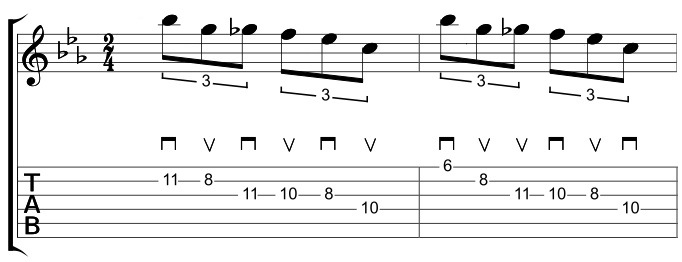
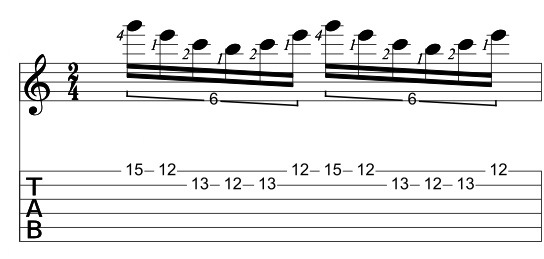
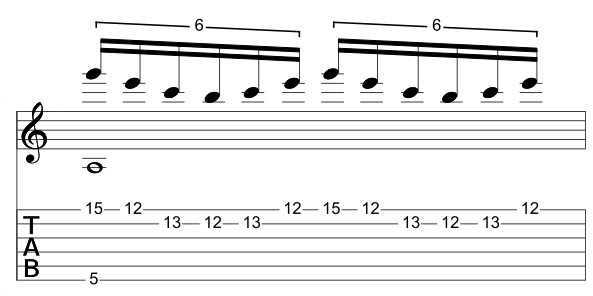
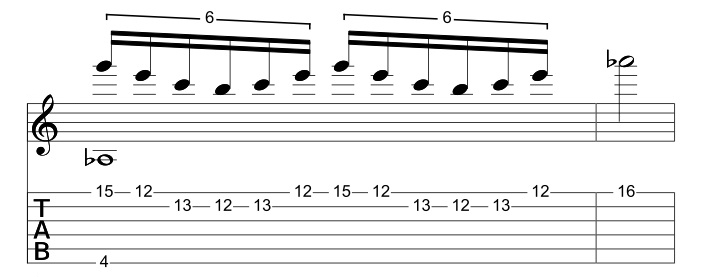
Here’s the first lick (in the video it’s played at 120 bpm – first as triplets then sextuplets):

.

(Note: fingerstyle players can play the 3-note groups as p-i-m)

.

[vimeo https://vimeo.com/44120906]

.

And here it is in notation and tab:

.

Lick #1

Now, let me explain a little about what going on here.  This is a transitional lick that resolves to G that uses different G-based chords starting from G, Bb and Db (aka G diminished).

.

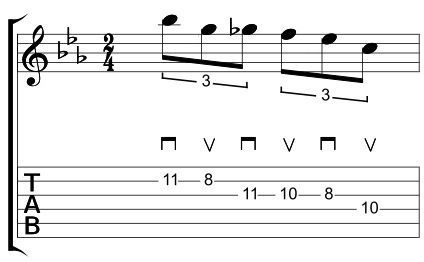
The first chord is a G7 (add 13).  Originally, I was going to use a straight descending 1 note-per string scale version of G Mixolydian (i.e. G, F, E, D, C, B, A) but – while the first three notes sounded great:

.

The spread wasn’t an easy one to get in to or out of cleanly.  So I cheated it and used the D instead, grabbing the E on the B string keeping the D and adding a B on the D-string.

.

If you remove the E, you have a nice voicing for a G7 chord starting from the 3rd, but for melodic playing it’s easier to arpeggiate the chord as 3 note groups.

.

The next chord is a G min 7 starting from the b3rd.  It uses the same picking pattern as the first arpeggio:

.

Then the lick jumps from the D to Db to start the G min7b5 (add11) arpeggio.  That might sound exotic – but it’s just 4 notes from the G Blues scale (G, Bb, C, Db and F).

.

..

Finally, it ends up with a G major triad with an added b3rd (a useful bluegrass cliché.  For even more of a bluegrass sound, add the E on the 12th fret E string between the D and the G).

.

.
Technical Considerations 

.

1.  As with the sweep picking blues pentatonic lesson, keeping the notes staccato (i.e. taking the finger pressure off the string after each note is played) will help with articulation. 

.

2.  The biggest challenge with this lick will probably be taming the open D string when you switch from the 3-string D-G-B pattern back to the top three strings.  Use pick hand muting to mute the D string once you play the first note on the high E string – and try practicing the lick as 9-note groupings to work that transition.

.

.

or

.

Lick #2

.

Lick #2 is just silly – but it’s a fun idea and it’s a great way to work on the 3-string picking pattern.  

.

[vimeo https://vimeo.com/44120906]

.

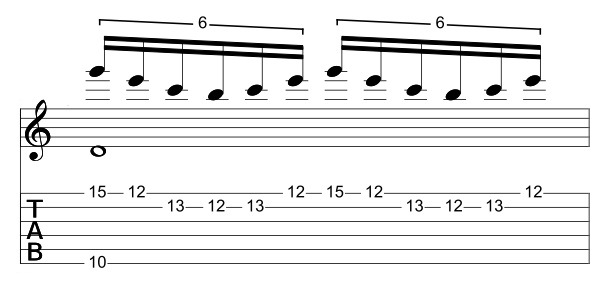
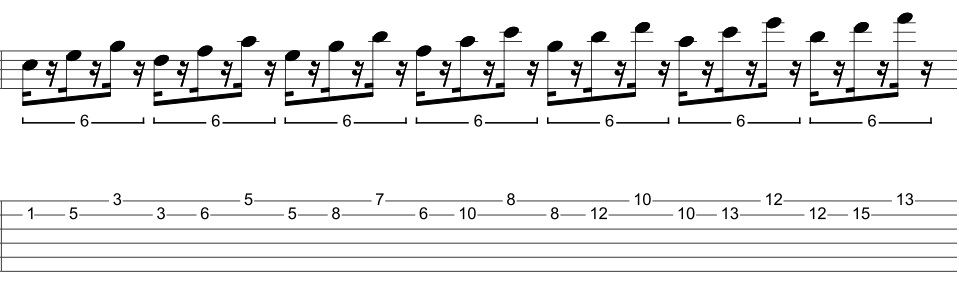
The lick is based on this idea:

.

.

This lick is just the first notes of lick #1 with a chromatically descending pattern based on the last three notes.  All I’ve done in lick #2 is chromatically ascend and then descend again like so:

.

Just use the same techniques that you used in getting the first lick down and pay attention to the 3 T’s (timing, (hand) tension and (quality of) tone and you’ll be fine.  (and remember – slow and steady wins the race here with regards to practice gains!)

.

This one-note per string scale idea is taken from the last section of my Melodic Patterns book so if this area interest you, you may want to check that book out.  You can find out more about it here.

.

As always, I hope this helps and thanks for reading!

-SC

.


If you like this approach, I have 2 books you may be interested in:


My Pentatonic Visualization Book


Minor Pent Front


is 100 + pages of licks and instruction and includes demonstrations and breakdowns of two-string fingerings, diagonal pentatonics, sweep picking pentatonics, pentatonic harmony and much more!  It’s available here.


My Melodic Patterns Book:


melodic-patterns


(available on Lulu or on Amazon) has a complete break down of all note-per-string scale variations which include the 2 above.  In the meantime, give this approach a try with other scales as well.  In the next sweep picking acoustic lesson – I’ll adapt this to a bluegrass lick that you might find cool.


Sweep Away Those Blues Or Some Useful Ways To Sweep Pick A Blues Scale

Right Lane?  Left Lane?  Shawn Lane.

I read an interview once with Shawn Lane where he talked about how he did very little taping and that the majority of really fast playing that he was doing was one-note per string fingerings.  It’s a cool idea, and here’s how I’ve adapted it to a C Blues/C Pentatonic Minor scale.

.

First, here’s the lick on acoustic.  FYI – I slide into the 1st note on the video 1st time through the lick.  (ps- it’s much easier to play cleanly on electric):

.

.

.

Note:  

I’m using C minor as a key signature here – but the key signature doesn’t show up in all the following notation.  In every example below, all notated B’s and E’s are Bb and Eb respectively as seen in the tab.

.

I explain each step of this in the video – but here’s the step by step process for how I came up with this:  

.

Let’s look at a standard C blues shape:

.

I’m going to use the descending portion of the lick starting from Bb.

.

.

Now I’m going to move the Bb from the B string back to the high E string.

.

Before                            and                      After

.

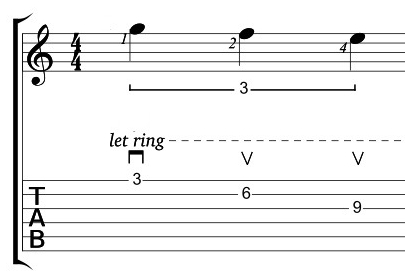
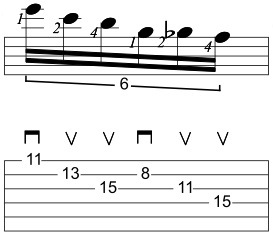
I’m using the 1st, 2nd and 4th fingers for the first three notes of the “After” section above.

.

Technical Note:

If you hold the notes down, you’ll loose definition on the individual notes because it’ll sound like you’re playing a chord.  So make each note staccato by lifting the finger off each note after playing it.  Try practicing just these 3 notes at first and work on getting the picking and the articulation down! Fingerstyle players can play the 3-string groupings as m-i-p (middle, index thumb).

.

Now I’ll move the F from the G string to the B string this gives us 2 three string shapes that can be swept pretty easily (fingering it is another issue entirely though!!)

.

Original Version                                    Bb moved to E string                      F moved to B string

.

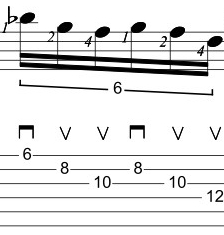
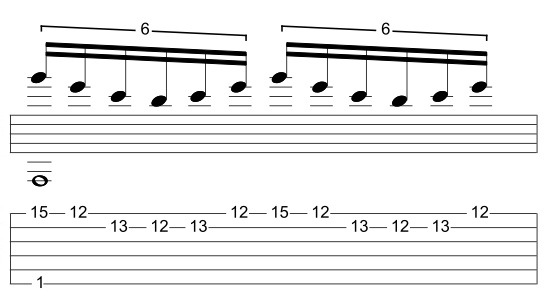
I’m playing the C on the D string with the 3rd finger so the pinky can grab the F#/Gb on the G string for the Paul Gilbert repeated note idea in the second sextuplet.

.
. 

.

The last sextuplet has a swept pentatonic idea that works in reverse from the initial lick.  Looking at that box blues shape again:

.

I’m starting from Bb on the D string and moving the Eb from the 8th fret of the G string to the 13th fret of the D string.  I’ve also taken the C from the 8th fret of the High E string and moved it to the 13th fret of the B string for a symmetrical shape.  Finally I’ve added the D to get a nice “9th” sound on the sweep. (Check the video for a full explanation).

.

“Shapes of things…”

.

Here’s something that isn’t covered in the video. This lick starts on the b7, but you can adapt the idea to any scale degree.  Moving down to the G, produces the following pattern.  It’s not really useful on the top 3 strings but the D, G, B shape is feasible.

.

C Blues from the 5th (G)

.

Here it is from the root (useful fingering #2):

.

C Blues from the root

.

Here it is from the b3rd.

.

C Blues from b3rd (Eb)

.

You can try it from the tritone as well.  The key thing is to find a shape that works for you, find a chord you like the sound of it over and monkey around with it until you get something you like out of it.

.

If you like this approach, I have 2 books you may be interested in

My Pentatonic Visualization Book

Minor Pent Front

is 100 + pages of licks and instruction and includes demonstrations and breakdowns of two-string fingerings, diagonal pentatonics, sweep picking pentatonics, pentatonic harmony and much more!  It’s available here.

My Melodic Patterns Book:

melodic-patterns

(available on Lulu or on Amazon) has a complete break down of all note-per-string scale variations which include the 2 above.  In the meantime, give this approach a try with other scales as well.  In the next sweep picking acoustic lesson – I’ll adapt this to a bluegrass lick that you might find cool.

.

As always, I hope this helps and thanks for reading!

-SC

.

If you like this post, you may also like:

TWO BLACK AND BLUEGRASS LICKS TO GET YOU OUT OF A SESSION (or sweep away those blues – Part 2)


.

Hot Rodding Your Minor Arpeggios – Or A Little Theory Goes A Long Ways

Hey everyone!

This post is tangentially related to the Modal Arpeggio posts that I put online so I’ve adapted the title (just like I’m going to be adapting the arpeggios in the post).

.

 “Minor minor on the wall….”

Let’s look at a 5-string A minor arpeggio:

.

.

Now there’s nothing wrong with this form.  But I find that a lot of people practice this arpeggio ascending and descending and then when it’s time to play over an A minor chord guess how they play it?

There was a time in the ’80’s where just cycling an A minor arpeggio over an A minor chord would cut it, but now it’s (yawn) boring.  So what can we do to make it more interesting?

.

Start with the Top Side

.

In a previous post, I talked about modifying triads to get more complex sounds.  In this lesson I’ll apply that to arpeggios.

The following is a map of alterations to show how chord tones can be modified to create other sounds.

.

.

So with any triad:

The root of the chord can be lowered to the 7 or raised to the 9

The third of the chord can be lowered to the 9 or raised to the 11

The fifth of the chord can be lowered to the 11 or raised to the 13

 .

In this manner, a triad can be altered into almost any other functional chord.

.
Let’s apply this to a minor arpeggio.

In the case of A minor I’m going to change the C on the high E string to B.  This creates an A minor (add 9) sound.


.

.

This is already a more interesting sound over an A minor chord to my ears.  But cycling the top notes of the arpeggio creates an interesting arpeggio sequence along the lines of something Tosin Abasi of Animals For Leaders might cycle (Try combining this lick with the one before it to see what I mean).

.

.

.

Going under the Hood

 .

This modification idea can be applied to any of the notes of the arpeggio, but for a moment let’s go in the opposite direction.  

In the previous post I talked about superimposing arpeggios.  Here I’ll take the same arpeggio form and drop the low note.  

Instead of stacking ascending thirds  like so:

A [up a 3rd]

C [up a 3rd]

E

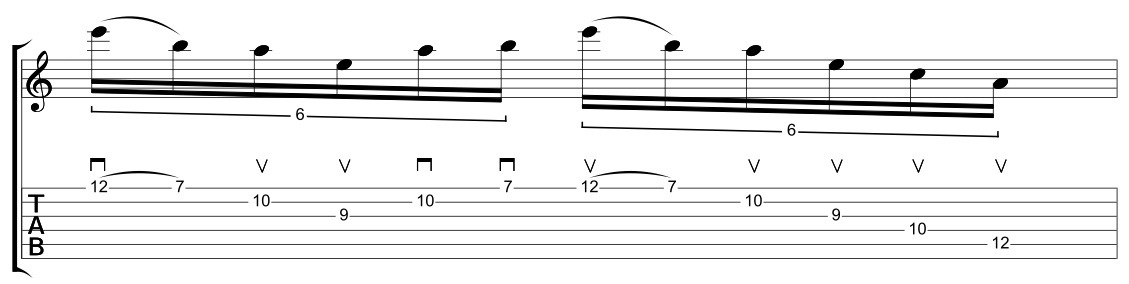
I’m going to go a 3rd below A to F.  In this example I hammer on the 2nd note and then play the rest with sweep picking.

.

.

Over F, these notes become:

F (Root), A (Major 3rd), C (5th), E (Major 7th) and B (#11) or F Maj7 #11.

.

Using F# instead:

.

.

.

These notes then become:

F# (Root), A (Minor 3rd), C ( flat 5th), E (minor 7th) and B (11) or F Minor 7 b5 (add #11).

.

You could also make to low note G on the 10th fret for an A minor 9 sound (starting from the b7 – G) or make the low note an E which creates a A minor (add 9) arpeggio starting from the 5th.

.

For now, let’s stick with the F major 7 (add #11).  If we stack another 3rd below the F, we get D which creates a D minor 9 (add 13) sound. 

.

.


The natural 13 with the minor 9 is truly a Dorian modal arpeggio sound.  To play a simplified version –  just play the F major 7 (#11) arpeggio above over a d minor chord.

.

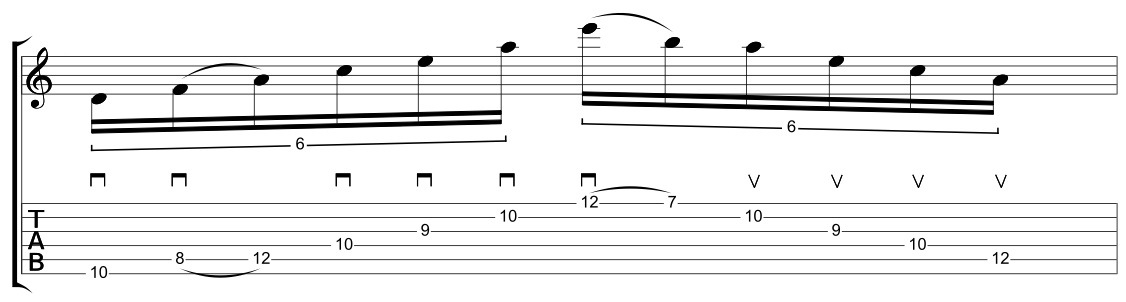
In the following example, I’ve added an open A string to the F major 7 (add #11) arpeggio.  Try playing this as a repeating figure which changing chords over the top of it.  It might give you a new song idea!

.

.

.

Hopefully this has given you some ideas and some new things to work on.  In the next lesson post, we get back into modes and get deeper into the individual modes.

.

Thanks for reading and I hope this helps!  

-SC

.

PS If you like this post you may also like:.

The Modal Microscope And A Sequenced Arpeggio Approach

Slash and Burn – Creating More Complex Sounds With Slash Chords

.

CREATING CHORDS AND LINES FROM ANY SCALE – A HARMONIC COMBINATORICS / SPREAD VOICINGS LESSON

AUGMENT YOUR KNOWLEDGE: SONIC SHAPES AND GETTING MORE FROM AUGMENTED CHORDS

Slash and Burn – Creating More Complex Sounds With Slash Chords

.

GETTING HIPNESS FROM A MAJOR TRIAD OR MORE CHORD RECYCLING PART 3

Getting Hipness From A Major Triad Or More Chord Recycling Part 2

GETTING HIPNESS FROM A MAJOR TRIAD OR MORE CHORD RECYCLING PART 1

.

RECYCLING CHORDS PART II: TRIAD TRANSFORMATION

RECYCLING CHORDS PART I OR WHERE’S THE ROOT?

RECYCLING SHAPES OR MODULAR ARPEGGIOS FOR FUN AND PROFIT

.

Some Useful Online Practice Tools

POSSESSION IS 9/10S OF THE LAW BUT PERCEPTION IS EVERYTHING OR PRACTICING PART VII

TESTING YOUR VOCABULARY OR PRACTICING PART VI

PRACTICE WHAT YOU PLAY OR PRACTICING PART V

.

DEFINITIONS AND DOCUMENTS OR PRACTICING PART IV

TENSION AND THE SODA CAN OR PRACTICING PART III

PROPER POSTURE IS REQUIRED FOR PROPER PERFORMANCE – PRACTICING PART II

PRACTICE MAKES BETTER AKA PRACTICING PART I

New Interview With Ola Strandberg Of .strandberg* Guitarworks Is Now Up On Guitar-Muse

Hey everyone!

Just a quick update.  As one of my side gigs writing columns for Guitar-Muse.com, I recently interviewed Ola Strandberg of .strandberg* Guitarworks.  Ola makes really cool custom models for players with ergonomic features and self designed parts (like bridges) that he uses in his builds.

In the interview, he talks about a number of cool topics (Including DIY and creative commons design) and as Misha from Periphery or Tosin from Animals as Leaders will tell you – from 6-8 strings Ola’s got it going on!

You can read the interview with Ola here, or read any of my other interviews with builders and players here.

Other than that I should be picking up the last of my boxes and then unpacking.  Hopefully then I can start the whole recording/gigging/clinic cycle that is supposed to start to get unearthed in NY.  

Now about that amp….

I should have a track on a new Mandorla release in May.  New Daren Burns tracks and the Rough Hewn trio ep are both threatening to drop before the end of the year.

Back to it (assembling IKEA furniture that is)!

As always, thanks for reading!

-SC

The GuitArchitect’s Guide To Modes Part 12 – Getting Into Modal Arpeggios – Superimpostion

Hello everyone!

Greetings from NYC!  While I’m still unpacking and waiting for instruments and boxes to make it here from South Pasadena I thought I’d mix and match a few ideas from my GuitArchitect’s Guide to Chord Scales book and modal arpeggios and talk about more ways to recycle things you already know!

.

2-string or not 2-string

(is that really the question?)

.

I’ve been talking a lot about 2 string arpeggios.  They’re really useful things in soloing because you can take a figure like this:

.

.

and move it in octaves while keeping the same fingering.

.

.

.

It’s a really useful visualization tool, and a relatively easy way to cover a lot of range on the instrument.

.

The real secret behind this approach is how you use the arpeggio or:

“So what about this superimposition thing?”

.

Superimposition is simply playing one thing on top of something that’s related but not in an immediately direct way.   Logic would dictate that you would play a C major 7 arpeggio over a C major chord.  That’s certainly one valid use, but it’s really not superimposing the chord because their directly related (i.e. Cmaj7 and C major).  Playing a C major 7 arpeggio over say a d minor or an e minor chord is getting more into what we’re talking about here.

In the examples below, I’ll be using a bass note to indicate tonality.  If you have a recording of a chord (or a bass note) to play over – just play the c major 7 arpeggio over one of those – otherwise you can use your fretting hand to tap each of the notes of the arpeggio (see the glass noodles post if you’re unfamiliar with the technique) and use your picking hand to tap the bass notes in the figure (and to help mute the strings)!

.

.

If the C major 7 chord is created by stacking ascending 3rds (C, E, G, B) then we should be able to go the reverse direction using descending 3rds from the root.  Going a 3rd below C gives us A which creates A, C, E, G, B or an A minor 9 arpeggio (no root):

.

.

Going a 3rd below A gives us F which implies: F (root), A (3rd), C (5th), E (7th), G (9th) and  B (#4 or #11)  or a F major 9 #11 arpeggio (no root, no 3rd):

.

.

(Note: This concept is explored in much more depth in the Harmonic Combinatorics book but you can get some information about the approach from the slash chords post or the recycling triads posts as well.)

.

You could continue on with this approach, and each time figuring out how the arpeggio functions over different chords, but there is an easier way!

.

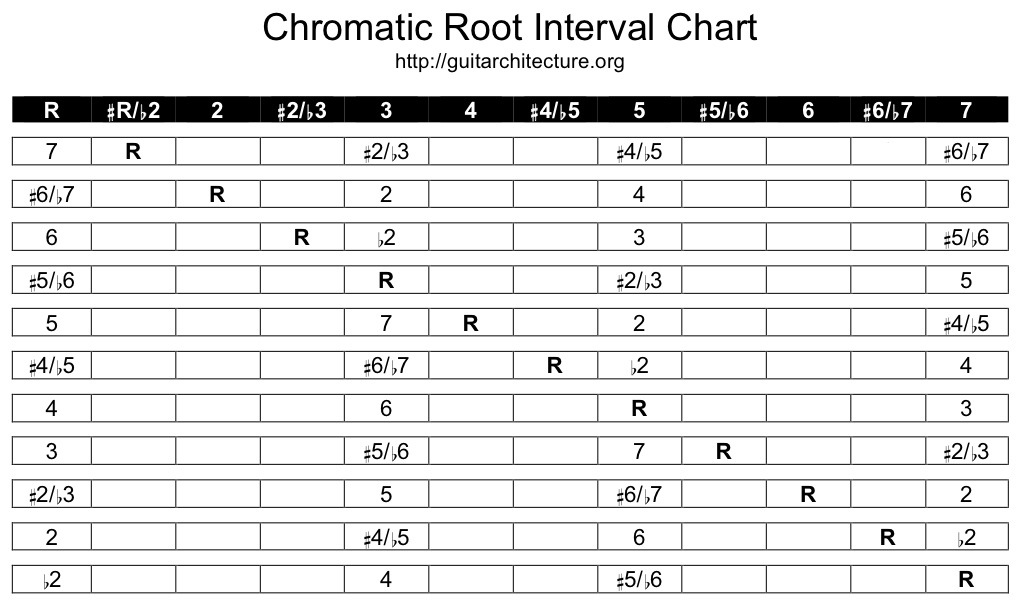
The Chromatic Root Interval Chart

In The GuitArchitect’s Guide to Chord Scales, I devised a chart that would tell the reader how any chord scale would function over any root.  I’ve adapted that chart and utilized it for arpeggios in this lesson.  Here’s the full chart:

.

.

At first glance, this can look confusing but it’s REALLY useful for determining how scales and arpeggios (or chords) function over different tonal centers.  

.

In the steps below, I’m going to outline every step that could be taken to visualize this, but once you understand the process, you can skip a lot of the steps and understand what’s happening almost immediately.

.

Let’s go back to the C maj 7 arpeggio.  The formula for the arpeggio is Root (or R) 3rd, 5th and 7th.  Here’s what it looks like superimposed into the chart.  

.

.

I’ve taken the extra step of removing all of the information in the other columns of the chart to solely show how the Root, 3rd, and 5th of a particular chord functions over other tonal centers. It’s also important to note that this chart accommodates all possible root notes.  So while sharped roots (#R) or flat roots (bR) are really heard as b2 (b9) or 7ths respectively, they’re listed here to show the functions of specific notes over tonal centers (e.g. C maj 7 arpeggio played over a C# tonality).

Okay – now let’s move the information in the chart to the key of C:

.

.

Presented this way,  we can see how things function.  Played over D for example – the C, E, G, B functions as a b7th, 9th, 4th (or 11th) and a 6th.  As a D Dorian sound (C major over D implies D Dorian) you lose the minor 3rd but get the natural 6th flavor of the mode.

.

.

I’ll simplify the chart a little more:

.

.

Again, it’s also important to note that this chart accommodates all possible root notes.  So while sharped roots (#R) or flat roots (bR) are really heard as b2 (b9) or 7ths respectively, they’re listed here to show the functions of specific notes over tonal centers (e.g. C maj 7 arpeggio played over a C# tonality).  This also counts for b4 (which will be heard as a 3rd), and double flats (like bb7 which will be heard as a 6th or bb3 which will be heard as a 2nd).

.

From intervals to chord tones

Since this chart was initially created for chord scales, the intervals all exist within an octave.  For the purposes of chords and arpeggios it’s more beneficial to think of:

  • 2nds as 9ths
  • 4ths as 11ths and 
  • 6ths as 13ths 

.

I’ve converted these intervals to chord tones in the chart below:

.

 .

One sound I get out of this immediately is the Ab which gives a Ab maj 7 (#5, #9 no root) sound.  I’ve resolved it to Ab in the example below – but give it a shot – it takes a generic C major 7 arpeggio and gives it a shot glass of tabasco.

.

.

.

When I went to Berklee and got knee-deep into analysis, my teacher gave me this pearl of insight, 

“Actually the whole point of harmony 1-4 [classes] is to show you how any chord can follow any other chord”.

.

The reality behind all of the charts and theory is, if you understand how an arpeggio functions then you’re more likely to be able to resolve it – regardless of what chord you play it over.  

That’s a big picture concept – you may want to give it a second to let it sink in.

.

The thing to start to focus on is how things sound to you – specifically how various chord tones and intervals sound over various chords you’re using.  How do you like the sound of a #4 over a major chord?  Or a b9 on a minor chord?  As you start to find chord tones that you like over those areas, you’ll start to find that you’ll seek those sounds out.   The chart is just a shortcut for seeing how things function – but it’s reliant on what you hear.

My recommendation is take this arpeggio, play it (slowly at first) over all the tonal centers and really be aware of how the notes are functioning.  And (here’s the step most people skip) if it sounds “bad” to you – find a way to resolve it (like going to the Ab in the example above).  I call this the Van Halen approach, there are plenty of times that Eddie hits clams – but he finds cool ways to work them around so that you say, “wow what a cool idea” rather than “oh he botched that one”.

I’ll talk more about the importance of knowing how to “fix” things in a future post, but trust me – it’s worth spending some time on.

.

In the next lesson post, I’ll get into arpeggio modification slash chord stylie.  It’ll be really cool and if I have my audio converters delivered in time I can even go back to posting audio clips again!

ah the joys of moving….

.

I hope this helps and thanks for reading!

.

-SC
GuitArchitect’s Guide To Modes Part 11 – Geting Into Modal Arpeggios – 7th chords

Hello everyone!!

In the previous modal arpeggio lesson, I covered how to visualize triads from 3-note per string patterns.  In this post, I’m going to apply the same concept to 7th chords.  If you haven’t checked out part 10 of the series, you may want to review the approach before moving on.

.

Major Scale Harmonization

.

Any major scale is made up of the following triads and 7th chords based on scale degree.

.

.

Related to the key of C major, this breaks down into:

.

  • Triads: C major, D minor, E minor, F major, G major, A minor and B diminished.
  • 7th chords: C major 7, D minor 7, E minor 7, F major 7, G7, A minor 7 and B minor 7b5

.

This means that there are 4 unique qualities of 7th chords for a major scale:

  • major 7 (C major 7 and F major 7 in the key of C)
  • minor 7 (D minor 7, E minor 7 and A minor 7 in the key of C)
  • dominant 7 (or 7) (G7  in the key of C)
  • minor 7 b5 (B min7b5  in the key of C)

.

Played as 2-string fingerings there are 4 possible inversions of each arpeggio.

.

.

.

.

.

To see how these shapes relate to the modes, let’s look at an ascending C major scale on the B and E strings:

.

.

Previously, we extracted every other note to reveal the triads related to each 6-note shape.

.

.

This time, we’ll remove the 3rd and the 5th note from each shape.  This will create a 7th chord arpeggio in the 3rd inversion (i.e. starting from the 7th).

.

.

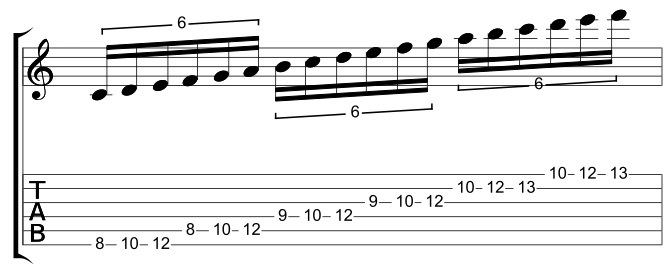
Here it is written as 16th notes:

.

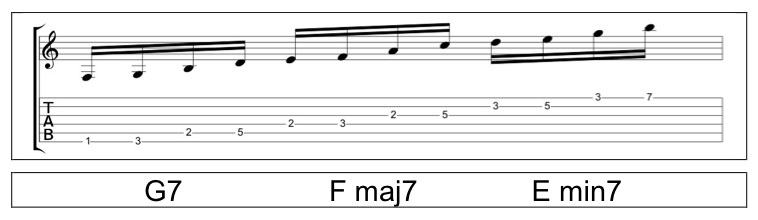
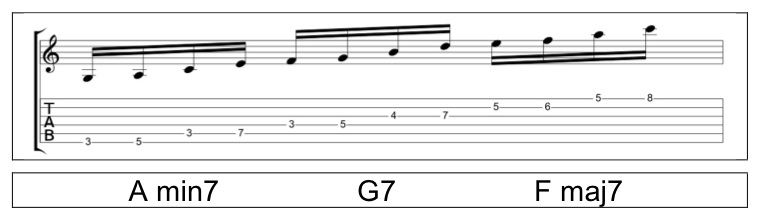
Chord sequence Dm7-Em7-Fmaj7-G7-Am7-Bm7b5-Cmaj7

.

While the approach I’ll demonstrate will work with any inversion, all the examples here will utilize the 3rd inversion.

.

The first important visualization with each form is that the 2nd note of each arpeggio in this lesson is acting as the root.

.

Step one: Using the patterns diagonally

.

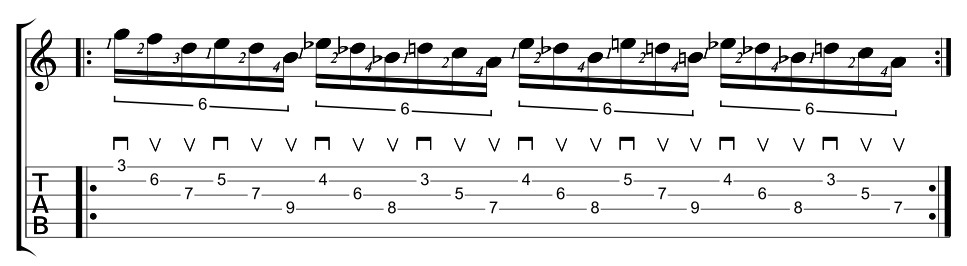
As I mentioned in the previous arpeggio post, a distinct advantage of 2-string patterns is that you can move them in octaves and maintain the same fingering.  Here’s a C major 7 arpeggio moved in octaves on the middle and top set of strings.

.

.

Michael Angelo Batio was the first rock guy I saw playing this type of pattern in a shred context but now the sound of it is pretty common rock/metal vocabulary.  This idea will get covered more in part 12 of this series, but to make it sound a little cooler, instead of playing it over a C major chord  – try playing the above arpeggio over an A minor chord:

.

  • when C major 7 (C, E, G, B) is played over A the notes act as (b3rd, 5th, b7th and 9th) or A minor 9 (no root)

.

Step 2: Putting it together positionally

 .

At the top of the page, I showed how I extracted arpeggios by eliminating the 3rd and 5th note from an ascending 3-note per string pattern.  This same process can also be applied positionally.  For example, here’s a 3-note per string C major scale played  in 8th position.

.

.

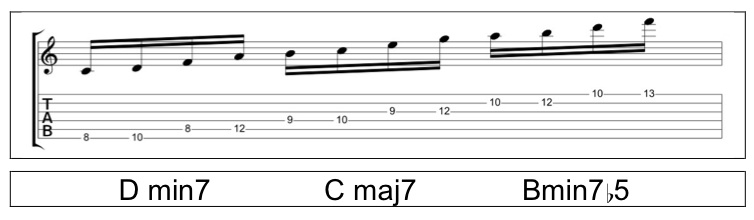
Now I’ll apply each of these arpeggio shapes to the C major scale starting with the root position. Notice that the 6-string shape links together a D minor 7, C Major 7, and a B minor 7b5 into one big arpeggio. 

.

.

To visualize the arpeggios across 6 strings just remember: 

 as the pitches ascend, the related arpeggios descend (and vice versa)!

.

Also remember that the 2nd note of the arpreggio acts as the root, so if you want the C major 7 arpeggio on the low E string

.

.

you’ll extract it from B Locrian.

.

.

The pattern creates a different flavor of modal arpeggio than the triadic version in part 10 of the guide.  Where the triadic version moves in diatonic thirds, this pattern keeps a diatonic 2nd between each 7th chord arpeggio. Here are all of the positional arpeggios of  the C major scale derived this way:

.


Big Picture Alert!!

 .

Since all of the notes of the C major scale are presented in the linked arpeggios, you could technically play this over any diatonic 7th chord in C major if you resolved it properly.  As a recap of the modal microscope lesson, I tend to view things from a parent scale perspective so:

.

  • If you play any of these patterns over a C major 7 chord – you’ll imply a C Ionian sound
  • If you play any of these patterns over a D minor 7 chord – you’ll imply a D Dorian sound
  • If you play any of these patterns over an E minor 7 chord – you’ll imply an E Phrygian sound
  • If you play any of these patterns over a F major 7 chord – you’ll imply a F  Lydian  sound
  • If you play any of these patterns over a G7 chord – you’ll imply a G  Mixolydian  sound
  • If you play any of these patterns over an A minor 7 chord – you’ll imply an A Aeolian sound and
  • If you play any of these patterns over a B minor 7b5  chord – you’ll imply a B Locrian sound

.

Now I’ll apply each of these arpeggio shapes to the C major scale.  Feel free to try these over any of the chords listed above (although you may want to read the note about “The Problem with Ionian” below if you’re playing any of them over C major 7).  I’m partial to playing them over D minor 7 or D minor 9 depending on which note I’m starting or ending on.

.

.

.

.

.

.

.

.

The “trouble” with Ionian

.

The “problem” with the Ionian mode in general is that the natural 4th is an avoid tone over major 7th chords with the same root.  (i.e. C Ionian played over C maj7).  For this reason, I generally avoid Ionian as a mode and instead focus on the major scale for visualization purposes.   If I were to use this approach over a C major 7 chord,  I would probably be more likely to go with a Parent Major scale of G major for a C Lydian sound (i.e. change the “F” in each pattern to “F#”). 

.

.

Step 3 – Adaptation

.

While I dig these arpeggios as is – I tend to use them as visualization tools.

.

You may notice that these arpeggios are all 2-note per string.

Just like a “box” position pentatonic scale….

“Hey”, you might be thinking, “what if you adapted all of those pentatonic variations and sequences that you worked out to these arpeggios?”

Good Idea!!!

.

 As a starting point, I’m partial to playing this form over D minor as it already has some of the step-wise shapes I associate with pentatonics:
.
.
so I’ll use it for the examples below.  In the first one, I’m applying a descending group of threes to a pattern. (This also works ascending as well).
.

A big thing I work on with pentatonics is string skipping.  Here, I’ve adapted an idea to the linked arpeggios.

.

.

Here’s a cool variation on this lick – replace the 8th fret “G” on the B string with an “A” to match the major 3rd interval on the G string.  Once you can visualize a lick making variations like this is relatively easy (and it sounds cool!!)

.

From there it’s easy to mix and match things,  Now that you see the pattern it comes from, the lick below just removes the F to create a different arpeggio shape.  It starts off as C major 9 but links into a D minor shape to create a D minor 13 sound followed by some string skipping.  Grab your guitar and give it a whirl!

.

.

The key with any approach like this is to keep it simple.  Mind you, some of these ideas might not sound simple, but the approach really comes from mastering the 2-string visualization idea, and then usurping it in cool ways!  Try coming up with your own variations!  

.

Extra Credit!!

.

Like I said before, while I’m sure that they’re out there, I don’t know any other guitarist who approaches fingering modal apreggios with the interlocking 7th chords,  but if these shapes are already familiar to you or if you’re looking to expand outside of this tonality, I have a few small tweaks that have BIG implications.

.

  • Lowering the E –> Eb in any of the C major patterns above will give you all of the Melodic Minor 7th chord linked arpeggios.
  • Lowering the E–> Eb and lowering the A –> Ab in any of the C major patterns above will give you all of the Harmonic Minor 7th chord linked arpeggios.

.

In other words, “Thar’s gold in them thar’ hills!!”  If you put some time into working with these ideas methodically, I’m sure you’ll get some unique approaches under your belt that’ll pay dividends (even if they don’t get you a tab at the general store).

.

Part 12 gets into superimposition.  It’ll be short, sweet and really cool!

.

I hope this helps!

.

-SC

.

 .