Be Wary Of The “To Kill A Mockingbird” Production Model

Harper Lee


I’ve been accused of having pedestrian tastes when listing Harper Lee’s To Kill a Mockingbird as one of my favorite books, but it’s a decision I stand by.  It’s extremely well written with excellent story telling, indelible characters and meticulous language and focus.  It’s truly a classic work.  


Here’s a question though, have you ever read any other Harper Lee books?


In case you’re wondering why you haven’t, it’s a trick question as there aren’t any.  A recent compelling documentary, Hey, Boo: Harper Lee & To Kill a Mockingbird, has brought to light a fantastic back story about the book.  Airline reservationist and author Harper Lee secured a literary agent with some strong short stories and a personal referral and then saw the original manuscript for Mockingbird rejected by 10 publishers before finding an editor in Philadelphia at a publishing firm who saw something real in the work.  The editor liked the idea but saw a series of short stories instead of a unified novel in its submitted form.   So the two of them went to work crafting a novel.


They proceeded to spend two years editing and hashing out the story.  I can only imagine what an exhilarating and agonizing time this must have been for Ms. Lee (she is said to have referred to this period of her life as, “A long and hopeless period of writing the book over and over again.”)  but the payoff was a book (and a movie) that became a classic (and a huge financial success).


Harper Lee hit paydirt with Mockingbird but while she never stopped writing, she never published again.  


Isaac Asimov

On the literary front, an interesting contrast to Harper Lee can be found in Isaac Asimov.  One of the most prolific writers of all time (his Wikipedia page bibliography is approximately 500 books), Azimov was originally a biochemistry professor at Boston University who became a wildly successful and influential author. I don’t know that any of his books have the emotional impact of Mockingbird (and none of them have the civil rights impact that Mockingbird did), but there’s no denying his influence.

.

In terms of artistic output,

I recommend that you don’t hinge all your efforts on any one big payoff.


It’s easy to fall into the trap of pursuing “perfection” in artistic output (particularly with regards to recording), but in my opinion, you shouldn’t hinge all of your efforts on ONE defining work.  This is applicable to any aspect of artistic work, but consider for a moment bands who hole up for years on end recording, editing and mixing their full length “masterpiece”.

.

In addition to the fact that it’s impossible to ascertain how it will hold up over time (I’m sure that there are a lot of former members of ’80s bands listening to the then “hip” electronic drums on old recordings and wondering what they were thinking.), all indications for the current and future economic model for working musicians involves multiple streams of revenue from multiple releases, sources and performance.  

.

In other words, you’re going to need a lot of output and it all has to be high quality.  


Creating a classic work like To Kill A Mockingbird is like hitting the artistic lottery.  Instead of getting stuck on any one big project, work consistently hard, keep enough perspective to know when a project is done (the subject of a much longer future post) and keep outputting material.  

.

As a short term example, 3 four song EPs released over the course of the year might ultimately gain you more traction (and visibility) than 1 full length released every 12-14 months but it will most certainly put you in a better spot that one full length released  every four or five years.

.

(In related news, I’m taking my own advice on this and plan on releasing a lot of Scott Collins output that’s been in a holding pen for a while.)

.

Stay engaged.

Stay productive.

Make everything you do as great as you can

then let it go and move on to the next thing you do.

.

As always, thanks for reading!

-SC

Rare Picks And A Pentatonic Approach From Mr. Cusano For Guitar-Muse

Hey Everyone!

A quick update from DC, where rock and roll is alive and well!

I’ll have some new playing and gear content up here in August.  In the meantime, since there’s been a lot of music business / psychology of music posts on GuitArchitecture lately,  I thought I’d touch on both areas with some new posts on Guitar-Muse.

First up, is a post on my Pickboy Speed King pick.  It’s a weird and cool piece of gear and the flatpickers amongst you might find some DIY inspiration in pick design there.  You can read all about it here.  

Secondly, I’m doing a player profile series for Guitar-Muse and the first player up is the former Vincent Cusano (Vinnie Vincent).  Vinnie has gotten a lot of attention in the press for everything but his guitar playing, but in many ways he’s a fascinating player to me.  He managed to fully embrace the shred aesthetic and do it in a really unique way.  Vinnie’s pentatonic-based approach produces some cool sounds that you can find here.

The player profile series is going to feature some cool guitarists that mostly fly under the radar.  As I mentioned before, the series will also include Alex Masi,  Vlatko Stefanovski, Ridgely Snow, and José Peixoto.

There should be some gear/tech pieces on modeling, tone and amps with some other interviews getting posted into August/September.

That’s it for now!

More stuff next week and as always thanks for reading.

-SC

Guitar-Muse Interview With Steve Vai And Gig, Post And Kindle Updates

Hey everyone!

.

Steve Vai Interview

My interview with Steve Vai is now up on Guitar-Muse.  You can read it here.  I’ve also posted a short lesson on rhythmic ear training that uses one of the new tracks as the basis for the lesson (copyright prohibits me from posting the actual notes – but it’s a good primer on how to figure out syncopated rhythms).  You can read that post here

.

Today’s Children of Mu Gig Is Rescheduled

The gig with Justin Wierbonski’s “Miles Davis Bitches-Brew era” group Children of Mu next Thursday is still happening but since today’s gig at the Shrine was double booked, it’s now been postponed until next Saturday evening.  

The rest of the band can’t make it so next Saturday’s show is going to be a drum guitar duo – but it’s going to be more free-form Jazz Sabbath (HA!)  and not at all “The Girl from Ipanema”!!

Forecast for next Saturday evening in Harlem –  high note density mixed with sporadic ambient textures with a chance of attendance.  Here are the dates for next week.

.

BAR4 

THURSDAY, JULY 12, 2012 – 9PM

.

THE SHRINE WORLD MUSIC VENUE 

Saturday, JULY 14, 2012 (time is evening TBA)

.

An Immodest Proposal Part II…

will be up on Monday and some people are likely to find it provocative.

In other post news, I do have some lessons to go up on the site over the next few weeks and I’ve been working on the Kindle book which I hope to have done by the end of the month.

Player profiles are on tap for Guitar-Muse in July and August and some cool interviewees in the pipeline in a “guitars of the underground series.”

.

Ah “Hot Town, summer in the city!”

Stay cool and thanks for reading.

-SC

Two Black and Bluegrass Licks To Get You Out Of A Session

Hey Everyone!

.

This lesson is a continuation of the same technical concept behind the sweep picking Pentatonic Minor/Blues scale lesson I posted earlier.  If you like this approach, you may like that lesson as well (links at the bottom of the page).

.

Today I have not one but TWO licks that go together like peanut butter and an ashtray.  Both of these are transitional licks leading back into key of G (The bluegrassiest of all keys) and while they probably won’t get you beat up (hence the black and bluegrass) or kicked out of a session – they might turn a head or two!

.

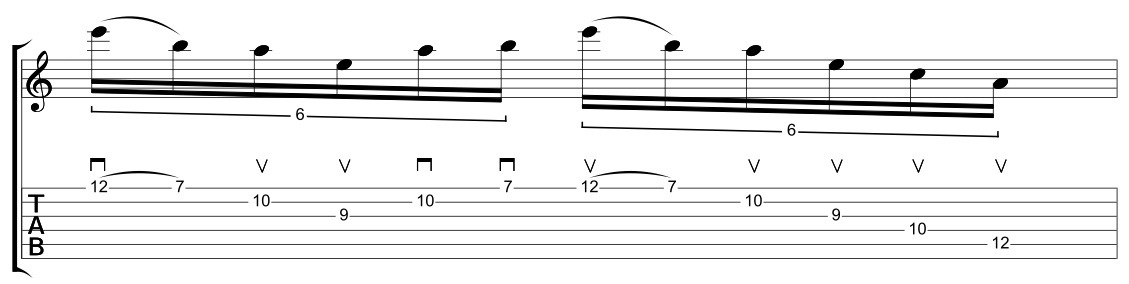
Here’s the first lick (in the video it’s played at 120 bpm – first as triplets then sextuplets):

.

(Note: fingerstyle players can play the 3-note groups as p-i-m)

.

[vimeo https://vimeo.com/44120906]

.

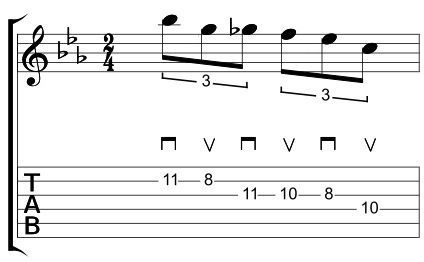
And here it is in notation and tab:

.

Lick #1

Now, let me explain a little about what going on here.  This is a transitional lick that resolves to G that uses different G-based chords starting from G, Bb and Db (aka G diminished).

.

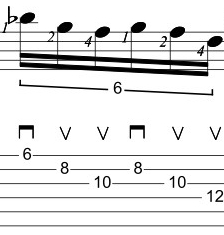
The first chord is a G7 (add 13).  Originally, I was going to use a straight descending 1 note-per string scale version of G Mixolydian (i.e. G, F, E, D, C, B, A) but – while the first three notes sounded great:

.

The spread wasn’t an easy one to get in to or out of cleanly.  So I cheated it and used the D instead, grabbing the E on the B string keeping the D and adding a B on the D-string.

.

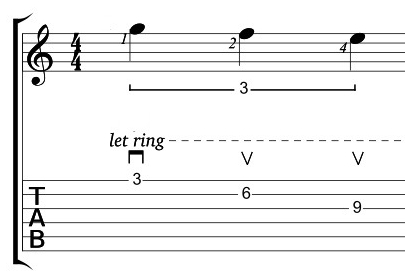
If you remove the E, you have a nice voicing for a G7 chord starting from the 3rd, but for melodic playing it’s easier to arpeggiate the chord as 3 note groups.

.

The next chord is a G min 7 starting from the b3rd.  It uses the same picking pattern as the first arpeggio:

.

Then the lick jumps from the D to Db to start the G min7b5 (add11) arpeggio.  That might sound exotic – but it’s just 4 notes from the G Blues scale (G, Bb, C, Db and F).

.

..

Finally, it ends up with a G major triad with an added b3rd (a useful bluegrass cliché.  For even more of a bluegrass sound, add the E on the 12th fret E string between the D and the G).

.

.
Technical Considerations 

.

1.  As with the sweep picking blues pentatonic lesson, keeping the notes staccato (i.e. taking the finger pressure off the string after each note is played) will help with articulation. 

.

2.  The biggest challenge with this lick will probably be taming the open D string when you switch from the 3-string D-G-B pattern back to the top three strings.  Use pick hand muting to mute the D string once you play the first note on the high E string – and try practicing the lick as 9-note groupings to work that transition.

.

.

or

.

Lick #2

.

Lick #2 is just silly – but it’s a fun idea and it’s a great way to work on the 3-string picking pattern.  

.

[vimeo https://vimeo.com/44120906]

.

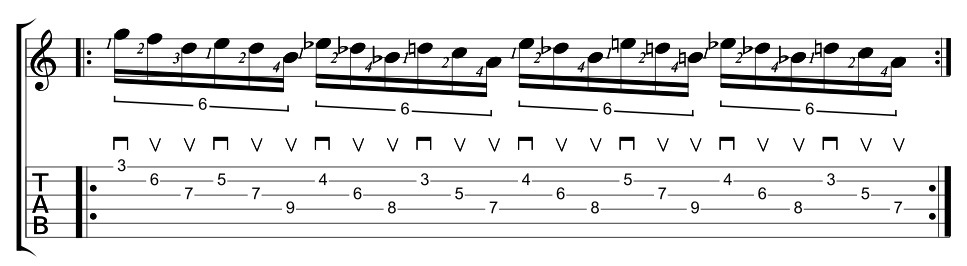
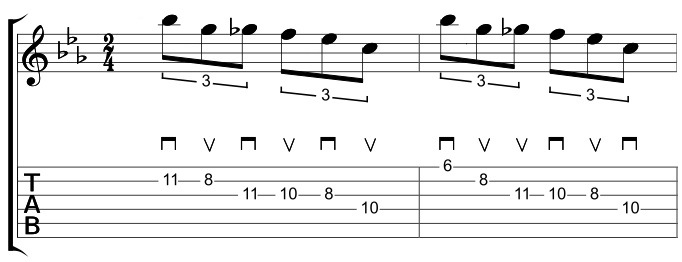
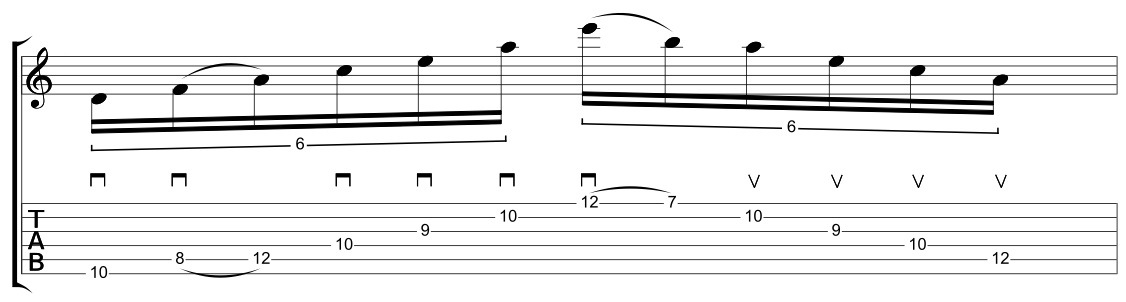
The lick is based on this idea:

.

.

This lick is just the first notes of lick #1 with a chromatically descending pattern based on the last three notes.  All I’ve done in lick #2 is chromatically ascend and then descend again like so:

.

Just use the same techniques that you used in getting the first lick down and pay attention to the 3 T’s (timing, (hand) tension and (quality of) tone and you’ll be fine.  (and remember – slow and steady wins the race here with regards to practice gains!)

.

This one-note per string scale idea is taken from the last section of my Melodic Patterns book so if this area interest you, you may want to check that book out.  You can find out more about it here.

.

As always, I hope this helps and thanks for reading!

-SC

.


If you like this approach, I have 2 books you may be interested in:


My Pentatonic Visualization Book


Minor Pent Front


is 100 + pages of licks and instruction and includes demonstrations and breakdowns of two-string fingerings, diagonal pentatonics, sweep picking pentatonics, pentatonic harmony and much more!  It’s available here.


My Melodic Patterns Book:


melodic-patterns


(available on Lulu or on Amazon) has a complete break down of all note-per-string scale variations which include the 2 above.  In the meantime, give this approach a try with other scales as well.  In the next sweep picking acoustic lesson – I’ll adapt this to a bluegrass lick that you might find cool.


Different Pricing Tiers Announced For Book PDFs

Update – 2/3/2013 


Hello everyone!  Please note that as of 2/1/2013 all of my books are available for order exclusively on my Lulu.com page and on Amazon.  While I may run an e-book  bundle offer directly in the future as of right now, unfortunately, no bundle options are available.


I’m leaving the page up for archival purposes but if you go to the Books link at the top of the page, you’ll find more detailed information about the books below and the other books in the GuitArchitect’s Guide To:  series.

.

-SC

.

.

I’ve had some people ask about book ordering.  It seems that the 3 pdfs for $30 price point was an easier one for some people to enter into instead of the 4 for $40.

.

I really want to make the books accessible to whoever wants them, so here’s the new price point breakdown for pdf orders (ordering information and links are at the bottom of the page.

.

Any individual pdf is $15 (US).

Any 2 pdfs are now $20 (US).

Any 3 pdfs are $30 (US).

Any 4 pdfs are $40 (US).

 .

I’ll be updating the books page with all of this information – but for now ordering info (as well as a full description and screen shots of each book) is below.

.

Currently, I have four guitar reference/instructional books available for purchase:

.

The GuitArchitect’s Guide to Modes: Melodic Patterns

.

The GuitArchitect’s Positional Exploration

.

The GuitArchitect’s Guide to Modes: Harmonic Combinatorics

and

. 

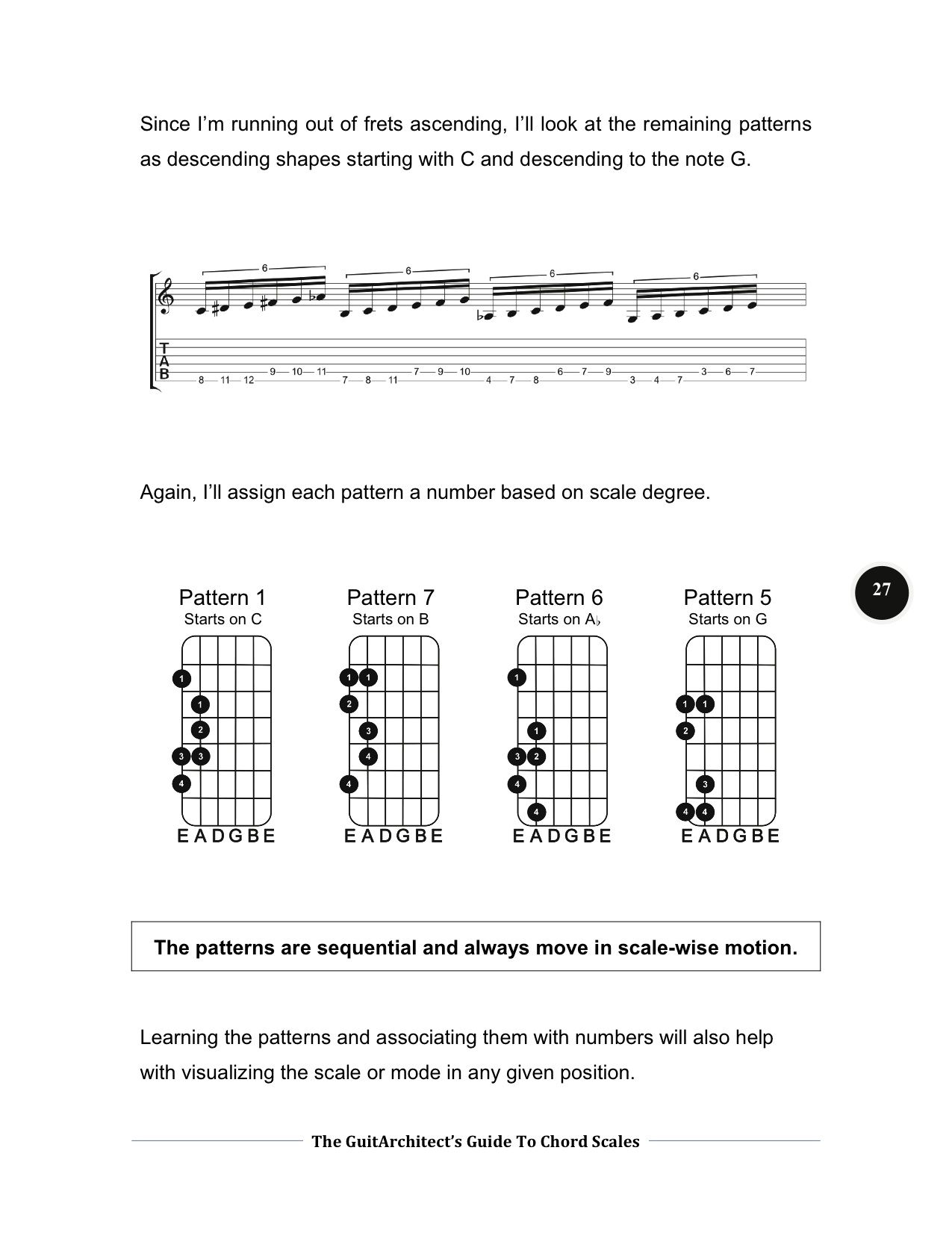
The GuitArchitect’s Guide to Chord Scales

Print editions of any of the books are available individually here (lulu.com) or on Amazon (amazon.com, amazon.co.uk, or amazon.fr).

.

The GuitArchitect’s Guide to Modes: Melodic Patterns 

(333 pages)

.
My sonic visualization system, GuitArchitecture,  utilizes an intuitive two-string method of understanding the guitar fingerboard in a logical and concise way where seven core fingerings for major, melodic minor and harmonic minor scales replace rote memorization with an intuitive overview that can be applied to any scale or modal system.

.

In The GuitArchitect’s Guide to Modes: Melodic Patterns, I’ve taken the two-string approach and created a reference book of melodic permutations that allows the reader to generate an almost infinite number of unique melodic cells and sequences.

.

Applicable to guitarists and bassists, this book is an invaluable resource for both compositional and improvisational material.

.

The GuitArchitect’s Guide to Modes: Melodic Patterns

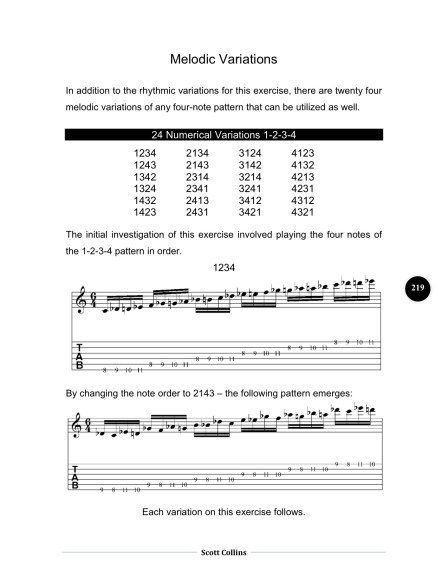
If you’ve ever looked at any instructional guitar material, you’ve probably come across some variation of the phrase, “Take this idea and transpose it to every other key”. In this book, I’ve taken a seed idea (a single two-string fingering for C Ionian) and then used a mathematical process called permutation, (which changes the sequence of how things are arranged) as a basis for creating unique melodic cells.

.

This book not only details every possible permutation, but then goes on to show how to create every unique combination of them. These unique melodic cells can be used either on their own as compositional or improvisational ideas or combined with other melodic cells to create longer phrases.

.

I’ve included jpegs of some of the pages from the Melodic Patterns book below.  Since the jpegs were converted from the pdf of the book, there’s some pixilation in the jpegs that is not present in the pdf but these will still give you an idea of what’s in the book. 

(Click on any graphic to see it as a larger size.)

.

.

.

.


The GuitArchitect’s Positional Exploration

(254 pages)

.

In The GuitArchitect’s Positional Exploration, I’ve taken an introductory guitar exercise and turned it on its head to reveal deep possibilities that exist not only in positional visualization, but in technical awareness as well.

.

This book shows how to take a simple idea and creatively develop and modify it through melodic, harmonic and rhythmic variations that can be applied to your own music as well.

.

.

.

.

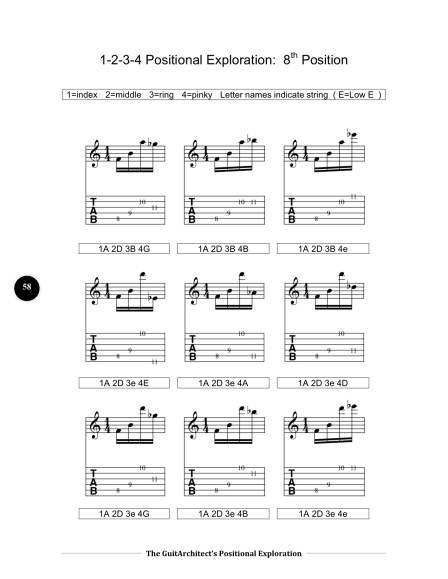
The GuitArchitect’s Positional Exploration Guide:

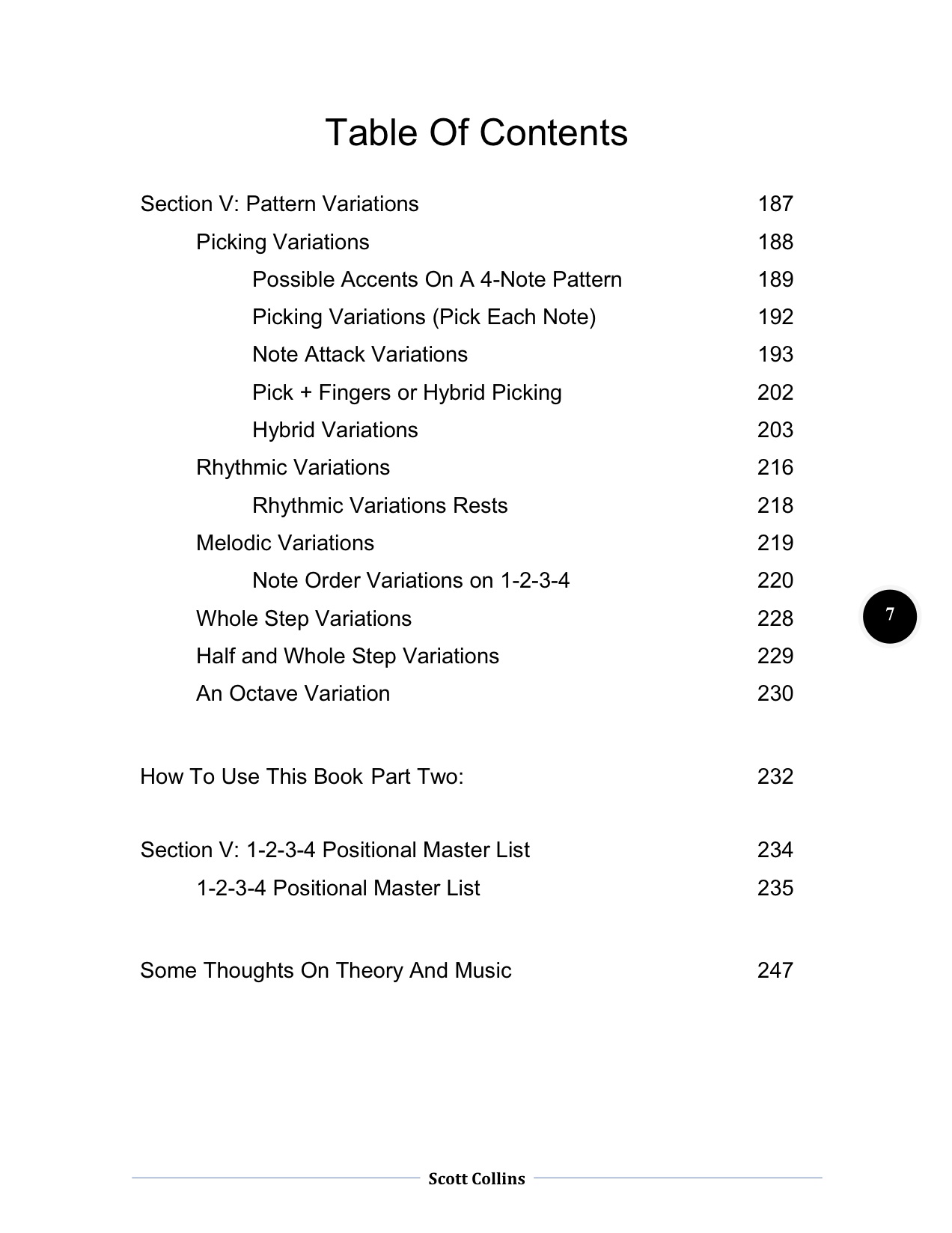
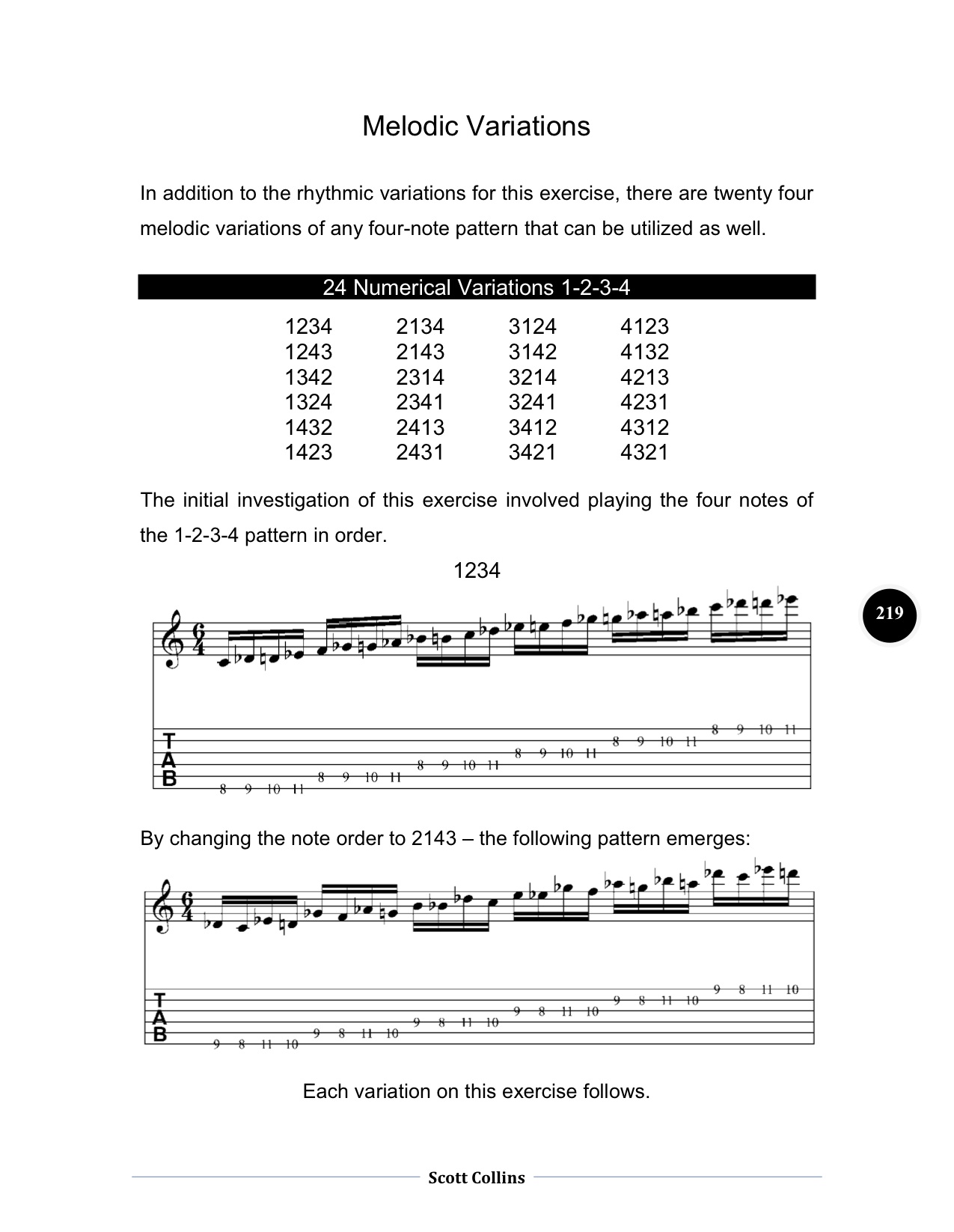
This book takes the initial 1-2-3-4 exercise and then adapts it to all other string-set-combinations in position.  But it also does some other important things for the reader:

  • In addition to documenting each example in the 8th position, it provides chordal analysis and a detailed series of charts for determining multiple harmonic interpretation of the notes involved.


  • From a technical standpoint, the book explores every possible variation of note attack that can be executed.  This could lead to entirely new technical approaches for the reader.


  • From a compositional/improvisational standpoint, the book covers a series of ways to manipulate the patterns, rhythmically and melodically in a systematic way to develop ideas fully.


I have a lesson on Guitar-Muse that uses material directly from the book.  If you want to get a sense of the content you can see it here.

.

I’ve included jpegs of some of the pages from the Positional Exploration book below.  Since the jpegs were converted from the pdf of the book, there’s some pixelation in the jpegs that’s not present in the pdf,  but these will still give you an idea of what’s in the book.

(Click on any graphic to see it as a larger size.)

.

.

.

.
.

The GuitArchitect’s Guide to Modes: Harmonic Combinatorics 

(410 pages)

.

.

.

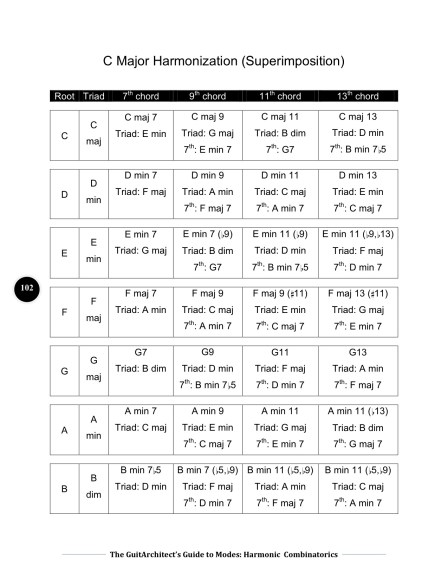
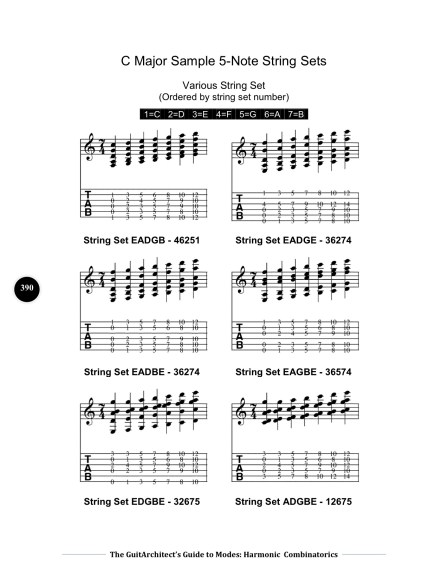
In The GuitArchitect’s Guide to Modes: Harmonic Combinatorics, I’ve gone into the nuts and bolts of chord construction and analysis by taking a systematic approach to generating thousands of chord variations that can be utilized intuitively in any key. In addition to being a vast harmonic resource, I also show you ways to make melodic lines from this material allowing the book to double as a melodic resource as well.

.

.

.

.

.

.

.

Harmonic Combinatorics is 410 pages of instruction and reference (that’s almost a ream of paper if you need a visual).  It’s the  deepest resource I’ve created and has numerous harmonic and melodic approaches that can be used to break through theoretical, technical or other musical limits you currently have.  

.

Harmonic Combinatorics?

.

As a general rule, I’m not a big fan of jargon, but in this case I think its applicable as it helps define what this book is, and what it isn’t.

This is not a traditional chord book. The purpose of this book is not to teach a number of stock voicings and typical chord progressions for the reader to default back to as there are dozens, if not hundreds, of books that already do that.

This book centers around a series of methodologies for developing unique harmonic and melodic voicings for compositional or improvisational use that can be adapted to any tonal system.

Harmonic Combinatorics refers to a process of identifying “countable discrete structures” harmonically. In this case, it means examining unique combinations of notes on all of the possible string combinations for the purposes of developing harmonic and melodic possibilities.

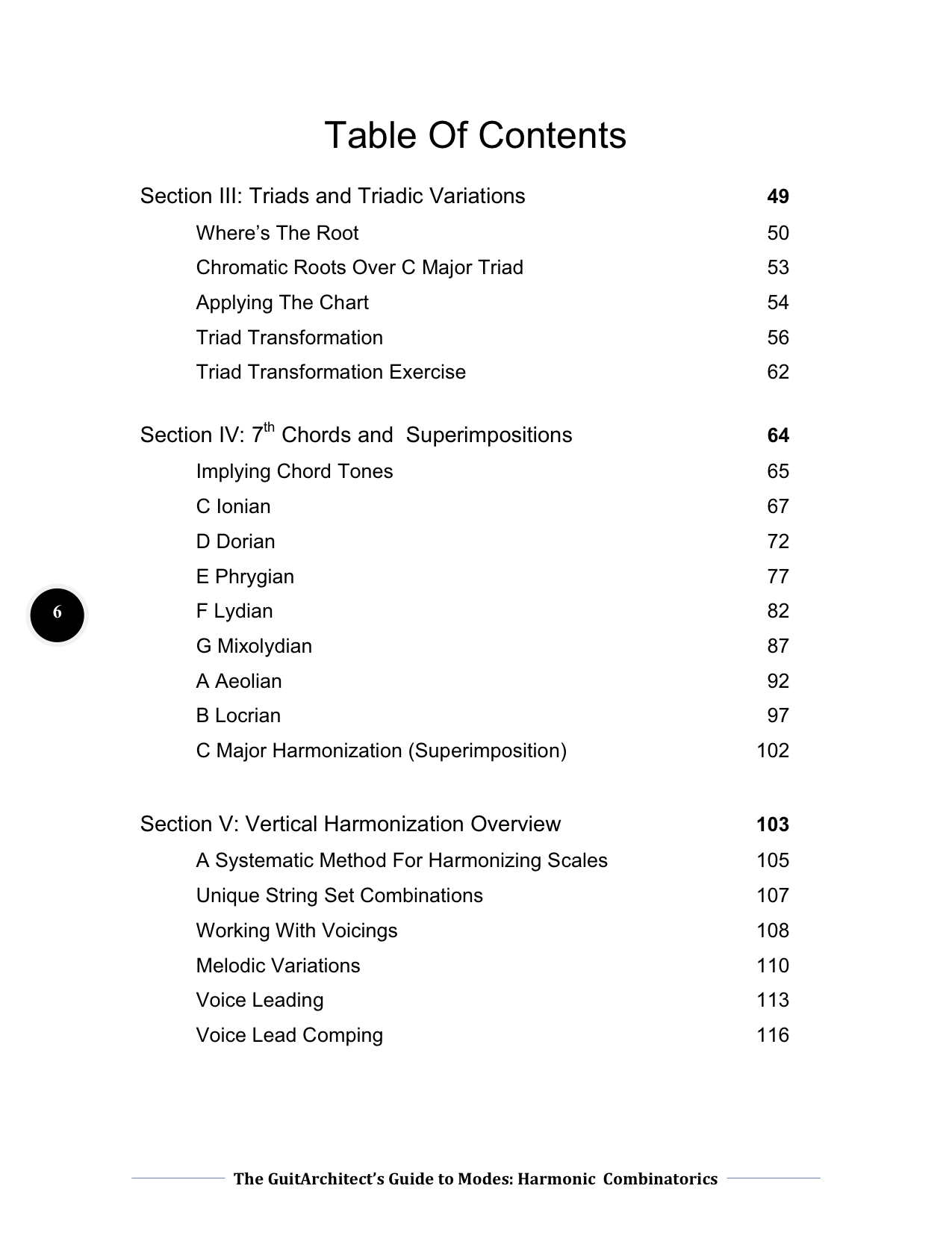
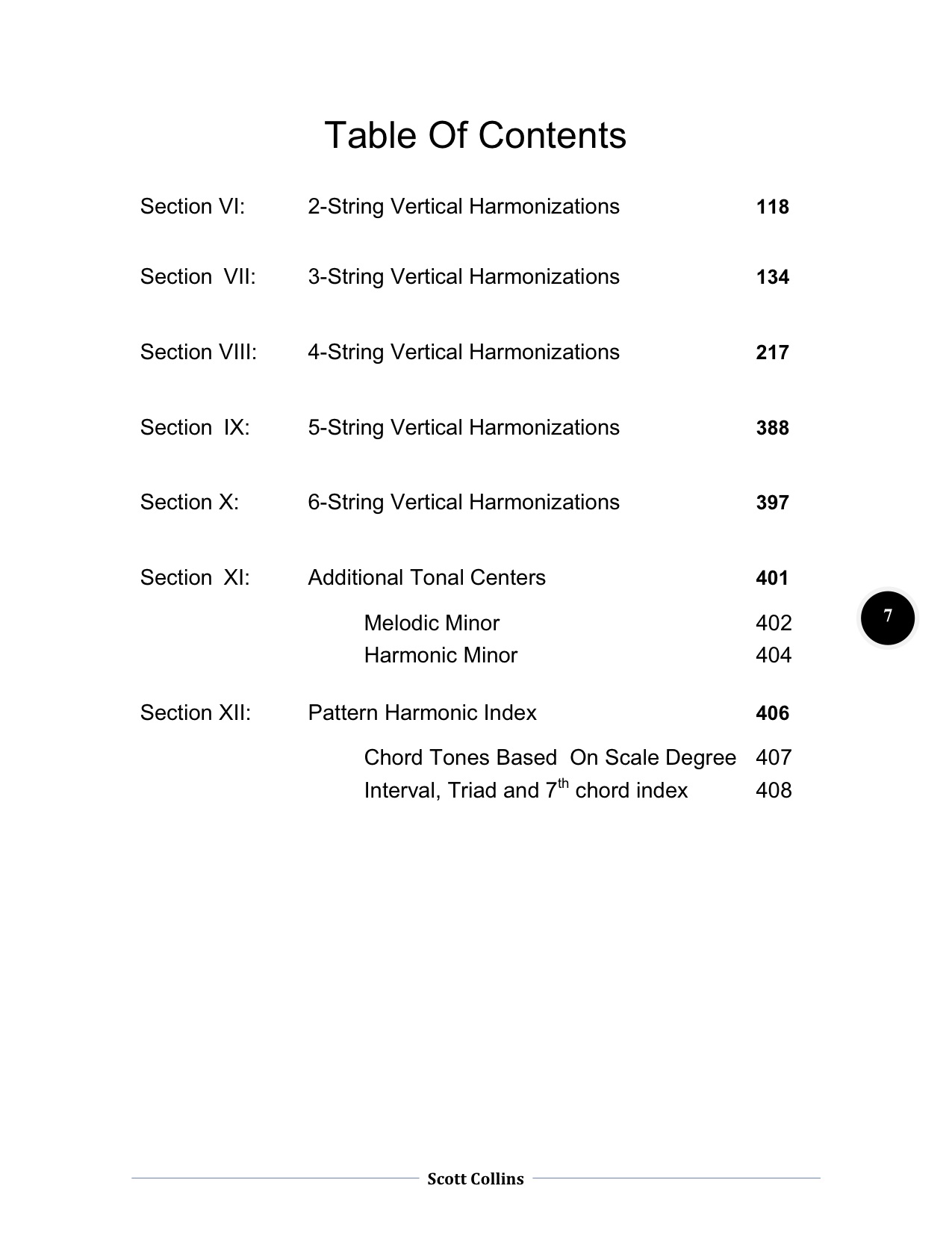
The book is divided into approximately 110 pages of instruction and 300 pages of reference.  It covers a lot of theory – but makes it accessible even to the novice and shows how to apply it.  It’s a modular text that can be read in either a linear or a non-linear way.

.

There are a couple of posts that I’ve put up that excerpts and adapts material directly from this book.  To get a sample of the book’s style you can check out :

.

CREATING CHORDS AND LINES FROM ANY SCALE – A HARMONIC COMBINATORICS / SPREAD VOICINGS LESSON

Slash and Burn – Creating More Complex Sounds With Slash Chords

RECYCLING CHORDS PART II: TRIAD TRANSFORMATION

RECYCLING CHORDS PART I OR WHERE’S THE ROOT?

.

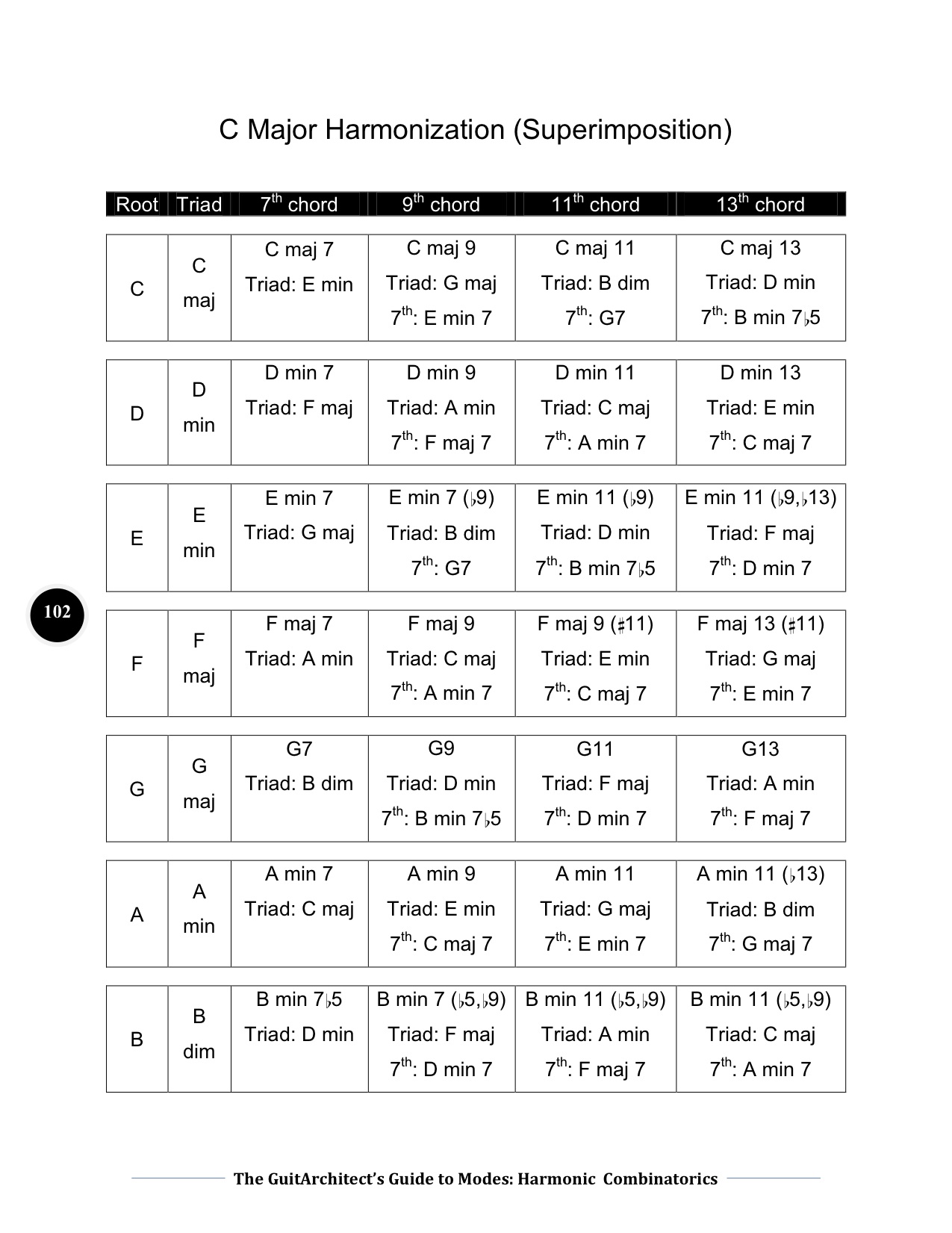
I’ve included jpegs of some of the pages from the Harmonic Combinatorics book below.  Since the jpegs were converted from the pdf of the book, there’s some pixelation in the jpegs that’s not present in the pdf,  but these will still give you an idea of what’s in the book.

(Click on any graphic to see it as a larger size.)

.

.

.

.

.

.


.

The GuitArchitect’s Guide to Chord Scales

(190 pages)

.

.

.

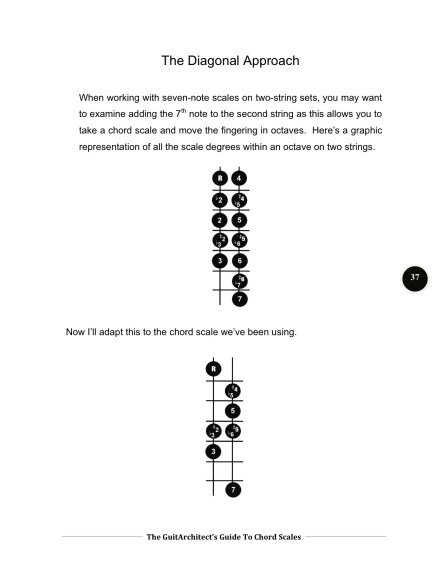
In The GuitArchitect’s Guide To Chord Scales, I show you how to make your own scales to use over chords and how to derive chords from whatever crazy scales you come up with in an easy, intuitive and musical way.

.

Over the course of its 190 pages, the Guide To Chord Scales not only offers extensive instruction and approaches, but also acts as a reference book covering chord scale options ranging from 3 notes right on up to the full 12-note chromatic.

.

While devised as a guitar resource for instructional, compositional and/or improvisational material – this book can be a vital component in any musician’s library.

.

The GuitArchitect’s Guide to Chord Scales

Chord Scales is 190 pages of instruction and reference.  It’s the shortest book I’ve written, but it’s just as deep as any of the other books.  The big difference between this book and the other books, is that this book starts by taking one chord scale and really putting it through the ringer and demonstrating how to use it in ways that are intuitive and musical.   Once the process for what to do with a chord scale is demonstrated, the book  then goes on to outline all the unique chord scales from 3-12 notes!!!

.

The book has a lot of performance insights and presents the material in a way I believe to be truly unique (at least I’ve never seen it dealt with this way before).  It’s incredible exciting to me, and while it’s been written as a soloing, compositional or improvisational resource for guitarists – it could be invaluable to musicians in general.

.

There are a couple of posts that I’ve put up that excerpts and adapts material directly from this book.  To get a sample of the book’s style you can check out :

.

CREATING CHORDS AND LINES FROM ANY SCALE – A HARMONIC COMBINATORICS / SPREAD VOICINGS LESSON

Making Music Out Of Scales

.

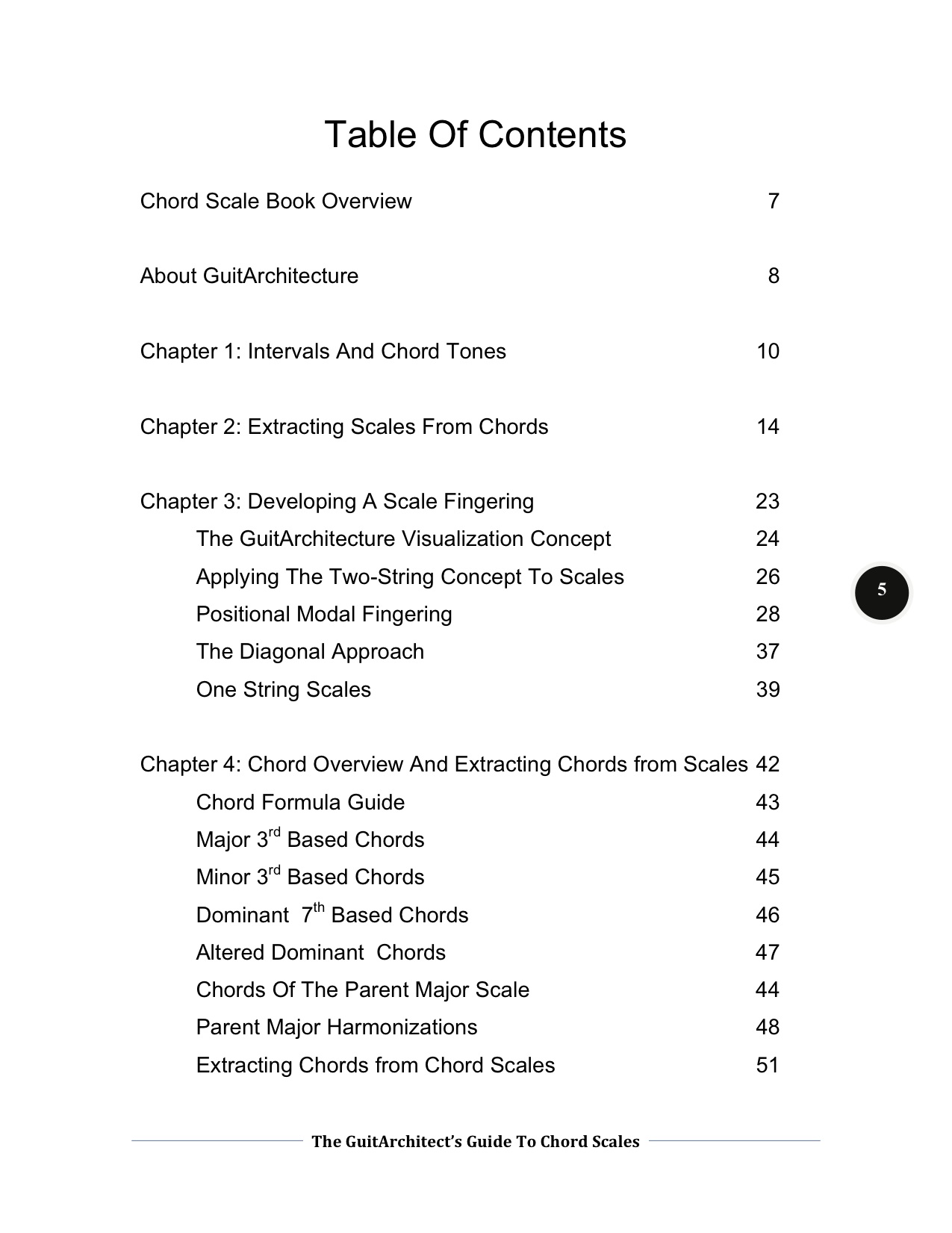
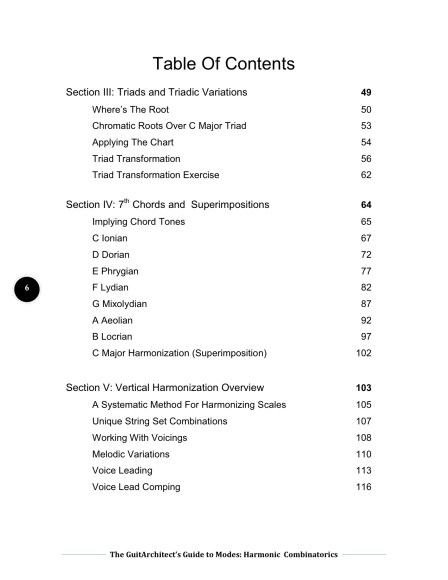
The lulu.com page includes a preview option for the first 12 pages of the book, but I’ve included some additional jpegs of some of the Chord Scales book  pages below.  Since the jpegs were converted from the pdf of the book, there’s some pixelation in the jpegs that’s not present in the pdf,  but these will still give you an idea of what’s in the book.

(Click on any graphic to see it as a larger size.)

.

.

.

Ordering information (slight return)

  • If you would like to purchase any individual book pdf  for $15 USD just click the PayPal link below.  (Also, when ordering, please specify which book you’d like – The GuitArchitect’s Guide To Modes: Melodic PatternsThe GuitArchitect’s Guide to Modes:  Harmonic CombinatoricsThe GuitArchitect’s Positional Exploration, or The GuitArchitect’s Guide to Chord Scales).

Any 1 GuitArchitecture pdf for $15.
..
  • If you would like to purchase any two book pdfs  for $20 USD (and save $10 off of individual orders) just click the PayPal link below.  (Also, when ordering, please specify which 2 pdfs you’d like – The GuitArchitect’s Guide To Modes: Melodic PatternsThe GuitArchitect’s Guide to Modes:  Harmonic CombinatoricsThe GuitArchitect’s Positional Exploration, or The GuitArchitect’s Guide to Chord Scales).

Any 2 GuitArchitecture pdfs for 20
..
  • If you would like to purchase any three book pdfs for $30 USD (and save $15 off of individual orders) just click the PayPal link below.  (Also, when ordering, please specify which 3 pdfs you’d like – The GuitArchitect’s Guide To Modes: Melodic PatternsThe GuitArchitect’s Guide to Modes:  Harmonic CombinatoricsThe GuitArchitect’s Positional Exploration, or The GuitArchitect’s Guide to Chord Scales).

Any 3 GuitArchitecture pdfs for $30
..

.

  • The  Four-book PDF bundle (which includes The GuitArchitect’s Guide To Modes: Melodic PatternsThe GuitArchitect’s Guide to Modes:  Harmonic CombinatoricsThe GuitArchitect’s Positional Exploration, and The GuitArchitect’s Guide to Chord Scales) is available for $40 using the PayPal bundle button below.  (A $20 savings off ordering the books on their own).

Any 4 GuitArchitecture pdfs for $40
..
  • If you’d like to save yourself the printing and binding costs, you can go to the link here ( Lulu.com ) to buy a nicely bound version of any of the books.

.

Please note:

I turn all orders around within the same day I receive PayPal notification.  

If you have ordered a book and have not heard from me within a 12-hour time frame, please send me an e-mail at guitar(dot)blueprint(at)gmail.com, and I’ll get back to you as soon as I can!

.

Special thanks to everyone who has already purchased a book.  Your support is greatly appreciated!

.

As always, thanks for reading!

.

-SC

Sweep Away Those Blues Or Some Useful Ways To Sweep Pick A Blues Scale

Right Lane?  Left Lane?  Shawn Lane.

I read an interview once with Shawn Lane where he talked about how he did very little taping and that the majority of really fast playing that he was doing was one-note per string fingerings.  It’s a cool idea, and here’s how I’ve adapted it to a C Blues/C Pentatonic Minor scale.

.

First, here’s the lick on acoustic.  FYI – I slide into the 1st note on the video 1st time through the lick.  (ps- it’s much easier to play cleanly on electric):

.

.

.

Note:  

I’m using C minor as a key signature here – but the key signature doesn’t show up in all the following notation.  In every example below, all notated B’s and E’s are Bb and Eb respectively as seen in the tab.

.

I explain each step of this in the video – but here’s the step by step process for how I came up with this:  

.

Let’s look at a standard C blues shape:

.

I’m going to use the descending portion of the lick starting from Bb.

.

.

Now I’m going to move the Bb from the B string back to the high E string.

.

Before                            and                      After

.

I’m using the 1st, 2nd and 4th fingers for the first three notes of the “After” section above.

.

Technical Note:

If you hold the notes down, you’ll loose definition on the individual notes because it’ll sound like you’re playing a chord.  So make each note staccato by lifting the finger off each note after playing it.  Try practicing just these 3 notes at first and work on getting the picking and the articulation down! Fingerstyle players can play the 3-string groupings as m-i-p (middle, index thumb).

.

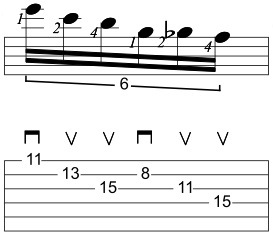
Now I’ll move the F from the G string to the B string this gives us 2 three string shapes that can be swept pretty easily (fingering it is another issue entirely though!!)

.

Original Version                                    Bb moved to E string                      F moved to B string

.

I’m playing the C on the D string with the 3rd finger so the pinky can grab the F#/Gb on the G string for the Paul Gilbert repeated note idea in the second sextuplet.

.
. 

.

The last sextuplet has a swept pentatonic idea that works in reverse from the initial lick.  Looking at that box blues shape again:

.

I’m starting from Bb on the D string and moving the Eb from the 8th fret of the G string to the 13th fret of the D string.  I’ve also taken the C from the 8th fret of the High E string and moved it to the 13th fret of the B string for a symmetrical shape.  Finally I’ve added the D to get a nice “9th” sound on the sweep. (Check the video for a full explanation).

.

“Shapes of things…”

.

Here’s something that isn’t covered in the video. This lick starts on the b7, but you can adapt the idea to any scale degree.  Moving down to the G, produces the following pattern.  It’s not really useful on the top 3 strings but the D, G, B shape is feasible.

.

C Blues from the 5th (G)

.

Here it is from the root (useful fingering #2):

.

C Blues from the root

.

Here it is from the b3rd.

.

C Blues from b3rd (Eb)

.

You can try it from the tritone as well.  The key thing is to find a shape that works for you, find a chord you like the sound of it over and monkey around with it until you get something you like out of it.

.

If you like this approach, I have 2 books you may be interested in

My Pentatonic Visualization Book

Minor Pent Front

is 100 + pages of licks and instruction and includes demonstrations and breakdowns of two-string fingerings, diagonal pentatonics, sweep picking pentatonics, pentatonic harmony and much more!  It’s available here.

My Melodic Patterns Book:

melodic-patterns

(available on Lulu or on Amazon) has a complete break down of all note-per-string scale variations which include the 2 above.  In the meantime, give this approach a try with other scales as well.  In the next sweep picking acoustic lesson – I’ll adapt this to a bluegrass lick that you might find cool.

.

As always, I hope this helps and thanks for reading!

-SC

.

If you like this post, you may also like:

TWO BLACK AND BLUEGRASS LICKS TO GET YOU OUT OF A SESSION (or sweep away those blues – Part 2)


.

Thinking, Knowing And Learning

The difference between information and knowledge


The deepest educational experiences that I’ve had all occurred at the school of hard knocks.  As a student in a traditional music school, I had blocks absorbing information that didn’t seem relevant to what I was doing because I didn’t see how it could relate to what I wanted to do (to be fair, this was also because most of the instructors I had were incapable to presenting the information in a way that showed how it could be adapted to individual styles).  

.

Much of the specific aspects of my style have come about from taking ideas or approaches that were interesting and finding ways to integrate them into what I do.  This might mean hearing a phrase or a chord progression and working it into my repertoire, or exploring unfamiliar ideas or new options in a solo or a compositional challenge.

.

A big part of gaining information is knowing what questions to ask and finding the right people to initially answer them.

Gaining knowledge, however,  is knowing what question is asked, what the real question being asked is and answering them yourself.

 .

I say this because while I can say, “If you’re looking for a Melodic Minor application – try playing a melodic minor scale from the b7 of a minor chord (i.e. Bb Melodic minor over a C minor chord)” to a student, this is just information.  Knowledge of the concept is evident when the student is improvising over a tune and gets to a C minor 7 chord and starts playing phrases that they hear from Bb melodic minor over the chord.  It comes after playing the scale over the chord, developing melodies and phrases based on the idea and learning it on a deeper level.  In other words, when the question is asked, “what do I play over this chord?” the player answers the question.

.

This is the difference between thinking and knowing.  

To think something, you only have to read it.  

To know something, you have to experience it.

.

Learning

.

Learning then, is really a bridge between exposure to an idea and knowledge of that idea. In an over-simplified manner, I  see learning as a process like this:

  • Exposure to an idea, “Did you know that you can do this?”
  • Exploration and  integration of that idea, “I’m trying to see how I can do this.”
  • Knowledge of an idea, “I’m doing this.”

.

The Thinking Trap

.

In the process above, thinking occurs at every step between exposure and knowledge.  In other words, you can think something but know nothing about it.  This is where you get people writing scathing product reviews of things they’ve never owned or used based on manufacturer’s specs or people using dogmatic approaches to situations based on someone else’s “knowledge”.  It’s a perceptual trap to equate thinking and knowing something and for me, this has been a hard-fought and life long process of recognizing that differentiation, understanding it and integrating it but perhaps posting this observation here will save some of you some time.  

.

As always, thanks for reading!

.

-SC

.

For those of you who are interested, there’s some further clarification for how this relates to my pedagogical approach here.

Hot Rodding Your Minor Arpeggios – Or A Little Theory Goes A Long Ways

Hey everyone!

This post is tangentially related to the Modal Arpeggio posts that I put online so I’ve adapted the title (just like I’m going to be adapting the arpeggios in the post).

.

 “Minor minor on the wall….”

Let’s look at a 5-string A minor arpeggio:

.

.

Now there’s nothing wrong with this form.  But I find that a lot of people practice this arpeggio ascending and descending and then when it’s time to play over an A minor chord guess how they play it?

There was a time in the ’80’s where just cycling an A minor arpeggio over an A minor chord would cut it, but now it’s (yawn) boring.  So what can we do to make it more interesting?

.

Start with the Top Side

.

In a previous post, I talked about modifying triads to get more complex sounds.  In this lesson I’ll apply that to arpeggios.

The following is a map of alterations to show how chord tones can be modified to create other sounds.

.

.

So with any triad:

The root of the chord can be lowered to the 7 or raised to the 9

The third of the chord can be lowered to the 9 or raised to the 11

The fifth of the chord can be lowered to the 11 or raised to the 13

 .

In this manner, a triad can be altered into almost any other functional chord.

.
Let’s apply this to a minor arpeggio.

In the case of A minor I’m going to change the C on the high E string to B.  This creates an A minor (add 9) sound.


.

.

This is already a more interesting sound over an A minor chord to my ears.  But cycling the top notes of the arpeggio creates an interesting arpeggio sequence along the lines of something Tosin Abasi of Animals For Leaders might cycle (Try combining this lick with the one before it to see what I mean).

.

.

.

Going under the Hood

 .

This modification idea can be applied to any of the notes of the arpeggio, but for a moment let’s go in the opposite direction.  

In the previous post I talked about superimposing arpeggios.  Here I’ll take the same arpeggio form and drop the low note.  

Instead of stacking ascending thirds  like so:

A [up a 3rd]

C [up a 3rd]

E

I’m going to go a 3rd below A to F.  In this example I hammer on the 2nd note and then play the rest with sweep picking.

.

.

Over F, these notes become:

F (Root), A (Major 3rd), C (5th), E (Major 7th) and B (#11) or F Maj7 #11.

.

Using F# instead:

.

.

.

These notes then become:

F# (Root), A (Minor 3rd), C ( flat 5th), E (minor 7th) and B (11) or F Minor 7 b5 (add #11).

.

You could also make to low note G on the 10th fret for an A minor 9 sound (starting from the b7 – G) or make the low note an E which creates a A minor (add 9) arpeggio starting from the 5th.

.

For now, let’s stick with the F major 7 (add #11).  If we stack another 3rd below the F, we get D which creates a D minor 9 (add 13) sound. 

.

.


The natural 13 with the minor 9 is truly a Dorian modal arpeggio sound.  To play a simplified version –  just play the F major 7 (#11) arpeggio above over a d minor chord.

.

In the following example, I’ve added an open A string to the F major 7 (add #11) arpeggio.  Try playing this as a repeating figure which changing chords over the top of it.  It might give you a new song idea!

.

.

.

Hopefully this has given you some ideas and some new things to work on.  In the next lesson post, we get back into modes and get deeper into the individual modes.

.

Thanks for reading and I hope this helps!  

-SC

.

PS If you like this post you may also like:.

The Modal Microscope And A Sequenced Arpeggio Approach

Slash and Burn – Creating More Complex Sounds With Slash Chords

.

CREATING CHORDS AND LINES FROM ANY SCALE – A HARMONIC COMBINATORICS / SPREAD VOICINGS LESSON

AUGMENT YOUR KNOWLEDGE: SONIC SHAPES AND GETTING MORE FROM AUGMENTED CHORDS

Slash and Burn – Creating More Complex Sounds With Slash Chords

.

GETTING HIPNESS FROM A MAJOR TRIAD OR MORE CHORD RECYCLING PART 3

Getting Hipness From A Major Triad Or More Chord Recycling Part 2

GETTING HIPNESS FROM A MAJOR TRIAD OR MORE CHORD RECYCLING PART 1

.

RECYCLING CHORDS PART II: TRIAD TRANSFORMATION

RECYCLING CHORDS PART I OR WHERE’S THE ROOT?

RECYCLING SHAPES OR MODULAR ARPEGGIOS FOR FUN AND PROFIT

.

Some Useful Online Practice Tools

POSSESSION IS 9/10S OF THE LAW BUT PERCEPTION IS EVERYTHING OR PRACTICING PART VII

TESTING YOUR VOCABULARY OR PRACTICING PART VI

PRACTICE WHAT YOU PLAY OR PRACTICING PART V

.

DEFINITIONS AND DOCUMENTS OR PRACTICING PART IV

TENSION AND THE SODA CAN OR PRACTICING PART III

PROPER POSTURE IS REQUIRED FOR PROPER PERFORMANCE – PRACTICING PART II

PRACTICE MAKES BETTER AKA PRACTICING PART I