An Unusual Capo Variation And Milking A Vamp

Hey everyone!

I haven’t posted a lesson in a while here – so I though I’d post a really quick one for getting some mileage out of a single chord vamp.  This is a little something I improvised on a tune for a live performance that’s now a loop based riff I build on live with a tentative title of, “remedial looping”.

That E Minor thing

First, let me take a BIG cue from my harmonic combinatorics book.  When I look at an E minor chord – harmonically I see something like this:

E Minor Harmonization

So whether it’s an E minor/ Em7 / Em9 / Emin 11 (b13) – I know that playing any notes from the E natural minor/G major scale will get be SOME variation of the above chords.

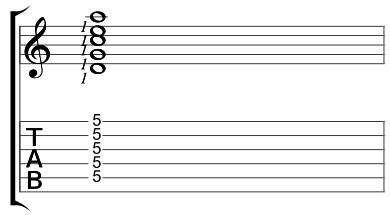
As a start let’s look at an E minor 7 chord:

E minor 7

Interesting observation – if I look at the barred notes on the 5th fret:

5th fret barre

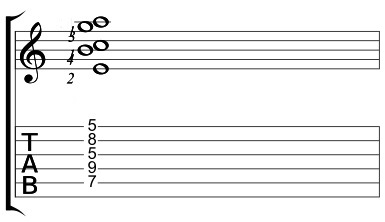
The notes are all found in the parent scale.  If I think of this voicing as a virtual capo and drop some of the notes on the 7th fret of the E minor chord to the 5th fret I get this really cool chordal cluster:

E min 7 (add 11 add b13)

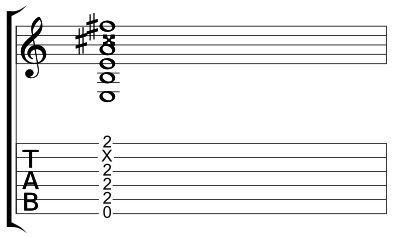
Going further – I could use open strings instead of the 5th fret and get a less clustered sound.  Instead, I decided to flip my capo around and use it as a partial capo on the second fret so that the low E string would ring out unobstructed but the rest of the notes on the second string would be fretted by the capo.

2nd Fret Partial Capo

Using the same idea as the previous example here’s the same modified Emin7 shape using notes on the 2nd fret instead of the 7th fret.

E min 7 sus 4

Make sure to play through those clusters individually as there are some good sounds there!

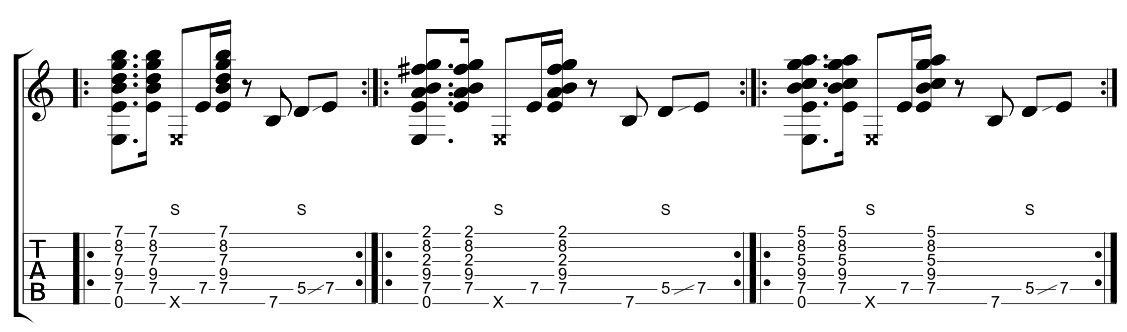
Put it together in a little string slaps for percussive effect and you have a little groove like this:

E min vamp

.

Note:  I play the notes on the B and D strings with the 3rd and 4th finger while I move the capo.  How I attack the D-E at the end of each measure will depend on fingering.  Sometimes I’ll slide and some times I’ll hammer on.

This is a pretty simple idea, but there are a few challenges with executing it cleanly.  Just remember to pay attention to the 3 T’s (Timing, Tone and (hand) Tension) and be aware of your finger position to make sure that the strings all ring out.

File under – a little theory can go a long ways!  I’ve left a number of variations out of the lesson to have one simple thing for you to develop on your own.

Good luck!

-SC

PS for those of you who are interested – this was tracked on my iPhone with the JamUp Pro app and a Line 6 Sonic Port interface.  A review of the Jam Up app will be up in the weeks ahead on Guitar-Muse.

It’s Not All Gold

As a professional – one important lesson to start internalizing is the need to balance being passionate about what you do and maintaining an emotional distance from it at the same time.

Hostile Terrain

Most of you have never heard of my first self published book, an unabashed DIY effort called Hostile Terrain.  It featured poetry, some plays, essays and other works.  Truth be told, about 30% still holds up as writing that I’d be willing to show to other people.

Hostile Terrain came out of a process of years of journaling.  I wrote everything down as an outlet.   I was depressed and desperate and it took a long time to realize that journaling just fed right into that.

I didn’t realize at the time that writing wasn’t getting bad things out of my system, but instead, it was just making me sicker.  I was breathing in the same stagnant air and thinking that I found something invigorating and relavatory because I was equating output with discovery.

In the next stage of this process, I was living with a person in a completely isolated situation and had hit emotional rock bottom because I had to confront things that intellect alone couldn’t solve and that I simply didn’t have the emotional maturity to deal with.

In the middle of this terrible living situation, a freak accident happened where the room I was living in flooded.  I lost 10 years of writing and journals.

I was devastated.  It was thousands of hours of work down the drain (or so I thought).

So being emotionally crushed, I went back to what I knew.  I went back to writing and eventually I wrote some more and then put out Hostile Terrain. I sent it out to friends and to a few publishing houses I was into, and while I got a few “attaboys” I got no interest from anyone for anything resembling publishing.

Bedtime Stories For Mutant Children

In the meantime, I decided to move away from poetry and into short stories.  I was really influenced by Tomas Bernhardt’s The Voice Imitator and decided to write a series of short stories that focused on dark stories for adults told in a children’s storybook style.  This was about 1996 or so. The Tim Burton book, The Melancholy Death Of Oyster Boy, came out mid project and even though I was jealous he beat me to the punch – my stories were much darker and I thought I might be able to get some publishing interest for a character I developed while on a grim tour of Germany (Kommandant Kumar) and for the overall book concept, Bedtime Stories For Mutant Children.

I had all the stories online so I could get feedback from my friends.  I didn’t have a computer at the time so I was working on my friend’s work computer.  I did this off and on for about a year.

Then something happened.

Within a 24-hour period the web server went out of business AND the hard drive that I had all of the files on seized.

I lost 30 short stories. Gone. Casper.

I hit my frustration limit and I stopped writing.  I abandoned the screenplay I wrote. I stopped all of the other writing I was doing and I worked on other things.

Eventually, I started seeing things differently, and I came to a realization.

It’s Not All Gold

  • There is no scarcity of ideas.

  • Not every idea has value

  • Important ideas will return

  • Sometimes it’s the process and not the product

There is no scarcity of ideas.

This was the biggest obstacle that I had to overcome in my own thinking and it’s one I still wrestle with.

There’s a fine line between being attached to an idea and being chained to it.

The difference is whether the idea you’re working with serves your larger goals, or if it’s only serving its own completion.

You don’t have to hold onto every idea like it’s a precious nugget.  There are more of them out there.

Not every idea has value equal to the amount of work needed to put it into action.

Again, it’s easy to get emotionally attached to the work put into an idea and equate work with value but that’s not always a direct relationship.  If you ever watch an episode of Shark Tank, you’ll likely see businesses where people have invested hundreds of thousands of dollars into a product that has generated no revenue after several years in place.  This is what I’m talking about.

Cultivating the mindset to distance yourself emotionally from what you’re doing is a difficult process to develop and maintain but it’s an extremely valuable one.

Important ideas will return

I like documenting things because sometime I find things worth exploring but, in retrospect, every really good idea I couldn’t remember came back to me or presented itself in a different form.

Sometimes it’s the process and not the product

For me, this is the most important lesson in this piece.

Earlier, in regards to losing all of my writing, I said that:

“It was thousands of hours of work down the drain (or so I thought).”

That work wasn’t down the drain at all.  The work I put into that sharpened my writing and really honed my ability to focus.

That emphasis made huge differences in my practicing and ultimately affected other areas of my life in a much more positive way than the actual writing ever did.

When I work on projects now, I assess the value of the outcome and the value of the experience and if either one makes sense for me to do, then I’ll take it on.

Don’t get hung up on old ideas at the expense of new ones.  Implement, assess and then continue or abandon as need be.

I hope this helps and as always, thanks for reading!

-SC

Keeping Your Ego Out Of The Song’s Way

Hey everyone.

A quick update before the post.  Just as an FYI – the podcast isn’t dead but with a number of recent time crunches and an unstable recording environment for a while recording opportunities have been non-existant.  There will definitely be more (less apologetic)  posts in the future.

Glenn Branca Ensemble at Berlin Atonal (Photo taken from Berlin Atonal FB page)

Glenn Branca Ensemble at Berlin Atonal (Photo taken from Berlin Atonal FB page)

Meantime back at the ranch –  I just got home from some shows in the UK and Germany and doing any type of touring always makes me a little introspective and makes me think back to this post that was originally posted on guitArchitecture.  It’s interesting playing shows with someone like Glenn Branca because you’re surrendering to the composer’s vision and doing your best to execute it.  It’s a mind set “classical” players live in constantly but it can be a strange one for an improvising artist.

Letting the song sing

One of my more esoteric laptop guitar gigs with Mark Trayle and Ulrich Krieger is up on SoundCloud.

My rig is essentially the same as before:

Guitar (8 string Omen) –> Duet Break out box–>Duet–>Laptop (w. usb Line 6 shortboard)–>AU LAB (w. SooperLooper and PODFarm)–>18 Watt atomic amp.  My favorite tech comment came from Mark, “Wow I just realized that your entire rig is on the lectern.  That’s pretty cool…”

Gigs like this are a little strange for me as multi-layered looping, manipulating and mixing typically involves a lot more editing than actual playing, but a big part of a situation like this involves keeping your ego out of the music’s way and making sure that you serve the song.

The Obligatory Experiential Example

Once I saw a gig at the House of Blues with Shawn Lane, Jonas Hellborg and Apartment Q258.  I was really excited to see the show and the first set was a  cool improv.  I was blown away at the hairpin turns that Hellborg and Q258 were taking, but at the 40 minute point or so – it looked like it was going to wrap up, and I guess Shawn hadn’t played enough – because he pulled out a 15-20 minute guitar solo.  While I love Shawn’s playing, I was looking at my watch by the six minute point.  It was so over the top that I left before the set was done.  It was just too much, had nothing to do with the spirit of the piece and just had too much to do with him showing us how well he could play.

About a year later I saw one of the strangest lineups I could remember:  Buckethead (with bass, drums and DJ) and Lane/Hellborg/Q258 opening for The Jazz Mandolin Project.  Initially, my thought was, “oh no not this again” but this time Lane was playing tunes.  The group played 3-4 tunes with open sections.  Everyone was playing in service to the song and there aren’t three people on the planet that could have played that set that night better than they did.  Jazz mandolin project got crushed but to be fair, I felt bad for any band that had to go on after Buckethead and Lane that night.

Which kind of musician are you?

Essentially there are two types of musicians that I’ve met in my travels:

  • there are people who play instruments to play music
  • and then there are those who play music to play their instruments.

As a related example, please allow me to explain…

Why Some Academic Jazz bugs me…

When I went to Berklee, there was an overarching theme that ran through many of the jazz recitals I saw:

  • Get through the head as quickly as possible
  • breathe a sigh of relief that that’s done because now the “real” music can happen (solos)

If you hate the head so much, why even play it?  Why not eliminate the song form entirely?

It’s because people are taught that the real music comes from their melodic/harmonic voice rather than emphasizing that it’s their voice in service to a context, be that a song form, a dialog with other players, or a specific audience/performance situation.

It’s a big part of why I never played jazz.  When studying it, I quickly realized that I just didn’t dig a lot of the real book tunes.  What I dug were specific players and those players always play the song and not the instrument – be it Ornette, or Monk or Bill Frisell.   It’s the combination of the players and the material that got to me.  I’m much more open about jazz now but that concept of the tune as a necessary evil is abhorrent to me.

For the players out there, on gigs like the one I posted, there are plenty of moments where I have to resist the urge to overplay and what follows are several techniques I use in that service, but for non players I use some of these approaches  in conversation as well.

1.  Pause and take a breath.  After that breath, do I still need to play/say what I want to play/say?  If the urgency is still there – then I play it.  90% of the time it probably isn’t.

2.  Play only when I exhale.  Sometimes I’ll talk or sing while I’m playing as well.  Sometimes that has nothing to do with the notes coming out of my guitar – but it’s about an interactive conversation.  And I want to make sure that everyone else speaks as well.

3.  Overplay and then regret it later.

Here’s another way to think about it.  You can work out consistently and build up huge muscles but you only need the muscles of a baby to pet a cat and if you handle a cat with the same force that you lift weights, you’ll probably kill it.

Just because you can play a million notes doesn’t mean that a million notes are going to work in every situation, but if you have the ability to play a million notes in your pocket you can pull it out when you need to.

In other words, your strength may not help you in petting a cat – but it may be the thing that keeps you alive when a book case falls on you.  Context may not everything but it’s a whole lot of something to consider.

Playing with good people is 1/2 the battle

Fortunately, Mark and Ulrich are such incredible musicians that it set the tone for the performance.  I knew that whatever they did would be great and that all I had to do was help mark the path and stay out-of-the-way when necessary.  I’m really fortunate that I’ve been able to play with people like Vinny Golia who are at such a stunning level that it’s going to bring me up a little just by sheer gravitational talent pull (and more likely to get my performance up by kicking my ass into gear to get with the program.)

The laptop/looping things I do are really different from many of the other contexts I play in but I enjoy them immensely and hopefully other people will as well.  Here’s hoping we see some official collins/krieger/trayle recordings in the future.

Thanks for reading!

-SC

ps – If you like this post, you may like the kindle ebooks I have for sale on Amazon.

Revised Pentatonic Visualization Book Is Out Now

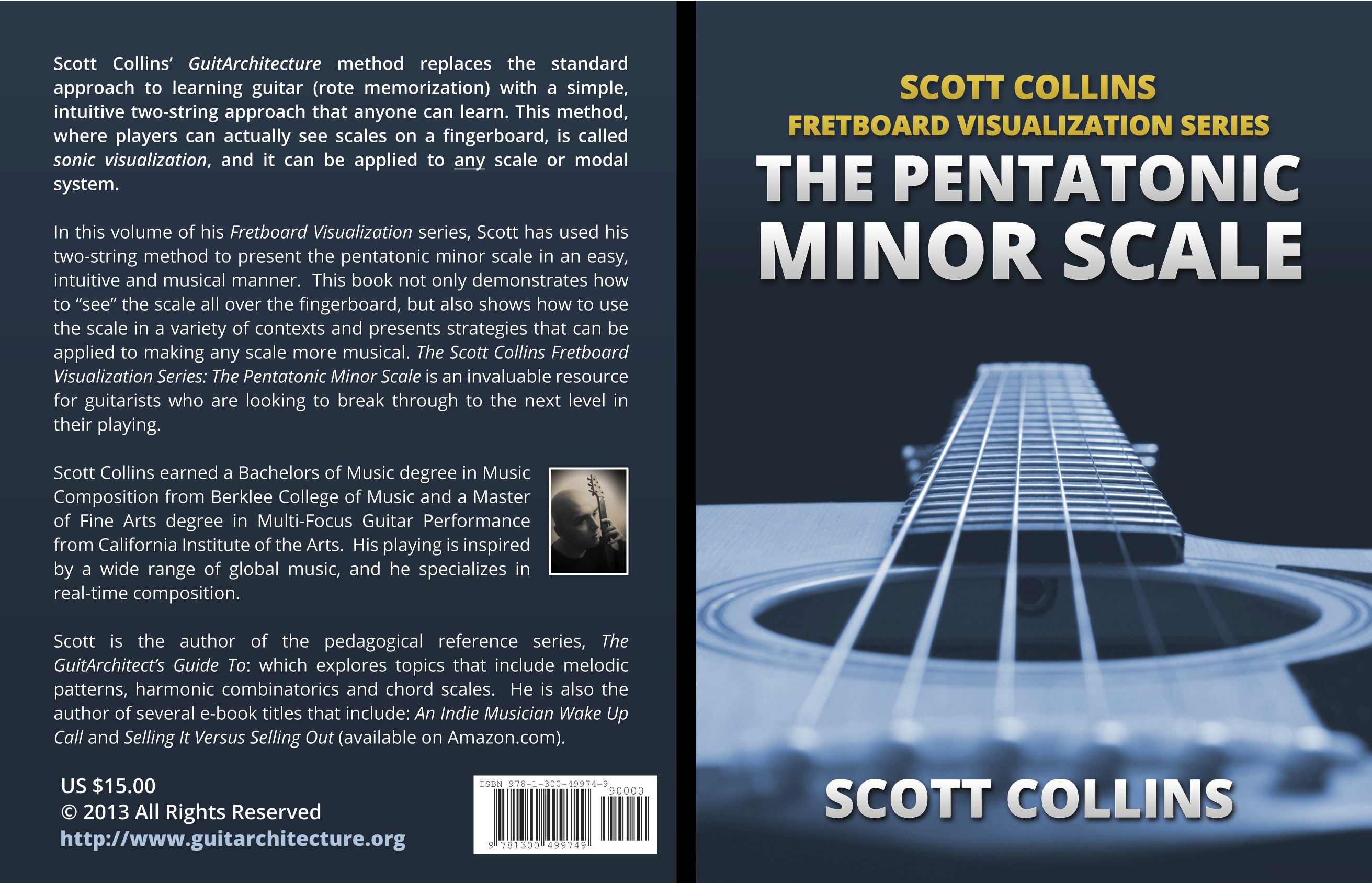
Scott Collins’ Fretboard Visualization Series: The Pentatonic Minor Scale

Hey Everyone,

After several months, I’ve just completed a massive update to my Pentatonic book and the print edition looks great!

This updated edition is almost twice as long as the original Fiver edition and has a complete overhaul of the text and graphics!

The updated version is $15 for the print edition and $10 for the PDF from LULU (The print edition should be up on Amazon in a couple of weeks)

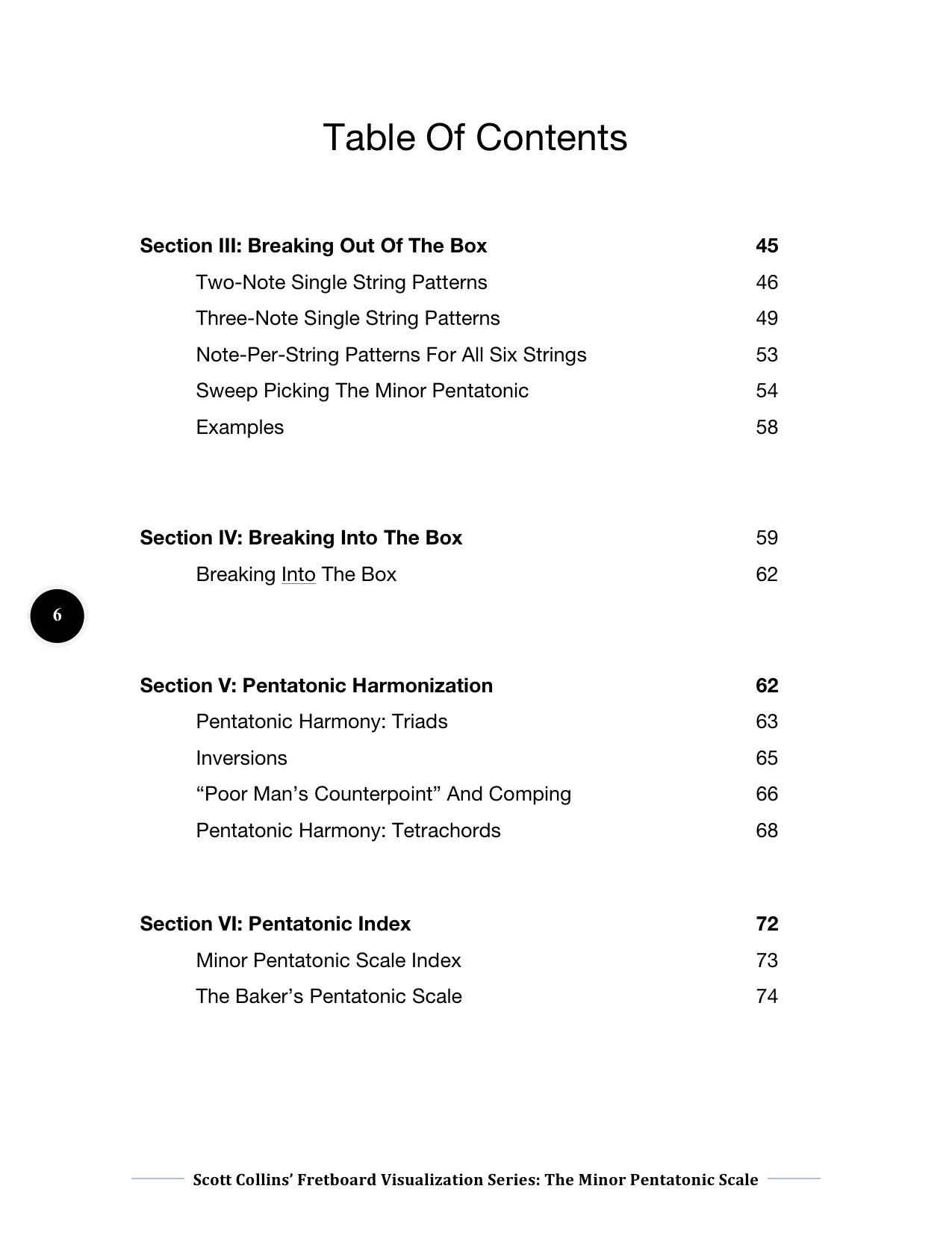
Pent table of contents 1


Pent Table of Contents 2
Pent table of contents 3

You can preview the contents and order it here.

The information on the back of the book follows.

Scott Collins’ GuitArchitecture method replaces the standard approach to learning guitar (rote memorization) with a simple, intuitive two-string approach that anyone can learn. This method, where players can actually see scales on a fingerboard, is called sonic visualization, and it can be applied to any scale or modal system.

In this volume of his Fretboard Visualization series, Scott has used his two-string method to present the pentatonic minor scale in an easy, intuitive and musical manner.  This book not only demonstrates how to “see” the scale all over the fingerboard, but also shows how to use the scale in a variety of contexts and presents strategies that can be applied to making any scale more musical. The Scott Collins Fretboard Visualization Series: The Pentatonic Minor Scale is an invaluable resource for guitarists who are looking to break through to the next level in their playing.

The Print Edition of the book is $15, and the e-book version is $10 on Lulu (the revised print edition should be up on Amazon in the next 2-3 weeks)

The Original Fiverr Edition

In the meantime, for those of you on a budget – the original pdf lesson book is still available for $5 on Fiverr (That link is here).

I’ve broken the book out into six different lessons over 50 pages that covers:
.
  • how to visualize pentatonic minor scales on the fingerboard positionally
  • how to use the scales over different tonal centers
  • one string patterns
  • cool ways to sequence the melodic cells with combinatorics and…
  • pentatonic harmony (Worth the price of admission alone)

.

In other words, it’s a series of short succinct lessons to get under your fingers to start playing but with enough meat on their bones to keep you busy for a while.

Here are some reviews from Fiverr:

“super fast [delivery]. looks good – now i have one more reason to hide and play. thanks!”

“Excellent value! look forward to putting it into practice.”

“Very useful guide for those interested in the material. Great seller!”

“This is the way it should be taught! This method helps you to arrive at a good understanding very quickly. Thank you very much!”

“Fantastic book. Looking forward to checking out your other stuff. Glad I came across this!”
“Great course. I didn’t realize it was this much info. Thanks a lot.”
.
Thanks Everyone!  Keep an eye out for my new Pentatonic Extraction Book which should be out this fall!!!!

Changing One’s Perception And Removing “Should” From One’s Vocabulary

“Oh should you now?”

We all have things that we know we’re supposed to do and don’t do with frequency.  We should see the doctor regularly.  We should exercise more and eat less.  We should really write our grandma.  We should really get to practicing.

The reality is that “shoulds” are little minefields in our brain.  We plant them around everywhere and then get absent-minded about where they are.  When we finally have to confront one, the temptation is to get upset because you now know what you should have done and did not – and the onus of it falls on you.

Getting past “should” is a life long struggle and as someone who is still working on it, I can say that it’s not easy but it is possible.

This can be done by removing the phrase “I should” from your vocabulary and replacing it with “I am

(i.e.  replacing “should” with “do”)

.

Adjusting your perception.

If you meet expatriates from the US who have been living in another country for a long time and not speaking their original language, occasionally they have a real disconnect when you speak English to them.  This has happened to me on several occasions where I’ve met people who were frustrated at not remembering words in English and feel very disconnected in speaking it with people.

.

There’s a reason for this.  They’re out of practice.

If you are a native English speaker in the US – you practice speaking and writing in the language every day.

.

The difference is you probably don’t think about it as “practice“.

You just think about part of it as your day.  As something that you do naturally, you don’t think of it as work or drudgery.  You feel comfortable enough in your use of it that when you are confronted with phrases or terms you’ve never heard before – you simply listen instead of freaking out and make sense of in in context.  You pick up information and interact with it all day long.

If you doubt this, try the following: Take your current practice regimen and instead of practicing scales or chords or what have you, take out a dictionary and apply the same regimen to trying to expand your vocabulary.  Unless you’re studying for the SATs or GREs, I bet you make it a day before it gets discarded entirely or doomed to the “should” bin.

.

If you make practicing just part of your regular day instead of something that has to be carved out of your schedule it will be easier to maintain.

.

Occasionally, I read articles with guitarists who claim that they never practice.  It’s important to remember that anyone who is the topic of an article in a trade publication  is generally going to be a professional musician with a rigorous performance schedule.  If they don’t have time to practice – its only because they’re gigging too much and while they may not be “practicing” by a strict definition you can bet they’re keeping their chops up.

.

I have no idea if Scotty Anderson “practices” but based on hearing him play I imagine that he has a guitar in his hand most of the day and is either playing or working on things all of the time.  Eddie Van Halen is another guy who may not identify what he does as practicing – but every interview I’ve read with him makes it seems like he has a guitar in his hands playing for hours every day.  (It’s also worth noting that many people consider Van Halen their best album for songs and playing.)

When Jimmy Rosenberg was playing with Sinti at the ripe old age of 16 he was asked by a guitar magazine how he got that frighteningly good at that age and he said, “Well I practice/play 4-5 hours a day, and rehearse with Sinti 4-5 hours a day, and then we have concerts”.

If you have a problem committing to practicing, you could change your mindset to move past “practicing” as an event and instead concentrate on doing” as a habit.

.

Think about how easy it is to gain a bad habit.  Now think about how hard it can be to break that habit.

There are plenty of good habits that you probably have developed as well and maintaining a good habit requires very little work.

Again it’s about perception.  If practicing is something you view as a chore it will be something that you are loathe to do.  It’ll be much easier to practice if you can make it something you look forward to.

To quote Albert Ellis,

“Don’t should on yourself”.

I hope this helps!  Thanks for dropping by!

-SC

.

The GuitArchitect’s Guide To Modes Part 17 – Makin’ Mu-sick With Not-Peggios

Hello everyone.

Here’s another short lesson that may keep you busy.

One thing to consider in any of the material I’ve ben presenting is that all of the modes, scales and other materials that I’ve presenting are all just tools to get to making music.

So here’s an example where I’m “breaking” few of the rules I’ve previously posted to get the sounds I’m looking for.

The lick.

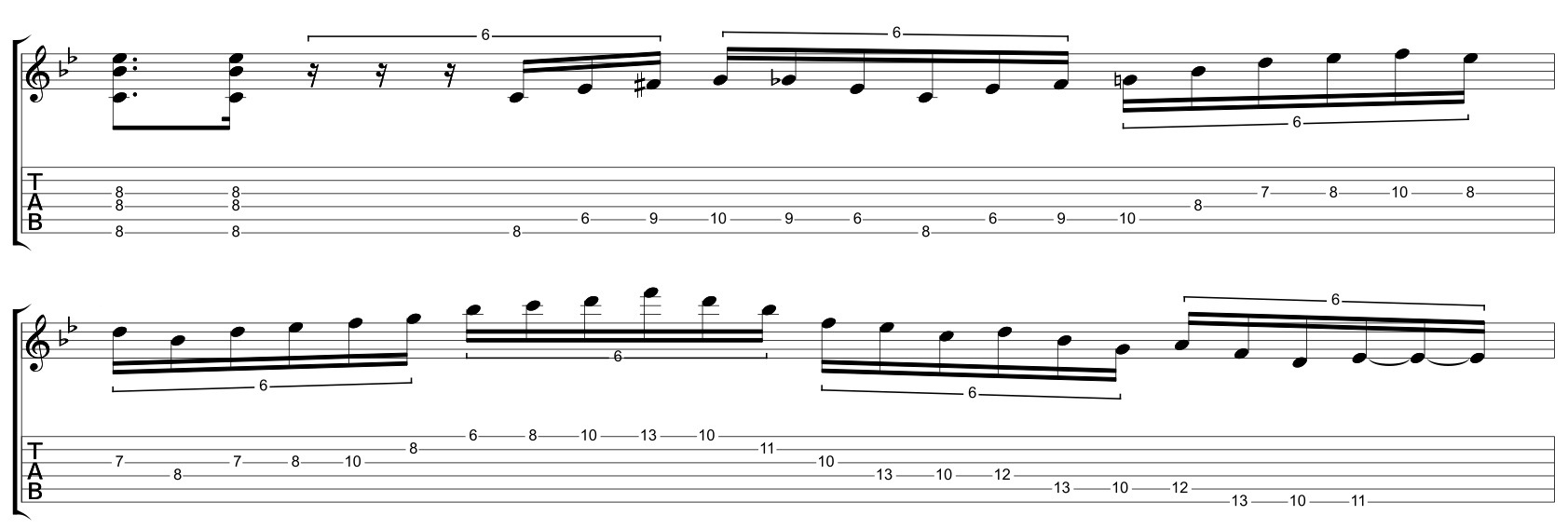
Here’s a lick I threw out over a C minor 7 vamp:

Click To Enlarge

Click on image to enlarge

Here’s the audio:

(If the play button doesn’t work – just click on the title and it’ll load in a new window).

.

Some “Broad Stoke” notes.

  • Contrasts play a critical role in having a good solo.  In the case of soloing over a vamp like this, I would either start spare and build into something rhythmically active or hit the gas out of the gate and then wind down (or further up) into something.  Since I’m playing something rhythmically active in the example above,  I’d probably phrase a series of short sparse lines after this and then build it back up again.
  • Speaking of rhythm, I usually try to start long passages off the beat.  It just allows the phrases to breathe a little more and starting fast passages on the beat makes me think of ’80’s metal.  Not a bad thing – but not what I’m always going for. ; )  Also the patterns are based around 4-note patterns so I’ll typically play them as sextuplets to make the phrasing less well… ’80’s metal.
  • The Paul Gilbert-ish pattern (ascending phrases that descend on a note and then ascend again) is one I use a lot.  Part of that use here is pedagogical.  By using the same rhythmic idea, it allows people to focus more on the notes being employed.  (Part of this is hoping that if I keep putting Paul Gilbert tags in my columns that he may find this blog eventually!)
  • The best thing I could do in this context might be to play nothing – but that makes for a boring lesson. Typically in soloing I want to be pretty deep in the song after a lot has already been said before I start putting my $.02 in.  When I see people starting to solo before they even know what the melody is, I kind of know what to expect.

Some Specifics.

  • The first chord is a C minor 7, so one of my first thoughts is to superimpose a G minor idea over it, and my initial thought was G Harmonic Minor.  To extract the “not-peggio” I start with a three-note per string harmonic minor scale from Bb….
G Harmonic Minor from C

See my previous lessons if the interlocking 2-string patterns are unfamiliar to you!

and then remove the first and third note on the low E, D and B strings.

I’ve notated this below as both 1/16th notes and sextuplets.

Notpeggio Extract
  • As I mentioned in part 16, with this approach, I tend to keep the arpeggio shape in position which means moving the shape on the highest two strings down.  So instead of starting on the pitch G on the B string I start on the F#.
high E string pattern

previous 6-note pattern – revised 6-note pattern

Conceptually it’s a small shift but it changes the six-string extraction to the following:

Modified patternwhich fits under my fingers much better.  While the interlocking two-string patterns may be confusing, the resulting “not-peggio” lays out nicely between the 6th and 10th frets.

  • Chromatic alterations.  If you look at the initial lick, you’ll see I alternate between the F# and the F natural.  Again, these patterns should just be viewed as a launching off point to develop your own ideas.

The Arpeggio

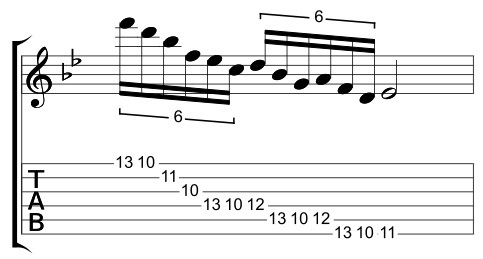
At the end of the phrase I slide up to an F and then descend on a Bb arpeggio.  For visualization purposes, here’s a version that starts on the beat:

Bb Major arpeggio w. encircling

Notice that on the bottom three strings I incorporate an encircling motive where instead of landing directly on the note D on the D string, I land on an Eb, go down to C and then hit the chord tone D.  This is a great way to add some zip to arpeggios and get a little extra mileage from a well worn melodic device.

This is a short lick that may take a while to get under your fingers!  I’m only playing it around 100 bpm or so as that’s the pocket I felt, but if you’re unfamiliar with sweep picking or the encircling idea with the arpeggios even getting it clean at 90 might take a while.  Just go slowly and work on the 3 T’s (Timing, Tone and Hand Tension).

That’s it for now!  I hope this helps and I hope that this lesson gives you some inspiration in developing your own melodic devices!

-SC

p.s. – The Rest of the “Not-peggio” posts can be found below:

The GuitArchitect’s Guide To Modes Part 16 – Not-Peggios Positional Lesson

The GuitArchitect’s Guide To Modes – Part 15 – Not-peggios – Harmonic Minor Version

The GuitArchitect’s Guide To Modes – Part 14 – Not-peggios – Melodic Minor Version

The GuitArchitect’s Guide To Modes – Part 13 – “Not-peggios”

p.s.s. – If you like this approach – the following books may be of interest to you!

guitarchitect-2 harmonic-combinatorics melodic-patterns positional-exploration

Don’t Be Afraid Of The Work

As I edit this, I’m taking a break from the final edits on the print edition of Pentatonic Visualization and working on the layout/order/edits of my Pentatonic Extraction book which should be out this fall.

That puts the tally to 3 books in 2011 (Melodic Patterns, Positional Exploration and Harmonic Combinatorics), 3 in 2012 (Chord Scales, and 2 short Kindle titles – An Indie Musician Wake Up Call and Selling It Versus Selling Out) and 3 in 2013 (Symmetrical 12-Tone Patterns, Pentatonic Visualization and Pentatonic Extraction) with a strong chance of another kindle book released this year as well.

.

While being able to call yourself an author seems appealing -working at this rate is arduous at best. When you don’t have a production house behind you – writing means taking on all of the menial tasks in getting a book out.  In this case, even something like the Visualization make over has taken a month to get done and taking on the Extraction book involves massive edits, re-writes and a complete reformatting (typically involving a tedious cut/paste/format/edit workflow).  The appeal of being an author becomes less glamorous  when it takes days and weeks of mind numbing work to get the book out the door.

.

But here’s something I’ve discovered:

Many people want to get better at something.

They have access to materials.

They have access to knowledge.

They have the desire to move forward.

.

Even with all of that energy and good intention, in any endeavour most people won’t do the work over the long haul.

.

Because the work is not glamorous.  It’s not always fun (though it’s usually nowhere near as bad as we make it out to be).  It’s often tedious and time-consuming and isn’t there something better (read more enjoyable) to do?

.

The real pay off is in what happens in the focused work.

Jonas Hellborg

Yngwie Malmsteen

Miroslav Tadic

Buckminster Fuller

Nikola Tesla

Thomas Edison

Jorge Luis Borges

It doesn’t matter which successful person you pick.  Most people who succeed do so because in addition to the initial vision (inspiration) they also have the ability to go the extra distance and see something to its logical conclusion (endurance).

.

Don’t be afraid of the work.  It’s where the nectar is.  It’s where the magic is and…

when you truly devote yourself to your work – you work on yourself at the same time.  

.

When you lose yourself in your work you’re really finding more of yourself.  You have to have your eyes open to see that.  You have to be open to that possibility to perceive that and you may not recognize it until later – but that connection ( or Csikszentmihalyi’s flow) carries through into other things.

A lesson from Borges

In the later years of Borges life (after his vision had gone),  he would write whatever story or poem he was working on in his head and then spend some time editing and perfecting each phrase as an internal process.  When it was done, he would call in his assistant and recite it in it’s final form to be transcribed and read back to him for approval.

.

Now 2 questions:

How many other people could write under those conditions?  A few.

How many could write at his level?  None…even with their sight.

He could have easily made excuses – writing in this fashion is incredibly difficult – but instead he put the effort in and continued to get his writing out into the world.

.

If you’re doing the work, you’re already ahead of the pack.

.

I hope this helps!  Thanks for reading.

.

-SC

(Special thanks to Chris Lavender for some extra perspective and inspiration on this post)

eX-Girl Lesson / Player Profile on Guitar-Muse

Hey Everyone,

My latest Guitar Notes From The Underground article is up on Guitar-Muse and features a song analysis that showcases some really cool riff ideas.  If you’re looking to hear something a little bizarre this morning (or looking for some new ways to break out of your writing rut) you might dig it!

I tend to keep the transcriptions spartan and just focus on the notes so people will check out the tracks, but if you’re willing to forgo crescendos, tempo markings and accents, the article is here.

For for those of you who are following it, the new Guit-A-Grip podcast will be up on Friday.

As always, thanks for reading!

Back to the Mono Kero!

-SC

The GuitArchitect’s Guide To Modes Part 16 – Not-Peggios Positional Lesson

Hello everyone.

This is going to be a short lesson as the concept is really simple but making it work requires a lot of shedding.

For those of you who have been following the guide to Modes might remember that back in part 3a/3b, I outlined a method for connecting 2-string modal patterns positionally using a simple rule where:

(As the scale ascends the patterns descend and vice-versa)

so that this C Ionian fingering


Can be broken down into three distinct two-string patterns:

.

.

Or

.

.

(You can review the earlier posts if this looks unfamiliar to you)

And the not-peggios?

Guess what?  The not-peggio shapes I’ve covered work the same way.

Previously, I took the two-string shapes and moved them in octaves – but looked at positionally…

C Major Positional Notpeggio I

Note that the first note of each 4-note goes from C to B to A.  (Or uses the C Ionian – B Locrian – A Aeolian shapes).

Since the pattern contains a c and a f (and avoid note over C Major) I decided to use this form over the relative minor (a minor) In this audio example below, I’ve played an A minor (add9) chord and then played the notes as a sextuplet (then as 1/16th notes).

What’s cool:

  • The resultant sound is somewhere between a scale and an arpeggio
  • All the notes from the parent  scale are present but divided out in different octaves
  • The concept works with any of the two-string shapes I covered (major, melodic minor and harmonic minor)
  • The pattern can be adapted to work over any diatonic chord (Try this one over D minor as well)

What’s jive:

  • The pattern features a funfy positional shift between the G and B strings which is VERY difficult to get smooth when descending.

The Workaround:

The workaround is very simple, I just change up the pattern order on the b and e strings.

In the example above I replace  C Ionian – B Locrian – A Aeolian shapes with C Ionian – B Locrian – G Mixolydian.  That results in:

C Major Notpeggio II Positional

It does make the overall pattern a little more scalar, but the only main difference is that this pattern lacks the A note.

In the audio below, I just played a sextuplet pattern and ended on the B (the 9 over A minor) the first time.

Homework:

Okay!  If you like this sound – here’s what I think you should do:

  1. Go back to part 13, part 14 and part 15 and review the Major, Melodic Minor and Harmonic Minor 2-string shapes and related chords.
  2. Record a diatonic chord from a group and practice one ascending pattern positionally over the chord.
  3. Try changing chords over static patterns (and vice versa) and start to make a record of which patterns you like over which chords.

This might sound like a lot of work, but the reality is that pretty quickly you’re going to find one or two of these that you really like and the idea is to tae those and try to incorporate them into your playing as thoroughly as you can!

I hope this helps!

The Perils Of Panaceas And Instant Gratification

That’s MBTI to you, Buster!

Most people have their first exposure to the Myers-BriggsType Indicator (MBTI) assessment either in a college psychology class, a life coaching session or in a work-related retreat / team building exercise.  For those of you who aren’t familiar with the test, participants are given a (psychologically loaded) questionnaire that’s been specifically devised to determine individual preferences and based on those, to then extrapolate the test taker’s decision-making process and world view.

In context, it can be a useful tool.  When participants get their four letter code that determines their personality type, they then typically get the equivalent of a score card to determine what the letters mean and to offer some guidelines on the types of decision-making process that they make.  Again, in context it can be a useful tool where participants might see themselves and their decision-making process in a whole new light.

However,  there always seems to be at least one person in a session who finds this to be something between a milestone and a revelatory experience and the next thing you know, every discussion with this person centers around Myers-Briggs.  Every interaction is analyzed and put through the Myers-Briggs filter.   “Oh well he must be an “I” which means that….”.

And then, eventually, someone calls them on their nonsense.

Myers-Briggs typing starts to break down in the real world, because while it’s not a bad contextual lens for gleaning some information, it’s not a good lens on its own and it certainly has limited validity as the sole filter for information.  Additionally, people don’t dig being typecast in any scenario, even when you’re trying to be helpful.

.

“Cure’s All that Ail’s ya!”

The web is full of these observations and cure-alls for whatever ail’s ya.  “Become a guitar god in a week by following these 3 weird simple rules.”   Or forums where one observation is yielded, “I had good success using product x with gear y” and soon you have other people who have never used product x or gear y saying, “Well if you use gear y YOU HAVE TO USE product x!!!”

Take any one-size fits all methodology, philosophy, strategy or any  solution with a BIG grain of salt because, in my own experience, there is no one panacea for anything. Just as there is no one filter that will make previously hidden elements of the world fully visible and comprehensible to you.

.

Instant gratification and false entitlement

.

The simple fact is that things that are worth having, have to be worked for.

.

As a society, we have mutated this concept through advertising and sold people on the concept that because they do work hard in other areas of their life, that they deserve everything.

“It might take you 3 years of saving to buy that 60″ flat screen TV.  You’ve worked hard establishing a line of good credit and you deserve to be comfortable in your twice re-financed home.   Pull that piece of plastic out of your pocket and you can walk home with it today!” – where you will set it up, take it for granted almost instantly and then spend 5 years paying it off and paying more than twice the actual cost of the item.

As Pascal said, “A trifle consoles us, for a trifle distresses us.” It should be called instant gratification because you’re gratified in an instant and your gratification lasts just as long.

.

Guitar playing isn’t like that.  Certainly pedagogy and information transfer has occurred to the point where people can progress technically much more quickly on the instrument than ever before.

But the problem is that guitar playing isn’t merely a skill like typing.

More than a skill set, a guitar is a vehicle for expression.  Technical facility might impress people, but if there’s nothing behind it in terms of depth of expression, you won’t make a long-lasting impression on them.

.

Having the depth to truly say something, takes time.  Plain and simple.

.

A good way to think about this is something a great luthier John Harper told me about guitar.  As you play guitar over time, the vibrations of the notes actually affects the wood on a cellular level.  The vibrations literally change the make up of the guitar over time.  This is why guitars that have been “played in” over time sound completely different than they did off the shelf.

.

There are plenty of shortcuts to becoming a fast guitar player.

There are plenty of shortcuts to becoming a better guitar player.

There are no shortcuts to becoming a great guitar player.

.

Truly great players, have a completely different relationship to music than most other people.  Music not only nourishes them, but eventually the musician starts communicating with the music rather than just the audience.  That conversation helps them gain further insight into themselves and actually helps to develop them more as people.

.

Not only is there no shortcut for that – but if you think about it, you really might not want a shortcut in that area. For example,  if you had the opportunity to meet anyone in history would you rather have the conversation with them when you were 4 years old or 34?  It might be exciting to meet them when you’re 4, but you really wouldn’t have anything to say.  It’s only with the passage of time and experience that you can start to meet the music part way and have that conversation. For every person, that time is different but putting the time in now gets you closer and closer to being able to have that dialog.

.

Be wary of the cure-all, the quick fix and the over-arching shortcut.  Work hard and work passionately and know that what you truly put of yourself into anything can ultimately pay dividends for you.

.

As always, thanks for reading!

.

-SC