Hot Rodding Your Minor Arpeggios – Or A Little Theory Goes A Long Ways

Hey everyone!

This post is tangentially related to the Modal Arpeggio posts that I put online so I’ve adapted the title (just like I’m going to be adapting the arpeggios in the post).

.

 “Minor minor on the wall….”

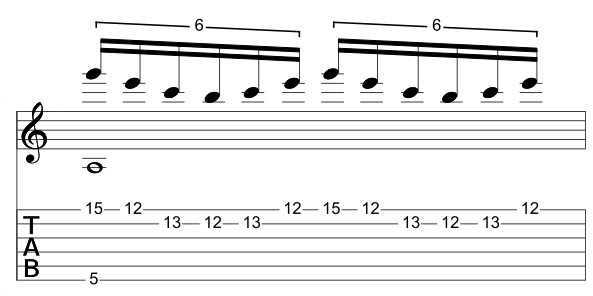
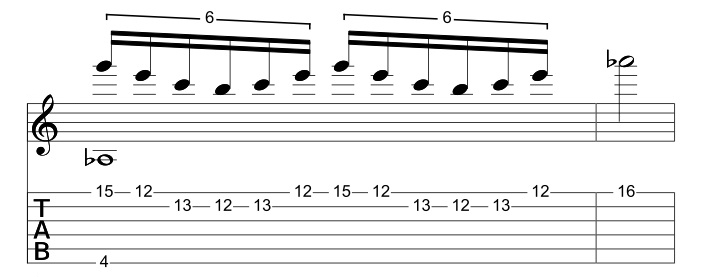
Let’s look at a 5-string A minor arpeggio:

.

.

Now there’s nothing wrong with this form.  But I find that a lot of people practice this arpeggio ascending and descending and then when it’s time to play over an A minor chord guess how they play it?

There was a time in the ’80’s where just cycling an A minor arpeggio over an A minor chord would cut it, but now it’s (yawn) boring.  So what can we do to make it more interesting?

.

Start with the Top Side

.

In a previous post, I talked about modifying triads to get more complex sounds.  In this lesson I’ll apply that to arpeggios.

The following is a map of alterations to show how chord tones can be modified to create other sounds.

.

.

So with any triad:

The root of the chord can be lowered to the 7 or raised to the 9

The third of the chord can be lowered to the 9 or raised to the 11

The fifth of the chord can be lowered to the 11 or raised to the 13

 .

In this manner, a triad can be altered into almost any other functional chord.

.
Let’s apply this to a minor arpeggio.

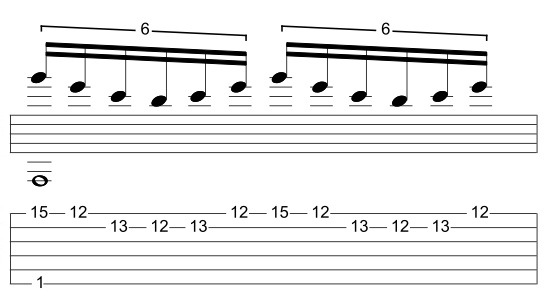
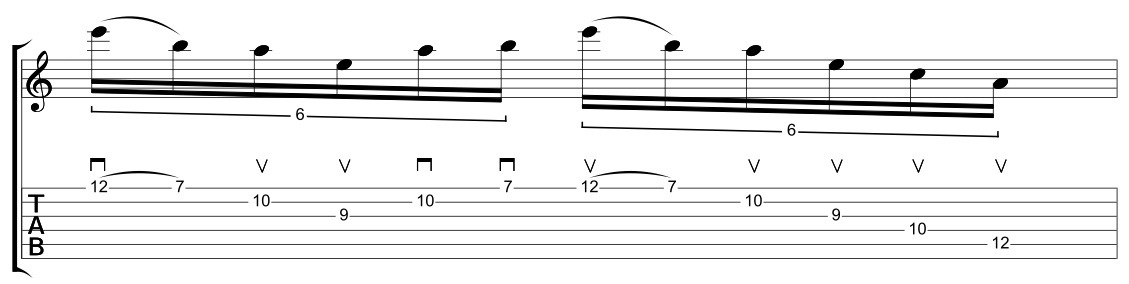
In the case of A minor I’m going to change the C on the high E string to B.  This creates an A minor (add 9) sound.


.

.

This is already a more interesting sound over an A minor chord to my ears.  But cycling the top notes of the arpeggio creates an interesting arpeggio sequence along the lines of something Tosin Abasi of Animals For Leaders might cycle (Try combining this lick with the one before it to see what I mean).

.
.

.

Going under the Hood

 .

This modification idea can be applied to any of the notes of the arpeggio, but for a moment let’s go in the opposite direction.  

In the previous post I talked about superimposing arpeggios.  Here I’ll take the same arpeggio form and drop the low note.  

Instead of stacking ascending thirds  like so:

A [up a 3rd]

C [up a 3rd]

E

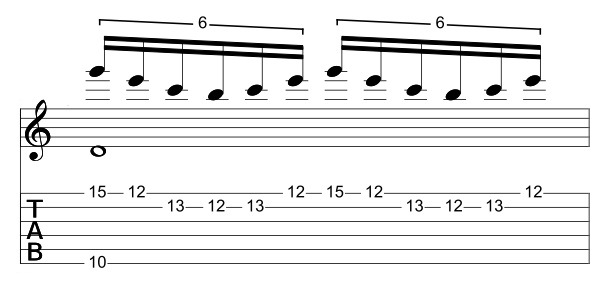
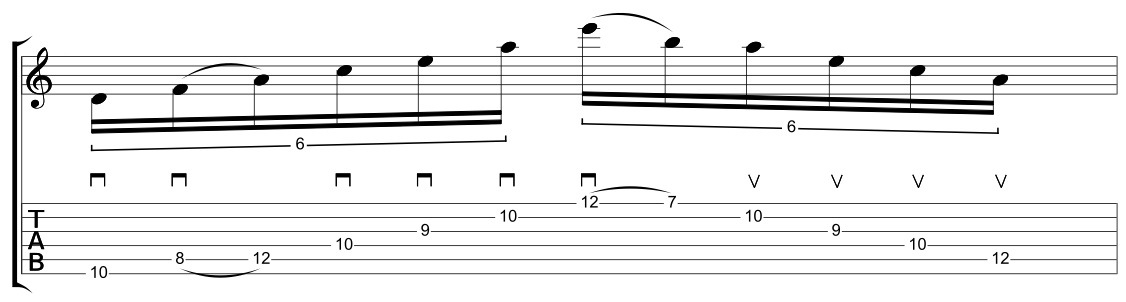
I’m going to go a 3rd below A to F.  In this example I hammer on the 2nd note and then play the rest with sweep picking.

.

.

Over F, these notes become:

F (Root), A (Major 3rd), C (5th), E (Major 7th) and B (#11) or F Maj7 #11.

.

Using F# instead:

.

.

.

These notes then become:

F# (Root), A (Minor 3rd), C ( flat 5th), E (minor 7th) and B (11) or F Minor 7 b5 (add #11).

.

You could also make to low note G on the 10th fret for an A minor 9 sound (starting from the b7 – G) or make the low note an E which creates a A minor (add 9) arpeggio starting from the 5th.

.

For now, let’s stick with the F major 7 (add #11).  If we stack another 3rd below the F, we get D which creates a D minor 9 (add 13) sound. 

.
.


The natural 13 with the minor 9 is truly a Dorian modal arpeggio sound.  To play a simplified version –  just play the F major 7 (#11) arpeggio above over a d minor chord.

.

In the following example, I’ve added an open A string to the F major 7 (add #11) arpeggio.  Try playing this as a repeating figure which changing chords over the top of it.  It might give you a new song idea!

.

.

.

Hopefully this has given you some ideas and some new things to work on.  In the next lesson post, we get back into modes and get deeper into the individual modes.

.

Thanks for reading and I hope this helps!  

-SC

.

PS If you like this post you may also like:.

The Modal Microscope And A Sequenced Arpeggio Approach

Slash and Burn – Creating More Complex Sounds With Slash Chords

.

CREATING CHORDS AND LINES FROM ANY SCALE – A HARMONIC COMBINATORICS / SPREAD VOICINGS LESSON

AUGMENT YOUR KNOWLEDGE: SONIC SHAPES AND GETTING MORE FROM AUGMENTED CHORDS

Slash and Burn – Creating More Complex Sounds With Slash Chords

.
GETTING HIPNESS FROM A MAJOR TRIAD OR MORE CHORD RECYCLING PART 3

Getting Hipness From A Major Triad Or More Chord Recycling Part 2

GETTING HIPNESS FROM A MAJOR TRIAD OR MORE CHORD RECYCLING PART 1

.

RECYCLING CHORDS PART II: TRIAD TRANSFORMATION

RECYCLING CHORDS PART I OR WHERE’S THE ROOT?

RECYCLING SHAPES OR MODULAR ARPEGGIOS FOR FUN AND PROFIT

.

Some Useful Online Practice Tools

POSSESSION IS 9/10S OF THE LAW BUT PERCEPTION IS EVERYTHING OR PRACTICING PART VII

TESTING YOUR VOCABULARY OR PRACTICING PART VI

PRACTICE WHAT YOU PLAY OR PRACTICING PART V

.

DEFINITIONS AND DOCUMENTS OR PRACTICING PART IV

TENSION AND THE SODA CAN OR PRACTICING PART III

PROPER POSTURE IS REQUIRED FOR PROPER PERFORMANCE – PRACTICING PART II

PRACTICE MAKES BETTER AKA PRACTICING PART I

Update – New Guitar-Muse Soloing Article, New Tracks Et More!

Hi Everyone!

I just wrote an “instructional” post for Guitar-Muse about soloing that’s coming more from a self-pedagogical/ philosophical/ motivational standpoint but talks about the factors determining when a song needs a solo and how to develop your own voice when soloing.   It works off of some of the ideas I’ve written about here and you can read that here.

For those of you into the RedLnyx Trials games – you can hear me playing a solo on a track called “Come Alive ” on the new Trials Evolution game.  There’s a video for that here.  The solo starts at 1:26 or so and followed some directorial cues for what they wanted for the solo.  I’ll have a post about my video game recording experiences up next week.

I’ve mentioned Manrico Montero’s awesome Mandorla label before, but I’ve just sent a new soundscape track off to him for an Autumn-themed net release.  I have no idea how my field recording gone awry track will fit – the text for the track is:

“The ground grows cold

the sky holds it’s breath

in Autumn the bill comes due.”

so it may be ambient soundscapes – but it’s not new age by any means!  No word on release date for that yet.

.

More reviews on the way.  I have a new set of monitors that I dig for the price range and I’m working with a beta version of the new Scuffham Amp update for a forthcoming review (early verdict – it’s cool!) More online lessons are also on the way.  I’m trying to get rough hewn tracks out the door and working on tracks for a new project.

.

Finally, I’ve gotten a lot of really kind comments from people about the GuitArchitect’s… book series and I wanted to thank everyone for their support.  I’m happy that the books are out there and that people are getting something useful from them!

.

Thanks again!

-SC

“It only takes one apple” or why customer service matters

Hello everyone!

I’ve written before about my recent relocation, but I had something come up in the move that highlights the importance of every contact we have with other people. 

The Digitech Space Station

The XP-300 is one of my favorite effect pedals of all time.  Having said that:

  • the A/D/A wasn’t great, and it was the exact opposite of transparent in the signal chain.  
  • It had 30-some presets but none of the parameters on any of them were edit-able.  

So while it wasn’t a great pedal on paper,  it actually had some great fx.  In addition to some nice swell sounds (you can hear it here on this Visible Inc. track – I ran out of space on Soundcloud – but I’ll have this up again!)

.

It had some filter sounds that ranged from wild to really musical:

.

and some really cool reverse sounds.  This is from an unreleased TubTime session and a good lesson on how not to solo over a static tonic in 7.  Geoff Chase is killing on drums on all the Tubtime stuff – so a big shout out to him.  Spacestation is in the beginning and the overplaying starts around  1:09.  (As an FYI – If I remember correctly this is a Ernie ball volume pedal, Big Muff Pi, Space Station and a Guyatone MD-2 run through a Fender 4×10 Deville.)

And finally some nice pre-whammy pedal glitch stuff as well (this is actually excerpted from the same piece as the solo above!)

.

Alright – anyway I used it A LOT for a number of years and even when I went to line 6 and laptop rigs it and a volume pedal were often the only external pedals I’d have in the signal chain.  The problem was the power supply connection got a little funky from velcroing it to my pedal board and it started to die on me on various gigs.  So it’s been sitting in a “to do” pile while I hoped that Digitech would get smart and just release the code as an AU or a VST.  (I say get smart because when a pedal sells for 3-400 dollars on ebay there’s clearly a market for it still – so if you already have the code it’s really not that challenging to port it over to a shell and make some money off of it.  But I digress with an aside about quibbles with Digitech’s marketing concept).

During the packing for the move, I had to make a number of decisions about what I was willing to get rid of as I simply couldn’t afford to mail everything.  When I came across the pedal – I went online and read a series of posts that said that Digitech would replace the power supplies for a flat fee of $30-$40 (I don’t remember what it was) so I called the repair center.  I had previously gotten an RMA for a GNX and they did a good job of turning it around so I didn’t expect any problems this time. It took a while to get transferred to the right department but I finally got someone on the phone.

Digitech: “Yeah?”

Me: “I’m sorry I just got transferred here – is this the repair center?”

Digitech: “Oh…yeah it is.  What do you need to get repaired?”

Me: “I just have a power supply on an XP300 that I need to get replaced.”

Digitech: “We don’t repair those anymore.”

Me: “ok…So what do I have to do?”

Digitech: “(Sighs and adopting the most dickish tone imaginable) You need to go to the web page and look for an authorized repair center near you.”

(I should mention that this is problematic for some people because having gone to the web page –  if you don’t live in an area with an authorized repair center you’re directed to the Digitech repair center – i.e. you’re SOL).

Me: “Alright – well the repair centers don’t repair all Digitech products right?”

Digitech: “That’s correct.”

Me: “(Still optimistic here) So is there a way for me to tell from the web page who will repair the unit?”

Digitech: “No you just have to call them all to see who will take it.”

Me: “(pause biting my tongue) So if I do find someone who will repair it they’d still probably have to order the power supply from you correct?” (Now finding this silly since the repair center is still involved on some level in the repair of the unit.)

Digitech: “Yeah probably.”

Me: “(Fed up) Clearly I’m taking up a lot of your valuable time.  So I’m going to let you go.  Thanks for clarifying my relationship with Digitech in the future.”

Digitech: “Ok.”

.

And I threw the pedal out.

That might come across as petulant – but I decided a long time ago that I wasn’t going to deal with poor customer service and what I have a difficult time conveying in the post is the sheer smarminess and exasperation of this person’s response.  

I understand that companies can’t update their products forever – but when a consumer has already purchased a product why would you expect them to go through the legwork when they eventually have to fix it? (Especially when Digitech could have easily just had some unpaid intern contact those repair places and gotten a list of who does what repairs and put that information on the website rather than just say, “Oh we’re not fixing those anymore – so go figure it out.”)

.

The Line 6 Variax

I bought a AC-700 from Sweetwater when they were discontinuing the line and it was a really cool instrument – especially for tracking acoustic guitar parts at home and not having to deal with setting up mics in a noisy apartment.  When the guitar shipped one of the piezos was dead so I contacted Line 6 customer service.  The  person on the phone was really helpful.  They offered to give me a list of repair centers and when I said that I couldn’t be without a guitar for a length of time to get it repaired – he asked me if I was comfortable with soldering (I was) and then said he could just send a replacement piezo and that I could call him when I had to install it when I got them.  He actually mailed me 2 of them (in case one of them didn’t work), and after removing the bad one – the new one worked like a charm.

.

Some thoughts about customer service

.

So the similarity between the two experiences is that I dealt with only one person from each company.  

The difference between the two experiences is that while I will probably never own another Digitech product, I would tell anyone who asked that Line 6 is a good company and that they’re good to deal with.  

.

(In a related note, I have a good relationship with Sweetwater.  Do they always have the cheapest prices?  Nope.  But they have things in stock, they’re knowledgable and they’re pleasant to deal with so when I a/b purchasing something from Sweetwater versus, say Guitar Center and the almost universally awful experiences I’ve had there – it’s a pretty easy decision.)

.

Admittedly, I am over-reacting (and dealing with every other stressful reaction of a move made my desire to deal with repairing something nil) – but the lesson here is that it sometimes only takes one person and one interaction to instill or ruin good will – and it takes a LONG TIME to rebuild that good will. 

.

How many times have you gone online to research a product and found someone just going off on it?  If you really care – you’ll look for other reviews but you only need to find a few of those about a company or product to move on.  Those people kill products and ultimately they hurt companies as well.  

.

As a working musician – you are a business and your business will succeed or fail based on what you offer, who you offer it to and how you offer it to them – so customer service skills are essential.  

.

Please take the preceding and the following as merely the incomplete and well-intentioned advice that came from years of making costly mistakes that it is.  

.

  • Treat every person and every interaction seriously and with respect.


  • Communicate proactively and clearly and put the emphasis on listening rather than speaking.  People generally don’t know how to ask for what they really want – by listening you can help piece together what they are asking for and what they are really looking for/inquiring about.


  • You’re not always going to be able to say yes to everyone or make everyone happy but if you have to say no, offer compromises or other solutions.  Be helpful.  


  • Don’t assume something is clear or understood.  Actively reach out to people you are working with to make sure you’re on the same page and have the same expectations. (I re-learned this lesson again recently the hard way.  So hopefully you’ll benefit from it now!)


  • Be careful of what you say and what you commit to.


  • Never compromise your integrity.  Do what you say you are going to do, but don’t do anything that compromises what you are all about.


  • Create clear expectations and clear boundaries.  There are people who will ask the world of you and trying to give it to them will kill you.  Be firm but fair, and set real limits on what you are trying to do.

.

It’s one thing to say something on a forum or post on the internet – but a whole other thing to deal with people on a personal level.  I’ll talk in more depth about this in the future, but if you don’t already, consider putting real stock in your interactions with people.  If nothing else, in the long run it’s to your advantage to do so.

.

As always, I hope this helps and thanks for reading!

-SC

.

PS. If you like this post, you may also like:

.

Where To Get Your Guitar Repaired In LA Or Lessons For The Self Employed Musician

“A Tale Of Two Cities” – Or A Lesson On Managing Consumer Expectation

.

Moving With Musical Instruments By Mail

As I’ve posted before, I just recently moved from South Pasadena, CA to Brooklyn, NY.  I did a similar move back in 2006 when I moved from Boston to go to CalArts in Valencia, CA and in both cases people were shocked when I said that I mailed everything.

Had I already owned a car, I might have looked into getting a trailer and doing the move, but since Boston isn’t a very car friendly town (as one winter of $600 in parking and tow fees attested to),  I had gotten rid of my car years ago and renting a car for that distance and time wasn’t financially viable.

So we mailed it all and then when we came back to the east coast, we did it again.  We spent about $1500 in shipping to get everything here.  Given that the estimate for a POD delivery across the coast would have been close to $7,000, the van rental would have been about $4-$5,000, I got off light.  (Mind you, if the move was a shorter distance, we probably would have gone with the POD option).

If you have to go this route I can give you some suggestions based on my experience – but keep in mind that other options may be available and/or preferable to you.

.

One thing I looked into initially was freight shipping (where all of your stuff is clear wrapped on pallets, billed by weight and typically shipped by truck).  While this would have been cheaper that piecemealing the shipments as we did, it was a little too rough for the instruments.  They’d get hit with a lot of heat and while any commercially available guitar goes through the same process essentially to get to the store – it wasn’t something I wanted to risk.  The logistics of getting something freight shipped to NY and then getting it to our apartment also wasn’t feasible.

.

For instruments – I’ve always used UPS.  They’re not the cheapest method of shipping – but the UPS stores I’ve been to do a better job packing than I would have.  It’ll cost you about $30 a box to do – but the shipping is determined by whichever is more expensive.  So in the case of guitars, the expense comes from the size of the box being shipped, so the weight isn’t a factor.  In once case I stuffed a heavy-duty music stand and instrument stand and it all got wrapped and shipped under the $30.  I shipped 3 basses together this way in 1 oversized box.

For my electric in a (high quality gig bag) they:

  • Wrapped the entire case in thick bubble wrap
  • Covered the case and the bubble wrap with an additional piece of card board (imagine a cardboard blanket)
  • put it in an appropriate sized box that was well tapped and
  • filled it with about 2 trash bags worth of peanuts.

.

So, yes you can do it cheaper on your own – but if you don’t have that much bubble wrap or peanuts handy (or a guitar sized box) – do you want to be running around trying to deal with that?

.

A note on UPS insurance:

You get $100 insurance on everything you ship automatically.  You can get more insurance BUT if you pack it on your own, they can dispute the claim because they don’t know what measures were taken to ship it.  So for that reason alone – it’s worth the $30 for them to pack it.

.

Tips on shipping guitars.

  • Slack the strings as much as possible before shipping them.  Strings usually break when you bring them back up to tension anyways, so if possible just take the strings off entirely and just plan on putting a new set on.   If you have an archtop style bridge you may want to lightly scotch tape it to the top of the guitar so it doesn’t move.
  • If I’m shipping the guitars in a hard case – I’ll usually run a little piece of bubble wrap around the neck where the neck is resting in the case.  Even though better quality cases have a lot of padding there, I’ve still gotten neck dings from the case in tough trips.  It might be paranoia now – but it’s worth the extra second to me.

.

Using the Po-O

The post office was invaluable to be in getting a lot of other things here.  All of the pedals and assorted small hardware shipped Priority mail.  In addition to the free box – the rule is: if it fits in the priority box – it ships – regardless of weight.  And I took full advantage of that.

.

Packing tip: 

A long time ago at a day job I had – I was berated by a boss for not using a full roll of tape on a computer box he was shipping.  “Tape is cheap – fixing something that fell out of a broken box is expensive.”  With the priority boxes I write the addresses in marker on the box – and then encase the boxes in clear plastic packing tape.  It addition to giving the box more support structurally (believe me I had some heavy things worked into those small boxes), it also prevents the address label from getting ripped off (lesson learned the hard way leaving Boston) and it makes the package less susceptible to rain damage.  Pedals were bubble wrapped as were expensive audio converters, headphones and other fragile items.

.

Music books, DVDs and CDs (remember them?) – were all shipped media rate in boxes I grabbed from the local pharmacy. The grocery store is a good place to look for odd sized boxes – but be sure to only use boxes with canned or dry goods.  You probably don’t want all you’re clothes to stink of rotting ice cream.  The heaviest boxes I shipped cost $20 or less to ship from one coast to another.  That’s an amazing deal to me.

.

A note on shipping USPS:

I don’t get insurance but I get delivery confirmation on EVERYTHING I ship.  The critical thing to know about this is that USPS isn’t well-organized with backtracking things.  So – when I shipped some priority boxes to Mrs. Collins (with – unbeknownst to me – about $1000 worth of flamenco shoes and accessories) and then misplaced the receipt – they had no way of looking up the package.

.

If you have the receipt and the confirmation numbers – they can find anything

without them – you’re screwed.

.

Organization is a key component to a move like this anyways.  If I was really organized this time I would have had a book, and a numbering system for each box where I could tell you exactly where anything.  The move was chaotic enough that it didn’t happen.  The plus side is that by keeping all the receipts (and the confirmation tags) – I could go through and make sure that everything got here (which it finally did).

.

This was of moving definitely isn’t for everyone.  You have to surrender some control and get used to the idea that things show up in a time frame when they do. But it’s worked for me so far.  It also had the additional benefit of exposing me to everything I was moving and allowed me to find some things I was looking for and get rid of a lot of things I didn’t need anymore.  “Do I really want to spend money to have this in NY?” got rid of a lot of things I wasn’t using anymore.
If I think of more about this I’l update the post.  In the meantime, if anyone else has thoughts or ideas about shiping instruments or moving by mail – please post them!
.
I hope this helps and as always thanks for reading!
.
-SC

New Interview With Ola Strandberg Of .strandberg* Guitarworks Is Now Up On Guitar-Muse

Hey everyone!

Just a quick update.  As one of my side gigs writing columns for Guitar-Muse.com, I recently interviewed Ola Strandberg of .strandberg* Guitarworks.  Ola makes really cool custom models for players with ergonomic features and self designed parts (like bridges) that he uses in his builds.

In the interview, he talks about a number of cool topics (Including DIY and creative commons design) and as Misha from Periphery or Tosin from Animals as Leaders will tell you – from 6-8 strings Ola’s got it going on!

You can read the interview with Ola here, or read any of my other interviews with builders and players here.

Other than that I should be picking up the last of my boxes and then unpacking.  Hopefully then I can start the whole recording/gigging/clinic cycle that is supposed to start to get unearthed in NY.  

Now about that amp….

I should have a track on a new Mandorla release in May.  New Daren Burns tracks and the Rough Hewn trio ep are both threatening to drop before the end of the year.

Back to it (assembling IKEA furniture that is)!

As always, thanks for reading!

-SC

The GuitArchitect’s Guide To Modes Part 12 – Getting Into Modal Arpeggios – Superimpostion

Hello everyone!

Greetings from NYC!  While I’m still unpacking and waiting for instruments and boxes to make it here from South Pasadena I thought I’d mix and match a few ideas from my GuitArchitect’s Guide to Chord Scales book and modal arpeggios and talk about more ways to recycle things you already know!

.

2-string or not 2-string

(is that really the question?)

.

I’ve been talking a lot about 2 string arpeggios.  They’re really useful things in soloing because you can take a figure like this:

.

.

and move it in octaves while keeping the same fingering.

.

.

.

It’s a really useful visualization tool, and a relatively easy way to cover a lot of range on the instrument.

.

The real secret behind this approach is how you use the arpeggio or:

“So what about this superimposition thing?”

.

Superimposition is simply playing one thing on top of something that’s related but not in an immediately direct way.   Logic would dictate that you would play a C major 7 arpeggio over a C major chord.  That’s certainly one valid use, but it’s really not superimposing the chord because their directly related (i.e. Cmaj7 and C major).  Playing a C major 7 arpeggio over say a d minor or an e minor chord is getting more into what we’re talking about here.

In the examples below, I’ll be using a bass note to indicate tonality.  If you have a recording of a chord (or a bass note) to play over – just play the c major 7 arpeggio over one of those – otherwise you can use your fretting hand to tap each of the notes of the arpeggio (see the glass noodles post if you’re unfamiliar with the technique) and use your picking hand to tap the bass notes in the figure (and to help mute the strings)!

.

.

If the C major 7 chord is created by stacking ascending 3rds (C, E, G, B) then we should be able to go the reverse direction using descending 3rds from the root.  Going a 3rd below C gives us A which creates A, C, E, G, B or an A minor 9 arpeggio (no root):

.

.

Going a 3rd below A gives us F which implies: F (root), A (3rd), C (5th), E (7th), G (9th) and  B (#4 or #11)  or a F major 9 #11 arpeggio (no root, no 3rd):

.

.

(Note: This concept is explored in much more depth in the Harmonic Combinatorics book but you can get some information about the approach from the slash chords post or the recycling triads posts as well.)

.

You could continue on with this approach, and each time figuring out how the arpeggio functions over different chords, but there is an easier way!

.

The Chromatic Root Interval Chart

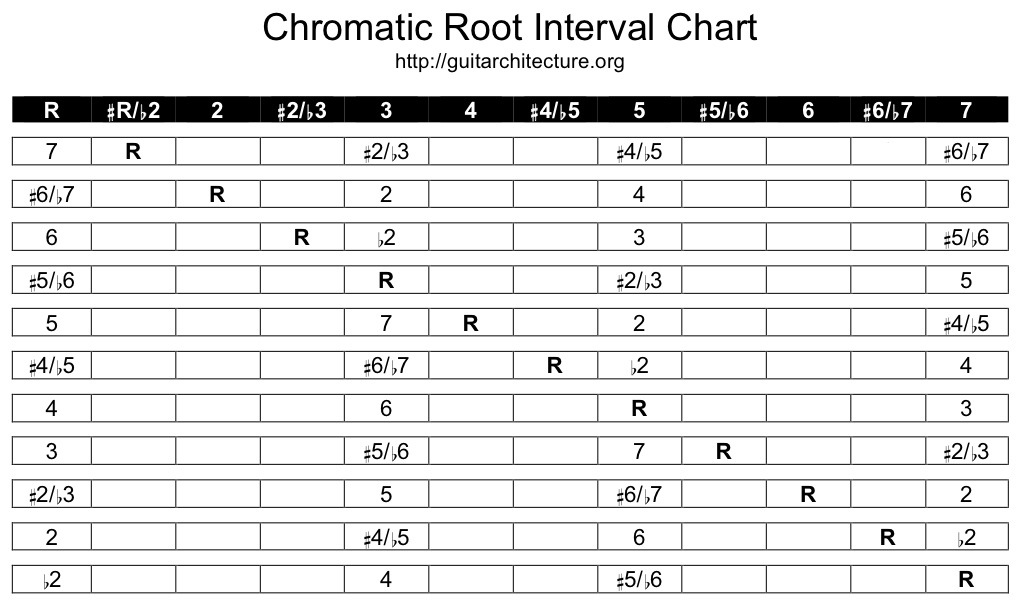
In The GuitArchitect’s Guide to Chord Scales, I devised a chart that would tell the reader how any chord scale would function over any root.  I’ve adapted that chart and utilized it for arpeggios in this lesson.  Here’s the full chart:

.

.

At first glance, this can look confusing but it’s REALLY useful for determining how scales and arpeggios (or chords) function over different tonal centers.  

.

In the steps below, I’m going to outline every step that could be taken to visualize this, but once you understand the process, you can skip a lot of the steps and understand what’s happening almost immediately.

.

Let’s go back to the C maj 7 arpeggio.  The formula for the arpeggio is Root (or R) 3rd, 5th and 7th.  Here’s what it looks like superimposed into the chart.  

.

.

I’ve taken the extra step of removing all of the information in the other columns of the chart to solely show how the Root, 3rd, and 5th of a particular chord functions over other tonal centers. It’s also important to note that this chart accommodates all possible root notes.  So while sharped roots (#R) or flat roots (bR) are really heard as b2 (b9) or 7ths respectively, they’re listed here to show the functions of specific notes over tonal centers (e.g. C maj 7 arpeggio played over a C# tonality).

Okay – now let’s move the information in the chart to the key of C:

.

.

Presented this way,  we can see how things function.  Played over D for example – the C, E, G, B functions as a b7th, 9th, 4th (or 11th) and a 6th.  As a D Dorian sound (C major over D implies D Dorian) you lose the minor 3rd but get the natural 6th flavor of the mode.

.

.

I’ll simplify the chart a little more:

.

.

Again, it’s also important to note that this chart accommodates all possible root notes.  So while sharped roots (#R) or flat roots (bR) are really heard as b2 (b9) or 7ths respectively, they’re listed here to show the functions of specific notes over tonal centers (e.g. C maj 7 arpeggio played over a C# tonality).  This also counts for b4 (which will be heard as a 3rd), and double flats (like bb7 which will be heard as a 6th or bb3 which will be heard as a 2nd).

.

From intervals to chord tones

Since this chart was initially created for chord scales, the intervals all exist within an octave.  For the purposes of chords and arpeggios it’s more beneficial to think of:

  • 2nds as 9ths
  • 4ths as 11ths and 
  • 6ths as 13ths 

.

I’ve converted these intervals to chord tones in the chart below:

.

 .

One sound I get out of this immediately is the Ab which gives a Ab maj 7 (#5, #9 no root) sound.  I’ve resolved it to Ab in the example below – but give it a shot – it takes a generic C major 7 arpeggio and gives it a shot glass of tabasco.

.

.

.

When I went to Berklee and got knee-deep into analysis, my teacher gave me this pearl of insight, 

“Actually the whole point of harmony 1-4 [classes] is to show you how any chord can follow any other chord”.

.

The reality behind all of the charts and theory is, if you understand how an arpeggio functions then you’re more likely to be able to resolve it – regardless of what chord you play it over.  

That’s a big picture concept – you may want to give it a second to let it sink in.

.

The thing to start to focus on is how things sound to you – specifically how various chord tones and intervals sound over various chords you’re using.  How do you like the sound of a #4 over a major chord?  Or a b9 on a minor chord?  As you start to find chord tones that you like over those areas, you’ll start to find that you’ll seek those sounds out.   The chart is just a shortcut for seeing how things function – but it’s reliant on what you hear.

My recommendation is take this arpeggio, play it (slowly at first) over all the tonal centers and really be aware of how the notes are functioning.  And (here’s the step most people skip) if it sounds “bad” to you – find a way to resolve it (like going to the Ab in the example above).  I call this the Van Halen approach, there are plenty of times that Eddie hits clams – but he finds cool ways to work them around so that you say, “wow what a cool idea” rather than “oh he botched that one”.

I’ll talk more about the importance of knowing how to “fix” things in a future post, but trust me – it’s worth spending some time on.

.

In the next lesson post, I’ll get into arpeggio modification slash chord stylie.  It’ll be really cool and if I have my audio converters delivered in time I can even go back to posting audio clips again!

ah the joys of moving….

.

I hope this helps and thanks for reading!

.

-SC