Recycling Chords Part I or Where’s The Root?

I’d like to start this brief series off with an explanation of how I view the function of theory.

(For those of you who are interested, this is taken from, A brief thought on Music Theory.)

Theory is secondary to sound.

The history of music originates in organized sound.  Theory and jargon were developed over time as a way to replicate those organized sounds.  When a term like “C major” is used, it tells the informed person what kind of sound is going to be produced. This jargon then, is nothing more than a way for musicians to express ideas to each other without written music in a more efficient manner.

It’s much less important to be able to look at something and say, “that’s an altered dominant chord” than it is to hear an altered dominant chord in your head and be able to realize it on the guitar (or to hear someone else playing it and know what to play against it).”

This series of lessons are excerpts from the Guitarchitect’s Guide to Modes: Major Harmony book (due out in 2012).  While that book covers basic intervals and chord theory, this lesson will make the most sense if  you have some knowledge about chords, intervals and chord construction.  Having said that, even if you have a very limited knowledge of these areas you can still get something from this lesson by playing through the examples.

When I was at Berklee, one of the recommendations I got was to learn a minimum of two voicings for every chord type I came across (and more if possible).  While this is certainly a valid point – another way to approach learning new voicings is to reconceptualize what you already know. To see other ways of looking at things in this case, I’ll need to bring in a little music theory/analysis.

.

When is C, E and G something other than C Major?

In order to identify a chord, we first have to establish the root to determine the functions of the other notes in the chord.

For example, if we look at the notes C, E, and G with C in the bass we get a C Major chord.
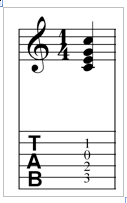
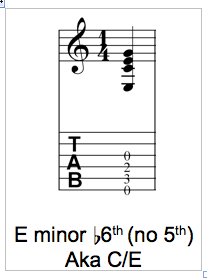
However if E is the root of the chord – it’s possible that the chord could be analyzed as an E minor with an added flat 6th and no 5th.

While you may hear this combination of notes as come kind of E minor chord, you are more likely to hear it as a C major triad with E in the bass.  The sound of a major triad is so entrenched in the average listener ’s head that it will be very difficult to hear this specific combination of notes as anything other than C major.

This is sometimes written as C/E.  This chordal notation is commonly called a slash chord and is written in the format of chord/bass note.
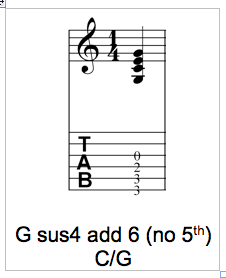
The same is true for the next example.  If G is the root of the chord – the chord could be analyzed as a G sus4 add 6 (no 5).  But more likely you will hear it as C/G.
Let’s add a note outside of the triad to the chord.  By putting an A in the bass, the chord spelling is now A-C-E-G (which is an A minor 7th chord).

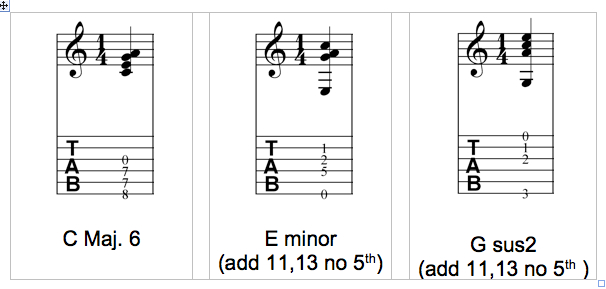
Just because you have 3 notes doesn’t mean that you’re limited to a specific chord type.  In other words the notes C, E, and G are sometimes more than a C Major chord.

Using the same process as above the collection of notes above could also be analyzed as:
.

Converting to C

Let’s now look at how a C Major triad can be analyzed over every other root.

A quick theory tip:  Whenever I see chord or a scale that I’m having trouble recognizing, I recommend modulating it to the key of C.  The reason for this is the lack of sharps or flats make any accidentals immediately identifiable.
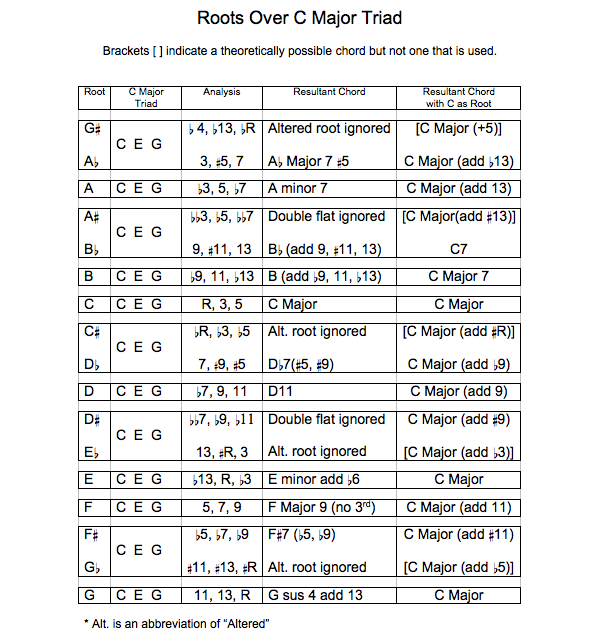
Here are a couple of points regarding this:

  1. There are several ways that these chords could be interpreted and that this is merely my analysis.
  2. The Analysis column is analysis in relation to the root.  For example, the C of a C major triad is a b4 over a G# root.
  3. The resultant chord column has an implied analysis.  For example the D11 derived from a C major triad over D is more accurately a D11 (no 3rd, no 5th add 9).
  4. Some of the voicings presented are theoretical voicings and not something you find on a chord chart.  For example: C7 is a much easier voicing to conceptualize than C Major (add #13) and I have yet to see a chord chart with C Major (add #13) on it.)  Ditto for altered roots.

.

Putting the Theory into Practice

Let’s say I’m playing a song that uses a major chord and I want to spice it up.

In looking at the above chart, I see that utilizing a C major triad over a Bb could be seen as a C7 chord with the 7 in the bass (C/ Bb ) or it could be seen as a Bb chord with every upper chord tension.

Here’s a voicing in open position.
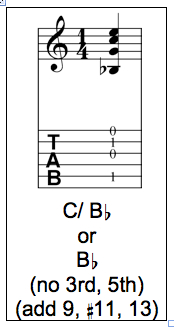
Now let’s make this a movable voicing.

Let’s begin with a 1st position C major chord

and a 1st position D major chord
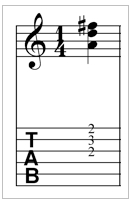
Keeping the root and the 3rd of the C major, we’ll use all the rest of the notes of D major:

and we get a really rich sounding substitution for a C major chord.

.

Next steps

This chord merely scratches the surface of this approach.

In addition to making some new chords from familiar voicings (i.e. Ab maj7#5 = C major /Ab), you also get some improvisational approaches as well (for example – as a starting point for soloing over a Ab maj7#5 you could play a C major arpeggio rather than learning a maj7#5 arpeggio).

For now, I would recommend exploring these sounds both as chords and as an arpeggio approach (i.e playing a C major arpeggio over each root) to see what sounds work for you and then adapt those to other keys.

Additionally, this process can be applied to any chord.  If you feel like exploring this approach – C minor might be a good place to start.

In part II of this series, I’ll discuss a process I call triadic transformation as another way to reconceptualize chords that you already know.

.

In the meantime, just remember that there isn’t anything here to get too hung up about.  Take the sounds and approaches that work for you and discard the rest.

I hope this helps!  You’re free to download and distribute any of the lessons here but I maintain the copyright on the material. I’m always looking for feedback, so if you have any questions or comments, please feel free to e-mail me at guitar.blueprint@gmail.com.

-SC
GuitArchitecture, Sonic Visualization And A Pentatonic Approach For The Holidays

Happy Holidays!

.

I know I’ve been posting a lot of gear related items lately – and  based on the statistics for site visits – this seems to be what people are primarily interested in – so this has driven the posting content recently.

While I’m happy to blog about gear (not incidentally, my 8 string Bare Knuckle Cold Sweat pickup came in last night and I squealed like Bobby Hill); I don’t want to get too far away from playing.  With that in mind I’m putting a concentrated effort to get more lesson/performance posts up to rebalance the site a bit.

I’ll have a new  chord-scale lesson up next week but in the meantime wanted to explain my performance/pedagogical approach to navigating the fingerboard with a fleet fingered pentatonic lick (yes, it’s reposted – but just like Thanksgiving leftovers – aren’t they still good on day two?).

.

GuitArchitecture?  Sonic Visualization?

.

I wanted to take a moment and talk a little about GuitArchitecture, sonic visualization and re-examine a chestnut from the lesson page as a little – three for the price of one post.

In broad strokes, the GuitArchitecture concept is that the nature of the guitar’s fretboard and tuning lends itself to visualizing fingering patterns.

While patterns performed mindlessly can be a bad thing, they allow people to realize ideas more readily.

Through these patterns, musical structures can be realized and worked into larger sonic arrangements.  More importantly, patterns can be associated with sounds and visualizing how to realize a sound by seeing its shape on the fretboard makes performing it easier.  Hence the term Sonic Visualization.

In my forthcoming books – I have a lot of information on this topic as it applies to scales.  When approaching scales – I see them as a series of modular two-string patterns that connect the entire fingerboard.

.

The GuitArchitecture Approach

. 

Here’s an applied example of sonic visualization:

Let’s say I’m playing a solo over an E minor chord.  As mentioned in a previous post – when soloing over a minor chord you can substitute a minor chord a 5th away (in this case B minor).

So if I’m thinking of using E pentatonic minor over the chord (E, G, A, B, D) I can also use B pentatonic minor (B, D, E, F#, A).

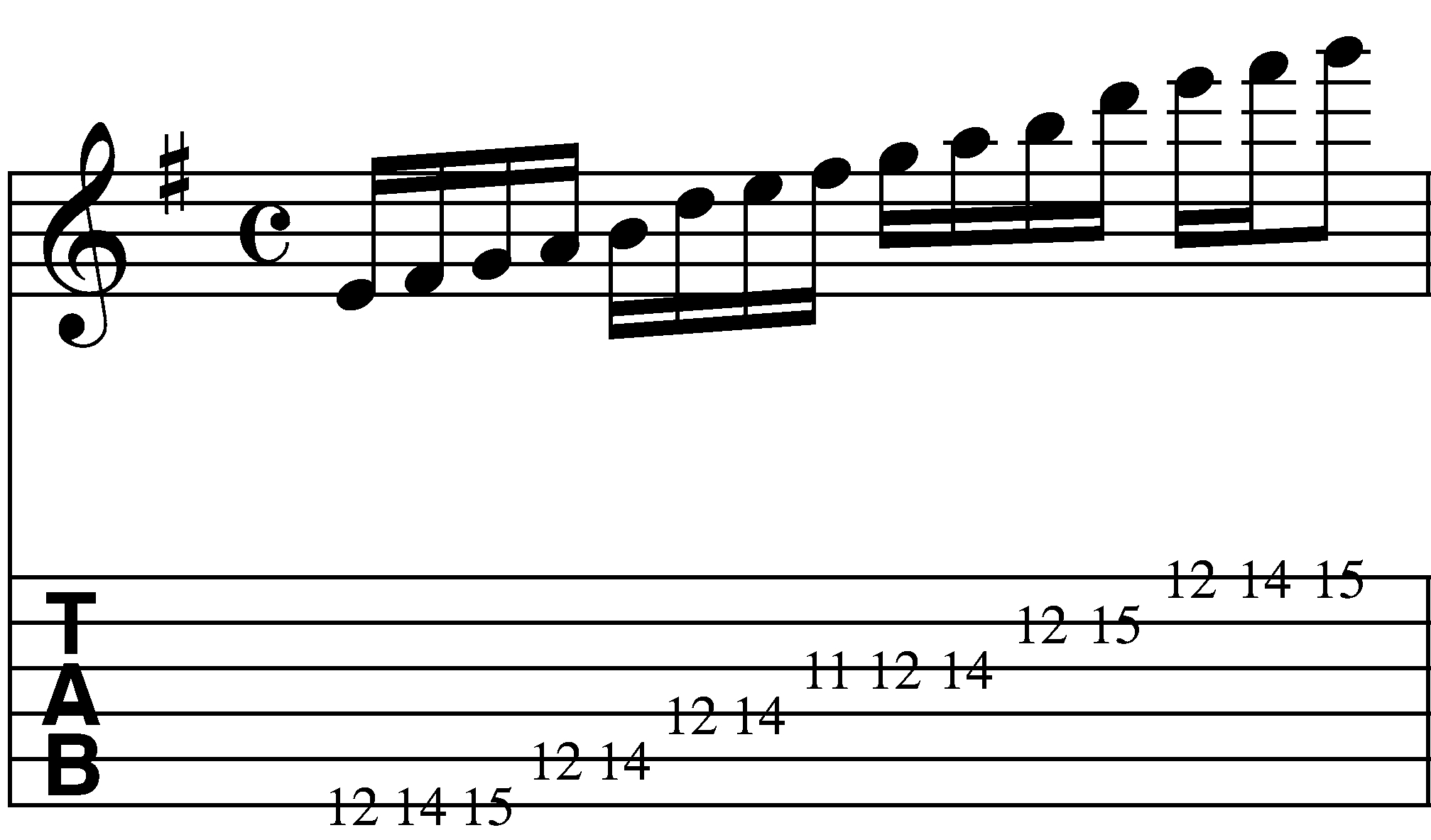
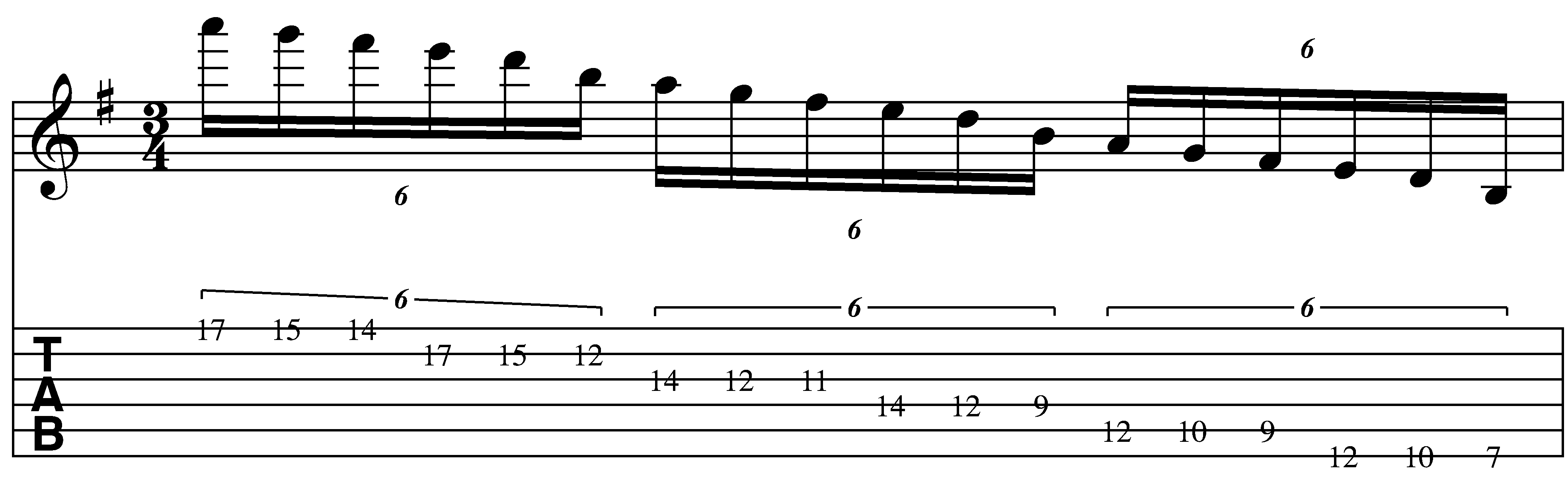
If you look carefully – you’ll see the only difference between the two is the F# and the G.   Both notes sound good against E minor, so if we combine them we get a six- note scale (E, F#, G, A, B, D).  Here is a sample fingering of the combined scales in the 12th position.

.

If that scale were fingered as a 2-string scale instead of a six- string box pattern – the same fingering pattern can be moved in octaves – thus eliminating the need for multiple fingerings. (This is the same approach I’m using on 8 string guitar btw).

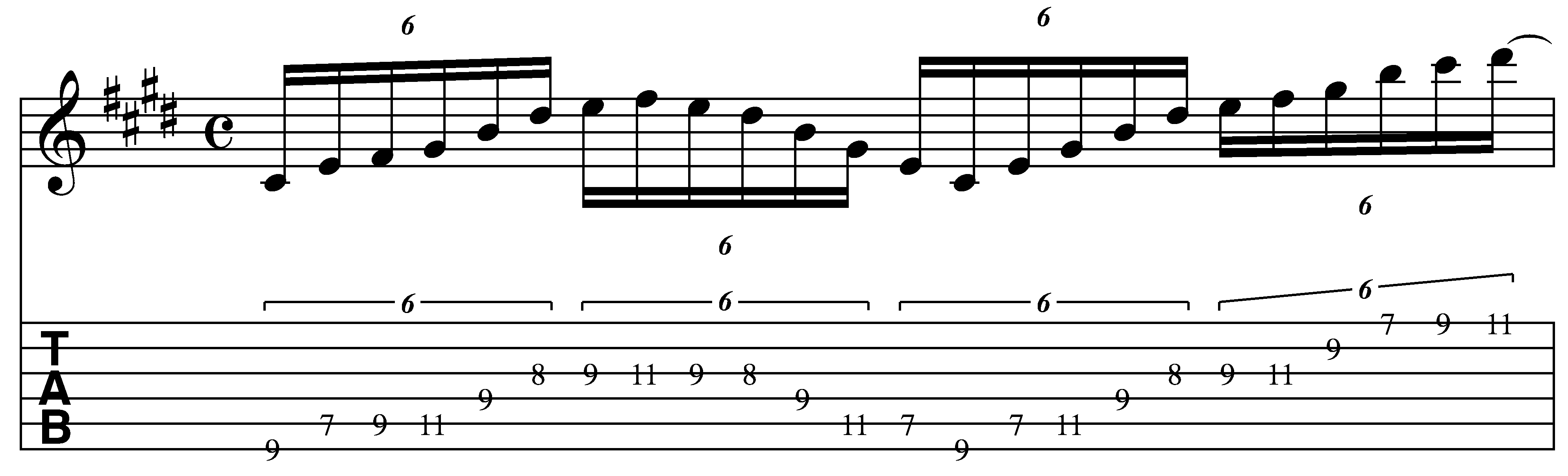
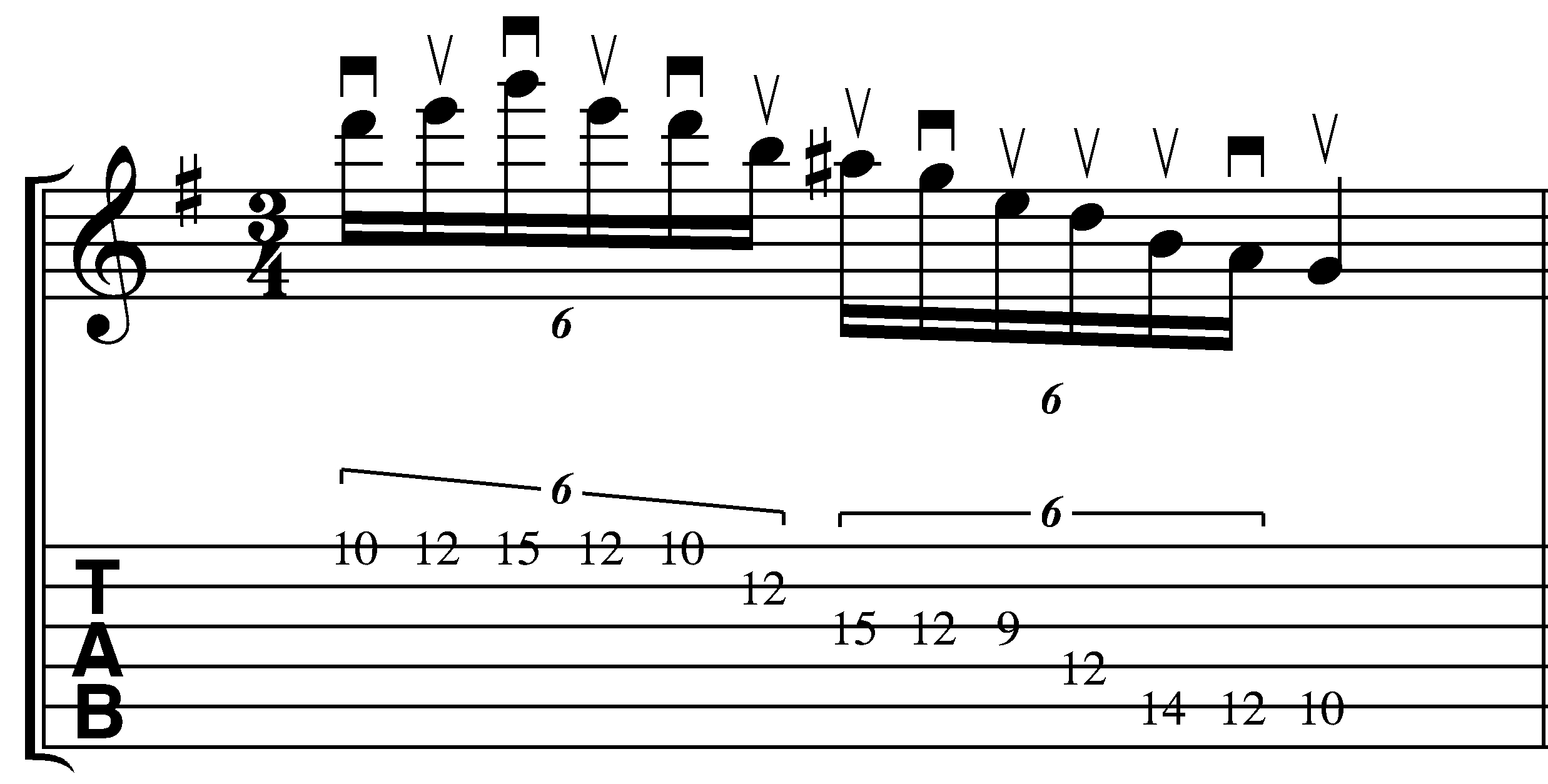
Here is an mp3 (note mp3s are a little glitchy in Safari – if it doesn’t play you may just have to reload the page) and notation/tab for the descending scale:

.

Sextuplet descending

.

.

* Fingering Note: I finger both patterns with the 1, 2 and 4 fret hand fingers on both string sets.

* Descending Picking Note: I play this with a modified sweep picking pattern

E string: up-down-up

B string: up-down-up

.

The picking pattern is the same for each string – but when I switch strings – it’s two up picks in a row.

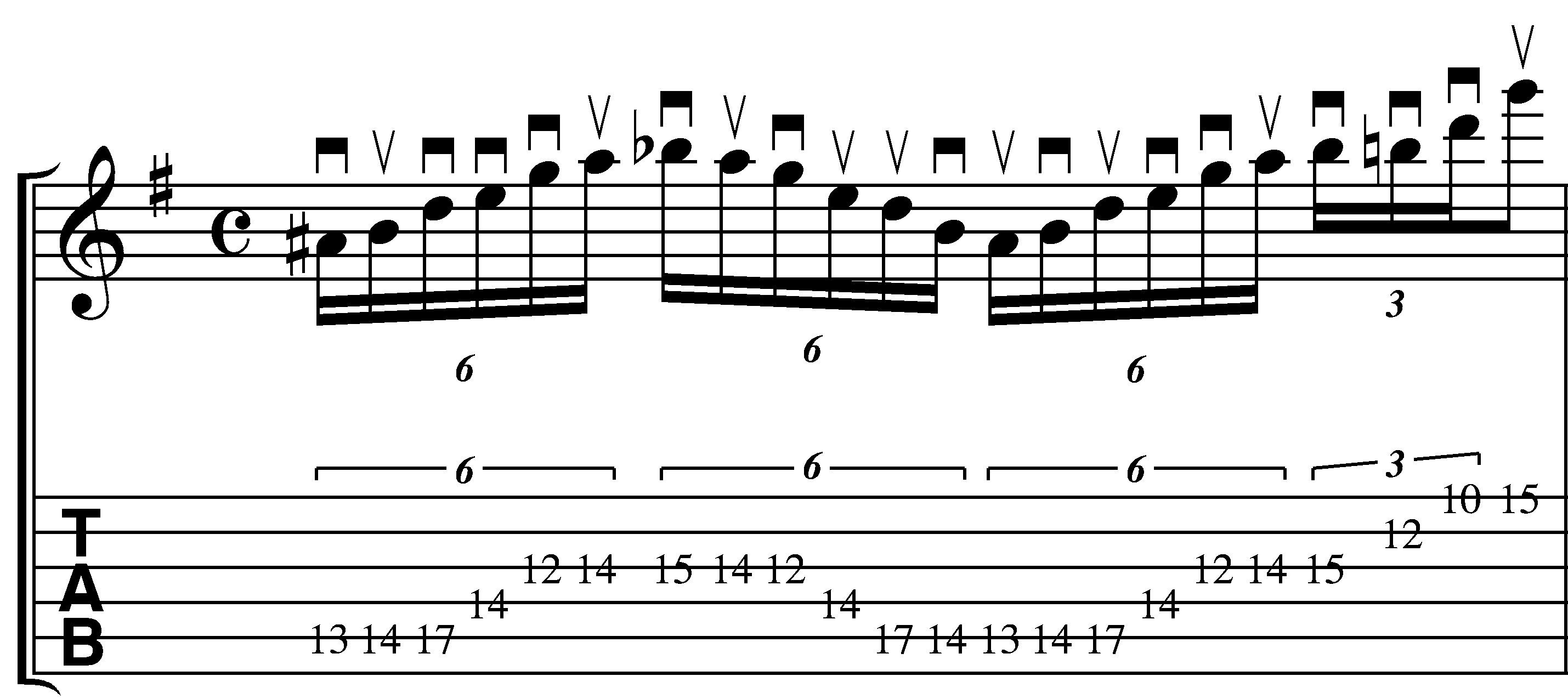
Here it is  ascending:

Sextuplet Ascending

.

* Ascending Picking Note: I also play this with a modified sweep picking pattern

.

E string: down-up-down

A string: down-up-down

.

The picking pattern is the same for each string – but when I switch strings – its two down picks in a row.

If you’re used to alternate picking  – you can use that approach as well but I try to apply the same picking pattern to all three-note per string patterns.

.

Practicing the pattern

.

In addition to focusing on the timing of the notes – it’s very important to practice slowly and only increase speed when both the timing (are all the notes being played with rhythmic equivalence?), tone (i.e. can you hear all of the notes clearly?) and hand tension (is your hand should be as relaxed as possible?) are all working together.

I’ve written a whole series of posts on practicing  (Post 1post 2post 3post 4post 5post 6 and post 7) that I’d recommend checking out if you haven’t already done so – but the simple principle here is to pay attention to what I call the 3 T’s in Performance: Timing, Tone Production and Tension.

This particular approach is challenging – particularly if you’re not used to the stretch.  Just remember to practice in small focused increments and try to increase steadily over time.

.

The Tones:

.

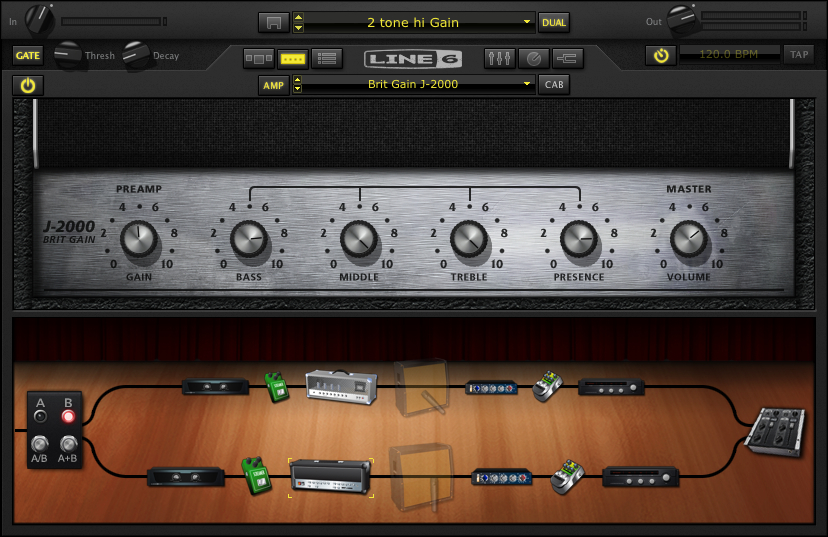
For those of you who are interested, tone on this recording was the same AU Lab/Apogee/FNH combination that I detailed here:

Here’s a screen shot of the Pod Farm setting (The tone can be downloaded from line 6 here):

.

That’s all for now

.

I hope this helps!  You’re free to download and distribute any of the lessons here but I maintain the copyright on the material.

I’m always looking for feedback on what people find useful and what they don’t so if you have any questions or comments, please feel free to e-mail me at guitar.blueprint@gmail.com

Warming Up: Finger Exercises, The 3 T’s And The Necessity Of Mistakes

Pedagogical Errors Were Made

One of the first lessons that guitar students are taught is the 1 note per fret 1-2-3-4 chromatic alternate picking exercise.  While this is typically presented  as an initial exercise to gain coordination – it has a very limited long run value.  As a static exercise, it  should be discarded from your regimen immediately because

.

you play what you practice

If you want to play semi-chromatic ideas at high speeds moving in 4ths – this is a great exercise to use.  But it’s a boring sound, a boring exercise and doesn’t translate well into everyday performance.

“But Scott”, you might posit, “it’s just  a warm up exercise.  It isn’t something to play at a gig.”  Then it’s a further waste of time as

.

everything you play should be something that translates to live performance

.

The Physicality Of Practicing or How To Lose A Gig

Here is a gig nightmare story that illustrates the point of proper technique versus strength.  Since the embarrassment here is all mine, all of the names will be on the record for my moment of shame.  Years ago when I was working at Sandy’s Music, one of my co-workers “Skinny Mike” Feudale wanted to see if I could play a gig with his rockabilly/psychobilly band – The Speed Devils. Mike is a great songwriter and the songs on the Speed Devil’s cd were really strong and lot of fun to play.  The Speed Devils had a gig come up in NY and needed a lead guitarist to sub in.  If it worked out – it could be a regular gig – but there were some rules.

.

1.  I had to look the part – fortunately the drummer Judd had a vintage bowling shirt I could squeeze into

2.  I had to play a vintage amplifier.  Fortunately I had just gotten my vintage Gibson amp back from Tom at AzTech electronics (truly an amazing amp guy) – which sounded and looked great.

3.  I had to play the Speed Devils guitar.  This was a hollow body that Mike had fixed up and completely vibed out (full flames and dice for volume knobs) with heavy gauge strings and high action to push the volume a little more.

We rehearsed the set once or twice and then went to the gig a couple of days later.

On the way from Boston to NY, I didn’t have time to warm up so I was doing some finger exercises to limber up my hands.  I was experimenting with a lot of grip master type things to strengthen my hands and try to fix my pinky (which was really quiet with hammer ons).  We got to the club and  I found out that there was no mike for my amp.  The only thing going through the PA was the vocals.

This is the point of the story that I should mention that while everything was fine when we had rehearsed at low volumes; my 15 watt amplifier could not compete with the rest of the band in a club setting.  As I was inaudible I started strumming louder, and with the live adrenaline kicking it, I started fretting harder as well.   Between the heavier string gauge, the higher action, the underpowered amp and the over-tensed playing- I blew my hands out by the second tune.

My hands were so shot that chording was difficult and soloing was all but impossible.  I limped through the rest of the performance – but nothing came out the way it was supposed to.  Needless to say, I didn’t get the gig – a sound decision by the band – but I was really angry with myself because I had unknowingly sabotaged myself before I even got there and had I taken a different approach – I would have been able to play the show much better and not let the band (and myself) down.

.

The Physicality Of Practicing (slight return)

Playing an instrument is a physical endeavour.  You can push your muscles too hard and hurt yourself badly playing the same things over and over. (Trust me – performance related injuries are not fun).

Having said that, this isn’t weightlifting.  You don’t need muscular hands capable of cracking walnuts to play guitar well – you need hands that can move  fingers quickly and independently –  a fast twitch muscle versus a slow twitch muscle. This leads to a little secret that students generally don’t get exposed to in rock guitar lessons

.

hammer on volume comes from the speed the fingers strike the string not the force

In terms of volume, the most problematic finger is typically the pinky.  One habit that I had to fix (and that I continue to see in a number of players) was the improper attack of the fret hand pinky on the strings. (In case you’re wondering about proper form, I’ve reposted some of the information from the Glass Noodles arpeggio post below).

.

Here’s a good way to visualize the fret hand finger motion you’re looking for:

Put the palms of your hands on a table.  Now without lifting the palms up, tap your fingertips one at a time on the table starting from the pinky and ending on the index.  You’ll notice that the fingers stay curved and that the large knuckle of each finger is responsible for the tapping.  This motion is what you’re looking for in this process.  Notice that you don’t need to hit the fingertips very hard against the table to get a crisp attack.

The concept of building up your hands like biceps – is just ridiculous.  The goal of guitar performance is to keep your hands relaxed so you don’t blow them out in a gig or on a session.

.

How I warm up now

When I warm up now – I play scales and arpeggios, switching between chord voicings of tunes I’m working on and improvising around various patterns at low tempos and paying strict attention to

.

The 3 T’s in Performance: Timing, Tone Production and Tension

(remember these – this awareness could save you untold time and pain later!)

.

In general –  you just want to make sure that all of your fingers have had a little blood flowing in them before you begin to play for any length of time.  I do this with a timer for 5 minutes (more or less depending on how my hands feel).

External warm up devices are kind of goofy to me.  Have you ever seen a runner go into a gym and max themselves out on a legpress before they went for a long run?  Do you really think that putting mechanized unfocused tension on a finger is going to make it play a musical passage more efficiently?

.

The necessity of making mistakes

Along with the forthcoming GuitArchitecture books, I have also put substantial time into  a general book of guitar technique.  In addition to discussing specifics of practice and performance methodology – I also took the 1-2-3-4 exercise and broke it down into every possible positional variation as a way to develop technique.  The book is currently 256 pages.  The majority of which are the 864 individual graphics that had to be created and placed in the text.

Midway through this process I started to question the mistake of basing any technical study on such an exercise – or the concept of musical exercises in general.  (Again the point isn’t to have svelte waistline or huge muscles – the point is to be able to play melodic and harmonic ideas more readily.)

I came to the conclusion that if the 1-2-3-4 example could be approached as a way to develop a systematic approach to generating both melodic ideas and melodic variation it could also benefit readers as a technical study as well.

.

Mistakes are teachable moments

It’s easy to see a mistake as something to learn from in a practice room session but harder to see it at a gig. If I walked away from the Speed Devils show and just said, “That gig sucked – so I must suck as a guitarist” I would have missed a great opportunity to see there was something very wrong in what I was doing. The gig taught me in addition to making sure that I had proper preparation and the right tools for the job that tension does not equal volume – and that lesson has been more beneficial to me than any lesson I could pay for.

.

I hope this is helpful to you!

Thanks for reading.

-SC

Guitarchitecture Post Featured In Guitar Player Holiday 2010 Issue – Quick Licks Section

It’s been a couple of productive days – The pentatonic/blues lick that was featured in the quick lick/rig du jour post has been featured in the Guitar Player Holiday 2010 issue. It’s the issue with Santana on the cover.  Thanks again to Matt Blackett  and the GP staff!

The long overdue Tubtime cd, “We Bleed The Sun And Make It Pay” – is finally up for sale on Itunes and on the CD baby tubtime page. Featuring the talents of Patty Barkas, Geof Chase, Joe Rauen and Keichi Hashimoto – Tubtime was the first project I was involved with that was based solely on of structured improvisation and in many mays was a cornerstone of what I do now. In addition to cd baby and Itunes – it’s also available on emusic should be available on Amazon and any other digital distribution service over the next several months.

Rough Hewn Trio @ CalArts was a big hit!  We should have video/audio up soon.

More info coing soon!  Thanks for dropping by!

Building Blocks – or more examinations of a laptop guitar setup.

If you’ve ever seen the American dubbed version of Mad Max (the whole movie plays very differently with the original voices – I’m just so used to the original American release’s versions of Night Rider, Toecutter and the Goose –  that that’s the only one I can watch), there’s a moment where The Goose realizes that the person they’re about to arrest is an associate of ToeCutter, and the camera closes in on his face as he says,

“Well well well…”


I wanted to go a little more in depth with the laptop guitar rig I’ve been toying around with.  I’ve posted a couple of things about this but I realized that it may be more beneficial to examine each component and see how it fits in the puzzle.  I tend to focus these on distorted sounds as those to me are the most difficult to replicate.  Even Logic has some decent sounding clean amps built in – getting a useable dirty sound is still the challenge at least for me.

So what I did was improvise a little idea in a C# minor tonality and then played a series of versions of it through different versions of the laptop set up – to show the evolution of where I have things now.

There’s still a great deal more work to do in this area, but at least these are some starting points and may at least shed a light on the process I’m using.

As a starting point you may want to look at the gear page or my previous entries on this topic here or here.

The (salt) lick


To begin with, here’s an mp3 of the first thing I improvised:  C# min improv .

* Note:

occasionally mp3’s don’t load properly when I check them in Safari.  When I refesh the page they come up.  If you have this problem – it may work for you.  If you still can’t hear the mp3 just leave a comment and I’ll re-post it.

And here’s the notation

The first part of the lick is somewhere between a scale passage and an arpeggio which makes it a little interesting to me.  This approach is something I use a lot in my soloing to get away from the temptation to go on autopilot and just run scales up and down the whole time.

Visually, I’m initially thinking “G#min arpeggio”, and then dropping the lowest notes by alternating 3rds to extend the tonality.  This is an arpeggio trick I use all the time to get new sounds out of old shapes.  I’ll detail this process here:

Here’s a G# minor arpeggio:

When I look at the distance between the G# and the B – that’s a minor 3rd.  By alternating 3rds ( either major-minor or minor-major) I can extend the tonality.  A major 3rd down from G# would be E.

If I drop the lowest note to the “E” on the A string – I’d have an E maj 7 arpeggio. (E G#, B, D#).

If I drop the lowest note to the “C#” on the E string – I’d have a C# minor 9 arpeggio. (C#, E, G#, B, D#).

(If you wanted to go further you could continue the process to A, F#, etc.)

The next thing I do is to add the F# on the A and G string.

This makes G# min7 / E maj 9 / C# min 11 depending on the chord it’s being played over or how you’re visualizing it.

Now that I have the larger shape – I fill in some 3 note per string patterns on the G and high E strings.

There’s a slight 2 string variation on the A string that’s hammered instead of picked, but otherwise the picking pattern discussed on the swept pentatonic lesson is the same approach that’s used here.

This is very similar to the 3 note per string / 1 note per string pentatonic patterns that I’ve been exploring in the online lessons area of the blog (you can see a pdf here).

The process that I’m detailing is how I began to practice these things and then develop them into more complex ideas.  I tend to see sounds like this as one large pattern now ( note:  the GuitArchitecture process is all about sonic visualization – i.e. associating shapes with sounds so that sounds can be created and manipulated in real time) .  So when I improvise, I’m not really too conscious of exactly what’s happening theoretically – only sonically.

This ends in a pretty pedestrian B major (C# Phrygian) scale run.  In soloing I would typically try to develop it into something else – but for the purposes of a sound demo – it makes sense to have a short lick with a definitive ending.

The sounds

First I’ll play the lick with the sound used at the ending point of the process.  Here are some screen shots of the set up.

The FNH guitar on the neck pickup goes into the Apogee duet into AU LAB:

I run PSP Vintage Warmer

into Pod farm 2.01 Ilok version

I’m using the Marshall side of this rather than the Soldano – so I’ll show the signal chain there (it’s the same for both setups shown).

I’m going to start with the mixer and then go from there:

Since I’m only running a single line in- I’ve set both inputs to left.

There’s a little tonal secret hiding in plain sight here as well.  If you look carefully – you’ll see that the DI is set to about 18%.  This allows some of the dry guitar signal to come through as well.  This give the tone a little body and clarity that’s lacking from just the straight signal.

You might find that to completely not be the case – and again – this is just one person’s process detailed here.

Here’s the gate.  I tend to keep the levels low so it doesn’t kick in when I’m playing – but kills the noise when the volume is off.

The gain on the Marshall is set around 22%.  I tend to crank the mids a little to help make sure the sound cuts through in a live mix (note the use of the term “help”.  In reality – sound at any live gig is only as good as the sound person.  I just do what I can on my end to make sure I can hear myself on stage.).

Before the Marshall for the “lead” sound I’ve put in a tube screamer.  Here are the settings for that:

Here’s the lick with the tube screamer (same as above): with tube screamer

Here’s the lick without the tube screamer:  without tube screamer .

To give you a sense of how important the amp gain is to the overall sound – here’s a variation of the lick above with the amp gain set around half:

Here’s the lick with the tube screamer (same as above): TS_ON_50%_gain .

Here’s the lick without the tube screamer:  NO_TS_50%_gain .

I actually like this amount of saturation for lead lines – but the reason I’ve gone with the lower gain is that chords (outside or Root-5th diads) – tends to just crap out and turn to sonic mush with higher gain settings.  So to balance the 2 I’ve been working on lower tweaks.


WHY THE CABINET IS TRANSLUCENT.

Oh that’s easy.  It’s because I’m not using it.

Instead I’m using Impulse Responses from Recabinet in LA Convolver (See the links above for more info).

Here are the settings:

The IR’s are from the Recabinet Modern 2.02 Mac and PC-> 1960 4×12 cabinet settings.  You’ll notice that I don’t have anything fancy in terms of mikes set up on the cabinet,

Here is a major component of this process.  Recabinet comes with something like 2000 IRs.  I could spend weeks doing nothing but checking tonal variations on all the different cabs mikes.  Someday when I need to get really deep into this – I will.

In the meantime – to cut down on the number of parameters and just get to a tone – I went with the KISS (keep it simple stupid) approach.  I thought about what cabinet could be a constant for all my sounds clean and dirty – and the 4 x 12 came to me.  I’ve heard a DeVille through one and it sounded good so I decided to use that as the standard and tweak the amp around the cabinet.  Live, a 57 on the grill sounds good to me.  I tried 2 different variations of the same thing and went from there.

To contrast this:  here is the sound of just PodFarm – with the PodFarm cabinets but with the PSP and post preamp off.

Here’s the lick with the tube screamer (same as above): NO_IR_YES_TS .

Here’s the lick without the tube screamer:  NO_IR_NO_TS .

Some of you may prefer these sounds.  I happen to think that “initial” mp3 – has a bit more character than these.

Here’s the rest of the signal chain:

Here’s the pre-amp (post amp! – this is a very useful tweak!):

Here’s the delay:

Here’s the reverb:

So to quote the Goose, “Well well well…”

It’s still a work in progress.  I’d like to work on tweaking the preamp after the cab to carve the tone a bit more and experiment with using an outside delay later in the AULAB signal chain – but for now this is where it is.

I hope this helps!  If you have any questions or comments please fell free to leave them on the blog – or e-mail me at guitar.blueprint@gmail.com .

Thanks for dropping by.

-SC

Glass Noodles – adapting a Philip Glass arpeggio approach to guitar

I tend to get a lot of playing ideas from sources other than guitar.  A primary source of influence is film and one of my all time favorites is Mishima. To me, Philip Glass’ score works brilliantly with the subject matter and helps create a powerful experience.

Here’s a lesson post on some cool approaches I borrowed (read: stole) from Glass that might provide you with some inspiration.

I’ll post the exercise first and then add some color commentary.

A link to an mp3 is here:  Glass Noodles122bpm

First thing’s first – the  triadic* chord progression (see note at the bottom) is  G Major, G# diminished, A Major, A# diminished, B Minor, G Major, B minor, B Diminshed, B Minor, G Major, B minor, B Diminshed. (Note: The second bar repeats – I just forgot to put the repeats in).

I’ll start with a technical issue and then go into the theoretical things to grab.

.

If you want it hypnotic –   you’ll have to lose the pick.

.

Part of the sound of this is the hypnotic repetition and a large part of that sound come from a uniform attack.  You can sweep pick all of these arpeggios as well – but for a more legato sound it’s best to approach all of these with fret hand tapping (i.e. all hammer ons and no picking).  From a technical standpoint the real challenges here are 1. keeping the attacks uniform (i.e. all of the note volumes are even) and 2. playing it in the pocket rhythmically.

.

Getting the maximum effect of something like this requires  sequencer like articulation and timing – and that alone makes this something worth studying.

.

As a starting point you’ll probably want to mute the stings to prevent open notes from ringing out (I just use my picking hand – some people use a hair tie or a piece of cloth.)

For uniform attacks – you’ll have to have very clean hammer-on technique with the fingertips hitting the strings instead of the pads of the fingers.   If there’s any slop there – it will come out in the arpeggios.  One other thing to note is that the notes should be lifted off and not pulled off.  If the only sound created is by the individual fingers hitting the strings – you will have a more uniform sound (which is totally the goal here).

.

Here’s a good way to visualize the fret hand finger motion you’re looking for.

.

Put the palms of your hands on a table.  Now without lifting the palms up, tap your fingertips one at a time on the table starting from the pinky and ending on the index.  You’ll notice that the fingers stay curved and that the large knuckle of each finger is responsible for the tapping.  This motion is what you’re looking for in this process.  You should also notice that you don’t need to hit the fingertips very hard against the table to get a crisp attack.

.

You should strive to get volume with the minimum amount of finger pressure.

The more relaxed you can keep your hand, the easier this will be.

.

You can add some compression to make help make the attacks more uniform as well.  I typically don’t use a lot of compression as I like to play very dynamically and find myself adjusting volume and tone a lot when I play – but a compressor plug in will make all of this easier to play.

This approach gets counter-intuitive at the G major arpeggio (the second arpeggio of bar 2).  For a technical stand point this is the trickiest part of the passage. (Note:  The numbers under the notes indicate fret hand fingerings.)
.

.

I am used to playing the G major arpeggio as a 5 string form – which usually uses the 3rd finger as a barre on the 12th fret, but barring the B and G on the 12 fret completely breaks up the sound and makes it impossible to get the tapped sound of the other notes.  To get around this – I use the index finger to fret the G  so each note gets a unique attack.

.

This is one of those deceptive exercises.  Playing it at 60% will not take very long – but the difference between 60% and 100% is HUGE.

.

Playing everything  with correct timing and really articulating every note will take a while.  Don’t get discouraged if it doesn’t happen right way.

.

The key here is to plan on spending a lot of time playing the arpeggios really slowly to make sure that the timing and volumes are 100% from the beginning.  You can read some of my posts on practicing to get a sense of the best way to start working on something like this.

Now some theory observations:

.

If you sharp the root of a major arpeggio – you get a diminished arpeggio.
.

This doesn’t sound like much – but look at the first 3 arpeggios.  By making the G a G#, you get a nice chromatic motion on the B string leading into the A Major Arpeggio.  You can also notice that the A# in the diminished arpeggio after the A major arpeggio leads right into the B Minor arpeggio.  This is a great way to sequence between 2 Major Arpeggios a step apart (Like G major and A major).

.

If you sharp the 5th of a minor arpeggio – you get the root of a major arpeggio.

.

Again a small thing – but by using this you get  a nice voice leading between the B minor/G major arpeggios in bar 2.  Also notice the chromatic motion on both the G and the high E string.   This continues the chromatic movement that occurred on the B string between the first 3 arpeggios.

.

If you flat the 5th of a minor arpeggio – you get the 5th of a Diminished arpeggio.

.

Check out the last arpeggio in bar 2!  By continuing the downward chromatic motion through the  G Major – B Minor – B Diminished – a sense of urgency is created and then the last point –

.

There’s mystery in keeping it unresolved.


.

In the Mishima soundtrack (you HAVE put the movie in your Netflix Queue yes?) there are a number of moments where at the end of the arpeggio flurries – it ends on an unresolved chord.   Here I’ve repeated the last arpeggio fully and then ended on the lower F on the last repeat.  If I was making a song out of these ideas – I would continue with the type of figures and ideas that have already been presented here and possibly resolving them.  But here in this context – ending on the F – just leaves a giant question mark and makes it interesting.  If you don’t believe me – watch the film!

.

*Note: If you move away from triads – there’s another analysis here:

.

The notes of G# diminished are can also be seen as the 3rd, 5th, and b7 of an E7 arpeggio.

Therefore: If you sharp the root of a major arpeggio – you also get the 3rd of a dominant 7th arpeggio (with no root).

.

This would make the chord progression   G Major, E7, A Major, F#7, B Minor, G Major, B minor, B Diminshed, B Minor, G Major, B minor, B Diminshed.

The bass motion would be what determines the actual chord progression.  I believe the bass motion followed the chromatic motion but the E7->A and F#7-Bm are pretty standard analysis for a chord progression like this.


More posts soon.  Please feel free to post any questions or comments you might have or e-mail me at guitar.blueprint@gmail.com.

-SC
Practice what you play or Practicing Part V

I realize that I’ve been talking a lot about how to practice and have only touched upon what to practice in a very limited sense.  If you have missed my other posts on practicing you can find them here: part 1part 2part 3 and part 4.

.

What to practice

Without being too obvious, you should practice what you’re going to play.

If I was a shred metal player – I’d learn a ton of shred metal tunes.  I’d work on scales and arpeggios a lot and investigate all sorts of lead techniques (tapping, pinch harmonics etc.).  I’d work on learning the solos to those tunes and then start trying to work on my own solos.  I might watch a bunch of instructional videos to try to get ideas as well.

If I was into Jazz, I’d be practicing specific standards.  I’d work on coming up with a bunch of ways to comp chords and practice soloing over the changes.  I’d listen to other renditions of the tunes and borrow (read: steal) any ideas I liked.

If your goal is to play exactly like Stevie Ray Vaughan – learning your melodic minor modes won’t help you directly with your goal, and being motivated to work on them will be difficult if you can’t tie it into your goals.

.

The #1 thing you should be practicing

Now, I’m going to advise you on the #1 thing you should be integrating into your practice regimen that you probably aren’t actively doing now – more than scales, chords or anything else I can think of for the moment.  And it’s a commonality with all of the examples above.

.

You should practice listening.

Not just hearing – really listening.

.

You should practice listening with the purpose of ultimately working on developing your musical vocabulary.

.

Listening, interacting and speaking are three pillars of any conversation and they should be important for you to consider in your playing as well.  If you can’t hear what’s going on – you’re not going to be able to say anything that’s poignant.

Without going into religion, I believe fundamentally that silence is a sacred thing.  I believe that if you are interrupting silence with sound  – you’d better have something to say.

So how do you practice listening?

.

Transcribe – or learn things aurally

There are a lot of internet sites that break down transcription methods better than I can do in the context of this post – but it’s important to note initially that you will probably not be that accurate.  Don’t worry about perfection.  Spend your energy learning phrases and understanding the context that they exist in (i.e. what chords to play them over).

When I first started playing guitar in bands and I had to learn songs for the bands I was playing in, the first thing I learned was the bass line – as it was easy for me to hear and gave me an idea of which “power chords” I’d have to play as well.  If you find a tune you like you should try to learn all the parts on guitar.  The bass lines, the vocal lines, the keyboard or other instrumental parts… You’ll start coming up with things that you might now have ever stumbled across on your own.  If you want to try to notate it – you will get even more out of it – but the important thing is to see how it all works together.

.

Sing it if you want to own it

Sing what you play.  Play a phrase and sing it back.

Play what you sing.  Sing a phrase and play it back.

When you sing something you internalize it.  Internalized things become a part of you.  When you play a melody try to sing it as well.  Listen to other people sing it and try to match the inflections.

(ah if only I thought of the above 2 myself – but they were taken from W.A. Mathieu’s excellent, The Listening Book. If you don’t know this book – I highly recommend it!)

.

Play with musicians that are better than you.

If you play with really good musicians – they’re listening.  We tend to copy other people’s behavior.  So if a room full of people are listening, we might be more inclined to listen as well.

.

Really listen to the world around you.

Try this for a moment.  Close your eyes and take a deep breath.  When you’re done exhaling –  focus for a couple of seconds on what you hear.  Doing this now I just heard – My refrigerator running.  The cat lightly snoring.  Cars passing in the distance.  Several neighbors mumbling down the hall.  The bathroom sink dripping.  The ac unit for the building turn off.  My heartbeat.  A car pulling into the garage.  When I imagine my heart beat as a bass drum being hit I can fall into a groove.  The fridge acts as a drone.  Now I hear a bird -it sounds like horn stabs.  The cars rumble like bass pitches.  My typing accelerates to accompany the sounds going on.  For an instant it’s a cool piece.  Then it vanishes as my perception goes back to what I’m doing.  Before I thought about it –  all I was aware of was the fridge.  Once I really listened I could hear a number of cool things going on.

.

When you really listen as a musician – you can start to get past the point of focusing on, “wait is that an A major or an A minor chord?” – and get into how what everyone is doing fits together.  You can start to get past the technique of performance and work towards making music.

Making music is a noble goal and it’s a goal that’s rooted in listening.   If you’re really listening all of those other things (scales, chords, etc) are going to come into play anyway and as you develop your vocabulary –  you develop your voice.

If you are known as someone who listens well and has something to say – there will always be people who seek you out.   In music.  In life.

.

Practice deeply.

Until next time.

-SC

.

If you like this post you may also like:

.

PRACTICE MAKES BETTER AKA PRACTICING PART I

PROPER POSTURE IS REQUIRED FOR PROPER PERFORMANCE – PRACTICING PART II

TENSION AND THE SODA CAN OR PRACTICING PART III

DEFINITIONS AND DOCUMENTS OR PRACTICING PART IV

.

PRACTICE WHAT YOU PLAY OR PRACTICING PART V

TESTING YOUR VOCABULARY OR PRACTICING PART VI

POSSESSION IS 9/10S OF THE LAW BUT PERCEPTION IS EVERYTHING OR PRACTICING PART VII

Some Useful Online Practice Tools

.

FINDING THE DEEPER LESSON

MELVILLE, MADNESS AND PRACTICING – OR FINDING THE DEEPER LESSON PART 2

INSPIRATION VS. INTIMIDATION

What’s wrong with playing “Flight of the Bumblebee” for a world speed record?

.

A quick lick – and a rig du jour update from Ho Chi Minh City

Greetings from the former/current Saigon. (Technically Ho Chi Minh City but many of the locals call it Saigon).  I had hoped to post a couple of blog updates up before I left, but instead was running around checking things for the trip. Now a jet lagged – iced coffee and soon to be bahn mi –  fueled post:

.

1 lick or 2?

So first – here is a lick that works off of the swept pentatonic idea (alternating 3 and 1 note per string ideas) that I explored in the last online lesson (you can find a pdf of that lesson here).  While the online lessons have focused a lot on pentatonics – I wanted to add the tritone to make “the blues scale” and show how this approach could be adapted.  Here is the idea ascending:

.

It’s very scalar – but I added  a couple of points of interest:

1. the little descending turn around allows you to play the basic ascending idea starting on both up and down strokes.

2.  I started on the tritone (if played over E minor) or the b3 (if played over G major) instead of the root.  If you’re playing this over G – think Bluegrass metal ; )

3.  The motion is more diagonally oriented than the strict pentatonic example but is the same basic approach.  I start the lick with my first finger and then shift positions for the D on the 12th fret of the D string and the D on the HighE.

.

Here is an mp3: Lick1

As variation – I took the same concept and applied it in a more positional approach.  Be careful with this stretch!  If it hurts stop immediately!!!

.

.

Here is an mp3: Lick 2

And finally here are the 2 licks played back to back:  backtoback 1

.

Laptop Rig

So I bit the bullet and got an apogee duet.  WOW!  It really has made a stunning difference in resolution and I suspect will help a lot with future mixes I’m working on. With that in mind I wanted to share with the rig I used for the mp3s above.

Here was the basic amp setting I used in Pod Farm 2.0.  This was based on a customtone forum patch called Electric Gypsy.  I just swapped in a tube screamer and bypassed the cab (using the Recabinet impulse responses instead).  One of the big revelations that I found in pod farm is that I could put preamps AFTER the power amp.  Adding that in to the signal chain opened it up a lot.

.

.

I blogged about using impulse responses over the cabs before.  The lie 6 cabs sound good – but to my ears the IR’s add a whole other area of depth.  Here are the IR’s I used – these were from the Modern 1960 4×12 set.  The screen shot is from LA convolver.

.

.

Finally – a screenshot of how it all lays out in AULab.  I just hit the record button in au lab and edited out the noise before and after the take in fission.

.

.

FNH Guitar –> Apogee Duet–>AULAB–>PSP Vintage Warmer–>Pod Farm 2.0–>La Convolver (w. Recabinet IRs)–>Sooperlooper

.

I’m still tweaking things – but I think that soundwise everything is improving a lot from where it was even a month ago.  Once I get an A/B set with the floorboard – I think that the laptop is going to be the rig du jour.

One last note – the macbook has is using 4 gigs of ram and was updated with a 7200 rpm Seagte internal drive. (500 gig from OWC).  My computer accepts a 4gig chip in 1 slot – so I may go up to 6 gigs – but the faster internal drive made a big performance difference in the machine. I’d say you’d really need to have that if you’re going to try to go this route.

* Note – I’ve recently posted more on this topic here which may be of interest to you.

Definitions and Documents Or Practicing Part IV

I was originally planning on updating this post with pictures of hand postures and address left and right hand muting techniques – but given that I have sunburned skin peeling off of 20% of my body – I’m going to hold off on photos for now.

Instead, I’d like to take a moment and actually address defining practicing as a means of understanding what is being addressed by practicing and then examine how documenting the process can assist with it.

For those of you who are just coming to this post you may want to also read the previous posts on practicing.  Here’s a link to part 1, part 2 and part 3.

Definition

By defining practicing it’s easier to understand what practicing is supposed to do.  Here is a partial definition from Meriam Webster.

“Main Entry: 1prac·tice

Variant(s): also prac·tise \ˈprak-təs\

Function: verb

Inflected Form(s): prac·ticed also prac·tisedprac·tic·ing also prac·tis·ing

Etymology: Middle English practisen, from Middle French practiser, from Medieval Latin practizare,alteration of practicare, from practica practice, noun, from Late Latin practice, from Greek praktikē, from feminine of praktikos

Date: 14th century

transitive verb1 a : carry outapply <practice what you preach> b : to do or perform often, customarily, or habitually<practice politeness> c : to be professionally engaged in <practice medicine >
2 a : to perform or work at repeatedly so as to become proficient <practice the act> b : to train by repeated exercises <practice pupils in penmanship>”

The definitions presented in the 2nd part of this definition help – but don’t really explain how to train or what practicing is supposed to achieve.  So I’m going to supply one of my own.

Practice:  The proper focused repetition of an idea through an incrementally difficult environment for the purpose of achieving a musical goal.

By tearing apart this definition some elements of practicing can be exposed that you might not have thought about before.

proper:  meaning the right way; consistently

focused:  Practice requires concentration because it requires attention to detail.

repetition:  repetition leads to familiarity (and familiarity breeds contempt so be careful here!)

incrementally difficult environment:  To practice something means that you are pushing your abilities to do something.  In music, one implication of this is to practice with a time keeping device (metronome, drum machine, drummer, recording, etc.) – but this could be any kind of parameter that actually pushes you.

for the purpose of achieving a musical goal:  Practice is goal oriented.  If you are not trying to achieve anything then you are not practicing.

With a clearer understanding of what is meant by practicing – we can go on to how to maximize the use of your practicing time.

1.  Set clear, well-defined goals (short AND long-term) and work towards those goals.

2.  Since practice requires concentration, put yourself in an environment that facilitates concentration such as a relatively quiet, well lit and well ventilated room as free of distraction as possible.

3.  While concentration is required for repetition, excessive repetition undermines concentration.  Many people use set periods of time to practice something.  This can be a good policy if it is done in moderation.  Bill Leavitt (the founder of the guitar department at Berklee)  suggested that students should practice reading for 15 minutes of every hour of practice – because 4 sessions of 15 concentrated minutes of practice get you a lot further than one hour of unfocused practice.  A timer (like an oven timer) can be a great assistance here.

For some people, concentration will be a learned activity.  If you are not used to focusing on something with intensity, then even trying to work 10 minutes on something may be problematic.

If you are having problems with this area – try starting with smaller intervals of time like 5 minutes with one short phrase and then move on to the next item on your agenda. Practicing in this manner will help you develop your capacity for focus as well.

.

There are several different thoughts about achieving goals, for me personally – it’s important to get many ideas into muscle memory slowly and develop them all at the same time rather than developing only one idea fully after another. You, however,  should plan on experimenting and find what approaches work for you

By setting a timer and not worrying about how long you are practicing, (in whatever methodology you use) you can spend more energy on the actual performance.

.

Documentation

One approach to consider is seen in how athletes train.  After all, playing guitar is a physical process that requires performance of well-trained activity.  This is very similar to a swimmer who has to be able to perform at a high level at a signal (like a whistle blowing).  One thing athletes do is WRITE IT DOWN.  Runners for example often keep a journal of performance times to see if they’re improving.  Writing things down in a journal doesn’t have to be complex or difficult.  I used to keep a notepad in my guitar case, and then write things down.  But now it’s easier to customize a practice log or journal and utilize that either in print or electronically.

.

I have linked two sample documents below.  Please feel free to download and use or edit at will.

PRACTICE LOG (PDF)

Weekly Practice Log (Word)

.

What needs to be written down:

Here’s a sample entry:

Week of What is being Practiced? Time Mon Tue Wed Thu Fri Sat Sun Notes
6/8/10 A Major Pentatonic sweep (sextuplets) 10 mins 100bpm             Watch Pinky tension!!

.

The goal is to write just enough to keep track of what you’re doing.  Feel free to add or drop items.  

.

If you’re going to start really putting the hours into practicing, I would recommend that you give yourself enough material to do no more than an hour or two at one sitting. 

.

Do multiple sittings a day if you want. (Personally – I can’t really focus very well after an hour or so consistently.  So if I can I do an hour in the afternoon and then another hour later).  

.

It also depends on what I need to practice.  If it’s a difficult piece I need to pull together – I might have to do 4-5 sessions like this a day.  The point is to find what works for you and stick with it.

.

I’m calling it a practice log or a journal – but really it’s a type of map –

by keeping a journal you can see where you’ve been, where you are and where you’re going.

.

It’s a good idea to periodically go through some old journals to just kind of get a fix for where you’re at.

Keeping a practice journal can be a drag and a chore if you want to view it that way, but it can be hugely beneficial in seeing what it is you are actually getting done.  If you make it a part of the practice ritual it will just be something you do.

For example, the first thing an experienced player will do before they play anything on a guitar is to see if it’s in tune.  If you get used to just picking up the journal when you pick up a guitar to practice – it will become 2nd nature.

Now that you’re writing it down – here are some things to address while you’re practicing:

.

Practice accurately.

You have to play slowly and accurately before you can play quickly and accurately.

.

Pay attention!

Can you make out all of the notes?  Are you really nailing the rhythm?  Are there any open strings ringing or unwanted notes?  Are you practicing the same way that you’re going to play?  Is the guitar in the same position when you practice as when you play in front of an audience?

[*Special Note: Paying attention requires concentration which is why you can’t really practice while you’re watching TV.  You can play or warm up in front of a TV – you just can’t focus on the TV and the guitar at the same time.  If you can’t pay attention to something try moving on.  If you can’t move on, then stop and come back to it.  You will get much more done this way that by just mindlessly running fingering patterns*]

.

Always use a metronome, recording or time keeping device when practicing.

.

Isolate problem areas.

If you are learning a piece, there are often several areas that need more attention that the rest of the piece.  Isolate those areas (however small they may be) and develop them. When you have gotten more comfortable with the problematic areas –  begin to practice sections before and after the area.  Treat the problem area as a center and keep moving out from the center as necessary.

.

Do it right the first time.

Paying attention allows you to make sure that you’re practicing correctly.  Practice correctly – play correctly.  Inherent in this idea is that you’re practicing at a tempo you’re comfortable enough that you can tell if you’re playing it correctly.

.

Don’t go overboard.

Some people go from not practicing at all to trying to practice the entire day.  Music is built off of experience, growth and endurance – none of which comes quickly.  Moderation is a good thing.  Occasionally think of the long term, and use the marathoner’s strategy of pacing yourself.

.

Persevere.

Establish a regimen and stick as close to it as you can. If you make practicing enjoyable – you’ll eventually start to look forward to it.  It’s okay to stop and take breaks from practicing as a regimen, just don’t forget to start up again.

.

Don’t forget to play.

The whole point of practicing is to gain elements to utilize in playing music.  Play whenever possible, desired and/or required.  After all this is supposed to be enjoyable.

.

All of this advice works off of the idea that you have specific goals in mind when practicing.  My suggestions for what to practice will be the subject of a later post.

.

I hope this helps!

.

-SC

.

If you like this post you may also like:

.

PRACTICE MAKES BETTER AKA PRACTICING PART I

PROPER POSTURE IS REQUIRED FOR PROPER PERFORMANCE – PRACTICING PART II

TENSION AND THE SODA CAN OR PRACTICING PART III

DEFINITIONS AND DOCUMENTS OR PRACTICING PART IV

.

PRACTICE WHAT YOU PLAY OR PRACTICING PART V

TESTING YOUR VOCABULARY OR PRACTICING PART VI

POSSESSION IS 9/10S OF THE LAW BUT PERCEPTION IS EVERYTHING OR PRACTICING PART VII

Some Useful Online Practice Tools

.

FINDING THE DEEPER LESSON

MELVILLE, MADNESS AND PRACTICING – OR FINDING THE DEEPER LESSON PART 2

INSPIRATION VS. INTIMIDATION

What’s wrong with playing “Flight of the Bumblebee” for a world speed record?.

.

Tension And The Soda Can Or Practicing Part III

Practicing Part III

In order to practice properly, attention needs to be paid to a number of different areas.  Today’s post addresses some issues regarding fretting hand tension as a precursor to proper form in practicing.

Fretting Hand Positioning and Tension

Many guitarists begin playing guitar without being aware of how much tension they are exerting on their fretting hand.  While the title refers to fretting hand fingers, hand tension is actually a complex coordination of muscles working in the hand and forearm.  The concept here is to talk about hand tension as it relates to your ability to move your fingers freely.

Here is an example that may help explain how much of a performance issue this can be.

For the purposes of this example, let’s imagine that you have taken a break from the rigors of guitar practice and have gone to spend the day at muscle beach with your friend Charles Atlas.  After arriving there and seeing miles and miles of Herculean figures – you have decided to show off to your friends and crush the can of soda you have been drinking.

Okay – hold your fretting hand out in front of you – like you were holding a soda can you were drinking from.

Really visualize the can.  Try to feel the ice cold metal against the palm of your hand.

Okay, now try to crush it.  But imagine that the can has been replaced with some infinitely strong material that can’t be crushed.  You don’t want to crush the imaginary can – but truly struggle against it.  If you’re doing the exercise properly, your arm is probably shaking from the exertion.

Okay – now try to move your fingers while you crush the can.  You may be able to move them a little but it’s going to be very difficult.  You should feel (or even see) a lot of tension in your forearm.

Now stop trying to crush the can.  Wiggle your fingers.  This should be much easier.

If you grip the guitar neck with too much tension, it’s the same as trying to crush the soda can.  If you are carrying tension it will be very difficult to move your fingers freely.

What follows is an exercise that can help with proper hand tension.

Proper Fretting Hand Tension Exercise

Sit in a comfortable chair (preferably without armrests) with your guitar around your neck as if you were going to play (you are wearing a strap aren’t you? If not you may want to read the last post.)

Relax your fretting hand by letting your arm hang fully extended by your side.  Wiggle your fingers a bit and try to relax as much as possible.

Take a deep breath.  While inhaling on that breath, make a fist.  As you exhale –  fully release the fist.  Just let your hand naturally relax into a position.  Look down at your hand.

Note – this is your hand in a relaxed position.

Now, keeping your hand in position, bend your elbow and bring your hand up to the neck of the guitar as if you were going to play.  Your fingers should be bent slightly at each knuckle (i.e. the fingers should be curved similar to the relaxed position).

Proper Fretting Hand Thumb Tension

Reverting back to the soda can example, it’s important that the thumb remain in the back of the neck as relaxed as possible as to not tense the rest of the hand.   This is something that I never thought about until I had studied with Jack Sanders.  So I need to thank him for bringing this to my attention in my own playing.

It’s also important to note that your hand position will change if you are doing a lot of string bending.  While it is possible to bend strings with your fretting hand thumb in the middle of the neck,  most people will be used to moving the thumb so that it is more on the bass string side of the fretboard to facilitate bending.   Since this isn’t the majority of what most people play on guitar – I view bending hand position as the exception rather than the rule.

The thumb acts as a balance to pressure from the fingers;  so the location of the thumb is very important.  Ideally the thumb should be in the middle of the guitar neck and typically in line with the middle finger or between the middle and ring finger.  What you are trying to do is put the thumb in an area of minimal tension.

Proper Fretting Hand Tension Exercise

Try playing a scale on the guitar.  If you think that your thumb is squeezing the back of the neck hard, try removing the thumb from the back of the fingerboard while you are playing.  Now gently and gradually, move the thumb back to the neck so that it is very lightly touching it.  Repeat as necessary.

Obviously a huge component in hand tension is how the fingers are actually connecting with the strings and that will be the subject of the next post on practicing.

I hope this helps!

-SC