Podcast #3 On Talent, Tenacity And Self Definition

Hello everyone,

My new podcast is now up for streaming and/or download.

(Once again – this podcast was recorded in the same marathon session as the first one and there’s some weird gain issues going on.  So it’s a little gritty sounding on headphones and only slightly more forgiving though speakers – this will be fixed by podcast #4 – but in the meantime my apologies for the crunchy vocals.)

Guit-A-Grip Episode #3 – Show Notes

Short But Sweet

I’ve mentioned before that the podcasts will vary in length – and this one is well under 10 minutes, but after the previous two podcasts, I thought it might be nice to go with more succinct post this time.

Book Plug

This is an excerpt from my Kindle title, Selling It Versus Selling Out that touches on a number of topics that I’ve talked about here.

For those of you you who are interested, that book is available here .

My first Kindle title (An Indie Musician Wake Up Call) may also be of interest to you.  That book is available here.

If you like the audio format, I should have a collected audio book of essays up (and possibly a physical book) by the end of the summer.

A new podcast will be up next week – and more posts are on their way.

Finally, If you like the podcast please let me know. If you really like it – leaving a rating on iTunes would be really appreciated.

Thanks again!

-SC

Subscription Notes:

  • You can subscribe through iTunes here:

(https://itunes.apple.com/us/podcast/guit-a-grip-podcast/id638383890 )

  • You can use this link to subscribe with any other feed based service:

(http://feeds.feedburner.com/GuitagripPodcast)

  • or you can right click here to download it.

Podcast #2 – Should You Go To Music School? (Answered By Someone Who Did Go – Twice)

Hello everyone!  As promised, here’s a stream of the new Guit-A-Grip podcast:

[audio http://traffic.libsyn.com/guitagrip/01_Guit-A-Grip_Podcast_Episode_2.mp3]

(Once again – this podcast was recorded in the same marathon session as the first one and there’s some weird gain issues going on.  So it’s a little gritty sounding on headphones and only slightly more forgiving though speakers – this will be fixed by podcast #4 – but in the meantime my apologies for the crunchy vocals.)

Man O-man!

This was such a deep topic and deserving of way more detail than my little 1/2 hour exploration.  In light of this travesty of brevity and over simplification I need to add a few basic points that will hopefully fill in the spaces.

.

Guit-A-Grip Episode #2 – Show Notes

.

The Flippant Answer (and the lengthy explanation)

I don’t want to cop out by answering this question initially with a maybe, but it really is situational.  No matter how well designed the curriculum is and how well developed the facilities are, there is no “one size fits all” solution.  Some people are going to thrive in   settings that other people will be miserable in.  But I hope the podcast addresses some of the economic realities of what people are getting into when they go to school, the realities of the job prospects when they leave school and the real reason to go to school (it’s as much about the why of your development as it is about developing the skill set of how you’ll develop).

.

The Community College Oversight

At an early point in the podcast, I set aside the issue of public/community colleges for private ones but I misspoke my motivation why.  Private ones are not necessarily where everyone seems to go, but they are the ones that seem to get the most attention in the public eye.

The only questions behind going to any college are questions of intent/purpose and long term cost. Since the cost behind going to state schools (for in state residents) is often a fraction of what private schools cost – I set state schools aside as the issues for or against going to one are largely the same.  So while there are large differences, from a motivational standpoint the issues are largely the same.

.

The sideman / private teacher money breakdown

At the 12:00 mark or so is yet another moment of me misspeaking.  I said that working as a side man that you’d likely be viewed as an independent artist – but I meant to say, “independent contractor”.  Both may be true but the independent contractor will have much larger financial implications down the road.

I quoted 40% for Independent contractor taxes – which is higher than standard with holding for an independent contractor – but is not completely outrageous as in addition to sate and federal tax withholdings – the additional taxes on self-employment put you in a much different tax bracket if you’re not writing everything off.

For example, for a $15/Hour independent contractor vs a $12/Hour for payroll employee, the take home pay after taxes will be about $9.75/hour for the independent contractor and (depending on withholdings) just below $10/hour for the payroll employee.

If you have a manager, agent or lawyer (and if you’re making $1500 a week as a side man it’s very likely that you have at least one of those people) – your expenses will have you holding back closer to 40% (if not more).  People filing Section C on their 1040’s are more likely to get audited and hopefully you’re paying quarterlies so you don’t get NAILED at the end of the year.

In other words 40% isn’t completely outrageous as a figure but it is high.  (FYI – When I paid taxes and penalties early on as an independent contractor for teaching at a music store my take home percentage of original income was closer to 50% all in.)

.

Networking – or emphasizing a big reason to go

In a speech I used to give entering art students I used to say something like this on orientation,

“Look around at the people around you – because these are the people you are going to rely on for the rest of your career.  These are the people who are going to throw gigs and referrals your way.  These are the people who are going to give you a couch to crash on when you’re in town and will lead you to the other connections that you need to make to succeed as an entrepreneur.  So get to know these people.  Make introductions, get to know what people do an work with the best people you can.”

The irony is that the value of this lesson is generally only learned years later and it’s the one that (generally) no one will teach you.

.

Expanding your aesthetic

This is one thing I largely skipped in this podcast.  One huge thing that I got out of college was exposure to a lot of things that I didn’t know about before.  I didn’t like everything I was exposed to, but the process of understanding why I didn’t like those things completely evolved my aesthetic.  You don’t have to go to a formalized school setting to have that happen – but when you have the right teacher to guide you and help you understand what to look for you’re going to get access to insights that would have ben much more difficult on your own.

The Faculty

I skipped this in the podcast entirely as I think it’s a given that you’re going to get access to professional faculty – but realize that you are going to probably find a few amazing teachers, some so-so teachers and some people who are just uninspired.  I had a few faculty members in my undergrad who made the material so listless that I couldn’t engage it either.  Having said that, there were some faculty in my undergrad were so amazing that it made up for the bad experiences (I should mention that almost all of the music faculty at CalArts I came into contact with at CalArts fall into the inspired category.)  But teachers can only teach if the student is willing to learn, and while every student may be present, without having a vested interest in the lesson and/or the subject matter – they may not be ready to learn.

Nothing says you have to do it at 18.

Boy, that was the biggest lesson I learned (and thanks to Reg Bloor for reminding me about that lesson!) I really was not in the headspace for my undergrad experience.  I’m really happy I did it for a number of reasons, but academically it was a wash for me.

Again, I was someone who read a lot – but knew very little.  I might have come across as mature and articulate on a good day, but none of it was based on knowledge of anything (and certainly not anything musical).  I got so much more out of my graduate experience years later just because I had a little living under my belt and knew what I wanted to get out of it (although that didn’t work out exactly as planned – more on that later).

Get the dumb stuff out of your system and then if you want to go to school – you’ll have a more solid reason for doing so (and a better chance of getting a deeper return on your investment).  Some people get the dumb stuff out of their system before they’re 16.  It didn’t happen for me until well after my college days.

A quote sometimes attributed to Mark Twain:

“When I was a boy of fourteen, my father was so ignorant I could hardly stand to have the old man around. But when I got to be twenty-one, I was astonished at how much he had learned in seven years.”

When I was 18, an older version of myself traveling back in time to counsel me could not have talked me out of going to music school.  I would have done anything to go there.

A real key is to have passion and determination so take any positive or negative aspects of the experience with a grain of salt.  If you look at the downsides and say, “I don’t care.  I’m going to do what I have to do.” then you’re ready to go.  There’s a lot to be said for sheer determination and while that can get you somewhere – it generally won’t get you to your final destination on it’s own.

The secret agenda

This podcast has as much to do with the current state of the industry, as it does the current economics of going to school but really, it’s just another examination of understanding the why behind taking any course of action to work in harmony with the how.

As always, thanks for reading and listening!  A much shorter podcast is on the way next week!

Part three next week is the last of the weird initial edit/recording sessions so better sounding audio is on it’s way!

Finally, If you like the podcast please let me know. If you really like it – leaving a rating on iTunes would be really appreciated.

Thanks again!

-SC

Subscription Notes:

  • You can subscribe through iTunes here:

(https://itunes.apple.com/us/podcast/guit-a-grip-podcast/id638383890 )

  • You can use this link to subscribe with any other feed based service:

(http://feeds.feedburner.com/GuitagripPodcast)

  • or you can right click here to download it.

12-Tone Lesson On Guitar-Muse, Podcast Updates And More

Hi everyone,

Just a few quick updates:

Guitar-Muse

The good people at Guitar-Muse have posted a lesson culled from one of the techniques in my Symmetrical Twelve-Tone Patterns book.

12 Tone Cover small

You can check that lesson out here.  You can check out a related lesson here.

I’ve got interviews, player profiles and more gear reviews coming down the G-M pike as well.

Guit-A-Grip

I have to thank everyone for the overwhelmingly positive response to the Guit-A-Grip site and podcast!  If you haven’t checked out the first podcast episode

  • you can find it by searching the iTunes store interface
  • You can subscribe to it through iTunes here:

(https://itunes.apple.com/us/podcast/guit-a-grip-podcast/id638383890 )

  • You can use this link to subscribe with any other feed based service:

(http://feeds.feedburner.com/GuitagripPodcast)

  • or you can right click here to download it.

BTW – If you dig the podcast and could take a moment to give it a rating on iTunes or a short review – I’d be much obliged.

The new Guit-A-Grip podcast will be up by Friday.

Other News

I’ve been working on something special for May – and something else that’s special for the fall.  It’s been a tough year so far – but I’m determined to accomplish some goals and make some magic from it still.  I hope you will as well.

As always, thanks for reading!

-SC

Guit-A-Grip Podcast Episode #1

In this episode of Guit-A-Grip – I start to discuss some of the thoughts behind this area of exploring the why of guitar playing.  As I referenced my (profoundly) brief foray in formal martial arts training, I’ve included more of that story in the post below this one.

Here’s a stream of the podcast!:

(There’s subscription and download information below if you want to check it out off line).

[audio http://traffic.libsyn.com/guitagrip/Guitagrip_Podcast_number_1.mp3]

Technical Notes:

It’s funny.  A while ago I recorded a lesson and I noticed in the explanation that I had a lot of “uhs” in between words – which was really annoying to me (to be fair it serves me right for not using a script for the lesson.)  I developed a new (and equally annoying habit) of putting long pauses in between statements.  I discovered that this time listening back to this first podcast.  Cutting that down and taking out numerous “uhs” in the conversation got the podcast to be several minutes shorter.  It also made the speech rushed and – well – some of the edited speech inflections are just bizarre.

Hopefully there will be less of that in the future.

Also to get the show in the pipeline, I recorded the first 3 episodes in one sitting to get them in the groove.  This means that some technical recording and mix issues will be consistent throughout the first 3 episodes, but I should have that sussed out by episode four.

Show Notes:

Also, this show (and site) is here to address issues revolving around the why of guitar (or the why of any pursuit) –  but in reality  the show topics will invariably touch on all manner of things that are related and interest me such as personal development, motivation and even music business matters.  Ultimately, it deals with the intersections of these areas.

The Anti-Four Hour Clarification

In the Podcast I talk a little about the anti-four hour concept.  I’ve posted more about that here (Or in the post directly above this post if your reading this on guitagrip.com.

Other show notes:

  • I referenced some of the books I had written in the Podcast so the link to them on Amazon is available here.
  • My other site (GuitArchitecture) deals more with the how of guitar playing and that site can be found here.

This is very much a work in progress – but one measures a circle beginning anywhere – so perhaps this is as much a first step as any.

As always thanks for reading and I hope you enjoy the show!

Subscription Notes:

You can find it by searching the iTunes store interface but in the meantime…

  • You can subscribe through iTunes here:

(https://itunes.apple.com/us/podcast/guit-a-grip-podcast/id638383890 )

  • You can use this link to subscribe with any other feed based service:

(http://feeds.feedburner.com/GuitagripPodcast)

  • or you can right click here to download it.

-SC

Finding The Deeper Lesson

Finding mastery in strange places….

One person who’s fascinating to me is Gordon Ramsay (in spite of a celebrity chef status).  I remember years ago, on an early season of Hell’s Kitchen, a Cambridge resident that competed on the show and interviewed by the local Fox affiliate after she was voted off.   When asked about how mean or callous he was, the woman replied that he was really neither.  She said he was a world-class chef who maintained high standards since his name was going out on everything and that his demands were in line with what was expected from any professional kitchen.

.

Another thing that fascinates me about Chef Ramsay (other than the fact that he came from a working class background and parlayed a career ending soccer injury into a pursuit of cooking) is that his mastery shines through on everything he does.  The next time you get a chance to see him do a cooking demonstration, watch the ease and speed he moves at.  Everything he does on camera is graceful, seamless and effortless.  If you’ve ever tried to pull off a video demonstration of something – you know how hard getting everything right really is (much less doing it on a sound stage in front of a national audience).

.

Reaching a level of technical precision where the technique is invisible is a sign of true mastery.

.

According to those who know, at the highest level the mastery of one thing is the same as the mastery of all things.   In other words, the focus, skill set and mental space that one needs to enter to be a master musician – is the same that it takes to be a great chef, a great athlete or anything great.

.

Once you learn how to master something, you’ve gained a skill set in mastery and, ultimately, that lesson can be the greater take away.

.
Years ago, when I was at my undergrad I wanted to get into martial arts.  I went to study kickboxing (since I had no aptitude for kicking) and my lesson was  with a guy who was nationally ranked.  When I went for the introductory lesson – we did a little bag work and when it was done I asked some questions about the martial arts as a philosophy and he replied that there was no philosophy, it was just about hitting the bag.  (That should have been a huge warning sign but instead I stuck it out for about 3 months).  I remember a class he was teaching where he was doing a weight lifting routine during a full class session of about 20 people.  We were working on kicks and he was teaching us by doing bench presses on a universal weight machine.

.

Some of the classes were taught by a student of his and while the student teacher was not at the technical skill level level of the main instructor, these were the most informative classes that I had there.  This teacher was attentive and really helped me address specific technical things and applications.  He might not have been at the technical level of the main teacher, but he was the much better teacher of the two.

Needless to say, I didn’t learn a lot from the main teacher about kickboxing (other than the fact that he was a lot better at it than I was).  But I did learn more than I thought I did.

.

The initial conclusions I took away from this experience were:

  • kickboxing sucks and/or
  • I suck at kickboxing

.

Obviously kickboxing doesn’t suck and neither of these were the real lessons for me.  They were just faulty conclusions that I came to.

.

Eventually, I realized that I had learned some other things:

.

    • I learned a lot about teaching – both good and bad practices.
    • I learned some things about myself like my threshold for frustration and the value of discipline and focus.
    • I started thinking about how training affects performance which opened some doors for practicing later on.

.

The take away

.

If someone plays something better than you, it doesn’t mean you’re hopeless as a guitar player – but it does mean that person devoted more time to something than you did.

It’s easy to fall into those mental traps and it’s also easy to take the wrong lesson from any given experience away with you. 

.

Try to find the lessons in whatever you do and then dig deeper into them and see if they have a broader application.

.

The wrong lessons are the self-defeating lessons. 

The right lessons are the self-empowering lessons.

.

Thanks for reading!

-SC

The GuitArchitect’s Guide To Modes – Part 14 Not-peggios – Melodic Minor Version

Hey everyone,

As promised, here’s a follow-up lesson that takes the approach I explored in Part 13 and applies it to the Melodic Minor scale.

I’ll use C Melodic Minor in this case – but this idea will work on any root.

Chords

Before we get too far into the lick side of this let’s look at the chords to see what we can play this over.

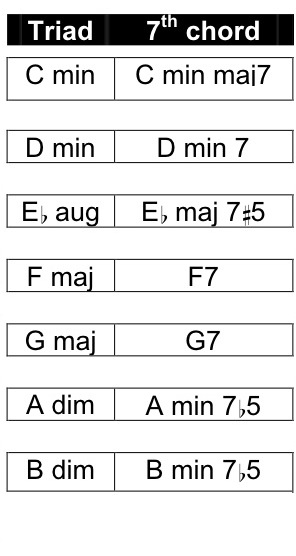
Here are the diatonic triads and 7th chords.


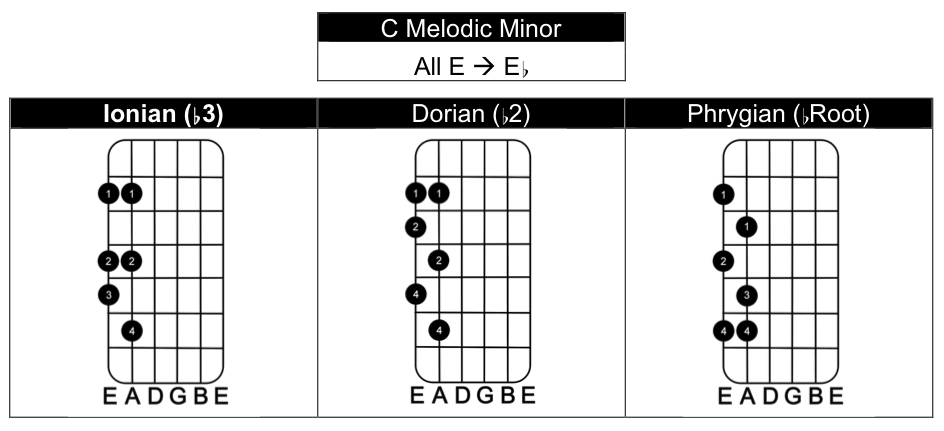
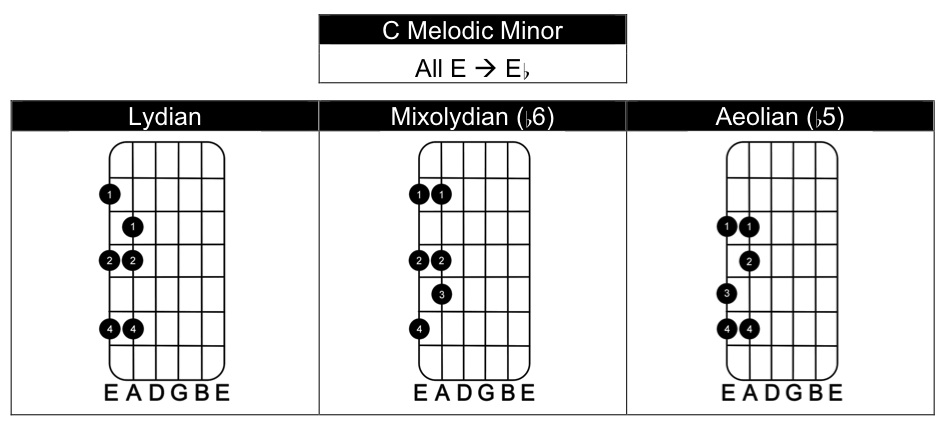
Try playing any of the following C Melodic Minor shapes over any of these chords..

Some Melodic Minor Notes:

  • Melodic Minor is an old scale.  Originally it was played as melodic minor when ascending but natural minor when descending.  Not a whole lot of people perform it that way in Jazz circles but mixing and matching the two can have some interesting sounds (i.e. it’s something you should consider experimenting with if this area interests you and you haven’t already).
  • Melodic Minor is a Dominant machine.  If you check out the harmonization above you’ll see that Melodic Minor has two 7th chords in it’s harmonization.  As Jazz standards use a LOT of dominant devices – this is a scale you’ll want to investigate if you have an even remote interest in Jazz.
  • Melodic Minor is a weird sound.  Yes it is.  The I chord is a minor (maj7) chord and that whole b3 mixed with the natural 6th and 7th makes for some interesting moments.  The only metal guy I knew who was really into that sound was David Chastain and he was doing instrumental stuff that didn’t really sound like anyone else. (Hint – this is worth exploring if you’re a rock or metal guy)
  • Hip trick alert:  since the ii chord is a minor chord -try playing C Melodic Minor lines over Bb Minor as well!

.

Now let’s talk about visualizing the scale.

“You take the good you take the bad – you flat the third and there you have…”

Melodic Minor

I’ve talked about my approach to Melodic Minor briefly in part 9 of this series – but as a brief review:

Major Scale/Modal Visualization Review

  • The guitar fingerboard can be divided into 3 sets of two strings. Any 2-string fingering pattern that starts on the B string can be moved to the same starting pitch on the D or the low E string and keep the same fingering.
  • The major scale can be broken down into seven two-string modes that follow a specific order based on its scale degree from the parent scale (Ionian, Dorian, Phrygian, Lydian, Mixolydian, Aeolian, Locrian). The two-string patterns are modular and can be adapted to positional playing.
  • Instead of thinking of individual modes when playing,  I tend to think of larger tonal systems (i.e. I think of C Major all over the fingerboard instead of D Dorian or A Aeolian.)
  • By thinking of the fingerboard in a larger scale – it makes it easier for me to navigate Melodic and Harmonic Minor as – solely from a fingering/sonic visualization standpoint – I just see it as variations of the Major scale patterns.

To visualize Melodic Minor patterns – simply flat the 3rd of the Parent Major scale. (i.e. to visualize C Melodic Minor just play C major but change every E  to Eb).

It’s important to note that all of the fingering conventions mentioned here are solely to assist with visualization as Melodic and Harmonic Minor really aren’t directly related to the Major scale sonically.

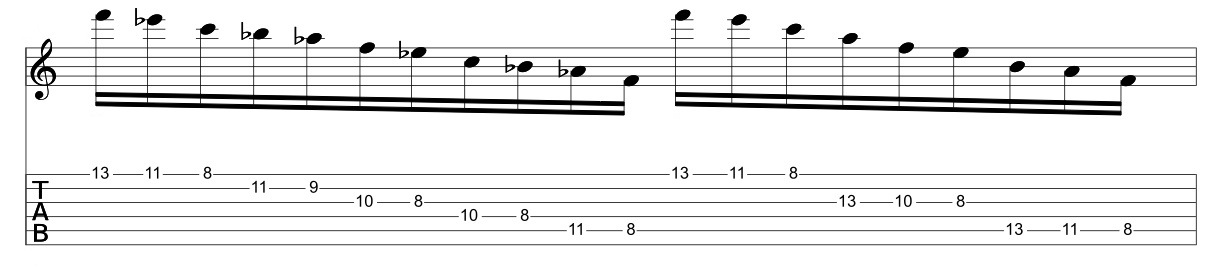
Here’s C Major

Here’s the audio.

Note:

In all the audio examples, I’ve played the example first as sextuplets – then at a slower tempo (i.e. 16ths) – then as sextuplets again.

Here’s C Melodic Minor

(the only difference is that the E has been changed to Eb)

.

.

Melodic Minor short cuts:

Using the Parent Major patterns above here’s a list of short cut’s to help you visualize the patterns.

.

Note: in the F Lydian shape – there’s no change from the major shape since there’s no Eb in the 2-string pattern.

.

.

.

Not-Peggios

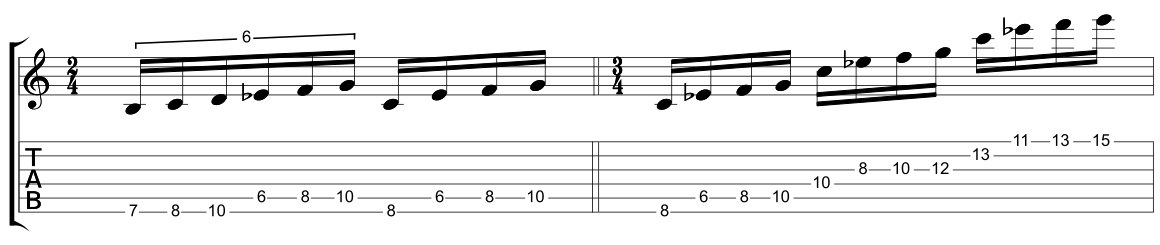
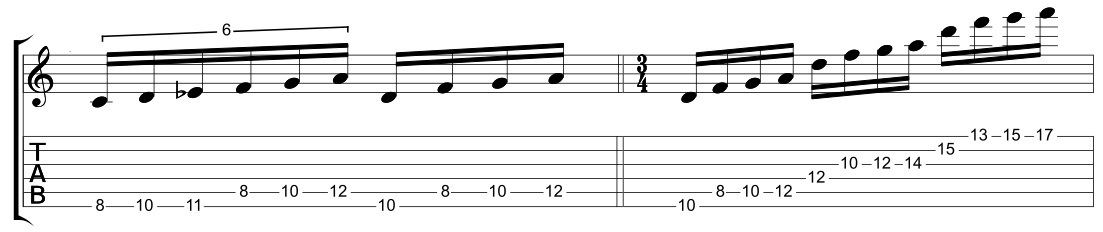
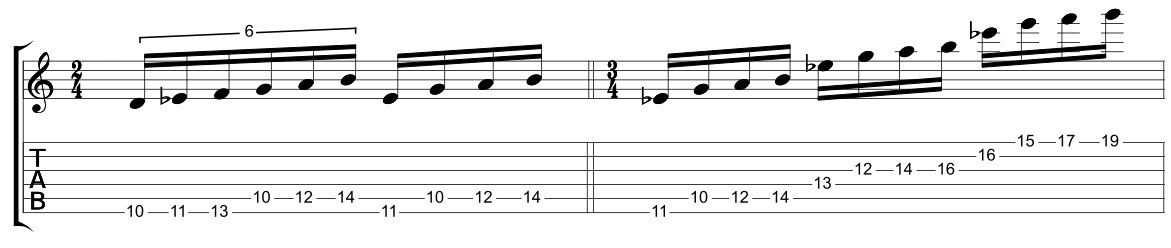
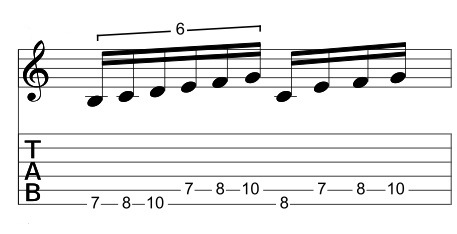
Now let’s take this not-peggio idea from the last lesson and apply it to C melodic minor starting from G.

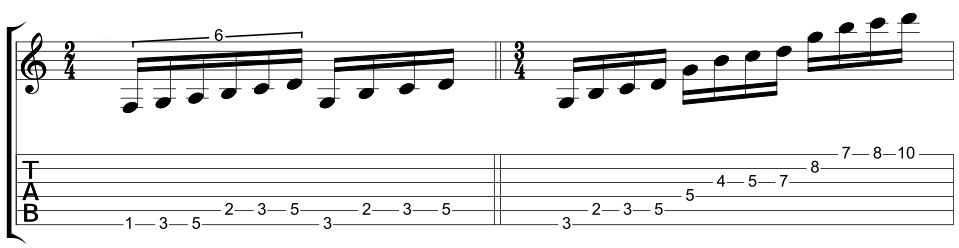
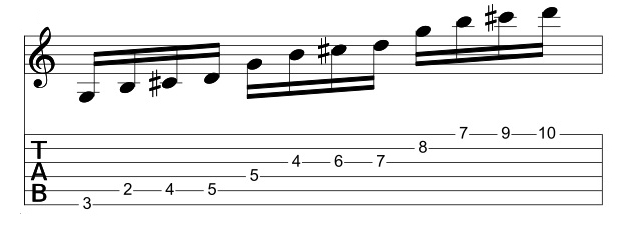
In each of the following I’ll show the 2-string pattern followed by the 4-note “notpeggio” extraction from that fingering and then show the multi octave form.

Note:  The extraction always starts from the second note of the 6-note pattern – so while the first example is extracted from the F Lydian fingering – it’s viewed as a G based pattern.

From G

G based pattern

Note: this G pattern is the same as the C major G shape.

From A

A based pattern

Note: this is a new shape from the Major patterns. The R-b3-4th-b5 shape may remind you of the A blues scale.

From B

B based pattern

Note: this is also a new shape from the Major patterns. The R-b3-b4th-b5 shape is something you may want to explore over diminished chords.

From C

C based pattern

Note: this C pattern shape is the same as the A minor form from C major.

From D

D based pattern

Note: this D pattern shape is also the same as the A minor form from C major.  This shape and the C minor shape above on their own really won’t give you much of the Melodic Minor flavor on their own – but alternating between the two of them will.  More on that in a future lesson.

From Eb

Eb based pattern

Note: this is a new shape from the Major patterns. The Eb Maj7 (#5) based pattern has been deconstructed into almost a whole-tone idea.  This is one of my favorite “outside” sounds in this scale.

From F

F based pattern

Finally,  this F pattern shape is the same as the F Lydian form from C major.

Here’s an audio sample of the 3/4 measures in ascending order from G

Next TIme?

In the next lesson I’ll look at applying this to Harmonic Minor and then I’ll look at working through these ideas positionally (Spoiler Alert – this is where this approach gets really cool!!).
As always, focus on the 3 T’s (Timing, Tone and hand Tension) when playing through these and make sure to have the timing locked in as you increase the metronome speed.  This approach is just a short cut to getting the patterns under your fingers.  By practicing them slowly and increasing the performance tempo gradually, you’re also getting the sound of them in your head – which is critical if they’re something you want to integrate in your playing!
As always, I hope this helps and thanks for reading!
– SC
PS – One plug here.  If you like this idea – I go MUCH deeper into similar concepts in my Guide to Chord Scales book – which covers every unique melodic combination from 3 notes to 12-note scales!!
Print editions of this book are available  on lulu.com or on Amazon (amazon.comamazon.co.uk, or amazon.fr).
.

The GuitArchitect’s Guide To Modes – Part 13 Not-peggios

Hello everyone!

It’s been a while since I’ve posted anything mode related. So I thought I’d make up for some lost time by posting this lesson.

Not-peggios?

Those of you who have been following the licks in this blog for a while have probably figured out that one of my favorite melodic approaches is to work in the area between scales and arpeggios.

For those of you who remember all the way back to part 11 of this series – this idea works on the same approach but with triads.

Step 1: Extracting the Not-peggio

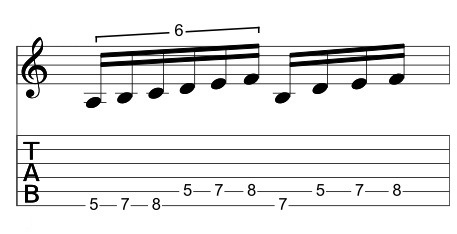
This idea uses the same 3-note-per-string / two string idea that’s behind all the visualization process here.  But to review:  Let’s start with a B Locrian scale pattern on the E and A strings:


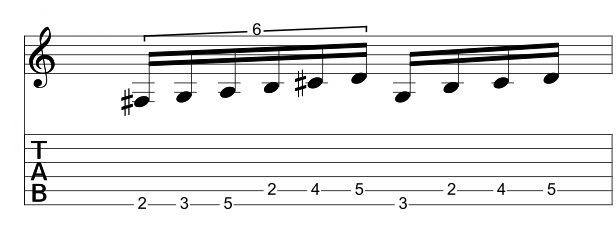
C Ionian
From there:  I’m going to remove the 1st and 3rd notes of the pattern:


Not Peggio Extraction

Leaving a C major major triad with an added 4th which is something that intervallically lies somewhere between an arpeggio and a scale.  Technically it’s a close voiced arpeggio but the “not-peggio” tag has worked better for me when I explain to people so I’ll use it here as well.

Call it scrapple, grapple or anything else that will help you remember it – the naming convention is much less important than getting it under your fingers and in your ears so you can play it.

The good news is that applying this approach to a Major scale only produces four unique qualities of these melodic devices which I’ll talk about below.

One brief technical note:  I recommend either one of following picking patterns for any of the 4-note shapes presented here:

Picking Examples

If you’re used to alternate picking, that will work as well but I find that the semi-swept approach of the first example gives me a more uniform sound for legato playing.  It’s counter-intuitive but check the A minor straight ascending mp3 below to see what I mean.

Major add 4

Major Add 4 shapes

This shape doesn’t really work that well over major chords because the 4th (aka 11) is an avoid tone over a major chord.

However they do work well over minor chords. Try playing the C Ionian shape over an A Minor but for the most part, I find the major add # 4 shape to be one I use much more often.

Major add #4

Major add # 4 shapes

.

I’ve talked about this before – but a kind of cool applied theory trick is that Lydian and Dorian are relative major/minor substitutions.  By that I mean that while C major is the relative major key of A natural minor related chords scales C Lydian and A Dorian both come from the same parent major scale (in this case G Major).  So licks generated from this source will do double duty over both major and minor chords.  A two-fer if you will (or won’t – I understand either way).

Let’s apply this idea to G Dorian.

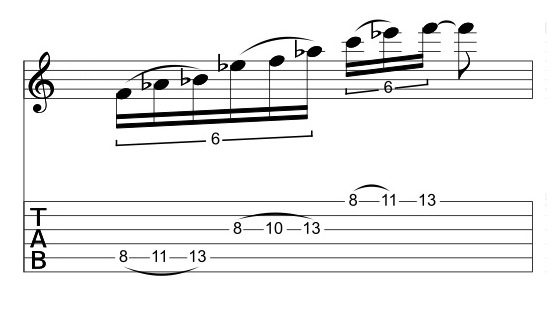
Here’s the 4-note shape taken from F# Phrygian:

G add # 4 extraction

And here it is an a 3 octave form:

G add # 4 3 octave pattern

.

Here’s a more sequences lick type of approach:

G Lydian 3 Octave run

Here’s the audio – with a short descend of the patten ending on the G on the 8th fret of b string.

You can try this approach over E minor for an E Dorian type sound as well.

 Minor add 4

Minor add 4 shapes

Okay a couple of quick tips here.  Since you don’t get the natural 6 of Dorian or the b2 of Phrygian in these shapes – they’re not really going to give you much of the flavor of those modes.

In this case, I’ll use the A Aeolian shape over A minor and F Major chords.

A Minor:


A Aeolian part 1

In this audio example I play the 3 octave form and then play the multi-octvave sequenced idea.

A Aeolian over F lick

Used over F Major:

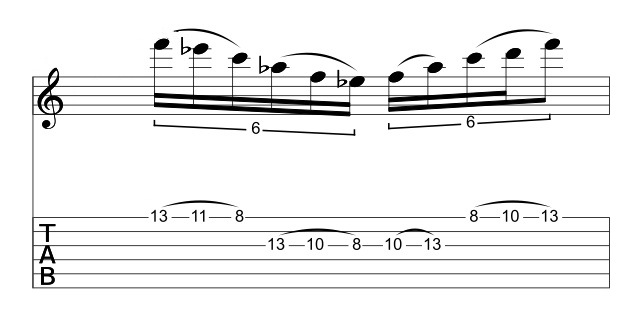
Now I’ll take the same sequenced idea and apply it over an F major lick.  Here’s an audio example.  I slid up to the G on the 15th fret of the high E string and then descended with some tremolo bar scoops along the way.

Normally, applying an A Aeolian idea over F major would give it a Lydian sound – but the lack of the B (#4) in the pattern makes it a little more open sounding to me.

Finally – here’s the Diminished form.

Diminished add 4

Diminished add 4 shapes

Looking at the notes here (B, D, F, E) – I see the upper notes of a G7 (add 13) chord: G [Root] – B [3rd] – D [5th] – F [b7] – E [13].  So this pattern is one I use in Dominant 7th situations.

Here’s the basic pattern:

B Locrian Multi Octave

And here’s the application over a G7 chord.  It uses the same pattern sequencing idea as the other examples ascending but bends into a couple of notes including the 3rd on the B string for the final note.

Next time?  Some Melodic and Harmonic Minor shapes to get under your fingers.

As always, I hope this helps!

-SC

PS – if you like the ideas in this approach – the following books will help you expand on this idea exponentially!

The GuitArchitect’s Guide To Chord Scales

The GuitArchitect’s Guide To Modes: Melodic Patterns

The GuitArchitect’s Guide To Modes: Harmonic Combinatorics

A Transparent Guitar And A Translucent Lesson

Hello everyone!

I hope this finds you well!  I have a couple of quick updates and a new lesson here for you today.

Guitar-Muse update:

Just in case you didn’t see it, I just wanted to let you know that a new review / tutorial on what to look for when buying a new guitar is up on Guitar-Muse right now.  Interested parties can check that out here.

Book Update:

All of the GuitArchitect’s Guide To… covers are done and up online.  You can see the revised editions here.  The Pentatonic book is getting a graphic overhaul and cleaned up for the print edition.  But I should have a new cover (and a revised edition) up by April.

Update Update:

I’ll have a couple of big announcements to make in the weeks ahead, but I think that it’s going to be good news for the readers of this blog and perhaps offer something truly useful.  So stay tuned – I might have an announcement (and something new to offer) as early as next week.

And an overdue lesson:

It’s been a spell since I’ve posted a lesson here (most of the lesson material for 2013 has been transcription work and lessons for Guitar-Muse), so I thought I’d rectify that with the following little morsel.  One thing I hope to do more in the future is offer bite sized lessons rather than the 3-6,000 word uber-lessons I’ve put up in the past.  Hopefully by making the lessons shorter, I can get them posted in a more routine fashion.

“You say you want a substitution…”

Okay – maybe none of you were saying that but I’ve got a string skipping idea that I think you might dig and want to explain where it’s coming from.

In this lesson, we’ll start with an F Pentatonic Minor (F, Ab, Bb, C, Eb)…and then add some notes to make something cool.

Visualizing the scale:

The first step in this lick is to visualize F Pentatonic minor in the 8th position.  The first group of notes in the example below is a F Pentatonic Minor scale.  In the second figure, I’ve removed the Bb  and moved the Ab to the G string to make it a 3-note-per string idea with a similar fingering.

 F Pent Minor - F Pent Minor 2 string

I find that removing notes from a straight scale-based pattern helps open up the sound of the scale as well when playing it in a linear fashion.

Preliminary Lick: F Pentatonic Minor on two strings

F Pentatonic Minor 2 strings

And here’s an mp3
.

Where there’s two there can usually be three:

Now I’ll take this same string skipping idea and expand on it moving it to a pattern on the E, G and A string.
F Pent Minor to F Minor 3 String

.

Preliminary Lick #2: F Pentatonic Minor on three strings

F Pent minor 3 strings

And here’s a MP3:

.

Adding by Subtracting

Using a trick I pulled from Eric Johnson (and a number of other players) I modified the scale by adding the 6 (the note D in this case) and the 9 (G) to the Pentatonic Minor scale to give it a slightly different sound.

Rather than think of extra notes – I simply modify some of the notes of the scale by a 1/2 step:

Changing the b3 to the 9 means changing an Ab to G

Changing the b7 to the 6 means changing an Eb to D

I don’t do this with every note, just a few of them.  If you look at the before and after below, you’ll see that the modified scale has the same number of notes but with an added bonus – namely a symmetrical fingering.

F Pent Minor to add 6 and 9

The advantage of a symmetrical fingering is that it makes it easier to manipulate when we use it in a pattern.

The Lick

Now with all of this back story it becomes much easier to see how I came up with the pattern below (based on an improvised idea):

F Dorian string ship seq

Here’s an MP3:

And here’s another MP3 in a more improvised vein.  By adding the natural 6 and the 2 (9) to the scale – what we really have here is a string skipping dorian lick.

Taking the idea a little further

In this case, I don’t mean stuffing more notes into a passage – I mean getting comfortable with the sound of added notes.

The MP3 below uses an approach from an early chapter of my Symmetrical Twelve-Tone Patterns book.  In that text, I talk a lot about understanding what it means to play “in” before you play out and being able to resolve “out” ideas or (in this case) resolve notes outside the scale.  But I also talk about working through ideas and finding resolutions.

When working with pentatonics add ons like the ones above, I’ll often work on accenting a note so I can really start to hear how it sounds in context.  The following short improvisation starts on the 6 and stresses that note for to accent the Dorian sound.

When working with ideas like this strive to get past the notes and to, instead, get into the sound.  It’s not just about playing a lot of notes, it’s about knowing which notes affect you before you play them.

Finally for those of you who are interested in the tech side of things – if you like the tone – it’s the same – AU Lab, Apogee Duet, FnH Guitars and Scuffham Amps combo that I typically use….

Scuffham Amp RigWith a little added reverb and a front end boost courtesy of the TS-999.

TS999

I hope this helps and, as always, thanks for reading!

-SC

The GuitArchitect’s Guide To Symmetrical Twelve-Tone Patterns Is Out Now

Hello all,

After a marathon couple of days editing the material – my 12-tone book is finally out the door!

The book and the e-book pdf are available on Lulu.com right now (and is also available on Amazon).

Symmetrical_12_Tone_Cover_Low Res

.

Bundle In The Jungle

Symmetrical Twelve Tone Patterns is a 284 page book with a large reference component  and about 100 pages of extensive notated examples and instruction.

What makes this book different (apart from the cover) and what I’m most excited about offering is a bundle of files that will help readers maximize material in the book.  The bundle contains:

  • Guitar Pro files of all the examples in the book (in GP6 and GP5 format). For those of you unfamiliar with this musical notation, tablature platform and playback program, having Guitar Pro files means that you can hear the examples without having a  guitar handy.  Having the files in a Guitar Pro format means that you can isolate each phrase and use it as a phrase trainer to help get the examples to up to speed.

  • MIDI files of the musical examples.
  • PDFs of the musical examples.
  • MP3s of all the musical examples (again, exported from the same material).

Here are some screen shots that I should have uploaded when this was posted originally!

.

TOC_1

Click on page to see larger image.

.

Click on page to see larger image.

Click on page to see larger image.

.

TOC_3

Click on page to see larger image.

.

Page 44

Click on page to see larger image.

.

Page 204

Click on page to see larger image.

.

Page 270

Click on page to see larger image.

.

“They play country And western”

Symmetrical Twelve-Tone Patterns presents the material in both improvisational and compositional contexts.  It shows how to create various intervallic lines and creates the outline of a tune and dissects how all the parts were created using this method.  If you’re looking for ways to explore new avenues in playing or in your writing this is the book for you!

The softbound copy GuitArchitect’s Guide To Symmetrical Twelve-Tone Patterns is for $35 and the e-book pdf is $15.  Both are available from The GuitArchitecture Product page on Lulu  or here on Amazon.com).

I’ll have a lesson from this material up in the weeks ahead, but in the meantime you may want to check out this post to get a flavor of the approach (and some interesting licks)!

Lots more ahead about this.  Thanks for reading!

-Scott

The 3 Secret Problems Of Jazz (And Jazz Is Not Alone)

A Book Excerpt or Marketing (Slight Return)

One interesting thing about publishing Kindle titles on Amazon is that Amazon does a web search to match various phrases with text you’re submitting.  This means that if you have any text on a website that you’ve included in your book, you’ll have to take it down from your site before the book is published.

I understand that the measure is there to protect copyright infringement (and make kindle content exclusive) but as a Kindle book excerpt exists to drive people to your Kindle title (and make money for Amazon),  it’s a flawed approach for most authors.

With that in mind, I may have to remove this post eventually, but for now – I hope you enjoy this chapter from Selling It Versus Selling Out (available here on Amazon).

Thanks for reading!

-SC

.

The 5th person sending me the NPR / Kurt Ellenberger post about the difficulties of being a jazz musician, was the tipping point for me writing a post I’d held off on for a while.  I don’t play Jazz but I’m an improvising musician who went through a rigorous Jazz pedagogy, so take please take whatever observations I offer here with a big grain of salt.

I think that Jazz has 3 big problems as a genre, and musicians working in that realm have their work cut out for them to move forward in it.

.

Duo or Trio wanted for restaurant

(no pay but you can sell your cd)

.

This gig scenario is actually a microcosm of the problems Jazz faces as a genre.

.

First, when you drive by a restaurant and you see a sign that says, “Tonight – live jazz!” have you ever turned excitedly to the person next to you and said, “Hey there’s a band playing there tonight!  I love Stella By Starlight!  Let’s go – maybe they’ll play it!”

No you haven’t. And no one else has either.  Because you don’t go to hear the music – you go to hear John McLaughlin or whatever other player interests you – and that’s the first big problem.  For the general public, Jazz has become a cult of personality for players instead of focusing on songs.

Many of the Real Book tunes date back to Tin Pan Alley.  Back in the day, Jazz players played on popular music.  People actually went out to hear the music and the band.   Remember the fire-storm Miles caused when he recorded a version of Time After Time?  He was just going back to that tradition of playing on tunes that people liked.  And yes, there’s been a lot of new music written – but as a genre, the focus is still on the players.  Once you put a focus on a player, you cut your audience down to people who like players and other musicians.  That’s really problematic if you’re trying to build a career.

No one (outside of musicians playing it or other musicians sitting with crossed arms at a gig critiquing a player hitting the changes) gives a toss about hearing Giant Steps live – they care about the energy the soloist is transmitting. The audience (such as it is) at every jazz gig I’ve been to is about 90% musicians and 10% fans.   I’ve mentioned this observation before, but in my undergrad experience I remember going to student recitals and seeing the band mindlessly getting through the head and then breathing a sigh of relief, “Thank God that’s over – now we can play some music!”  If you just want to solo with complete disregard for the song – why even maintain the pretense of playing the tune?

Mind you, the issue of repertoire is an over simplification.  I don’t want to discount that a lot of great music has been written.  While I think that is where Duke and Mingus got it right in keeping the focus on some great pieces, I don’t see any contemporary Jazz composer’s gaining traction in the same way they did.   There are a number of reasons for this (including saturation of the music market), but rock music survives because people sing along with the songs and dig the rock star.  As a genre, focusing on the Jazz star is a hole that will take a long time to get out of.

.

“Stop collaborate and listen”

The next problem with Jazz (as indicated by the gig listing above), is the implication that Jazz is background music.  Any type of music is no longer music if no one is listening – and Jazz is a music that demands the listener’s attention to pick up on the nuances of the performance.   People go to a restaurant to eat, not to listen to the (unpaid) band.  Or fans of the band go to the restaurant to hear the musicians play and begrudgingly order food and the 2-drink minimum.  So other than people the band has brought (in reality – the only reason restaurants book music anymore) – the other patrons there aren’t listening.  Some bands fight this by playing louder and then the patrons just eat and leave.

Musicians take these gigs (and wedding gigs) because they need cash, but as a culture we have moved into an ADD mindset with regard to focus.  People are less likely to sit down with a record and dig though it and try to get something out of it.  They listen to 5 seconds of an mp3 stream and then move onto the next thing.

.

Music and players are everywhere

As I mentioned before, the saturated music market is one of the biggest obstacles that challenges Jazz as a genre.  There are a lot of players with less and less venues to play in.  So you get musicians taking unpaid gigs at a restaurant and wondering why they haven’t sold any cds (and why management wouldn’t comp the food now that the sets are done).

There’s value in scarcity and people have infinite access to music.  If you wanted to hear Miles Davis electric band play back in the day, you went to go see them.  Now you go to You Tube.  There’s increasingly fewer reasons for people to go out and see a show for the sake of seeing a show.  In general, they won’t go just because a band is playing and it’s something to do.

.

“…Those were the days…”

Derek Bailey has one of my favorite quotes ever about the conservatory experience.  (I’m paraphrasing here), “As soon as bebop became a set series of formulas taught in an academic setting it went from being the vibrant searching music that it was and became a maudlin reminder of the good old days”.

Many people associate Jazz with comfort (like sitting next to a fire with a glass of wine and listening to Sketches of Spain).  They have a nostalgic view about going to a bistro and hearing some jazz.  (Some of these people will also tell you that the LOVE Michael Bublé as evidence of a “Jazz” pedigree!?!  This is another problem where people have equated intrumentation and arrangement with a genre.) Comfort is a tough market to cultivate and maintain, but Jazz has also been equated with cultured music and as some people go see Jazz in the way that they go to a museum, this could be a key.

People want to be moved.

They want to center.  They want to focus.

People go to a museum to experience something.  They go to a show because they don’t want to miss an event.  As an audience, people are searching for something new.

That sounds like Jazz to me.  Ellinger is right.  In terms of output – Jazz IS thriving.  But its musicians (by and large) are not and if the musicians and composers aren’t thriving – then the genre is in real trouble.

.

As a genre, I think Jazz needs a re-branding.

Many Jazz musicians are already doing this.  They don’t call their music Jazz anymore.  They come up with a million other labels and get new audiences in by playing venues guised as something other than Jazz – but playing Jazz at its core.  Playing “searching vibrant” music that moves people.

Appealing to people’s mind as cultured music is a good start.  Appealing to people as head boppin’ – ass twitchin’ music that grabs the ear and moves the soul is even better.

As a label, Jazz is too broad to be meaningful to most players – but to the public that label already has associations with it.  As a genre, Jazz needs to bring new fans into the fold with songs and then wow them with the musicianship behind them.

And it needs to happen, because it’s too beautiful a thing to let slip away.

.

This excerpt is taken from Selling It Versus Selling Out (Applying Lessons From The Business Of Music) which is available as a Kindle title here.

If you like this essay, you may also like, An Indie Musician Wake Up Call also available on Amazon here.

.

.