Schecter Omen 8 String Review Part 2 – String Observations And Sound Clips

Some observations about strings

I mentioned a lot of the issues I had with the  low F# string in part one of this review, as well as some specifics of getting an .007 up to pitch as the high A string.  I still haven’t has a change to get the guitar properly set up, so everything I’m posting here should be taken with a grain of salt.

While an .007 D’Addario can be stretched up to pitch on the 26.5″ scale neck and the strings can be bent a 1/2 step or so from the 12th fret up – it is pretty tempermental (I snapped the 5 strings I ordered from juststrings.com over the course of a couple of days).  Since the Octave4Plus strings may take anywhere from 2-6 weeks to get shipped, I’ve ordered 30 sets of the .007s in the meantime (about $.50 a string versus about $6 a string for the Ocatve4plus – but if those strings don’t snap when you look at them the wrong way – it’s a good investment).

I like the D’addario .010 7 string pack set a lot for this guitar.  With the extra scale length – the tension is a little closer to an .011.  While I can’t really bend on the .007 – I can dig in on the other strings and be a little more aggressive with the bending.

Because I ran out of .007s (and none of the local music stores stock them) I found place that carried single .008s.  Those strings will not handle being tuned to high A (apparently Octave4Plus .008s can handle this tension at this scale – FYI) – so I’ve been playing the guitar tuned down a 1/2 step to acomodate the high Ab.

.

Some modifications you may want to make / Design Recommendations

.

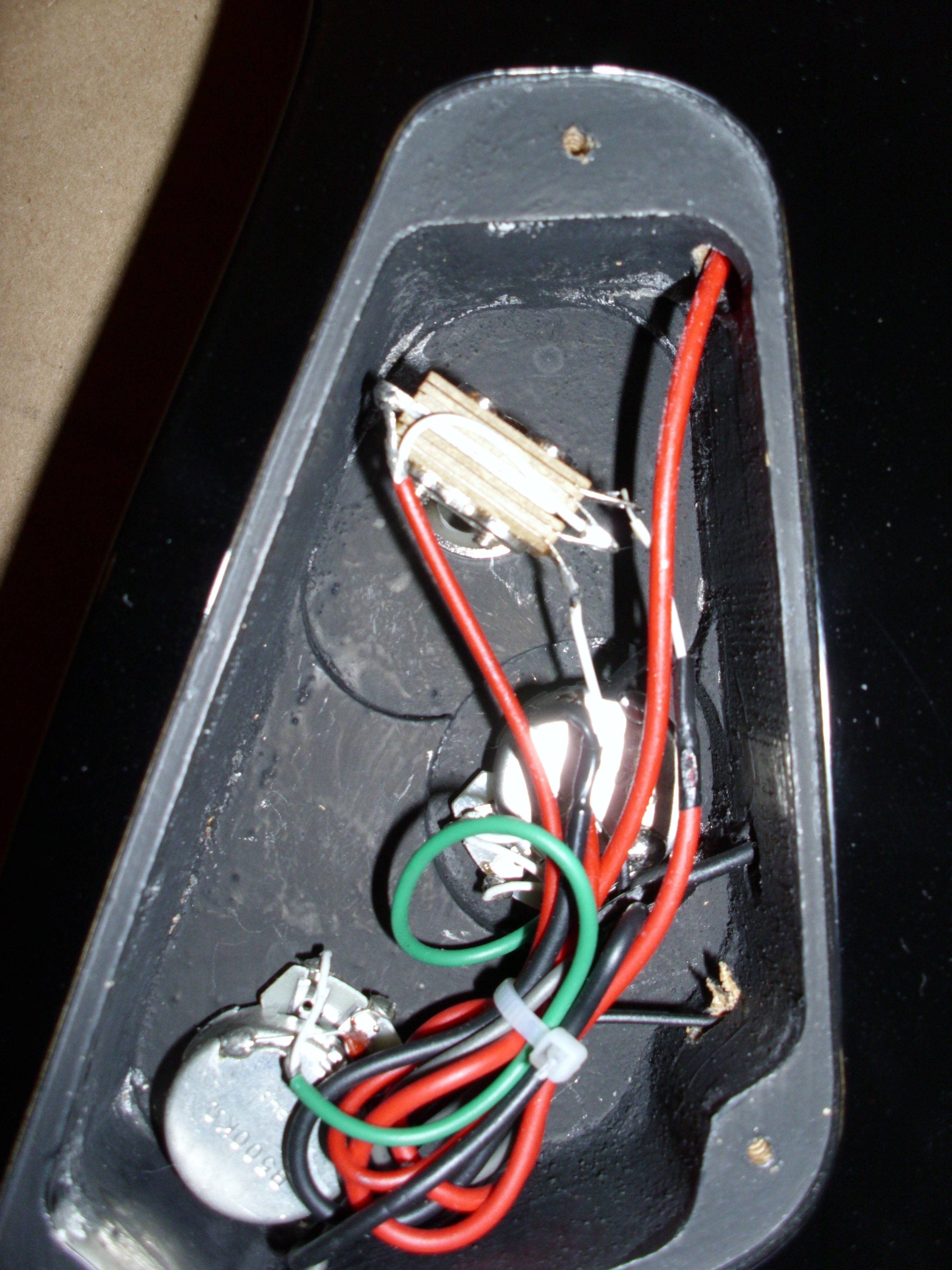
  • The tuners really can’t handle the strings at this pitch.  Since the guitar has 4 tuners on a side – you would need to purchase two 6 string sets to replace them.  While I like Steinberger tuners – I’d have to think quite a bit before I sank $200 into tuners on any guitar.  I’d recommend using the highest gear ratio you can get.


  • While the pickups are better than what you’d expect on a budget guitar, they are a little lackluster.  Here is the sound of a B minor scale played with the neck, middle and bridge pickup settings on a clean amp setting in AU lab with PodFarm.

(Note – if you have a problem hearing the mps3 just refresh your browser window – it’s a little glitchy in Safari but seems to work fine in other browsers.)

Also – while I could have edited the clips a little tighter – the hum from the CRT is present in the clips so this should be a realistic testing environment of what some one would get just pluging this into their laptop.

Here is the sound of a B minor scale played with the neck, middle and bridge pickup settings on a dirty amp setting.

Here is the sound of a dirge type of riff played with the neck pickup.

Here is the sound of a dirge type of riff played with the middle pickup settings.

Here is the sound of a dirge type of riff played with the bridge pickup.

I plan on swaping these out with Bare Knuckle Pickups at some point.  While you could spend $200 more and get a Damien Elite – with better tuners and an EMG set – I’m not really psyched about the EMG tones.  I’d rather have $200 to spend on pickups I like rather than spend $200 more on a guitar and still have to swap out the pickups.

.

Update:

Since this initial post – I’ve had a Bare Knuckle cold sweat put into the neck position.  Info, pics and mp3’s here.

  • I like the belly cut a lot – but I plan on getting a wrist cut added to the body to cut down on the slab feeling when playing it.
  • As I mentioned before – the 24th fret on anything other than the highest string is pretty much just for show.  If you really wanted to access those frets, you need to modify the bout.

Final Thoughts

When I play a chord like this C major 9 #11 (if you listen under headphones – you can hear all the harmonics ringing out at the end like a piano with the sustain pedal on) I’m surprised that more people don’t go this route.  Eight string guitars may not be for everyone – but for those of you who are feeling adventurous this is not only most inexpensive entry point for exploration, it also gets you a guitar that is very similar in features to the model that’s $200 more – and stand up to other eight strings costing more than twice as much.

Thanks for reading!

-SC

Schecter Omen 8 String Review

Another guitar?

With the sale of a couple of guitars –  I decided I wanted to experiment with an extended range instrument – but didn’t want to spend a lot of money.  I had been looking at the Damien Elite 8 – which I saw in this video. I liked what I heard of the instrument – but then found the 2011 Omen 8 was released and $200 cheaper than the Elite (with free shipping from Amazon) so I bit the bullet and gave it a try.

I haven’t bought a new instrument in a while so I while I had played a couple of Schecter 6 strings (well made but not my thing) I was curious about what would come in the mail.  Given that a hipshot guitar bridge alone would run me $114 – I couldn’t build a guitar for $399.  My logic in the process was that even if the guitar was sub-par that I could part it out and have FNH Guitars build me a custom model (I can hear FNH’s John Harper’s eyes rolling back into his head with that!)

The Schecter Omen 8 – is a South Korean built guitar that is set up and shipped in the states.  Frankly, it’s a lot of guitar at this price point.

Guitar Stats

The guitar has a basswood body with 2 Schecter brand pickups and eight string bridge.

In comparison, the Damien Elite has a mahogany bodywith a quilted maple top , multi-ply binding and active EMG-808 pickups.  The body itself is surprisingly contoured.  While I was surprised to see a belly cut, a wrist cut would benefit the model as well.  The routing for the electronics is clean, and the finish is top notch.

The string through body bridge works well.  The pickups are functional but a little lackluster.  (Part of this could be the basswood body – Another reason I like bolt on necks vs. neck though body.  In a bolt on neck if you hate the neck but like the body (or vice versa) you can just switch it out. With a neck through body – you buy a new guitar).  I’m not a fan of active pickups so I would probably plan on replacing them even if I sprung the extra money for the Elite.

The 24 Jumbo fret bolt-on maple neck has a rosewood fingerboard and a 26.5″ scale to accommodate the extended tuning of the instrument.  Note: you could make the tuning whatever you wanted – but it’s strung with what appears to be a D’Addario stings (update I’ve been informed  on the sevenstring.org forum that Schecter’s standard 8-string set is: .10 .13 .17 .30 .42 .54 .64 .74 – thank you sir!) for a low to high tuning of F#-B-E-A-D-G-B-E.  The  Schecter tuners are functional (you get Grovers on the Damien Elite) and the inlay is a simple dot inlay (instead of the more elaborate “stained cross” inlay on the Elite).

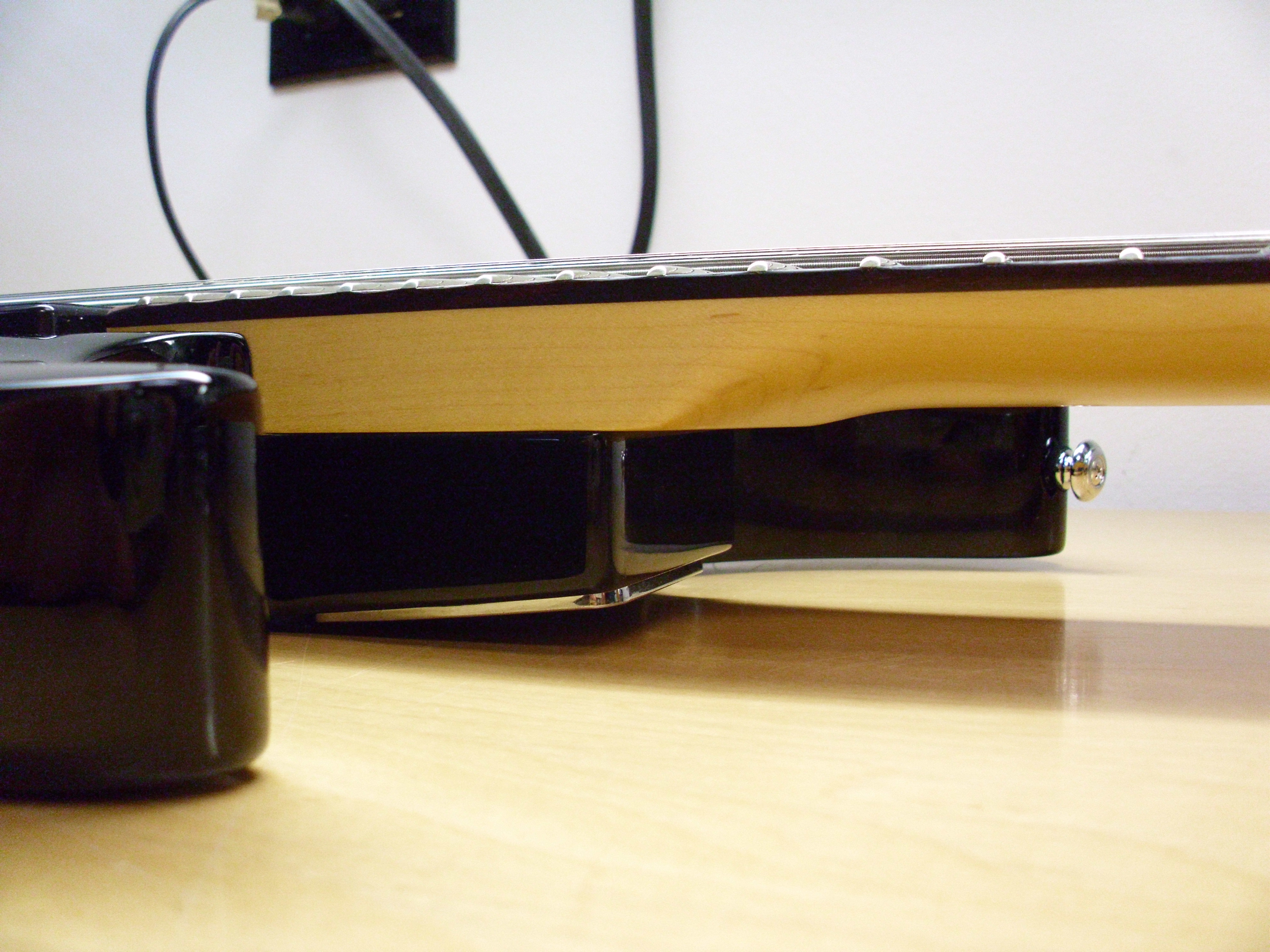
In many of the forums I researched, people complained about the “baseball bat necks” of the bolt on Schecters.  I didn’t find that to be the case at all.  While there is a heel cut in the body to help access the upper frets:

The joint itself is a little chunky.

Given the amount of string tension on the neck – this isn’t that surprising but it does mean that in performance the top two frets are basically for show.

Setup wasn’t bad but needed a little more tweaking.  In addition to the F# intonation being off the nut action was pretty high for some of the strings.

I know the lowest string needs extra room to vibrate – but it was really high on the E, A and D strings as well. Especially on the higher frets.

In use

The guitar sustains well acoustically without amplification but – the shipped string (I believe a.074) on  26.5″ scale is really too small for the low F#.  At that pitch the string just flops on the fretboard.  Also in terms of timbre – the F# is a little strange to me.  It seems to fight between wanting to be a bass and a guitar. I could get some nice sounds with clean tones – but I had a really hard time integrating it with any kind of distorted tone.  Part of that could be the pickups as well.  The high gain tones that sounds best for single pitches turn to mush on chords so there’s a balancing act there.  Going up to a .08 would probably tighten it up and I may got that route eventually but for now I wanted to go more well rounded.

Having said that – the scale length is workable by getting rid of the F#.  The tuning I’m using right now is (low to high) B-E-A-D-G-C-E-A.  This uses the above mentioned D’Addario 7 string pack with a .007 for the high A.  I’ve also swapped out the .059 for a .062 for the B which seems to feel better.

Tech Tips

Here are a couple of suggestions that will help if you use the high A tuning.

  • You’ll have to adjust the intonation when using a different string.  Start by removing the lowest string (in this case F#).  Before you put the new string in – move the saddle so the front edge is in line with the saddle on the low B string. (Do not adjust the height screws! All you’re doing is adjusting the string length so that the string intonates properly.  Since the other strings are already intonated – this will cut down on time adjusting it substantially).  Leave the top string (the High A) where it is and adjust accordingly.
  • I’ve tuned the B string up to C.  This keeps a 4th between the E and high A string (top 2 strings) and a 3rd between the C & E strings.  This way all of my 3 note per string scale patterns stay the same.
  • There’s a company that sells strings specifically for high pitches on extended range instruments called Octave4Plus.  While I may look into their strings in the future – while I was waiting for the guitar to come – I put an order into Just Strings and ordered 2 sets of the D’Addario 7 string packs and 5 single .007 strings to see if I could do it on my own.  (Update – you can read an Octave4plus review here) – What I wanted to see was if the string would snap near the nut or at the bridge.  When I tuned the first string up – I tried to get it to pitch and it snapped at the tuner.

What I recommend you do is tune the string up to F# or G and let it sit for a while.  Tune the other strings.  Every 3-5  minutes or so – try to bring it up another 1/2 step and repeat until you get it to pitch.  By letting the string stretch at various points – it becomes more stable under pressure.

In using this tuning – I wonder how it would work in a 25.5″ scale.  The advantage of that to me is that I could use .011s (or .012s!) for the 6 strings and then fill in the top and bottom appropriately.  I can’t help but think that heavier gauge strings would drive the pickup more and result in better tone.  The issue there would be the floppy low B. Every variation is a series of compromises – just something to consider.

  • In moving the strings – you will probably have to adjust the nut slots.  I’d recommend having a qualified guitar tech do this if you’re not sure what you’re doing.

Overall Thoughts

I am constantly amazed at the cost point versus quality of work that is coming out of South Korea these days.  If Amazon is selling this guitar at $400 (I rounded up for convenience), that means that it’s probably leaving South Korea at a cost of $150-$200 shipped – which is pretty mind boggling if you think about it.

Count on spending some additional cash on setup right out of the gate.  Further on down the line – you will probably want to put money into pickups and perhaps tuners as well.  If you like active pickups, or want a really nice looking figured top- this is a no brainer – save up an additional $200 and get a Damien Elite 8.  Otherwise – minus the top and the pickups – this is basically the same guitar for 1/3 less money.

I’m still sorting out how to play this!!  In the meantime, you can read more and hear some mp3s here.

If you’re looking for a gig bag for one of these – the Gator Viper is the best deal out there right now.

In the meantime – If you have any questions – please feel free to drop me a line @ guitar.blueprint@gmail.com !

Happy Thanksgiving!

-SC

Warming Up: Finger Exercises, The 3 T’s And The Necessity Of Mistakes

Pedagogical Errors Were Made

One of the first lessons that guitar students are taught is the 1 note per fret 1-2-3-4 chromatic alternate picking exercise.  While this is typically presented  as an initial exercise to gain coordination – it has a very limited long run value.  As a static exercise, it  should be discarded from your regimen immediately because

.

you play what you practice

If you want to play semi-chromatic ideas at high speeds moving in 4ths – this is a great exercise to use.  But it’s a boring sound, a boring exercise and doesn’t translate well into everyday performance.

“But Scott”, you might posit, “it’s just  a warm up exercise.  It isn’t something to play at a gig.”  Then it’s a further waste of time as

.

everything you play should be something that translates to live performance

.

The Physicality Of Practicing or How To Lose A Gig

Here is a gig nightmare story that illustrates the point of proper technique versus strength.  Since the embarrassment here is all mine, all of the names will be on the record for my moment of shame.  Years ago when I was working at Sandy’s Music, one of my co-workers “Skinny Mike” Feudale wanted to see if I could play a gig with his rockabilly/psychobilly band – The Speed Devils. Mike is a great songwriter and the songs on the Speed Devil’s cd were really strong and lot of fun to play.  The Speed Devils had a gig come up in NY and needed a lead guitarist to sub in.  If it worked out – it could be a regular gig – but there were some rules.

.

1.  I had to look the part – fortunately the drummer Judd had a vintage bowling shirt I could squeeze into

2.  I had to play a vintage amplifier.  Fortunately I had just gotten my vintage Gibson amp back from Tom at AzTech electronics (truly an amazing amp guy) – which sounded and looked great.

3.  I had to play the Speed Devils guitar.  This was a hollow body that Mike had fixed up and completely vibed out (full flames and dice for volume knobs) with heavy gauge strings and high action to push the volume a little more.

We rehearsed the set once or twice and then went to the gig a couple of days later.

On the way from Boston to NY, I didn’t have time to warm up so I was doing some finger exercises to limber up my hands.  I was experimenting with a lot of grip master type things to strengthen my hands and try to fix my pinky (which was really quiet with hammer ons).  We got to the club and  I found out that there was no mike for my amp.  The only thing going through the PA was the vocals.

This is the point of the story that I should mention that while everything was fine when we had rehearsed at low volumes; my 15 watt amplifier could not compete with the rest of the band in a club setting.  As I was inaudible I started strumming louder, and with the live adrenaline kicking it, I started fretting harder as well.   Between the heavier string gauge, the higher action, the underpowered amp and the over-tensed playing- I blew my hands out by the second tune.

My hands were so shot that chording was difficult and soloing was all but impossible.  I limped through the rest of the performance – but nothing came out the way it was supposed to.  Needless to say, I didn’t get the gig – a sound decision by the band – but I was really angry with myself because I had unknowingly sabotaged myself before I even got there and had I taken a different approach – I would have been able to play the show much better and not let the band (and myself) down.

.

The Physicality Of Practicing (slight return)

Playing an instrument is a physical endeavour.  You can push your muscles too hard and hurt yourself badly playing the same things over and over. (Trust me – performance related injuries are not fun).

Having said that, this isn’t weightlifting.  You don’t need muscular hands capable of cracking walnuts to play guitar well – you need hands that can move  fingers quickly and independently –  a fast twitch muscle versus a slow twitch muscle. This leads to a little secret that students generally don’t get exposed to in rock guitar lessons

.

hammer on volume comes from the speed the fingers strike the string not the force

In terms of volume, the most problematic finger is typically the pinky.  One habit that I had to fix (and that I continue to see in a number of players) was the improper attack of the fret hand pinky on the strings. (In case you’re wondering about proper form, I’ve reposted some of the information from the Glass Noodles arpeggio post below).

.

Here’s a good way to visualize the fret hand finger motion you’re looking for:

Put the palms of your hands on a table.  Now without lifting the palms up, tap your fingertips one at a time on the table starting from the pinky and ending on the index.  You’ll notice that the fingers stay curved and that the large knuckle of each finger is responsible for the tapping.  This motion is what you’re looking for in this process.  Notice that you don’t need to hit the fingertips very hard against the table to get a crisp attack.

The concept of building up your hands like biceps – is just ridiculous.  The goal of guitar performance is to keep your hands relaxed so you don’t blow them out in a gig or on a session.

.

How I warm up now

When I warm up now – I play scales and arpeggios, switching between chord voicings of tunes I’m working on and improvising around various patterns at low tempos and paying strict attention to

.

The 3 T’s in Performance: Timing, Tone Production and Tension

(remember these – this awareness could save you untold time and pain later!)

.

In general –  you just want to make sure that all of your fingers have had a little blood flowing in them before you begin to play for any length of time.  I do this with a timer for 5 minutes (more or less depending on how my hands feel).

External warm up devices are kind of goofy to me.  Have you ever seen a runner go into a gym and max themselves out on a legpress before they went for a long run?  Do you really think that putting mechanized unfocused tension on a finger is going to make it play a musical passage more efficiently?

.

The necessity of making mistakes

Along with the forthcoming GuitArchitecture books, I have also put substantial time into  a general book of guitar technique.  In addition to discussing specifics of practice and performance methodology – I also took the 1-2-3-4 exercise and broke it down into every possible positional variation as a way to develop technique.  The book is currently 256 pages.  The majority of which are the 864 individual graphics that had to be created and placed in the text.

Midway through this process I started to question the mistake of basing any technical study on such an exercise – or the concept of musical exercises in general.  (Again the point isn’t to have svelte waistline or huge muscles – the point is to be able to play melodic and harmonic ideas more readily.)

I came to the conclusion that if the 1-2-3-4 example could be approached as a way to develop a systematic approach to generating both melodic ideas and melodic variation it could also benefit readers as a technical study as well.

.

Mistakes are teachable moments

It’s easy to see a mistake as something to learn from in a practice room session but harder to see it at a gig. If I walked away from the Speed Devils show and just said, “That gig sucked – so I must suck as a guitarist” I would have missed a great opportunity to see there was something very wrong in what I was doing. The gig taught me in addition to making sure that I had proper preparation and the right tools for the job that tension does not equal volume – and that lesson has been more beneficial to me than any lesson I could pay for.

.

I hope this is helpful to you!

Thanks for reading.

-SC

POD HD vs Pod Farm: A Cost Comparison

One thing that occasionally drives me crazy is trying to find out about a piece of gear – finding a googled link – reading through a multi page posting involving specific gear only to get to a final point of, “Oh I don’t have the unit and I’ve never tried it – but I’ve read the specs.”

Having prefaced this – with any luck this post won’t make you crazy.

I have been taking a good look at the POD HD 500.  One thing I like about the laptop rig is being able to set things up quickly – but as a friend of mine once quipped about another unit, “…you can’t check your e-mail on dedicated hardware – but it’s also much less likely to break down on stage.”

Another nice thing about dedicated hardware is the fact that it’s self contained.  There’s something about being able to plug something in and be up and running in no time at all.  Even as compact as my laptop rig is – it would still be faster to run through the HD than setting everything up on my laptop.

The price tag – Part I

The POD HD 500 will run about $500.  For that you get the same ins and outs that you got with the POD X3 – 16 amp and cab models (apparently the modeling is built from the ground up in a completely different way than the previous pods – hence the “HD”), about 100 effects and an onboard looper that can loop audio up to 48 seconds (in 1/2 time mode – 24 in regular speed).

If you’re running POD Farm 2.0 on a laptop consider this for a moment:

A second generation Macbook will run you at least a grand.  You really need a 7200 rpm drive – and that isn’t standard on most computers so you’re looking $50-$100 or more (assuming you’re installing it yourself) and 4 gigs of memory or more (if not already installed – again let’s say $50-100 depending on memory and model) – so let’s just average $150 ($75+75) for memory and drive costs.

You’ll need an audio interface.  If you use line 6 gear – you can get a cheaper rate on Pod farm but it’s usb… Let’s assume for a moment you’re going to go whole hog and go with a high quality audio interface.  An RME Fireface will run you at least a grand – so let’s also assume you’re going to go “budget” and get an Apogee Duet for $499.  If you upgrade to a break out box – it’s a minimum of $95 more for the unbalanced version.

You can get Pod Farm Platinum for $149 on Amazon (and for $184.99 get the Ilok key as well) – This is opposed to the $299 you’ll be charged from Line 6 for Platinum alone.

From a software standpoint I use AU Lab (which comes free on the OSX installer disc) and Sooper Looper (which is shareware – but you should pay Jesse something for the product – it’s one of the best software investments you can make).

If you don’t want to have to click on a mouse for a set – you would need a midi controller.  I like the shortboard mk II (approximately $199 – but it you may want to spend the $7-10 bucks for a 10-15 foot USB cable if running it live).  It’s usb powered, well constructed and works really well (except for the fact that Line 6 currently doesn’t support displaying patch names on the controller – only midi values – this is a big minus for live use – because you have to stare at the screen to see what patch you’re playing.

So for a live laptop rig (from scratch) or The price tag – Part II

Computer:  1000 + 150 (average memory and drive cost) + $599 (Duet + breakout box)+  $184.99 (Pod Farm + Ilok key) + $199 shortboard = $2133!!!!

That $1995 for an Axe-FX ultra is starting to look like a steal (although the Axe-FX midi controller is $799 – which makes the shortboard look better and better all the time)!  Comparatively, an Eleven Rack Mount will run you about $760 or so.

This doesn’t include a laptop bag, external drives (for looping/recording to), IRs  (impulse responses), conditioned power supply, USB hubs, breakout boxes or other expenses.  To put it in perspective however, you probably already have a computer and an audio interface of some kind so many of these other expenses are not critical.

From a cost perspective – there is no comparison between a POD HD and a laptop rig running POD farm.

But here’s my thought on it.

I can’t imagine Line 6 not issuing a POD farm version of the HD models.  The code for the models is already written and they already have a wrapper (Pod Farm).  My guess is that they’ll wait a while for hardware orders to fill up and then release a POD farm version.

I have no idea what the hardware is in the POD HD unit (it runs up to 96k internally) – but I have to think that:

1.  My laptop has more memory, hard drive space and a faster processor than what’s on the HD (or the Axe-FX or the Eleven for that matter)

2.  Related to this – that I can run more than 8 effects if need be on my laptop – which it the limit on the HD

3. The Apogee has to have better A/D/A conversion than the POD HD.

4.  While the built-in looper is a great addition – that it doesn’t hold a candle to Sooperlooper for features or loop time.

Does this mean that I’m dissing the HD series?  Not at all.  As you can see from the economic breakdown above – I think the HD is an amazing deal.

The Pod X3 was already useable – and even not having tried the HD (cough, cough) – I have to think it’s sonically a step forward. Heck if I could clear out some money – I might be willing to pick one up for sheer convenience alone.

But in going the laptop route – I’m making an investment in the future.

I’m putting my money on better software and better plugins and knowing that if the POD HD sounds that much better than the POD X3, that the Pod Farm version may even blow it out of the water.

There’s always cheaper ways to do things.  For a long time I ran a POD 2.0 into a Fender DeVille and always had people asking what I was using to get my tones.  As a general rule, I would suggest to get the best gear you can afford and make the most of it.

One final thought

If you own a car – you will always be sinking money into it – insurance, gas, oil, tires, breaks, maintenance, etc, etc.  It’s expensive – but it beats walking.

When I was at Berklee –  there was a shred guitarist whose pedal board had about 30-40 pedals on it and needed to be carried by two people.   This was before the signal hit the full rack space unit.  All of this gear was for 3 tones – clean, metal rhythm and lead.  Additionally, he had 2-3 Rocktron hush units in the rig.  When he stopped playing there would be a literal sound of locusts trying to break through the speaker before the gate kicked in (here’s an approximation of the sound: wheedley-wheedley-wheedley-wheedley-SCHHHHHKKKKKKK – silence).

A laptop guitar rig is kind of like a car.  If you own a guitar, you will always be sinking money into it (and the gear used with it) as well – but it beats walking with a pedal board with 30 pedals on it to a gig.

Thanks for reading!

-SC

.

POD HD Flash Memory Update, POD HD500 In Live Use And More Thoughts About Gear

SOME THOUGHTS ON MODELING, GEAR ACQUISITION AND THE POD HD500

LINE 6 POD FARM 2.5 UPDATE AND POD FARM FREE ANNOUNCED

APOGEE DUET 2 ANNOUNCED

New SooperLooper Update 1.6.16

OCTAVE4PLUS A4 – .007 STRING REVIEW

BKP (BARE KNUCKLE PICKUPS) 8 STRING COLD SWEAT PICKUP

.

LAPTOP GUITAR MUST BUY – GATOR VIPER ELECTRIC GIGBAG W. LAPTOP COMPARTMENT REVIEW

HOME FOR THE HOLIDAYS – GATOR VIPER GIG BAG REVIEW

SCHECTER OMEN 8 STRING REVIEW PART 2 – STRING OBSERVATIONS AND SOUND CLIPS

SCHECTER OMEN 8 STRING REVIEW

APOGEE DUET BREAK OUT BOX OVERVIEW

LINE 6 FBV EXPRESS MK II REVIEW

MONO PRODUCER BAG (LAPTOP BAG REVIEW)

.

POD HD500 AND POD FARM CONJECTURES

STEINBERGER GEARLESS TUNERS – REVIEW

TOOTHPICKS AND THEIR PROPER PLACE IN GUITAR MAINTENANCE

WHERE TO GET YOUR GUITAR REPAIRED IN LA OR LESSONS FOR THE SELF EMPLOYED MUSICIAN

GUITAR STREET IN HO CHI MINH CITY VIETNAM

RIG AROUND THE ROSIE OR MEDIATIONS AND MEDITATIONS ON GEAR

LINE 6 POD FARM 2.0 OVERVIEW

VARIAX AC700 REVIEW/WORKBENCH OVERVIEW

FNH ULTRASONIC GUITAR REVIEW

GEAR

.

Apogee Duet Break Out Box Overview

The Apogee Duet is a pretty remarkable piece of gear – and it terms of A/D/A conversion – it does a great job at it’s price point.  The Duet 1/4″/XLR cables, however,  are a little hit and miss:

You’ll notice that the connecting wires are thin and a little fragile looking.  Also – because of the way that the 1/4″ cables I use pull of the breakout cable – I feel like it’s adding additional tension to the wires.  In short, it made me a little nervous in live use.  Then I found out about the Duet Break Out Box – which mounts all of the cable’s into a single metal box with a rugged high quality cable attached and decided to give it a try.

There are 2 versions of the Duet Breakout Box (both are 100% passive and line level).  I’m using the unbalanced box – as I’m not sending signal over long cables – but the price difference is $99 versus The Breakout Balanced – which will run you $215 or so.

Sonically, I don’t hear a difference between the breakout cable and the breakout box -which is a good thing – the selling point of the unit is it’s ruggedness. The box is solid, well constructed and can definitely handle a live gig.  The enclosed cable is about a foot long  – so you may want to invest in a longer cable eventually – but for my purposes this works fine.

Do you need this unit?  If you’re doing mostly studio or home work you can probably get by with your existing cable fine.  But if you are planning on using the unit live – this is a worthwhile investment.

The Double Edged Sword Of “Fix It In The Mix”

Recently, while working on some mix downs of the Rough Hewn Trio improvisations we found a track that we all really liked had some nasty digital distortion on the take.

So as a workaround we decided to see if we could salvage it  by reamping the track through the Atomic Amp.  Craig and I sent the signal through the Duet out into the amp and then threw a 57 on it to see what happened. (From a technical standpoint there was a noticable difference. I’d like to think that the tubes smoothed it out a bit  but I don’t know if it was really a huge sonic improvement over just reamping it in POD Farm.  I’ll have an excerpt online soon.)

“Let’s fix it in the mix” in general is an act of desperation but it’s one that can be rooted in prgamatism (and one that is encouraged in recordings made by the music industry).

DIY Recording

When a new band records something they typically don’t have a lot of cash.  But they have a computer, some recording software (or worse warez) and some USB audio interfaces and think, “Oh hell I got all those great plug ins the pros use, we can record our cd here and it’s going to be amazing.” (and to be fair – sometimes it is and (in general) I’d say the overall quality of sounds people are getting at home is the highest it’s ever been largely due to the quality of samples and processing available –  but if you’re recording everything from scratch you’re usually in for a world of pain.

If said band is a live act with a live drummer then they either buy a bunch of mikes and stands and track it home OR go to a studio and track it there.  If they do it at home – they probably don’t have very good quality microphones, headphones or monitors – and will go to the studio to try to try to fix the problem.  This is the tip of the sonic iceberg.  There will often be a lot of other mix problems and it will either be a sub par recording OR at the bite the bullet point – they will get a professional to come in to fix it.

This is typically expensive (to get it fixed properly) or unsatisfying (if heavily compromised).  Fixing something that has gone horribly wrong is usually very time consuming and therefore very expensive.  With solutions of either have to spend money trying to fix what exists or re-record parts of it, at a certain point new bands simply run out of money and then make the most of what they have.  Again – usually with mixed results.

Let’s look at a major release for a moment.

Another Story Time With Scott

Again, the following has been altered to protect the guilty.

A very good friend of mine is a world class engineer/producer.  Super cool guy.  He was telling me once about a major label session that he did when he first went to NYC with a well known band.  The recording he worked on with them was a multi-platinum release.

“I can’t listen to that cd”, he once told me, “there’s not 4 bars of anyone playing at the same time on it.”

See (it used to be that) when you’re signed to a major label – you got the sweet sweet advance.  On the surface, it’s an intoxicating dollar number and the band is thinking they’re going to be able to live off of it for years!

But then the manager gets a cut, and the agent, and the producer (picked by the label and either working a flat rate or percentage or both), and then there’s the studio with the sweet sweet gear.  Even with the block book rate it’s still costing a pretty penny and it’s all recoupable against media sales.

So the gear gets all set up.  And scratch tracks are recorded and the first track is played down.

Repeat 30 times.

Move to next song

Repeat as necessary

Then the producer and the engineer go through the recording of the drums – meticulously for a LONG time (think days, or weeks versus hours) .  The producer starts making notes like – “Okay for track 1.  I like the intro from take 6.  The first verse from take 10, the chorus from take 2,” etc. and frankenstein a drum track together.  Then beats are corrected.  Drop fills, etc.  Until they have the perfect drum track.

For a moment – think about how long that would take someone to do.  Even if they knew Pro Tools really really well.

Now imagine this process repeated with bass, guitars, vocals, etc.

Now imagine mixing it.  With this same attention to detail.  With mutiple mixes run by multiple people.  Until (finally) everyone signs off on the mix and it gets sent for mastering.

If you’re imagining time as money, you can see why a new release might cost $250,000 or more.  Since this money is all advanced  based on sales you can imagine how long it takes for a band to get their money back.

It is essentially  a brilliant type of loan sharking.  Money is loaned to an act at an impossible point of payback with the full knowledge that they will never be able to pay the money back to get paid for their work – BUT in the meantime -the actual work they’ve done (said recording) would still be raking in money for the label that they weren’t entitled to.

It’s kind of like if a loan shark had you paying money back – but somehow was able to deposit 90% of your paycheck before it got to you.  As you were getting full taxes deducted on that amount and drowning in debt – you ask when you’re going to see some money and are met with a response of , “What do you mean get paid?  You’re still paying the interest.  We’ll let you know when you get some money.  I understand it’s hard.  Why don’t you borrow some more money and go on tour?That will bring in money.”  The touring expenses are also recoupable, and so it continues like indentured servitude.

As a contrast – Poison’s debut was done in a weekend.  Not a brilliant sonic document – but I heard that they spent something like 30k on the recording and actually made money off it.  (think about that as a cost for a weekend record for a second next time you budget going into the studio).

For a more musically satisfying example – Stevie Ray Vaughan’s Texas Flood was recorded in an afternoon.  They set up their PA in the studio.  Played their set.  Went to lunch.  Came back and played the set again.  Then John Hammond took the best takes and mixed it down.

It’s important to be able to perform at a high level without having to rely on digital editing to get a useable take.

Because there’s no second take when you’re playing in front of an audience.

The double edged sword of “fix it in he mix” – is that it’s also important to know when to stop.

When you’re on take 100 of the verse vocal and it’s not working – you may have to call it a day and edit it together later.  Metalocalypse, has a brilliant moment involving this idea with  “One Take Willy” that, unfortunately, is truer than it is comfortable.

When spending time in a studio tracking, there’s a constant balance of the cost/performance/time ratio. (i.e. getting the recording with a minimal number of takes). If you’re (insert major label super over produced auto tune vocal act here), this is not really an issue – but if you’re not rolling in money – “fix it in the mix” always has a certain degree of uncertainty to it and a general loss of money.

I’m not saying, “don’t be experimental” but it’s important to realize that ‘experimental” usually has a high cost either economically in a studio or in time if done at home.  And it’s important to keep your eye on the bill so you don’t get stuck with the full tab.

Thanks for reading!

Line 6 FBV Express Mk II Review

I just wanted to post a quick review on a Line 6  FBV MK II Express I picked up to use as a back up for a gig.

This unit is about 1/2 the size of the FBV mkII shortboard.    It comes with 4 midi assignable (either through USB or Cat 5 connection cable) switches, a tuner display (if used with a Line 6 amp) and a dedicated volume/wah pedal.  It was small enough that if I positioned it carefully – I would probably be able to fit it in the front flap of my gig bag – which is a big plus.

The layout is smart.  Everything is easily accessed and if you don’t need to tweak a lot of parameters – this may be a great choice of controller for you.  Another possible use in Pod Farm would be to set up the assignable switches as on/offs for various pedals – then you could turn 4 pedals on or off (plus the volume and wah) – with the unit.  I like switching through banks – so this isn’t a great option for me – but it’s very flexible for what it is.

This is a budget pedal – it has a plastic back as opposed to the metal back of the MK II shortboard – but having said that  – it seemed to hold up fine under normal use.  The USB powered out option is a really smart one – as you could use it to control parameters in a variety of plug ins or DAWs.

As a pedal, it’s a good budget investment.  If nothing else you could control wah and volume remotely though Pod Farm and that alone could be helpful.   If you like to tweak sounds – I would recommend just spending the extra $100 bucks and getting the mk II shortboard and get full functionality – otherwise – if you just have a few parameters to control – this pedal may be a good option for you.

Thanks for reading!

Guitarchitecture Post Featured In Guitar Player Holiday 2010 Issue – Quick Licks Section

It’s been a couple of productive days – The pentatonic/blues lick that was featured in the quick lick/rig du jour post has been featured in the Guitar Player Holiday 2010 issue. It’s the issue with Santana on the cover.  Thanks again to Matt Blackett  and the GP staff!

The long overdue Tubtime cd, “We Bleed The Sun And Make It Pay” – is finally up for sale on Itunes and on the CD baby tubtime page. Featuring the talents of Patty Barkas, Geof Chase, Joe Rauen and Keichi Hashimoto – Tubtime was the first project I was involved with that was based solely on of structured improvisation and in many mays was a cornerstone of what I do now. In addition to cd baby and Itunes – it’s also available on emusic should be available on Amazon and any other digital distribution service over the next several months.

Rough Hewn Trio @ CalArts was a big hit!  We should have video/audio up soon.

More info coing soon!  Thanks for dropping by!

Tubtime: “We Bleed The Sun And Make It Pay” now available on CD Baby

The long overdue Tubtime cd, “We Bleed The Sun And Make It Pay” – is finally up for sale on the CD baby tubtime page, and should be available on Itunes and Amazon over the next several months.

Featuring the talents of Patty Barkas, Geof Chase, Joe Rauen and Keichi Hashimoto – Tubtime is an experiment in 2003 to see if an accessible cd of structured improvisation could be successfully executed.

The CD notes are below:

Tubtime has its roots in work in the unholy union of drummer/engineer Geoff Chase’s “Directive 4″ project that featured rock improvisation with various Boston musicians and guitarist Scott Collins’ goal to be able to work with musicians of such a high caliber that they could perform a full set of improvised material that sounded pre-composed.

Over the course of 2003-2004 Tubtime ended up with several cds worth of material that will all hopefully see the light of day. The music is being finally released after numerous relocations and other various hold ups, because we kept running into people who had heard of us (or heard the tracks) despite having never played live. While we haven’t performed since then – the threat of more music is always a real one.

“We Bleed The Sun And Make It Pay” was the culmination of 4 such sessions. All of the music was written and tracked live and in real time (although, Geoff took some of the improvised material and used it as transitional material on transitional tracks.)

The poem on the cover photo (taken by Joe Rauen) was inspired by a quote attributed to Dick Cheney who rationalized a series of governmental policies by saying, “this is out due.” It was such an incredibly brazen sense of entitlement that the poetic fragment was written around it.

Visually, the Tubtime project was working around a “disturbed child” aesthetic with lots of pictures with distorted perspective and coloring outside of the lines. I think that the music captures some of that as well. There is a certain honesty of immediacy that comes from real improvisation – and hopefully that translates as well.

There was no real concept when we recorded the tracks, but I developed one when assembling the cd. As the tracks were mixed and sequences there was a specific story line worked out involving themes of narcissism, paranoia and altered states of perception.

“We Bleed The Sun and Make It Pay” is a type of sonic documentary of where we all were at the time of recording it. As it takes a couple of minutes to develop each of the pieces – I think It works best as a bumpy 58 minute sonic journey. I hope you enjoy both the turbulence and the scenery.

The tracks were performed by:
Patty Barkas – vocals
Geoff Chase – drums
Scott Collins –guitar & loops
Keichi Hashimoto – trumpet
Joe Rauen – bass & loops

Thanks for reading!

Rough Hewn Trio

I just wanted to take a second to announce a new project I’ve been working on with Chris Lavender  and Craig Bunch.  Rough Hewn Trio is a project that mixes through composed ideas with heavy doses of improvisation.

We have our first gig this Thursday @ CalArts where we’ll be accompanying Germaine Dulac’s La Souriante Madame Beudet (The Smiling Madame Beudet) and Teinosuke Kinugasa’s  Brilliant “lost” film – Kurutta Ippeiji, (aka Page of Madness or Page out of order).

Craig and I have done a preliminary mix of some live recordings we’ve made – so we should have videos and mp3s up on a dedicated site soon with other novel things like an EPK and a bio.

Thanks for reading!  More info coming soon.