Some Useful Online Practice Tools

While some larger GuitArchitecture posts are in the pipeline, I wanted to post about a few online tools I use frequently when practicing that may be helpful to you as well.

In previous practice posts, I talked about keeping a practice log and using small increments of time (5-10 minutes) in multiple sessions to really focus on ideas.  (You can download a sample log here or here). The tools I mentioned to assist in this are a metronome and a stop watch.

.

Seventh String

Not to be confused with the very cool sevenstring.org forum, Seventh string is the company that produces the excellent Transcribe! software.  While Transcribe! isn’t free (nor should it be – it’s an excellent piece of software that will pay for itself many times over) they have a number of useful free apps on their utilities page that may be of interest to you.  The apps all use Java so you’ll need to have that installed if they’re not working – but the great thing about each of these apps is that they can either be run online or downloaded to your computer to run if you’re somewhere without an internet connection.

Getting in tune is the first step to any practice session.  The online tuner on seventh string is functional but I find the tuning fork to be a lot more useful.  In addition to providing tones to tune to, the tuning fork also can act as a drone.  Drones can be a great tool for developing melodic ideas in a harmonic context.

The real prize here though is the metronome.  I love the old school graphic and the click sound isn’t annoying to me.  It also has tap tempo and can move incrementally.

.

Stopwatch

Working hand in hand with the metronome for timed training is a stop watch.  I’ve plenty of hardware versions that are fine.  But I really like the  numerous variations on the online-stopwatch site.  The countdown version is perfect for setting 5-10 minute increments (or longer) and rings when it’s done.  There’s a metronome on this site as well – but it doesn’t allow incremental movement.

When practicing mid day – I tend to just open up my log, tune up, set the countdown timer turn on the metronome and work on the first thing on the log list.

.

The simpler you make a routine – the easier it is to maintain.

Anyways, nothing Earth shattering here – but I hope it helps!

Thanks for reading!

-SC

.

If you like this post you may also like:

.

PRACTICE MAKES BETTER AKA PRACTICING PART I

PROPER POSTURE IS REQUIRED FOR PROPER PERFORMANCE – PRACTICING PART II

TENSION AND THE SODA CAN OR PRACTICING PART III

DEFINITIONS AND DOCUMENTS OR PRACTICING PART IV

.

PRACTICE WHAT YOU PLAY OR PRACTICING PART V

TESTING YOUR VOCABULARY OR PRACTICING PART VI

POSSESSION IS 9/10S OF THE LAW BUT PERCEPTION IS EVERYTHING OR PRACTICING PART VII

Some Useful Online Practice Tools

.

FINDING THE DEEPER LESSON

MELVILLE, MADNESS AND PRACTICING – OR FINDING THE DEEPER LESSON PART 2

INSPIRATION VS. INTIMIDATION

What’s wrong with playing “Flight of the Bumblebee” for a world speed record?

.

I have linked two sample documents for logs below.  You could use word or excel, or any basic word processing or spreadsheet application to generate one of these.  I haven’t seen an online version of these I like – So I’ll stick with these for now.

PRACTICE LOG (PDF)

Weekly Practice Log (Word)
Putting The Trio In Rough Hewn Trio Or Some Upcoming Shows

We’ve booked a couple of shows around Chris’ summer tour with Martin Fabricius and Craig’s ongoing tour of regional correctional facilities.

.

In chronological order:

.

  • Saturday, April 30 · 2:00pm – 3:00pm UC Irvine, Claire Trevor School of the Arts, Winifred Smith Hall – 4002 Mesa Road – Irvine, CA – iPhone Not Required (but bring’m if you got’m) i.e. Lavender’s Grad Recital
  • Friday, May 27 – Tribal Café – 1651 West Temple Street Los Angeles, CA 90026-5026 (213) 483-4458
    Yes Memorial Day Weekend.  No – we’re not sure who’s going to be in town to be there. Yes it will be awesome. Starts at 7:30 – bands TBA
  • Friday, July 15th – Tribal Café (Do you see a trend here) Starts at 7:30 – bands TBA

Here’s the info for the Irvine show from Chris.  This is going to be a really cool recital that will feature audience members playing with the band using Chris’ Thumbafon iphone ap.

.

iPhone Not Required (but bring’m if you got’m)

.

Saturday, April 30 · 2:00pm – 3:00pm

UC Irvine, Claire Trevor School of the Arts, Winifred Smith Hall

4002 Mesa Road

Irvine, CA

This is the penultimate performance of my graduate work, which is centered around the investigation of using mobile devices as a means toward audience collaborated performance. It’s an epic social/musical experiment* that YOU WON’T WANT TO MISS!

Performance starts at 2pm.

Checkout www.thumbafon.com for information on the iPhone App which will be used during the performance.

Featuring the Rough Hewn Trio”

Finally if you want to get a sense of the mellower side of our ensemble:

..

.

Two Steps Back Or Setbacks In Project Management

Recently, I had a substantial graphics setback in one of the GuitArchitecture books that will delay publication by at least 2 months.  This is the latest in a series of obstacles that have come about from starting this project, and I thought it might be beneficial to talk about the books in a little more depth and also to talk a little about dealing with setbacks in project management.

When I was at CalArts, I was a TA for Miroslav Tadic.  This meant that in addition to grad studies, I was teaching 10 hours a week (all in ½ hour lessons and about an hour of  built in lesson prep time).   At Berklee, lessons were a fairly straightforward affair – each term had proficiencies and you had to prepare the material you needed for each proficiency over the course of the term.  At CalArts, there were no proficiencies per se.  Lessons were centered on student interest and what I started seeing as a commonality among guitar majors was an interest in modes, scales, chords and their applications.

.

Understanding the fingerboard

.

When I first learned these things – I used CAGED shapes – which really didn’t make a lot of sense to me.  What was instilled in me by my teachers during this time was the concept of – you don’t have to understand it – you just have to play it.  This also did not make a lot of sense to me.

I realized later on that what my teachers were trying to instill (at least what I hope my teachers were trying to instill) was the concept that you don’t have to understand it – you just have to hear it and get it under your fingers so you can play it.  Having said that, if the fingering you have to work with doesn’t make any sense – you’re not going to be able to assimilate or utilize it easily.

While CAGED allows people to connect chords and scale shapes it doesn’t adapt well outside of the major scale. My method breaks all scales into modular shapes that cover the fingerboard in an intuitive way. Instead of twenty-one positional fingerings to cover major, melodic minor and harmonic minor – GuitArchitecture uses seven core fingerings to cover all of these scales.  This approach allows players to break out of performance ruts and substantially reduces the need for memorization required to play scales.

In other words, it gets the notes under your fingers faster and in a way that makes sense.

The people who studied with me seemed to get a lot out this approach.  When I took a pedagogy class with Susie Allen at CalArts, it made sense to take the material I codified and make a presentation out of it.  I pulled 120 pages together pretty quickly and then had the idea that maybe there was a book hidden in these lesson materials that I generated.

.

Forming the clay

.

The approach that I use is very straight forward, but where I saw students getting hung up was in the application of the scales (i.e. breaking out of the stock forms and making music).  I realized a number of method books had been done – but the majority of these books presented a scale with a 2 sentence explanation and then had 40 licks using the scale.  If these happen to be licks from your favorite player, this may work for you – but it’s going to be hard to get people to practice licks for the sake of learning them in the scale.

I decided to go in a different direction from a standard lick book, and create something that would be a combination of instruction and reference.  I wanted to create a book that you could get ideas from really quickly to make music – but would have enough depth to be something that readers could go back to over and over again.  The first area I decided to tackle in-depth would be the issue of sequences.  Here’s lesson 1 in project management:

.

Build off of past experiences (or go with what you know)

.

I had never seen any book that took a systematic approach to generating melodic sequences so I decided to work out the permutations to generate all possible unique melodic sequences.

When I wrote my Symmetrical 12 tone book, I used this same process to generate all of the possible 12 tone rows that could be created using symmetrical divisions of the octave (whole tone scale (6 divisions), augmented chord (3 divisions),  diminished chord (4 divisions),  and tritone (2 divisions).  This was extremely helpful in knowing in advance what would be required in terms of mental discipline to generate these ideas.  It was also a little daunting as material in the 12 tone book couldn’t be measured in hours or days – it took almost 2 ½ years of constant work from concept to cover.  This brings up another important point in project management:

.

Whenever possible start with the heavy lifting

.

The reason for this is, as a project drags on – your endurance to complete the project will wear down exponentially to the point where even the slightest bumps in the road will have you questioning whether or not you can finish the project.  You need to get whatever really ugly stuff (in terms of work) out of the way while you have the energy to do so.  So I decided to start the process of generating all of the patterns and notating them.

.

Beware of the rope swing

.

You know those cute graphics of kids grabbing a piece of rope hanging from a tree and swinging into a lake?  The story I know about a kid who did this ended differently.  In the story I know, the kid was unfamiliar with the lake, swung into the shallow trying to do a flip, landed the wrong way and broke his back.  Unless something’s on fire or you’re chased by zombies you should always go into the water before just diving in so you know what you’re getting into.  Even knowing that, it’s easy to get into a situation and then get overwhelmed by the enormity of it no matter how well prepared you think you are.  This brings up another point.

.

Be realistic about what you can do

.

I could have sat down for a week or two straight and probably generated all of the graphics I needed, but there would have been thousands of errors – in something where the tolerance for errors is 0%.  Knowing what kind of concentration was required I did no more than 2-3 hours of work in a single sitting.  This meant it took a lot longer, but the review process was ultimately easier.

.

Break up overwhelming things into small chunks

.

How many of you have seen Bobcat Goldthwait’s Shakes The Clown?  Truly worthy of the title of “the Citizen Kane of alcoholic clown films”, the opening sequence is a fade in to an apartment in squalor.  While a record skips in the background, a dog is trying to choke down a full slice of pizza.  Project management is like this.  If you try to do all things on all frontiers at once, you’re just a dog choking on a slice of pizza in Florence Henderson’s apartment in Shakes The Clown.  The key is to have a strong overall view of the project.  In doing so, you can identify what else needs to be addressed and work small on multiple fronts as you need to.  While working on the graphics, I also started expanding on the modal application idea and applied this same approach to modal arpeggios, modal pentatonics and modal chord voicings (and harmony).  In Frankensteining these together I realized that I had a problem but

.

Contortion doesn’t hurt if you’re limber

.

When I assembled all of these components – I had about 2,000 pages of material.  This was prohibitively expensive to produce  and (in that form) something no one would read (much less purchase).   If I was dead set on releasing only one volume, I’d be in a lot of trouble – but working with the material I had and creating something new gave me more options.

.

Projects have a tendency to run wild on their own – so plan on constantly monitoring their growth

.

The good news was that I did have an overall view of what I was trying to achieve.  In reviewing the material, I realized I could severely edit the material and expand some of these areas into five full books on their own:

  • The GuitArchitect’s Guide to Modes
  • The GuitArchitect’s Guide to Modes: Melodic Patterns
  •  The GuitArchitect’s Guide to Modes: Modal Arpeggios
  • The GuitArchitect’s Guide to Modes: Modal Pentatonics and
  • The GuitArchitect’s Guide to Modes: Chords and Major Modal Harmony.

In the meantime, there was a 6th book that I was developing, The GuitArchitect’s Positional Exploration. This book had started as a technical book, but I realized mid way through that the technical issues I wanted to address would be much better served by looking at a video.  So I refocused what I had to make it into something useful.

.

The main modes book would have to be one of the first ones released and I wanted to get the sequences book done at the same time but the Positional Exploration book was the closest one to being done.  Working within those parameters, I decided to release these three books this year and then focus on releasing the remaining books at the rate of one a year until I get to the point that I no longer want to read another book much less write one.

.

Be prepared to go a lot of it on your own

.

People generally have an aversion to things without proven track records.  When people see something new in terms of a project, they typically want to wait and see how it’s going to work out before they get on the bandwagon.   Once it gets rolling and other people sing its praises, there’s no shortage of people who will want to lend a hand or be associated with it in some way, but in the beginning expect to spend a lot of money and/or a lot of time to get the skill sets you may be missing to complete your project.  Along those lines:

.

Be ready to make a lot of mistakes

.

Do you know the story of Thomas Edison and the creation of the light bulb?  Apparently Edison tried some 3,000 filaments in creating the light bulb.  There was nothing glamorous about this work.  It was just shoving a bunch of different things into a light bulb to see what worked the best.

.

If you’re working on any project there will be multiple points that you are literally in the dark and will have to triage a solution.

.

When I first came up with the book idea, I wasn’t sure what the layout was going to be and didn’t have the money for a graphic designer.  I made some initial design decisions that, once I had enough material together to really get a sense of what the book was going to be, I realized really wouldn’t work.  This required a lot of labor to fix so…

.

Be ready to improvise because you can’t plan for everything

.

Many solutions are wrong.  Unless you’ve done the same project before – there will be countless things that go wrong.  Solutions to problems will not always be obvious, easy or desirable.  But if you’re flexible and have a strong conviction about what the project will be when it’s done – it will be easier to adapt solutions to the project (or vice versa).

In going though the review stages of the books I realized that there was an entire graphics section I missed.  Even being as methodical and meticulous about it as possible, when working on something with this scope you’ll miss things.  Fixing this will now set the book back at least 2 months and while it is immensely frustrating – it’s also manageable because I know the books are going to be done this year and along those lines:

.

Have a deadline or know when you’re done

.

Deadlines allow you to get things done.  I’d write more about this but I’ve already written on it here.

.

You really can’t do it alone

.

I am really fortunate in that I had a number of people who were willing to take a look at what I had done and offer feedback.  Some of that feedback resulted in me realizing just how much material had to be edited further and/or corrected.

Even with innumerable revisions and examinations – it’s really difficult to catch everything. Even if you can, it’s unlikely that you’ll be objective enough about the project at that point to see all of the angles that other people see when they examine what you’re doing.  This might cause a lot of discomfort in realizing that something that you thought was mostly done actually had a ways to go, but in my case, having a stronger book makes it all worthwhile.  And this leads to the final point:

.

The difference between 99% and 100% isn’t always 1% – sometimes it’s 100%

.

The paradox of most long term projects is that the closer you get to completing the project, the more every instinct in your body will tell you to bail out on it.  By the time you get to getting the project to 99% it may take as much energy as you’ve put into the project up to that point to get that final 1%.  In the end,  the payoff is in the 1%.

I’m bummed about doing a lot of work I’ve already done all over again, but I’m really excited about these books.  I don’t think there’s really anything like them and hopefully other people will feel the same way.

I hope this helps with your long term projects!

Thanks for reading.

-SC

.

If you like this post you may also like:

.

Books:


.

Getting hipness from a major triad or more chord recycling part 3

In part one of this post, I looked at generating different major chord variations based on flatting the root and the 5th.  In part 2, I sharped those pitches and then combined the two approaches to create additional chords and textures.  In this post, I’m going to look at applying these chord tones to  melodic (or lead) ideas.  But first…

.

The Relative Minor Explanation:

The second post of this series ended on a cliffhanger when I said that all of the A major upper extensions would work as substitutions for F# minor chords.   You can read the rest of this Relative Minor explanation if you want to understand why this works – otherwise you can just skip ahead to the next section for some melodic ideas.

Here’s the explanation for this.

In a major chord, the 4th is sometimes known as an avoid note.  In the key of C, this means that the note F is usually viewed as a note to avoid either melodically or harmonically.  If we look at a major scale:

C D E F G A B C

the only 1/2 steps in the scale are between E/F and B/C.

Chromatics are powerful things in music.  They tend to act as tonal anchors to where the tonal center is.  If you play a simple ascending C major scale and stop on the note B, most listeners will want you to resolve to C.   In the major scale the 1/2 step between the 3rd and 4th makes the ear think that F major is the tonal center.

(For those of you familiar with ear training, if you sing a c major scale from C to F – it sounds like you’re singing so la ti Do – instead of Do re me fa.)

One innovation that came about in jazz music was to substitute an #4 for a 4 over chords with a major quality.  This put the 1/2 step motion between the 4th and the 5th.  Since the 5th is a chord tone in a major triad, it has less of an effect of moving outside of the key.

Here’s how this is applied:

  • Any Major scale with a #4 is a Lydian mode.
  • The A Lydian mode is taken from the parent Major scale of E Major.
  • The Relative Minor chord of A Major is F# minor.
  • In the key of E Major, F# is the second scale degree and uses the Dorian mode.
  • Dorian is a popular mode for soloing over minor chords.

Here’s the shortcut:

You can change the chord scale with the chord if you want here – but if you’re playing a chord progression that goes between a major and the relative minor chord (and you’re using Lydian for the major chord) – you can keep using the same scale to create a Dorian sound over the minor chord

(and vice-versa).

A Quick Review

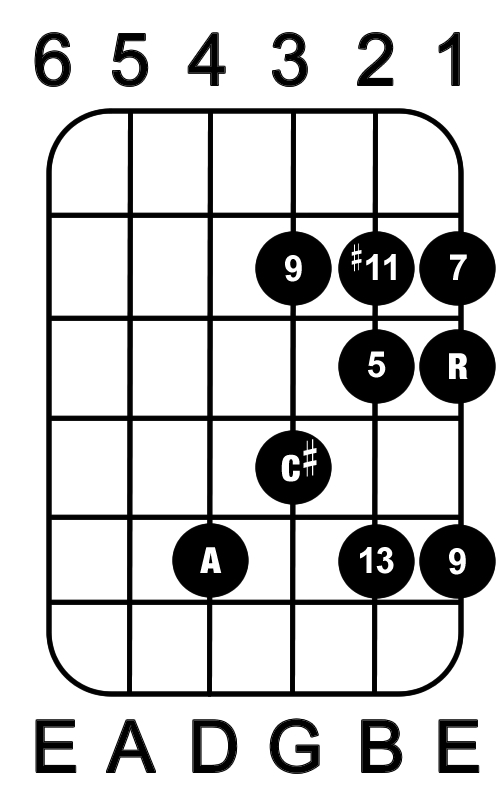
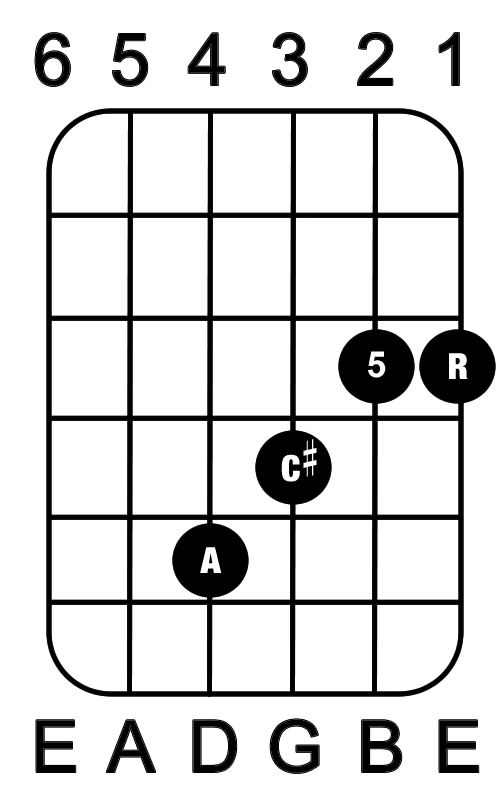
Here’s the Major chord shape I’ve been modifying over the first 2 lessons:


.

A Major

.

If the root and the 5th are strategically sharped or flatted, other chord tones (7, #11, 9 and 13 can be created).

.

A major with  additional chord tones on the B and E string

Since the b (9th) on the high E string is available, the 9th on the g string is something that can be incorporated as well.

.

A Lydian/F# Dorian Chord tones based on an A major chord shape

.

If I’m soloing over A major (or F# Minor)  – all of these notes are fair game. 

Try all the licks below over an A major type chord or F# minor type chord.

.

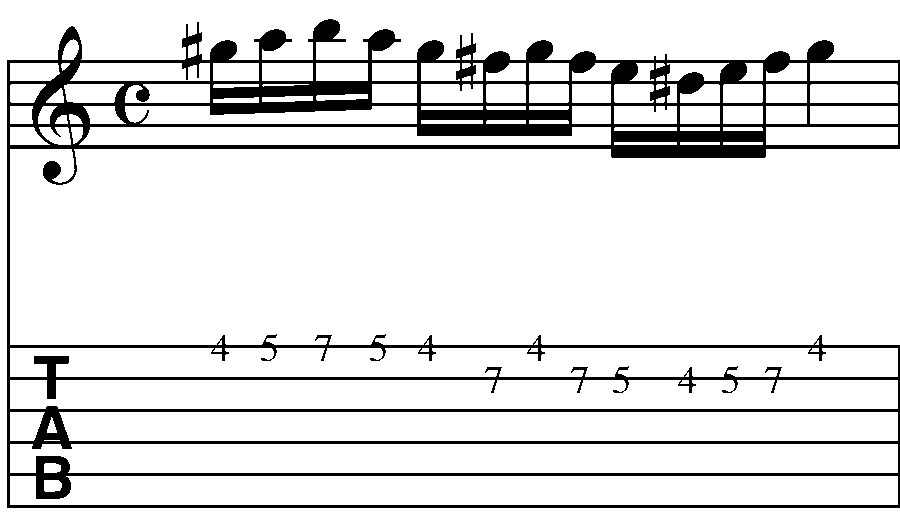
Lick 1 (Double Click any notation to see full size)

Lick 1


I try to stay with consistent note-per-string fingerings on strings when playing melodically, so here I’m going to take the same idea and just move the last note to the g string to create a 3 note per string pattern.

.

Lick 1: Three note-per-string shape

.

Here’s how it sounds at 1/2 speed.

Here’s how it sounds at tempo.

.

Lick 2:

Here, I’m taking the same notes and breaking them up intervallically into 4ths (except for the 5th in the last 2 notes which adds some variety in the cycle).  Licks like these are easy to visualize (and therefore easy to manipulate when improvising).

.

Here’s how it sounds at tempo. 

Note:

When I improvised this- I played it as transcribed – but when I recorded it – I played the last 2 notes as 1/8th notes instead – please take any of the ideas here and manipulate them as you see fit.

.

Here’s a similar (but shorter) idea with a scalar pattern at the end.

.

4ths lick 2

.

Here’s how it sounds at 1/2 speed.

Here’s how it sounds at tempo.

Lick 3:

Here’s an arpeggio idea that incorporates chromaticism.

.

arpeggio lick w. chromatics

.

Here’s how it sounds at 1/2 speed and then at tempo.

.

A couple of notes:

  • In the beginning I’m visualizing a C# min7 arpeggio (C#, E, G#, B) starting on the B.
  • The chromatic motion isn’t random – instead it specifically emphasizes the A and the C# in the A Major chord.
  • In the 3rds pattern that ends the lick – I’m skipping the middle note of the 3 note per string pattern in Lick 1.  I like using 3rds in patterns because it breaks up the monotony of just running scales up and down.


Going Further – Dominant Superimposition:

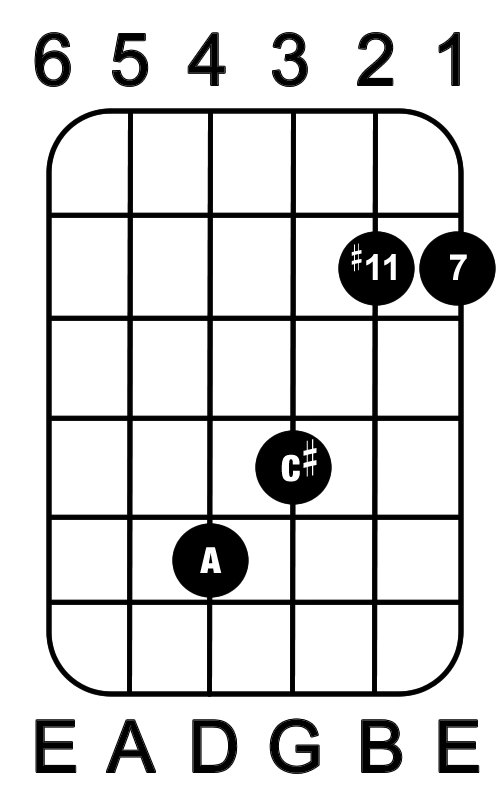
Now that some initial options have been explored – I’ll take a look at the upper notes of the voicing.  If I take the previous fretboard diagram and extend a note on the g string I’ll have something that looks like the diagram below:

Here’s a chord voicing I discussed in part 2 of this series (B7/A)

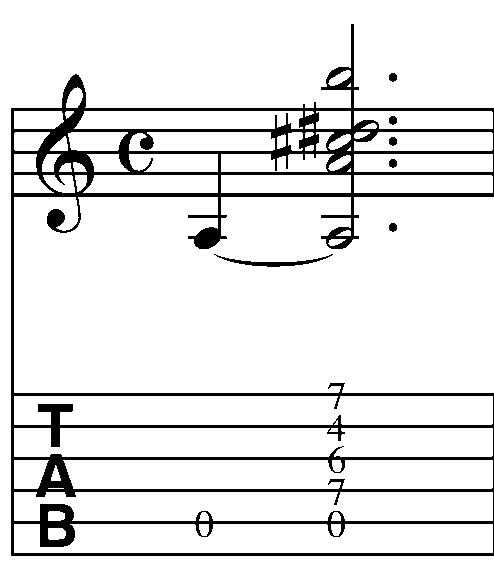
And here’s how it sounds.

Short cut 1:

Playing a dominant 7th chord on the second scale degree of a major chord will get you all of the upper extensions and the root)

(i.e. B7 over A major)

Short cut 2:

When soloing over a major chord – you can play a dominant arpeggio on the second scale degree (i.e. B7 over A major).

In the example below, I’m combining a B9 arpeggio and an A major arpeggio to create a melodic idea.  The A and C# on the D string are the linking material between the 2 arpeggios (they act as the 7 and 9 in the B9 chord, or as the root and 3rd of the A Major).

The important thing with any superimposition like this is to resolve it to a chord tone in the chord you’re soloing over (in this case A).

.

.

Here’s how it sounds at 1/2 speed.

Here’s how it sounds at tempo.

.


Going Further – Minor Superimposition:

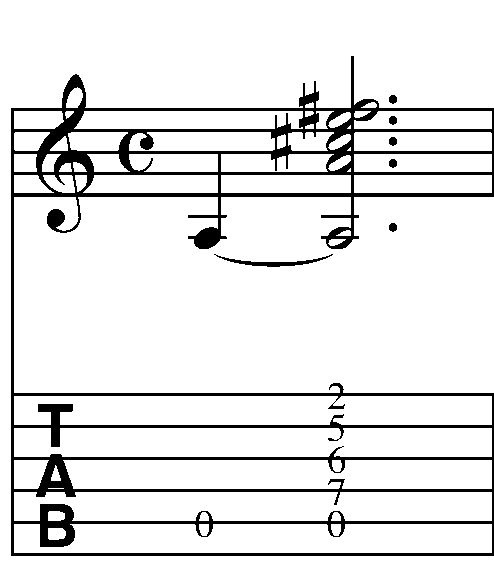
Here’s another chord voicing I discussed in part 2 of this series (G# min7/A)

Short cut 1:

Playing a minor chord on the seventh scale degree of a major chord will get you upper extensions (7, 9, #11 and 13)  of the chord.

(i.e. G# min7 played over A major)

Short cut 2:

When soloing over a major chord – you can play a minor arpeggio on the second scale degree (i.e. G# min7/A).

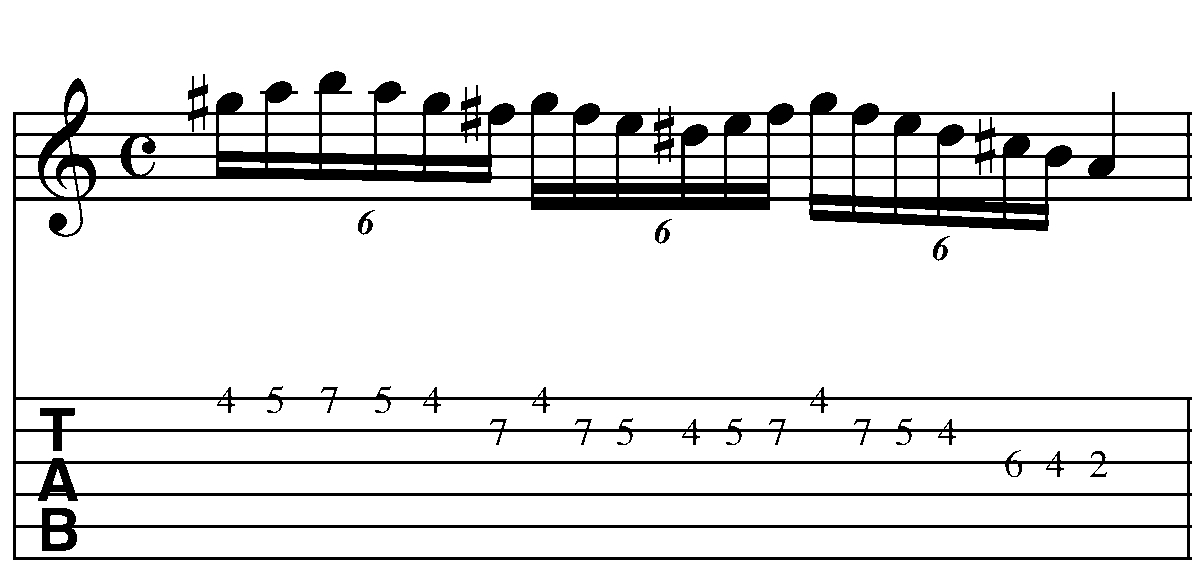
In the example below, I’m combining a sextuplet idea from the earlier licks and a  G#min arpeggio to create a melodic idea. Again, an important thing with any superimposition like this is to resolve it to a chord tone in the chord you’re soloing over (in this case A).

I’m not a fan of the shift from E to D# in this fingering as it requires quickly barring to get the rest of the arpeggio.  As an alternate fingering, I  recommend this:

.

The “picking” is just a suggestion.  (For example: you could also pull off the D# to the B on the g string and then just continue the sweep picking motion.)

.

Here’s how it sounds at 1/2 speed.

Here’s how it sounds at tempo.

.

Wrapping it up:

This is really only the beginning of where these approaches can go.  Hopefully this will give you some ideas to explore both in comping and soloing.  If there’s enough interest, I’ll expand this approach to minor and dominant chords in future posts.

Final Tech Note:

For those of you who are interested, these are the approximate settings I’m using in Pod farm for the distorted tone here:

Thanks for reading!

-SC

A Game Changer? The Sonuus i2M musicport overview

I haven’t done a gear review in a while – so I thought I’d bring something exciting to the table this time.

.

Lately, I’ve been thinking more about Midi guitar.  Not in the traditional sense of, “wouldn’t it be great to get some flute sounds out of my guitar for this smooth jazz solo?” but using it in (potentially) some more subversive ways.

.

Midi conversion as an improvisation tool:

The first thought that occurred to me was midi guitar is a glitchy proposition to begin with. Even optimizing everything (picking technique, muting, pick choice, tracking parameters, etc) – there was still a lot that could go “wrong”.  This excited me from an improvisational standpoint because it meant that I could have other notes spit out at me that I didn’t play – and that I’d have to actually improvise with what was happening there.  To me, this is much more in the spirit of improvising that playing the same 40 licks I’ve worked out over Stella by Starlight.

.

Midi conversion as a texture:

Additionally, the glitch effect can work really well in sound scape ideas where I might be generating different sounds over (and within) a loop.  That’s appealing to me as well.

.

Midi conversion as a transcriber:

The real interest for this idea though came up with the dvd instructional material that I wanted to generate.  After seeing clips of John McLaughlin’s instructional dvd and realizing that he was simply using a midi guitar to capture audio and midi data in Logic.  By doing this – he would have a rough transcription of what he was playing and then be able to tweak it to make it more accurate from there.  A really good idea and one that stuck with me.

But midi always struck me as a lark.  The pickups and converters meant that I was looking at $500-$600 minimum for something that really wasn’t necessary.  Then I started seeing the ads for…

.

The Sonuus i2M musicport:

If you’ve picked up a guitar magazine or been anywhere guitar related on the internet – you have undoubtably seen an ad for one of the Sonuus Midi Converters.  Their newest converter the i2M musicport, is a small (read: tiny) monophonic midi converter and a 16bit 48k digital audio interface.  Listing for $199 (and selling for $149) this is one of the most intriguing products on the market to me right now.

The unit has a ¼ inch jack on one side and a USB connection on the other which makes it about the size of an adult thumb.  It’s bus powered by the USB – so there’s no additional power supply (the green lit SONUUS logo is a nice design touch as well as the key clip.

It’s impossible for me to image a smaller device but how does it sound?  Since the i2M acts as an audio interface and an audio midi converter – I’ll address this question in two parts.

.

Audio:

The ¼ inch jack is actually a high impedance (hi-Z) input preamp with a 16 bit/44.1 or 48k conversion rate.  Even though I typically like higher audio specs when using my guitar the sound is remarkably transparent and I had no issues with quality.  In fact, this is an ideal interface for practicing or jotting down ideas and would even consider trying it out on a gig if I needed to.  It should also be noted that while I’ve only tested it with a guitar it can be used with bass guitar or other line level sources (like a microphone).  There should be no real issue in using a 7 or 8 string guitar with it either.

.

Midi:

First: I should state that this unit is a midi converter.  It doesn’t have any midi sounds on its own so you’ll need appropriate software (any software with a midi sampler or synth  will probably do) to hear and record midi.

Secondly: The midi conversion is monophonic.  Anything involving chords or multiple held notes will produce unpredictable results.

Having said that, the i2M does monophonic conversion remarkably well.  Tracking was fast, smooth and had very low latency with stock settings (particularly on the higher strings).  If you go to the sonuus website, you can download the Desktop Editor software which will allow you to adjust midi settings to suit your style as well.

Rather than just list them, I’d recommend that you go to the Sonuus web site where you can get full specs.

In use:

I decided to see if I could use the i2M as both an audio interface and a midi converter to see if I could use the score function in Logic to transcribe what I was playing.

The i2M is class-compliant which means that it’s plug and play.  I opened up Logic and had no problem setting it up as a default audio and midi input.  To create a real world example of what it sounds like it when you plug-in and play – nothing was optimized.  The audio is generated from a FnH Ultrasonic guitar plugging into the i2M at 48k.  No amp sims were used in Logic.  The guitar track only has LA convolver, some speaker IRs and a reverb on the channel. The midi is generated from the EXS 24 (using the Garageband/Logic Yamaha Piano).

All Logic and i2M settings are stock.  I heard the piano sound and decided to improvise in a Cecil Taylor style where caution was just thrown to the wind and I approached ideas as melodic flourishes.  I wanted to throw the unit some curve balls so I tried sweep picking, alternate picking and tapping various ideas to see how it reacted.

This video below is just a screen shot of the score pages with an mp3 of both channels so you can compare the difference between the audio and the midi tracking. (You’ll probably want to see it at full screen size – FYI).

.

Here’s what impressed me:

The tracking was pretty clean.  There were a few random glitches on the midi score  but those could be easily fixed.  For the most part, I got a rough sketch of what I was playing while I was playing it.  Very cool.

There are certain open strings ringing and other string noses that were ignored.  This was surprising and cool.

The audio signal sounded pretty good out of the box – but to be 100% fair – this was with a clean sound.   I  ran this through POD Farm to see how the distorted tones were – but  for me, the resolution and bit depth weren’t there for a satisfying dirty tone.  In other words, as an audio converter – this isn’t going to replace my Apogee Duet – but this is really nit picking as the unit is, first and foremost, a midi converter so the fact that it processes any audio is just as bonus.  Additionally, comparing a $150 multifunction unit to a $500 specialized audio interface isn’t a fair comparison.   That being said, the i2M has a reasonable starting point for a clean tone.

.

Also while the unit is plug and play as an audio device for Logic and Garage band, AU lab didn’t recognize it.  Not a deal breaker and something I need to research further but it may be something to look into depending on what platform you plan on using.

This unit is just a lot of fun.  I probably spent 2 hours just playing the various logic EXS patches.  Additionally the piano/guitar sound gave me a lot of compositional ideas in a Maria João idea – which is always a good thing.  I tried it with Absynth as well and it worked seamlessly (it even kept tracking as I took liberal swipes at my tremolo arm).

.

In my opinion this unit is a game changer for guitarists (and hopefully for a lot of other instruments as well).  To have something that works this well at this price point while putting an audio interface and a midi converter well within most gear budgets.  For this demonstration, I’m essentially using it as a toy, but the potential applications for this are exciting.

Whether you’re looking to lightly tread the waters of midi guitar, get in deep for sonic mangling or just need a decent pocket audio interface, you’re hard pressed to do better than the i2M.

Thanks for reading!

-SC

Getting Hipness From A Major Triad Or More Chord Recycling Part 2

In part one of this post, I looked at generating different major chord variations based on flatting the root and the 5th.  In this post, I’m looking at sharping those pitches and combining the two for additional textures (if you came here directly – you may want to review the A major variations in  part one before continuing).

.

Start with a map:

Adapting chord forms requires the ability to visualize chord tones around the shape you’re using.  As a starting point, here’s a fretboard diagram of an A major chord (with the A being on the 7th fret of the D string).  I’ve added some additional chordal extensions on the E and B strings (but this process could be applied to any string-set).

In the last lesson, I looked at creating sounds with the 6th (or 13 – see post 1 for the difference between the 2) on the E string.  This time, I’ll add the 6th (6th or 13th) on the B string by raising the E  up to F#.

.

A Major 6th no 5th

Here is the sound of the A Major 6th (no 5th) chord.

.

Comparing this to the A major 6th voicing in part 1:

.

A Major 6 - Watch the 1st finger stretch - if it hurts - stop Immediately!!

Here’s an mp3 of this chord.

.

The new voicing is certainly easier.  If I was really stuck on the close voicing of the E and the F# in the A major 6th, I could simply move the F# to the B string and move the E to the open string like this:

A maj 6 with open E string

.

Several Notes:

  • This voicing wasn’t included in the first lesson as I wanted to show the process of how to derive these chords.
  • The upside to this approach is it makes this specific voicing easier to play – but the downside is it’s not movable – which may or may not be problematic for you.
  • If a chord is really difficult to finger – there is always an easier way.  You may not get the specific notes or voicings you’re looking for – but there’s always an easier way.

Now I’ll extend the initial Major 6th sound by flatting the 7th.  This is done by lowering the A to G#.

.

A Maj 7 add 13 no 5th

Here’s how it sounds.

Again,  I’m a sucker for chords with seconds in the voicing (in this case the F# and G#).  It adds a little but of tension and elevates the chord a bit.

.

Adding in the 9th:

First let’s create an A major add 9 chord.

.

A add 9

Here’s how it sounds.

.

Note:

The reason this is an add 9 chord and not a major 9 chord is the lack of a 7th.

Since the chord is a major chord with a 9th added, it’s called an add 9.

.

Now I’ll add a sharp #11.  This is done by lowering the E to D#.

.

A maj 9 sharp 11 no 7th no 5th

Here’s how it sounds.

.

Another Note:


The further you extend the harmony and remove initial chord tones, the more vague the sound of the chord is as related to the tonic.

For example:  The chord above could be analyzed as an A major 9 # 11 with no 7th and no 5th. But the notes are A,  C#, D# and B.  If those tones are centered around B – you have a B, D#, A and C# or a B dominant 9 (no 5th)/A.

If you have to analyze a chord with more than 1 elimination (i.e. “no 7th no 5th”) there’s probably a simpler analysis of the chord.


Going Further:

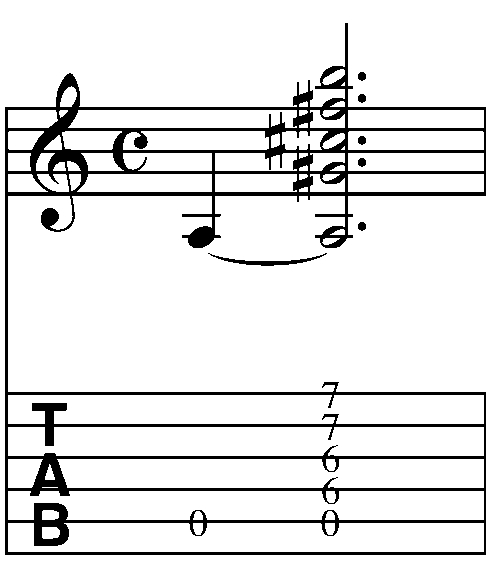
Now that some initial options have been explored – I’ll take a look at the upper notes of the voicing.  If I take the previous fretboard diagram and extend a note on the G string I’ll have something that looks like the diagram below (again the A listed below is on the 7th fret of the D string):

If I’m willing to be a little adventurous and replace the 3rd of the chord (C#) with the #11 (D#) , I’ll get a voicing with a root and then all upper tensions (9, #11 and 13).  Here it is notated:

.

B7/A

And here’s how it sounds.

.

While you could analyse this related to the key of A Major (A major 13, #11, no 3rd, no 5th, no 7th) you may have noticed that shape is the upper chord voicing for a VII position B 7 barre chord.

.

Short cut 1:

Playing a dominant 7th chord on the second scale degree of a major chord will get you all of the upper extensions and the root).

(i.e. B7 over A major)

But isn’t a stable sound on its own.  If you play this chord and then the standard A major, it will probably feel resolved to you when you play the A.  If you have a song with a number of bars of A major – switching between these two chords is a nice way to generate a little harmonic motion.

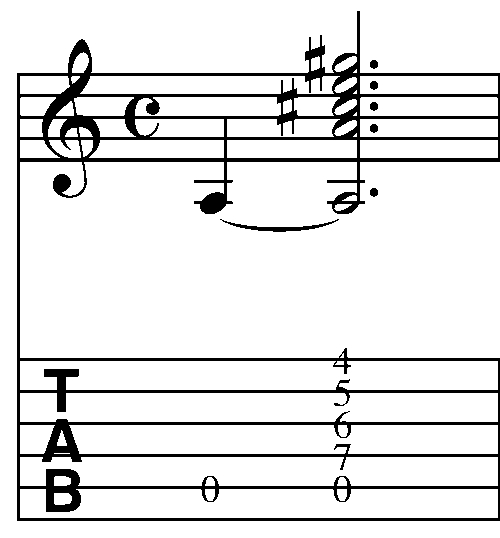
Now, I’ll take this idea a little further by lowering the A to a G#:

G# min 7/A

.

Here’s how it sounds.

.

This gives the chord a 7 (G#), 9 (B), #11 (D#) and 13 (F#) – or all of the upper chord tones.

Short cut 2:

Playing a minor 7th chord on the seventh scale degree of a major chord will get you all of the upper extensions of the chord.

(i.e. G# minor 7 over A major)

Like the B7/A, this isn’t a stable sound on its own.  If you play this chord and then the standard A major, it will probably feel resolved to you when you play the A.

.

Quartal for your thoughts?

Here’s one last transformation for now.  Here I’m going to lower the D# to C# to create a quartal chord.

.

Quartal Chord

And here’s how it sounds:

.

A quartal chord is a chord that is built on 4ths (G#, C#, F#, B) as opposed to being built on 3rds like A Major (A, C#, E).  To me, quartal voicings have a nice “airy” or “floating” quality .  This is just one of many  possible quartal voicings built from A major.  Quartal voicings will be discussed more in-depth in a future post.

.

How to double the number of chords that have been covered.

So far, I’ve looked at a series of chords that either work as substitutions and/or extensions for major chords  I’m going to go into more depth about why this works in the next post but for right now – here’s a quick tip that gives a whole other dimension to using these chords.

.

Every chord presented here also works over the relative minor (i.e. F# minor chord).

.

Try taking this chord:

.

and after you play it add an F# by tapping a fret hand finger on the 2nd fret F# on the low E string for a very hip F# min 9 extension.

.

F# min 9 add 13 no 11

.

Hopefully this has given you some new chordal ideas!!  You may want to go back to the first post and apply this idea by playing through all of the voicings covered there and adding the F# as a root.

In addition to explaining this approach more in-depth, in part 3 of these posts I’m going to explore a number of ways to use these ideas in your soloing.

Thanks for reading!!  Please feel free to post any questions you might have.

-SC

Getting Hipness From A Major Triad Or More Chord Recycling Part 1

When I was at Berklee, one thing that took a while for me to really get my ear around was upper chord tones (7ths, 9ths, 11ths and 13ths).  Growing  up listening to a great deal of rock music – basic triads sounded “right” to me.   I learned a lot of esoteric chord voicings to try to expand on those forms – but my ear wasn’t ready for it and so I had no real motivation to develop it at the time.

As I mentioned in the getting through the gig and the recycling chords posts, simple triadic forms can be manipulated in a way that allows players to get more complex harmonic textures in real-time.  Additionally, these approaches can be adapted to lead playing as well.  This short series of posts are going to go deeper into adapting one specific chord voicing.  As a starting point I’ll use the major triad.

The following examples are based around a 5th position A major chord played on the D, G, B, and E strings.


The reason I’m using this specific voicing is to allow the open A string to ring while playing the chord to help reinforce the root.  Here’s the basic rhythm of the chordal examples:

While notated this way for simplicity, all the examples are played with a slight arpeggiation to help accent the different notes.

.

Here’s an mp3 of an A Major Triad.

 .

Rooting around for extra tones:

The first way to generate some additional substitutions for a simple major chord  is to lower the root chromatically.

While there is a root on both the D and the high E string, for now these examples will focus on manipulating the root on the high E string.

Lowering the root of a major triad a 1/2 step (1 fret) produces a Major 7th chord:

(This can be used in place of any A major triad)
A Major 7 Chord

 .

Here’s an mp3 of this A Major 7 chord.

.

Lowering the root of a major triad a step (2 frets) produces a Dominant 7th chord:

(This can sometimes be used in place of an A major triad

Example: When the A acts as a V chord in a chord progression (A -> D becomes A7–>D))

A7 Chord

.

Here’s an mp3 of this A 7 chord.

.

Note:

While dominant 7th chords contain a major triad in them – they are their own unique animal.  A future post will go into generating dominant chords – in depth – but this voicing is presented here as part of the process of generating chords by altering the root.

.

Lowering the root of a major triad a step  and a 1/2 (3 frets) produces a Major 6th chord:

(Typically this can be used in place of any A major triad)

A Major 6 - Watch the 1st finger stretch - if it hurts - stop Immediately!!

.

Here’s an mp3 of this A Major 6th chord.

.

Another Note:

There are certainly easier ways to generate this chord – but any chord form with  a 1/2 or whole step between notes on the B and E strings will require some limber hands.  Again, this voicing is not the only possible voicing of this chord but instead is just one possibility.

.

6th chord/13th chord Tip:

Frequently, I’m asked about the difference between a 6th chord and a 13th chord.  Since the note is the same for both the 6th and the 13th, the terms are sometimes used interchangably – but the difference is based around whether the chord has a 7th in it.  In the example above, the F# acts as a 6th, because no 7th is present in the chord.  If a seventh was in the chord, the F# would be viewed as a 13th.

.

The #4/#11:

One hip tone to use in a Major based chord is the #4 (or #11).  This is generated by flatting the 5th a 1/2 step (1 fret).

A Major add #4

.

Here’s an mp3 of this A Major add #4 chord.

I like voicings like this where the top voices (C#, D# and E in this case) are all close voiced (i.e. in the same octave). The technique of combining these close voiced ideas with open strings is a favorite approach of mine.

This idea can be expanded on by flatting the root as well.

This produces an A major 7 add #11 (no 5th) chord (A favorite substitution of mine for a major chord).

A Maj 7 # 11 no 5th

.

Here’s an mp3 of this chord.

.

Shortcut:

If you flat the top two notes of a major barre chord with the fifth and root on the B and high E string – you get a pretty hip major chord substitution.  This works in any key.

In part 2 of this series, I’ll look at sharping the 5th and the root to generate more chord voicings, combining both approaches and extrapolating lead ideas from these approaches as well.

Thanks for reading!!

-SC

Getting Through The Gig – Negotiating A Chord Chart Part 3

I took the wrong weekend to sleep in!  Guitar Squid distributed a link to part one of the post and by the time I got to check my stats for the weekend I had already missed my record keeping days.

However, you got here – welcome.

In the previous posts (part 1 and part 2), I talked about deciphering chord symbols and developing shortcuts for playing them.  In this post I’m going to talk about my approach and  how I ended up reading the chart.

.

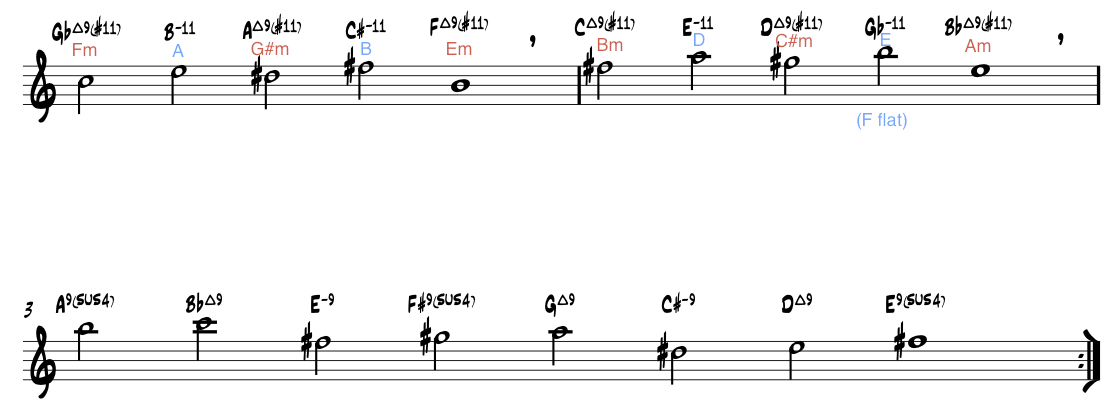
One final time – here’s the 232 chart with upper extension triads written in:

.

Full Triadic Substitutions / Shortcuts

Here’s an mp3 of the track.  This was recorded with an FnH Ultrasonic recorded directly into AU Lab with PodFarm 2.0 @ 44.1.  The goal was an ambient wash of sound but in retrospect, I should have gone with a longer delay time/wetter reverb to hold the sustain.

Here’s the PodFarm Patch:

Here’s Bar 1 of the chart:

232 Measure 1

Notes:

  • Simple is better.  I usually start with 3-4 note voicings and then add from there on subsequent passes.
  • I chose the F minor chord in the first position to make the C in the chart the top note of the voicing (and thus accent the melody) – this kept my initial focus on voicings primarily on the D, G and B strings.
  • I added the bass note on the E and A strings so I could get a little more of the chord texture.
  • On the B minor 11 chord, I made some alterations on the fly.  To get the melody note on top of the voicing I doubled the 11 (E on the 5th fret).  Technically this isn’t a minor 11 chord as there’s no 3rd – but in this case Chris was playing the full voicing anyway, so I’m just adding texture.  Depending on what the bass was doing on the second pass I would probably add the 3rd of the chord (D) on the 5th fret of the A string.
  • The 3rd and 4th chords follow a similar pattern so I used the same voicing.
  • I decided to drop down to 1st position for the last chord to get some low-end emphasis.  I’d probably add some harp harmonics as well.
  • The same voicings and approach are used in Bar 2.

.

Bar 2

232 Measure 2

Bars 3-4


232 Measures 3-4

Notes:

  • A 9 (sus4) – This went to g,b and e strings to facilitate the melody note.  With the kind of ambient swell sounds that I used – muting the strings with the pick hand between chord changes becomes important to maintain smooth delay.
  • Bb Maj 9 – Here I was actually thinking Dm 7/Bb.  So I’m just using the top notes of the voicing.
  • E min 9 – This is a stock A string minor 9 voicing I use.  I have a couple of these for E and A strings I throw in when I need to.
  • F#9 (sus 4) – E maj/F# voicing based off of a VII position E barre chord.
  • G maj 9  – I was thinking B min but then added the A on the 10th fret for the melody and the G on the A string for the root.
  • C#min 9 – I moved the melody up an octave on the last 3 chords to amp up the arrangement.  Stock E string rooted voicing.  Sometimes I’d play the B on the D string and sometimes not.
  • D Maj 9 – Variation on the C#min9 shape – 2 useful voicings to have at your disposal.
  • E9 sus 4 – Just kept the D Maj 9 voicing, added the F# on the top string and played the low octave E.  I addition to filling out the chord the voicing puts me in a good spot space wise if we decide to repeat bars 1-4.

.

This has been a long series of instruction for a pretty simple chord chart, but the purpose of it was to detail the process behind those short cuts.  It might seem long and involved – but it gets easier over time.  In reality – the voicings took about a minute to suss out.

.

I hope this helps!  Please feel free to reply here or send an email to guitar.blueprint@gmail.com with any other questions you might have about this.

-SC

Getting Through The Gig – Negotiating A Chord Chart Part 2

In the previous getting through the gig post, I talked about how to interpret chord symbols to determine what a song is asking for.  Today, I’m going to use upper structure triads (triads built on chord tones other than the root) to simplify the chart.  If you’re unfamiliar with the chord symbols below, you may want to start with Part 1 of this lesson.

This lesson will continue to use the  232 chart used in part 1.

.

(232 © Chris Lavender 2011 used with permission)

.

For now – let’s assume that you know how to play at least some major and minor triad shapes.  (If you didn’t take my advice to review the triadic inversions at the end of  the last post – you may want to do so now.)

.

Getting through the Charts part 1 – Unfamiliar and familiar


When sight-reading a chart, my goal isn’t neccessarilly to have a brilliant interpretation playing it the first time (although if I can make it better – great) . I just want to make sure that I’m playing the chords as written and then try to adapt it to the song.  So if I have stock voicings at my fingers for chords on the chart and they make sense, I’ll play those and then voice lead or tailor the approach from there.

Let’s assume for a moment that it’s a worse case scenario – you’re given this chart to play and all of these chords are alien to you.

.

Step 1:

Look for common chord types.

In this case, there are only a few different types of chords in the piece:

  • major9 #11
  • minor 11,
  • 9sus4,
  • major 9 and
  • minor 9.

If generic voicings can be developed they can just be moved to the roots of the chords that need to be played.

.

Step 2:

Convert to the key of C and figure out the chord formula.

The reason to convert to the key of C – is that the lack of sharps or flats in the key signature makes it easy to alter chord formulas as need be.

Here are the chords in question in the key of C:

C major9 #11:  C, E, G, B, D, F# (1, 3, 5, 7, 9, #11)

C minor 11:  C, Eb, G, Bb, D, F (1, b3, 5, b7, 9, 11)

C 9sus4: C, F, G, Bb, D,  (1, 4, 5, b7, 9)

C major 9: C, E, G, B, D (1, 3, 5, 7, 9)

C minor 9: C, Eb, G, Bb, D (1, b3, 5, b7, 9)

.

Step 3:

Focus on the upper notes (7, 9, 11, 13) of the voicing (and/or any alterations) and make a short cut:

Note:

This process assumes that there’s a bass player who will be playing the root.  You also loose the 3rd in the voicing, but you can always add the root, 3rd or any other chord tone  in later. The initial step is to just get through the chart, and then spruce it up as you gain familiarity.


In the C major9 #11, the upper notes are the 7, 9 and #11 (B, D, F# ) this is a B minor triad with a C in the bass (also written B min/C).


The shortcut here is –

if you play a minor triad a ½ step down from the root

you’ll have the upper extension of the major 9 #11 chord.


Here are the transposed voicings


Gb major 9 #11 = F minor/Gb

A major 9 #11 = G# minor/A

F major 9 #11 = E minor/F

C major 9 #11 = B minor/E

D major 9 #11 = C# minor/D

Bb major 9 #11 = A minor/Bb

Here they are penciled into the chart:

Maj. 9 sharp 11 Shortcut

Note:

I’m going to into specific voicings in the third and final post – the idea here is to just to document how to figure out some basic chord substitutions.  While I haven’t written in the bass note (i.e. Gb major 9 #11 = F minor/Gb  – written on the chart as simply Fm), the bass note is still in the original chord voicing, so I can work it into the tonic as necessary.


In the C minor 11, the upper notes are the b7, 9 and 11 (Bb, D, F) this is a Bb major triad with a C in the bass (also written B/C).

.

The shortcut here is –

if you play a major triad a step down from the root

you’ll have the upper extension of the minor 11 chord.


Here are the transposed voicings:


B minor 11 = A/B

C# minor 11 = B/C#

E minor 11 = D/E

Gb minor 11 = Fb(E)/Gb

and applied to the chart:

Minor 11 Triadic shortcuts


Next, let’s look at the 9 sus4 chord


C 9sus4: C, F, G, Bb, D,  (1, 4, 5, b7, 9)

Here the upper extensions are the b7, 9 and the added sus4 (Bb, D, F)

The real difference between the C9 Sus4 and the C minor 11 is the Eb.

.

The shortcut here is –

if you play a major triad a step down from the root

you’ll also have the primary tones of the 9sus4 chord.


Here are the transposed voicings:


A9 sus 4 = G/A

F#9 sus 4 = E/F#

E9 sus 4 = D/E

and applied to the chart:

9 sus 4 Triadic Shortcuts


For 11 and 13th chords, I tend to think in terms of  triads based on the 7th or the 9th.  Major and Minor 9th chords can be seen as triads starting from the 5th (but I usually see them as 7th chords from the 3rd – more on that in part 3 of these posts).


Major 9th shortcut –

if you play a major triad chord a 5th up from the root

you’ll have the upper extension of the major 9th chord.


Here are the transposed voicings:


C major 9: C, E, G, B, D (1, 3, 5, 7, 9) = G/C

Bb major 9 = F/Bb

G major 9 = D/G

D major 9 = A/D

and applied to the chart:

Major 9th Triad Shortcuts


Minor 9th shortcut –

if you play a minor triad a 5th up from the root

you’ll have the upper extension of the minor 9th chord.


Here are the transposed voicings:


C minor 9: C, Eb, G, Bb, D (1, b3, 5, b7, 9)  = G Minor

Emin9 = B min/E

C#min9 = G# min/ C#

And the big reveal or…


GET ON WITH IT ALREADY SCOTT – WHAT DOES ALL THIS MEAN?


Okay here’s the initial chart again:

.

and here’s the modified chart with triadic substitutions written in (click on the chart to see it full-sized).

.

Full Triadic Substitutions / Shortcuts

.

Which do you find easier to read chord-wise?


“Hey take a solo…”

As an additional bonus to this approach, these upper extension triads can also be approached as arpeggios that can be played over each chord for soloing or as a simpler tonal center for chord scales (just realize that not all chord scales that work for the upper extension triad will work for the initial chord – but experiment and use your ear to guide you for what works.)

In the final post of this series, I’ll show how I ended up voicing the tune.

Thanks for reading!

-SC

Getting Through The Gig – Negotiating A Chord Chart Part 1

In the previous surviving the gig post, I talked about some memorization skills that can help get through gigs that require learning a lot of tunes.  In this series of posts, I want to focus on how to get through gigs that may have unfamiliar chord changes.

In this post, I’m going to be discussing how to interpret chord symbols and then developing some short cuts for how to generate chord voicings on the bandstand as it were.  If you are already familiar with how to read chord voicings – you may want to skim this and just go to part 2.

There will be a lot of detail over these posts for how I’m doing what I’m doing, but once you get the concept under your belt.  It should be something you can do on the fly if need be.

As an example, I’ll be look at part of a chart Rough Hewn touch/stick/Warr guitarist Chris Lavender sent to me, called 232

(232 © Chris Lavender 2011 used with permission)

.

First Step – Know what notes the chord symbols are asking for.

It’s not that hard to figure out chords if you know what the symbols mean.  Here are some general shortcuts for chord types beyond triads.  There are only 3 basic categories that we’ll look at: Major, Minor and Dominant:

.

Major

(Sometimes designated by “major”, “maj” or a triangle)

Any type of major chord always has a major triad (Root, 3rd and 5th) plus a major 7th in the full chord voicing unless it states otherwise.  If a chart has any type of C Major chord variation (C Major 7, C Major 9 or C Major 13)  –  the voicing has a C, E, G and B.

Note:

When removing notes from any voicing the 5th is usually the first to go (unless it’s altered like #5, or b5).

The initial short cut is: any major type chord starts with (1,3, 7) or (C, E, B) in the key of C.


Minor

(Sometimes designated by “minor”, “min”. or “-” )

Any type of minor chord always has a minor triad (Root, b3rd and 5th) plus a b7th in the full chord voicing unless it states otherwise.  If a chart has any type of C Major chord variation (C minor 7, C minor 9, C minor 11 or C minor 13)  –  the voicing has a C, Eb, G and Bb.

Note:

When removing notes from any voicing the 5th is usually the first to go (unless it’s altered like #5, or b5).

The initial short cut is: any minor type chord starts with (1,b3, b7) or (C, bE, bB) in the key of C.


Dominant

(Sometimes designated by “dominant”, “dom”. or no designation

i.e. “C7”, “C9” or “C13” refers to a dominant chord unless otherwise stated)

Any type of dominant chord always has a major triad (Root, 3rd and 5th) plus a b7th in the full chord voicing unless it states otherwise.  If a chart has any type of C dominant chord variation (C 7, C 9, C 11 or C 13)  –  the voicing has a C, E, G and Bb.

Note:

When removing notes from any voicing the 5th is usually the first to go (unless it’s altered like #5, or b5).

The initial short cut is: any dominant type chord starts with (1,3, b7) or (C, E, Bb) in the key of C.


Beyond this, you just need to add in additional pitches based on what the voicing indicates.

Here’s a chart that relates all of the potential chord tones that you might see to a scale degree for quick reference.

Putting the chart to use:

The first chord in the 232 chart is a C major 9 #11.  As a reminder – any extended C major chord will have C, E, G, B in the full voicing.  Since it’s a C major 9, a 9th – which in the chart above is a D – will have to be added.    The #11 means an F# will get added to the voicing as well.  This brings the full voicing to (C, E, G, B, D, and F#).

Again, the only time you would probably play a full voicing is for a solo guitar or perhaps a duet performance.  In the next post, I’ll discuss how to extract what you need to get through the chart.

.

Second Step – Know some chords

When I went to Berklee, I was advised that I should learn at least 2 chord voicings for any chords that could be put on a chart in front of me.  These stock voicings are typically low E or A string rooted (as it helps with visualization) and are the default voicings that you would use if you were sight-reading a chart.  These typically include triads, Major /Minor / Dominant chord 7th, 9th, 11th and 13th chords.

While this is, generally, useful advice, I should state for the record that while I did the initial memorization required for school proficiencies – I quickly forgot the majority of voicings I wasn’t using all the time. Learning every inversion of every possible 7th, 9th, 11th and 13th chord on multiple string sets will take YEARS.  For some people, it’s the best method, but it never worked that well for me.

.

Once I understood how chords worked, I never bothered to memorize many specific voicings above a 9th chord because I found some shortcuts to get the sounds I needed.


Note:

This is not to say that you should be lazy.If you follow through on the suggestions that I have – you should plan on learning triads and 7th chords at a very deep level (i.e. you should have the goal of being able to play any triad or 7th chord in any inversion in any position).

(more on how to do that in a future post)


I hope this helps!  In the next post – I’ll simplify the 232 chart with some harmonic shortcuts.

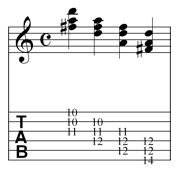
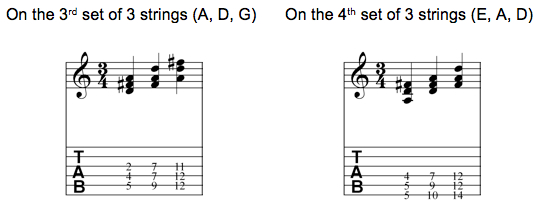
While digesting this – I’d recommend you take some time to work on your chord inversions.  If you’re unfamiliar with them you may want to check out the D major inversions I’ve posted below, and adapt this process to minor triads (just flat the third – F# and make it F in the examples below), and 7th chords (major, dominant and minor).

.

(The following is adapted from another post (Recycling Chords Part II: Triad Transformation).

.

Thanks for reading!!


-SC

.

Note:  D major is used in the following examples instead of C major because the original post dealt with transforming triads.  Each note of a 1st position D major chord can be lowered to another note on the fingerboard, without using open strings.  In other words, each chord is a moveable voicing on the fingerboard. The following should be adapted to C major and other keys as necessary.

.

The first step to adapting voicings is to make sure you can visualize triads both horizontally and vertically across the fingerboard.

.

Horizontal (i.e. positional) Visualization

Here’s a series of  D major chord inversions in the 2nd position.

Helpful Tip

As you play through these voicings pay particular attention to which chord tone each finger is on (i.e. for the first D Major chord voicing – the first finger is on the 5th of the chord (A), the third finger is on the root (D) and the second finger is on the 3rd (F#). More on this later.

Here are the D major inversions in the 5th position

and in the 10th position.

Vertical Visualization

.

Note:

the important thing with both the horizontal and vertical voicings is knowing where each chord tone is located in the voicing.

.

One way to practice this is to play through the chords and stop at random points and ask, “where is the root?” “where is the 3rd?”  “where is the 5th ?”  This has to be full internalized to be able to realize the goal of instant chord tone identification.