Guit-A-Grip Podcast Episode #10 – On “You’re Welcome”

Hello everyone!

The iTunes synch.

This has been an on-going battle but (fingers crossed)  I think this is finally all set.

It looks like the links and streaming is reset on the individual pages on this site, but if you’re subscribed to the podcast you may have to unsubscribe and re-subscribe to the podcast to get the episodes that got jacked up in the synch (Episode #3, #4, #5 and the latest #9).

Again, my apologies!!!  I’m a real luddite on some things I guess!

If you’re unsure how to reset this in iTunes – in my iTunes, I went to Podcasts Selected Get-A-Grip.  Unsubscribed and then hit the subscribe button, and the episodes all came up with the right episodes and times.

(Also FYI – you may have noticed a page on the top bar that says PODCASTS and they’re all there for download and streaming!  Hopefully it’s all set now.)

Episode #10?

The ten episode milestone is now in the rear view mirror!   Guit-A-Grip podcast episode #10 “On ‘You’re welcome”‘  is out and available for download/streaming.

Subscription Notes:

  • You can subscribe through iTunes here:
  • You can use this link to subscribe with any other feed based service:
  • or you can right-click here to download it.
  • or you can stream this episode below.
.

Guit-A-Grip Episode #10 – Show Notes

Generally, I listen back to the podcast and make copious notes about what I thought was clear at the time that turns out to be pretty murky.  I only have a few points I feel compelled to address this time.

I don’t have all the answers.

Well…Duh Scott ; )

No one has all the answers, and I’m more than suspicious of anyone who does.  I’ve just been fortunate in that I’ve made a near infinite number of mistakes – some of which I’ve actually learned from –  all of which have given me a perspective that’s been useful to me. Hopefully my answers will help you solve some of your own questions,  (you may want to check out my – Don’t buy the app – Be The App podcast for more on this idea).

For me, the main thing to remember is that lessons only have value in their application (as does philosophy hence my mini rant mid podcast).

That Martial Arts story:

That’s a post I did called Finding The Deeper Lesson.  If you haven’t read it yet, you might dig the article!

I don’t believe in evil:

That’s not entirely true, but I didn’t articulate it well.  I believe that people do evil things to each other quite often, but they don’t see it as evil, they see it as being the right thing to do (or the self serving thing to do) with no care for how it affects other people.  People in caves (or anywhere else for that matter) are not trying to advance an agenda they think is evil (Like Dr. Evil in an evil lair) – they’re doing what they think is right for themselves or their cause.

Much of evil, then, lies in action  maybe even in some cases more so than intent….more on that later.

There’s more

There’s always more, but it feels like I actually touched on a lot of things in the podcast I intended to, so I don’t feel compelled to write a lot about it here.

As always, thanks for visiting, reading and listening.  I hope you get something out of the podcast, and if you like the series please drop a line sometime.

Thanks again!

-SC


Guit-A-Grip Episode #9: Transitioning From An Island To A Peninsula

Hello everyone!

After a little blogging run, I’m back to podcasting.  I’m experimenting with the format for what works best for people, so the fate of the podcasts are TBD but in the meantime, Guit-A-Grip podcast episode #9  is out and available for download/streaming.

Subscription Notes:

  • You can subscribe through iTunes here:
  • You can use this link to subscribe with any other feed based service:
  • or you can right-click here to download it.
  • or you can stream this episode below.

.

Guit-A-Grip Episode #9 – Show Notes

The genius in question

I’ll reveal this someday, but for now if you know me from my club ’98 days, you’ll know who I’m talking about.

The study in question.

Here’s a link to the Huffpo article I referenced in the podcast.

The last meal in question.

Uh…my death row meal?  Depends on where I was…probably a bahn mi, but really good pizza, mashed potatoes, burrito, veggie burger or mac and cheese would be on the list as well.  Iced coffee would be there.

The show format

The fluff above not withstanding, I think it’s really important that anything I post here is succinct enough to be inspirational and actionable.  So I’m shooting for more of 10-20 minute posts that have a central idea to ponder and then move from there.  But I’m really interested in how these things benefit you. As always, If you like the podcast please let me know. If you really like it -and listen to it on iTunes –  leaving a rating there would be really appreciated!

More posts and podcasts are on their way.

Thanks again!

-SC


Keeping Your Ego Out Of The Song’s Way

Hey everyone.

A quick update before the post.  Just as an FYI – the podcast isn’t dead but with a number of recent time crunches and an unstable recording environment for a while recording opportunities have been non-existant.  There will definitely be more (less apologetic)  posts in the future.

Glenn Branca Ensemble at Berlin Atonal (Photo taken from Berlin Atonal FB page)

Glenn Branca Ensemble at Berlin Atonal (Photo taken from Berlin Atonal FB page)

Meantime back at the ranch –  I just got home from some shows in the UK and Germany and doing any type of touring always makes me a little introspective and makes me think back to this post that was originally posted on guitArchitecture.  It’s interesting playing shows with someone like Glenn Branca because you’re surrendering to the composer’s vision and doing your best to execute it.  It’s a mind set “classical” players live in constantly but it can be a strange one for an improvising artist.

Letting the song sing

One of my more esoteric laptop guitar gigs with Mark Trayle and Ulrich Krieger is up on SoundCloud.

My rig is essentially the same as before:

Guitar (8 string Omen) –> Duet Break out box–>Duet–>Laptop (w. usb Line 6 shortboard)–>AU LAB (w. SooperLooper and PODFarm)–>18 Watt atomic amp.  My favorite tech comment came from Mark, “Wow I just realized that your entire rig is on the lectern.  That’s pretty cool…”

Gigs like this are a little strange for me as multi-layered looping, manipulating and mixing typically involves a lot more editing than actual playing, but a big part of a situation like this involves keeping your ego out of the music’s way and making sure that you serve the song.

The Obligatory Experiential Example

Once I saw a gig at the House of Blues with Shawn Lane, Jonas Hellborg and Apartment Q258.  I was really excited to see the show and the first set was a  cool improv.  I was blown away at the hairpin turns that Hellborg and Q258 were taking, but at the 40 minute point or so – it looked like it was going to wrap up, and I guess Shawn hadn’t played enough – because he pulled out a 15-20 minute guitar solo.  While I love Shawn’s playing, I was looking at my watch by the six minute point.  It was so over the top that I left before the set was done.  It was just too much, had nothing to do with the spirit of the piece and just had too much to do with him showing us how well he could play.

About a year later I saw one of the strangest lineups I could remember:  Buckethead (with bass, drums and DJ) and Lane/Hellborg/Q258 opening for The Jazz Mandolin Project.  Initially, my thought was, “oh no not this again” but this time Lane was playing tunes.  The group played 3-4 tunes with open sections.  Everyone was playing in service to the song and there aren’t three people on the planet that could have played that set that night better than they did.  Jazz mandolin project got crushed but to be fair, I felt bad for any band that had to go on after Buckethead and Lane that night.

Which kind of musician are you?

Essentially there are two types of musicians that I’ve met in my travels:

  • there are people who play instruments to play music
  • and then there are those who play music to play their instruments.

As a related example, please allow me to explain…

Why Some Academic Jazz bugs me…

When I went to Berklee, there was an overarching theme that ran through many of the jazz recitals I saw:

  • Get through the head as quickly as possible
  • breathe a sigh of relief that that’s done because now the “real” music can happen (solos)

If you hate the head so much, why even play it?  Why not eliminate the song form entirely?

It’s because people are taught that the real music comes from their melodic/harmonic voice rather than emphasizing that it’s their voice in service to a context, be that a song form, a dialog with other players, or a specific audience/performance situation.

It’s a big part of why I never played jazz.  When studying it, I quickly realized that I just didn’t dig a lot of the real book tunes.  What I dug were specific players and those players always play the song and not the instrument – be it Ornette, or Monk or Bill Frisell.   It’s the combination of the players and the material that got to me.  I’m much more open about jazz now but that concept of the tune as a necessary evil is abhorrent to me.

For the players out there, on gigs like the one I posted, there are plenty of moments where I have to resist the urge to overplay and what follows are several techniques I use in that service, but for non players I use some of these approaches  in conversation as well.

1.  Pause and take a breath.  After that breath, do I still need to play/say what I want to play/say?  If the urgency is still there – then I play it.  90% of the time it probably isn’t.

2.  Play only when I exhale.  Sometimes I’ll talk or sing while I’m playing as well.  Sometimes that has nothing to do with the notes coming out of my guitar – but it’s about an interactive conversation.  And I want to make sure that everyone else speaks as well.

3.  Overplay and then regret it later.

Here’s another way to think about it.  You can work out consistently and build up huge muscles but you only need the muscles of a baby to pet a cat and if you handle a cat with the same force that you lift weights, you’ll probably kill it.

Just because you can play a million notes doesn’t mean that a million notes are going to work in every situation, but if you have the ability to play a million notes in your pocket you can pull it out when you need to.

In other words, your strength may not help you in petting a cat – but it may be the thing that keeps you alive when a book case falls on you.  Context may not everything but it’s a whole lot of something to consider.

Playing with good people is 1/2 the battle

Fortunately, Mark and Ulrich are such incredible musicians that it set the tone for the performance.  I knew that whatever they did would be great and that all I had to do was help mark the path and stay out-of-the-way when necessary.  I’m really fortunate that I’ve been able to play with people like Vinny Golia who are at such a stunning level that it’s going to bring me up a little just by sheer gravitational talent pull (and more likely to get my performance up by kicking my ass into gear to get with the program.)

The laptop/looping things I do are really different from many of the other contexts I play in but I enjoy them immensely and hopefully other people will as well.  Here’s hoping we see some official collins/krieger/trayle recordings in the future.

Thanks for reading!

-SC

ps – If you like this post, you may like the kindle ebooks I have for sale on Amazon.

“Embrace The Scariness”

Let’s say you want to get something done.

Fear can either kill your project or kick it into gear.

But what effect it has largely depends on how you view it.

Some fear is healthy.  Standing on the ledge of a building might invoke the kind of fear that is razor sharp and puts all of you senses on overdrive.  That kind of fear – the fear of survival – can be a healthy and reasonable fear.

The other fear – the fear of failure or the fear of the unknown – can kill you.  Fear of failure can kill your dreams and sap whatever inertia you might have built up in seeing your project to fruition.

Failing to do anything is infinitely worse than failing to succeed.

When I moved to NY, I left a secure gig and a lot of leads for future work,  but I left because my wife was already living there there and that was the priority.

In the middle of a particularly arduous moment in the relocation, my dear friend Lulu offered me the best advice I’d ever gotten. “Embrace the scariness. It will keep you sharp. And once you are here, work will come.”   And even when the work didn’t come right away  I didn’t die.  Life moved on and I moved with it.

Here’s a hard fought lesson about fear. That moment when you feel the all embracing fear and you’re wondering if you’re going to be able to do the project should be when you know you’re on the right track.

It’s the moment when you realize that you’re going to commit to doing something. Sometimes you have to take a leap even if that means you’ll be forced to sink or swim (and nothing wakes a person up more quickly than choking on a mouthful of water).

Just remember that no matter what you’re working on you’re probably not going to die.  Learn to identify your fear and head it off at the pass.

As a big bandleader once said, “A musician is not like a fine cheese or wine.  They don’t get better just sitting around.  They get sh*ty and stale.”

If you’re scared, it means your probably about to make a change.  Embrace the scariness and repeat often.

As always, thanks for reading!

-SC

Don’t Knock It ‘Til You Try It – A Little Perfectionism Is Good For The Soul

Perfectionism has a bad rap.

It’s true.  Tune into any podcast, blog post or pop culture portal and someone will tell you perfection is overrated.

Present company included.  I have a post right before this one that described perfection (As in perfectly sequenced MIDI timing and pitch) as boring.

But here’s the thing (and there’s almost always a thing)….

It’s easy to go to extremes.

People will tell you that in a black and white scenario that they like the grey, but they typically like the grey closest to either extreme because balancing the middle is hard.

Those in any facet of the entrepreneurial space say, “Hey just get it out there and keep getting stuff out there!”  But that  advice works on the assumption that what you’re getting out is good.

It’s easy to confuse output with accomplishment.

On one extreme you have artists who cut corners with projects and turn out 1/2 baked recordings, books, films  and other works of art because they want to get the next thing out the door.

On the other extreme, you have people who never release anything because what they’re working on is never done.

The hardest thing in the world for an artist to confront objectively is a mirror.

“…Anything Less Than The Best Is A Felony.”

The best means discomfort.

It means pushing yourself right up to the limit of what can be done in the time frame that you have to work in.

Very few people do this on their own.

I really dislike gym culture (and much of its clientele), but I really like the physicality of gyms.  What’s great about it is that you see your limits immediately.   You can either can lift something or you can’t.  The benchmarks for performance are immediate and obvious as are the developments you make over time.

Developing yourself as an artist is much more difficult to determine.

It’s the distorted reflection in the mirror.  Many artists often look in the mirror and see someone else’s reflection.  They compare what they do to what other people are doing.

But it’s really like the gym.  It doesn’t matter if the person next to you can bench press more that you can, it only matters what you can do.

Another book story

I just re-released my pentatonic book.

When I initially released it, I wanted to put out an inexpensive pdf that would help people because some of the feedback I got from my other books was that they had too much information and were more money than people wanted to pay.

But releasing it the way I did just ended up hurting me instead. Because instead of making it 60 perfect pages, I made it the best thing I could in a weekend and got it out the door with my thinking being,  “Well the people who want a $5 book will read it quickly and then want a bunch of them in short order so I need to get in the flow of releasing a lot of them quickly.”  So I did it as an experiment basically.

It was a terrible idea.

It was a terrible idea 1.) because it wasn’t perfect.  There were typos and oversimplifications and shortcuts that were taken to get the length of the book down.  While some people who were looking for this format saw it and said, “Wow this is a great idea!”  the people who were judging all my output by this first impression (i.e. looking for faults in the book i.e. shopping) said, “Oh…thank God I didn’t buy the full book.”  It was the wrong first step to introduce people to what I do.

It was also a terrible idea because 2.) while it was a bargain for what it offered (6 lessons in a really valuable technique for $5) – the people who bought that book were never going to pony up $30 for a 400 page book. It would just be an endless series of releasing 60 page $5 books.

(On a related note, the people who bought the larger books were probably less likely to go back and purchase a smaller book.)  It was the wrong market for the wrong product.

So from a sales perspective, it was the wrong way to go.

On the plus side of this process – I got to use what I had done as a template to make the book I wanted to, instead of the book I thought people were asking for.

So, I took the lessons from the other books and filled out the material and re-wrote and edited almost everything.

And you might think, oh if the first book was 60 pages, it should only take 1/2 that time to create a 100 page book.

It ended up taking about 80-100 hours.

For the most part, those hours were spent on really tedious work.  Recreating graphics and editing them on the pixel level.  Rewriting almost every word and sweating the content.  Working on layout, fixing the table of contents.  Printing the book in multiple versions and getting the information flow just right.

In other words, mostly cutting and pasting and editing.

Hopper

Despite what can only be described as a borderline unhealthy appreciation for Apocalypse Now, my favorite artist named Hopper isn’t Dennis Hopper but instead Edward Hopper.

Here in NY, the Whitney is showing a fabulous Hopper exhibit (“Hopper Drawing”)  that shows numerous sketches Hopper made before he made some of his most iconic paintings, and seeing them really shows his thought process.   Mostly you see a process of him sketching ideas with endless variation and tweaking them so that when it came time to paint it he understood every nuance.  Every light source…every shadow…every aspect of the architecture that would allow the painting to express what he wanted to say.

If he just threw the first image that came to his mind up on the canvas, it never would have worked as well.  It was only in that exhaustive research and exploration that he came to the true articulations of what he needed to say.

The effortless work of art is a lie.

Even watching Shawn Lane roll off a “perfect” improvised line, that effortlessness only comes from tens of thousands of hours of work (or more) to get to that point.  Hopper got to where he did by striving to push himself further.

To discount perfection entirely is to sell yourself short.

Better work only comes from raising the stakes, demanding more from yourself and repeating endlessly.

Like everything – it’s a balance.  Too much perfectionism and nothing ever gets released.  Too little and you release sub-par material.

But in a “It’s a journey not the destination” variation – it’s not just about finding the balance – it’s about finding out why the balance is important and how that balance helps you achieve what you’re setting out to do.

Until next time – thanks for reading!

-SC

PS – if you’re interested you can find out all about my newest guitar book release here, here or here.

Re-contextualizing Time

Here’s an obvious statement, with a not-so-obvious ramification.

Time is cumulative.


As a society, we’re trained to think of time in specific blocks.  We take an hour for lunch.  We work from 9-5 (if you’re lucky).  Television shows are either a ½ hour or an hour.


So we’re trained to think that if we don’t do anything for the full hour that nothing is getting done.


Here’s an experiment.


Can you do a 100 push ups in a sitting?


If not, can you do 10?


If you could do 10 consecutive push ups with perfect form how long would that take?  Maybe 30 seconds?  Now let’s say you did that 10 times a day.  That’s 300 seconds (aka 5 minutes).  But you can’t do anything with 5 minutes of exercise a day, right?

Wrong.

Try it every day for 5 weeks.  Try adding 1 push up per set every week (and more if you can).  That pushes you up to 15 per set or 150 a day.  By sheer increase in number you’ll notice that you’re getting stronger.   You’ll probably  notice physical changes as well.

Guess what happens when you apply this to practicing a difficult passage with a metronome?

Reclaim those shorter time increments in your day by reprogramming your brain for what they mean!  Those minutes add up over the course of the days, weeks and months ahead.

You can get a lot done in a lunch hour and those hours add up. Set a timer and work on things for 20 minute increments.  But when you work on them, really work on them.  Don’t half-ass them.  If you do this multiple times a day, you will get a lot more done than you might think.

If you have a strong understanding for why you are doing something, you will do whatever you have to to overcome any obstacles associated with how.

I hope this helps!  More posts soon (and more podcasts as soon as I can stop running my air conditioner long enough to record one!)  Thanks for reading.

-SC

PS: If you play guitar you may be interested in a book I just released yesterday!

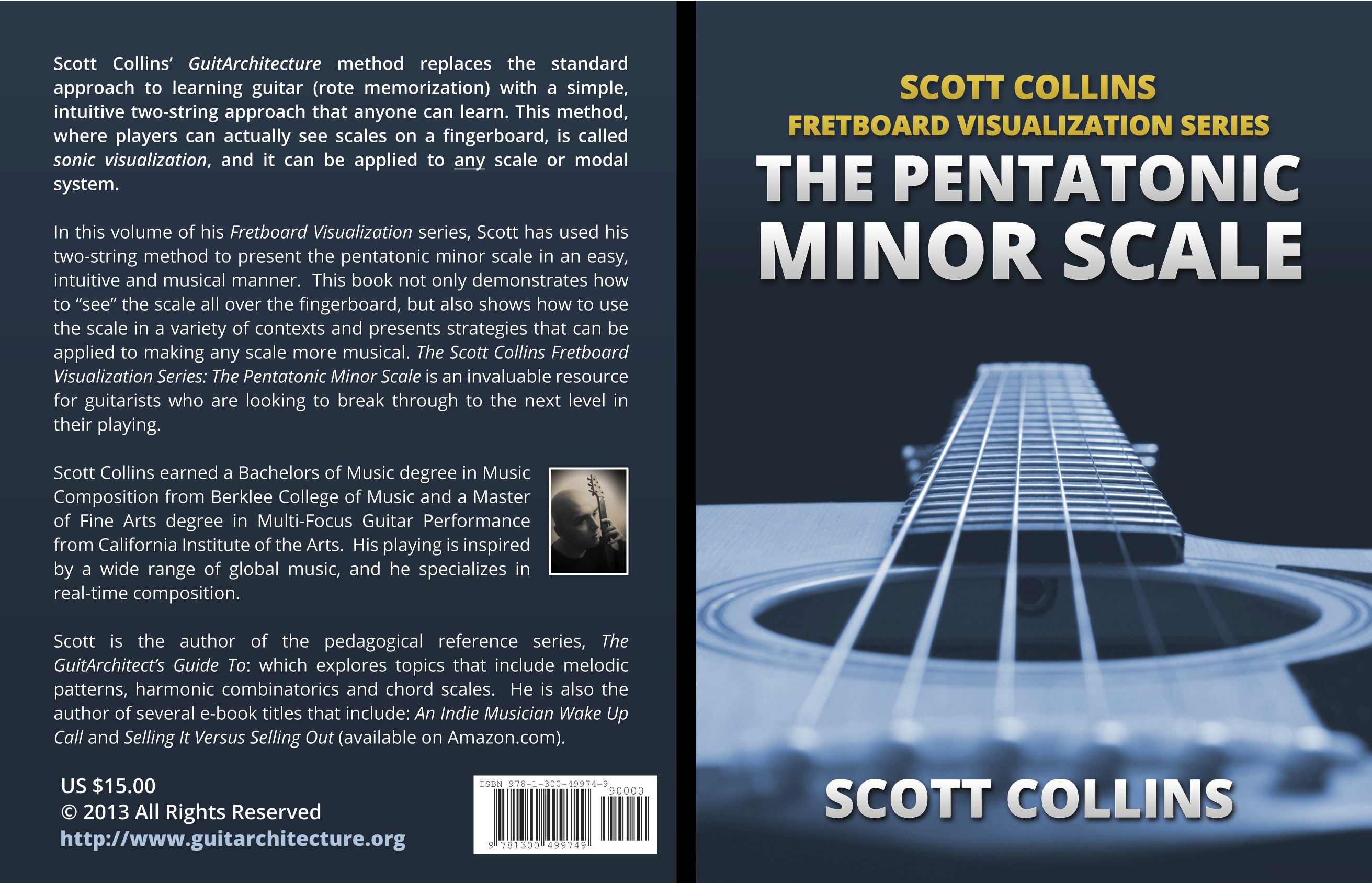
The Scott Collins Fretboard Visualization Series: The Pentatonic Minor Scale

Book Cover Full
You can read all about that here or see excerpts and order the book here.

Revised Pentatonic Visualization Book Is Out Now

Scott Collins’ Fretboard Visualization Series: The Pentatonic Minor Scale

Hey Everyone,

After several months, I’ve just completed a massive update to my Pentatonic book and the print edition looks great!

This updated edition is almost twice as long as the original Fiver edition and has a complete overhaul of the text and graphics!

The updated version is $15 for the print edition and $10 for the PDF from LULU (The print edition should be up on Amazon in a couple of weeks)

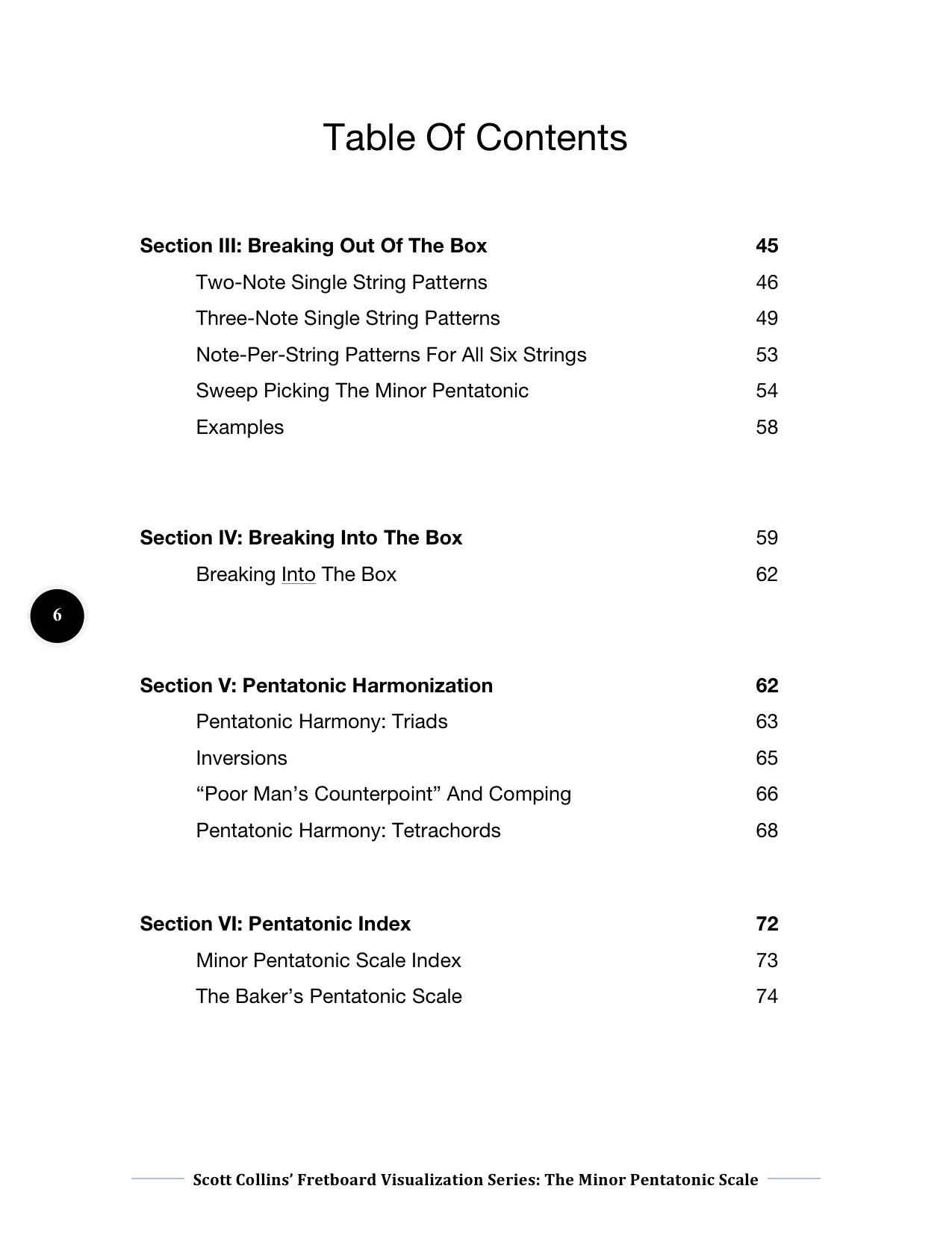
Pent table of contents 1


Pent Table of Contents 2
Pent table of contents 3

You can preview the contents and order it here.

The information on the back of the book follows.

Scott Collins’ GuitArchitecture method replaces the standard approach to learning guitar (rote memorization) with a simple, intuitive two-string approach that anyone can learn. This method, where players can actually see scales on a fingerboard, is called sonic visualization, and it can be applied to any scale or modal system.

In this volume of his Fretboard Visualization series, Scott has used his two-string method to present the pentatonic minor scale in an easy, intuitive and musical manner.  This book not only demonstrates how to “see” the scale all over the fingerboard, but also shows how to use the scale in a variety of contexts and presents strategies that can be applied to making any scale more musical. The Scott Collins Fretboard Visualization Series: The Pentatonic Minor Scale is an invaluable resource for guitarists who are looking to break through to the next level in their playing.

The Print Edition of the book is $15, and the e-book version is $10 on Lulu (the revised print edition should be up on Amazon in the next 2-3 weeks)

The Original Fiverr Edition

In the meantime, for those of you on a budget – the original pdf lesson book is still available for $5 on Fiverr (That link is here).

I’ve broken the book out into six different lessons over 50 pages that covers:
.
  • how to visualize pentatonic minor scales on the fingerboard positionally
  • how to use the scales over different tonal centers
  • one string patterns
  • cool ways to sequence the melodic cells with combinatorics and…
  • pentatonic harmony (Worth the price of admission alone)

.

In other words, it’s a series of short succinct lessons to get under your fingers to start playing but with enough meat on their bones to keep you busy for a while.

Here are some reviews from Fiverr:

“super fast [delivery]. looks good – now i have one more reason to hide and play. thanks!”

“Excellent value! look forward to putting it into practice.”

“Very useful guide for those interested in the material. Great seller!”

“This is the way it should be taught! This method helps you to arrive at a good understanding very quickly. Thank you very much!”

“Fantastic book. Looking forward to checking out your other stuff. Glad I came across this!”
“Great course. I didn’t realize it was this much info. Thanks a lot.”
.
Thanks Everyone!  Keep an eye out for my new Pentatonic Extraction Book which should be out this fall!!!!

Deadlines Are Your Best Friend

Hey Everyone!

I have a new post coming up next week about benchmarks and perfection, but as a starting point I wanted to bring out this chestnut (originally posted on guitarchitecture.org).

One of the things that attracts me to improvisation is the immediacy of it.  You perform and then it’s done.  While I like documenting these improvisations I fully recognize the danger of doing so.  (The danger being that when you record something there is a tendency to say, “Oh that sounds pretty good. I should just tweak a couple of things and then it will be perfect.”)

A Variation on the “I used to Walk a mile in the snow to get to school” rant

The way records used to be made back in the day,  involved a bunch of musicians who rehearsed and/or toured some material to death getting together in a room.  Mics would be set up and levels were typically set by putting loud instruments in the back of the room and softer ones up front (soloists would literally step up to the mike to solo and then step back) and after the end of the performance, the record was recorded.

Multitracking came along and studio time was still prohibitively expensive enough that you wanted to get tracks done as quickly as possible.  I played in several bands that did weekend cd’s tracking and overdubs on day one and mixing on day two.  There were always things that you wanted to tweak – but two days later you had a CD and it was done.

You kids and your new fangled “machines”

Now everyone has a multitrack recorder called a computer that can edit audio to the millisecond and the temptation to play god and make the perfect aural universe is a dangerous one to productivity.

Don’t get me wrong.  I love my computer and I love Logic but I also know that if a take is 95% of the way there in terms of recording – it may take all day at best to get that extra 5%.  In a worst case scenario it might take forever.

Perfection is over rated.

Midi can be “perfect”.  It can be quantized and performed uniformly ever single time.  From a performance perspective, it can play things faster and cleaner than you will ever be able to with millisecond accurate timing.

Midi is also typically boring.  No one wants to watch a sequencer play things on a stage.  Audiences might listen, but they’re not going to give it their full attention.

In pop music (i.e. “rock” music) – ProTools and midi as a performance standard have increasingly become the goal.  Once I was sitting with a world class engineer and in discussing talking about how out of control the pursuit of “perfection” in commercially released recordings is,  He said, “let me give you an example” and proceeded to bring up a track he was working on on his desk top.  The track was going really slow.

“Is that an old computer?” I asked.  It turned out that it was the newest version.  Top of the line with memory and drives at the highest level the system would support.

When the track finally loaded I saw why it took so long.  There were eighteen thousand edits on the drum track alone.  18,000 edits!  On a 4 minute song.  Every single drum hit was cross faded.  Every single hit was moved and jostled to fit a midi track.

From a perspective of timing – it was perfect but from a performance perspective it was boring and it sounded like every other programmed drum track you ever heard.

I am not advising you to give up on bettering yourself (quite the contrary) – but my general advice to any artist is not to get seduced by “perfection”.  Perfection can be a great motivator or it can be the siren song that sinks your productivity.

To paraphrase a quote that I should be able to cite, “A true artist never completes a work but merely abandons it.”

Deadlines are your best friend.

Deadlines allow you to get things done.

Real (i.e. no-moving and non-negotiable) deadlines force you to realize that 95% of something is more than 100% of nothing.

Work at the highest level that you possibly can – but realize when it’s time to move on to the next thing.

As Steve Jobs famously stated,

“Real artists ship.”

Thanks for reading!

-SC

Changing One’s Perception And Removing “Should” From One’s Vocabulary

“Oh should you now?”

We all have things that we know we’re supposed to do and don’t do with frequency.  We should see the doctor regularly.  We should exercise more and eat less.  We should really write our grandma.  We should really get to practicing.

The reality is that “shoulds” are little minefields in our brain.  We plant them around everywhere and then get absent-minded about where they are.  When we finally have to confront one, the temptation is to get upset because you now know what you should have done and did not – and the onus of it falls on you.

Getting past “should” is a life long struggle and as someone who is still working on it, I can say that it’s not easy but it is possible.

This can be done by removing the phrase “I should” from your vocabulary and replacing it with “I am

(i.e.  replacing “should” with “do”)

.

Adjusting your perception.

If you meet expatriates from the US who have been living in another country for a long time and not speaking their original language, occasionally they have a real disconnect when you speak English to them.  This has happened to me on several occasions where I’ve met people who were frustrated at not remembering words in English and feel very disconnected in speaking it with people.

.

There’s a reason for this.  They’re out of practice.

If you are a native English speaker in the US – you practice speaking and writing in the language every day.

.

The difference is you probably don’t think about it as “practice“.

You just think about part of it as your day.  As something that you do naturally, you don’t think of it as work or drudgery.  You feel comfortable enough in your use of it that when you are confronted with phrases or terms you’ve never heard before – you simply listen instead of freaking out and make sense of in in context.  You pick up information and interact with it all day long.

If you doubt this, try the following: Take your current practice regimen and instead of practicing scales or chords or what have you, take out a dictionary and apply the same regimen to trying to expand your vocabulary.  Unless you’re studying for the SATs or GREs, I bet you make it a day before it gets discarded entirely or doomed to the “should” bin.

.

If you make practicing just part of your regular day instead of something that has to be carved out of your schedule it will be easier to maintain.

.

Occasionally, I read articles with guitarists who claim that they never practice.  It’s important to remember that anyone who is the topic of an article in a trade publication  is generally going to be a professional musician with a rigorous performance schedule.  If they don’t have time to practice – its only because they’re gigging too much and while they may not be “practicing” by a strict definition you can bet they’re keeping their chops up.

.

I have no idea if Scotty Anderson “practices” but based on hearing him play I imagine that he has a guitar in his hand most of the day and is either playing or working on things all of the time.  Eddie Van Halen is another guy who may not identify what he does as practicing – but every interview I’ve read with him makes it seems like he has a guitar in his hands playing for hours every day.  (It’s also worth noting that many people consider Van Halen their best album for songs and playing.)

When Jimmy Rosenberg was playing with Sinti at the ripe old age of 16 he was asked by a guitar magazine how he got that frighteningly good at that age and he said, “Well I practice/play 4-5 hours a day, and rehearse with Sinti 4-5 hours a day, and then we have concerts”.

If you have a problem committing to practicing, you could change your mindset to move past “practicing” as an event and instead concentrate on doing” as a habit.

.

Think about how easy it is to gain a bad habit.  Now think about how hard it can be to break that habit.

There are plenty of good habits that you probably have developed as well and maintaining a good habit requires very little work.

Again it’s about perception.  If practicing is something you view as a chore it will be something that you are loathe to do.  It’ll be much easier to practice if you can make it something you look forward to.

To quote Albert Ellis,

“Don’t should on yourself”.

I hope this helps!  Thanks for dropping by!

-SC

.

Customer Service Growing Pains or No One’s Ever Happy In A Compromise.

Wait, what about the books now?

As many of you know, a while ago I made a shift away from offering PDFs directly and moved it over to Lulu (which also distributes it to Amazon).  I did this for several reasons, but mainly I wanted the customer to be able to order the books and download them instantly.  Sometimes, schedule conflicts held up orders and while people were really cool about it – I know that when you order something you generally want it RIGHT NOW.

So the plus side is that the orders go out immediately.

The down side, and it’s a near insurmountable downside for me, is that while Lulu and Amazon have some analytics about who orders books –  I have no way to contact people to thank them or to talk to them about any aspects of the book that they dug, disliked or just didn’t get.

All I have is this blog and that co-opted Ambrose Bierce (?) reference in the title that reminds me that the nature of service mandates that while you can’t give everyone everything always – you should always give them the best of what they’re asking for.

So a few things then:

1.  If you’ve ordered any of my books in a print or pdf format – THANK YOU! It’s really appreciated and I hope that you’re getting something out of them.

2.  If you’ve ordered any of my books from Amazon or Lulu please feel free to drop me a line at guitar.blueprint@gmail.com with any questions, comments etc.

3.  I’m really trying to get in touch with anyone who’s bought my Pentatonic Visualization book from Lulu or Amazon.  I have dates and sales numbers but no names and I’d really like to get some supplemental material to you!  This also goes for those of you who bought the Symmetrical Twelve-Tone Patterns book who haven’t gotten the free bundle that compliments the book.

4.  While I promote Lulu and Amazon evenly – I should mention that Amazon is currently selling physical copies of my books at a 10% discount from Lulu.  I know that PDFs are convenient, but these books are really designed to be something that you hold (or put on a music stand) and flip to a physical page.

Again, thank you for your support, you indulgence and for your interest in anything that I’m writing about or doing.  I hope that any or all of it helps you in some way shape or form.

-SC

ps – The Devil’s Dictionary was a hugely influential book on me.  I thought Bierce gave me the compromise quote – but I may have cobbled it together from a few other sources.  If anyone knows a source, please drop me a line so I don’t have to be the pompous ass who quotes himself ; )

For those of you interested, Bierce’s actual definition  was,

“Compromise, n. Such an adjustment of conflicting interests as gives each adversary the satisfaction of thinking he has got what he ought not to have, and is deprived of nothing except what was justly his due.”

 – Ambrose Birece, The Devil’s Dictionary