Deadlines Are Your Best Friend

Hey Everyone!

I have a new post coming up next week about benchmarks and perfection, but as a starting point I wanted to bring out this chestnut (originally posted on guitarchitecture.org).

One of the things that attracts me to improvisation is the immediacy of it.  You perform and then it’s done.  While I like documenting these improvisations I fully recognize the danger of doing so.  (The danger being that when you record something there is a tendency to say, “Oh that sounds pretty good. I should just tweak a couple of things and then it will be perfect.”)

A Variation on the “I used to Walk a mile in the snow to get to school” rant

The way records used to be made back in the day,  involved a bunch of musicians who rehearsed and/or toured some material to death getting together in a room.  Mics would be set up and levels were typically set by putting loud instruments in the back of the room and softer ones up front (soloists would literally step up to the mike to solo and then step back) and after the end of the performance, the record was recorded.

Multitracking came along and studio time was still prohibitively expensive enough that you wanted to get tracks done as quickly as possible.  I played in several bands that did weekend cd’s tracking and overdubs on day one and mixing on day two.  There were always things that you wanted to tweak – but two days later you had a CD and it was done.

You kids and your new fangled “machines”

Now everyone has a multitrack recorder called a computer that can edit audio to the millisecond and the temptation to play god and make the perfect aural universe is a dangerous one to productivity.

Don’t get me wrong.  I love my computer and I love Logic but I also know that if a take is 95% of the way there in terms of recording – it may take all day at best to get that extra 5%.  In a worst case scenario it might take forever.

Perfection is over rated.

Midi can be “perfect”.  It can be quantized and performed uniformly ever single time.  From a performance perspective, it can play things faster and cleaner than you will ever be able to with millisecond accurate timing.

Midi is also typically boring.  No one wants to watch a sequencer play things on a stage.  Audiences might listen, but they’re not going to give it their full attention.

In pop music (i.e. “rock” music) – ProTools and midi as a performance standard have increasingly become the goal.  Once I was sitting with a world class engineer and in discussing talking about how out of control the pursuit of “perfection” in commercially released recordings is,  He said, “let me give you an example” and proceeded to bring up a track he was working on on his desk top.  The track was going really slow.

“Is that an old computer?” I asked.  It turned out that it was the newest version.  Top of the line with memory and drives at the highest level the system would support.

When the track finally loaded I saw why it took so long.  There were eighteen thousand edits on the drum track alone.  18,000 edits!  On a 4 minute song.  Every single drum hit was cross faded.  Every single hit was moved and jostled to fit a midi track.

From a perspective of timing – it was perfect but from a performance perspective it was boring and it sounded like every other programmed drum track you ever heard.

I am not advising you to give up on bettering yourself (quite the contrary) – but my general advice to any artist is not to get seduced by “perfection”.  Perfection can be a great motivator or it can be the siren song that sinks your productivity.

To paraphrase a quote that I should be able to cite, “A true artist never completes a work but merely abandons it.”

Deadlines are your best friend.

Deadlines allow you to get things done.

Real (i.e. no-moving and non-negotiable) deadlines force you to realize that 95% of something is more than 100% of nothing.

Work at the highest level that you possibly can – but realize when it’s time to move on to the next thing.

As Steve Jobs famously stated,

“Real artists ship.”

Thanks for reading!

-SC

Changing One’s Perception And Removing “Should” From One’s Vocabulary

“Oh should you now?”

We all have things that we know we’re supposed to do and don’t do with frequency.  We should see the doctor regularly.  We should exercise more and eat less.  We should really write our grandma.  We should really get to practicing.

The reality is that “shoulds” are little minefields in our brain.  We plant them around everywhere and then get absent-minded about where they are.  When we finally have to confront one, the temptation is to get upset because you now know what you should have done and did not – and the onus of it falls on you.

Getting past “should” is a life long struggle and as someone who is still working on it, I can say that it’s not easy but it is possible.

This can be done by removing the phrase “I should” from your vocabulary and replacing it with “I am

(i.e.  replacing “should” with “do”)

.

Adjusting your perception.

If you meet expatriates from the US who have been living in another country for a long time and not speaking their original language, occasionally they have a real disconnect when you speak English to them.  This has happened to me on several occasions where I’ve met people who were frustrated at not remembering words in English and feel very disconnected in speaking it with people.

.

There’s a reason for this.  They’re out of practice.

If you are a native English speaker in the US – you practice speaking and writing in the language every day.

.

The difference is you probably don’t think about it as “practice“.

You just think about part of it as your day.  As something that you do naturally, you don’t think of it as work or drudgery.  You feel comfortable enough in your use of it that when you are confronted with phrases or terms you’ve never heard before – you simply listen instead of freaking out and make sense of in in context.  You pick up information and interact with it all day long.

If you doubt this, try the following: Take your current practice regimen and instead of practicing scales or chords or what have you, take out a dictionary and apply the same regimen to trying to expand your vocabulary.  Unless you’re studying for the SATs or GREs, I bet you make it a day before it gets discarded entirely or doomed to the “should” bin.

.

If you make practicing just part of your regular day instead of something that has to be carved out of your schedule it will be easier to maintain.

.

Occasionally, I read articles with guitarists who claim that they never practice.  It’s important to remember that anyone who is the topic of an article in a trade publication  is generally going to be a professional musician with a rigorous performance schedule.  If they don’t have time to practice – its only because they’re gigging too much and while they may not be “practicing” by a strict definition you can bet they’re keeping their chops up.

.

I have no idea if Scotty Anderson “practices” but based on hearing him play I imagine that he has a guitar in his hand most of the day and is either playing or working on things all of the time.  Eddie Van Halen is another guy who may not identify what he does as practicing – but every interview I’ve read with him makes it seems like he has a guitar in his hands playing for hours every day.  (It’s also worth noting that many people consider Van Halen their best album for songs and playing.)

When Jimmy Rosenberg was playing with Sinti at the ripe old age of 16 he was asked by a guitar magazine how he got that frighteningly good at that age and he said, “Well I practice/play 4-5 hours a day, and rehearse with Sinti 4-5 hours a day, and then we have concerts”.

If you have a problem committing to practicing, you could change your mindset to move past “practicing” as an event and instead concentrate on doing” as a habit.

.

Think about how easy it is to gain a bad habit.  Now think about how hard it can be to break that habit.

There are plenty of good habits that you probably have developed as well and maintaining a good habit requires very little work.

Again it’s about perception.  If practicing is something you view as a chore it will be something that you are loathe to do.  It’ll be much easier to practice if you can make it something you look forward to.

To quote Albert Ellis,

“Don’t should on yourself”.

I hope this helps!  Thanks for dropping by!

-SC

.

Do You View Your (Music) Career Like An Actor?

I just saw a documentary on Netflix called “That Guy Who Was In That Thing” which is about a number of instantly recognizable character actors and their paths to get to claw their way to the middle.  ; )

The documentary is thoroughly engaging by being both entertaining and thought-provoking.  There also happen to be a number of parallels between performing in the film/television industry and performing in the music industry.  The subjects spoke at length about the difficulties that come with the ebb and flow of work that their careers take.  They talked about how they were (and are) out of work for years before they get a few gigs or hit a streak of work and all of them had stories of other parallel jobs that they worked while trying to make a living acting and tales of losing gigs for any one of a dozen reasons.

Two things grabbed me right away.

1.  The subjects spoke at length about how the number of actors out there willing to work for less has caused many of them to make less money than they did before. The thinking being, we don’t have to pay you that anymore because there are 10,000 other people who will kill to sit in that chair for less money.  The number of parallels with this and recording musicians (and performing artists) was striking. I’m paraphrasing here, “You realize that they don’t need you to fill the role, they just need to fill the role.”  Does this sound familiar to anyone performing and/or recording music out there?

2.  Musicians might actually have it easier than actors.

Here’s my thinking behind this.  Actors need vehicles to act in.  So the model they use is basically variations for  Advertising / Televison / Film.  For a TV show, this might mean

  • auditioning for a pilot with hundreds of people
  • getting a callback with maybe 50 people
  • getting a second callback with 20 people
  • doing a test with 5-6 people
  • having a series of negotiating calls made to see what you will cost them
  • testing in front of the studio executives this will limit you to a group of maybe 3 people
  • if chosen, you then shoot a pilot
  • the pilot then has to get picked up and
  • then you hope that the series doesn’t get cancelled after the first few episodes

The interesting thing to me was that this paralleled musicians and major labels.  The thinking was for years that you had to be in a band and signed to a label to have a career. Online distribution changed that model forever.

Having said that, artists on labels are/were the only people getting tour support. (They’re  generally the only people to also get tour support via sponsorship. )

For actors, working with studios means you get to keep your SAG card.  You get to keep your benefits and the SAG card is key to the audition process (and the securing of roles).

It doesn’t say it directly in the documentary – but some of these actors slogging it out in endless auditions seem to be afraid that the new (up and coming) actors are just getting pulled from YouTube.

I don’t think it’s the case for major films – and won’t be for a while.

Studio legend Tommy Tedesco once related a story where some MI students went with him on a session and one of them said, “I don’t understand.  Someone who’s been playing a year could play that part.”  And Tommy said, “yes. that’s probably true.”

The student pushed it more and said, “But you make triple scale, why do they pay all of that money to bring you in when they could get someone to do it much cheaper?”

Tedesco replied, “Because when you spend 50 or 75,000 on a recording session with an orchestra, you don’t want to lose money because some guy might screw up his part.  You’re going to get the best players on the session to make sure that absolutely nothing goes wrong.”

Again, I’m not knocking YouTube – but a YouTube performance doesn’t mean you can handle the rigors of any gig that comes your way.  While it might get you an audition, in and of itself, it’s never going to give you traction if you don’t have the skills to back it up.

Here’s what bugged me about the documentary.

No one talked about going DIY.

No one talked about making their own films.  Writing and staging their own plays.  Starting their own companies. All they talked about was a variation of the formula:

Get call from agent + audition + a dozen factors MAY = a gig.

It’s easy to view a music career like this.  Waiting for a shot – the right moment, the right contact – to make a big pay out.  It’s the lottery mentality to which I say, “sure, put a couple of bucks in and see if you get lucky, but putting your life savings in it probably won’t pay off.”

Those development contracts like Joan Crawford were on back in the day are never coming back to the movie houses.  Those days of getting signed to a label and having a carer carefully cultivated over multiple releases are never coming back.

Elvis already left the building.

While I’m fully in favor of seeking out opportunity – by and large you make your own opportunities and the formula for that is:

Do really good work + Do it frequently + Affect, motivate and/or move other people = being the go to person for “that thing”.

If what you do services a niche audience, you might not get rich but it’s probably the best way to build a long-term career.

Thanks for reading!

-SC

Don’t Be Afraid Of The Work

As I edit this, I’m taking a break from the final edits on the print edition of Pentatonic Visualization and working on the layout/order/edits of my Pentatonic Extraction book which should be out this fall.

That puts the tally to 3 books in 2011 (Melodic Patterns, Positional Exploration and Harmonic Combinatorics), 3 in 2012 (Chord Scales, and 2 short Kindle titles – An Indie Musician Wake Up Call and Selling It Versus Selling Out) and 3 in 2013 (Symmetrical 12-Tone Patterns, Pentatonic Visualization and Pentatonic Extraction) with a strong chance of another kindle book released this year as well.

.

While being able to call yourself an author seems appealing -working at this rate is arduous at best. When you don’t have a production house behind you – writing means taking on all of the menial tasks in getting a book out.  In this case, even something like the Visualization make over has taken a month to get done and taking on the Extraction book involves massive edits, re-writes and a complete reformatting (typically involving a tedious cut/paste/format/edit workflow).  The appeal of being an author becomes less glamorous  when it takes days and weeks of mind numbing work to get the book out the door.

.

But here’s something I’ve discovered:

Many people want to get better at something.

They have access to materials.

They have access to knowledge.

They have the desire to move forward.

.

Even with all of that energy and good intention, in any endeavour most people won’t do the work over the long haul.

.

Because the work is not glamorous.  It’s not always fun (though it’s usually nowhere near as bad as we make it out to be).  It’s often tedious and time-consuming and isn’t there something better (read more enjoyable) to do?

.

The real pay off is in what happens in the focused work.

Jonas Hellborg

Yngwie Malmsteen

Miroslav Tadic

Buckminster Fuller

Nikola Tesla

Thomas Edison

Jorge Luis Borges

It doesn’t matter which successful person you pick.  Most people who succeed do so because in addition to the initial vision (inspiration) they also have the ability to go the extra distance and see something to its logical conclusion (endurance).

.

Don’t be afraid of the work.  It’s where the nectar is.  It’s where the magic is and…

when you truly devote yourself to your work – you work on yourself at the same time.  

.

When you lose yourself in your work you’re really finding more of yourself.  You have to have your eyes open to see that.  You have to be open to that possibility to perceive that and you may not recognize it until later – but that connection ( or Csikszentmihalyi’s flow) carries through into other things.

A lesson from Borges

In the later years of Borges life (after his vision had gone),  he would write whatever story or poem he was working on in his head and then spend some time editing and perfecting each phrase as an internal process.  When it was done, he would call in his assistant and recite it in it’s final form to be transcribed and read back to him for approval.

.

Now 2 questions:

How many other people could write under those conditions?  A few.

How many could write at his level?  None…even with their sight.

He could have easily made excuses – writing in this fashion is incredibly difficult – but instead he put the effort in and continued to get his writing out into the world.

.

If you’re doing the work, you’re already ahead of the pack.

.

I hope this helps!  Thanks for reading.

.

-SC

(Special thanks to Chris Lavender for some extra perspective and inspiration on this post)

Stop Kicking Yourself When You’re Down Or Discarding The Amateur Mindset

“If you think you can do a thing or think you can’t do a thing, you’re right.”

(I don’t quote racists like Henry Ford lightly.  But, for me, many of Ford’s quotes highlight the lesson that there are times that you have to listen to the message while ignoring the messenger.)

The biggest obstacle in the way of most people realizing their goals isn’t a lack of money, information or skill.  

It’s their mindset.

Thinking like an amateur may be holding you back.

.

The Devastating Gig

If I have any wisdom to impart, it is undoubtably from making a seemingly endless series of mistakes and correcting them.   One mistake that I made early on (that took a long time for me to identify and correct) was equating what I played with who I was.    This meant that every single gig was a proving ground.

So if I played a good gig, I was elated because I was somehow validated as a good guitar player.

And if I played a bad gig….then it must mean I was a terrible guitarist.

This sounds insane to me as I write this (and hopefully insane to you when you read it!)!  But this is a common mindset.  I know a lot of players who do this and beat themselves up at gigs, sessions and in the privacy of their own practice time.

It comes from how players define themselves and it comes from thinking like an amateur.

.

You are more than what you do

Many musicians develop some odd concepts (in my opinion) about what constitutes a musician.  I remember getting out of college and having a discussion with a classmate of mine.  He had asked what I was doing for work and I said, “Oh I’ve got a day gig to pay some bills and then I’m gigging/recording with a couple of bands and teaching on the side.”

His face buckled into a disgusted contortion as if instead of speaking –  human biohazard had just freed itself from my mouth and landed on the table between us.  “Oh….”, he said in the most passive aggressive snark possible.  “I see.”

“What about you?” I asked, trying to ignore the reaction.  “What are you doing these days?”

“Oh well I’m playing in a band full-time and teaching.”

“That’s great!!” I said.   “Is it all original music?”

“No it’s a GB band.”

“Hmm…I didn’t know you liked those kinds of gigs.”

“Oh I hate them.  The people are stupid and the tunes are awful, but some of the players are okay and sometimes we get to play some standards after the date.”

(insert awkward pause) “Well at least it’s pay….”

“Well it’s consistent.  But it’s not great money.  I’m always spending almost as much on my car and gas as what I’m making on a gig.  So I’m running a little short.  Thanks a lot for paying for the coffee by the way…”

Does that sound rewarding to you?  It didn’t sound rewarding to me.

.

How you define yourself will either break you out of prison or put you there 

I defined a professional musician as someone who was paid to perform music at a professional level.  My classmate defined a professional musician as a person whose sole source of income comes from playing music.

I’ll paraphrase a quote from my friend bassist/composer Daren Burns here,

“I am completely unimpressed when someone tells me that they’re a full-time musician playing music that they hate.  I don’t see anything noteworthy  or impressive in that at all.”

.

There was a several year period of time that Jeff Beck was pretty much working on cars full-time and not playing guitar at all.  I’ve never met Jeff Beck – but based on what I’ve seen of him I don’t think that he worried about whether or not he was less of a musician because he wasn’t playing music full-time.   Additionally, you’d be hard pressed to find anyone who thought of Jeff Beck as a mechanic who played a little guitar.

Jeff Beck defined himself, did what he wanted to do and didn’t worry about how other people defined him.  Not to take anything away from Jeff, but isn’t it odd that most musicians think of this mindset as fearless and badass?   It’s odd because in my way of thinking, this should be the norm rather than the exception.

.

If you don’t define yourself, you let other people define you and (most likely) you won’t like their definition.

How do you deal with isolation?   Some people see the four walls they are in as a cell and each hour of each day erodes who they are a little more until there is nothing left of them.  Other people see the four walls as a blank canvas and work on creating things within those confines.

.

Life is a surprisingly good teacher if you’re observant.  If you take the time and energy to look at what, how and why you do the things that you do – you might learn a lot about what your priorities are.  For myself, I learned a while ago that there were a number of things that I wanted to do, and that there was no clear career trajectory to get to where I ultimately wanted to go – so I was going to have to find my own way.   I could either get hung up on what other people thought of a path I was on (that quite frankly they didn’t understand), or I could take steps towards achieving goals I had for myself.

.

Are you thinking like an amateur?

I don’t know how many of you have toured with bands.  It’s an interesting experience.  Even if you’re unfamiliar with the material on the first night, within a couple of shows you get into a rhythm and the set moves into a comfort zone.   And in your spare time – you find that you’re not shedding the material relentlessly (because you already have it down), but instead you’re stopping at roadside attractions and looking for clean places to go to the bathroom so you don’t have to bag it on the bus. (If you don’t know what that means – don’t ask and enjoy your morning coffee instead).

Amateurs analyze every aspect of the performance. They scrutinize every detail and obsess over what was right and what was wrong.

Professionals get the set under their belt and then show up to do the work.

.

The Ballad of Jane the Plumber

Llet’s say a homeowner has a broken pipe in the basement.  So they call Jane the plumber.  Jane comes over to the house and says, “this whole pipe has to come out and it’s an odd size.   I don’t have any that length on me.  I can do a quick fix that’s not going to be pretty.  I’ll get you through the next day or two – but I’ll have to pick some up and come back and to replace it.”

Do you think the homeowner says, “What a noob!  She doesn’t even have pipe!”  Not likely.  The homeowner is thinking, “I’m glad that the water is back on again.  I hope this doesn’t cost me fortune!”

Now, do you think Jane the plumber went back home and had a melt-down?  “I am such a hack!  I can’t believe that I showed up at that house without that pipe!  That repair was a joke!  I am such a loser!”

Not bloody likely.  She probably put the pipe order in and went to the next gig.

I’m not saying that professionals don’t care.  Professionals do care about what they do, but they don’t get emotionally invested.  They’re professional because they have the skill set to handle what comes up at the gig, not get freaked out and get through it.  They don’t waste energy evaluating what they do – because they’re too busy doing it.

If you find that you’re taking punches from yourself at a gig or a session take a step back and ask yourself, “what would Jeff Beck do?”  and then go tool out your engine 😉

I hope this helps!  As always, thanks for reading!

-SC

The Instructional Methodology Behind “How Not To Do Things”

Hi Everyone! I’m prepping for an upcoming recording session, but I thought in the meantime I’d share another excerpt from my Amazon kindle book, Selling it Versus Selling Out which may have a perspective that’s helpful for you.
41sc-8d22lL._AA160_


If you’ve ever had insomnia and turned on a television, you’ve probably seen info-mercials that are based on success formulas.  “I made $1,000,000 in recycling and you can too!”  The selling point is that if you emulate what successful people have done, you will get the same results they did.

The problem with this idea is that the “one size fits all” mentality for success rarely seems to work.


One possible reason for this is that so many factors go into “success”, it’s difficult to glean all of the components that go into helping make someone successful.

For example, as a guitarist, I could watch an instructional video of someone playing a guitar lick quickly, learn all of the notes being played, practice diligently and still not be able to get the lick sounding the same because of any one of a number of factors (hand tension, timing, phrasing, string thickness etc.)

While it’s easy to look for successful models and try to emulate that success, it can be even more informative to look at what doesn’t work and model a path against failure.

You can read a book about Donald Trump and still be no closer to achieving his level of success. In contrast, if you watch the television show Intervention and see someone who’s short-circuited their career by being a full blown drug addict, you can decide not to follow their example and make a conscious step towards being the person you want to become.

Lessons from an error-filled methodology

When I first started playing guitar I spent a lot of time working on the solos in songs I was playing.  As a commonality, the solos in these songs were all fast and required substantial technique. I assumed that if I just learned the notes, I could get the solos up to speed eventually.  My practicing “method” was to just play these licks for hours on end to get them as fast as I could.

In this process, as soon as I could play the notes I would try to play them faster (which was actually much faster than I really could accurately play them).  In addition to making things sloppy, it also made my hands overly tense as I was trying to play outside of the realm of my ability and this tension carried over into my playing. I eventually could get the speed of the notes, but there was a lack of clarity and most certainly, a lack of fluidity.

It goes without saying – this is not how you want to practice something.

In conjunction with writing my instructional books, I watched every guitar instructional video I could get my hands on to see how my methods stacked up.  Here’s what I found:

Very few people can teach material to others well.

The amount of information that was misleading or wrong was shocking.   It occurred to me that many people are poor teachers because they either don’t know the material at a deep enough level to explain it to someone else or because they have no concept of how to relate that material to other people.  This makes the job of the student that much harder, because the student has to sort out what the teacher is trying to say rather than what is actually being said.

Ignorance is contagious.

Ignorance is viral.  It spreads quickly and easily and once infected, it can be a difficult process to overcome.  In my own case, the problems I developed by “practicing” in the wrong way have taken years to try to fix and is still an ongoing process.   (This speaks to both why it’s important to learn things the right way the first time and how difficult it is to overcome bad habits).

If you take this to a YouTube level – you’ll find many people who play a lot of notes but can’t play them well.  Sometimes there’s no concept of phrasing.  You see out of tune, out of time bends with no control followed by a flurry of notes hiding under a ton of effects.   I’ve seen the tension I talked about above from trying to play too fast too quickly in a lot of online videos.  The notes are kind of there but only in a holographic way.  You get the feeling that if you were to put a metronome down on a table and drop the tempo by 1/2 that whatever the person was playing would completely fall out of the pocket or more likely completely fall apart.

Observing and reflecting on people getting things wrong, can inspire you to see elements of weakness in yourself and correct them.

When I see someone play badly, I try to figure out why it’s bad and then try to see if there’s something I can take away from it to develop my own playing.  Maybe it’s a simple observation like, “Ok I really need to work on my vibrato!” – but I try to make each observation a lesson.

How not to do things also directly relates to goals.  It’s about looking at an outcome and saying, “if I do not want a specific outcome to happen what steps do I need to take?”   Its advantage over merely examining how to do things is that it gets your hands dirty and forces you to come into contact with the nitty-gritty behind various processes.  In this way, it may help you come to a deeper understanding of what you’re trying to do and how to go about doing it.

Thanks for reading!

If you like this post, you may like two of the Kindle e-books I currently have out, An Indie Musician Wake Up Call and Selling It Versus Selling Out.

The Perils Of Panaceas And Instant Gratification

That’s MBTI to you, Buster!

Most people have their first exposure to the Myers-BriggsType Indicator (MBTI) assessment either in a college psychology class, a life coaching session or in a work-related retreat / team building exercise.  For those of you who aren’t familiar with the test, participants are given a (psychologically loaded) questionnaire that’s been specifically devised to determine individual preferences and based on those, to then extrapolate the test taker’s decision-making process and world view.

In context, it can be a useful tool.  When participants get their four letter code that determines their personality type, they then typically get the equivalent of a score card to determine what the letters mean and to offer some guidelines on the types of decision-making process that they make.  Again, in context it can be a useful tool where participants might see themselves and their decision-making process in a whole new light.

However,  there always seems to be at least one person in a session who finds this to be something between a milestone and a revelatory experience and the next thing you know, every discussion with this person centers around Myers-Briggs.  Every interaction is analyzed and put through the Myers-Briggs filter.   “Oh well he must be an “I” which means that….”.

And then, eventually, someone calls them on their nonsense.

Myers-Briggs typing starts to break down in the real world, because while it’s not a bad contextual lens for gleaning some information, it’s not a good lens on its own and it certainly has limited validity as the sole filter for information.  Additionally, people don’t dig being typecast in any scenario, even when you’re trying to be helpful.

.

“Cure’s All that Ail’s ya!”

The web is full of these observations and cure-alls for whatever ail’s ya.  “Become a guitar god in a week by following these 3 weird simple rules.”   Or forums where one observation is yielded, “I had good success using product x with gear y” and soon you have other people who have never used product x or gear y saying, “Well if you use gear y YOU HAVE TO USE product x!!!”

Take any one-size fits all methodology, philosophy, strategy or any  solution with a BIG grain of salt because, in my own experience, there is no one panacea for anything. Just as there is no one filter that will make previously hidden elements of the world fully visible and comprehensible to you.

.

Instant gratification and false entitlement

.

The simple fact is that things that are worth having, have to be worked for.

.

As a society, we have mutated this concept through advertising and sold people on the concept that because they do work hard in other areas of their life, that they deserve everything.

“It might take you 3 years of saving to buy that 60″ flat screen TV.  You’ve worked hard establishing a line of good credit and you deserve to be comfortable in your twice re-financed home.   Pull that piece of plastic out of your pocket and you can walk home with it today!” – where you will set it up, take it for granted almost instantly and then spend 5 years paying it off and paying more than twice the actual cost of the item.

As Pascal said, “A trifle consoles us, for a trifle distresses us.” It should be called instant gratification because you’re gratified in an instant and your gratification lasts just as long.

.

Guitar playing isn’t like that.  Certainly pedagogy and information transfer has occurred to the point where people can progress technically much more quickly on the instrument than ever before.

But the problem is that guitar playing isn’t merely a skill like typing.

More than a skill set, a guitar is a vehicle for expression.  Technical facility might impress people, but if there’s nothing behind it in terms of depth of expression, you won’t make a long-lasting impression on them.

.

Having the depth to truly say something, takes time.  Plain and simple.

.

A good way to think about this is something a great luthier John Harper told me about guitar.  As you play guitar over time, the vibrations of the notes actually affects the wood on a cellular level.  The vibrations literally change the make up of the guitar over time.  This is why guitars that have been “played in” over time sound completely different than they did off the shelf.

.

There are plenty of shortcuts to becoming a fast guitar player.

There are plenty of shortcuts to becoming a better guitar player.

There are no shortcuts to becoming a great guitar player.

.

Truly great players, have a completely different relationship to music than most other people.  Music not only nourishes them, but eventually the musician starts communicating with the music rather than just the audience.  That conversation helps them gain further insight into themselves and actually helps to develop them more as people.

.

Not only is there no shortcut for that – but if you think about it, you really might not want a shortcut in that area. For example,  if you had the opportunity to meet anyone in history would you rather have the conversation with them when you were 4 years old or 34?  It might be exciting to meet them when you’re 4, but you really wouldn’t have anything to say.  It’s only with the passage of time and experience that you can start to meet the music part way and have that conversation. For every person, that time is different but putting the time in now gets you closer and closer to being able to have that dialog.

.

Be wary of the cure-all, the quick fix and the over-arching shortcut.  Work hard and work passionately and know that what you truly put of yourself into anything can ultimately pay dividends for you.

.

As always, thanks for reading!

.

-SC

Inspiration Versus Intimidation

As a followup to Podcast #4, I thought I’d talk about perception and playing guitar.

I’ve gotten some emails from people who read through my GuitArchitecture blog, and wanted to know what they should do if they’re not the next Guthrie Gowan, Hendrix, Holdsworth or the next (insert great player here).  I understand where they’re coming from.  If you turn on a computer it’s hard not to find some terrifying audio or video clip of someone playing really advanced guitar.

The implication that you could come to is that everyone in the world is playing guitar at an amazing level and the pressure many guitarists (and I suspect other musicians as well) feel is that they need to meet that standard.

Before I attempt to defuse this argument, I’d like to address the leap in technical advances on guitar and then talk about why it doesn’t matter.

.

Free Bird as an aphrodisiac

A friend of mine, who’s an excellent guitarist, was talking to me about the radical shift in technical standards in guitar playing and said, “You know – I remember when “Free Bird” was considered a virtuoso guitar solo.  If you could play that you were pretty much guaranteed to go home with someone at the end of the gig.  But now…I’ve got guys who have been playing for less than a year who can play that.”

.

Knowledge might seem arithmetic in its application
but like technology it’s exponential.

When I say that technology is exponential, I mean that technological advances typically build on previous technological breakthroughs.  For example, the ENIAC (i.e. the first computer-depending on how you define “computer”), used punch cards, weighed 30 tons, took up approximately 1800 square feet and used around 18,000 vacuum tubes. (No word on what kind of tone it had!)  All of this for a processing speed comparable to a calculator.  Notice the timeline in each step beyond that initial innovation (taken in part from The computer history timeline):

.

  • ENIAC
  • the invention of the transistor
  • the invention of  FORTRAN computer language
  • integrated circuits
  • the ram chip
  • the microprocessor and the floppy disc
  • IBM home computer and MS-DOS
  • Apple Lisa (with first GUI)
  • Windows

and then a series of major advances in microprocessor speed and size.  Each one of these changes ultimately created exponential innovations. In order for me to run a laptop guitar rig, I need a laptop with an operating system, a  fast processing speed, substantial ram, a fast hard drive, an audio converter, and software to make sense of what I’m trying to input and output from the computer.  None of this was even remotely in the thoughts of a potential application for a computer when ENIAC was built.

.

Where before they took years or decades, advances now occur daily or sometimes hourly because each piece of technology allows someone else to build on it  and make their own innovation by taking it in a different direction.

.

When Nicolò Paganini was alive, he was able to position himself uniquely as he was not only a virtuoso performer, but also developed a repertoire that only he had the technical skill set to play.  But once the music was published, other people started being able to play the music.  Some of the techniques became standardized, and pedagogical approaches improved.  With each passing generation more and more people were able to play it.

.

Now, while still difficult music, it’s nowhere near as impossible as it initially seemed.  Here’s some footage of Sarah Chang when she was 10 years old in 1990 performing some of his music.

.

If you think about it in the history of shred guitar, you would not have current innovators without people like Yngwie Malmsteen and Eddie Van Halen.  When those initial recordings came out they were considered impossible.  No one knew what the hell to do with Eruption.  It was Ed’s big middle finger to everyone – because no one could touch what he was doing at the time of Van Halen 1.  When I hear Far Beyond The Sun, I think back to people listening to the Rising Force CD and shaking their heads in disbelief.  Now either one of those pieces is something that you could learn to play given the proper instruction, music, time and a audio/visual demonstration.

.

The reason for this is it’s much easier to do something when you hear or see it being done.  

.

Once you hear someone play a solo at a high speed, you know that speed is attainable – because you’ve heard them play it and it transcends your limitations. When you see a video of them playing it, it makes it even easier as you can see more of the physical nuances of how something is being played.


With every recording and video, there is probably someone who is adapting or learning a technique associated with that recording and using it as a stepping stone. This is why there is such a glut of guitar videos, and why it seems that everyone is making one.

.

There certainly are a lot of videos out there but they don’t tell the full story of the player.  And with that in mind, it’s now time for:

.

Another Berklee story:

.

My first day at Berklee, I was in my dorm room and heard someone playing Tony MacAlpine.  I grabbed my guitar and went looking for the room to see what was going on.  The music was coming from the dorm room directly beneath me – at the time I had a black Aria Pro II Knight Warrior I knocked on the door and the door swung open and there was another guitarist also named Scott who also had a black Aria Pro II Knight Warrior strapped onto his body (this turned out to be a fortuitous moment for me because Scott today is one of my dearest friends (and an unbelievable guitarist)).  I introduced myself and walked in.  Scott sat down on his bed and started playing some terrifying 2 handed pattern on his guitar.  I processed that for a moment and then went to go meet his roommate, Drew.

.

Scott might disagree with me now, but here’s what I remember –  Drew was one of the most technically proficient guitarists I’ve ever seen.  He had literally taken the Michael Angelo instructional video and learned all of the licks but was playing them just as cleanly but even faster.  When he improvised a solo, he kind just re-arranged parts of those licks – but it was still incredibly impressive.

.

I left pretty stunned.  I had just seen the two most technical guitar players at the school, but what I thought I had seen were two typical guitarists and that this was the performance standard of all the guitarists there.  I was starting to wonder just how far in over my head I was at this school.

.

A couple of days later, I walked by the practice rooms.  A transcription of an Eric Johnson piece had just gotten published in one of the guitar magazines and I was now listening to twenty guitar players all playing the same lick at different speeds.  I processed that for about ten minutes – and realized my initial perception about the general level of skill amongst my fellow players was completely wrong.

Looking back at it now, I recognize that my thinking was faulty on multiple levels.

  • I assumed that everyone was “better” than me.


  • I assumed that “better” was a universal definition.


  • I assumed that my value as a player was only a comparative value related to how well other people play.

.

Now I think all of these assumptions were wrong.

.

To be sure, there are markers that you are improving as a player.  Maybe it’s fluency, maybe it’s repertoire, maybe it’s connection with the music or the instrument.  For each person, how they are getting better is ultimately self-defined.

.

If you define it solely based on what other people can do, you’re selling yourself short.

.

There are technical hurdles to playing music.  If someone counts off a tempo and you play your hot lead line over it – you can either cut it or you can’t.  There’s no real debate over that.  It’s strictly a performance issue.  You can, for example, either play an arpeggio at a certain tempo consistently or you can’t.  If the player next to you can play that arpeggio consistently at that tempo, then they have achieved a higher skill set on performing that arpeggio – but that has no reflection on either of your abilities to play music.  Just like your speed at filling gas tank has no direct reflection on your ability to drive.

.

I’ve had students who have come to me and said, “I’m never going to be able to play like (player x) so why even bother?”  This is like saying, “Noam Chomsky speaks English and I speak English, but I’ll never speak about linguistics in English like Noam Chomsky so I might as well not even say anything at all.”  Hopefully, this line of thinking sounds silly when you put it in context.  English is only a language.  You use it to express yourself.  It doesn’t matter what judgements people put on it, it only matters that you can communicate effectively.  The same is true for music as well.

.

Unfortunately, the social lesson that many people learn is that their value is comparative.

.

  • We value ourselves based not only on how much money we make, but how much other people make
  • on how our lives and the things in our lives stack up against other people’s
  • on how many cds we’ve sold versus other cd sales, etc, etc….

.

If you fall into this category here’s one way to turn this line of thinking around that will be more beneficial to you:

.

Ask not “how do I stack up against others?”, but instead, “what can I gain from this?”

.

If  I see someone playing an awesome solo, I don’t think, “Oh man I wonder if I can play that well?” (Although I certainly used to!)  I listen for the things that I like (or sometimes don’t like) and then see how I could incorporate that into my playing.   I take the things around me and try to use them for inspiration.  That way I don’t waste energy on getting intimidated.

.

It can be hard to maintain that observation, but if you perceive getting better as a self-made standard that others can help you rise up to rather than a standard of others that you need to reach, I think it may serve you much better.

.

I mention Guthrie Govan’s playing here because I really dig it.  I think he’s a brilliant guitarist.  But I really don’t give a toss about how I stack up against him. The world doesn’t need another Guthrie Gowan.  We already have one, and he’s great but what I do care about is how I can take every innovation of his I like and adapt it to what I do to advance my playing.

.

“Do not seek to follow in the footsteps of the men of old; seek what they sought.”

.

Lord Basho was once asked by an acolyte what could be done to make the world a better place.  He was purported to have replied, “be the best person you can be – and then there will be one less rascal in the world.”

.

The world doesn’t need another version of anyone, it instead needs you to become the best version of yourself you can.

.

As always, thanks for reading!

-SC

Focus, Music And The Big Picture

Anyone who knows me in a first person manner knows that I have a lot of first person stories.  When asked about that I reply, “When you go looking for an underground show, in a part of town not known for underground shows and go get Chinese food at 3 in the morning, you’ll probably end up with at least an anecdote.”

In other words – if you’re always seeking things out you’re much more likely to find something.  It might not be what you expected to find, but you’ll never find it if your eyes aren’t open.

A while back, I was reading Winifred Gallagher’s, Rapt (which is quite good) and being in a mode where I was seriously considering the issues of attention and focus I was reading a trade publication and came across this Jonas Hellborg quote which (in addition to being in synch with Rapt) rang with both an eloquence and a poignancy to me.  Perhaps you’ll agree. (Please note, the emphasis added below is mine and was not in the original article).

“In order to function as a human being, you have to be able to focus.  You have to be able to center.  Some people are into religion.  They pray or meditate or they do this or that.  Music is such a thing.  It’s a discipline and you use it for the purpose of focusing your mental, your spiritual activity in one direction and become whole.  As you do that you will get more and more capacity as a musician.  But if you can express what you need to express with just a limited vocabulary, you can still do that.  It’s not about the vocabulary.  It’s not about how many words you can use; it’s about what you can say.”

.

This quote contains elements of my entire philosophy.  I’d like to modify it a little to adapt it more fully.

“(Music) is a discipline and if you use it for the purpose of focusing your mental, your spiritual activity in one direction and becoming whole, you will get more and more capacity as a musician. “

.

I’ve modified this because Hellborg’s quote assumes everyone making music is doing that but personal experience has shown me that few people come to performing music with the purposeful process of becoming whole.  They come to it because they are looking for something.   Some people find it in a chord progression or a song and never need to go any further.  Some go deeper looking for something else.

Going deep is where you find the nectar.

Going deeper into almost anything with deliberation and focus will open your eyes and allow you to see more.

With that clarity, sometimes, comes the additional focus in what you’re searching for.

Sometimes the how leads to the why, but having a why will always lead to a how.

Yin and Yang.  You need both for a full circle.

Thanks for reading.

-SC

“What Does It Get You?”

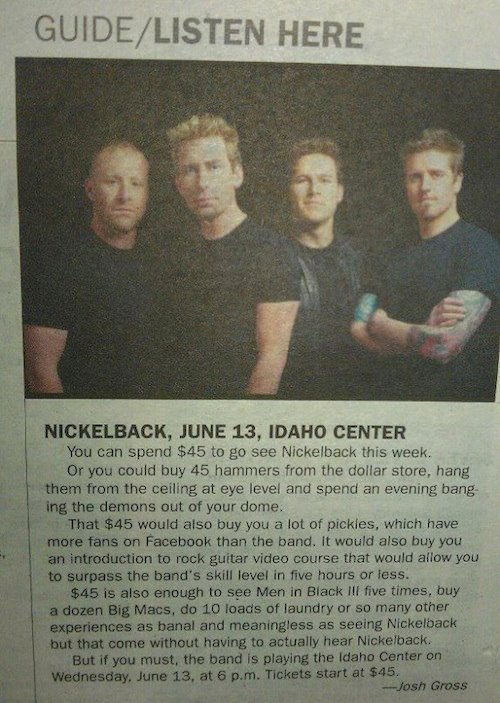
(Please note: while this is a repost – the underlying observation is still the same – even if the Nickleback concert mentioned is from last year).

I’d like to talk a little bit about vehemence as criticism and the web.

.

I’ve been exposed to a LOT of anger and negativity on the web recently and while it’s probably no more than usual but it’s still enough of a concentration that it’s disturbing to me.

.

Article A: “theJoshGross”

.

This showed up on a friend of mine’s FB feed with the caption “ouch!”

.

.

I’m not a fan of Nickelback – but this is just lame.

This is supposed to be a pre-concert promotion, and instead becomes another nail in the coffin for print journalism.  After all, if newspapers are just going to print what reads like a glorified blog rant,  we don’t really need them as we already have an internet for snarky posts.

.

Nickleback is making a living playing music that they want to play, which is the goal of almost every other musician I know.  And people are buying their music and going to their shows (in very big venues).

.

How is crapping on their success or their fans cool?

.

It isn’t.

.

This is another example of some people believing that the internet is always the great equalizer, when the reality is that sometimes it’s the great diminisher.  Despite the author’s efforts, this review will galvanize the resolve of the band’s fans and will get other people to check out Nickleback online to see what the hubbub is all about.  The band will ultimately end up with a stronger fan base as a result of it.

.

Heckler

.

I don’t know how many of you have seen Jamie Kennedy’s Heckler film (it’s currently streaming on Netflix if you haven’t.)  There are certainly things in the film that are easy to dismiss, but if you dig your nails under the veneer, there’s a lot being said about art, opinions, the internet and contemporary criticism that are directly applicable to being any kind of artist (especially a musician).
.

Rob Zombie is featured in one part of the film and shares the following anecdote:

.
[The] first review that I remember getting with my band back in the day was, ‘This is the worst band ever.’ And the funniest thing…what turned in my mind back then 20 years ago, was that I’d read it and see the person’s name and go, ‘Wow.  That guy must be really cool and smart and hip…and I’m a F*ckin’ jackass.”  And then I met the guy and I’m like, “That f*ckin’ loser?”

.

.

False entitlement and vindictiveness

.

“I do think critics have changed from when I was first aware of them.   They seem to, earlier, have a sense of humility.  I think, like in so many place in society, there’s just too much of their ego.”

– Bill Maher – Heckler.

.

There’s a huge difference between criticism and just being vindictive.  Heckler has an early scene where Jamie brings two guys backstage to ask about their “criticism” of the show.

.

Heckler A: Umm…Where do you start? I mean….that was embarrassing to say the least.

Jamie Kennedy: How is that embarrassing?

HA:   It’s kind of hard to watch that kind of crash and burn.

JK:  What do you do?

HA: I’m an assistant to someone that has a lot of kids…

JK: So you’re a baby sitter?

HA:  Yeah…kind of.

JK: What do you know about comedy baby sitter?

HA: I like things that are funny.  I mean…

JK:  What makes you laugh?  F*cking baby farts?

HA: No…I mean…I would have rather heard that in your show.  But I would have rather sat through a Creed concert than that.

JK: You have f*cking balls of steel.

HA: Sorry but I mean…when you see someone just f*cking up and ruining everything, and you paid money to see it don’t you want to kind of say, ‘What the f*ck are you doing?’

JK: Can’t you have like any constructive criticism?

HA:  You want me to tell you like different jokes?

JK: NO!  Why are you giving me your opinion?  Because you want me to get better or because you want to just feel like, ‘Yeah f*ck you!’?

.

Bingo.
.
That hit the nail on the head.

.

That’s about 50% of the forum posts I come across and about 30% of the FB threads I see lately.  It seems to be fueled by a bizarre sense of entitlement that seems to ask, “how DARE you expose me to that?”  These people then feel justified in going off on things 1.  because their delicate sensibilities have been overturned and 2. because they’re not held accountable for their actions.

.

(One of the greatest moments in Heckler, btw, is when director Uwe Boll “invites” a number of critics who have trashed his work up to Canada to box him in a one-round exhibition match.  The critics that go talk all sorts of trash about his movies, and then the film cuts to Boll feeding all of them their faces in the ring.  The sight of one reviewer vomiting on the street post-fight while wearing a white shirt with “Hi mom” scrawled on it  was somehow incredibly satisfying and I think it was because these people finally had to be held accountable for what they said.)

.

In the quote above with Jamie, I think he’s being a little thin-skinned (it’s also understandable given that this is getting caught on film after he just did a show).  I don’t think that you need to be a comedian to know what you find funny, but without every stepping on a stage and doing 15 minutes of comedy in front of a live audience, you’re not going to be able to give any kind of constructive criticism about what they’re doing wrong, other than say, “that wasn’t funny.”

.

What I want to talk about is the anger behind this.  The righteous indignation that is required to completely eviscerate a band or player.

.

For people who identify with the article or the quotes above, let me ask one question:

.

What does being angry about that get you?

.

Does it make you a better person?

Does it improve the lives of those around you?

or does it just make you angrier?

.

Because, as John Lydon said, “Anger is an energy”

but it’s an energy that  feeds off of you.  

.

(There is a lot in the world to be angry about, and for a number of those things, anger is the only appropriate emotion.  I just don’t happen to think that other people’s artistic output is one of those things.)

.

Me and Lord Basho down by the Schoolyard

.

People who know me in any capacity will probably tell you that I have some strong opinions about things and am not shy about verbalizing them.

.

What many of those people don’t know, is that I had a major philosophical shift over the last 10 years that resulted in some behavioral changes as well.  Part of that stems from the passing of my father’s father.

.

When I grew up, my grandfather probably loomed over me larger than anyone else in my life.  A large, loud and intimidating man,  he worked the first shift at GE in Schenectady, NY and then drove home to Mayfield to work at the Driftwood, the bar/beach that he owned and operated, until close for over 20 years.

.

As physically intimidating and forceful as he was (in his 60’s, I once watched him dead lift an engine block out of a car and put it on a picnic table next to him to work on it (nearly breaking the table).  “It’s heavier than I remember”, he dead panned to me.) the disconcerting thing was that I got to know him in his “mellow years”.  During my teenage years, I would meet friends of his who would pull me aside and tell me that they couldn’t believe how mellow he’d gotten.  When I said that he didn’t seem very mellow to me, they would tell me various Leland stories like the one where he broke up a large biker fight in his parking lot by himself with a baseball bat.

.

There were dozens of these stories, and they were all true.  My father referred to him once as, “a brutal man from a brutal time”.   Amongst his many professions, my grandfather was an undefeated amateur boxer who did multiple tours of NY in his youth, “I fought mostly’ rubes.   Big farm boys with thick arms and glass jaws.”  and stopped fighting because, “sooner or later you’ll take a hit and I was vain about keeping my looks”.  As a kid in upstate NY, I was in awe of him.

.

Around this same time, I was fascinated by the Samurai and codes of honor and read everything I could get my hands on.  And hidden in all of the research I was doing, I found this pearl about violence that would ultimately resonate with me in a big way from Lord Basho:

.

“Show me the man of violence who comes to a good end, and I will take him as my master.”

.

Sadly, in the end this was true for my grandfather as well.  He had been ill for some time, but when my  father showed me a photo of him right before he had died, I was unable to mentally reconcile my memory of the man with the spectral figure I was looking at.

.

The ravages of time (along with Parkinson’s and Alzheimer’s) had reduced him to a husk of his former self.  With a shock of white hair and his skeletal frame barely covered by a bathrobe attempting to shield his grey skin, his face was a mixture of confusion and fear.  He had no idea where he was or what was going on, and the glint of his eye (sometimes from mischief and sometime from anger), was now replaced with a dull terror.

.

As my father showed me this photo, all I could think about was the Lord Basho quote.

.

It didn’t end well for that guy, and to me,  he was superman.

.

I started thinking about how I conducted myself and there were a lot of moments that didn’t hold up well under scrutiny.  I realized that a lot of that anger was just resentment.  I resented successful people who I didn’t think were talented.  I resented people who played effortlessly and never seemed to work at it and what wasn’t resentment was fear and insecurity.  I wasn’t sure that I was good enough or talented enough, or that I was making the right decision.

.

I still had some childish thoughts that I was working from.

.

So I decided to grow up.

.

I worked on eliminating that nonsense and ultimately, I started developing strength through self-awareness and empathy.

.

The more I learned about the bands I didn’t think were talented, the more I saw that they were talented in other ways and had worked hard to get where they were.  It also made me realize that I only saw one side to every story, and that no story in the real world works that way.  Beyond that, I realized that their journey had nothing to do with mine.

.

When I took responsibility for my path, I stopped being emotionally tied to what other people were doing. (And if you have to go out of your way to sh*t on someone, you have become emotionally tied to what they’re doing.)

.

You can travel on anger,

but if anger is your only fuel, you won’t get very far.

.

And again, what I’m discussing here is vehemence rather than criticism.

.

I think it’s important to remain critical of things that you experience.  All art work is not good.  All music is not good.  But I recommend that if you find something you don’t like, take a moment to determine what it is that you don’t like about it and use it to further develop your own aesthetic rather than trying to tear someone else down.

.

If you don’t like bands, don’t listen to them.

.

If you’re going to rage against something, rage against something worthwhile.  But despite what you may have been taught, sh*tting on other musicians for what they do doesn’t make you cooler.  It just makes you smaller.

,

As always, thanks for reading.

-SC

.