Inspiration Versus Intimidation

As a followup to Podcast #4, I thought I’d talk about perception and playing guitar.

I’ve gotten some emails from people who read through my GuitArchitecture blog, and wanted to know what they should do if they’re not the next Guthrie Gowan, Hendrix, Holdsworth or the next (insert great player here).  I understand where they’re coming from.  If you turn on a computer it’s hard not to find some terrifying audio or video clip of someone playing really advanced guitar.

The implication that you could come to is that everyone in the world is playing guitar at an amazing level and the pressure many guitarists (and I suspect other musicians as well) feel is that they need to meet that standard.

Before I attempt to defuse this argument, I’d like to address the leap in technical advances on guitar and then talk about why it doesn’t matter.

.

Free Bird as an aphrodisiac

A friend of mine, who’s an excellent guitarist, was talking to me about the radical shift in technical standards in guitar playing and said, “You know – I remember when “Free Bird” was considered a virtuoso guitar solo.  If you could play that you were pretty much guaranteed to go home with someone at the end of the gig.  But now…I’ve got guys who have been playing for less than a year who can play that.”

.

Knowledge might seem arithmetic in its application
but like technology it’s exponential.

When I say that technology is exponential, I mean that technological advances typically build on previous technological breakthroughs.  For example, the ENIAC (i.e. the first computer-depending on how you define “computer”), used punch cards, weighed 30 tons, took up approximately 1800 square feet and used around 18,000 vacuum tubes. (No word on what kind of tone it had!)  All of this for a processing speed comparable to a calculator.  Notice the timeline in each step beyond that initial innovation (taken in part from The computer history timeline):

.

  • ENIAC
  • the invention of the transistor
  • the invention of  FORTRAN computer language
  • integrated circuits
  • the ram chip
  • the microprocessor and the floppy disc
  • IBM home computer and MS-DOS
  • Apple Lisa (with first GUI)
  • Windows

and then a series of major advances in microprocessor speed and size.  Each one of these changes ultimately created exponential innovations. In order for me to run a laptop guitar rig, I need a laptop with an operating system, a  fast processing speed, substantial ram, a fast hard drive, an audio converter, and software to make sense of what I’m trying to input and output from the computer.  None of this was even remotely in the thoughts of a potential application for a computer when ENIAC was built.

.

Where before they took years or decades, advances now occur daily or sometimes hourly because each piece of technology allows someone else to build on it  and make their own innovation by taking it in a different direction.

.

When Nicolò Paganini was alive, he was able to position himself uniquely as he was not only a virtuoso performer, but also developed a repertoire that only he had the technical skill set to play.  But once the music was published, other people started being able to play the music.  Some of the techniques became standardized, and pedagogical approaches improved.  With each passing generation more and more people were able to play it.

.

Now, while still difficult music, it’s nowhere near as impossible as it initially seemed.  Here’s some footage of Sarah Chang when she was 10 years old in 1990 performing some of his music.

.

If you think about it in the history of shred guitar, you would not have current innovators without people like Yngwie Malmsteen and Eddie Van Halen.  When those initial recordings came out they were considered impossible.  No one knew what the hell to do with Eruption.  It was Ed’s big middle finger to everyone – because no one could touch what he was doing at the time of Van Halen 1.  When I hear Far Beyond The Sun, I think back to people listening to the Rising Force CD and shaking their heads in disbelief.  Now either one of those pieces is something that you could learn to play given the proper instruction, music, time and a audio/visual demonstration.

.

The reason for this is it’s much easier to do something when you hear or see it being done.  

.

Once you hear someone play a solo at a high speed, you know that speed is attainable – because you’ve heard them play it and it transcends your limitations. When you see a video of them playing it, it makes it even easier as you can see more of the physical nuances of how something is being played.


With every recording and video, there is probably someone who is adapting or learning a technique associated with that recording and using it as a stepping stone. This is why there is such a glut of guitar videos, and why it seems that everyone is making one.

.

There certainly are a lot of videos out there but they don’t tell the full story of the player.  And with that in mind, it’s now time for:

.

Another Berklee story:

.

My first day at Berklee, I was in my dorm room and heard someone playing Tony MacAlpine.  I grabbed my guitar and went looking for the room to see what was going on.  The music was coming from the dorm room directly beneath me – at the time I had a black Aria Pro II Knight Warrior I knocked on the door and the door swung open and there was another guitarist also named Scott who also had a black Aria Pro II Knight Warrior strapped onto his body (this turned out to be a fortuitous moment for me because Scott today is one of my dearest friends (and an unbelievable guitarist)).  I introduced myself and walked in.  Scott sat down on his bed and started playing some terrifying 2 handed pattern on his guitar.  I processed that for a moment and then went to go meet his roommate, Drew.

.

Scott might disagree with me now, but here’s what I remember –  Drew was one of the most technically proficient guitarists I’ve ever seen.  He had literally taken the Michael Angelo instructional video and learned all of the licks but was playing them just as cleanly but even faster.  When he improvised a solo, he kind just re-arranged parts of those licks – but it was still incredibly impressive.

.

I left pretty stunned.  I had just seen the two most technical guitar players at the school, but what I thought I had seen were two typical guitarists and that this was the performance standard of all the guitarists there.  I was starting to wonder just how far in over my head I was at this school.

.

A couple of days later, I walked by the practice rooms.  A transcription of an Eric Johnson piece had just gotten published in one of the guitar magazines and I was now listening to twenty guitar players all playing the same lick at different speeds.  I processed that for about ten minutes – and realized my initial perception about the general level of skill amongst my fellow players was completely wrong.

Looking back at it now, I recognize that my thinking was faulty on multiple levels.

  • I assumed that everyone was “better” than me.


  • I assumed that “better” was a universal definition.


  • I assumed that my value as a player was only a comparative value related to how well other people play.

.

Now I think all of these assumptions were wrong.

.

To be sure, there are markers that you are improving as a player.  Maybe it’s fluency, maybe it’s repertoire, maybe it’s connection with the music or the instrument.  For each person, how they are getting better is ultimately self-defined.

.

If you define it solely based on what other people can do, you’re selling yourself short.

.

There are technical hurdles to playing music.  If someone counts off a tempo and you play your hot lead line over it – you can either cut it or you can’t.  There’s no real debate over that.  It’s strictly a performance issue.  You can, for example, either play an arpeggio at a certain tempo consistently or you can’t.  If the player next to you can play that arpeggio consistently at that tempo, then they have achieved a higher skill set on performing that arpeggio – but that has no reflection on either of your abilities to play music.  Just like your speed at filling gas tank has no direct reflection on your ability to drive.

.

I’ve had students who have come to me and said, “I’m never going to be able to play like (player x) so why even bother?”  This is like saying, “Noam Chomsky speaks English and I speak English, but I’ll never speak about linguistics in English like Noam Chomsky so I might as well not even say anything at all.”  Hopefully, this line of thinking sounds silly when you put it in context.  English is only a language.  You use it to express yourself.  It doesn’t matter what judgements people put on it, it only matters that you can communicate effectively.  The same is true for music as well.

.

Unfortunately, the social lesson that many people learn is that their value is comparative.

.

  • We value ourselves based not only on how much money we make, but how much other people make
  • on how our lives and the things in our lives stack up against other people’s
  • on how many cds we’ve sold versus other cd sales, etc, etc….

.

If you fall into this category here’s one way to turn this line of thinking around that will be more beneficial to you:

.

Ask not “how do I stack up against others?”, but instead, “what can I gain from this?”

.

If  I see someone playing an awesome solo, I don’t think, “Oh man I wonder if I can play that well?” (Although I certainly used to!)  I listen for the things that I like (or sometimes don’t like) and then see how I could incorporate that into my playing.   I take the things around me and try to use them for inspiration.  That way I don’t waste energy on getting intimidated.

.

It can be hard to maintain that observation, but if you perceive getting better as a self-made standard that others can help you rise up to rather than a standard of others that you need to reach, I think it may serve you much better.

.

I mention Guthrie Govan’s playing here because I really dig it.  I think he’s a brilliant guitarist.  But I really don’t give a toss about how I stack up against him. The world doesn’t need another Guthrie Gowan.  We already have one, and he’s great but what I do care about is how I can take every innovation of his I like and adapt it to what I do to advance my playing.

.

“Do not seek to follow in the footsteps of the men of old; seek what they sought.”

.

Lord Basho was once asked by an acolyte what could be done to make the world a better place.  He was purported to have replied, “be the best person you can be – and then there will be one less rascal in the world.”

.

The world doesn’t need another version of anyone, it instead needs you to become the best version of yourself you can.

.

As always, thanks for reading!

-SC

The GuitArchitect’s Guide To Modes – Part 15 Not-peggios – Harmonic Minor Version

Hey everyone,

As promised, here’s a follow-up lesson that takes the approach I explored in Part 13 and Part 14 and now applies it to the Harmonic Minor scale.

I’ll use C Harmonic Minor in this case – but this idea will work on any root.

Chords

Before we get too far into the lick side of this let’s look at the chords to see what we can play this over.

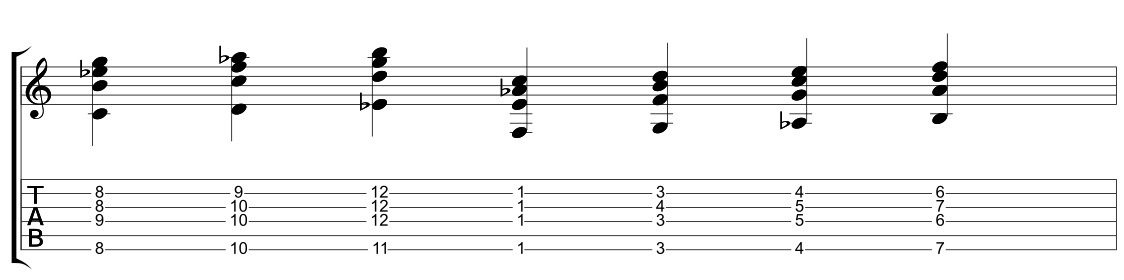
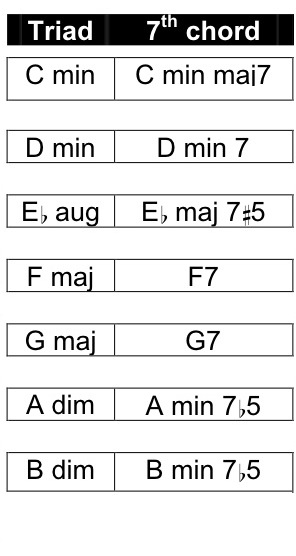
Here are the diatonic triads and 7th chords.

.
.
Try playing the initial C Harmonic Minor shape over any of these chords…
.
.
.

Harmonic Minor Notes:

  • C Harmonic Minor is spelled C, D, Eb, F, G, Ab, B, C – and from the root note the step and a 1/2 between the Ab and the B is a very distinctive sound of the scale.  
  • This scale has a lot of cool arpeggios and chord scale associations, but the most commonly used scales and modes are the root scale and the mode based on the 5th of the scale (R, b2, 3, 4, 5, b6, b7).  Having said that, modes starting on the b3 and 4th add some really cool sounds as well.

Now let’s talk about visualizing the scale.

.

Harmonic Minor

I’ve talked about my approach to Harmonic Minor briefly in part 9 of this series – but as a brief review:

Major Scale/Modal Visualization Review

  • The guitar fingerboard can be divided into 3 sets of two strings. Any 2-string fingering pattern that starts on the B string can be moved to the same starting pitch on the D or the low E string and keep the same fingering.
  • The major scale can be broken down into seven two-string modes that follow a specific order based on its scale degree from the parent scale (Ionian, Dorian, Phrygian, Lydian, Mixolydian, Aeolian, Locrian). The two-string patterns are modular and can be adapted to positional playing.
  • Instead of thinking of individual modes when playing,  I tend to think of larger tonal systems (i.e. I think of C Major all over the fingerboard instead of D Dorian or A Aeolian.)
  • By thinking of the fingerboard in a larger scale – it makes it easier for me to navigate Melodic and Harmonic Minor as – solely from a fingering/sonic visualization standpoint – I just see it as variations of the Major scale patterns.

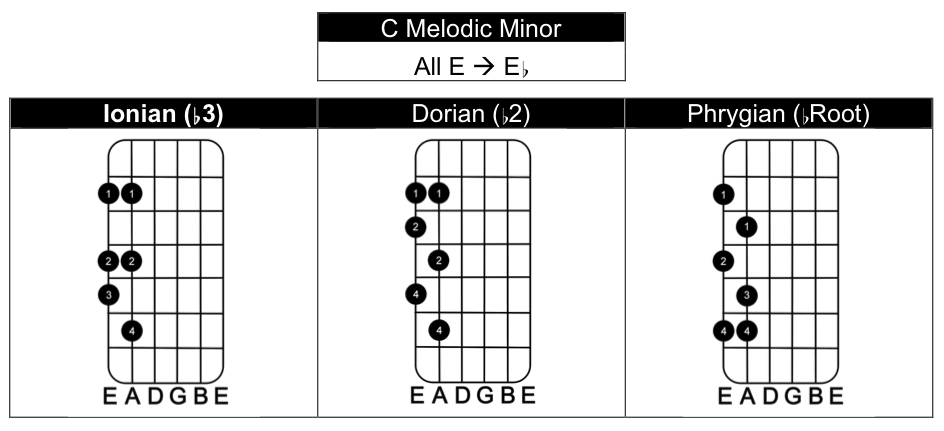
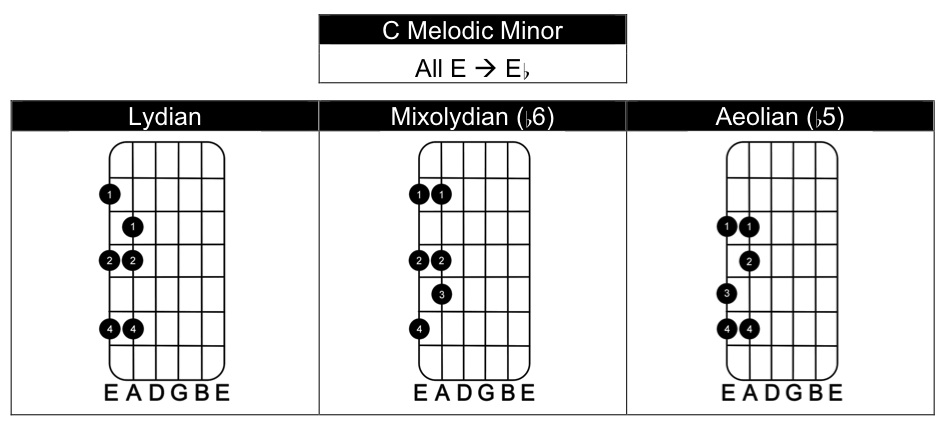
To visualize Harmonic Minor patterns – simply flat the 3rd and the 6th of the Parent Major scale. (i.e. to visualize C Melodic Minor just play C major but change every E  to Eb, and change every A to Ab).

It’s important to note that all of the fingering conventions mentioned here are solely to assist with visualization as Melodic and Harmonic Minor really aren’t directly related to the Major scale sonically.

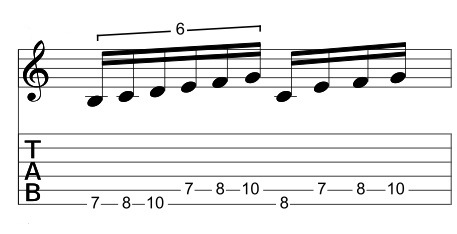
Here’s C Major

Here’s the audio.

Note:

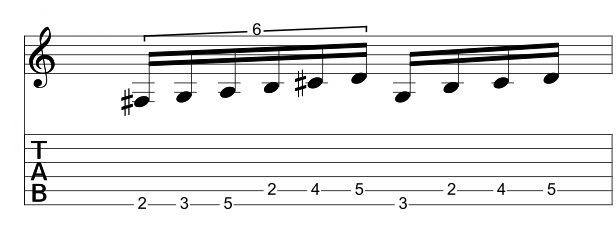
In all the audio examples, I’ve played the example first as sextuplets – then at a slower tempo (i.e. 16ths) – then as sextuplets again.


Here’s C Harmonic Minor

(the only differences are

the E has been changed to Eb and

the A has been changed to Ab)

.

.

Harmonic Minor short cuts:

To visualize Harmonic Minor Patterns – simply flat the 3rd and the 6th of the Parent Major scale.

(i.e. to visualize C Harmonic Minor just play C major but change every E  to Eb and every A  to Ab).

.

Here are the pattern adaptations.  In a situation like this, it can get confusing to remember a formula like “Dorian b2, b5” so as an alternative you may just want to try remembering something like “Pattern 1” for Ionian b3, b6, “Pattern 2” for Dorian b2, b5, etc.

.

.
.
.
Here’s the same scale pattern – I left off the text “Pattern 6” in the example be by mistake but the sequence is Ionian b3, b6 (Pattern 1 ), Locrian b4 (Pattern 7) and Ionian b5, bRoot (Pattern 6).  You can really see this if you compare it to the initial major patterns.
.
.

Not-Peggios

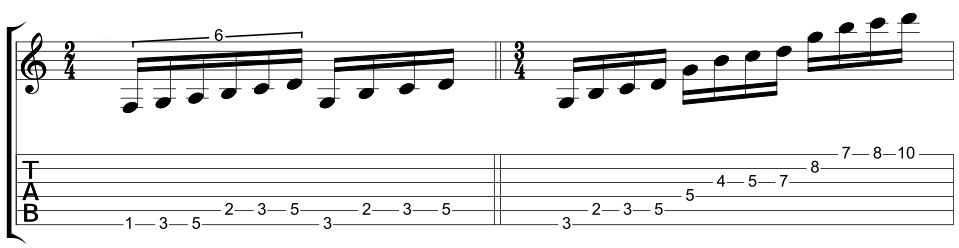
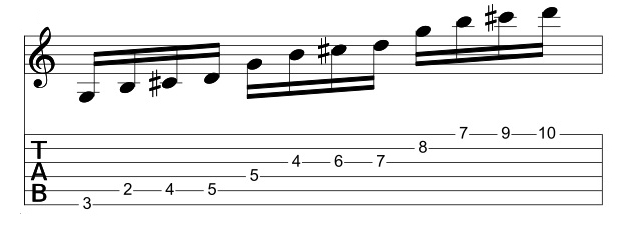
Now let’s take this not-peggio idea from the last lesson and apply it to C Harmonic Minor starting from G.

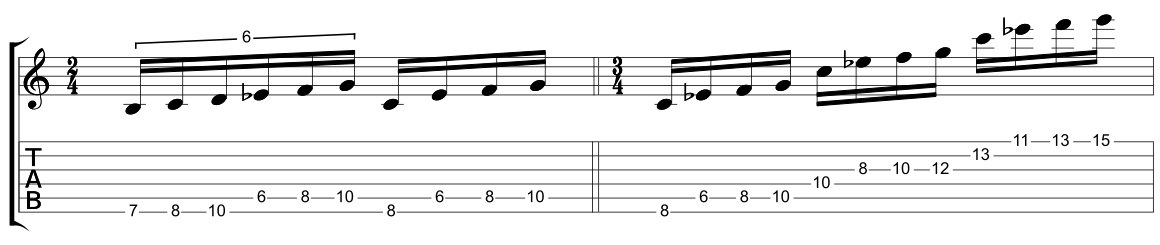
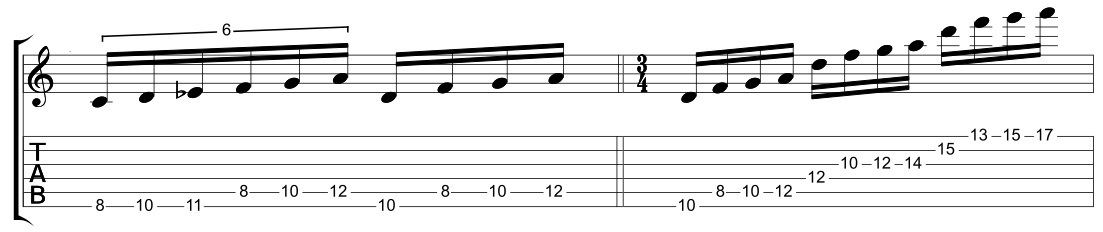
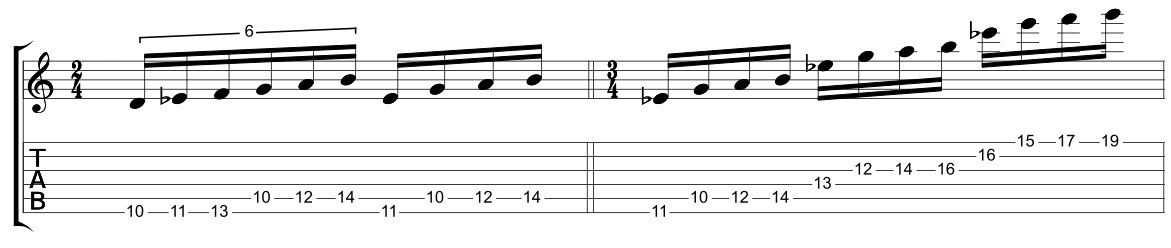
In each of the following I’ll show the 2-string pattern followed by the 4-note “notpeggio” extraction from that fingering and then show the multi octave form.

Note:  The extraction always starts from the second note of the 6-note pattern – so while the first example is extracted from the F Lydian fingering – it’s viewed as a G based pattern.

From G

F Based Pattern

Note: this G-based pattern is the same as the C major and the C Melodic Minor G shape. It’s functional but a little plain sounding over a G major chord.

From Ab

G Based Pattern

Note: this R-3-#4-5 extraction works great as a lydian sound from the Root (Ab Lydian in this case) or a Dorian Sound over the vi (F minor in this case)

From B

Ab Based Pattern

Note: even though the original shape is different, this R-b3-b4th-b5 extraction is the same as the Melodic Minor pattern and is something you may want to explore over diminished chords.

From C

B Based Pattern

Note: this C pattern shape is the same as the C-Based C Melodic Minor pattern.

From D


C Based Pattern

Note: this R-b3-4-b5 extraction is right out of the D-Blues scale and can be used in the same context (just remember to resolve the Ab!)

From Eb

D Based Pattern

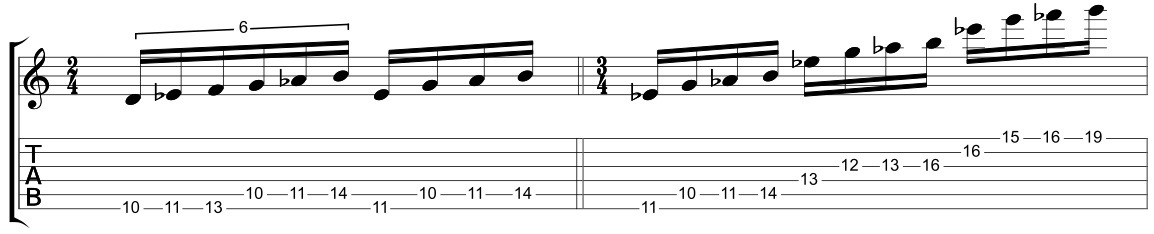
Note: this is a new shape from the other patterns we’ve seen. The R-3-4-b5 (i.e. major b5 (add 11) sound mixed with the min3-min2-augmented 2nd construction and the added chromatic weight from the G to Ab  makes it sound a bit harmonically unsettled over an Eb root.  I think it’s one of the more interesting sounds of the scale along with the final extraction….

From F

Eb Based Pattern

Note: this is a new shape from the other patterns we’ve seen. The R-b3-#4-5 (i.e. minor add (#11)) sound is a really nice spice to incorporate in your melodic ideas!

Here’s an audio sample of the 3/4 measures in ascending order from G

Next TIme?

In the next lesson I’ll look at using these extractions positionally.  It’s a Scott Collins original idea – and not one that I’ve heard anyone else really employ in this manner!
.

Practice Tips

As always, focus on the 3 T’s (Timing, Tone and hand Tension) when playing through these and make sure to have the timing locked in as you increase the metronome speed.  This approach is just a short cut to getting the patterns under your fingers.  By practicing them slowly and increasing the performance tempo gradually, you’re also getting the sound of them in your head – which is critical if they’re something you want to integrate in your playing!
As always, I hope this helps and thanks for reading!
– SC
PS – One plug here.  If you like this idea – I go MUCH deeper into similar concepts in my Guide to Chord Scales book – which covers every unique melodic combination from 3 notes to 12-note scales!!
Print editions of this book are available  on lulu.com or on Amazon (amazon.comamazon.co.uk, or amazon.fr).
.
.

P.S. If you like this post – you may also like:

BOOKS:


Focus, Music And The Big Picture

Anyone who knows me in a first person manner knows that I have a lot of first person stories.  When asked about that I reply, “When you go looking for an underground show, in a part of town not known for underground shows and go get Chinese food at 3 in the morning, you’ll probably end up with at least an anecdote.”

In other words – if you’re always seeking things out you’re much more likely to find something.  It might not be what you expected to find, but you’ll never find it if your eyes aren’t open.

A while back, I was reading Winifred Gallagher’s, Rapt (which is quite good) and being in a mode where I was seriously considering the issues of attention and focus I was reading a trade publication and came across this Jonas Hellborg quote which (in addition to being in synch with Rapt) rang with both an eloquence and a poignancy to me.  Perhaps you’ll agree. (Please note, the emphasis added below is mine and was not in the original article).

“In order to function as a human being, you have to be able to focus.  You have to be able to center.  Some people are into religion.  They pray or meditate or they do this or that.  Music is such a thing.  It’s a discipline and you use it for the purpose of focusing your mental, your spiritual activity in one direction and become whole.  As you do that you will get more and more capacity as a musician.  But if you can express what you need to express with just a limited vocabulary, you can still do that.  It’s not about the vocabulary.  It’s not about how many words you can use; it’s about what you can say.”

.

This quote contains elements of my entire philosophy.  I’d like to modify it a little to adapt it more fully.

“(Music) is a discipline and if you use it for the purpose of focusing your mental, your spiritual activity in one direction and becoming whole, you will get more and more capacity as a musician. “

.

I’ve modified this because Hellborg’s quote assumes everyone making music is doing that but personal experience has shown me that few people come to performing music with the purposeful process of becoming whole.  They come to it because they are looking for something.   Some people find it in a chord progression or a song and never need to go any further.  Some go deeper looking for something else.

Going deep is where you find the nectar.

Going deeper into almost anything with deliberation and focus will open your eyes and allow you to see more.

With that clarity, sometimes, comes the additional focus in what you’re searching for.

Sometimes the how leads to the why, but having a why will always lead to a how.

Yin and Yang.  You need both for a full circle.

Thanks for reading.

-SC

The Important Things In Life Are The Things You Do

This is The Grendel:

Grendel for web

He just turned 14.  I’ve had him for 10 or 11 years.  I’ve just found out that he won’t make it to 15.  He probably won’t see much of 14 even.  He’s very very ill and the vet has informed us that even the most aggressive treatment will mean the difference between his leaving this form between any moment and a few months from now.

It’s heartbreaking to me.  After a decade, I could not love a son more than The Grendel.  I’d set every guitar I own on fire if it would make him better without a moment’s hesitation.

But it won’t.

When I lived in Sylmar, my cat Oliver died from old age and that was hard.  (“Hard” in the sense that as a child, I went to something like 14 funerals of family and friends in a single year and have attended many more since then.  I understand loss intimately.)  I buried him in the backyard in my favorite shirt, and I cried like a little boy for a while.

This creature with a plum sized brain has taught me so much.  He taught me to be generous.  He taught me to give of myself and to do everything – eating, sleeping, playing – with all the attention and energy available to me.  More than anything, he taught me to be grateful.  Grateful for the time I had with him.  Grateful for the lessons that he taught me.  Grateful for showing me the love I had in my heart and for being someone I could give it to unconditionally.

I love my guitars but they’re just a tool.  I use them like I’d use a favorite pen – but I’ll never love a guitar like I love The Grendel.

So now I try to make him comfortable.  I try to give him what I can and try not to cry as Candace takes pictures of him being cute.

There are lines to get under my fingers, songs to record, things to write – but those things will wait.  Those things will still be there tomorrow.  My boy is here today.

The important things in life are the things you do. 20 years from now – you won’t remember that thing you saw on YouTube.  You’ll remember the moments that were real.  You’ll remember the warmth of the sun on the back of your neck as you and your beloved are walking towards the perfect skyline.  You’ll remember the freckled lip and the silent meow.

As a musician, your job is to express something and move other people.  To do that you need to develop substantial skill, but you also need to live a bit to have something to actually say.  It’s why a 13-year old boy will probably not write the most devastating love song you’ve ever heard – even though he’s convinced that it could not be any heavier.

Having things to say takes time, it takes other people and it takes other experiences.

Being a little older you see the balance in keeping both those things in check.

A long time ago, I realized that death gives life meaning.  It’s only in the finite that there is a sense of urgency to accomplish something.  If you had forever to get good at guitar, it wouldn’t mean much because everyone would eventually get good at it.

It saddens me that my boy will eventually be gone but that’s the price of being here and I wouldn’t give up my time with him for anything.

Everybody gets a ticket at birth and at some point, somebody collects the ticket.   The good news (other than the fact that you get a ticket at all) is that once you’re tall enough to get on the ride – you get to determine both the ride and how you interact with it.

It’s a tremendous amount of power.  Use it passionately.  Use it wisely.  Use it to make the world a better place.

For now – I have to go learn whatever lessons The Grendel’s willing to teach me.

As always, thanks for reading.

-SC

The GuitArchitect’s Guide To Modes – Part 14 Not-peggios – Melodic Minor Version

Hey everyone,

As promised, here’s a follow-up lesson that takes the approach I explored in Part 13 and applies it to the Melodic Minor scale.

I’ll use C Melodic Minor in this case – but this idea will work on any root.

Chords

Before we get too far into the lick side of this let’s look at the chords to see what we can play this over.

Here are the diatonic triads and 7th chords.


Try playing any of the following C Melodic Minor shapes over any of these chords..

Some Melodic Minor Notes:

  • Melodic Minor is an old scale.  Originally it was played as melodic minor when ascending but natural minor when descending.  Not a whole lot of people perform it that way in Jazz circles but mixing and matching the two can have some interesting sounds (i.e. it’s something you should consider experimenting with if this area interests you and you haven’t already).
  • Melodic Minor is a Dominant machine.  If you check out the harmonization above you’ll see that Melodic Minor has two 7th chords in it’s harmonization.  As Jazz standards use a LOT of dominant devices – this is a scale you’ll want to investigate if you have an even remote interest in Jazz.
  • Melodic Minor is a weird sound.  Yes it is.  The I chord is a minor (maj7) chord and that whole b3 mixed with the natural 6th and 7th makes for some interesting moments.  The only metal guy I knew who was really into that sound was David Chastain and he was doing instrumental stuff that didn’t really sound like anyone else. (Hint – this is worth exploring if you’re a rock or metal guy)
  • Hip trick alert:  since the ii chord is a minor chord -try playing C Melodic Minor lines over Bb Minor as well!

.

Now let’s talk about visualizing the scale.

“You take the good you take the bad – you flat the third and there you have…”

Melodic Minor

I’ve talked about my approach to Melodic Minor briefly in part 9 of this series – but as a brief review:

Major Scale/Modal Visualization Review

  • The guitar fingerboard can be divided into 3 sets of two strings. Any 2-string fingering pattern that starts on the B string can be moved to the same starting pitch on the D or the low E string and keep the same fingering.
  • The major scale can be broken down into seven two-string modes that follow a specific order based on its scale degree from the parent scale (Ionian, Dorian, Phrygian, Lydian, Mixolydian, Aeolian, Locrian). The two-string patterns are modular and can be adapted to positional playing.
  • Instead of thinking of individual modes when playing,  I tend to think of larger tonal systems (i.e. I think of C Major all over the fingerboard instead of D Dorian or A Aeolian.)
  • By thinking of the fingerboard in a larger scale – it makes it easier for me to navigate Melodic and Harmonic Minor as – solely from a fingering/sonic visualization standpoint – I just see it as variations of the Major scale patterns.

To visualize Melodic Minor patterns – simply flat the 3rd of the Parent Major scale. (i.e. to visualize C Melodic Minor just play C major but change every E  to Eb).

It’s important to note that all of the fingering conventions mentioned here are solely to assist with visualization as Melodic and Harmonic Minor really aren’t directly related to the Major scale sonically.

Here’s C Major

Here’s the audio.

Note:

In all the audio examples, I’ve played the example first as sextuplets – then at a slower tempo (i.e. 16ths) – then as sextuplets again.

Here’s C Melodic Minor

(the only difference is that the E has been changed to Eb)

.

.

Melodic Minor short cuts:

Using the Parent Major patterns above here’s a list of short cut’s to help you visualize the patterns.

.

Note: in the F Lydian shape – there’s no change from the major shape since there’s no Eb in the 2-string pattern.

.

.

.

Not-Peggios

Now let’s take this not-peggio idea from the last lesson and apply it to C melodic minor starting from G.

In each of the following I’ll show the 2-string pattern followed by the 4-note “notpeggio” extraction from that fingering and then show the multi octave form.

Note:  The extraction always starts from the second note of the 6-note pattern – so while the first example is extracted from the F Lydian fingering – it’s viewed as a G based pattern.

From G

G based pattern

Note: this G pattern is the same as the C major G shape.

From A

A based pattern

Note: this is a new shape from the Major patterns. The R-b3-4th-b5 shape may remind you of the A blues scale.

From B

B based pattern

Note: this is also a new shape from the Major patterns. The R-b3-b4th-b5 shape is something you may want to explore over diminished chords.

From C

C based pattern

Note: this C pattern shape is the same as the A minor form from C major.

From D

D based pattern

Note: this D pattern shape is also the same as the A minor form from C major.  This shape and the C minor shape above on their own really won’t give you much of the Melodic Minor flavor on their own – but alternating between the two of them will.  More on that in a future lesson.

From Eb

Eb based pattern

Note: this is a new shape from the Major patterns. The Eb Maj7 (#5) based pattern has been deconstructed into almost a whole-tone idea.  This is one of my favorite “outside” sounds in this scale.

From F

F based pattern

Finally,  this F pattern shape is the same as the F Lydian form from C major.

Here’s an audio sample of the 3/4 measures in ascending order from G

Next TIme?

In the next lesson I’ll look at applying this to Harmonic Minor and then I’ll look at working through these ideas positionally (Spoiler Alert – this is where this approach gets really cool!!).
As always, focus on the 3 T’s (Timing, Tone and hand Tension) when playing through these and make sure to have the timing locked in as you increase the metronome speed.  This approach is just a short cut to getting the patterns under your fingers.  By practicing them slowly and increasing the performance tempo gradually, you’re also getting the sound of them in your head – which is critical if they’re something you want to integrate in your playing!
As always, I hope this helps and thanks for reading!
– SC
PS – One plug here.  If you like this idea – I go MUCH deeper into similar concepts in my Guide to Chord Scales book – which covers every unique melodic combination from 3 notes to 12-note scales!!
Print editions of this book are available  on lulu.com or on Amazon (amazon.comamazon.co.uk, or amazon.fr).
.

The GuitArchitect’s Guide To Modes – Part 13 Not-peggios

Hello everyone!

It’s been a while since I’ve posted anything mode related. So I thought I’d make up for some lost time by posting this lesson.

Not-peggios?

Those of you who have been following the licks in this blog for a while have probably figured out that one of my favorite melodic approaches is to work in the area between scales and arpeggios.

For those of you who remember all the way back to part 11 of this series – this idea works on the same approach but with triads.

Step 1: Extracting the Not-peggio

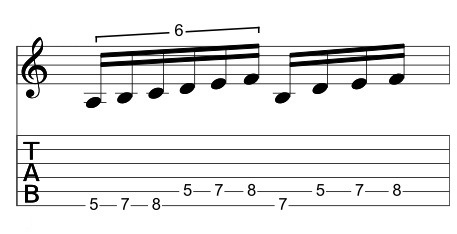
This idea uses the same 3-note-per-string / two string idea that’s behind all the visualization process here.  But to review:  Let’s start with a B Locrian scale pattern on the E and A strings:


C Ionian
From there:  I’m going to remove the 1st and 3rd notes of the pattern:


Not Peggio Extraction

Leaving a C major major triad with an added 4th which is something that intervallically lies somewhere between an arpeggio and a scale.  Technically it’s a close voiced arpeggio but the “not-peggio” tag has worked better for me when I explain to people so I’ll use it here as well.

Call it scrapple, grapple or anything else that will help you remember it – the naming convention is much less important than getting it under your fingers and in your ears so you can play it.

The good news is that applying this approach to a Major scale only produces four unique qualities of these melodic devices which I’ll talk about below.

One brief technical note:  I recommend either one of following picking patterns for any of the 4-note shapes presented here:

Picking Examples

If you’re used to alternate picking, that will work as well but I find that the semi-swept approach of the first example gives me a more uniform sound for legato playing.  It’s counter-intuitive but check the A minor straight ascending mp3 below to see what I mean.

Major add 4

Major Add 4 shapes

This shape doesn’t really work that well over major chords because the 4th (aka 11) is an avoid tone over a major chord.

However they do work well over minor chords. Try playing the C Ionian shape over an A Minor but for the most part, I find the major add # 4 shape to be one I use much more often.

Major add #4

Major add # 4 shapes

.

I’ve talked about this before – but a kind of cool applied theory trick is that Lydian and Dorian are relative major/minor substitutions.  By that I mean that while C major is the relative major key of A natural minor related chords scales C Lydian and A Dorian both come from the same parent major scale (in this case G Major).  So licks generated from this source will do double duty over both major and minor chords.  A two-fer if you will (or won’t – I understand either way).

Let’s apply this idea to G Dorian.

Here’s the 4-note shape taken from F# Phrygian:

G add # 4 extraction

And here it is an a 3 octave form:

G add # 4 3 octave pattern

.

Here’s a more sequences lick type of approach:

G Lydian 3 Octave run

Here’s the audio – with a short descend of the patten ending on the G on the 8th fret of b string.

You can try this approach over E minor for an E Dorian type sound as well.

 Minor add 4

Minor add 4 shapes

Okay a couple of quick tips here.  Since you don’t get the natural 6 of Dorian or the b2 of Phrygian in these shapes – they’re not really going to give you much of the flavor of those modes.

In this case, I’ll use the A Aeolian shape over A minor and F Major chords.

A Minor:


A Aeolian part 1

In this audio example I play the 3 octave form and then play the multi-octvave sequenced idea.

A Aeolian over F lick

Used over F Major:

Now I’ll take the same sequenced idea and apply it over an F major lick.  Here’s an audio example.  I slid up to the G on the 15th fret of the high E string and then descended with some tremolo bar scoops along the way.

Normally, applying an A Aeolian idea over F major would give it a Lydian sound – but the lack of the B (#4) in the pattern makes it a little more open sounding to me.

Finally – here’s the Diminished form.

Diminished add 4

Diminished add 4 shapes

Looking at the notes here (B, D, F, E) – I see the upper notes of a G7 (add 13) chord: G [Root] – B [3rd] – D [5th] – F [b7] – E [13].  So this pattern is one I use in Dominant 7th situations.

Here’s the basic pattern:

B Locrian Multi Octave

And here’s the application over a G7 chord.  It uses the same pattern sequencing idea as the other examples ascending but bends into a couple of notes including the 3rd on the B string for the final note.

Next time?  Some Melodic and Harmonic Minor shapes to get under your fingers.

As always, I hope this helps!

-SC

PS – if you like the ideas in this approach – the following books will help you expand on this idea exponentially!

The GuitArchitect’s Guide To Chord Scales

The GuitArchitect’s Guide To Modes: Melodic Patterns

The GuitArchitect’s Guide To Modes: Harmonic Combinatorics

Notes From A Lecture

“What’s with all these words and where’s the shred stuff?”

I know I’ve been veering away form strictly guitar stuff lately on this blog.  (Don’t worry though, the pure guitar thing is never too far away. A number of new (strictly guitar related) posts have made their way to Guitar-Muse and there’s some new material that will be released either in Kindle or e-book format.)  A large part of the shift in content here is due to a move from focusing on working through the how (how do you play modes on guitar) and shifting the focus more to the why (i.e. my philosophy).  I’ve talked about this before but without a strong sense of why you do what you do, progressing and improving in the long term will fall apart as you face the numerous challenges and obstacles that you’ll be faced with on the long haul.

As someone who plays and teaches, I’m often asked, “How long does it take to learn to play guitar?” It’s a surprisingly easy question to answer.  It depends on what you want to do on the instrument.  If you want to learn to play a few chords to serenade someone on a tune you can get some basic chord forms and strum patterns down in as little as a few weeks.

If you want to really say something unique to you on the instrument, it will take years or decades of hard work and those before you who have already been on the path for decades will tell you that they’re still working on defining and articulating what they say on the instrument. This leads directly into my first point.

.

The heretic’s statement

While I love the guitar dearly, it’s just a tool of expression.

Guitar playing is only a reflection of who I am at the time I’m playing.  It’s a sonic documentary.  It’s a voice that I control with my fingers.

I need a pen to write ideas down on a piece of paper, but ultimately the ideas behind the writing are a lot more important than some scribbles on a page.

It’s a symbiotic relationship.  As I play guitar, I develop as a person as well.  As a person I take a number of influences that inspire me (like literature, film and other people’s music) and use those as spring boards for expression.

While I work at being a better guitarist, I’m also working at being a better person and vice-versa.

To me – it’s all guitar playing.

.

The How and Albert Ellis

For those of you unfamiliar with the man, Albert Ellis is not some brilliant up and coming underground shredder that will show you how to stuff 15 notes in a 5 note bag.  Mr. Ellis was a particularly brilliant psychologist who had taken some cues from Stoicism, and Levi-Strauss and created a new form of therapy known as REBT (Rational Emotive Behavior Therapy). I had first discovered Ellis’ work in college and while I found his books to be somewhat bizarre in their tone (the writing style seemed to be mired in the 1950’s with references to things like “Pollyannaish thinking”) his approach of using rational thought to break people out of emotional traps they had fallen into was particularly insightful to me and spoke to my own approach to removing emotions from problems and tackling them for what they are.

In the 1990’s I saw that an Adult Education division was going to bring Albert Ellis to speak at the lecture.  To say that Ellis was a brusque man is stating it mildly.  Throughout the lecture he swore like a sailor, called b-s on any number of things and took anonymous audience questions about problems they were having on stage and then talked through how to approach the problem.

When the lecture was over.  People were congregating around to talk to him and he yelled “Excuse me” and “Get out of my way” as he bolted out the door and went to his car.  I believe his logic was, he was paid to speak for two hours, people could ask him whatever they wanted during that time and he wasn’t going to hang out for another hour or two afterwards.  The audience hated this but I saw it as a man who practiced what he preached.  (If you read below, you’ll see that this wasn’t solely about the money – The Ellis Institutecontinues to offer the Friday Night public workshop that Ellis discusses below for the inflation adjusted price of $15 per person.  It’s about not getting entangled in things you don’t wish to).

I made a number of notes at the lecture and I’ve posted them below.  In terms of content, its a little rough and tumble and should act as little more than a “Cliff notes” version of his approach – but you might find it to be an interesting overview in how to remove emotions from problems and attack them in a systematic process.

If you find feelings of anger, depression or inadequacy acting as obstacles in your practicing, playing or goals, you might find Ellis’ approach helpful. I’ll include any new notes in brackets [ ].

Notes on an Albert Ellis lecture in Boston.  December 8, 1994.

Albert Ellis, Ph.D. is the head of the Institute for Rational-Emotive Therapy (RET). [Ellis used the terms RET and REBT in the lecture interchangeably] He conducts interviews every Friday night at the Institute for $5.

Ellis’ methodology is borne out of a philosophical tradition rather than a psychological one. Of primary influence to his methodology were the Greeks and their focus on the analytical.

You are a talented screwball.

.

The RET observations:

1.  All people want to be loved and accepted.

2. People meet conflicts with this goal.  The experience rejection/frustration /disappointment.

3.  People refuse to change

.

Three causes for Neurosis

1. EGO – I am the center fo the universe

2.  Anger / Rage

3. A perception that there has to be environmental control.

#2 and #3 –> refusal to accept (rationalize)

The two words that cure all neurosis?:  Tough shit.

Past events are not the causes for present conditions.

Humans are born with two tendencies

1.  Posessing goals, values, desires, etc and demanding what you want.  Ellis seems to view people generally as babies where immediate needs are the primary focus.  That egocentricity makes people very upsettable.

2.  People have a constructive self-actualizing tendency.  You are born to think.

The net effect of these two statements is that while you can disturb yourself, you can also undisturb yourself.

You balance the rational and the unrational. The Universe is ambivalent.

.

Three Insights of RET

1.  No one (or nothing) ever upset you.  You choose to upset yourself.

2.  When it [the depression/anxiety/problematic emotion] started is irrelevant.  It lasts because you believe it.  You can’t change people or situations – only perception.

3.  There is no magic. No one’s going to come down from the sky to save you. There is only work and practice.

.

How to change:

Cognitive thinking

1. Dispute the “musts”  “I must be this…I must do this.” Why must you? [Ellis refers to this in some of his writing as ‘musterbation”]

2. Along similar lines…”I can’t bear it (rejection, etc)” or  “I can’t stand it.” The implication is –   “I can’t stand it and be happy at all.”

3.  “When I fail, I am worthless” in reality – “I acted badly – but I screwed up and I am human.”

.

There are two solutions to a poor sense of self-worth

1.  I’m okay because I am alive. (I’m okay because I choose to be okay.)

2.  I’m neither good or bad as good implies perfection and bad implies damnable [The terms are all or nothings propositions for Ellis].  I am a human who behaves well and when I agree to reach/perform certain moral ethical deeds, I am behaving well but good deeds do not make me good.  (preferred method). I am not my acts/behaviours.

.

Self Esteem is an illness

When I am doing okay, I am okay – otherwise I’m a worm and even when I am okay – I worry about being a worm.

Low self-esteem: Because people don’t love me enough and because I act well I am okay.

High Self-Esteem I’m okay when I’m beautiful.

Self esteem is conditional.  The goal is unconditional self-acceptance.  Unconditional acceptance must be taught.

.

Coping methods

Referencing:  When you do something compulsively bad –  you write down all of the disadvantages of the act and review often.

Rational coping self-statement:  Effective view philosophy [Also written – also reviewed often]

“I don’t need – but I would like.”

There is nothing awful – only inconvenient. “Mind you getting slowly tortured to death is inconvenient but it is not a worse case scenario.  You could always be tortured more slowly.”  [What was implied by Ellis is that you can not be faced with the most awful thing or situation.]

Psycho-educational techniques:  Good books, video, etc prosleytize and teach so that you can learn.

Modeling:  find good role models

Role Playing: stop at anxious (or appropriate sensation) moments and analyze.  What am I thinking right now?

Positive thinking is okay but does have it’s limitations.  Its achilles heel is that it can reinforce the “must” syndrome.

If you’re afraid of something. Do it.  repeatedly.  Rewards afterwards and “punish” if you fall through. [Ellis used a couple of examples here but he said to a woman trying to lose weight, “Okay.  You want to loose weight.  And you eat cookies all the time so as one step of this, you’re going to stop eating cookies.  What do you hate to do in the world more than anything? ‘Call my mother-in-law.’ Okay then.  So from now on if you eat a cookie, you’ll have to call your mother-in-law and talk to her.  But you really have to do it!  It only works if you follow through.” In more extreme cases, Ellis recommends people burn money as a punishment.  “After someone burns their second $20 bill, they stop doing what they’re doing pretty quickly”]

You let other people affect you but not disturb you.

.

Grief vs depression.

Grief is okay.

Grief:  I’ve lost something and that is bad

Depression: Isn’t it too bad that I’ve lost something?

.

Problematic Solutions

When a situation is bad – do not leave when you are upset because you’ll take those emotions with you into every other situation.

1.  Analyze how upset you are

2.  Act rationally.

The approach seems to have several steps.

1.  Problem identification

2.  Statement and picturing of the worst thing that could happen.

3.  Identifying feelings with that scenario.

4.  Changing feelings/perceptions of the worse case scenario used rational coping self statements repeatedly and setting up small reward/punishment systems to work on those statements daily.

This last step implies a lot of time.  There is no quick panacea for your problems.

Dr. Ellis has a hard methodology.  It makes the individual fully responsible for his/her actions, works within a closed system and puts emphasis on the body’s cognitive powers. He is violently opposed to most forms of therapy which he feels puts too much emphasis on past actions and events and not enough on present responsibility.  While he isn’t opposed to all forms of psychotherapy, his motto certainly seems to be, let the buyer beware.

His lecture was filled with cursing.  It seems to be a part of his shtick, but one of the things that it did was keep the audience laughing – and laughter (along with responsibility, work and perception) seems to be a very important part of the RET methodology.

*Those are all the notes I had from the lecture.

I hope you found this interesting, insightful, or helpful in some way and, as always, thanks for reading.

-SC

New Jimmy Rosenberg Lesson Up, GM Posts And More Books On The Way

Hello everyone!

Sometimes life throws you some curve balls.  I had planned on getting loads of playing and gigging in and instead, I’m in full throttle writing mode!  There are benefits to that though such as:

  • A new lesson for Guitar-Muse is up online.  This player profile covers Jimmy Rosenberg’s solo on the Flintstone’s theme!  If you want an ass kicking chops intensive piece in the Gypsy Jazz style to work on (as played by a then 15 year old Jimmy!) check it out here!
  • In other GM news, player profiles continue with lessons from the works of Ridgely Snow, Vlatko Stefanovski, Jimmy Rosenberg and José Peixoto.  The current plan is to alternate these every other week  with the Chasing Tone Series.  Part three of the  series should be up next week (in the meantime you can read part one here or part 2 here). Interviews with Ken Kantor (ZT Amps) and Marco Oppedisano (Mechanical Uprising, The Ominous Corner) and a cd review are also on the docket.
  • In terms of writing, last week saw some new things of mine drop.  There’s a book out on Kindle about the state of the music industry (thanks to everyone who’s gotten behind that and to Jzzmchn for the kind review!) and a Pentatonic Visualization pdf for sale either here or on Fiverr.  (Thanks for the positive reviews there as well everyone!)  New stuff is also on the way.  I’m currently editing Nothing Ever Got Done With An Excuse (the time/project management book) and a to be titled book of Music Business Essays.  I’m also working on serializing the Pentatonic Book as a short series of Kindle lessons and then expanding beyond that book into some of the material from the GuitArchitect’s Guide To Pentatonics Book notes that I gathered a while ago.  The graphic editing along on the initial Pentatonic book is tough slogging to try to make it work on the Kindle, but I think I can do it in a way that will be accessible and look good.  The larger GuitArchitecture books will get ported over to Kindle (albeit in a radically altered form) later this fall.
  • Music.  Working on cleaning up tracks on the Rough Hewn Ep, and trying to find the right place to track my acoustic guitar EP.  Work is slated to begin in the next 2-3 weeks for a commissioned soundtrack for Page Of Madness (aka A Page out of Order).  A track of mine is still supposed to come out on Mandorla at some point this fall and Daren Burns told me that he’s releasing the studio Onibaba recording before the end of the year as well.  There should be some other gigs and recording slated over the next few months as well.
  • I’ll be trying to get some of the “other” posts up on GuitArchitecture as well!  I’m aiming for high output before the end of the year!  And I hope to see you there.

As always, thanks for reading!
.

-SC

Detriment Versus Determination

I wanted to take a moment to talk about balance in terms of vision, execution and success.  And I’d like to do this because, in what has been a challenging transition moving to NY,  I’ve come across a number of posts with well-meaning advice that all seem to work on the universal formula of: following your vision = success.

“You will always be successful if you follow your vision.”

That’s just simply not true.

It’s not only a case of gleaning the wrong lesson from a given situation, it’s a case of giving advice to people that makes them think that they’ve failed when they followed their vision and it didn’t bring them the result that they planned on.

Detriment

I’ve talked here before about the television show Shark Tank (and the much better BBC series Dragon’s Den that it’s based on), and one thing that happens consistently on the show(s) is people investing everything they have (and more) into a bad business.  They’ll present an idea that might seem novel, but when the investors get into the financials it becomes obvious that the business isn’t working.

It’s heartbreaking to watch because, as an outside observer, you can immediately see it’s a bad investment.  The people who have created it however are so passionate and have invested so much of themselves that they’re convinced turning the business around is merely a matter of determination.  They’re convinced that if they just keep at it and invest more money into it, it will succeed.  They’re convinced that it’s some shortage of resources, execution or acumen that’s causing the business to fail.

The Golem

The history of the Golem goes back much earlier in Jewish folklore than the story that I’m telling here,  but the most famous story of the Golem dates back to 16th century Prague.  Rabbi Loew, the chief Rabbi in the Prague ghetto, sculpted a figure out of mud (The Golem) and then (through a secret series of steps) brought him to life to protect the locals from antisemitic attacks.  The Golem went on a murderous rampage and to be stopped, Rabbi Loew erased the first letter of the word “emet” (truth or reality) on the Golem’s forehead leaving the Hebrew word “met” (dead).  The Golem turned back to lifeless mud and, legend has it, was taken to Rabbi Loew’s attic to be reactivated in the event that it was needed again.

Redefining “Success”

Now I don’t think that I’m telling tales out of school, but you can devote the rest of your life to carving anthropomorphic shapes out of the dirt and not make a golem.  Maybe you’ll prove me wrong!  But I don’t think that it’s a constructive use of time – if you’re trying to make a rampaging golem.

If, however, you like working with your hands and like sculpting golems you might find yourself getting good at it.  You might start creating something unique that gets the attention of other people, who ask if you could make a smaller version out of clay.  Or perhaps you document all of the golems that you create with photographs and release a photo book on The Golem project.

The point is, you can be successful in whatever you do but

  • it might not be the success that you planned on
  • any alternative success will only come out of hard, passionate work of high quality that connects with other people.
  • Finding alternate success requires being open to other possibilities.

Determination – A Guitar Story

When I went to Berklee, I had a couple of hometown awards for playing under my belt and had built up quite a bit of speed from practicing the same licks over and over again.

I also didn’t have any formal instruction.  I was practicing things with bad technique in a vacuum.  So while I could play quickly and energetically, I didn’t have anything to say and what I could say I could only express quickly and inarticulately.

I had inadvertently modeled my guitar playing after the way an auctioneer speaks at an auction.

“ihavetwentyfivetwentyfivedoihear3030thirthinthebackdoihear35…”

When I got to Berklee, my first teacher Doug (a killin’ Jazz player – btw), really took me to task on my picking and my timing.  He told me that I’d have to start all over technically.

I was pretty resistant to this idea.  So I said, “to Hell with that” and just kept doing what I did.

And like the people on Shark Tank/Dragon’s Den – my work stagnated.

Sure I got faster, and a little cleaner.  But, as a player I wasn’t getting any better.

Fast forward to going to CalArts. I remember the first lesson with Miroslav Tadic well.  I barely slept the night before and when we met,  I talked about how I wanted to learn repertoire, how I wanted to be able to negotiate odd time signatures in a more fluent way and how I really wanted to work on ornamentation and stylistic elements of Baltic music.

He had me play for about 30 seconds and said, “Your hands are a mess.”  Your fret hand is completely compromised for your playing.”  He told me I’d have to put intensive work in to fix it.

Again, I was resistant to the idea but realizing where I went wrong at Berklee, I decided to give it a shot.  I also took some lessons with Jack Sanders and Jack reinforced everything that Miroslav told me. Then I started the real work.

I started relearning everything that used my pinky.  Ultimately, I had to re-learn everything.

That was a while ago… and I’m STILL working on it.

“Success” – A “Career” Story

One of the primary reasons I went to grad school was because the local music scene I lived in was in a death spiral (in terms of how things had always been done) and I didn’t see that changing in any other scene. I thought if I could get a teaching gig at the collegiate level that it would a.) be something that I could engage in passionately and do really well and b.) give me the financial stability to do what I wanted to do with my musical interests on the side.

When I got out in 2008, the job market was grim.  The following financial crisis made it even worse, and I realized that (in an ever shrinking pool of positions and downsized departments) that (for the few positions I was seeing open) no one was going to even look at my resume without a doctorate.  And a doctorate wasn’t in my future.

I realized that the only way I was going to get into that building was through the back door.  So I worked on books and tried to establish myself more as a player.  And then, I was informed that without a lengthy peer-reviewed process with a limited release on a “name” publisher that no one in academe was going to take my books seriously.

(This despite the fact that no one in academe has released 1200 pages of guitar reference texts, much less done so in the same academic year.  There’s an extended rant in my pocket about the whole outdated academe publishing scam that I’ll save for another post.)

It was the last reinforcement I needed.  For the foreseeable future, I was going to have to go it on my own.

If I viewed going to CalArts solely as a stepping stone to a university faculty position, it would (thus far) be a profound failure.

But I don’t look at it that way.

In addition to the incredible knowledge I got there, my books would never have been done if I didn’t go to CalArts.  I never would have gotten the video game credits I have if I wasn’t there. This blog wouldn’t exist and I wouldn’t be writing for Guitar-Muse.

Even more importantly, I never would have met (and played with) people like Miroslav Tadic, Vinny Golia, Randy Gloss, Susie Allen, Wadada Leo Smith, Butch Morris, Carmina Escobar, Daren Burns, Sahba Motallebi, Craig Bunch, Eric Klerks, Sarah Phillips, Andre LaFosse, George McMullin, Don McLeod, John French, Jonathan Wilson or the dozens of other people I was fortunate enough to meet and play with being there.  Some of these people will be lifelong friends and (while my creditors would disagree) you can’t put a price on that.

.

In other words, it paid off in different ways and was a success in other ways, but not in the way I initially planned for it to be.


And so…

Be determined and passionate and present in whatever you do, but be balanced enough to know when you’re making progress, and when you’re trying to make a Golem.

Like the first lesson that Miroslav gave me, putting that advice into practice might take a while to implement.  But trust me, it’s a good use of your time.

.

I hope this helps!  As always, thanks for reading!

-SC

Rare Picks And A Pentatonic Approach From Mr. Cusano For Guitar-Muse

Hey Everyone!

A quick update from DC, where rock and roll is alive and well!

I’ll have some new playing and gear content up here in August.  In the meantime, since there’s been a lot of music business / psychology of music posts on GuitArchitecture lately,  I thought I’d touch on both areas with some new posts on Guitar-Muse.

First up, is a post on my Pickboy Speed King pick.  It’s a weird and cool piece of gear and the flatpickers amongst you might find some DIY inspiration in pick design there.  You can read all about it here.  

Secondly, I’m doing a player profile series for Guitar-Muse and the first player up is the former Vincent Cusano (Vinnie Vincent).  Vinnie has gotten a lot of attention in the press for everything but his guitar playing, but in many ways he’s a fascinating player to me.  He managed to fully embrace the shred aesthetic and do it in a really unique way.  Vinnie’s pentatonic-based approach produces some cool sounds that you can find here.

The player profile series is going to feature some cool guitarists that mostly fly under the radar.  As I mentioned before, the series will also include Alex Masi,  Vlatko Stefanovski, Ridgely Snow, and José Peixoto.

There should be some gear/tech pieces on modeling, tone and amps with some other interviews getting posted into August/September.

That’s it for now!

More stuff next week and as always thanks for reading.

-SC