Guit-A-Grip Podcast #12 – New Book Excerpt #1

Hello everyone!

The New Book?

Yep!  I have a few new books that I’m working on, and the non-guitar instructional book, Nothing Ever Got Done With An Excuse (Or a case study in how to plan projects and get things done).  is all about several large scale projects that I got done (such as releasing 4 books of 1,200 + pages of writing in 5 months of 2011/2012).

You’re Podcasting this?

Yep!  A large component of the book is accountability so there are several advantages to podcasting the bulk of the book.

  1. It builds an audience for the book.
  2. It gives me a framework (and deadlines) for editing the material.
  3. Like I said in the podcast (re: pedagogy for pay and the flamenco dance teaching model) even if the ENTIRE book was put up online, there are people that will still want a book of the material.

Episode #12

Guit-A-Grip podcast episode #12 “Nothing Ever Got Done With An Excuse Introduction And Overview Excerpt” is out and available for download/streaming.

Subscription Notes:

  • You can subscribe through iTunes here:
  • You can use this link to subscribe with any other feed based service:
  • or you can right-click here to download it.
  • or you can stream this episode below.
.

Show Notes

The (other) Book

The writing book I reference in the podcast is Chris Baty’s, No Plot? No Problem!  A low-stress, high-velocity guide to writing a novel in 30 days. There are a bajillion Kindle titles for outputting an ebook quickly, but Chris’ book is the granddaddy of them in my humble opinion.

The Harvard Study:

The study I cited in the podcast was from a source that quoted,  What They Don’t Teach You in the Harvard Business School, by Mark McCormack.  Funny story, this site contends that the data is largely fabricated and based on a non-existant 1953 Yale study! (It then goes on to cite another study that came to the same conclusion).  So take that for what it’s worth because if the original study anecdote WAS fabricated – I can’t even fathom the number of people who must have cited the McCormack reference of it (or a reference to the reference) by now.

“There are only 12 notes and they take forever to learn.”

This is just a reminder.  If the new habits you’re trying to acquire are outside your comfort zone, you’ll need to review your game plan often.

The Steps to follow:

WOW!  It turns out that I was reading from an earlier draft of the book and missed a few steps!  Here’s a case where it pays to check out the website as well as the podcast.  ; )  I changed the below from first person to passive to make it more applicable to the reader.

How to manage a project in a few broad strokes

  • Have a clear vision of what you want to do (set quantifiable goals).
  • Align perception with reality and create priorities (in other words make an honest assessment of what needs to happen to reach those goals)
  • Set deadlines and benchmarks.
  • Be accountable.
  • Do daily focused work on those goals and limit distractions and obstacles in the way of achieving them.
  • Make periodic reviews to check your project’s status against the benchmarks and timeline.
  • Utilize available resources when possible/necessary.

That’s it for now!

See you soon and thanks again for listening/reading!

-SC


An Unusual Capo Variation And Milking A Vamp

Hey everyone!

I haven’t posted a lesson in a while here – so I though I’d post a really quick one for getting some mileage out of a single chord vamp.  This is a little something I improvised on a tune for a live performance that’s now a loop based riff I build on live with a tentative title of, “remedial looping”.

That E Minor thing

First, let me take a BIG cue from my harmonic combinatorics book.  When I look at an E minor chord – harmonically I see something like this:

E Minor Harmonization

So whether it’s an E minor/ Em7 / Em9 / Emin 11 (b13) – I know that playing any notes from the E natural minor/G major scale will get be SOME variation of the above chords.

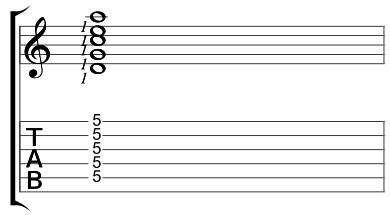
As a start let’s look at an E minor 7 chord:

E minor 7

Interesting observation – if I look at the barred notes on the 5th fret:

5th fret barre

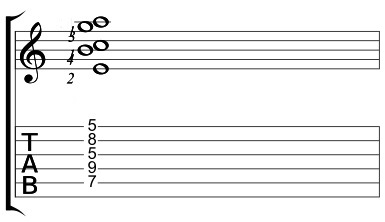
The notes are all found in the parent scale.  If I think of this voicing as a virtual capo and drop some of the notes on the 7th fret of the E minor chord to the 5th fret I get this really cool chordal cluster:

E min 7 (add 11 add b13)

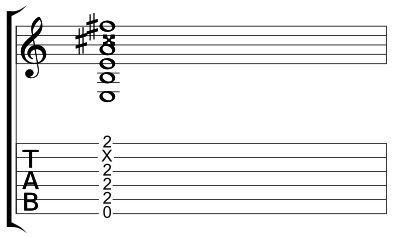
Going further – I could use open strings instead of the 5th fret and get a less clustered sound.  Instead, I decided to flip my capo around and use it as a partial capo on the second fret so that the low E string would ring out unobstructed but the rest of the notes on the second string would be fretted by the capo.

2nd Fret Partial Capo

Using the same idea as the previous example here’s the same modified Emin7 shape using notes on the 2nd fret instead of the 7th fret.

E min 7 sus 4

Make sure to play through those clusters individually as there are some good sounds there!

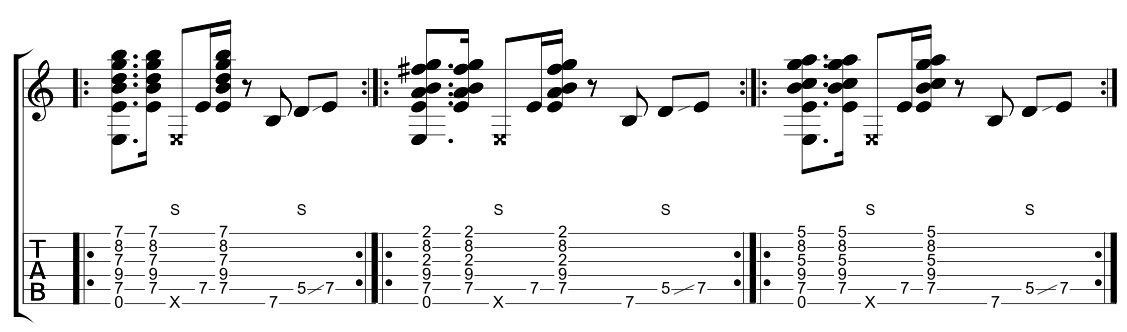
Put it together in a little string slaps for percussive effect and you have a little groove like this:

E min vamp

.

Note:  I play the notes on the B and D strings with the 3rd and 4th finger while I move the capo.  How I attack the D-E at the end of each measure will depend on fingering.  Sometimes I’ll slide and some times I’ll hammer on.

This is a pretty simple idea, but there are a few challenges with executing it cleanly.  Just remember to pay attention to the 3 T’s (Timing, Tone and (hand) Tension) and be aware of your finger position to make sure that the strings all ring out.

File under – a little theory can go a long ways!  I’ve left a number of variations out of the lesson to have one simple thing for you to develop on your own.

Good luck!

-SC

PS for those of you who are interested – this was tracked on my iPhone with the JamUp Pro app and a Line 6 Sonic Port interface.  A review of the Jam Up app will be up in the weeks ahead on Guitar-Muse.

Guit-A-Grip Episode #11 – “Deeper and Deeper”

Hello everyone!

The Return Of The Podcasts?!?

So I took some time off from podcasting to evaluate the podcasts and re-assess.  The original idea of the podcasts was to bring people outside of what I normally do into my work, but it appears to just siphon traffic from guitarchitecture.org.

I’m re-thinking the purpose of the site with that in mind, and I’ve committed to podcasting  here at least until the end of the year while I refine the focus of the podcasts and see what happens.

In the meantime…

Episode #11

Guit-A-Grip podcast episode #11 “Deeper and Deeper” is out and available for download/streaming.

Subscription Notes:

  • You can subscribe through iTunes here:
  • You can use this link to subscribe with any other feed based service:
  • or you can right-click here to download it.
  • or you can stream this episode below.
.

Show Notes

This is a short podcast, so I’ll just fill in a few points.

Deeper and Deeper:

This was the name of a track of a band called The FIXX that was hugely influential on me.  When I got their Reach The Beach album, I played it so many times that the vinyl grew thin.  While I was listening to it, I was listening deeply to how the guitar parts would drive some tunes and just lay back and sit in the pocket on other tunes.  Jamie West-Oram, their guitarist, would become a really big influence on me as he made me realize the concept of playing a supporting role in a band.  Knowing where where slide, keyboard line and vocal inflection was on the record came from deep listening and changed how I viewed my own roles in playing with other people.

I’ll talk about this more in a future podcast, but when people smile that nonsensical smug guru smile and say things like, “the answer lies within” it tells me that they only understand part of the equation.

Ultimately, only you can provide your own answers, but you’re never going to come up with intelligent answers if you’ve never investigated anyone else’s solutions but your own.  People left to their own devices with no external input of any kind typically don’t become Buddha, they become dull and dim-witted and develop “facts” based on little more than observation.  Babies don’t come out of the womb fully formed.  They have to be exposed to language (i.e. copy language) to master it and ultimately come up with their own original ideas.

Going deep into something and loosing yourself into it, can be a way to go deeper into yourself if you learn lessons from the process or gain insights from what’s happening.

Repetition:

“There are only 12 notes and they take forever to learn.”

I think that a good philosophy has to have simple truths at it’s core in order to be actionable (and thus be a philosophy).  My guitar system, GuitArchitecture, is based on a handful of modular approaches that can be adapted to a variety of formats.  My philosophy is the same.  It’s based on a handful of ideas that I’ll repeat here over and over.

And I do that because some of them will take forever to learn.

In this process, I’m always falling back into old habits – the difference is that I can now usually identify what’s happening and I just don’t stay in those places for as long as I used to.

Music is about the destination and the process.  I wrote this blog, and podcast and teach because I’ve been fortunate enough to make a vast number of mistakes (large and small) and hopefully I can help other people not make the same mistakes I did.

More Next Time:

As always, thanks for visiting, reading and listening.  I hope you get something out of the podcast, and if you like the series please drop a line sometime.

See you soon and thanks again!

-SC

PS – Here are some Fixx tracks to get you through the day!
(Just skip the ads):
.
Deeper and Deeper (Not much guitar in the mix but a great track)
http://www.youtube.com/watch?v=yIi79BHQ1ps
.
Saved By Zero (Check out all of the neat fills and variations Jamie throws in!)
http://www.youtube.com/watch?v=euBzxXFEuA4.

Beautiful Friction (Live) – Even with some issues – better than the studio version

.
What God (Live) – The Chorus on this is (makes kissing fingertips motion).
http://www.youtube.com/watch?v=A6UuLVxKJUk
 

It’s Not All Gold

As a professional – one important lesson to start internalizing is the need to balance being passionate about what you do and maintaining an emotional distance from it at the same time.

Hostile Terrain

Most of you have never heard of my first self published book, an unabashed DIY effort called Hostile Terrain.  It featured poetry, some plays, essays and other works.  Truth be told, about 30% still holds up as writing that I’d be willing to show to other people.

Hostile Terrain came out of a process of years of journaling.  I wrote everything down as an outlet.   I was depressed and desperate and it took a long time to realize that journaling just fed right into that.

I didn’t realize at the time that writing wasn’t getting bad things out of my system, but instead, it was just making me sicker.  I was breathing in the same stagnant air and thinking that I found something invigorating and relavatory because I was equating output with discovery.

In the next stage of this process, I was living with a person in a completely isolated situation and had hit emotional rock bottom because I had to confront things that intellect alone couldn’t solve and that I simply didn’t have the emotional maturity to deal with.

In the middle of this terrible living situation, a freak accident happened where the room I was living in flooded.  I lost 10 years of writing and journals.

I was devastated.  It was thousands of hours of work down the drain (or so I thought).

So being emotionally crushed, I went back to what I knew.  I went back to writing and eventually I wrote some more and then put out Hostile Terrain. I sent it out to friends and to a few publishing houses I was into, and while I got a few “attaboys” I got no interest from anyone for anything resembling publishing.

Bedtime Stories For Mutant Children

In the meantime, I decided to move away from poetry and into short stories.  I was really influenced by Tomas Bernhardt’s The Voice Imitator and decided to write a series of short stories that focused on dark stories for adults told in a children’s storybook style.  This was about 1996 or so. The Tim Burton book, The Melancholy Death Of Oyster Boy, came out mid project and even though I was jealous he beat me to the punch – my stories were much darker and I thought I might be able to get some publishing interest for a character I developed while on a grim tour of Germany (Kommandant Kumar) and for the overall book concept, Bedtime Stories For Mutant Children.

I had all the stories online so I could get feedback from my friends.  I didn’t have a computer at the time so I was working on my friend’s work computer.  I did this off and on for about a year.

Then something happened.

Within a 24-hour period the web server went out of business AND the hard drive that I had all of the files on seized.

I lost 30 short stories. Gone. Casper.

I hit my frustration limit and I stopped writing.  I abandoned the screenplay I wrote. I stopped all of the other writing I was doing and I worked on other things.

Eventually, I started seeing things differently, and I came to a realization.

It’s Not All Gold

  • There is no scarcity of ideas.

  • Not every idea has value

  • Important ideas will return

  • Sometimes it’s the process and not the product

There is no scarcity of ideas.

This was the biggest obstacle that I had to overcome in my own thinking and it’s one I still wrestle with.

There’s a fine line between being attached to an idea and being chained to it.

The difference is whether the idea you’re working with serves your larger goals, or if it’s only serving its own completion.

You don’t have to hold onto every idea like it’s a precious nugget.  There are more of them out there.

Not every idea has value equal to the amount of work needed to put it into action.

Again, it’s easy to get emotionally attached to the work put into an idea and equate work with value but that’s not always a direct relationship.  If you ever watch an episode of Shark Tank, you’ll likely see businesses where people have invested hundreds of thousands of dollars into a product that has generated no revenue after several years in place.  This is what I’m talking about.

Cultivating the mindset to distance yourself emotionally from what you’re doing is a difficult process to develop and maintain but it’s an extremely valuable one.

Important ideas will return

I like documenting things because sometime I find things worth exploring but, in retrospect, every really good idea I couldn’t remember came back to me or presented itself in a different form.

Sometimes it’s the process and not the product

For me, this is the most important lesson in this piece.

Earlier, in regards to losing all of my writing, I said that:

“It was thousands of hours of work down the drain (or so I thought).”

That work wasn’t down the drain at all.  The work I put into that sharpened my writing and really honed my ability to focus.

That emphasis made huge differences in my practicing and ultimately affected other areas of my life in a much more positive way than the actual writing ever did.

When I work on projects now, I assess the value of the outcome and the value of the experience and if either one makes sense for me to do, then I’ll take it on.

Don’t get hung up on old ideas at the expense of new ones.  Implement, assess and then continue or abandon as need be.

I hope this helps and as always, thanks for reading!

-SC

All Opinions Are Not Equal

Hey Everyone,

This is the last phoned in post for a while!  Look for all new content next week.  In the meantime, here’s a chestnut from the GuitArchitecture.org page.

.

A while back, I was reading a forum post and I was outright flabbergasted at the number of people who had VERY STRONG opinions about musicians and they money they make, even though they themselves weren’t musicians and had no experience trying to make money from one’s art.  It served as a good reminder that,

.

For the record, all opinions are not equal.

The internet will give you the impression that they are, but they aren’t.

.

There are basically informed opinionswrongly informed opinions and uninformed opinions and while everyone is entitled to their own opinion, they do not (and should not) equate in terms of validity.

.

Informed vs Uninformed Opinions

Let’s say I’m hiking with my friends and we come across a snake.  On of my friends, who knows nothing at all about snakes and is more than a little immature, says to me that it would make a great gag to pick up the harmless small snake and throw it at someone.  Another one of my friends, who happens to be a zoologist, tells me that he recognizes the snake as a highly poisonous one and advises me to stay away from it.

Which opinion do you think I’m going to listen to about handling the snake?

Yes, both people are entitled to their opinions, but for me there is a more validity in the opinion of the person who knows what the Hell they’re talking about.

.

Wrongly informed opinions

The internet is full of people who dispense data guised as wisdom.

People who have “informed” opinions because they read or heard something somewhere.

Forums are filled with these people.  Jokers who fill up pages of forum space talking about the merits and detriments of various products only to find that they don’t own any of them, but are just speculating based on ad copy and product specifications.

Wrongly informed opinions are even more detrimental to making an informed decision, because, like most conspiracy theories, they have at least a grain of truth that their logical architecture is based on.  That truth is what typically passes the smell test, “does it smell like bs to you?” and leads to the, “if a is to be and b is to c then a is to z” logic that often comes about from this.

Opinions aren’t facts and shouldn’t be treated the same way.

.

The Lesson Story

I believe that I’ve related this story once before, but I relate it again as I didn’t find it right away and it’s relevant to this idea.

I once had a person respond in a really combative way to a teaching ad I put up on Craigslist.

(BTW – I know CL works like gang busters for some people, but it never worked out for me.  I think this is largely because while my lessons are a bargain in terms of what a student can learn, they’re not cheap.  And CL guitar lessons seem to be ALL about the cheap.)

Getting back to the story, he demanded to know how much of my time was spent teaching, and whether I was a real full-time musician.  I responded to his e-mail as tactfully as I could, addressing my credentials and trying to determine what I wanted to learn.  He responded with a lengthy e-mail that included demands for justifying my price because, “I only want to study with the best.”  and he needed to figure out if I am “the best”.

Now the “best” anything, in terms of artistic expression, is a term that makes me uncomfortable.  I do happen to be the best teacher in the Scott Collins teaching method and style.  In that style and method of teaching, you wont find anyone who teaches better than me. Now, am I the best teacher for you?  I don’t know.  I have been for some students, but I can’t line up 30 people and say, “I’m better than all those people” because I am only the best at what I do and conveying information to people in my manner.

Despite being really put off by his approach,  I pushed the topic a bit and asked about his current skill set and what he was trying to do.  He explained that he was not a guitarist, but that he was planning on buying a guitar soon. While he didn’t play any other instruments, he was going to play guitar because he had really long fingers and knew that he could play it very well in a short period of time. Hence his need for the best teacher, because he needed someone who would help him unleash the awesome untapped divine talent that had been bestowed to him in his teens.

In other words, I spent 45 minutes writing thoughtful carefully worded responses intended to clarify, but ultimately justifying my skill set to a completely ignorant person who knew nothing about guitar and didn’t even play, but had a LOT of strong opinions about what I did.

.

Save yourself some time and energy.

As musicians, it’s common to get worked up over people’s opinions about what we do.

I’m not saying that all listeners are uninformed.  I’ve had people who happened to have listened to a lot of music deeply offer really insightful observations to me about what they liked or didn’t like about various things.  They didn’t know jargon, but they knew what they were talking about in terms of conveying their aesthetic.

What I am saying is that if the opinion you’re listening to (or more likely reading) is uninformed, that engaging that opinion is generally a time-suck.  You can try to inform the  person expressing the opinion, which takes time (and the right person willing to listen to other opinions) or you can walk away.

It’s easy to get entangled into flamed threads or comment sections to contribute an opinion, but if you’re trying to explain to a non-musician why musicians should be compensated.  You’re wasting time that’s better spent making a good piece of art to sell to them instead.

Thanks for reading!

-SC

p.s. I’ve mentioned it before, but that Indie Musician Wake Up Call Kindle book is a cheap $1.99 insight into some of the issues covered here ; )

.

The Five Words Or Less Challenge

(Hey everyone.  Since I’m in the process of moving, the gone fishin’ sign is still up on the door and for this week’s post I’m rolling out some more excerpts and miscellaneous observations from my Selling It Versus Selling Out ebook that you may enjoy.

The podcast will come back in the weeks ahead after I’m settled.  In the meantime, you can check out the latest one here.)

Five Words Or Less

Up until fairly recently, I had a habit that, in retrospect, is quite embarrassing.

I couldn’t describe what I did musically in five words or less to other people.

When asked what I did, I said I played guitar, and then went into a painfully earnest description that was supposed to be informational (but in reality probably sounded more like babbling).

No matter how sincere people are, most of them shut down with information overload and anything more than 5 words describing what you do initially (“initially” is an important qualifier here by the way) is information overload.

That might sound harsh but it’s not meant to be.  It’s simply that even musicians (i.e. people who do this every day of their lives) tend to lose focus after 10 words or so. I might talk about how hearing koto playing worked its way into my comping and they might be looking at me smiling and wondering about the discolored tooth in the front of my mouth (it’s discolored because I got into an accident the day of my grandmother’s funeral and ate a face full of gravel killing the nerve in my front tooth.  It’s also why I very rarely smile with a full open-faced smile.  But I digress….).

To non-musicians it’s even more alien.  They often really want to understand what you’re doing, but experience has shown me that the more descriptive you get, the more you’re going to lose them.  People are busy.  They have a lot on their mind and they’re often easily distracted, so don’t lose them if they’re interested in what you do!

.

The restroom pitch

Now I’ve clarified this with the word initially.  For those of you familiar with the term, this is less of an elevator pitch and (in terms of length of time) more of a restroom pitch.  Imagine you walk up to a sink in a restroom and someone is already using the neighboring sink.  The person recognizes you and taps the soap dispenser and asks, “Hey don’t you play music – what kind of music do you play?”  you’ve got about 5 words to get it across before he or she runs the tap water and can’t hear what you’re saying.

.

The goal of being able to do this isn’t to limit yourself in a bad way.  

The point of it is to come up with just enough of a description to get someone’s interest and have them ask more about what it is that you do.

Interestingly enough, while the 5-word rule applies to a band bio (keep it short and to the point), it doesn’t necessarily apply to other text-based media.  People who want to read about a band are often willing to read lengthy articles and will actually retain the information – but that’s after there interest is piqued, and the window for that is generally a short sentence or two.

.

In person – in an initial meeting  – you’ve got about 5 words to bring them in.

If you’re interested in trying this for yourself here are some tips that may help.

  • Try to describe yourself musically in 5 words or less.
  • Make it descriptive enough that people get some sense of what you’re doing – but open enough to let their imagination fill in the other pieces.  “Improvised rock guitar” isn’t a bad start, but people who hear that are going to think “jam band”.  So if you play in a jam band it’s easier to just say “I play in a jam band”.  If you don’t play in a jam band, you might need a better description.
  • If you’re comparing yourself to other bands – don’t use any more than two (“Black Sabbath meets Elton John” gets someone’s attention.  “Take Yngwie Malmsten’s leads with Tony Levin’s pocket and hold it together with Zakir Hussain’s tabla” looses people.  Shred guitar with tabla gets it back again.  Will your bassist get pissed at that description?  Probably – but again the idea is to distill it down to its essence – because the essence is where all the potency is.

While this process will help you describe your music to other people (and thus make it more accessible to them automatically), it has a second (and ultimately more significant) advantage. It clarifies in your own head exactly what it is you’re trying to do.

If it takes 30 seconds for someone to initially describe what they’re doing it’s generally because they’re a little muddled on the goal as well.  Again, it’s something I was guilty of on my own and I now have short descriptions for everything I do.  They’re not all 5 words or less (and they all need revision and improvement)  but they’re distilled enough that people get the gist of what I’m doing.

For example, when people ask about performance I often tell them I play “ethnically influenced rock guitar”, “loop-based improvised guitar” or “improvised music for multi-media”.

When asked about my teaching style, I can explain that as a teacher my goal is to “help students hear the music within” or to “help students sound like themselves”.  Both sentences are a little clunky – but that’s the simplest essence.  That’s what I can boil it down to and if I understand it on the base level, I can always expand on it later. How I do these things is a much longer discussion.  Even though none of them fully define what I do, they help open a door for that discussion to occur and opening doors is what music should do in general.

Give it a try!  You may find out some interesting things about yourself!

.

As always, thanks for reading!

-SC

.

PS – If you dig this post, you may like my ebooks (both available for Amazon Kindle or for the FREE Kindle App).  Click on graphic for book link page.

.

Indie Musician Wake Up Call

41sc-8d22lL._AA160_

 .

Guit-A-Grip Podcast Episode #10 – On “You’re Welcome”

Hello everyone!

The iTunes synch.

This has been an on-going battle but (fingers crossed)  I think this is finally all set.

It looks like the links and streaming is reset on the individual pages on this site, but if you’re subscribed to the podcast you may have to unsubscribe and re-subscribe to the podcast to get the episodes that got jacked up in the synch (Episode #3, #4, #5 and the latest #9).

Again, my apologies!!!  I’m a real luddite on some things I guess!

If you’re unsure how to reset this in iTunes – in my iTunes, I went to Podcasts Selected Get-A-Grip.  Unsubscribed and then hit the subscribe button, and the episodes all came up with the right episodes and times.

(Also FYI – you may have noticed a page on the top bar that says PODCASTS and they’re all there for download and streaming!  Hopefully it’s all set now.)

Episode #10?

The ten episode milestone is now in the rear view mirror!   Guit-A-Grip podcast episode #10 “On ‘You’re welcome”‘  is out and available for download/streaming.

Subscription Notes:

  • You can subscribe through iTunes here:
  • You can use this link to subscribe with any other feed based service:
  • or you can right-click here to download it.
  • or you can stream this episode below.
.

Guit-A-Grip Episode #10 – Show Notes

Generally, I listen back to the podcast and make copious notes about what I thought was clear at the time that turns out to be pretty murky.  I only have a few points I feel compelled to address this time.

I don’t have all the answers.

Well…Duh Scott ; )

No one has all the answers, and I’m more than suspicious of anyone who does.  I’ve just been fortunate in that I’ve made a near infinite number of mistakes – some of which I’ve actually learned from –  all of which have given me a perspective that’s been useful to me. Hopefully my answers will help you solve some of your own questions,  (you may want to check out my – Don’t buy the app – Be The App podcast for more on this idea).

For me, the main thing to remember is that lessons only have value in their application (as does philosophy hence my mini rant mid podcast).

That Martial Arts story:

That’s a post I did called Finding The Deeper Lesson.  If you haven’t read it yet, you might dig the article!

I don’t believe in evil:

That’s not entirely true, but I didn’t articulate it well.  I believe that people do evil things to each other quite often, but they don’t see it as evil, they see it as being the right thing to do (or the self serving thing to do) with no care for how it affects other people.  People in caves (or anywhere else for that matter) are not trying to advance an agenda they think is evil (Like Dr. Evil in an evil lair) – they’re doing what they think is right for themselves or their cause.

Much of evil, then, lies in action  maybe even in some cases more so than intent….more on that later.

There’s more

There’s always more, but it feels like I actually touched on a lot of things in the podcast I intended to, so I don’t feel compelled to write a lot about it here.

As always, thanks for visiting, reading and listening.  I hope you get something out of the podcast, and if you like the series please drop a line sometime.

Thanks again!

-SC


Guit-A-Grip Episode #9: Transitioning From An Island To A Peninsula

Hello everyone!

After a little blogging run, I’m back to podcasting.  I’m experimenting with the format for what works best for people, so the fate of the podcasts are TBD but in the meantime, Guit-A-Grip podcast episode #9  is out and available for download/streaming.

Subscription Notes:

  • You can subscribe through iTunes here:
  • You can use this link to subscribe with any other feed based service:
  • or you can right-click here to download it.
  • or you can stream this episode below.

.

Guit-A-Grip Episode #9 – Show Notes

The genius in question

I’ll reveal this someday, but for now if you know me from my club ’98 days, you’ll know who I’m talking about.

The study in question.

Here’s a link to the Huffpo article I referenced in the podcast.

The last meal in question.

Uh…my death row meal?  Depends on where I was…probably a bahn mi, but really good pizza, mashed potatoes, burrito, veggie burger or mac and cheese would be on the list as well.  Iced coffee would be there.

The show format

The fluff above not withstanding, I think it’s really important that anything I post here is succinct enough to be inspirational and actionable.  So I’m shooting for more of 10-20 minute posts that have a central idea to ponder and then move from there.  But I’m really interested in how these things benefit you. As always, If you like the podcast please let me know. If you really like it -and listen to it on iTunes –  leaving a rating there would be really appreciated!

More posts and podcasts are on their way.

Thanks again!

-SC


Keeping Your Ego Out Of The Song’s Way

Hey everyone.

A quick update before the post.  Just as an FYI – the podcast isn’t dead but with a number of recent time crunches and an unstable recording environment for a while recording opportunities have been non-existant.  There will definitely be more (less apologetic)  posts in the future.

Glenn Branca Ensemble at Berlin Atonal (Photo taken from Berlin Atonal FB page)

Glenn Branca Ensemble at Berlin Atonal (Photo taken from Berlin Atonal FB page)

Meantime back at the ranch –  I just got home from some shows in the UK and Germany and doing any type of touring always makes me a little introspective and makes me think back to this post that was originally posted on guitArchitecture.  It’s interesting playing shows with someone like Glenn Branca because you’re surrendering to the composer’s vision and doing your best to execute it.  It’s a mind set “classical” players live in constantly but it can be a strange one for an improvising artist.

Letting the song sing

One of my more esoteric laptop guitar gigs with Mark Trayle and Ulrich Krieger is up on SoundCloud.

My rig is essentially the same as before:

Guitar (8 string Omen) –> Duet Break out box–>Duet–>Laptop (w. usb Line 6 shortboard)–>AU LAB (w. SooperLooper and PODFarm)–>18 Watt atomic amp.  My favorite tech comment came from Mark, “Wow I just realized that your entire rig is on the lectern.  That’s pretty cool…”

Gigs like this are a little strange for me as multi-layered looping, manipulating and mixing typically involves a lot more editing than actual playing, but a big part of a situation like this involves keeping your ego out of the music’s way and making sure that you serve the song.

The Obligatory Experiential Example

Once I saw a gig at the House of Blues with Shawn Lane, Jonas Hellborg and Apartment Q258.  I was really excited to see the show and the first set was a  cool improv.  I was blown away at the hairpin turns that Hellborg and Q258 were taking, but at the 40 minute point or so – it looked like it was going to wrap up, and I guess Shawn hadn’t played enough – because he pulled out a 15-20 minute guitar solo.  While I love Shawn’s playing, I was looking at my watch by the six minute point.  It was so over the top that I left before the set was done.  It was just too much, had nothing to do with the spirit of the piece and just had too much to do with him showing us how well he could play.

About a year later I saw one of the strangest lineups I could remember:  Buckethead (with bass, drums and DJ) and Lane/Hellborg/Q258 opening for The Jazz Mandolin Project.  Initially, my thought was, “oh no not this again” but this time Lane was playing tunes.  The group played 3-4 tunes with open sections.  Everyone was playing in service to the song and there aren’t three people on the planet that could have played that set that night better than they did.  Jazz mandolin project got crushed but to be fair, I felt bad for any band that had to go on after Buckethead and Lane that night.

Which kind of musician are you?

Essentially there are two types of musicians that I’ve met in my travels:

  • there are people who play instruments to play music
  • and then there are those who play music to play their instruments.

As a related example, please allow me to explain…

Why Some Academic Jazz bugs me…

When I went to Berklee, there was an overarching theme that ran through many of the jazz recitals I saw:

  • Get through the head as quickly as possible
  • breathe a sigh of relief that that’s done because now the “real” music can happen (solos)

If you hate the head so much, why even play it?  Why not eliminate the song form entirely?

It’s because people are taught that the real music comes from their melodic/harmonic voice rather than emphasizing that it’s their voice in service to a context, be that a song form, a dialog with other players, or a specific audience/performance situation.

It’s a big part of why I never played jazz.  When studying it, I quickly realized that I just didn’t dig a lot of the real book tunes.  What I dug were specific players and those players always play the song and not the instrument – be it Ornette, or Monk or Bill Frisell.   It’s the combination of the players and the material that got to me.  I’m much more open about jazz now but that concept of the tune as a necessary evil is abhorrent to me.

For the players out there, on gigs like the one I posted, there are plenty of moments where I have to resist the urge to overplay and what follows are several techniques I use in that service, but for non players I use some of these approaches  in conversation as well.

1.  Pause and take a breath.  After that breath, do I still need to play/say what I want to play/say?  If the urgency is still there – then I play it.  90% of the time it probably isn’t.

2.  Play only when I exhale.  Sometimes I’ll talk or sing while I’m playing as well.  Sometimes that has nothing to do with the notes coming out of my guitar – but it’s about an interactive conversation.  And I want to make sure that everyone else speaks as well.

3.  Overplay and then regret it later.

Here’s another way to think about it.  You can work out consistently and build up huge muscles but you only need the muscles of a baby to pet a cat and if you handle a cat with the same force that you lift weights, you’ll probably kill it.

Just because you can play a million notes doesn’t mean that a million notes are going to work in every situation, but if you have the ability to play a million notes in your pocket you can pull it out when you need to.

In other words, your strength may not help you in petting a cat – but it may be the thing that keeps you alive when a book case falls on you.  Context may not everything but it’s a whole lot of something to consider.

Playing with good people is 1/2 the battle

Fortunately, Mark and Ulrich are such incredible musicians that it set the tone for the performance.  I knew that whatever they did would be great and that all I had to do was help mark the path and stay out-of-the-way when necessary.  I’m really fortunate that I’ve been able to play with people like Vinny Golia who are at such a stunning level that it’s going to bring me up a little just by sheer gravitational talent pull (and more likely to get my performance up by kicking my ass into gear to get with the program.)

The laptop/looping things I do are really different from many of the other contexts I play in but I enjoy them immensely and hopefully other people will as well.  Here’s hoping we see some official collins/krieger/trayle recordings in the future.

Thanks for reading!

-SC

ps – If you like this post, you may like the kindle ebooks I have for sale on Amazon.

“Embrace The Scariness”

Let’s say you want to get something done.

Fear can either kill your project or kick it into gear.

But what effect it has largely depends on how you view it.

Some fear is healthy.  Standing on the ledge of a building might invoke the kind of fear that is razor sharp and puts all of you senses on overdrive.  That kind of fear – the fear of survival – can be a healthy and reasonable fear.

The other fear – the fear of failure or the fear of the unknown – can kill you.  Fear of failure can kill your dreams and sap whatever inertia you might have built up in seeing your project to fruition.

Failing to do anything is infinitely worse than failing to succeed.

When I moved to NY, I left a secure gig and a lot of leads for future work,  but I left because my wife was already living there there and that was the priority.

In the middle of a particularly arduous moment in the relocation, my dear friend Lulu offered me the best advice I’d ever gotten. “Embrace the scariness. It will keep you sharp. And once you are here, work will come.”   And even when the work didn’t come right away  I didn’t die.  Life moved on and I moved with it.

Here’s a hard fought lesson about fear. That moment when you feel the all embracing fear and you’re wondering if you’re going to be able to do the project should be when you know you’re on the right track.

It’s the moment when you realize that you’re going to commit to doing something. Sometimes you have to take a leap even if that means you’ll be forced to sink or swim (and nothing wakes a person up more quickly than choking on a mouthful of water).

Just remember that no matter what you’re working on you’re probably not going to die.  Learn to identify your fear and head it off at the pass.

As a big bandleader once said, “A musician is not like a fine cheese or wine.  They don’t get better just sitting around.  They get sh*ty and stale.”

If you’re scared, it means your probably about to make a change.  Embrace the scariness and repeat often.

As always, thanks for reading!

-SC