Hey! Thanks for dropping by!
This post has actually been re-written, edited and moved into it’s new home at Guitar-Muse! You can read all about in in my “Evolution of a Live Rig” series for them!
Part 1 is here!
Part 2 is here!

Hey! Thanks for dropping by!
This post has actually been re-written, edited and moved into it’s new home at Guitar-Muse! You can read all about in in my “Evolution of a Live Rig” series for them!
Part 1 is here!
Part 2 is here!
Hello everyone!!
Here’s part 2 of the diagonal pentatonic lesson..Hopefully you’ve checked out the posts on two string patterns and part one of the diagonal forms post and have gotten the shapes and visualizations down and under your fingers. (if not – just take a moment and check out the other two posts).
.
In this lesson, I’m going to continue the process of combining the two approaches into 5-note diagonal shapes.
.
5 Note Diagonal Pentatonics
.
Perviously, I took a look at one 5 note pattern on two strings. This can be done by either putting 2 notes on one string and 3 on another (1.e. a 2-3 pattern):

..
or by putting 3 notes on one string and 2 on another (1.e. a 3-2 pattern):
.
 .
.
..
Note:
Those of you looking at the picking pattern closely may notice that I play the 3-2 pattern with a partial sweep instead of strict alternate picking. While the 2-3 pattern can be swept as well, you’d have to start it on an upstroke:
.

.
From a picking perspective – I find the 3-2 typically works best when ascending and the 2-3 works best when descending – but from a fingering standpoint – sometimes the reverse of this will be true. A little experimentation goes a long ways here.
.
Working with these forms:
I’ve documented every 2-3 and 3-2 combination here – but in general I don’t recommend spending a lot of time practicing forms that you’re not going to use.
.
Instead, try the following:
.
.
You may want to start with an E minor or Em 7 and then try other chords like C Maj 7, G Maj 7, F Maj 7, D min 7 or A min 7.
.
.
“Ceci n’est pas une pipe” or when is 5 – 4?
.
In the previous lesson, I talked a little about altering the rhythms of any sequences that you’re playing. Dividing the beat with a different number of notes than the notes in your phrases can add some rhythmic tension and goose the melodic line a little. For example, here’s the initial 3-2 pattern from above moved in scale wise motion through each note of the E pentatonic minor scale. I’m playing the phrase below as quintuplets (i.e. 5 notes to the beat).
(If you have trouble counting the phrase try saying (“here’s a group of five”). If you do it over and over again in a shopping mall someone will probably call security – so you may want to use your internal voice for this)
.
On a more serious note – I’ve notated the phrase as 5/4 to make the rhythmic division clear. In the mp3 below – I’m playing the phrase over a 4/4 drum groove so there are 3 beats of space (5 beats + 3 beats = 8 beats or 2 bars of 4/4) before the descending line starts. Here’s the ascending line:
.

.
and here’s the descending line:
.

.
Now I’m going to take the same sequence but play it as 1/16th notes which does a very cool thing over the drum beat. Where the previous phrase has the first note of each pattern start on a down beat, here the starting note keeps getting displaced.
.
Note :
I’ve notated the phrase as 7/4 to make the rhythmic division clear (just like the groups of 5). In the mp3 below – I’m playing the phrase over the same 4/4 drum groove so there is 1 beats of space (creating a 2-bar phrase of 4/4) before the descending line starts. Here’s the ascending line:
.
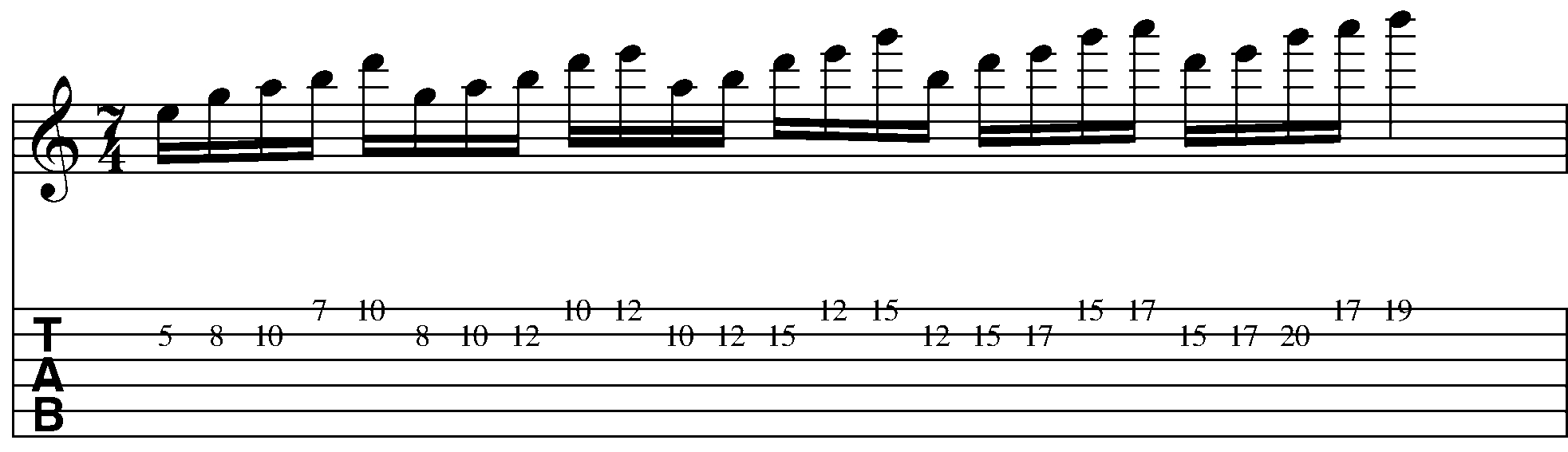
.
And the descending line….
.

.
and here they are back to back
.
The Shapes of things….
Now I’m going to go through each of the individual shapes and make some notes. At the end of the shapes, I’ve included an mp3 of my preferred shapes in groups of 5 and then groups of 4.
.
Pattern 1
(Starting on the Root)
.
Here’s the 2-3 shape on the bottom 2 strings:
.

.
And played in octaves:
.
Note:
The stretch on the D and G strings isn’t very comfortable – so I’d most likely use this fingering only when descending.
.

.
Here it is in a 3-2 shape. I’m playing the notes on the 3rd fret with the second finger, 2nd fret with the first finger and 5th fret with the pinky.
.
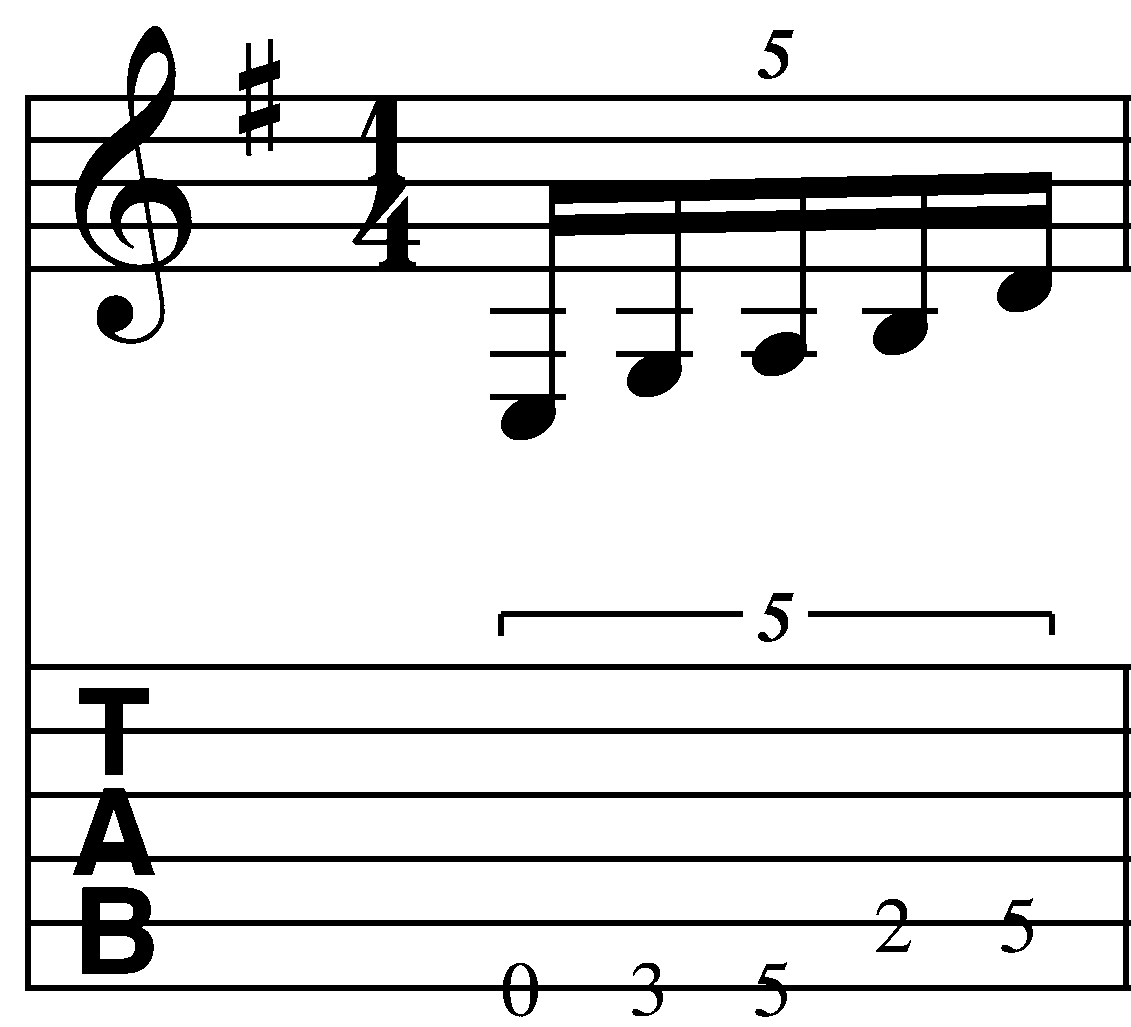
..
Here is the 3-2 shape in octaves. The same fingering pattern applies just add the 1st finger for the “e”.
.

.
Pattern 2
(Starting on the b3)
.
Here’s the 2-3 shape. It’s not very positional ascending – so again I use it primarily for descending ideas.
..
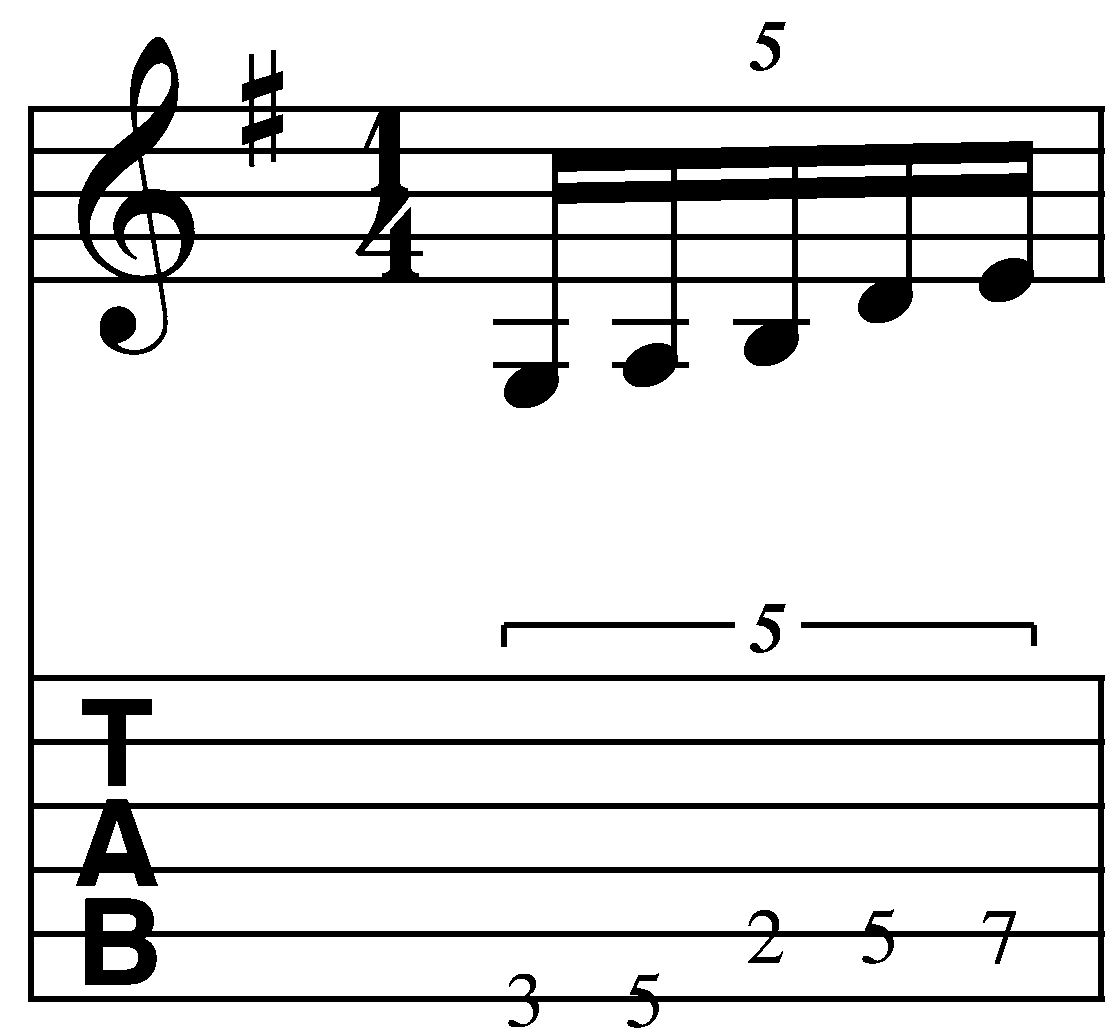
.
Here is the 2-3 shape in octaves:

.
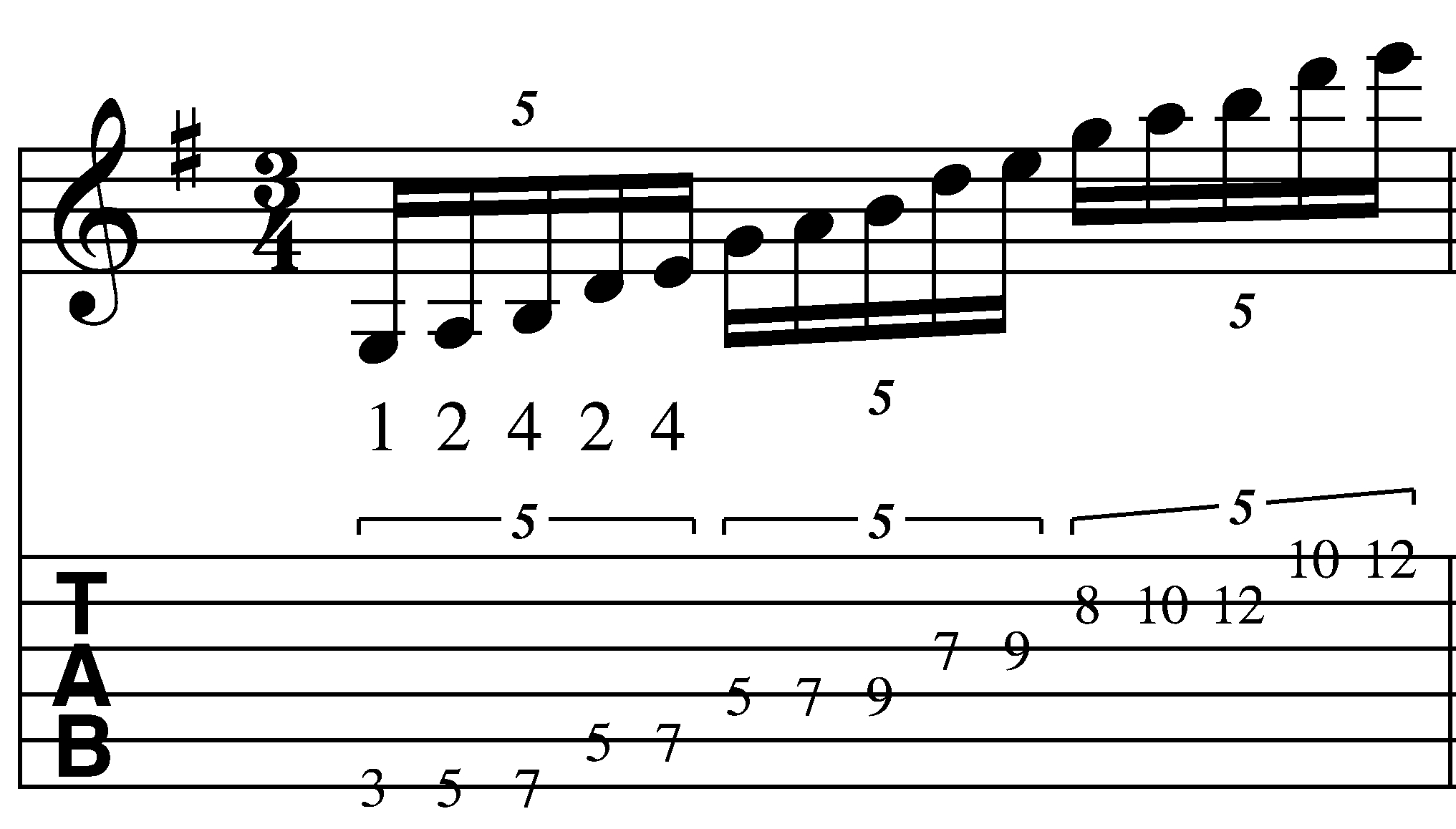
Here’s the 3-2 shape. The symmetrical fingering of the 2nd and 4th finger in this pattern is interesting to me. I’m not a big finger exercise guy anymore, but if you’re looking for a fingering pattern to clean up your 2nd and 4th finger, smoothing out the octave runs on this shape will help with synchronization if you’re practicing it correctly. (You can check out the practice posts on my blog for some helpful practice tips – just look on the blueprint page).
.
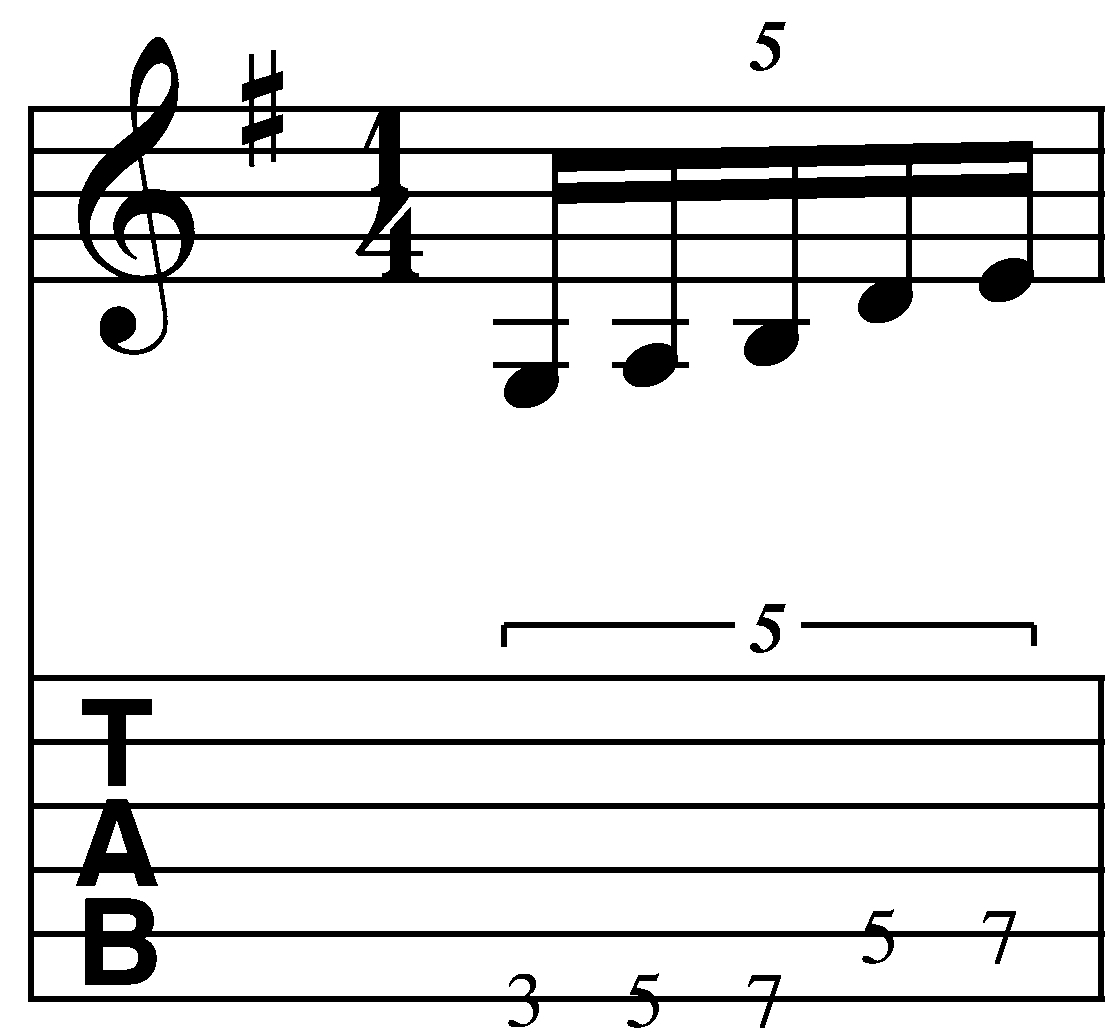
.
Here’s the 3-2 shape in octaves:
.
.
Pattern 3
(Starting on the 4th)
.
Here it is in a 2-3 shape. I actually prefer this pattern to the 3-2 shape as I find that by using my first and second fingers on the 5th and 7th frets, the pattern is more comfortable to me.
.

.
Here it is 2-3 in octaves. I play this version primarily with alternate picking, but play two down strokes in a row to get from the G to the A to start every two string pattern on a down stroke.
.

.
Here’s the 3-2 shape. If the 2nd pattern 3-2 shape is comfortable to you – you may like this one as well.
.

.
Here is the 3-2 shape in octaves:

.
Pattern 4
(Starting on the 5th)
.
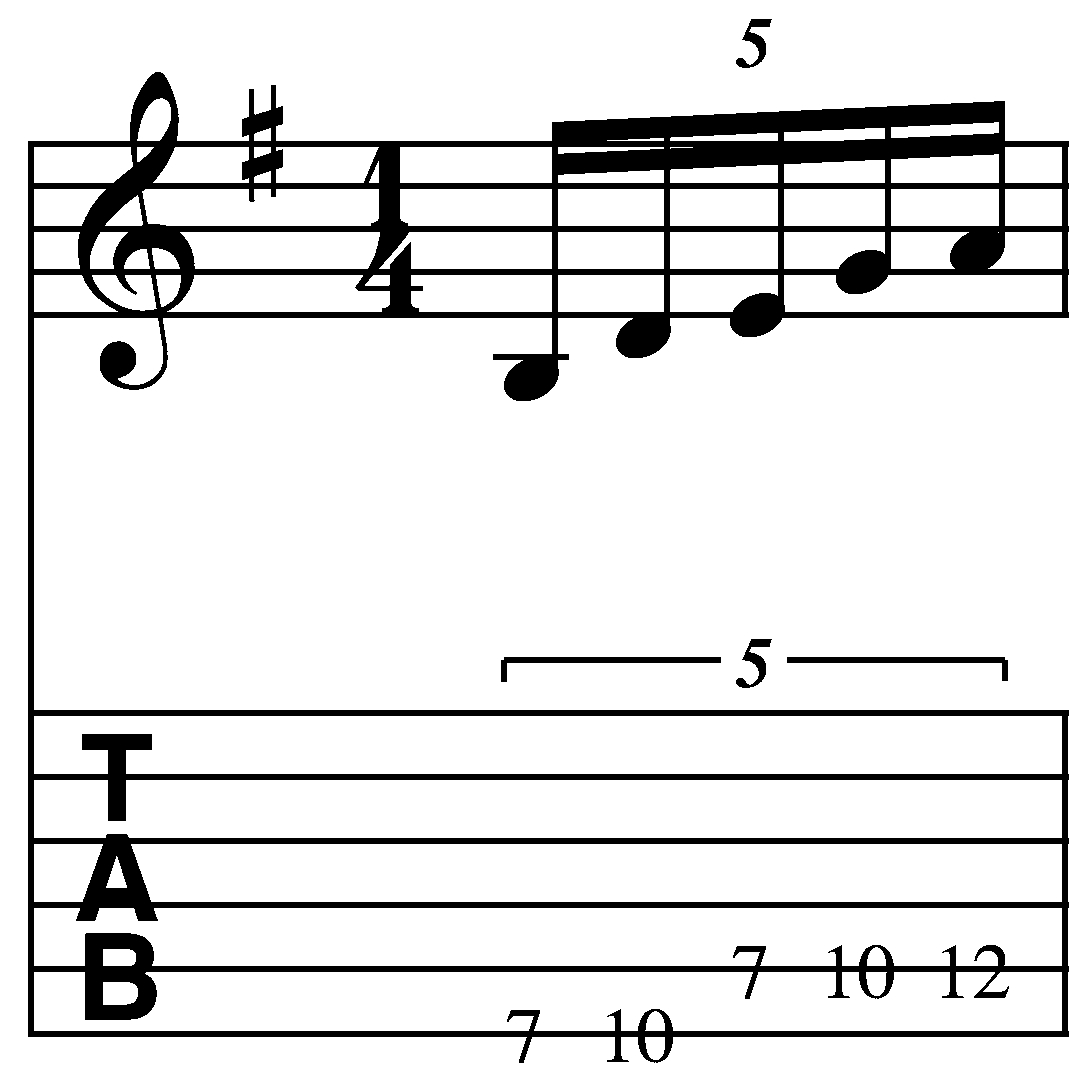
Here’s the 2-3 shape. I use fingers 1-3-4 for this one.
.
.
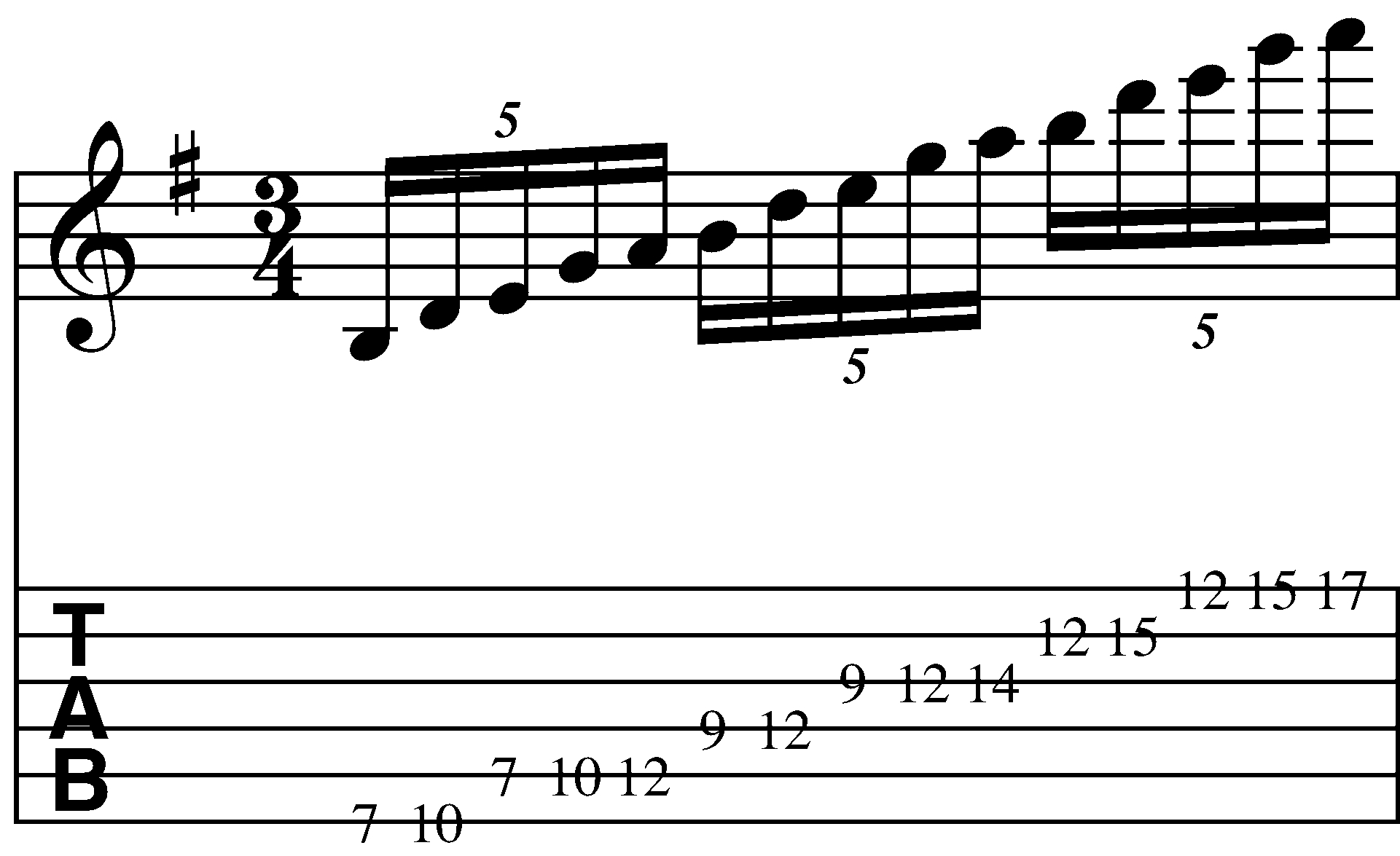
Here is the 2-3 shape in octaves. I use the same picking pattern I described in pattern 3 for this pattern as well.
.
.
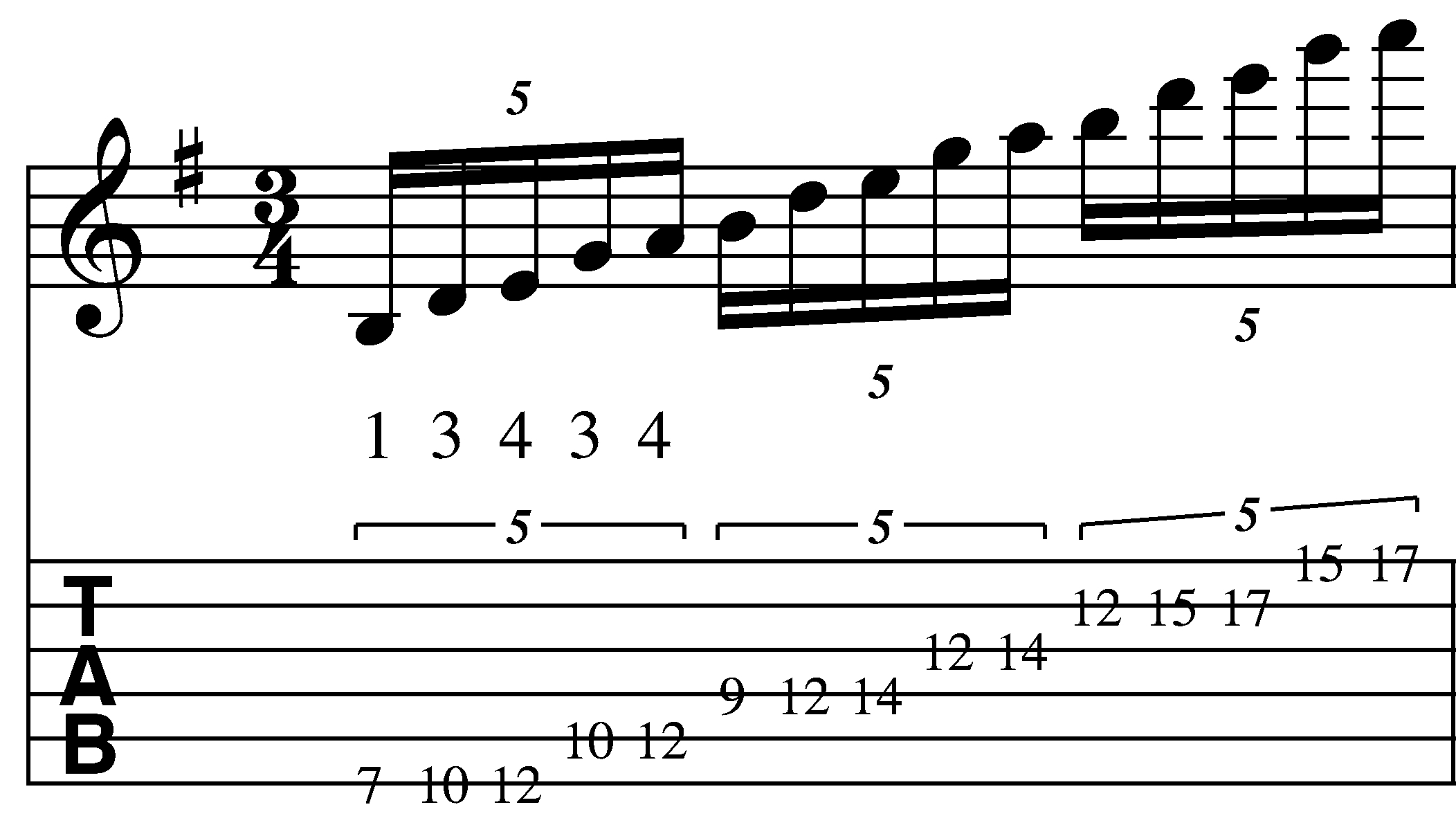
Here’s the 3-2 shape. The focus here is the 3-4 finger shift.
.

Here it is in octaves.
.
Pattern 5
(Starting on the b7 th)
.
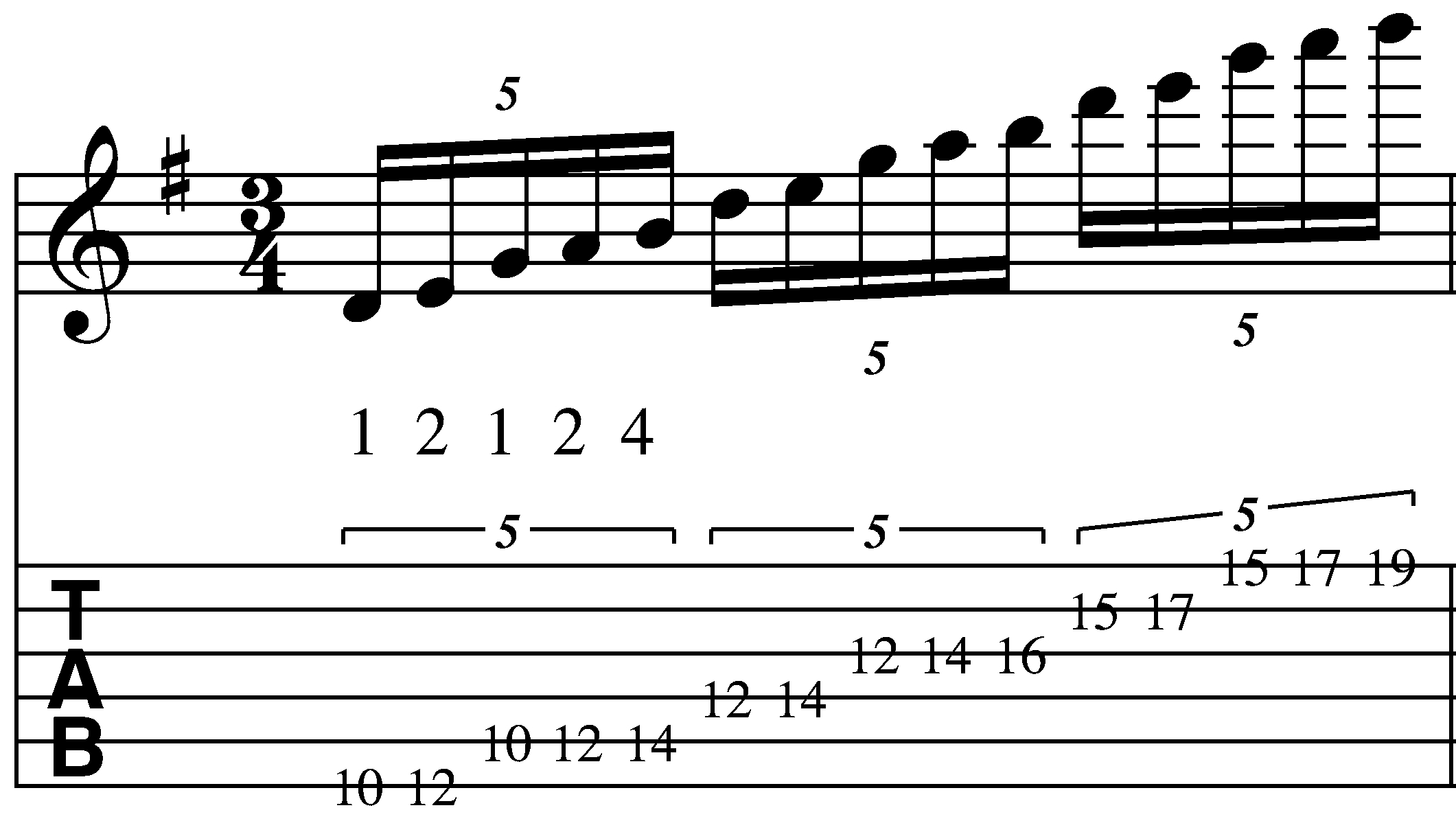
Here’s the 2-3 shape. This sits under the fingers very comfortably.
.

.
Here it is in octaves. This is a great shape to repeat a few times before moving to the next octave.
.
.
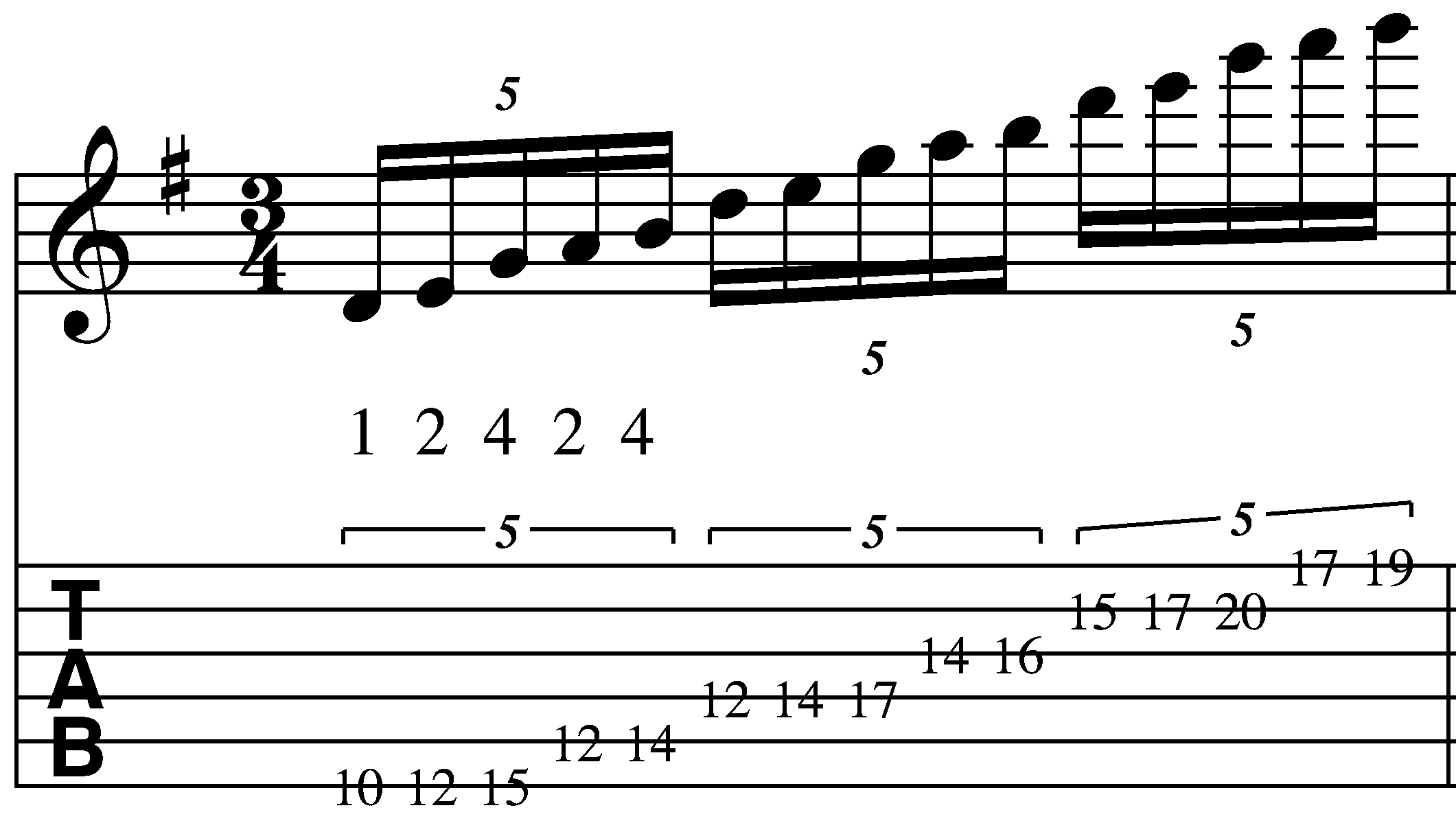
Here’s the 3-2 shape. This is a form I abandoned almost instantly – especially because the 2-3 form is so much easier.
.
.
Here it is in octaves. On the high B and E strings – this form can be useful when descending. I use 3-1-4-2-1 for the fingering pattern. On the ascending 5s and 4s phrase, I played all the patterns in the 3-2 shapes to keep the picking consistent – so if you’re going to be playing the patterns on just 2-strings, you may want to familiarize your self with both divisions.
.
.
Finally here’s an mp3 of each group in order. I recorded the patterns that I marked out as preferred patterns. Typically I wouldn’t switch between phrases (and picking patterns) like this. The same rhythmic idea as above (i.e. patterns notated for clarity but played over 2 bar 4/4 phrases).
.
.
Note:
These shapes are all adaptable to the blues scale as well by just adding an A#/Bb to the patterns.
.
“Ceci n’est pas une pipe” II or when is five six?
.
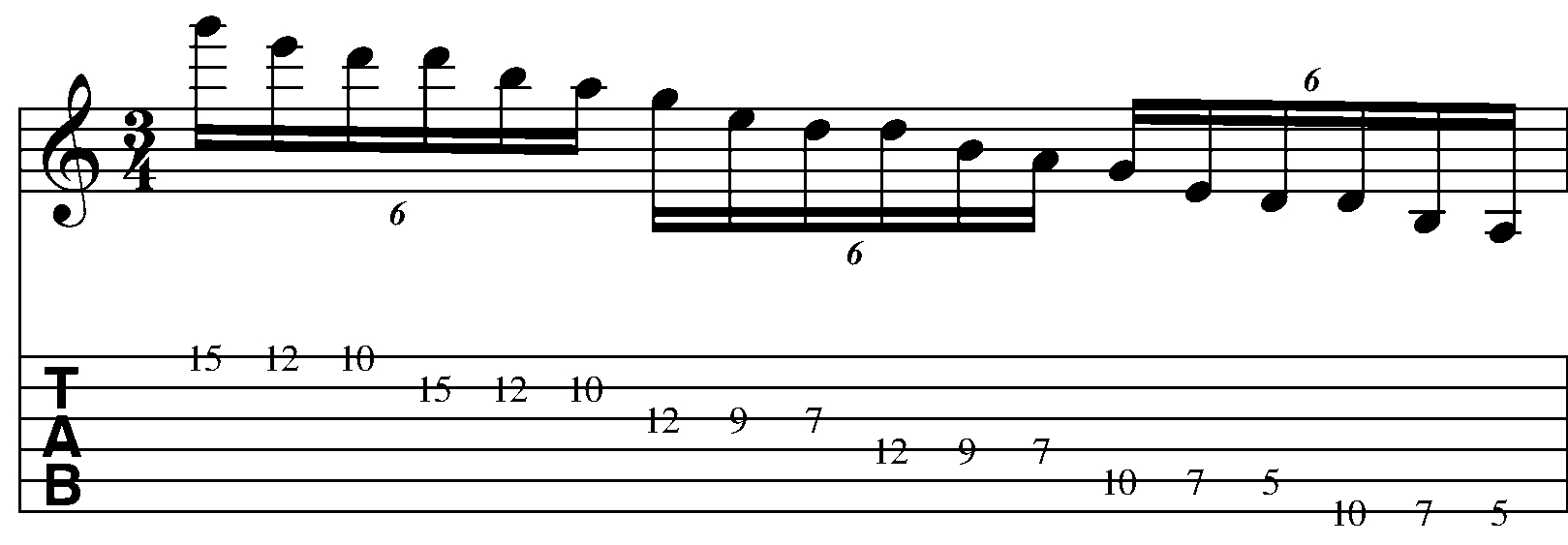
So here’s another way to manipulate the patterns into something more fluid. Both pattern 3 and pattern 4 have symmetrical fingerings. In pattern 3 for example, if I double the d between the 2 shapes I get a 6 note pattern with the same fingering. This works best as a descending line to my ears:
.
.
.
Here’s the same idea with pattern 4 using a doubled E.
.
( 8/7/11 -Note: the wrong graphic was posted here previously but this has now been fixed – SC)
.
By understanding patterns, it becomes possible to manipulate them and make them work for you. The key is to take one idea or approach and put it through the paces and try to get something out of it that works for you.
.
I hope this helps! In the meantime, if you like this approach, I have a book that includes this material you may be interested in

is 100 + pages of licks and instruction and includes demonstrations and breakdowns of two-string fingerings, diagonal pentatonics, sweep picking pentatonics, pentatonic harmony and much more! It’s available here.
.
Thanks for reading!
-SC
Hello everyone!! After a lengthy delay – I’m posting this pentatonic lesson. The amount of information over the next few posts will keep some of you busy for a while.
.
A general online lesson note:
.
The lessons I post here typically go into quite a bit of detail with the rationale that the reader (i.e. you) can take bite sized pieces of information and return to the material as needed. If this more information than you will probably be able to process in a single setting, simply take one or two things that sound cool to you and apply them to what you’re currently playing (songs, solos, etc).
.
One idea applied well is worth more than a dozen ideas applied poorly.
.
In this lesson I’m going to combine 2-string pentatonic patterns into a diagonal approach.
.
Note: For those of you who want to adapt these ideas to the blues scale just add in the A#/Bb to the patterns listed below.
.
..
Diagonal Pentatonics
.
Playing two-string patterns in octaves moves the fretboard shape both horizontally and vertically (i.e. diagonally). Two-string diagonal playing can help with visualization as the same pattern is simply moved to the octave of the starting pitch.
.
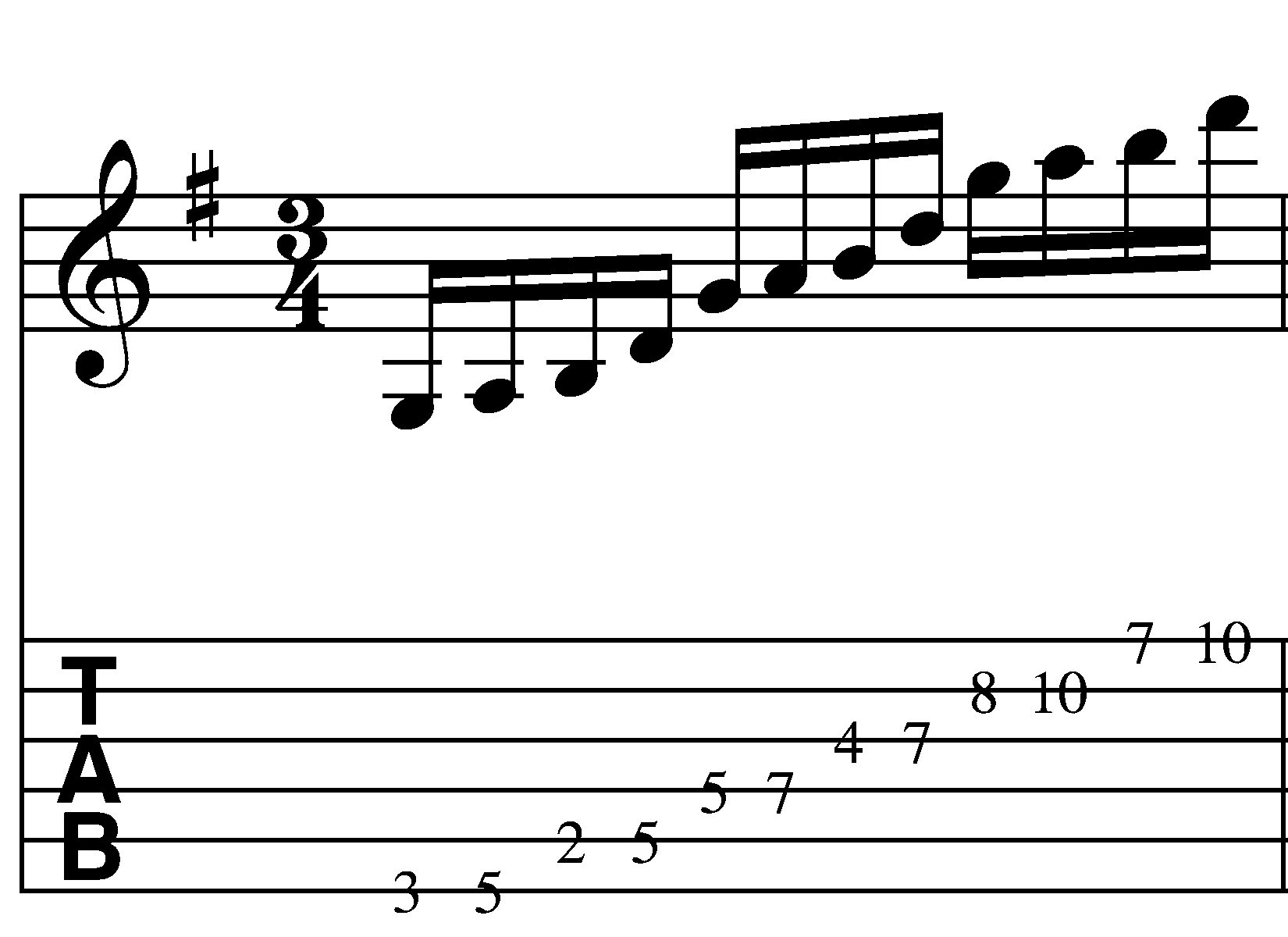
To illustrate this – I’ll start with the following four-note shapes. Use alternate picking for all of the following exercises. With the exception of the first four notes which use open position, the rest of the patterns use the same fingering.
.
All of the following examples should be practiced with strict alternate picking or legato (i.e. using hammer-ons and pull offs) and (ideally) played over a chord to supply a harmonic context.
.
Some chords to try:
.
.
Here’s the 1st pattern moved in octaves.

.
.
Pattern # 2
.
.
Pattern # 3

.
.
Pattern # 4
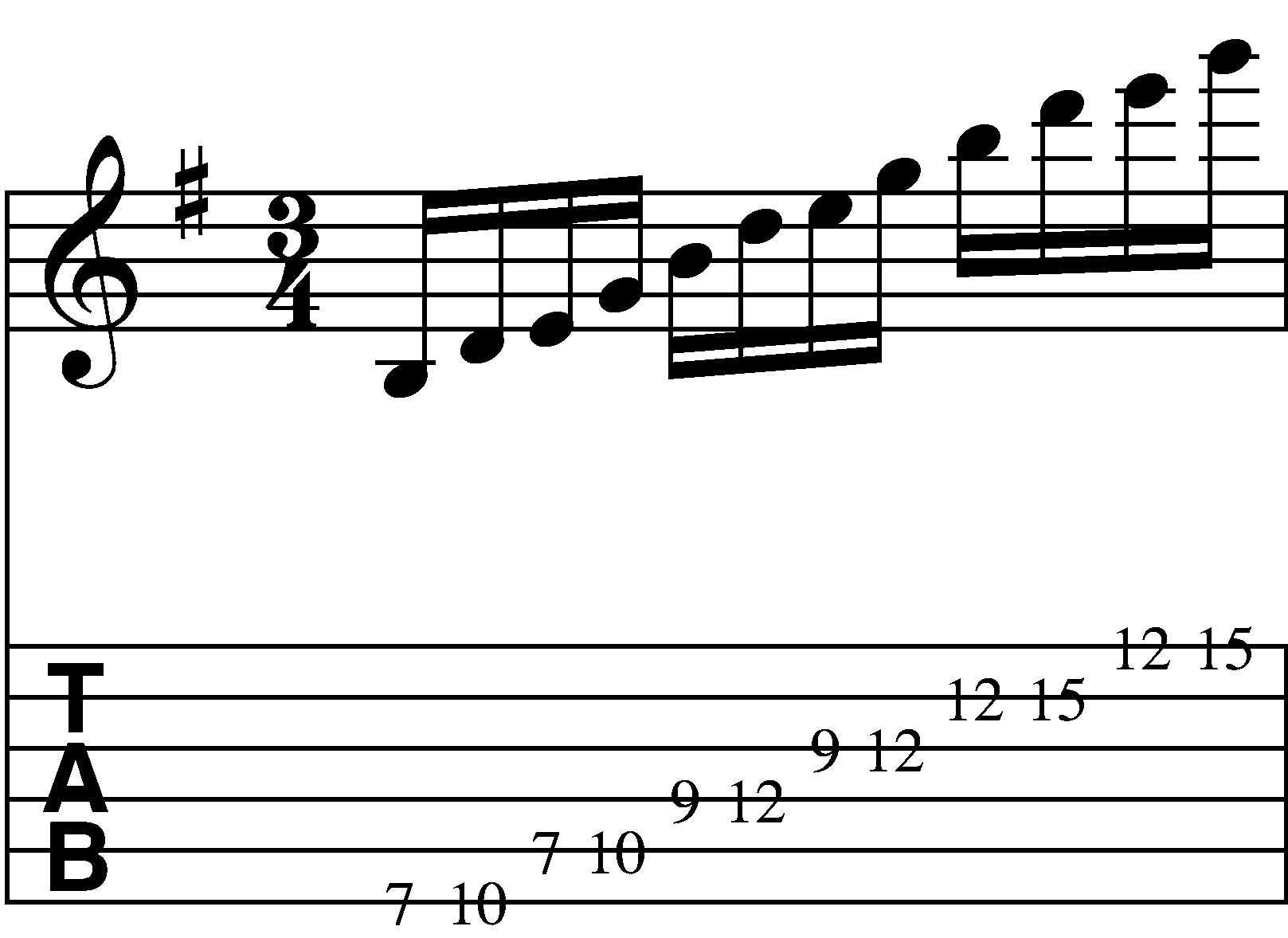
.
.
Pattern # 5

.
.
Working with patterns
.
Note:
Pentatonic scales, or any kind of scale in general, are simply a tool in making music, but are not music in and of themselves. The goal of this process is to use these shapes as a way to visualize sounds and then to be able to manipulate them in real-time.
.
Let’s generate a musical line using this approach. Here’s an idea in the style of Paul Gilbert. I’m picking every note in the example – but you could use hammer-ons or pull offs for a more legato feel. It’s played first with sextuplets and then slower at 16th notes to make the notes easier easier to hear.
.

.
.
The drums on this track are just a simple loop I pulled together for a song I was working on called Raga Jam.
.
.
While recorded at 105 bpm – the mp3 can be downloaded and then slowed down or sped up to accommodate your tempo needs. A number of applications will do this but if you’re looking for a recommendation – I recommend Transcribe! by Seventh String Software.
.
There are several ideas here worth exploiting.
.
.
In general, practice playing patterns in a variety of rhythms as you may find ideas you can use later.
.
.
The use of the open E and A strings changes the overall fingering shape on the bottom, middle and top two strings which may make the lick more challenging to play.
.
If you are having difficulty playing something melodically, take a close look at the fingering you’re using and see if it’s the most efficient one.
.
In the example below, I’ve taken the same notes and broken them up into melodic shapes that use the G, A and B pitches on the same string. You will probably find this much easier to play.
.
Here’s a fingering variation of the above idea (watch the skip from G to B on the D string!)
..

.
.
Going a little further:
.
Sometimes patterns can lead us to unexpected melodic places. Here, in this approximation of an improvisation for example,
.

.
.
.
By understanding patterns, it becomes possible to manipulate them and make them work for you. In the next lesson we’ll play full pentatonic patterns on 2 string sets and bring in a few other ideas that will spice up your approaches
.
Tones:
.
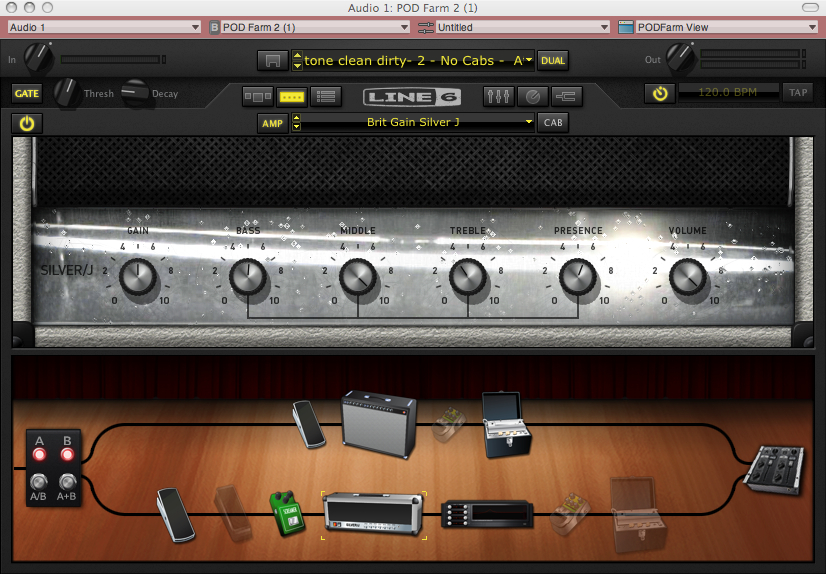
Finally, for those of you interested in the technical side of what I’m doing here are some screen shots of my set up. First the AU Lab rig:
.

.
Something that may be of interest to you – I set Audio MIDI Setup to 88.2k for the DUET – but run the LA Convolver speaker cabs at 44.1. That way the audio conversion rate for the guitar signal stays higher but I can use things that run at 44.1 (like the audio player on the Generator 1 strip).
.

.
I’ve mentioned the AUAUDIO File Player on my AU lab posts – but it’s a cool plug-in. Using it, I can bring in all kinds of samples or tracks and run them live with the guitar signal and record them with the click of the record button. (It’s how all of these tracks are recorded btw – live into AU Lab).
There are two dirty sounds (I didn’t like my first tones so I re-recorded everything. When I couldn’t find the first 5 audio files while typing this – I just went with the initial recordings since I didn’t have access to my guitar.)
.
Here’s the dirty side of the main tone (Tube screamer is set at 9%, 53% and 9% – BTW)
.
.
and the clean side:
.
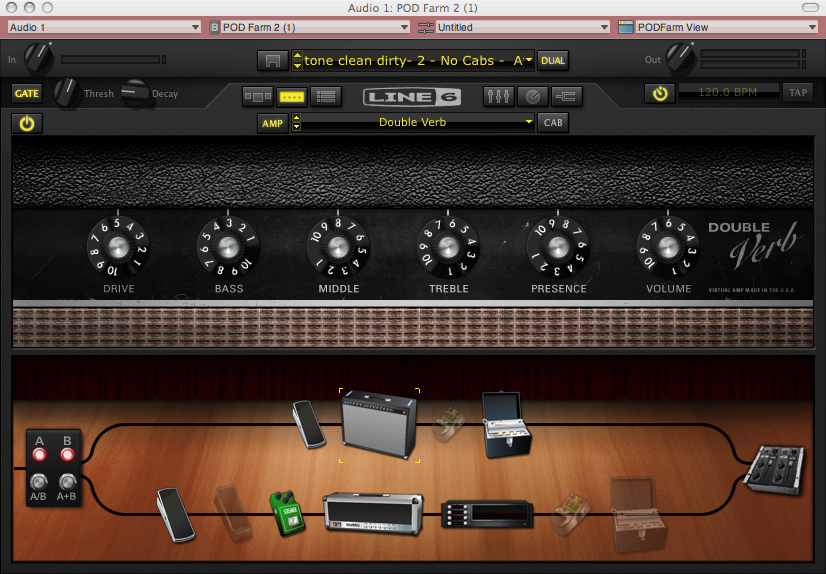
.
Tracks 1-4 are just my standard Marshall Who? settings
.

.
Part two will be up soon!! In the meantime, if you like this approach, I have a book that includes this material you may be interested in that features this material and much more!
is 100 + pages of licks and instruction and includes demonstrations and breakdowns of two-string fingerings, diagonal pentatonics, sweep picking pentatonics, pentatonic harmony and much more! It’s available here.
.
Thanks for reading!
-SC
I had a moment to catch up on some things this weekend, and returned a call from a friend of mine at CalArts. We had a very nice conversation catching up and discussing Higher Education funding, trends, pedagogy and the like and she was kind enough to tell me this:
“You know, in a conversation we had once – you gave me some advice and told me that, ‘it is what it is’. I thought about that a lot – and about how you’ve brought it up a number of times in our conversations – and it’s something I find myself coming back to as a mantra when I’m facing something difficult.”
She had asked me about where that mindset came from, and I’m sure it’s rooted in growing up in a working class small town in upstate New York. Compared to many people around me I had it relatively easy. My parents both worked hard – my dad taught middle school and my mom worked in a factory – and they owned the house we lived in. (A note: Despite a lot of nonsense talk generated in the media earlier in the year, as people living on an educator’s salary, we did not live high on the hog. We burned wood for fuel (that we cut stacked and dried on our own), did all our own repairs and (for a while) raised animals for food. The two-story house I grew up in with a garage and a 2 story workshop on a 1/2 acre of land sold for well under 40k if that tells you anything about the economics of the region.)
Other people I knew had it really hard. Farmers (and often their children) who worked from dawn to dusk with spouses working additional odd jobs just to make ends meet. We had “valley runners” – a term of no endearment reserved for families who would relocate multiple times a year to stay one step ahead of the law. I’d always see the kids in my classes; they’d show up for a couple of months and then be gone to the next county. When I’d see them months, or years later, they had always changed for the worse. They picked up a number of skills they needed to survive when you’re always on the run (typically manipulation, but sometimes cons or petty theft), that were depressing enough for an adult to have to rely on to get by – much less a child.
Mainly though, I knew a lot of good people who worked hard and were often presented with really difficult situations. And the response to those situations was to work through it. I can’t count the number of times that I heard variations of, “No use crying about it – let’s get to work.”
For those of you who resonate with this sentiment, and have never read Marcus Aurelius’ Meditations, it might be worth a moment of your time. One point Aurelius’ (and other Stoics like Epictetus) bring up repeatedly is the value of seeing things for what they are. That often means removing the emotional issues associated with the matters at hand and trying to deal with them objectively. (Albert Ellis made an entire career out of this method of inquiry with his REBT (Rational Emotive Behavioral Therapy) approach).
.
Getting emotional about certain things (particularly difficult things) only adds to their difficultly.
.
In my world view, some things are simply facts andviewing those things as such makes it easier to see them for what they are.
.
For example:
2+2=4.
How do you feel about that? (or do you feel anything?)
It’s difficult to get emotionally invested in it because it’s merely a fact.
.
Now here’s the idea applied: where a student might hear, “You’re going to have to put a lot of time in to getting those sweep arpeggios down the way you want.” I hear “2+2=4”. There’s no emotional involvement and so there’s less to get tripped up on.
There are a million reasons to procrastinate, and generally only one or two to get something done. If you’re facing something really daunting there’s a several part process I can share to help make it manageable.
.
Getting it done
.
.
I remember reading a David Lee Roth interview where he was talking about how having a drive was the only thing that was going to get you through endless vocal practicing in your bedroom.
There’s nothing glamorous in the work that goes into doing anything well, but it’s necessary to acquire the skills needed to do those things.
.
In other words, it is what it is.
.
Thanks for reading.
-SC
A lot actually, because if speed is the only tool at your disposal you’re not going to be a working craftsman (or craftswoman) for very long.
.
Guitar-squid, (a cool user-generated content guitar site I really like and recommend you check out), recently posted a link to a you-tube clip of of John Taylor trying to break a speed record by playing along with a sequence of Nikolai Rimsky-Korsakov’s Flight of the bumblebee at 600 bpm ( 11:48/12:26 in the video – note: I think the math here is suspect – it may be 600 bpm if he’s counting it as 1/8th notes – but it sounds like 1/16ths at 250 bpm/300 bpm to me).
.
.
For sheer technical precision you can also see this attempt by Tiago Della Vega at the same song here at a much cleaner 320 bpm. (7:38 or so)
.
.
The Guitar-Squid post was asking the question of whether or not the performance was real or faked. The real question however should probably be, other than the players themselves, does anyone care?
.
Flight of The Bumblebee
.
I’m not going to bag on either of these players because I respect the work that went into both renditions, but I am going to use this approach as a springboard for:
.
Why I think trying to set Guinness World Records for speed is a musical dead-end.
.
.
.
One reason these particular arrangements aren’t moving is because there’s nothing to contrast the velocity of notes against besides a number of earlier renditions of the same arrangement. Let me use another analogy. Say you take a commercial flight somewhere and have a window seat. Soon you get to cruising height and look out above the peaceful clouds and it feels very calm. You’re actually moving at over 500 mph but since there’s nothing to contrast it against, it just seems like a “normal speed”. If, however, you were to fly at that speed about 20 feet off the ground you’d probably die of fear – because when you saw how fast you were moving past other vehicles and identifiable landmarks, you would understand just how fast you’re going. When you play quickly, it’s only quick compared to the slowest note you’re playing. Otherwise, you’re just playing a lot of notes and it’s perceived as cruising speed by the audience.
.
.
In contrast to this, Hendrix’s solo on All along the Watchtower is something I could sing start to finish right now. Paco De Lucia can play a million notes with every one of them will leaving you breathless – and I’m sure that he could care less about how fast he could play Flight of The Bumblebee. In these examples, both players left me with something even after I stopped listening to the recording, because there’s real expression behind it. It’s hard to be play a lot of notes with meaning, but it can be done and when it happens – it’s done by people who are playing a lot of notes to get somewhere very specific rather than just to impress you. I’d point to the best moments of Yngwie or Scotty Anderson as one starting point and Shawn Lane, Allan Holdsworth or Guthrie Gowan as three guys on the more extreme end of the spectrum of note density who have something to say.
.
I’m not going to put all the fault on Rimsky-Korsakov either because the fault lies more in this particular arrangement and the parts people are leaving out as much as it is what they’re playing. Below is a piano rendition by Maxim. While it’s nowhere near the velocity of either of the guitar versions above, playing the harmonic component at the same time makes for a more nuanced (i.e. to my ears – enjoyable ) rendition.
.
.
.
If you do get gigs from it, they’ll be clinic type gigs where you play this and (just like the end of the first video) you’ll just getting people demanding that you play it faster. Not “better” – just faster. Because all this arrangement has going for it is velocity, and just like your news story will get bumped by other local news, your speed playing will get bumped by a cool extreme sports video or another video of someone wiping out trying to do a stunt.
.
I’ve mentioned some elements of this here and here as well, but being known as a really good guitar player who has the ability to chop out when you need to will serve your career in a much greater capacity than being known as the player with just a lot of chops.
.
Please note:
I’m not bagging on having chops or trying to develop them (and to do so would be completely hypocritical in my case). As a musician, you have to have enough ability to express yourself on your instrument and that requires technique. But technique only exists to help serve the song and the musical moment. Technique for its own sake is a musical dead-end.
.
Bonus quiz:
.
Give yourself a B+ if you can name either of the names of the two guys playing the guitar videos above without looking them up. If you can name either one two days from now without looking it up give yourself an A+.
..
Be the person people hit the rewind button for.
..
Marty Friedman once talked about how a really great solo is the one that you’d stop the recording for and rewind to hear again.
.
We remember things that touch us. We remember things that move us in some way. We share those things with other people. People that get excited about the things you do, are more likely to see you perform or seek you out and if you can move them at a show, you’ll see them again. That’s how you build an audience – one rabid fan at a time. If you touch people as a musician, you’ll be able to sustain an audience (and a career) a lot longer than someone who merely impresses them.
.
Thanks for reading!
.
-SC
.
ps – if you like this you may also like:
.
A number of the motivational posts I’ve posted here center around a few key concepts:
.
.
The reason I come back to these posts to the extent that I do (and why I address it with myself as much as I can), is because it’s incredibly important to make the most of your time and enjoy it because time is all you’ve got. All the talent, skill, strength, brains or money in the world won’t stop you from dying eventually. Since all those things (talent, skill, strength, brains and money ) are acquired over time, in the end all you have is your time and how you’ve used it.
.
Life is short and the only thing of value. Don’t waste it away.
.
We live in the most technologically advanced era the world the world has ever seen, but despite (and/or because of) that technology we also live increasingly isolated existences. As a society, we often equate texting with talking and surfing the web to connecting with someone (or something).
.
All we’re really doing is staring at a TV with an infinite number of channels and typing.
.
There’s only limited interaction and a one way transmission of data. It’s addicting, comfortable and seductive and brings about the complacency and relaxation everyone looks for at one time or another. I’m not saying you shouldn’t relax, but I am saying that being sedentary in anything you do carries it’s own inertia (physical and psychological). The more you turn off your brain, the more likely you are to turn off your brain – even when you don’t want to.
.
My father’s grandfather worked coal for the railroad every day of his teenage and adult life. It was long hours of backbreaking labor and by all accounts, he was an incredibly powerful man. When he retired, he decided that he was going to retire from everything. He sat in his favorite chair and went from someone who was active and engaged to someone with very minimal physical exertion and no real goals for the future other than not working. He died a couple of years later. I can’t prove that they’re related, by in my mind they are. By my dad’s account, he basically just decided to stopped living.
.
“When You Come To A Fork In The Road – Take It”
.
And this brings me back to meaningful living and navigating the overwhelming number of options available to us. Indecision is a natural byproduct of being overwhelmed. While I’m all for making an informed decision before taking action, if you spend too much time informing yourself, you won’t have any inertia to carry out what you initially wanted to do. The unexamined life may not be worth living – but the over-examined isn’t either.
.
In any battle with indecision, at a certain point you have to punt. If you get overwhelmed with options, pick one and run with it until you have to switch to another. If you have a good grasp of what it is that you want to do, you’ll make changes in direction as you require to get back on track.
.
It’s less important what thing you do first as long as you do something.
.
Thanks for reading.
.
-SC
It’s easy to get so caught up in the how, or the technical process of what you’re doing, that you forget the why.
.
Every once in a while someone will send me a You Tube clip of some wunderkind playing a million notes and I often think, “Wow it’s impressive to spend so much time getting that down. I wonder how they’re going to use that when they’re playing Brown Eyed Girl at the local bar?” The answer, of course, is that they’re not going to play that or maybe even any song. The point of the video generally isn’t to develop something interesting in a larger musical context (like a song) but instead to promote their efforts by performing something technically difficult to get people impressed.
.
I don’t fault players for this, they’re simply trying to make a connection and that’s the point of music in general. Sometimes that means playing a million notes and sometimes that happens in the silences of the music you’re playing. It’s an easy path to go down because making a connection is really hard. In addition to a lot of work, it requires experience, sincerity and no small amount of guts to leave yourself exposed. In contrast, sitting down with a metronome and getting a lick up to a quick tempo is substantially easier and the result is quantifiable. Even if people aren’t impressed, you’ll know that you got it up to speed and take some comfort in advancing your technical ability.
.
But the flash of something fast will fade quickly, and what’s left is the content of what’s being said and the sincerity behind it.
.
I like video game licks in certain contexts, but they’re probably not going to work on a ballad very well (even if it is a fusion track 😉 ). If you’re saying a lot of words without much meaning it’s not going to have a lot of impact.
.
I’ve had gigs where everything involving making a connection turns off on the stage and while it’s not a defining moment in human history, for someone who’s being used to being connected to music it’s a pretty awful feeling. I’d even argue that this was the case for 90% of the gigs I’ve played in LA. There can be any number of reasons for this. There might be technical issues that completely pull you out of your mindset. The audience might not be there to make a connection. Things may not be jelling with the band. But most importantly, it may be your disconnect, and it’s the most important, because it’s the only performance factor that you really have control over.
.
Those of you familiar with the Aesop’s fable regarding the fox and the lion will probably remember the final adage, “Familiarity Breeds Contempt “. You can put so much time into the same thing on guitar that it loses all musical meaning. The bad news is it’s probably not going to gain additional meaning on the bandstand. In all likelihood you’re going to disconnect from it further.
.
The more you work with specific things the easier it is to auto pilot your way through them, and the less likely you’ll be able to connect with it. Taking that a step further, it’s going to be hard to connect to audiences if you’re disconnected from your own playing. It’s more common than you might think, and a lot of musicians go through small (or large) periods where they “weren’t feeling it”. They hit a wall.
.
By it’s nature, any wall is usually made of pretty hard material so meeting it head on and trying going through it is not the best approach. I can tell you from personal experience that taking the approach of saying, “suck it up” isn’t going to get your groove back. Playing through it is exactly what you probably shouldn’t be doing because it’s just going to distance you further from the actual music when you play. It’s like when a relationship is on the rocks and you’re convinced that spending more time together will make it better when the time you spend now is stinted and awkward. The better approach in both cases is to step back and get some perspective…to go over the wall if you will…
.
One man’s recommendation for dealing with the wall
.
If you’re facing this right now, here are some strategies that may help.
.
.
There are a lot of other things you can try, but the real goal here is to get re-engaged and bring that to your playing. As corny as it may sound, playing is an expression of who you are and where you’ve been. If you don’t have anything to say in your playing, it may be time to live a little more so you’ll have a story to tell next time you sit down…For me, it was about realizing what was wrong, taking ownership of that and moving past it to get back to making music instead of just sound again.
.
Good luck to you and thanks for reading!
-SC
.
Hey all,
Greetings from the sweltering heat of AZ! (Sweltering heat? In June? In a desert? Go figure!!)
Here is a micropost of a few things in orbit of the world of GuitArchitecture.
Real posts resume next week! Thanks for dropping by and have a good weekend!
-SC
The forums have been a flutter over the Fractal Audio announcement/release of a major upgrade to the Axe FX product line, the new Axe FX II. For those of you who aren’t familiar with the unit, The Axe FX is a high end modeler that emulates a number of amp tones and effects very well.
.
From my second hand experience the pros are:
.
.
The cons are:
.
.
As soon as the FXII was announced, a number of Ultra and Standards went up on eBay. The fact that the re-sale value on Ebay is quite high ($1300-$1600 for an Ultra on Buy it Now) also speaks well to the quality of the unit. I’m sure that the new model is a substantial improvement over the original (which are now phased out) – but how much better does it have to be? The current world economy is helping some people keep cooler heads and realize that if they always liked the tone out of their current Ultra – that they’re probably still going to like it a year from now. With that in mind, here’s a gear acquisition reminder:
.
Cutting edge es MUY CARO!!
.
The latest thing is always going to set you back financially. To add insult to injury – you’re generally paying to be part of the learning curve. Things break, things go wrong, things need updating and as someone on board for version 1, you will be part of that curve. On the plus side, you’ll know the unit deeper than a lot of people and be able to coax things out of it easier. Economically, it’s a simple question of how useful or necessary that skill set is to you.
.
However, if you can hold back a little and wait out the initial rush. You’ll see the products getting updated. You’ll see other people having to tweak tones and work out solutions to problems. You’ll also see some people getting frustrated and selling their things at a great loss. I saw an Axe Standard on eBay for $800. If I was in the market for one that price would be WAY more appealing than the $1700 they were originally getting for them.
.
If you want something new it’s typically financially prudent if you can hold off. (With used gear, it’s always – you snooze you lose – and it’s also generally the case with one offs, rare or discontinued items. One of my favorite sonic mangling pedals, the Digitech Space Station, was acquired from Guitar Center when Digitech discontinued them for $90.)
.
POD HD500
.
However, when I read about the recent substantial update to the POD HD line – my curiosity was piqued. I had already mentioned the price versus performance differences between the POD Farm and the POD HD; but the ever increasing set up time of my POD Farm rig had me looking at the POD HD a lot closer recently. The Pod Farm rig still completely makes sense to me for laptop gigs – where I’m sitting down at a table and sculpting sound – but the laptop with a live band thing started to become an issue, not only live but also in setup time for rehearsal.
.
There are probably a thousand pages with stats, clips, videos and MP3s of the POD HD. So I’m going to spare you all of that. You’ve already probably researched that to get here. What I can offer are my impressions for using it live, and how I think it stacks up.
.
Construction:
.
This is a sturdy unit weighing in around 14 lbs due to the all-metal chassis. It feels solid and I have no doubts about it standing up to live use. The switches are similar to the X3 or Shortboard MK II, but seem to be a little higher quality to me. (I don’t have any quantifiable analysis so I might be imagining that – but they work well in any case). The expression pedal on my unit is even smoother than my Shortboard MK II. Some people have had problems with the pedal but mine was fine. After I installed all of the updates, I did have to recalibrate it, but since then – I’ve had no issue with it.
.
The display is very clear, and offers multiple viewing options, but I’d like to see a fully realized list option as well. You can edit all of the parameters on the unit, but the HD EDIT program is so much more intuitive, you’ll probably gravitate to editing things on a computer. That said, some parameters can only be edited on the unit itself (like the looper features), so you may want to get a little familiar with the on board controls as well.
.
The HD 500 doesn’t have an off button – which is a little strange but manageable. While the power cable is shorter than what I’m used to on a stand alone unit, I’m guessing that Line 6 planned on it being mounted to a pedal board and then just plugged into a power strip. This would also explain the elongated plug size as it looks like it’s designed to fit between other plugs on a power strip.
.
In terms of ins and outs on the unit – the 500 is very similar to the X3, ¼ “, XLR and SPDIF outs, as well as midi connectivity and an RCA jack in for mp3 players/etc. You can record with the USB – but I only use it to connect to edit so I can’t comment on recording direct with it. I do find the connection time with my mac to be EXTREMELY slow – but it works fine once it’s connected. The proprietary DT50 and the variax connections are cool as well, but since I don’t have either right now, I can’t comment on them.
.
Managing expectations for current Pod users:
.
First – and this is important – there is no upgrade path from old models to new models. There’s no tonal equivalency between old patches and new. Furthermore, I would argue that if you expect this unit to sound exactly like your favorite X3 patch, you’re probably going to be disappointed.
.
One thing to remember in the non-modeled world is that any amp is, by and large, a one trick pony. I played a 5150 combo once with a nice dirty tone and one of the most useless clean tone’s I’ve ever heard. As someone who put substantial energy into trying, it’s useless to attempt to make a Marshall sound like a Fender twin (or vice versa). So even people who don’t model – and get the bunk of their tones with pedals of one type or another – end up compromising when it comes to tone. If you’re playing through a Fender you might get a Marshall-ish tone, but it’s not going to stack up side by side to a Marshall going through a 4×12. In managing my own expectations the my goal eventually shifted to getting a useable tone (in this case with a Marshall as a bench mark). If your expectation with modeling is that it’s going to sound exactly like a Bogner through your $100 practice amp – you’re going to be disappointed.
.
Having said that, this unit has some really good sounds. A lot of the tricks that I developed to get around limitations in the X3, or Pod Farm are actually not necessary in the HD because the base amp sounds are that much better.
.
.
Second – the tones between units aren’t compatible. The Pod HD 300 or 400 tones won’t import into the 500 directly. That does seem a little myopic to me – but the good news is that you can download the HD edits for any of the units and run them without hardware. When I found a HD 400 Plexi patch I liked – I just downloaded it, opened it up in the HD 400 Edit and then just manually copied the patch elements into the 500 for tweaking.
.
Third – the volume and wah assignments aren’t automatic and are counter intuitive to me on a number of patches. Having said that, they’re not that difficult to set up. One thing I did was to save a patch with all my routing up and then build other patches around that set up to save time.
.
Fourth – The DSP issue. I think that some real world tests should have been done to make sure that the POD could handle any configuration of effects in the 8 slots they have. There’s a great PDF (Thanks Fester2k!!) that shows how the models and FX use DSP. Some are just more hoggish than others. The particle verb sounds great – but you’re going to have to compromise some things if you want more than one in the chain.
.
Fifth – The signal chain is very flexible (and the new GUI for editing is slick). The expression pedal being used as a straight volume pedal takes up an FX slot – BUT if you assign the expression pedal to an amp volume parameter you can control the volume with no hits to the number of FX slots. I suppose you could assign the expression pedal to a sweepable tone control on the amp for a makeshift wah, but since neither of these effects use a lot of DSP for most people it won’t be an issue.
.
A neat trick I grabbed from the Gear net forums is that you can use the FX send as a volume boost by just plugging a ¼“ cable into the FX send/receive and boosting the level on the FX Send. This is a good trick for Pad or FX heavy sounds without an amp to boost the signal and can also work as a clean solo boost.
.
Amps:
.
In the POD HD series, a lot has been made about the smaller number of amps. Personally, I only use 4-5 amps in POD Farm anyway so the number isn’t an issue if the quality is there, and by and large I think it is. The fenders sound really good to my ears, and you can even push them to get them to break up like a real Fender would. The Gibson is cool and the Vox and Supro are nice touches as well.
.
In terms of distortion, I find that a number of the amps break up in a musical way and react to picking dynamics much more so than the X3 or POD Farm. I can clean up some of the Marshall models by rolling the volume back and then punch it to distort at full bore. VERY COOL. The JCM 800 works really well for me live. The park does some nice things as well as the J45. A lot of people rave about the Dr Z…I haven’t gotten it do do what I want – but it’s a cool addition. For metal (and metalish variations) – the mesa works really well. The sound just cuts through everything. The Line 6 Elektrik model can get comically over the top as well.
.
There are some nice contrasts between the pre-amp only models and the actual full amp versions. One BIG benefit to the full amp models is the ability to tweak Master, Sag, Hum, Bias, and Bias eXcursion. Particularly on the distorted models, being able to adjust the Master and Sag make tone adjustments that range from subtle to blatant. The downside is using some models of the full amps will cause a spike in DSP use and may make the overload screen pop up. Line 6 did a streaming video with some GREAT information on all of these parameters (tech talk starts around 24:00).
.
Cabinets and Mics:
.
The biggest complaint people on the forums would like to address is that they can’t upload their own IRs to use with the amps. You can bypass the cabs and mikes on the 500 and if I were recording direct in the studio, I might be looking more in this option. But since I’m looking at more of an all-in-one option, and running all of these into my atomic, I think a number of the cabs sound fine for my purposes. Being able to load IR’s would be nice but would also put a substantial tax on the processor – and I’d rather have things running the way that they are. That being said, I’m not always happy with what I hear through headphones – but I run the patches studio direct into my Atomic and some of the amp/mic combinations work really well.
.
FX:
.
It is pretty easy to max out the processor, but some of the Fx sound really good. Most people on the forums would like additional options for drives, gates, etc. and I suspect we’ll see more of those over time. In the meantime, you can certainly get useable sounds out of the Fx/amp combination pretty quickly. There are certain sounds on Pod Farm I REALLY wanted to get out of this unit that I just can’t. The Fx are too different and I run out of DSP too quickly. Having said that, I have some Fx patches on this unit I can’t get out of my Pod Farm – even with all the other sounds. So it’s a fair trade off to me. You’re limited to DSP power but you can run multiple instances of pedals as well. A good thing in my book. The expression pedal can be routed to any fx parameters as well, so for example you could go from a dry clean sound to an ambient one just by fading in the verbs, delays or whatever other effects you have on the pedal.
.
Looper:
.
The looper was one of the things that excited me the most about this unit. It doesn’t have anything near the complexity of something like SooperLooper, but is functional for stacking loops. It does have some eq and recording volume options for loop recording that help with the stacking options. A big part of what I do with looping involves bringing loops in and out of the mix with what I’m playing but since there’s no editable parameter for loop volume (i.e. being able to use an expression pedal to adjust wet/dry volume levels of the loop volume); it’s something that I can’t really use too much right now. Hopefully this will get addressed in a future update (along with allowing the external ¼” expression pedal jack to be routed to a 3rd expression pedal just to control loop levels).
.
On the stock setting, the switches convert their functions to looper parameters (record/overdub, start/stop, 1/2 speed, reverse, etc). So if you’re using the bottom row of switches to bank through sounds and want to switch tones on a loop, you’ll have to turn the looper switch off (the loop will keep running), and then switch from there. This also means that you have to turn the loop switch back on to turn the looper off.
.
The looper has 2 modes, post and pre. In post, it records the entire signal chain. Generally, this is probably the setting you want to use. In the pre-mode the looper records the dry signal, and processes it through what ever patches you are switching between. Having said that, by using the looper in the pre mode, you can loop a riff and then switch it between patches or tweak the sound of a patch without having to play it endlessly.
.
The only other drag I can think of right now is that none of the looper parameters can be edited in the current HD edit. It would be nice to have a global feature on the edit that also included a parameter for the looper.
..
Using it with the Atomic:
.
This is where I think this unit really shines. On POD Farm, there were a number of factors that I had to use to determine how the unit would sound. Most of the distortions only sounded useable to me at 96k (which put a huge tax on the system), and even then patches at low volume and higher volume often reacted completely differently. Sounds that sounded good at an apartment level sounded like crap at stage volume in a club and vice versa. With the POD HD, everything evened out more live. I turned it up at the club and really had very little tweaking from bedroom volumes. Additionally, no one really noticed the lack of the laptop sonically, so it was a big victory there. I used it with the 18 watt Atomic for the last Rough Hewn Trio gig, and never had to turn the master volume past 12 o’clock.
.
The comparison?
.
I’ve read a lot about people comparing this to the Axe fx. There probably is no comparision. It doesn’t matter to me much anyways as an Axe Fx II is out of my price range right now.
..
In terms of the POD HD:
..
.
I’ve never used pervious firmware versions of the POD HD but everything that I’ve read has said that this update was substantial. I can’t help but think that not only is this unit going to get better firmware updates (and more models of everything perhaps) – but that the Pod Farm HD version is going to be pretty much untouchable.
.
Accessories:
.
The Pod doesn’t come with a gig bag or case, so you’ll need some way to carry it. I have a gator gig bag I used for the Pod X3, that fits the unit. The pedal board option is more enticing, but good quality boards are expensive. Rondo Music has an inexpensive flight case that would fit the unit. But it’s still probably going to set you back at least $100 with tax and S/H.
.
Lately, I’m been more inclined to mount it, the power supply and all of the cables on pedal board and spend the extra buck on something like this and just be able to carry everything in one bag. You could probably get something similar at a thrift store for $10-$20 and then be able to take it on a plane with you as well.
.
Thanks for reading.
.
-SC
.
Hey all – a couple of brief news things:
.
1. My interview with FNH Guitars is now live on Live4Guitar, a very cool guitar blog with a paid lesson service as well. I’m going to be posting some lessons and additional content there fairly regularly, so check back here or at Live4Guitar.
.
2. I’ve also taken on a new weekly column for Guitar-Muse.com, that will be a 10 questions with various builders, players and tech people. I’m in the process of lining some cool people up – but wanted to get your feedback as well. The first person on the block is Jonathan Wilson who’s doing incredible work making bowed guitars in SoCal (check out some of the awesomeness on the Togaman GuitarViol site). Update: This interview is now online, you can read all about it here.
.
I’ve also got interviews with FnH Guitars, Jack Sanders and a couple of other people lined up. But I’m interested to see who you dear readers, would like to read about. If you could take a second to just put a name or a company name in the survey, it would be very helpful.
Click here to put your request in
.
Thanks for reading!
-SC
 GuitArchitecture.org