
When I was at Berklee, one thing that took a while for me to really get my ear around was upper chord tones (7ths, 9ths, 11ths and 13ths). Growing up listening to a great deal of rock music – basic triads sounded “right” to me. I learned a lot of esoteric chord voicings to try to expand on those forms – but my ear wasn’t ready for it and so I had no real motivation to develop it at the time.
As I mentioned in the getting through the gig and the recycling chords posts, simple triadic forms can be manipulated in a way that allows players to get more complex harmonic textures in real-time. Additionally, these approaches can be adapted to lead playing as well. This short series of posts are going to go deeper into adapting one specific chord voicing. As a starting point I’ll use the major triad.
The following examples are based around a 5th position A major chord played on the D, G, B, and E strings.
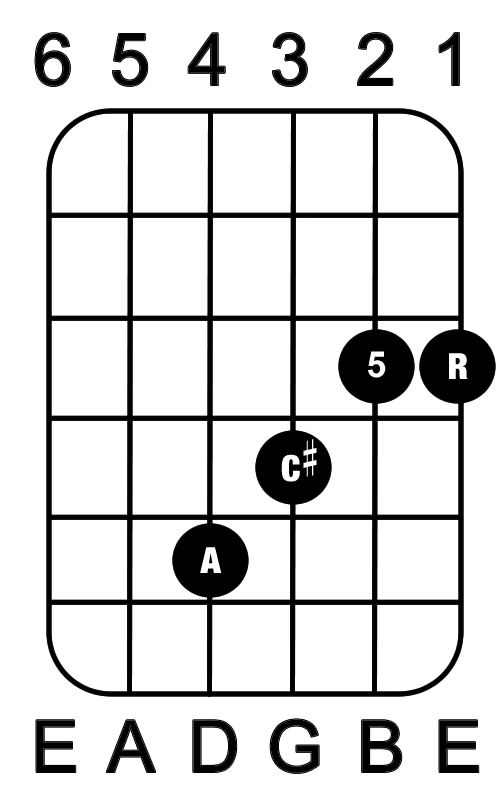
The reason I’m using this specific voicing is to allow the open A string to ring while playing the chord to help reinforce the root. Here’s the basic rhythm of the chordal examples:

While notated this way for simplicity, all the examples are played with a slight arpeggiation to help accent the different notes.
.
Here’s an mp3 of an A Major Triad.
.
Rooting around for extra tones:
The first way to generate some additional substitutions for a simple major chord is to lower the root chromatically.
While there is a root on both the D and the high E string, for now these examples will focus on manipulating the root on the high E string.

Lowering the root of a major triad a 1/2 step (1 fret) produces a Major 7th chord:
(This can be used in place of any A major triad)
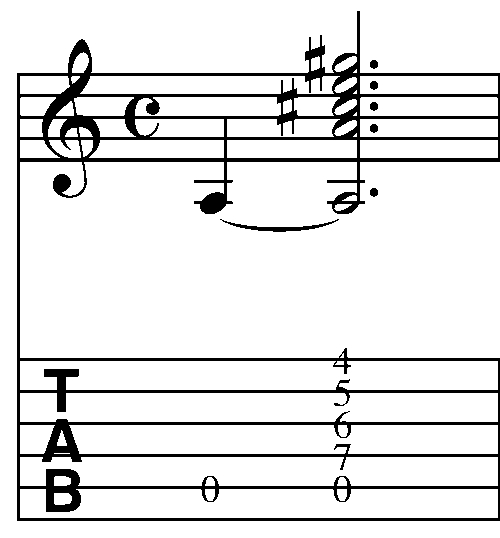
A Major 7 Chord
.
Here’s an mp3 of this A Major 7 chord.
.
Lowering the root of a major triad a step (2 frets) produces a Dominant 7th chord:
(This can sometimes be used in place of an A major triad
Example: When the A acts as a V chord in a chord progression (A -> D becomes A7–>D))

A7 Chord
.
Here’s an mp3 of this A 7 chord.
.
Note:
While dominant 7th chords contain a major triad in them – they are their own unique animal. A future post will go into generating dominant chords – in depth – but this voicing is presented here as part of the process of generating chords by altering the root.
.
Lowering the root of a major triad a step and a 1/2 (3 frets) produces a Major 6th chord:
(Typically this can be used in place of any A major triad)
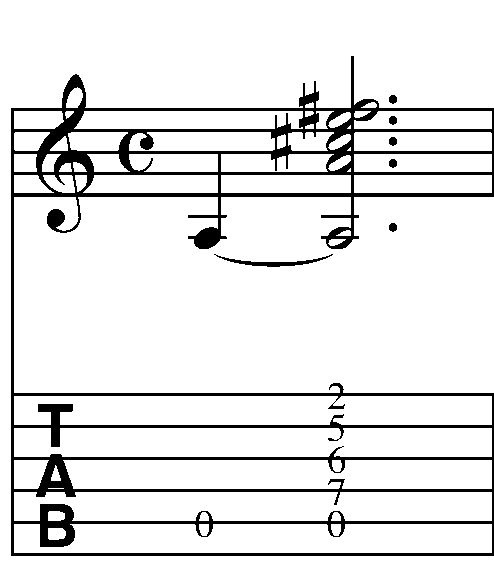
A Major 6 - Watch the 1st finger stretch - if it hurts - stop Immediately!!
.
Here’s an mp3 of this A Major 6th chord.
.
Another Note:
There are certainly easier ways to generate this chord – but any chord form with a 1/2 or whole step between notes on the B and E strings will require some limber hands. Again, this voicing is not the only possible voicing of this chord but instead is just one possibility.
.
6th chord/13th chord Tip:
Frequently, I’m asked about the difference between a 6th chord and a 13th chord. Since the note is the same for both the 6th and the 13th, the terms are sometimes used interchangably – but the difference is based around whether the chord has a 7th in it. In the example above, the F# acts as a 6th, because no 7th is present in the chord. If a seventh was in the chord, the F# would be viewed as a 13th.
.
The #4/#11:
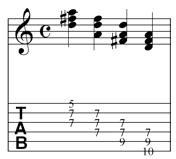
One hip tone to use in a Major based chord is the #4 (or #11). This is generated by flatting the 5th a 1/2 step (1 fret).

A Major add #4
.
Here’s an mp3 of this A Major add #4 chord.
I like voicings like this where the top voices (C#, D# and E in this case) are all close voiced (i.e. in the same octave). The technique of combining these close voiced ideas with open strings is a favorite approach of mine.
This idea can be expanded on by flatting the root as well.
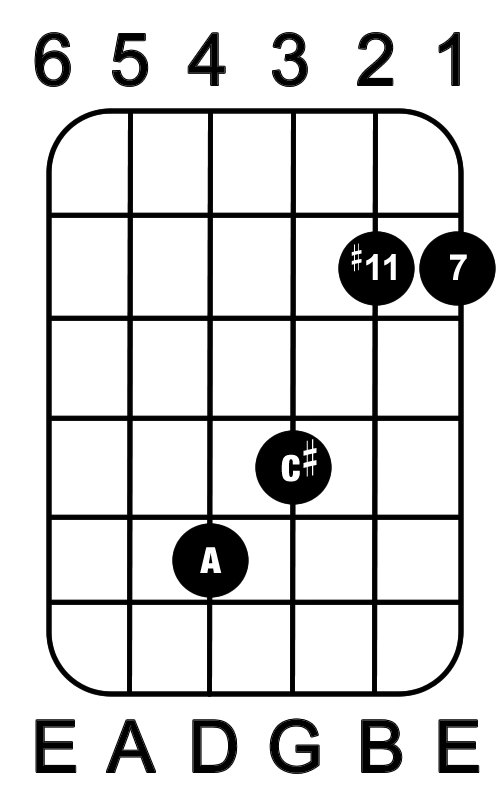
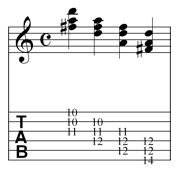
This produces an A major 7 add #11 (no 5th) chord (A favorite substitution of mine for a major chord).

A Maj 7 # 11 no 5th
.
.
Shortcut:
If you flat the top two notes of a major barre chord with the fifth and root on the B and high E string – you get a pretty hip major chord substitution. This works in any key.
In part 2 of this series, I’ll look at sharping the 5th and the root to generate more chord voicings, combining both approaches and extrapolating lead ideas from these approaches as well.
Thanks for reading!!
-SC





 GuitArchitecture.org