Glass Noodles – adapting a Philip Glass arpeggio approach to guitar

I tend to get a lot of playing ideas from sources other than guitar.  A primary source of influence is film and one of my all time favorites is Mishima. To me, Philip Glass’ score works brilliantly with the subject matter and helps create a powerful experience.

Here’s a lesson post on some cool approaches I borrowed (read: stole) from Glass that might provide you with some inspiration.

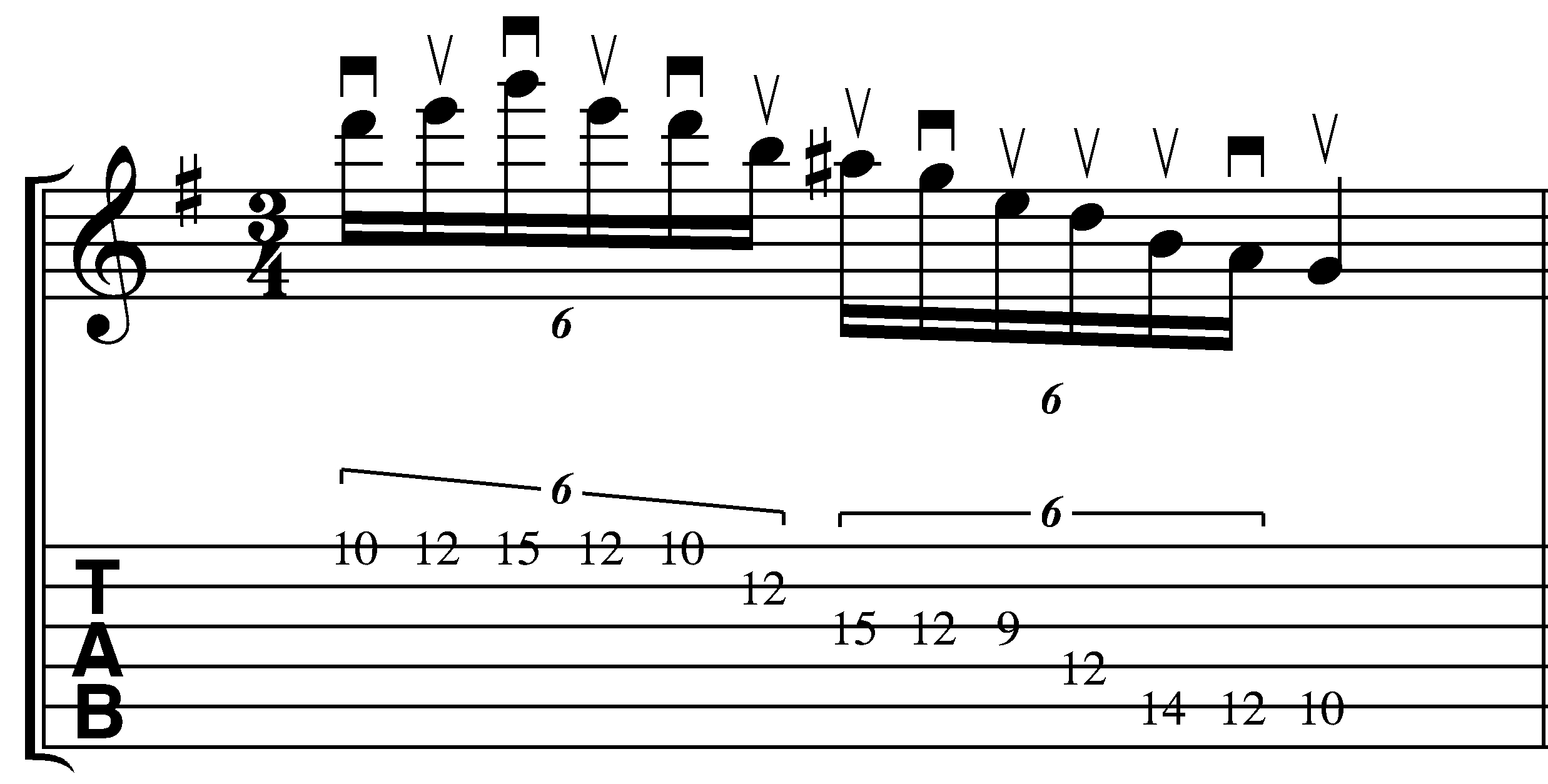
I’ll post the exercise first and then add some color commentary.

A link to an mp3 is here:  Glass Noodles122bpm

First thing’s first – the  triadic* chord progression (see note at the bottom) is  G Major, G# diminished, A Major, A# diminished, B Minor, G Major, B minor, B Diminshed, B Minor, G Major, B minor, B Diminshed. (Note: The second bar repeats – I just forgot to put the repeats in).

I’ll start with a technical issue and then go into the theoretical things to grab.

.

If you want it hypnotic –   you’ll have to lose the pick.

.

Part of the sound of this is the hypnotic repetition and a large part of that sound come from a uniform attack.  You can sweep pick all of these arpeggios as well – but for a more legato sound it’s best to approach all of these with fret hand tapping (i.e. all hammer ons and no picking).  From a technical standpoint the real challenges here are 1. keeping the attacks uniform (i.e. all of the note volumes are even) and 2. playing it in the pocket rhythmically.

.

Getting the maximum effect of something like this requires  sequencer like articulation and timing – and that alone makes this something worth studying.

.

As a starting point you’ll probably want to mute the stings to prevent open notes from ringing out (I just use my picking hand – some people use a hair tie or a piece of cloth.)

For uniform attacks – you’ll have to have very clean hammer-on technique with the fingertips hitting the strings instead of the pads of the fingers.   If there’s any slop there – it will come out in the arpeggios.  One other thing to note is that the notes should be lifted off and not pulled off.  If the only sound created is by the individual fingers hitting the strings – you will have a more uniform sound (which is totally the goal here).

.

Here’s a good way to visualize the fret hand finger motion you’re looking for.

.

Put the palms of your hands on a table.  Now without lifting the palms up, tap your fingertips one at a time on the table starting from the pinky and ending on the index.  You’ll notice that the fingers stay curved and that the large knuckle of each finger is responsible for the tapping.  This motion is what you’re looking for in this process.  You should also notice that you don’t need to hit the fingertips very hard against the table to get a crisp attack.

.

You should strive to get volume with the minimum amount of finger pressure.

The more relaxed you can keep your hand, the easier this will be.

.

You can add some compression to make help make the attacks more uniform as well.  I typically don’t use a lot of compression as I like to play very dynamically and find myself adjusting volume and tone a lot when I play – but a compressor plug in will make all of this easier to play.

This approach gets counter-intuitive at the G major arpeggio (the second arpeggio of bar 2).  For a technical stand point this is the trickiest part of the passage. (Note:  The numbers under the notes indicate fret hand fingerings.)
.

.

I am used to playing the G major arpeggio as a 5 string form – which usually uses the 3rd finger as a barre on the 12th fret, but barring the B and G on the 12 fret completely breaks up the sound and makes it impossible to get the tapped sound of the other notes.  To get around this – I use the index finger to fret the G  so each note gets a unique attack.

.

This is one of those deceptive exercises.  Playing it at 60% will not take very long – but the difference between 60% and 100% is HUGE.

.

Playing everything  with correct timing and really articulating every note will take a while.  Don’t get discouraged if it doesn’t happen right way.

.

The key here is to plan on spending a lot of time playing the arpeggios really slowly to make sure that the timing and volumes are 100% from the beginning.  You can read some of my posts on practicing to get a sense of the best way to start working on something like this.

Now some theory observations:

.

If you sharp the root of a major arpeggio – you get a diminished arpeggio.
.

This doesn’t sound like much – but look at the first 3 arpeggios.  By making the G a G#, you get a nice chromatic motion on the B string leading into the A Major Arpeggio.  You can also notice that the A# in the diminished arpeggio after the A major arpeggio leads right into the B Minor arpeggio.  This is a great way to sequence between 2 Major Arpeggios a step apart (Like G major and A major).

.

If you sharp the 5th of a minor arpeggio – you get the root of a major arpeggio.

.

Again a small thing – but by using this you get  a nice voice leading between the B minor/G major arpeggios in bar 2.  Also notice the chromatic motion on both the G and the high E string.   This continues the chromatic movement that occurred on the B string between the first 3 arpeggios.

.

If you flat the 5th of a minor arpeggio – you get the 5th of a Diminished arpeggio.

.

Check out the last arpeggio in bar 2!  By continuing the downward chromatic motion through the  G Major – B Minor – B Diminished – a sense of urgency is created and then the last point –

.

There’s mystery in keeping it unresolved.


.

In the Mishima soundtrack (you HAVE put the movie in your Netflix Queue yes?) there are a number of moments where at the end of the arpeggio flurries – it ends on an unresolved chord.   Here I’ve repeated the last arpeggio fully and then ended on the lower F on the last repeat.  If I was making a song out of these ideas – I would continue with the type of figures and ideas that have already been presented here and possibly resolving them.  But here in this context – ending on the F – just leaves a giant question mark and makes it interesting.  If you don’t believe me – watch the film!

.

*Note: If you move away from triads – there’s another analysis here:

.

The notes of G# diminished are can also be seen as the 3rd, 5th, and b7 of an E7 arpeggio.

Therefore: If you sharp the root of a major arpeggio – you also get the 3rd of a dominant 7th arpeggio (with no root).

.

This would make the chord progression   G Major, E7, A Major, F#7, B Minor, G Major, B minor, B Diminshed, B Minor, G Major, B minor, B Diminshed.

The bass motion would be what determines the actual chord progression.  I believe the bass motion followed the chromatic motion but the E7->A and F#7-Bm are pretty standard analysis for a chord progression like this.


More posts soon.  Please feel free to post any questions or comments you might have or e-mail me at guitar.blueprint@gmail.com.

-SC
A quick lick – and a rig du jour update from Ho Chi Minh City

Greetings from the former/current Saigon. (Technically Ho Chi Minh City but many of the locals call it Saigon).  I had hoped to post a couple of blog updates up before I left, but instead was running around checking things for the trip. Now a jet lagged – iced coffee and soon to be bahn mi –  fueled post:

.

1 lick or 2?

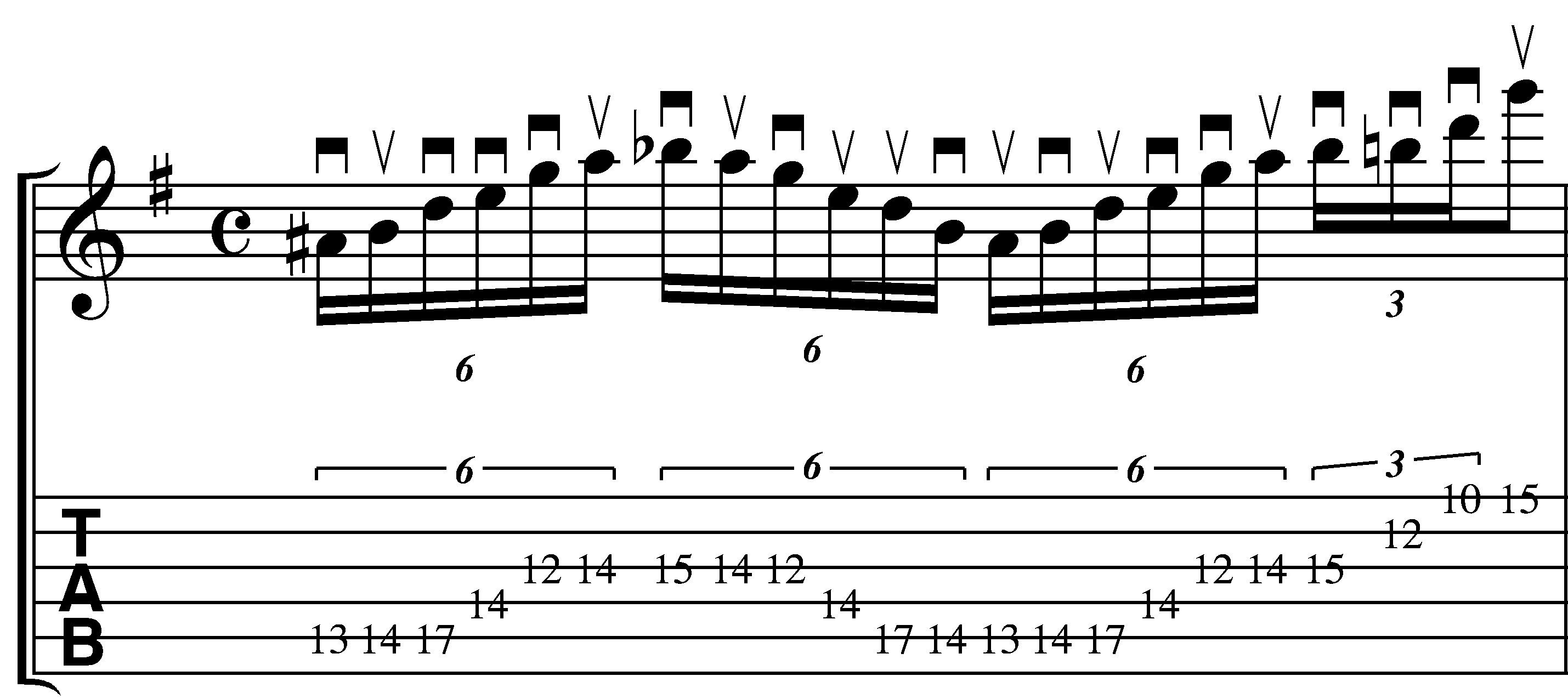
So first – here is a lick that works off of the swept pentatonic idea (alternating 3 and 1 note per string ideas) that I explored in the last online lesson (you can find a pdf of that lesson here).  While the online lessons have focused a lot on pentatonics – I wanted to add the tritone to make “the blues scale” and show how this approach could be adapted.  Here is the idea ascending:

.

It’s very scalar – but I added  a couple of points of interest:

1. the little descending turn around allows you to play the basic ascending idea starting on both up and down strokes.

2.  I started on the tritone (if played over E minor) or the b3 (if played over G major) instead of the root.  If you’re playing this over G – think Bluegrass metal ; )

3.  The motion is more diagonally oriented than the strict pentatonic example but is the same basic approach.  I start the lick with my first finger and then shift positions for the D on the 12th fret of the D string and the D on the HighE.

.

Here is an mp3: Lick1

As variation – I took the same concept and applied it in a more positional approach.  Be careful with this stretch!  If it hurts stop immediately!!!

.

.

Here is an mp3: Lick 2

And finally here are the 2 licks played back to back:  backtoback 1

.

Laptop Rig

So I bit the bullet and got an apogee duet.  WOW!  It really has made a stunning difference in resolution and I suspect will help a lot with future mixes I’m working on. With that in mind I wanted to share with the rig I used for the mp3s above.

Here was the basic amp setting I used in Pod Farm 2.0.  This was based on a customtone forum patch called Electric Gypsy.  I just swapped in a tube screamer and bypassed the cab (using the Recabinet impulse responses instead).  One of the big revelations that I found in pod farm is that I could put preamps AFTER the power amp.  Adding that in to the signal chain opened it up a lot.

.

.

I blogged about using impulse responses over the cabs before.  The lie 6 cabs sound good – but to my ears the IR’s add a whole other area of depth.  Here are the IR’s I used – these were from the Modern 1960 4×12 set.  The screen shot is from LA convolver.

.

.

Finally – a screenshot of how it all lays out in AULab.  I just hit the record button in au lab and edited out the noise before and after the take in fission.

.

.

FNH Guitar –> Apogee Duet–>AULAB–>PSP Vintage Warmer–>Pod Farm 2.0–>La Convolver (w. Recabinet IRs)–>Sooperlooper

.

I’m still tweaking things – but I think that soundwise everything is improving a lot from where it was even a month ago.  Once I get an A/B set with the floorboard – I think that the laptop is going to be the rig du jour.

One last note – the macbook has is using 4 gigs of ram and was updated with a 7200 rpm Seagte internal drive. (500 gig from OWC).  My computer accepts a 4gig chip in 1 slot – so I may go up to 6 gigs – but the faster internal drive made a big performance difference in the machine. I’d say you’d really need to have that if you’re going to try to go this route.

* Note – I’ve recently posted more on this topic here which may be of interest to you.

Definitions and Documents Or Practicing Part IV

I was originally planning on updating this post with pictures of hand postures and address left and right hand muting techniques – but given that I have sunburned skin peeling off of 20% of my body – I’m going to hold off on photos for now.

Instead, I’d like to take a moment and actually address defining practicing as a means of understanding what is being addressed by practicing and then examine how documenting the process can assist with it.

For those of you who are just coming to this post you may want to also read the previous posts on practicing.  Here’s a link to part 1, part 2 and part 3.

Definition

By defining practicing it’s easier to understand what practicing is supposed to do.  Here is a partial definition from Meriam Webster.

“Main Entry: 1prac·tice

Variant(s): also prac·tise \ˈprak-təs\

Function: verb

Inflected Form(s): prac·ticed also prac·tisedprac·tic·ing also prac·tis·ing

Etymology: Middle English practisen, from Middle French practiser, from Medieval Latin practizare,alteration of practicare, from practica practice, noun, from Late Latin practice, from Greek praktikē, from feminine of praktikos

Date: 14th century

transitive verb1 a : carry outapply <practice what you preach> b : to do or perform often, customarily, or habitually<practice politeness> c : to be professionally engaged in <practice medicine >
2 a : to perform or work at repeatedly so as to become proficient <practice the act> b : to train by repeated exercises <practice pupils in penmanship>”

The definitions presented in the 2nd part of this definition help – but don’t really explain how to train or what practicing is supposed to achieve.  So I’m going to supply one of my own.

Practice:  The proper focused repetition of an idea through an incrementally difficult environment for the purpose of achieving a musical goal.

By tearing apart this definition some elements of practicing can be exposed that you might not have thought about before.

proper:  meaning the right way; consistently

focused:  Practice requires concentration because it requires attention to detail.

repetition:  repetition leads to familiarity (and familiarity breeds contempt so be careful here!)

incrementally difficult environment:  To practice something means that you are pushing your abilities to do something.  In music, one implication of this is to practice with a time keeping device (metronome, drum machine, drummer, recording, etc.) – but this could be any kind of parameter that actually pushes you.

for the purpose of achieving a musical goal:  Practice is goal oriented.  If you are not trying to achieve anything then you are not practicing.

With a clearer understanding of what is meant by practicing – we can go on to how to maximize the use of your practicing time.

1.  Set clear, well-defined goals (short AND long-term) and work towards those goals.

2.  Since practice requires concentration, put yourself in an environment that facilitates concentration such as a relatively quiet, well lit and well ventilated room as free of distraction as possible.

3.  While concentration is required for repetition, excessive repetition undermines concentration.  Many people use set periods of time to practice something.  This can be a good policy if it is done in moderation.  Bill Leavitt (the founder of the guitar department at Berklee)  suggested that students should practice reading for 15 minutes of every hour of practice – because 4 sessions of 15 concentrated minutes of practice get you a lot further than one hour of unfocused practice.  A timer (like an oven timer) can be a great assistance here.

For some people, concentration will be a learned activity.  If you are not used to focusing on something with intensity, then even trying to work 10 minutes on something may be problematic.

If you are having problems with this area – try starting with smaller intervals of time like 5 minutes with one short phrase and then move on to the next item on your agenda. Practicing in this manner will help you develop your capacity for focus as well.

.

There are several different thoughts about achieving goals, for me personally – it’s important to get many ideas into muscle memory slowly and develop them all at the same time rather than developing only one idea fully after another. You, however,  should plan on experimenting and find what approaches work for you

By setting a timer and not worrying about how long you are practicing, (in whatever methodology you use) you can spend more energy on the actual performance.

.

Documentation

One approach to consider is seen in how athletes train.  After all, playing guitar is a physical process that requires performance of well-trained activity.  This is very similar to a swimmer who has to be able to perform at a high level at a signal (like a whistle blowing).  One thing athletes do is WRITE IT DOWN.  Runners for example often keep a journal of performance times to see if they’re improving.  Writing things down in a journal doesn’t have to be complex or difficult.  I used to keep a notepad in my guitar case, and then write things down.  But now it’s easier to customize a practice log or journal and utilize that either in print or electronically.

.

I have linked two sample documents below.  Please feel free to download and use or edit at will.

PRACTICE LOG (PDF)

Weekly Practice Log (Word)

.

What needs to be written down:

Here’s a sample entry:

Week of What is being Practiced? Time Mon Tue Wed Thu Fri Sat Sun Notes
6/8/10 A Major Pentatonic sweep (sextuplets) 10 mins 100bpm             Watch Pinky tension!!

.

The goal is to write just enough to keep track of what you’re doing.  Feel free to add or drop items.  

.

If you’re going to start really putting the hours into practicing, I would recommend that you give yourself enough material to do no more than an hour or two at one sitting. 

.

Do multiple sittings a day if you want. (Personally – I can’t really focus very well after an hour or so consistently.  So if I can I do an hour in the afternoon and then another hour later).  

.

It also depends on what I need to practice.  If it’s a difficult piece I need to pull together – I might have to do 4-5 sessions like this a day.  The point is to find what works for you and stick with it.

.

I’m calling it a practice log or a journal – but really it’s a type of map –

by keeping a journal you can see where you’ve been, where you are and where you’re going.

.

It’s a good idea to periodically go through some old journals to just kind of get a fix for where you’re at.

Keeping a practice journal can be a drag and a chore if you want to view it that way, but it can be hugely beneficial in seeing what it is you are actually getting done.  If you make it a part of the practice ritual it will just be something you do.

For example, the first thing an experienced player will do before they play anything on a guitar is to see if it’s in tune.  If you get used to just picking up the journal when you pick up a guitar to practice – it will become 2nd nature.

Now that you’re writing it down – here are some things to address while you’re practicing:

.

Practice accurately.

You have to play slowly and accurately before you can play quickly and accurately.

.

Pay attention!

Can you make out all of the notes?  Are you really nailing the rhythm?  Are there any open strings ringing or unwanted notes?  Are you practicing the same way that you’re going to play?  Is the guitar in the same position when you practice as when you play in front of an audience?

[*Special Note: Paying attention requires concentration which is why you can’t really practice while you’re watching TV.  You can play or warm up in front of a TV – you just can’t focus on the TV and the guitar at the same time.  If you can’t pay attention to something try moving on.  If you can’t move on, then stop and come back to it.  You will get much more done this way that by just mindlessly running fingering patterns*]

.

Always use a metronome, recording or time keeping device when practicing.

.

Isolate problem areas.

If you are learning a piece, there are often several areas that need more attention that the rest of the piece.  Isolate those areas (however small they may be) and develop them. When you have gotten more comfortable with the problematic areas –  begin to practice sections before and after the area.  Treat the problem area as a center and keep moving out from the center as necessary.

.

Do it right the first time.

Paying attention allows you to make sure that you’re practicing correctly.  Practice correctly – play correctly.  Inherent in this idea is that you’re practicing at a tempo you’re comfortable enough that you can tell if you’re playing it correctly.

.

Don’t go overboard.

Some people go from not practicing at all to trying to practice the entire day.  Music is built off of experience, growth and endurance – none of which comes quickly.  Moderation is a good thing.  Occasionally think of the long term, and use the marathoner’s strategy of pacing yourself.

.

Persevere.

Establish a regimen and stick as close to it as you can. If you make practicing enjoyable – you’ll eventually start to look forward to it.  It’s okay to stop and take breaks from practicing as a regimen, just don’t forget to start up again.

.

Don’t forget to play.

The whole point of practicing is to gain elements to utilize in playing music.  Play whenever possible, desired and/or required.  After all this is supposed to be enjoyable.

.

All of this advice works off of the idea that you have specific goals in mind when practicing.  My suggestions for what to practice will be the subject of a later post.

.

I hope this helps!

.

-SC

.

If you like this post you may also like:

.

PRACTICE MAKES BETTER AKA PRACTICING PART I

PROPER POSTURE IS REQUIRED FOR PROPER PERFORMANCE – PRACTICING PART II

TENSION AND THE SODA CAN OR PRACTICING PART III

DEFINITIONS AND DOCUMENTS OR PRACTICING PART IV

.

PRACTICE WHAT YOU PLAY OR PRACTICING PART V

TESTING YOUR VOCABULARY OR PRACTICING PART VI

POSSESSION IS 9/10S OF THE LAW BUT PERCEPTION IS EVERYTHING OR PRACTICING PART VII

Some Useful Online Practice Tools

.

FINDING THE DEEPER LESSON

MELVILLE, MADNESS AND PRACTICING – OR FINDING THE DEEPER LESSON PART 2

INSPIRATION VS. INTIMIDATION

What’s wrong with playing “Flight of the Bumblebee” for a world speed record?.

.