A quick lick – and a rig du jour update from Ho Chi Minh City

Greetings from the former/current Saigon. (Technically Ho Chi Minh City but many of the locals call it Saigon).  I had hoped to post a couple of blog updates up before I left, but instead was running around checking things for the trip. Now a jet lagged – iced coffee and soon to be bahn mi –  fueled post:

.

1 lick or 2?

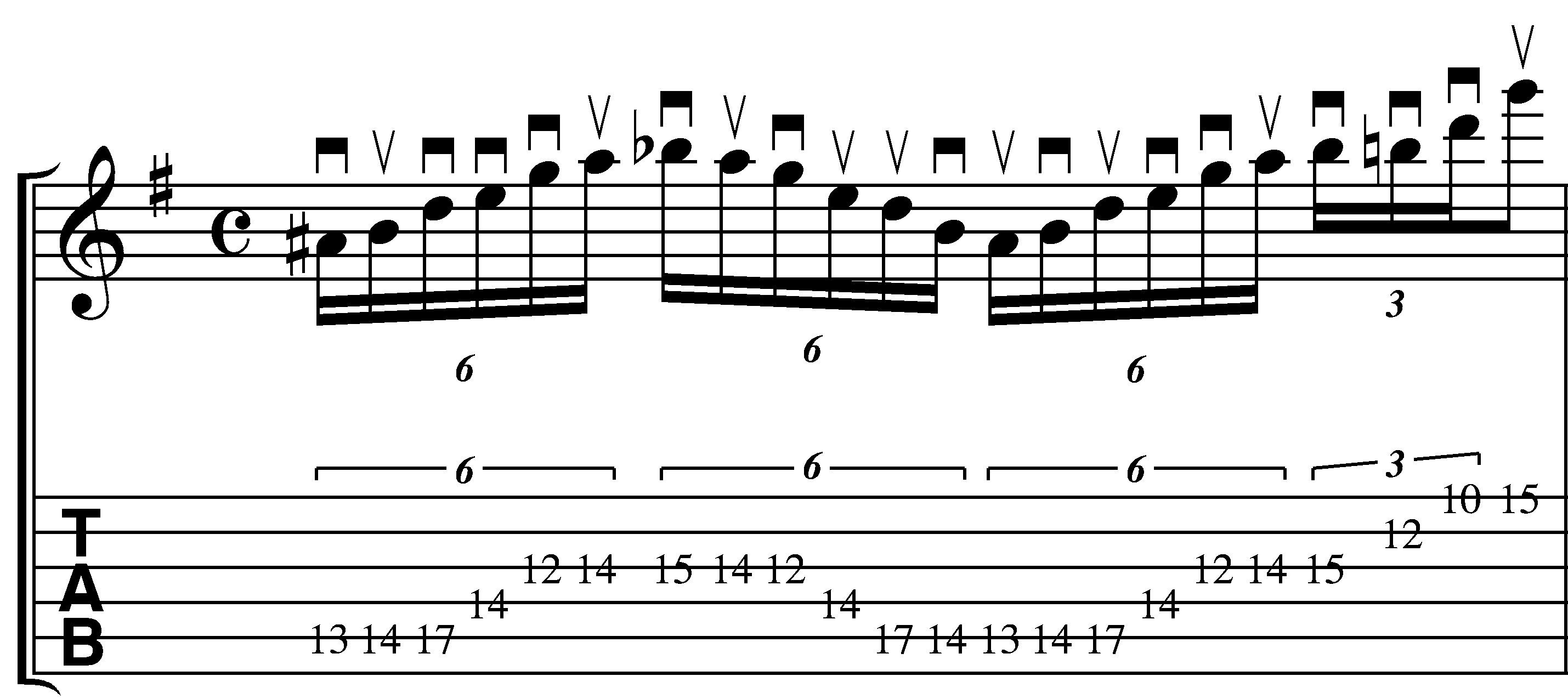
So first – here is a lick that works off of the swept pentatonic idea (alternating 3 and 1 note per string ideas) that I explored in the last online lesson (you can find a pdf of that lesson here).  While the online lessons have focused a lot on pentatonics – I wanted to add the tritone to make “the blues scale” and show how this approach could be adapted.  Here is the idea ascending:

.

It’s very scalar – but I added  a couple of points of interest:

1. the little descending turn around allows you to play the basic ascending idea starting on both up and down strokes.

2.  I started on the tritone (if played over E minor) or the b3 (if played over G major) instead of the root.  If you’re playing this over G – think Bluegrass metal ; )

3.  The motion is more diagonally oriented than the strict pentatonic example but is the same basic approach.  I start the lick with my first finger and then shift positions for the D on the 12th fret of the D string and the D on the HighE.

.

Here is an mp3: Lick1

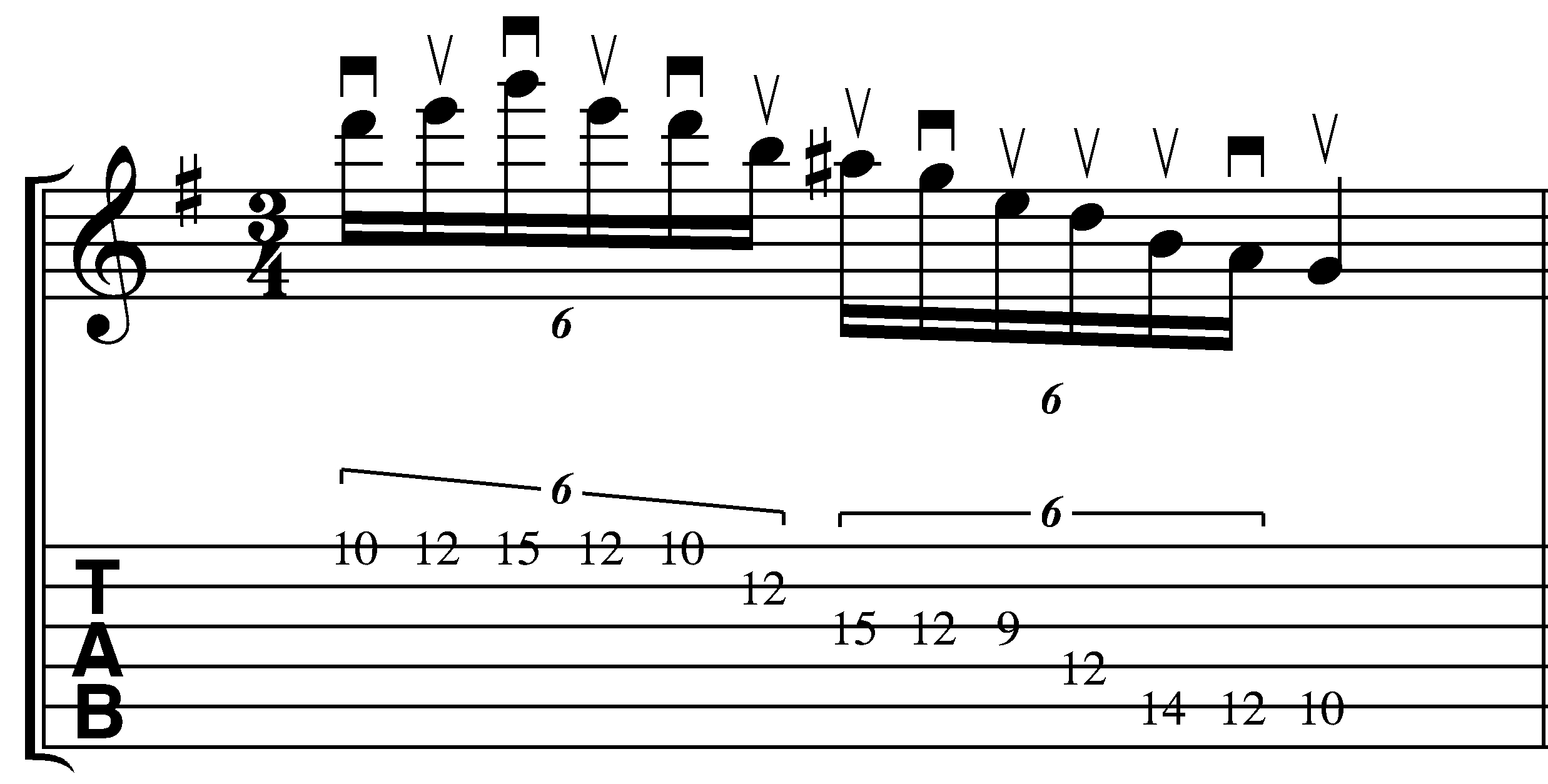
As variation – I took the same concept and applied it in a more positional approach.  Be careful with this stretch!  If it hurts stop immediately!!!

.

.

Here is an mp3: Lick 2

And finally here are the 2 licks played back to back:  backtoback 1

.

Laptop Rig

So I bit the bullet and got an apogee duet.  WOW!  It really has made a stunning difference in resolution and I suspect will help a lot with future mixes I’m working on. With that in mind I wanted to share with the rig I used for the mp3s above.

Here was the basic amp setting I used in Pod Farm 2.0.  This was based on a customtone forum patch called Electric Gypsy.  I just swapped in a tube screamer and bypassed the cab (using the Recabinet impulse responses instead).  One of the big revelations that I found in pod farm is that I could put preamps AFTER the power amp.  Adding that in to the signal chain opened it up a lot.

.

.

I blogged about using impulse responses over the cabs before.  The lie 6 cabs sound good – but to my ears the IR’s add a whole other area of depth.  Here are the IR’s I used – these were from the Modern 1960 4×12 set.  The screen shot is from LA convolver.

.

.

Finally – a screenshot of how it all lays out in AULab.  I just hit the record button in au lab and edited out the noise before and after the take in fission.

.

.

FNH Guitar –> Apogee Duet–>AULAB–>PSP Vintage Warmer–>Pod Farm 2.0–>La Convolver (w. Recabinet IRs)–>Sooperlooper

.

I’m still tweaking things – but I think that soundwise everything is improving a lot from where it was even a month ago.  Once I get an A/B set with the floorboard – I think that the laptop is going to be the rig du jour.

One last note – the macbook has is using 4 gigs of ram and was updated with a 7200 rpm Seagte internal drive. (500 gig from OWC).  My computer accepts a 4gig chip in 1 slot – so I may go up to 6 gigs – but the faster internal drive made a big performance difference in the machine. I’d say you’d really need to have that if you’re going to try to go this route.

* Note – I’ve recently posted more on this topic here which may be of interest to you.

Rig around the Rosie or Mediations and Meditations on Gear

Yesterday, I was trolling online for one or two things that I’d like to have to fill my insatiable gear lust and found an Atomic 1×12 amp for sale in Las Vegas for $149! A phone call and a credit card number later the amp was on its way to South Pasadena.

Now, I already had one of these amps – so a logcal question would be, “What the Hell do you need two of them for?”  Well, a couple of things,

1.  When I find things I like I try to buy a backup in case something goes wrong.  We can call this the great “Digitech Space Station lesson” – where (when they were in the death knell of production) Guitar Center was blowing them out @ $99 per and I only bought one.  Now the one I have is on its last legs and replacement ones are about $300-$400 on ebay.

2.  2 amps mean I can run my effects stereo.  Sounds small – but when looping things in stereo and there’s sound swirling around your feet…ahhhhh…there’s nothing like it.

3.  They don’t make this model anymore – and if worse comes to worse I could unload it for $250-$300 if I had to.

4.  As much as it kills me to say it – tubes project sound differently than solid state.  Before I left Boston, one of the bands I was playing in was One of Us.  The singer/guitarist/songwriter John Eye, had a Vetta – that sounded good.  It was super flexible and could do things that my amp set up never could.  But live, my rig (see the bottom of the media page for full rig information) projected completely differently.  Even when I used the pod 2.0 in front of my DeVille – it pushed the sound in a completely different way.

So, when playing with rock bands – I try to use a tube amp when possible.  For the film/video gigs I do – It’s more about convenience as there’s less sonically for me to have to compete with in terms of space.

(As a side note, John Eye is a truly great frontman.  He and I had very different views about live performance, but I always liked and respected him and dug his material.  I’ve included links above – including the Pull video which has some life footage of me with the band – but not audio 😦 .  I don’t know if any of the material I recorded with the band at that time will be on it – but if not – I’m sure the new material will be very cool.)

Getting back to gear and its endless acquisition –  I have conflicting opinions about it.

Having said all of this, will I still need to get Pod Farm Platinum eventually to go with the Pod X3 and the X3 live?  Yep.  Just a matter of time.  Will I get the Apogee Duet?  Yep – just a matter of time.

Because just like the plague inspired song quoted in the title, “Ashes – ashes we all fall down.”  – and life is too short to waste it on crappy tone.

I have missed a lot of great gear at great prices by waiting to buy it when I saw it.  If it’s a good deal, and I can make your money back on reselling it (if I have to) I jump on it now – before the next person does. Because who knows?  That extra piece of gear might get me .01% closer to the sound I’m looking for.

A long winded justification for buying an amp – but it’s important to have a realistic expectation of why you’re buying a piece of gear if not for yourself than to be able to explain it to your spouse.

I’m still unpacking – so no profound posts for a while probably.  Less fluff and more content next time around.  Thanks for dropping by.

-SC

Tech Limbo (Neither Heaven nor Hell R.I.P. Ronnie James Dio)

So I’m packing, moving and simultaneously trying to get some stuff ready for the Cha’ak’ab Paaxil Festival in Yucatán, México June 3-5th.  My plan is to leave the amp here and to use a combination of Line 6 gear and a guitar to play the shows.

After playing with Wael Kakish and the Middle Eastern ensemble last night, I was able to open the package I got from Sweetwater and check out my new Line 6 FBV Shortboard Mk II.

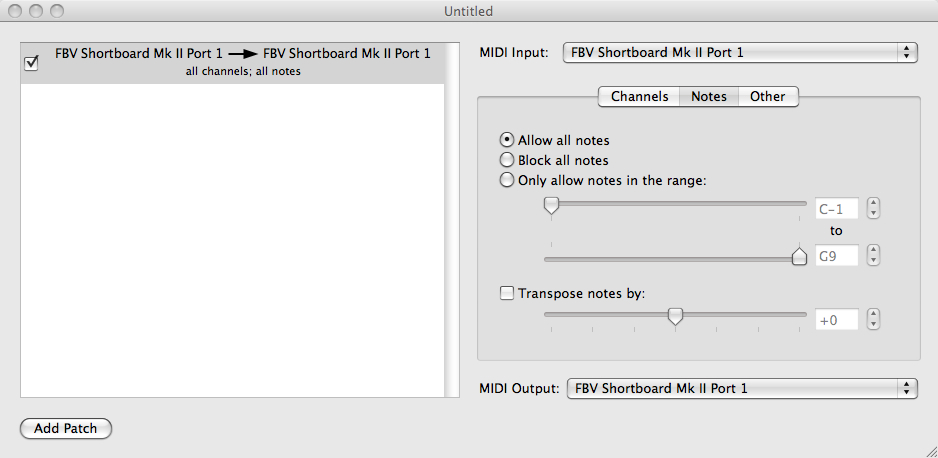
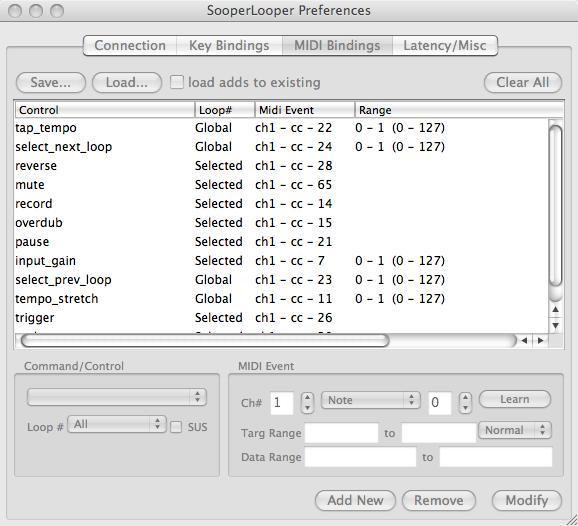
The new board is REALLY cool.  It’s solid in it’s construction and small enough to fit in my laptop bag.  After I downloaded the FBV Control software from Line 6.   I tried to set up a SooperLooper session in AU lab.  The concept was to run the AU of SooperLooper in AU Lab and use a midi patchbay to make sure the signal was going from the FBV to the Sooperlooper session.  Here are the patchbay settings.

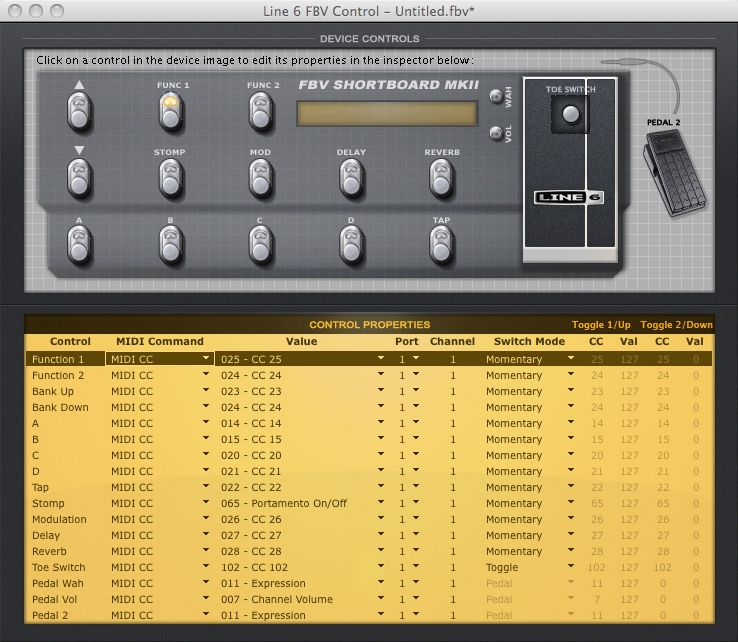
Had some trouble initially  but once I went into FBV control and reset some of the switches everything worked.

This probably isn’t the smartest series of codes to get everything to work – but it’s working.

The only gripe that I have is that I wish that some additional parameters in SL could be controlled via midi (i.e. 1/2 or double speed or main monitor volume for fades).  It’s easy enough to lean over and hit the keyboard – but it does defeat the purpose of ordering a 15′ USB cable.  The board itself though works like a charm.

I’m in the process of working on sounds on the X3 Live for the show – and tweak PA vs. amp sounds.  One thing I’ve noticed with modeling is that there are at least 4 different scenarios for setting up sounds:

1.  Headphone patches – i.e. practicing or recording

2.  Playing through an amp at low volumes

3.  Playing through an amp at high volumes

4.  Playing through a PA.

You might think that there wasn’t a lot of variance – but the differences between these parameters are huge.  I have patches that sound mediocre at low volumes and sound really good when the volume gets goosed a bit.  Headphone patches that work well at home and fall apart live – and vice versa.

As a result of all of these constant parameters I’ve been experimenting with Impulse Responses in Logic’s Space Designer (and LA Convoluter) and getting some encouraging results.

Impulse Responses (IRs)

In a simplified definition:  Impulse Responses (IRs) are measurements of acoustic spaces that can be loaded into applications (Like Altiverb or Space Designer) to create different types of reverberations.

I read an article about beefing up Logic 8’s guitar amp pro by replacing the speaker sims with IR’s.  That article is here.  This got me looking for all kinds of IR’s.  For those of you who want to see how this works on guitar tracks – check out the recabinet site.  There’s a really cool pdf that talks about the different IRs and the mics used to capture them.  As of this writing they’re selling a download of something like 2000 IR’s for $15 bucks.

Now I’ve been testing these at home – the difference is night and day!

It’s late while I’m posting this – but let me give you 2 simple examples.  First here is a simple rock rhythm with a plexi type setting.  This is just the AU recording of the pod with a plexi setting and the 4×12 cabinets selected.

DirtyrhythmnoIR

Now here is a another take of the same pattern and settings but with a 4×12 IR added. It’s a little brighter but the response is different as well.

DirthrhythmIR

To my ears – the second is a little more natural sounding particularly on the ascending chords.  Here’s one more example with a clean tone.  It’s subtle but noticable.  First with no IR

BluevelvetnoIR

And with the same IR as above added:

BlueVelvetIR

The non traditional guitar sounds have various degrees of success, some sound better some sound worse.  But this made a HUGE difference on the headphones.  I’ll try them through speakers later.

For those of you looking for free links here are a couple of them.  I’m in the process of downloading these myself – so no guarantees for the sounds themselves.

First some very cool non-guitar specific responses here:

Then some more guitar and bass specific IRs here. But I’m digging the redcabi.net IRs so far…

I found an AU ( LAConvolver ) that supports IRs and runs in AU lab – if I keep the wet gain at 50% it works well.

The advantages of AU lab are several (including low CPU use and that you can route audio OR midi through it) but the main advantage is that when you save the session all of the parameters in all associated plug-in’s applications are saved.  In other words – when I get it set up for use with a PA – it’s done.  No more re-inventing the wheel.  This is particularly helpful when you’ve set up a series of midi commands for Sooper Looper.

Here’s the laptop setup:

FNH Guitar -> Radial Dragster ->Pod x3 Live -> (Stereo out) ->Behringer FCA 202 (I hope to sub this out with an Apogee Duet eventually) -> Macbook Pro (Intel Core 2 Duo 2.4 Ghz – older model) ->Aulab running LAConvolver and Sooperlooper->(Stereo out) ->Behringer.

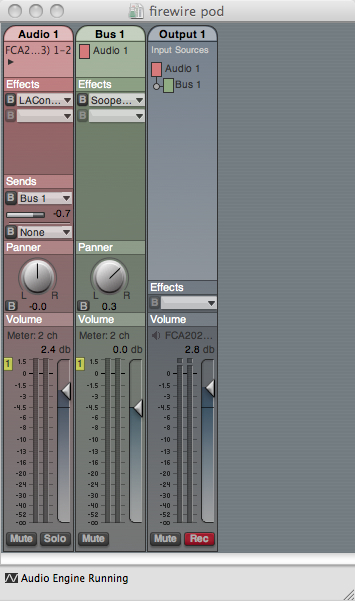
Here’s the AuLab set up – I’ve put SL on a Bus – but I since I can mix wet and Dry in SL I could have just left it on channel 1.


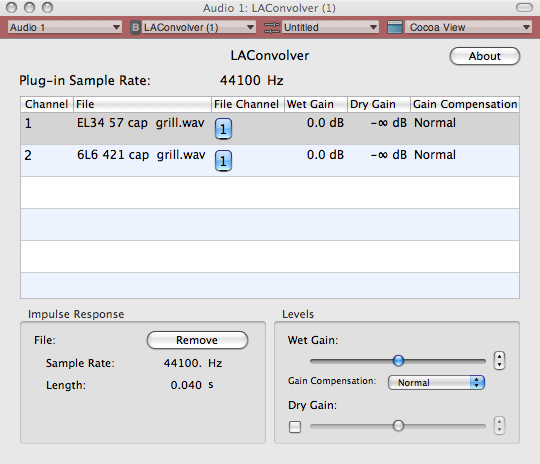
Here are some sample LA Convolver settings (these are both from the 4×12 greenback IR’s in redcabi.net):

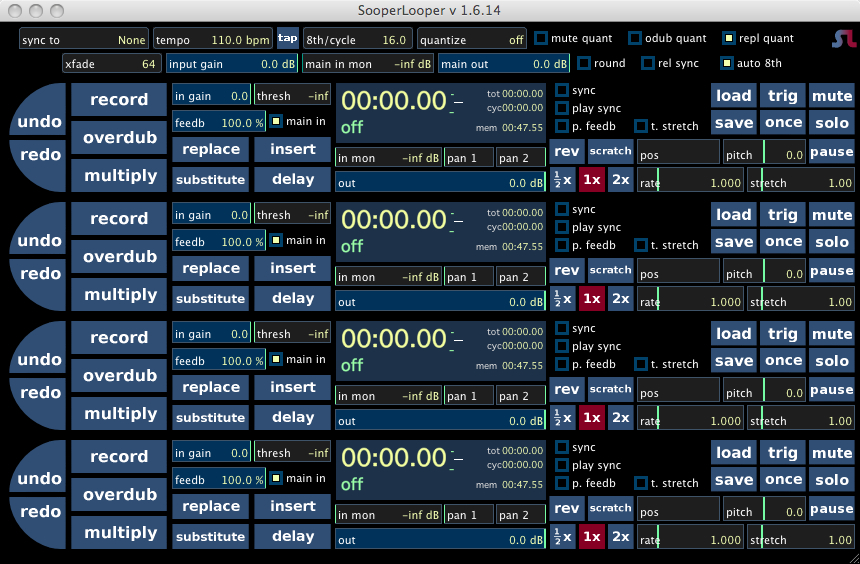
And finally 4 instances of SL.

I’m still experimenting but this is the current plan.  Now to apply all of this to mainstage to get synths and percussion in the mix….

This may not make any sense.  The goal to to fit everything into 1 bag – except for a guitar and a gig bag.  Hopefully I’ll have photos soon.

Also the title of this references the passing of Ronnie James Dio.  I enjoyed his work with Rainbow and while he and Vivian Campbell had a pretty miserable falling out – their 1st 2 cds had some great moments vocal and guitar (particularly Last in Line with perhaps the quintessential heavy metal guitar solo).  Dio was 67 on hitting the stage with Black Sabbath (ok fine – Heaven and Hell) at an age many people are bed ridden.  It reminds me of my favorite quote on retirement ever:

All I do is play music and golf.  What do you want me to retire from?” – Willie Nelson

Rest in peace Ronnie.

Line 6 Pod Farm 2.0 Overview

I’ve taken advantage of Line 6’s free 14 day download of POD Farm Platinum 2.0 ilok version and have been working on formulating somethings for a review.  I won’t be able to post a full review now, but I wanted to post a couple of brief observations.

1.  The demo version was a little glitchy in standalone version, so I’ve been using it with AU LAB.  For those of you who don’t know about it (I had to find out about it on the super looper forum) – AU Lab is a free app that comes with the OSX Xcode Tools.  It was designed to test AU plug ins with but its a stand alone app with a fully configurable mixer ( inputs, outputs, effects busses) .  It records output and even generates midi clock!  Also it makes a very small cpu impact – so it’s perfect for hosting something like Pod Farm and say SooperLooper.

2.  2.0 supports midi – which means you can control it with a foot controller like the FBV shortboard MKII or the Behringer FCB1010.  I didn’t get to work with this yet – but this brings the live laptop rig very feasible for me.

3.  Stereo rigs which you can A/B/Y!!!  which alone would have been really cool – but you can use multiple effects in the same rig – something you can’t do on the POD for example.

Here’s a screen shot of a modification I made on the Outer Space preset.  I just added a preamp in the beginning of the chain.

So here is an mp3 of a guitar track I improvised with this setting:

Outerspace II

This was made with a FNH ultrasonic guitar, Behringer FCA202,  Macbook Pro (2007), and AU Lab.  No post processing.

So this particular sample doesn’t sound very guitarish – but that’s part of the reason I really like this approach.  You can create things that you never could create with pedals without a ton of gear and/or a ton of noise.

As with many other sims – getting usable clean tones is pretty easy and getting dirty tones that respond the way an amp would is a little trickier.  But the presets on all of these models are light years away from older line 6 presets that I’ve heard.  It’s pretty easy to get a tone in the ball park and tweak it from there.

Line 6 has some great audio/video demos on their site, so I wont go into too much here for demos as they’ve done it really well.   Also the May lesson uses the same signal chain for all the mp3s that will be posted there.

I need to also give kudos in that all of the sounds on the sites are included in the presets and they have also noted processed vs unprocessed sounds.  Yes there is a big difference between the two, and it’s important to note those differences so that when you dial up a preset you know what to expect.

The only thing I wish it had was a dedicated looper, but that’s not a deal breaker.

If you have an I-LOK I’d say to definitely check it out.  It’s more flexible than the POD and does some very cool things.

For further applications of this set up you can also  go here or here.


Variax AC700 Review/Workbench Overview

This is an update from a review I did a while ago.  It includes more detail, some information on workbench and some mp3s.  It’s a LONG post, but hopefully it’ll help answer any questions you might have.

VariaxAc700Bk.jpg

In 2004, Line 6 heralded a new era in guitars with their new guitar line, the Variax. Previously they had released the Line 6 POD which emulated a number of different amplifiers through a process called modeling and put those controls in a kidney bean shaped device that fit in a gig bag. With the Variax line, they took this same concept and applied it to guitars – i.e. they answered the question, “what if we had a guitar that had a number of modeled characteristics of really iconic guitars and put them in 1 guitar?” The Variax AC700 took this same concept and applied it to acoustics. With Sweetwater offering a $400 price drop on the Black and Burst AC700 models – I thought It was time to give it a try, and see if I could get an instrument that would allow me to leave my Chappel acoustic at home.

Note:

Line 6 has currently ceased production on this guitar although you can still find the used on Craigslist or Ebay.

First impressions

I opened the box and the first thing I saw was a gig bag. Very good quality. Lots of padding and generous space for the cables.

The Variax has 2 outs on the instrument. 1 out is a VDI cable that interfaces directly with The POD x3 live/line 6 gear. The second out is a 1/4 inch out. The Vax requires power to model, so you either need to run batteries OR there is a DI box that you can use with a planet Waves cable that had XLR or 1/4′ out. DI box is high quality, and guitar came with the Planet Waves cable as well so that’s a definite plus.

A lot of people on the forums commented on how much they hated the neck, and how it didn’t feel like an acoustic – those were not the initial thoughts about mine when I got it. My initial thought was – “It’s heavier than I thought it would be”. Opening the gig bag, I discovered that the guitar was a solid body guitar with a fake sound hole, probably very similar to the Chet Atkins Nylon. Since the sound is all generated from piezos this made sense. The body is Mahagony with a Cedar top, but since mine is flat black – it’s impossible to guess at the material. The finish looked good, and I liked the inlays in the fretboard a lot as well.

The neck didn’t bother me. It’s also mahogany with a rosewood fingerboard. The profile is somewhere between an acoustic and an electric with a 17″ radius – it’s pretty flat. It’s a 25-1/2″ scale length, which means it’s the same as the other variaxs so if you like the electric you’ll like this. It has 24 frets and pretty clear access up to the 20th fret or so. The irony of my first 24 fret instrument being an acoustic is certainly not lost on me. It’s a nice touch, but if anything the extra 2 frets take up space I’d rather have open for for picking. The more important thing here is that the access to the other frets is great. Being able to play up to the 19 fret with no access issues is a major coup for the acoustic.

Setup was a little suspect. Anytime you buy a new guitar, you should plan on getting it set up by a professional. I took mine to a luthier friend in L.A. and got a new nut and a fret dressing which made a huge difference ion terms of playability.

By the way –  the guitar came with a plastic nut and bridge pins – Plastic nuts are a big sticking point for me – particularly on an instrument in this price range.

The bridge is an acoustic style bridge with individual piezos for each string. The bridge is set up so that the height is controlled by a couple of allen screws – which is a good idea. The only drag here is that the piezos are not adjustable so adjusting the physical intonation would be very tricky. Fortunately mine was set up just fine.

A brief side story:

When I got the guitar – one string was much quieter than the other strings. I went to the excellent Line 6 forums and found that on some of the models some of the piezos were bad. I called customer service – they recommended that I take it to a repair center. When I said that I was handy with a soldering iron – they mailed me a piezo. A 10 minute soldering job later and it was all set. A lot of other customer service centers could follow this example of how it should be done.

Before I explain the models, I need to explain some of the instrument controls:

The knob on the upper bout selects models – if you push it – it changes color and you can get preset tunings for each model.  You can edit these in workbench (more on that later).

Next to the knob are 3 sliders:

The top slider controls EQ – but does it in a very interesting way – the concept here is that the slider has two mic placements and by moving the slider you pan between the two sounds. A VERY cool idea – having said that additional EQ needs to come from another source. This is from the line 6 copy:

“The Variax Acoustic 700’s top slider (the one furthest away from you when you hold the guitar) allows you to alter the position of the modeled microphone. Here’s a simple way to remember how it works: As you move the slider closer to the soundhole (away from the Model Select knob), the Mic Position is also getting closer to the soundhole. Some of the instruments modeled in the Variax Acoustic 700 don’t have a soundhole, but the control will work similarly for these instruments. When the slider is close to the Model Select knob, the strings (and upper frequencies) are emphasized; when the slider is close to the soundhole, the body (and lower frequencies) are emphasized.”

Here’s how it sounds:

I’ll start with some fingerstyle (one thing to note is that the “Sweet spot” is actually right around the 24th fret.  That’s where all of these were performed.  All recordings were tracked straight into Logic with no additional EQ or processing using the USB out on the Pod X3.

Out of the box – I put a “parlor” model (based on a Martin size 5 “Parlor”) through an acoustic setting in my Line 6 Pod:

The first mp3s are excerpts of a solo finger style piece of mine that’s currently untitled.  55 refers to the bpm.  If you play each mp3 – you can hear the timbral difference is the virtual mic placement.

Parlor mic far left 55

Parlor mic far right 55

Parlor mic middle 55

Next some flatpicking.  This was something I improvised in a vaguely celtic/bluegrass that I might flush out into a Dan Crary Style flatpicking tune but for now here are 3 more excerpts.  These also use the Parlor – which isn’t my favorite guitar for flatpicking – but this gives you a full tonal sense of this setting.

Parlor mic far left 120

Parlor mic far right 120

Parlor mic middle 120

Finally for now – here’s an excerpt from another original song of mine, “The Kake Song” that features 2 handed tapping.

Parlor far left 140

Parlor far right 140

Parlor mic middle 140

The middle slider controls volume.

The bottom slider controls onboard compression. You can control the amount here but that’s the only parameter of control.  A good idea but I prefer outboard compression instead.

What is notably absent is an onboard tuner. I guess the concept here is that if you’re using a POD that you use the tuner on the POD. If you’re going direct into a PA or an amp – bring a tuner.

There are alternate modes for the sliders as well that control a virtual capo and some preset tunings. The virtual capo is a nice touch for detuned items – but I prefer a physical capo to capo up.

One thing about the different tunings to work around is that the guitar maintains standard pitch and alters the output pitch through pitch shifting. In other words – if the can hear the unplugged sound of the physical string over the pitch shifted modified string it can throw you. I like headphone to block it out. Live, I would just crank the monitor a bit.

Workbench

Line 6 sells a products called Workbench which is a software/hardware component to modify settings on variax guitars. It’s $99 for the hardware and the cd, BUT if you have a pod with a variax port, then the software is a free download for registered users. Workbench is pretty much a mandatory item if you use this product. With it you can store body models and customize your own tunings. It’s very intuitive to use and is a much better interface than trying to just use the various knob combinations on the guitar.

So you need to have the instrument hooked up through USB to a computer to get Workbench to boot (this is either done through a line 6 USB enabled device like a POD or a piece of hardware that ships with the Workbench CD if you order it.

Once you get workbench up and running, you select a model and then get brought to a screen that looks like this:


I’ll start with some basics.  The left hand side of the screen gives you a visual of the body type.  On the electric models you can move pickup placements around here and get a lot a tonal variance.  On the acoustics – it’s more of a one trick pony for the actual guitar.  A really nice feature for future updates would be if you could vary the material (different top or sides) or fingerboard (ebony or rosewood) all subtle differences – but that’s where a lot of tonal magic lies.

The right hand side of the screen will give you more of the tonal variance that may help you.  First, you’ll notice the Studio/Live switch – according to Line 6 (some detailed information here) the studio mode includes room reflections on the guitar output.  It is a noticeable timbral shift.  Trim and Compression will affect the instrument output volume and mic will help tweak the instrument tone.

For some of you – the real reason to use workbench will be the parameter at the bottom of the screen.  What is represented here is a virtual capo.  Enabling the capo allows you to pitch shift any string up or down and octave.  If you want to change a preset tuning this is the easiest place to do it.  Honestly – you will hear aliasing and artifacts at anything more than a step and a half, but – if you’re going for altered textures (i.e. non traditional acoustic tones – that could work for you).  Personally – being able to set the guitar up in 2 sets of 1/2 step clusters was pretty amazing.  Another caveat here is that while the body is still a solid body guitar – unless you are wearing good noise canceling headphones – you will probably hear the standard tuned guitar and the pitch shifted guitar at the same time.  When you’re playing with a band – I doubt you’d hear it but if you’re playing solo acoustic somewhere it could be an issue.

Related to the pitch shifting is the mix and detune functions.  You not only mix the strings (i.e. pitch shift certain stings like a 12 string and have other notes stay unaffected, but you can intonate strings in cents!  That could be HUGE in getting alt tunings more in tune to your liking.  There are some really good work bench posts on the Vettaville site here and a specific tutorial on Harmomic Open Tuning here.

Another nice feature is that you can adjust individual string volumes!  This is a really great feature if you need to quiet certain strings or make other strings pop in volume.

To get there,  under the “Editor” menu, look  for “String Volume Setup”  You’ll see something that looks like this:
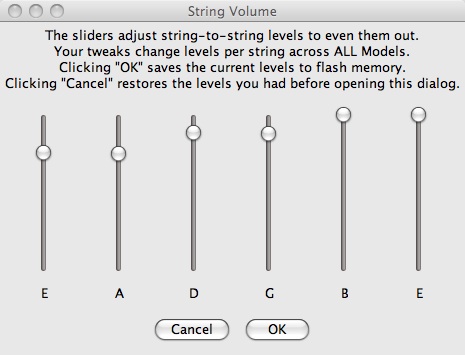
Simply drag the sliders to the level you want and click ok.  Line 6 offers this observation as well (from the above mentioned link.

“As a side note, it’s normal for many guitars to have volumes that differ from string to string. One example of this would be guitars with combination of a fairly small fretboard radius and pickups with non-staggered polepieces. It can also happen with guitars that have peaks in body resonance at or near the fundamental or one of the lower harmonics of a specific note.”

The Models

These are the models that are available on the guitar:

Martin size 5 “Parlor”
Martin 000-18
Martin D-28
Gibson J-45
Gibson J-200
Selmer-Maccaferri
D’Angelico New Yorker
Nylon String Classical
Guild F412 12-String
Stella 12-String
National Style O
Wood body Dobro
Gibson Mastertone Banjo
Mandocello
Japanese Shamisen
Traditional Indian Sitar

Generally, I find that different guitars sound better for different things. For example I like fingerpicking on the parlor – but like the J-45 for flatpicking.

This brings up another tweaking issue as well as I really dislike the banjo sound with a flatpick, but can use it fingerstyle.  Banjos usually don’t sound great with a single flatpick anyway – so this could be a non-issue.

Beyond the question of – does the 12 string sound just like a 12 string (the answer here is no), is the question of would I want to use it in a band with other instruments? And the answer there is I think it gets by. Compared to bringing another guitar and trying to keep all 12 strings in tune – it makes me happy.  It has the vibe of a 12 string and would probably sit well in band mix.

And that’s really the point of this guitar, to allow a lot of flexibility. Do you want to switch to DADGAD tuning in the middle of a tune? No problem. Want to switch from a Martin to a banjo to a 12 string for each section of a song. No problem.

For the most part this is really a live vs. a studio instrument – and in that context,  I think it shines.  But I think that this would even be usable in some recording contexts.  For my purposes – living in a noisy apartment building where having a quiet space to mic an acoustic and get through a take without extraneous noise – this things is a godsend.  Would I use this over a vintage Martin in a pro studio?  No.  Would I use this to track a take at home while sonic chaos is going on all around me?  Absolutely.

Having said that, it’s important to acknowledge what may be an issue for some players:

String Muting

One things that will be problematic for some people is the issue of string muting.  On the Line 6 Variax forums there’s a lot of talk about the issues with string muting regarding the electrics – but as this is a piezo based pickup system, the isn’t going to sound like string muting on a regular guitar.

Case in point:  Here is the sound of an Al Dimeola style lick in A Dorian. First it’s played with no muting, and then with string muting LOGIC string mute 140.  Definitely not Friday Night in San Francisco.  Some tweaking with compression and EQ might help with this – but I haven’t had much luck so far. If this is a major component of your style this might be an issue – but if you’re willing to work around it, there are a lot of other things here.

It does handle regular flatpicking fairly well though –  here is a post involving acoustic sweep picking that was recorded with the Variax.

The electic variax has undergone  a transformation in the forthcoming Tyler Variax with substantially more processing power, hopefully the acoustic will get a revision as well.

Likes:

This is a well constructed guitar with a tremendous amount of tonal flexibility.  Parlor, 000, D-28, and J-45 models sound really good.  I like the inclusion of the oddball instruments like the Shamisen and mandocello, also like the  gypsy jazz guitar and the nylon (but suspect that they probably sound better on the nylon string Variax 300).  This guitar won’t do everything – but it may save you 2-3 gig bags of guitars at your next gig.  Workbench is a truly revolutionary idea and the alternate tuning features are cool.  12 strings and virtual capos are really good ideas.

Dislikes:

In terms of the build – the body size is a little too small for me (I’d like more of a dreadnaught sized body as well).  Also, a plastic nut and pins on a high end instrument sounds like a little thing – but a guitar is a bunch of little things all put together.  String muting may be an issue for some people.  Sitar sound has a high pitch overtone that makes it unusable for me.   The banjo doesn’t seem as well executed as some of the other models. While I like the idea of the 12 string – it’s okay for strumming but doesn’t hold up on the single note level for me.

Would like (Wish List):

On the electric variax you can virtually move between various pickups body and placement options. I’d love it if I could combine a J-200 and a shamisen for example. Just as the Pod X3 has 2 rigs at once, having 2 guitars at once would be cool…

Multiple body sizes.

More models.

I’d love modeled material that you could never make a guitar out of – like stone or glass or paper. It would be nice to “build” guitars that you couldn’t feasible make in the real world.

It would be nice if you could control some other modeled aspects in Workbench – i.e. top back and side material, fingerboard material, sound hole size and placement, etc.

Final thoughts:

I don’t know if paying the extra $400 for a a natural finish ( I notice that Sweetwater doesn’t even have that model listed anymore) is worth it but for this is a lot of guitar for the money.  I’m going to be doing some studio experiments so see if I can get the tones a little closer – but for demos or backing tracks this guitar is definitely

Recommended!

FNH Ultrasonic Guitar review

Photography by Nancy MacDonald

4/11

Full disclosure – I am now endorsed by FNH guitars but was not at the time of this review.

This gear review is for a customized Ultrasonic guitar that was built by FNH guitars.  FNH guitars are a small custom shop consisting of Chris Fitzpatrick and John Harper (i.e. FNH) that are making hand crafted electric guitars starting at $1299 and several other instruments at other price points.  Many of the stats can be found here.  Note that the guitar pictured above is from the website as Nancy McDonald is a much better photographer than I am.  The review model differs from the photo in bridge, color and lack of a pickguard.  These are discussed in more detail below.

The body and neck aesthetic remind me of some of the 1960’s EKO designs.  While many of the designs from that era looked really cool on paper they were also either impossible to play or just sounded awful, FNH has taken the best visual elements of those designs and hot rodded the instrument  for playability.  Wrist and belly cuts are nice features and make you feel like you’re playing a guitar and not a block of wood with strings.  The weight of the guitar is light and well- balanced.  It’s comfortable to play either sitting down or standing up.

In terms of build, the body is one piece poplar (I believe that poplar is similar to alder in a lot of ways if that is the body material you’re currently use to).  It has a nice resonance to it when played acoustically – which is generally a really good sign of its amplified potential.  FNH offers several varieties of finish – I went with a flat black which is a good call, but there are some nice finishes on various guitars on their web site as well.   The Ultrasonic on the website has a Tele-style bridge but mine shipped with a Gotoh fixed bridge.  Since the guitars are customized – you can also get them with any bridge style you’d like.

The neck is a 25 ½ inch scale (just like a fender) with a choice of fingerboard materials.  22 frets is the standard but mine shipped with 21 (so I’d have to go all Blackmore or Yngwie for those high D, E and Eb notes!).   I requested a maple neck with rosewood fingerboard and a 12” radius.  The website mentions maple and ebony as other fingerboard options but everything here can be customized to player specifications.  The neck has a gorgeous amber tinted oil finish (nitrocellulose is also an option) that really brings out the rock maple.  The neck is extremely comfortable and didn’t have any dead spots on the fingerboard.  The rounded heel joint makes upper fret access very easy and assisted with playability as well.

The electronic controls (volume knob, tone knob and a 3-way selector switch,) are in a very logical place.  They’re low enough on the body to be out of the way of strumming but still easy to reach.  The Electrosocket output jack is mounted on the lower bout of the guitar which doesn’t get in the way when sitting down with the instrument. Pickups are customizable (They typically will use OC Duff, Seymour Duncans, Lollars, Fralins or Golden Age but no neck pickup is also an option) – I asked John to choose for me and he picked a Duncan Pearly gates for the bridge and a Golden Age ’59 for the neck.  This is a really great combination that offers a lot of tonal variety.  The pots are 250K which has some nice roll off characteristics for both volume and tone.

I’ve included some mp3’s of various tones recorded with a POD x3 straight into my laptop.  The tracks have been kept as raw as possible – no post EQ or sweetening – to give you a sense of what the guitar sounds like when you plug it in.

First just some simple solo guitar sounds, I used a clean Hiwatt model with a little verb here are some simple fingerpicking sounds.  There are 3 samples – recorded in order of neck, middle pickup selector position (out of phase) and bridge positions.

Next,  9 versions of a simple G major strum here with the same amp setting.  First is a strum in the neck position followed by a strum with the tone knob rolled off to about 50%, then with the tone knob rolled off all the way.  This order is repeated for both the middle pickup selector position and bridge pickup.  MP3 of that is here.

Next is more of a lead tone recorded with a Marshall amp model here is a solo lead tone in the neck position with tone rolled off about 50%.  MP3s can be heard here and here.  A few more of these samples can be found on the April online lesson where all the mps3 were done with this guitar.

Next is a guitar/drum duo.  The track ren can be found here. This was played on a LINE 6 Sparkle model.  The drums are the Jazz expansion set of EZ drummer.  Guitar part is fully improvised in kind of a Daniel Lanois type of mode and uses each of the pickup selections over the track.

Finally a short dirge/doom metal kind of track with a drop D guitar.  This was played through a LINE 6 Big Bottom  model.  The drums are the Drummer From Hell expansion set of EZ drummer.  Guitar part is full improvised – but uses the middle pickup selector position.  The mp3 can be found here.

A hallmark of truly great design is translucency.  A well designed guitar should just play, feel and sound great, and not draw attention to how it is done.  $1299 for a completely hand built guitar of this quality is nothing short of miraculous.  Additionally, FNH has another guitar model (The Beaumont), the Subsonic bass and an AMAZING electric mandolin based on a danelectro vibe the mandolectro.

FNH GUITARS

http://www.fnhguitars.com/