Building Blocks – or more examinations of a laptop guitar setup.

If you’ve ever seen the American dubbed version of Mad Max (the whole movie plays very differently with the original voices – I’m just so used to the original American release’s versions of Night Rider, Toecutter and the Goose –  that that’s the only one I can watch), there’s a moment where The Goose realizes that the person they’re about to arrest is an associate of ToeCutter, and the camera closes in on his face as he says,

“Well well well…”


I wanted to go a little more in depth with the laptop guitar rig I’ve been toying around with.  I’ve posted a couple of things about this but I realized that it may be more beneficial to examine each component and see how it fits in the puzzle.  I tend to focus these on distorted sounds as those to me are the most difficult to replicate.  Even Logic has some decent sounding clean amps built in – getting a useable dirty sound is still the challenge at least for me.

So what I did was improvise a little idea in a C# minor tonality and then played a series of versions of it through different versions of the laptop set up – to show the evolution of where I have things now.

There’s still a great deal more work to do in this area, but at least these are some starting points and may at least shed a light on the process I’m using.

As a starting point you may want to look at the gear page or my previous entries on this topic here or here.

The (salt) lick


To begin with, here’s an mp3 of the first thing I improvised:  C# min improv .

* Note:

occasionally mp3’s don’t load properly when I check them in Safari.  When I refesh the page they come up.  If you have this problem – it may work for you.  If you still can’t hear the mp3 just leave a comment and I’ll re-post it.

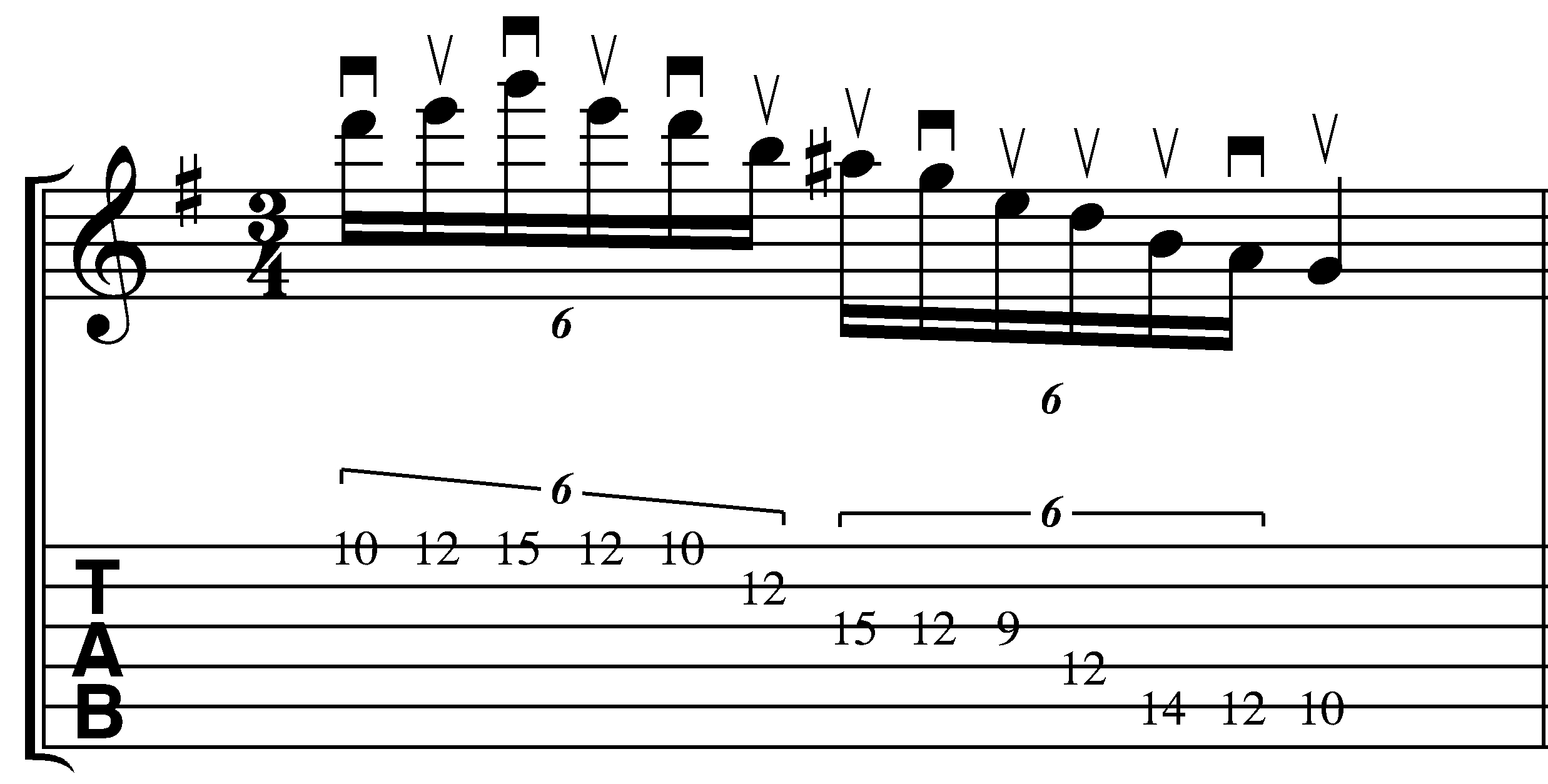
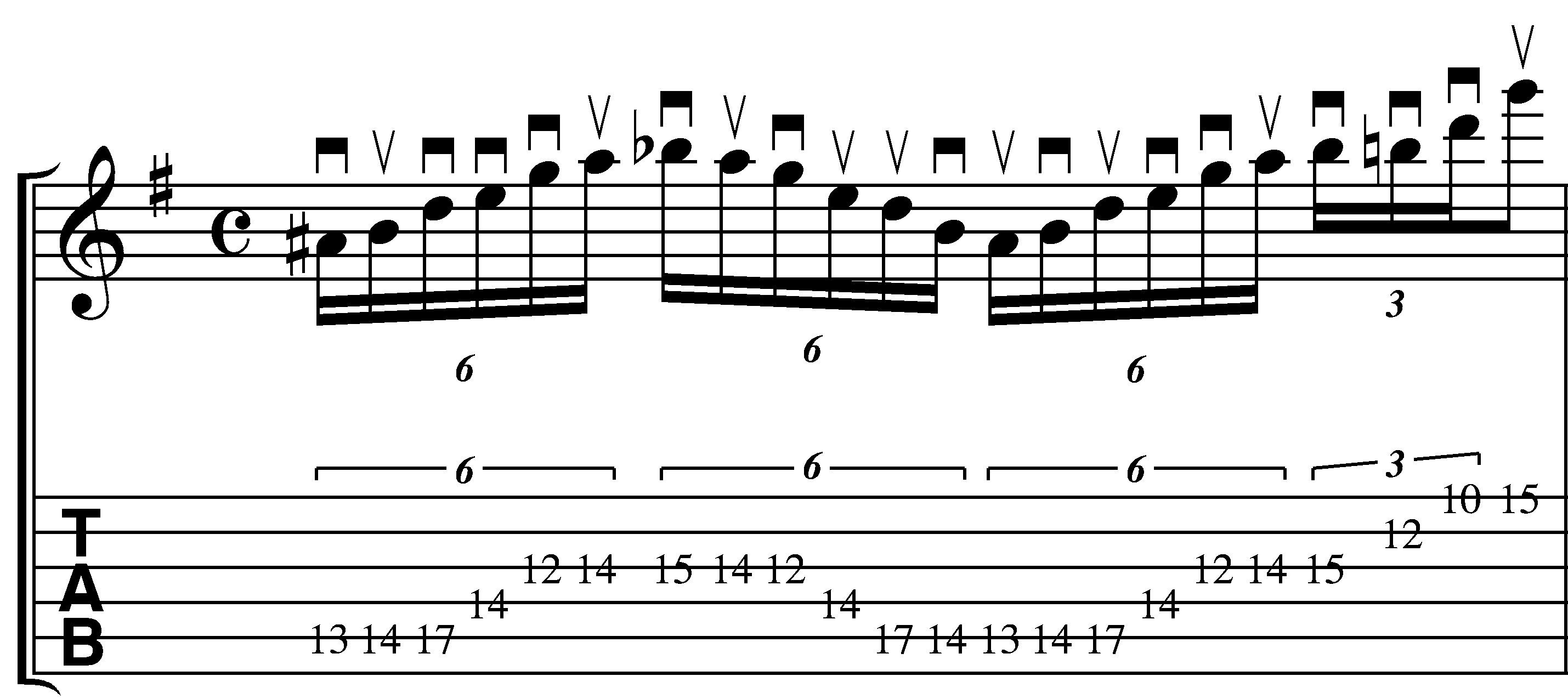
And here’s the notation
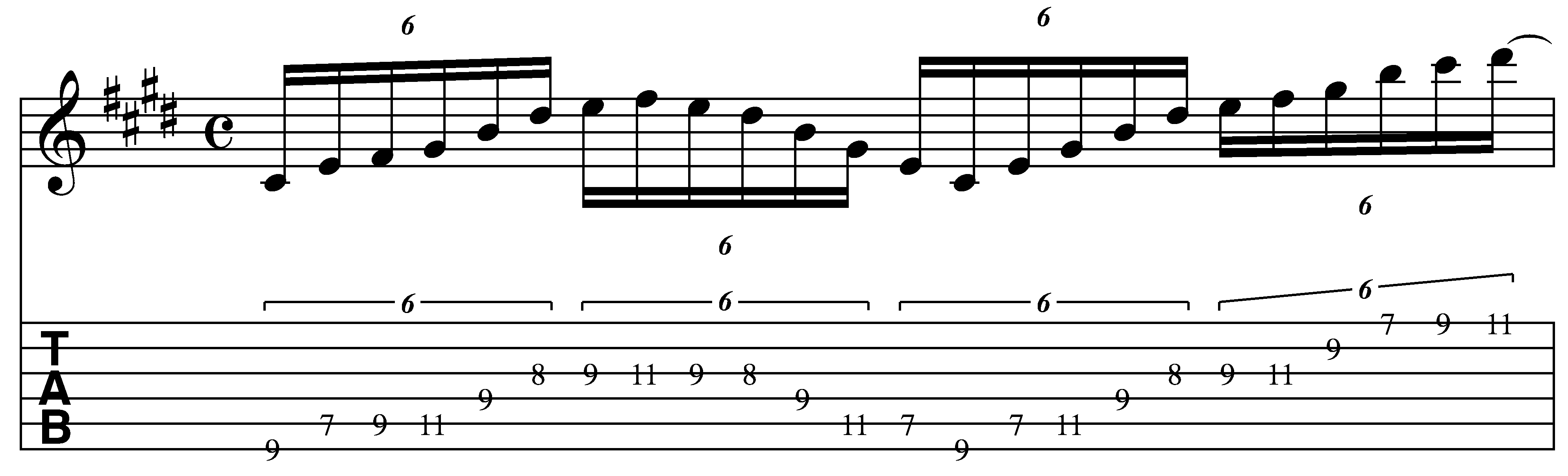
The first part of the lick is somewhere between a scale passage and an arpeggio which makes it a little interesting to me.  This approach is something I use a lot in my soloing to get away from the temptation to go on autopilot and just run scales up and down the whole time.

Visually, I’m initially thinking “G#min arpeggio”, and then dropping the lowest notes by alternating 3rds to extend the tonality.  This is an arpeggio trick I use all the time to get new sounds out of old shapes.  I’ll detail this process here:

Here’s a G# minor arpeggio:

When I look at the distance between the G# and the B – that’s a minor 3rd.  By alternating 3rds ( either major-minor or minor-major) I can extend the tonality.  A major 3rd down from G# would be E.

If I drop the lowest note to the “E” on the A string – I’d have an E maj 7 arpeggio. (E G#, B, D#).

If I drop the lowest note to the “C#” on the E string – I’d have a C# minor 9 arpeggio. (C#, E, G#, B, D#).

(If you wanted to go further you could continue the process to A, F#, etc.)

The next thing I do is to add the F# on the A and G string.

This makes G# min7 / E maj 9 / C# min 11 depending on the chord it’s being played over or how you’re visualizing it.

Now that I have the larger shape – I fill in some 3 note per string patterns on the G and high E strings.

There’s a slight 2 string variation on the A string that’s hammered instead of picked, but otherwise the picking pattern discussed on the swept pentatonic lesson is the same approach that’s used here.

This is very similar to the 3 note per string / 1 note per string pentatonic patterns that I’ve been exploring in the online lessons area of the blog (you can see a pdf here).

The process that I’m detailing is how I began to practice these things and then develop them into more complex ideas.  I tend to see sounds like this as one large pattern now ( note:  the GuitArchitecture process is all about sonic visualization – i.e. associating shapes with sounds so that sounds can be created and manipulated in real time) .  So when I improvise, I’m not really too conscious of exactly what’s happening theoretically – only sonically.

This ends in a pretty pedestrian B major (C# Phrygian) scale run.  In soloing I would typically try to develop it into something else – but for the purposes of a sound demo – it makes sense to have a short lick with a definitive ending.

The sounds

First I’ll play the lick with the sound used at the ending point of the process.  Here are some screen shots of the set up.

The FNH guitar on the neck pickup goes into the Apogee duet into AU LAB:

I run PSP Vintage Warmer

into Pod farm 2.01 Ilok version

I’m using the Marshall side of this rather than the Soldano – so I’ll show the signal chain there (it’s the same for both setups shown).

I’m going to start with the mixer and then go from there:

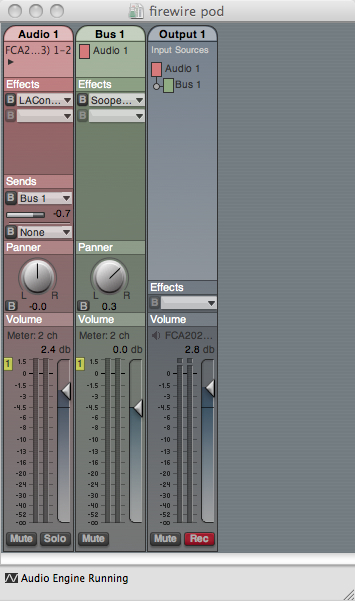
Since I’m only running a single line in- I’ve set both inputs to left.

There’s a little tonal secret hiding in plain sight here as well.  If you look carefully – you’ll see that the DI is set to about 18%.  This allows some of the dry guitar signal to come through as well.  This give the tone a little body and clarity that’s lacking from just the straight signal.

You might find that to completely not be the case – and again – this is just one person’s process detailed here.

Here’s the gate.  I tend to keep the levels low so it doesn’t kick in when I’m playing – but kills the noise when the volume is off.

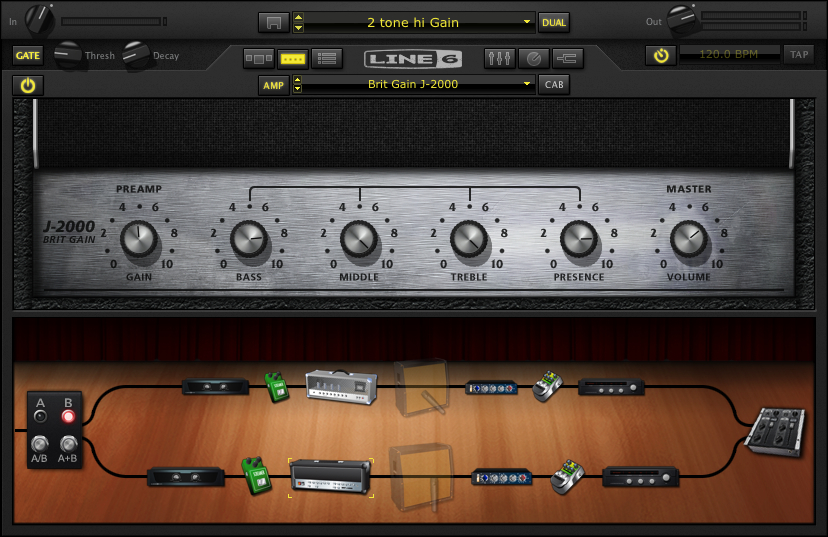
The gain on the Marshall is set around 22%.  I tend to crank the mids a little to help make sure the sound cuts through in a live mix (note the use of the term “help”.  In reality – sound at any live gig is only as good as the sound person.  I just do what I can on my end to make sure I can hear myself on stage.).

Before the Marshall for the “lead” sound I’ve put in a tube screamer.  Here are the settings for that:

Here’s the lick with the tube screamer (same as above): with tube screamer

Here’s the lick without the tube screamer:  without tube screamer .

To give you a sense of how important the amp gain is to the overall sound – here’s a variation of the lick above with the amp gain set around half:
Here’s the lick with the tube screamer (same as above): TS_ON_50%_gain .

Here’s the lick without the tube screamer:  NO_TS_50%_gain .

I actually like this amount of saturation for lead lines – but the reason I’ve gone with the lower gain is that chords (outside or Root-5th diads) – tends to just crap out and turn to sonic mush with higher gain settings.  So to balance the 2 I’ve been working on lower tweaks.


WHY THE CABINET IS TRANSLUCENT.

Oh that’s easy.  It’s because I’m not using it.

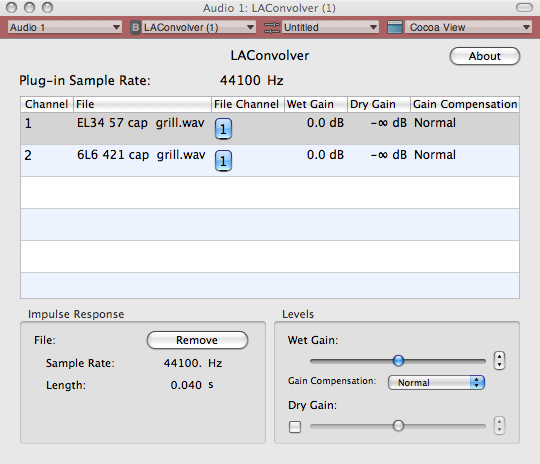
Instead I’m using Impulse Responses from Recabinet in LA Convolver (See the links above for more info).

Here are the settings:

The IR’s are from the Recabinet Modern 2.02 Mac and PC-> 1960 4×12 cabinet settings.  You’ll notice that I don’t have anything fancy in terms of mikes set up on the cabinet,

Here is a major component of this process.  Recabinet comes with something like 2000 IRs.  I could spend weeks doing nothing but checking tonal variations on all the different cabs mikes.  Someday when I need to get really deep into this – I will.

In the meantime – to cut down on the number of parameters and just get to a tone – I went with the KISS (keep it simple stupid) approach.  I thought about what cabinet could be a constant for all my sounds clean and dirty – and the 4 x 12 came to me.  I’ve heard a DeVille through one and it sounded good so I decided to use that as the standard and tweak the amp around the cabinet.  Live, a 57 on the grill sounds good to me.  I tried 2 different variations of the same thing and went from there.

To contrast this:  here is the sound of just PodFarm – with the PodFarm cabinets but with the PSP and post preamp off.

Here’s the lick with the tube screamer (same as above): NO_IR_YES_TS .

Here’s the lick without the tube screamer:  NO_IR_NO_TS .

Some of you may prefer these sounds.  I happen to think that “initial” mp3 – has a bit more character than these.

Here’s the rest of the signal chain:

Here’s the pre-amp (post amp! – this is a very useful tweak!):

Here’s the delay:

Here’s the reverb:

So to quote the Goose, “Well well well…”

It’s still a work in progress.  I’d like to work on tweaking the preamp after the cab to carve the tone a bit more and experiment with using an outside delay later in the AULAB signal chain – but for now this is where it is.

I hope this helps!  If you have any questions or comments please fell free to leave them on the blog – or e-mail me at guitar.blueprint@gmail.com .

Thanks for dropping by.

-SC
A quick lick – and a rig du jour update from Ho Chi Minh City

Greetings from the former/current Saigon. (Technically Ho Chi Minh City but many of the locals call it Saigon).  I had hoped to post a couple of blog updates up before I left, but instead was running around checking things for the trip. Now a jet lagged – iced coffee and soon to be bahn mi –  fueled post:

.

1 lick or 2?

So first – here is a lick that works off of the swept pentatonic idea (alternating 3 and 1 note per string ideas) that I explored in the last online lesson (you can find a pdf of that lesson here).  While the online lessons have focused a lot on pentatonics – I wanted to add the tritone to make “the blues scale” and show how this approach could be adapted.  Here is the idea ascending:

.

It’s very scalar – but I added  a couple of points of interest:

1. the little descending turn around allows you to play the basic ascending idea starting on both up and down strokes.

2.  I started on the tritone (if played over E minor) or the b3 (if played over G major) instead of the root.  If you’re playing this over G – think Bluegrass metal ; )

3.  The motion is more diagonally oriented than the strict pentatonic example but is the same basic approach.  I start the lick with my first finger and then shift positions for the D on the 12th fret of the D string and the D on the HighE.

.

Here is an mp3: Lick1

As variation – I took the same concept and applied it in a more positional approach.  Be careful with this stretch!  If it hurts stop immediately!!!

.

.

Here is an mp3: Lick 2

And finally here are the 2 licks played back to back:  backtoback 1

.

Laptop Rig

So I bit the bullet and got an apogee duet.  WOW!  It really has made a stunning difference in resolution and I suspect will help a lot with future mixes I’m working on. With that in mind I wanted to share with the rig I used for the mp3s above.

Here was the basic amp setting I used in Pod Farm 2.0.  This was based on a customtone forum patch called Electric Gypsy.  I just swapped in a tube screamer and bypassed the cab (using the Recabinet impulse responses instead).  One of the big revelations that I found in pod farm is that I could put preamps AFTER the power amp.  Adding that in to the signal chain opened it up a lot.

.

.

I blogged about using impulse responses over the cabs before.  The lie 6 cabs sound good – but to my ears the IR’s add a whole other area of depth.  Here are the IR’s I used – these were from the Modern 1960 4×12 set.  The screen shot is from LA convolver.

.

.

Finally – a screenshot of how it all lays out in AULab.  I just hit the record button in au lab and edited out the noise before and after the take in fission.

.

.

FNH Guitar –> Apogee Duet–>AULAB–>PSP Vintage Warmer–>Pod Farm 2.0–>La Convolver (w. Recabinet IRs)–>Sooperlooper

.

I’m still tweaking things – but I think that soundwise everything is improving a lot from where it was even a month ago.  Once I get an A/B set with the floorboard – I think that the laptop is going to be the rig du jour.

One last note – the macbook has is using 4 gigs of ram and was updated with a 7200 rpm Seagte internal drive. (500 gig from OWC).  My computer accepts a 4gig chip in 1 slot – so I may go up to 6 gigs – but the faster internal drive made a big performance difference in the machine. I’d say you’d really need to have that if you’re going to try to go this route.

* Note – I’ve recently posted more on this topic here which may be of interest to you.

Rig around the Rosie or Mediations and Meditations on Gear

Yesterday, I was trolling online for one or two things that I’d like to have to fill my insatiable gear lust and found an Atomic 1×12 amp for sale in Las Vegas for $149! A phone call and a credit card number later the amp was on its way to South Pasadena.

Now, I already had one of these amps – so a logcal question would be, “What the Hell do you need two of them for?”  Well, a couple of things,

1.  When I find things I like I try to buy a backup in case something goes wrong.  We can call this the great “Digitech Space Station lesson” – where (when they were in the death knell of production) Guitar Center was blowing them out @ $99 per and I only bought one.  Now the one I have is on its last legs and replacement ones are about $300-$400 on ebay.

2.  2 amps mean I can run my effects stereo.  Sounds small – but when looping things in stereo and there’s sound swirling around your feet…ahhhhh…there’s nothing like it.

3.  They don’t make this model anymore – and if worse comes to worse I could unload it for $250-$300 if I had to.

4.  As much as it kills me to say it – tubes project sound differently than solid state.  Before I left Boston, one of the bands I was playing in was One of Us.  The singer/guitarist/songwriter John Eye, had a Vetta – that sounded good.  It was super flexible and could do things that my amp set up never could.  But live, my rig (see the bottom of the media page for full rig information) projected completely differently.  Even when I used the pod 2.0 in front of my DeVille – it pushed the sound in a completely different way.

So, when playing with rock bands – I try to use a tube amp when possible.  For the film/video gigs I do – It’s more about convenience as there’s less sonically for me to have to compete with in terms of space.

(As a side note, John Eye is a truly great frontman.  He and I had very different views about live performance, but I always liked and respected him and dug his material.  I’ve included links above – including the Pull video which has some life footage of me with the band – but not audio 😦 .  I don’t know if any of the material I recorded with the band at that time will be on it – but if not – I’m sure the new material will be very cool.)

Getting back to gear and its endless acquisition –  I have conflicting opinions about it.

Having said all of this, will I still need to get Pod Farm Platinum eventually to go with the Pod X3 and the X3 live?  Yep.  Just a matter of time.  Will I get the Apogee Duet?  Yep – just a matter of time.

Because just like the plague inspired song quoted in the title, “Ashes – ashes we all fall down.”  – and life is too short to waste it on crappy tone.

I have missed a lot of great gear at great prices by waiting to buy it when I saw it.  If it’s a good deal, and I can make your money back on reselling it (if I have to) I jump on it now – before the next person does. Because who knows?  That extra piece of gear might get me .01% closer to the sound I’m looking for.

A long winded justification for buying an amp – but it’s important to have a realistic expectation of why you’re buying a piece of gear if not for yourself than to be able to explain it to your spouse.

I’m still unpacking – so no profound posts for a while probably.  Less fluff and more content next time around.  Thanks for dropping by.

-SC
Tech Limbo (Neither Heaven nor Hell R.I.P. Ronnie James Dio)

So I’m packing, moving and simultaneously trying to get some stuff ready for the Cha’ak’ab Paaxil Festival in Yucatán, México June 3-5th.  My plan is to leave the amp here and to use a combination of Line 6 gear and a guitar to play the shows.

After playing with Wael Kakish and the Middle Eastern ensemble last night, I was able to open the package I got from Sweetwater and check out my new Line 6 FBV Shortboard Mk II.

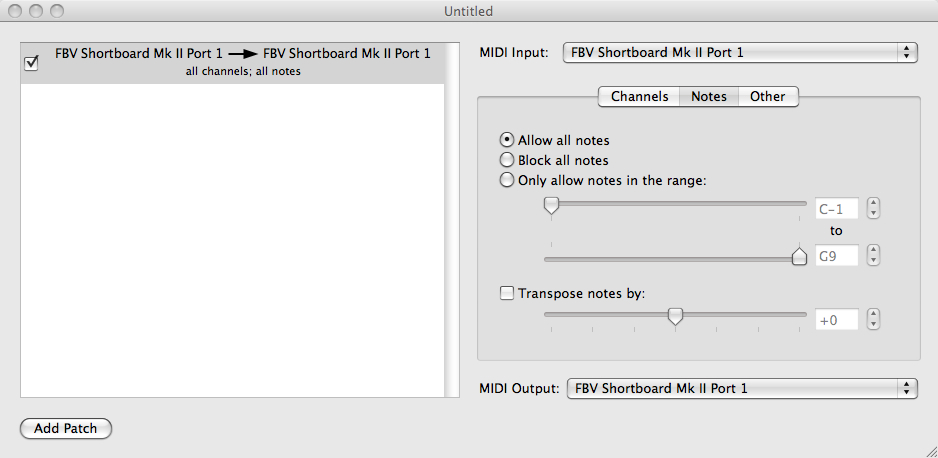
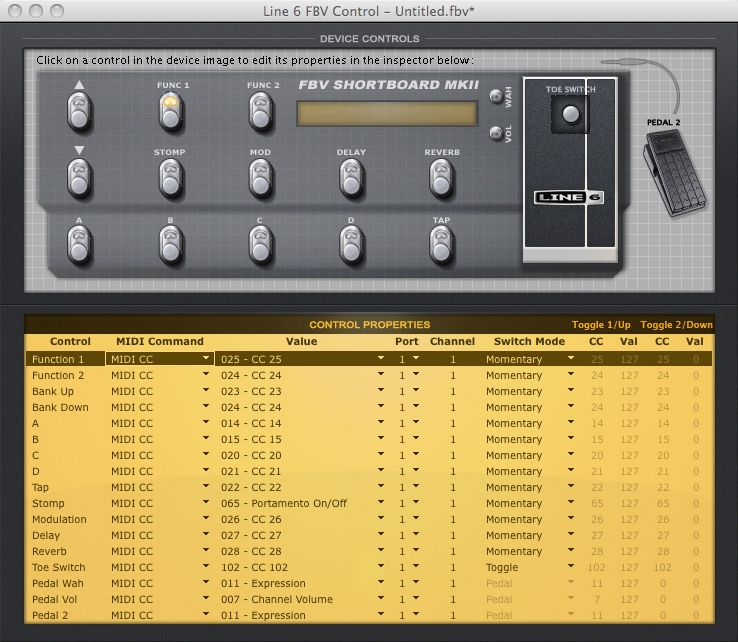
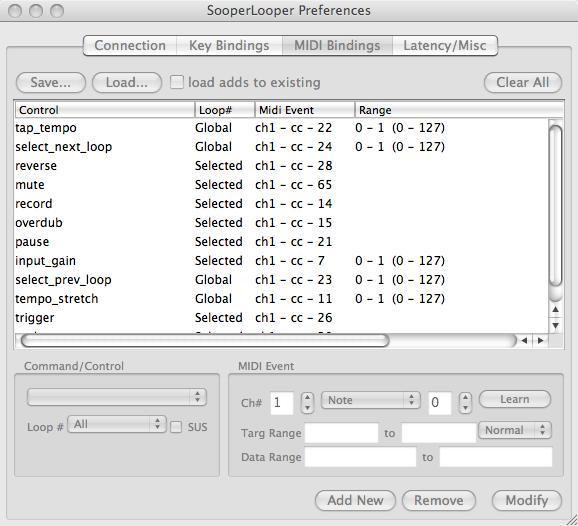
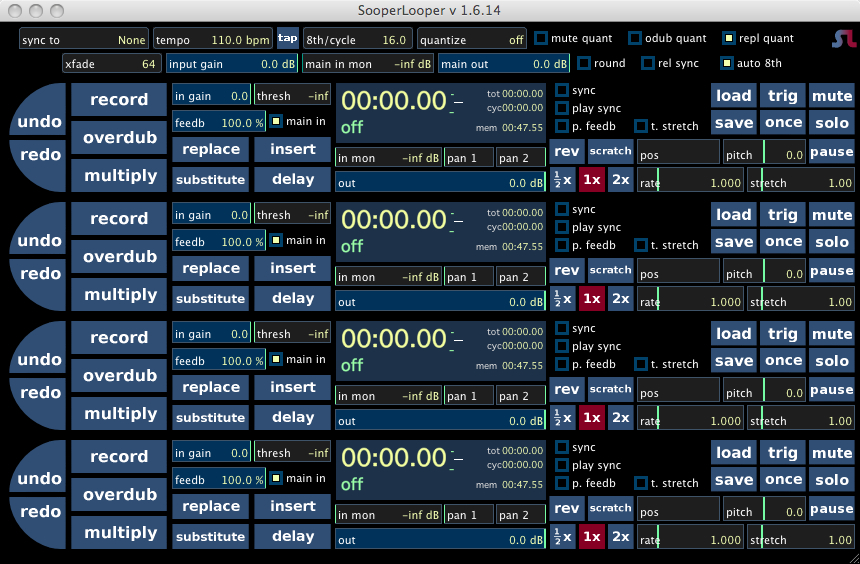
The new board is REALLY cool.  It’s solid in it’s construction and small enough to fit in my laptop bag.  After I downloaded the FBV Control software from Line 6.   I tried to set up a SooperLooper session in AU lab.  The concept was to run the AU of SooperLooper in AU Lab and use a midi patchbay to make sure the signal was going from the FBV to the Sooperlooper session.  Here are the patchbay settings.

Had some trouble initially  but once I went into FBV control and reset some of the switches everything worked.

This probably isn’t the smartest series of codes to get everything to work – but it’s working.

The only gripe that I have is that I wish that some additional parameters in SL could be controlled via midi (i.e. 1/2 or double speed or main monitor volume for fades).  It’s easy enough to lean over and hit the keyboard – but it does defeat the purpose of ordering a 15′ USB cable.  The board itself though works like a charm.

I’m in the process of working on sounds on the X3 Live for the show – and tweak PA vs. amp sounds.  One thing I’ve noticed with modeling is that there are at least 4 different scenarios for setting up sounds:

1.  Headphone patches – i.e. practicing or recording

2.  Playing through an amp at low volumes

3.  Playing through an amp at high volumes

4.  Playing through a PA.

You might think that there wasn’t a lot of variance – but the differences between these parameters are huge.  I have patches that sound mediocre at low volumes and sound really good when the volume gets goosed a bit.  Headphone patches that work well at home and fall apart live – and vice versa.

As a result of all of these constant parameters I’ve been experimenting with Impulse Responses in Logic’s Space Designer (and LA Convoluter) and getting some encouraging results.

Impulse Responses (IRs)

In a simplified definition:  Impulse Responses (IRs) are measurements of acoustic spaces that can be loaded into applications (Like Altiverb or Space Designer) to create different types of reverberations.

I read an article about beefing up Logic 8’s guitar amp pro by replacing the speaker sims with IR’s.  That article is here.  This got me looking for all kinds of IR’s.  For those of you who want to see how this works on guitar tracks – check out the recabinet site.  There’s a really cool pdf that talks about the different IRs and the mics used to capture them.  As of this writing they’re selling a download of something like 2000 IR’s for $15 bucks.

Now I’ve been testing these at home – the difference is night and day!

It’s late while I’m posting this – but let me give you 2 simple examples.  First here is a simple rock rhythm with a plexi type setting.  This is just the AU recording of the pod with a plexi setting and the 4×12 cabinets selected.

DirtyrhythmnoIR

Now here is a another take of the same pattern and settings but with a 4×12 IR added. It’s a little brighter but the response is different as well.

DirthrhythmIR

To my ears – the second is a little more natural sounding particularly on the ascending chords.  Here’s one more example with a clean tone.  It’s subtle but noticable.  First with no IR

BluevelvetnoIR

And with the same IR as above added:

BlueVelvetIR

The non traditional guitar sounds have various degrees of success, some sound better some sound worse.  But this made a HUGE difference on the headphones.  I’ll try them through speakers later.

For those of you looking for free links here are a couple of them.  I’m in the process of downloading these myself – so no guarantees for the sounds themselves.

First some very cool non-guitar specific responses here:

Then some more guitar and bass specific IRs here. But I’m digging the redcabi.net IRs so far…

I found an AU ( LAConvolver ) that supports IRs and runs in AU lab – if I keep the wet gain at 50% it works well.

The advantages of AU lab are several (including low CPU use and that you can route audio OR midi through it) but the main advantage is that when you save the session all of the parameters in all associated plug-in’s applications are saved.  In other words – when I get it set up for use with a PA – it’s done.  No more re-inventing the wheel.  This is particularly helpful when you’ve set up a series of midi commands for Sooper Looper.

Here’s the laptop setup:

FNH Guitar -> Radial Dragster ->Pod x3 Live -> (Stereo out) ->Behringer FCA 202 (I hope to sub this out with an Apogee Duet eventually) -> Macbook Pro (Intel Core 2 Duo 2.4 Ghz – older model) ->Aulab running LAConvolver and Sooperlooper->(Stereo out) ->Behringer.

Here’s the AuLab set up – I’ve put SL on a Bus – but I since I can mix wet and Dry in SL I could have just left it on channel 1.


Here are some sample LA Convolver settings (these are both from the 4×12 greenback IR’s in redcabi.net):

And finally 4 instances of SL.

I’m still experimenting but this is the current plan.  Now to apply all of this to mainstage to get synths and percussion in the mix….

This may not make any sense.  The goal to to fit everything into 1 bag – except for a guitar and a gig bag.  Hopefully I’ll have photos soon.

Also the title of this references the passing of Ronnie James Dio.  I enjoyed his work with Rainbow and while he and Vivian Campbell had a pretty miserable falling out – their 1st 2 cds had some great moments vocal and guitar (particularly Last in Line with perhaps the quintessential heavy metal guitar solo).  Dio was 67 on hitting the stage with Black Sabbath (ok fine – Heaven and Hell) at an age many people are bed ridden.  It reminds me of my favorite quote on retirement ever:

All I do is play music and golf.  What do you want me to retire from?” – Willie Nelson

Rest in peace Ronnie.