Here’s an obvious statement, with a not-so-obvious ramification.
Time is cumulative.
As a society, we’re trained to think of time in specific blocks. We take an hour for lunch. We work from 9-5 (if you’re lucky). Television shows are either a ½ hour or an hour.
So we’re trained to think that if we don’t do anything for the full hour that nothing is getting done.
Here’s an experiment.
Can you do a 100 push ups in a sitting?
If not, can you do 10?
If you could do 10 consecutive push ups with perfect form how long would that take? Maybe 30 seconds? Now let’s say you did that 10 times a day. That’s 300 seconds (aka 5 minutes). But you can’t do anything with 5 minutes of exercise a day, right?
Wrong.
Try it every day for 5 weeks. Try adding 1 push up per set every week (and more if you can). That pushes you up to 15 per set or 150 a day. By sheer increase in number you’ll notice that you’re getting stronger. You’ll probably notice physical changes as well.
Guess what happens when you apply this to practicing a difficult passage with a metronome?
Reclaim those shorter time increments in your day by reprogramming your brain for what they mean! Those minutes add up over the course of the days, weeks and months ahead.
You can get a lot done in a lunch hour and those hours add up. Set a timer and work on things for 20 minute increments. But when you work on them, really work on them. Don’t half-ass them. If you do this multiple times a day, you will get a lot more done than you might think.
If you have a strong understanding for why you are doing something, you will do whatever you have to to overcome any obstacles associated with how.
I hope this helps! More posts soon (and more podcasts as soon as I can stop running my air conditioner long enough to record one!) Thanks for reading.
-SC
PS: If you play guitar you may be interested in a book I just released yesterday!
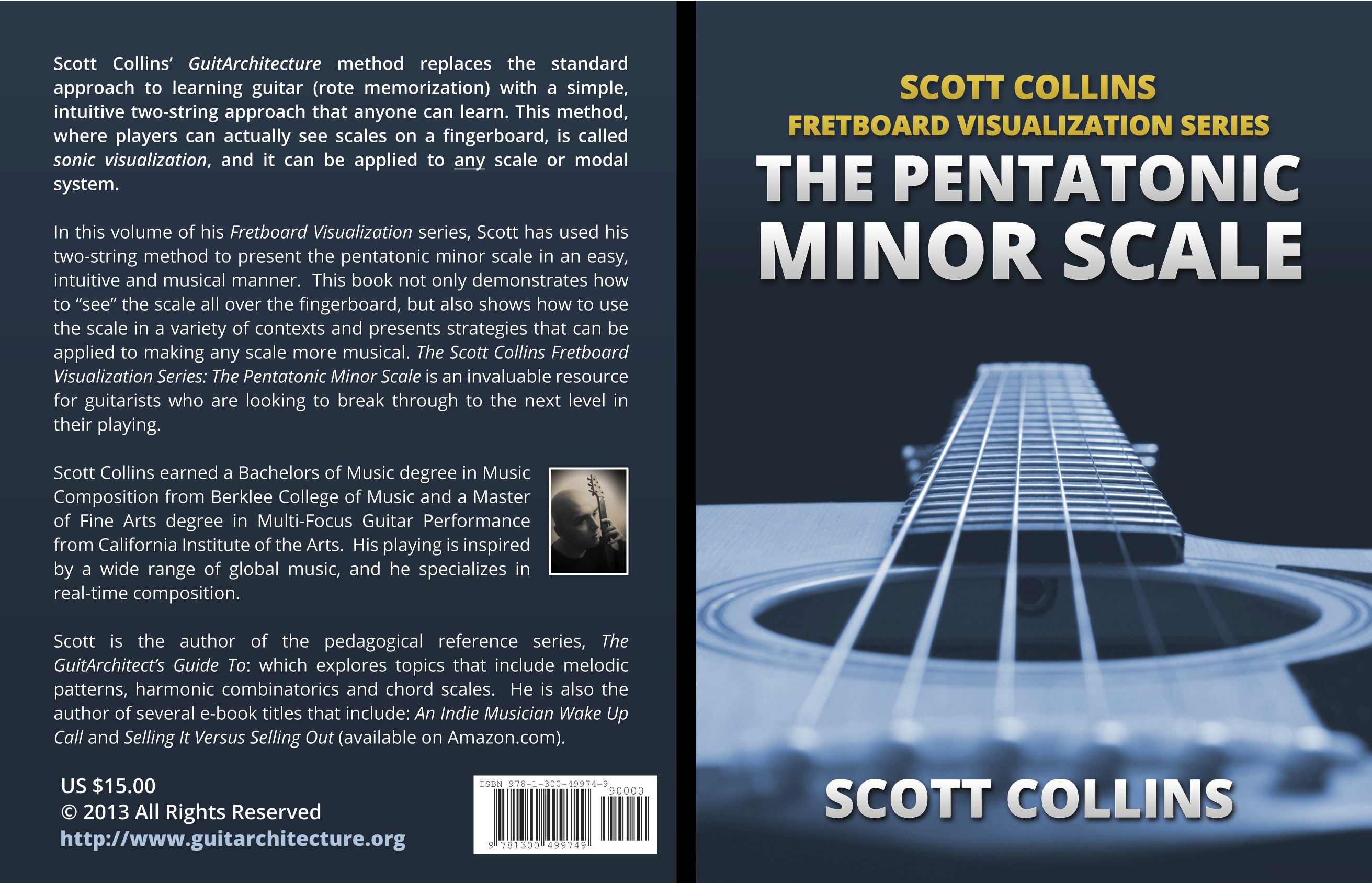
The Scott Collins Fretboard Visualization Series: The Pentatonic Minor Scale
You can read all about that here or see excerpts and order the book here.
I have a new post coming up next week about benchmarks and perfection, but as a starting point I wanted to bring out this chestnut (originally posted on guitarchitecture.org).
One of the things that attracts me to improvisation is the immediacy of it. You perform and then it’s done. While I like documenting these improvisations I fully recognize the danger of doing so. (The danger being that when you record something there is a tendency to say, “Oh that sounds pretty good. I should just tweak a couple of things and then it will be perfect.”)
A Variation on the “I used to Walk a mile in the snow to get to school” rant
The way records used to be made back in the day, involved a bunch of musicians who rehearsed and/or toured some material to death getting together in a room. Mics would be set up and levels were typically set by putting loud instruments in the back of the room and softer ones up front (soloists would literally step up to the mike to solo and then step back) and after the end of the performance, the record was recorded.
Multitracking came along and studio time was still prohibitively expensive enough that you wanted to get tracks done as quickly as possible. I played in several bands that did weekend cd’s tracking and overdubs on day one and mixing on day two. There were always things that you wanted to tweak – but two days later you had a CD and it was done.
You kids and your new fangled “machines”
Now everyone has a multitrack recorder called a computer that can edit audio to the millisecond and the temptation to play god and make the perfect aural universe is a dangerous one to productivity.
Don’t get me wrong. I love my computer and I love Logic but I also know that if a take is 95% of the way there in terms of recording – it may take all day at best to get that extra 5%. In a worst case scenario it might take forever.
Perfection is over rated.
Midi can be “perfect”. It can be quantized and performed uniformly ever single time. From a performance perspective, it can play things faster and cleaner than you will ever be able to with millisecond accurate timing.
Midi is also typically boring. No one wants to watch a sequencer play things on a stage. Audiences might listen, but they’re not going to give it their full attention.
In pop music (i.e. “rock” music) – ProTools and midi as a performance standard have increasingly become the goal. Once I was sitting with a world class engineer and in discussing talking about how out of control the pursuit of “perfection” in commercially released recordings is, He said, “let me give you an example” and proceeded to bring up a track he was working on on his desk top. The track was going really slow.
“Is that an old computer?” I asked. It turned out that it was the newest version. Top of the line with memory and drives at the highest level the system would support.
When the track finally loaded I saw why it took so long. There were eighteen thousand edits on the drum track alone. 18,000 edits! On a 4 minute song. Every single drum hit was cross faded. Every single hit was moved and jostled to fit a midi track.
From a perspective of timing – it was perfect but from a performance perspective it was boring and it sounded like every other programmed drum track you ever heard.
I am not advising you to give up on bettering yourself (quite the contrary) – but my general advice to any artist is not to get seduced by “perfection”. Perfection can be a great motivator or it can be the siren song that sinks your productivity.
To paraphrase a quote that I should be able to cite, “A true artist never completes a work but merely abandons it.”
Deadlines are your best friend.
Deadlines allow you to get things done.
Real (i.e. no-moving and non-negotiable) deadlines force you to realize that 95% of something is more than 100% of nothing.
Work at the highest level that you possibly can – but realize when it’s time to move on to the next thing.
I just saw a documentary on Netflix called “That Guy Who Was In That Thing” which is about a number of instantly recognizable character actors and their paths to get to claw their way to the middle. ; )
The documentary is thoroughly engaging by being both entertaining and thought-provoking. There also happen to be a number of parallels between performing in the film/television industry and performing in the music industry. The subjects spoke at length about the difficulties that come with the ebb and flow of work that their careers take. They talked about how they were (and are) out of work for years before they get a few gigs or hit a streak of work and all of them had stories of other parallel jobs that they worked while trying to make a living acting and tales of losing gigs for any one of a dozen reasons.
Two things grabbed me right away.
1. The subjects spoke at length about how the number of actors out there willing to work for less has caused many of them to make less money than they did before. The thinking being, we don’t have to pay you that anymore because there are 10,000 other people who will kill to sit in that chair for less money. The number of parallels with this and recording musicians (and performing artists) was striking. I’m paraphrasing here, “You realize that they don’t need you to fill the role, they just need to fill the role.” Does this sound familiar to anyone performing and/or recording music out there?
2. Musicians might actually have it easier than actors.
Here’s my thinking behind this. Actors need vehicles to act in. So the model they use is basically variations for Advertising / Televison / Film. For a TV show, this might mean
auditioning for a pilot with hundreds of people
getting a callback with maybe 50 people
getting a second callback with 20 people
doing a test with 5-6 people
having a series of negotiating calls made to see what you will cost them
testing in front of the studio executives this will limit you to a group of maybe 3 people
if chosen, you then shoot a pilot
the pilot then has to get picked up and
then you hope that the series doesn’t get cancelled after the first few episodes
The interesting thing to me was that this paralleled musicians and major labels. The thinking was for years that you had to be in a band and signed to a label to have a career. Online distribution changed that model forever.
Having said that, artists on labels are/were the only people getting tour support. (They’re generally the only people to also get tour support via sponsorship. )
For actors, working with studios means you get to keep your SAG card. You get to keep your benefits and the SAG card is key to the audition process (and the securing of roles).
It doesn’t say it directly in the documentary – but some of these actors slogging it out in endless auditions seem to be afraid that the new (up and coming) actors are just getting pulled from YouTube.
I don’t think it’s the case for major films – and won’t be for a while.
Studio legend Tommy Tedesco once related a story where some MI students went with him on a session and one of them said, “I don’t understand. Someone who’s been playing a year could play that part.” And Tommy said, “yes. that’s probably true.”
The student pushed it more and said, “But you make triple scale, why do they pay all of that money to bring you in when they could get someone to do it much cheaper?”
Tedesco replied, “Because when you spend 50 or 75,000 on a recording session with an orchestra, you don’t want to lose money because some guy might screw up his part. You’re going to get the best players on the session to make sure that absolutely nothing goes wrong.”
Again, I’m not knocking YouTube – but a YouTube performance doesn’t mean you can handle the rigors of any gig that comes your way. While it might get you an audition, in and of itself, it’s never going to give you traction if you don’t have the skills to back it up.
Here’s what bugged me about the documentary.
No one talked about going DIY.
No one talked about making their own films. Writing and staging their own plays. Starting their own companies. All they talked about was a variation of the formula:
Get call from agent + audition + a dozen factors MAY = a gig.
It’s easy to view a music career like this. Waiting for a shot – the right moment, the right contact – to make a big pay out. It’s the lottery mentality to which I say, “sure, put a couple of bucks in and see if you get lucky, but putting your life savings in it probably won’t pay off.”
Those development contracts like Joan Crawford were on back in the day are never coming back to the movie houses. Those days of getting signed to a label and having a carer carefully cultivated over multiple releases are never coming back.
Elvis already left the building.
While I’m fully in favor of seeking out opportunity – by and large you make your own opportunities and the formula for that is:
Do really good work + Do it frequently + Affect, motivate and/or move other people = being the go to person for “that thing”.
If what you do services a niche audience, you might not get rich but it’s probably the best way to build a long-term career.
I thought this was fixed, but apparently some component of the lib syn/feedburner/iTunes trinity is broken and despite re-uploading some of the files the links for Episode #4 and Episode #5 are pulling up podcast #2 in iTunes.
I have NO idea for why that is happening but I’ve included streaming and download links here for all of the current episodes. These load right up in my podcasts so hopefully they’ll do the same for you!
I’ve moved all the podcasts to one central place, the PODCAST tab on the top of the page.
.
Again, my apologies for the inconvenience everyone! More content coming soon!
Guit-A-Grip podcast episode #8 is now out and available for download/streaming. I’ve changed the order up a little bit and you’ll find the stream and links below.
The Guit-A-Grip Podcast Process
This podcast format (instead of just blogging) largely came about because discussions with friends of mine in any kind of creative field would result in my going off on some tangent covering the intersection of music business and personal motivation which sometimes people got something from. I’ve tried to keep some of that flavor here (minus the manic expressions and cursing). So when I go to do a show – I’ll have some talking points and then improvise around the notes and try to hit a few marks.
While this may work in a conversation, it’s a mixed bag for audio recording.
The plus side of this process is that you come to realizations about things that you weren’t planning on. While I had been conceptualizing the area around the actionable differences between an answer and a solution – I never verbalized it before like I did in this podcast.
The down side is that you have to remove a lot of awkward pauses, “ummmms” and “uhssss” that come up in conversation getting to points like the one above. I want to distill the audio experience and get it down to the essence of what the listener is looking for.
In addition to taking some time, this editing process occasionally leads to some stunted audio. It also leaves some conversational holes for ideas that are half started and then need a resolution. Hence the need for the show notes.
Trying to find a segue (as opposed to a Segway) into the topic. Yes, there are a lot of ads for apps. There will be many more. It’s not some kind of advertising menace. Yet.
.
The Calculator.
The idea I’m rambling around in the early steps of the podcast is how the use of a calculator is completely divorced from both the math required to solve the problem and the mechanics of how the calculator arrives at the solution.
In playing guitar, something can come out of the work that goes into really learning a piece at a deep level. It’s why some music theorists go so gaga for analysis because they’re finding new connections and seeing things on a deeper level.
To be sure, I’m not a Luddite. You’re not going to gain much doing long addition for EVERYTHING – but if you get used to using a calculator – you’ll be amazed at how quickly your math skills start to atrophy.
.
The App
In the app story I used an app that addressed a specific issue with a limited answer base. Most apps don’t exclude other people BUT if you’re using YELP during a vegetarian conference to find a local vegetarian restaurant in the area – and there’s only one – guess who’s going to get a table? The first person who finds out about the restaurant and gets there.
The main point is that other people’s solutions are often adaptable to your situation, but the better you get at finding your own solution, the better you will become at developing solutions in general. Ditto for applying those solutions.
That’s a wrap.
As always, If you like the podcast please let me know. If you really like it -and listen to it on iTunes – leaving a rating there would be really appreciated!
Several things got me thinking about this topic – but the key moment I knew I’d have to write about this came the last time I saw my mother in upstate New York and found a bunch of old scores from my Berklee composition days and sat there scratching my head.
They were really disjointed and amateurish. It was like seeing myself go through puberty again and hearing my voice crack. For a moment, it made me feel awful and then I remembered that I wasn’t that guy anymore. Just as a 5 year old version of me tried to stick a fork in an electrical socket to see what would happen (I’m not doing that anymore btw) I’m not that same person.
I should know this but it’s either The Code of the Samurai or The Hagakure that has a philosophical maxim that I’ve held onto for much of my life,
“Seven times down – Eight times up.”
And it’s served me will. You will hit walls and obstacles in whatever it is you do, but the actions you take in resolving those things will ultimately be how you define yourself.
You are not your job (Unless you define yourself that way)
One of the first jobs I ever had was in a department store. It was supposed to be a temp job during renovation, but I worked really hard, hustled and made myself an asset to the store so when the time came to keep a handful of employees – I was one of the ones they kept.
Perhaps there’s an alternate universe where I’m still working at that store, but I knew that there would be other things for me to do and so I moved on. It’s not part of my self definition.
While my undergrad experience was a lopsided one I don’t view myself as a failure (even though I have a few grades that argue that point!)
I had a bad experience and had to decide what was important and move on to the next thing.
I had to teach myself what I needed to know and transition from thinking to knowing.
I made myself a better musician, learned a lot of hard lessons and eventually transitioned to a place where I got into grad school (and no failing grades that time around). That experience is a big part of what’s gone into making me who I am but, like the department store job, it’s not part of my self definition.
Things referenced in the Podcast
I mentioned that I’d link to some things in the Podcast so let’s try that.
First – some clarifiers
1. I remember the instance with the guidance office now. We had to fill out the applications but the guidance office would not release transcripts to us – so we needed to give them our applications to submit so they could enclose transcripts. I was told, “Our office does not make mistakes” when I got the letter back from Berklee even though I pointed to the requirement in print and noted that the transcript provided didn’t meet them.
2. Eugene’s trick bag is the Steve Vai guitar solo that Ralph Macchio is hand synching to for the film Crossroads.
3. Self Educated man – was a reference to self-taught man in La Nausée – a novel a mischievous member of the faculty gave me to read as a book report. In 7th grade. Brought up unsuccessfully in an attempt to woo a weary admissions counselor.
4. Books Berklee recommended – Robert Starter’s Rhythmic Training was one of them but the others evade me now.
5. In finding the scores I actually found the letter kicking me out of the composition department and found the photocopy of the letter I got from the chair to get back in. A series of correspondences (and conversations) that I had previously blocked from my memory.
6. Juggernaut. This was the composition I referenced in the Podcast. Don’t ask. My instructor didn’t use the term “stones” that I used in the podcast either.
7. “They were torn apart” – specifically one faculty member with a real problem with me blocked my graduation and took no small pleasure in COVERING my scores with red writing. Now I don’t blame him – but at the time my thought was, “I was already graded on these why are you grading them a second time?” Other comments included weird personal observations on how he didn’t like my music.
8. This podcast is for everyone who had a plan. Tried to execute the plan. Had the plan blow up in their face and continue on despite everything.
Second – some music links.
Comité de salut public
I mentioned that I had a group at Berklee that used some of the contemporary composition techniques and wrote tunes with them. That group was called The Committee Of Public Safety and (to my knowledge) was the only avante garde-core French Revolution “tribute band” in Boston at the time. I wrote all the tunes and some of them are below:
But you can hear (and download) all of the tracks (and read more info than you ever wanted to know about this group) here.
The Committee of Public Safety was:
Pat Aldous/Marko Djordjevic – drums
Caroline Dillon – cello
Mike Mallory – bass
Teresa Sienkiewicz / Pat Raymaker- voice
The Time with the Tub
Click for more info
Tubtime came out of a series of sessions I had with drum / recording guru Geoff Chase. I dragged my friend Joe Rauen along to play bass and Geoff dragged the incomparable Patty Barkas along to sing. Somehow we got the mighty Keichi Hashimoto to play with us as well.
We recorded another album’s worth of material that we’ll leak out eventually but for now here’s a soundcheck you might dig as well.
.
The Book
Ah, yes – I referenced the book I wrote to get into grad school.
First, there were two components to the application. In addition to the Tubtime CD there was some audio:
and then the book. Excerpts of the ORIGINAL (error plagued) version was on Google Books but I don’t see it now.
The New (VASTLY improved) book:
Is available on Lulu or Amazon. (Amazon probably ships it easier – but the Lulu page has WAY more information and book excerpts).
Note: the cover is vintage 2013. The original cover was a flat blue with a white title.
Post
I promised a linked post that related more of this story and you can read that here .
Onward and Upward
I hope this helps (or is at least enjoyable or amusing to you)!
As always, If you like the podcast please let me know. If you really like it – leaving a rating on iTunes would be really appreciated!
Hi Everyone! I’m prepping for an upcoming recording session, but I thought in the meantime I’d share another excerpt from my Amazon kindle book, Selling it Versus Selling Out which may have a perspective that’s helpful for you.
If you’ve ever had insomnia and turned on a television, you’ve probably seen info-mercials that are based on success formulas. “I made $1,000,000 in recycling and you can too!” The selling point is that if you emulate what successful people have done, you will get the same results they did.
The problem with this idea is that the “one size fits all” mentality for success rarely seems to work.
One possible reason for this is that so many factors go into “success”, it’s difficult to glean all of the components that go into helping make someone successful.
For example, as a guitarist, I could watch an instructional video of someone playing a guitar lick quickly, learn all of the notes being played, practice diligently and still not be able to get the lick sounding the same because of any one of a number of factors (hand tension, timing, phrasing, string thickness etc.)
While it’s easy to look for successful models and try to emulate that success, it can be even more informative to look at what doesn’t work and model a path against failure.
You can read a book about Donald Trump and still be no closer to achieving his level of success. In contrast, if you watch the television show Intervention and see someone who’s short-circuited their career by being a full blown drug addict, you can decide not to follow their example and make a conscious step towards being the person you want to become.
Lessons from an error-filled methodology
When I first started playing guitar I spent a lot of time working on the solos in songs I was playing. As a commonality, the solos in these songs were all fast and required substantial technique. I assumed that if I just learned the notes, I could get the solos up to speed eventually. My practicing “method” was to just play these licks for hours on end to get them as fast as I could.
In this process, as soon as I could play the notes I would try to play them faster (which was actually much faster than I really could accurately play them). In addition to making things sloppy, it also made my hands overly tense as I was trying to play outside of the realm of my ability and this tension carried over into my playing. I eventually could get the speed of the notes, but there was a lack of clarity and most certainly, a lack of fluidity.
It goes without saying – this is not how you want to practice something.
In conjunction with writing my instructional books, I watched every guitar instructional video I could get my hands on to see how my methods stacked up. Here’s what I found:
Very few people can teach material to others well.
The amount of information that was misleading or wrong was shocking. It occurred to me that many people are poor teachers because they either don’t know the material at a deep enough level to explain it to someone else or because they have no concept of how to relate that material to other people. This makes the job of the student that much harder, because the student has to sort out what the teacher is trying to say rather than what is actually being said.
Ignorance is contagious.
Ignorance is viral. It spreads quickly and easily and once infected, it can be a difficult process to overcome. In my own case, the problems I developed by “practicing” in the wrong way have taken years to try to fix and is still an ongoing process. (This speaks to both why it’s important to learn things the right way the first time and how difficult it is to overcome bad habits).
If you take this to a YouTube level – you’ll find many people who play a lot of notes but can’t play them well. Sometimes there’s no concept of phrasing. You see out of tune, out of time bends with no control followed by a flurry of notes hiding under a ton of effects. I’ve seen the tension I talked about above from trying to play too fast too quickly in a lot of online videos. The notes are kind of there but only in a holographic way. You get the feeling that if you were to put a metronome down on a table and drop the tempo by 1/2 that whatever the person was playing would completely fall out of the pocket or more likely completely fall apart.
Observing and reflecting on people getting things wrong, can inspire you to see elements of weakness in yourself and correct them.
When I see someone play badly, I try to figure out why it’s bad and then try to see if there’s something I can take away from it to develop my own playing. Maybe it’s a simple observation like, “Ok I really need to work on my vibrato!” – but I try to make each observation a lesson.
How not to do things also directly relates to goals. It’s about looking at an outcome and saying, “if I do not want a specific outcome to happen what steps do I need to take?” Its advantage over merely examining how to do things is that it gets your hands dirty and forces you to come into contact with the nitty-gritty behind various processes. In this way, it may help you come to a deeper understanding of what you’re trying to do and how to go about doing it.
Stewart’s is a family owned company that has convenience stores in upstate NY and Vermont. The Drake brothers started by making ice cream at their farm in 1921. In 1935 they start Saratoga Dairy out of their barn. That same year pasteurization of milk is required by the state and many local farmers use Saratoga Dairy for this service. 1938 they expand into producing other milk and milk based by-products such as cheese, powdered whey and casein.
Stewart’s has come a long ways. Their Wikipedia page sites 324 stores and 1.4 billion (!!) in sales of Stewart’s branded products such as coffee, soda, milk, chips and ice cream. You can find out more about them here.
In contrast, Wemple and Edick’s is a small ice cream shop on the outer edge of Johnstown NY. Run from an old-fashioned general store that’s been there since 1826, they make hard ice cream, and baked goods. They’re only open seasonally. They don’t have a web page – but you can find their Facebook page here.
Stewart’s makes a lot of money. They do a lot of things. Wemple and Edick’s basically does one thing, but even though they’re only open seasonally they make enough money to keep the doors open doing what they want to do.
In typical Guit-A-Grip fashion relating aspects of each of their merits to what you do as an artist/entrepreneur is at best a gross over simplification, but you might be able to get something out of the contrasts that are presented. (Also, that part of the podcast apes the Seth Godin Start Up School presentation style in manner that was unintentional when I did it, but eye rolling on play back.)
If you travel anywhere in upstate NY – you’ll find a Stewart’s – but you have to seek out Wemple and Edick’s (and many’s a time I went and was crushed to find out that they weren’t open).
While on the surface this is a music business post, at its core the topic relates to both the how and the why of whatever it is you’re doing and I hope it helps in some way.
As always, If you like the podcast please let me know. If you really like it – leaving a rating on iTunes would be really appreciated!
My latest Guitar Notes From The Underground article is up on Guitar-Muse and features a song analysis that showcases some really cool riff ideas. If you’re looking to hear something a little bizarre this morning (or looking for some new ways to break out of your writing rut) you might dig it!
I tend to keep the transcriptions spartan and just focus on the notes so people will check out the tracks, but if you’re willing to forgo crescendos, tempo markings and accents, the article is here.
For for those of you who are following it, the new Guit-A-Grip podcast will be up on Friday.
I was thinking about the earlier podcasts and one thing I wanted to experiment with is really focusing the podcasts into short take aways that can be acted on immediately. Kind of motivational and philosophical licks if you will. So the next posts will be short but I’ll continue to intersperse them with longer posts for people who want more information. I’m trying to find the ideal format here, and I guess I’ll wait to see what springs up.
So this episode goes all into the lifeblood of any artistic longevity, your fans. I mentioned the “Don’t Stop Believing” documentary in the podcast and while it should be out on DVD eventually, you can stream it now right here.
Arnel comes across really well in the video – and what the video doesn’t highlight is that Arnel was a 40 year old singer in a Manilla based cover band. In the often ageist rock and roll market, that’s a time that many people consider a death sentence for achieving their dreams. One incredible fan may have given him the platform for Neal Schon to find him, but it’s his talent and energy that put him on that stage. He kept working even when logically, there wasn’t much point in his doing so.
Perhaps the greatest lesson in the movie comes at the point where he’s blowing the audition. Arnel relates that he has this burning question of, “How am I going to let my true self come through if that want a classic sound?” during the audition which he finally answers with the realization that they brought him there to do a job and that that’s what he’s going to focus on.
If you commit to something and do your best – you don’t have to worry about whether or not you’re going to come out of your shell because people will see you for who you are. How many times have you gone to see a band and walked away with an observation about one player? “The band was good…but that drummer was unbelievable!” And I’m not talking about just dumping a lot of chops here, I’m talking about how great players transcend the material by being in the moment of what they’re doing. They say something real and the audience gets that message. Then you get players like Vinny Golia who have all the expression and chops in the world and is just a force of nature on a bandstand where you’re never going to doubt who that guy is.
(I’m off topic here but I will, yet again, plead with anyone who will listen to me that Vinny Golia is one of the closest things that we have to a national treasure and I can think of no one in the arts more deserving of a MacArthur fellowship than him. Please tell all your friends – particularly the ones who submit nominations.)
As a secondary lesson, it acts as a great reminder about opportunity. When opportunity knocks most people ignore it because they don’t recognize it as an opportunity. Arnel was going to blow off the e-mail from Neal Schon because he didn’t think it was serious. Keeping options open makes it easier to answer the knock of opportunity when it happens – even if it just sounds like someone tapping their fingers on something.
Jason Becker
Additionally, if you’re looking for an inspirational guitar documentary – I would implore you to buy the Jason Becker documentary. Jason Becker, an astonishingly talented guitarist on the eve of his greatest guitar victory (securing the guitar slot in David Lee Roth’s band) get’s diagnosed with ALS which ultimately robs him of the ability to play guitar. The documentary about Jason showcases his early story but is also about Jason’s refusal to stop making music and how he is still composing music using eye movements to enter in midi notes.
I have a movie review (and a transcription of one of the excerpts from the film) on Guitar-Muse, but the heartbreaking thing is that while Jason has a legion of well meaning fans that many of those fans uploaded all of his recorded material (including his DVD) to web, which deprives he and his family from income that could help maintain his life.
If you have Netflix, you can stream the documentary (which might put a few pennies in his pocket) but it’s also available for purchase on dvd or you could make a donation directly to the family here. If you’re a fan of his music, it would be a great way to give something back to someone who really needs the help.
next time
Back to the podcast – If you like the podcast please let me know. If you really like it – leaving a rating on iTunes would be really appreciated!
More posts and podcasts are on their way Next time, I’ll talk about the best ice cream shop in NY that you never heard of (unless you know where Sammonsville is)!



 GuitArchitecture.org