Favored Curry Or Spicing Up Chord Scales And Triads Part 2

In Part 1 of this lesson,  I went over how to create a chord scale for improvising over a specific chord (in this case C major)  chord.  As a brief recap – here is the chord scale I chose:

.

C major chord scale with a # 2, # 4, and a b6 scale degree.

.

To start this off – here’s a sample lick using this scale:

.

Here’s how the scale sounds played slowly  (1/4 note at 90)

Here’s the scale faster (1/4 note at 180).

.

The chords you say?

Since we’ve engineered this chord scale around a C major triad – we know that any licks we come up with will work over that chord – but to see what other chords can be used with this scale – we need to harmonize it.

Let’s look at the triadic (3 note) harmony first.

.

C major chord scale with a # 2, # 4, and b6 scale harmonized in 3rds (triads)

.

**Note the first 2 chords have been moved to the back three strings to facilitate playing:

.

Here are  the chord formulas that are generated:

  1. C, E, G – Root, 3rd and 5th – C Major
  2. D#, F#, Ab – Root, 3rd and double flat 5th – non functional harmony*
  3. E, G, B – Root, flat 3rd and 5th – E minor
  4. F#, Ab, C – Root, double flat 3rd, flat 5th – non functional harmony*
  5. G, B, D# – Root, 3rd, sharp 5th – G Augmented
  6. Ab, C, E – Root, 3rd, sharp 5th – Ab Augmented
  7. B, D#, F#, – Root, 3rd, 5th – B Major

(Note:  even though these don’t have a triadic function they can serve a function enharmonically – I’ll get to that in the 7th chord section).

To recap –  any licks that we generate from this scale will work over C major, E minor and B major.

 .

Adding the spice

Since we started this approach with C major – let’s look at a lick that spices up a C Major Triad.

.

Here’s an mp3 of the lick.  This is an example of something I might play as a backup accompaniment in the pre-chorus of a song.

To my ears even playing this over a straight C major tonality, the D#–>E really triggers an E minor tonality.  Try playing this over a C major –> E minor progression.

.

Moving to E minor – here’s an approach I use a lot in rhythm playing.

.

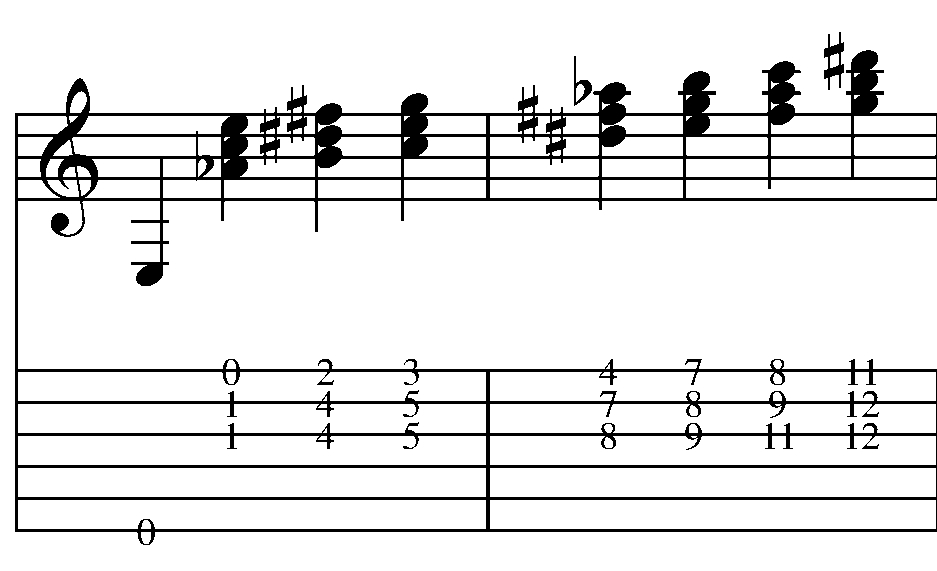
The first step is to take a set of three strings – in this case I’ll use the high E, B and G strings.

Starting with a sample chord voicing in the low register – ascend up the neck by moving each note in the voicing up by scale degree.  In this example:
.

I’ve started with an initial voicing (Ab, C and E) and moved it through scale-wise motion.

.

(Note:  I hear this as G# instead of Ab – you may want to see the section on enharmonics below).

.

Here is an mp3 of the voicings.  In the audio example, I play a low E between each chord to establish an overall tonality.

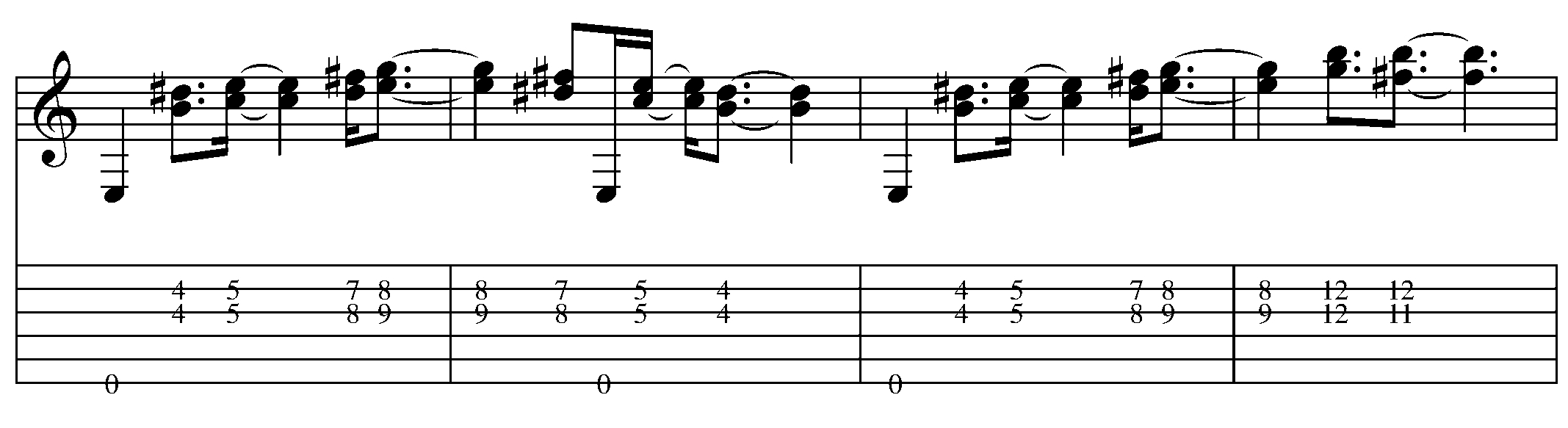
Having done this – I see some cool dyads ( 2 note voicings) on the B and G strings that I can use to spice up an E minor vamp.  This is an example of the type of comping I might do on the verse of a song if the song chart just said E minor).
.

Here is an mp3 of the lick.  Don’t be afraid to lay into the slides or add a little vibrato to make the notes sing a little more.

With a lot of these approaches – I’m not really conscious of what the specific functions of the notes are.  Once I know that the scale will work over a chord – it’s more about focusing on the sound of the notes and how they fit into the song.  On some tunes – these notes would clash with the melody and it wouldn’t work.

This process is about building a repertoire of sounds to have at your disposal.  Knowing the theory around it just allows you to adapt those sounds and approaches to make the fit where you want them to.

.

Space is the place

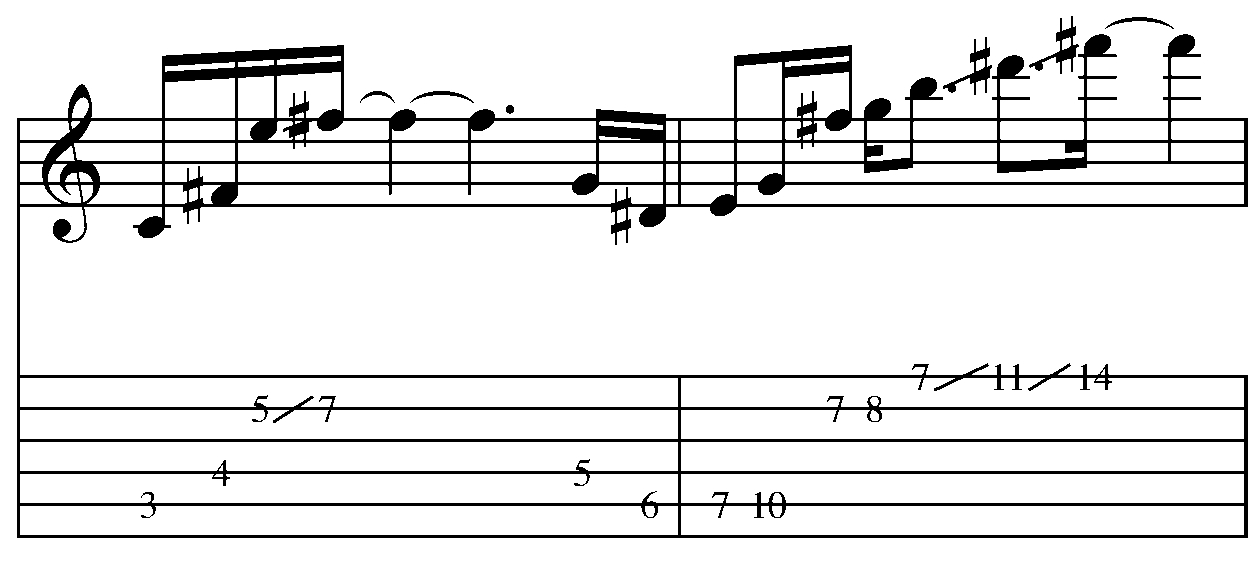
Here’s a lick that takes the above approach of breaking chords up into different string sets and applies it to a melody line.  Here I’ve focused on the A, D and B strings and added in the high E string at the end.
.

Here is an mp3 of the lick.  Note the slides, vibrato and slightly rubato phrasing at the end of the lick.  These are the little nuances that help make the difference between playing music and playing notes.

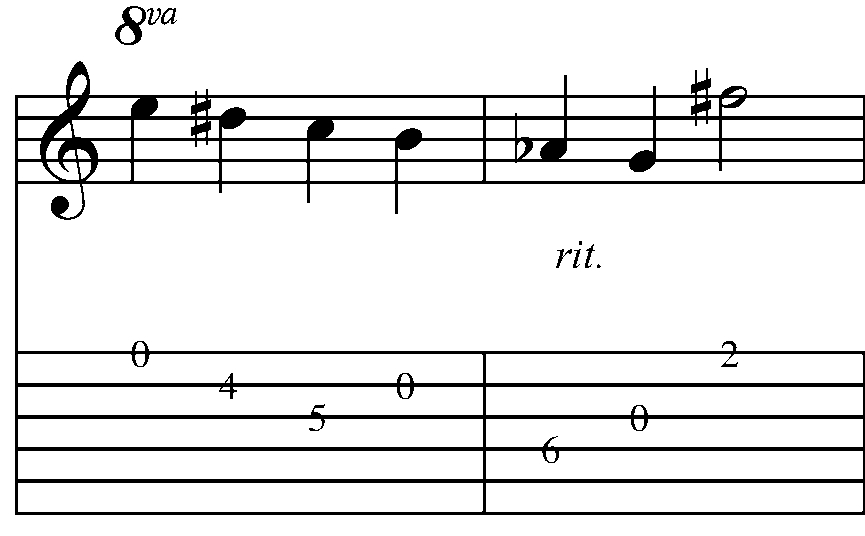
This next lick combines chord forms and melody by using artificial (i.e. “harp”) harmonics.  To produce these – a chord shape is held with the fretting hand while the picking hand picks and partially frets notes 12 frets higher resulting in a chime like timbre.  If you are unfamiliar with this technique – just google Lenny Breau (an absolute master of the approach) and you’ll get an idea.

For this specific lick:  I’m holding the D# with my second finger, the C with my 3rd and the Ab with my 4th so I can reach the F# with the fret hand 1st finger.

.

Here’s an mp3.
.

One of the secrets of this method is to strategically time the release of the fret hand notes.  The longer you can leave the notes held down, the more the pitches will bleed into one another – which produces the desired effect.  Before we go to the next lick I need to make a brief enharmonic diversion.

 .

An Enharmonic Diversion

An enharmonic is when a note is spelled differently but sounds the same (for example Ab and G#).  When playing this over an E drone – I hear the pitch on the first fret of the G string as a G# (i.e the third of the chord) instead of Ab.  It’s very difficult for me to hear that note functioning as a b4.

As a case in point, here’s another lick.  (This piece makes liberal use of vibrato bar scoops – listening to the mp3 of the lick for phrasing is recommended).

.

.

I’ve notated this lick with both a G# and a G natural as those are the intervals I hear in the approach.

With this interpretation it makes the scale harmonically vague as it would then have both a major AND a minor 3rd.  If we go back over the initial triadic chord and replace the Ab with G#, F# for Gb and D# for Eb we get a couple of different chord options.

  1. C, E, G#-  C Augmented
  2. E, G#, B –  E Major
  3. G#, B, D# – G# minor
  4. C, Eb , G –  C Minor
  5. G, B, Eb – Eb Augmented
  6. Ab, C, Eb – Ab Major

To recap –  in addition to C major, E minor and B major – these licks can also be used with care over E major, Ab major, C minor  and G# minor.

.

To finish this approach out for now – let’s look at 7th chords.

 .

C major chord scale with a # 2, # 4, and b6 scale harmonized in 3rds (7th chords)

**Note:  the stretch on the second chord should be approached with caution.  If it hurts – stop playing immediately!

.

Here are the chord formulas that are generated:

  1. C, E, G, B – Root, 3rd, 5th and 7th  – C Major 7
  2. D#, F#, Ab, C – Root, 3rd and double flat 5th, double flat 7 – Enharmonically – this spells – Ab, C, Eb, Gb, – or Ab7 – but doesn’t serve a function from the D# pitch.
  3. E, G, B, D# – Root, flat 3rd, 5th and 7th – E minor (Major 7)
  4. F#, Ab, C, E – Root, double flat 3rd, flat 5th – Enharmonically – this spells – Ab, C, Eb, Gb, – or Ab7 – but doesn’t serve a function from the F# pitch.
  5. G, B, D#, F# – Root, 3rd, sharp 5th, 7th – G Augmented 7
  6. Ab, C, E, G – Root, 3rd, sharp 5th – Ab Augmented 7
  7. B, D#, F#,A  – Root, 3rd, 5th, flat 7th  – B7

This gives us a couple of new tonalities to explore – namely, C Major 7th, E minor (major 7th), B7 and Ab7.

..

The final tally:

At a minimum, this chord scale will generate licks that can be used over the following chords:

C major, C Major 7th,

C minor, C minor (major 7th)

E major, E Major 7

E minor, E minor (major 7th),

Ab major, Ab7

G# minor

B major,  B7

.

Next steps:

You will probably not like the use of this scale with all of the chords listed but, as is the case with any musical approach, the key is always to use your ears as a guide to what works and what doesn’t.

I hope this helps! 

Happy Holidays and thanks for reading!

.

The material in the lesson is adapted from the material in The GuitArchitect’s Guide To Chord Scales book. More information about that book (including an overview and jpegs of sample pages) can be found here.

.

-SC

.

PS – If you like this post you may also like:

.

MAKING MUSIC OUT OF SCALES

CREATING CHORDS AND LINES FROM ANY SCALE – A HARMONIC COMBINATORICS / SPREAD VOICINGS LESSON

.

RECYCLING SHAPES OR MODULAR ARPEGGIOS FOR FUN AND PROFIT

GLASS NOODLES – ADAPTING A PHILIP GLASS ARPEGGIO APPROACH TO GUITAR

.

MELVILLE, MADNESS AND PRACTICING – OR FINDING THE DEEPER LESSON PART 2

SOME USEFUL ONLINE PRACTICE TOOLS

POSSESSION IS 9/10S OF THE LAW BUT PERCEPTION IS EVERYTHING OR PRACTICING PART VII

TESTING YOUR VOCABULARY OR PRACTICING PART VI

PRACTICE WHAT YOU PLAY OR PRACTICING PART V

.

DEFINITIONS AND DOCUMENTS OR PRACTICING PART IV

TENSION AND THE SODA CAN OR PRACTICING PART III

PROPER POSTURE IS REQUIRED FOR PROPER PERFORMANCE – PRACTICING PART II

PRACTICE MAKES BETTER AKA PRACTICING PART I

.

MELVILLE, MADNESS AND PRACTICING – OR FINDING THE DEEPER LESSON PART 2

FINDING THE DEEPER LESSON

INSPIRATION VS. INTIMIDATION

.

WARMING UP: FINGER EXERCISES, THE 3 T’S AND THE NECESSITY OF MISTAKES

“THE LIMITS OF MY LANGUAGE ARE THE LIMITS OF MY WORLD”

A BRIEF THOUGHT ABOUT MUSIC THEORY

.

BOOKS

LESSONS

.

Favored Curry Or Spicing Up Chord Scales And Triads Part 1

[This lesson uses material from The GuitArchitect’s Guide To Chord Scales which details all unique chord scales from 3-note cells to the 12-note chromatic set.  You can find out about that book (and the other GuitArchitecture books) here.]

When improvising over a C major chord, the first thought for many beginning improvisers is to use the C major scale as a melodic resource.  For example:  here are the notes of a C Major triad (C, E, G) broken up into a sample 2 string arpeggio:

.

C Major Arpeggio

.

One related chord scale for this scale is the C Major (Ionian) scale.  The reason for this is that all of the notes in the C major triad are found in the C major scale.

.

C Major Scale

.

While there is nothing wrong with this approach, in addition to being a fairly bland melodic color to utilize, it contains the 4th scale degree (F), which is often referred to as an avoid note because of its 1/2 step relationship to E.

.

Option B:  Modal Interchange

One solution to this is to use modal interchange to find alternate scales that work over a triad.  For example, C Major is a diatonic chord in the key of G.  Playing a G major scale starting and ending on C produces a C Lydian scale.

.

C Lydian  (Parent scale: G Major)


This scale works well with the triad.  In addition to containing the C major triad, it also has a raised fourth degree (aka #11), which adds a nice tension.

But this is merely scratching the surface of what can be found from this approach.

.

Option C:  Creating your own chord scale

.

Here ‘s a process for generating any chord scale based on a chord.

Step 1:  Start with a chord and write out the notes of the chord in ascending order.

.

Note: the smaller the chord, the more scale options you will have.

Let’s now look at the C major triad as a chord formula.  Since it’s made up of the notes C, E and G  any parent scale for C major chord should contain these notes (at least for now).

.

Step 2:  Between the notes of the chord, write in all possible notes for each additional scale degree.

For example, in the Ionian and Lydian chord scale examples above, the 2nd degree was D, but it could have just as easily been Db or D#.

Expanding on this idea, the 4th could either be F natural or F#, the 6th could either be Ab, A natural or A#, and the 7th could either be Bb, B natural or B#.

If we apply this idea to the all of the other scale degrees, we end up with a chromatic scale that looks like this in list form:

  • Scale Degree 1  – C
  • Scale Degree 2 – Db, D, D#
  • Scale Degree 3 – E
  • Scale Degree 4  – F, F#
  • Scale Degree 5  -G
  • Scale Degree 6 – Ab, A, A#
  • Scale Degree 7 – Bb, B

.

or this in music notation:

.

C Major triad with chromatic scale degrees

.

Note:  If you are planning on harmonizing the scale, deriving modal arpeggios or pentatonics, I recommend you keep each scale degree unique (i.e. that you use either Db or D or D#,  but not more than one type of D pitch).

Likewise, there are several enharmonic pitches (i.e. pitches that are spelled differently but sound the same) presented in the full chromatic.   While you could use A# and Bb in a chord scale since they are the same sounding pitch the result will be a 6 note scale.

.

Step 3:  Choose the scale degrees that sound the best to you.

Based on the above parameters, there are 32 unique chord scales for the C major triad.  Let’s look at one of them.

For this example, I’m going to choose a #2 for the second scale degree, a #4, a b6 and a natural 7 scale degree for a very chromatic chord scale. Here it is in list form:

  • Scale Degree 1  – C
  • Scale Degree 2 – D#
  • Scale Degree 3 – E
  • Scale Degree 4  – F#
  • Scale Degree 5  – G
  • Scale Degree 6 – Ab
  • Scale Degree 7 – B

and in music notation:

This scale has a # 2, # 4, and a b6 scale degree.

.

Next Steps

In the next lesson – we’ll examine how the scale is harmonized and generate some licks derived from this technique.

Thanks for reading!

-SC

.

The material in the lesson is adapted from the material in The GuitArchitect’s Guide To Chord Scales book. More information about that book (including an overview and jpegs of sample pages) can be found here.


PS – If you like this post you may also like:

.

MAKING MUSIC OUT OF SCALES

CREATING CHORDS AND LINES FROM ANY SCALE – A HARMONIC COMBINATORICS / SPREAD VOICINGS LESSON

FAVORED CURRY OR SPICING UP CHORD SCALES AND TRIADS PART 2

.

RECYCLING SHAPES OR MODULAR ARPEGGIOS FOR FUN AND PROFIT

GLASS NOODLES – ADAPTING A PHILIP GLASS ARPEGGIO APPROACH TO GUITAR

.

MELVILLE, MADNESS AND PRACTICING – OR FINDING THE DEEPER LESSON PART 2

SOME USEFUL ONLINE PRACTICE TOOLS

POSSESSION IS 9/10S OF THE LAW BUT PERCEPTION IS EVERYTHING OR PRACTICING PART VII

TESTING YOUR VOCABULARY OR PRACTICING PART VI

PRACTICE WHAT YOU PLAY OR PRACTICING PART V

.

DEFINITIONS AND DOCUMENTS OR PRACTICING PART IV

TENSION AND THE SODA CAN OR PRACTICING PART III

PROPER POSTURE IS REQUIRED FOR PROPER PERFORMANCE – PRACTICING PART II

PRACTICE MAKES BETTER AKA PRACTICING PART I

.

MELVILLE, MADNESS AND PRACTICING – OR FINDING THE DEEPER LESSON PART 2

FINDING THE DEEPER LESSON

INSPIRATION VS. INTIMIDATION

.

WARMING UP: FINGER EXERCISES, THE 3 T’S AND THE NECESSITY OF MISTAKES

“THE LIMITS OF MY LANGUAGE ARE THE LIMITS OF MY WORLD”

A BRIEF THOUGHT ABOUT MUSIC THEORY

.

BOOKS

LESSONS

.

I hope this helps!  You’re free to download and distribute any of the lessons here but I maintain the copyright on the material.

.

Glass Noodles – adapting a Philip Glass arpeggio approach to guitar

I tend to get a lot of playing ideas from sources other than guitar.  A primary source of influence is film and one of my all time favorites is Mishima. To me, Philip Glass’ score works brilliantly with the subject matter and helps create a powerful experience.

Here’s a lesson post on some cool approaches I borrowed (read: stole) from Glass that might provide you with some inspiration.

I’ll post the exercise first and then add some color commentary.

A link to an mp3 is here:  Glass Noodles122bpm

First thing’s first – the  triadic* chord progression (see note at the bottom) is  G Major, G# diminished, A Major, A# diminished, B Minor, G Major, B minor, B Diminshed, B Minor, G Major, B minor, B Diminshed. (Note: The second bar repeats – I just forgot to put the repeats in).

I’ll start with a technical issue and then go into the theoretical things to grab.

.

If you want it hypnotic –   you’ll have to lose the pick.

.

Part of the sound of this is the hypnotic repetition and a large part of that sound come from a uniform attack.  You can sweep pick all of these arpeggios as well – but for a more legato sound it’s best to approach all of these with fret hand tapping (i.e. all hammer ons and no picking).  From a technical standpoint the real challenges here are 1. keeping the attacks uniform (i.e. all of the note volumes are even) and 2. playing it in the pocket rhythmically.

.

Getting the maximum effect of something like this requires  sequencer like articulation and timing – and that alone makes this something worth studying.

.

As a starting point you’ll probably want to mute the stings to prevent open notes from ringing out (I just use my picking hand – some people use a hair tie or a piece of cloth.)

For uniform attacks – you’ll have to have very clean hammer-on technique with the fingertips hitting the strings instead of the pads of the fingers.   If there’s any slop there – it will come out in the arpeggios.  One other thing to note is that the notes should be lifted off and not pulled off.  If the only sound created is by the individual fingers hitting the strings – you will have a more uniform sound (which is totally the goal here).

.

Here’s a good way to visualize the fret hand finger motion you’re looking for.

.

Put the palms of your hands on a table.  Now without lifting the palms up, tap your fingertips one at a time on the table starting from the pinky and ending on the index.  You’ll notice that the fingers stay curved and that the large knuckle of each finger is responsible for the tapping.  This motion is what you’re looking for in this process.  You should also notice that you don’t need to hit the fingertips very hard against the table to get a crisp attack.

.

You should strive to get volume with the minimum amount of finger pressure.

The more relaxed you can keep your hand, the easier this will be.

.

You can add some compression to make help make the attacks more uniform as well.  I typically don’t use a lot of compression as I like to play very dynamically and find myself adjusting volume and tone a lot when I play – but a compressor plug in will make all of this easier to play.

This approach gets counter-intuitive at the G major arpeggio (the second arpeggio of bar 2).  For a technical stand point this is the trickiest part of the passage. (Note:  The numbers under the notes indicate fret hand fingerings.)
.

.

I am used to playing the G major arpeggio as a 5 string form – which usually uses the 3rd finger as a barre on the 12th fret, but barring the B and G on the 12 fret completely breaks up the sound and makes it impossible to get the tapped sound of the other notes.  To get around this – I use the index finger to fret the G  so each note gets a unique attack.

.

This is one of those deceptive exercises.  Playing it at 60% will not take very long – but the difference between 60% and 100% is HUGE.

.

Playing everything  with correct timing and really articulating every note will take a while.  Don’t get discouraged if it doesn’t happen right way.

.

The key here is to plan on spending a lot of time playing the arpeggios really slowly to make sure that the timing and volumes are 100% from the beginning.  You can read some of my posts on practicing to get a sense of the best way to start working on something like this.

Now some theory observations:

.

If you sharp the root of a major arpeggio – you get a diminished arpeggio.
.

This doesn’t sound like much – but look at the first 3 arpeggios.  By making the G a G#, you get a nice chromatic motion on the B string leading into the A Major Arpeggio.  You can also notice that the A# in the diminished arpeggio after the A major arpeggio leads right into the B Minor arpeggio.  This is a great way to sequence between 2 Major Arpeggios a step apart (Like G major and A major).

.

If you sharp the 5th of a minor arpeggio – you get the root of a major arpeggio.

.

Again a small thing – but by using this you get  a nice voice leading between the B minor/G major arpeggios in bar 2.  Also notice the chromatic motion on both the G and the high E string.   This continues the chromatic movement that occurred on the B string between the first 3 arpeggios.

.

If you flat the 5th of a minor arpeggio – you get the 5th of a Diminished arpeggio.

.

Check out the last arpeggio in bar 2!  By continuing the downward chromatic motion through the  G Major – B Minor – B Diminished – a sense of urgency is created and then the last point –

.

There’s mystery in keeping it unresolved.


.

In the Mishima soundtrack (you HAVE put the movie in your Netflix Queue yes?) there are a number of moments where at the end of the arpeggio flurries – it ends on an unresolved chord.   Here I’ve repeated the last arpeggio fully and then ended on the lower F on the last repeat.  If I was making a song out of these ideas – I would continue with the type of figures and ideas that have already been presented here and possibly resolving them.  But here in this context – ending on the F – just leaves a giant question mark and makes it interesting.  If you don’t believe me – watch the film!

.

*Note: If you move away from triads – there’s another analysis here:

.

The notes of G# diminished are can also be seen as the 3rd, 5th, and b7 of an E7 arpeggio.

Therefore: If you sharp the root of a major arpeggio – you also get the 3rd of a dominant 7th arpeggio (with no root).

.

This would make the chord progression   G Major, E7, A Major, F#7, B Minor, G Major, B minor, B Diminshed, B Minor, G Major, B minor, B Diminshed.

The bass motion would be what determines the actual chord progression.  I believe the bass motion followed the chromatic motion but the E7->A and F#7-Bm are pretty standard analysis for a chord progression like this.


More posts soon.  Please feel free to post any questions or comments you might have or e-mail me at guitar.blueprint@gmail.com.

-SC

A brief thought about music theory

One of the reoccurring  areas of concern that comes up in lessons is the issue of music theory.   This is both in terms of people who don’t want to be taught any kind of  theory, (as in, “No – don’t show me that!  It’ll mess up my playing!”) to people who have been exposed to terms that they have questions about. Usually both scenarios involve a lot of trepidation and discomfort (much of which is needlessly inflicted).

I would guess that the only people who have ever leapt for joy at the sight of a musical note on paper without hearing it are composers.  For most people, music is an expression solely existing in an aural form (i.e. it’s something we hear).

.

Theory is secondary to sound.

The history of music originates in organized sound.  Theory and jargon were developed over time as a way to replicate those organized sounds.  A term like “C major” is just musical jargon.  When “C Major” is said, it tells the informed person what kind of sound is going to be produced. This jargon then, is nothing more than a way for musicians to express ideas to each other without written music in a more efficient manner.

It’s much less important to be able to look at something and say, “that’s an altered dominant chord” than it is to hear an altered dominant chord in your head and be able to realize it on the guitar ( or to hear someone else playing it and know what to play against it).

.

In other words, theory and/or analysis should always be in the service of sound.

.

I think theory should have two functions – first to help us realize sounds that we want to reproduce and (to me the much more exciting option) to expose us to sounds we didn’t know were there.

.

The entire concept of GuitArchitecture (presenting applied theory as a set of approaches that can be used to help access both known and unknown sounds) is why a lot of the book material is less about licks and more about approaches.  

.

From a teaching perspective, it probably doesn’t matter if you can sound like me (unless that’s what you’re striving for), the important thing is developing your individual voice and being able to replicate sounds either intuitively and/or with theory is a major component of any player’s individual sound.

.

Theory, then,  is just a tool.  It really isn’t anything to get tripped up on.

.