Limiting Options Is A Key To Productivity

One of the benefits of living in the 21st century is that we have more options in every aspect of our lives than ever.

Consider music for a moment.  In Beethoven’s day, If you wanted to hear Bach’s St. Matthews Passion, you had one of two choices.  You could either go to where a choir was performing the work, or acquire sheet music for the piece and organize your own choir to perform it.  ”Hearing” a piece performed for anyone living outside of a city meant that you could have been traveling for days or weeks to get somewhere where it was being performed.  Your “favorite” orchestral works may be something that you only heard 3-4 times in your lifetime.

If you have an internet connection, you can listen to any one of a hundred versions of the work instantly.  You can listen to it anywhere at anytime – even while driving. That’s an amazing thing.

.

But too much of anything is a bad thing.

.

When faced with too many options people generally shut down.  If you’ve ever watched an episode of Kitchen Nightmares, one of the first things Gordon Ramsay does is cut down the menu.  This not only focus the diners on a few select dishes  but also ensures  that the kitchen doesn’t get overwhelmed in preparing dishes.  When a kitchen can focus on a one page menu rather than a ten page menu – their chances of getting the dishes sent out the way they’re supposed to be climb dramatically.

Relating this to practicing – it’s easy to fall into this harmless looking trap.  You decide to sit down to practice and the first thing you think is, “Ok time to practice! I should practice scales, and comping – I have to make sure I work on improv – oh and reading – wow I really need to work on reading, and…”

…and…and…and soon it’s an hour later and nothing is done.

I’ve already posted about the importance of defining practice sessions and maintaining a practice log here, and about developing practicing as a habit rather than an event here, but I think it’s important to note that in whatever you do

.

the end result of too many options isn’t freedom

it’s paralysis

.

Have you every woken up with a goal for the day and not gotten it done because too many other things got in the way?  ”I wanted to go to the gym, but I had to get groceries and then while I was out I had to run some other errands and then…” (insert infinite number of events that go until the conclusion of the day making going to the gym impossible).  This is an example of getting overwhelmed with too many ways to spend time instead of just picking one thing at a time a focusing on that.

Here’s a related  productivity secret that may help you focus on your priorities:

.

The important things in life are the things you do

.

You can tell me that going to the gym and getting in shape is important to you – but if you spend the day watching TV instead of going to the gym than being comfortable is more important that being in shape.  In college you see people who blow off classes and then pull a week of all nighters to pass the term.  This shows me it’s important to them.  Their priorities may have gotten skewed over the course of the term but, at the end of the day, they made themselves very uncomfortable to achieve a goal and that shows where their priorities are.  This is in contrast to the people who say that they’re going to pull all nighter to get the paper done and take the F instead.

.

Here are a couple of inter-related strategies to getting things done:

.

  • If you are not getting things done – Identify what you want to be important and then make it a habit by doing it – a lot.
  • Clearly define your goals.
  • Make daily steps toward achieving those goals.
  • Realize that as each day is different – the results you get each day will be different.
  • When facing discouragement – keep your eye on long term goals.
  • Periodically assess your progress and adjust your actions accordingly.

.

And finally, some related quotes:

.

“If you always do what you always did you will always get what you always got”

(Unknown but I did see one reference that attributed it to J. “Moms” Mabley)

.

“If a thing is worth doing, it is worth doing well. If it is worth having, it is worth waiting for. If it is worth attaining, it is worth fighting for. If it is worth experiencing, it is worth putting aside time for.”

– Susan Jeffries

I hope this helps!  As always, thanks for dropping by.

– SC

Don’t Let Time Become An Excuse For Not Starting Something

Hi everybody!

I just wanted to add a post to go with the new series I’m running on my podcast. (if you like this post you might want to check it out if you haven’t already!)

.

Time and Fear

It can be scary to start a new project, take on a new initiative or choose a new direction. One fear-based response I hear from people consistently for why they don’t want to take on something new is some variation of this:

.

“Well…what if I put all of this time and energy into it and it doesn’t go anywhere?”

.

The Tough Love Part Of The Post

Here is the reality check for this line of thinking:

Your time has no fixed economic value before you start something.

Let me clarify this.  If you’re currently making six figures a year in your day job, you are sorely mistaken (or outright delusional) if you’re taking on something new at the ground level and assuming that your time in your new venture will initially have the same value as what you’re currently making.

If you open a hot dog stand and sell five hot dogs in your first hour, SOME portion of that wage (and given the cost of supplies will be a negative figure in this case) will be your new (hopefully temporary) hourly wage.

While it doesn’t mean that’s what you’re worth –  it does mean that’s what you’re making at this moment.  Five years from now your artisan dogs might support a dozen stands selling hundreds an hour and bringing in real money – but at this moment – in the simplest equation – your business is valued at the dollar value generated when expenses are subtracted from assets and revenue.

Later on, once your project has inertia, your time will have a definitive value and there will be numerous things fighting for your time.  But initially, it’s like going to court in that just as you don’t get compensated for your time to appear in court – you don’t get back the time or energy in a project that went bust.  It’s gone.  Eat the loss and let it go.

.

Sometimes you take a step back to move forward.

When I realized that my fretting hand technique was holding back my playing I had to re-learn about 1/2 of what I “knew” how to play.

It was a drag, and initially it felt like a huge waste of time taking a step that far back and I resisted it for a year because I didn’t want to wast my time taking a step back when there was already a lot I could do on guitar.

But what I could already do wasn’t getting me any further ahead in the long run.  The process of revamping my technique made me re-evaluate my relationship to the instrument and to music as a whole.  I began to hear my playing differently and began to hear other people’s playing differently.  Ultimately it got me the fluidity and clarity that I admired in so many other players playing that I was always wondering why it was missing from mine.

I sometimes wonder if people get frustrated when they talk about whatever they saw on the internet or TV (i.e. “if your time is so valuable how exactly are you spending it now?”) and then go on to ask the initial question:

.

“Well…what if I put all of this time and energy into it and it doesn’t go anywhere?”

.

Here’s the answer:

The good news is that if the project is a bust (and if you haven’t invested EVERYTHING into it) you can quit and take what you’ve learned from this venture to move on to the next one.

I copped this from Seth Godin who once said that quitting is undervalued and that the problem with quitting is that most people quit something when it’s too late.  The time to quit is in the early stages BEFORE you take the second mortgage, empty the bank account and realize that if this doesn’t work out that you and your family need to move back in with your folks.

.

And now the caveat!

If this website has a one word core idea, it’s balance“.

Before I played guitar, I started off as a drummer in junior high school.  If I didn’t quit drums in my first year and later switched to guitar I never would have stayed in music because by the time I had enough time in on drums in high school I wouldn’t have had the energy or interest to transition to learning guitar.

If I quit my pursuit to revamp my technique too early, I never would have made the progress in my playing that I did.

The balance is the hardest thing because the onus of understanding and maintaining that balance falls on you, the individual.

Balance will play a huge role in the posts and podcasts ahead!

Starting any new project will take inertia to keep it going.  Once you get the project going you’ll have plenty of opportunities to evaluate your use of time and address it’s value in a real way, but don’t let that short circuit your plans for starting something.

More content coming soon.  As always, thanks for reading!

-SC

Depth Of Experience (Or If You Weren’t There Then You Weren’t Really There)

You know it’s going to be dark when it starts with Videodrome
My brother from another mother, Frank Coleman, recently reminded me of a quote from Videodrome (a favorite film from one of my all time favorite directors, David Cronenberg):

“The television screen is the retina of the mind’s eye. Therefore, the television screen is part of the physical structure of the brain. Therefore, whatever appears on the television screen emerges as raw experience for those who watch it. Therefore, television is reality, and reality is less than television.”

That’s from 1983, but it seems to ring more true to me than ever (and Frank as well which is why I’m sure he posted it!)

Audition

Years ago, I had the chance to see a special sneak preview screening of Takashi Miike’s, Audition at the Brattle Theatre in Cambridge, MA.  With a program description of, “Sleepless in Seattle meets Silence of the Lambs“, I knew I’d have to check it out.

The theatre was full and the midway point of the film was where the romantic comedy went, well…dark.  (spolier alert if you’ve never seen the film).

There’s a scene towards the end of the film where the jilted female lead begins by poking the paralyzed protagonist with wires and culminates in amputating his leg with a piece of razor wire, while he’s fully conscious and aware of what’s going on.  I should mention that she’s smiling and making DISTURBING child like noise while she’s doing this.

It’s a nine minute plus sequence.  More than 1/2 the audience walked out of the film.  I was cringing in my seat while this was happening and laughing a kind of nervous laugh because of the effect it was having on everyone (including myself).

Cut to a year later.  I find a on-US DVD release of the video in an unmarked shop in Chinatown and grabbed it immediately.  I got a bunch of friends of mine together and hyped up the the film and we put it in and….

it was boring.

It was boring because we were sitting around eating pizza and talking and not watching the film.  We were pausing it when people went to the bathroom.

It was boring because we weren’t present in the moment.  It was background noise that was waiting for a big scene to shock people.

It taught me a HUGE lesson

The reason it worked in a theatre was that the audience there was immersed in it.

It was a ritual.  Watching a dvd in a living room with a Frathouse vibe killed the experience.

I realized that that was why people liked vinyl.

It wasn’t the sound.  It was the ritual.  It was the fact that you had to manually engage the stylus to get to another point of the song.  Otherwise you were along for the ride when it was playing,  If you were bouncing around, the needle would skip.  It forced you to remain relatively still and experience the recording as a whole (or at least as a whole side).

Depth of experience

We live in a video generation now where being exposed to a video often gets equated to having that experience but it’s important to realize that watching someone get hit in the groin on You Tube is not the same as getting hit in the groin yourself. (Empathy is not experience).

Even though biologically I think we’re wired to count what’s seen and heard as experience, what’s missing is context. There are reasons why people say, “You had to be there.”  There are reasons why some experiences are bigger than an actual event.  It’s the performance and the vibe, and the energy of the crowd and being fully present and engaged.

That’s hard to do with a YouTube video.  Trust me, you might see a video of someone killing it musically on You Tube but you’re only getting part of the story. Seeing someone play something doesn’t mean that you’ve assimilated it in any way, shape or form.   I think it’s important to remember that seeing something doesn’t mean that you’ve experienced it.  It goes back to that point I’ve reiterated here endlessly:

Thinking something does not always mean knowing something.

Seeing something doesn’t mean that you actually experienced it.

If you weren’t there when it happened, then your memory of it later is only a hologram.

“The television screen is the retina of the mind’s eye. Therefore, the television screen is part of the physical structure of the brain. Therefore, whatever appears on the television screen emerges as raw experience for those who watch it. Therefore, television is reality, and reality is less than television.”

.

But I’m not a nihilist.   Reality doesn’t have to be less than television.  The difference lies with you and I.

In some way, shape or form, I hope this helps.

As always, thanks for reading.

-SC

It’s Not All Gold

As a professional – one important lesson to start internalizing is the need to balance being passionate about what you do and maintaining an emotional distance from it at the same time.

Hostile Terrain

Most of you have never heard of my first self published book, an unabashed DIY effort called Hostile Terrain.  It featured poetry, some plays, essays and other works.  Truth be told, about 30% still holds up as writing that I’d be willing to show to other people.

Hostile Terrain came out of a process of years of journaling.  I wrote everything down as an outlet.   I was depressed and desperate and it took a long time to realize that journaling just fed right into that.

I didn’t realize at the time that writing wasn’t getting bad things out of my system, but instead, it was just making me sicker.  I was breathing in the same stagnant air and thinking that I found something invigorating and relavatory because I was equating output with discovery.

In the next stage of this process, I was living with a person in a completely isolated situation and had hit emotional rock bottom because I had to confront things that intellect alone couldn’t solve and that I simply didn’t have the emotional maturity to deal with.

In the middle of this terrible living situation, a freak accident happened where the room I was living in flooded.  I lost 10 years of writing and journals.

I was devastated.  It was thousands of hours of work down the drain (or so I thought).

So being emotionally crushed, I went back to what I knew.  I went back to writing and eventually I wrote some more and then put out Hostile Terrain. I sent it out to friends and to a few publishing houses I was into, and while I got a few “attaboys” I got no interest from anyone for anything resembling publishing.

Bedtime Stories For Mutant Children

In the meantime, I decided to move away from poetry and into short stories.  I was really influenced by Tomas Bernhardt’s The Voice Imitator and decided to write a series of short stories that focused on dark stories for adults told in a children’s storybook style.  This was about 1996 or so. The Tim Burton book, The Melancholy Death Of Oyster Boy, came out mid project and even though I was jealous he beat me to the punch – my stories were much darker and I thought I might be able to get some publishing interest for a character I developed while on a grim tour of Germany (Kommandant Kumar) and for the overall book concept, Bedtime Stories For Mutant Children.

I had all the stories online so I could get feedback from my friends.  I didn’t have a computer at the time so I was working on my friend’s work computer.  I did this off and on for about a year.

Then something happened.

Within a 24-hour period the web server went out of business AND the hard drive that I had all of the files on seized.

I lost 30 short stories. Gone. Casper.

I hit my frustration limit and I stopped writing.  I abandoned the screenplay I wrote. I stopped all of the other writing I was doing and I worked on other things.

Eventually, I started seeing things differently, and I came to a realization.

It’s Not All Gold

  • There is no scarcity of ideas.

  • Not every idea has value

  • Important ideas will return

  • Sometimes it’s the process and not the product

There is no scarcity of ideas.

This was the biggest obstacle that I had to overcome in my own thinking and it’s one I still wrestle with.

There’s a fine line between being attached to an idea and being chained to it.

The difference is whether the idea you’re working with serves your larger goals, or if it’s only serving its own completion.

You don’t have to hold onto every idea like it’s a precious nugget.  There are more of them out there.

Not every idea has value equal to the amount of work needed to put it into action.

Again, it’s easy to get emotionally attached to the work put into an idea and equate work with value but that’s not always a direct relationship.  If you ever watch an episode of Shark Tank, you’ll likely see businesses where people have invested hundreds of thousands of dollars into a product that has generated no revenue after several years in place.  This is what I’m talking about.

Cultivating the mindset to distance yourself emotionally from what you’re doing is a difficult process to develop and maintain but it’s an extremely valuable one.

Important ideas will return

I like documenting things because sometime I find things worth exploring but, in retrospect, every really good idea I couldn’t remember came back to me or presented itself in a different form.

Sometimes it’s the process and not the product

For me, this is the most important lesson in this piece.

Earlier, in regards to losing all of my writing, I said that:

“It was thousands of hours of work down the drain (or so I thought).”

That work wasn’t down the drain at all.  The work I put into that sharpened my writing and really honed my ability to focus.

That emphasis made huge differences in my practicing and ultimately affected other areas of my life in a much more positive way than the actual writing ever did.

When I work on projects now, I assess the value of the outcome and the value of the experience and if either one makes sense for me to do, then I’ll take it on.

Don’t get hung up on old ideas at the expense of new ones.  Implement, assess and then continue or abandon as need be.

I hope this helps and as always, thanks for reading!

-SC

All Opinions Are Not Equal

Hey Everyone,

This is the last phoned in post for a while!  Look for all new content next week.  In the meantime, here’s a chestnut from the GuitArchitecture.org page.

.

A while back, I was reading a forum post and I was outright flabbergasted at the number of people who had VERY STRONG opinions about musicians and they money they make, even though they themselves weren’t musicians and had no experience trying to make money from one’s art.  It served as a good reminder that,

.

For the record, all opinions are not equal.

The internet will give you the impression that they are, but they aren’t.

.

There are basically informed opinionswrongly informed opinions and uninformed opinions and while everyone is entitled to their own opinion, they do not (and should not) equate in terms of validity.

.

Informed vs Uninformed Opinions

Let’s say I’m hiking with my friends and we come across a snake.  On of my friends, who knows nothing at all about snakes and is more than a little immature, says to me that it would make a great gag to pick up the harmless small snake and throw it at someone.  Another one of my friends, who happens to be a zoologist, tells me that he recognizes the snake as a highly poisonous one and advises me to stay away from it.

Which opinion do you think I’m going to listen to about handling the snake?

Yes, both people are entitled to their opinions, but for me there is a more validity in the opinion of the person who knows what the Hell they’re talking about.

.

Wrongly informed opinions

The internet is full of people who dispense data guised as wisdom.

People who have “informed” opinions because they read or heard something somewhere.

Forums are filled with these people.  Jokers who fill up pages of forum space talking about the merits and detriments of various products only to find that they don’t own any of them, but are just speculating based on ad copy and product specifications.

Wrongly informed opinions are even more detrimental to making an informed decision, because, like most conspiracy theories, they have at least a grain of truth that their logical architecture is based on.  That truth is what typically passes the smell test, “does it smell like bs to you?” and leads to the, “if a is to be and b is to c then a is to z” logic that often comes about from this.

Opinions aren’t facts and shouldn’t be treated the same way.

.

The Lesson Story

I believe that I’ve related this story once before, but I relate it again as I didn’t find it right away and it’s relevant to this idea.

I once had a person respond in a really combative way to a teaching ad I put up on Craigslist.

(BTW – I know CL works like gang busters for some people, but it never worked out for me.  I think this is largely because while my lessons are a bargain in terms of what a student can learn, they’re not cheap.  And CL guitar lessons seem to be ALL about the cheap.)

Getting back to the story, he demanded to know how much of my time was spent teaching, and whether I was a real full-time musician.  I responded to his e-mail as tactfully as I could, addressing my credentials and trying to determine what I wanted to learn.  He responded with a lengthy e-mail that included demands for justifying my price because, “I only want to study with the best.”  and he needed to figure out if I am “the best”.

Now the “best” anything, in terms of artistic expression, is a term that makes me uncomfortable.  I do happen to be the best teacher in the Scott Collins teaching method and style.  In that style and method of teaching, you wont find anyone who teaches better than me. Now, am I the best teacher for you?  I don’t know.  I have been for some students, but I can’t line up 30 people and say, “I’m better than all those people” because I am only the best at what I do and conveying information to people in my manner.

Despite being really put off by his approach,  I pushed the topic a bit and asked about his current skill set and what he was trying to do.  He explained that he was not a guitarist, but that he was planning on buying a guitar soon. While he didn’t play any other instruments, he was going to play guitar because he had really long fingers and knew that he could play it very well in a short period of time. Hence his need for the best teacher, because he needed someone who would help him unleash the awesome untapped divine talent that had been bestowed to him in his teens.

In other words, I spent 45 minutes writing thoughtful carefully worded responses intended to clarify, but ultimately justifying my skill set to a completely ignorant person who knew nothing about guitar and didn’t even play, but had a LOT of strong opinions about what I did.

.

Save yourself some time and energy.

As musicians, it’s common to get worked up over people’s opinions about what we do.

I’m not saying that all listeners are uninformed.  I’ve had people who happened to have listened to a lot of music deeply offer really insightful observations to me about what they liked or didn’t like about various things.  They didn’t know jargon, but they knew what they were talking about in terms of conveying their aesthetic.

What I am saying is that if the opinion you’re listening to (or more likely reading) is uninformed, that engaging that opinion is generally a time-suck.  You can try to inform the  person expressing the opinion, which takes time (and the right person willing to listen to other opinions) or you can walk away.

It’s easy to get entangled into flamed threads or comment sections to contribute an opinion, but if you’re trying to explain to a non-musician why musicians should be compensated.  You’re wasting time that’s better spent making a good piece of art to sell to them instead.

Thanks for reading!

-SC

p.s. I’ve mentioned it before, but that Indie Musician Wake Up Call Kindle book is a cheap $1.99 insight into some of the issues covered here ; )

.

The Five Words Or Less Challenge

(Hey everyone.  Since I’m in the process of moving, the gone fishin’ sign is still up on the door and for this week’s post I’m rolling out some more excerpts and miscellaneous observations from my Selling It Versus Selling Out ebook that you may enjoy.

The podcast will come back in the weeks ahead after I’m settled.  In the meantime, you can check out the latest one here.)

Five Words Or Less

Up until fairly recently, I had a habit that, in retrospect, is quite embarrassing.

I couldn’t describe what I did musically in five words or less to other people.

When asked what I did, I said I played guitar, and then went into a painfully earnest description that was supposed to be informational (but in reality probably sounded more like babbling).

No matter how sincere people are, most of them shut down with information overload and anything more than 5 words describing what you do initially (“initially” is an important qualifier here by the way) is information overload.

That might sound harsh but it’s not meant to be.  It’s simply that even musicians (i.e. people who do this every day of their lives) tend to lose focus after 10 words or so. I might talk about how hearing koto playing worked its way into my comping and they might be looking at me smiling and wondering about the discolored tooth in the front of my mouth (it’s discolored because I got into an accident the day of my grandmother’s funeral and ate a face full of gravel killing the nerve in my front tooth.  It’s also why I very rarely smile with a full open-faced smile.  But I digress….).

To non-musicians it’s even more alien.  They often really want to understand what you’re doing, but experience has shown me that the more descriptive you get, the more you’re going to lose them.  People are busy.  They have a lot on their mind and they’re often easily distracted, so don’t lose them if they’re interested in what you do!

.

The restroom pitch

Now I’ve clarified this with the word initially.  For those of you familiar with the term, this is less of an elevator pitch and (in terms of length of time) more of a restroom pitch.  Imagine you walk up to a sink in a restroom and someone is already using the neighboring sink.  The person recognizes you and taps the soap dispenser and asks, “Hey don’t you play music – what kind of music do you play?”  you’ve got about 5 words to get it across before he or she runs the tap water and can’t hear what you’re saying.

.

The goal of being able to do this isn’t to limit yourself in a bad way.  

The point of it is to come up with just enough of a description to get someone’s interest and have them ask more about what it is that you do.

Interestingly enough, while the 5-word rule applies to a band bio (keep it short and to the point), it doesn’t necessarily apply to other text-based media.  People who want to read about a band are often willing to read lengthy articles and will actually retain the information – but that’s after there interest is piqued, and the window for that is generally a short sentence or two.

.

In person – in an initial meeting  – you’ve got about 5 words to bring them in.

If you’re interested in trying this for yourself here are some tips that may help.

  • Try to describe yourself musically in 5 words or less.
  • Make it descriptive enough that people get some sense of what you’re doing – but open enough to let their imagination fill in the other pieces.  “Improvised rock guitar” isn’t a bad start, but people who hear that are going to think “jam band”.  So if you play in a jam band it’s easier to just say “I play in a jam band”.  If you don’t play in a jam band, you might need a better description.
  • If you’re comparing yourself to other bands – don’t use any more than two (“Black Sabbath meets Elton John” gets someone’s attention.  “Take Yngwie Malmsten’s leads with Tony Levin’s pocket and hold it together with Zakir Hussain’s tabla” looses people.  Shred guitar with tabla gets it back again.  Will your bassist get pissed at that description?  Probably – but again the idea is to distill it down to its essence – because the essence is where all the potency is.

While this process will help you describe your music to other people (and thus make it more accessible to them automatically), it has a second (and ultimately more significant) advantage. It clarifies in your own head exactly what it is you’re trying to do.

If it takes 30 seconds for someone to initially describe what they’re doing it’s generally because they’re a little muddled on the goal as well.  Again, it’s something I was guilty of on my own and I now have short descriptions for everything I do.  They’re not all 5 words or less (and they all need revision and improvement)  but they’re distilled enough that people get the gist of what I’m doing.

For example, when people ask about performance I often tell them I play “ethnically influenced rock guitar”, “loop-based improvised guitar” or “improvised music for multi-media”.

When asked about my teaching style, I can explain that as a teacher my goal is to “help students hear the music within” or to “help students sound like themselves”.  Both sentences are a little clunky – but that’s the simplest essence.  That’s what I can boil it down to and if I understand it on the base level, I can always expand on it later. How I do these things is a much longer discussion.  Even though none of them fully define what I do, they help open a door for that discussion to occur and opening doors is what music should do in general.

Give it a try!  You may find out some interesting things about yourself!

.

As always, thanks for reading!

-SC

.

PS – If you dig this post, you may like my ebooks (both available for Amazon Kindle or for the FREE Kindle App).  Click on graphic for book link page.

.

Indie Musician Wake Up Call

41sc-8d22lL._AA160_

 .

Keeping Your Ego Out Of The Song’s Way

Hey everyone.

A quick update before the post.  Just as an FYI – the podcast isn’t dead but with a number of recent time crunches and an unstable recording environment for a while recording opportunities have been non-existant.  There will definitely be more (less apologetic)  posts in the future.

Glenn Branca Ensemble at Berlin Atonal (Photo taken from Berlin Atonal FB page)

Glenn Branca Ensemble at Berlin Atonal (Photo taken from Berlin Atonal FB page)

Meantime back at the ranch –  I just got home from some shows in the UK and Germany and doing any type of touring always makes me a little introspective and makes me think back to this post that was originally posted on guitArchitecture.  It’s interesting playing shows with someone like Glenn Branca because you’re surrendering to the composer’s vision and doing your best to execute it.  It’s a mind set “classical” players live in constantly but it can be a strange one for an improvising artist.

Letting the song sing

One of my more esoteric laptop guitar gigs with Mark Trayle and Ulrich Krieger is up on SoundCloud.

My rig is essentially the same as before:

Guitar (8 string Omen) –> Duet Break out box–>Duet–>Laptop (w. usb Line 6 shortboard)–>AU LAB (w. SooperLooper and PODFarm)–>18 Watt atomic amp.  My favorite tech comment came from Mark, “Wow I just realized that your entire rig is on the lectern.  That’s pretty cool…”

Gigs like this are a little strange for me as multi-layered looping, manipulating and mixing typically involves a lot more editing than actual playing, but a big part of a situation like this involves keeping your ego out of the music’s way and making sure that you serve the song.

The Obligatory Experiential Example

Once I saw a gig at the House of Blues with Shawn Lane, Jonas Hellborg and Apartment Q258.  I was really excited to see the show and the first set was a  cool improv.  I was blown away at the hairpin turns that Hellborg and Q258 were taking, but at the 40 minute point or so – it looked like it was going to wrap up, and I guess Shawn hadn’t played enough – because he pulled out a 15-20 minute guitar solo.  While I love Shawn’s playing, I was looking at my watch by the six minute point.  It was so over the top that I left before the set was done.  It was just too much, had nothing to do with the spirit of the piece and just had too much to do with him showing us how well he could play.

About a year later I saw one of the strangest lineups I could remember:  Buckethead (with bass, drums and DJ) and Lane/Hellborg/Q258 opening for The Jazz Mandolin Project.  Initially, my thought was, “oh no not this again” but this time Lane was playing tunes.  The group played 3-4 tunes with open sections.  Everyone was playing in service to the song and there aren’t three people on the planet that could have played that set that night better than they did.  Jazz mandolin project got crushed but to be fair, I felt bad for any band that had to go on after Buckethead and Lane that night.

Which kind of musician are you?

Essentially there are two types of musicians that I’ve met in my travels:

  • there are people who play instruments to play music
  • and then there are those who play music to play their instruments.

As a related example, please allow me to explain…

Why Some Academic Jazz bugs me…

When I went to Berklee, there was an overarching theme that ran through many of the jazz recitals I saw:

  • Get through the head as quickly as possible
  • breathe a sigh of relief that that’s done because now the “real” music can happen (solos)

If you hate the head so much, why even play it?  Why not eliminate the song form entirely?

It’s because people are taught that the real music comes from their melodic/harmonic voice rather than emphasizing that it’s their voice in service to a context, be that a song form, a dialog with other players, or a specific audience/performance situation.

It’s a big part of why I never played jazz.  When studying it, I quickly realized that I just didn’t dig a lot of the real book tunes.  What I dug were specific players and those players always play the song and not the instrument – be it Ornette, or Monk or Bill Frisell.   It’s the combination of the players and the material that got to me.  I’m much more open about jazz now but that concept of the tune as a necessary evil is abhorrent to me.

For the players out there, on gigs like the one I posted, there are plenty of moments where I have to resist the urge to overplay and what follows are several techniques I use in that service, but for non players I use some of these approaches  in conversation as well.

1.  Pause and take a breath.  After that breath, do I still need to play/say what I want to play/say?  If the urgency is still there – then I play it.  90% of the time it probably isn’t.

2.  Play only when I exhale.  Sometimes I’ll talk or sing while I’m playing as well.  Sometimes that has nothing to do with the notes coming out of my guitar – but it’s about an interactive conversation.  And I want to make sure that everyone else speaks as well.

3.  Overplay and then regret it later.

Here’s another way to think about it.  You can work out consistently and build up huge muscles but you only need the muscles of a baby to pet a cat and if you handle a cat with the same force that you lift weights, you’ll probably kill it.

Just because you can play a million notes doesn’t mean that a million notes are going to work in every situation, but if you have the ability to play a million notes in your pocket you can pull it out when you need to.

In other words, your strength may not help you in petting a cat – but it may be the thing that keeps you alive when a book case falls on you.  Context may not everything but it’s a whole lot of something to consider.

Playing with good people is 1/2 the battle

Fortunately, Mark and Ulrich are such incredible musicians that it set the tone for the performance.  I knew that whatever they did would be great and that all I had to do was help mark the path and stay out-of-the-way when necessary.  I’m really fortunate that I’ve been able to play with people like Vinny Golia who are at such a stunning level that it’s going to bring me up a little just by sheer gravitational talent pull (and more likely to get my performance up by kicking my ass into gear to get with the program.)

The laptop/looping things I do are really different from many of the other contexts I play in but I enjoy them immensely and hopefully other people will as well.  Here’s hoping we see some official collins/krieger/trayle recordings in the future.

Thanks for reading!

-SC

ps – If you like this post, you may like the kindle ebooks I have for sale on Amazon.

“Embrace The Scariness”

Let’s say you want to get something done.

Fear can either kill your project or kick it into gear.

But what effect it has largely depends on how you view it.

Some fear is healthy.  Standing on the ledge of a building might invoke the kind of fear that is razor sharp and puts all of you senses on overdrive.  That kind of fear – the fear of survival – can be a healthy and reasonable fear.

The other fear – the fear of failure or the fear of the unknown – can kill you.  Fear of failure can kill your dreams and sap whatever inertia you might have built up in seeing your project to fruition.

Failing to do anything is infinitely worse than failing to succeed.

When I moved to NY, I left a secure gig and a lot of leads for future work,  but I left because my wife was already living there there and that was the priority.

In the middle of a particularly arduous moment in the relocation, my dear friend Lulu offered me the best advice I’d ever gotten. “Embrace the scariness. It will keep you sharp. And once you are here, work will come.”   And even when the work didn’t come right away  I didn’t die.  Life moved on and I moved with it.

Here’s a hard fought lesson about fear. That moment when you feel the all embracing fear and you’re wondering if you’re going to be able to do the project should be when you know you’re on the right track.

It’s the moment when you realize that you’re going to commit to doing something. Sometimes you have to take a leap even if that means you’ll be forced to sink or swim (and nothing wakes a person up more quickly than choking on a mouthful of water).

Just remember that no matter what you’re working on you’re probably not going to die.  Learn to identify your fear and head it off at the pass.

As a big bandleader once said, “A musician is not like a fine cheese or wine.  They don’t get better just sitting around.  They get sh*ty and stale.”

If you’re scared, it means your probably about to make a change.  Embrace the scariness and repeat often.

As always, thanks for reading!

-SC

Don’t Knock It ‘Til You Try It – A Little Perfectionism Is Good For The Soul

Perfectionism has a bad rap.

It’s true.  Tune into any podcast, blog post or pop culture portal and someone will tell you perfection is overrated.

Present company included.  I have a post right before this one that described perfection (As in perfectly sequenced MIDI timing and pitch) as boring.

But here’s the thing (and there’s almost always a thing)….

It’s easy to go to extremes.

People will tell you that in a black and white scenario that they like the grey, but they typically like the grey closest to either extreme because balancing the middle is hard.

Those in any facet of the entrepreneurial space say, “Hey just get it out there and keep getting stuff out there!”  But that  advice works on the assumption that what you’re getting out is good.

It’s easy to confuse output with accomplishment.

On one extreme you have artists who cut corners with projects and turn out 1/2 baked recordings, books, films  and other works of art because they want to get the next thing out the door.

On the other extreme, you have people who never release anything because what they’re working on is never done.

The hardest thing in the world for an artist to confront objectively is a mirror.

“…Anything Less Than The Best Is A Felony.”

The best means discomfort.

It means pushing yourself right up to the limit of what can be done in the time frame that you have to work in.

Very few people do this on their own.

I really dislike gym culture (and much of its clientele), but I really like the physicality of gyms.  What’s great about it is that you see your limits immediately.   You can either can lift something or you can’t.  The benchmarks for performance are immediate and obvious as are the developments you make over time.

Developing yourself as an artist is much more difficult to determine.

It’s the distorted reflection in the mirror.  Many artists often look in the mirror and see someone else’s reflection.  They compare what they do to what other people are doing.

But it’s really like the gym.  It doesn’t matter if the person next to you can bench press more that you can, it only matters what you can do.

Another book story

I just re-released my pentatonic book.

When I initially released it, I wanted to put out an inexpensive pdf that would help people because some of the feedback I got from my other books was that they had too much information and were more money than people wanted to pay.

But releasing it the way I did just ended up hurting me instead. Because instead of making it 60 perfect pages, I made it the best thing I could in a weekend and got it out the door with my thinking being,  “Well the people who want a $5 book will read it quickly and then want a bunch of them in short order so I need to get in the flow of releasing a lot of them quickly.”  So I did it as an experiment basically.

It was a terrible idea.

It was a terrible idea 1.) because it wasn’t perfect.  There were typos and oversimplifications and shortcuts that were taken to get the length of the book down.  While some people who were looking for this format saw it and said, “Wow this is a great idea!”  the people who were judging all my output by this first impression (i.e. looking for faults in the book i.e. shopping) said, “Oh…thank God I didn’t buy the full book.”  It was the wrong first step to introduce people to what I do.

It was also a terrible idea because 2.) while it was a bargain for what it offered (6 lessons in a really valuable technique for $5) – the people who bought that book were never going to pony up $30 for a 400 page book. It would just be an endless series of releasing 60 page $5 books.

(On a related note, the people who bought the larger books were probably less likely to go back and purchase a smaller book.)  It was the wrong market for the wrong product.

So from a sales perspective, it was the wrong way to go.

On the plus side of this process – I got to use what I had done as a template to make the book I wanted to, instead of the book I thought people were asking for.

So, I took the lessons from the other books and filled out the material and re-wrote and edited almost everything.

And you might think, oh if the first book was 60 pages, it should only take 1/2 that time to create a 100 page book.

It ended up taking about 80-100 hours.

For the most part, those hours were spent on really tedious work.  Recreating graphics and editing them on the pixel level.  Rewriting almost every word and sweating the content.  Working on layout, fixing the table of contents.  Printing the book in multiple versions and getting the information flow just right.

In other words, mostly cutting and pasting and editing.

Hopper

Despite what can only be described as a borderline unhealthy appreciation for Apocalypse Now, my favorite artist named Hopper isn’t Dennis Hopper but instead Edward Hopper.

Here in NY, the Whitney is showing a fabulous Hopper exhibit (“Hopper Drawing”)  that shows numerous sketches Hopper made before he made some of his most iconic paintings, and seeing them really shows his thought process.   Mostly you see a process of him sketching ideas with endless variation and tweaking them so that when it came time to paint it he understood every nuance.  Every light source…every shadow…every aspect of the architecture that would allow the painting to express what he wanted to say.

If he just threw the first image that came to his mind up on the canvas, it never would have worked as well.  It was only in that exhaustive research and exploration that he came to the true articulations of what he needed to say.

The effortless work of art is a lie.

Even watching Shawn Lane roll off a “perfect” improvised line, that effortlessness only comes from tens of thousands of hours of work (or more) to get to that point.  Hopper got to where he did by striving to push himself further.

To discount perfection entirely is to sell yourself short.

Better work only comes from raising the stakes, demanding more from yourself and repeating endlessly.

Like everything – it’s a balance.  Too much perfectionism and nothing ever gets released.  Too little and you release sub-par material.

But in a “It’s a journey not the destination” variation – it’s not just about finding the balance – it’s about finding out why the balance is important and how that balance helps you achieve what you’re setting out to do.

Until next time – thanks for reading!

-SC

PS – if you’re interested you can find out all about my newest guitar book release here, here or here.

Re-contextualizing Time

Here’s an obvious statement, with a not-so-obvious ramification.

Time is cumulative.


As a society, we’re trained to think of time in specific blocks.  We take an hour for lunch.  We work from 9-5 (if you’re lucky).  Television shows are either a ½ hour or an hour.


So we’re trained to think that if we don’t do anything for the full hour that nothing is getting done.


Here’s an experiment.


Can you do a 100 push ups in a sitting?


If not, can you do 10?


If you could do 10 consecutive push ups with perfect form how long would that take?  Maybe 30 seconds?  Now let’s say you did that 10 times a day.  That’s 300 seconds (aka 5 minutes).  But you can’t do anything with 5 minutes of exercise a day, right?

Wrong.

Try it every day for 5 weeks.  Try adding 1 push up per set every week (and more if you can).  That pushes you up to 15 per set or 150 a day.  By sheer increase in number you’ll notice that you’re getting stronger.   You’ll probably  notice physical changes as well.

Guess what happens when you apply this to practicing a difficult passage with a metronome?

Reclaim those shorter time increments in your day by reprogramming your brain for what they mean!  Those minutes add up over the course of the days, weeks and months ahead.

You can get a lot done in a lunch hour and those hours add up. Set a timer and work on things for 20 minute increments.  But when you work on them, really work on them.  Don’t half-ass them.  If you do this multiple times a day, you will get a lot more done than you might think.

If you have a strong understanding for why you are doing something, you will do whatever you have to to overcome any obstacles associated with how.

I hope this helps!  More posts soon (and more podcasts as soon as I can stop running my air conditioner long enough to record one!)  Thanks for reading.

-SC

PS: If you play guitar you may be interested in a book I just released yesterday!

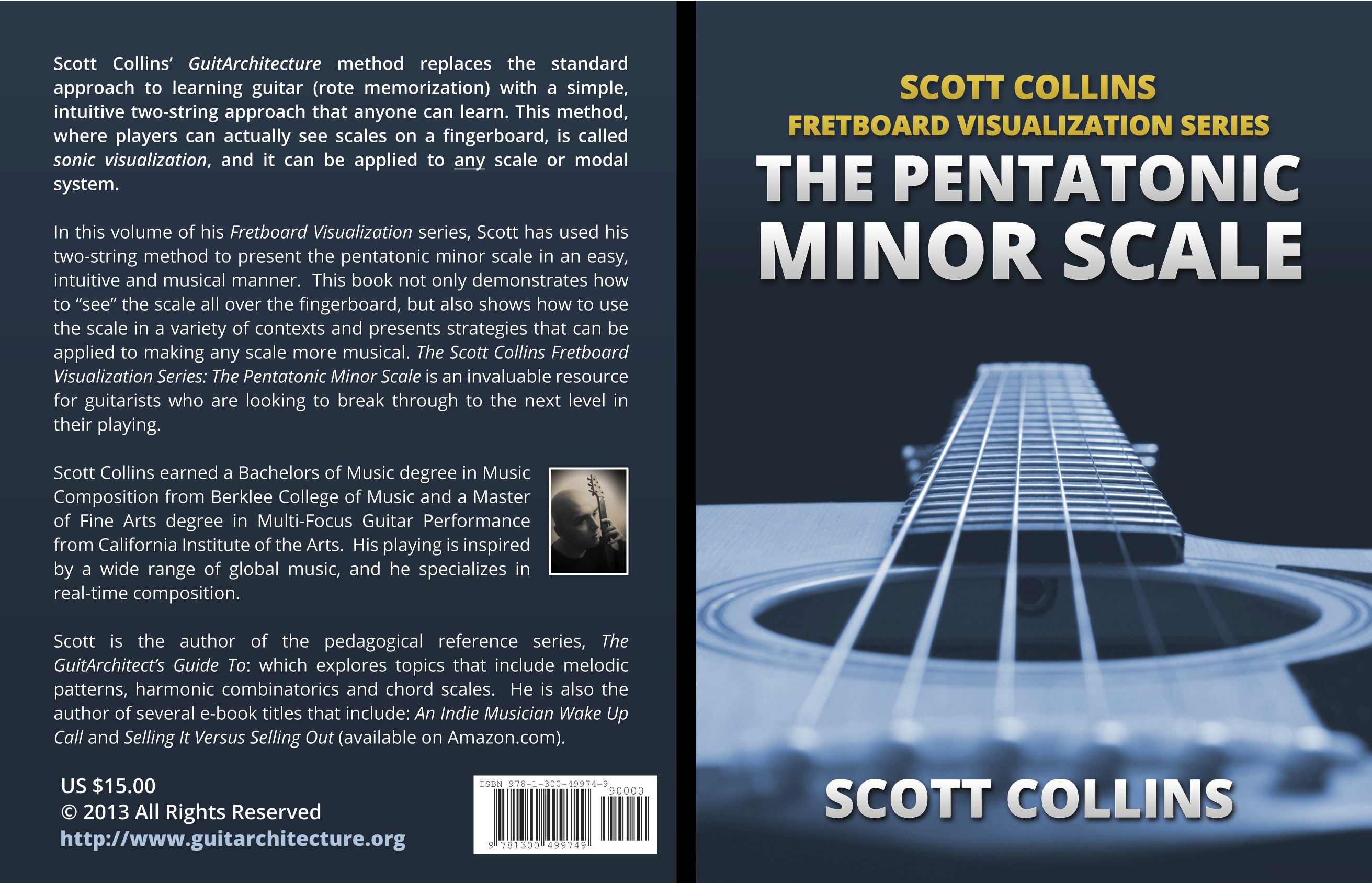
The Scott Collins Fretboard Visualization Series: The Pentatonic Minor Scale

Book Cover Full
You can read all about that here or see excerpts and order the book here.