Practice what you play or Practicing Part V

I realize that I’ve been talking a lot about how to practice and have only touched upon what to practice in a very limited sense.  If you have missed my other posts on practicing you can find them here: part 1part 2part 3 and part 4.

.

What to practice

Without being too obvious, you should practice what you’re going to play.

If I was a shred metal player – I’d learn a ton of shred metal tunes.  I’d work on scales and arpeggios a lot and investigate all sorts of lead techniques (tapping, pinch harmonics etc.).  I’d work on learning the solos to those tunes and then start trying to work on my own solos.  I might watch a bunch of instructional videos to try to get ideas as well.

If I was into Jazz, I’d be practicing specific standards.  I’d work on coming up with a bunch of ways to comp chords and practice soloing over the changes.  I’d listen to other renditions of the tunes and borrow (read: steal) any ideas I liked.

If your goal is to play exactly like Stevie Ray Vaughan – learning your melodic minor modes won’t help you directly with your goal, and being motivated to work on them will be difficult if you can’t tie it into your goals.

.

The #1 thing you should be practicing

Now, I’m going to advise you on the #1 thing you should be integrating into your practice regimen that you probably aren’t actively doing now – more than scales, chords or anything else I can think of for the moment.  And it’s a commonality with all of the examples above.

.

You should practice listening.

Not just hearing – really listening.

.

You should practice listening with the purpose of ultimately working on developing your musical vocabulary.

.

Listening, interacting and speaking are three pillars of any conversation and they should be important for you to consider in your playing as well.  If you can’t hear what’s going on – you’re not going to be able to say anything that’s poignant.

Without going into religion, I believe fundamentally that silence is a sacred thing.  I believe that if you are interrupting silence with sound  – you’d better have something to say.

So how do you practice listening?

.

Transcribe – or learn things aurally

There are a lot of internet sites that break down transcription methods better than I can do in the context of this post – but it’s important to note initially that you will probably not be that accurate.  Don’t worry about perfection.  Spend your energy learning phrases and understanding the context that they exist in (i.e. what chords to play them over).

When I first started playing guitar in bands and I had to learn songs for the bands I was playing in, the first thing I learned was the bass line – as it was easy for me to hear and gave me an idea of which “power chords” I’d have to play as well.  If you find a tune you like you should try to learn all the parts on guitar.  The bass lines, the vocal lines, the keyboard or other instrumental parts… You’ll start coming up with things that you might now have ever stumbled across on your own.  If you want to try to notate it – you will get even more out of it – but the important thing is to see how it all works together.

.

Sing it if you want to own it

Sing what you play.  Play a phrase and sing it back.

Play what you sing.  Sing a phrase and play it back.

When you sing something you internalize it.  Internalized things become a part of you.  When you play a melody try to sing it as well.  Listen to other people sing it and try to match the inflections.

(ah if only I thought of the above 2 myself – but they were taken from W.A. Mathieu’s excellent, The Listening Book. If you don’t know this book – I highly recommend it!)

.

Play with musicians that are better than you.

If you play with really good musicians – they’re listening.  We tend to copy other people’s behavior.  So if a room full of people are listening, we might be more inclined to listen as well.

.

Really listen to the world around you.

Try this for a moment.  Close your eyes and take a deep breath.  When you’re done exhaling –  focus for a couple of seconds on what you hear.  Doing this now I just heard – My refrigerator running.  The cat lightly snoring.  Cars passing in the distance.  Several neighbors mumbling down the hall.  The bathroom sink dripping.  The ac unit for the building turn off.  My heartbeat.  A car pulling into the garage.  When I imagine my heart beat as a bass drum being hit I can fall into a groove.  The fridge acts as a drone.  Now I hear a bird -it sounds like horn stabs.  The cars rumble like bass pitches.  My typing accelerates to accompany the sounds going on.  For an instant it’s a cool piece.  Then it vanishes as my perception goes back to what I’m doing.  Before I thought about it –  all I was aware of was the fridge.  Once I really listened I could hear a number of cool things going on.

.

When you really listen as a musician – you can start to get past the point of focusing on, “wait is that an A major or an A minor chord?” – and get into how what everyone is doing fits together.  You can start to get past the technique of performance and work towards making music.

Making music is a noble goal and it’s a goal that’s rooted in listening.   If you’re really listening all of those other things (scales, chords, etc) are going to come into play anyway and as you develop your vocabulary –  you develop your voice.

If you are known as someone who listens well and has something to say – there will always be people who seek you out.   In music.  In life.

.

Practice deeply.

Until next time.

-SC

.

If you like this post you may also like:

.

PRACTICE MAKES BETTER AKA PRACTICING PART I

PROPER POSTURE IS REQUIRED FOR PROPER PERFORMANCE – PRACTICING PART II

TENSION AND THE SODA CAN OR PRACTICING PART III

DEFINITIONS AND DOCUMENTS OR PRACTICING PART IV

.

PRACTICE WHAT YOU PLAY OR PRACTICING PART V

TESTING YOUR VOCABULARY OR PRACTICING PART VI

POSSESSION IS 9/10S OF THE LAW BUT PERCEPTION IS EVERYTHING OR PRACTICING PART VII

Some Useful Online Practice Tools

.

FINDING THE DEEPER LESSON

MELVILLE, MADNESS AND PRACTICING – OR FINDING THE DEEPER LESSON PART 2

INSPIRATION VS. INTIMIDATION

What’s wrong with playing “Flight of the Bumblebee” for a world speed record?

.

Guitar Street in Ho Chi Minh City Vietnam

After reading a great set for forum posts on harmony central (link is broken) about a guitar factory in Vietnam – I decided to try to find the guitar street – a 500 meter stretch of Nguyen Thien Thuat street (between Nguyen Thi Minh Khai and Nguyen Dinh Chieu) with over 20 guitar shops.  The one that I’ve read about online the most is Duy Ngoc (named after the owner), but the harmony central article mentioned another builder, Binh – who works out of Tam Hiep @ 36 Nguyen Thien Thuat.

Binh is an awesome guy and has a large number of low end guitars and some really impressive handmade instruments.

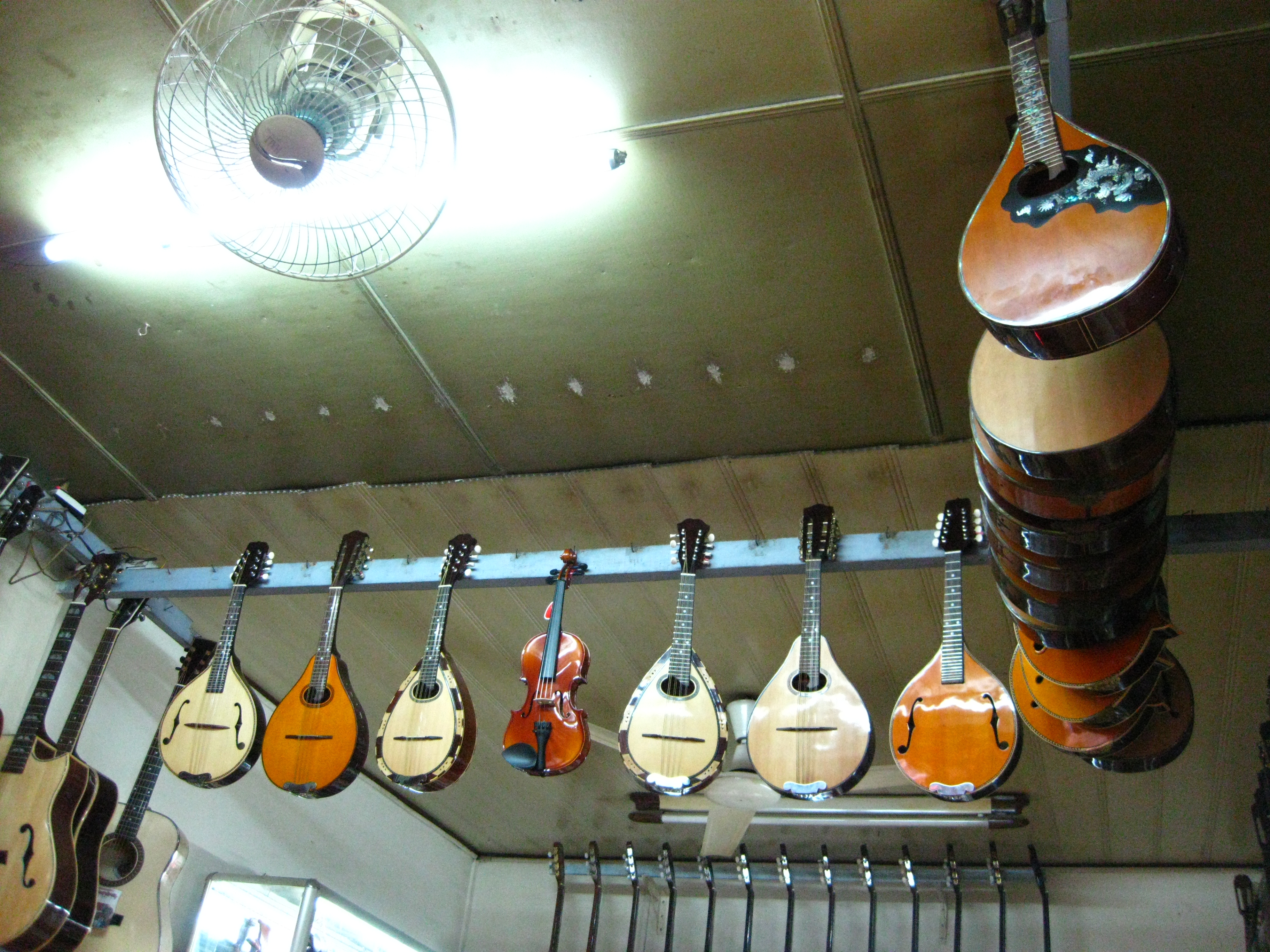
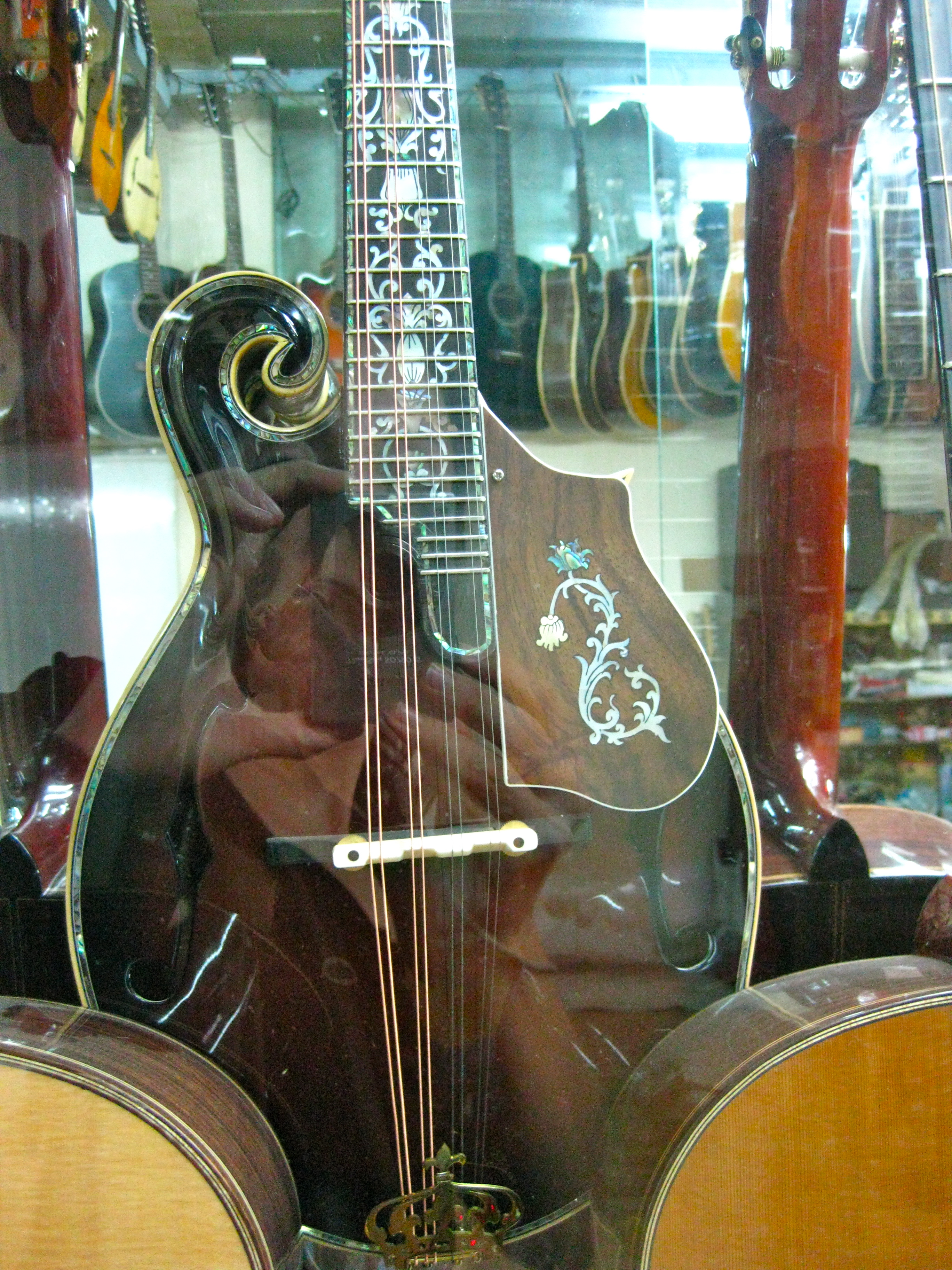
Here’s some mandos and other instruments up on the walls (including the arch top cut away on the left).

.

And more of the budget guitars on the side wall.

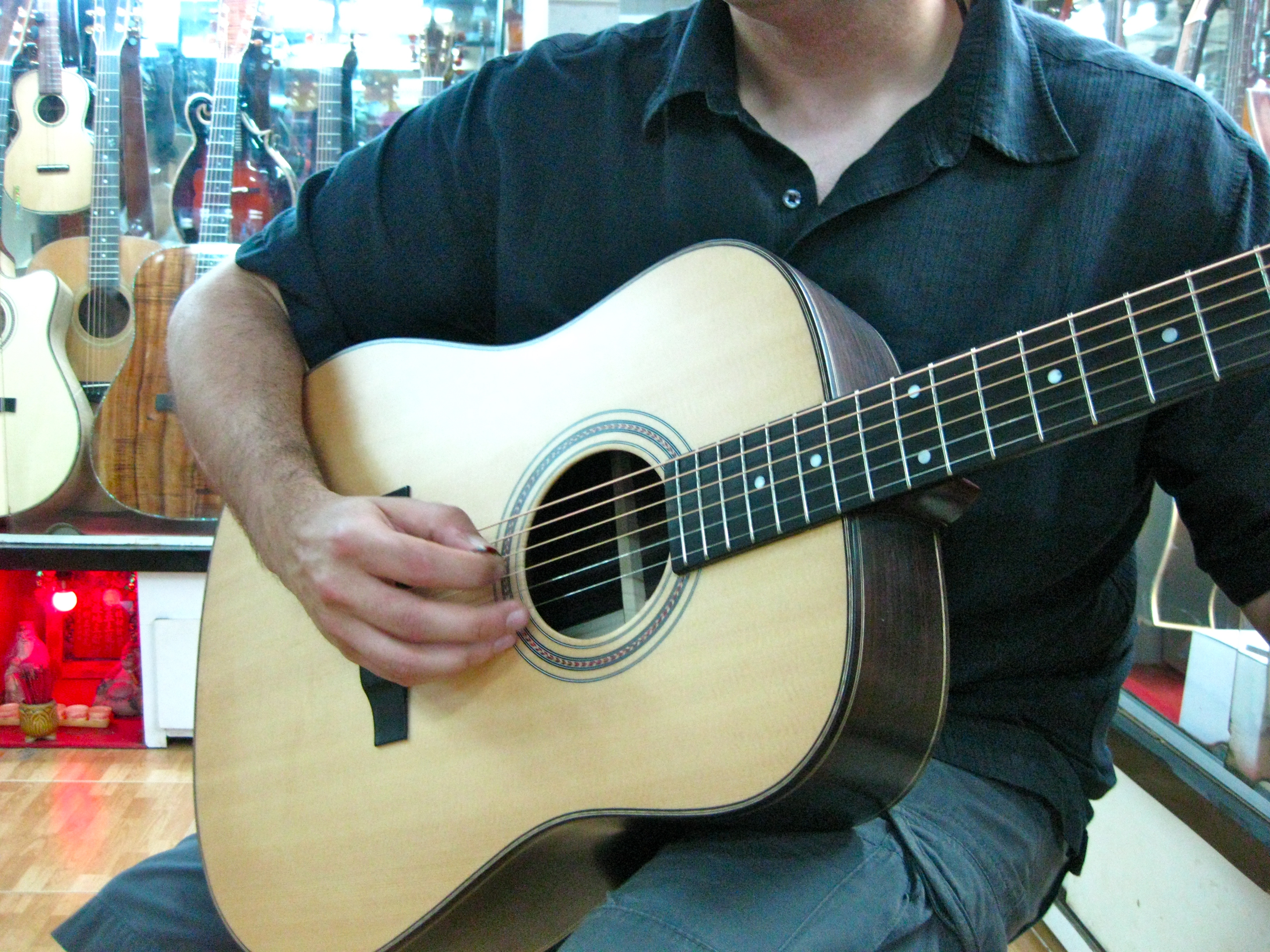
I played one of the guitars that the owner said was the best. (it was in the glass case)  A dreadnought copy.

.

One of the loudest acoustics I’ve ever played.  Just projected really well.  Very even tone.  All hand made with excellent fretwork and construction.

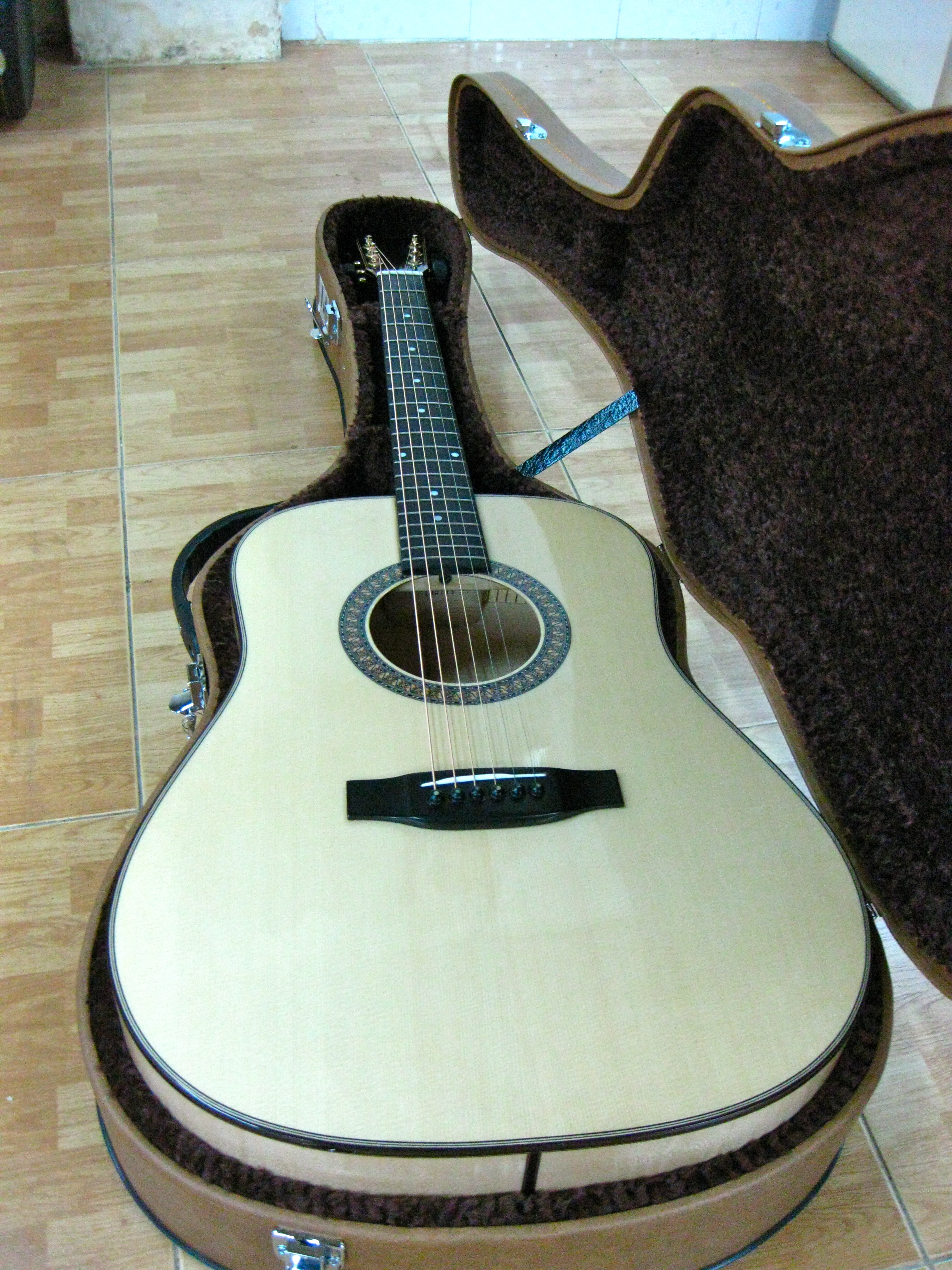
Here’s the back of the guitar (I had to take my shoes off to enter the store hence the socks!)

.

.

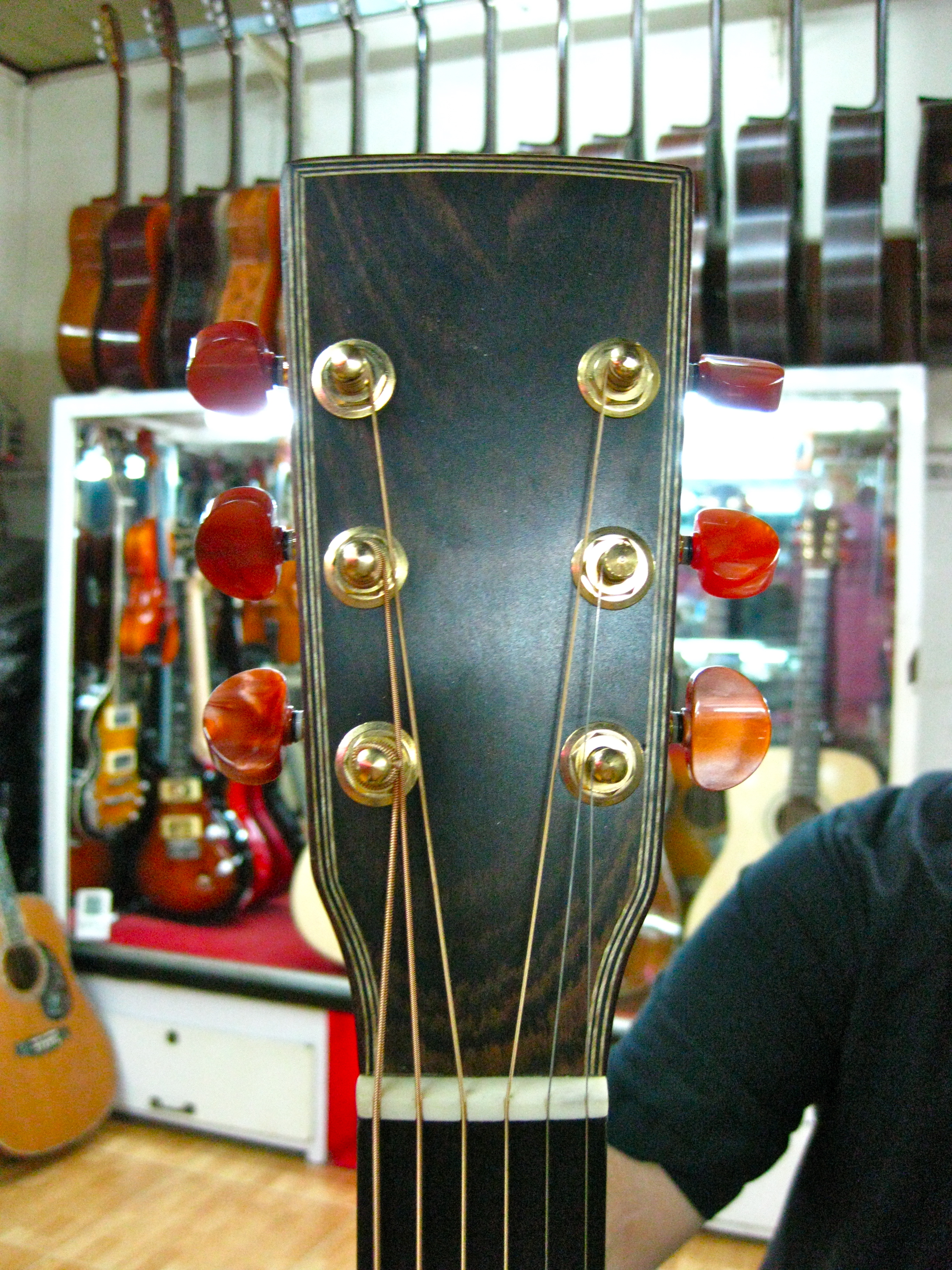
And here’s the headstock (note the inlay):

.

.

The tuners were okay but could have been better.  Otherwise, everything was a professional level build and execution.   He wanted 8,000,000 vn – About $420.

He then said – you should see this one as well.  Same build but with a glossy finish:

.

This one sounded even better.  A little more pronounced bass.   I only hesitated trying it because I’m not a huge fan of finished necks but I hated to put it down.This one was the same price – about $420 us with case.  Reminder – this is a hand made guitar!  Not a cnc router in sight!!!

This guitar was no joke – I’m talking about something that was easily a $1200-$1500 guitar in the US for a factory made instrument if not more.

That’s why it made it home with me.  I talked him down to about $410 US with a hardshell.  

(You can see a brief video with a low fi camera of the guitar here.)

Here’s an archtop mando I was able to try.  Check out the fingerbaord inlay:

.

.

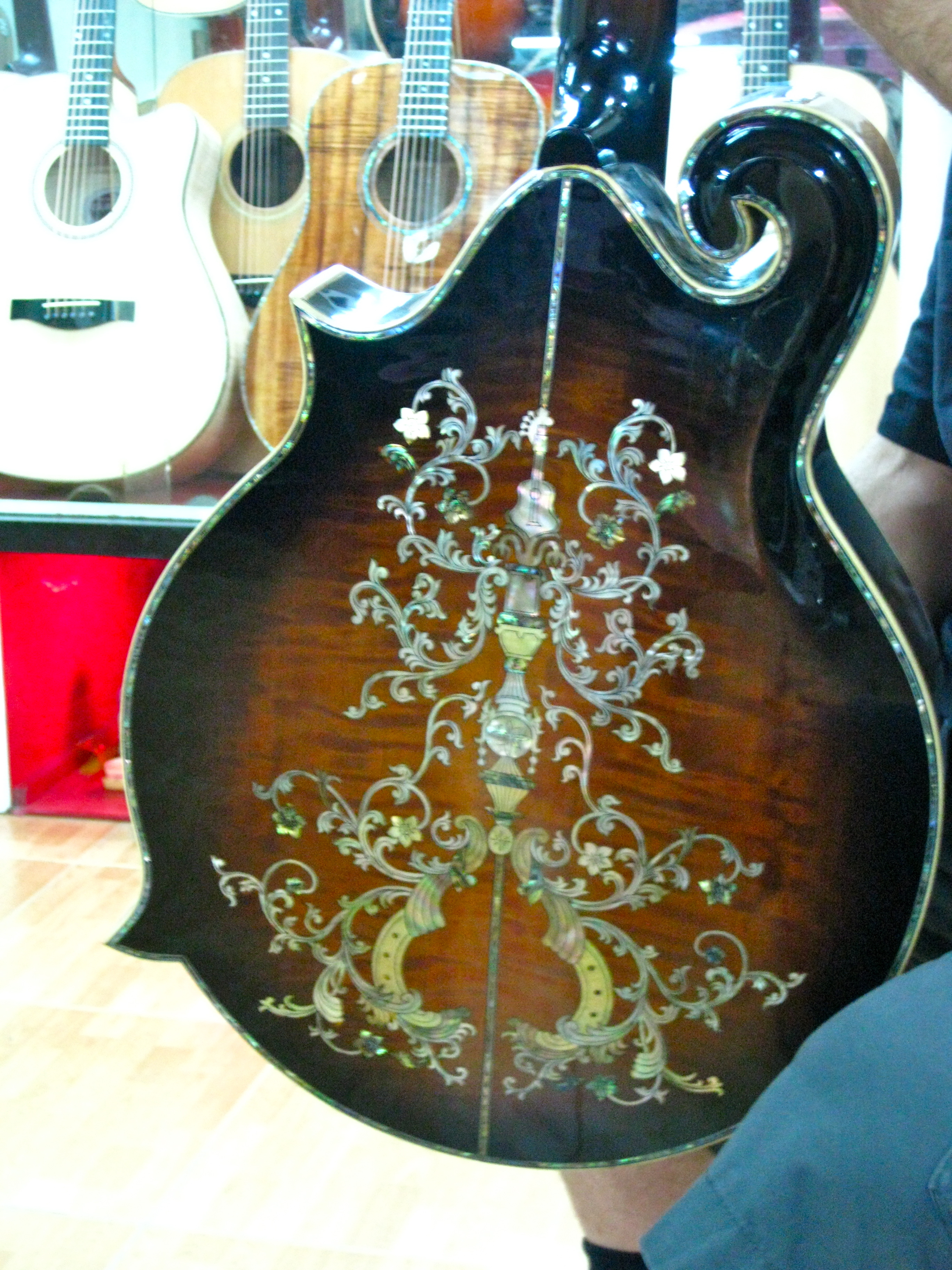
The 6 string version had a similar font inlay.  I thought I got a fretboard photo – but missed it.  Here’s the back inlay:

.

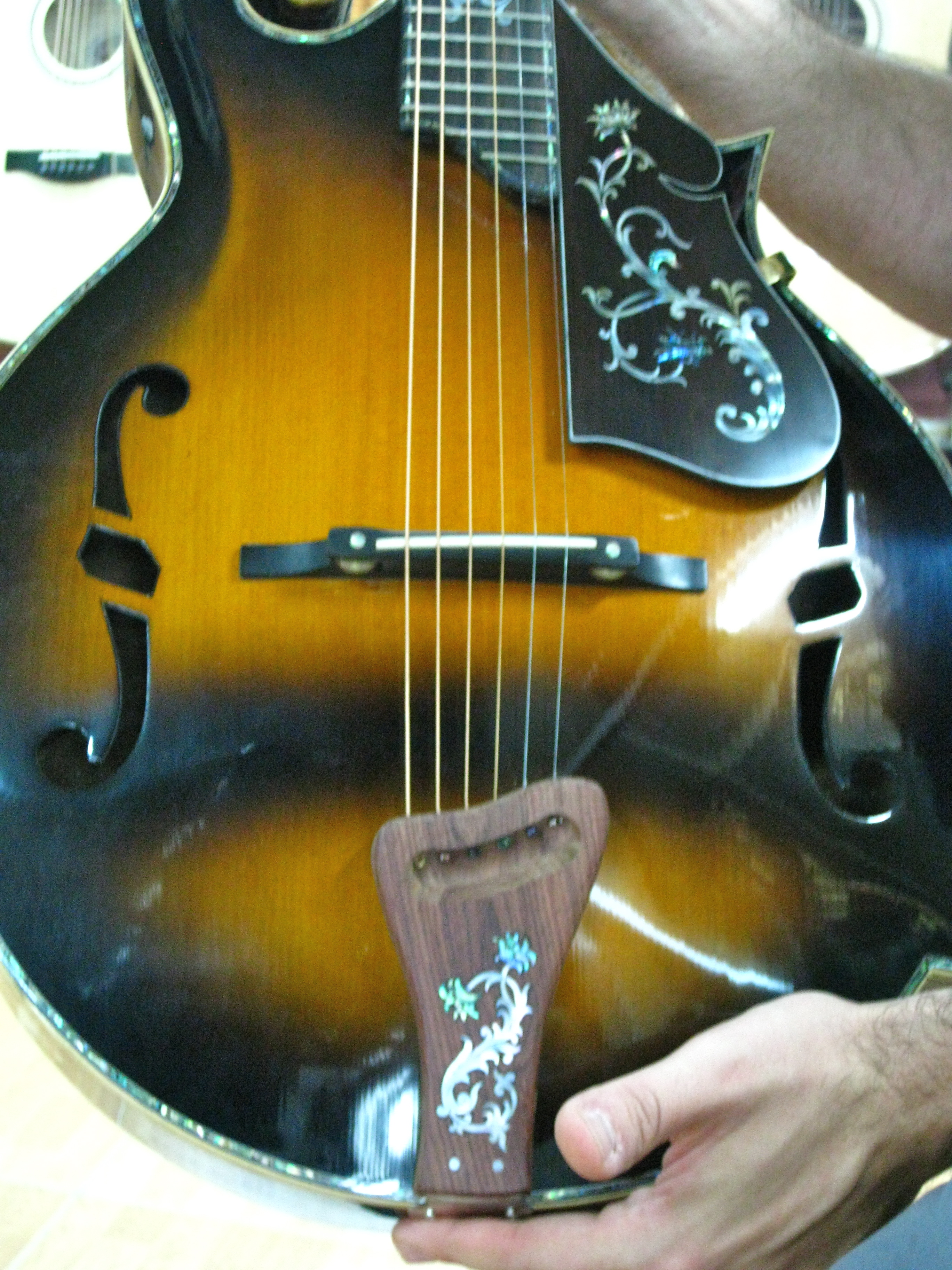
And the tailpiece as well:

Again this thing was LOUD – and projected really well.  Very even tone.  Just a knockout.  The work around the inlay was a little more noticible but for a $400 guitar there was really nothing to complain about.

The harmony central article linked above mentioned that for about $600 they could make a custom guitar.  If I had baritone dimensions – I would probably be all over that.

Here I’m holding a Vietnamese style guitar.

.

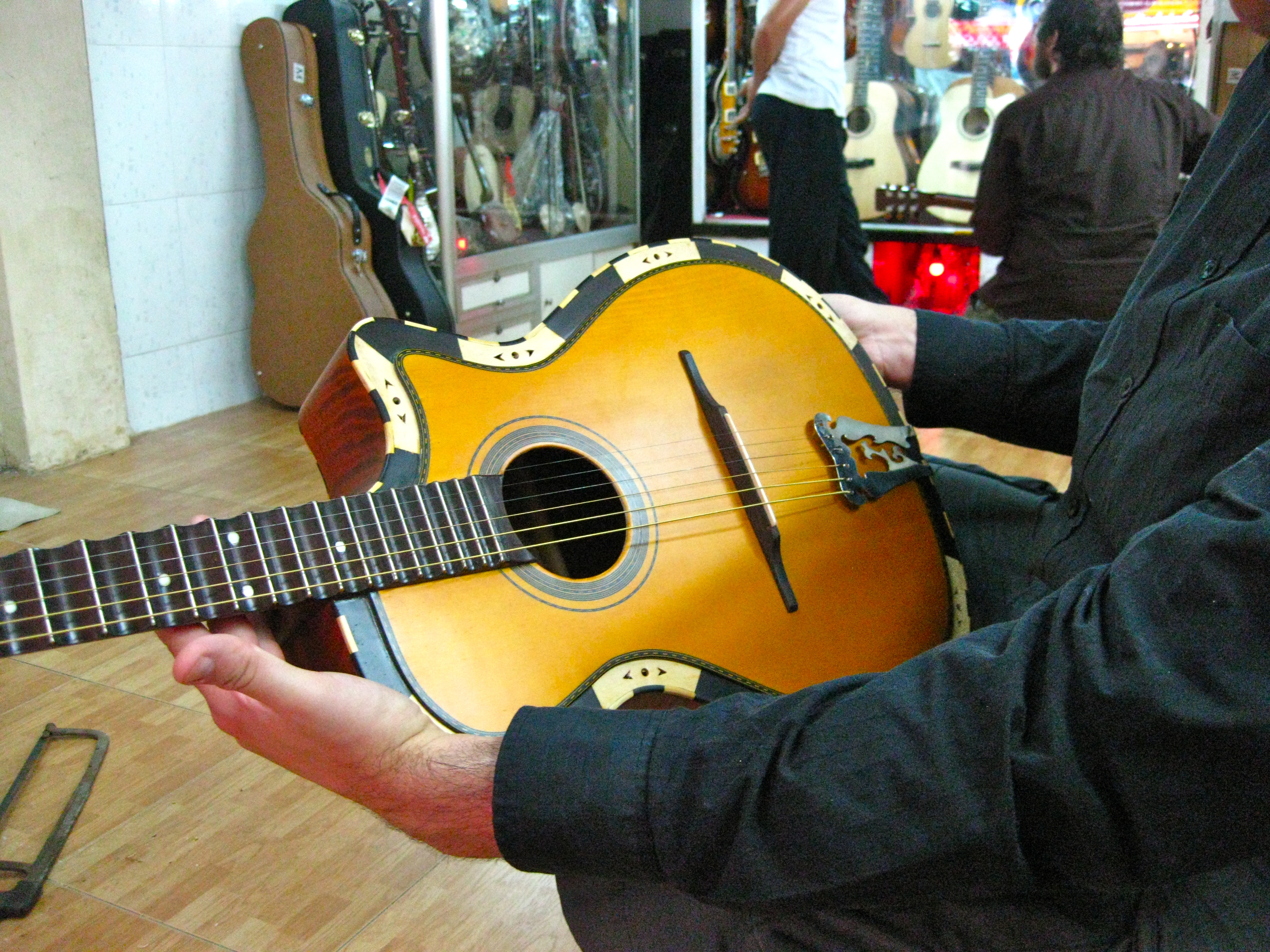
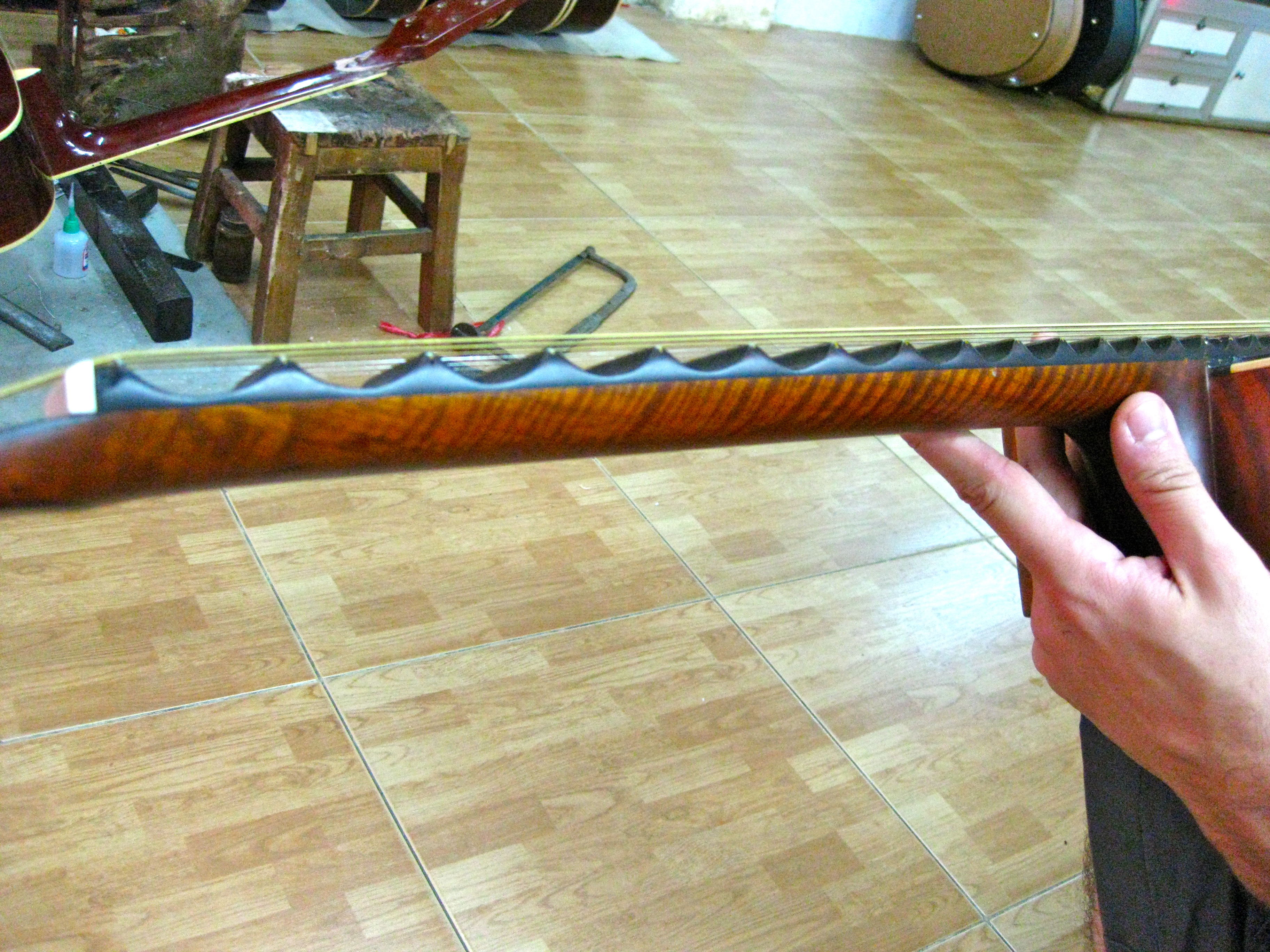
Bizarre tuning and the body construction was lower quality so the tone was very tinny. Note the scalloped fingerboard. There’s a better photo below of just how deep the scallop is.

(It’s also interesting to note that all of the repair and set up work is being done on the floor like the use of a stool of a headstock rest.)

.

.

This was about $150 US.  This was tempting but when put into standard tuning – the top 2 strings crapped out on big bends.  The low E-G strings were very cool though!! Also it was kind of a drag about the body  because I would have really liked to have heard the dreadnought copy with that scalloping!  A number of the other shops has a similar style body – So I don’t know if he made this one or just set it up.

.

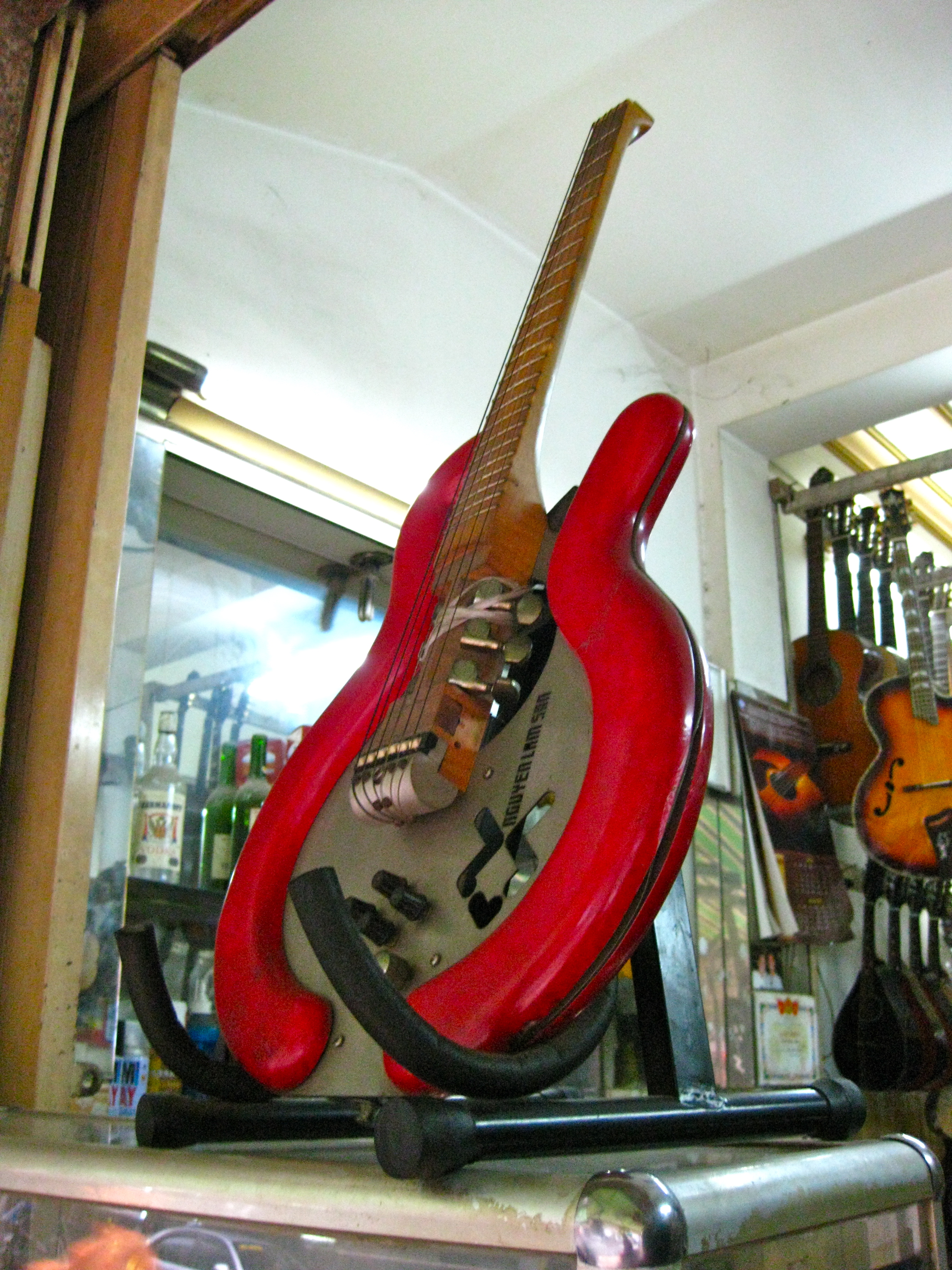
This next one was special.  That was at a 2nd hand shop about 4 doors down on the other side of the street.  A piece of sheet metal with wood bracing on the sides. The wood on the lower bout was cracked in the middle.   The back of the neck had kind of a Stevens cutaway if you remember those.  It looks like there was a magnetic pickup towards the bridge that was filled in with wood.  and maybe one by the neck.  There was a plastic bag tying it to the guitar stand – and I don’t know Vietnamese so unfortunatelyI was only able to guess that the woman filling in at the store didn’t know if it was for sale or not.  I’m not even sure it was functional but that didn’t stop me from lusting after it.

.

A couple of doors town they had a guitar that was called a “teisco”  with that scalloping seen above and a built in ring mod/octave switch.  They wanted 1,9000,000 vn (about $100).  That one didn’t end up coming back with me as there was no gig bag and probably too fragile to get home.  I couldn’t get them to come down on price – so they showed me a “fender” with the same scalloping, a trem and built in flange/auto wah switch for 900,000 vn.

Binh’s contact info is on the sign – but his e-mail address is in the almost 20 page harmony central post that started it all off for me. (binhguitar@yahoo.com)

.
Thanks for dropping by!

.

PS – If you like this post you may also like the guitars of Vietnam post I wrote for the mighty Joe Gore’s Tone-Fiend column.

A quick lick – and a rig du jour update from Ho Chi Minh City

Greetings from the former/current Saigon. (Technically Ho Chi Minh City but many of the locals call it Saigon).  I had hoped to post a couple of blog updates up before I left, but instead was running around checking things for the trip. Now a jet lagged – iced coffee and soon to be bahn mi –  fueled post:

.

1 lick or 2?

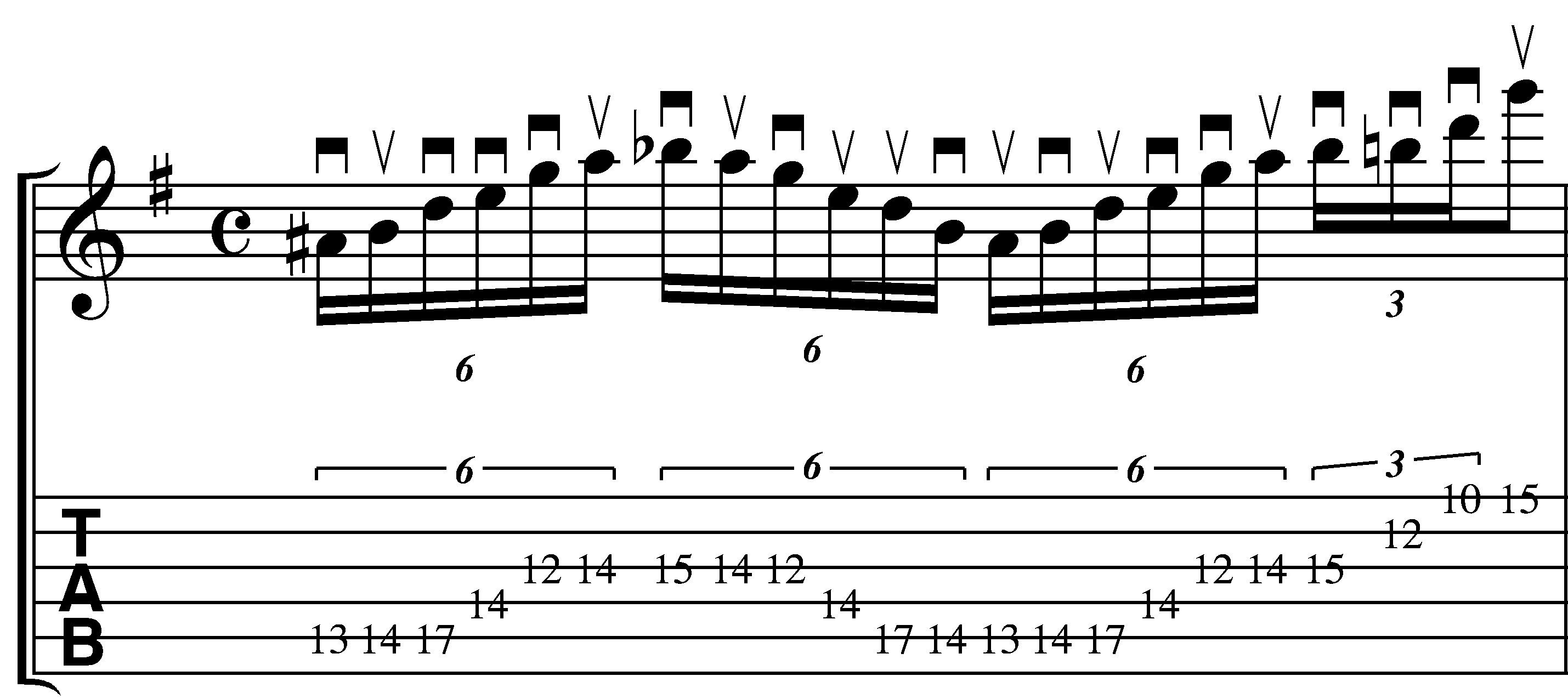
So first – here is a lick that works off of the swept pentatonic idea (alternating 3 and 1 note per string ideas) that I explored in the last online lesson (you can find a pdf of that lesson here).  While the online lessons have focused a lot on pentatonics – I wanted to add the tritone to make “the blues scale” and show how this approach could be adapted.  Here is the idea ascending:

.

It’s very scalar – but I added  a couple of points of interest:

1. the little descending turn around allows you to play the basic ascending idea starting on both up and down strokes.

2.  I started on the tritone (if played over E minor) or the b3 (if played over G major) instead of the root.  If you’re playing this over G – think Bluegrass metal ; )

3.  The motion is more diagonally oriented than the strict pentatonic example but is the same basic approach.  I start the lick with my first finger and then shift positions for the D on the 12th fret of the D string and the D on the HighE.

.

Here is an mp3: Lick1

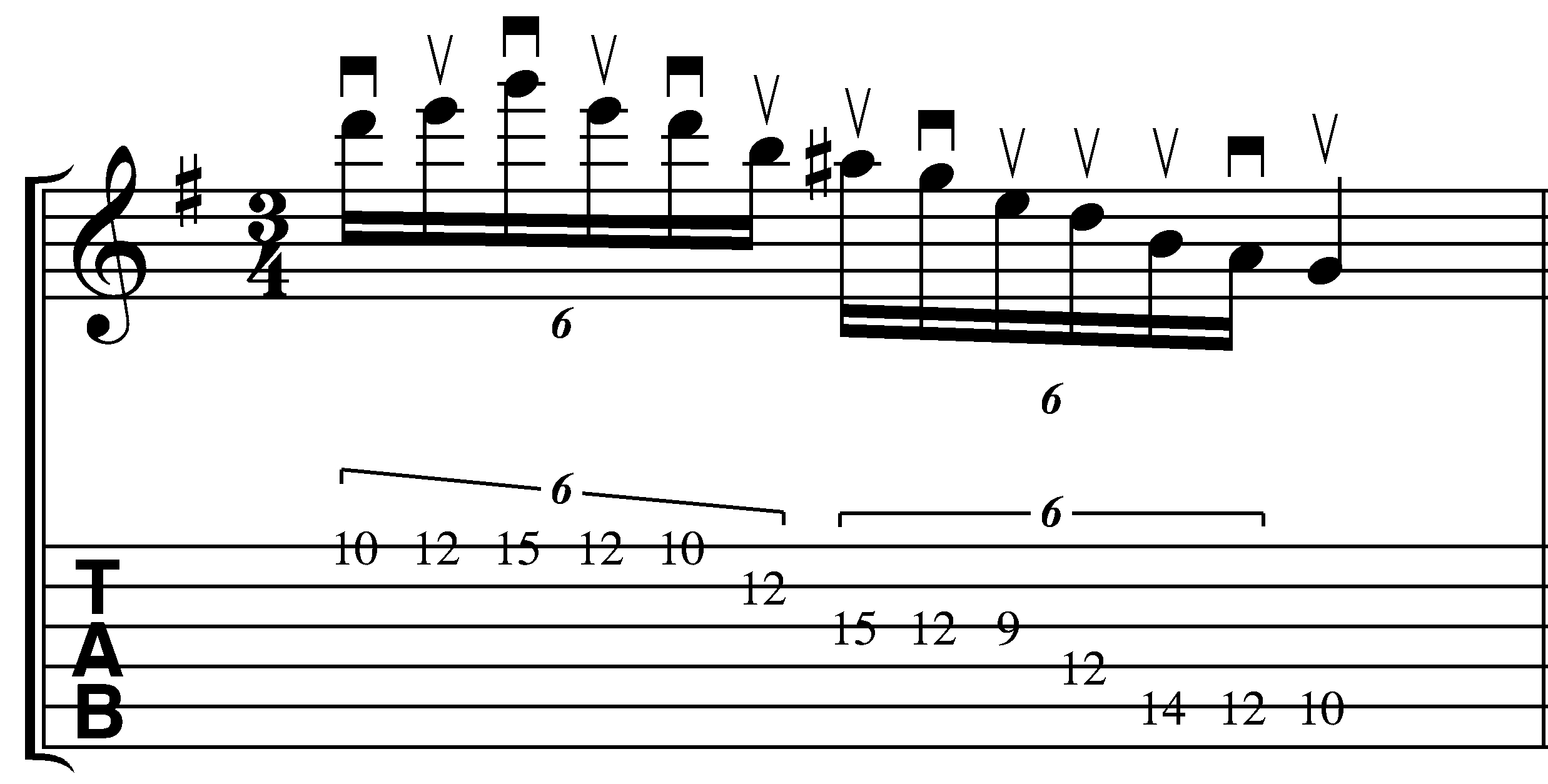
As variation – I took the same concept and applied it in a more positional approach.  Be careful with this stretch!  If it hurts stop immediately!!!

.

.

Here is an mp3: Lick 2

And finally here are the 2 licks played back to back:  backtoback 1

.

Laptop Rig

So I bit the bullet and got an apogee duet.  WOW!  It really has made a stunning difference in resolution and I suspect will help a lot with future mixes I’m working on. With that in mind I wanted to share with the rig I used for the mp3s above.

Here was the basic amp setting I used in Pod Farm 2.0.  This was based on a customtone forum patch called Electric Gypsy.  I just swapped in a tube screamer and bypassed the cab (using the Recabinet impulse responses instead).  One of the big revelations that I found in pod farm is that I could put preamps AFTER the power amp.  Adding that in to the signal chain opened it up a lot.

.

.

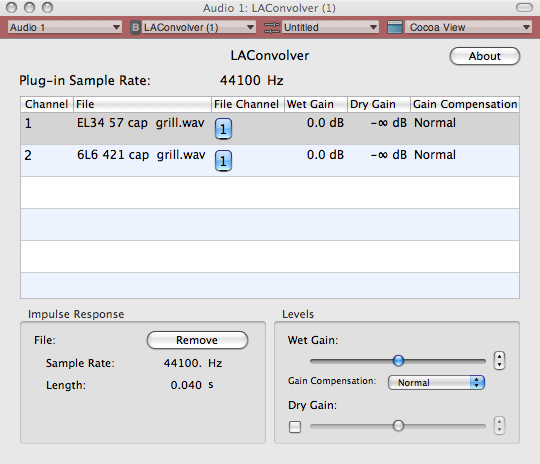
I blogged about using impulse responses over the cabs before.  The lie 6 cabs sound good – but to my ears the IR’s add a whole other area of depth.  Here are the IR’s I used – these were from the Modern 1960 4×12 set.  The screen shot is from LA convolver.

.

.

Finally – a screenshot of how it all lays out in AULab.  I just hit the record button in au lab and edited out the noise before and after the take in fission.

.

.

FNH Guitar –> Apogee Duet–>AULAB–>PSP Vintage Warmer–>Pod Farm 2.0–>La Convolver (w. Recabinet IRs)–>Sooperlooper

.

I’m still tweaking things – but I think that soundwise everything is improving a lot from where it was even a month ago.  Once I get an A/B set with the floorboard – I think that the laptop is going to be the rig du jour.

One last note – the macbook has is using 4 gigs of ram and was updated with a 7200 rpm Seagte internal drive. (500 gig from OWC).  My computer accepts a 4gig chip in 1 slot – so I may go up to 6 gigs – but the faster internal drive made a big performance difference in the machine. I’d say you’d really need to have that if you’re going to try to go this route.

* Note – I’ve recently posted more on this topic here which may be of interest to you.

Rig around the Rosie or Mediations and Meditations on Gear

Yesterday, I was trolling online for one or two things that I’d like to have to fill my insatiable gear lust and found an Atomic 1×12 amp for sale in Las Vegas for $149! A phone call and a credit card number later the amp was on its way to South Pasadena.

Now, I already had one of these amps – so a logcal question would be, “What the Hell do you need two of them for?”  Well, a couple of things,

1.  When I find things I like I try to buy a backup in case something goes wrong.  We can call this the great “Digitech Space Station lesson” – where (when they were in the death knell of production) Guitar Center was blowing them out @ $99 per and I only bought one.  Now the one I have is on its last legs and replacement ones are about $300-$400 on ebay.

2.  2 amps mean I can run my effects stereo.  Sounds small – but when looping things in stereo and there’s sound swirling around your feet…ahhhhh…there’s nothing like it.

3.  They don’t make this model anymore – and if worse comes to worse I could unload it for $250-$300 if I had to.

4.  As much as it kills me to say it – tubes project sound differently than solid state.  Before I left Boston, one of the bands I was playing in was One of Us.  The singer/guitarist/songwriter John Eye, had a Vetta – that sounded good.  It was super flexible and could do things that my amp set up never could.  But live, my rig (see the bottom of the media page for full rig information) projected completely differently.  Even when I used the pod 2.0 in front of my DeVille – it pushed the sound in a completely different way.

So, when playing with rock bands – I try to use a tube amp when possible.  For the film/video gigs I do – It’s more about convenience as there’s less sonically for me to have to compete with in terms of space.

(As a side note, John Eye is a truly great frontman.  He and I had very different views about live performance, but I always liked and respected him and dug his material.  I’ve included links above – including the Pull video which has some life footage of me with the band – but not audio 😦 .  I don’t know if any of the material I recorded with the band at that time will be on it – but if not – I’m sure the new material will be very cool.)

Getting back to gear and its endless acquisition –  I have conflicting opinions about it.

Having said all of this, will I still need to get Pod Farm Platinum eventually to go with the Pod X3 and the X3 live?  Yep.  Just a matter of time.  Will I get the Apogee Duet?  Yep – just a matter of time.

Because just like the plague inspired song quoted in the title, “Ashes – ashes we all fall down.”  – and life is too short to waste it on crappy tone.

I have missed a lot of great gear at great prices by waiting to buy it when I saw it.  If it’s a good deal, and I can make your money back on reselling it (if I have to) I jump on it now – before the next person does. Because who knows?  That extra piece of gear might get me .01% closer to the sound I’m looking for.

A long winded justification for buying an amp – but it’s important to have a realistic expectation of why you’re buying a piece of gear if not for yourself than to be able to explain it to your spouse.

I’m still unpacking – so no profound posts for a while probably.  Less fluff and more content next time around.  Thanks for dropping by.

-SC

Definitions and Documents Or Practicing Part IV

I was originally planning on updating this post with pictures of hand postures and address left and right hand muting techniques – but given that I have sunburned skin peeling off of 20% of my body – I’m going to hold off on photos for now.

Instead, I’d like to take a moment and actually address defining practicing as a means of understanding what is being addressed by practicing and then examine how documenting the process can assist with it.

For those of you who are just coming to this post you may want to also read the previous posts on practicing.  Here’s a link to part 1, part 2 and part 3.

Definition

By defining practicing it’s easier to understand what practicing is supposed to do.  Here is a partial definition from Meriam Webster.

“Main Entry: 1prac·tice

Variant(s): also prac·tise \ˈprak-təs\

Function: verb

Inflected Form(s): prac·ticed also prac·tisedprac·tic·ing also prac·tis·ing

Etymology: Middle English practisen, from Middle French practiser, from Medieval Latin practizare,alteration of practicare, from practica practice, noun, from Late Latin practice, from Greek praktikē, from feminine of praktikos

Date: 14th century

transitive verb1 a : carry outapply <practice what you preach> b : to do or perform often, customarily, or habitually<practice politeness> c : to be professionally engaged in <practice medicine >
2 a : to perform or work at repeatedly so as to become proficient <practice the act> b : to train by repeated exercises <practice pupils in penmanship>”

The definitions presented in the 2nd part of this definition help – but don’t really explain how to train or what practicing is supposed to achieve.  So I’m going to supply one of my own.

Practice:  The proper focused repetition of an idea through an incrementally difficult environment for the purpose of achieving a musical goal.

By tearing apart this definition some elements of practicing can be exposed that you might not have thought about before.

proper:  meaning the right way; consistently

focused:  Practice requires concentration because it requires attention to detail.

repetition:  repetition leads to familiarity (and familiarity breeds contempt so be careful here!)

incrementally difficult environment:  To practice something means that you are pushing your abilities to do something.  In music, one implication of this is to practice with a time keeping device (metronome, drum machine, drummer, recording, etc.) – but this could be any kind of parameter that actually pushes you.

for the purpose of achieving a musical goal:  Practice is goal oriented.  If you are not trying to achieve anything then you are not practicing.

With a clearer understanding of what is meant by practicing – we can go on to how to maximize the use of your practicing time.

1.  Set clear, well-defined goals (short AND long-term) and work towards those goals.

2.  Since practice requires concentration, put yourself in an environment that facilitates concentration such as a relatively quiet, well lit and well ventilated room as free of distraction as possible.

3.  While concentration is required for repetition, excessive repetition undermines concentration.  Many people use set periods of time to practice something.  This can be a good policy if it is done in moderation.  Bill Leavitt (the founder of the guitar department at Berklee)  suggested that students should practice reading for 15 minutes of every hour of practice – because 4 sessions of 15 concentrated minutes of practice get you a lot further than one hour of unfocused practice.  A timer (like an oven timer) can be a great assistance here.

For some people, concentration will be a learned activity.  If you are not used to focusing on something with intensity, then even trying to work 10 minutes on something may be problematic.

If you are having problems with this area – try starting with smaller intervals of time like 5 minutes with one short phrase and then move on to the next item on your agenda. Practicing in this manner will help you develop your capacity for focus as well.

.

There are several different thoughts about achieving goals, for me personally – it’s important to get many ideas into muscle memory slowly and develop them all at the same time rather than developing only one idea fully after another. You, however,  should plan on experimenting and find what approaches work for you

By setting a timer and not worrying about how long you are practicing, (in whatever methodology you use) you can spend more energy on the actual performance.

.

Documentation

One approach to consider is seen in how athletes train.  After all, playing guitar is a physical process that requires performance of well-trained activity.  This is very similar to a swimmer who has to be able to perform at a high level at a signal (like a whistle blowing).  One thing athletes do is WRITE IT DOWN.  Runners for example often keep a journal of performance times to see if they’re improving.  Writing things down in a journal doesn’t have to be complex or difficult.  I used to keep a notepad in my guitar case, and then write things down.  But now it’s easier to customize a practice log or journal and utilize that either in print or electronically.

.

I have linked two sample documents below.  Please feel free to download and use or edit at will.

PRACTICE LOG (PDF)

Weekly Practice Log (Word)

.

What needs to be written down:

Here’s a sample entry:

Week of What is being Practiced? Time Mon Tue Wed Thu Fri Sat Sun Notes
6/8/10 A Major Pentatonic sweep (sextuplets) 10 mins 100bpm             Watch Pinky tension!!

.

The goal is to write just enough to keep track of what you’re doing.  Feel free to add or drop items.  

.

If you’re going to start really putting the hours into practicing, I would recommend that you give yourself enough material to do no more than an hour or two at one sitting. 

.

Do multiple sittings a day if you want. (Personally – I can’t really focus very well after an hour or so consistently.  So if I can I do an hour in the afternoon and then another hour later).  

.

It also depends on what I need to practice.  If it’s a difficult piece I need to pull together – I might have to do 4-5 sessions like this a day.  The point is to find what works for you and stick with it.

.

I’m calling it a practice log or a journal – but really it’s a type of map –

by keeping a journal you can see where you’ve been, where you are and where you’re going.

.

It’s a good idea to periodically go through some old journals to just kind of get a fix for where you’re at.

Keeping a practice journal can be a drag and a chore if you want to view it that way, but it can be hugely beneficial in seeing what it is you are actually getting done.  If you make it a part of the practice ritual it will just be something you do.

For example, the first thing an experienced player will do before they play anything on a guitar is to see if it’s in tune.  If you get used to just picking up the journal when you pick up a guitar to practice – it will become 2nd nature.

Now that you’re writing it down – here are some things to address while you’re practicing:

.

Practice accurately.

You have to play slowly and accurately before you can play quickly and accurately.

.

Pay attention!

Can you make out all of the notes?  Are you really nailing the rhythm?  Are there any open strings ringing or unwanted notes?  Are you practicing the same way that you’re going to play?  Is the guitar in the same position when you practice as when you play in front of an audience?

[*Special Note: Paying attention requires concentration which is why you can’t really practice while you’re watching TV.  You can play or warm up in front of a TV – you just can’t focus on the TV and the guitar at the same time.  If you can’t pay attention to something try moving on.  If you can’t move on, then stop and come back to it.  You will get much more done this way that by just mindlessly running fingering patterns*]

.

Always use a metronome, recording or time keeping device when practicing.

.

Isolate problem areas.

If you are learning a piece, there are often several areas that need more attention that the rest of the piece.  Isolate those areas (however small they may be) and develop them. When you have gotten more comfortable with the problematic areas –  begin to practice sections before and after the area.  Treat the problem area as a center and keep moving out from the center as necessary.

.

Do it right the first time.

Paying attention allows you to make sure that you’re practicing correctly.  Practice correctly – play correctly.  Inherent in this idea is that you’re practicing at a tempo you’re comfortable enough that you can tell if you’re playing it correctly.

.

Don’t go overboard.

Some people go from not practicing at all to trying to practice the entire day.  Music is built off of experience, growth and endurance – none of which comes quickly.  Moderation is a good thing.  Occasionally think of the long term, and use the marathoner’s strategy of pacing yourself.

.

Persevere.

Establish a regimen and stick as close to it as you can. If you make practicing enjoyable – you’ll eventually start to look forward to it.  It’s okay to stop and take breaks from practicing as a regimen, just don’t forget to start up again.

.

Don’t forget to play.

The whole point of practicing is to gain elements to utilize in playing music.  Play whenever possible, desired and/or required.  After all this is supposed to be enjoyable.

.

All of this advice works off of the idea that you have specific goals in mind when practicing.  My suggestions for what to practice will be the subject of a later post.

.

I hope this helps!

.

-SC

.

If you like this post you may also like:

.

PRACTICE MAKES BETTER AKA PRACTICING PART I

PROPER POSTURE IS REQUIRED FOR PROPER PERFORMANCE – PRACTICING PART II

TENSION AND THE SODA CAN OR PRACTICING PART III

DEFINITIONS AND DOCUMENTS OR PRACTICING PART IV

.

PRACTICE WHAT YOU PLAY OR PRACTICING PART V

TESTING YOUR VOCABULARY OR PRACTICING PART VI

POSSESSION IS 9/10S OF THE LAW BUT PERCEPTION IS EVERYTHING OR PRACTICING PART VII

Some Useful Online Practice Tools

.

FINDING THE DEEPER LESSON

MELVILLE, MADNESS AND PRACTICING – OR FINDING THE DEEPER LESSON PART 2

INSPIRATION VS. INTIMIDATION

What’s wrong with playing “Flight of the Bumblebee” for a world speed record?.

.

Tech Limbo (Neither Heaven nor Hell R.I.P. Ronnie James Dio)

So I’m packing, moving and simultaneously trying to get some stuff ready for the Cha’ak’ab Paaxil Festival in Yucatán, México June 3-5th.  My plan is to leave the amp here and to use a combination of Line 6 gear and a guitar to play the shows.

After playing with Wael Kakish and the Middle Eastern ensemble last night, I was able to open the package I got from Sweetwater and check out my new Line 6 FBV Shortboard Mk II.

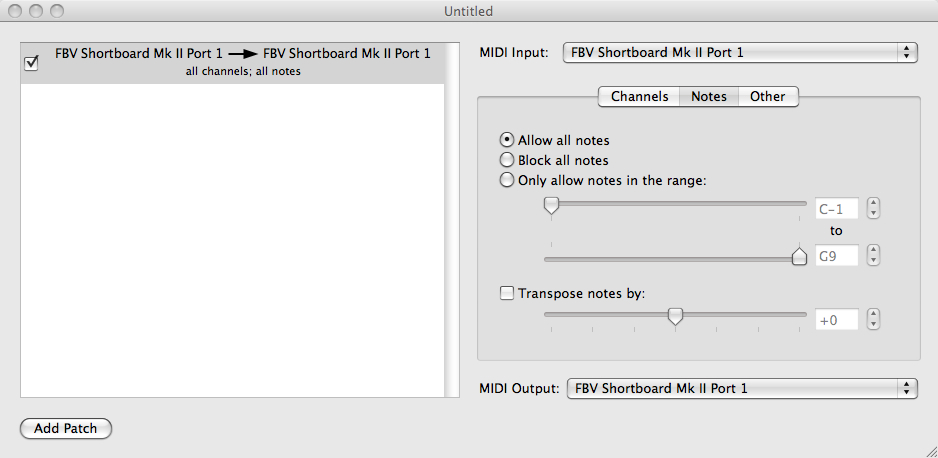
The new board is REALLY cool.  It’s solid in it’s construction and small enough to fit in my laptop bag.  After I downloaded the FBV Control software from Line 6.   I tried to set up a SooperLooper session in AU lab.  The concept was to run the AU of SooperLooper in AU Lab and use a midi patchbay to make sure the signal was going from the FBV to the Sooperlooper session.  Here are the patchbay settings.

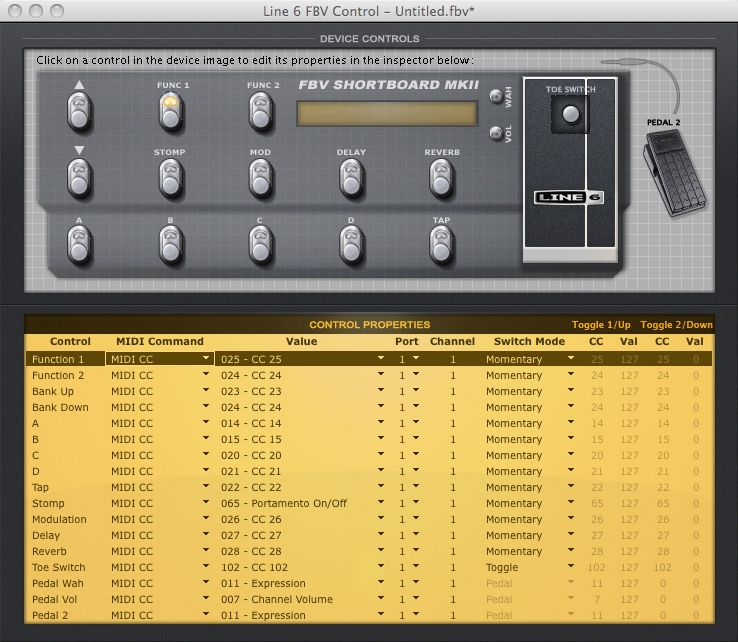
Had some trouble initially  but once I went into FBV control and reset some of the switches everything worked.

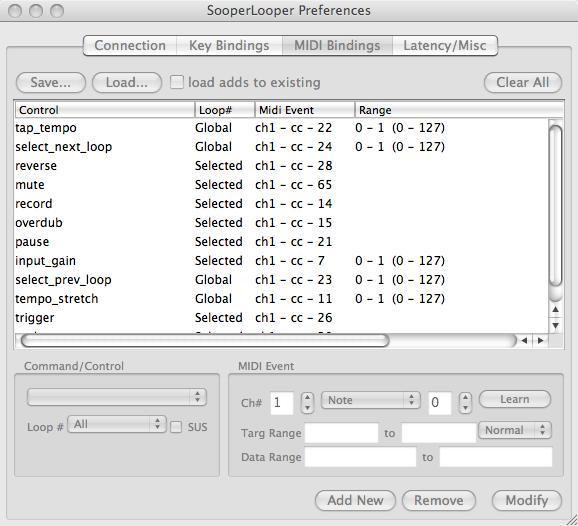
This probably isn’t the smartest series of codes to get everything to work – but it’s working.

The only gripe that I have is that I wish that some additional parameters in SL could be controlled via midi (i.e. 1/2 or double speed or main monitor volume for fades).  It’s easy enough to lean over and hit the keyboard – but it does defeat the purpose of ordering a 15′ USB cable.  The board itself though works like a charm.

I’m in the process of working on sounds on the X3 Live for the show – and tweak PA vs. amp sounds.  One thing I’ve noticed with modeling is that there are at least 4 different scenarios for setting up sounds:

1.  Headphone patches – i.e. practicing or recording

2.  Playing through an amp at low volumes

3.  Playing through an amp at high volumes

4.  Playing through a PA.

You might think that there wasn’t a lot of variance – but the differences between these parameters are huge.  I have patches that sound mediocre at low volumes and sound really good when the volume gets goosed a bit.  Headphone patches that work well at home and fall apart live – and vice versa.

As a result of all of these constant parameters I’ve been experimenting with Impulse Responses in Logic’s Space Designer (and LA Convoluter) and getting some encouraging results.

Impulse Responses (IRs)

In a simplified definition:  Impulse Responses (IRs) are measurements of acoustic spaces that can be loaded into applications (Like Altiverb or Space Designer) to create different types of reverberations.

I read an article about beefing up Logic 8’s guitar amp pro by replacing the speaker sims with IR’s.  That article is here.  This got me looking for all kinds of IR’s.  For those of you who want to see how this works on guitar tracks – check out the recabinet site.  There’s a really cool pdf that talks about the different IRs and the mics used to capture them.  As of this writing they’re selling a download of something like 2000 IR’s for $15 bucks.

Now I’ve been testing these at home – the difference is night and day!

It’s late while I’m posting this – but let me give you 2 simple examples.  First here is a simple rock rhythm with a plexi type setting.  This is just the AU recording of the pod with a plexi setting and the 4×12 cabinets selected.

DirtyrhythmnoIR

Now here is a another take of the same pattern and settings but with a 4×12 IR added. It’s a little brighter but the response is different as well.

DirthrhythmIR

To my ears – the second is a little more natural sounding particularly on the ascending chords.  Here’s one more example with a clean tone.  It’s subtle but noticable.  First with no IR

BluevelvetnoIR

And with the same IR as above added:

BlueVelvetIR

The non traditional guitar sounds have various degrees of success, some sound better some sound worse.  But this made a HUGE difference on the headphones.  I’ll try them through speakers later.

For those of you looking for free links here are a couple of them.  I’m in the process of downloading these myself – so no guarantees for the sounds themselves.

First some very cool non-guitar specific responses here:

Then some more guitar and bass specific IRs here. But I’m digging the redcabi.net IRs so far…

I found an AU ( LAConvolver ) that supports IRs and runs in AU lab – if I keep the wet gain at 50% it works well.

The advantages of AU lab are several (including low CPU use and that you can route audio OR midi through it) but the main advantage is that when you save the session all of the parameters in all associated plug-in’s applications are saved.  In other words – when I get it set up for use with a PA – it’s done.  No more re-inventing the wheel.  This is particularly helpful when you’ve set up a series of midi commands for Sooper Looper.

Here’s the laptop setup:

FNH Guitar -> Radial Dragster ->Pod x3 Live -> (Stereo out) ->Behringer FCA 202 (I hope to sub this out with an Apogee Duet eventually) -> Macbook Pro (Intel Core 2 Duo 2.4 Ghz – older model) ->Aulab running LAConvolver and Sooperlooper->(Stereo out) ->Behringer.

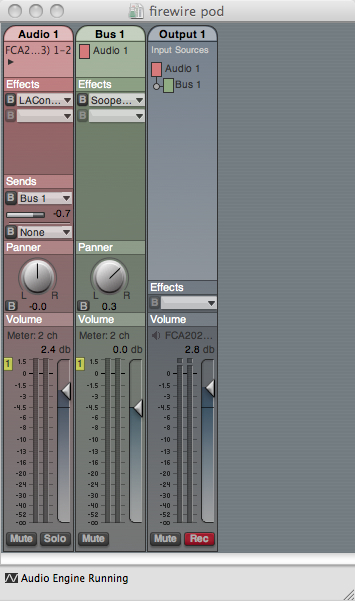
Here’s the AuLab set up – I’ve put SL on a Bus – but I since I can mix wet and Dry in SL I could have just left it on channel 1.


Here are some sample LA Convolver settings (these are both from the 4×12 greenback IR’s in redcabi.net):

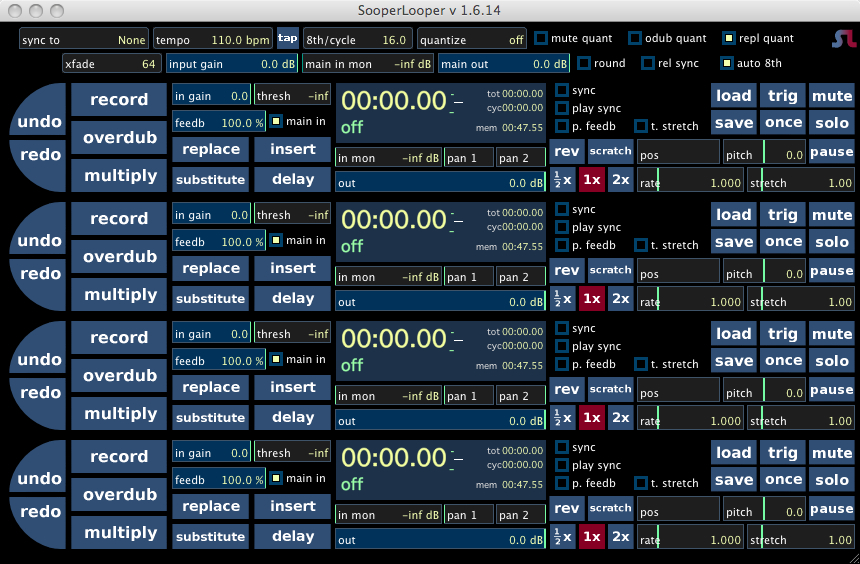
And finally 4 instances of SL.

I’m still experimenting but this is the current plan.  Now to apply all of this to mainstage to get synths and percussion in the mix….

This may not make any sense.  The goal to to fit everything into 1 bag – except for a guitar and a gig bag.  Hopefully I’ll have photos soon.

Also the title of this references the passing of Ronnie James Dio.  I enjoyed his work with Rainbow and while he and Vivian Campbell had a pretty miserable falling out – their 1st 2 cds had some great moments vocal and guitar (particularly Last in Line with perhaps the quintessential heavy metal guitar solo).  Dio was 67 on hitting the stage with Black Sabbath (ok fine – Heaven and Hell) at an age many people are bed ridden.  It reminds me of my favorite quote on retirement ever:

All I do is play music and golf.  What do you want me to retire from?” – Willie Nelson

Rest in peace Ronnie.

Line 6 Pod Farm 2.0 Overview

I’ve taken advantage of Line 6’s free 14 day download of POD Farm Platinum 2.0 ilok version and have been working on formulating somethings for a review.  I won’t be able to post a full review now, but I wanted to post a couple of brief observations.

1.  The demo version was a little glitchy in standalone version, so I’ve been using it with AU LAB.  For those of you who don’t know about it (I had to find out about it on the super looper forum) – AU Lab is a free app that comes with the OSX Xcode Tools.  It was designed to test AU plug ins with but its a stand alone app with a fully configurable mixer ( inputs, outputs, effects busses) .  It records output and even generates midi clock!  Also it makes a very small cpu impact – so it’s perfect for hosting something like Pod Farm and say SooperLooper.

2.  2.0 supports midi – which means you can control it with a foot controller like the FBV shortboard MKII or the Behringer FCB1010.  I didn’t get to work with this yet – but this brings the live laptop rig very feasible for me.

3.  Stereo rigs which you can A/B/Y!!!  which alone would have been really cool – but you can use multiple effects in the same rig – something you can’t do on the POD for example.

Here’s a screen shot of a modification I made on the Outer Space preset.  I just added a preamp in the beginning of the chain.

So here is an mp3 of a guitar track I improvised with this setting:

Outerspace II

This was made with a FNH ultrasonic guitar, Behringer FCA202,  Macbook Pro (2007), and AU Lab.  No post processing.

So this particular sample doesn’t sound very guitarish – but that’s part of the reason I really like this approach.  You can create things that you never could create with pedals without a ton of gear and/or a ton of noise.

As with many other sims – getting usable clean tones is pretty easy and getting dirty tones that respond the way an amp would is a little trickier.  But the presets on all of these models are light years away from older line 6 presets that I’ve heard.  It’s pretty easy to get a tone in the ball park and tweak it from there.

Line 6 has some great audio/video demos on their site, so I wont go into too much here for demos as they’ve done it really well.   Also the May lesson uses the same signal chain for all the mp3s that will be posted there.

I need to also give kudos in that all of the sounds on the sites are included in the presets and they have also noted processed vs unprocessed sounds.  Yes there is a big difference between the two, and it’s important to note those differences so that when you dial up a preset you know what to expect.

The only thing I wish it had was a dedicated looper, but that’s not a deal breaker.

If you have an I-LOK I’d say to definitely check it out.  It’s more flexible than the POD and does some very cool things.

For further applications of this set up you can also  go here or here.


Tension And The Soda Can Or Practicing Part III

Practicing Part III

In order to practice properly, attention needs to be paid to a number of different areas.  Today’s post addresses some issues regarding fretting hand tension as a precursor to proper form in practicing.

Fretting Hand Positioning and Tension

Many guitarists begin playing guitar without being aware of how much tension they are exerting on their fretting hand.  While the title refers to fretting hand fingers, hand tension is actually a complex coordination of muscles working in the hand and forearm.  The concept here is to talk about hand tension as it relates to your ability to move your fingers freely.

Here is an example that may help explain how much of a performance issue this can be.

For the purposes of this example, let’s imagine that you have taken a break from the rigors of guitar practice and have gone to spend the day at muscle beach with your friend Charles Atlas.  After arriving there and seeing miles and miles of Herculean figures – you have decided to show off to your friends and crush the can of soda you have been drinking.

Okay – hold your fretting hand out in front of you – like you were holding a soda can you were drinking from.

Really visualize the can.  Try to feel the ice cold metal against the palm of your hand.

Okay, now try to crush it.  But imagine that the can has been replaced with some infinitely strong material that can’t be crushed.  You don’t want to crush the imaginary can – but truly struggle against it.  If you’re doing the exercise properly, your arm is probably shaking from the exertion.

Okay – now try to move your fingers while you crush the can.  You may be able to move them a little but it’s going to be very difficult.  You should feel (or even see) a lot of tension in your forearm.

Now stop trying to crush the can.  Wiggle your fingers.  This should be much easier.

If you grip the guitar neck with too much tension, it’s the same as trying to crush the soda can.  If you are carrying tension it will be very difficult to move your fingers freely.

What follows is an exercise that can help with proper hand tension.

Proper Fretting Hand Tension Exercise

Sit in a comfortable chair (preferably without armrests) with your guitar around your neck as if you were going to play (you are wearing a strap aren’t you? If not you may want to read the last post.)

Relax your fretting hand by letting your arm hang fully extended by your side.  Wiggle your fingers a bit and try to relax as much as possible.

Take a deep breath.  While inhaling on that breath, make a fist.  As you exhale –  fully release the fist.  Just let your hand naturally relax into a position.  Look down at your hand.

Note – this is your hand in a relaxed position.

Now, keeping your hand in position, bend your elbow and bring your hand up to the neck of the guitar as if you were going to play.  Your fingers should be bent slightly at each knuckle (i.e. the fingers should be curved similar to the relaxed position).

Proper Fretting Hand Thumb Tension

Reverting back to the soda can example, it’s important that the thumb remain in the back of the neck as relaxed as possible as to not tense the rest of the hand.   This is something that I never thought about until I had studied with Jack Sanders.  So I need to thank him for bringing this to my attention in my own playing.

It’s also important to note that your hand position will change if you are doing a lot of string bending.  While it is possible to bend strings with your fretting hand thumb in the middle of the neck,  most people will be used to moving the thumb so that it is more on the bass string side of the fretboard to facilitate bending.   Since this isn’t the majority of what most people play on guitar – I view bending hand position as the exception rather than the rule.

The thumb acts as a balance to pressure from the fingers;  so the location of the thumb is very important.  Ideally the thumb should be in the middle of the guitar neck and typically in line with the middle finger or between the middle and ring finger.  What you are trying to do is put the thumb in an area of minimal tension.

Proper Fretting Hand Tension Exercise

Try playing a scale on the guitar.  If you think that your thumb is squeezing the back of the neck hard, try removing the thumb from the back of the fingerboard while you are playing.  Now gently and gradually, move the thumb back to the neck so that it is very lightly touching it.  Repeat as necessary.

Obviously a huge component in hand tension is how the fingers are actually connecting with the strings and that will be the subject of the next post on practicing.

I hope this helps!

-SC


Proper Posture Is Required For Proper Performance – Practicing Part II

In the last post, I talked about some of the pre-requisites for setting up to practice.  While I want to discuss specific issues with  proper picking and fretting hand techniques, it’s important to address how the actual guitar is positioned when playing.

.

When practicing, it is imperative to practice the same way consistently so that performance is consistent.

A key component of this is posture.

.

First, a brief anecdote.  When I started playing guitar, I didn’t pay a lot of attention to how I was practicing or how I was holding the guitar.  I just paid attention to whether or not I was getting the notes out (more on what’s wrong with this in future posts).  I started noticing my live playing was really inconsistent.  Sometimes the solos I practiced came out fine and sometimes they were really sloppy.  I initially attributed it to nerves or adrenaline, but after reading a number of books on performance I was introduced to the concept of “muscle memory”, and realized the root of my problem.

For those of you who have never heard of this term, when performing repetitive tasks synapses actually rewire themselves in your brain to short cut the mental processing behind the activity.  This is known as “muscle memory”.  Muscle memory is different from your dad’s memory of where he might have set his car keys down, and more like words carved in stone.  On the plus side – if you’re doing things correctly – you don’t have to worry about it – but on the minus side if you have to fix something that’s ingrained in muscle memory  – it takes a lot of effort to erase them.

Here’s an example that illustrates this idea.  

If I am walking and need to tie my shoe lace –  “tie my shoe” is a short cut for the following steps (or some variation):

  1. Notice my shoe is untied
  2. Stop walking
  3. Bend down
  4. Grab one lace per hand
  5. Cross laces to opposite sides of shoe in an x shape
  6. Tuck one lace under another
  7. Pull laces taught
  8. Move laces in opposite direction
  9. Make a loop with the first lace (i.e. “bunny ears.”)
  10. Cross one “ear” over the other, in the opposite order of your overhand knot.
  11. Bend one loop over the other
  12. Pass the tip of the bent ear through the hole
  13. Pull the loops tight
  14. Double knot if need be

.

Once you’ve mastered this skill,  you probably don’t have to put any thought into it at all.  You could easily have a conversation and do it at the same time.  A complex list of processes have been broken down into a single mental shortcut in this case called “tie my shoe”.

In music, muscle memory works the same way.  If you play a lick over and over again the same way your brain actually rewires itself so that the numerous physical events that go into playing “lick #7” in your brain just becomes a mental shortcut “lick #7”.

.

In my first person anecdote above, because my playing position varied between sitting, standing, squatting and lying down – I wasn’t developing proper muscle memory.  Instead of learning one lick – my brain was trying to learn how to play that idea in a variety of contexts.  This sounds small – but if you’ve ever been in a situation where you weren’t able to nail a part you normally can – you know what I’m referring to here.

.

The Solution?

My solution came in the form of a guitar strap.

Some people do not use guitar straps.  In playing steel string guitar, I believe that a guitar strap is every bit as important as a guitar string.  Again, if your hands are not in the same position when you practice as when you perform you will not have proper muscle memory and the chances of flubbing notes goes up dramatically.

The key to using a guitar strap is to make sure that the guitar sits on your frame the same way when you stand as when you sit.

.

Note:

You may be asking.  Well – what about nylon string guitars?  While it’s pretty rare to see nylon string guitarists use a strap, if you see a number of players you’ll notice that the majority of the good ones have very consistent posture.  Posture is a big part of the classical pedagogical tradition and while flamenco guitar posture may be unorthodox with regards to the classical tradition, it is most definitely a consistent posture.

This is not to say that muscle memory isn’t flexible.  You don’t have to have your hands in exactly the same position or expect total failure.  If you’re playing live and you move around – your body will typically adapt to what’s going on and accommodate you.  If you like to practice sitting(and many people do unless they’re practicing with a band) having a consistent instrument position will help you perform more consistently when you stand – which is likely how you are going to perform unless you’re used to performing when sitting down.

Give it a try.  When practicing try adjusting your strap differently when you sit or when you stand and see if makes a difference over a couple of weeks.  You might be surprised.

.

In the next post I’ll start the long process of addressing left and right hand placement, tension and the thumb (i.e. some common sense “secrets” that evade a lot of teachers and students).

Thanks for reading.

-SC


.

Practice Makes Better aka Practicing Part I

Probably the most commonly asked question of guitar teachers is some variant of, “How do I get better at (insert topic here)?” – which invariably leads to an answer of “practice”. 

.

If you’re a rock guitarist like me, you probably won’t get much (if any) further clarification on this point as many instructors I’ve come in contact with don’t have an understanding of practicing other than repetition.  Since practicing is such an absolutely vital step in gaining instrumental proficiency, it seems odd that proper practicing methods for guitar are misunderstood by so many.

.

There are a number of reasons for this.  Speaking from personal experience, I do not come from a classical background.  This is important to note because when you play an unamplified instrument in a concert hall (like a classical guitar) you need to make sure that you know how to project the sound, and that requires a specific focus on areas like proper technique, tone production and repertoire.  So typically from the get-go there’s a concise emphasis on technique and repertoire and typically some level of addressing what and how to practice.

As someone who learned a lot by trial and error – with the emphasis on error –  it’s really only within the last four years of teaching that made me go deep into practicing methodology.  What follows is a series of observations on optimising the practice experience.

.

There are really two broad issues here – how and what to practice.  So the first series of postings will deal with the “how” of practicing – optimal performance issues and methodologies and then delve into the “what” to practice.

.

**Note: 

some of this may seem excessively rudimentary, but greatness is in the details.  And if you’re striving for greatness  it’s best to address some details early.

.

The First Prerequisite: The Guitar

Before examining any of the methodology of the text it is important to note all of the material presented here is dependent on a useable instrument in optimal playing condition.

If you’ve never had your guitar set up, or if you are not familiar with how to set up a guitar, I recommend taking your guitar to a qualified guitar repair person and having the instrument professionally adjusted.

For people who play primarily 6-string electric guitar, I recommend playing everything you practice on an acoustic as well.

There are several reasons for this:

1.  In playing acoustic, there are no effects to mask performance flaws.  If your playing is sloppy, it is something that you will become immediately aware of, particularly if you are recording. Listening to a recording of an acoustic will reveal every unintentional open string, choked note, finger squeak and any other unintentional noise.

2. Acoustic strings are typically heavier than electric strings.  Playing acoustic guitar with proper technique will build strength and endurance that makes playing electric guitar much easier.

3.  For the most part, any technique that you develop for electric guitar should be something that can be performed on acoustic guitar.  It can be a humbling experience at best (and an ego shattering one at worst) to shed a hot lick on electric, think you have it down and then crash and burn when you try to play it on acoustic.  I’ve seen this happen numerous times on unplugged shows and it’s always grim.

.

The Second Prerequisite: Practice Materials

There are several things I recommend to have with you when  practicing.

1.  A metronome or time keeping device.  It’s VERY important to practice with a time keeping device.  If a metronome doesn’t work for you, use a drum loop or have someone record percussion for you.  If you practice out of time, you will play out of time.

2.  A tuner.  Ultimately it’s a good goal to be able to fine tune accurately by ear or by pitch, but since this skill can take a while to acquire, it’s a good idea to start with a tuner.

3.  A note-book, notepad or (if using a computer) word processing application.  This will be covered more in-depth later, but it’s important to be able to write everything down.

4.  A recorder.  Try to get in the habit of recording parts of your practice session.  It doesn’t need to be a brilliant hi fidelity recording.  You could use your cell phone as a recording device and probably record some video as well. The recording quality just needs to be something audible that you can review.  In addition to being able to hear your performance.  It can help you get used to the sound of your playing.  If you get more into recording later, it will be less stressful, as you will have already had a lot of experience.

5. A guitar strap.  Properly adjusted.  (This step assumes you are playing a steel string guitar – nylon string classical guitar style has its own set of rules for proper guitar body placement when playing and performing.  The point of this step is to have the guitar sit consistently on your body when practicing and performing. More on this later).

6.  A comfortable chair (if you’re sitting).

7. A timer.  Like an egg timer or a kitchen timer.

8. Goals.  More on this later as well, but it’s important to have a very clear goal of what you’re trying to achieve.  There are some goal oriented links and observations here.

Most of this can fit in a guitar case and set up in about a minute.  The key is to not make any part of this an ordeal.  If something is difficult, you’re probably much less likely to do it.

The next practice post will address posture, muscle memory and some other interesting ideas.

In the meantime, if you haven’t been doing so already make sure to warm your hands up with light stretching before strenuous play.  There’s some basic overview information here, but it’s also worthwhile to mention that not everything on the internet is accurate or useful.  So if you research something online and try to apply it and it hurts – STOP IMMEDIATELY.

This will be a good reminder for me to go over warm up routines in a future post.

I hope this helps!

-SC

.