Update – 2/3/2013
Hello everyone! Please note that as of 2/1/2013 all of my books are available for order exclusively on my Lulu.com page and on Amazon. While I may run an e-book bundle offer directly in the future as of right now, unfortunately, no bundle options are available.
I’m leaving the page up for archival purposes but if you go to the Books link at the top of the page, you’ll find more detailed information about the books below and the other books in the GuitArchitect’s Guide To: series.
.
-SC
.
.
I’ve had some people ask about book ordering. It seems that the 3 pdfs for $30 price point was an easier one for some people to enter into instead of the 4 for $40.
.
I really want to make the books accessible to whoever wants them, so here’s the new price point breakdown for pdf orders (ordering information and links are at the bottom of the page.
.
Any individual pdf is $15 (US).
Any 2 pdfs are now $20 (US).
Any 3 pdfs are $30 (US).
Any 4 pdfs are $40 (US).
.
I’ll be updating the books page with all of this information – but for now ordering info (as well as a full description and screen shots of each book) is below.
.
Currently, I have four guitar reference/instructional books available for purchase:
.
The GuitArchitect’s Guide to Modes: Melodic Patterns
.
The GuitArchitect’s Positional Exploration
.
The GuitArchitect’s Guide to Modes: Harmonic Combinatorics
.
and
.
The GuitArchitect’s Guide to Chord Scales
.
Print editions of any of the books are available individually here (lulu.com) or on Amazon (amazon.com, amazon.co.uk, or amazon.fr).
.
The GuitArchitect’s Guide to Modes: Melodic Patterns
(333 pages)

.
My sonic visualization system, GuitArchitecture, utilizes an intuitive two-string method of understanding the guitar fingerboard in a logical and concise way where seven core fingerings for major, melodic minor and harmonic minor scales replace rote memorization with an intuitive overview that can be applied to any scale or modal system.
.
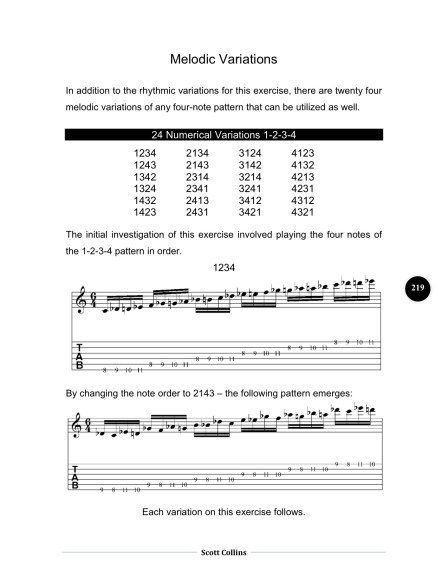
In The GuitArchitect’s Guide to Modes: Melodic Patterns, I’ve taken the two-string approach and created a reference book of melodic permutations that allows the reader to generate an almost infinite number of unique melodic cells and sequences.
.
Applicable to guitarists and bassists, this book is an invaluable resource for both compositional and improvisational material.
.
The GuitArchitect’s Guide to Modes: Melodic Patterns
If you’ve ever looked at any instructional guitar material, you’ve probably come across some variation of the phrase, “Take this idea and transpose it to every other key”. In this book, I’ve taken a seed idea (a single two-string fingering for C Ionian) and then used a mathematical process called permutation, (which changes the sequence of how things are arranged) as a basis for creating unique melodic cells.
.
This book not only details every possible permutation, but then goes on to show how to create every unique combination of them. These unique melodic cells can be used either on their own as compositional or improvisational ideas or combined with other melodic cells to create longer phrases.
.
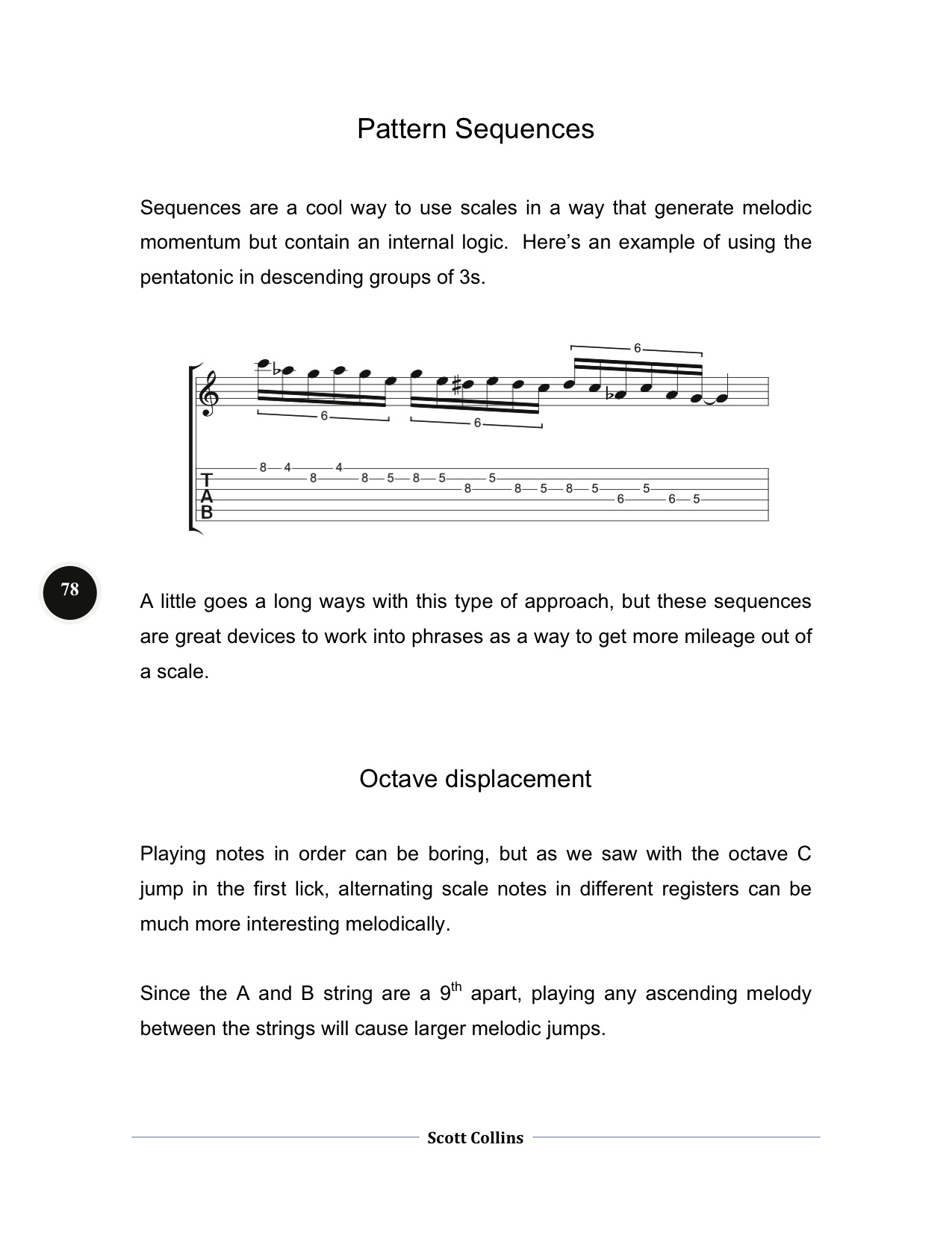
I’ve included jpegs of some of the pages from the Melodic Patterns book below. Since the jpegs were converted from the pdf of the book, there’s some pixilation in the jpegs that is not present in the pdf but these will still give you an idea of what’s in the book.
(Click on any graphic to see it as a larger size.)
.

.

.

.
The GuitArchitect’s Positional Exploration
(254 pages)
.

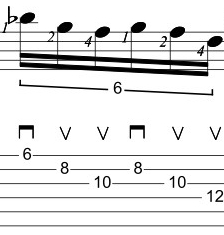
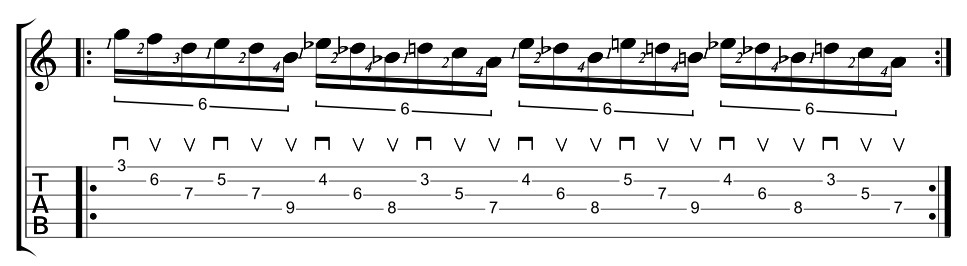
In The GuitArchitect’s Positional Exploration, I’ve taken an introductory guitar exercise and turned it on its head to reveal deep possibilities that exist not only in positional visualization, but in technical awareness as well.
.
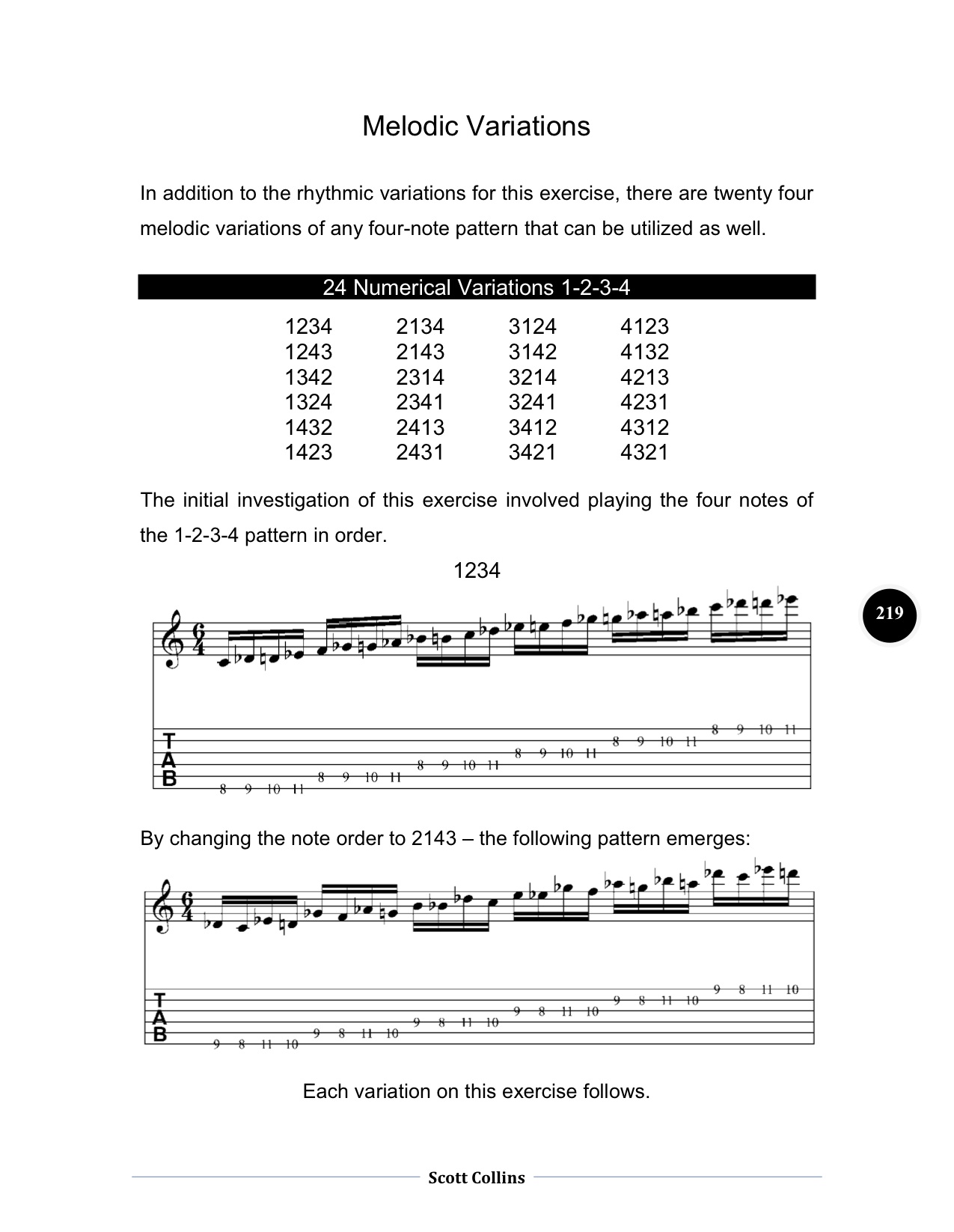
This book shows how to take a simple idea and creatively develop and modify it through melodic, harmonic and rhythmic variations that can be applied to your own music as well.
.
.
.
.
The GuitArchitect’s Positional Exploration Guide:
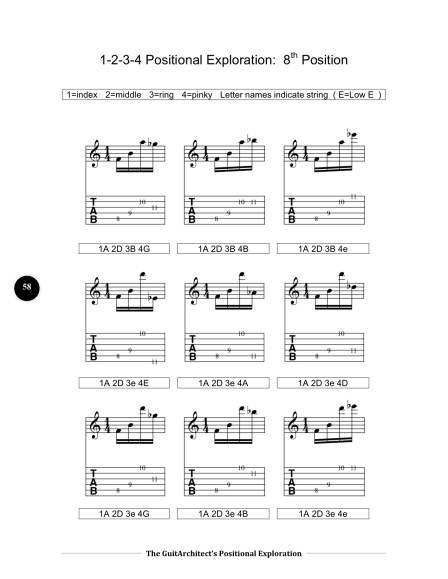
This book takes the initial 1-2-3-4 exercise and then adapts it to all other string-set-combinations in position. But it also does some other important things for the reader:
- In addition to documenting each example in the 8th position, it provides chordal analysis and a detailed series of charts for determining multiple harmonic interpretation of the notes involved.
- From a technical standpoint, the book explores every possible variation of note attack that can be executed. This could lead to entirely new technical approaches for the reader.
- From a compositional/improvisational standpoint, the book covers a series of ways to manipulate the patterns, rhythmically and melodically in a systematic way to develop ideas fully.
I have a lesson on Guitar-Muse that uses material directly from the book. If you want to get a sense of the content you can see it here.
.
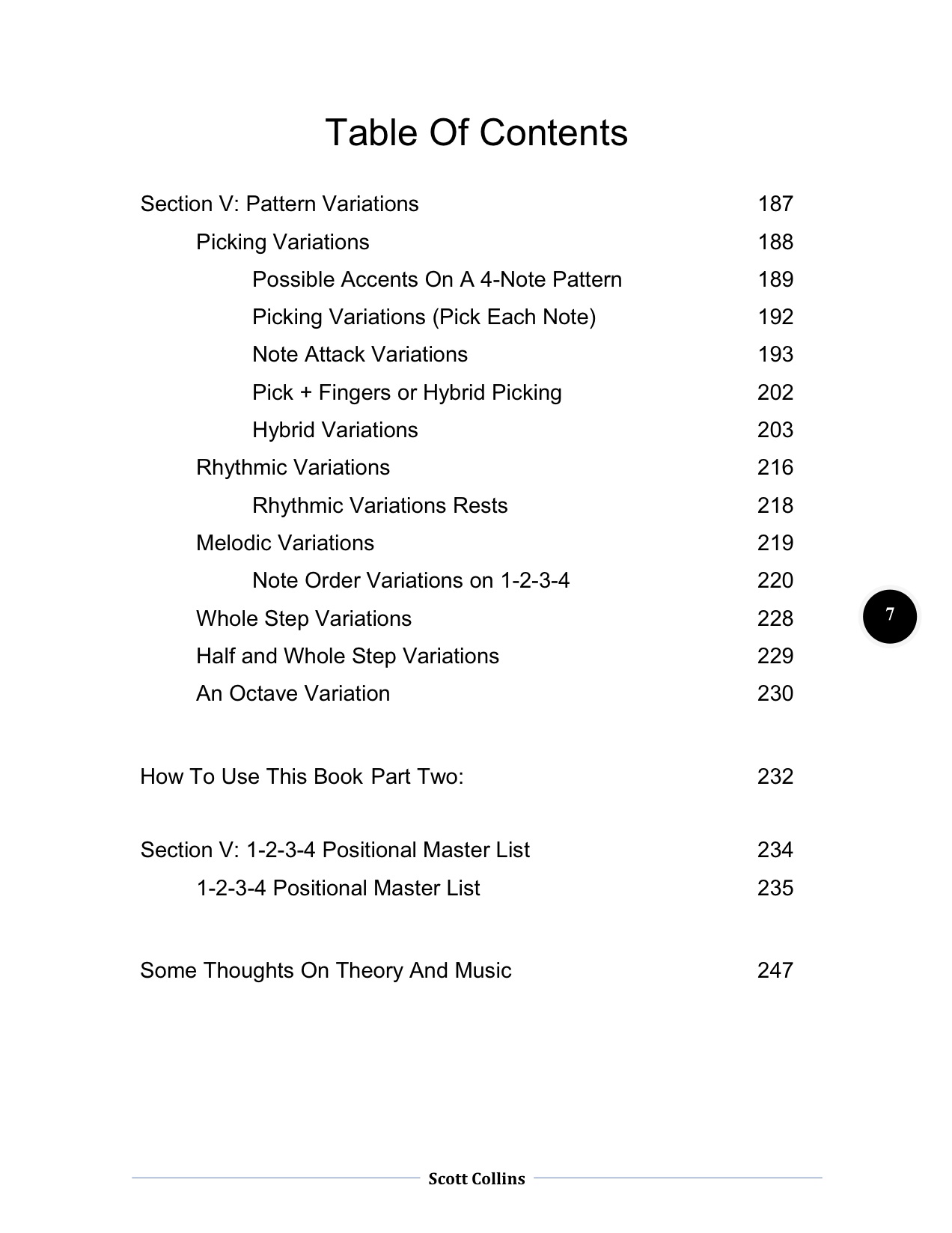
I’ve included jpegs of some of the pages from the Positional Exploration book below. Since the jpegs were converted from the pdf of the book, there’s some pixelation in the jpegs that’s not present in the pdf, but these will still give you an idea of what’s in the book.
(Click on any graphic to see it as a larger size.)

.

.
.
.
.
The GuitArchitect’s Guide to Modes: Harmonic Combinatorics
(410 pages)

.
.
.
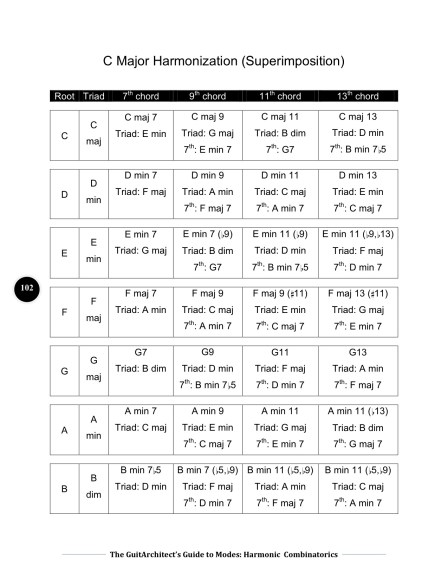
In The GuitArchitect’s Guide to Modes: Harmonic Combinatorics, I’ve gone into the nuts and bolts of chord construction and analysis by taking a systematic approach to generating thousands of chord variations that can be utilized intuitively in any key. In addition to being a vast harmonic resource, I also show you ways to make melodic lines from this material allowing the book to double as a melodic resource as well.
.
.
.
.
.
.
.
Harmonic Combinatorics is 410 pages of instruction and reference (that’s almost a ream of paper if you need a visual). It’s the deepest resource I’ve created and has numerous harmonic and melodic approaches that can be used to break through theoretical, technical or other musical limits you currently have.
.
Harmonic Combinatorics?
.
As a general rule, I’m not a big fan of jargon, but in this case I think its applicable as it helps define what this book is, and what it isn’t.
This is not a traditional chord book. The purpose of this book is not to teach a number of stock voicings and typical chord progressions for the reader to default back to as there are dozens, if not hundreds, of books that already do that.
This book centers around a series of methodologies for developing unique harmonic and melodic voicings for compositional or improvisational use that can be adapted to any tonal system.
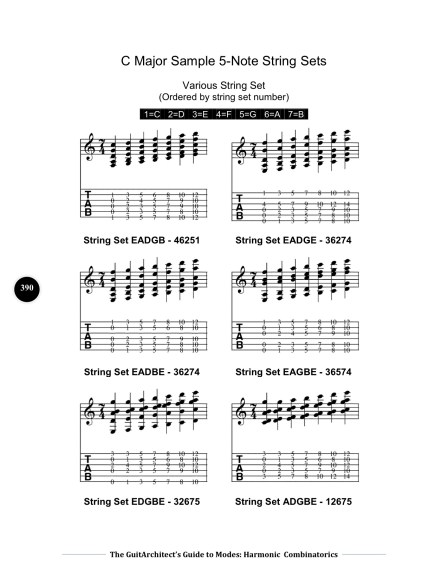
Harmonic Combinatorics refers to a process of identifying “countable discrete structures” harmonically. In this case, it means examining unique combinations of notes on all of the possible string combinations for the purposes of developing harmonic and melodic possibilities.
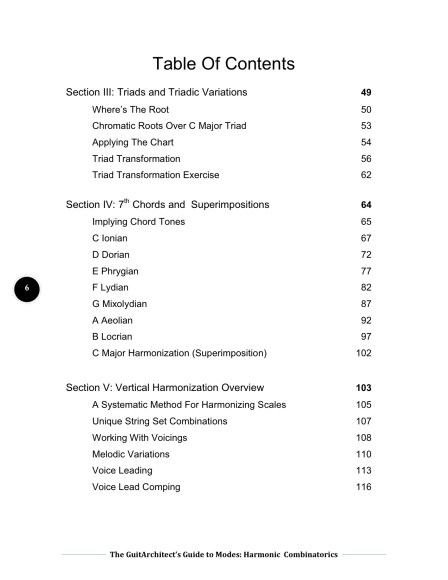
The book is divided into approximately 110 pages of instruction and 300 pages of reference. It covers a lot of theory – but makes it accessible even to the novice and shows how to apply it. It’s a modular text that can be read in either a linear or a non-linear way.
.
There are a couple of posts that I’ve put up that excerpts and adapts material directly from this book. To get a sample of the book’s style you can check out :
.
.
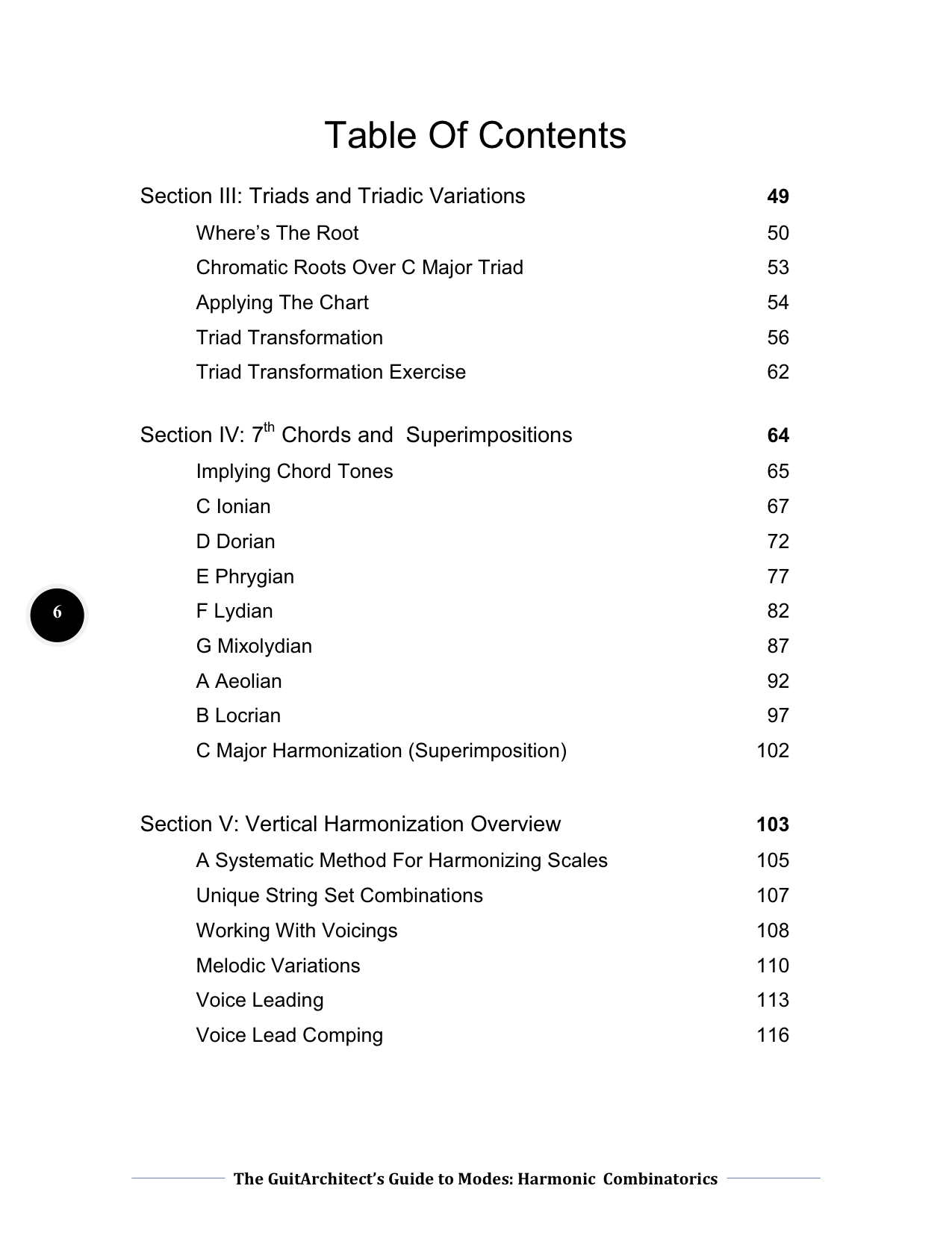
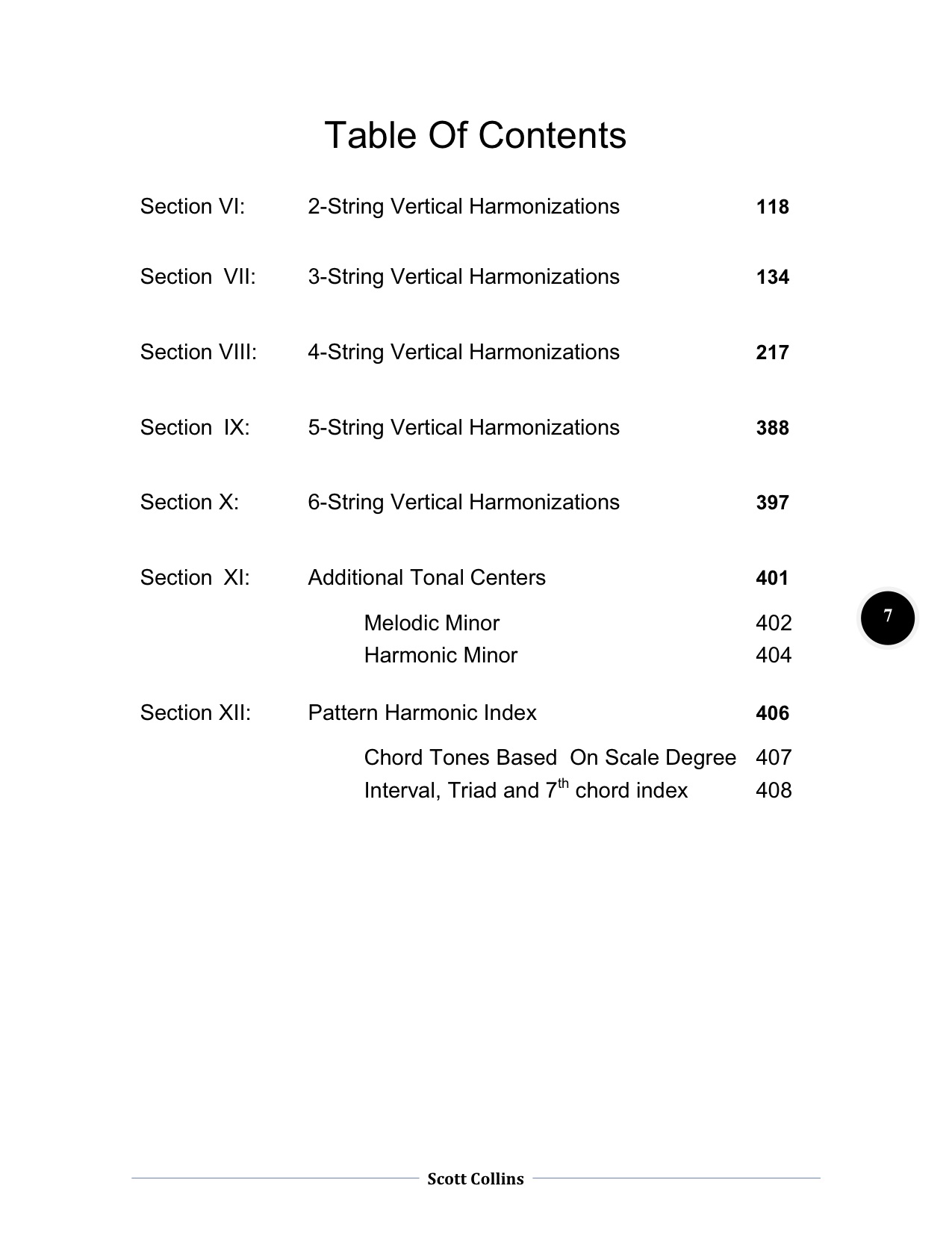
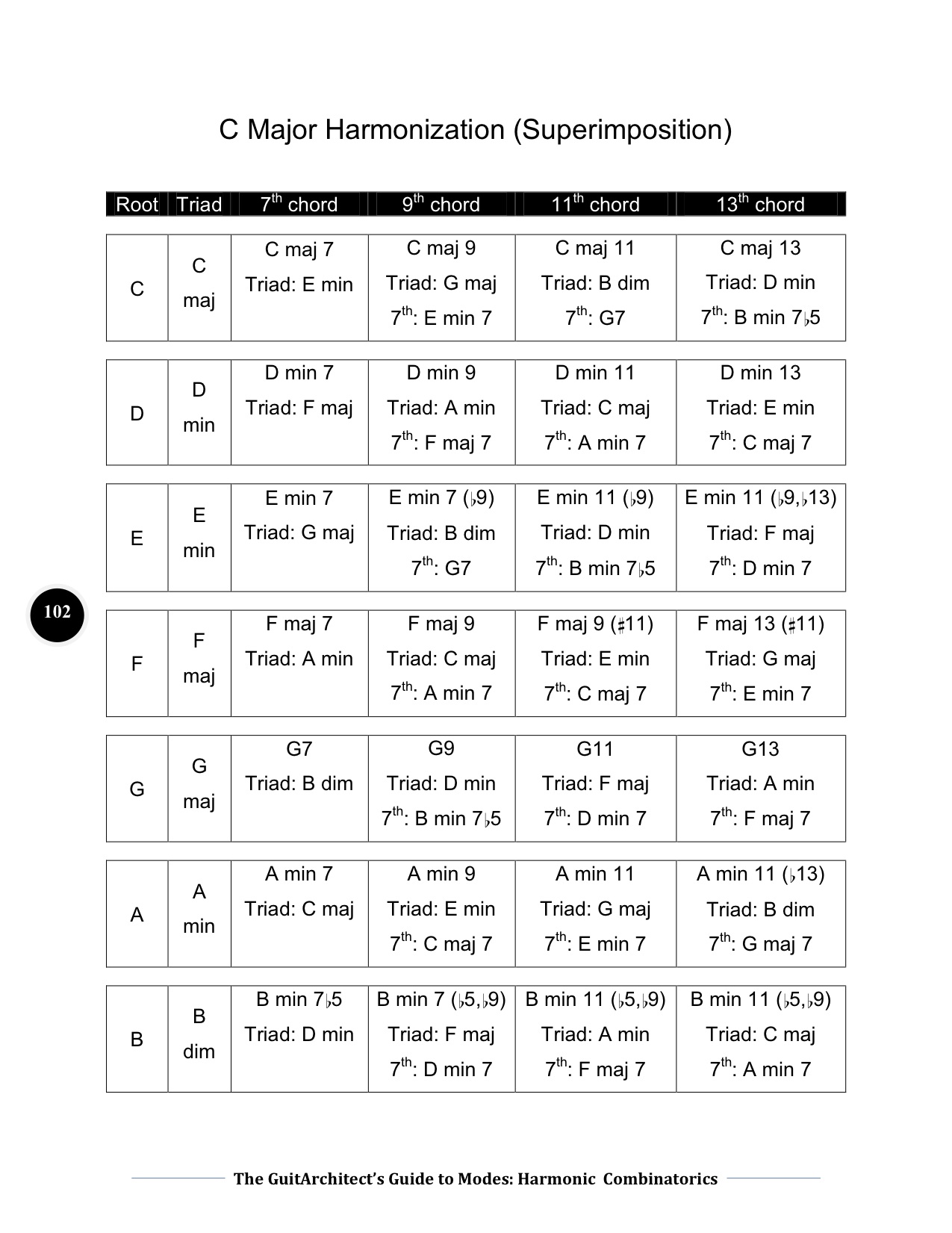
I’ve included jpegs of some of the pages from the Harmonic Combinatorics book below. Since the jpegs were converted from the pdf of the book, there’s some pixelation in the jpegs that’s not present in the pdf, but these will still give you an idea of what’s in the book.
(Click on any graphic to see it as a larger size.)

 .
.
 .
.
.
.
.

.
.
The GuitArchitect’s Guide to Chord Scales
(190 pages)

.
.
.
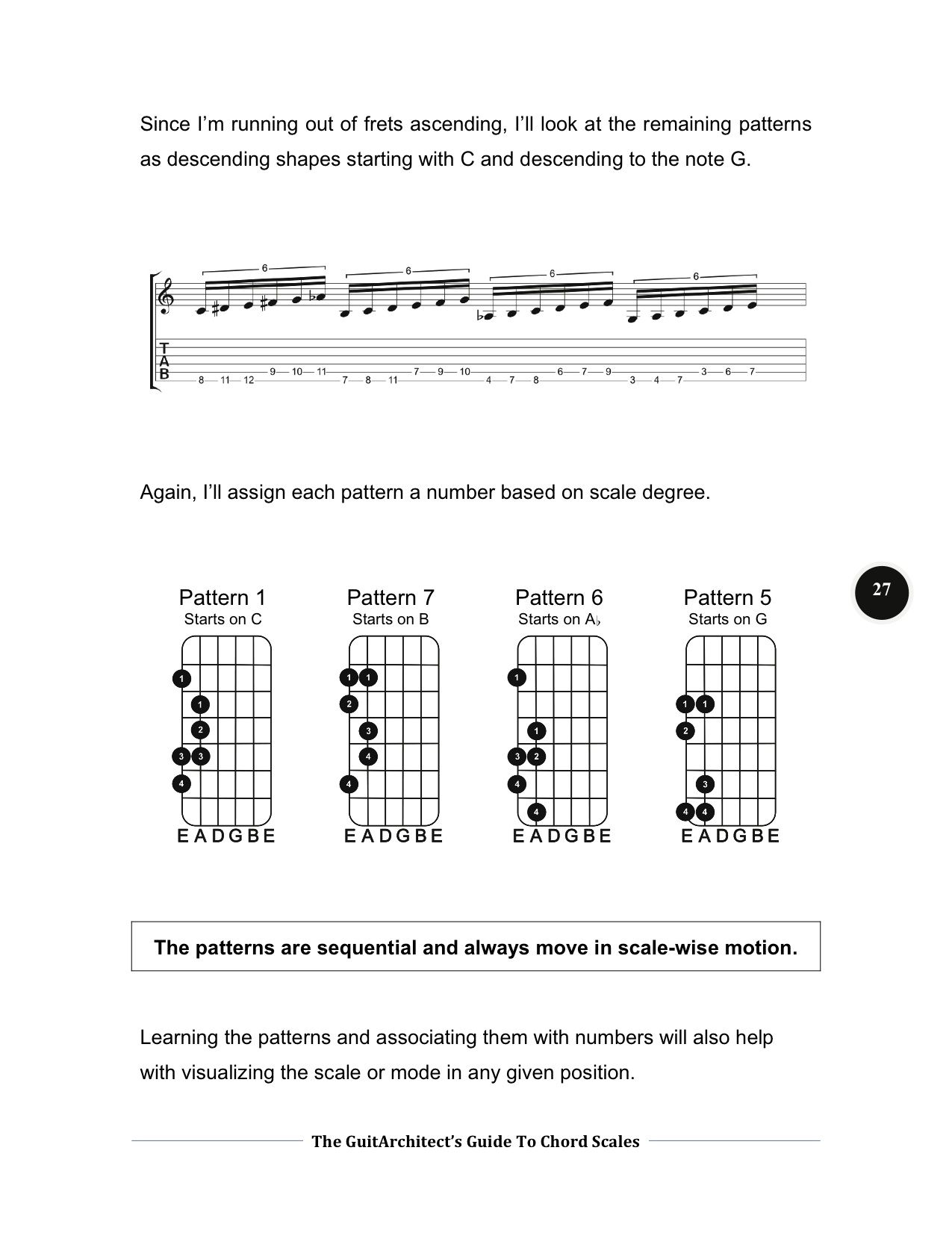
In The GuitArchitect’s Guide To Chord Scales, I show you how to make your own scales to use over chords and how to derive chords from whatever crazy scales you come up with in an easy, intuitive and musical way.
.
Over the course of its 190 pages, the Guide To Chord Scales not only offers extensive instruction and approaches, but also acts as a reference book covering chord scale options ranging from 3 notes right on up to the full 12-note chromatic.
.
While devised as a guitar resource for instructional, compositional and/or improvisational material – this book can be a vital component in any musician’s library.
.
The GuitArchitect’s Guide to Chord Scales
Chord Scales is 190 pages of instruction and reference. It’s the shortest book I’ve written, but it’s just as deep as any of the other books. The big difference between this book and the other books, is that this book starts by taking one chord scale and really putting it through the ringer and demonstrating how to use it in ways that are intuitive and musical. Once the process for what to do with a chord scale is demonstrated, the book then goes on to outline all the unique chord scales from 3-12 notes!!!
.
The book has a lot of performance insights and presents the material in a way I believe to be truly unique (at least I’ve never seen it dealt with this way before). It’s incredible exciting to me, and while it’s been written as a soloing, compositional or improvisational resource for guitarists – it could be invaluable to musicians in general.
.
There are a couple of posts that I’ve put up that excerpts and adapts material directly from this book. To get a sample of the book’s style you can check out :
.
.
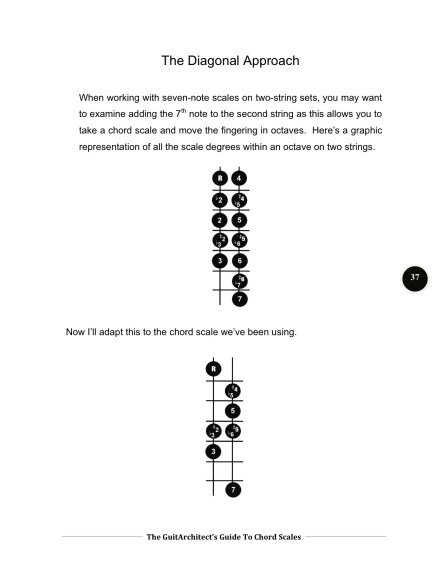
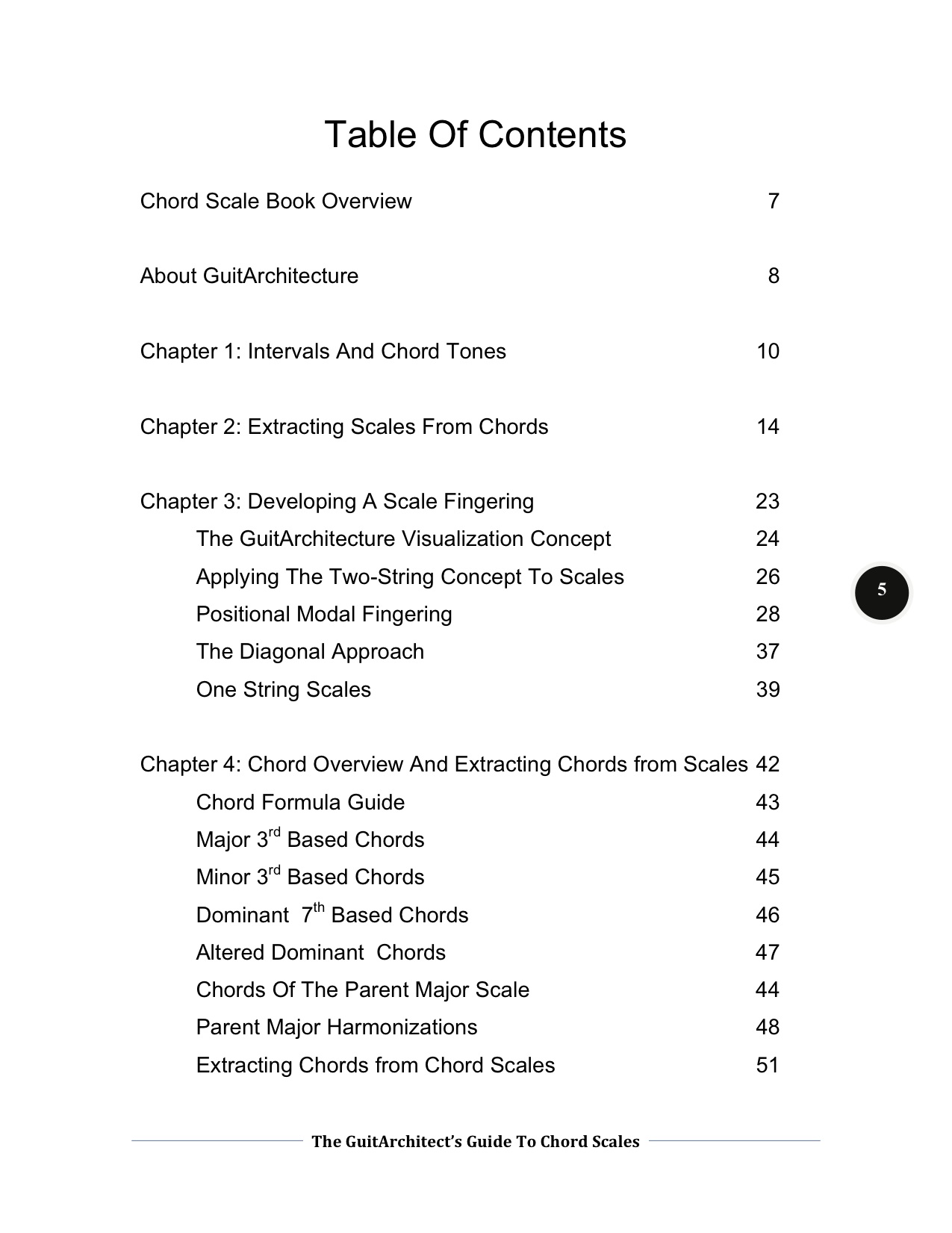
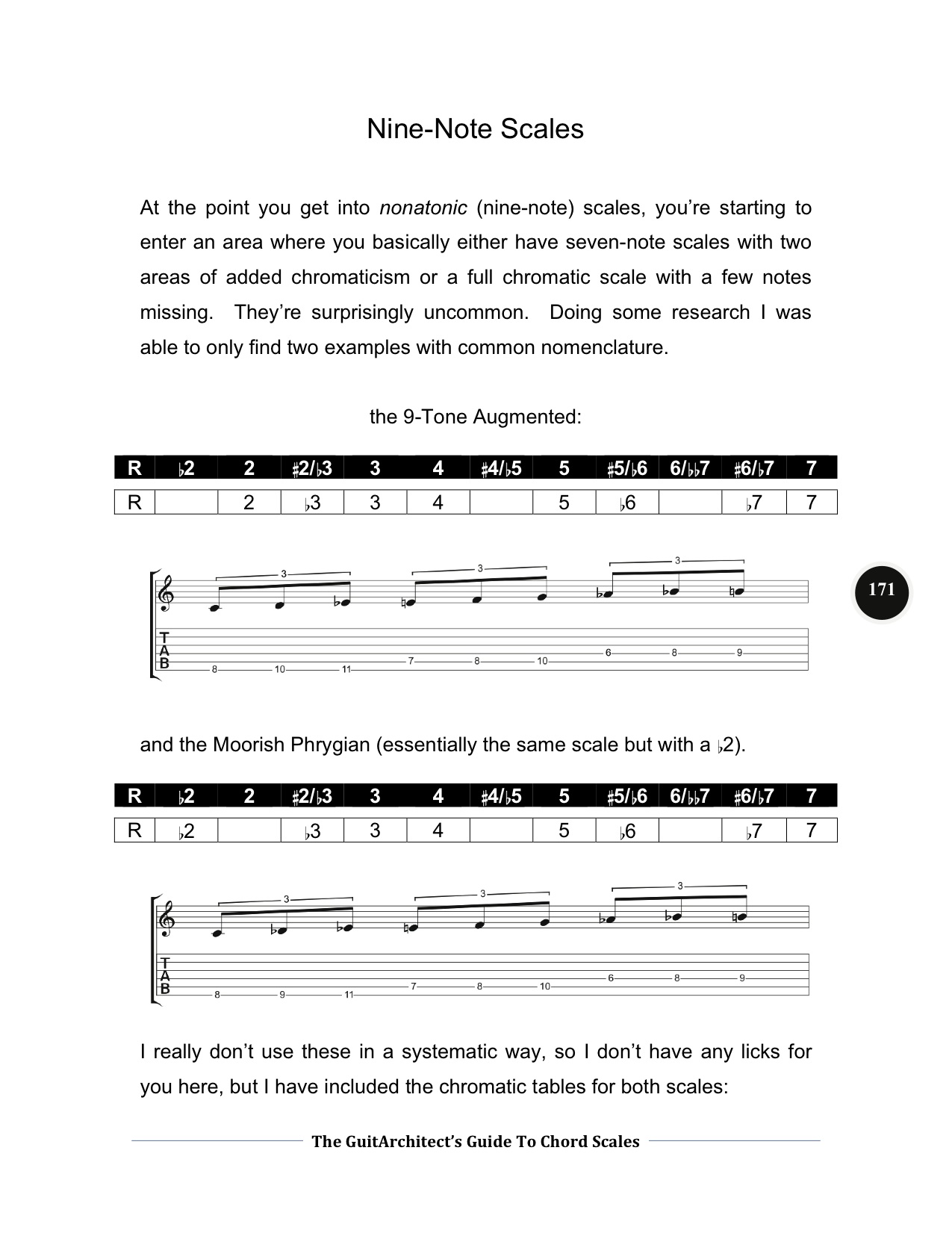
The lulu.com page includes a preview option for the first 12 pages of the book, but I’ve included some additional jpegs of some of the Chord Scales book pages below. Since the jpegs were converted from the pdf of the book, there’s some pixelation in the jpegs that’s not present in the pdf, but these will still give you an idea of what’s in the book.
(Click on any graphic to see it as a larger size.)


.

.


.
Ordering information (slight return)
- If you would like to purchase any individual book pdf for $15 USD just click the PayPal link below. (Also, when ordering, please specify which book you’d like – The GuitArchitect’s Guide To Modes: Melodic Patterns, The GuitArchitect’s Guide to Modes: Harmonic Combinatorics, The GuitArchitect’s Positional Exploration, or The GuitArchitect’s Guide to Chord Scales).

Any 1 GuitArchitecture pdf for $15.
..
-
If you would like to purchase any two book pdfs for $20 USD (and save $10 off of individual orders) just click the PayPal link below. (Also, when ordering, please specify which 2 pdfs you’d like – The GuitArchitect’s Guide To Modes: Melodic Patterns, The GuitArchitect’s Guide to Modes: Harmonic Combinatorics, The GuitArchitect’s Positional Exploration, or The GuitArchitect’s Guide to Chord Scales).
Any 2 GuitArchitecture pdfs for 20
..
- If you would like to purchase any three book pdfs for $30 USD (and save $15 off of individual orders) just click the PayPal link below. (Also, when ordering, please specify which 3 pdfs you’d like – The GuitArchitect’s Guide To Modes: Melodic Patterns, The GuitArchitect’s Guide to Modes: Harmonic Combinatorics, The GuitArchitect’s Positional Exploration, or The GuitArchitect’s Guide to Chord Scales).
Any 3 GuitArchitecture pdfs for $30
..
.
- The Four-book PDF bundle (which includes The GuitArchitect’s Guide To Modes: Melodic Patterns, The GuitArchitect’s Guide to Modes: Harmonic Combinatorics, The GuitArchitect’s Positional Exploration, and The GuitArchitect’s Guide to Chord Scales) is available for $40 using the PayPal bundle button below. (A $20 savings off ordering the books on their own).
Any 4 GuitArchitecture pdfs for $40
..
- If you’d like to save yourself the printing and binding costs, you can go to the link here ( Lulu.com ) to buy a nicely bound version of any of the books.
.
Please note:
I turn all orders around within the same day I receive PayPal notification.
If you have ordered a book and have not heard from me within a 12-hour time frame, please send me an e-mail at guitar(dot)blueprint(at)gmail.com, and I’ll get back to you as soon as I can!
.
Special thanks to everyone who has already purchased a book. Your support is greatly appreciated!
.
As always, thanks for reading!
.
-SC
















 GuitArchitecture.org