Testing Your Vocabulary Or Practicing Part VI

In the last post on practicing, I focused a great deal on the importance of listening in general and I’d like to focus and frame that importance a little more this time.

.

Before I move on, you may want to read my previous posts on practicing.  If you have missed those posts, you can find them here: part 1part 2part 3 , part 4 and part 5.

.

It’s important to realize that scales, arpeggios or any other kind of melodic or harmonic device is only a tool in the service of making music – and is not music in and of itself.

.

One way to get to making music with these devices is to learn other people’s music and phrasing, either by transcribing or learning by ear.

As a guitar teacher, I occasionally to run into students who are resistant to this idea as they only want to learn “their music”.

.

Learning other people’s music is learning your music because it’s part of a process in developing your voice.

The point of music is to communicate and to communicate with people you must have something to say.  This is done not only with vocabulary, but with a familiarity of language that comes from constant exposure and interaction.

.

When you learn other people’s music, or licks or chord progressions you learn vocabulary.  You learn phrases that work their way into your being and begin to form your aesthetic.  When you talk about “your writing style” for something you’re writing – do you make up all of the words you are going to use?  In reality, you use words that you’ve used before.  You use phrases that you’ve seen other people use that have now become part of “your writing style”.

.

If you’ve ever been around a child that’s learning to verbalize their thoughts – you’ve heard a lot of sounds coming out that are not recognizable as words (much less sentences).  It can be a real struggle to determine what it is that the child is attempting to do (or perhaps wants).  If you were to isolate that child at a certain point of development and refuse to interact verbally, the child would eventually develop his or her own language – but it would be completely inaccessible to you.  You would be unable to communicate verbally with the child and have to do things visually to convey ideas.

I’ve heard some singer/songwriter music that was done with this mindset.  The lyrics represent things that are so personal that it is impossible to gain any meaning from them without an intimate knowledge of the person.  Harmonically (because the performers use sounds that “are theirs” and nothing more),  the approach is severely limited and the chord progressions tend to all sound the same.  If you’ve ever had this experience you may find that you tend to tune out after a song or two as I do.

.

Learning vocabulary

When learning vocabulary, there are several steps (this is a profoundly oversimplified list):

  1. Exposure (or more likely multiple exposures) to a word (usually in a context)
  2. Use of the word
  3. Integration of the word into conversation/writing etc.

.

This means that there is a lot of word use to get to the point of integration.  In musical terms, you may have to shed a lick or phrase a lot not only from a technical standpoint (use of the phrase), but also to have it be “available” when you’re improvising (integration).  And this is a real test of your vocabulary.

.

You might think you have something down – but no matter how much you shed something,

if you can’t access it when you’re improvising – it’s not fully integrated into your playing.

.

It’s important to realize that integrating vocabulary is a conscious decision.  It isn’t passive at all.  Just because I hear a sound – doesn’t mean I know what it is or how to react to it. This is the real difference between hearing and listening.

.

Hearing is biological, listening is mental.

You can get a lot from working with transcription software (like transcribe) and using it as a phrase trainer (i.e. taking an advanced technical or shred lick and slowing it down to such a slow speed that it becomes playable).

.

Don’t be afraid of working on complex solos or phrases!

.

All you have to do is:

slow it down and

break it into small components that you can play and

try to increase the speed a little every day.

.

In this way you’re actually getting more complex patterns under your fingers and gaining some refined ideas to draw upon.  By working in this manner, you can develop phrases so that you have something that you can use at a variety of tempos. Having ideas that work in a number of contexts  makes it easier to integrate into your playing..

If this is an area of interest, you may also want to read this post on music as language.  You can also find some posts that may help with practice/motivation stating with one on focus here, a thought on music theory in performance here, or the importance of deadlines here.

.

I hope this helps!  Thanks for dropping by!

-SC

.

If you like this post you may also like:

.

PRACTICE MAKES BETTER AKA PRACTICING PART I

PROPER POSTURE IS REQUIRED FOR PROPER PERFORMANCE – PRACTICING PART II

TENSION AND THE SODA CAN OR PRACTICING PART III

DEFINITIONS AND DOCUMENTS OR PRACTICING PART IV

.

PRACTICE WHAT YOU PLAY OR PRACTICING PART V

TESTING YOUR VOCABULARY OR PRACTICING PART VI

POSSESSION IS 9/10S OF THE LAW BUT PERCEPTION IS EVERYTHING OR PRACTICING PART VII

Some Useful Online Practice Tools

.

FINDING THE DEEPER LESSON

MELVILLE, MADNESS AND PRACTICING – OR FINDING THE DEEPER LESSON PART 2

INSPIRATION VS. INTIMIDATION

What’s wrong with playing “Flight of the Bumblebee” for a world speed record?

.
Building Blocks – or more examinations of a laptop guitar setup.

If you’ve ever seen the American dubbed version of Mad Max (the whole movie plays very differently with the original voices – I’m just so used to the original American release’s versions of Night Rider, Toecutter and the Goose –  that that’s the only one I can watch), there’s a moment where The Goose realizes that the person they’re about to arrest is an associate of ToeCutter, and the camera closes in on his face as he says,

“Well well well…”


I wanted to go a little more in depth with the laptop guitar rig I’ve been toying around with.  I’ve posted a couple of things about this but I realized that it may be more beneficial to examine each component and see how it fits in the puzzle.  I tend to focus these on distorted sounds as those to me are the most difficult to replicate.  Even Logic has some decent sounding clean amps built in – getting a useable dirty sound is still the challenge at least for me.

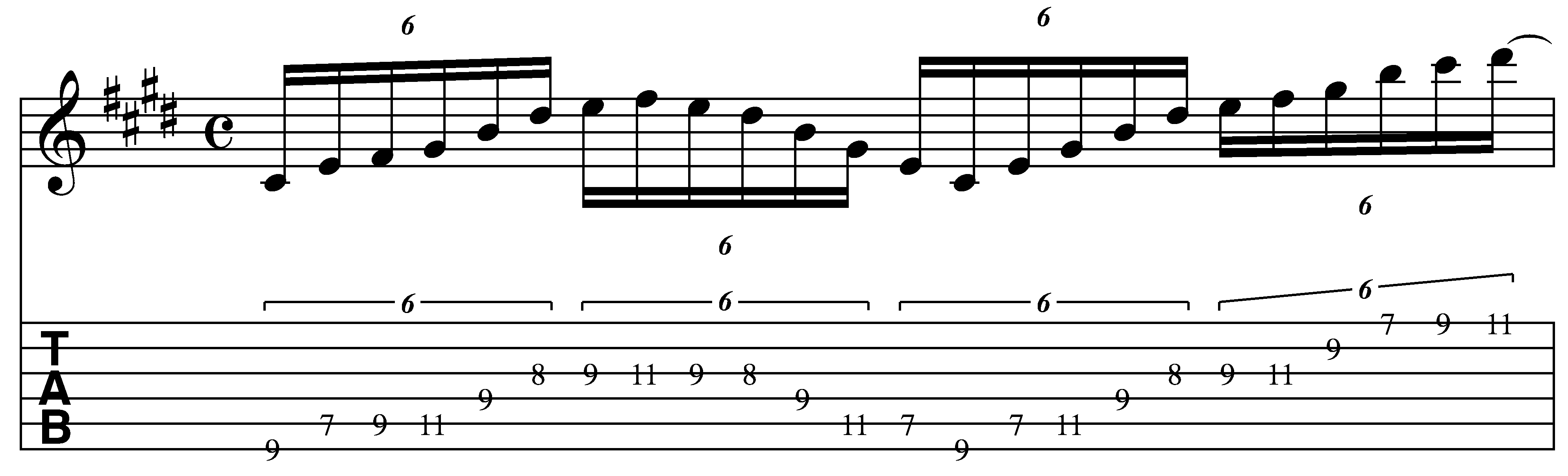
So what I did was improvise a little idea in a C# minor tonality and then played a series of versions of it through different versions of the laptop set up – to show the evolution of where I have things now.

There’s still a great deal more work to do in this area, but at least these are some starting points and may at least shed a light on the process I’m using.

As a starting point you may want to look at the gear page or my previous entries on this topic here or here.

The (salt) lick


To begin with, here’s an mp3 of the first thing I improvised:  C# min improv .

* Note:

occasionally mp3’s don’t load properly when I check them in Safari.  When I refesh the page they come up.  If you have this problem – it may work for you.  If you still can’t hear the mp3 just leave a comment and I’ll re-post it.

And here’s the notation

The first part of the lick is somewhere between a scale passage and an arpeggio which makes it a little interesting to me.  This approach is something I use a lot in my soloing to get away from the temptation to go on autopilot and just run scales up and down the whole time.

Visually, I’m initially thinking “G#min arpeggio”, and then dropping the lowest notes by alternating 3rds to extend the tonality.  This is an arpeggio trick I use all the time to get new sounds out of old shapes.  I’ll detail this process here:

Here’s a G# minor arpeggio:

When I look at the distance between the G# and the B – that’s a minor 3rd.  By alternating 3rds ( either major-minor or minor-major) I can extend the tonality.  A major 3rd down from G# would be E.

If I drop the lowest note to the “E” on the A string – I’d have an E maj 7 arpeggio. (E G#, B, D#).

If I drop the lowest note to the “C#” on the E string – I’d have a C# minor 9 arpeggio. (C#, E, G#, B, D#).

(If you wanted to go further you could continue the process to A, F#, etc.)

The next thing I do is to add the F# on the A and G string.

This makes G# min7 / E maj 9 / C# min 11 depending on the chord it’s being played over or how you’re visualizing it.

Now that I have the larger shape – I fill in some 3 note per string patterns on the G and high E strings.

There’s a slight 2 string variation on the A string that’s hammered instead of picked, but otherwise the picking pattern discussed on the swept pentatonic lesson is the same approach that’s used here.

This is very similar to the 3 note per string / 1 note per string pentatonic patterns that I’ve been exploring in the online lessons area of the blog (you can see a pdf here).

The process that I’m detailing is how I began to practice these things and then develop them into more complex ideas.  I tend to see sounds like this as one large pattern now ( note:  the GuitArchitecture process is all about sonic visualization – i.e. associating shapes with sounds so that sounds can be created and manipulated in real time) .  So when I improvise, I’m not really too conscious of exactly what’s happening theoretically – only sonically.

This ends in a pretty pedestrian B major (C# Phrygian) scale run.  In soloing I would typically try to develop it into something else – but for the purposes of a sound demo – it makes sense to have a short lick with a definitive ending.

The sounds

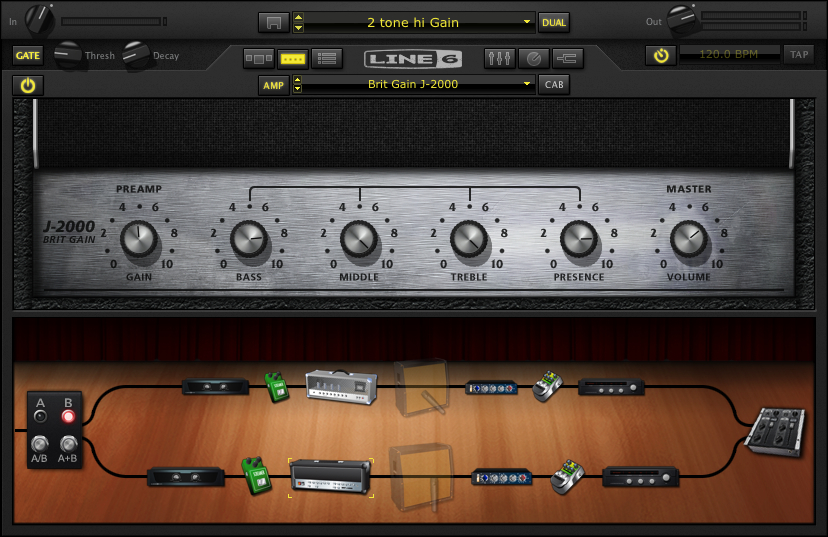
First I’ll play the lick with the sound used at the ending point of the process.  Here are some screen shots of the set up.

The FNH guitar on the neck pickup goes into the Apogee duet into AU LAB:

I run PSP Vintage Warmer

into Pod farm 2.01 Ilok version

I’m using the Marshall side of this rather than the Soldano – so I’ll show the signal chain there (it’s the same for both setups shown).

I’m going to start with the mixer and then go from there:

Since I’m only running a single line in- I’ve set both inputs to left.

There’s a little tonal secret hiding in plain sight here as well.  If you look carefully – you’ll see that the DI is set to about 18%.  This allows some of the dry guitar signal to come through as well.  This give the tone a little body and clarity that’s lacking from just the straight signal.

You might find that to completely not be the case – and again – this is just one person’s process detailed here.

Here’s the gate.  I tend to keep the levels low so it doesn’t kick in when I’m playing – but kills the noise when the volume is off.

The gain on the Marshall is set around 22%.  I tend to crank the mids a little to help make sure the sound cuts through in a live mix (note the use of the term “help”.  In reality – sound at any live gig is only as good as the sound person.  I just do what I can on my end to make sure I can hear myself on stage.).

Before the Marshall for the “lead” sound I’ve put in a tube screamer.  Here are the settings for that:

Here’s the lick with the tube screamer (same as above): with tube screamer

Here’s the lick without the tube screamer:  without tube screamer .

To give you a sense of how important the amp gain is to the overall sound – here’s a variation of the lick above with the amp gain set around half:

Here’s the lick with the tube screamer (same as above): TS_ON_50%_gain .

Here’s the lick without the tube screamer:  NO_TS_50%_gain .

I actually like this amount of saturation for lead lines – but the reason I’ve gone with the lower gain is that chords (outside or Root-5th diads) – tends to just crap out and turn to sonic mush with higher gain settings.  So to balance the 2 I’ve been working on lower tweaks.


WHY THE CABINET IS TRANSLUCENT.

Oh that’s easy.  It’s because I’m not using it.

Instead I’m using Impulse Responses from Recabinet in LA Convolver (See the links above for more info).

Here are the settings:

The IR’s are from the Recabinet Modern 2.02 Mac and PC-> 1960 4×12 cabinet settings.  You’ll notice that I don’t have anything fancy in terms of mikes set up on the cabinet,

Here is a major component of this process.  Recabinet comes with something like 2000 IRs.  I could spend weeks doing nothing but checking tonal variations on all the different cabs mikes.  Someday when I need to get really deep into this – I will.

In the meantime – to cut down on the number of parameters and just get to a tone – I went with the KISS (keep it simple stupid) approach.  I thought about what cabinet could be a constant for all my sounds clean and dirty – and the 4 x 12 came to me.  I’ve heard a DeVille through one and it sounded good so I decided to use that as the standard and tweak the amp around the cabinet.  Live, a 57 on the grill sounds good to me.  I tried 2 different variations of the same thing and went from there.

To contrast this:  here is the sound of just PodFarm – with the PodFarm cabinets but with the PSP and post preamp off.

Here’s the lick with the tube screamer (same as above): NO_IR_YES_TS .

Here’s the lick without the tube screamer:  NO_IR_NO_TS .

Some of you may prefer these sounds.  I happen to think that “initial” mp3 – has a bit more character than these.

Here’s the rest of the signal chain:

Here’s the pre-amp (post amp! – this is a very useful tweak!):

Here’s the delay:

Here’s the reverb:

So to quote the Goose, “Well well well…”

It’s still a work in progress.  I’d like to work on tweaking the preamp after the cab to carve the tone a bit more and experiment with using an outside delay later in the AULAB signal chain – but for now this is where it is.

I hope this helps!  If you have any questions or comments please fell free to leave them on the blog – or e-mail me at guitar.blueprint@gmail.com .

Thanks for dropping by.

-SC

Glass Noodles – adapting a Philip Glass arpeggio approach to guitar

I tend to get a lot of playing ideas from sources other than guitar.  A primary source of influence is film and one of my all time favorites is Mishima. To me, Philip Glass’ score works brilliantly with the subject matter and helps create a powerful experience.

Here’s a lesson post on some cool approaches I borrowed (read: stole) from Glass that might provide you with some inspiration.

I’ll post the exercise first and then add some color commentary.

A link to an mp3 is here:  Glass Noodles122bpm

First thing’s first – the  triadic* chord progression (see note at the bottom) is  G Major, G# diminished, A Major, A# diminished, B Minor, G Major, B minor, B Diminshed, B Minor, G Major, B minor, B Diminshed. (Note: The second bar repeats – I just forgot to put the repeats in).

I’ll start with a technical issue and then go into the theoretical things to grab.

.

If you want it hypnotic –   you’ll have to lose the pick.

.

Part of the sound of this is the hypnotic repetition and a large part of that sound come from a uniform attack.  You can sweep pick all of these arpeggios as well – but for a more legato sound it’s best to approach all of these with fret hand tapping (i.e. all hammer ons and no picking).  From a technical standpoint the real challenges here are 1. keeping the attacks uniform (i.e. all of the note volumes are even) and 2. playing it in the pocket rhythmically.

.

Getting the maximum effect of something like this requires  sequencer like articulation and timing – and that alone makes this something worth studying.

.

As a starting point you’ll probably want to mute the stings to prevent open notes from ringing out (I just use my picking hand – some people use a hair tie or a piece of cloth.)

For uniform attacks – you’ll have to have very clean hammer-on technique with the fingertips hitting the strings instead of the pads of the fingers.   If there’s any slop there – it will come out in the arpeggios.  One other thing to note is that the notes should be lifted off and not pulled off.  If the only sound created is by the individual fingers hitting the strings – you will have a more uniform sound (which is totally the goal here).

.

Here’s a good way to visualize the fret hand finger motion you’re looking for.

.

Put the palms of your hands on a table.  Now without lifting the palms up, tap your fingertips one at a time on the table starting from the pinky and ending on the index.  You’ll notice that the fingers stay curved and that the large knuckle of each finger is responsible for the tapping.  This motion is what you’re looking for in this process.  You should also notice that you don’t need to hit the fingertips very hard against the table to get a crisp attack.

.

You should strive to get volume with the minimum amount of finger pressure.

The more relaxed you can keep your hand, the easier this will be.

.

You can add some compression to make help make the attacks more uniform as well.  I typically don’t use a lot of compression as I like to play very dynamically and find myself adjusting volume and tone a lot when I play – but a compressor plug in will make all of this easier to play.

This approach gets counter-intuitive at the G major arpeggio (the second arpeggio of bar 2).  For a technical stand point this is the trickiest part of the passage. (Note:  The numbers under the notes indicate fret hand fingerings.)
.

.

I am used to playing the G major arpeggio as a 5 string form – which usually uses the 3rd finger as a barre on the 12th fret, but barring the B and G on the 12 fret completely breaks up the sound and makes it impossible to get the tapped sound of the other notes.  To get around this – I use the index finger to fret the G  so each note gets a unique attack.

.

This is one of those deceptive exercises.  Playing it at 60% will not take very long – but the difference between 60% and 100% is HUGE.

.

Playing everything  with correct timing and really articulating every note will take a while.  Don’t get discouraged if it doesn’t happen right way.

.

The key here is to plan on spending a lot of time playing the arpeggios really slowly to make sure that the timing and volumes are 100% from the beginning.  You can read some of my posts on practicing to get a sense of the best way to start working on something like this.

Now some theory observations:

.

If you sharp the root of a major arpeggio – you get a diminished arpeggio.
.

This doesn’t sound like much – but look at the first 3 arpeggios.  By making the G a G#, you get a nice chromatic motion on the B string leading into the A Major Arpeggio.  You can also notice that the A# in the diminished arpeggio after the A major arpeggio leads right into the B Minor arpeggio.  This is a great way to sequence between 2 Major Arpeggios a step apart (Like G major and A major).

.

If you sharp the 5th of a minor arpeggio – you get the root of a major arpeggio.

.

Again a small thing – but by using this you get  a nice voice leading between the B minor/G major arpeggios in bar 2.  Also notice the chromatic motion on both the G and the high E string.   This continues the chromatic movement that occurred on the B string between the first 3 arpeggios.

.

If you flat the 5th of a minor arpeggio – you get the 5th of a Diminished arpeggio.

.

Check out the last arpeggio in bar 2!  By continuing the downward chromatic motion through the  G Major – B Minor – B Diminished – a sense of urgency is created and then the last point –

.

There’s mystery in keeping it unresolved.


.

In the Mishima soundtrack (you HAVE put the movie in your Netflix Queue yes?) there are a number of moments where at the end of the arpeggio flurries – it ends on an unresolved chord.   Here I’ve repeated the last arpeggio fully and then ended on the lower F on the last repeat.  If I was making a song out of these ideas – I would continue with the type of figures and ideas that have already been presented here and possibly resolving them.  But here in this context – ending on the F – just leaves a giant question mark and makes it interesting.  If you don’t believe me – watch the film!

.

*Note: If you move away from triads – there’s another analysis here:

.

The notes of G# diminished are can also be seen as the 3rd, 5th, and b7 of an E7 arpeggio.

Therefore: If you sharp the root of a major arpeggio – you also get the 3rd of a dominant 7th arpeggio (with no root).

.

This would make the chord progression   G Major, E7, A Major, F#7, B Minor, G Major, B minor, B Diminshed, B Minor, G Major, B minor, B Diminshed.

The bass motion would be what determines the actual chord progression.  I believe the bass motion followed the chromatic motion but the E7->A and F#7-Bm are pretty standard analysis for a chord progression like this.


More posts soon.  Please feel free to post any questions or comments you might have or e-mail me at guitar.blueprint@gmail.com.

-SC

Practice what you play or Practicing Part V

I realize that I’ve been talking a lot about how to practice and have only touched upon what to practice in a very limited sense.  If you have missed my other posts on practicing you can find them here: part 1part 2part 3 and part 4.

.

What to practice

Without being too obvious, you should practice what you’re going to play.

If I was a shred metal player – I’d learn a ton of shred metal tunes.  I’d work on scales and arpeggios a lot and investigate all sorts of lead techniques (tapping, pinch harmonics etc.).  I’d work on learning the solos to those tunes and then start trying to work on my own solos.  I might watch a bunch of instructional videos to try to get ideas as well.

If I was into Jazz, I’d be practicing specific standards.  I’d work on coming up with a bunch of ways to comp chords and practice soloing over the changes.  I’d listen to other renditions of the tunes and borrow (read: steal) any ideas I liked.

If your goal is to play exactly like Stevie Ray Vaughan – learning your melodic minor modes won’t help you directly with your goal, and being motivated to work on them will be difficult if you can’t tie it into your goals.

.

The #1 thing you should be practicing

Now, I’m going to advise you on the #1 thing you should be integrating into your practice regimen that you probably aren’t actively doing now – more than scales, chords or anything else I can think of for the moment.  And it’s a commonality with all of the examples above.

.

You should practice listening.

Not just hearing – really listening.

.

You should practice listening with the purpose of ultimately working on developing your musical vocabulary.

.

Listening, interacting and speaking are three pillars of any conversation and they should be important for you to consider in your playing as well.  If you can’t hear what’s going on – you’re not going to be able to say anything that’s poignant.

Without going into religion, I believe fundamentally that silence is a sacred thing.  I believe that if you are interrupting silence with sound  – you’d better have something to say.

So how do you practice listening?

.

Transcribe – or learn things aurally

There are a lot of internet sites that break down transcription methods better than I can do in the context of this post – but it’s important to note initially that you will probably not be that accurate.  Don’t worry about perfection.  Spend your energy learning phrases and understanding the context that they exist in (i.e. what chords to play them over).

When I first started playing guitar in bands and I had to learn songs for the bands I was playing in, the first thing I learned was the bass line – as it was easy for me to hear and gave me an idea of which “power chords” I’d have to play as well.  If you find a tune you like you should try to learn all the parts on guitar.  The bass lines, the vocal lines, the keyboard or other instrumental parts… You’ll start coming up with things that you might now have ever stumbled across on your own.  If you want to try to notate it – you will get even more out of it – but the important thing is to see how it all works together.

.

Sing it if you want to own it

Sing what you play.  Play a phrase and sing it back.

Play what you sing.  Sing a phrase and play it back.

When you sing something you internalize it.  Internalized things become a part of you.  When you play a melody try to sing it as well.  Listen to other people sing it and try to match the inflections.

(ah if only I thought of the above 2 myself – but they were taken from W.A. Mathieu’s excellent, The Listening Book. If you don’t know this book – I highly recommend it!)

.

Play with musicians that are better than you.

If you play with really good musicians – they’re listening.  We tend to copy other people’s behavior.  So if a room full of people are listening, we might be more inclined to listen as well.

.

Really listen to the world around you.

Try this for a moment.  Close your eyes and take a deep breath.  When you’re done exhaling –  focus for a couple of seconds on what you hear.  Doing this now I just heard – My refrigerator running.  The cat lightly snoring.  Cars passing in the distance.  Several neighbors mumbling down the hall.  The bathroom sink dripping.  The ac unit for the building turn off.  My heartbeat.  A car pulling into the garage.  When I imagine my heart beat as a bass drum being hit I can fall into a groove.  The fridge acts as a drone.  Now I hear a bird -it sounds like horn stabs.  The cars rumble like bass pitches.  My typing accelerates to accompany the sounds going on.  For an instant it’s a cool piece.  Then it vanishes as my perception goes back to what I’m doing.  Before I thought about it –  all I was aware of was the fridge.  Once I really listened I could hear a number of cool things going on.

.

When you really listen as a musician – you can start to get past the point of focusing on, “wait is that an A major or an A minor chord?” – and get into how what everyone is doing fits together.  You can start to get past the technique of performance and work towards making music.

Making music is a noble goal and it’s a goal that’s rooted in listening.   If you’re really listening all of those other things (scales, chords, etc) are going to come into play anyway and as you develop your vocabulary –  you develop your voice.

If you are known as someone who listens well and has something to say – there will always be people who seek you out.   In music.  In life.

.

Practice deeply.

Until next time.

-SC

.

If you like this post you may also like:

.

PRACTICE MAKES BETTER AKA PRACTICING PART I

PROPER POSTURE IS REQUIRED FOR PROPER PERFORMANCE – PRACTICING PART II

TENSION AND THE SODA CAN OR PRACTICING PART III

DEFINITIONS AND DOCUMENTS OR PRACTICING PART IV

.

PRACTICE WHAT YOU PLAY OR PRACTICING PART V

TESTING YOUR VOCABULARY OR PRACTICING PART VI

POSSESSION IS 9/10S OF THE LAW BUT PERCEPTION IS EVERYTHING OR PRACTICING PART VII

Some Useful Online Practice Tools

.

FINDING THE DEEPER LESSON

MELVILLE, MADNESS AND PRACTICING – OR FINDING THE DEEPER LESSON PART 2

INSPIRATION VS. INTIMIDATION

What’s wrong with playing “Flight of the Bumblebee” for a world speed record?

.