Some Observations On Inertia And A Cool Online App For Getting Things Done

A routine can be a powerful thing in productivity.  It helps instil a sense of inertia and, as I’ve talked about in posts like this, or  this one , keeping the ball rolling is usually a lot easier than initially getting it to roll.  The counter-intuitive reality behind doing things is that:

.

Activity leads to other activity.  It creates its own inertia.

Bodies at rest tend to stay at rest.

.

The counter-intuitive part of this is when you’re sitting on a sofa and think, “I’m really tired.  I  just have to rest for a second and mentally gear myself up for this”.  Inertia is working at keeping you sitting on the couch.  If there’s a TV on or an internet connection – it’s working double time.

.

The reality is that just getting up and doing the thing actually takes less energy that expending the energy debating with yourself about whether or not you have the tools or the energy to do something.

.

The caveat is that this assumes we’re talking about moderate activity.  If you’ve just run a marathon, I’m not advocating staying on your feet if you need to rest.  I’m talking about procrastination versus physical exhaustion.

.

Procrastination is an energy suck

.

Completing projects is invigorating.  It’s that energy that comes from getting something done and thinking, “All right – what’s next?” It takes way more mental energy to keep putting something off than to just deal with it.

.

Here are some tips that may be helpful:

.

  • Have goals.  If you don’t know what you’re trying to do – you’re not likely to figure out the how.
  • If you have something you’re procrastinating – try to tackle small parts of if consistently.  You’re going to get more mileage out of small daily improvements than trying to cram something into a marathon session.
  • Monitor progress.  This goes along with goal setting but it’s important to check back and see how you’re progressing.
  • Be accountable but pragmatic.  Either to yourself or other people, to get things done, it’s important to be held to your goals.  Along with monitoring progress, being pragmatic (rather than judgemental) about your progress will help as well.  If things aren’t progressing they way you’d like – beating yourself up isn’t going to help the process.  By monitoring things you can see what works and what doesn’t work and adjust as necessary.

.

I Done This

Neither a typo or an obscure pop reference, I want to thank my friend Daren Burns for bringing this to my attention.  I done this.com is a cool free online productivity tool that combines some of the tips that I’ve mentioned above,  Here’s a quote from the web page:

.

“iDoneThis is an email-based productivity log. This evening, you’ll receive your first email from us asking, “What’d you get done today?” Just respond to our email and we record what you wrote into your calendar. Use your progress from yesterday to motivate you today.”

By helping to monitor progress and helping keep consistency and accountability, this could be something to help get the ball rolling for you. If you have something you’ve been putting off doing (like practicing) try it for a week and see what happens.

.

I hope this helps!  Thanks for reading.

.

-SC

.
On “It is what it is”

I had a moment to catch up on some things this weekend, and returned a call from a friend of mine at CalArts.  We had a very nice conversation catching up and discussing Higher Education funding, trends, pedagogy and the like and she was kind enough to tell me this:

“You know, in a conversation we had once – you gave me some advice and told me that, ‘it is what it is’.  I thought about that a lot – and about how you’ve brought it up a number of times in our conversations – and it’s something I find myself coming back to as a mantra when I’m facing something difficult.”

She had asked me about where that mindset came from, and I’m sure it’s rooted in growing up in a working class small town in upstate New York.  Compared to many people around me I had it relatively easy.  My parents both worked hard – my dad taught middle school and my mom worked in a factory – and they owned the house we lived in. (A note: Despite a lot of nonsense talk generated in the media earlier in the year, as people living on an educator’s salary, we did not live high on the hog.  We burned wood for fuel (that we cut stacked and dried on our own), did all our own repairs and (for a while) raised animals for food. The two-story house I grew up in with a garage and a 2 story workshop on a 1/2 acre of land sold for well under 40k if that tells you anything about the economics of the region.)

Other people I knew had it really hard.  Farmers (and often their children) who worked from dawn to dusk with spouses working additional odd jobs just to make ends meet.   We had “valley runners” – a term of no endearment reserved for families who would relocate multiple times a year to stay one step ahead of the law.  I’d always see the kids in my classes; they’d show up for a couple of months and then be gone to the next county.  When I’d see them months, or years later, they had always changed for the worse.  They picked up a number of skills they needed to survive when you’re always on the run  (typically manipulation, but sometimes cons or petty theft), that were depressing enough for an adult to have to rely on to get by – much less a child.

Mainly though, I knew a lot of good people who worked hard and were often presented with really difficult situations.  And the response to those situations was to work through it.  I can’t count the number of times that I heard variations of, “No use crying about it – let’s get to work.”

For those of you who resonate with this sentiment, and have never read Marcus Aurelius’ Meditations, it might be worth a moment of your time.  One point Aurelius’ (and other Stoics like Epictetus) bring up repeatedly is the value of seeing things for what they are.  That often means removing the emotional issues associated with the matters at hand and trying to deal with them objectively. (Albert Ellis made an entire career out of this method of inquiry with his REBT (Rational Emotive Behavioral Therapy) approach).

.

Getting emotional about certain things (particularly difficult things) only adds to their difficultly.

.

In my world view, some things are simply facts andviewing those things as such makes it easier to see them for what they are.

.

For example:

2+2=4.

How do you feel about that? (or do you feel anything?)

It’s difficult to get emotionally invested in it because it’s merely a fact.

.

Now here’s the idea applied: where a student might hear, “You’re going to have to put a lot of time in to getting those sweep arpeggios down the way you want.” I hear “2+2=4”.  There’s no emotional involvement  and so there’s less to get tripped up on.

There are a million reasons to procrastinate, and generally only one or two to get something done.  If you’re facing something really daunting there’s a several part process I can share to help make it manageable.

.

Getting it done

.

  1. Know why you need to do what you’re doing. As Viktor Frankl once said, “He who has a why can bear almost any how”.
  2. Deal with problems individually.  Many problems are multi-tiered so break them down into individual components to make them easier to manage.
  3. See the problem for what it is.  Gain a scope of what it is you are trying to do and prioritize what has to happen to complete it.  (For example: If you’re trying to get better at sight-reading – you’re going to have to work on it a lot over a longer period of time.  If you’re trying to get two bars of a solo down – it will probably be a much shorter over-all time investment).
  4. Have milestones and a deadline.  Know what you’re going to complete by when.
  5. Prioritize and address what you can.  Don’t get hung up on big steps here, this stage is all about the specifics of each step (i.e. the grunt work).
  6. Reassess and return.  As milestones are reached verify your progress and start again.

.

I remember reading a David Lee Roth interview where he was talking about how having a drive was the only thing that was going to get you through endless vocal practicing in your bedroom.

There’s nothing glamorous in the work that goes into doing anything well, but it’s necessary to acquire the skills needed to do those things.

.

In other words, it is what it is.

.

Thanks for reading.

-SC

“When You Come To A Fork In The Road Take It”

A number of the motivational posts I’ve posted  here center around a few key concepts:

.

  • Having a clear vision of what you want to do (goals)
  • Aligning perception with reality (having an honest assessment of what needs to happen to reach those goals)
  • Daily work on those goals
  • Limiting distractions, and obstacles in the way

.

The reason I come back to these posts to the extent that I do (and why I address it with myself as much as I can), is because it’s incredibly important to make the most of your time and enjoy it because time is all you’ve got.  All the talent, skill, strength, brains or money in the world won’t stop you from dying eventually.  Since all those things (talent, skill, strength, brains and money ) are acquired over time, in the end all you have is your time and how you’ve used it.

.

Life is short and the only thing of value.  Don’t waste it away.

.

We live in the most technologically advanced era the world the world has ever seen, but despite (and/or because of) that technology we also live increasingly isolated existences.   As a society, we often equate texting with talking and surfing the web to connecting with someone (or something).

.

All we’re really doing is staring at a TV with an infinite number of channels and typing.

.  

There’s only limited interaction and a one way transmission of data.   It’s  addicting, comfortable and seductive and brings about the complacency and relaxation everyone looks for at one time or another.  I’m not saying you shouldn’t relax, but I am saying that being sedentary in anything you do carries it’s own inertia (physical and psychological).  The more you turn off your brain, the more likely you are to turn off your brain – even when you don’t want to.

.

My father’s grandfather worked coal for the railroad every day of his teenage and adult life.  It was long hours of backbreaking labor and by all accounts, he was an incredibly powerful man.  When he retired, he decided that he was going to retire from everything.  He sat in his favorite chair and went from someone who was active and engaged to someone with very minimal physical exertion and no real goals for the future other than not working.  He died a couple of years later. I can’t prove that they’re related, by in my mind they are.  By my dad’s account, he basically just decided to stopped living.

.

“When You Come To A Fork In The Road  – Take It”

.

And this brings me back to meaningful living and navigating the overwhelming number of options available to us.   Indecision is a natural byproduct of being overwhelmed.  While I’m all for making an informed decision before taking action, if you spend too much time informing yourself, you won’t have any inertia to carry out what you initially wanted to do. The unexamined life may not be worth living – but the over-examined isn’t either.

.

In any battle with indecision, at a certain point you have to punt.  If you get overwhelmed with options, pick one and run with it until you have to switch to another.  If you have a good grasp of what it is that you want to do, you’ll make changes in direction as you require to get back on track.

.

It’s less important what thing you do first as long as you do something.

.

Thanks for reading.

.

-SC

Circumnavigating The Wall You Just Hit

It’s easy to get so caught up in the how, or the technical process of what you’re doing, that you forget the why

.

Every once in a while someone will send me a You Tube clip of some wunderkind playing a million notes and I often think, “Wow it’s impressive to spend so much time getting that down.   I wonder how they’re going to use that when they’re playing Brown Eyed Girl at the local bar?”  The answer, of course, is that they’re not going to play that or maybe even any song.  The point of the video generally isn’t to develop something interesting in a larger musical context (like a song) but instead to promote their efforts by performing something technically difficult to get people impressed.

.

I don’t fault players for this, they’re simply trying to make a connection and that’s the point of music in general.  Sometimes that means playing a million notes and sometimes that happens in the silences of the music you’re playing.   It’s an easy path to go down because making a connection is really hard. In addition to a lot of work, it requires experience, sincerity and no small amount of guts to leave yourself exposed.  In contrast, sitting down with a metronome and getting a lick up to a quick tempo is substantially easier and the result is quantifiable.  Even if people aren’t impressed, you’ll know that you got it up to speed and take some comfort in advancing your technical ability.

.

But the flash of something fast will fade quickly, and what’s left is the content of what’s being said and the sincerity behind it.
.

I like video game licks in certain contexts, but they’re probably not going to work on a ballad very well (even if it is a fusion track 😉 ).  If you’re saying a lot of words without much meaning it’s not going to have a lot of impact.

.

I’ve had gigs where everything involving making a connection turns off on the stage and while it’s not a defining moment in human history, for someone who’s being used to being connected to music it’s a pretty awful feeling.  I’d even argue that this was the case for 90% of the gigs I’ve played in LA.  There can be any number of reasons for this.  There might be technical issues that completely pull you out of your mindset.  The audience might not be there to make a connection.  Things may not be jelling with the band.  But most importantly,  it may be your disconnect, and it’s the most important, because it’s the only performance factor that you really have control over.

.

Those of you familiar with the Aesop’s fable regarding the fox and the lion will probably remember the final adage, “Familiarity Breeds Contempt “.  You can put so much time into the same thing on guitar that it loses all musical meaning.  The bad news is it’s probably not going to gain additional meaning on the bandstand.  In all likelihood you’re going to disconnect from it further.

.

The more you work with specific things the easier it is to auto pilot your way through them, and the less likely you’ll be able to connect with it.  Taking that a step further, it’s going to be hard to connect to audiences if you’re disconnected from your own playing.   It’s more common than you might think, and a lot of musicians go through small (or large) periods where they “weren’t feeling it”.  They hit a wall.

.

By it’s nature, any wall is usually made of pretty hard material so meeting it head on and trying going through it is not the best approach.  I can tell you from personal experience that taking the approach of saying, “suck it up” isn’t going to get your groove back.  Playing through it is exactly what you probably shouldn’t be doing because it’s just going to distance you further from the actual music when you play.  It’s like when a relationship is on the rocks and you’re convinced that spending more time together will make it better when the time you spend now is stinted and awkward.  The better approach in both cases is to step back and get some perspective…to go over the wall if you will…

.

One man’s recommendation for dealing with the wall

.

If you’re facing this right now, here are some strategies that may help.

.

  • Acknowledge that you’ve hit a wall.  You can’t fix something you don’t recognize as a problem.
  • Once you acknowledge that you’ve hit a wall, realize that while it might be big and imposing, it’s still only a wall.
  • If the wall you’ve hit is from playing in general, take a break from playing for a couple of days.  Spend that time trying to connect with friends or family.  What you do isn’t really as important as the fact that you’re engaged and connected while you do it.
  • Learn some new songs.  Learn things that are very non guitaristic like vocal melodies or horn lines.  Take those ideas and write something new with them.
  • Go back and listen to music that inspired you.  Try to find out what it was that inspired you about the music.  Don’t over think or over analyze it, just try to connect with it.
  • Get out of your comfort zone.  Listen to music from other cultures.  Read a book by an unfamiliar (but recommended author).  Play with different musicians.  Take a short trip somewhere you’ve never been with a friend and see some new surroundings.  When I was in Phoenix, I checked out the Musical Instrument Museum and had my head turned around in a dozen different directions both by the instruments and the multimedia presentations of field recordings.  I left that place with a lot of new musical ideas buzzing around my head.
  • Practice playing in front of other people.  Learn a new song and play it at an open mic.  Make notes of when you’re connecting and when other people are connecting and make mental notes of how they’re doing it.
  • When you come back to practicing, take a measured breath before you begin playing.  Mark the fact that you’re about to start something to get into the zone.
  • Try being mindful of what you’re practicing.  Set limits on time and only practice one thing as long as you can be engaged in practicing it.
  • When you play a solo – try only playing what you can sing.

 .

There are a lot of other things you can try, but the real goal here is to get re-engaged and bring that to your playing.  As corny as it may sound, playing is an expression of who you are and where you’ve been.  If you don’t have anything to say in your playing, it may be time to live a little more so you’ll have a story to tell next time you sit down…For me, it was about realizing what was wrong, taking ownership of that and moving past it to get back to making music instead of just sound again.

  .

Good luck to you and thanks for reading!

-SC

.


Recycling Chords Part II: Triad Transformation

In the previous recycling chords lesson, I looked at ways to reinterpret chords. Another way to create different sounds is to take something as basic (and familiar) as a triad and alter tones to create more complex chords.

Note: this process isn’t designed to replace the need to learn multiple chord voicings but instead to supplement it.

.

Starting with the Flats

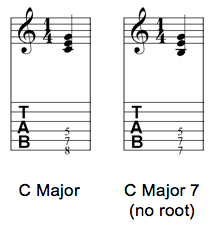
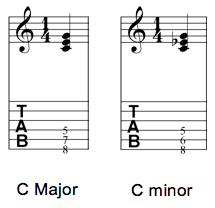
For example, take a C major triad (C, E, G) and flat the 3rd, and it becomes a C minor triad.

This idea also can be applied to the root of the chord.

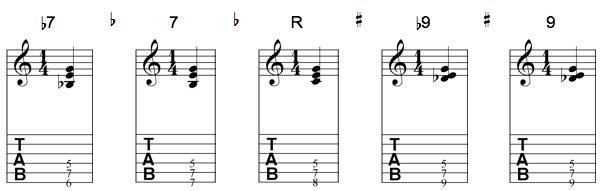
If the note C is flatted a ½ step (1 fret), the new note is B.  This creates a C major 7th chord with no root.

Likewise, if the note C is flatted a 1 step (2 frets), the new note is Bb. This creates a C7 chord with no root.

.

Moving to sharps

To add a 9th to the chord quality, raise the root  a ½ step for a flat 9 (b9) (or a step for a natural 9).

.

This is a good place to make a couple of notes:

.

First: the voicings presented here are used to demonstrate the process, but I like some of them better in other registers.  For example, here is the C add 9 voicing on the top 3 strings.

Second:  one reason to explore voicings without roots is that, in an ensemble setting, the bassist often holds down the root of the chord.  If you need the root –  it’s easy enough to just add it in.  Here is the same chord with a root:

The chord tone transformation chart


The following is a map of alterations to show how chord tones can be modified to create other sounds.

.

Taking the approach above, some general rules can be applied to a major triad.

.

The root of the chord can be lowered to the 7 or raised to the 9.


.

The third of the chord can be lowered to the 9 or raised to the 11.

.

The fifth of the chord can be lowered to the 11 or raised to the 13.

 .

In this manner, a triad can be altered into almost any other functional chord.


Here’s an exercise that utilizes a D major triad to illustrate this idea:

.

Note:  D major is used instead of C major because each note of a 1st position D major chord can be lowered to another note on the fingerboard, without using open strings.  In other words, each chord is a moveable voicing on the fingerboard.

.

The first step of this exercise is to make sure you can visualize triads both horizontally and vertically across the fingerboard.

 .

Horizontal (i.e. positional) visualization

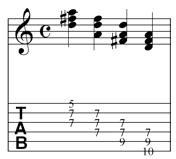
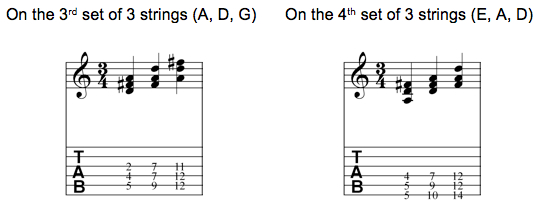
Here’s a series of  D major chord inversions in the 2nd position.

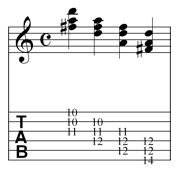
Here are the D major inversions in the 5th position

and in the 10th position.

If these voicings are unknown to you, start by familiarizing yourself with them before continuing to the rest of the lesson.

.

Vertical visualization

Note: the important thing with both the horizontal and vertical voicings is knowing where each chord tone is located in the voicing.

One way to practice this is to play through the chords and stop at random points and ask, “where is the root?” “where is the 3rd?”  “where is the 5th ?”  This has to be full internalized to be able to intelligently transform the chords, with the goal being instant chord tone identification.


As with the horizontal voicings, if these voicings are unknown to you, start by familiarizing yourself with them before continuing to the rest of the lesson.

.

Triad Transformation Exercise

Now that the preliminary steps have been taken, let’s begin the process.

First, here are a few chord formulas we’ll need:

Major: Root, 3rd, 5th – D, F#, A

Major 7th: Root, 3rd, 5th and 7th –  D, F#, A, C#

Dominant 7th: Root, 3rd, 5th and  flat 7th –  D, F#, A, C

Minor: Root, flat 3rd, 5th –  D, F, A, C

Major 7 flat 5: Root, flat 3rd, flat 5th and flat 7th-  D, F, Ab, C

Now, let’s go through the exercise as individual steps to explain the process.

.

Step 1:  Take a Major chord (in this case D)

Step 2: Make it a D Major 7 chord

[by flatting the root a 1/2 step (1 fret)]

Step 3: Make the chord a D dominant 7 (D7) chord

[by flatting the root 1 step (2 frets)]

Step 4: Make the chord a d minor 7 chord

[by flatting the 3rd of the D7 a 1/2 step (1 fret)]

Step 5: Make the chord a d minor 7b5 chord

[by flatting the 5th of the Dminor7 a 1/2 step (1 fret)]

You get the idea.  Transform the chord into every possible voicing and repeat with every other inversion.

.

When less is more – A case for smaller voicings

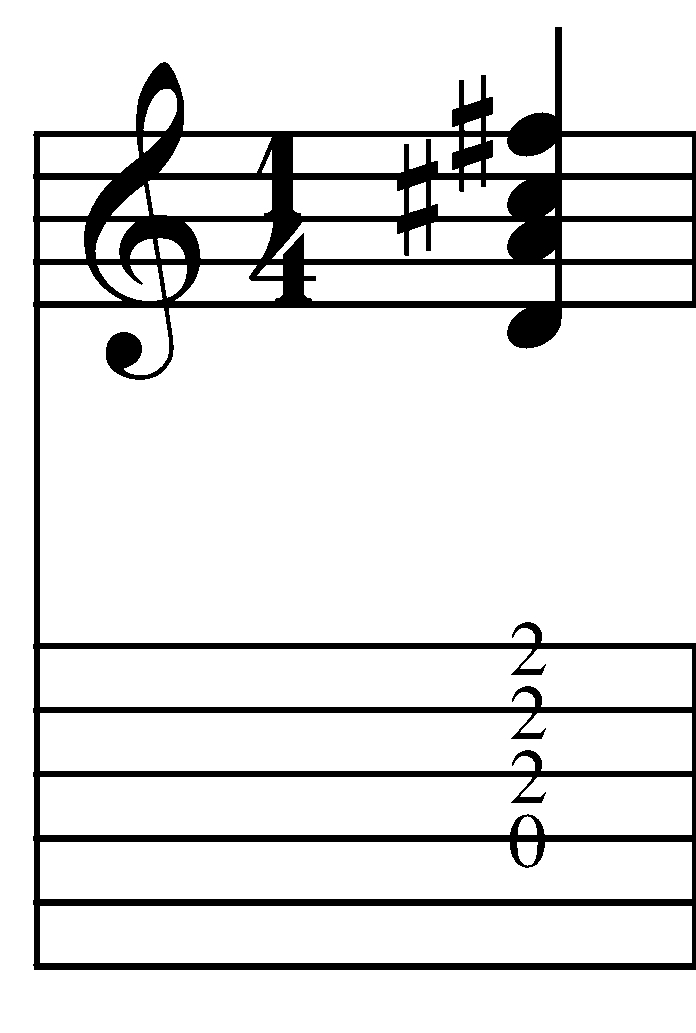
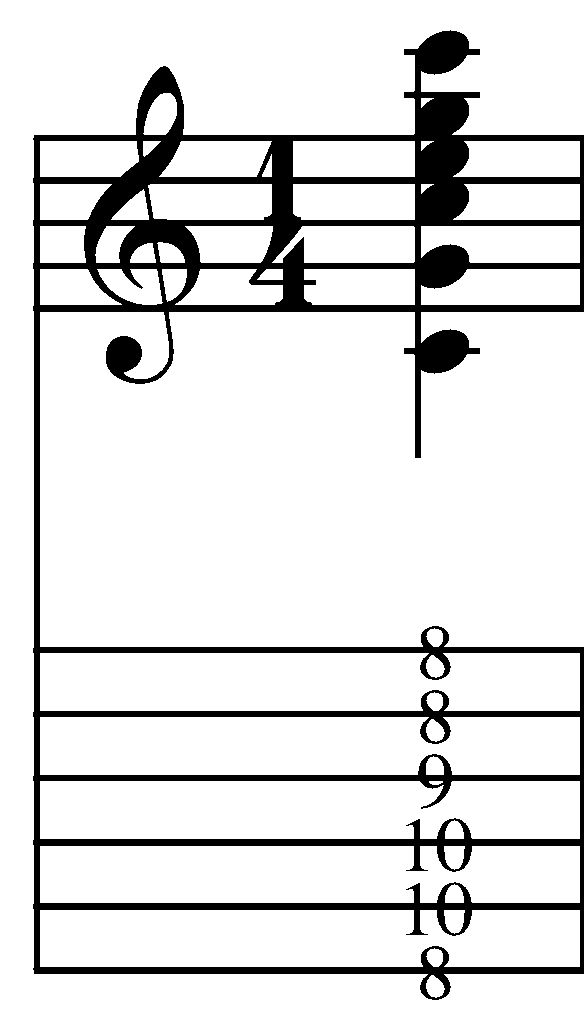
When I started out playing, if a song called for a C major chord, I’d play something like this:

While there’s nothing wrong with six note voicings, context is everything.  It took a while to realize that when playing in larger groups, smaller voicings sometimes helped propel the song and allowed for better voice leading.

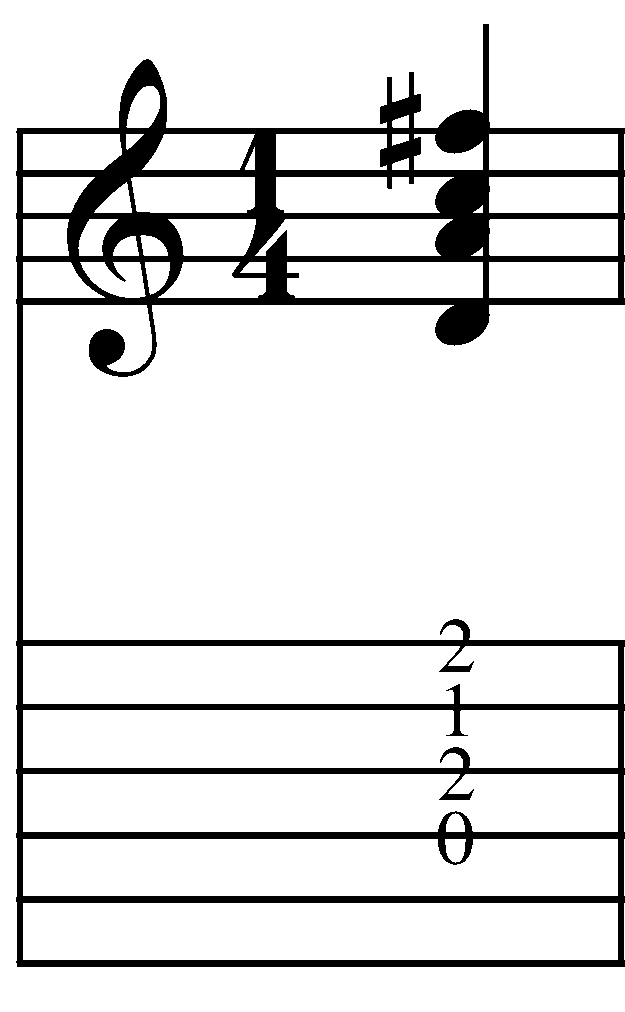
For example: here’s the same C Major chord but with just 3 notes.

And here is the voicing in a I-iv-V7 (C-F-G7) progression with smooth voice leading.

If you’re playing solo guitar – this isn’t going to fill a lot of space sonically but it works well in an ensemble, and it’s easy to play.  A win-win.

I hope this helps!  In a future lesson I’ll go further into this concept and use it to create 9th, 11th and 13th chords.  In the meantime, you’re free to download and distribute any of the lessons here but I maintain the copyright on the material.

I’m always looking for feedback on what people find useful and what they don’t, so if you have any questions or comments, feel free to e-mail me at guitar.blueprint@gmail.com .

Practice Makes Better aka Practicing Part I

Probably the most commonly asked question of guitar teachers is some variant of, “How do I get better at (insert topic here)?” – which invariably leads to an answer of “practice”. 

.

If you’re a rock guitarist like me, you probably won’t get much (if any) further clarification on this point as many instructors I’ve come in contact with don’t have an understanding of practicing other than repetition.  Since practicing is such an absolutely vital step in gaining instrumental proficiency, it seems odd that proper practicing methods for guitar are misunderstood by so many.

.

There are a number of reasons for this.  Speaking from personal experience, I do not come from a classical background.  This is important to note because when you play an unamplified instrument in a concert hall (like a classical guitar) you need to make sure that you know how to project the sound, and that requires a specific focus on areas like proper technique, tone production and repertoire.  So typically from the get-go there’s a concise emphasis on technique and repertoire and typically some level of addressing what and how to practice.

As someone who learned a lot by trial and error – with the emphasis on error –  it’s really only within the last four years of teaching that made me go deep into practicing methodology.  What follows is a series of observations on optimising the practice experience.

.

There are really two broad issues here – how and what to practice.  So the first series of postings will deal with the “how” of practicing – optimal performance issues and methodologies and then delve into the “what” to practice.

.

**Note: 

some of this may seem excessively rudimentary, but greatness is in the details.  And if you’re striving for greatness  it’s best to address some details early.

.

The First Prerequisite: The Guitar

Before examining any of the methodology of the text it is important to note all of the material presented here is dependent on a useable instrument in optimal playing condition.

If you’ve never had your guitar set up, or if you are not familiar with how to set up a guitar, I recommend taking your guitar to a qualified guitar repair person and having the instrument professionally adjusted.

For people who play primarily 6-string electric guitar, I recommend playing everything you practice on an acoustic as well.

There are several reasons for this:

1.  In playing acoustic, there are no effects to mask performance flaws.  If your playing is sloppy, it is something that you will become immediately aware of, particularly if you are recording. Listening to a recording of an acoustic will reveal every unintentional open string, choked note, finger squeak and any other unintentional noise.

2. Acoustic strings are typically heavier than electric strings.  Playing acoustic guitar with proper technique will build strength and endurance that makes playing electric guitar much easier.

3.  For the most part, any technique that you develop for electric guitar should be something that can be performed on acoustic guitar.  It can be a humbling experience at best (and an ego shattering one at worst) to shed a hot lick on electric, think you have it down and then crash and burn when you try to play it on acoustic.  I’ve seen this happen numerous times on unplugged shows and it’s always grim.

.

The Second Prerequisite: Practice Materials

There are several things I recommend to have with you when  practicing.

1.  A metronome or time keeping device.  It’s VERY important to practice with a time keeping device.  If a metronome doesn’t work for you, use a drum loop or have someone record percussion for you.  If you practice out of time, you will play out of time.

2.  A tuner.  Ultimately it’s a good goal to be able to fine tune accurately by ear or by pitch, but since this skill can take a while to acquire, it’s a good idea to start with a tuner.

3.  A note-book, notepad or (if using a computer) word processing application.  This will be covered more in-depth later, but it’s important to be able to write everything down.

4.  A recorder.  Try to get in the habit of recording parts of your practice session.  It doesn’t need to be a brilliant hi fidelity recording.  You could use your cell phone as a recording device and probably record some video as well. The recording quality just needs to be something audible that you can review.  In addition to being able to hear your performance.  It can help you get used to the sound of your playing.  If you get more into recording later, it will be less stressful, as you will have already had a lot of experience.

5. A guitar strap.  Properly adjusted.  (This step assumes you are playing a steel string guitar – nylon string classical guitar style has its own set of rules for proper guitar body placement when playing and performing.  The point of this step is to have the guitar sit consistently on your body when practicing and performing. More on this later).

6.  A comfortable chair (if you’re sitting).

7. A timer.  Like an egg timer or a kitchen timer.

8. Goals.  More on this later as well, but it’s important to have a very clear goal of what you’re trying to achieve.  There are some goal oriented links and observations here.

Most of this can fit in a guitar case and set up in about a minute.  The key is to not make any part of this an ordeal.  If something is difficult, you’re probably much less likely to do it.

The next practice post will address posture, muscle memory and some other interesting ideas.

In the meantime, if you haven’t been doing so already make sure to warm your hands up with light stretching before strenuous play.  There’s some basic overview information here, but it’s also worthwhile to mention that not everything on the internet is accurate or useful.  So if you research something online and try to apply it and it hurts – STOP IMMEDIATELY.

This will be a good reminder for me to go over warm up routines in a future post.

I hope this helps!

-SC

.