Line 6 Pod Farm 2.0 Overview

I’ve taken advantage of Line 6’s free 14 day download of POD Farm Platinum 2.0 ilok version and have been working on formulating somethings for a review.  I won’t be able to post a full review now, but I wanted to post a couple of brief observations.

1.  The demo version was a little glitchy in standalone version, so I’ve been using it with AU LAB.  For those of you who don’t know about it (I had to find out about it on the super looper forum) – AU Lab is a free app that comes with the OSX Xcode Tools.  It was designed to test AU plug ins with but its a stand alone app with a fully configurable mixer ( inputs, outputs, effects busses) .  It records output and even generates midi clock!  Also it makes a very small cpu impact – so it’s perfect for hosting something like Pod Farm and say SooperLooper.

2.  2.0 supports midi – which means you can control it with a foot controller like the FBV shortboard MKII or the Behringer FCB1010.  I didn’t get to work with this yet – but this brings the live laptop rig very feasible for me.

3.  Stereo rigs which you can A/B/Y!!!  which alone would have been really cool – but you can use multiple effects in the same rig – something you can’t do on the POD for example.

Here’s a screen shot of a modification I made on the Outer Space preset.  I just added a preamp in the beginning of the chain.

So here is an mp3 of a guitar track I improvised with this setting:

Outerspace II

This was made with a FNH ultrasonic guitar, Behringer FCA202,  Macbook Pro (2007), and AU Lab.  No post processing.

So this particular sample doesn’t sound very guitarish – but that’s part of the reason I really like this approach.  You can create things that you never could create with pedals without a ton of gear and/or a ton of noise.

As with many other sims – getting usable clean tones is pretty easy and getting dirty tones that respond the way an amp would is a little trickier.  But the presets on all of these models are light years away from older line 6 presets that I’ve heard.  It’s pretty easy to get a tone in the ball park and tweak it from there.

Line 6 has some great audio/video demos on their site, so I wont go into too much here for demos as they’ve done it really well.   Also the May lesson uses the same signal chain for all the mp3s that will be posted there.

I need to also give kudos in that all of the sounds on the sites are included in the presets and they have also noted processed vs unprocessed sounds.  Yes there is a big difference between the two, and it’s important to note those differences so that when you dial up a preset you know what to expect.

The only thing I wish it had was a dedicated looper, but that’s not a deal breaker.

If you have an I-LOK I’d say to definitely check it out.  It’s more flexible than the POD and does some very cool things.

For further applications of this set up you can also  go here or here.


Tension And The Soda Can Or Practicing Part III

Practicing Part III

In order to practice properly, attention needs to be paid to a number of different areas.  Today’s post addresses some issues regarding fretting hand tension as a precursor to proper form in practicing.

Fretting Hand Positioning and Tension

Many guitarists begin playing guitar without being aware of how much tension they are exerting on their fretting hand.  While the title refers to fretting hand fingers, hand tension is actually a complex coordination of muscles working in the hand and forearm.  The concept here is to talk about hand tension as it relates to your ability to move your fingers freely.

Here is an example that may help explain how much of a performance issue this can be.

For the purposes of this example, let’s imagine that you have taken a break from the rigors of guitar practice and have gone to spend the day at muscle beach with your friend Charles Atlas.  After arriving there and seeing miles and miles of Herculean figures – you have decided to show off to your friends and crush the can of soda you have been drinking.

Okay – hold your fretting hand out in front of you – like you were holding a soda can you were drinking from.

Really visualize the can.  Try to feel the ice cold metal against the palm of your hand.

Okay, now try to crush it.  But imagine that the can has been replaced with some infinitely strong material that can’t be crushed.  You don’t want to crush the imaginary can – but truly struggle against it.  If you’re doing the exercise properly, your arm is probably shaking from the exertion.

Okay – now try to move your fingers while you crush the can.  You may be able to move them a little but it’s going to be very difficult.  You should feel (or even see) a lot of tension in your forearm.

Now stop trying to crush the can.  Wiggle your fingers.  This should be much easier.

If you grip the guitar neck with too much tension, it’s the same as trying to crush the soda can.  If you are carrying tension it will be very difficult to move your fingers freely.

What follows is an exercise that can help with proper hand tension.

Proper Fretting Hand Tension Exercise

Sit in a comfortable chair (preferably without armrests) with your guitar around your neck as if you were going to play (you are wearing a strap aren’t you? If not you may want to read the last post.)

Relax your fretting hand by letting your arm hang fully extended by your side.  Wiggle your fingers a bit and try to relax as much as possible.

Take a deep breath.  While inhaling on that breath, make a fist.  As you exhale –  fully release the fist.  Just let your hand naturally relax into a position.  Look down at your hand.

Note – this is your hand in a relaxed position.

Now, keeping your hand in position, bend your elbow and bring your hand up to the neck of the guitar as if you were going to play.  Your fingers should be bent slightly at each knuckle (i.e. the fingers should be curved similar to the relaxed position).

Proper Fretting Hand Thumb Tension

Reverting back to the soda can example, it’s important that the thumb remain in the back of the neck as relaxed as possible as to not tense the rest of the hand.   This is something that I never thought about until I had studied with Jack Sanders.  So I need to thank him for bringing this to my attention in my own playing.

It’s also important to note that your hand position will change if you are doing a lot of string bending.  While it is possible to bend strings with your fretting hand thumb in the middle of the neck,  most people will be used to moving the thumb so that it is more on the bass string side of the fretboard to facilitate bending.   Since this isn’t the majority of what most people play on guitar – I view bending hand position as the exception rather than the rule.

The thumb acts as a balance to pressure from the fingers;  so the location of the thumb is very important.  Ideally the thumb should be in the middle of the guitar neck and typically in line with the middle finger or between the middle and ring finger.  What you are trying to do is put the thumb in an area of minimal tension.

Proper Fretting Hand Tension Exercise

Try playing a scale on the guitar.  If you think that your thumb is squeezing the back of the neck hard, try removing the thumb from the back of the fingerboard while you are playing.  Now gently and gradually, move the thumb back to the neck so that it is very lightly touching it.  Repeat as necessary.

Obviously a huge component in hand tension is how the fingers are actually connecting with the strings and that will be the subject of the next post on practicing.

I hope this helps!

-SC


Proper Posture Is Required For Proper Performance – Practicing Part II

In the last post, I talked about some of the pre-requisites for setting up to practice.  While I want to discuss specific issues with  proper picking and fretting hand techniques, it’s important to address how the actual guitar is positioned when playing.

.

When practicing, it is imperative to practice the same way consistently so that performance is consistent.

A key component of this is posture.

.

First, a brief anecdote.  When I started playing guitar, I didn’t pay a lot of attention to how I was practicing or how I was holding the guitar.  I just paid attention to whether or not I was getting the notes out (more on what’s wrong with this in future posts).  I started noticing my live playing was really inconsistent.  Sometimes the solos I practiced came out fine and sometimes they were really sloppy.  I initially attributed it to nerves or adrenaline, but after reading a number of books on performance I was introduced to the concept of “muscle memory”, and realized the root of my problem.

For those of you who have never heard of this term, when performing repetitive tasks synapses actually rewire themselves in your brain to short cut the mental processing behind the activity.  This is known as “muscle memory”.  Muscle memory is different from your dad’s memory of where he might have set his car keys down, and more like words carved in stone.  On the plus side – if you’re doing things correctly – you don’t have to worry about it – but on the minus side if you have to fix something that’s ingrained in muscle memory  – it takes a lot of effort to erase them.

Here’s an example that illustrates this idea.  

If I am walking and need to tie my shoe lace –  “tie my shoe” is a short cut for the following steps (or some variation):

  1. Notice my shoe is untied
  2. Stop walking
  3. Bend down
  4. Grab one lace per hand
  5. Cross laces to opposite sides of shoe in an x shape
  6. Tuck one lace under another
  7. Pull laces taught
  8. Move laces in opposite direction
  9. Make a loop with the first lace (i.e. “bunny ears.”)
  10. Cross one “ear” over the other, in the opposite order of your overhand knot.
  11. Bend one loop over the other
  12. Pass the tip of the bent ear through the hole
  13. Pull the loops tight
  14. Double knot if need be

.

Once you’ve mastered this skill,  you probably don’t have to put any thought into it at all.  You could easily have a conversation and do it at the same time.  A complex list of processes have been broken down into a single mental shortcut in this case called “tie my shoe”.

In music, muscle memory works the same way.  If you play a lick over and over again the same way your brain actually rewires itself so that the numerous physical events that go into playing “lick #7” in your brain just becomes a mental shortcut “lick #7”.

.

In my first person anecdote above, because my playing position varied between sitting, standing, squatting and lying down – I wasn’t developing proper muscle memory.  Instead of learning one lick – my brain was trying to learn how to play that idea in a variety of contexts.  This sounds small – but if you’ve ever been in a situation where you weren’t able to nail a part you normally can – you know what I’m referring to here.

.

The Solution?

My solution came in the form of a guitar strap.

Some people do not use guitar straps.  In playing steel string guitar, I believe that a guitar strap is every bit as important as a guitar string.  Again, if your hands are not in the same position when you practice as when you perform you will not have proper muscle memory and the chances of flubbing notes goes up dramatically.

The key to using a guitar strap is to make sure that the guitar sits on your frame the same way when you stand as when you sit.

.

Note:

You may be asking.  Well – what about nylon string guitars?  While it’s pretty rare to see nylon string guitarists use a strap, if you see a number of players you’ll notice that the majority of the good ones have very consistent posture.  Posture is a big part of the classical pedagogical tradition and while flamenco guitar posture may be unorthodox with regards to the classical tradition, it is most definitely a consistent posture.

This is not to say that muscle memory isn’t flexible.  You don’t have to have your hands in exactly the same position or expect total failure.  If you’re playing live and you move around – your body will typically adapt to what’s going on and accommodate you.  If you like to practice sitting(and many people do unless they’re practicing with a band) having a consistent instrument position will help you perform more consistently when you stand – which is likely how you are going to perform unless you’re used to performing when sitting down.

Give it a try.  When practicing try adjusting your strap differently when you sit or when you stand and see if makes a difference over a couple of weeks.  You might be surprised.

.

In the next post I’ll start the long process of addressing left and right hand placement, tension and the thumb (i.e. some common sense “secrets” that evade a lot of teachers and students).

Thanks for reading.

-SC


.

Practice Makes Better aka Practicing Part I

Probably the most commonly asked question of guitar teachers is some variant of, “How do I get better at (insert topic here)?” – which invariably leads to an answer of “practice”. 

.

If you’re a rock guitarist like me, you probably won’t get much (if any) further clarification on this point as many instructors I’ve come in contact with don’t have an understanding of practicing other than repetition.  Since practicing is such an absolutely vital step in gaining instrumental proficiency, it seems odd that proper practicing methods for guitar are misunderstood by so many.

.

There are a number of reasons for this.  Speaking from personal experience, I do not come from a classical background.  This is important to note because when you play an unamplified instrument in a concert hall (like a classical guitar) you need to make sure that you know how to project the sound, and that requires a specific focus on areas like proper technique, tone production and repertoire.  So typically from the get-go there’s a concise emphasis on technique and repertoire and typically some level of addressing what and how to practice.

As someone who learned a lot by trial and error – with the emphasis on error –  it’s really only within the last four years of teaching that made me go deep into practicing methodology.  What follows is a series of observations on optimising the practice experience.

.

There are really two broad issues here – how and what to practice.  So the first series of postings will deal with the “how” of practicing – optimal performance issues and methodologies and then delve into the “what” to practice.

.

**Note: 

some of this may seem excessively rudimentary, but greatness is in the details.  And if you’re striving for greatness  it’s best to address some details early.

.

The First Prerequisite: The Guitar

Before examining any of the methodology of the text it is important to note all of the material presented here is dependent on a useable instrument in optimal playing condition.

If you’ve never had your guitar set up, or if you are not familiar with how to set up a guitar, I recommend taking your guitar to a qualified guitar repair person and having the instrument professionally adjusted.

For people who play primarily 6-string electric guitar, I recommend playing everything you practice on an acoustic as well.

There are several reasons for this:

1.  In playing acoustic, there are no effects to mask performance flaws.  If your playing is sloppy, it is something that you will become immediately aware of, particularly if you are recording. Listening to a recording of an acoustic will reveal every unintentional open string, choked note, finger squeak and any other unintentional noise.

2. Acoustic strings are typically heavier than electric strings.  Playing acoustic guitar with proper technique will build strength and endurance that makes playing electric guitar much easier.

3.  For the most part, any technique that you develop for electric guitar should be something that can be performed on acoustic guitar.  It can be a humbling experience at best (and an ego shattering one at worst) to shed a hot lick on electric, think you have it down and then crash and burn when you try to play it on acoustic.  I’ve seen this happen numerous times on unplugged shows and it’s always grim.

.

The Second Prerequisite: Practice Materials

There are several things I recommend to have with you when  practicing.

1.  A metronome or time keeping device.  It’s VERY important to practice with a time keeping device.  If a metronome doesn’t work for you, use a drum loop or have someone record percussion for you.  If you practice out of time, you will play out of time.

2.  A tuner.  Ultimately it’s a good goal to be able to fine tune accurately by ear or by pitch, but since this skill can take a while to acquire, it’s a good idea to start with a tuner.

3.  A note-book, notepad or (if using a computer) word processing application.  This will be covered more in-depth later, but it’s important to be able to write everything down.

4.  A recorder.  Try to get in the habit of recording parts of your practice session.  It doesn’t need to be a brilliant hi fidelity recording.  You could use your cell phone as a recording device and probably record some video as well. The recording quality just needs to be something audible that you can review.  In addition to being able to hear your performance.  It can help you get used to the sound of your playing.  If you get more into recording later, it will be less stressful, as you will have already had a lot of experience.

5. A guitar strap.  Properly adjusted.  (This step assumes you are playing a steel string guitar – nylon string classical guitar style has its own set of rules for proper guitar body placement when playing and performing.  The point of this step is to have the guitar sit consistently on your body when practicing and performing. More on this later).

6.  A comfortable chair (if you’re sitting).

7. A timer.  Like an egg timer or a kitchen timer.

8. Goals.  More on this later as well, but it’s important to have a very clear goal of what you’re trying to achieve.  There are some goal oriented links and observations here.

Most of this can fit in a guitar case and set up in about a minute.  The key is to not make any part of this an ordeal.  If something is difficult, you’re probably much less likely to do it.

The next practice post will address posture, muscle memory and some other interesting ideas.

In the meantime, if you haven’t been doing so already make sure to warm your hands up with light stretching before strenuous play.  There’s some basic overview information here, but it’s also worthwhile to mention that not everything on the internet is accurate or useful.  So if you research something online and try to apply it and it hurts – STOP IMMEDIATELY.

This will be a good reminder for me to go over warm up routines in a future post.

I hope this helps!

-SC

.

Variax AC700 Review/Workbench Overview

This is an update from a review I did a while ago.  It includes more detail, some information on workbench and some mp3s.  It’s a LONG post, but hopefully it’ll help answer any questions you might have.

VariaxAc700Bk.jpg

In 2004, Line 6 heralded a new era in guitars with their new guitar line, the Variax. Previously they had released the Line 6 POD which emulated a number of different amplifiers through a process called modeling and put those controls in a kidney bean shaped device that fit in a gig bag. With the Variax line, they took this same concept and applied it to guitars – i.e. they answered the question, “what if we had a guitar that had a number of modeled characteristics of really iconic guitars and put them in 1 guitar?” The Variax AC700 took this same concept and applied it to acoustics. With Sweetwater offering a $400 price drop on the Black and Burst AC700 models – I thought It was time to give it a try, and see if I could get an instrument that would allow me to leave my Chappel acoustic at home.

Note:

Line 6 has currently ceased production on this guitar although you can still find the used on Craigslist or Ebay.

First impressions

I opened the box and the first thing I saw was a gig bag. Very good quality. Lots of padding and generous space for the cables.

The Variax has 2 outs on the instrument. 1 out is a VDI cable that interfaces directly with The POD x3 live/line 6 gear. The second out is a 1/4 inch out. The Vax requires power to model, so you either need to run batteries OR there is a DI box that you can use with a planet Waves cable that had XLR or 1/4′ out. DI box is high quality, and guitar came with the Planet Waves cable as well so that’s a definite plus.

A lot of people on the forums commented on how much they hated the neck, and how it didn’t feel like an acoustic – those were not the initial thoughts about mine when I got it. My initial thought was – “It’s heavier than I thought it would be”. Opening the gig bag, I discovered that the guitar was a solid body guitar with a fake sound hole, probably very similar to the Chet Atkins Nylon. Since the sound is all generated from piezos this made sense. The body is Mahagony with a Cedar top, but since mine is flat black – it’s impossible to guess at the material. The finish looked good, and I liked the inlays in the fretboard a lot as well.

The neck didn’t bother me. It’s also mahogany with a rosewood fingerboard. The profile is somewhere between an acoustic and an electric with a 17″ radius – it’s pretty flat. It’s a 25-1/2″ scale length, which means it’s the same as the other variaxs so if you like the electric you’ll like this. It has 24 frets and pretty clear access up to the 20th fret or so. The irony of my first 24 fret instrument being an acoustic is certainly not lost on me. It’s a nice touch, but if anything the extra 2 frets take up space I’d rather have open for for picking. The more important thing here is that the access to the other frets is great. Being able to play up to the 19 fret with no access issues is a major coup for the acoustic.

Setup was a little suspect. Anytime you buy a new guitar, you should plan on getting it set up by a professional. I took mine to a luthier friend in L.A. and got a new nut and a fret dressing which made a huge difference ion terms of playability.

By the way –  the guitar came with a plastic nut and bridge pins – Plastic nuts are a big sticking point for me – particularly on an instrument in this price range.

The bridge is an acoustic style bridge with individual piezos for each string. The bridge is set up so that the height is controlled by a couple of allen screws – which is a good idea. The only drag here is that the piezos are not adjustable so adjusting the physical intonation would be very tricky. Fortunately mine was set up just fine.

A brief side story:

When I got the guitar – one string was much quieter than the other strings. I went to the excellent Line 6 forums and found that on some of the models some of the piezos were bad. I called customer service – they recommended that I take it to a repair center. When I said that I was handy with a soldering iron – they mailed me a piezo. A 10 minute soldering job later and it was all set. A lot of other customer service centers could follow this example of how it should be done.

Before I explain the models, I need to explain some of the instrument controls:

The knob on the upper bout selects models – if you push it – it changes color and you can get preset tunings for each model.  You can edit these in workbench (more on that later).

Next to the knob are 3 sliders:

The top slider controls EQ – but does it in a very interesting way – the concept here is that the slider has two mic placements and by moving the slider you pan between the two sounds. A VERY cool idea – having said that additional EQ needs to come from another source. This is from the line 6 copy:

“The Variax Acoustic 700’s top slider (the one furthest away from you when you hold the guitar) allows you to alter the position of the modeled microphone. Here’s a simple way to remember how it works: As you move the slider closer to the soundhole (away from the Model Select knob), the Mic Position is also getting closer to the soundhole. Some of the instruments modeled in the Variax Acoustic 700 don’t have a soundhole, but the control will work similarly for these instruments. When the slider is close to the Model Select knob, the strings (and upper frequencies) are emphasized; when the slider is close to the soundhole, the body (and lower frequencies) are emphasized.”

Here’s how it sounds:

I’ll start with some fingerstyle (one thing to note is that the “Sweet spot” is actually right around the 24th fret.  That’s where all of these were performed.  All recordings were tracked straight into Logic with no additional EQ or processing using the USB out on the Pod X3.

Out of the box – I put a “parlor” model (based on a Martin size 5 “Parlor”) through an acoustic setting in my Line 6 Pod:

The first mp3s are excerpts of a solo finger style piece of mine that’s currently untitled.  55 refers to the bpm.  If you play each mp3 – you can hear the timbral difference is the virtual mic placement.

Parlor mic far left 55

Parlor mic far right 55

Parlor mic middle 55

Next some flatpicking.  This was something I improvised in a vaguely celtic/bluegrass that I might flush out into a Dan Crary Style flatpicking tune but for now here are 3 more excerpts.  These also use the Parlor – which isn’t my favorite guitar for flatpicking – but this gives you a full tonal sense of this setting.

Parlor mic far left 120

Parlor mic far right 120

Parlor mic middle 120

Finally for now – here’s an excerpt from another original song of mine, “The Kake Song” that features 2 handed tapping.

Parlor far left 140

Parlor far right 140

Parlor mic middle 140

The middle slider controls volume.

The bottom slider controls onboard compression. You can control the amount here but that’s the only parameter of control.  A good idea but I prefer outboard compression instead.

What is notably absent is an onboard tuner. I guess the concept here is that if you’re using a POD that you use the tuner on the POD. If you’re going direct into a PA or an amp – bring a tuner.

There are alternate modes for the sliders as well that control a virtual capo and some preset tunings. The virtual capo is a nice touch for detuned items – but I prefer a physical capo to capo up.

One thing about the different tunings to work around is that the guitar maintains standard pitch and alters the output pitch through pitch shifting. In other words – if the can hear the unplugged sound of the physical string over the pitch shifted modified string it can throw you. I like headphone to block it out. Live, I would just crank the monitor a bit.

Workbench

Line 6 sells a products called Workbench which is a software/hardware component to modify settings on variax guitars. It’s $99 for the hardware and the cd, BUT if you have a pod with a variax port, then the software is a free download for registered users. Workbench is pretty much a mandatory item if you use this product. With it you can store body models and customize your own tunings. It’s very intuitive to use and is a much better interface than trying to just use the various knob combinations on the guitar.

So you need to have the instrument hooked up through USB to a computer to get Workbench to boot (this is either done through a line 6 USB enabled device like a POD or a piece of hardware that ships with the Workbench CD if you order it.

Once you get workbench up and running, you select a model and then get brought to a screen that looks like this:


I’ll start with some basics.  The left hand side of the screen gives you a visual of the body type.  On the electric models you can move pickup placements around here and get a lot a tonal variance.  On the acoustics – it’s more of a one trick pony for the actual guitar.  A really nice feature for future updates would be if you could vary the material (different top or sides) or fingerboard (ebony or rosewood) all subtle differences – but that’s where a lot of tonal magic lies.

The right hand side of the screen will give you more of the tonal variance that may help you.  First, you’ll notice the Studio/Live switch – according to Line 6 (some detailed information here) the studio mode includes room reflections on the guitar output.  It is a noticeable timbral shift.  Trim and Compression will affect the instrument output volume and mic will help tweak the instrument tone.

For some of you – the real reason to use workbench will be the parameter at the bottom of the screen.  What is represented here is a virtual capo.  Enabling the capo allows you to pitch shift any string up or down and octave.  If you want to change a preset tuning this is the easiest place to do it.  Honestly – you will hear aliasing and artifacts at anything more than a step and a half, but – if you’re going for altered textures (i.e. non traditional acoustic tones – that could work for you).  Personally – being able to set the guitar up in 2 sets of 1/2 step clusters was pretty amazing.  Another caveat here is that while the body is still a solid body guitar – unless you are wearing good noise canceling headphones – you will probably hear the standard tuned guitar and the pitch shifted guitar at the same time.  When you’re playing with a band – I doubt you’d hear it but if you’re playing solo acoustic somewhere it could be an issue.

Related to the pitch shifting is the mix and detune functions.  You not only mix the strings (i.e. pitch shift certain stings like a 12 string and have other notes stay unaffected, but you can intonate strings in cents!  That could be HUGE in getting alt tunings more in tune to your liking.  There are some really good work bench posts on the Vettaville site here and a specific tutorial on Harmomic Open Tuning here.

Another nice feature is that you can adjust individual string volumes!  This is a really great feature if you need to quiet certain strings or make other strings pop in volume.

To get there,  under the “Editor” menu, look  for “String Volume Setup”  You’ll see something that looks like this:
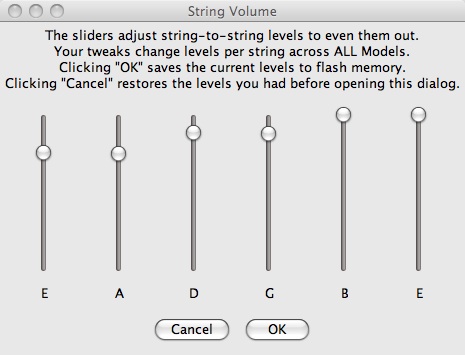
Simply drag the sliders to the level you want and click ok.  Line 6 offers this observation as well (from the above mentioned link.

“As a side note, it’s normal for many guitars to have volumes that differ from string to string. One example of this would be guitars with combination of a fairly small fretboard radius and pickups with non-staggered polepieces. It can also happen with guitars that have peaks in body resonance at or near the fundamental or one of the lower harmonics of a specific note.”

The Models

These are the models that are available on the guitar:

Martin size 5 “Parlor”
Martin 000-18
Martin D-28
Gibson J-45
Gibson J-200
Selmer-Maccaferri
D’Angelico New Yorker
Nylon String Classical
Guild F412 12-String
Stella 12-String
National Style O
Wood body Dobro
Gibson Mastertone Banjo
Mandocello
Japanese Shamisen
Traditional Indian Sitar

Generally, I find that different guitars sound better for different things. For example I like fingerpicking on the parlor – but like the J-45 for flatpicking.

This brings up another tweaking issue as well as I really dislike the banjo sound with a flatpick, but can use it fingerstyle.  Banjos usually don’t sound great with a single flatpick anyway – so this could be a non-issue.

Beyond the question of – does the 12 string sound just like a 12 string (the answer here is no), is the question of would I want to use it in a band with other instruments? And the answer there is I think it gets by. Compared to bringing another guitar and trying to keep all 12 strings in tune – it makes me happy.  It has the vibe of a 12 string and would probably sit well in band mix.

And that’s really the point of this guitar, to allow a lot of flexibility. Do you want to switch to DADGAD tuning in the middle of a tune? No problem. Want to switch from a Martin to a banjo to a 12 string for each section of a song. No problem.

For the most part this is really a live vs. a studio instrument – and in that context,  I think it shines.  But I think that this would even be usable in some recording contexts.  For my purposes – living in a noisy apartment building where having a quiet space to mic an acoustic and get through a take without extraneous noise – this things is a godsend.  Would I use this over a vintage Martin in a pro studio?  No.  Would I use this to track a take at home while sonic chaos is going on all around me?  Absolutely.

Having said that, it’s important to acknowledge what may be an issue for some players:

String Muting

One things that will be problematic for some people is the issue of string muting.  On the Line 6 Variax forums there’s a lot of talk about the issues with string muting regarding the electrics – but as this is a piezo based pickup system, the isn’t going to sound like string muting on a regular guitar.

Case in point:  Here is the sound of an Al Dimeola style lick in A Dorian. First it’s played with no muting, and then with string muting LOGIC string mute 140.  Definitely not Friday Night in San Francisco.  Some tweaking with compression and EQ might help with this – but I haven’t had much luck so far. If this is a major component of your style this might be an issue – but if you’re willing to work around it, there are a lot of other things here.

It does handle regular flatpicking fairly well though –  here is a post involving acoustic sweep picking that was recorded with the Variax.

The electic variax has undergone  a transformation in the forthcoming Tyler Variax with substantially more processing power, hopefully the acoustic will get a revision as well.

Likes:

This is a well constructed guitar with a tremendous amount of tonal flexibility.  Parlor, 000, D-28, and J-45 models sound really good.  I like the inclusion of the oddball instruments like the Shamisen and mandocello, also like the  gypsy jazz guitar and the nylon (but suspect that they probably sound better on the nylon string Variax 300).  This guitar won’t do everything – but it may save you 2-3 gig bags of guitars at your next gig.  Workbench is a truly revolutionary idea and the alternate tuning features are cool.  12 strings and virtual capos are really good ideas.

Dislikes:

In terms of the build – the body size is a little too small for me (I’d like more of a dreadnaught sized body as well).  Also, a plastic nut and pins on a high end instrument sounds like a little thing – but a guitar is a bunch of little things all put together.  String muting may be an issue for some people.  Sitar sound has a high pitch overtone that makes it unusable for me.   The banjo doesn’t seem as well executed as some of the other models. While I like the idea of the 12 string – it’s okay for strumming but doesn’t hold up on the single note level for me.

Would like (Wish List):

On the electric variax you can virtually move between various pickups body and placement options. I’d love it if I could combine a J-200 and a shamisen for example. Just as the Pod X3 has 2 rigs at once, having 2 guitars at once would be cool…

Multiple body sizes.

More models.

I’d love modeled material that you could never make a guitar out of – like stone or glass or paper. It would be nice to “build” guitars that you couldn’t feasible make in the real world.

It would be nice if you could control some other modeled aspects in Workbench – i.e. top back and side material, fingerboard material, sound hole size and placement, etc.

Final thoughts:

I don’t know if paying the extra $400 for a a natural finish ( I notice that Sweetwater doesn’t even have that model listed anymore) is worth it but for this is a lot of guitar for the money.  I’m going to be doing some studio experiments so see if I can get the tones a little closer – but for demos or backing tracks this guitar is definitely

Recommended!

A brief thought about music theory

One of the reoccurring  areas of concern that comes up in lessons is the issue of music theory.   This is both in terms of people who don’t want to be taught any kind of  theory, (as in, “No – don’t show me that!  It’ll mess up my playing!”) to people who have been exposed to terms that they have questions about. Usually both scenarios involve a lot of trepidation and discomfort (much of which is needlessly inflicted).

I would guess that the only people who have ever leapt for joy at the sight of a musical note on paper without hearing it are composers.  For most people, music is an expression solely existing in an aural form (i.e. it’s something we hear).

.

Theory is secondary to sound.

The history of music originates in organized sound.  Theory and jargon were developed over time as a way to replicate those organized sounds.  A term like “C major” is just musical jargon.  When “C Major” is said, it tells the informed person what kind of sound is going to be produced. This jargon then, is nothing more than a way for musicians to express ideas to each other without written music in a more efficient manner.

It’s much less important to be able to look at something and say, “that’s an altered dominant chord” than it is to hear an altered dominant chord in your head and be able to realize it on the guitar ( or to hear someone else playing it and know what to play against it).

.

In other words, theory and/or analysis should always be in the service of sound.

.

I think theory should have two functions – first to help us realize sounds that we want to reproduce and (to me the much more exciting option) to expose us to sounds we didn’t know were there.

.

The entire concept of GuitArchitecture (presenting applied theory as a set of approaches that can be used to help access both known and unknown sounds) is why a lot of the book material is less about licks and more about approaches.  

.

From a teaching perspective, it probably doesn’t matter if you can sound like me (unless that’s what you’re striving for), the important thing is developing your individual voice and being able to replicate sounds either intuitively and/or with theory is a major component of any player’s individual sound.

.

Theory, then,  is just a tool.  It really isn’t anything to get tripped up on.

.

FNH Ultrasonic Guitar review

Photography by Nancy MacDonald

4/11

Full disclosure – I am now endorsed by FNH guitars but was not at the time of this review.

This gear review is for a customized Ultrasonic guitar that was built by FNH guitars.  FNH guitars are a small custom shop consisting of Chris Fitzpatrick and John Harper (i.e. FNH) that are making hand crafted electric guitars starting at $1299 and several other instruments at other price points.  Many of the stats can be found here.  Note that the guitar pictured above is from the website as Nancy McDonald is a much better photographer than I am.  The review model differs from the photo in bridge, color and lack of a pickguard.  These are discussed in more detail below.

The body and neck aesthetic remind me of some of the 1960’s EKO designs.  While many of the designs from that era looked really cool on paper they were also either impossible to play or just sounded awful, FNH has taken the best visual elements of those designs and hot rodded the instrument  for playability.  Wrist and belly cuts are nice features and make you feel like you’re playing a guitar and not a block of wood with strings.  The weight of the guitar is light and well- balanced.  It’s comfortable to play either sitting down or standing up.

In terms of build, the body is one piece poplar (I believe that poplar is similar to alder in a lot of ways if that is the body material you’re currently use to).  It has a nice resonance to it when played acoustically – which is generally a really good sign of its amplified potential.  FNH offers several varieties of finish – I went with a flat black which is a good call, but there are some nice finishes on various guitars on their web site as well.   The Ultrasonic on the website has a Tele-style bridge but mine shipped with a Gotoh fixed bridge.  Since the guitars are customized – you can also get them with any bridge style you’d like.

The neck is a 25 ½ inch scale (just like a fender) with a choice of fingerboard materials.  22 frets is the standard but mine shipped with 21 (so I’d have to go all Blackmore or Yngwie for those high D, E and Eb notes!).   I requested a maple neck with rosewood fingerboard and a 12” radius.  The website mentions maple and ebony as other fingerboard options but everything here can be customized to player specifications.  The neck has a gorgeous amber tinted oil finish (nitrocellulose is also an option) that really brings out the rock maple.  The neck is extremely comfortable and didn’t have any dead spots on the fingerboard.  The rounded heel joint makes upper fret access very easy and assisted with playability as well.

The electronic controls (volume knob, tone knob and a 3-way selector switch,) are in a very logical place.  They’re low enough on the body to be out of the way of strumming but still easy to reach.  The Electrosocket output jack is mounted on the lower bout of the guitar which doesn’t get in the way when sitting down with the instrument. Pickups are customizable (They typically will use OC Duff, Seymour Duncans, Lollars, Fralins or Golden Age but no neck pickup is also an option) – I asked John to choose for me and he picked a Duncan Pearly gates for the bridge and a Golden Age ’59 for the neck.  This is a really great combination that offers a lot of tonal variety.  The pots are 250K which has some nice roll off characteristics for both volume and tone.

I’ve included some mp3’s of various tones recorded with a POD x3 straight into my laptop.  The tracks have been kept as raw as possible – no post EQ or sweetening – to give you a sense of what the guitar sounds like when you plug it in.

First just some simple solo guitar sounds, I used a clean Hiwatt model with a little verb here are some simple fingerpicking sounds.  There are 3 samples – recorded in order of neck, middle pickup selector position (out of phase) and bridge positions.

Next,  9 versions of a simple G major strum here with the same amp setting.  First is a strum in the neck position followed by a strum with the tone knob rolled off to about 50%, then with the tone knob rolled off all the way.  This order is repeated for both the middle pickup selector position and bridge pickup.  MP3 of that is here.

Next is more of a lead tone recorded with a Marshall amp model here is a solo lead tone in the neck position with tone rolled off about 50%.  MP3s can be heard here and here.  A few more of these samples can be found on the April online lesson where all the mps3 were done with this guitar.

Next is a guitar/drum duo.  The track ren can be found here. This was played on a LINE 6 Sparkle model.  The drums are the Jazz expansion set of EZ drummer.  Guitar part is fully improvised in kind of a Daniel Lanois type of mode and uses each of the pickup selections over the track.

Finally a short dirge/doom metal kind of track with a drop D guitar.  This was played through a LINE 6 Big Bottom  model.  The drums are the Drummer From Hell expansion set of EZ drummer.  Guitar part is full improvised – but uses the middle pickup selector position.  The mp3 can be found here.

A hallmark of truly great design is translucency.  A well designed guitar should just play, feel and sound great, and not draw attention to how it is done.  $1299 for a completely hand built guitar of this quality is nothing short of miraculous.  Additionally, FNH has another guitar model (The Beaumont), the Subsonic bass and an AMAZING electric mandolin based on a danelectro vibe the mandolectro.

FNH GUITARS

http://www.fnhguitars.com/