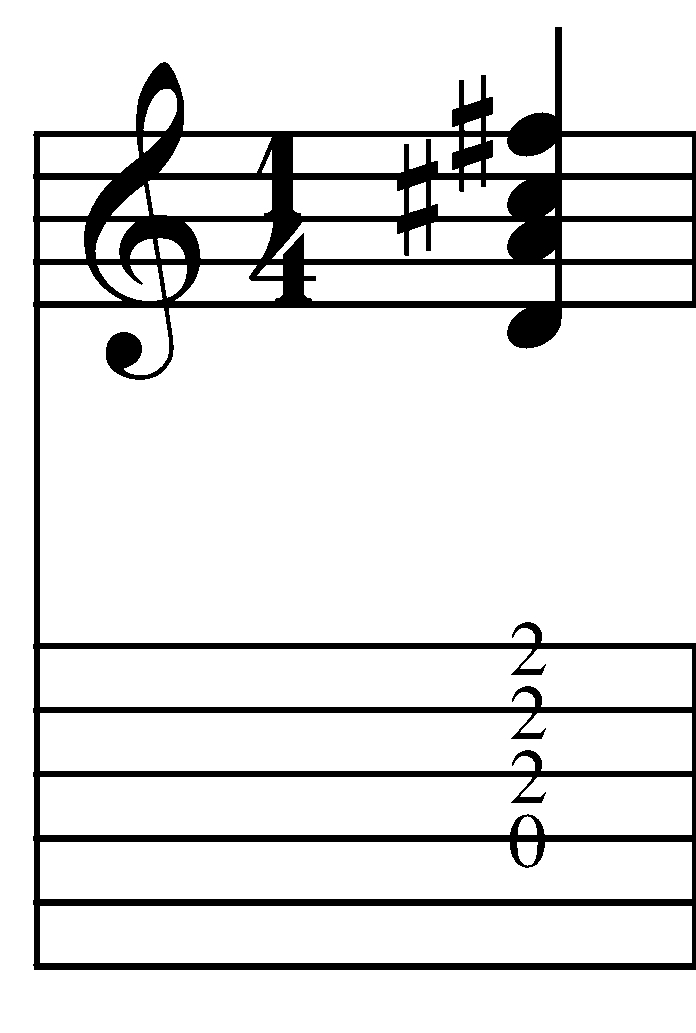
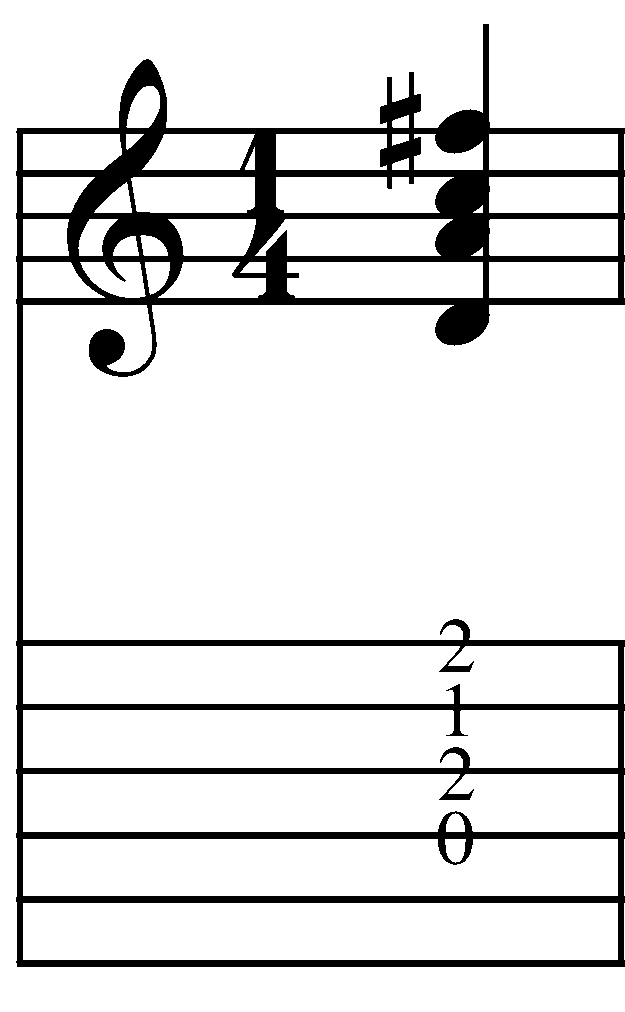
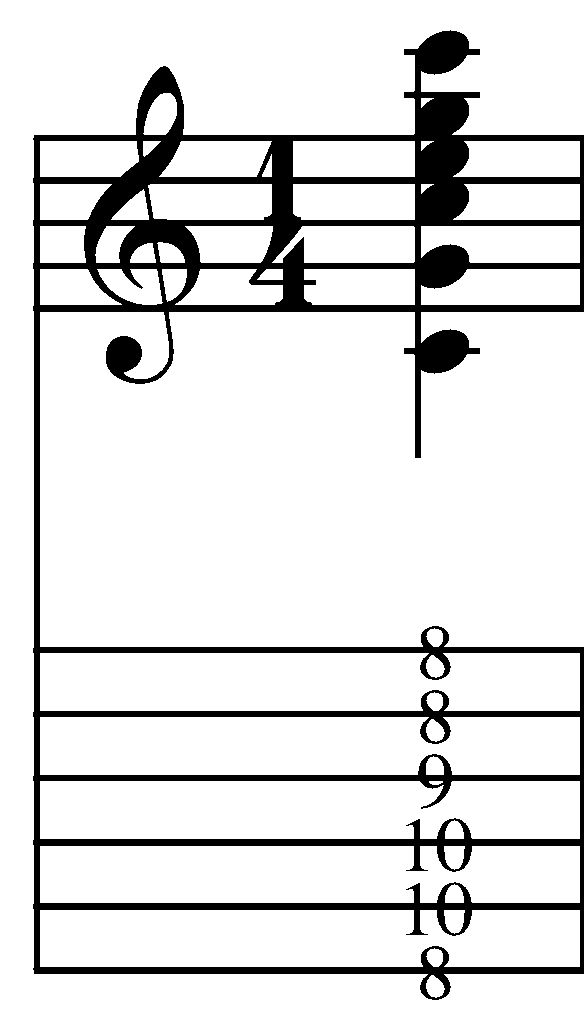
Getting Hipness From A Major Triad Or More Chord Recycling Part 2

In part one of this post, I looked at generating different major chord variations based on flatting the root and the 5th.  In this post, I’m looking at sharping those pitches and combining the two for additional textures (if you came here directly – you may want to review the A major variations in  part one before continuing).

.

Start with a map:

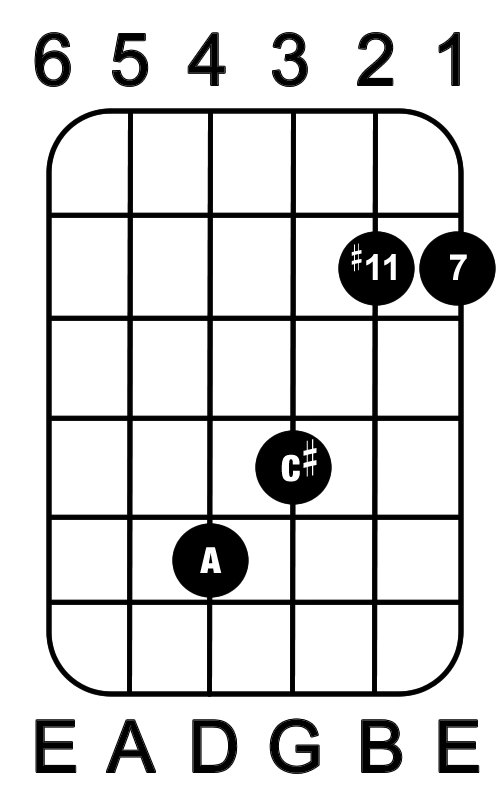
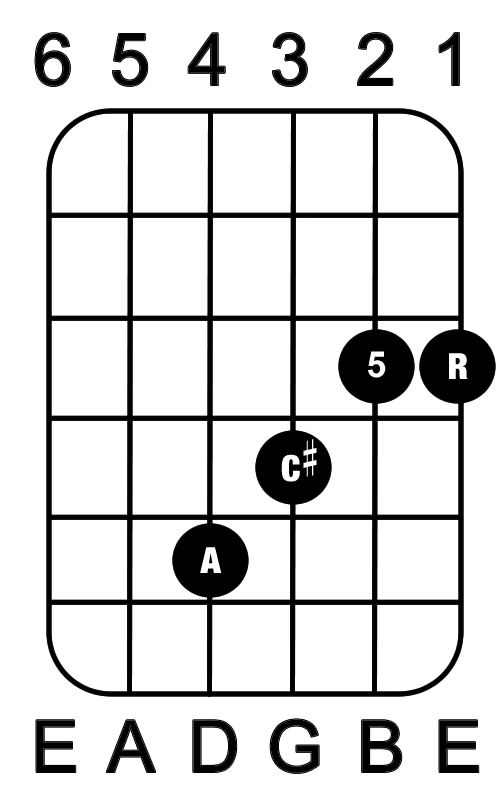
Adapting chord forms requires the ability to visualize chord tones around the shape you’re using.  As a starting point, here’s a fretboard diagram of an A major chord (with the A being on the 7th fret of the D string).  I’ve added some additional chordal extensions on the E and B strings (but this process could be applied to any string-set).

In the last lesson, I looked at creating sounds with the 6th (or 13 – see post 1 for the difference between the 2) on the E string.  This time, I’ll add the 6th (6th or 13th) on the B string by raising the E  up to F#.

.

A Major 6th no 5th

Here is the sound of the A Major 6th (no 5th) chord.

.

Comparing this to the A major 6th voicing in part 1:

.
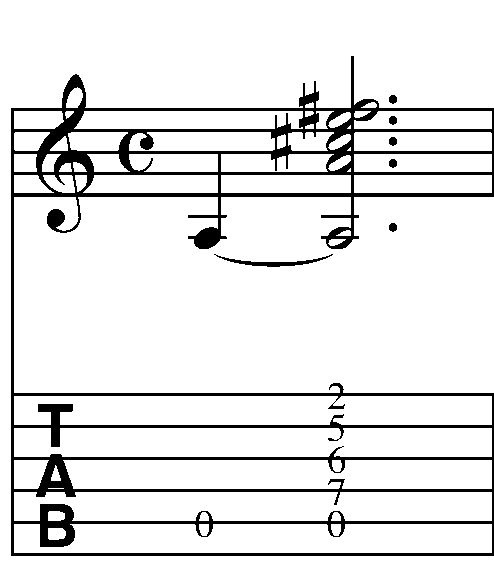
A Major 6 - Watch the 1st finger stretch - if it hurts - stop Immediately!!

Here’s an mp3 of this chord.

.

The new voicing is certainly easier.  If I was really stuck on the close voicing of the E and the F# in the A major 6th, I could simply move the F# to the B string and move the E to the open string like this:

A maj 6 with open E string

.

Several Notes:

  • This voicing wasn’t included in the first lesson as I wanted to show the process of how to derive these chords.
  • The upside to this approach is it makes this specific voicing easier to play – but the downside is it’s not movable – which may or may not be problematic for you.
  • If a chord is really difficult to finger – there is always an easier way.  You may not get the specific notes or voicings you’re looking for – but there’s always an easier way.

Now I’ll extend the initial Major 6th sound by flatting the 7th.  This is done by lowering the A to G#.

.

A Maj 7 add 13 no 5th

Here’s how it sounds.

Again,  I’m a sucker for chords with seconds in the voicing (in this case the F# and G#).  It adds a little but of tension and elevates the chord a bit.

.

Adding in the 9th:

First let’s create an A major add 9 chord.

.

A add 9

Here’s how it sounds.

.

Note:

The reason this is an add 9 chord and not a major 9 chord is the lack of a 7th.

Since the chord is a major chord with a 9th added, it’s called an add 9.

.

Now I’ll add a sharp #11.  This is done by lowering the E to D#.

.
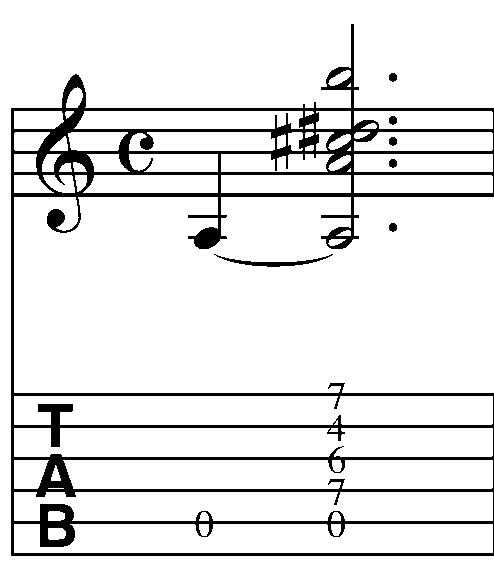
A maj 9 sharp 11 no 7th no 5th

Here’s how it sounds.

.

Another Note:


The further you extend the harmony and remove initial chord tones, the more vague the sound of the chord is as related to the tonic.

For example:  The chord above could be analyzed as an A major 9 # 11 with no 7th and no 5th. But the notes are A,  C#, D# and B.  If those tones are centered around B – you have a B, D#, A and C# or a B dominant 9 (no 5th)/A.

If you have to analyze a chord with more than 1 elimination (i.e. “no 7th no 5th”) there’s probably a simpler analysis of the chord.


Going Further:

Now that some initial options have been explored – I’ll take a look at the upper notes of the voicing.  If I take the previous fretboard diagram and extend a note on the G string I’ll have something that looks like the diagram below (again the A listed below is on the 7th fret of the D string):

If I’m willing to be a little adventurous and replace the 3rd of the chord (C#) with the #11 (D#) , I’ll get a voicing with a root and then all upper tensions (9, #11 and 13).  Here it is notated:

.

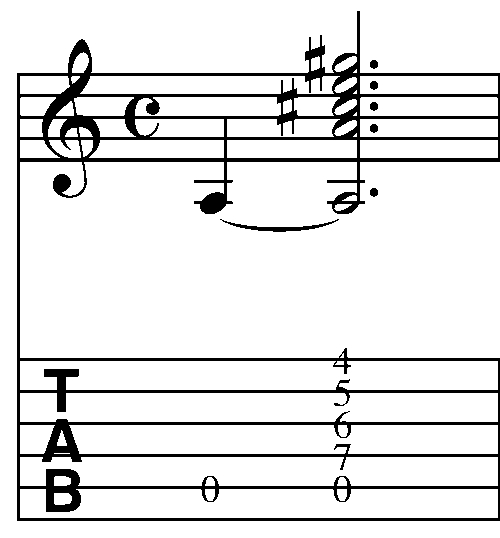
B7/A

And here’s how it sounds.

.

While you could analyse this related to the key of A Major (A major 13, #11, no 3rd, no 5th, no 7th) you may have noticed that shape is the upper chord voicing for a VII position B 7 barre chord.

.

Short cut 1:

Playing a dominant 7th chord on the second scale degree of a major chord will get you all of the upper extensions and the root).

(i.e. B7 over A major)

But isn’t a stable sound on its own.  If you play this chord and then the standard A major, it will probably feel resolved to you when you play the A.  If you have a song with a number of bars of A major – switching between these two chords is a nice way to generate a little harmonic motion.

Now, I’ll take this idea a little further by lowering the A to a G#:

G# min 7/A

.

Here’s how it sounds.

.

This gives the chord a 7 (G#), 9 (B), #11 (D#) and 13 (F#) – or all of the upper chord tones.

Short cut 2:

Playing a minor 7th chord on the seventh scale degree of a major chord will get you all of the upper extensions of the chord.

(i.e. G# minor 7 over A major)

Like the B7/A, this isn’t a stable sound on its own.  If you play this chord and then the standard A major, it will probably feel resolved to you when you play the A.

.

Quartal for your thoughts?

Here’s one last transformation for now.  Here I’m going to lower the D# to C# to create a quartal chord.

.
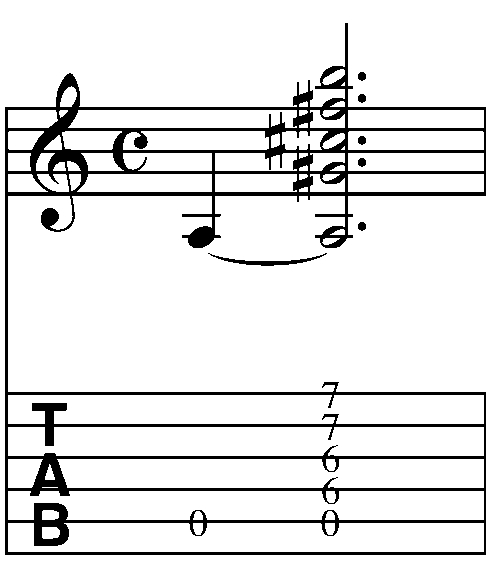
Quartal Chord

And here’s how it sounds:

.

A quartal chord is a chord that is built on 4ths (G#, C#, F#, B) as opposed to being built on 3rds like A Major (A, C#, E).  To me, quartal voicings have a nice “airy” or “floating” quality .  This is just one of many  possible quartal voicings built from A major.  Quartal voicings will be discussed more in-depth in a future post.

.

How to double the number of chords that have been covered.

So far, I’ve looked at a series of chords that either work as substitutions and/or extensions for major chords  I’m going to go into more depth about why this works in the next post but for right now – here’s a quick tip that gives a whole other dimension to using these chords.

.

Every chord presented here also works over the relative minor (i.e. F# minor chord).

.

Try taking this chord:

.

and after you play it add an F# by tapping a fret hand finger on the 2nd fret F# on the low E string for a very hip F# min 9 extension.

.

F# min 9 add 13 no 11

.

Hopefully this has given you some new chordal ideas!!  You may want to go back to the first post and apply this idea by playing through all of the voicings covered there and adding the F# as a root.

In addition to explaining this approach more in-depth, in part 3 of these posts I’m going to explore a number of ways to use these ideas in your soloing.

Thanks for reading!!  Please feel free to post any questions you might have.

-SC
Getting Hipness From A Major Triad Or More Chord Recycling Part 1

When I was at Berklee, one thing that took a while for me to really get my ear around was upper chord tones (7ths, 9ths, 11ths and 13ths).  Growing  up listening to a great deal of rock music – basic triads sounded “right” to me.   I learned a lot of esoteric chord voicings to try to expand on those forms – but my ear wasn’t ready for it and so I had no real motivation to develop it at the time.

As I mentioned in the getting through the gig and the recycling chords posts, simple triadic forms can be manipulated in a way that allows players to get more complex harmonic textures in real-time.  Additionally, these approaches can be adapted to lead playing as well.  This short series of posts are going to go deeper into adapting one specific chord voicing.  As a starting point I’ll use the major triad.

The following examples are based around a 5th position A major chord played on the D, G, B, and E strings.


The reason I’m using this specific voicing is to allow the open A string to ring while playing the chord to help reinforce the root.  Here’s the basic rhythm of the chordal examples:

While notated this way for simplicity, all the examples are played with a slight arpeggiation to help accent the different notes.

.

Here’s an mp3 of an A Major Triad.

 .

Rooting around for extra tones:

The first way to generate some additional substitutions for a simple major chord  is to lower the root chromatically.

While there is a root on both the D and the high E string, for now these examples will focus on manipulating the root on the high E string.

Lowering the root of a major triad a 1/2 step (1 fret) produces a Major 7th chord:

(This can be used in place of any A major triad)

A Major 7 Chord

 .

Here’s an mp3 of this A Major 7 chord.

.

Lowering the root of a major triad a step (2 frets) produces a Dominant 7th chord:

(This can sometimes be used in place of an A major triad

Example: When the A acts as a V chord in a chord progression (A -> D becomes A7–>D))

A7 Chord

.

Here’s an mp3 of this A 7 chord.

.

Note:

While dominant 7th chords contain a major triad in them – they are their own unique animal.  A future post will go into generating dominant chords – in depth – but this voicing is presented here as part of the process of generating chords by altering the root.

.

Lowering the root of a major triad a step  and a 1/2 (3 frets) produces a Major 6th chord:

(Typically this can be used in place of any A major triad)

A Major 6 - Watch the 1st finger stretch - if it hurts - stop Immediately!!

.

Here’s an mp3 of this A Major 6th chord.

.

Another Note:

There are certainly easier ways to generate this chord – but any chord form with  a 1/2 or whole step between notes on the B and E strings will require some limber hands.  Again, this voicing is not the only possible voicing of this chord but instead is just one possibility.

.

6th chord/13th chord Tip:

Frequently, I’m asked about the difference between a 6th chord and a 13th chord.  Since the note is the same for both the 6th and the 13th, the terms are sometimes used interchangably – but the difference is based around whether the chord has a 7th in it.  In the example above, the F# acts as a 6th, because no 7th is present in the chord.  If a seventh was in the chord, the F# would be viewed as a 13th.

.

The #4/#11:

One hip tone to use in a Major based chord is the #4 (or #11).  This is generated by flatting the 5th a 1/2 step (1 fret).

A Major add #4

.

Here’s an mp3 of this A Major add #4 chord.

I like voicings like this where the top voices (C#, D# and E in this case) are all close voiced (i.e. in the same octave). The technique of combining these close voiced ideas with open strings is a favorite approach of mine.

This idea can be expanded on by flatting the root as well.

This produces an A major 7 add #11 (no 5th) chord (A favorite substitution of mine for a major chord).

A Maj 7 # 11 no 5th

.

Here’s an mp3 of this chord.

.

Shortcut:

If you flat the top two notes of a major barre chord with the fifth and root on the B and high E string – you get a pretty hip major chord substitution.  This works in any key.

In part 2 of this series, I’ll look at sharping the 5th and the root to generate more chord voicings, combining both approaches and extrapolating lead ideas from these approaches as well.

Thanks for reading!!

-SC

Recycling Chords Part II: Triad Transformation

In the previous recycling chords lesson, I looked at ways to reinterpret chords. Another way to create different sounds is to take something as basic (and familiar) as a triad and alter tones to create more complex chords.

Note: this process isn’t designed to replace the need to learn multiple chord voicings but instead to supplement it.

.

Starting with the Flats

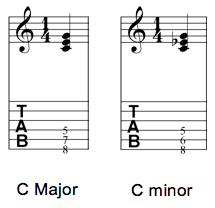
For example, take a C major triad (C, E, G) and flat the 3rd, and it becomes a C minor triad.

This idea also can be applied to the root of the chord.

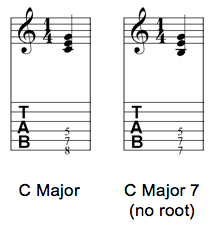
If the note C is flatted a ½ step (1 fret), the new note is B.  This creates a C major 7th chord with no root.

Likewise, if the note C is flatted a 1 step (2 frets), the new note is Bb. This creates a C7 chord with no root.

.

Moving to sharps

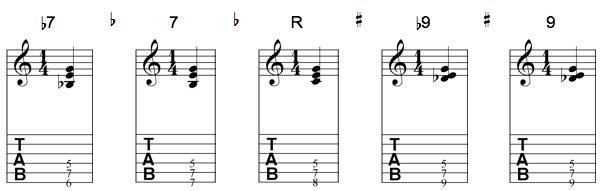
To add a 9th to the chord quality, raise the root  a ½ step for a flat 9 (b9) (or a step for a natural 9).

.

This is a good place to make a couple of notes:

.

First: the voicings presented here are used to demonstrate the process, but I like some of them better in other registers.  For example, here is the C add 9 voicing on the top 3 strings.

Second:  one reason to explore voicings without roots is that, in an ensemble setting, the bassist often holds down the root of the chord.  If you need the root –  it’s easy enough to just add it in.  Here is the same chord with a root:

The chord tone transformation chart


The following is a map of alterations to show how chord tones can be modified to create other sounds.

.

Taking the approach above, some general rules can be applied to a major triad.

.

The root of the chord can be lowered to the 7 or raised to the 9.


.

The third of the chord can be lowered to the 9 or raised to the 11.

.

The fifth of the chord can be lowered to the 11 or raised to the 13.

 .

In this manner, a triad can be altered into almost any other functional chord.


Here’s an exercise that utilizes a D major triad to illustrate this idea:

.

Note:  D major is used instead of C major because each note of a 1st position D major chord can be lowered to another note on the fingerboard, without using open strings.  In other words, each chord is a moveable voicing on the fingerboard.

.

The first step of this exercise is to make sure you can visualize triads both horizontally and vertically across the fingerboard.

 .

Horizontal (i.e. positional) visualization

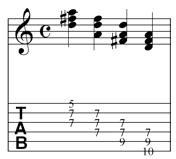
Here’s a series of  D major chord inversions in the 2nd position.

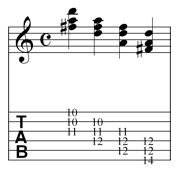
Here are the D major inversions in the 5th position

and in the 10th position.

If these voicings are unknown to you, start by familiarizing yourself with them before continuing to the rest of the lesson.

.

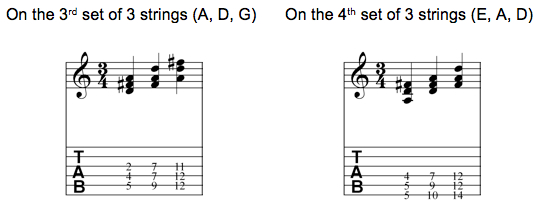
Vertical visualization

Note: the important thing with both the horizontal and vertical voicings is knowing where each chord tone is located in the voicing.

One way to practice this is to play through the chords and stop at random points and ask, “where is the root?” “where is the 3rd?”  “where is the 5th ?”  This has to be full internalized to be able to intelligently transform the chords, with the goal being instant chord tone identification.


As with the horizontal voicings, if these voicings are unknown to you, start by familiarizing yourself with them before continuing to the rest of the lesson.

.

Triad Transformation Exercise

Now that the preliminary steps have been taken, let’s begin the process.

First, here are a few chord formulas we’ll need:

Major: Root, 3rd, 5th – D, F#, A

Major 7th: Root, 3rd, 5th and 7th –  D, F#, A, C#

Dominant 7th: Root, 3rd, 5th and  flat 7th –  D, F#, A, C

Minor: Root, flat 3rd, 5th –  D, F, A, C

Major 7 flat 5: Root, flat 3rd, flat 5th and flat 7th-  D, F, Ab, C

Now, let’s go through the exercise as individual steps to explain the process.

.

Step 1:  Take a Major chord (in this case D)

Step 2: Make it a D Major 7 chord

[by flatting the root a 1/2 step (1 fret)]

Step 3: Make the chord a D dominant 7 (D7) chord

[by flatting the root 1 step (2 frets)]

Step 4: Make the chord a d minor 7 chord

[by flatting the 3rd of the D7 a 1/2 step (1 fret)]

Step 5: Make the chord a d minor 7b5 chord

[by flatting the 5th of the Dminor7 a 1/2 step (1 fret)]

You get the idea.  Transform the chord into every possible voicing and repeat with every other inversion.

.

When less is more – A case for smaller voicings

When I started out playing, if a song called for a C major chord, I’d play something like this:

While there’s nothing wrong with six note voicings, context is everything.  It took a while to realize that when playing in larger groups, smaller voicings sometimes helped propel the song and allowed for better voice leading.

For example: here’s the same C Major chord but with just 3 notes.

And here is the voicing in a I-iv-V7 (C-F-G7) progression with smooth voice leading.

If you’re playing solo guitar – this isn’t going to fill a lot of space sonically but it works well in an ensemble, and it’s easy to play.  A win-win.

I hope this helps!  In a future lesson I’ll go further into this concept and use it to create 9th, 11th and 13th chords.  In the meantime, you’re free to download and distribute any of the lessons here but I maintain the copyright on the material.

I’m always looking for feedback on what people find useful and what they don’t, so if you have any questions or comments, feel free to e-mail me at guitar.blueprint@gmail.com .