A Transparent Guitar And A Translucent Lesson

Hello everyone!

I hope this finds you well!  I have a couple of quick updates and a new lesson here for you today.

Guitar-Muse update:

Just in case you didn’t see it, I just wanted to let you know that a new review / tutorial on what to look for when buying a new guitar is up on Guitar-Muse right now.  Interested parties can check that out here.

Book Update:

All of the GuitArchitect’s Guide To… covers are done and up online.  You can see the revised editions here.  The Pentatonic book is getting a graphic overhaul and cleaned up for the print edition.  But I should have a new cover (and a revised edition) up by April.

Update Update:

I’ll have a couple of big announcements to make in the weeks ahead, but I think that it’s going to be good news for the readers of this blog and perhaps offer something truly useful.  So stay tuned – I might have an announcement (and something new to offer) as early as next week.

And an overdue lesson:

It’s been a spell since I’ve posted a lesson here (most of the lesson material for 2013 has been transcription work and lessons for Guitar-Muse), so I thought I’d rectify that with the following little morsel.  One thing I hope to do more in the future is offer bite sized lessons rather than the 3-6,000 word uber-lessons I’ve put up in the past.  Hopefully by making the lessons shorter, I can get them posted in a more routine fashion.

“You say you want a substitution…”

Okay – maybe none of you were saying that but I’ve got a string skipping idea that I think you might dig and want to explain where it’s coming from.

In this lesson, we’ll start with an F Pentatonic Minor (F, Ab, Bb, C, Eb)…and then add some notes to make something cool.

Visualizing the scale:

The first step in this lick is to visualize F Pentatonic minor in the 8th position.  The first group of notes in the example below is a F Pentatonic Minor scale.  In the second figure, I’ve removed the Bb  and moved the Ab to the G string to make it a 3-note-per string idea with a similar fingering.

 F Pent Minor - F Pent Minor 2 string

I find that removing notes from a straight scale-based pattern helps open up the sound of the scale as well when playing it in a linear fashion.

Preliminary Lick: F Pentatonic Minor on two strings

F Pentatonic Minor 2 strings

And here’s an mp3
.

Where there’s two there can usually be three:

Now I’ll take this same string skipping idea and expand on it moving it to a pattern on the E, G and A string.
F Pent Minor to F Minor 3 String

.

Preliminary Lick #2: F Pentatonic Minor on three strings

F Pent minor 3 strings

And here’s a MP3:

.

Adding by Subtracting

Using a trick I pulled from Eric Johnson (and a number of other players) I modified the scale by adding the 6 (the note D in this case) and the 9 (G) to the Pentatonic Minor scale to give it a slightly different sound.

Rather than think of extra notes – I simply modify some of the notes of the scale by a 1/2 step:

Changing the b3 to the 9 means changing an Ab to G

Changing the b7 to the 6 means changing an Eb to D

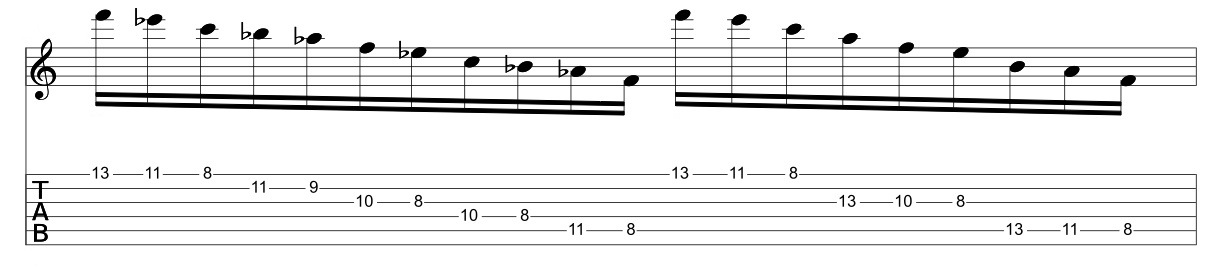
I don’t do this with every note, just a few of them.  If you look at the before and after below, you’ll see that the modified scale has the same number of notes but with an added bonus – namely a symmetrical fingering.

F Pent Minor to add 6 and 9

The advantage of a symmetrical fingering is that it makes it easier to manipulate when we use it in a pattern.

The Lick

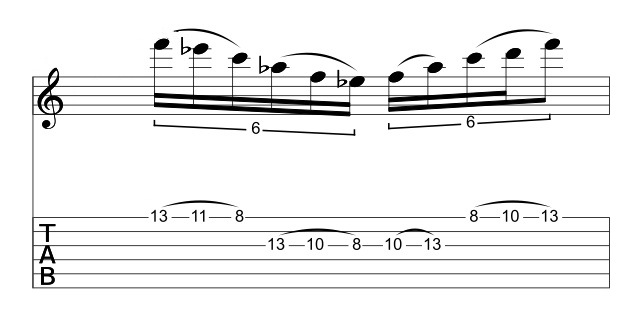
Now with all of this back story it becomes much easier to see how I came up with the pattern below (based on an improvised idea):

F Dorian string ship seq

Here’s an MP3:

And here’s another MP3 in a more improvised vein.  By adding the natural 6 and the 2 (9) to the scale – what we really have here is a string skipping dorian lick.

Taking the idea a little further

In this case, I don’t mean stuffing more notes into a passage – I mean getting comfortable with the sound of added notes.

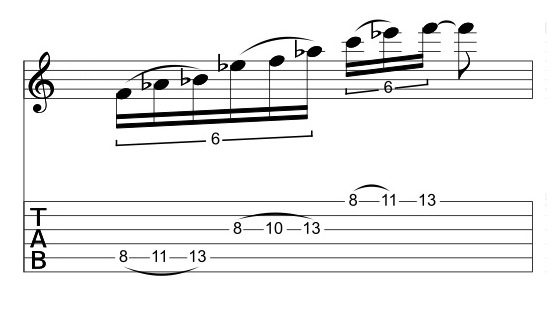
The MP3 below uses an approach from an early chapter of my Symmetrical Twelve-Tone Patterns book.  In that text, I talk a lot about understanding what it means to play “in” before you play out and being able to resolve “out” ideas or (in this case) resolve notes outside the scale.  But I also talk about working through ideas and finding resolutions.

When working with pentatonics add ons like the ones above, I’ll often work on accenting a note so I can really start to hear how it sounds in context.  The following short improvisation starts on the 6 and stresses that note for to accent the Dorian sound.

When working with ideas like this strive to get past the notes and to, instead, get into the sound.  It’s not just about playing a lot of notes, it’s about knowing which notes affect you before you play them.

Finally for those of you who are interested in the tech side of things – if you like the tone – it’s the same – AU Lab, Apogee Duet, FnH Guitars and Scuffham Amps combo that I typically use….

Scuffham Amp RigWith a little added reverb and a front end boost courtesy of the TS-999.

TS999

I hope this helps and, as always, thanks for reading!

-SC

Altruistic Action And Selfish Motivation

The best relationship lesson I ever learned.

Believe it or not, the best lesson I ever learned in a relationship tied directly into a lesson that it took years to integrate into my playing.

Years ago, I was in an absolutely intoxicating relationship with a remarkable woman that I thought I was going to marry.  But there were a lot of difficulties in that situation.  I had just come out of my undergraduate program by the skin of my teeth and entered the workplace in a field that had nothing to do with the skills I acquired…to pay off the student loans associated with those skills.  I threw myself onto this ready-made family and was completely  in over my head.  (I eventually learned that, “No, no…I got this.” is the mantra of the drowning person succumbing to their own delusion.)

But I really wanted to make the relationship work so I did whatever I could to accommodate the other person (generally at substantial discomfort to myself).  The more I became a martyr, the more miserable I became and as I became more miserable I simply poisoned a doomed relationship that much faster.  I doubt that you’d be surprised when she broke up with me.  I, on the other hand, was gutted.

And the first thing I did?  I threw all of those things I did “for her” back in her face.  And I did that because I was immature and I didn’t understand the situation.

I didn’t understand that she never asked me to do any of those things that I did.

It took me months to learn the lesson that in any relationship, you need to do things that you want to do.  You need to be selfish in certain things because if you only do things that you hate doing, you’re going to be miserable and you’re going to be miserable around.

When I did get married years later, I was grateful for that lesson as I was for doing things for my wife because I wanted to do them for her.  There are a number of other lessons that I’ve had to learn since then, but I am thankful that I got that first one out of the way…

Perhaps you’re thinking, “Nice story Scott.  Bully for you – but what the Hell does this have to do with guitar playing?”

A lot actually.

In your relationship with music you also have to be a little selfish.

If every action that you take is going to be dependent on someone else’s approval for you to feel good about it – you are on a road to artistic ruin.

Piggybacking off of my last post, there are many things that you are likely to work on that will not pan out for one reason or another but (in a “it’s the journey not the destination” variation) the only reason to get involved in any project is because you can invest yourself into it emotionally as well as physically and/or financially.

Be 100% clear – you may play guitar – but if you are not in the business of moving people with your music all the finger exercises and hours with a metronome in the world won’t help you.

You move people by writing and playing honest music.  It’s a critical step in connecting with people.  If you’re sincerely invested in what you’re doing, that’s going to come across.

To be clear – I’m not saying that you have total license to be an ass.

Have you ever seen a band or a movie that has no regard for it’s audience at all?  You’ll know it when you do – because it comes across as self indulgent and you’re going to feel kind of icky when it’s done.

If you get a call to play light background music at a wedding and you show up and play Black Metal for a bunch of blue hairs – you’re being an ass.  The point of this isn’t to alienate an audience, it’s to bring people in and engage them in what you’re doing.

When I wrote my GuitArchitecture books, I wrote about things that I thought would be useful for people – but I did it based on books that I would want to read.  If it passed the test of me picking up a book and saying, “wow that’s really cool!” then I figured that someone else would dig it as well.

I released it for other people, but I wrote it for me.

If I was dependent on accolades, then I could never release anything because I’d be too petrified that someone wouldn’t like it in one fashion or another.  Instead, I invest myself in doing the best work I can and know that if I think it’s good that someone else probably will as well.  I put myself in the mindset of asking how I would best learn a particular lesson and then use that as a model for communicating those ideas to other people.

The worst moments I’ve ever had in my playing are the one’s where I start second guessing what I’m doing and editing myself instead of just committing to what I’m doing.

In helping other people you help yourself.

In helping connect with other people, I better myself as a person.  It’s a key reason why I spend time on this site posting free content.   In sincerely trying to help people, I also build trust, make connections, develop friendships and ultimately earn fans.

Helping people helps you in the long run, but only if you’re offering help for the right reasons.

Again it comes back to balance.  I come from a working class background and I learned quickly that I don’t trust anyone who doesn’t act in their own self interests in some way shape or form.  It’s okay to be a little selfish in your motivations, but you have to be sincere in what you’re doing.  When I see people “networking” I throw up in my mouth a little but when I see people really engaging with other people and then building off of those connections it doesn’t bother me at all. In whatever you do, if your actions aren’t altruistic they’re not going to take you very far.

I hope that helps!

As always, thanks for reading .

-SC

Embracing The Setback

I was working on a project last night that wasn’t going particularly well.

In fact, I had been avoiding it for the last year or so, and I remembered last night why this wasn’t done before as my usual modus operandi of:

  • tacking the project head on
  • getting reminded by a kick in the face of why I had abandoned it previously and
  • ultimately reaching a frustration threshold that required putting the project on hold again

was already in full swing.  

And then I remembered something, from the Hagakure,

“Seven times down.  Eight times up.”

I’ve written before about increasing one’s awareness for potential lessons that you can learn from a given situation, but I think it’s important to revisit this area periodically as it can be a stumbling block.

Old Definitions

I used to get really frustrated when things didn’t work out.  Admittedly, my capacity to fail at things is world class.  For a long time my success rate for projects turning out positively as I expected them to was about 5%.

I would look at those situations, and analyze them endlessly to try to figure out what was wrong and see what I could learn from them.

But there was a commonality with the 90-95% failure rate.

That commonality was me.

Re-defined results

Once I stopped blaming external forces, and started taking on the blame, I realized that this issue wasn’t execution – it was expectation.  I had expectations of making things work through sheer force of will, even when a more objective observation would have revealed that financial, technical or scheduling shortcomings were things that could not always be overcome by sheer force of will.

So I started working on a modified time set.  I didn’t worry about how long it took for me to get something down.  I didn’t worry about having to have something perfect.  I just did the best work that I could do, and did it as often as I could.

If I had written my first guitar book and expected it to set the world on fire, I would have been crushed at never getting it out the door.

Instead, I developed another project and used the skills and focus from the first project to make a better book.

My print editions are now getting proper covers – some of them TWO YEARS after I wrote them.  If I settled on a crappy design and locked myself into that two years ago, I would have had something amateurish that I would have been ashamed of.  Now I have something I can stand behind.

That never would have happened if I had been in a rush.  If I had had expectations that it was going to be perfect or be nothing.

Now I have 10 books that I’ve written (8 of them published).  I’ll write more.  But if I had stopped when the first (still unpublished one) didn’t pan out – I never would have completed the others.

You will face setbacks in whatever you do.  The reason to embrace them is that if you have a setback, it’s because you’re doing something.

Consider this for a moment.  If you try to move 100 small things forward and 95 of them fail – you’re still 5 things further ahead than you were.

So now I’m plowing through that project – as painful and slow going as it is – not because I have to get it done, but because the intertia in getting that thing done will act as fuel for all the other things I have to do.

And there’s a lot to do.

I hope this helps!

As always thanks for reading.

-SC

The GuitArchitect’s Guide To Symmetrical Twelve-Tone Patterns Is Out Now

Hello all,

After a marathon couple of days editing the material – my 12-tone book is finally out the door!

The book and the e-book pdf are available on Lulu.com right now (and is also available on Amazon).

Symmetrical_12_Tone_Cover_Low Res

.

Bundle In The Jungle

Symmetrical Twelve Tone Patterns is a 284 page book with a large reference component  and about 100 pages of extensive notated examples and instruction.

What makes this book different (apart from the cover) and what I’m most excited about offering is a bundle of files that will help readers maximize material in the book.  The bundle contains:

  • Guitar Pro files of all the examples in the book (in GP6 and GP5 format). For those of you unfamiliar with this musical notation, tablature platform and playback program, having Guitar Pro files means that you can hear the examples without having a  guitar handy.  Having the files in a Guitar Pro format means that you can isolate each phrase and use it as a phrase trainer to help get the examples to up to speed.

  • MIDI files of the musical examples.
  • PDFs of the musical examples.
  • MP3s of all the musical examples (again, exported from the same material).

Here are some screen shots that I should have uploaded when this was posted originally!

.

TOC_1

Click on page to see larger image.

.

Click on page to see larger image.

Click on page to see larger image.

.

TOC_3

Click on page to see larger image.

.

Page 44

Click on page to see larger image.

.

Page 204

Click on page to see larger image.

.

Page 270

Click on page to see larger image.

.

“They play country And western”

Symmetrical Twelve-Tone Patterns presents the material in both improvisational and compositional contexts.  It shows how to create various intervallic lines and creates the outline of a tune and dissects how all the parts were created using this method.  If you’re looking for ways to explore new avenues in playing or in your writing this is the book for you!

The softbound copy GuitArchitect’s Guide To Symmetrical Twelve-Tone Patterns is for $35 and the e-book pdf is $15.  Both are available from The GuitArchitecture Product page on Lulu  or here on Amazon.com).

I’ll have a lesson from this material up in the weeks ahead, but in the meantime you may want to check out this post to get a flavor of the approach (and some interesting licks)!

Lots more ahead about this.  Thanks for reading!

-Scott

Working With Limitations Or How (Not) To Write A Book Part II

Hello everyone!

As I write this, I am still in editing / revising mode and doing the final clean up on the latest  GuitArchitect’s Guide To: book involving 12-tone patterns.  For those of you engaging in large-scale projects, I thought I’d offer a few observations about various parts of the process and, perhaps, give you some ideas that you can apply to your things in your daily life as well.

On “Easy” Projects

As I’ve been writing each of these books (and supplementing that with posts here and Guitar-Muse articles, interviews and reviews), I knew that my writing style was evolving and that my pedagogical model was changing.  While I was happy with the content I was releasing for my other books, there was one past effort that was tormenting me; Symmetrical 12-Tone Patterns For Improvisation.

Symmetrical 12-Tone Patterns was my first published book in 2006. (There’s a short book of prose called Hostile Terrain and a 300-page book entitled The Guitar Pattern Reference Book Vol. 1, that will never see the light of day – making the “new” book the 9th or 10th I’ve worked on depending on how you’re counting it.)

Symmetrical 12-Tone Patterns had its roots in the process I explored in The Guitar Pattern Book.  I started working on it when I realized there was a way to systematically re-order a 12-tone row and get some pattern-based sounds that were “out”.  I was looking for a dissonant angle to add to my playing but what I ultimately got was substantially deeper.

The Guitar Pattern Book

The Guitar Pattern Book was a reference text I devised that would (ultimately) show every possible permutation of 1, 2 and 3-note per string patterns on the guitar. Since I didn’t have access to any kind of graphic design program  at the time I was writing it,  I created a template made several hundred free copies and began charting them all out.  With a marker.  In off hours.  In down time.  Anytime I had a moment, I was sitting with a marker and a paper and plotting these out with excruciating detail.

Printing them at Kinkos, the cost was about $30 a book.  This was pre-print on demand and I knew that I’d never sell the book at $60.  So I mailed out a few copies to see if anyone was interested in the idea (I never got a single reply back) and shelved the idea.

As a commercial venture, this project that I sank hundreds (if not thousands) of hours into was a dismal failure.  As an experience however, it proved to be invaluable to me.

  • It taught me the value of discipline.  Real discipline.  At the time, I was working in a dismal office job and in a relationship that was self-destructing.  I remember waking up every day dreading going to work, and then being at work and dreading coming home.  That went on for the better part of a year before I finally figured out how to get out of that situation but the intellectual rigor that went into systematically plotting out the details in this book, was a key factor in me getting through that situation as it gave me something else to focus on.
  • Most Importantly, it taught me that it could be done.  It taught me that even with no money, or resources that I could write a book.  It taught me that you can bring something into the world on your own with sheer determination.  Because, particularly at the early stages of anything,  you can not count on anyone to help you.  Once you get established, it’s much easier to get people aligned with you, but initially people are not going to want to spend time or money) on an unknown quantity.

Symmetrical 12-Tone Patterns

With the previous experience of the Guitar Pattern book behind me, I didn’t flinch several years later at the work that would be required when I had the realization that you could create symmetrical rows.  I’ve already talked about the actual break down of the divisions in this post,  but let me give you a scope of the work that went into the creation of the tables in the book.  Let’s say that we’re talking about 2 sets of 6-note patterns.  The process of documenting them went something like this.

C (m2) B(m2) Bb(m2) A(m2) Ab(m2) G  /

Gb (m2) F (m2) E (m2) Eb(m2) D(m2) Db

or m2-m2-m2-m2-m2-m2

Then I would check (by “check” – I mean write out the interval pattern until it was either complete or discarded because there was a duplicate note)

m2-m2-m2-m2-m2-M2

m2-m2-m2-m2-m2-m3

m2-m2-m2-m2-m2-M3

m2-m2-m2-m2-m2-P4

m2-m2-m2-m2-m2-P5

m2-m2-m2-m2-m2-m6

m2-m2-m2-m2-m2-M6

m2-m2-m2-m2-m2-m7

m2-m2-m2-m2-m2-M7

Before moving onto:

m2-m2-m2-m2-M2-m2

And starting it all over again ad nauseum.  Not all of the patterns worked.  This was done for all 2, 3, 4 and 6-note divisions.  If I were doing it now, I’d hire a computer science student to generate the lists in a couple of days.  At the time, I just knew I’d have to knuckle down and do it.

For a year.

Every waking hour that I wasn’t working, working out, playing or teaching guitar, I was sitting with a paper and a pen.  Endlessly running intervals to create the lists.

I should mention that I wasn’t doing this to write a book.  That thought existed as maybe a possibility.  I thought at best I might be able to publish an article on it somewhere.

Getting Creamed by Creamer

It’s funny now that I have that thought about publishing an article, because at about the 3/4’s mark of this research, I was sitting in the library taking a break from writing and reading back issues of Guitar Player Magazine and what do I see?

A full six page article by Dave Creamer on symmetrical 12-tone patterns.

I wanted to vomit because all I could see was all the work I did going down the tubes.  Dave’s article was brilliant.  It was short, and succinct and (more importantly) showed how to use the ideas in a musical way.

At the same time, as a guitarist in Boston I was at a crossroads.  I was playing in some really good bands, but they just weren’t getting traction of any kind.  I kept getting involved in projects that were taking a lot of time for rehearsals but weren’t recording or gigging consistently.  It was 2005.  I saw the writing on the wall and realized that the live scene was going to go down the tubes before it had any kind of resurgence.  So I decided to go to Grad school and get a degree to teach guitar and follow a different plan for gigging.

Both of these factors together made me decide to take all this work I had done and put it into a book.  I decided that I couldn’t be intimidated by the fact that Dave Creamer had already done something brilliant with the same idea, I decided that I’d just have to move forward anyways.  And In applying to Grad school I knew that no one else was going to be able to send in a 200+ page book as a part of an ADMISSIONS package to a school.  So I went all in and filled in the pattern based material with some explanation and took it to Lulu.

2 months later – I was a published author.

There was one problem.

For some reason, the fonts didn’t embed correctly in the text.  This meant that every sharp and flat was reversed.  Lulu tech support had no idea why it was happening.  So I had to send ANOTHER Kinkos bound copy in to supplement the book of errors I had already sent in with an extensive apology.

I still got into grad school.  And, as a bonus, I had a book out in the world.  I was now a self-published author.

This book experience taught me a lot as well.

1.  It taught me the value of proofing!  Had I caught the initial mistakes in the printing, I would have saved myself the agony of having to create a revised version and getting it out the door.

2.  It taught me to stick with ideas if they’re good.  I could have abandoned the book when I found out about Dave’s work but instead I just went forward.

3.  It reminded me to work with what I had.  I didn’t have a graphic design program, but I had word – so I did the layout in Word.  I took the other guitar books that I had and carefully studied the overall layout and applied those ideas to the design.  This experience was invaluable to me later as I learned to really get whatever I could out of whatever software I was using.

The GuitArchitect’s Guide To Symmetrical 12-Tone Patterns

With the release of my Guide To Chord Scales book, I knew that I was at least a year out from having another book done and an idea hit me.  In the years that had passed since the  Symmetrical 12-Tone Patterns book, I was less enamored with the book.  I had written the book as a general guide to 12-tone patterns and hadn’t made it guitar specific.  I decided that the easiest thing would be to retire the current 12-tone book and make some revisions to it (add a new introduction, update some of the material and add some guitar tabs instead of standard notation) and it would be good to go.

I seriously underestimated the scope of this project.

In addition to the layout revisions and headaches caused by some of the initial design decisions that I had made with the book, in reviewing the material I realized that my entire relationship with the material had changed over time.

So where I thought this would be putting in an extra 20-30 hours to have a “new” and improved book up, what happened instead was a complete re-imagining of the material in content, scope and execution taking hundreds of hours of investment.

Having said that I’m rapidly nearing the February finish line and I’m going back to the excitement level of the 5-year old Scott Collins who woke up at 3 in the morning on Christmas say and spent 3 hours trying to wake his parents up because it was technically Christmas and Santa was already here so why were they sleeping?

What I learned from this book:

1.  It’s easy for projects get away from you.  If I knew in advance how much time this book would have taken, I would have approached it very differently.  Having said that, the book is only coming together as it is because of the particular process that it went through.

So when a project gets away from you, you have to keep your eye on the prize and make sure that the work you’re doing is ultimately going to serve the project.

2.  The value of DIY.  Most authors sign with publishers because they want someone else to do everything.  Let someone else do the editing, the layout, the marketing, the promotion and collect the revenue.  Then they wonder why their cut it so small.

As an author (or an independent guitarist) – you’re not going to be able to throw money at every problem the way large publishers can.  You’ll have to fix things on your own.

For this book, this was a godsend because it was only in working over the material endlessly that I discovered the best way to convey everything that I wanted to.  That never would have happened by just sending my text to someone on elance and having them give it a once over for grammar.

3.  I learned to leverage resources.  In the previous releases, I was so fixated on being goal oriented and getting the books out the door that I neglected things like covers (though the Repo Man era generic covers were a direct contrast to the depth of the material in the books themselves.  So this book has an actual cover:

12 Tone Cover small

and I also have to mention Doug Kearns – who’s done proofing of the text that has helped immeasurably. (One bummer about my current process, due to the number of accidentals in the material – automated spell checking doesn’t work. It’s another time-consuming area that wasn’t immediately obvious).  Doug was kind enough to do this with other books and I owe him a Skype lesson in addition to the books sent his way.  John Harper gave feedback and revisions that Proved invaluable as have Andre Lafosse and Candace Burnham.

Without the input of all those people, the book would be a fraction of what it is.  So leverage the support of the people around you.

4.  Every success is built off of previous work (successes and failures). The Guitar Pattern Book was really the thing that started everything and if I stopped there I would have just been a filed author.  I never would have written this book without the books that came before.  Even if this book never sells a single copy, it’s a huge artistic success for me.

Now I need to find a better way to market it than, “The book that answers the question that no one was asking.”

I’ll have a full book out for the Kindle about this year (Nothing Ever Got Done With An Excuse – no I didn’t forget about it, I’ve just been busy).  But in the meantime consider this.

Every step taken to get to this book was something that (despite however much of a setback it was at the time) was ultimately a component in moving forward.

Regardless of whatever is happening in your life, be present in what’s going on but use what you are doing as a spring-board to get to the next step – even if you’re unsure of what that step is.

As always, thanks for reading!

-SC

How (Not) To Write A Book

Hello everyone!  I hope this finds you well!

“Oh wait…this is an open mic comedy night now?”

There’s a joke I was told years ago that acts as a surprisingly apt metaphor for creating a book.

A man dies and when he wakes up he’s greeted by a demon who tells him that he’s died and gone to Hell.  On the plus side, there is one last choice that he’ll be able to make – namely which of the 3 rooms in Hell he’ll be in for all eternity.

The man is taken to the first room and peers into a vast number of people standing on their heads on a hard wood floor.  It looks very uncomfortable.

At room number two, there is an equal number of people standing on their heads but this time instead of hard wood, it’s a solid rock floor.  It seems substantially worse than the first room.

The final room is filled with even more people than the first two rooms combined.  In this room, everyone is knee deep in the most foul and putrid liquid imaginable, but they’re all drinking coffee.  It seems completely disgusting, but at least they’re drinking coffee and that might be the easiest of the three to deal with for eternity.  The man chooses this room.

As the demon locked the door behind him, a voice over the intercom barked out, ‘Coffee break’s over!  Back on your heads!”

As I write this I’m taking a coffee break from being knee deep in editing my Symmetrical 12-Tone Patterns book and smiling at the parallels.

How Not To Write A Book Or A Blog

Anyone with any productivity training would tell you that my method of creating books  (getting inspired, doing all the necessary research, writing a draft and then tackling re-writes, editing, revisions and layout simultaneously) is insane.  And from the standpoint of someone thinking in terms of high output writing like NaNoWriMo (National Novel Writing Month), they’d be right.

But for me, writing in a purely “efficient” manner doesn’t work that way.

I don’t plan out my blogs (beyond a topic and a point of view) because when I write spontaneously, I can help create the immediacy of conversational speech.  That’s the good side of working in that manner.

On the down side, writing that way means that I’m perpetually editing posts, cleaning them up and working endlessly to keep the energy level high while adding some artistry in how I’m conveying ideas.

In other words, I write quickly and edit as long as I’m able.  The editing may be where the actual craft comes in, but without that initial energy of getting the ideas on the page the clean up is useless.

This idea is expressed more succinctly in the familiar adage, “You can’t polish a turd.”

Modular Conventional Wisdom

I’ve written before about the differences between data and knowledge and on the importance of common sense,  as a means of negotiating the constant overwhelm of data. But what this process has taught me is that most conventional wisdom is really best applied in a modular and contextual manner rather than as an absolute.

It’s easy to grasp onto advice and, in an effort to shorten a learning curve, grasp it as gospel – but the real knowledge you gain in life comes from that learning curve.  I’ve learned much more from my mistakes than from my successes, and without those mistakes my successes never would have happened.

Tim Ferriss talks about four hour mastery.  That might get you to an avenue to manipulate your way through a martial art competition, but it’s going to get your ass handed to you in street fight.

There are shortcuts for work, but there are no shortcuts for understanding your own OS.  There are no shortcuts for finding out what works for you and finding out the best way for you to negotiate the world around you.

Put In The Work But Respect The Process

How I create my books is incredibly time consuming and almost infinitely frustrating in the number of times specifics have to be revisited because of how I re-work the material.  But it is only in that re-working that I can see the deeper connections.  It’s in that revision that the work adds clarity  to strength and it’s in going back and sweating minutiae that the work goes from, say, 95% to 98%, and from 98% to 98.4% or 99%.  The agony and the ecstasy both come from working towards those final percentages.

And Don’t Fixate on TIme

So, yes the 12-Tone book is late (Draft one was due Christmas Day!) but more importantly, it’s already the best book that I’ve written thus far and it’s only in the last month that all the substantial changes have happened.

Should I work on being more efficient?  Absolutely! But rushing the book out would have made it a much more inferior experience for the reader.  Instead of thinking about how much time I’m losing in yet (another) substantial revision, I’m focusing instead on what is coming from investing time in this way.

In writing a book, in playing guitar, in enjoying a walk on a brisk day, the magic is in the details.  In being fully engaged in the present.  Don’t be in a rush to gloss over them.

As always, thanks for reading.

-SC

p.s. – for a limited time (1/21/13 – 1/25/13) my shortest Kindle title, An Indie Musician Wake Up Call is free on Amazon.  You can find that book here and download it for free starting on the 21st.  (If you don’t have a Kindle the Kindle app is free on Amazon).  If you do happen to download it, please drop me a line and let me know what you think!  If you like it, please make sure to check out my other Kindle title, Selling It Versus Selling Out (Applying Lessons From The Business Of Music).

12-Tone Book Update And A ZT Amps Junior Review On Guitar-Muse

Hello Everyone,

Just a few quick updates here.

First, my 12-tone book is in the final stages of editing.  I’m just cleaning up text and typos and working on the cover design.  I hope to have it out by early February.

Secondly, I just wrote a new review for ZT Amps Junior Amp for Guitar Muse.  You can read that review here.

For anyone interested, I have a series of interviews, reviews, tips and lessons there as well.  You can fin that here.

Or just the lessons below.

And a

Jason Becker Documentary Announcement (and lesson)

Jimmy Rosenberg Player Profile (and lesson)

Alex Masi Player Profile (and lesson)

Vinnie Vincent Player Profile (and lesson)

A Rhythmic Ear Training Lesson with Steve Vai’s Velorum

Pragmatic Guitar Soloing Tips

A farewell to exercises and a warm-up lick

Playing With Spiders (or getting more from the 1-2-3-4)

As always, thanks for reading!

-SC
The 3 Secret Problems Of Jazz (And Jazz Is Not Alone)

A Book Excerpt or Marketing (Slight Return)

One interesting thing about publishing Kindle titles on Amazon is that Amazon does a web search to match various phrases with text you’re submitting.  This means that if you have any text on a website that you’ve included in your book, you’ll have to take it down from your site before the book is published.

I understand that the measure is there to protect copyright infringement (and make kindle content exclusive) but as a Kindle book excerpt exists to drive people to your Kindle title (and make money for Amazon),  it’s a flawed approach for most authors.

With that in mind, I may have to remove this post eventually, but for now – I hope you enjoy this chapter from Selling It Versus Selling Out (available here on Amazon).

Thanks for reading!

-SC

.

The 5th person sending me the NPR / Kurt Ellenberger post about the difficulties of being a jazz musician, was the tipping point for me writing a post I’d held off on for a while.  I don’t play Jazz but I’m an improvising musician who went through a rigorous Jazz pedagogy, so take please take whatever observations I offer here with a big grain of salt.

I think that Jazz has 3 big problems as a genre, and musicians working in that realm have their work cut out for them to move forward in it.

.

Duo or Trio wanted for restaurant

(no pay but you can sell your cd)

.

This gig scenario is actually a microcosm of the problems Jazz faces as a genre.

.

First, when you drive by a restaurant and you see a sign that says, “Tonight – live jazz!” have you ever turned excitedly to the person next to you and said, “Hey there’s a band playing there tonight!  I love Stella By Starlight!  Let’s go – maybe they’ll play it!”

No you haven’t. And no one else has either.  Because you don’t go to hear the music – you go to hear John McLaughlin or whatever other player interests you – and that’s the first big problem.  For the general public, Jazz has become a cult of personality for players instead of focusing on songs.

Many of the Real Book tunes date back to Tin Pan Alley.  Back in the day, Jazz players played on popular music.  People actually went out to hear the music and the band.   Remember the fire-storm Miles caused when he recorded a version of Time After Time?  He was just going back to that tradition of playing on tunes that people liked.  And yes, there’s been a lot of new music written – but as a genre, the focus is still on the players.  Once you put a focus on a player, you cut your audience down to people who like players and other musicians.  That’s really problematic if you’re trying to build a career.

No one (outside of musicians playing it or other musicians sitting with crossed arms at a gig critiquing a player hitting the changes) gives a toss about hearing Giant Steps live – they care about the energy the soloist is transmitting. The audience (such as it is) at every jazz gig I’ve been to is about 90% musicians and 10% fans.   I’ve mentioned this observation before, but in my undergrad experience I remember going to student recitals and seeing the band mindlessly getting through the head and then breathing a sigh of relief, “Thank God that’s over – now we can play some music!”  If you just want to solo with complete disregard for the song – why even maintain the pretense of playing the tune?

Mind you, the issue of repertoire is an over simplification.  I don’t want to discount that a lot of great music has been written.  While I think that is where Duke and Mingus got it right in keeping the focus on some great pieces, I don’t see any contemporary Jazz composer’s gaining traction in the same way they did.   There are a number of reasons for this (including saturation of the music market), but rock music survives because people sing along with the songs and dig the rock star.  As a genre, focusing on the Jazz star is a hole that will take a long time to get out of.

.

“Stop collaborate and listen”

The next problem with Jazz (as indicated by the gig listing above), is the implication that Jazz is background music.  Any type of music is no longer music if no one is listening – and Jazz is a music that demands the listener’s attention to pick up on the nuances of the performance.   People go to a restaurant to eat, not to listen to the (unpaid) band.  Or fans of the band go to the restaurant to hear the musicians play and begrudgingly order food and the 2-drink minimum.  So other than people the band has brought (in reality – the only reason restaurants book music anymore) – the other patrons there aren’t listening.  Some bands fight this by playing louder and then the patrons just eat and leave.

Musicians take these gigs (and wedding gigs) because they need cash, but as a culture we have moved into an ADD mindset with regard to focus.  People are less likely to sit down with a record and dig though it and try to get something out of it.  They listen to 5 seconds of an mp3 stream and then move onto the next thing.

.

Music and players are everywhere

As I mentioned before, the saturated music market is one of the biggest obstacles that challenges Jazz as a genre.  There are a lot of players with less and less venues to play in.  So you get musicians taking unpaid gigs at a restaurant and wondering why they haven’t sold any cds (and why management wouldn’t comp the food now that the sets are done).

There’s value in scarcity and people have infinite access to music.  If you wanted to hear Miles Davis electric band play back in the day, you went to go see them.  Now you go to You Tube.  There’s increasingly fewer reasons for people to go out and see a show for the sake of seeing a show.  In general, they won’t go just because a band is playing and it’s something to do.

.

“…Those were the days…”

Derek Bailey has one of my favorite quotes ever about the conservatory experience.  (I’m paraphrasing here), “As soon as bebop became a set series of formulas taught in an academic setting it went from being the vibrant searching music that it was and became a maudlin reminder of the good old days”.

Many people associate Jazz with comfort (like sitting next to a fire with a glass of wine and listening to Sketches of Spain).  They have a nostalgic view about going to a bistro and hearing some jazz.  (Some of these people will also tell you that the LOVE Michael Bublé as evidence of a “Jazz” pedigree!?!  This is another problem where people have equated intrumentation and arrangement with a genre.) Comfort is a tough market to cultivate and maintain, but Jazz has also been equated with cultured music and as some people go see Jazz in the way that they go to a museum, this could be a key.

People want to be moved.

They want to center.  They want to focus.

People go to a museum to experience something.  They go to a show because they don’t want to miss an event.  As an audience, people are searching for something new.

That sounds like Jazz to me.  Ellinger is right.  In terms of output – Jazz IS thriving.  But its musicians (by and large) are not and if the musicians and composers aren’t thriving – then the genre is in real trouble.

.

As a genre, I think Jazz needs a re-branding.

Many Jazz musicians are already doing this.  They don’t call their music Jazz anymore.  They come up with a million other labels and get new audiences in by playing venues guised as something other than Jazz – but playing Jazz at its core.  Playing “searching vibrant” music that moves people.

Appealing to people’s mind as cultured music is a good start.  Appealing to people as head boppin’ – ass twitchin’ music that grabs the ear and moves the soul is even better.

As a label, Jazz is too broad to be meaningful to most players – but to the public that label already has associations with it.  As a genre, Jazz needs to bring new fans into the fold with songs and then wow them with the musicianship behind them.

And it needs to happen, because it’s too beautiful a thing to let slip away.

.

This excerpt is taken from Selling It Versus Selling Out (Applying Lessons From The Business Of Music) which is available as a Kindle title here.

If you like this essay, you may also like, An Indie Musician Wake Up Call also available on Amazon here.

.

.

2013: How Not To Repeat The Mistakes Of The Past (Or Nothing Ever Got Done With An Excuse)

(This is a repost of something I wrote for the end of 2010.  The dates and information have been updated, and this has become one of the few yearly repost traditions I indulge in.)

.

I had hoped to get a few more things done before the end of the year, but decided instead to take the last week to wind down and center.  I find that this not only helps me take stock of what worked and didn’t work for me in 2012 but also helps me make sure I’m on track for what I want to get done in the new year.  As George Santayana said,

“Those who do not learn from history are doomed to repeat it.”

.

As 2012 draws to a close, I think back to many conversations I had with people at the end of 2009.  At that time, it seemed like everyone I talked to said the same thing, “2009 was such a bad year.  2010 has to be better.  It just has to.”

Now it seems I’m listening to the same sentiment with the same people about 2012 and the coming 2013.  And in some ways they have a valid point.  Listening to their circumstances, 2012 certainly offered some of these people a tough blow – but regardless of their circumstances, I believe that, unless they experience a windfall of good fortune, I will hear the same sentiments echoed at the end of 2013.  There’s a reason for this:

“If you always do what you’ve always done – you’ll always get what you always got” – anon

.

While I fully appreciate the merits of planning and goal setting – life will throw you any number of curveballs that may make a meticulously laid out plan get derailed.

.

A good plan has to be countered with an ability to improvise (as need be) to make sure that even if your mode of transportation is disabled, that you are still on the path to achieve your goals.

.

“Improvisation as a practice is the focus of an idea through an imposed restriction.  This restriction could either be self-imposed or be imposed upon the improviser through other means. Improvisation as it relates to common experience can be seen in the example of the car that stops running in the middle of a trip.  A person experienced in auto repair may attempt to pop the hood of the car to see if they can ascertain how to repair the vehicle.  Or they may try to flag down help.  Or they may try to use a cell phone to contact a garage.  The point being that within the context of a vehicle malfunction, different actions are improvised based on the improviser’s facility with both the situation at hand and the tools at their disposal….life is essentially an improvisation.  As individuals we come into each day not exactly knowing what will happen.  We know that there is an eventual end, but we don’t know when or how it will end.  But we continue to improvise, because it is in both the active improvisation (the present), the skill set and knowledge of that improvisation (the past) and in the philosophical/worldview/goals guiding our improvisational choices (the future) that we create meaning.”


If you approach life’s problems with the same mindset you’ve always had 

-and your new year’s resolutions run contrary to that mindset –

your resolutions are doomed.

.

I say this as a seasoned graduate of the school of hard knocks and as a person who found that while success felt a lot better – failure was a much more thorough teacher.

.

2012 had some great ups and downs for me and now there are a number of life and playing upgrades I’m going to put into practice in 2013 to address the things that didn’t work for me.  For those of you who are interested in making a real change the new year – here’s what worked for me going into 2012 that I plan on using this year as well:


Know the big picture.

If you have a goal – know why you have the goal.  As Victor Frankl once said, “He who has a why can endure almost any how.

.

Take stock of what you have done and identify what needs to change.

Have you done things that work towards that goal?  If so, what have you really done? What worked?  What didn’t work?  And what parameters can you put in place to make it work better?

What decisions did you make that set you back and how could you alter those decisions in the future?

Sometimes honesty is brutal but this isn’t about beating yourself up.  It’s about taking a realistic stock of what worked and what didn’t work for you in the year, reinforcing that things that work for you and discarding what didn’t work for you.

.

Revolution not resolution

People typically make resolutions because they recognize a need for change in their life.

Personally, change hasn’t been about making a momentary decision as a knee jerk reaction to something (which usually lasts as long as the time it took to make that decision).

The long-lasting changes in my life have come from making lifestyle changes, setting priorities and working within those changes.  Change, then, is not a temporary compromise to a current observation but is instead a revolt against habitual modes of thinking and operation. 

.

Positive habits

Making something a daily positive habit (like brushing your teeth) makes it easier to maintain over the long haul.

.

“Don’t make excuses – make it right” –  Al Little

People make excuses for things all the time.  No one cares about excuses because nothing ever got done with an excuse.  People (typically) only care about results.

There will undoubtably be moments that you relapse into older habits.  Instead of making excuses for why it happened – just acknowledge it and move past it. When you fall off the bike, it’s not about sitting down and nursing your scrapes.  It’s about getting back up on the bike again.  As it says in The Hagakure“Seven times down – eight times up”

.

There’s strength in numbers

Try to surround yourself with supportive people.

  • Not enabling people who will make changes more difficult for you.
  • Not negative or judgmental people who will scoff at your desire for change

.

Talk to the friends and family who will give honest and supportive feedback.  Here’s another important tip – don’t burn those people out with your goals.  The people around you have their own lives, so if every conversation becomes about you and your goals, you’re going to see less and less of those people!

.

In addition to (or in some cases in lieu of) that support, you may want to look into some free online accountability sites like Idonethis.com (post on this here) or Wunderlist.com which maintains a private calendar to help observe progress.

.

Be motivated to do more but be grateful for what you have

In a final 2012 observation, I’d like to thank everyone who took a moment to come here and read what I was doing.  So thank you all again and I hope that 2013 is your best year yet.

.

-SC

Interview With ZT Amp’s Ken Kantor Now Up on Guitar-Muse

Hello everyone!

This is just a short update of some recent going ons that may be of interest to you.

Guitar-Muse

I have some new articles up on Guitar-Muse and some more on the way:

  • Today’s article is an interview I did with Ken Kantor (ZT Amps).   (You can read it here). Ken really knocked me out with his ability to take complex ideas and articulate them in an accessible way.
  • Part 4 of the  “Evolution of a live rig” series
  • Player Profile / Lesson on Ridgely Snow
  • Player Profile / Lesson on Vlatko Stefanovski
  • Player Profile / Lesson on José Peixoto
  • Interview with bassist/Magic Band guitarist/Jack of all Jacks Eric Klerks
  • reviews, interviews and other lessons in the pipeline.

Mu-sick

Rough Hewn Trio is supposed to get mixed before the end of the year, and I just haven’t found a studio I dig/can afford to track the acoustic ep (but I will and it’ll be cool)!

12 What?

Oh man oh man – the 12 Tone Pattern Improv book is kicking my ass, but this edition is going to be really cool.  Look for a lot of guitar-specific applications and some cool ideas.

In other words, a long series of days and nights ahead….hopefully with some good things to show for it.

As always, thanks for reading!

-SC