The GuitArchitect’s Guide To Modes – Part 13 Not-peggios

Hello everyone!

It’s been a while since I’ve posted anything mode related. So I thought I’d make up for some lost time by posting this lesson.

Not-peggios?

Those of you who have been following the licks in this blog for a while have probably figured out that one of my favorite melodic approaches is to work in the area between scales and arpeggios.

For those of you who remember all the way back to part 11 of this series – this idea works on the same approach but with triads.

Step 1: Extracting the Not-peggio

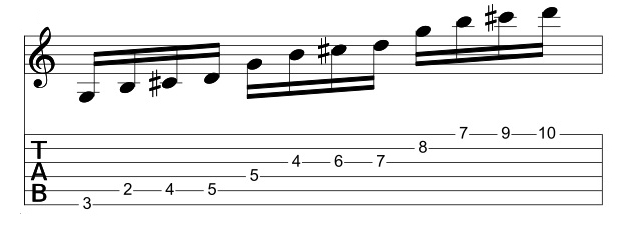
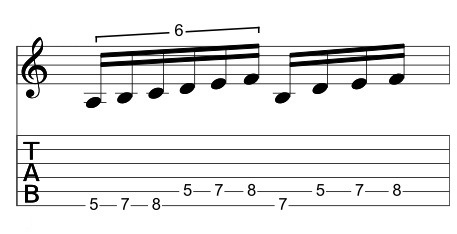
This idea uses the same 3-note-per-string / two string idea that’s behind all the visualization process here.  But to review:  Let’s start with a B Locrian scale pattern on the E and A strings:


C Ionian
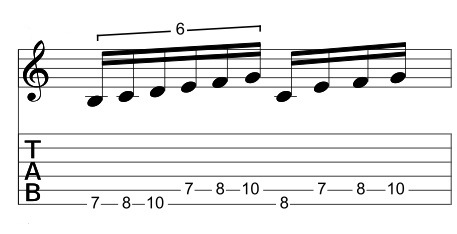
From there:  I’m going to remove the 1st and 3rd notes of the pattern:


Not Peggio Extraction

Leaving a C major major triad with an added 4th which is something that intervallically lies somewhere between an arpeggio and a scale.  Technically it’s a close voiced arpeggio but the “not-peggio” tag has worked better for me when I explain to people so I’ll use it here as well.

Call it scrapple, grapple or anything else that will help you remember it – the naming convention is much less important than getting it under your fingers and in your ears so you can play it.

The good news is that applying this approach to a Major scale only produces four unique qualities of these melodic devices which I’ll talk about below.

One brief technical note:  I recommend either one of following picking patterns for any of the 4-note shapes presented here:

Picking Examples

If you’re used to alternate picking, that will work as well but I find that the semi-swept approach of the first example gives me a more uniform sound for legato playing.  It’s counter-intuitive but check the A minor straight ascending mp3 below to see what I mean.

Major add 4

Major Add 4 shapes

This shape doesn’t really work that well over major chords because the 4th (aka 11) is an avoid tone over a major chord.

However they do work well over minor chords. Try playing the C Ionian shape over an A Minor but for the most part, I find the major add # 4 shape to be one I use much more often.

Major add #4

Major add # 4 shapes

.

I’ve talked about this before – but a kind of cool applied theory trick is that Lydian and Dorian are relative major/minor substitutions.  By that I mean that while C major is the relative major key of A natural minor related chords scales C Lydian and A Dorian both come from the same parent major scale (in this case G Major).  So licks generated from this source will do double duty over both major and minor chords.  A two-fer if you will (or won’t – I understand either way).

Let’s apply this idea to G Dorian.

Here’s the 4-note shape taken from F# Phrygian:
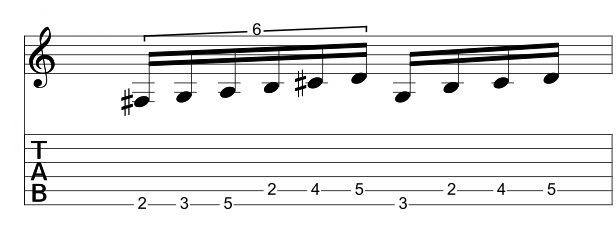
G add # 4 extraction

And here it is an a 3 octave form:

G add # 4 3 octave pattern

.

Here’s a more sequences lick type of approach:

G Lydian 3 Octave run

Here’s the audio – with a short descend of the patten ending on the G on the 8th fret of b string.

You can try this approach over E minor for an E Dorian type sound as well.

 Minor add 4

Minor add 4 shapes

Okay a couple of quick tips here.  Since you don’t get the natural 6 of Dorian or the b2 of Phrygian in these shapes – they’re not really going to give you much of the flavor of those modes.

In this case, I’ll use the A Aeolian shape over A minor and F Major chords.

A Minor:


A Aeolian part 1

In this audio example I play the 3 octave form and then play the multi-octvave sequenced idea.

A Aeolian over F lick

Used over F Major:

Now I’ll take the same sequenced idea and apply it over an F major lick.  Here’s an audio example.  I slid up to the G on the 15th fret of the high E string and then descended with some tremolo bar scoops along the way.

Normally, applying an A Aeolian idea over F major would give it a Lydian sound – but the lack of the B (#4) in the pattern makes it a little more open sounding to me.

Finally – here’s the Diminished form.

Diminished add 4

Diminished add 4 shapes

Looking at the notes here (B, D, F, E) – I see the upper notes of a G7 (add 13) chord: G [Root] – B [3rd] – D [5th] – F [b7] – E [13].  So this pattern is one I use in Dominant 7th situations.

Here’s the basic pattern:

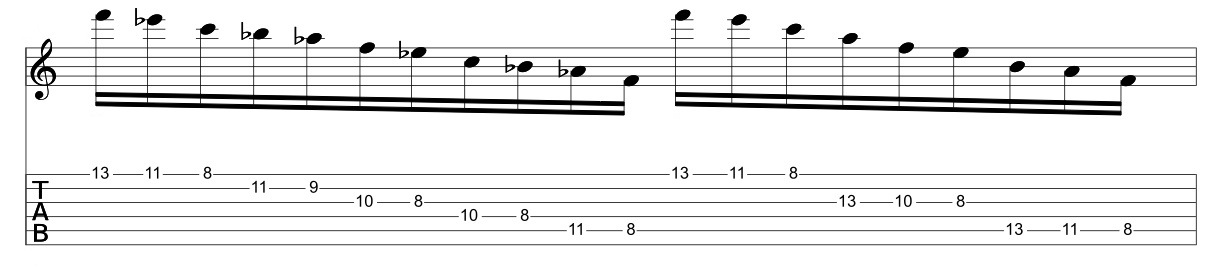
B Locrian Multi Octave

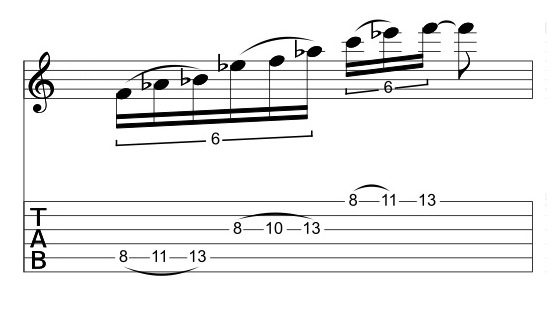
And here’s the application over a G7 chord.  It uses the same pattern sequencing idea as the other examples ascending but bends into a couple of notes including the 3rd on the B string for the final note.

Next time?  Some Melodic and Harmonic Minor shapes to get under your fingers.

As always, I hope this helps!

-SC

PS – if you like the ideas in this approach – the following books will help you expand on this idea exponentially!

The GuitArchitect’s Guide To Chord Scales

The GuitArchitect’s Guide To Modes: Melodic Patterns

The GuitArchitect’s Guide To Modes: Harmonic Combinatorics

A Transparent Guitar And A Translucent Lesson

Hello everyone!

I hope this finds you well!  I have a couple of quick updates and a new lesson here for you today.

Guitar-Muse update:

Just in case you didn’t see it, I just wanted to let you know that a new review / tutorial on what to look for when buying a new guitar is up on Guitar-Muse right now.  Interested parties can check that out here.

Book Update:

All of the GuitArchitect’s Guide To… covers are done and up online.  You can see the revised editions here.  The Pentatonic book is getting a graphic overhaul and cleaned up for the print edition.  But I should have a new cover (and a revised edition) up by April.

Update Update:

I’ll have a couple of big announcements to make in the weeks ahead, but I think that it’s going to be good news for the readers of this blog and perhaps offer something truly useful.  So stay tuned – I might have an announcement (and something new to offer) as early as next week.

And an overdue lesson:

It’s been a spell since I’ve posted a lesson here (most of the lesson material for 2013 has been transcription work and lessons for Guitar-Muse), so I thought I’d rectify that with the following little morsel.  One thing I hope to do more in the future is offer bite sized lessons rather than the 3-6,000 word uber-lessons I’ve put up in the past.  Hopefully by making the lessons shorter, I can get them posted in a more routine fashion.

“You say you want a substitution…”

Okay – maybe none of you were saying that but I’ve got a string skipping idea that I think you might dig and want to explain where it’s coming from.

In this lesson, we’ll start with an F Pentatonic Minor (F, Ab, Bb, C, Eb)…and then add some notes to make something cool.

Visualizing the scale:

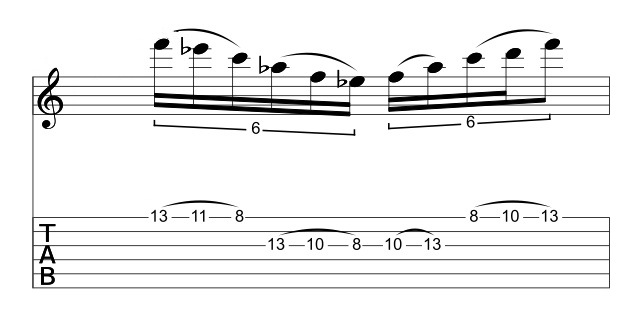
The first step in this lick is to visualize F Pentatonic minor in the 8th position.  The first group of notes in the example below is a F Pentatonic Minor scale.  In the second figure, I’ve removed the Bb  and moved the Ab to the G string to make it a 3-note-per string idea with a similar fingering.

 F Pent Minor - F Pent Minor 2 string

I find that removing notes from a straight scale-based pattern helps open up the sound of the scale as well when playing it in a linear fashion.

Preliminary Lick: F Pentatonic Minor on two strings

F Pentatonic Minor 2 strings

And here’s an mp3
.

Where there’s two there can usually be three:

Now I’ll take this same string skipping idea and expand on it moving it to a pattern on the E, G and A string.
F Pent Minor to F Minor 3 String

.

Preliminary Lick #2: F Pentatonic Minor on three strings

F Pent minor 3 strings

And here’s a MP3:

.

Adding by Subtracting

Using a trick I pulled from Eric Johnson (and a number of other players) I modified the scale by adding the 6 (the note D in this case) and the 9 (G) to the Pentatonic Minor scale to give it a slightly different sound.

Rather than think of extra notes – I simply modify some of the notes of the scale by a 1/2 step:

Changing the b3 to the 9 means changing an Ab to G

Changing the b7 to the 6 means changing an Eb to D

I don’t do this with every note, just a few of them.  If you look at the before and after below, you’ll see that the modified scale has the same number of notes but with an added bonus – namely a symmetrical fingering.

F Pent Minor to add 6 and 9

The advantage of a symmetrical fingering is that it makes it easier to manipulate when we use it in a pattern.

The Lick

Now with all of this back story it becomes much easier to see how I came up with the pattern below (based on an improvised idea):

F Dorian string ship seq

Here’s an MP3:

And here’s another MP3 in a more improvised vein.  By adding the natural 6 and the 2 (9) to the scale – what we really have here is a string skipping dorian lick.

Taking the idea a little further

In this case, I don’t mean stuffing more notes into a passage – I mean getting comfortable with the sound of added notes.

The MP3 below uses an approach from an early chapter of my Symmetrical Twelve-Tone Patterns book.  In that text, I talk a lot about understanding what it means to play “in” before you play out and being able to resolve “out” ideas or (in this case) resolve notes outside the scale.  But I also talk about working through ideas and finding resolutions.

When working with pentatonics add ons like the ones above, I’ll often work on accenting a note so I can really start to hear how it sounds in context.  The following short improvisation starts on the 6 and stresses that note for to accent the Dorian sound.

When working with ideas like this strive to get past the notes and to, instead, get into the sound.  It’s not just about playing a lot of notes, it’s about knowing which notes affect you before you play them.

Finally for those of you who are interested in the tech side of things – if you like the tone – it’s the same – AU Lab, Apogee Duet, FnH Guitars and Scuffham Amps combo that I typically use….

Scuffham Amp RigWith a little added reverb and a front end boost courtesy of the TS-999.

TS999

I hope this helps and, as always, thanks for reading!

-SC