More Things Rig

Hi Everyone,

It’s been a while since I had a gear post, but I thought I’d put up a quick update that some of you might find interesting.

And besides – what guitar player doesn’t like gear (or reading about gear?)

That Muse Of Guitar

The Guitar-Muse posts are on a bit of a hiatus for the moment, but I did a short series for them about the evolution of my live rig and getting it down to something manageable for travel.  You can read those posts below:

Part 1

Part 2

Part 3

Part 4

I never got to do part 5 or 6, but for people that are interested here’s some of the things I make sound with now (and it may be something you can apply to your own live rigs):

Electric – The Exonerated

As part of the Buck Moon Arts Festival, I volunteered to do live accompaniment for a staged reading of the play, The Exonerated.  The play called for a Slingblade/Daniel Lanois sparse type of accompaniment.  As the drummer I wanted to work with wasn’t available, I brought my full rig and laptop.

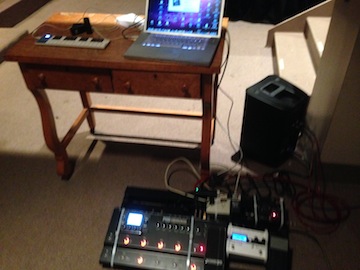
Live Rig

Can improvise, arrange and mix multiple audio signals for a live show. Can not shoot a picture in focus.

What you’ll find here:

  • FnH Guitar (not pictured) being played with picks, slide and ebow running into
  • Nady TD-1 (with 12AU7) going into a
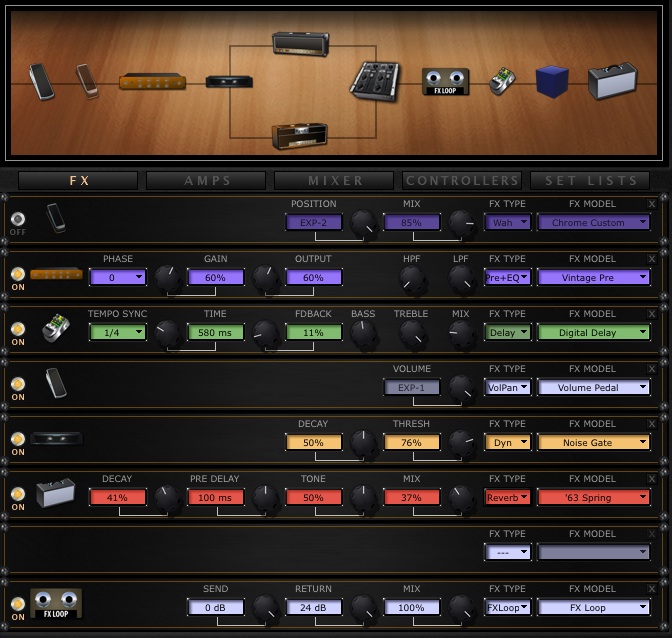
  • POD 500X HD
  • (there’s an additional expression pedal as well) running the effects send into a
  • Torpedo C.A.B. and running that out to a
  • QSC K-8 speaker.

The laptop is running Logic Audio/Absynth and a few other apps and I’m triggering sounds and loops with the Korg Nano Key.  The audio leaves my headphone jack and goes into the 1/8″ input of the POD.

Perhaps you noticed the white Zip Ties….I tried using just the Velcro on the PedalTrain and when I opened the bag, all the pedals were pulled off the board and on the bottom of the bag.  I went to the hardware store and got the longest ZIP ties I could to hold everything down and all was right with the world.  A dedicated power supply for everything would be nice, but as that would require having the power input completely re-wired on the TD-1, that’s on a back burner for now.

I really dig the Scuffham amps S-Gear, so if I could have gotten the Scuffham amps and SooperLooper plug in in AU Lab to play nice with the Line 6 USB shortboard I might have just brought the Apogee Duet, laptop and shortboard.

But my laptop isn’t getting any younger and a new laptop is out of the budget right now so rig B right now is my iPhone, Sonic Port, Positive Grid, Audio Bus and Loopy HD.  I dig the loop features a lot and if the AirTurn BT-105-PB4 works the way I think it will I might be able to make it one of my default live rigs.

Having said that, the POD rig does a LOT of things really well and while I like the Positive grid guitar tones, in its current incarnation it can’t touch the POD for non-guitaristic tones (i.e. the weird stuff – i.e. the good stuff).  Using a RADIAL splitter and a SONUUS i2M to allow the guitar to be a MIDI controller is also something I’ve experimented with before and will come back to.  Again – it depends on the consistency of the laptop.

I also have a ZT junior amp, which I really dig and I’ve done a couple of background music gigs that just required showing up with a small amp.  For a straight jazz, country or for just a warm clean tone in small settings it’s my go-to.

Acoustic Tone

The last set up on my Tam Hiep made it borderline unplayable due to a sympathetic vibration on the low E string.  File that under substantial repairs/bummer.

In the meantime, since I don’t want to gig with my Jeff Chappel guitar – I’ve gone back to Yamaha APX’s for live use.  I have an APX700 12 string that I’m using for more Dastgah/Maqam type things with a B-F#-B-F#-B-F# tuning.  Right now I have it set up for octave tuning but will likely use the same adaptations I used on the Rogue (i.e. making it a 10 string with unison strings on the D and G strings.

I’m keeping an eye out for another APX700ii, 700 or 500ii.  The Yamaha and the BT-105 are the last anticipated gear purchases for quite a while but we’ll see what happens.

In terms of amps and effects.  It depends on the situation but the Yamaha AG-Stomp does everything I could ask it to do in a live setting and a ZT Acoustic lunchbox is arriving via UPS today and I anticipate that that will solve any live need I could possibly have.

That’s it for now!


Deciphering What’s Actually On The Page or Don’t Believe The Hype

Sony Records sent out a press release today that will surely set the internet a flutter.  Here’s the AP (In this case – Alternative Press) Story Line:

Middle school metal trio sign $1.7 million record deal with Sony Music

Boy that sounds great!  Here everyone is talking about the record industry tanking and Sony steps up and signs Unlocking The Truth with a big-ass old school record deal!  $1.7 million huh?  Time to get those middle schoolers in your house some lessons and up on a stage so you can get that Middle School Metal Money.  (I’ll give credit where it’s due – I can’t come up with a better catch phrase than Middle School Metal.)

But the numbers here mean nothing.  Look at my underlined quotes from the AP article.

“Brooklyn, New York based middle school metal trio, Unlocking The Truth, have inked a record deal with Sony Music potentially worth $1.7 million, according to a report from the New York Daily News. The band are guaranteed two albums, with a $60,000 advance on the first, and up to $350,000 for the second. If the efforts prove fruitful, the band could reap the full benefits of the six-record, million dollar-plus contract. “

So here’s how I read this:

Unlocking the truth signed a record contract with an OPTION for 6 records.

I will bet dollars to donuts that they signed a 360 deal with Sony – which means that any revenue streams generated by the band will find a percentage going back to Sony.

That $60,000 advance will be recoupable – which means the band won’t make a dime of the record until they pay back the label for the money that the label spent on them.  You’ve seen the spotify stream articles.  How many digital plays and downloads does it take to pay back $60,000?  A lot more than any other band playing in this genre is getting right now.  Hell, probably more than EVERY other band in this genre is getting right now.

That’s IF the record comes in on budget – which it won’t – you’ll have to factor out the producer’s percentage, the lawyer’s percentage and anyone else getting a cut from this as well.

Oh..and then there’s the video.  IF the record gets released, the label will demand a video to help promote it.  That’s also recoupable against album sales so, again, the band won’t see any money from the record until that gets paid back as well.

They’ll have to tour to promote the record.  The label may offer tour support but if they do – it’s also recoupable.  That’s also problematic because if they signed a 360 deal (and I don’t think there’s any way the label would sign them and not demand a 360 deal) – the label is taking additional cuts on top of any money being made.

So in the past, tour support might be renting a tour bus and paying for the PA – but (in addition to whatever percentage of the door you got) whatever shirts or other merch you sold you got to keep.  In a 360 deal – your small percentage on shirts or ANYTHING else you have to sell – just got a lot smaller.

Note that the article says that the label will pay UP TO $350 K for the second release.  That also means that they could pay nothing and then the band is screwed because they won’t be able to record with anyone else until that release comes out.  That also means that the label could record the album and then just refuse to release it.

Guess who sits in limbo unable to do anything else with anyone else until that happens?

So:

  • IF the first record makes enough money to warrant making a second record that gets released and
  • IF the second record can be recorded and makes money

Then the label MIGHT pick up the rest of the releases with advances (i.e. money that mathematically can never be paid back) that MAY make up to 1.7 million.  Again –  IN ADVANCES – not in income.

So for the type of music the band plays –

I’m betting that this is solely a PR move.

It’s smoke and mirrors.

Sony’s gonna ride the publicity on this, record an album and then push the novelty aspect of that.  “Middle School Metal” is easier to get press on than “Middle Aged Metal”.  Then like every other novelty (“Pac Man Fever” comes to mind) it will fade.

This irritates me for two reasons:

1.  From the “news” angle – it’s irresponsible hype that sends the wrong message to people about the state of the industry.  People look at the headline and come to a conclusion that has no basis in reality for artists.

2.  Malcolm was a student of mine, very briefly, at a music summer camp I taught at.  If you see him sweep-picking something live –  it may well be a form I taught him.  He’s a nice kid and I dig his energy and enthusiasm.  I dig that he’s gotten the press and gigs that he has and I don’t want to see him get taken advantage of.

But is it a bad decision?
Oh, probably not.  But really it depends on what you think the outcome is going to be.

If approached as a money-making venture – yes, definitively it’s a colossally bad idea.

But if this is an exposure play…if this is just a springboard for them to do something else POST Sony – it might not a bad play because right now they’re 13 years old.  They don’t have to make money because they have a parent (or parents) who will make sure that they’re fed and have a roof over their head.

In other words, they’re in a radically different situation than the average band.  They might be able to afford to be indentured to a label for a couple of years.

But for the average band – the last sentence of this: which does a great job of breaking down real money for major label acts…. is where they’re really at.

Public Service Announcement:

Friends Don’t Let Friends Sign 360 Deals.

Is Music Dying?

[Please note: This is a re-post from guitarchitecture.org]

(Before we start – a quick plug for the BuckMoon Arts Festival)

As a reminder to anyone who happens to be in the upstate NY area, I’ll be performing live accompaniment for a staged reading of The Exonerated as part of the BuckMoon Arts Festival on July 12-13, and leading a series of panel discussions with working artists and industry experts on how artists can monetize their art.  You can read about both of those here.

In doing some research for the panel discussions I was listening to the CD Baby podcasts this week and I caught up on two interesting, and somewhat related stories to the panel.

1.  Apple’s Eddie Cue announced that Apple bought Beats because “Music Is Dying”

2.  Indie artist Shannon Curtis came on to promote her new book, “No Booker, No Bouncer, No Bartender: How I Made $25K On A 2-Month House Concert Tour (And How You Can Too)”

Is Music Dying?

I’ve never seen anyone at Apple make any kind of negative statement about the music industry, which is why iTunes Eddie Cue’s quote is somewhat telling:

“Music is dying,” said Cue. “It hasn’t been growing. You see it in the number of artists. This past year in iTunes, it’s the smallest number of new releases we’ve had in years.”

As quoted from  http://readwrite.com/2014/05/28/apple-beats-eddy-cue-jimmy-iovine#awesm=~oHLbiOYNIxpYCB

My guess is that he’s talking about the smallest number of major label releases, as there is no shortage of independent music being released.  and that might be true. A recent Variety article entitled, Music Sales Continue to Plummet for Albums and Digital Downloads, brought up the following statistics comparing sales for the first 1/2 year of 2014 with sales from 2013.

  • Total album sales (any format) dropped nearly 15%.
  • Sales of individual digital tracks were down by 13%
  • Streaming was up 42% (but streaming revenues for music are almost nothing)
  • Vinyl sales were up 40%, with Jack White’s Lazaretto selling over 48,000 units.
  • The year’s best seller is the Frozen soundtrack which has sold over 2.6 million units.

As the article’s author, Christopher Morris put it:

“To put the steepness of the decline in perspective: Just 18 months ago, Adele’s Grammy-winning “21” – the bestselling album of 2011 and 2012 — finished the latter year with sales in excess of 10 million. It is conceivable that such a phenomenon will not be seen in the industry again.”

In contrast, check out the story about Indie Artist Shannon Curtis who went from playing clubs to making $25,000 on a 2-month tour of house concerts.

So, is music dying?

Well….music itself isn’t dying (that quote is just silly) but music making is being altered in a way that professional musicians are not able to make a living at it with traditional means. The traditional major label model has moved from a terminal status to life support and musicians are having to find ways to try to make money with more revenue streams than ever, that pay less money than ever, with more people competing in the market forever.

Shannon Curtis was able to bring in some money doing house concert shows to audiences who wanted to see her in a non-traditional venue (but I’m guessing she’ll make more money from her e-book from musicians looking for a new angle than she ever did from her concert tour!)  But the real problem most new artists face is that culturally we’ve created a Vine audience with a short attention span.  One that demands immediate gratification and doesn’t want to have to wait to experience something.

Having said that, people still want to connect with things on a deeper level, and the artists that can weather the storm and actually touch people – consistently in an honest emotional way, are the ones who will be building a career and those artists are going to face even bigger challenges over the next 10 years.  Perhaps that struggle will make some great art.

Back to the panel prep!  As always, thanks for reading!

Deciphering Apple’s Eddie Cue’s “Music Is Dying Quote”

BuckMoon Arts Festival

As a reminder to anyone who happens to be in the upstate NY area, I’ll be performing live accompaniment for a staged reading of The Exonerated as part of the BuckMoon Arts Festival on July 12-13, and leading a series of panel discussions with working artists and industry experts on how artists can monetize their art.  You can read about both of those here.

In doing some research for the panel discussions I was listening to the CD Baby podcasts this week and I caught up on two interesting, and somewhat related stories to the panel.

1.  Apple’s Eddie Cue announced that Apple bought Beats because “Music Is Dying”

2.  Indie artist Shannon Curtis came on to promote her new book, “No Booker, No Bouncer, No Bartender: How I Made $25K On A 2-Month House Concert Tour (And How You Can Too)”

Is Music Dying?

I’ve never seen anyone at Apple make any kind of negative statement about the music industry, which is why iTunes Eddie Cue’s quote is somewhat telling:

“Music is dying,” said Cue. “It hasn’t been growing. You see it in the number of artists. This past year in iTunes, it’s the smallest number of new releases we’ve had in years.”

As quoted from  http://readwrite.com/2014/05/28/apple-beats-eddy-cue-jimmy-iovine#awesm=~oHLbiOYNIxpYCB

My guess is that he’s talking about the smallest number of major label releases, as there is no shortage of independent music being released.  and that might be true. A recent Variety article entitled, Music Sales Continue to Plummet for Albums and Digital Downloads, brought up the following statistics comparing sales for the first 1/2 year of 2014 with sales from 2013.

  • Total album sales (any format) dropped nearly 15%.
  • Sales of individual digital tracks were down by 13%
  • Streaming was up 42% (but streaming revenues for music are almost nothing)
  • Vinyl sales were up 40%, with Jack White’s Lazaretto selling over 48,000 units.
  • The year’s best seller is the Frozen soundtrack which has sold over 2.6 million units.

As the article’s author, Christopher Morris put it:

“To put the steepness of the decline in perspective: Just 18 months ago, Adele’s Grammy-winning “21” – the bestselling album of 2011 and 2012 — finished the latter year with sales in excess of 10 million. It is conceivable that such a phenomenon will not be seen in the industry again.”

In contrast, check out the story about Indie Artist Shannon Curtis who went from playing clubs to making $25,000 on a 2-month tour of house concerts.

So, is music dying?

Well….music itself isn’t dying (that quote is just silly) but music making is being altered in a way that professional musicians are not able to make a living at it with traditional means. The traditional major label model has moved from a terminal status to life support and musicians are having to find ways to try to make money with more revenue streams than ever, that pay less money than ever, with more people competing in the market forever.

Shannon Curtis was able to bring in some money doing house concert shows to audiences who wanted to see her in a non-traditional venue (but I’m guessing she’ll make more money from her e-book from musicians looking for a new angle than she ever did from her concert tour!)  But the real problem most new artists face is that culturally we’ve created a Vine audience with a short attention span.  One that demands immediate gratification and doesn’t want to have to wait to experience something.

Having said that, people still want to connect with things on a deeper level, and the artists that can weather the storm and actually touch people – consistently in an honest emotional way, are the ones who will be building a career and those artists are going to face even bigger challenges over the next 10 years.  Perhaps that struggle will make some great art.

Back to the panel prep!  As always, thanks for reading!

Be Yourself And Become The Curve

Some Advice from Marty Friedman

Marty Friedman (ex-Cacophony, ex-Megadeth, current full time Guitar Hero) has a new album out (and a new signature PRS guitar) and so he’s making the promotional rounds with a number of interviews in American publications.  He had a great response to a question that really resonated with me.  When asked about advice he had for players who want to develop chops, he answered the question at a much deeper level

“The best piece of advice is this: Once you find something in your playing that sounds good to you, go head over heels in that direction.  Developing enough chops to play like me or Jeff Beck or anybody is not the goal.  The goal is to acquire chops to develop yourself to a point where you’re going in a direction that you like.  Once you do that, you’re halfway home because if you have your own unique direction than no one can touch you.  Ever since I started playing, I’ve gone completely in my own direction.  The flip side is, I could never be in a Led Zeppelin cover band or something because I would suck at copying Jimmy Page or anyone else.  The point is, if you really want to grow as a guitarist, find something that you dig about yourself, exploit the living hell out of it and continue developing that forever.”

– July 2014 Guitar Player interview

.

Don’t Follow The Curve – Adapt To The Curve

One mistake I see some businesses (this includes musicians and any other entrepreneurs so yes – this applies to you dear reader) make is to try to capitalize on a popular trend.  Here’s the cycle (and thus the dilemma) with this approach.

  • The trend creator starts off with a disadvantage.  They have to get people to buy into something new.  Even if it’s something familiar, getting it in the hands of people (and getting the money out of those people’s hands) is time consuming and/or expensive.
  • If the trend creator becomes the trend setter, then the trend creator has a potential slam dunk because they’re in the position to fully capitalize on it.  But what often happens is that a previous trend creator (who is now an established trend setter) sees a new trend and is in a better position to capitalize on it than the trend creator.  If you ever watch Shark Tank, you’ll see investors wrestle with this idea with entrepreneurs fairly consistently, “There’s nothing proprietary about this.  What would stop (insert major industry player here) from taking this idea, mass producing it and crushing you?  Nothing.”
  • Years ago I heard a great piece of advice that I took to heart, “By the time you read about a hot new trend in any print publication – it’s no longer a hot trend.”   That was true 20 years ago – and it’s even more true now.

Trying to capitalize on a trend is a dead end because you are rarely in the position to make  it work for you.  In the 1980’s, Yngwie Malmsteen was a trend setter for neo-classical guitar.  There were a bajillion guitarists who tried to ape that style.  The ones that just played that style recorded one or two records and were never heard from again.

The one’s who took those technical ideas and applied them to other areas are among those who kept making music and developed audiences for what they did.  They adapted to the curve instead of following it and in doing so, became their own curves.

(Incidentally, the one neo-classical player from the 80’s who’s still consistently recording and on tour as a solo artist is Yngwie Malmsteen and people are still copying him.)

Trend creation is hard but trying to capitalize on someone else’s trend and make a living from it on the ground level is infinitely harder.  You may want to remember that the next time your fellow band mate comes to rehearsal and says, “Maybe we should write a Black Keys (or whoever else comes to mind) type of song.” ; )

As always, I hope this helps and thanks for reading!

-SC

The Ghost Of The Guit-A-Grip Podcast (Or Lessons Learned From Setting Up A Podcast)

Hello everyone!

Episode #15

Guit-A-Grip podcast episode #15  is out and available for download/streaming.

Subscription Notes:

  • You can subscribe through iTunes here:
  • You can use this link to subscribe with any other feed based service:
  • or you can right-click here to download it.
  • or you can stream this episode below.
.

Show Notes:

Wait….There’s A Podcast?

Yes sir or/and ma’am!  There’s definitively a podcast that was going on with the posts.  I set it aside for a while while I was looking for a house (we moved in February), and took some time to really review what went so horribly wrong with it.  The dissection of all the gory details can be found in the podcast, but the short story is that I made a series of assumptions that didn’t work out they way I thought they might and learned some good things for the next go-round!

I reference a martial arts post in the podcast, that I’m fond of (despite the knee jerk inducing title).  That post can be read here.

Overall, I feel like I may have helped some people by going over all the things I did wrong – but hopefully I’ll be able to help a lot more people in the future.

That’s it for now!

As always, I hope this helps you with your own goals – or at least keeps you amused until the next time!

See you soon and thanks again for listening/reading!

-SC


Rig-O-Tone-y or More Hybrid Tone Approaches

When Gear Acquisition Syndrome is fuel for the fire

After my last post on using the Torpedo Cab and the Nady TD-1 in conjunction with the POD HD500X, I thought I’d talk a little bit more about the configuration I’m currently using and then A/B the approaches for you.

The TD might stand for “Terrible Design”

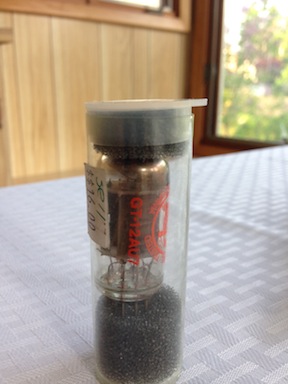
I had done a substantial amount of research for a BIAS review for Guitar-Muse that may or may not be see the light of day and in researching all aspects of the tube pre-amp, rediscovered the 12AU7.

12AU7

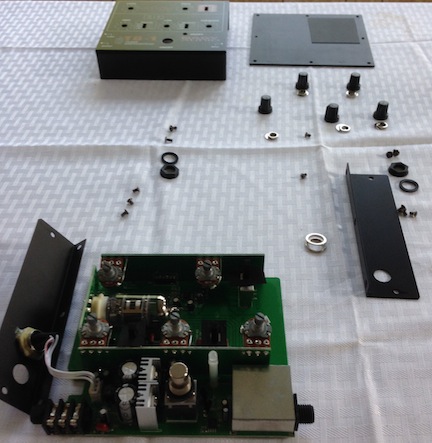
This tube is a direct replacement for a 12AXA7 but has some different tonal characteristics and offers less gain.  On a recent trip to Drome Sound, I found a NOS Groove Tubes 12AU7 for $10 and decided to swap it out in my Nady TD-1.  The TD-1 is a cool pedal in terms of tone, and a terrible housing design as replacing the tube requires completely dismantling the casing.

As a first step, you’ll need 3 tools to do this.

ToolsOn my first dismantling attempt, I realized that I didn’t have a star shaped driver to undo the sides of the casing.  It seemed cruel for Nady to not simply use philips head screws but a quick trip to Radio Shack got me the driver I needed (with some other attachments) and soon I had this.

Nady Pedal DisassembleThere are 36 parts holding the casing together.  You need to remove all 36 to get the tube out (a Chinese made 12AX7B in this case).

Pedal Interior

You’ll also notice that you don’t have a lot of wiggle room to extract the tube.  The photo above shows the replaced GT in the socket.

The A/B Rig

First off.  I had a strange experience with my hybrid solution at the last gig I played.  Soundcheck went fine and then live when I switched to my lead patch the volume dropped by 70% or more.  I had to full crank my QSC K-8 (which I’ve never had to turn past 10 o’clock [the off position starts at 6 o’clock]) to be heard.  I assumed it was a cable or a bad connection but checking the cables after the gig, they were all fine.  Line 6 just released a new Firmware update to deal with volume drops with that occurred when switching patches with specific configurations and I guess mine was one of them as it seems to be working now.

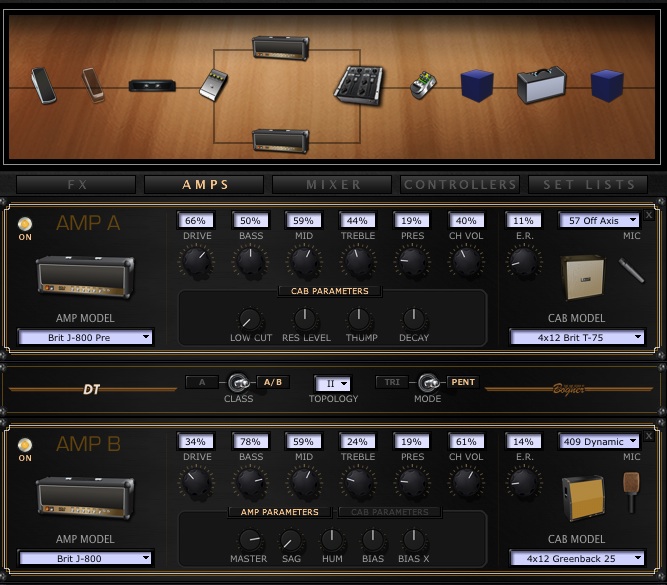
I started the process this weekend of porting all of my patches from the HD-500 over to the 500-X (and trying to recreate some of my POD Farm patches there as well) and thought I’d give you an A/B example of the dual rig.

This was one of my old POD patches that I liked.
Dual 800It was a great dirty rhythm sound but the leads were hit and miss.  I put a FX loop in with a 6 DB increase and used it as a boost for solos.

In contrast, here’s my current configuration.  The tube screamer is gone and replaced by the TD-1.

J800 + J45_1The TD is also the first step of my signal chain so I use that for the lead boost.  Here are the amps:

800 + 45_2You may notice that the cab models are turned off.  The FX loop now goes out to the Torpedo for the cab simulation.

So this means that I have 2 extra things plugged in with my POD.  Which is way more of a pain than simply using the POD direct.  But does it make a difference?

Well the tones are completely different but here’s the A/B.  I’m just improvising some D major patterns over a D5 chord.

Recorded the TD/Torpedo is more saturated, but the biggest difference is live.  When played through my QSC, the second tone has substantially increased presence in the room.  I don’t know how to describe it but seems to jump out more from the speaker.  There’s also a little hiss from the pedal, but I can live with it in a live context.

Wait there’s a third option?

Having said all of that I took advantage of a recent cancelled rehearsal I showed up to to put my Positive Grid Jam Up App through the paces.  I can work with it at home but it’s a different context to put it through an amp on a stage in a large hall and see what happens and I have to say – I was pretty blown away.

I’m going to be doing live accompaniment for a production of The Exonerated at the BuckMoon Arts Festival in July and currently it looks like I’ll just be bringing my iphone, a laptop for some synths and looping and a powered speaker.  It doesn’t have the flexibility that the POD set up does, but for situations where I just need a decent clean/dirty tone – it gets the job done and then some.

More tone reports as the summer progresses – but hopefully this is useful to some of you.

As always, thanks for reading!

-SC

Differentiating Between Action and Change

Physician Heal Thyself

I was reading an e-book on my iPhone the other day and hit the library tab by mistake which revealed every book in my account.

Since a lot of authors will give books away to try to get reviews (a profoundly unsuccessful tactic that I tried myself once) – there are a number of titles there.  Skimming through them  I thought about the difference between taking action and making changes.

Taking Action is often a cycle that is more of a stationary bike than anyone would care to admit.  For many of us, the cycle works like this:

  • You realize that something is wrong and needs fixing.  Perhaps you’re in a dead-end job, or you need to lose weight or you need to figure out how to get your product out in the world.
  • Realizing that you have a problem – you decide to take action to fix that problem.  You do research and find that someone else also had this problem and came up with a solution – and their book is only $3.99!  You pick it up, and (if you’re really motivated) you read a chapter and perhaps have a few “a-ha!” moments and start to carve out your plan.
  • More likely you pick it up and go make yourself a coffee or a tea to sit down and read it and then get distracted by what someone posted on Facebook and then never get back to it.

I saw (what I may have mistakenly remembered was a) TED Talk that advised people to not discuss projects at the preliminary level with other people because their likelihood to complete them would diminish.  The speaker cited a study that showed that discussing future projects with other people created the same chemical reaction in the brain as actually completing them.  It’s why some people get super psyched about a plan they’re going to enact, have their friends tell them it’s brilliant and then there’s no fire the following day to complete it.

From personal experience, I can tell you that it’s easy to confuse buying something with doing something because by buying something you’re taking action – which is what you said you’d do.

Taking action doesn’t necessarily mean making change.

Change comes from consistency.

  • Consistency means working on something repeatedly (and often daily) until it becomes an integrated part of you.

Change comes from focus.

  • Focus is a skill.  It has to be developed and nurtured.
  • Focus is easier to maintain when options are limited.
  • It is much easier to sit down and focus on a book if it’s the only book in the queue and not have a full queue and have your energy divided between which other books there you should read.

Some people are autodidactic.  They can read a book, assimilate and integrate the material and take immediate action.

Not everyone works that way though and the irony is that people who are not naturally autodidactic will often read a book, not take action on the book, assume that something must be wrong with them because they can see that the material book is working for other people and then solve the problem by buying another book.

Your book will not solve your problem on it’s own.

The actions you take from doing the things talked about in the book however, may.

So please, stop reading this post and start making the change you want to be.

But also please come back – I’ll have a lot more material up to help stay whatever course you happen to be on.

As always, thanks for reading!

-SC

So You Want a “Budget” 8-String – An Omen 8-String Update

Go With What You Know

Of all the posts on my site – by far the two most popular are my post on Guitar Street in Vietnam and the post on my Omen 8-string.  Since I’m not going to be able to make it back to Vietnam anytime soon, I thought I’d post on some things I’ve been working on with the 8-string.

Budget is the mother of invention

I basically have two views on gear.

On one hand, I fully believe that you should invest the money and buy quality gear that works for you.  On the People’s Court, Judge Millian has an common quote I’ll cite here, “Lo barato sale caro” – The cheap comes out expensive.  I have often found that when trying to cut corners on certain things (“That $30 chorus pedal doesn’t sound that bad”) that it ends up costing me more in the long haul (like having to spend valuable studio time testing out a bunch of other gear because that $30 pedal and that $100 amp DO sound that bad).  My QSC K-8 is not a cheap speaker, but given that it can push me in front of an entire band, it’s a bargain.

On the other hand, the quality of gear available now is better than it’s ever been.  I’ve been using Positive Grid’s JamUp and Bias with a Line 6 Sonic Port and I’m consistently blown away with the high gain tones and the quality of some of the effects coming out of my iPhone.
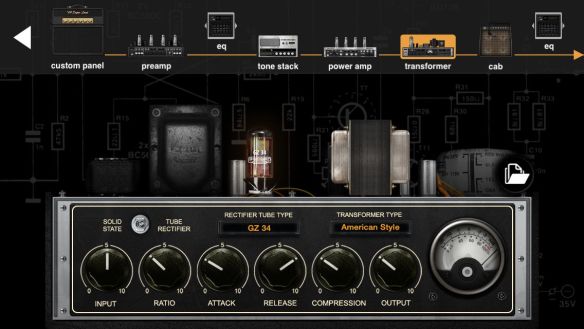
Transformer Front

Mind you, the hidden cost of this IS the iPhone but the apps are ridiculously inexpensive.  With the discounts they were offering before the BIAS release, I think I was fully loaded on the software for $60 or so.

Moving this argument to guitars, the building standards on mass produced guitars are constantly improving and the price is consistently dropping.  So when I looked at getting into an 8-string guitar, there were two routes.

  • Spend (for me) a lot of money on a custom model or
  • Try out an inexpensive model and see if it would work for me

Since it was a large unknown for me, I decided to go with the Schecter Omen 8-string.  You can read that gear review here, but a lot has happened to the guitar since then which may be of interest to people who are looking

This is another example of “Lo barato sale caro” BUT in this case it’s still much less expensive than purchasing a custom guitar and it’s good to see how these things develop.

There’s no going back to Kansas Dorothy
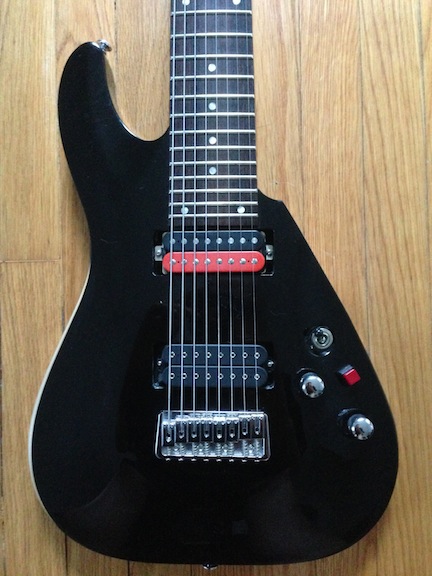
8 String Close Up

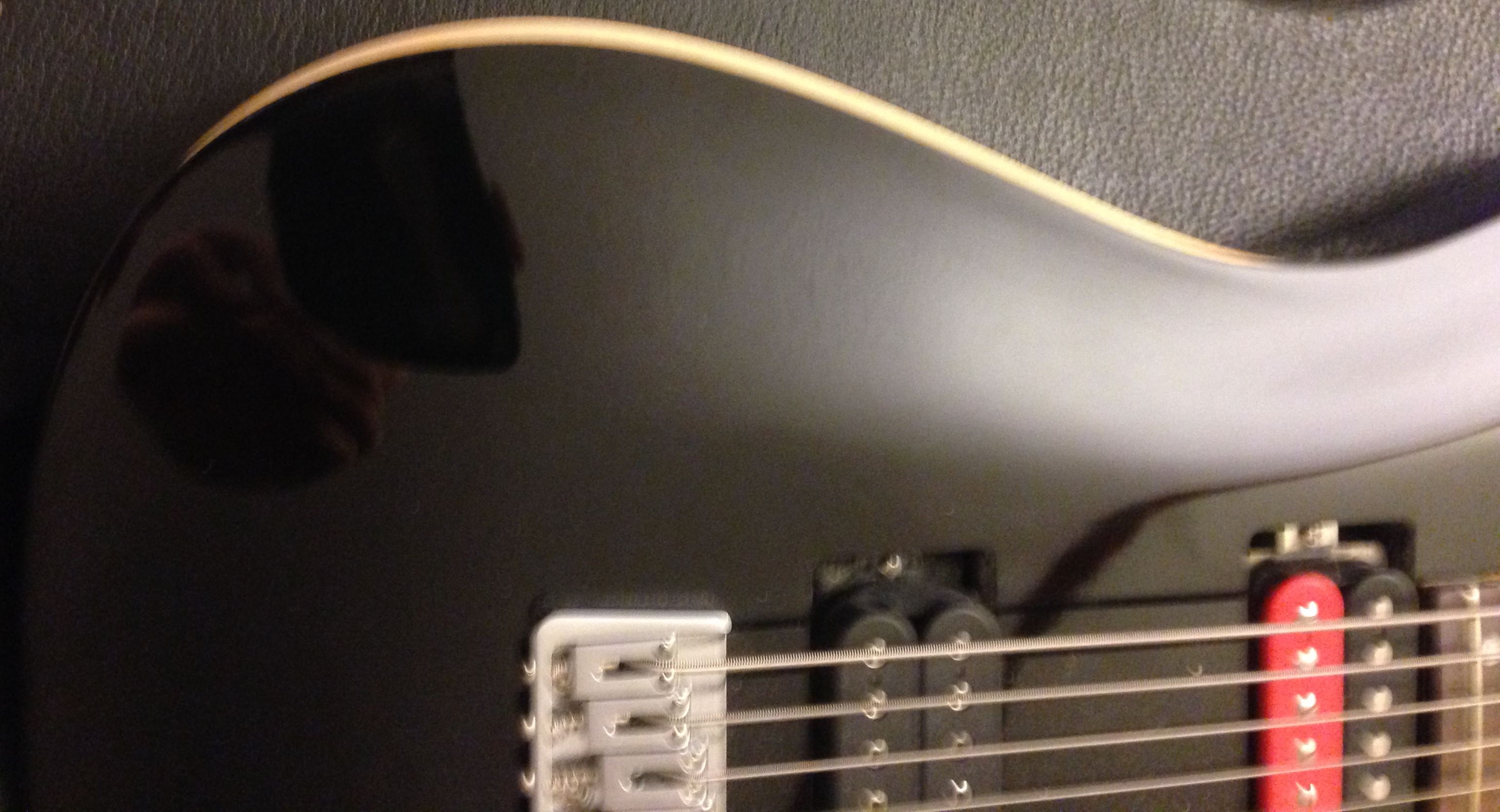
You’ll notice that on the right hand side of the body, there’s a modification that there’s no real turing back from.  (Side note:  When Mrs. Collins saw this mod she had a strange expression on her face and when I asked what was wrong she said, “Now you’ll never be able to sell it.” 😉 – Very true.)  However, you need to make gear work for you.  And this mod was done for a very specific reason.

Tuning

 Initially, I was experimenting with the following tuning:

(low to high) B-E-A-D-G-C-E-A.  

And then using a .007 for the high A and a .062 for the B.  But it didn’t work for me because the high A was incredibly unstable.  When I tracked some alternate takes for the Trials Evolution game, I ended up going through 3 of them at the session.  

So I thought I’d try the Tobin Abasi (Animals as Leaders) tuning with an additional Low E/A added to the standard 6 string tuning [(low to high) E-A-E-A-D-G-C-E].

I got a DiMarzio D Activator bridge pickup and had FnH Guitar’s John Harper install it and set the guitar up for the heavier gauge strings.  I got it back earlier in the year and used a F#-B-E-A-D-G-C-E tuning and I didn’t dig it.  I just couldn’t find a tone that worked with that tuning.

So I went back to the drawing board and decided to try to see if dropping the entire tuning down a step would give me the stability to make it through a live show.  I had about 20 .007 strings to experiment with so I figured I’d give it a try.  Also, I was reading about a string development that was interesting to me

Ernie Ball 7-String Cobalt set

After experimenting with various strings over the years I’ve always come back to using D’addarios for my electrics.  I still swear by their Pure Nickle .011s for my FnH – but I didn’t like the strings that shipped with my Omen and I didn’t like any of the 8 string set options that I tried.  When I realized that I’d have to throw a high string on the top anyways, I just started looking at 7 string sets that would work for me.  I liked a Rotosound set that I found, but when Ernie Ball announced their Cobalt 7-string set that supposedly had more output and clarity, I figured that I’d give them a try.

Out of the bag, the wound strings had an interesting texture.  I realize that interesting is a terrible descriptive, but I don’t really know how to describe it other than to say that they felt more “metallic” than the strings I was used to.  Not in a bad way, just a different way.  Using the new tuning, I found that the guitar had a lot more clarity on the lower string on high gain settings.  Often with high gain tones, the bottom end becomes mud – but I found that I could still use 4-5 note voicings and have clarity in each note.

My other string discovery was more counter intuitive.  After going through 6-8 .007s with the high G tuning – I decided to try to use .008s and they’re holding up much better!  I can only bend a step or so on the high frets – but I’ve only broken 1 .008 string so far and I’m pretty sure I can make it through a live set now.

Getting back to the photo:

8 String Close Up

With that tuning in mind, the upper bout on the treble side made it impossible to access the upper frets.  The reason for this is that the chunky bolt-on joint
Heel Cut

required pushing the wrist out to access the frets above the 18th fret which bumped it right into the bout.

It doesn’t sound like much, but if you’re going to go through the trouble to have a high G string, you want to be able to fully utilize it.  So out went the bout.

It was a great decision!  Not only did I get access to the upper frets on the high string, but it gave my full access above the 17th fret on the lower strings which wasn’t possible before.  Second only to this mod:

8 String Guitar

which allowed me to comfortably rest my arm on the body, it’s done a lot for the playability of the guitar.

Mod Review:

Okay – so for those of you interested in going the “inexpensive” route with an 8-string – here are the mods that were added to the guitar.

Pickups:  I’d say that you have to go into this guitar an expect to replace the pickups.  I like the Bare Knuckle and the DiMarzio for completely different reasons – but I find that they compliment each other really well.

Tuners:  Same thing with the tuners.  I’ve replaced the Low A and high G with Grover Rotomatics, but the middle 3+3 need tuner replacement as well.

Kill Switch:  Some people thought that was really gimmicky – but it’s turned out to be really great when acting as a uber-noise gate.  I can hold it down and get ultra-tight exits and entries into tunes.

Lower Bout Bevel:  The carving on the lower edge looks nice but doesn’t feel good when resting your forearm on it.  Also, aesthetically I think the single line of natural wood peeking through the black looks bad-assed.

Upper Bout Removal:  You’ll have to wear a strap with this mod as the guitar won’t be sitting on your knee, but what it does for upper fret access is a game changer.

This might sound like a lot, but as I said in the initial review, the Omen is a well built guitar at a great price point and that was the template that was really necessary for this to be possible.  All in when everything is said and done – I’ll probably have about $850 into the guitar but the Omen is a serious player now and the ability to go from the A on a bass guitar to a high G a full octave above the G on the 15th fret of a high E string gives me all the range I could possibly hope for.

Now comes the hard part

Actually getting around on the thing at the same level I can with my string is still taking me a while.  The strings are REALLY close together so every time I go from playing this to playing my electric 6 string or acoustic I can’t believe how far apart the strings are.  Also the modified tuning means that I have to transpose everything in my head.  This means that occasionally I’ll start to play something and have to switch mid-stream because I’m in the wrong key!  Fortunately, those “whoops!” moments get worked out at home so they’re not being made on the stage.

(It’s also interesting just how different this guitar is in terms of timbre from my other guitars.  In JamUp Pro for example, I had to make my own amps in Bias to find a high gain model that worked with my guitar well as none of the high gain models provided did what I needed them to do.  With the 8-string even stock models like the Jeff Loomis model sound really good to my ears with no modification necessary.)

I’ll be documenting some of the strategies that I use in navigating the 8 string fingerboard later this year – but suffice to say that without the 2-string visualization methods that I’ve been using (and writing about) on the 6-string, I don’t know how I’d be able to tackle this.

More gear and playing posts in the pipeline.  As always, thanks for reading!

-SC

The Trickle Down Theory In Action

I was listening to the radio as I was driving home last night (I had finally caught up with all my pod casts on my iPhone) and the local classic rock radio station was playing a syndicated run of the Sixx Sense (Nikki Sixx of Motley Crue’s) radio show.  On the show, Nikki mentioned a statement Joey Kramer of Aerosmith made in an interview that Aerosmith wouldn’t likely be releasing any more full length recordings.

“It would be great to make another record, but it’s almost (like) ‘Why bother?’ Records don’t sell and they don’t do anything….There’s really no money per se to be made on records. We used to make a lot of money on records. Now all of our money is made on touring. Artistically, it would be fun to make another record and it would be a beautiful thing if we can put it together. But to what avail, I don’t know. There’s almost no reason to do it, you know, judging from the last one and how it went over.”

(This quote was taken from this article).  – http://music.msn.com/music/article.aspx?news=864585

Aerosmith’s 15th release, Music From Another Dimension sold “only” 63,100 copies during its first week U.S. release – a substantial downturn from previous efforts.

Sixx went on to talk about how no one buys albums anymore and about the business model for releasing singles going forward for both Aerosmith and for his band.

A completely unnecessary plug for Seth Godin

For those of you who have any interest in music as Business – I can’t recommend the completely free Seth Godin’s Start Up School podcast enough. (You may want to take a moment right now and go ahead and download the episodes.  Don’t worry this post is staying right here).  Mr. Godin talks about a number of great things that are applicable to making money in music in the podcasts, but one area in particular can be direct relation to this post.  In one episode, Mr. Godin said that people at the top are always the last to be affected by an economic downturn.  So, for example, Van Morrison will still have people go out and buy Moondance because it’s Van Morrison.  He might not be making the money he was making before file sharing, but he’s making more money than a new, unknown act would be making from music.

So, the fact that a large band is now coming to the same conclusion as every other working band on the planet this late in the game isn’t surprising.

But I think that their strategy is all wrong.

I think it’s all wrong because I’m guessing that they only learned half the lesson presented here and will execute the strategy in the wrong way.

The Dinosaur And Creating False Scarcity

The bands that get momentum from the “singles” models (and I put singles in quotes because I honestly think that only people over the age of 30 even remember what I single release it) get momentum from an aggressive release and touring schedule.  They might release 2-5 eps a year.  They have new tracks out constantly because it’s the new tracks that drive traffic and attention to them.

It’s an aggressive promotion strategy and one that requires a lot of flexibility.

Aerosmith is a large corporate dinosaur – even if they’re not signed to a label anymore.  They need to self-fund releases (and it will give them pause to output money before bringing more in) and, quite frankly, given that every past effort has involved spending years recording, mixing and promoting a new full length release – they’re not going to be able to strip it down and knock new releases out one after another in quick fashion.

But I also think they got it wrong.

Know Your Audience.

Yes, a number of people who are willing to buy music will buy a single rather than an album.

You know who buys albums, by and large?

I’ll give you a few groups off the top of my head.

Metalheads

Prog Rock fans

Jazzers

Those are some specific sub-genres that have fans who get behind bands rather than singles.  People who dig Animals as Leaders will buy whatever new release they have.  Ditto for King Crimson or Allan Holdsworth fans.  They’re not in it for the single.  They’re in it for the experience.

Aerosmith may look back at the ‘80s when 40,000 units sold might not even get you a top 40 release in a given week, but they don’t seem to realize that 60,000+ units is a LOT of units sold in the contemporary music market.

I’m guessing their fans will wait for a new album.

Will they wait for the same length of time for a new single?

There are a few related lessons I’m gathering from this extrapolation on a statement.

Know your audience

know what they expect from you

know your ability to meet those expectations.

It’ll be interesting to see what happens down the road for Aerosmith.  They might have enough backlog to be able to get things out quickly and prove me wrong, but it’ll be interesting to see how it plays out for them in the future.

That’s it for now.  As always – I hope this helps in some way and thanks for reading!

-SC