Guest post on Joe Gore/Seymour Duncan’s Tone Fiend and The Fortunate Demise Of The News Page

So, in typical GuitArchitecture “last thing first” style, the news page is gone.  It seems to make more sense to just put updates about gigs, recordings, etc. here.  I always forgot about the “news” aspect of the page anyway so (even with about 30 pages of updates and info in the hopper)  it’s not much of an immediate loss.  For those of you who subscribe to the blog, I’ll try to keep the news posts to a minimum.  In the meantime, here are some recent items that may be of interest.

.

Guest Blogging for Joe Gore’s Tone Fiend

Big thanks to Joe Gore for posting my article (and editing my chicken scratches into something coherent) on the wild string sounds of Vietnam on his great tone fiend blog.  If you want to see some crazy guitars (and some crazier phrasing) you can czech out that post here.

.

  • In other guest posting news, I have a (relatively) new post up on Guitar-Muse.  If you’re looking for a warm-up lick (and some good playing advice) check it out! A cool  interview with Mike Scuffham (of Scuffham Amps/S-gear) is also up here , and you can find all my posts (interviews, lessons, and more) here (it’s 3 pages so just tab through the bottom of the page.
  • Books.  I just want to take a moment and thank everyone for their pdf orders (and kind words about the books in general).  It’s simultaneously affirming and humbling at the same time.  So thank you!  If you’ve ordered a hard copy, I still hope to have print editions  by the end of January.  As soon as I get proofed editions – I’ll  get one out to you!

There’s more to come!!

As always, thanks for reading!

-SC

Getting Hipness From A Major Triad Or More Chord Recycling Part 1

When I was at Berklee, one thing that took a while for me to really get my ear around was upper chord tones (7ths, 9ths, 11ths and 13ths).  Growing  up listening to a great deal of rock music – basic triads sounded “right” to me.   I learned a lot of esoteric chord voicings to try to expand on those forms – but my ear wasn’t ready for it and so I had no real motivation to develop it at the time.

As I mentioned in the getting through the gig and the recycling chords posts, simple triadic forms can be manipulated in a way that allows players to get more complex harmonic textures in real-time.  Additionally, these approaches can be adapted to lead playing as well.  This short series of posts are going to go deeper into adapting one specific chord voicing.  As a starting point I’ll use the major triad.

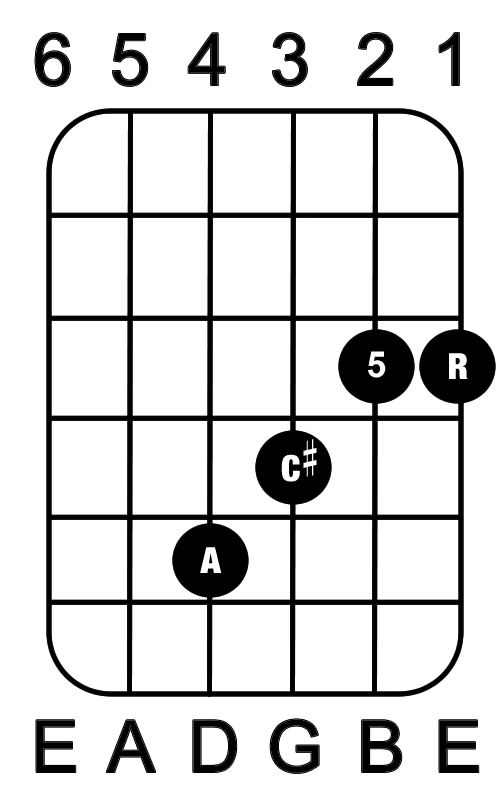
The following examples are based around a 5th position A major chord played on the D, G, B, and E strings.


The reason I’m using this specific voicing is to allow the open A string to ring while playing the chord to help reinforce the root.  Here’s the basic rhythm of the chordal examples:

While notated this way for simplicity, all the examples are played with a slight arpeggiation to help accent the different notes.

.

Here’s an mp3 of an A Major Triad.

 .

Rooting around for extra tones:

The first way to generate some additional substitutions for a simple major chord  is to lower the root chromatically.

While there is a root on both the D and the high E string, for now these examples will focus on manipulating the root on the high E string.

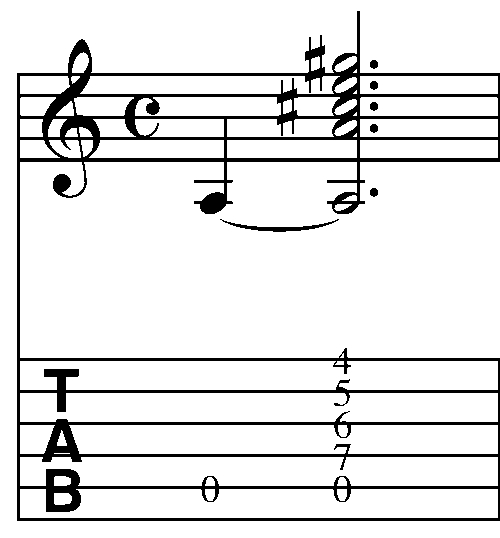
Lowering the root of a major triad a 1/2 step (1 fret) produces a Major 7th chord:

(This can be used in place of any A major triad)

A Major 7 Chord

 .

Here’s an mp3 of this A Major 7 chord.

.

Lowering the root of a major triad a step (2 frets) produces a Dominant 7th chord:

(This can sometimes be used in place of an A major triad

Example: When the A acts as a V chord in a chord progression (A -> D becomes A7–>D))

A7 Chord

.

Here’s an mp3 of this A 7 chord.

.

Note:

While dominant 7th chords contain a major triad in them – they are their own unique animal.  A future post will go into generating dominant chords – in depth – but this voicing is presented here as part of the process of generating chords by altering the root.

.

Lowering the root of a major triad a step  and a 1/2 (3 frets) produces a Major 6th chord:

(Typically this can be used in place of any A major triad)

A Major 6 - Watch the 1st finger stretch - if it hurts - stop Immediately!!

.

Here’s an mp3 of this A Major 6th chord.

.

Another Note:

There are certainly easier ways to generate this chord – but any chord form with  a 1/2 or whole step between notes on the B and E strings will require some limber hands.  Again, this voicing is not the only possible voicing of this chord but instead is just one possibility.

.

6th chord/13th chord Tip:

Frequently, I’m asked about the difference between a 6th chord and a 13th chord.  Since the note is the same for both the 6th and the 13th, the terms are sometimes used interchangably – but the difference is based around whether the chord has a 7th in it.  In the example above, the F# acts as a 6th, because no 7th is present in the chord.  If a seventh was in the chord, the F# would be viewed as a 13th.

.

The #4/#11:

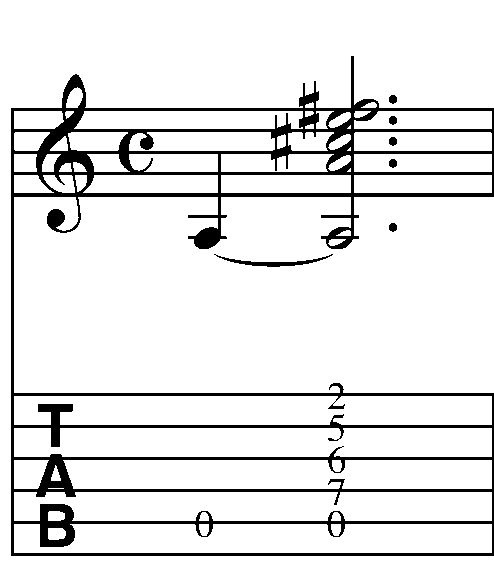
One hip tone to use in a Major based chord is the #4 (or #11).  This is generated by flatting the 5th a 1/2 step (1 fret).

A Major add #4

.

Here’s an mp3 of this A Major add #4 chord.

I like voicings like this where the top voices (C#, D# and E in this case) are all close voiced (i.e. in the same octave). The technique of combining these close voiced ideas with open strings is a favorite approach of mine.

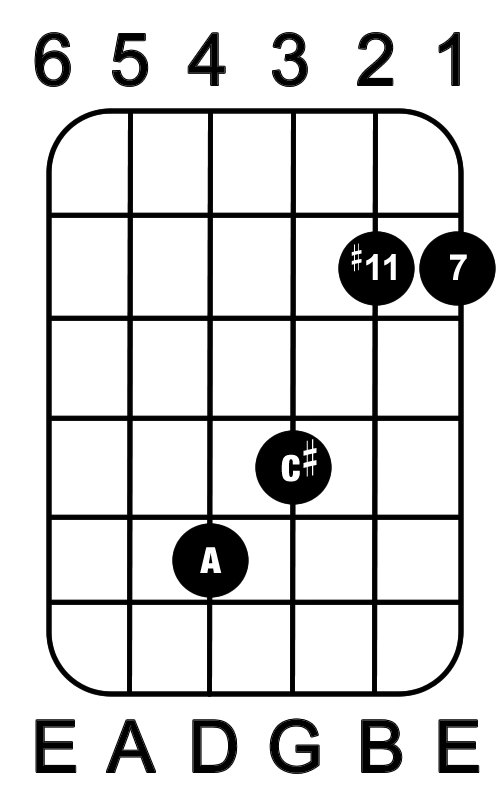
This idea can be expanded on by flatting the root as well.

This produces an A major 7 add #11 (no 5th) chord (A favorite substitution of mine for a major chord).

A Maj 7 # 11 no 5th

.

Here’s an mp3 of this chord.

.

Shortcut:

If you flat the top two notes of a major barre chord with the fifth and root on the B and high E string – you get a pretty hip major chord substitution.  This works in any key.

In part 2 of this series, I’ll look at sharping the 5th and the root to generate more chord voicings, combining both approaches and extrapolating lead ideas from these approaches as well.

Thanks for reading!!

-SC

A Reminder – Stuart Adamson – Holidays – And Seasonal Affective Disorder

I’ve been thinking a lot about Stuart Adamson (guitarist and founder of Big Country) lately as I knew that the anniversary (not the term I’d like to use here – but the only one that comes to mind) of his death is in December (it turns out it was yesterday, December 16th.).

The first time I heard, “In a big country” and heard the way the the guitars were imitating bagpipes, I was blown away.  It never occurred to me that a guitar could imitate other instruments and in a lot of ways – the explorations I’ve made in adapting techniques and approaches from other cultures to guitar all stem from that initial door being opened for me.

It is incredibly awful to realize that the man who wrote these lyrics:

“…I’m not expecting to grow flowers in the desert,
But I can live and breathe and see the sun in wintertime..

And in a big country, dreams stay with you,
Like a lover’s voice, fires the mountainside..
Stay alive..”

would be found dead by his own hand in a hotel.

I don’t know anything about Stuart Adamson.  I don’t know anything about the pressures that drove him to such a desperate act so his particular situation isn’t something I feel comfortable discussing.

I will say that this season reminds me that I know some people with Seasonal Affective Disorder (S.A.D.) and the winter holidays are always particularly difficult (and sometimes very desperate) times for them.

.

Note:

The tags for this post are very limited and specific – so if you’ve come here from a google search – I implore you to read on.

.

All I can say is that every person on this planet has an effect on other people. You matter because everyone matters and no matter how physically or emotionally isolated you might perceive yourself to be – there are people who care about you.

If you or someone you know is prone to depression around the holidays – please seek out (or encourage them to seek out) professional help if  not doing so already.

Even if professional help is not available at the hour you might need it – if you are feeling desperate at a minimum try to reach out to other people.

And if other people need help, please make yourself available to them.  Sometimes a caring friend is just enough to get people past a dark moment long enough that they don’t do something rash.

.

In the U.S. The National Suicide Prevention Lifeline is 1-800-273-8255.

.

Again, I don’t know anything about Stuart Adamson.  But in listening to The Crossing, I can’t help but think the world is a smaller place without him.

Towards A Personal Improvisational Aesthetic

The following is a paper I submitted for Susie Allen’s Aesthetics and Ontology of Free Improvisation class at CalArts.

The paper discusses the aesthetics behind my improvisational process and was written as an improvisation (i.e. in a 25  minute writing session with no edits) .  This writing style was done in the spirit of the class – but I hope that it addresses some real points regarding improvisation and not just my undying love for the Sledgehammer riffs of Black Sabbath 😉

While highly personal (it is my own aesthetic I’m discussing) – I’ve posted it as it brings up some questions on the nature of improvisation.

When I went to Berklee, there was a very dogmatic definition of “improvisation” in play that typically involved playing well rehearsed licks over well worn changes.  This has as little to do with improvisation (in my way of thinking) as me being spontaneous at a party and deciding to tell the story about the time I was on the number 1 bus with the wasted hooker on the way to Central Square I’ve told a dozen times before…

Derek Bailey’s Improvisation book, is a good beginning toward a real discussion of this topic – but it really only scratches the surface.  A difficult topic, along with aesthetics and one that certainly isn’t deeply represented here.  Nevertheless, you may find a point or two of interest below….

Note: – Unlike the paper I submitted to Susie, I did edit this post for spelling mistakes.

.

Towards A Personal Improvisational Aesthetic

.

“This paper is being written as an improvisation.  I have a central idea that I am working on, namely the aesthetic of what I do, and then will base a series of observations around that.  With any luck this will lead to a logical conclusion.

.

My aesthetic comes from a variety of sources, I am fond of saying that Arika Kurosawa’s RAN was probably more influential to my musical development than any composition.  This is of course an oversimplification.  Growing up in a white middle class home in a small town in upstate New York…An early love of horror and science fiction films…early Saturday Night Live episodes and classic comedy, the works of Charles Schultz, of Borges, Marquez and the other magical realists.  The stylism of Yukio Mishima.  Punk rock and Bartok.  Ornette and Black Sabbath.  The Beatles and the Swans.  Eiko Ishiyoka.  Ingmar Bergman.  Woody Allen.  Son House.  Charlie Patton.  David Cronenberg.  This list alone would take up four or five pages.  The point is that my aesthetic is formed by not only all of the things I have experienced, but in fact, from all of the things around me.

.

While my aesthetic has a variety of things in its origin, it is fueled by a resonance with passion.  It is what unites the Balkan folk tune with Patsy Cline.  I seek passion in performance.  I seek actions that come from a real place.  That are transmitted somehow in a real way – a way that resonates with my own emotions.

.

I seek the articulation of the scream, of the sob.  I seek the frame work for tears and joy.  Occasionally I seek the image in the blade of the knife.  I seek the commonality of the intimate connection.

.

My own “art” involves sonics – and while I am frequently fond of dismissing it as, “all the same to a deaf person” – my music – my sound is part of the core of my being.  And with it comes baggage.  Baggage is not always a good thing in sonics.  Neitzsche’s abyss gazing back into thee.  Familiar things that go everywhere YOU go.   That start to define you.  People look at baggage to see where you have been.  They look at your baggage to make judgments about you through your travels…your experiences, “Oh you’ve never been to Lisbon darling – oh you really must go sometime”.  Baggage is a difficult thing because your baggage usually carries things that are yours.  This is important, there is a little of you in all of your baggage and that is why it is so difficult to get rid of.

I understand the importance of repertoire, but repertoire is ultimately not of terrible interest to me.  Repertoire to me equates to repetition.  Our culture thrives on repetition.  If you do something successful, the thinking is you should immediately do it again.  Society seems to tell people that you should vary responses only if there is a guarantee of succeeding at an even greater level and that you should never vary responses if there is even the faint stink of failure.

.

Repetition can be an anathema to improvisation.  It is acceptable to me in some elements of improvisation.  For example, a person improvises an idea and repeats it – setting a stage for motif or a tonal idea.  This is acceptable to me.  The concept of repertoire as I learned it, the old music of a number of dead old men – all performed with an archivist’s attention to detail, is not really in line with my thinking.

.

I like improvising.  I like creating new repertoire.  I like knowing that this moment is unique.  That it will never happen this way again.

.

Still I can’t leave well enough alone.  I have the consistent idea to document these improvisations.  To edit out the warts and polish them like a stone.  The world belongs to the editors. The editors determine history and the people who determine history determine the basis for context.

.

This is a problem with improvising a paper.  Ideas ramble and there is no way to reel them in.  This paper, however, is a true improvisation.  It has been started with a goal in mind and is moving towards a conclusion.  My marketing experiments with improvisation, trying to clean up recordings to make them more viable for other consumers is not going to have an effect on this paper.  This paper is a stream of thought that will not be altered.

.

And this process is necessary.  It is necessary because the only way to get to the heart of this issue is to do so without self-editing.  To write this down as if I can split the singular voice in my mind into a conversation. That these words – these chemical reactions in my brain that generate these disgusting, silly guttural hang-ups are now reduced even further into lines on a page…into dots on a computer screen is humorous to me.  Because somehow these lines work their way back through the reader’s complex neural network and allows those ideas to be interpreted by the reader in a very similar way.

.

This is the point of improvisation.  Improvisation idealistically creates a communal idea.  It creates core material from something unique and allows for a direct transmission to the audience.  This is the ideal.  Improvisation is a language. When people are listening – improvisation takes metaphoric words and phrases and transforms them into a dialog. The beauty of improvisation is that where words will generally have a similar meaning (i.e. when I write the word chair there is a platonic idea of a chair that is generated in the reader’s mind’s eye.)  But in improvisation, the audience is an active participant in facilitating a dialog that can never be interpreted by the audience in the same way that it is for the improvisers.  It is a translucent image rather than a transparent one and it is in this distortion that there is beauty, there is horror and there is the essence of what it is to be human.

.

Improvisation as a practice is the focus of an idea through an imposed restriction.  This restriction could either be self imposed or be imposed upon the improviser through other means. Improvisation as it relates to common experience can be seen in the example of the car that stops running in the middle of a trip.  A person experienced in auto repair may attempt to pop the hood of the car to see if they can ascertain how to repair the vehicle.  Or they may try to flag down help.  Or they may try to use a cell phone to contact a garage.  The point being that within the context of a vehicle malfunction, different actions are improvised based on the improviser’s facility with both the situation at hand and the tools at their disposal.  The same is true for an improvising artist.

.

This is why improvisation and the aesthetic behind that improvisation is so important.  Because life is essentially an improvisation.  As individuals we are brought into an unknown situation and then required to come into each day not exactly knowing what will happen.  We know that there is an eventual end, but we don’t know when or how it will end.  But we continue to improvise, because it is in the active improvisation and in the aesthetic behind our improvisational choices that we create meaning.”

“The limits of my language are the limits of my world”

If you want to be a great guitarist you should try to develop and nurture passion for other art or music that has nothing to do with guitar and adapt or assimilate those things in your playing.

.

Story Time

.

Please allow me to share a story with you.  This is a true story, but the names have been removed to protect the guilty.

Once upon a time, there was a doe-eyed child trapped in a 17 year old body who left his small town of 2,000 people and went to a big city to study guitar.  The institution of learning he went to study guitar at was a very big place with several thousand musicians.  At the absolute minimum it was completely overwhelming for him as an experience.  He went to the school knowing his ass was going to get kicked – but not knowing that saying his ass would get kicked would be more like telling the parachuter mid jump when his/her chute wouldn’t open he/she might break a bone from the fall when they “bounced” (yes “bounced” is the technical term for this occurrence and yes, it happens often enough that a term needed to be developed).

.

It kind of broke him.

.

In addition to the culture shock of being in a city, rather than a place he described as “Deliverence with snow”, he found the school had a real focus on Jazz and anything non-Jazz was looked upon with complete derision.  He was bombarded with fellow students and faculty telling him the music he liked – the music that was a part of his soul –  was trash and he was wasting his time with it because Jazz was the only music that mattered.  So he did what anyone from a small working class town would do, he became a walking middle finger to anything Jazz because he thought that it was the only way he could defend his identity.  The moment that door was shut was the moment his undergrad experience was doomed.

.

Now to be fair, the blame for this was 50-50.  He had no understanding of Jazz as a style.  

Where he grew up in upstate NY, Classic Rock radio and top 40 was the staple and those were his primary means of musical exploration.  But the problem was the curriculum was based around an academic buy-in for Jazz pedagogy, so if you knew nothing about it stylistically – there was no easy way in.  It was just simply rammed down your throat and you either swallowed or spat it out.

In his lesson – a weekly 1/2 hour slot – he and his teacher went over a series of proficiency requirements that were necessary to pass the final exam.  The student asked questions about why he needed this material and how he could utilize the material in the rock and metal music he was playing –  but he was just told these were tools he needed to play Jazz.  And given what we’ve said about his (now visceral) reaction to Jazz you can imagine how well this was received.

.

His second semester he found another teacher and this teacher was more understanding about what he was trying to do and who shared a lot of his interests.  The two of them started delving into Japanese modes and other concepts and he actually got excited about what he was doing.   The student asked his new teacher if they could just keep going in this direction instead of focusing on rote memorizations of reharmonized chord-solo renditions of tunes that he didn’t need solo renditions.  The teacher said to talk with the chair of the department and get his approval.

.

The chair of the department was newly appointed, had a lot of work to do and was not happy with the prospect of meeting with this student.  The student explained he had a very specific direction that he wanted to go in his playing, that this direction didn’t coincide with the narrow parameters of the proficiencies and then asked the chair if there was any way that he could be accommodated.  The chair informed him that wasn’t what they did at the school.  The purpose of the school (according to the chair) was to have students master that particular school’s style and then when the student got out he or she would have the rest of their carer to develop their own style.

.

The student said that while he realized he was only a student – the logic of the argument evaded him.  Actually, in the interest of honest reporting and to exclude any pretense of articulation what he said was,

.

“Look I know I don’t know anything – but that’s the dumbest thing I’ve ever heard.  There’s only 12 notes – that’s the substance.  Everything else is style.  What is the point of having 800 people all walking out of here and all sounding exactly the same?  Isn’t my style the only thing that’s going to make me different from every other guitarist out there?”

.

The student was then told that was the way it was and he could either take it or leave it.  

The student thanked the chair for his time, walked over to another office and submitted a change of major form.

.

Music is a language.  If you learn it as a language – immersing yourself in it, learning vocabulary, speaking it to others as often as possible – you will gain fluidity in it.

.

I want to discus vocabulary for a moment and then discuss the issue of style.  One way to think of licks is as musical vocabulary.  As a musician, you learn a bunch of licks so you can communicate with other musicians.  It’s similar to going on any trip or travel.  You might not speak a foreign language – but you should at least learn how to say a few words or phrases to try to get you by.

.

If you only learn licks from one source –

it will be difficult to not sound like that source.

.

If I go to a show and see a guitar player I can tell you usually in a song or two who he’s listened to.  If it’s only guitar players I probably won’t make it to song #3.  Going back to the language analogy, if you grow up in New Jersey and everyone you know and speak with is from New Jersey – you’re going to have to work hard to get a Texas accent sounding authentic, much less an Irish or Spanish one.  Do you have to learn other accents?  No.  No one is forcing you to do so but it’s important to realize that…

.

all of your experiences influence how you communicate with other people.

.

Hence the Wittgenstein quote in the article.  For those of you who remember Orwell’s “1984” – there was the idea of newspeak,  the language that kept getting smaller each year for the purposes of eradicating thoughtcrime.  The less you experience in the world, the less you are able to express.  This is why 13 year old children writing love songs do not have the lyrical content to truly plumb the depths of the soul, even though they are often supremely confident that they do.

.

If your experiences influence how you speak with other people then it stands to reason they can effect how you play with other people.  If, for example, four guys in a room have only listed to, played and learned “Smoke on the water” – they’re not going to write “Giant Steps” on their own any time soon.  They’re going to play “Smoke on the water” and if they do write something new, it will probably have a lot of similarities to “Smoke on the water”.  (Traveler’s advisory – do not party with these guys.)

.

Adaptation and the hidden agenda

.

This isn’t to say that you shouldn’t learn other people’s licks.  It’s vital that you dobecause you have to develop vocabulary, but I highly recommend you vary your sources.  If you play guitar, try learning music played on other stringed instruments like violin, or from non-string performances like vocal lines.  My rhythm playing is rhythmically informed by things like drum rudiments, flamenco foot work and rhythmic phonetics.  My single line playing is rooted in rock, but there’s various Hindustani, Balkan, Arabic and Koto references that are specific to things I do.

.

Almost every gig I’ve ever played I got because I put energy into learning things that weren’t guitaristic and adapting them.  You’ll never confuse my guitar with a Kayagum – but if I play a note with a sharp bend and crazy vibrato it doesn’t sound like a guitar lick either.  It crosses a boundary and becomes something new.  And here is the hidden agenda.

.

When it becomes new, it becomes yours and things that are yours have extra value.

.

In addition to this, try cultivating artistic influences from things that are not guitar related.  

The painter Francis Bacon probably influenced me at least as much as Hendrix and his works are a model for me in expressing motion and fluidity through art.  I’m passionate about books and films and I try to adapt anything worthwhile in those experiences into my playing.

.

Acquiring tastes

.

A funny thing happened to that student after he got out of school.  He started playing with a lot of other players who had opened their minds instead of closing them and those people hipped him to a lot of music – including Ornette Coleman and Ornette was making some of the most wonderful music he had ever heard.  The student found that when it wasn’t being force fed to him as the only viable form of musical expression that there were a lot of great artists and great music being made in the genre and years later (with a little maturity and perspective behind him) he became a fan and started adopting a number of ideas and approaches from the style into his playing.

.

The important thing is to find things that you are passionate about and explore, adapt and/or assimilate them to the fullest level you can.

.

The limits of your musical language are the limits of your style.

.

As always thanks for reading!

-SC

Welcome!

Welcome to my blog.  What you will find here is information about GuitArchitecture, links to media, lesson material and various related music projects that are ongoing.

This blog is more of a static webpage than a daily updated outpouring of observations – and that’s probably a good thing.  I tweak little things here and there and tend to put a lot up at once.  Hence the original publishing date of last July.

There are links on the right to take you anywhere on the site.

Thanks for dropping by!