The Accidental Path To Authorship – Part I – Angry Guitar

Recently, I had a Facebook Memory that came up from 2011.

Facebook Memory


This prompted a question from a friend of mine.

“Is there any part of you that misses doing all that writing? Are you happy to have (seemingly) traded that out for a ton of playing and gigging lately? Do you seek a middle ground between the two?”

My reply is long and probably will never be read by the people who want to learn more about retro-fitting Steinberger tuners on their guitar but it may be of interest to those of you at crossroads in your musical development as the path to learning guitar at a deep level in my case was not a straightforward journey.

Ultimately, it speaks more to:

  • having a deep seated “why” and a desire to learn
  • adaptability and having an ability to create opportunity rather than waiting for one to happen
  • simple endurance.  Being too pig-headed to refuse to give up and keep going despite not having any kind of external support structure.


Part I of my revised (and greatly expanded) reply is below.  I don’t know if this will help anyone, but I’m posting it with the knowledge that there’s much to be gained in examining what to do as well as what not to do.

The short answer is no, I don’t miss it.

I have another book that could have been edited and released 2 years ago and I decided to hold off on it, because at a certain point the inertia of writing was easier than playing – and playing was an important part of what I wanted to do. The more I was writing, the less time I had to actually play and the longer it was becoming before I released something.

Thank you!  Good night!

For those of you who want the MUCH longer answer, here you go…

My entire path to guitar started in anger.

I was in middle school and studying drums with Rex, who was a notoriously difficult teacher.  He would brag about having 20 people sign up for drums and only have 2 complete the program.  It took me years to realize that difficulty is not an indicator of the merits of an educator’s program, but instead an admission of an inability to engage students at a deeper level.  I would come to see this again with some of the faculty at Berklee when I went there years later.  It took me a long time to realize that truly great teachers (like Henry Tate, Mitch Haupers, Jon Finn, Stephanie Tiernan or Rick Applin at Berklee or Susie Allen, Vinny Golia or Miroslav Tadic at CalArts to name but a few) have an ability to explain things in an accessible way and draw students in rather than setting up artificial obstacles to knowledge to see if you were “worthy” of receiving it.
Anyways, back to drums.  I had done rudiments with the sticks and practice pad I got, but it was deadly dull and, as no one could explain the tie in to this and making music, I had no educational buy in.  So I decided to quit.  My friend Chad told me to check out this guy named  Jimi Hendrix and I taped the local classic rock station playing “Are you experienced?” on my boom box and that just burned a hole in my head.  I played that tape over and over again listening to the sounds he made on the guitar.

When I decided to drop out of the drum group, I said, “I think I’m going to learn guitar” and my classmate (and eventual high school band mate) Jeff said, “You’re never going to play guitar.” – and that’s all it took.  That one moment of, “I’ll show you!” fueled much of the rest of my life.

Lesson one – change can happen in an instant and one moment can affect the rest of your life.

My parents got me a beat up 3/4 size acoustic guitar that one of my cousins didn’t want to play anymore to play.   I liked it – but with approximately 1/2″ action at the 12th fret it was largely unplayable so with much cajoling, my parents bought a guitar.  I wanted a name model and what I got was an acoustic that my high school shop teacher Jeff Chappel made.

(Lengthy side note for you guitar geeks still reading this, my Chappel guitar is also one of the weirdest guitars that I own in that the scale length is completely non standard – something like 24.70″.  This in and of itself isn’t a big deal until you’re working at Sandy’s Music years later and have to reset the neck.  In doing so you realize that Jeff employed a furniture builder’s technique of doweling both sides of the dovetail joint for increased glue space after you DESTROY the heel of the guitar trying to get the neck out of the pocket.  This then requires getting Sandy’s guitar repair guy (and future FnH Guitar’s design guru) John Harper to rebuild the joint and ultimately employ a Taylor style screw system to keep the neck in place, reset the neck and create a new fingerboard where – lo and behold – the scale length becomes an issue when figuring out where the frets go.  All this took place over the decade long debacle that became the first of several guitar repairs on that instrument.)

At the time, owning a guitar my shop teacher made was unbelievably geeky – now it’s the coolest guitar that I own.  It was also geeky as I wanted to play electric.  At the time the acoustic in comparison just seemed lame and  much harder to physically play than electric. (This is more amusing as all the gigging I’ve done in the last 2 years has been on acoustic!)

Lessons

My parents insisted that I have lessons so I studied with the only guitar teacher in the area, a lovely older lady named Flora who taught piano and guitar out of her house and basically had me play out of the Mel Bay book series for much of high school.  This curriculum was not super inspiring to a guy who wanted to play rock guitar.

One of her other students was a classmate of mine named Yio.  One day he heard me butchering a version of “Paranoid” that I got out of the Guitar For The Practicing Musician magazine I picked up at the local news stand and had me play in his parent’s garage.  I lugged my Pro Co Scamp amp and whatever mongrel distortion pedal I had at the time to Yio’s house and we played a couple of tunes.  Our friend, Vince, was playing drums and we tried to plow through the Scorpions “Rock me like a Hurricane”. After I tried to play the first lead in the beginning solo and just played as fast as I could, Vince said, “Scott Collins – lead guitar!” and from then on that was kind of my role.

Lesson one revised.  One positive comment can affect you forever.

Yio and I formed a band, part of that band became another band and I played in those groups all through High School.  What I remember about that time was taking it VERY seriously.  I spent every hour that I could with a guitar in my hand.  This was pre-internet so I spent a lot of time learning things from records and tabs from Guitar For The Practicing Musician. I didn’t have videos to watch or people to study with I just tried to learn with whatever was nearby.

I still took weekly lessons up through my junior year of high school but my teacher didn’t really know how to help me.  She was a piano teacher who knew how to read and play chords from the Mel Bay book – so I had to learn for myself.  What strides I made as a player just came from being willing to do what other people were not willing to do – namely sit down with a transcription of something like Mr. Crowley and play the parts over and over again until I could get them under my fingers.  As I didn’t have a lot of social obligations for things I needed to do if I wasn’t in school or working on jobs my dad gave me,  I had a guitar in my hand and played a LOT of guitar (and picked up every bad habit a self-taught player could learn).

During this time, I organized Battle of the Bands through the Yorker club, the New York State historical Society, partially as a way to play but more because my dad was a faculty adviser for the group and would be there to see me play.  He didn’t go to any of the performances I had outside of those events and always assumed I’d grow out of the guitar thing.  He was bitterly opposed to me going to school for music. To give you some perspective how deep this ran, two years ago we were talking on the phone and he said, “You know I finally realized that you’re really serious about this music thing.  You’re probably never going to give it up are you?”

I get it now.  He wanted the best for me and in his mind the best for me was a stable job, home and family – none of which he saw in a career in music (looking back at this today I would say he’s 99.9% correct about that as well.  If those things are of value to you – you will have to make them work despite a career in music not because of it.

My mom on the other hand, was the one who championed what I did.  She supported me and told me that I needed to try to do my best at whatever I did.  In the end, my parents were there when I needed them and I couldn’t have gotten into Berklee without them.

Lesson two – No person is an island.  You need to have at least one person to help champion your decisions while you establish your path.

I wasn’t able to play guitar in high school bands because there was only one guitar chair and it went to the older players there.  I finally got to play in the Jazz band in my senior year (Yio was in concert band that year.  This is what happens when you’re in a school with 800 students K-12 – you get hand-me downs until your last day).  I was given charts for things like Chick Corea’s “Spain” with no explanation of what to do for rhythm (“How do I play this chord?”  “I don’t know”, the band teacher replied, “you’re the one who plays guitar.”) or lead or what was expected of me in the band.  With no information at hand,  I had to try to figure it out on my own.  Again – this is pre-internet – so my days were spent at the library trying to find out what a 7b9 chord was.  The Grove music dictionary I had access to wasn’t particularly helpful in this area.  This lead to a nightmare concert, and a feeling that Jazz was somehow beyond me.

Lesson three – mindset is everything.  If you don’t believe you can do something, you’ll never be able to do it with that mindset.

Somewhere in my Junior year, I picked up a copy of Musician magazine because my guitar god at the time, Yngwie Malmsteen was on the cover, and saw an ad for Berklee School of Music.  “You can go to school for music?”  I lead a sheltered life.  If you removed our cars, electricity and rotary dial phones we would have essentially been Amish.  I didn’t even know that going to school to play guitar was a possibility.   That became etched in my brain.  Again, since this was pre-internet you couldn’t go any look at something online to get a sense about it.  I sent away for some admissions material.  I took a trip and visited my friend Bob who was going to school there and we ended up seeing the midnight screening of an epic of American Film making, “Street Trash”.  Man was I sold!!  Sign me up.  This is the school I need to go to and the city I need to be in.

My high school wouldn’t release a transcript to me (and I didn’t know enough to fight it) so I had to give my Berklee application to them and they sent it off with the transcript.  I got a rejection letter in the mail.  It turns out the high school guidance office didn’t include my senior classes on the transcript, so Berklee rejected my application and said I’d have to re-submit.  We resubmitted and Berklee said that they’d already accepted too many guitarists into the program.  I’d either have to take the 5-week program or audition.  Well, my dad was violently opposed to me paying money to “take a God-damn summer music camp”, so I had to audition.  (Note:  auditioning now is the norm but at the time NO ONE auditioned to get into school.  Once I got there I found only 3 other people in my time there who had to audition to get in).

Again this is all pre-internet so there were no online resources to determine what Major 7 chords were.  There were chords, sight reading and a performance piece.  I went to the library and looked up all the information I could.  I created a book of my own chord voicings based on what I found there and learned Steve Vai’s final portion of “Eugene’s Trick Bag” for my audition piece.

Lesson four – when you face what is a seemingly insurmountable obstacle you can either make excuses or make it work.

I had a meeting with an admissions counselor at 9 am in Boston (a 4-hour drive away) and my performance audition at 10.  I stayed up until about 1 am working on the piece and my mom said, “You better get some sleep we have a long drive tomorrow.”  I went to bed.

I was laying on the bed and it took a while to go to sleep.  I remember waking up and my underwear were soaked.  “Did I just pee myself?”  Nope.  The heater for the waterbed heated through the liner and now the bed was leaking all over the floor (and precariously close to the power strip).  As I got out of bed, I also got the single worse charlie-horse I’ve ever gotten in my life.  I was pounding on the walls trying to get my parents to help, dancing around in a desperate (and futile) attempt to walk off the charlie horse for the better part of 5-6 minutes before they finally heard me.

My parents woke up and we ran a garden hose down the front set of stairs and out of the house.  My mom started to siphon the water at the bottom of the stairs and got a mouth full of bed-water which included the chemicals they use to prevent algae build up.  This resulted in chemical burns in her mouth which had to suck on the 4 1/2 hour drive each way to Boston.

We finally drained the bed around 3 am and I had to take a shower and go to the audition.  I slept a bit on and off on the way down.  The pressure was on.  In a bid to not leave myself an out – I didn’t apply anywhere else.  If I didn’t get into Berklee, there was no plan B.

I went to the admissions interview.  I remember the admissions counselor was cute and I tried to impress her with a number of books I read but (again) growing up in a vacuum, I didn’t know how to pronounce Sarte (“Nausea” and “No Exit” were two pretty influential books for me), Camus or Kierkegaard.  At the time I’m sure I thought I was being smooth, but now years later thinking about the 5-6 random long hairs that were passing as a mustache, my mispronunciations and awkward mannerisms I want to crawl back into bed and pull the covers up over my head as I type this.  I went from there to the audition in the 1140 Boylston building by walking down a flight of stairs that felt much longer than they were.

When I got to the audition there were awards and accolades for the man I was meeting with all over the wall.  It was more than a little intimidating.  He was perfectly nice and had me run through some chords (“We don’t get a lot of people coming in with drop-4 voicings” –  I had no idea what he was talking about.  There were just the voicings I figured out based on that I could get out of the Grove dictionary.)  some scales and then my prepared piece.  Which I hacked my way through as best I could.

I thought I blew it.  I remember sitting there thinking, “I didn’t get in.  My dad is going to kill me.  What am I going to do now?”

“I hear some promise in that.  I think you could probably figure it out and get tings together here.”

“Does that mean I got in?”

“Well, I have to give the recommendation to admissions but yes – you got in.”

“Oh my God!  I could kiss you.”

“Please don’t.”

Somehow, I made it through the audition and I got in.  We called my dad from a pay phone in Boston and drove back.

Lesson five – when your back is up against the wall you’ll find out very quickly just how bad you want something. 

In this case, I wanted nothing more than to play guitar.

I was incredibly excited.  I knew I was going to get my ass kicked, but anticipated learning a lot as well.

In Part II –

  • From the Farm to the Fusion Farm.
  • What’s it like to go to a music college?
  • Working for a livin’ – Band(s) in Boston.
  • The Escape Plan.
  • Books and life pre-and post music grad school
  • The Escape plan Part II

I hope this helps – or is at least amusing!

As always, thanks for reading!

-SC

New Lesson Part III – A Process To Get Better

Case Study

In part one of this series I laid a some ground work for the idea that improvisation can be utilized for a practice and compositional tool.  In part two, I showed how I used that approach to write a song and develop a lick for the solo .

Here in Part III of this series, I’m going to use the lick I came up with to show how I approach practicing.  While I’m demonstrating this to show how to get a specific lick under your fingers, this approach can be used for more rapid skill acquisition in any area.

Step 1: Separate A Specific Goal From A Desire

A lot of times, people will say they have a general goal like, “I want to get better at guitar” and then buy a book that they read a bit of any perhaps play something for a minute or two in an unorganized session and then play the same licks they were playing before and never open the book again.

“I don’t know why I don’t get any better.  I practice all the time and have dozens of books but I keep playing the same things.”

It’s because you have a desire but you don’t have a specific goal.

Desire is important.  It’s a motivator.  It’s the why behind the things that you do.  But desire doesn’t get things done.

“I want to be a jazz guitarist” is a desire.

“I’ve adopted a daily practice of learning a new standard in every key and transcribing my favorite artists soloing on those tunes.” is a more actionable goal that works in the service of the desire of becoming a Jazz guitarist.

Goals address what what and the how of the things that you do. The specific mentioned above  is important as:

Specific Goals Get Specific Things Done.

Depending on the thing you’re working on, a setting a realistic time frame for the goal might be make it easier to achieve as well.

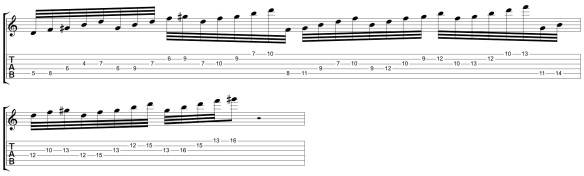
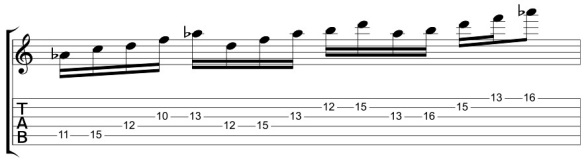
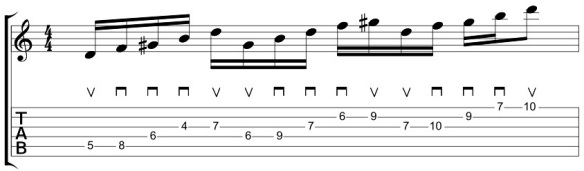
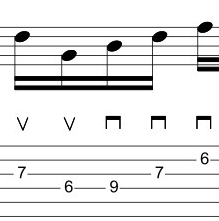
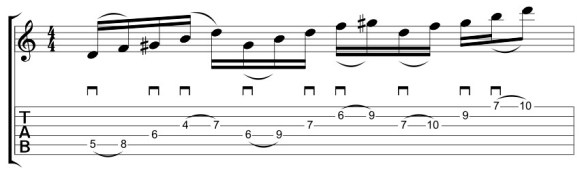
In this case, my goal is to try to get this lick:

32nd Note Lick Revised

up to the tempo of the song I want to use it in.

Step 2: Identifying The Thing(s) To Work On

In my example above, my goal is very specific so in this instance that’s the thing I’m going to work on.

It’s important to note that in going through this process you will very likely realize that what you’re working on uncovers all sorts of other areas that need to be developed to achieve that goal.

For a non-musical example, if you made a New Year’s resolution to loose 50 pounds by summer you might have identified working out at a gym as one of the things to work on but actually getting to the gym consistently might be a bigger problem in realizing that goal.  So you’d have to address things like willpower / motivation or other issues in addition to the initial area identified (the need for more exercise).

In the lick above, there might be a whole host of technical issues (sweep picking, string muting, etc.) that needs to be addressed in order to be able to play on the lick.  That aspect of it can become very frustrating if you didn’t anticipate it.  Just be aware that working on one thing will often mean working on multiple things.

Step 3: Contextualize And Analyze

One common mistake that I see people make is learning a lot of licks and then not knowing how to use them.  By understanding what you’re playing and how it works in a harmonic context, you can then take that information and re-contextualize it – (i.e. use it for soloing in other songs).

I already did a lengthy contextualization and analysis of this in part two of this lesson.  But here’s a cliff’s note version.

In this case:

32nd Note Lick Revised

The lick is a diminished lick that I’m using as a solo over an ostinato.

Ganamurti Ost

Step 4: Deconstruct

So when faced with a lick like this:

32nd Note Lick Revised

many players will just set a metronome and just start whacking away at it to try to get it up to speed.

This is NOT the best way to address something like this.

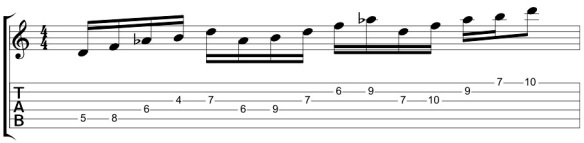
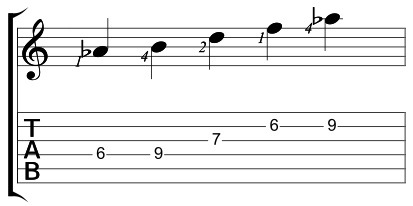
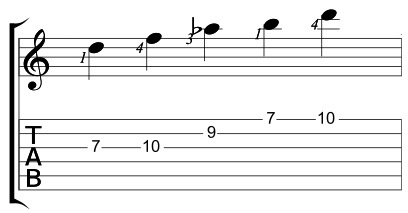
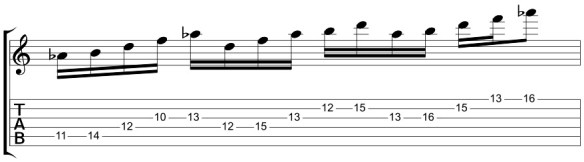
I recommend breaking it down into components.  So if I look at the first two beats and slow them down – essentially I see:

four four sixteenth first
Which is just the same fingering repeated at the 8th fret:

four four positional sixteenth two

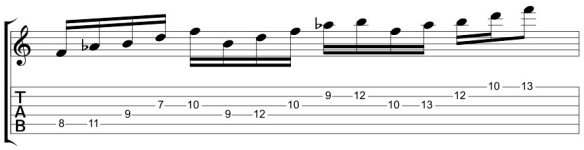
and the 11th fret:

Four Four Positional three

So if I look at that first lick again:

four four sixteenth first

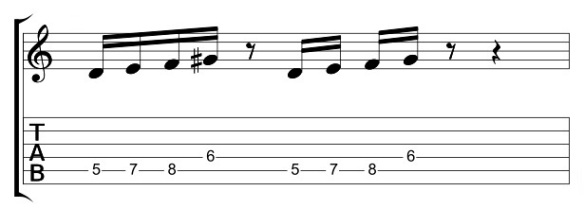
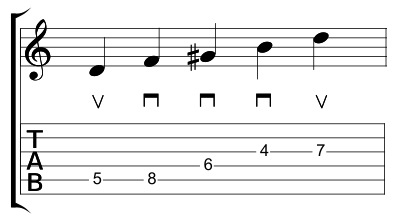
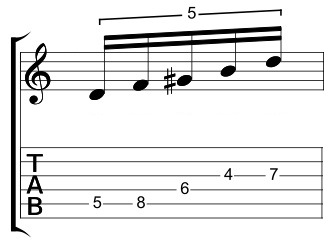
I can see that it’s the same basic idea on three strings in terms of picking and fingering – a minor 3rd on the same string, a single note on the next string and a minor third on the third string.

Or isolated further essentially this.

Diminished 7th quint

While the fingering might be adjusted slightly for the note on the middle string,  the first thing to do is address this initial shape.  Because if I don’t have this down then the rest of the lick won’t come together.

Step 5: Refine

If the lick features something really unfamiliar to me – I’ll break it down even further.

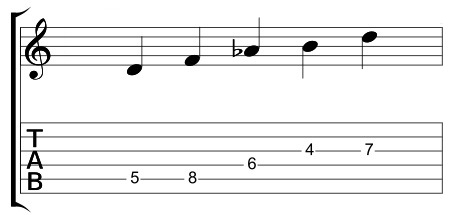
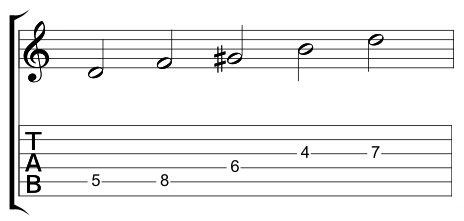
  • My initial focus is to just make sure I get the right notes.  Rather than even looking at 1/16th or 1/8th notes I might break it down to this:

D Dim 7 to octave

or even this:

5 Note half Note

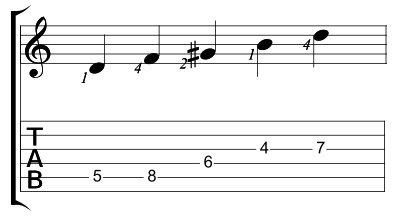
  • The first thing to address is the fingering.  I’ll use the 1st and 4th fingers for the notes on the outer strings and the 2nd finger on the inner string.

5 note fingering

This will keep the fingering the same on the D-G-B strings:

5 Note fingering-2

And when I get to the G-B-E strings the only finger I’m changing is the note on the B string:

5 Note fingering 3

  • The next thing I’ll address is the picking.  Note that I’m going to pick the form in a semi-sweep pick that might seem unusual:

Initial Picking

The reason for this can be seen better when you look at the lick in full position:

16th Note Initial Picking

The reason I start the lick on an up-stroke is to create a small sweep going between patterns:

Picking Excerpt

But this solution is just what works for me.  You could use hammer-ons to play the whole lick as downstrokes and that would work as well:
Hammer On Lick

The point here is to find what makes the most sense to you to play the lick to make sure that you’re playing it properly.

Step 6: Measure

Tim Ferriss has frequently thrown out this quote (proper citing needed)

“That which gets measured gets managed.”

When I go on a trip, my sense of direction is typically terrible.  If the sun is out I can work out “the Sun rises in the East and sets in the West” to at least get my general bearings but at night – left to my own devices without a GPS of some kind – I will typically go in the wrong direction.

I mention this because past experiences have shown me that using perception without any kind of concrete markings is a terrible measure for how I’m progressing on something.

In my case, I do several things to help measure how I’m doing.

  1.  I use a stop watch.  I’ve been practicing for a while so I can sit for longer periods of time and generally stay on task, but for the beginner I’d recommend a 5-15 minute block.  If I only have an hour to work on a few things, I’ll take 4 15-minute blocks and really focus on only one thing for that interval.  That’s why the stop watch is so important because it allows you to focus on the task at hand without spending any mental bandwidth on how long you’re working on something.  (Bonus tip – 4 FOCUSED 15 minute sessions over the course of a day will get you infinitely further than one unfocused 1 hour practice session at a time).
  2. I use a metronome or a time keeping device.  If I can play the lick at the beginning of the session at 100 and end at 105 I’ve made progress.
  3. I write it down and by that I mean I (generally) keep a daily log of whatever I’ve practiced for whatever length of time I practiced it for and make any notes of things I addressed.

    Example:

    “3/13/16:  5-Note Diminished run- 15 mins @160.  Work on articulating middle notes.”

    That’s really important.  So many of my students who say that they’ve never made progress before become VERY surprised when they have to write something down and REALLY see exactly how much (or in most cases how little) time they’ve actually put into something.

Step 7: Play it (or perform it, or do it) and observe it

Okay – we’ve covered a LOT of preliminary groundwork but the reason for that is because practicing something wrong will only make you better at playing it wrong and you will plateau at a much lower performance level.  Playing it correctly (i.e. with no tension, proper form, timing and phrasing will take longer in the short run but will save you insurmountable time in the long run.

I hope you’ll take this advice from my own experience.  I have had to start from scratch – from the beginning – TWICE – because of all of the bad habits I picked up and had to get rid of.  Had I know what I know now, I could have gotten where I am now in 1/4 of the time.

Here’s the trick to practicing this.

You need to really focus on what you’re playing and pay attention to how you’re playing it.  But you need to do this in an impartial way.

This means divorcing yourself from the outcome and just focusing on the moment.  The way I do this is somewhat schizophrenic in that when I practice I almost view it as if someone else is performing it.  While I realize that this may sound insane –  the point for me is to not get caught up in judging myself (“that sucked” doesn’t help you get better) but instead to focus on the process (i.e. the physical mechanics of what I’m doing. “Is it in time?  Is it in tune?  Am I playing that with minimal hand tension?)  The goal is to be as impartial an observer as you can be and just focus on the execution.

To do this, you’ll want to perform it at a level where it’s engaging (don’t make it too easy) but not so difficult that it’s overwhelming OR where you’re bringing in bad practice habits. 

When I was in high school I used to just practice everything as fast as I could and then use a metronome to try to make it faster and all that did was had me play with a lot of tension and not in a rhythmic pocket.  I could never figure out how people could play effortlessly and smoothly and it was years later that I realized that they played that way because they practiced that way.

Step 8: Correct

This is where the adjustments happen.  If my hands are tense, I adjust to play with less tension.  If my rhythm is off, I adjust to get back in time.  If other strings are ringing out, I adjust my hands to mute the strings better.

Step 9: Isolate the problem area(s) – Deconstruct Again

If I’m working on a big lick and have a problem switching position – I’ll apply this entire process to just that one problem area and correct that. Don’t spend 15 minutes playing 100 notes if you’re tripping up on 4 in the middle.  Get the problem area sorted out and then (once that’s worked out and smooth) work on playing the areas immediately before and after the problem and ultimately playing the whole thing.

Step 10: Play/perform/do it and observe it again

So I apply the correction.  When I get to the point where I can play it 5-6 times in a row perfectly, then I’ll adjust appropriately.

This Specific Lick:

Here’s how I tackle this:
32nd Note Lick Revised

  • Since it’s a repeating 5-note pattern, I start with the first 5 notes and establish a fingering and picking pattern.  I practice that with proper technique and timing and get it to where it’s smooth and effortless at a tempo.
  • I repeat this process with the 5-note pattern on the D-G-B strings and on the G-B-E strings, again getting each individual pattern smooth and effortless.  Spending more time on the first pattern gets these patterns under my fingers more rapidly.
  • Once I have the three patterns down I’ll focus stringing them together in position.16th Note Initial Picking
  • Once that position’s down I’ll do the same thing in the other positions:
    four four positional sixteenth two

and
11th Fret four four revised

  • Then I’ll focus on tying them all in together and look for trouble areas.  One issue I had with this pattern is making the switch from the high E string to the first note of the next pattern on the A string.
  • In this case, once I could play the full pattern with 16th notes at 160, I cut the tempo in half and started working on 32nd notes at 82.  I typically raise the metronome marking anywhere from 2-5 bpm when developing something like this until I get to my desired tempo.  The end tempo is typically 10-20 bpm above where I’m planning on playing it as playing it live with adrenaline kicking it in, we always play things faster so I like to be prepared (or at least more prepared).

That’s the process in a (rather large) nutshell!

My recommendation is to give it a go with something that you’re specifically trying to learn and see how it works for you.

  • You may find that it takes you longer than you expect it to
  • You may find the process uncovers a LOT of other things that need work

Those are both okay!  They come with the territory.  The good news is once you start doing this consistently, you’ll find that you make REAL progress in the things you’re working.


Here’s the big secret no one is probably telling you:

Practice requires practice!

Just like anything else, you actually have to practice practicing to get better at it (practicing).

The good news is you CAN get better at practicing and in doing so you will find that it actually takes LESS time to work on things because you get more efficient at what you’re practicing and how you’re practicing it.

As I mentioned before, I am working on a whole new pedagogical model that uses this methodology as it’s core to get better playing results in a shorter period of time.  I’m just about through the development stage – but if it’s something that interests you – please send me an email at guitar (dot) blueprint @ gmail (dot) com – and I’d be happy to send you more information once it’s ready.

Finally, consistent and steady wins the race

To get better at something isn’t any secret at all.  It’s putting in consistent focused time, day after day.

  • Be clear on what you want to do
  • Be clear on HOW you’re going to do it
  • Do it every day until it’s done

Move on to the next thing and repeat

I hope this helps and, as always, thanks for reading!

-SC
A Few Connor McGregor Quotes To Consider

Right now some of you might be reading this and thinking,

“Oh Geez…what is up with this guy and MMA?  I just want to play guitar.”

But to me they’re related.  Completely utterly and totally.

Because what it takes to get on a stage and improvise is also what it takes to get in a ring with someone who wants nothing more than to knock or choke you out.

You have to prepare endlessly and ruthlessly and get yourself to the best possible place you can be in and even then, in your absolute prime, you might get caught and KO’d.

The fighters who quit at that point are the ones who look at the match and say, “All that work was for nothing.”  They’re wed to an outcome.

The fighters who stick it out are the ones who are wed to the process.  They know that sometimes you have a good night and sometimes you have a bad night but if your training and preparation is excellent, then there’s a likelihood that even on a bad night you might be better than your opponent is on a good night.

When asked, “Why would you post something about Connor McGregor after he just lost a fight?”  the above is the answer.  Everyone loses a fight.  Everyone gets knocked down but the question is what is it that motivates you to get back up again?

“There’s no talent here, this is hard work…This is an obsession. Talent does not exist, we are all equals as human beings. You could be anyone if you put in the time. You will reach the top, and that’s that. I am not talented, I am obsessed.”

and (Re: the Jose Aldo 13 second KO)

“To the naked eye it was 13 seconds, but to my team and my family it has been a lifetime of work to get to that 13 seconds.”

I’m going to be posting a lengthy description about what it really means to practice something as that relates to both short term skill acquisition and long term mastery.  It may provide you some solace that most people know nothing about practicing, because most people do the same thing over and over, make very little progress and assume that because they put in the time that they know how to do it.

And I know this because I’ve been there.  Heck, I spent most of my life there!  I’ve now been playing guitar for most of my life and I’m STILL confronting the differences between what I think and what I know.

A recent story from a recent gig

Last Friday, I played a gig with Korisoron.  It was our usual repeating gig with a big difference – we had a special flamenco trio playing with us and as my wife was the dancer, I wanted to make sure it went well.  (If you live in the capital region of New York and you’re looking for Flamenco dance lessons or someone to dance for your show you can find her here!)

So I was running around a lot.  There was a lot of pre show and packing and set up and I didn’t get to warm up before I played.

In the OLDE days, I would have an entire ritual that I’d go through running scales and whatnot trying to get my hands ready.  Eventually I figured out that those gigs never worked well.  The gigs I played the best were ones where I was very lightly wamed up and not thinking about it too much.

Instead of running scales, I’ll play parts of songs or, in this case, pick a slow tune to start of the set and warm up over a song or two.  By the second tune I was largely good to go.

Is that a strategy I’d recommend for other people?  Absolutely not.  It worked for me in that context because I’ve already put the work in.  The work happens in the shed.  If the prep is done then it’s just a matter of going out an executing the best you can.

In my experience there is no cookie cutter formula to gigs where you’re improvising a lot other than being able to gauge the situation, making yourself as comfortable as possible and working from there.  As a kid, i got frostbite in my hands and feet and now even on days with mild weather my hands need extra time to warm up.  If it’s a hot gig with a lot of sweat I have to make other adjustments for my hands.  If I’m in a room where I can’t hear that well – I have to adjust again.

That kind of self-awareness happens over years of playing and learning how you respond to things.  Of getting to the point where you know what works and what doesn’t for you.

If you put the work in, then 90% of what happens in the ring, on the stage, is mental.  IF YOU PUT THE WORK IN.  That’s an important clarifier I’ve seen a lot of people talk a good talk about the mental game and fall apart on stage because they thought something they didn’t know.

“To the naked eye it was 13 seconds, but to my team and my family it has been a lifetime of work to get to that 13 seconds.”

To the untrained ear, an improvised solo is just magic notes from some mystic place that flow out over a verse or a chorus.  To those in the know, it’s a lifetime of work to pull those notes from a very concrete place to then make that moment sing.

In the next post, I plan to outline a specific practice strategy for how I get something done on a deadline – but in the meantime I hope you’ll consider a few points.

  • You can’t get anything of long term value without putting in the work for it.
  • Focus on the process not just to the outcome.
  • It’s not just about mindless work.  Learn what works best for you and use that knowledge to make better gains in what you’re working on.
  • Talent is just practice in disguise.

Thanks for reading!

-SC

For those of you in NYC this Friday (3/11/16) KoriSoron is opening for Persian Tar and Setar virtuoso Sahba Motallebi at le poisson rouge – 155 Bleecker Street.  Doors at 6:30.  Music at 7:30.  $15 in advance.  $20 day of show.  More information on the Facebook event page here!