Making Music Out Of Scales

Hello everyone, and welcome to the largest GuitArchitecture lesson I’ve ever put up online!

.

In this lesson (an excerpt of some ideas from my forthcoming GuitArchitect’s Guide to Modes book), I’m going to talk about the difference between scales and music and show some concrete ways to adapt scales into unique phrases.

 .

When I first started playing guitar, I listened to a lot of metal and the players I was into were fond of working ascending and descending scales into their solos.   (I also listened to a lot of Al DiMeola on Friday Night in San Francisco as well).  So I initially focused a great deal on scales and got to the point where I could play them quickly (but not really cleanly).  The flash of this got me noticed by other players in my area, but I always felt like something was missing.

 .

At best, scales are only ½ of the equation

 .

Seeing where my fingers needed to go was important but phrasing is where the real music is happening.

.

Note:

There’s a lot of information below.  Just take your time and go at your own pace.  It’ll still be there later.

.

Here’s another way to think of it.  Scales are like basic vocabulary.  They’re your nouns and verbs and no matter how you speak (with arpeggios, intervals or chords), they all have a basis in scales.

Your phrases are your sentences.  Guys with great phrasing can play a scale and make sentence out of it.  But a scale is, in and of itself, largely just a tool in making music and not music itself.

First Steps: Music is a language.  

So approach it the way you approach your native language

.

The way we learn language is by listening to other people speak and then emulating their speech.  Initially it’s nonsensical.  Then some disjointed vocabulary emerges which eventually gives way to sentences.  There is typically a period of formal study where reading is taught, and students are required to write ideas down.  Eventually, we take on unique characteristics that make our voices distinct.  With daily exposure language, and our understanding of it is constantly evolving.

Learning music is the same thing.  It first requires active listening.  You need to find music that you’re passionate about and really work on learning it by ear.  Music theory is also important, because it can help you make shortcuts to understanding a sound (for example, “that Phrygian pattern” gives the informed listener an idea of what a sound is before he or she even hears it), but really getting into phrasing requires an aural understanding.   Initially, this will take a long time and you probably won’t have all of the technical skills that you’ll need to get it at 100% accuracy.  That’s fine.  Get what you can – but really pay attention to phrasing details like pitch (vibrato, slides, bends, etc) and rhythm.  If at all possible – try to sing along with what you’re trying to learn.   If you get to the point that you’re not enjoying it – move on and come back to it.  The more you actively enjoy what you’re doing, then more you will get out of it.

.

Step 2 involves listening out of your comfort zone.

.

Try checking out music from other (non-guitar playing) musicians and cultures as well.  A lot of my pointillist rhythm ideas were copped directly from Japanese Koto approaches.  I stole a lot of things from Arabic music (specifically Turkish folk and classical music, the Iranian Radif and various maqams), Hindustani music, and vocal music from around the world.  I copped gypsy violin and accordion licks and Klezmer clarinet lines.   Lately I’ve been super into the insanely wide vibrato and pitch bends in Vietnamese Dan Bau music.   The important thing is searching out for other sounds, getting inspired by them and taking something from them.

For me a lot of this has been the nonsense portion of trying to speak other musical languages.   Not everything I do translates in multiple musical situations.  It’s not always correct or accurate, and sometimes that’s even better because then it’s my own spin on it.

Really importantly  – not all of it sticks.  I spent a lot of time learning things that didn’t directly work its way into my playing.  That’s fine.  The important things are the things that will ultimately stick with you.  What it’s given me are some things that are distinctly mine now.  A distinct accent if you will, that immediately identifies a handful of things that I say as me.

 .

Next Steps:

 .

In addition to learning things by ear, having a few different approaches to using scales in your bag can help give you the flexibility to express some really musical things.  I’ve already posted on the area of limiting options, and with that in mind I think it’s more important to go deep with a few ideas, rather than just scatter-shot a number of approaches and deal with them all superficially.  So I’ll cover some of them here

 .

Starting point: The Scale

 .

For an initial starting point, I’m going to look at a 3-note-per-string C Aeolian scale.  Try running this scale a few times with the fingering and picking patterns I’ve provided to make sure it’s under your fingers.

 .

.

 .

In the mp3 above, I’ve played the scale in 16th’s, a C minor 7 chord (to hear a harmonic context) and then as sextuplets.

.

Note:

In some textbooks you’ll see the b6 as an avoid tone against a minor 7 chord (i.e. the Ab as an avoid tone for C minor 7).  You can always just play a minor triad or a 5th for a similar effect.  I’ve included the minor 7th here because – aesthetically – it doesn’t bother me and I like the sound of a minor 7th better than the triad.

Picking this as I have above results in a smoother (almost legato) sound than I could get using alternate picking, even though I’m still picking every note.  For the initial fingering, I’m playing the first 2 notes of each grouping with my 1st and 2nd fingers to facilitate the slight positional shift on the B and E strings.

.

Note:  When practicing any musical idea, it helps to have a melodic and rhythmic context.  A time keeping device can certainly help, but I’ve included a short C note for a drone and a drum loop for your convenience below:

.

.

 .

Approach #1:  Skipping notes and using patterns

 .

The only time I use straight ascending/descending scales is if I have a target note that I’m specifically trying to get to.  In those cases, having some velocity to get there can build tension and make it exciting to hear.  Otherwise when you hear one note after another in straight ascending or descending scalar patters, it gets very predictable pretty quickly.

Here’s a sample phrase I improvised based on the scale above.  I’ve added some notes below.

 .

.

.

  1. On the first part of the phrase on the A and G strings, I’m only playing the notes C, D and Eb.  Adding a string skip and doubling the C at the octave creates more excitement in the phrase.  I’ve provided an optional notation indicating picking the octave C with the pick hand middle finger to give it a little snap – but you can certainly flatpick it as well.
  2. Starting on the Bb on the G string,  I’ve rhythmically copied the same phrase as on the A and G strings.  By playing it as a pattern, it creates some consistency in the phrase.  While the rhythm is sextuplets – the phrasing is alternating groups of 4 and 6.
  3. The last 6 notes break out of the pattern by just playing a straight ascending scale.

 ..

Here’s another track variation.  I’m picking every note on this one:

.

.

Approach #1a:  Skipping notes part 2 (Pentatonics)

Another way to work scalar ideas into a musical context is to reduce scales to pentatonics.  For example:  Here is my initial scale again:

.

And now I’m going to remove the F and the Bb from the scale.   This leaves a five-note pentatonic (C, D, Eb, G, Ab) – sometimes called Hirajoshi.

 .

.

.

The term, “Hirajoshi”,  actually refers to a Koto tuning.  In the Japanese scale system, this collection of intervals would be recognized as belonging to the In scale.  But since so many guitarists refer to this as Hirajoshi, I’ll use that nomenclature here.

Regardless of what you call it, sonically it’s a very cool scale.  The skips between the Eb/G and Ab/C really open the scale up sonically.

.

Here’s a variation on the lick above using this pentatonic idea in the second ½ of the phrase.

.

.

.

Technically, in addition to some of the challenges of the first lick, another tricky thing here is the skip from the C to the Eb on the G and B strings because the D, C, Bb pull off wants to go back up to D.  Sonically though it adds a really nice contour to the phrase.

 .

Approach #2:  Sequences

 .

Sequences are a cool way to use scales in a way that generate melodic momentum but contain an internal logic.  Here’s an example of using the pentatonic in descending groups of 3s.

 .
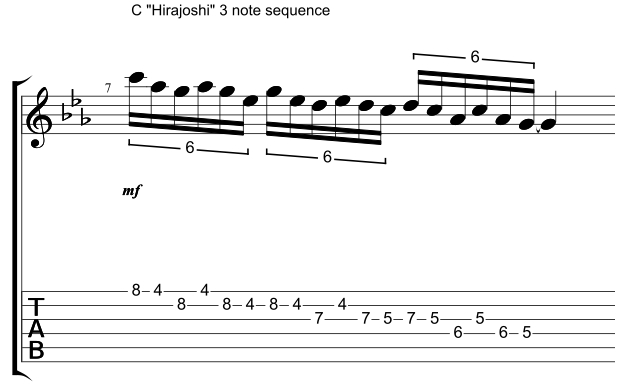
.

.

This is a very Marty Friedman-esque idea.  A little goes a long ways with this type of approach, but these sequences are great devices to work into phrases as a way to get more mileage out of a scale.

. .

Approach #3:  Octave displacement

 .

Playing notes in order can be boring, but as we saw with the octave C jump in the first lick, alternating scale notes in different registers can be much more interesting melodically.  Since the A and B string are a 9th apart, playing an ascending melody between the strings works well positionally.

The first step in this process involves being able to visualize the scale on each individual string:

 .

 .

Here’s a melodic idea that works off of this ascending/descending idea.  It works without a trem as well, but adding the trem gives it more of a slidish feel.  The important thing is to let it all ring together in a controlled way.  I’ve recorded this at full tempo and then in 1/2 time and I think it works a lot better at 1/2 speed .

 .

.

.

If you look at the notes in the phrases (C, D, Eb), (D, Eb, G), (Ab, Bb, Ab), (G, F, Eb).  They’re all based on short simple melodic ideas that sound more complex when broken up over octaves.

.

Approach #4:  Modal Arpeggios

 .

Previously, I removed two notes to create a pentatonic scale but if I play every other note of a mode, I can create an extended arpeggio called a modal arpeggio.

For example, here’s the scale again:

 .

Taking every other note:

 .

.

And putting it into a phase gives me this:

 .

.

.

Note#1:

It’s interesting because while the scale and tonality is rooted in C, sliding the last note of the arpeggio up to D gave it a whole other texture.

.

Note #2:

A lot of phrasing is really about minute details.  Here’s the same arpeggio but I sit on the first note just a little longer.  It makes the phrase more musical to me:

.

.

Here’s another arpeggio idea with a repeated phrase in the middle.

.

.

.

Playing arpeggios on smaller string sets allows me to sequence ideas more easily (Like the first 5 notes).  The jump to the Eb is probably the biggest surprise in the phrase.  Short but sweet.

This modal arpeggio approach can be applied to any mode or scale and offers a great way to add some additional textures into your soloing.

 .

Some Concluding Thoughts

 .

Normally, I would have broken this up into multiple posts, but I though it was important to get the aural learning component and the melodic variations on the same page.I didn’t even get into rhythmic variations, double stops, chromatics, chordal applications, superimpositions or any of the literally dozens of other approaches that can be used to extract music from scales.  It really all comes back to how much music you’ve absorbed because the most used tools in your melodic toolbelt are going to be your ears and your aesthetic and those are both guided by what you’ve been exposed to.

For those of you using GuitarPro, you can download the .gpx file of this lesson (with an extra arpeggio thrown in for good measure) here.

 .

The GuitArchitect’s Guide To Chord Scales

 .

Chord Scales Cover Front And Back

I’ve mentioned before, that (for me) the biggest advantage of investigating harmony and theory is to expose people to sounds that they didn’t know where there.  This is the entire purpose behind the  GuitArchitecture series.  One of the GuitArchitecture books in that series, The GuitArchitect’s Guide To Chord Scales utilizes and expands on this idea by exploring all unique scales from 3-12 notes!!!   The above material is expanded on substantially in that book so if you like this lessons you’ll really like the book.

More info on the book here.

Lulu Link

Amazon link

If you like this book you might want to check out the other books in this series here.

As always, thanks for reading!

.

-SC

Two Steps Back Or Setbacks In Project Management

Recently, I had a substantial graphics setback in one of the GuitArchitecture books that will delay publication by at least 2 months.  This is the latest in a series of obstacles that have come about from starting this project, and I thought it might be beneficial to talk about the books in a little more depth and also to talk a little about dealing with setbacks in project management.

When I was at CalArts, I was a TA for Miroslav Tadic.  This meant that in addition to grad studies, I was teaching 10 hours a week (all in ½ hour lessons and about an hour of  built in lesson prep time).   At Berklee, lessons were a fairly straightforward affair – each term had proficiencies and you had to prepare the material you needed for each proficiency over the course of the term.  At CalArts, there were no proficiencies per se.  Lessons were centered on student interest and what I started seeing as a commonality among guitar majors was an interest in modes, scales, chords and their applications.

.

Understanding the fingerboard

.

When I first learned these things – I used CAGED shapes – which really didn’t make a lot of sense to me.  What was instilled in me by my teachers during this time was the concept of – you don’t have to understand it – you just have to play it.  This also did not make a lot of sense to me.

I realized later on that what my teachers were trying to instill (at least what I hope my teachers were trying to instill) was the concept that you don’t have to understand it – you just have to hear it and get it under your fingers so you can play it.  Having said that, if the fingering you have to work with doesn’t make any sense – you’re not going to be able to assimilate or utilize it easily.

While CAGED allows people to connect chords and scale shapes it doesn’t adapt well outside of the major scale. My method breaks all scales into modular shapes that cover the fingerboard in an intuitive way. Instead of twenty-one positional fingerings to cover major, melodic minor and harmonic minor – GuitArchitecture uses seven core fingerings to cover all of these scales.  This approach allows players to break out of performance ruts and substantially reduces the need for memorization required to play scales.

In other words, it gets the notes under your fingers faster and in a way that makes sense.

The people who studied with me seemed to get a lot out this approach.  When I took a pedagogy class with Susie Allen at CalArts, it made sense to take the material I codified and make a presentation out of it.  I pulled 120 pages together pretty quickly and then had the idea that maybe there was a book hidden in these lesson materials that I generated.

.

Forming the clay

.

The approach that I use is very straight forward, but where I saw students getting hung up was in the application of the scales (i.e. breaking out of the stock forms and making music).  I realized a number of method books had been done – but the majority of these books presented a scale with a 2 sentence explanation and then had 40 licks using the scale.  If these happen to be licks from your favorite player, this may work for you – but it’s going to be hard to get people to practice licks for the sake of learning them in the scale.

I decided to go in a different direction from a standard lick book, and create something that would be a combination of instruction and reference.  I wanted to create a book that you could get ideas from really quickly to make music – but would have enough depth to be something that readers could go back to over and over again.  The first area I decided to tackle in-depth would be the issue of sequences.  Here’s lesson 1 in project management:

.

Build off of past experiences (or go with what you know)

.

I had never seen any book that took a systematic approach to generating melodic sequences so I decided to work out the permutations to generate all possible unique melodic sequences.

When I wrote my Symmetrical 12 tone book, I used this same process to generate all of the possible 12 tone rows that could be created using symmetrical divisions of the octave (whole tone scale (6 divisions), augmented chord (3 divisions),  diminished chord (4 divisions),  and tritone (2 divisions).  This was extremely helpful in knowing in advance what would be required in terms of mental discipline to generate these ideas.  It was also a little daunting as material in the 12 tone book couldn’t be measured in hours or days – it took almost 2 ½ years of constant work from concept to cover.  This brings up another important point in project management:

.

Whenever possible start with the heavy lifting

.

The reason for this is, as a project drags on – your endurance to complete the project will wear down exponentially to the point where even the slightest bumps in the road will have you questioning whether or not you can finish the project.  You need to get whatever really ugly stuff (in terms of work) out of the way while you have the energy to do so.  So I decided to start the process of generating all of the patterns and notating them.

.

Beware of the rope swing

.

You know those cute graphics of kids grabbing a piece of rope hanging from a tree and swinging into a lake?  The story I know about a kid who did this ended differently.  In the story I know, the kid was unfamiliar with the lake, swung into the shallow trying to do a flip, landed the wrong way and broke his back.  Unless something’s on fire or you’re chased by zombies you should always go into the water before just diving in so you know what you’re getting into.  Even knowing that, it’s easy to get into a situation and then get overwhelmed by the enormity of it no matter how well prepared you think you are.  This brings up another point.

.

Be realistic about what you can do

.

I could have sat down for a week or two straight and probably generated all of the graphics I needed, but there would have been thousands of errors – in something where the tolerance for errors is 0%.  Knowing what kind of concentration was required I did no more than 2-3 hours of work in a single sitting.  This meant it took a lot longer, but the review process was ultimately easier.

.

Break up overwhelming things into small chunks

.

How many of you have seen Bobcat Goldthwait’s Shakes The Clown?  Truly worthy of the title of “the Citizen Kane of alcoholic clown films”, the opening sequence is a fade in to an apartment in squalor.  While a record skips in the background, a dog is trying to choke down a full slice of pizza.  Project management is like this.  If you try to do all things on all frontiers at once, you’re just a dog choking on a slice of pizza in Florence Henderson’s apartment in Shakes The Clown.  The key is to have a strong overall view of the project.  In doing so, you can identify what else needs to be addressed and work small on multiple fronts as you need to.  While working on the graphics, I also started expanding on the modal application idea and applied this same approach to modal arpeggios, modal pentatonics and modal chord voicings (and harmony).  In Frankensteining these together I realized that I had a problem but

.

Contortion doesn’t hurt if you’re limber

.

When I assembled all of these components – I had about 2,000 pages of material.  This was prohibitively expensive to produce  and (in that form) something no one would read (much less purchase).   If I was dead set on releasing only one volume, I’d be in a lot of trouble – but working with the material I had and creating something new gave me more options.

.

Projects have a tendency to run wild on their own – so plan on constantly monitoring their growth

.

The good news was that I did have an overall view of what I was trying to achieve.  In reviewing the material, I realized I could severely edit the material and expand some of these areas into five full books on their own:

  • The GuitArchitect’s Guide to Modes
  • The GuitArchitect’s Guide to Modes: Melodic Patterns
  •  The GuitArchitect’s Guide to Modes: Modal Arpeggios
  • The GuitArchitect’s Guide to Modes: Modal Pentatonics and
  • The GuitArchitect’s Guide to Modes: Chords and Major Modal Harmony.

In the meantime, there was a 6th book that I was developing, The GuitArchitect’s Positional Exploration. This book had started as a technical book, but I realized mid way through that the technical issues I wanted to address would be much better served by looking at a video.  So I refocused what I had to make it into something useful.

.

The main modes book would have to be one of the first ones released and I wanted to get the sequences book done at the same time but the Positional Exploration book was the closest one to being done.  Working within those parameters, I decided to release these three books this year and then focus on releasing the remaining books at the rate of one a year until I get to the point that I no longer want to read another book much less write one.

.

Be prepared to go a lot of it on your own

.

People generally have an aversion to things without proven track records.  When people see something new in terms of a project, they typically want to wait and see how it’s going to work out before they get on the bandwagon.   Once it gets rolling and other people sing its praises, there’s no shortage of people who will want to lend a hand or be associated with it in some way, but in the beginning expect to spend a lot of money and/or a lot of time to get the skill sets you may be missing to complete your project.  Along those lines:

.

Be ready to make a lot of mistakes

.

Do you know the story of Thomas Edison and the creation of the light bulb?  Apparently Edison tried some 3,000 filaments in creating the light bulb.  There was nothing glamorous about this work.  It was just shoving a bunch of different things into a light bulb to see what worked the best.

.

If you’re working on any project there will be multiple points that you are literally in the dark and will have to triage a solution.

.

When I first came up with the book idea, I wasn’t sure what the layout was going to be and didn’t have the money for a graphic designer.  I made some initial design decisions that, once I had enough material together to really get a sense of what the book was going to be, I realized really wouldn’t work.  This required a lot of labor to fix so…

.

Be ready to improvise because you can’t plan for everything

.

Many solutions are wrong.  Unless you’ve done the same project before – there will be countless things that go wrong.  Solutions to problems will not always be obvious, easy or desirable.  But if you’re flexible and have a strong conviction about what the project will be when it’s done – it will be easier to adapt solutions to the project (or vice versa).

In going though the review stages of the books I realized that there was an entire graphics section I missed.  Even being as methodical and meticulous about it as possible, when working on something with this scope you’ll miss things.  Fixing this will now set the book back at least 2 months and while it is immensely frustrating – it’s also manageable because I know the books are going to be done this year and along those lines:

.

Have a deadline or know when you’re done

.

Deadlines allow you to get things done.  I’d write more about this but I’ve already written on it here.

.

You really can’t do it alone

.

I am really fortunate in that I had a number of people who were willing to take a look at what I had done and offer feedback.  Some of that feedback resulted in me realizing just how much material had to be edited further and/or corrected.

Even with innumerable revisions and examinations – it’s really difficult to catch everything. Even if you can, it’s unlikely that you’ll be objective enough about the project at that point to see all of the angles that other people see when they examine what you’re doing.  This might cause a lot of discomfort in realizing that something that you thought was mostly done actually had a ways to go, but in my case, having a stronger book makes it all worthwhile.  And this leads to the final point:

.

The difference between 99% and 100% isn’t always 1% – sometimes it’s 100%

.

The paradox of most long term projects is that the closer you get to completing the project, the more every instinct in your body will tell you to bail out on it.  By the time you get to getting the project to 99% it may take as much energy as you’ve put into the project up to that point to get that final 1%.  In the end,  the payoff is in the 1%.

I’m bummed about doing a lot of work I’ve already done all over again, but I’m really excited about these books.  I don’t think there’s really anything like them and hopefully other people will feel the same way.

I hope this helps with your long term projects!

Thanks for reading.

-SC

.

If you like this post you may also like:

.

Books:


.