The 10,000 Hour Rule In Context

There was research and then there was Gladwell..and then the Gladwell acolytes…and then the Gladwell detractors and then we were left with a number.

10,000 hours.

You need 10,000 hours to master something….or do you?

Here’s another opinion.  From the trenches, based on no scientific data whatsoever, but operating solely in the area of personal experience.

First off – mastery as a term is deceptive at best.

I’m highly suspicious of anyone who calls themselves a master musician, because I’ve never seen anyone who operated at a level of mastery that identified themselves as such.  The people who play at the highest levels are often the ones who can tell you exactly what they can’t do and still struggle with the demands of whatever instrument they have.

Yes you need time – but it has to be focused time

I know a lot of people who started playing guitar when I did.  They’ve easily put 10,000 hours in on their instrument.  They’re marginally better than they were when they first started.  There are several reasons why:

  • They got one thing down and never expanded upon it.  If you ever listen to me practice, it rarely sounds very good.  There’s a reason for that – when you’re practicing you’re supposed to push yourself beyond your current capacity.  I can’t tell you the number of times I’ve walked by a practice room where someone was just playing all the stuff they already knew how to do and were convinced that they were really getting better.    If you ever go to a blues jam – you will always find that guy who’s playing the same thing over and over again on every tune.  Come back next week and you’ll hear it again.  It’s like you’re listening to a human sampler.  If you never push yourself – you will never get better.


  • 10,000 hours needs both focus and context.  What are you spending 10,000 hours working on?  The person spending 2,000 hours on focused goals that integrate skill sets will generally run laps around the person who put an unfocused 10,000 hours in.


  • It’s daily work – often on fundamentals.  Really.  It’s putting consistent focused time in every day that yields results.  Itzhak Perlman still practices scales 4-5 hours a day.  Trust me, he knows those scales everywhere there is to play them on the violin – but mastery is in going deep into areas that few other people are willing to commit to.


  • You’ll need models and or mentors.  No one is an island.  You’ll need to emulate other people to get to the unique combination of influences and skills that will create your unique artistic stamp.


  • A big portion of the time required for mastery goes into developing aesthetic.  I can teach you the technical aspects of guitar playing in a relatively short period of time, but it’s going to take me a lot longer to teach you how to play well.


A musician was once relating to me the story of how pedagogy was handled in the part of India he was from.  “If you wanted to learn tabla.  someone would make an introduction and that person would handle all elements of the terms of study (payment, etc).  That was never discussed between teacher and student.  Then, you would go to the guru’s house and you might not touch a tabla for a year.  You would be cutting wood and doing all sorts of manual labor around the house – but the lessons would be going on around you and subconsciously the sounds and rhythms would be working their way into your ear.

Then one day you might get a lesson and learn some basic rhythms.   It might be a three hour lesson to get some basics together and then there would be some follow up spot checks to see how you were progressing.   Once you were ready you’d get another lesson and that would eventually become a regular event – but all during that time you’d be absorbing what was happening around you and starting to develop a sense of how things are supposed to sound – that way you know what sounds you are trying to create.”

A Rag is a DEEP thing.  If you’re just running the notes up and down, you’re not playing a Rag. It’s not just a collection of notes, each one is a world that contains melodies, phrases and even times of day that they’re to be played that define it.  You can learn some of the phrases relatively quickly but really knowing the Rag is a whole different thing, and a whole different time frame.

Aashish Khan once told me that his grandfather made him stay on one particular Rag for a year.  To put that into context, imagine practicing C major scales and phrases for 12 hours a day for a year and at each stage having your teacher tell you, “You’re not ready yet.”  Could you keep pushing forward in the face of that adversity?

Here’s the thing:

Very little is impossible.  The amazing thing about acquiring any skill set is that it’s about breaking complex motions down into its simplest components, mastering each one of them in a vacuum and then integrating them into a larger context.

Bukowski once said, “Endurance is more important than the truth.”  What I think he meant by that was that no one starts off as a brilliant writer/guitarist/anything.  There’s a long period of time that you’re going to be bad at something when you take it on, but the people who keep at it eventually get better.  Some of them even get to be great and become the very thing they were trying to be.

Mastery is largely about learning how to acquire a skill set.  If you’ve gotten good at playing guitar, it will probably not take you as long to get good at say, mandolin.  I’d argue even further that if you’re a great instrumentalist, you’ll probably pick up something like cooking at a high level much faster than someone who has not acquired mastery in a specific area.

Finally, I’d argue that mastery is a reflection of self.  It’s not about being able to play a scale the fastest or having the hippest lines over a chord progression.  It’s a cumulative process that uses something (playing guitar for example) as a means for getting to the best version of you that’s possible.  It’s not about mastering a Rag for example, it’s about your individual expression within that Rag.  It’s about where you are in a given moment of time and about what you have to say within that medium.

Mastery isn’t about guitar.  It’s about you.

To master anything

You’ll need time.

You’ll need focus.

You’ll need challenging things to work on.

It’s best to get crackin’ now!

As always, thanks for reading!

-SC


Rig-O-Lution Or More Notes From The Trenches Of Tone

The Siren’s Song Of Old School

More and more, I get players who stick with un-amplified acoustic guitar for performance.  Mind you, playing acoustic guitar and really articulating every note can a BEAR, but it’s such a dynamic instrument that gives you back exactly what you put into it.  There’s something really satisfying about strumming a chord on an acoustic and just having it decay naturally.

However, this isn’t about the easy solution. ; )

A Tale of Two Gigs

A while back – I talked about how I had taken my POD HD500 out for a show and was really surprised by how well the tones went across.  Basically I had 2 dirty and 2 clean tones (Really one dirty and one clean with a slight variation) – and running that out into the hall with a single QSC K-8 speaker.

After the latest Variax debacle, I decided to upgrade to the POD HD500X and, as I understood it, the only real difference was an upgrade in switches, and more memory so my tones would remain exactly the same.

But a funny thing happened.  I played another gig – with the same group and in the same hall, and this time a PA was set up.  So I ran a stereo pair to the house through the XLR outs and also ran a line out to my QSC K-8.

And I wasn’t digging my tone.

It was really shrill and strange and I was fighting it (along with the looper which was acting a little glitchy as well) for the duration of the evening.  I was able to limp through the gig but I wasn’t psyched.

So I went back to the drawing board.

Whatever happened to that Laptop Guitar Rig?

Several of you may remember a NUMBER of posts about my laptop rig (Just check the Blueprints page for the Laptop Guitar Rig section).  Funny thing about that.  My laptop got really out of date.

Enough so that running any kind of intensive audio software on it required disc repairs, defragging and obscure incantations.

Gradually, my system wouldn’t support the newer versions of AU LAB, and my software wouldn’t run on the updates I had.

I still use it for sound sculpture, but it’s been a little too glitchy to run live.  But one idea that I had there (running a signal out to a impulse response for a more 3-D tone) was one that still appealed to me as it seemed like I couldn’t get a tone out of the cabs without MAJOR EQ tweaking that worked for me.  Also, I liked a few of the distortions but I also felt limited with the models there.  So I started looking into solutions outside the POD.

DAMN!!!  The Torpedo!  Full Speed Ahead!

Here’s the first part of the solution.  A local music shop had a used version of a Two Notes Torpedo C.A.B. for sale for about 1/2 the street price.  After sitting on that for a while (and seeing it sit around on the shelf desperately looking for an owner) I offered them $20 less than the asking price and brought it home.

CAB_3D_721

Photo Taken From TWO NOTES Web Site.

The Torpedo Cab is basically a speaker cabinet simulator that acts as an Impulse Response (IR) loader in a stompbox format.  It doesn’t have any load box capabilities so you can’t use it directly with your JCM 800 speaker out (they do make gear you can run right out of a power amp into) – but it offers substantial tonal flexibility.  In addition to using their own format (which allows for virtual mic placement and different cab and mic options) you can also use a simulated power amp and EQ which is accessible through either the pedal screen or through the free Torpedo Remote software.

This is a GREAT pedal!!  It’s super solid and offers a lot of great tones on the fly.  Out of the box, there were some decent cabs and mics – but I wasn’t getting them to sound the way that I wanted them to.  Fortunately, Two Notes BlendIR came to the rescue.

BLENDIR

BlendIR is a free app that allows you to load multiple IRs and mix them down to a single file that can be read by the Torpedo CAB.

Blend IR

This is a big deal, because if you want to mix the sound of say a room mike, a close mic and a mid distance mike in the proprietary format, you’re out of luck as it only supports one mic at a time.  In my case I had a bunch of REALLY GREAT Marshall IRs that I was able to download for free from RED WIREZ (http://www.redwirez.com/).  In the example above, I mixed multiple IRs to create a stacked sound I was looking for.

That Distortion

Also, I was obsessing about distortion a little bit and thinking a lot about how much I dug some of Shawn Lane’s dirty tones.  Part of his sound started from front loading a solid-state Holmes Mississippi Bluesmaster Amp with a Westbury Tube Overdrive (later the Holmes was replaced with a Peavey Pro-Fex that Peavey had modded for him).  There’s a thread with some REALLY interesting insights on his tone here (about 1/2 way down the page).

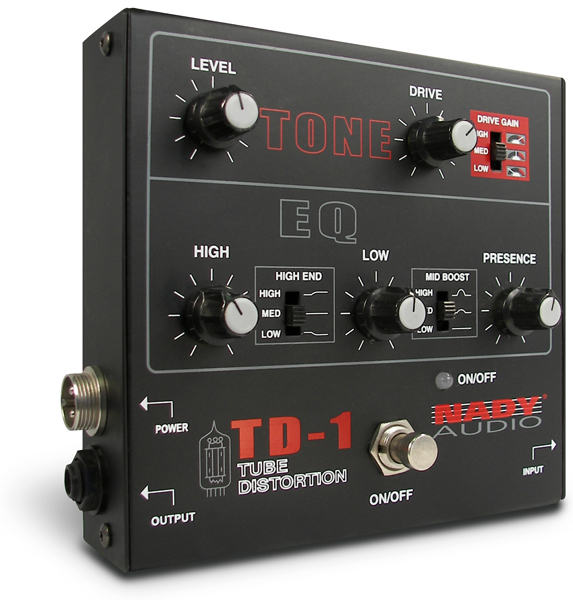
Westbury was bought out by NADY, and NADY’s TD-1 is the updated version of it. 

Nady TD-1 fron Nady Website

Nady TD-1 fron Nady Website

Nady released several versions of the pedal.  The original just had an on/off switch with Gain and Level controls.  The current version features 3 different levels of drive, and an EQ section.  I do like some of the Line 6 distortion pedals, but they haven’t modeled enough of them for my taste, so I wanted to experiment with this.  

A sale on Amazon had one shipped to me for under $100.  

The Pluses:

  • It’s a REALLY sturdy pedal
  • it’s relatively quiet
  • it has tremendous tonal variance

The Minuses:

The power connector is funky.

(I only mention this as making it a part of a pedal board will require more than a pedal power supply.)

While you can get high gain tones from it, I think it works best as on the low-mid gain settings – and it works great there.

The Line 6 Story I Can’t Find Now.

Somewhere in my jumble of posts is a brief anecdote about the time I met with Rich Renken when he was working at Line 6.  Rich had a great story about the (much maligned) Marshall cabinet that was modeled.  There were a number of people online who hated the Marshall cabinet that Line 6 had in the POD saying it sounded nothing like a Marshall.

What Rich said was funny about that was Line 6 tested a NUMBER of Marshall cabinets until they found the cabinet that everyone agreed had THE Marshall sound.  That cabinet was modeled and they then A/B’d the sound of the amplified cabinet with the sound of the model and everyone there said it sounded identical.  End users were brought in and they also couldn’t tell the difference.  The guys at Line 6 assumed they hit a home run.

But the thing is that it’s all about context.  That Marshall cab that Line 6 modeled may have sounded exactly like that cabinet miked up in a studio environment – but that same tone might not work at all in someone’s headphone mix.  The tone you hear on a mastered recording is sometimes radically different than what you’d hear coming out of the cone.

So, I don’t think that the Marshall sound is awful, but I don’t think it fully works in the context that I’m trying to use my sounds in.  And that’s what’s prompting the current signal chain.

Signal Chain

The signal chain is FnH guitar –>Nady TD1 –> POD HD500X.  The Nady is only used for a solo tone.

In the 500X – The FX send goes to the Torpedo CAB back into the unit.

From the 500x – I use the XLR outs for the house and run a line out to my QSC K-8 (either for monitoring OR for live sound if there’s no PA).

Here’s The Signal Path Of The Dirty Rhythm Sound I’m Currently Using

Rhythm 1

Basically what I’ve done here is try to combine the best of both worlds.  Amp A runs to the Torpedo for the cabinet sound and I’ve blended that with Amp B for the modeled cab.  Some people use the Pre-Amp versions of these amps to save on DSP, but I find that the deeper amp controls like SAG play a big role in the feel of the amps.  Amp B does have some additional EQ thrown on it to boos the cab sound a bit  and amp A had bit of slap back delay.  Both signals are then mixed (around 30% in the left channel for A and 30% in the right channel for B) and run through a common reverb for continuity.

Here’s the basic lead tone.

Lead 1

This is essentially the same as the rhythm tone, but I’ve removed the Tube Screamer and addd a volume and wah.   I think the modeled Tube Screamer works well with the modeled amps (it sounds great when you roll off the volume a bit rhythm) – but it just didn’t have the lead sound I was looking for.

Even at lower levels, the NADY does introduce noise, and the Line 6 gate I’m using needs a lot of tweaking.  There’s some digital dirt on the end of notes as they decay – so I find that the NADY is causing me to ride both Tone and Volume controls on the FnH more than before.  (In other words it’s forcing me to be more expressive and thus more musical).  Gain staging was a bit of an issue with the FX loop as well and it took a couple of passes to tame some sound issues there as well).

Live Versus Phone (or Phones Home)

One GREAT thing about using the QSC K-8 is that it gives me a pretty accurate picture of  what my tones sound like through a PA.  I like the Atomic amps I was using before a great deal, but they weren’t accurate at all for live sound, and having to mike one for the room, was completely counter to the point of running a modeler.

I’ve talked about this in other posts as well – but it’s still amusing to me just HOW different those tonal requirements are.  Even after getting it close to dialed in on my phones, I had to use a different IR for the K-8.

I’m not posting any tones now, because this is still very much a work in progress – but I’ll have something up relatively soon (hopefully a live clip!)  The word of the day here is EXPERIMENT.  That’s the truth of it.  Plugging a box into the front of a POD may get you something out of the unit you weren’t getting before.

For now, I think I’m going to see a lot more of hybrid rig configurations in my future until digital technology fully catches up – but rest assured it’s catching up and while the all in one solution is already here for many players, I anticipate that even players like me that need some old school feel and flavor will see an all in one digital solution within the next 5-10 years (if not sooner – I’m pretty knocked out by the Positive Grid software – look for some words on that soon!)  The future is not only coming, for the most part it’s already here.

Okay!  Enough rambling for one day.  As always thanks for reading!

-SC

2 String Melodic-Minor Arpeggio/Scale Fragments

Hi Everyone!

As promised here’s a quick lesson of some material I’ve been exploring lately that may be interesting to you as well!

The In-Between

As those of you who have explored my not-peggio series know, I’m a big fan of melodic material that exists in the area between scales and arpeggios.

The following ideas will be drawn from D Melodic Minor (D, E, F, G, A, B, C#) – but the approach can be applied to any scale.  Lately I’ve really been into trying to work this scale over knuckle-dragging metal that exploits that Phrygian-ish 1/2 step E->F Bass motion but the licks presented will work over any of the chords outlined below,

Two-String is The Thing

The first thing I’m going to do is look at some ascending two-string diatonic 7th chord arpeggios.

2_String_7th note arpeggios

If you’re not familiar with these shapes try practicing them up and down the fretboard to get them under your fingers.

Here’s a little secret:

  • When I play two-string patterns, I think of all of the time I spent working out permutations for the two-string minor pentatonic patterns I practiced endlessly and try to find a way to get a little more use out of them.

With that in mind, I thought,  “What if I extended this arpeggio with some diatonic notes and kept the 2-note-per-string idea the same?”

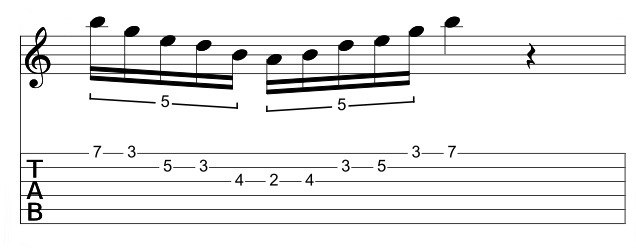
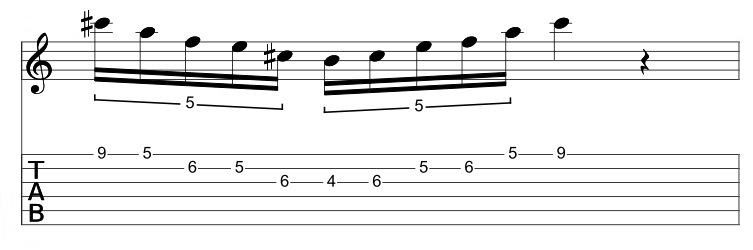
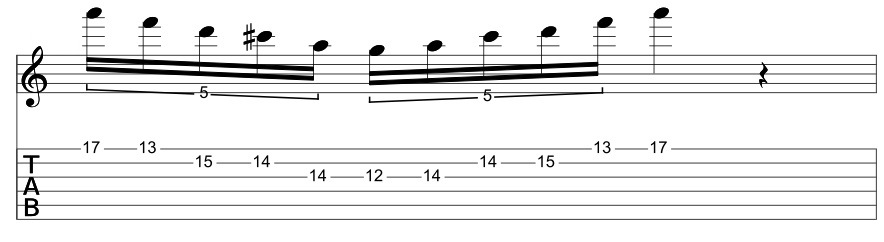
Applied to the first arpeggio above, I got this (Note the fingering):

Extended Pattern Fingering

Practicing it a bit to get fluidity, I realized that I was playing it in a different rhythm:

Pattern 1

This specific arpeggio could be called an E min 7 (add 11), but the combination of 3rds and some step-wise motion opened up the sound of the arpeggio for me and made it sound more like a fluid lick.

Here’s each individual pattern.

Pattern 1 Pattern 2 Pattern 3 Pattern 4 Pattern 5 Pattern 6 Pattern 7

I’ve added a Soundcloud link of all of the individual patterns played together below.

Technical Note:

I think I’m playing this around quarter = 132 or so and using a combination of hammer-ons/pull-offs and sweep picking.  I edited out some clipping that occurred when I recorded these but you may still here some elements of them in the mp3.

As always, pay attention to the 3T’s (Tone, TIming and (hand) Tension) when practicing these and focus on trying to be as fluid as possible.  Also be aware of the little finger dance between the first and second fingers when switching between the G and B string.

Aesthetic Note:

While you could play each of these ideas all in a row as I did in the example, I view each of these licks as connective tissue to help create larger phrases.

I’ll post more examples of these in the weeks ahead.  In the meanwhile, keep exploring and, as, always, thanks for reading.

-SC

PS – for those of you who are interested, the sound on the demo was recorded on my iPhone using a modded 69 Lead amp I created in Positive Grid’s BIAS running through a signal chain in JamUp Pro.

It’s a stunning App…and I can’t recommend it strongly enough.  Look for an upcoming review in Guitar-Muse.com!

A Lesson Learned From A Tyler Variax JTV-69

The JTV-69

A series of events conspired to put a Tyler Variax in my hands this week (these events included an upswing in students, massive price drops in that particular model, and a demo model in cherry condition selling for $800 shipped) but my joy on Wednesday quickly turned to frustration and, in a first for me,  it goes back to Sweetwater today.

Disclosure

I have owned Variaxs before.  When I moved from California, I sold a 300 and a 700AC and I liked things about both of them (I really regret selling the 700 to this day).  I like the concept of modeling and if there is an ideal demographic for a person who wants complete control over the sounds in his guitar, I would have thought it was me.

Unboxing

The guitar came with a Line 6 gig bag, USB interface (for connecting with Workbench), USB cable, Variax CAT cable and a battery charger.  The 700AC came with a GREAT gig bag.  While this gig bag looked the same, the interior was much cheaper in both materials and construction and the padding was of what’s found on a $30 no name bag from Musician’s Friend.

This was actually a harbinger of what was to come.

The Build

First, the positive.

  • The design on this is light years from the VAX 300.  It didn’t feel like a slab of wood the way the 300 did.  The wrist cut (rounded to the back) and rounded heel were nice additions and there was clear access all the way up to the 22nd fret.  The finish was flawless and, in short, it’s a nice looking guitar.
  • The top loading tremolo bridge is a really clever design and works well with the TUSQ nut and locking tuners.
  • Line 6 developed a new battery that worked really well with the guitar and was a welcome relief from the AA batter holder or the powered cable box required with earlier models.  They claim 12 hours of use time when fully charged.  I spent 3-4 hours my first day charging the battery and it didn’t run out of juice during the testing time so that seems like an accurate estimate to me.
  • The addition of the tuning wheel to dial in alternate tunings for the patches is also a great touch.

Now the not so positive:

  • The neck….I hate the neck.  The fingerboard radius is fine and the string spacing is actually comfortable – but the neck… first it’s a matte finish and not a gloss finish.  That’s just a personal preference but it didn’t work for me.  Second, the neck is a C shape but it just feels incredible bulky.  Apparently this isn’t a minority opinion as once it was determined on the forums that the Mighty-Mite compound radius Strat necks sold by Stew-Mac fit with very little alteration, Stew-Mac sold out of them, and they’re currently on back order.
  • The acoustic tone.  By that I don’t mean the models.  I mean, how does the guitar sound when it’s played un-amplified.  And to be honest, it just sounded a little one-dimensional.  More specifically, it sounded like a plastic Maccaferri which is not a tone I prize.  I bumped up the string guage to .011’s and that helped with the projection a bit but it wasn’t an inspiring guitar to play.

The Firmware

When I went to register the guitar I realized that it shipped with v 1.8 software (You need v 2.0 software to connect to workbench).  Upgrading required using the same USB interface that the 1st generation Vaxs used.  Given that a key selling point for this instrument is the integration of the Variax and the POD fact the requirement of an external box just seems clunky.

It behaved in a clunky manner as well.  It took 3-4 times to get recognized by Line 6 Monkey before I could upgrade it.  The upgrade was very straightforward.

Workbench

One of the most intriguing elements of this guitar is the fact that EVERY aspect of the tone (and intonation) is fully customizable with the Workbench software.

Pickups:

You can control the type of pickup. The wiring of the pickup (series or parallel) the polarity, the angle, height and placement. Virtual pickup placement and angles are literally drag and drop parameters and place them anywhere along the string path of the body.

WorkbenchJ

Strings:

StringsJ

You can control individual volumes!  No more of that E string barking out at you if you don’t want it!

You can control individual pitches (this can also be done on the guitar itself with the virtual capo function) and you can control the intonation through the Parallel Pitch function.

PotsJPots:

You can control the resistance and taper of the pots so the tone “rolls” on or off the way you want it to.

In other words, you can customize any aspect of a guitar or just create sounds that have never been made before.

It’s a remarkable piece of software and engineering, and a tweaker’s paradise.  But playing this guitar taught me something.

I’m not a really a tweaker.

.

The Sounds and Performance

This is where this realization really came into play.

Again, let’s start off with the good.

  • The physical pickups.  A number of players who have these guitars say that they use the on board pickups most of the time and they sound good enough that it’s easy to see why.
  • The models are dead quiet.  That’s the thing I loved about my original Variaxs, no buzz when recording.
  • The string muting is MUCH better.  This was a big downfall on the original Vaxs but this was largely fixed with the new versions.
  • The tracking is unbelievable.  I found ZERO perceptable latency with the models on this guitar.
  • The virtual capo function is pretty awesome.  You can literally touch notes on a guitar and the computer will assign a new open tuning in a second or so.  I got this guitar because I thought It would be fun to play in standard tuning and drop into a DADGAD for a chorus.  You can do that with this guitar.
  • The integration with the POD is stunning.  You can change patches and guitars with a foot switch.  Acoustic alternate tuning on the verse and distorted Les Paul on the chorus.  One switch can be set to do that.
Here’s where I had a problem.
Basically, my biggest problem with the guitar (other than the neck) is that you have to adapt your playing and tone to the performance aspects associated with each guitar.  Sean Halley hipped me to that with his Line 6 Blog post where he talks about using .011 gauge strings, playing as light as possible and using a really minimal signal path to get his acoustic tone.
  • I tend to play hard.  So this was a learning curve for me, but even playing softer, I still needed to drop my volume down to about 50% on all of the models I was using because I was hearing really strange aliasing with some of the settings.  It was more pronounced on some models than others – (The Dano and the teles were some of the best sounding models on there to my ears) – but it was still really problematic.
  • I tend to play with low stage volume, and if you’re not playing loud enough to cover up the acoustic sound of the guitar, you’re going to be subjected to sonic weirdness as your ear tries to mix the acoustic sound with the modeled tone – particularly with regards to altered tunings.
This leads me to a favorite story of mine.
.

The Ted Nugent Story

.

Here’s where I get to tell my favorite second hand Ted Nugent story.  (If you like this story –  ask Bob Bradshaw about the time he made a board for Prince because it essentially ends the same way.)
A GREAT guy I knew from Berklee used to run sound for the Nuge back in the day.  Where most live stages have a wall of amps that are basically there to fill out the stage (there’s a reason that only one of them is miked usually), the Nuge had a wall of Fenders that were all live (even more insane when you consider that he was playing a hollowbody guitar at that point!).  The stage volume was deafening, and based on his signal path he would walk up to each amp and just dial in the numbers that he knew would get him his tone and play.
.
The amount of noise that was coming from the stage was driving the sound people nuts.  So they rack mounted and hard wired his pedals and Echoplex (they changed the tapes and cleaned the heads as well) and got rid of a ton of hiss.  They showed their work to Ted and he hated it.
.
He hated it, because it completely changed the sound of his amps – and the number system he used to dial in his tone no longer worked.  Ted wasn’t about to re-discover how to get his sound, so they had to undo everything (they put the old tape back in but refused to dirty up the heads again).
.
With that in mind here was my problem.
.
I might have been able to fix the aliasing issues with Workbench but the thing is, I didn’t dig how the models were sounding with my tones. It makes sense.  My tones were crafted around my FnH which sounds completely different from this guitar
But like the Nuge, I spent a lot of time getting some of those sounds together.  I didn’t want to do that again.
And there’s the real review.
This is a bold solution to a sonic problem.
If you are the type of person who wants to be able to control every aspect of tone and have the ability to create tones that have never been heard before – this is a solution that approaches the answer.  And I say that because if you are that type of person, then you will swap out physical pickups, swap out the neck and make every aspect of this instrument conform to what you want it to be.
This is expected when buying a used guitar but that’s not why I would buy a new guitar.
This particular guitar wasn’t inspiring to play, and the thought of customizing every aspect of it (from the neck to the pickups, to the string output, to the patches and having it be weeks or months to get to where I needed to go) just isn’t interesting to me.  As it is, I’ve already lost the better part of two days just trying to get it going, and that’s my threshold for moving on.
What follows is pure conjecture and should be viewed as opinion rather than fact.
I don’t think I’m alone.
.
I’m guessing that the Variax cost, if you were getting an artist rate, would probably be $600-$700. So if Sweetwater is selling these at $899 for a new model.  They can’t be making much money.
.
Furthermore, Guitar Center Used is selling these for around $700.  (A JTV-59 was up today for $549! – Ouch indeed!)
.
I don’t know if they’re making a price drop to promote these guitars, to move them, or what have you but what is interesting to me, in contrast, is that the JTV-59 (The Les Paulish one) has not dropped in price.
.
That one also looks much more comfortable to play and knowing that you can mount a Bigsby to it makes it appealing to me.  The only reason I didn’t look closer at that one is the substantial price difference.
.
You may dig the JTV-69.  You might like the neck, embrace all the things I really liked about this guitar and not be bothered by what I didn’t like.
.
So I haven’t given up entirely.  I’m sure that there will be a point where I try to cross this bridge again, but it’s not the right guitar for me right now and so back it goes.

As You Gaze Into The BabyMetal The BabyMetal Also Gazes Into Thee

BabyMetal

Earlier this month on Facebook, I put up a link to a video that a friend of mine hipped me to called BabyMetal.

I loved it for a number of reasons.

As someone who was familiar with J-Pop and Metal, it was a bizarre juxtaposition of two musical styles that at first glance appear incompatible, but actually works in an indescribable way.

I may have been amused watching the video up to the verse of the tune but I was dumbfounded when it got to the chorus.  It completely surprised me, and I can’t tell you the last time that happened to me in a popular song.

I dug the production.  I dug the concept.  I dug the band in skeleton costumes.  I dug that SO MANY people were there to see the show.  (And it is most definitely a show – based on the audio in the video – I doubt that much of that performance is “live” in the same way that a Britney Spears performance is more about being a live show/event than a musical concert).

On repeated viewings, it made me smile ear to ear regardless of whatever mood I was in before I heard the tune. It’s high energy and fun and if given the chance I’d do that gig in a heartbeat.

However, when other people posted about this on FB, it appears that 3 young girls fronting a metal band, singing about loving chocolate and dancing synchronized steps to it can shake some people’s delicate sensibilities to the core.

There were people that were outright angry at having been exposed to this.  Comments like “This is cancer for metal” or “I don’t find this funny at all” or a dozen other sentiments of people who were annoyed or outraged that this existed in the world and that they saw it.

And then I had a realization about strong opinions to art.

Art can be a Rorschack test.

It’s not the inkblot on the paper, but what you see in the inkblot that’s important to what’s happening with you.

If you have strong opinions about something it’s because it challenges or conflicts with beliefs and/or aesthetics that you have.  However, that’s what art is supposed to do.  It communicates and challenges. It exposes you to things you haven’t seen/heard/experiences before so you can expand your horizons and develop your own aesthetic.

I heard a quote on The Wednesday, March 12th show of @ Midnight (a gameshow riff on Comedy Central) from staff writer/contestant Matt Mira that resonated with me.  When asked to help define the internet he started his punch line with:

“The Internet is actually a place where non-content creators go to complain about content that’s been created….”

For many guitarists, YouTube has become a delivery device for an endless pissing contest of this guitarist’s solo being better than that guitarist’s solo and this gear being better than that gear but do any of those comparisons challenge anything other than your opinion?

“As you gaze into the abyss, the abyss also gazes into thee.”

I posit that if the BabyMetal video makes you angry, it’s because you’re already angry.  If metal as a genre is so fragile that 3 girls (and a talented producer) combining J-Pop with it ruins it for you, then it’s probably time to move on.

Here’s what I see.

This video inspires me.  It has over 4,200,000 views on YouTube.  They had the number 2 album on iTunes and their cd’s are selling for $40 on Amazon!  In the video, it looks like they’re playing to a crowd of at least 5,000 people if not more – and the crowd is into it!

If a concept this weird can get traction, then what’s my/your/anyone else’s excuse for not getting things out into the world?

When asked by an acolyte how to make the world a better place Lord Basho replied something to the effect of, “Just be the best person you can and then there will be one less rascal in the world.”

It’s well documented that goal setting is a critical element in getting things accomplished, but in the best tip I gotten in a while – reverse engineering goal setting by looking back from the future is a great way to keep yourself on track with achieving goals.

  • Instead of looking at where you are right now, take a moment and write down today’s month and day on a piece of paper and add in the year 5 years from now.


  • Then write down all the things you accomplished in your life by that date.


  • Finally, write down today’s month and day and one year from now.

Now the question is, what are you doing right now to achieve those 5 year goals?

I’m going to go watch the video again, and then get my sounds together for a show next week, and put things in place for getting things done this year in meeting those goals.

What are you going to do?

I hope this helps and as always, thanks for reading!

-SC

You May Need A Teacher Or Buying Something Isn’t The Same As Doing Something

Talkin’ Yourself Out Of A Job

There’s a study excerpt I read, (probably a link from a TED Talk page), that talked about new research that shows that when you talk to people about doing something that it has a similar chemical process in the brian as actually doing that thing.

You may have experienced this if you’ve ever gotten amped talking with your friends about something you’re going to do, resolve to start your life-changing journey the following day, and find yourself out of gas. (The band X has a great song line on the track, Lettuce and Vodka: “Last night’s judgment day is this morning’s cartoon…” that sums up this predicament well.)

Personal experience has shown me that it’s not just talk that has this effect.  Education can often work this way as well.

For example, you get all excited because guitarist X has released a new book on the topic you want to know more about.  You buy the book to study the material and after some initial examination of the material, you find it in the pile with the other materials that have gone neglected.

How many people buy gym memberships and then never go to a gym?  It’s those same people who are often making statements like, “Yeah…I know I have a membership and everything, I really need to go….”

The Point of College

One thing that surprised me a lot about college was coming to the conclusion that what I learned at the time only accounted for a fraction of it’s value.  Going to college:

  • Exposed me to new ideas
  • Honed my aesthetic and made me realize why I liked or didn’t like things
  • Exposed me to new players
  • Forced me to play with others on a higher level
  • Taught me how to learn.

That last one is the big ticket item in the list.  You might not have to go to college to learn that lesson but you do need to devote a lot of concentrated study to learn what works for you.

For example, there were times in my life that a gym was a really good fit for me.  There were times that a gym was a bad fit for me.  Being a home owner now, and realizing that it was easier to clock in at home and put the time in made it a much easier decision to get a stationary bike and some weights because that worked better for me.  Some people need to go to a gym to get in the proper mindset (and to have access to the right equipment) to work out.

So the first point is that everyone is different.

But, acknowledging that everyone is different, everyone starts from the beginning at multiple points in their life.  In my experience, the big difference between people who stay with it and people who drop out is what and how they are learning.

A large percentage of the lessons I have taught have been correcting misinformation.  For example, if left to your own devices and watching YouTube videos that tell you that even with two working legs that the “proper” way to run involves only using your left leg, you might get really skilled at running with just your left leg and be able to run with one leg faster than anyone that you come across, but not matter how much time or effort you put in, you are never going to outrun a trained athlete who runs with both legs.

It’s the same thing with technical things like picking, hand tension or fretboard attacks.  Sure you can learn it wrong and get to a certain point, but you will invariably plateau and then wonder why you aren’t progressing any further.

The Flamenco Dance Master Class Lesson Scam

I’ve already posted about this, but I can tell you all about, what I believe to be, a brilliant scam that I’ve seen perpetrated by multiple Flamenco dance teachers in the states.  It works like this:

A well known dancer who happens to be in town for a show advertises a master class for students through the promoter.  While you might think that a master class would imply that only advanced students would attend, generally a lot of beginning and intermediate students show up and  jockey for the best position in their class to see the teacher.  Two things happen with this:

  1. It automatically drops the level of the class to the lowest common denominator
  2. It becomes very difficult to see the choreography

This is also the point in the scam to mention that typically ANY recording device will not be allowed in the class.  Sometimes they’ll let you record the audio but video is generally forbidden.

Then the class is taken through some warm up exercises and then through the choreography.

Here’s the scam.  Unless you’re a trained dancer familiar with the style, there is no way you will be able to get the choreography down without recording it.

Here’s the genius of this.  Later, when the student is trying to figure out the choreography and getting it wrong they blame themselves for not having the ability to remember the steps.

The dance teachers know this.  They’re profoundly protective of their choreography because they had to learn it the same way everyone else did.  By working with their teachers repeatedly and learning the choreography slowly over time.

So, they either have two choices.  They cross an item off their bucket list and go onto something else or they take more lessons and learn the pieces.

Now “scam” is a harsh term for this.  The only scam aspect of it is that it presents a masters class that won’t offer a lot for most people to learn.  Only a microscopic percentage of people who take an individual master class will walk away with something substantial.  What this system does accomplish is perpetuating the need for a teacher.

While no one want’s to be out of a job here’s the thing:

A good teacher will teach you a skill.

A great teacher will teach you what you need to learn and a great teacher will ultimately teach him or herself  out of a job because the student won’t need the teacher anymore.

While this might seem like a terrible business plan it works on numbers.  Great teachers do this because there are always new students on the horizon who need to learn.  And students who get what they need will refer other people to those teachers.

Buying Something Isn’t The Same As Doing Something

While there are some people who can teach themselves by picking up a book and working through the material, many people will need someone to help guide them and challenge them to get the material down.

If you pick up a book or a video and don’t make any progress, don’t despair!  It may just mean that you need to schedule some lessons to get on track and have someone help guide you to get to your goals.

Buying something isn’t the same as doing something but it’s a great start!

The important thing is to figure out what works for you and then take the appropriate action.
I hope this helps!
-SC
ps – if this applies to you and you feel like lessons may benefit you – feel free to send me an e-mail at guitar.blueprint@gmail.com for information about lessons.

How NOT To Network Part 2 – Getting Press And Or Getting Reviewed


Recap: The Power Of The Negative Example

In part 1 of this post I discussed a few key points:

  • Networking is a process of building a mutually advantageous relationship with other people, and not a way to manipulate people into getting what you want from them. Given that networking is a critical component in any success in any endeavor, it’s important to put some effort into doing it the right way.
  • I also talked about the power of negative example and illustrated how somethings successful completion can often be tied to numerous factors but its failure is generally tied into only one or two reasons.  Therefore in project management, it sometimes makes more sense to reverse engineer against failure (“This is what I don’t want to have happen”) instead of solely planning for success.

That Muse of Guitar

Some of you may be familiar with my interview/gear review/lesson series on Guitar-Muse.com With that in mind, I thought I’d write a little about my experience about networking with the media as someone who has conducted and given interviews and talk about some things that I’ve learned about dealing with the press taken from both sides of the isle.

Accentuate The Positive

In contrast to part one of this series, the list of things you should do in an interview is very short.

  • You should always be professional.
  • You should always respect people’s time
  • You should always be prepared.

While the list is short, there’s a great deal that goes into every bullet point, so I’ll use the space below to hit some talking points.

.

A Tale Of 3 Reviews

The first tale

The first tale revolves an email from someone who saw my name in a review and then sent the following paraphrased e-mail (I couldn’t find the original in my in box).

“Hey.  Here’s my new release.  It’s great!  It would be good if you could get a review of it posted in the next week or so.  Also, I might be able to do an interview this week as well, but it’s pretty busy – so let me know.”

While a variation of this would be a perfectly appropriate email to send to your PR person on payroll,  I never heard of this guy before.  Or his music. I didn’t bother downloading the recording.  I’ve never heard of him since the “request” either.

  • Understand what you bring to the table.

Reviewers don’t work for you.  If they’re professional, they suffer through a lot of dreck trying to get 500 words out at a time and live for the moments that the discover things that actually move them.  They (generally) want to find new things but are innundated with content.

So while they don’t work for you, you (potentially) have fuel for their fire.

The second tale

In this second story, Jonathan Wilson, a friend of mine who created the awesome Togaman Guitatviol, had announced on his Facecook page that he had a new CD out.  I had already interviewed him for Guitar-Muse and had played with him before so I knew what he was doing and was interested in the CD.  I sent him a message and said that if he sent me a copy that I’d write a review.  He asked what I would need and I gave him the parameters (mp3s and jpegs of the cover art).  He mailed me the materials right away and when I sent him questions about the material and followed up with answers in short order.

  • Be visible

If writer’s don’t know about what you’re doing, they can’t write about it.

  • Be flexible and be prepared

Different publications will have different parameters for what they’ll want.  Since many blogs pay for bandwidth they’ll want small jpegs or gifs.  When I did an interview for an article in PW Magazine, the editor asked for headshots at 600 DPI and all variety of jpegs (none of which got used in the article).  You can’t be prepared for every scenario, but you should have head shots, promo photos and cover art in a variety of formats in case people need them.  Publications generally work on tight deadlines so when these things are asked for, you won’t have a lot of time to get them out the door.

The third tale

In another situation, I was contacted by someone who read an interview I did with a similar artist and sent me an email.  He introduced himself, explained how he found me, explained why I might be interested in his cd and asked if he could send me a copy.  He was sending the cd from overseas and the first copy never made it past customs.  He sent e-mails every week or two and then sent another cd when it was obvious the first CD never came.  He e-mailed sporadically and kept it on my radar.  He also sent me a thank you note after the interview.

This is pretty much an example of everything you should do for a review.

  • Be succinct

Don’t write an introductory page of material and make the pitch at the bottom.  Get right to it.  Here’s a sample outline:

  • Polite introduction – explanation of why you’re contacting them
  • here’s what I do/have
  • here’s why it might appeal to you or your readers
  • here’s where you can contact me
  • thank you

If you’re writing someone for the first time, don’t skip any of those points.  Especially the contact information and thanks.

  • Do your research

Don’t send your metal cd to a Jazz website unless it has some very concrete jazz element to it.  Read other reviews and interviews and target writers that may be sympathetic to what you’re doing.

  • Follow up

This is pretty much the perfect amount of follow up.  In contrast, I could point to the numerous people who just never responded to e-mails or the subject of the interview who  was e-mailing hourly and finally building to more than 10 e-mails an hour with revisions.  Either one of those is going to burn a bridge.

Research/Read. Write. Send. Follow up. Revise. Repeat.

Read other people’s press releases.  Get a sense of what is out there.  Make notes of what works and what doesn’t.

When you start writing to people, start from a position of being able to describe what you do in 5 words or less, knowing who you are trying to reach and why.  Write as succinctly as possible but write enough to entice.  The fan dancer entices an audience by the possibility of what they might see rather than what they actually do see.

Send and follow up are the same thing.

Revise your materials and your pitch.

The main thing with this is to build some inertia.  You might spend days relentlessly editing materials for your first pitch, but after you’ve sent out a few dozen you’ll get in a rhythm and get your time down to anywhere from a minute to a 1/2 hour.

Also, be sure to be balanced and don’t get hung up on your current project.  You always want to have a new project in your pocket as a goal on the horizon.  And you’ll need to cross the bridges you build now for everything in the future.

Remember:  The golden question of networking then isn’t, “What’s in it for me?” but instead is, “What’s in it for us?”  Build relationships sincerely and without an evil (i.e.  completely self serving) agenda.

That’s it for now.  Perhaps I’ll fill this out with a part three at some point but in the meantime I hope this helps!

-SC

Practicing With Intent Or You Play What You Know

Hi Everyone!

I’ve been doing a lot of research for the book on practicing I’ve been threatening to release.  As part of that process, I’ve been examining various routines, rituals and regrets in my own regimen (and non-regimens) that I’ve adopted over the years and come back to the following conclusions.

  • People listen to music because they like it, but they go to see music or seek out music because they want to experience something and they want to feel something.
  • As musicians our job then is to communicate something.  The easiest way to do that is to do so with intent.  The easiest way to communicate with intent is to do so with authority and conviction.  Conviction comes from conveying what we know.
  • Practicing then is the process of transforming material from exposure to conception and then from conception to knowledge.

The (Please get me out of this) Blues Jam Example

For example, let’s say you’re sitting in with some musicians that you’ve never played with before.  What’s the first thing that you all try to do?  Find some common ground to play on.  For most rock player’s this will involve a rock standard (like a Led Zeppelin track) or a blues.  For the purposes of this argument, let’s say it’s a blues.

You learn a lot about people from how they play a blues.  How they comp and solo, how they utilize the form, how they support and drive other players.

Now, in this situation – how many times has the following happened to you?

It comes for your time to comp and all the hip voicings and cool comping ideas you have have gone out the window and you play the same chord voicings you always play.

It comes time to solo and all those cool things you’ve been shedding make a single (or no) appearance and you play the same licks you always do.

And you reflect on it later and think what happened there?

What happened was, you generally play what you know.

Let’s say you go to a job interview and you’re meeting with a prospective employer.

  • Are you going to launch into a free form association of how the color of the walls remind you of  when you would lay on your back in the fields on a warm summer’s day and gaze at the sky from your early days growing up on the farm or
  • are you going to talk about your skill sets and how they fit the position, answer the answers you’ve practiced for the questions that you know they’re going to ask and use all of your language skills to answer any questions you weren’t prepared for in a way that didn’t blow your chances at getting the position out of the water?

In stressful positions, we look for the familiar to help guide us through the unfamiliar.  In a performance situation, it’s very difficult to really be in the moment (i.e. setting the stage for an emotional connection with the audience) and have the presence of mind to think, “Hey maybe that symmetrical diminished thing would fit here.”

Practicing With Intent

What got me thinking about all of this was a lesson with a student where his playing was always quiet and reserved – even when he was trying to play aggressively.  It turned out that he practiced quietly at home and never practiced playing aggressively.  Where I end up seeing a lot of students is in making the distinction that playing loudly does not have to mean playing with excessive hand tension.

If you don’t practice being able to play at various degrees of emotional intensity, then you probably won’t be able to summon it on the stage.  There are scads of metal players who play a lot of notes, and there’s nothing behind them.  In contrast, I go back to this video:

of a 21 year old Yngwie Malmsteen just killing it with a live set of Alcatrazz.  The interesting change in perception for me came after reading his memoir and discovering just how deliberate his practicing was.  He practiced everything with the intent of playing it live.  It was all played with maximum intent, and that came across in every solo that he did.

There’s so much to experience, so much to learn and so little we will ever comparatively know.  Try to be mindful of both how and why you are practicing everything and make sure you bring it to the stage when you’re playing.  If you practice with intent, you’re more likely to play that way as well.

As always, thanks for reading!

-SC

Paco De Lucia has left the building

Paco De Lucia died today.


In public, I remain stoic.  I reflect on the fact that the nature of life is terminal and that even though losing Paco is painful that it is a much better alternative to him never having been here at all.

In private though, I am heartbroken and this is a devastating loss to me.

When I was growing up, I saw a transcription for Al DiMeloa’s Mediterranean Sundance that included Al’s (and part of Paco’s) solo.  When I finally heard the Friday Night in San Francisco recording, I was knocked out.  Much of my senior year was spent getting DiMeola’s wicked picking together but the stuff that really grabbed me was Paco’s playing.  It had all the speed and fire of DiMeola and a depth to it that was other worldly.

Years later when DiMeola, McLaughlin and De Lucia toured again I got to see them at Boston’s Symphony Hall.  I was six rows back and the tickets cost me a small fortune, but, in retrospect it was a moment I was waiting my whole life for.

DiMeola sat on the left hand side of the stage with his Ovation guitar plugged into a mini-refrigerator sized rack mount unit.  McLaughlin sat on a piano bench on the right going into a small Sony digital unit.  De Lucia sat in the middle with a mike on the guitar.  I understand that privately the men did not speak to each other on tour and I do not know if there was an argument before the show, but Paco came to the stage that day as a matador.  He played circles around two world class players and then drove it home.  People may have had opinions about who did what before the show, but the only name I heard after the show was Paco (except for my friend Scott Crosby who was on a McLaughlin kick at the time but he can certainly be forgiven ; ) )

In Flamenco, there is a concept called Duende.  In its simplest possible description – it’s basically the goosebump moment.  The moment that the hair stands up on the back of your neck and all of your attention gets dragged into the moment.  Paco could summon duende, and it was always lurking behind every nuance of his playing.

He used flamenco for a vehicle for self-expression and had such a unique voice that, starting with his work with Camarón, he created new forms and new definitions of Flamenco.  He is also the guy who brought the cajón to Flamenco.

Paco used technique as a means to an end, “I have always found that the more technique you have the easier it is to express yourself. If you lack technique you lose the freedom to create.”  He combined a number of existing techniques in a manner and accuracy that had never been done before.   He set a standard by which all other players would be judged.  He inspired legions of other guitarists and musicians who all strove for that power.

There is basically Flamenco before Paco and Flamenco after Paco.

There will be many players in his wake who will technically dominate the instrument but there will never be another Paco.

For my money, the greatest player that ever walked the Earth.

Paco De Lucia has left the building.  And the building is much smaller than before.

Touring Fiction And Fact

This Road Starts With Metal

This post is borne from a series of blog articles in the metal community that went viral.

To start, MetalSucks posted an piece that corporate sponsors may be detrimental to some touring acts which was followed by a rebuttal to the contrary.  All of which lead to the latest “Hey here’s the economic reality of being in a touring band” post courtesy of Shane Bley of the band Oh, Sleeper.  He describes the group as a mid-level band which with a $300 guarantee in various venues is probably only a slight exaggeration in stature (Try getting a $300 guarantee from a club you’ve never played in x 10 or 20 venues.  You have to have some kind of stature to get that guarantee) .

I’ve posted some excerpts below (you can read the full post here):

“On tour bands have two ways to make money. Guaranties, and Merchandise.

On tour bands have big bills. The biggest are: Managers, Booking agent, Merch Rates, Merch bills, Food, and of course.. the Gas bill.  Our last headliner tour was an east coast run with 3 other bands. The average guaranty per band was 300$ per band, and around 300$ in merch. This was the average for all 4 bands, for the entire tour.So we have a 600$ gross income per night.

Now lets break this down.  Merchandise is bough, printed, and shipped on the bands dollar….$300(gross) – $150(merch cost) – $75(merch venue rate) = $75 (Net profit for the band.) BUT the breakdown doesnt stop there. If the band has a manager, he takes 15% of Net profit of merch.SO MERCH TOTAL PER NIGHT:$75 X .15 = $11.25$75 – $11.15 = $63.75( TOTAL Net profit in merch for the band.)

Guaranties:$300(gross guaranty) – $45(managers cut 15%) – $30(booking agents cut 10%) = $225 Average Gas bill is around $150. some days way better some days way worse….Most west coast tours we do the average gas bill is around 200–250…but ill use 150 for this example.$225(guaranty after manage and agent deductions) – $150(gas bill) = $75We have 6 people on tour, our 5 Guys, and our merch guy “The maze”. We give everyone $10 bucks a day to eat on. (This isnt enough when your 6 4 and 200lbs like micah and i by the way)6 people x $10 = $60$75 – $60 = $15$15 Total net profit in Guaranties.

$63.75(Net merch) + $15(Net guaranty) =$78.75 for the band for the night. out of $600 gross.if you divide that 6 ways its $13.12 a day per band member.———-This doesnt include hotel costs. which are usually 50–60 bucks. Most bands dont get hotels or shower to save money to pay for phone bills. This does not include Tires/Van payment/Oil changes/Van upkeep registration bla bla/Trailer tires/Gear/etc. This doesnt include taxes. This doesnt include ROAD TOLLS. Which in the northeast can add up to 20–40bucks a day.”

.

Is this an oversimplification of the economics of touring?

Yes it is.

There are a number of tweaks that could be made to the above example to make it more profitable.

But it’s also accurate of the current climate and, for many bands looking to this as an example,  it’s putting the cart in front of the horse.

Wait there’s history lecture here?

Touring – as described above –  is a dinosaur.

It’s a relic from the old music business model where you would:

  • sign to a major label
  • get in debt up to your eyeballs releasing a debt record
  • get label support to go out on the road an promote the record to sell more records for the label.

What was lost to most acts in this equation was the fact that touring expenses were generally recoupable to the label, so it was pretty much impossible for most artists to make their money back.  That was one reason why you had bands on the road for years that would come home and not have any money to show for it.

The labels had these bands tour relentlessly to sell records, but some of them ended up building a fan base.  This is a double edged sword for a label as a popular band that switches labels is now someone else’s money maker.  This became really important later on when the bands would break up and the singer or principle member of the band formed new band and had to take it on the road as there was a built in audience to draw from.

DIY

Punk (oddly enough like the folk, bluegrass and other musical examples that didn’t have label support before them) came along and turned this model on it’s head.  DIY had a new ethos:

  • bands did the legwork
  • they booked their own shows
  • released their own records and merch and
  • kept the money for themselves.

When DIY worked (and it didn’t always work) – it did so because of local scenes.  It worked because local scenes had loyalty and community.  There would be people who would go to the VFW on a Sunday afternoon just because some hardcore band was playing.  In other words, it was as much about the scene as it was about the music.  Each one built off the other.

We’re not in Kansas anymore Dorothy

A funny thing happened on the way to the forum.

We de-contextualized art with the advent of the internet.  Gradually, we didn’t have to go to a venue to see a band, or go to a cd store to find new music because we could see videos of bands playing and hear their music for free online.

We orphaned tracks from albums and took away the context for listening to songs.  We took away the ritual of finding something exciting in a store and getting it home and popping it in a tape deck or playing it on a turn table while reading the liner notes to find out more about what we were listening to.

Scenes gradually became online communities which has the potential to reach more people in more places but largely removed localization.

So to recap:

The way consumers acquired music changed and no longer required a physical place to buy or hear music.

The way music was sold, no longer required selling to people in person.

The way people experienced music was now (largely) relegated to another component in an ADHD addled cocktail of a lifestyle.

File under: not much of a silver lining

The thing is, the old system was already broken.  It was already unsustainable, and all of these factors coming together simply put a light on the accounting parlour trick that was the old label system that had run its course.

Most people were never making big money anyway.  It’s the old joke about a musician being a person who loads $5000 dollars worth of gear into a $1000 van to drive 100 miles for a gig that pays $50.

I previously posted an article that (allegedly) showed the houses the band Manowar lived in in upstate NY and the article was written with a lot of snark because there was a real disconnect between the fantasy of being in a band and the reality of being in one.  Manowar sells out several thousand seat halls in Europe and (according to the article) have members that still live at home with their folks.

So, we now see the little man behind the curtain.  That’s probably a god thing, because it means we can get real.

What to do

I think one answer lies in the idea behind kickstarter.

Mind you, I don’t think the answer is kickstarter.  Crowdfunding already has a stink around it for many people who see it as a sign of desperation but Kickstarter doesn’t just smell funny, it’s already dead.  It’s already passe.  The mainstream hasn’t fully caught up yet – but what was the last crowd sourced start up you funded through kickstarter?

Kickstarter isn’t the answer but the idea behind it is more important than ever.

The idea behind it is tapping into the online community.  Seth Godin would probably talk about building your tribe, I think of it as building a scene.

The future is regional and global.

Global access, regional development and support.

The future is in scenes, fans and community.

The internet was supposed to be the great uniter.  It was supposed to be the thing that brought us all together, and instead it put all of us alone in a room staring at a smart phone screen looking for the next thing to entertain us.

People feel isolated.  They want to experience things.  They want to belong to something bigger than themselves.

One thing I hear musicians say all the time is, “No one wants to go out to shows anymore.”

Locally, Proctor’s Theatre in Schenectady had ticket sales for a Book of Mormon run there  that broke the theater ticket system from the crushing demand.  We’re talking about lines around the block.  My Valentines Day present of tickets for a show in NYC with  Mrs. Collins ended up running me $300 or so (and those were the cheap seats!) and, like it was for the months before and after that Valentines Day, the venue was completely sold out.

People will go out to shows that are events.  They will not go spend $10 on a cover and pay for a two-drink minimum to see their friend Dave’s band play at 11pm on a Tuesday night when, consciously or subconsciously, they can go see him anytime.

There’s value in scarcity.

Back to that touring thing.

I’m not saying don’t tour.

I’m saying tour smaller and keep your expenses low.  I think it was Ellis Paul who toured for years in a car with just his manager for company.  That’s a profitable touring model.  Taking your musical collective of 12 people on the road and making money?  No chance.

I’m saying tour smaller in scope – Think local then regional.

BUILD YOUR SCENE!  Be a big fish in a small pond, and support that small pond to keep it well stocked.  Find compatible acts and create events that people want to go to.  Give people something that they want to belong to.  Some of the pop up restaurants are a brilliant example of this idea.

Find alternate sources of income.

This is critical.  They days of making all your money from one thing are over for most people.  Musicians with diverse skill sets who do multiple things well will be more likely to  keep their head above water.

In the first article I mentioned there was a very interesting post from MattBandhappy, who it turns out is the drummer in Periphery.  Periphery is a djent band with a sizeable following.  They’ve been on the cover of magazines.  They play expensive custom gear and it turns out that none of them are making much money off Periphery.

“This article explains one of the exact reasons why i started teaching on tour and online. I play drums in Periphery, and believe me, we need more than just the band to make money. Because of this need, I created bandhappy.com – A global marketplace for live, online, video chat and on tour music lessons. Through our video chat platform, working musicians can teach their fans all over the world without any geographic limitations right from home, as well as being able to schedule, communicate, get paid, and promote their lessons. Artists can also use our scheduling and payment tools to teach lessons on-tour from city to city at every venue they play…This site really gives working musicians a way to tap into their fan bases, make a supplemental income for themselves, and tour without the worry of where their next dollar or meal are coming from.

.

Embrace “tour support” when possible.

A lot of times it’s not DIY or Die but is instead DIY AND Die.

You need support when you go on the road.  This is traditionally been fans.  For some acts this has been corporate funded sponsorship, privately funded sponsorship (like grants)  or public funded sponsorship (like paid public performances).

There are acoustic acts that have done this for years.  They book a tour of school districts to play because they know they can get x amount of dollars to play a school assembly, book a series of house concerts and then book other events around those to fill in.

10 years ago, I would have said the way to do a tour for a mainstream type act would have been to partner with someone like Starbucks.  Try to get them to pay transportation costs to every Starbucks you could do an unplugged set into and then play the local venue.

Now I would say that there are better partners and after you have a few small successes you may even be able to crowdfund future efforts with real fans, and not simply faceless Avatars who have no connection to you other than to perpetually stalk you with cries of, “HEY WHERE’S THAT MONEY I PAID YOU?”

So, build a fan base.  Build a scene.  Build community.  And if you’re going to tour – tour smart in ways that make sense for you and not simply ways that are simply always the way they’ve been done.

As always, thanks for reading!

-SC