Philip Seymour Hoffman – Beyond The Cautionary Tale

As I write this, it’s been announced that Philip Seymour Hoffman was found dead at age 46 in his Manhattan apartment with a syringe in his arm.

I expect that there will be the usual reactions to celebrity passings.  The sadness of a death that could have preventable…the lament of being cut down so young in his prime and of future work that might have been done.

There will inevitably be the epitaph of a life lived as a cautionary tale.  A commentary on drugs and the danger of addiction.

But, what is often missing from these visceral and superficial observations is broader inquiry.  For example,

What makes Philip Seymour Hoffman’s passing noteworthy?

People die every second of every minute of every day.  Why is his death announced with any more gravity than the passing of your Aunt Millie?  Do we have some kind of cultural hierarchy or caste system that acknowledges celebrities lives as having a different value than our own?

I don’t think so.

I think people will make a big deal out of this because they feel a connection to his work.

He moved people.  He helped them feel something, and people associate that loss with that memory.  They may have never met the man, but they have a strong opinion about his work.

There’s a lesson there.

I don’t know if art makes one immortal, but it builds connections to people.  It creates conversations and exposes people to other ways of seeing the world.

It makes the world a better place.

As an artist, I recommend that you get past the obvious lesson of the ravages of addiction and the trappings of the celebrity lifestyle, and use this opportunity to be introspective about what you are doing.

What am I putting out into the world?

How am I connecting with people?

How do I make the world a better place?

I don’t know if Philip Seymour Hoffman ever asked himself these questions.  I know that he was a true artist, and that as an artist he had to face dark nights of the soul and if he didn’t ask these questions, he asked questions that were very similar.

Yes, he died tragically and young.  But the very nature of life is terminal.

You have a finite amount of time to get something done.

To make a connection to the world.

To impose your meaning on what can be a meaningless world.

To help make this place better than what you found it.

Going beyond the cautionary tale, life is always short – make the most of it while you are here and follow the actionable example of Philip Seymour Hoffman’s life.

be a life long student.

work hard.

do the best work you can

to the very best of your ability

work constantly and

make each new project better than the last one.

Let’s not use this moment as a simple lecture about drugs, let’s use it as an unfortunate inspiration.

As always,

Thanks for reading.

-Scott

Do You Want To Be Right Or Do You Want To Be Paid?

Don’t leave your music business in the hands of other people

It began, as so many of these things do now, on Facebook.

A well-meaning person posted a question in a musician’s group.

ARE THERE ANY BOOKING AGENTS AROUND TO TRY AND BOOK OUR JAZZ TRIO. THANK YOU [name and email removed]

I’ve already written about a number of problems with this scenario in my The 3 Secret Problems with Jazz post on guitarchitecture.org, but the main problems with this specific scenario are the following:

  • These gigs don’t typically pay well.
  • These gigs don’t typically draw.  If your jazz group brings 100 people to a restaurant on a Tuesday night, you won’t need a booking agent because you’ll have an open invitation.
  • No one in a band wants to book these gigs, because booking requires a lot of leg work.
  • No one outside of a band wants to do the legwork because there’s no money to be made.

From a music business perspective, it’s a Catch-22.  If you have to ask for a booking agent, you probably don’t have enough of a draw to get a good one.

Still, I wanted to be helpful and not draw direct attention to the real issue at play.  Here was my (heavily edited) reply.

Hey [name],

My best suggestion is to look at it from the booking agent’s perspective. Do you have a big enough draw to make enough money to make it worth the booking agent’s time to call all the places he or she will need to to set up a gig?

If you can show that you have a draw and that there’s money to be made, you’ll probably find that the resources will present themselves to you.

Good luck!!

This was met almost immediately with the following response:

Or you can find a club owner that knows how to market his club. You entertain HIS customers.

.

To be fair – he’s right.

Club owners should promote music acts.

But clubs are notoriously bad at promoting music, jazz clubs are almost non-existant, jazz is usually relegated to lounges, bars or restaurants of some type and music acts are usually the Hail Mary pass of a restaurant.

(i.e. “Geesh, we only had 20 people here tonight.  Maybe if we got some live music and did a happy hour type of thing…”)

In other words, it’s usually an afterthought.

When I was in Boston – I remember the exact moment when I saw the death knell for a local live music career there.

It was a Friday night on Landsdowne Street, there were lines outside every door, and every club had a DJ instead of bands.

I thought about it from the venue’s perspective and came up with the following.

  • The draw is better with a DJ than it is on most band nights.
  • Dealing with a DJ means dealing with (and paying) one person instead of dealing with 3 bands and 12-15 people.

There wasn’t much incentive for them to book local live music.  As a live musician, that’s a substantial problem.

Looking at it from the other side of the equation, we come back to the topic question:

Do you want to be right or do you want to be paid?

If you go to a venue and rely on their promotion alone, you are playing dice with the house and in the end the house always wins.  Sure, you get to say that you’re playing a gig but playing to an empty room can not only be a huge kick in the teeth, but it also won’t convert many in the audience to coming to see you again.

Being right and not getting paid means that regardless of whatever’s happening that you’re wrong.  Sometimes you have to move past who is right and who is wrong and get to the central idea of weas in coming up with an answer to how do we both get what we need out of this?

If you like this post, you can find The 3 Secret Problems of Jazz (and a number of other music business posts) in my kindle e-book, Selling It Versus Selling Out.

You may want to also check out my Indie Musician Wake up Call e-book as well!

AnIndieMusicianWakeUpCall

As always, thanks for reading!

-SC

Working With Limitations

There is a Stravinsky story I find myself telling often.

Allegedly, when he went to compose, the first thing Stravinsky would do is put a time and key signature on a piece of manuscript paper to limit himself.  Without that he would look at the piano and, seeing an almost infinite number of possibilities, get overwhelmed and shut down.

A key part of the process to learning anything is overcoming limitations.  By expanding one’s knowledge and skill set things that were impossible become possible or even easy.  As a musician, when I find an obstacle to something that I need to be able to do, I often practice playing that thing to add it to my abilities.

But what about other strategies for dealing with limitations?

Instead of assuming that limitations needed to be eliminated, what if, limitations were embraced and worked with to reach your goals?

Kang Yana Mulyana

I know very little about this Indonesian guitarist other than the fact that he has some very real physical impediments that make playing the guitar in a “traditional” manner impossible.

Check out his workaround!

What’s technically amazing to me about this is that the fretting hand is only using the thumb and pinky (!?!) to get those notes out of the guitar!

How did he do this?

1. He had a why.

Again Victor Frankl, “He who has a why can bear almost any how”

2.  He worked with his limitations rather than try to overcome them.

If he had gone to a guitar store to take a lesson, he probably would have been told that his physical limitations would prevent him from playing and that he’d have to do something else.  But his numerous work arounds (putting the guitar on the floor, finding alternate ways to fret and pick notes), allowed him to get the same end result.

Do you.

Let’s not get this twisted, I’m not saying that you should be lazy.  Kang Yana Mulyana spent an unimaginable amount of time working on guitar to get the end results he wanted (and that’s some real physical and mental obstacles to overcome).

What I am saying is that there is no one-size-fits-all approach to achieving your goals.  What worked for one person will not necessarily work for you.  The important things are to have an end goal that you’re trying to achieve and to work with your attributes and limitations to achieve them.  Learning what works for you is a lifelong lesson and it’s definitely one worth taking on.

Here’s one more video to help keep you inspired.

As always, thanks for reading!

-SC

Pentatonic Short Lick Part III

Hello everyone!

If you haven’t had a chance to check out part one or part two of this series I’ve been revamping some of the material from my last clinic for some upcoming events and I thought I’d take a couple of posts and put up one lick/approach in each one.

Prepping The Lick

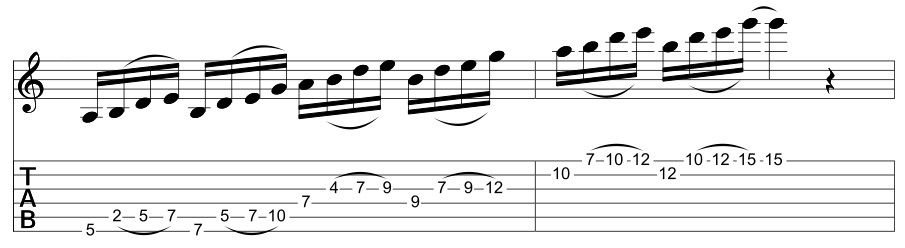
In this lesson I’m going to combine a few penatatonic shapes to make a shape that can be played with sweep picking for a more legato sound.


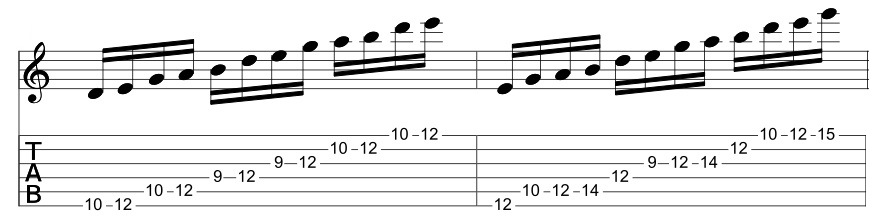
Sticking with E Minor Pentatonic from the previous licks, in the example below I’ve taken a two-note per string fingering starting from D in the first measure.  In the second measure, I’ve started the sequence from the root, E, and changed the fingerings of the notes so that it alternates from 1 note-per-string to 3 notes-per-string.

Positional Explanation

This allows me to use all down-strokes and hammer-ons when ascending the scale which helps create a more fluid sound.

Lick #3

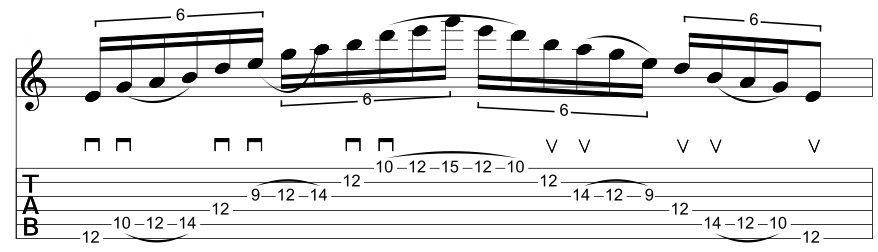
This lick is simply an ascending and descending run to demonstrate the fingering and sweep picking approach.  As a lick, it’s something I would use typically either ascending or descending to get into another register of the guitar when improvising.

While I practice ideas like this in 16th notes to get them under my fingers, I find the phrasing to be a little mechanical.  So, after I get the fingering down, I’ll typically move it to other rhythmic groupings.  Moving it to sextuplets in this case, puts the accents in more interesting places (and makes it a 4/4 phrase rather than a 3/4 phrase):

Pentatonic Lick #3

Here’s a mp3 at different tempos.  As with lick #2, the first pass is phrased at 16th notes and the second at sextuplets.

Tips:

Remember to keep your hands relaxed and focus on the 3 T’s (Timing, Tone and (hand) Tension).

Try experimenting with this idea starting from other notes in the scale and/or modulating the ideas to other tonal centers!

If you like this idea, you may want to check out my not-peggio lesson posts as they use a similar alternating 1-note-per-string-3-note-per-string idea.

That’s it for now!

As always!  Thanks for reading!

-SC

.

ps – for those of you who are interested, this was tracked entirely on my iPhone using JamUpPro and a Line 6 Sonic Port.

Pentatonic %22rig%22

p.s.s. – If you like this idea you may dig my Pentatonic Visualization Book!

theminorpentatonicscale-front
Click Cover For Book Link

The Power Of Negative Example or How NOT To Network Part 1

The Power Of Negative Example

Years ago, I had helped some friends of mine organize a music festival at CalArts.  I was originally brought in because they “thought I’d be good with money”, but pretty quickly I ended up taking on a co-leadership role and helping to organize an event that had 40+ acts in three performance spaces for a full day.  It was exhilarating and exhausting and in many ways worth all of the work that went into it.

After the festival, one of the co-organizers way kind enough to say the following to me.

“You know I learned an incredible lesson from you.  I kept thinking about how we were going to do something and your approach was, ‘It’s fine that we want to do that but this is what I don’t want to have happen…’ and just making sure a few things didn’t go wrong made it much easier to get the things we wanted to go right done.”

Success can be due to a myriad number of factors but when things fail, they typically only do so for one or two reasons.

Therefore, if you set up the basic conditions for your desired outcome to occur and then actively work against things that could go wrong, it’s much easier to troubleshoot than trying to create all of the conditions for success.

In other words, the “don’t do this” list is usually much shorter and more actionable  than the “do this” list.

With that in mind, I’m going to detail some serious pitfalls that I’ve seen and experienced in networking.  Networking is a vital component to artistic survival in the 21st century.  If you don’t build communities with people you’re going to be relegated to creating things in isolation and for most people that’s unsustainable.

Look for the deeper lesson

My recommendation with this approach is in looking at what goes wrong with networking look for the deeper lesson and see what you can do right.

How NOT to network

.

1.  View networking as an end goal.

I could have also said, use networking as an intransitive verb.  “We are going to network with that person…” is something that I heard come out of more than one music business major’s mouth while I was at Berklee.

Networking is a process of building a mutually advantageous relationship with other people, not a way to manipulate people into getting what you want from them.

Go to a music business conference and you will see the people who are there solely to network a thousand miles away.  Everyone else will as well.  There’s a stench of desperation that will clear a room out faster than a pungent fart.

2.  Be insincere.

Some of the more Machiavelli-insprired readers may take a page from The Prince and try to “network” and hide their self-serving intentions.  I would advise you to just be honest and transparent when dealing with people, but even if you were approaching this from the most Machiavellian perspective, I would say that there is no advantage to being insincere. Most people are not good enough actors to pull this off, and there’s no reason to.  Even if you were to fool people at the offset, they’re going to figure it out eventually.

3.  Try to capitalize on a non-existant relationship at the get-go.

I had someone contact me out of the blue from CalArts who wanted me to help him promote his release.  He wrote the e-mail like we hung out all the time or had a personal connection and in truth, I only vaguely knew who he was from his dealings with another person.  If this was a really good friend of mine, or someone that I knew it would be fine but it just came across as shallow manipulation.

I never think of networking as such.  I think of it as making friends and acquaintances.  I ask people I know for favors, and give favors to friends who ask me for them.  THAT’S networking.  If you approach networking with the same approach as you’d have in making new friends it will take you much further in getting you to the end result.

4.  Make it all about you.

No one likes a parasite.  If you don’t have a symbiotic relationship with people they won’t help sustain you in the long run.  Also, being really needy and constantly asking people for things is another way to get people off your radar.

5.  Don’t pay it back.

Ask for a favor and then be too busy to help people with something when they need it.  See how long that sustains you in the industry.

6.  Do poor work.

This one isn’t so obvious but you have to have something to offer to a relationship.   If you don’t play particularly well and you’re billing yourself as a performer that’s going to be a problem.  If you’re a singer songwriter and you neither sing or play well there’s not going to be a whole lot of reason to recommend you.  Building relationships is easier when you are that person people go to for things.

7.  Be irresponsible and/or don’t follow up.

This one boggles my mind.   The number of times that people don’t show for things or don’t do what they say they’re going to do is astounding to me.  Those people tend to move to the periphery of the scene or become absent entirely.

Related to #6, if you’re the best at what you do people may cut you a little slack, but if you flake out on things, people just won’t deal with you.

.

An Illustrative Story

There’s a lot more about networking that  I’ll cover in part 2, but in the meantime here’s an illustrative story that will cover much of what I’ve talked about.

I got an email from a student at Berklee who read my bio and wanted to talk with me about being a guitarist in New York City and wanted to know if we could meet up.  Even though I never got any assistance from anyone (much less alumni) when I went to school, I thought I’d help this guy anyways by paying it forward even though I knew that this meeting would fall into a professional guitarist/life-coaching area that I am generally compensated for.

We met at a Pret A Manger.  He asked a lot of random questions about what I did and about the scene and wrote down all of my answers.  I was shocked at how little research he had done.  He had been in the city for 3 days and hadn’t even picked up a copy of the Voice to see what was going on.    I gave him the best answers I could and helped him identify a specific niche that he could serve for his teaching and gave him a number of contacts.  He had a small journal and took about 5 pages of notes.  I gave him a card (which he left on the table) and wished him well.  I never heard from him again.

The sad thing is that I’m sure someone in a music business class told him to try to network with people already in the scene and while it really couldn’t have gone much worse for him from a networking angle, I’m also sure he thought the meeting went really really well.

There’s so much to learn from the mistakes above!  But let me put the scenario in a different light that may affect how you approach networking in the future.

Other than a story, what do I get out of this interaction?

You have to give people something if you’re going to continue a relationship with them.  Even if it’s nothing more than a thank you or offering to get them a cup of coffee.

If he had bought a book, or directed people to my website, or even sent a follow up e-mail that simply said, “thank you for your time” it might have given me something.

Do I regret helping him?  Absolutely not, but that door is closed for him in the future.

I’ll never hear from that guy again and it’s too bad for him because if he had handled that interchange better, I could have really helped him get the pieces in place that he needed to relocate and do what he wanted to do.

The golden question of networking then isn’t, “What’s in it for me?” but instead is, “What’s in it for us?”

In part 2 of this post, I’ll talk about how not to network with regards to getting reviewed.

Hope to see you there.  As always thanks for reading, I hope it helps!

-SC

Pentatonic Short Lick Part II

Hello everyone!

If you haven’t had a chance to check out part one of this series, I’ve been revamping some of the material from my last clinic for some upcoming events and  I thought I’d take a couple of posts and put up one lick/approach in each one.

Recycling

One thing that will become apparent if you read this blog with any regularity, is that I recycle licks a lot.  That’s generally because if I’m going to spend the time to really learn a lick, I want to make sure I can get the most mileage from it I can.  In this lesson I’m going to use a pentatonic shape to create a modal sound.

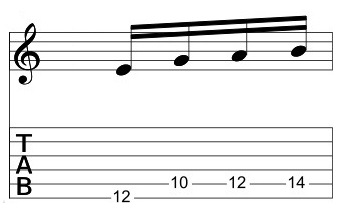
Sticking with E Minor Pentatonic, here’s a 2-string fingering based on an idea in the last lesson.

E Minor Pent 4-note

Taking that same E Minor Pentatonic shape and moving it to F# creates a pentatonic sequence based on E Minor Pentatonic and F# Minor Pentatonic :

E Minor Pent F# Minor Pent

The notes from both patterns produce E, F#, G, A, B, C# (aka E Dorian with no 7th).  This works really well over and E minor chord for a E Dorian type sound or G Major for a G Lydian type sound.

With 8 you get octaves and rhythmic displacement

I’m not counting on many people getting the play on “With 6 you get eggroll” name drop (a feature with Doris Day and George Carlin!!), but I’ll take this idea and move it in octaves:

Lick 2 - Moved in octaves

Click to enlarge:

Depending on what chord I’m playing this over I’ll end on different notes.  For example, when played over E minor, I’ll stop on the B on the 19th fret.

While I practice ideas like this in 16th notes to get them under my fingers, I find the phrasing to be a little mechanical.  So, after I get the fingering down, I’ll typically move it to other rhythmic groupings.  Moving it to sextuplets in this case, puts the accents in more interesting places (and makes it a 4/4 phrase rather than a 3/4 phrase):

Lick 2 Full

Here’s an mp3 at different tempos.  The first pass is phrased at 16th notes and the second at sextuplets.

Tips:

Remember to keep your hands relaxed and focus on the 3 T’s (Timing, Tone and (hand) Tension).

Try playing moving this shape to other areas (This E min shape + D min = E, F, G, A, B which produces a Phrygian-ish type sound).

If you like this idea, you may want to check out my not-peggio lesson posts as they use a similar alternating 1-note-per-string-3-note-per-string idea.

That’s it for now!  (Trust me getting that in the pocket may take some time!)  Lick #3 will be up next week.

As always!  Thanks for reading!

-SC

.

ps – for those of you who are interested, this was tracked entirely on my iPhone using JamUpPro and a Line 6 Sonic Port.

Pentatonic %22rig%22

p.s.s. – If you like this idea you may dig my Pentatonic Visualization Book!

theminorpentatonicscale-front

Click Cover For Book Link

2014: How Not To Repeat The Mistakes Of The Past (Or Nothing Ever Got Done With An Excuse)

It’s that time of year again…

(This is a repost of something I wrote for the end of 2009.  The dates and information have been updated, and this has become one of the few yearly repost traditions I indulge in.)

.

At the end of every year, I typically take the last week between Christmas and New Years to wind down and center.  It not only helps me take stock of what worked and didn’t work for me in in the year but also helps me make sure I’m on track for what I want to get done moving forward.  As George Santayana said,

“Those who do not learn from history are doomed to repeat it.”

.

As 2013 draws to a close, I think back to many conversations I had with people at the end of 2009.  At that time, it seemed like everyone I talked to said the same thing, “2009 was such a bad year.  2010 has to be better.  It just has to.”

Now it seems I’m listening to the same sentiment with the same people about 2013 and the coming 2014.  And in some ways they have a valid point.  Listening to their circumstances, 2013 certainly offered some of these people a tough blow – but regardless of their circumstances, I believe that, unless they experience a windfall of good fortune, I will hear the same sentiments echoed at the end of 2014.  There’s a reason for this:

“If you always do what you’ve always done – you’ll always get what you always got” – anon

.

While I fully appreciate the merits of planning and goal setting – life will throw you any number of curveballs that may make a meticulously laid out plan get derailed.

.

A good plan has to be countered with an ability to improvise (as need be) to make sure that even if your mode of transportation is disabled, that you are still on the path to achieve your goals.

.

“Improvisation as a practice is the focus of an idea through an imposed restriction.  This restriction could either be self-imposed or could be imposed upon the improviser through other means.

Improvisation as it relates to common experience can be seen in the example of the car that stops running in the middle of a trip.  A person experienced in auto repair may attempt to pop the hood of the car to see if they can ascertain how to repair the vehicle.  Or they may try to flag down help.  Or they may try to use a cell phone to contact a garage.  The point being that within the context of a vehicle malfunction, different actions are improvised based on the improviser’s facility with both the situation at hand and the tools at their disposal.

….life is essentially an improvisation.  As individuals we come into each day not exactly knowing what will happen.  We know that there is an eventual end, but we don’t know when or how it will end.  But we continue to improvise, because it is in both the active improvisation (the present), the skill set and knowledge of that improvisation (the past) and in the philosophical/worldview/goals guiding our improvisational choices (the future) that we create meaning.”


If you approach life’s problems with the same mindset you’ve always had 

-and your new year’s resolutions run contrary to that mindset –

your resolutions are doomed.

.

I say this as a seasoned graduate of the school of hard knocks and as a person who found that while success feels a lot better – ultimately failure is a much more thorough teacher.

.

2013 had some great ups and downs for me and now there are a number of life and playing upgrades I’m going to put into practice in 2014 to address the things that didn’t work for me.  For those of you who are interested in making a real change the new year – here’s what worked for me going into 2013 that I plan on using this year as well:


Know the big picture.

If you have a goal – know why you have the goal.  As Victor Frankl once said, “He who has a why can endure almost any how.

.

Take stock of what you have done and identify what needs to change.

Have you done things that work towards that goal?  If so, what have you really done? What worked?  What didn’t work?  And what parameters can you put in place to make it work better?

What decisions did you make that set you back and how could you alter those decisions in the future?

Sometimes honesty is brutal but this isn’t about beating yourself up.  It’s about taking a realistic stock of what worked and what didn’t work for you in the year, reinforcing that things that work for you and discarding what didn’t work for you.

.

Revolution not resolution

People typically make resolutions because they recognize a need for change in their life.

Personally, change hasn’t been about making a momentary decision as a knee jerk reaction to something (which usually lasts as long as the time it took to make that decision).

The long-lasting changes in my life have come from making lifestyle changes, setting priorities and working within those changes.  Change is not a temporary compromise to a current observation but is instead a revolt against habitual modes of thinking and operation. 

.

Positive habits

Making something a daily positive habit (like brushing your teeth) makes it easier to maintain over the long haul. (See my post about the value of rituals for more on this.)

.

“Don’t make excuses – make it right” –  Al Little

People make excuses for things all the time.  No one cares about excuses because nothing ever got done with an excuse.  People (typically) only care about results.

There will undoubtably be moments that you relapse into older habits.  Instead of making excuses for why it happened – just acknowledge it and move past it. When you fall off the bike, it’s not about sitting down and nursing your scrapes.  It’s about getting back up on the bike again.  As it says in The Hagakure“Seven times down – eight times up”

.

There’s strength in numbers

Try to surround yourself with supportive people.

  • Not enabling people who will make changes more difficult for you.
  • Not negative or judgmental people who will scoff at your desire for change

Like minded people who have goals and are motivated.

Talk to the friends and family who will give honest and supportive feedback.  Here’s another important tip – don’t burn those people out with your goals.  The people around you have their own lives, so if every conversation becomes about you and your goals, you’re going to see less and less of those people!

.

In addition to (or in some cases in lieu of) that support, you may want to look into some free online accountability sites like Idonethis.com (post on this here) or Wunderlist.com which maintains a private calendar to help observe progress.

.

Commit to One Change

It’s easy to get hung up and overwhelmed with the specifics of a long term goal.  Try making one lifestyle change and commit to seeing that through.  (Again, you can read my post about the value of rituals for more on this.)

.

Be motivated to do more but be grateful for what you have

Finally, I’d like to thank everyone who took a moment to come here and read my writing.  I hope this helps you in some way shape or form and I hope that 2014 is your best year yet.

.

-SC

There’s Value In Ritual

It starts with Santa

I must have been a good boy this year, because Santa was unbelievably generous to me this Christmas.  In addition to gear, books and films, this

rok2

Photo taken from the ROK website.

made it’s way to my door (courtesy of Mrs. Collins).

.

“You say tomato I say espresso.”

The Rok Espresso maker is a hand pumped espresso maker that requires no electricity.  In theory, you simply add ground espresso to the portafilter and pour boiling hot water in the top chamber.  Lifting the handles up pushes water into the chamber and pulling them down creates about 9 bars of pressure to make an espresso shot.

I say “in theory” because it turns out that there are a lot of factors that go into espresso quality.  Traditional espresso machines have boing water going through them which keep the portafilter hot and makes for a more uniform shot – so I started soaking the portafilter in boiled water in the cup to pre-heat both of them.  The roast and grind of the coffee play a role so I experimented with pre-ground and full bean blends.  This lead me to a hand cranked ceramic burr grinder:

Ceramic Burr Grinder

Which works aesthetically with the powerless espresso maker and provides a uniform grind.  Experts will tell you that there are a near endless number of factors that will go into the flavor even down to the tamper (a stainless steel 49mm tamper for me – but the plastic tamper works fine).

Getting a shot of espresso now requires:

  • heating boiling water
  • hand cranking the burr grinder for about 115 rotations to get the proper amount of coffee
  • putting the portafilter in a cup and pouring the boiling hot coffee in
  • waiting about 10-15 seconds for the filter to heat up
  • pouring out the water
  • scooping the coffee into the portafilter
  • tamping it down
  • attaching the filter
  • pouring the water into the espresso maker
  • lifting the handles all the way up
  • pulling the handles down about an 1/8″ to infuse the espresso
  • lifting the handles back up and pulling them down to extract the espresso

then dumping out the portafilter.

in other words – it’s a few more steps than loading coffee into my Aeropress coffee maker which also makes a really good cup of coffee.

You may be asking yourself

What the Hell does this have to do with guitar?

and the answer is – quite a bit.

There’s value in ritual

When you slow down and invest time into something, you have the opportunity to enter a different headspace.  It’s not guaranteed, but think about the number of times that you realized something while you were brushing your teeth before bed or taking a shower before you start your day.

Hand grinding the beans only takes a minute or two, but it gives me pause and becomes a kind of meditative action.  When I get through all of the steps and taste the espresso, it’s nuanced in deeper way than the Aeropress coffee.  It’s a completely different experience than popping a netpresso pod into a machine and hitting start.

If you’re having problems reaching the goals that you want, you may want to consider taking the approach of adopting a daily ritual.  If you’re talking about guitar playing, consider adding one daily ritual to whatever you’re currently doing.  Maybe it’s transcribing, sight reading, chordal studies, scales or improvisation.  It really doesn’t matter that much what it is, and more that you’re doing it daily, with purpose and with proper technique.

Wait where are you sending me now?

Every year, I put a post up on GuitArchitecture.org about New Year’s resolutions, goal setting and breaking out of the mistakes of the past and if getting things done in the New Year interest you, you may want to read that here.

In the meantime, consider this…

In my experience, the biggest long term changes that come in life come from daily attention.  Don’t worry about huge overarching goals.  Work on one thing, and commit to doing it every day.

I have to “test’ more espresso while working on my 8-string playing (one of my daily rituals now that it’s back) and prep for UFC 168 tonight.

There’s a lot of good things happening that will be manifesting themselves more fully in the new year in the meantime,  I hope that 2014 is your best year yet.

As always, thanks for reading!

-SC

Listening To Advice Given And A Short Pentatonic Lick Series

Hello everyone!

I’ve been revamping some of the material from my last clinic for some upcoming events and considering some of the really insightful comments I got there and emails sent here in an effort to make improvements on that material (and things presented here) .

I’ve been told recently with regards to the lesson material here that much of it is very rich in content and a lot to digest.  When I posted lesson material here in the past, my idea was always that people would simply take what they got from it and come back as they needed to.  But one thing the clinic reminded me of is that sometimes people just want a bit of something and not the whole shebang.

With that in mind, I thought I’d take a couple of posts and put up one lick/approach in each one.  A sonic amuse-bouche if you will (and if we’re going to take this questionable post holiday meal / sound analogy any further).

Life in the Shawn Lane

One idea I copped a while ago from Shawn Lane was modifying pentatonic patterns to create things that work for you.

For example, let’s say I was going to play a pentatonic sequence in E Minor Pentatonic:

Here’s the initial idea using a 2-string shape starting from A and one from B:

Pentatonic Sequence 1

Maybe I’ll take this idea and move it in octaves:

Pentatonic Sequence 2

Even playing this legato, there are some technical challenges as you get into faster tempos and the fingering creates an 1/8 note accent that makes the phrase less legato than I like.

By moving the second note of each pattern to the next string:

Pentatonic Sequence 3

I create a fingering pattern with some plusses and a minus.

On the plus side:

  • Each pattern now uses the same fret hand fingers (2-1-2-4)
  • Picking is simply downstrokes (although you could use hammer ons for every note)
  • The patterns only accents the first note. (Special playing tip – if you play this as sextuplets, it gives the lick an even more legato feel!)

On the minus side:

  • The patterns use some WIDE intervals.  (Player’s tip – you may want to modulate this to other keys where the frets are closer together or use right hand taps for the top note if the stretch is too wide for you – if you experience any fret hand pain when playing this – stop immediately!  Playing through pain can cause long term damage to you hands!!!)

For me, the pluses outweigh the minus.  When I initially approached this idea, I just worked on the initial pattern for a while before moving it into octaves.

Lick #1

Pentatonic Sequence 4

And here’s the audio:

Tips:

Remember to keep your hands relaxed and focus on the 3 T’s (Timing, Tone and (hand) Tension).

Try playing this over various harmonic contexts (like Emin, Amin, G major, etc.)

If you like this idea, you may want to check out my not-peggio lesson posts as they use a similar alternating 1-note-per-string-3-note-per-string idea.

That’s it for now!  (Trust me getting that in the pocket may take some time!)  Lick #2 will be up next week.

As always!  Thanks for reading!

-SC

.

ps – for those of you who are interested, this was tracked entirely on my iPhone using JamUpPro and a Line 6 Sonic Port.  Still tweaking the tones a bit but there’s a lot of potential in this rig (particularly with the Air Turn integration and the upcoming BIAS release)!

Pentatonic %22rig%22

p.s.s. – If you like this idea you may dig my Pentatonic Visualization Book!

theminorpentatonicscale-front

A Holiday Thought That May Help The Whole Year

Note: this was originally posted on GuitArchitecture but I think the message is still valid.

If web traffic is any indicator, I should be writing more about guitar shops in Vietnam, 8 string guitars (and pickups) and Philip Glass arpeggios which comprise the top 3 Google searches for my guitArchitecture blog.  (With absolutely no disrespect to Mr. Glass,  I never would have dreamed that there are thousands of people in the world actively trying to find out about “Philip Glass arpeggio”s.  Hopefully that makes someone’s day better!)

.

But  since I don’t work with Google ads for ad revenue, I get to post on whatever interests me and while the personal motivation /psychology of guitar playing, tangential music business and music making observational posts get substantially fewer hits – they seem to be the ones that affect some people more.

.

I’ve talked before about the need for a thick skin if you’re going to be an artist and how having a strong opinion could result in people reacting strongly to it as well.  While that’s an observation I still stand behind, I feel I should temper that advice with another suggestion that may serve you well.

Forgive people (including yourself) and

try to empathize with them.

.

These things are actually related.  The more you see where someone else is coming from, the less likely you are to judge them harshly. This doesn’t mean forgetting, or letting people do hurtful things to you without consequence –  it just means letting go and moving on.  If this sounds counter-intuitive, then you should consider doing this because it will serve you better in the long run.  As Carrie Fisher once said:

.

“Resentment is like drinking poison and waiting for the other person to die.”

..

Looking back at my own life I see much truth in this statement.  I think of the actions of other people I resented and I see a series of torches that I carried.  Each requiring an exhausting amount of energy and maintenance to keep burning.

.

John Lydon once said, “Anger is an energy” and while I believe that there are things are worth fighting and things worth fighting for, I also recognize that you only have a finite amount of energy in life.  In my own life, I eventually had to ask myself the question, “do you really want to spend energy and time on resentment or do you want to spend it on making your life (or the lives of other people) better?”

.

A friend of mine recently sent me a link of yet another video of Pat Metheny going off on Kenny G.  When I saw it, I thought about some of Pat’s earlier diatribes about Kenny and my reaction was the same this time as it was before.   I didn’t laugh or think that it’s cool but instead I thought that it’s sad Pat Metheny has to be so insecure about what he does that he has to attack another musician for doing what they want to do musically.  Because if you’re secure about what you do, you don’t need to attack other people.  It does less to debase Kenny G in the public eye and instead of makes Pat Metheny look like a bully. Think I’m wrong?  Consider these questions for a moment:

.

Does going off on Kenny G  get Pat more fans?

Does it get him more album sales?

Does it get more people going to Pat Metheny shows? Or

Does it keep Kenny G’s name in the news?

.

If Kenny G had a deliberate plan of making music he hated just to sell a million copies of it then perhaps I could understand the rancor but I believe that Kenny  is playing music he wants to play just like Pat Metheny is.  It’s not something I dig, so it’s not something I buy or listen to so and (like many people I suspect) I don’t think about Kenny G until I stumble across another video of Pat going off on him.  If Pat empathized with that sentiment he might be less resentful of what Kenny G is doing (and would look a little less ridiculous).  Some jazz purists might not think that Pat looks ridiculous, but in support of my argument I ask only one question:

.

Of all the ills in the world, is going off on Kenny G really the best you can do?

.

Again, this is just my $.02 but don’t waste energy on people and things you dislike.  Instead, take that energy and invest it in making things better.  It’s something I’m still working on for myself.  Perhaps it will be helpful to you.

.

Merry Christmas and Happy Holidays to you all!

-SC