Making A Longer Phase From A Few Notes

Just like Ratt – I’m back for more (hopefully you are also).

(Please feel free to insert another random hair metal reference if that suits you better).

I’m in the midst of a bunch of recording and gig preparation, and I thought one of the things I pulled out in a piece might help you.

I have an instrumental track that’s based on a pentatonic I’ve heard in Hindustani music before but don’t know the name of.  Other players have gravitated to this sound as well and in print I’ve only seen it listed as “Indian Pentatonic” (which, if we’re going to call it that, we might as well call it “Vindaloo” because vindaloo is at least tasty.)

Here’s the scale in A descending and then ascending.  Don’t let the time signature throw you off.  It’s just there to get all 5 notes in a bar.
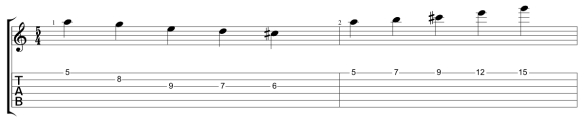
A Pentatonic Asc Desc
In A  – I see R, 3, 4, 5 b7 (aka an A Mixolydian extraction) so this would work over chord taken from the parent scale D major.  In this case I’m using over a G – A vamp.

Start Small

Notice in the descending version I used one note on the B string and then 3 on the G string.  I do this because keeping only one note of the scale on the middle string of a 3 string group (in this case E, B, G) allows me to set up a sweepable version of the scale.

Why do I do that?

Here’s a little secret about guitar.  Certain techniques will take you a VERY long time to get under your fingers so if you’re going to spend the time to work on them make sure you find ways to use them to get the sounds you’re looking for.

Here I’ve taken the ascending scale and added 2 descending notes.  I’ve included 2 picking variations in the first two examples.  In my own playing I find that I end up going to the first Down Up Up pattern more often than not – but it’s worth the time to be able to do both of them.

For the example below – choose ONE picking variation and use it for all the groups of notes.  Pay attention to the 3 T’s (Timing, Tone and Hand Tension) and try playing it over a chord to associate the scale with a harmony.

A Pent 3 Note Sweeps

You might notice in the example that the E string always uses the index finger of the fretting hand and the G string always uses the pinky.  That leaves either the 2nd or 3rd finger for the B string note.  The fingering consistency also makes it easier to memorize the patterns.

Then build up
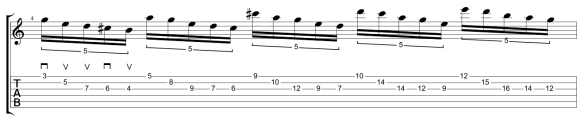
A Pent 5 Note

Now I’ve added a few notes on the G string.  One nice thing about Pentatonics is that they have some built in intervals larger than a major or minor 2nd that make them sound less “scale-ish” to my ears.  I’ve only included one picking idea above.  The 2-note sweep in the middle with the alternating picking would allow you to repeat the picking pattern, but you could also use pull-offs on the notes on the G string.

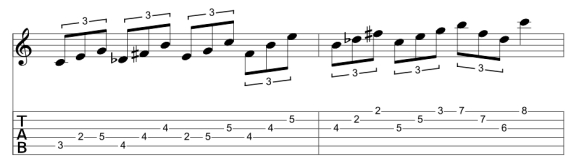
If the scale can descend on the G string – it can also ascend on the E string.  Here’s a two bar lick based on the idea above and adding in some notes on the E string as well.

A Pent Descending Line

Let’s Break This Down

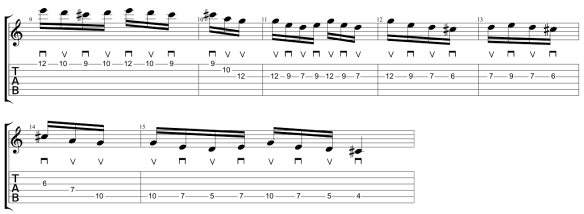
A Pent Breakdown
I’ve broken this down in overlapping phrases to show how I expanded the initial idea into something larger.

Bar 9 Above:  This is a simple descending / ascending of the scale on the E string

Bar 10: There’s the sweep

Bar 11: This is a similar 7-note descending / ascending idea as bar 9

Bar 12-13: I broke this out to show the position shift to add the C# again with a similar idea as bar 9 and 11

Bar 14: There’s the sweep again

Bar 15: this is an the same idea as before but one octave lower.

Notice how there are two simple pieces of “connective tissue” the sweep and the short one string scale passage that ties the lick together.

Let’s look at another (and more challenging) idea:

Lick #2
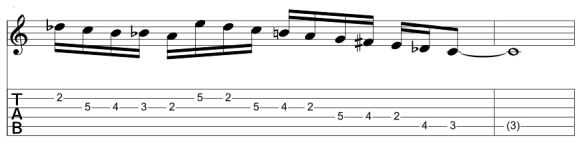
A Pent Lick 2

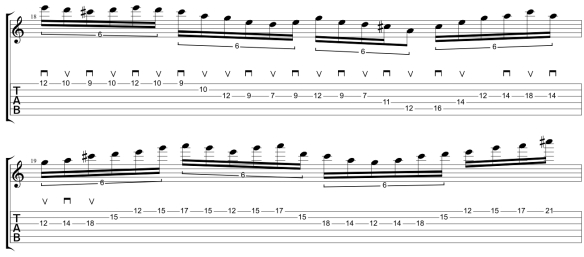
Here I expanded on the initial idea.  I’m using sextuplets now so it’s faster.  In the first measure – there’s a slight pause on the last A in beat 3 to accommodate a position shift for the following beat.  As a phrase, I’d likely sit on that A for a beat or two before continuing but I shortened the time to fit it in a smaller graphic.

The position shift allows me to set up a sequence to ascend the scale again and build a little excitement.  Technically this uses all the ideas that have already been used.

Again – these techniques take time to get them under your fingers so they sound good.  Don’t take shortcuts.  Really focus on the 3 T’s and then find ways to incorporate them in ideas you already are using.

And one for the road

So far in this lesson we’ve been exploring string ascending / descending scales.  Adding in things like string skipping will give you some wider intervals to incorporate and get you further away from the scale sound.  Here’s one variation below.

Idea 3

My suggestions (should you choose to take them)

  • Find fingerings that work for you
  • incorporate some of the scale sequence ideas into the phrases you create
  • mix and match see how far you can go in one direction or the next before you run out of notes
  • incorporate different scale sequence ideas.  (For more information on this my Melodic Patterns book can open some doors here).


I hope this helps and as always, thanks for reading!

-SC
What Scale Do I Use?

Well…


Yep – It’s been a while.  A lot’s gone on.   These posts take quite a while to do so I need to either figure out a way to make them MUCH shorter or just post more sporadically.  I had a couple of free hours this AM so here we go!  Let’s get to something you might be able to use.

A lot of times in lessons, I get asked some variation of the question,

“What should I play over this or that chord?”


For example, here’s a question I answered on Facebook  a while back and I thought that the answer for approaching any kind of unfamiliar chord might help some of you.

“hi folks!Cmaj7b9#11 what scale can i use???????”

Here’s how I approach unfamiliar chords and it may help you:

  •  If I don’t recognize the chord – I recommend CONVERTING to the key of C.  The reason for this is the key of C has no sharps or flats so any chord formulas become easier to figure out.  In this case we’re already in C (C maj7 b9 #11).


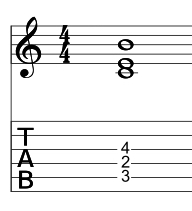
  • Make sure you understand the chord. The chord is C maj7 b9 #11. The major 7th chord formula is Root (C), 3rd (E), 5th (G), 7th (B).  On top of that we’re adding a b9 (Db) and a #11 (F#).  Lets find a voicing that makes sense.


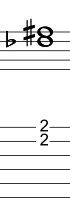
In a Major 7th chord, the 5th doesn’t really add any flavor to the chord.  It’s just filler.  If you need to condense voicings just remove the 5th (if it’s an altered 5th like. #5 or a b5 – that’s a different story!!).  Here’s a shell voicing of the C major 7th (no 5th):  R-3rd-5th.

C Maj
Now I see that Db – F# as just a barre on the 2nd fret.  (Side note – taken on it’s own I hear this as F#-C# or a F# power chord.  In the following examples I’ll continue to use Db but I recommend paying attention to what you hear and adjusting appropriately).

DbF#

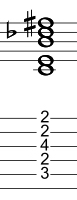
Combining the two produces this:

CMaj 7b9#11_1

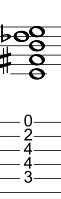
As an alternative to this voicing I also like the 3rd on the high E string – so I’ve switched the F# and E around in the voicing below.  Use one of these for the examples below (or any other voicing with the appropriate notes that works for you.)

Cmaj7b9#11_2

  • Now that we know what chord we’re playing the question of “what do we play over it?” becomes a little easier to answer.  My very first question might be counter-intuitive but typically I’d ask, “What chord are you playing after it?”  It’s important to understand how a chord works in the context of the chords around it because ultimately you want to be able to make a musical statement that has continuity through a chord progression.


  • For the sake of simplicity, let’s assume it’s the ending chord of a tune.  Start with just the notes of the chord: C, E, G, B, Db, F# 

    in order that becomes C, Db, E, F#, G, B.  Using the notes that are actually in the chord for melodic exploration are the best place to start!  You can always add other notes after!

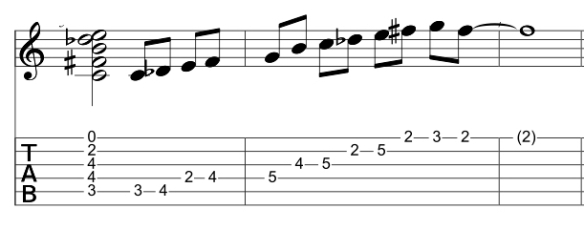
Here’s a lick that uses the notes of the scale in position.

Scale 1

When I play licks like this I always play the chord first to get the sound of the chord in my head and THEN work on a lick.  You could loop the chord with a looper, record it and play it as a backing track, etc.  the point is to get the harmonic context (i.e. the sound) in your head first and go from there.

Note:  the resolution to C doesn’t really feel complete.  The F# and Db in the chord creates instability.  It’s almost as if the chord is implying (to my ears) a resolution to Em.  When you have chords like any kind of dominant chord – they typically want to resolve somewhere.  Pay attention to where your ear tells you the chord is going and use that in crafting lines and ideas.

So start here!  Just familiarize yourself with the sound of the chord and how the individual chord tones work over it.

  • You could remove any note for a pentatonic (C, E, F#, B, G / C, Db, E, F#, B for example).  Here’s are a few fingerings to explore those ideas.  Apply melodic devices (rests, rhythmic variation, sequencing) to get generate unique ideas.

Cmaj7b9#11_2

Pentatonic Lick 1_1A

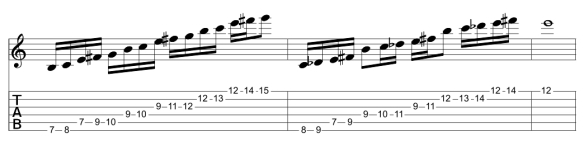
  • You’re only missing some type of A for a 7-note scale (Ab, A, A#)  Let’s say A for now:  C, Db, E, F#, G, A, B

Here are a couple of ideas floating around that.  The first one uses the sequencing idea we saw before – the second is just a straight melody.

7 note with A

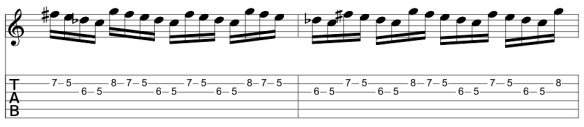
  • Repeating licks are something worth exploring as well (particularly if you’re playing the last chord as a cadenza).  Here’s a little McLaughlin inspired run.

Repeating Lick

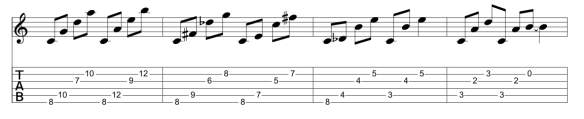
  • Try extracting some triads, 7th chords or intervallic ideas from the scale.  In the example below, I took a G5 add 2 (aka Gsus2 aka replacing the B in a G major triad with an A) and moved it in scale wise motion on the A, G and B strings.  I added a C in the bass for harmonic context (sometimes played with the thumb but you can experiment with fingerings) to help get the sound of the triad in my head. (Watch that stretch in bar 3!!  If it hurts your hand just tap the C with your picking hand.)

Intervals 1

  • You can get a lot of mileage from just two alternating between 2 sets of triads (or any other type of 3 note cells – the end result is a Hexatonic – or 6-note scale).  Here I’ve used C major and the notes Db, F# B.  I start moving them through inversions and then mix an match to get some more interesting ideas out of the line.

Intervals 2

  • You could also try working in some chromaticism (D, Eb, G#, Bb) etc. for a 8 or 9- note scale:

Chromatic

  • This doesn’t even take into account approach notes (there’s a considerable amount of 1/2 step motion in the chord already (B-C, C-Db, F#G) but you could add in approach notes to B (Bb),  E(Eb), or F# (F) for example, superimposition of other arpeggios / tonalities or a number of other approaches – this is simply one simple approach to get some ideas flowing for approaching how to play over an unfamiliar chord.


  • One place where people get hung up on something like this is trying to take on too much at once.  “Seeing” the chord over the entire fretboard.  Working out arpeggios in all positions etc.. Notice that once I worked out a voicing in second position – many of the licks just worked around the chord shape there.  Start small!!!  Find a sound you like and run it into the ground with melodic possibilities and variations and lick ideas. Then try others. One eats an elephant one bite at a time.


Ultimately what to play over any given chord will depend on the melody, the chords before and after it, the mood of the tune, and your aesthetic.  It also depends on what you hear – so explore lot’s of variations and work on the ones that sound good to you!

As always, I hope this helps and thanks for reading!

-SC