Tech Limbo (Neither Heaven nor Hell R.I.P. Ronnie James Dio)

So I’m packing, moving and simultaneously trying to get some stuff ready for the Cha’ak’ab Paaxil Festival in Yucatán, México June 3-5th.  My plan is to leave the amp here and to use a combination of Line 6 gear and a guitar to play the shows.

After playing with Wael Kakish and the Middle Eastern ensemble last night, I was able to open the package I got from Sweetwater and check out my new Line 6 FBV Shortboard Mk II.

The new board is REALLY cool.  It’s solid in it’s construction and small enough to fit in my laptop bag.  After I downloaded the FBV Control software from Line 6.   I tried to set up a SooperLooper session in AU lab.  The concept was to run the AU of SooperLooper in AU Lab and use a midi patchbay to make sure the signal was going from the FBV to the Sooperlooper session.  Here are the patchbay settings.
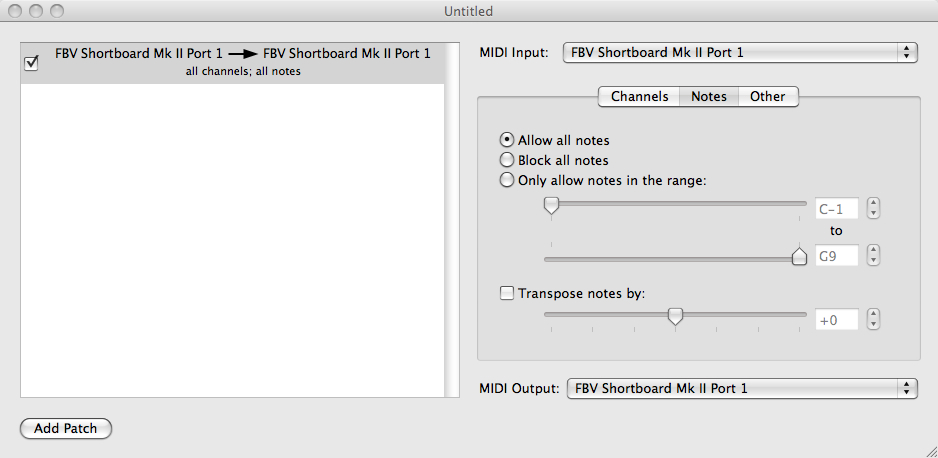
Had some trouble initially  but once I went into FBV control and reset some of the switches everything worked.
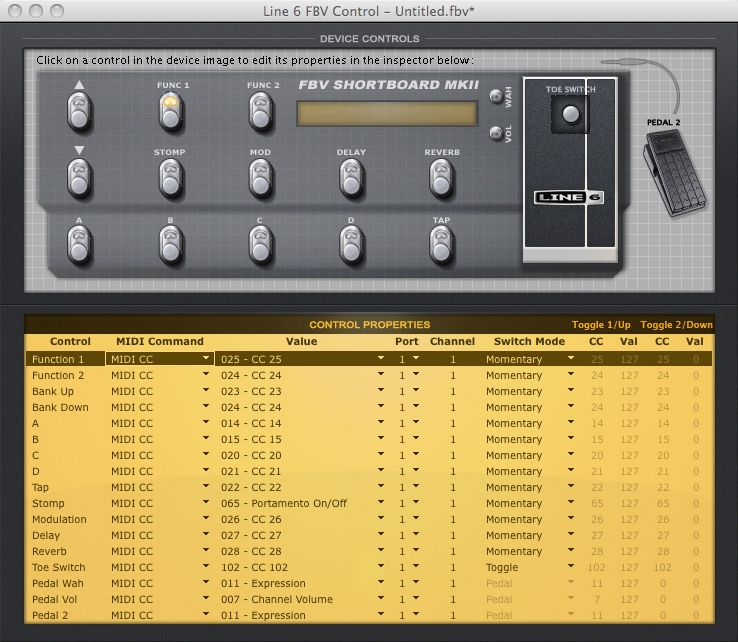
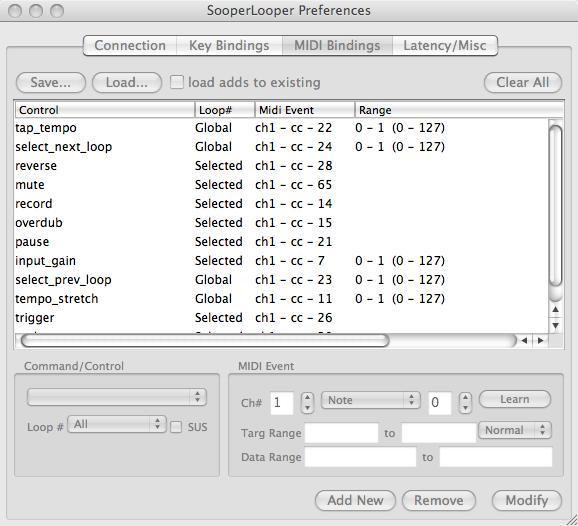
This probably isn’t the smartest series of codes to get everything to work – but it’s working.

The only gripe that I have is that I wish that some additional parameters in SL could be controlled via midi (i.e. 1/2 or double speed or main monitor volume for fades).  It’s easy enough to lean over and hit the keyboard – but it does defeat the purpose of ordering a 15′ USB cable.  The board itself though works like a charm.

I’m in the process of working on sounds on the X3 Live for the show – and tweak PA vs. amp sounds.  One thing I’ve noticed with modeling is that there are at least 4 different scenarios for setting up sounds:

1.  Headphone patches – i.e. practicing or recording

2.  Playing through an amp at low volumes

3.  Playing through an amp at high volumes

4.  Playing through a PA.

You might think that there wasn’t a lot of variance – but the differences between these parameters are huge.  I have patches that sound mediocre at low volumes and sound really good when the volume gets goosed a bit.  Headphone patches that work well at home and fall apart live – and vice versa.

As a result of all of these constant parameters I’ve been experimenting with Impulse Responses in Logic’s Space Designer (and LA Convoluter) and getting some encouraging results.

Impulse Responses (IRs)

In a simplified definition:  Impulse Responses (IRs) are measurements of acoustic spaces that can be loaded into applications (Like Altiverb or Space Designer) to create different types of reverberations.

I read an article about beefing up Logic 8’s guitar amp pro by replacing the speaker sims with IR’s.  That article is here.  This got me looking for all kinds of IR’s.  For those of you who want to see how this works on guitar tracks – check out the recabinet site.  There’s a really cool pdf that talks about the different IRs and the mics used to capture them.  As of this writing they’re selling a download of something like 2000 IR’s for $15 bucks.

Now I’ve been testing these at home – the difference is night and day!

It’s late while I’m posting this – but let me give you 2 simple examples.  First here is a simple rock rhythm with a plexi type setting.  This is just the AU recording of the pod with a plexi setting and the 4×12 cabinets selected.

DirtyrhythmnoIR

Now here is a another take of the same pattern and settings but with a 4×12 IR added. It’s a little brighter but the response is different as well.

DirthrhythmIR

To my ears – the second is a little more natural sounding particularly on the ascending chords.  Here’s one more example with a clean tone.  It’s subtle but noticable.  First with no IR

BluevelvetnoIR

And with the same IR as above added:

BlueVelvetIR

The non traditional guitar sounds have various degrees of success, some sound better some sound worse.  But this made a HUGE difference on the headphones.  I’ll try them through speakers later.

For those of you looking for free links here are a couple of them.  I’m in the process of downloading these myself – so no guarantees for the sounds themselves.

First some very cool non-guitar specific responses here:

Then some more guitar and bass specific IRs here. But I’m digging the redcabi.net IRs so far…

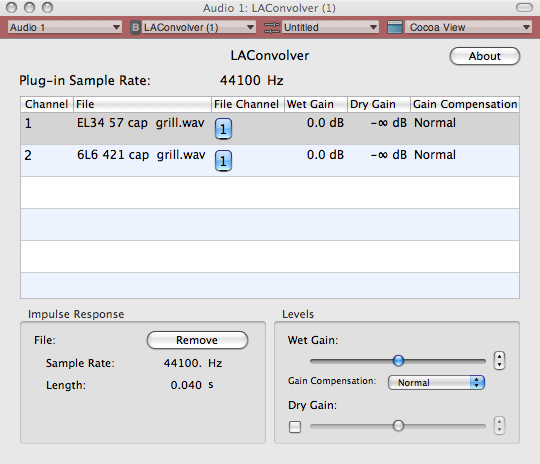
I found an AU ( LAConvolver ) that supports IRs and runs in AU lab – if I keep the wet gain at 50% it works well.

The advantages of AU lab are several (including low CPU use and that you can route audio OR midi through it) but the main advantage is that when you save the session all of the parameters in all associated plug-in’s applications are saved.  In other words – when I get it set up for use with a PA – it’s done.  No more re-inventing the wheel.  This is particularly helpful when you’ve set up a series of midi commands for Sooper Looper.
Here’s the laptop setup:

FNH Guitar -> Radial Dragster ->Pod x3 Live -> (Stereo out) ->Behringer FCA 202 (I hope to sub this out with an Apogee Duet eventually) -> Macbook Pro (Intel Core 2 Duo 2.4 Ghz – older model) ->Aulab running LAConvolver and Sooperlooper->(Stereo out) ->Behringer.

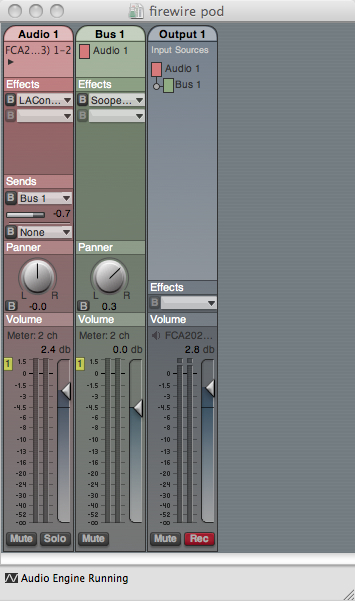
Here’s the AuLab set up – I’ve put SL on a Bus – but I since I can mix wet and Dry in SL I could have just left it on channel 1.

Here are some sample LA Convolver settings (these are both from the 4×12 greenback IR’s in redcabi.net):
And finally 4 instances of SL.
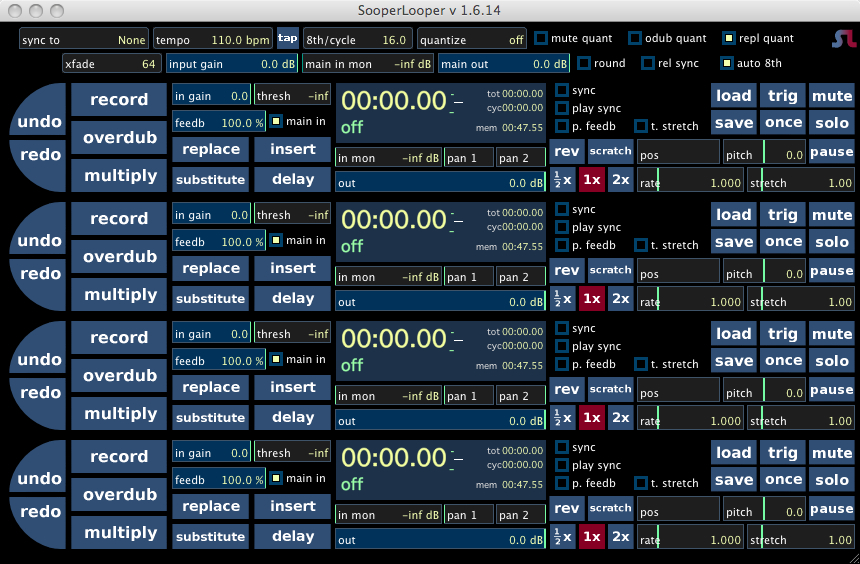
I’m still experimenting but this is the current plan.  Now to apply all of this to mainstage to get synths and percussion in the mix….

This may not make any sense.  The goal to to fit everything into 1 bag – except for a guitar and a gig bag.  Hopefully I’ll have photos soon.

Also the title of this references the passing of Ronnie James Dio.  I enjoyed his work with Rainbow and while he and Vivian Campbell had a pretty miserable falling out – their 1st 2 cds had some great moments vocal and guitar (particularly Last in Line with perhaps the quintessential heavy metal guitar solo).  Dio was 67 on hitting the stage with Black Sabbath (ok fine – Heaven and Hell) at an age many people are bed ridden.  It reminds me of my favorite quote on retirement ever:

All I do is play music and golf.  What do you want me to retire from?” – Willie Nelson

Rest in peace Ronnie.

“The limits of my language are the limits of my world”

If you want to be a great guitarist you should try to develop and nurture passion for other art or music that has nothing to do with guitar and adapt or assimilate those things in your playing.

.

Story Time

.

Please allow me to share a story with you.  This is a true story, but the names have been removed to protect the guilty.

Once upon a time, there was a doe-eyed child trapped in a 17 year old body who left his small town of 2,000 people and went to a big city to study guitar.  The institution of learning he went to study guitar at was a very big place with several thousand musicians.  At the absolute minimum it was completely overwhelming for him as an experience.  He went to the school knowing his ass was going to get kicked – but not knowing that saying his ass would get kicked would be more like telling the parachuter mid jump when his/her chute wouldn’t open he/she might break a bone from the fall when they “bounced” (yes “bounced” is the technical term for this occurrence and yes, it happens often enough that a term needed to be developed).

.

It kind of broke him.

.

In addition to the culture shock of being in a city, rather than a place he described as “Deliverence with snow”, he found the school had a real focus on Jazz and anything non-Jazz was looked upon with complete derision.  He was bombarded with fellow students and faculty telling him the music he liked – the music that was a part of his soul –  was trash and he was wasting his time with it because Jazz was the only music that mattered.  So he did what anyone from a small working class town would do, he became a walking middle finger to anything Jazz because he thought that it was the only way he could defend his identity.  The moment that door was shut was the moment his undergrad experience was doomed.

.

Now to be fair, the blame for this was 50-50.  He had no understanding of Jazz as a style.  

Where he grew up in upstate NY, Classic Rock radio and top 40 was the staple and those were his primary means of musical exploration.  But the problem was the curriculum was based around an academic buy-in for Jazz pedagogy, so if you knew nothing about it stylistically – there was no easy way in.  It was just simply rammed down your throat and you either swallowed or spat it out.

In his lesson – a weekly 1/2 hour slot – he and his teacher went over a series of proficiency requirements that were necessary to pass the final exam.  The student asked questions about why he needed this material and how he could utilize the material in the rock and metal music he was playing –  but he was just told these were tools he needed to play Jazz.  And given what we’ve said about his (now visceral) reaction to Jazz you can imagine how well this was received.

.

His second semester he found another teacher and this teacher was more understanding about what he was trying to do and who shared a lot of his interests.  The two of them started delving into Japanese modes and other concepts and he actually got excited about what he was doing.   The student asked his new teacher if they could just keep going in this direction instead of focusing on rote memorizations of reharmonized chord-solo renditions of tunes that he didn’t need solo renditions.  The teacher said to talk with the chair of the department and get his approval.

.

The chair of the department was newly appointed, had a lot of work to do and was not happy with the prospect of meeting with this student.  The student explained he had a very specific direction that he wanted to go in his playing, that this direction didn’t coincide with the narrow parameters of the proficiencies and then asked the chair if there was any way that he could be accommodated.  The chair informed him that wasn’t what they did at the school.  The purpose of the school (according to the chair) was to have students master that particular school’s style and then when the student got out he or she would have the rest of their carer to develop their own style.

.

The student said that while he realized he was only a student – the logic of the argument evaded him.  Actually, in the interest of honest reporting and to exclude any pretense of articulation what he said was,

.

“Look I know I don’t know anything – but that’s the dumbest thing I’ve ever heard.  There’s only 12 notes – that’s the substance.  Everything else is style.  What is the point of having 800 people all walking out of here and all sounding exactly the same?  Isn’t my style the only thing that’s going to make me different from every other guitarist out there?”

.

The student was then told that was the way it was and he could either take it or leave it.  

The student thanked the chair for his time, walked over to another office and submitted a change of major form.

.

Music is a language.  If you learn it as a language – immersing yourself in it, learning vocabulary, speaking it to others as often as possible – you will gain fluidity in it.

.

I want to discus vocabulary for a moment and then discuss the issue of style.  One way to think of licks is as musical vocabulary.  As a musician, you learn a bunch of licks so you can communicate with other musicians.  It’s similar to going on any trip or travel.  You might not speak a foreign language – but you should at least learn how to say a few words or phrases to try to get you by.

.

If you only learn licks from one source –

it will be difficult to not sound like that source.

.

If I go to a show and see a guitar player I can tell you usually in a song or two who he’s listened to.  If it’s only guitar players I probably won’t make it to song #3.  Going back to the language analogy, if you grow up in New Jersey and everyone you know and speak with is from New Jersey – you’re going to have to work hard to get a Texas accent sounding authentic, much less an Irish or Spanish one.  Do you have to learn other accents?  No.  No one is forcing you to do so but it’s important to realize that…

.

all of your experiences influence how you communicate with other people.

.

Hence the Wittgenstein quote in the article.  For those of you who remember Orwell’s “1984” – there was the idea of newspeak,  the language that kept getting smaller each year for the purposes of eradicating thoughtcrime.  The less you experience in the world, the less you are able to express.  This is why 13 year old children writing love songs do not have the lyrical content to truly plumb the depths of the soul, even though they are often supremely confident that they do.

.

If your experiences influence how you speak with other people then it stands to reason they can effect how you play with other people.  If, for example, four guys in a room have only listed to, played and learned “Smoke on the water” – they’re not going to write “Giant Steps” on their own any time soon.  They’re going to play “Smoke on the water” and if they do write something new, it will probably have a lot of similarities to “Smoke on the water”.  (Traveler’s advisory – do not party with these guys.)

.

Adaptation and the hidden agenda

.

This isn’t to say that you shouldn’t learn other people’s licks.  It’s vital that you dobecause you have to develop vocabulary, but I highly recommend you vary your sources.  If you play guitar, try learning music played on other stringed instruments like violin, or from non-string performances like vocal lines.  My rhythm playing is rhythmically informed by things like drum rudiments, flamenco foot work and rhythmic phonetics.  My single line playing is rooted in rock, but there’s various Hindustani, Balkan, Arabic and Koto references that are specific to things I do.

.

Almost every gig I’ve ever played I got because I put energy into learning things that weren’t guitaristic and adapting them.  You’ll never confuse my guitar with a Kayagum – but if I play a note with a sharp bend and crazy vibrato it doesn’t sound like a guitar lick either.  It crosses a boundary and becomes something new.  And here is the hidden agenda.

.

When it becomes new, it becomes yours and things that are yours have extra value.

.

In addition to this, try cultivating artistic influences from things that are not guitar related.  

The painter Francis Bacon probably influenced me at least as much as Hendrix and his works are a model for me in expressing motion and fluidity through art.  I’m passionate about books and films and I try to adapt anything worthwhile in those experiences into my playing.

.

Acquiring tastes

.

A funny thing happened to that student after he got out of school.  He started playing with a lot of other players who had opened their minds instead of closing them and those people hipped him to a lot of music – including Ornette Coleman and Ornette was making some of the most wonderful music he had ever heard.  The student found that when it wasn’t being force fed to him as the only viable form of musical expression that there were a lot of great artists and great music being made in the genre and years later (with a little maturity and perspective behind him) he became a fan and started adopting a number of ideas and approaches from the style into his playing.

.

The important thing is to find things that you are passionate about and explore, adapt and/or assimilate them to the fullest level you can.

.

The limits of your musical language are the limits of your style.

.

As always thanks for reading!

-SC

Seeing the forest instead of the tree

This is a re-post of an entry I made in response to a post on Penelope Trunk’s Brazen Careerist blog.  The specific entry that I was responding to regarded building a career as an artist.  That post can be found here.  It gave some advice to people who wanted to be artists and included the following bolded points:

.

  1. You cannot do art if you are starving.
  2. Art emanating from a black hole is a choice.
  3. Real artists will make art no matter what.
  4. You do not need to quit your day job.
  5. You are not a better artist if you can do it full time.

.

The bullet points don’t really do the post justice.  I think Penelope had a lot of good reasoning behind what she posted and I’d recommend that you check it out.  As you might imagine, there was a lot of controversy in the comments following her post with some people were very supportive and some were very resistant.

This post is ultimately about focus and about working through short and long terms goals and setting priorities.

Currently, I don’t perform music as a full-time gig because the music that I want to play traditionally does not make a lot of money and music is too important to me to play in situations I don’t want to play in ONLY for money.  If the right gig came along – or the right circumstances allowed me to do what I do on guitar full-time – then I would certainly do so.  I’m sure that I can position myself into that place ultimately but, in the meantime, there are other things that I’m not willing to compromise on in regards to my music or my life (like healthcare which would be impossible to swing on a $50/night gig) in the short-term.

.

By being a little selective in gigs and playing situations – I can bring a lot more to the table when I play.  By being selective in lessons, I can fully engage myself in helping someone rather than just trying to herd as many people through as possible just to make rent.


I’ve edited the post to fit the context of this blog better but have kept the majority of the content intact.

.

Re: How to build a career as an artist

.

“I’m not sure what the median age of the reader of this specific post is. Outside of regular readers,  I would guess that the primary readers are a). people who are out of undergrad , working a day job and are here because someone forwarded a link of encouragement or b). people who have artistic pasts (and presents) and balance that with another income. This post is more for those of you who are recently out of college and facing both massive debt and doubt – because I’ve been there myself.

This will probably be a long post, but I am putting it here because this is information that would have helped me immensely after school and perhaps it will help you.

.

Kafka and Ives


In balancing art and non-artistic work, there are many historical precedents with a fomous one being Franz Kafka – who balanced his writing with working in an insurance company. (Kafka would also read bits of “The Trial” at parties and laugh uncontrollably, so you can take that and some of the biggest daddy issues ever committed to print and ask how well that’s truly balanced.  To be fair, this was more of a question of Kafka’s balance as a person and not his balance of white collar and white knuckle work.)

In music, the specific example that is often given of this balance is the American composer Charles Ives.  Ives lived in musical obscurity at the beginning of the 20th century and wrote some of the most challenging music imaginable. While little of it was played in his lifetime, Ives would go on to become one of the most influential composers of the 20th century.  Aside from his musical work, he was also the vice president of an insurance agency and continued to write and work for much of his life. Add the fact that very few people recognized the genius of his work and that much of his music was never played during his lifetime and you have a classic story of artistic struggle.  

This is typically heralded as an example of how to balance art and non-art work.  That is until you read any one of his biographies and get to the part of his life where one night he came down the stairs of his home crying and said, ‘I can’t do this anymore.’  For the last 20 years of his life, he never wrote another note of music.

While this (the Brazen Careerist) post has some really solid advice, the one thing that is inferred, but not said explicitly, is that art takes time. There are technical skills required to create any kind of art – and the maintenance and advancement of those skills takes concentrated and focused time. The core question at work here seems to be, ‘What are my priorities?’

I’ll insert a temporary diversion here: one thing to consider in an arts education – formal or informal – is that many artists focus on the ‘how’ of their art but not the ‘why’. The importance of this issue can not be overstated.

.

If you have a solid understanding of why you do the things you do, then the question of how will be more easily resolved.


As an example of priorities, if you find that you’re spending more time at the bar with friends then you are working on your art – your priorities are telling you something. For some people, this is merely an issue of time management. But for others, their priorities are out of whack with their perception of reality.

If your concept of why you create art is clear, then a day job is nothing more than a vehicle for income while you work on your art and the challenge is in utilizing the elements of the day job that work for you.

I will use a personal example. A while back, I was several years out of my undergrad school and playing a GB (General Business – like a cover band) gig. You see, the thing about making money playing music is that most of the gigs that pay are gigs like this one. While you will run in circles with people who can’t play their way out of a paper bag, you will also find extraordinary musicians with major credentials playing at the same crappy bar as you because – it’s a paying gig.

So in this story –  I was playing cheesy music I loathed in a strange trio (the person who got me the gig said, ‘some of their tunes are dangerously close to grooving’) in some dive restaurant in the middle of nowhere for people who didn’t care.  At this point in my life, I was completely despondent.  I was working a day job for benefits and to pay off my school loan, and doing this gig on weekends to keep my chops up and I just felt awful.  It suddenly occurred to me, ‘Wait a minute. Why do I feel this way?  The whole reason I started playing music was because it felt good, and now every time I pick up my instrument I just feel bad.  I don’t EVER want to feel this way when I play music.’

And so I quit. I figured that I would work hard, pay off my school debt and do something else with my life.

.

But the things in life that are important to you stay inside of you, even in their absence.


It took a while, but I started realizing that it was the loss of my connection to my instrument that caused me such pain . I couldn’t quit music – because music had become an integral part of who I was.  I couldn’t get rid of music any more than I could get rid of my skin.

So I kept my job.  And then got one that paid better.  I played in a lot of local bands that paid nothing, but because I had a day job IT DIDN’T MATTER that it paid nothing.  I played the music, because I enjoyed the music.  In looking at the club scene in Boston and weighing my options, I decided that, for me, the best balance would be teaching music in a college environment. Teaching was something that I did well. It allowed me to give back to beginning musicians and it would give me the flexibility to pursue my music on my own terms. To do this, I needed a master’s degree. I worked hard and got a scholarship to a well regarded school on the opposite coast of where I lived.  I got my degree,  got another gig and another day job to pay bills and now am working towards that goal. Was going to grad school in my 30’s an easy thing to do? Not at all.  It was a culture shock and a calculated gamble.  But it was necessary for what I wanted to do in the long run.

Some people (on the post replies) have suggested that going to grad school is a waste of money and time.  So I can’t say, ‘don’t waste your money on grad school’.  Even though I had a scholarship and was working – I still had to take out loans to cover the difference.  My advice is if you DO go to grad school have a VERY clear idea of what it is you want to do with that degree.  Also have a very clear idea of what the expenses behind school mean to you in the short and long-term as well.

.

Many of the paying opportunities that come to an artist will require doing things that you might not want to do. If you understand the WHY of what you do, those issues will be easier for you to resolve.


I’m married so also realize that my priorities are different from what they were 20 years ago. If someone came up to me at 17 and said, ‘Hey we have a rock band and we’re going on tour. We have no idea about money or food or where we’ll sleep but you will be able to play in front of people every night for the next couple of months.’ there’s no question I would have gone (this happened at 25 and I was promised some money but the result was actually the same).

But once you start working with issues like rent and bills – money becomes an issue.  Once you start waking up on strange people’s floors to the house pet eating its own vomit several inches away from your face – accommodations start to become more of an issue.

One final observation along this issue of why:

.

It’s important to realize that some people are artists and some are artisans.


To me, an artisan is a person with a high technical skill set who enjoys the physical activity associated with that skill. For example, my mom is a tolle painter. She would be perfectly happy to paint the same items over and over again – because she enjoys the act of painting. As a musician friend of mine once said, “I don’t care what I play – I just want to play the guitar.”

An artist by contrast is someone who enjoys the physical activity associated with creation. To the artist, painting the same flower over and over is an anathema to their existence. The WHY of their art is based in discovery.

And it’s important to know which one of these you are.  In recognizing what you want to do – you can make decisions that support those goals.

I don’t know if this helps any of you. I have strong feelings about this because I’ve been able to do both for a while and am finally moving towards being able to synthesize the two.

If you can walk away from this post with only one piece of advice – try this one: Life is a marathon and not a 50 yard dash. There will be times that you want to give up, times that is goes easy and times of incredible difficulty – but know that if you have the long-term goals in sight – that will be what keeps you going.  If you go into a marathon with a 50 yard dash mentality you’re going to crack at the first real hardship.  As Bukowski once said, ‘Endurance is more important than the truth.’

Good luck.  Expect to be your own critic and your own cheering section.”

.

Be aware when your perception is myopic and never give up.


As it says in the Hagakure, “7 times down – 8 times up”.

.

I hope this helps!

-SC

.

Line 6 Pod Farm 2.0 Overview

I’ve taken advantage of Line 6’s free 14 day download of POD Farm Platinum 2.0 ilok version and have been working on formulating somethings for a review.  I won’t be able to post a full review now, but I wanted to post a couple of brief observations.

1.  The demo version was a little glitchy in standalone version, so I’ve been using it with AU LAB.  For those of you who don’t know about it (I had to find out about it on the super looper forum) – AU Lab is a free app that comes with the OSX Xcode Tools.  It was designed to test AU plug ins with but its a stand alone app with a fully configurable mixer ( inputs, outputs, effects busses) .  It records output and even generates midi clock!  Also it makes a very small cpu impact – so it’s perfect for hosting something like Pod Farm and say SooperLooper.

2.  2.0 supports midi – which means you can control it with a foot controller like the FBV shortboard MKII or the Behringer FCB1010.  I didn’t get to work with this yet – but this brings the live laptop rig very feasible for me.

3.  Stereo rigs which you can A/B/Y!!!  which alone would have been really cool – but you can use multiple effects in the same rig – something you can’t do on the POD for example.

Here’s a screen shot of a modification I made on the Outer Space preset.  I just added a preamp in the beginning of the chain.

So here is an mp3 of a guitar track I improvised with this setting:

Outerspace II

This was made with a FNH ultrasonic guitar, Behringer FCA202,  Macbook Pro (2007), and AU Lab.  No post processing.

So this particular sample doesn’t sound very guitarish – but that’s part of the reason I really like this approach.  You can create things that you never could create with pedals without a ton of gear and/or a ton of noise.

As with many other sims – getting usable clean tones is pretty easy and getting dirty tones that respond the way an amp would is a little trickier.  But the presets on all of these models are light years away from older line 6 presets that I’ve heard.  It’s pretty easy to get a tone in the ball park and tweak it from there.

Line 6 has some great audio/video demos on their site, so I wont go into too much here for demos as they’ve done it really well.   Also the May lesson uses the same signal chain for all the mp3s that will be posted there.

I need to also give kudos in that all of the sounds on the sites are included in the presets and they have also noted processed vs unprocessed sounds.  Yes there is a big difference between the two, and it’s important to note those differences so that when you dial up a preset you know what to expect.

The only thing I wish it had was a dedicated looper, but that’s not a deal breaker.

If you have an I-LOK I’d say to definitely check it out.  It’s more flexible than the POD and does some very cool things.

For further applications of this set up you can also  go here or here.