Go With What You Know
Of all the posts on my site – by far the two most popular are my post on Guitar Street in Vietnam and the post on my Omen 8-string. Since I’m not going to be able to make it back to Vietnam anytime soon, I thought I’d post on some things I’ve been working on with the 8-string.
Budget is the mother of invention
I basically have two views on gear.
On one hand, I fully believe that you should invest the money and buy quality gear that works for you. On the People’s Court, Judge Millian has an common quote I’ll cite here, “Lo barato sale caro” – The cheap comes out expensive. I have often found that when trying to cut corners on certain things (“That $30 chorus pedal doesn’t sound that bad”) that it ends up costing me more in the long haul (like having to spend valuable studio time testing out a bunch of other gear because that $30 pedal and that $100 amp DO sound that bad). My QSC K-8 is not a cheap speaker, but given that it can push me in front of an entire band, it’s a bargain.
On the other hand, the quality of gear available now is better than it’s ever been. I’ve been using Positive Grid’s JamUp and Bias with a Line 6 Sonic Port and I’m consistently blown away with the high gain tones and the quality of some of the effects coming out of my iPhone.
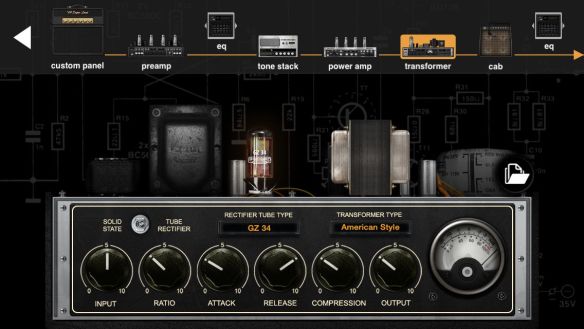
Mind you, the hidden cost of this IS the iPhone but the apps are ridiculously inexpensive. With the discounts they were offering before the BIAS release, I think I was fully loaded on the software for $60 or so.
Moving this argument to guitars, the building standards on mass produced guitars are constantly improving and the price is consistently dropping. So when I looked at getting into an 8-string guitar, there were two routes.
- Spend (for me) a lot of money on a custom model or
- Try out an inexpensive model and see if it would work for me
Since it was a large unknown for me, I decided to go with the Schecter Omen 8-string. You can read that gear review here, but a lot has happened to the guitar since then which may be of interest to people who are looking
This is another example of “Lo barato sale caro” BUT in this case it’s still much less expensive than purchasing a custom guitar and it’s good to see how these things develop.
There’s no going back to Kansas Dorothy
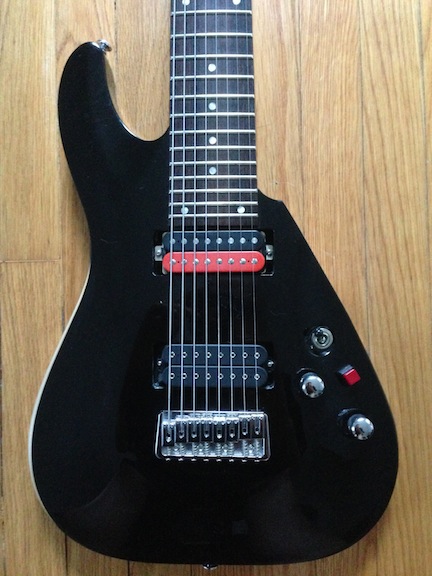
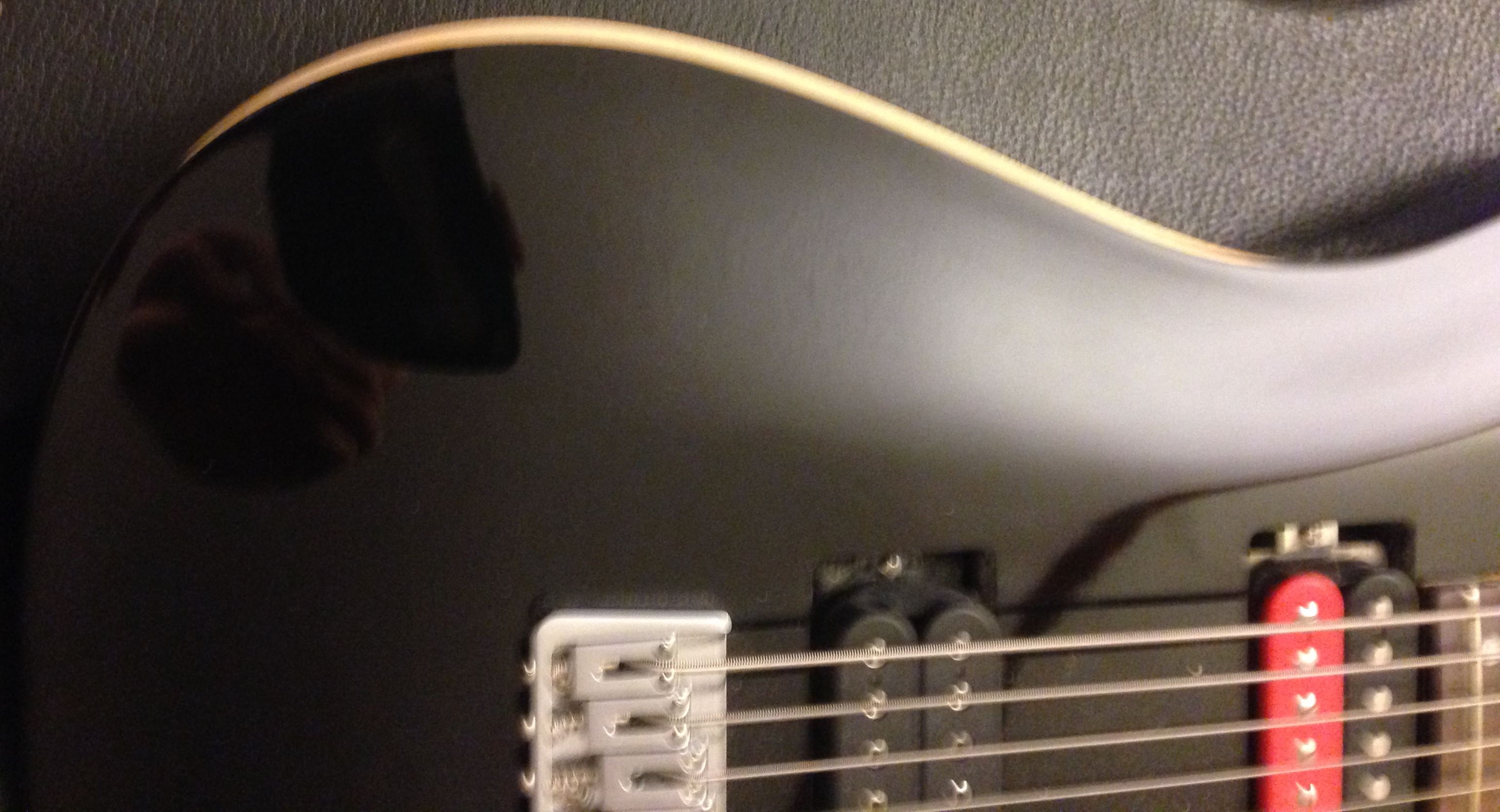
You’ll notice that on the right hand side of the body, there’s a modification that there’s no real turing back from. (Side note: When Mrs. Collins saw this mod she had a strange expression on her face and when I asked what was wrong she said, “Now you’ll never be able to sell it.” 😉 – Very true.) However, you need to make gear work for you. And this mod was done for a very specific reason.
Tuning
Initially, I was experimenting with the following tuning:
(low to high) B-E-A-D-G-C-E-A.
And then using a .007 for the high A and a .062 for the B. But it didn’t work for me because the high A was incredibly unstable. When I tracked some alternate takes for the Trials Evolution game, I ended up going through 3 of them at the session.
So I thought I’d try the Tobin Abasi (Animals as Leaders) tuning with an additional Low E/A added to the standard 6 string tuning [(low to high) E-A-E-A-D-G-C-E].
I got a DiMarzio D Activator bridge pickup and had FnH Guitar’s John Harper install it and set the guitar up for the heavier gauge strings. I got it back earlier in the year and used a F#-B-E-A-D-G-C-E tuning and I didn’t dig it. I just couldn’t find a tone that worked with that tuning.
So I went back to the drawing board and decided to try to see if dropping the entire tuning down a step would give me the stability to make it through a live show. I had about 20 .007 strings to experiment with so I figured I’d give it a try. Also, I was reading about a string development that was interesting to me
Ernie Ball 7-String Cobalt set
After experimenting with various strings over the years I’ve always come back to using D’addarios for my electrics. I still swear by their Pure Nickle .011s for my FnH – but I didn’t like the strings that shipped with my Omen and I didn’t like any of the 8 string set options that I tried. When I realized that I’d have to throw a high string on the top anyways, I just started looking at 7 string sets that would work for me. I liked a Rotosound set that I found, but when Ernie Ball announced their Cobalt 7-string set that supposedly had more output and clarity, I figured that I’d give them a try.
Out of the bag, the wound strings had an interesting texture. I realize that interesting is a terrible descriptive, but I don’t really know how to describe it other than to say that they felt more “metallic” than the strings I was used to. Not in a bad way, just a different way. Using the new tuning, I found that the guitar had a lot more clarity on the lower string on high gain settings. Often with high gain tones, the bottom end becomes mud – but I found that I could still use 4-5 note voicings and have clarity in each note.
My other string discovery was more counter intuitive. After going through 6-8 .007s with the high G tuning – I decided to try to use .008s and they’re holding up much better! I can only bend a step or so on the high frets – but I’ve only broken 1 .008 string so far and I’m pretty sure I can make it through a live set now.
Getting back to the photo:
With that tuning in mind, the upper bout on the treble side made it impossible to access the upper frets. The reason for this is that the chunky bolt-on joint
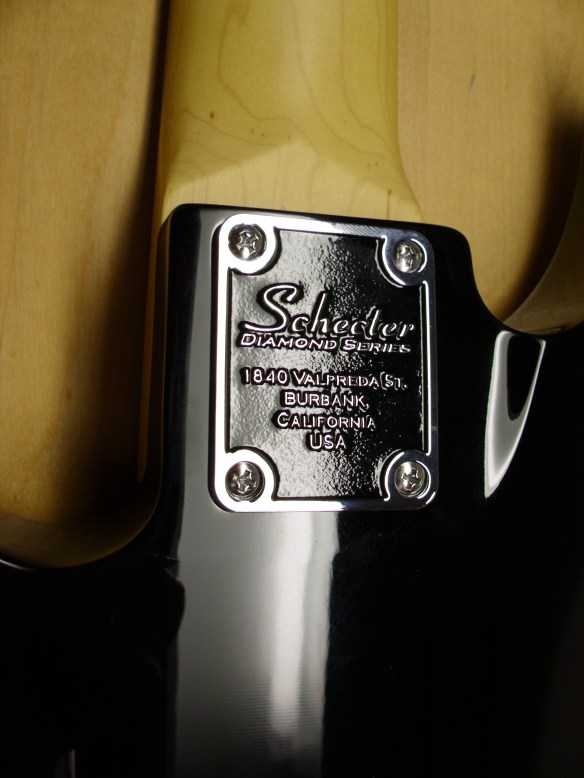
required pushing the wrist out to access the frets above the 18th fret which bumped it right into the bout.
It doesn’t sound like much, but if you’re going to go through the trouble to have a high G string, you want to be able to fully utilize it. So out went the bout.
It was a great decision! Not only did I get access to the upper frets on the high string, but it gave my full access above the 17th fret on the lower strings which wasn’t possible before. Second only to this mod:

which allowed me to comfortably rest my arm on the body, it’s done a lot for the playability of the guitar.
Mod Review:
Okay – so for those of you interested in going the “inexpensive” route with an 8-string – here are the mods that were added to the guitar.
Pickups: I’d say that you have to go into this guitar an expect to replace the pickups. I like the Bare Knuckle and the DiMarzio for completely different reasons – but I find that they compliment each other really well.
Tuners: Same thing with the tuners. I’ve replaced the Low A and high G with Grover Rotomatics, but the middle 3+3 need tuner replacement as well.
Kill Switch: Some people thought that was really gimmicky – but it’s turned out to be really great when acting as a uber-noise gate. I can hold it down and get ultra-tight exits and entries into tunes.
Lower Bout Bevel: The carving on the lower edge looks nice but doesn’t feel good when resting your forearm on it. Also, aesthetically I think the single line of natural wood peeking through the black looks bad-assed.
Upper Bout Removal: You’ll have to wear a strap with this mod as the guitar won’t be sitting on your knee, but what it does for upper fret access is a game changer.
This might sound like a lot, but as I said in the initial review, the Omen is a well built guitar at a great price point and that was the template that was really necessary for this to be possible. All in when everything is said and done – I’ll probably have about $850 into the guitar but the Omen is a serious player now and the ability to go from the A on a bass guitar to a high G a full octave above the G on the 15th fret of a high E string gives me all the range I could possibly hope for.
Now comes the hard part
Actually getting around on the thing at the same level I can with my string is still taking me a while. The strings are REALLY close together so every time I go from playing this to playing my electric 6 string or acoustic I can’t believe how far apart the strings are. Also the modified tuning means that I have to transpose everything in my head. This means that occasionally I’ll start to play something and have to switch mid-stream because I’m in the wrong key! Fortunately, those “whoops!” moments get worked out at home so they’re not being made on the stage.
(It’s also interesting just how different this guitar is in terms of timbre from my other guitars. In JamUp Pro for example, I had to make my own amps in Bias to find a high gain model that worked with my guitar well as none of the high gain models provided did what I needed them to do. With the 8-string even stock models like the Jeff Loomis model sound really good to my ears with no modification necessary.)
I’ll be documenting some of the strategies that I use in navigating the 8 string fingerboard later this year – but suffice to say that without the 2-string visualization methods that I’ve been using (and writing about) on the 6-string, I don’t know how I’d be able to tackle this.
More gear and playing posts in the pipeline. As always, thanks for reading!
-SC



 GuitArchitecture.org